Photo: Linda Barrett.
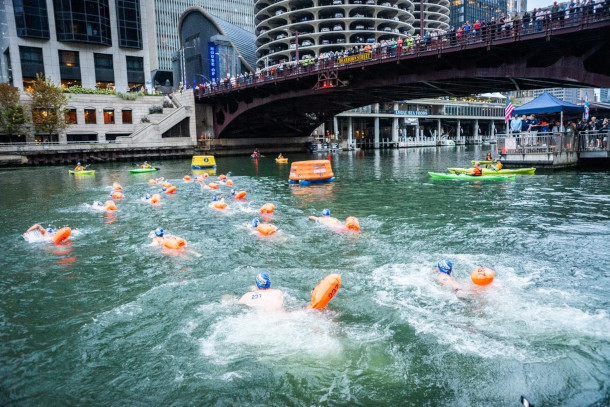
The Chicago River, once badly polluted, has been cleaned up. Above, 265 swimmers participated in a public swim this year.
When humans make up their minds to do something, miracles can happen. Remember the river that caught fire and led to the Clean Water Act? Today’s article points to a more recent river success.
The environmental radio show Living on Earth reports that “on September 21st, hundreds of people leapt into the Chicago River for the first public swimming event since 1927.” Here’s an interview between Friends of the Chicago River Executive Director Margaret Frisbie and Aynsley O’Neill of Living on Earth. (I edited out the verbal pauses.)
Aynsley O’Neill
“This public swimming event was a fundraiser, but its impact actually goes even further than that. What does it mean to you to have public swimming in the Chicago River for the first time in nearly 100 years?
Margaret Frisbie
” ‘I was a magical day that’s hard to describe, seeing hundreds of people in the water swimming so joyfully, really represented all the work that Friends of the Chicago River and so many organizations and agencies have done to improve the health of the river, not only for people, but for wildlife too. The morning of the swim, people just were beyond thrilled. People were watching from the bridges. They were watching from the Riverwalk. … For people who’ve lived here a long time, I think it’s a game-changer. Seeing people in the water makes you believe that it’s possible. …
“We had Olympic athletes. We had … Becca Mann, who’s an Olympic athlete who swims 10Ks in open water, which is really impressive and amazing. She got out and she was just beside herself, and she said, I cannot wait to come back to Chicago and do this again. …
O’Neill
“Give us a sense of the difference between maybe now and maybe 50 years ago in terms of sewage spills into the river.
Frisbie
“When friends of the Chicago River was founded in 1979, on average, there was sewage in the river every three days. Fast Forward 46 years, and basically there’s never sewage in the river ever. …
“The one thing that’s always fun for us to talk about at Friends of the Chicago River is how alive the river is and how different it is. .. We’re seeing our aquatic animal life going up, and that’s because of the work of Friends of the Chicago River, the Metropolitan Water Reclamation District, the forest preserves at Cook County and so many partners. In the 1970s, when friends was founded, there were less than 10 species of fish in the river system. Now there’s nearly 80, and we have beavers and muskrats and turtles, and we’re seeing the return of river otters, who are really an excellent sign of river health, because they depend on clean water to keep their coats clean and their bodies healthy, and then they’re also dependent upon mussels and fish and other aquatic and macro invertebrates to eat. …
O’Neill
“For those who are unfamiliar, how did we get here? …
Frisbie
“Over the last 50 years, Friends of the Chicago River has been chipping away at both the actual water quality through advocating for cleaning up the river system, but also by using the Clean Water Act and building support for a river that was swimmable. And so the water quality has changed since 1979 when we were founded, bit by bit, you know, using the rules of the Clean Water Act and partnering with government agencies like the Metropolitan Water Reclamation District that dug a huge tunnel and reservoir system that’s virtually eliminated sewage from the river system, and then also disinfecting sewage affluent that goes to the river, and just also creating public access so people can get down to and in the water.
O’Neill
“How much of this was from a government level versus a volunteer level? How did that work?
Frisbie
“[It] really it takes both. The Tunnel and Reservoir Plan is 110 miles of tunnel, three enormous reservoirs that can store 17 billion gallons of sewage and storm water and industrial waste. However, it’s not just about building it; it’s having support for that system and also making sure that the government agencies who are working on it are on task, and making sure that they’re getting the work done. … Advocates encouraged and pushed a long way. So while we partner with this agency, the Metropolitan Water Reclamation District, on many, many programs, we also were engaged with forcing a permit that included an enforceable deadline of 2029 so they have to be done and wrap up the project and not say, hey, we ran out of money, we just can’t finish it yet. …
O’Neill
“What would you consider the biggest challenge during this process of cleaning up the Chicago River?
Frisbie
“People got used to the river systems being a place where sewage and waste could go, as opposed to we’re on the shores of Lake Michigan, which everyone fights for. …
“The river comes to us. It flows through communities. It’s a community connector, and it provides access to nature for people who live in an urban area. We also know that with the impact of the climate crisis, heat is the number one killer, and it is incumbent upon all of us to take seriously the fact that people need public open space where they can go and they can get away from the heat. … We know that nature actually improves public health, and, you know, mental wellness. So it plays so many, many, many roles. And then also we have major biodiversity loss, and cities can play a role in protecting biodiversity. … We are getting massive amounts of migratory animals, birds, bats, insects, and they depend on natural areas, and so it’s really important for that too. …
O’Neill
“For many of us, we might hear about the Chicago River once a year, St. Patrick’s Day, when it gets dyed green. What do you think about this tradition? …
Frisbie
“At Friends of the Chicago River, we think that we have outgrown that tradition. It’s really a fun morning. It builds community. … But we think a river that’s alive with wildlife really needs to be treated like a natural resource.”
More at Living on Earth, here.









 Suzanne's Mom's Blog