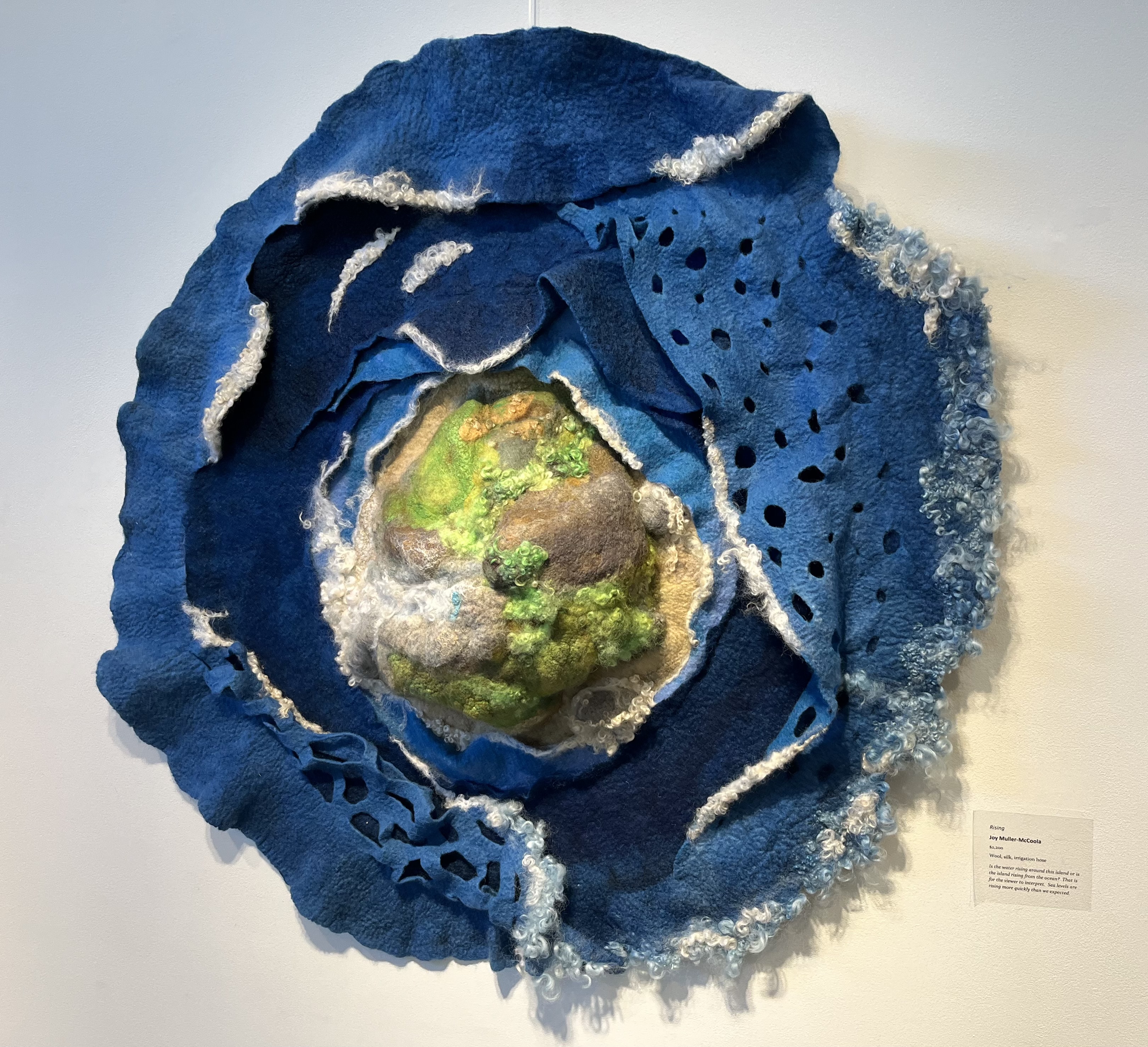
Photos:John and Suzanne’s Mom. Joy Muller-McCoola’s fiber art piece “Rising,” at Lexington Art.
Textile artist Ann often digs me out of my rut to go see some fiber art and afterward have a nice lunch somewhere close by. Most recently, we went to a beautiful show at the Lexington Arts and Crafts Society in Lexington, Massachusetts.
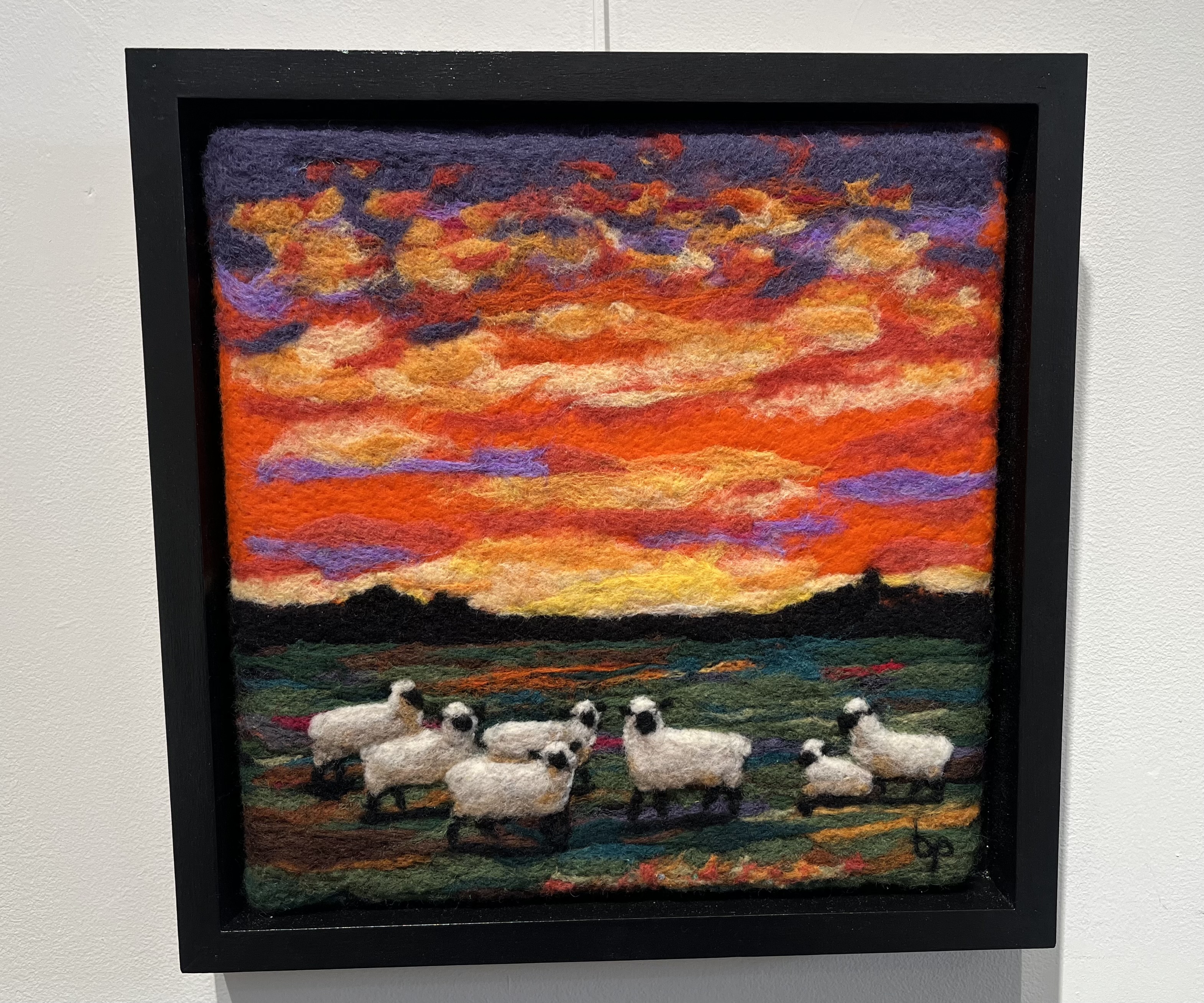
I was drawn to the piece above because I love islands. This one is emerging from the sea in an unspoiled form. It felt hopeful. Below is one called “Sky with 7 Sheep.” It practically leapt from the wall.
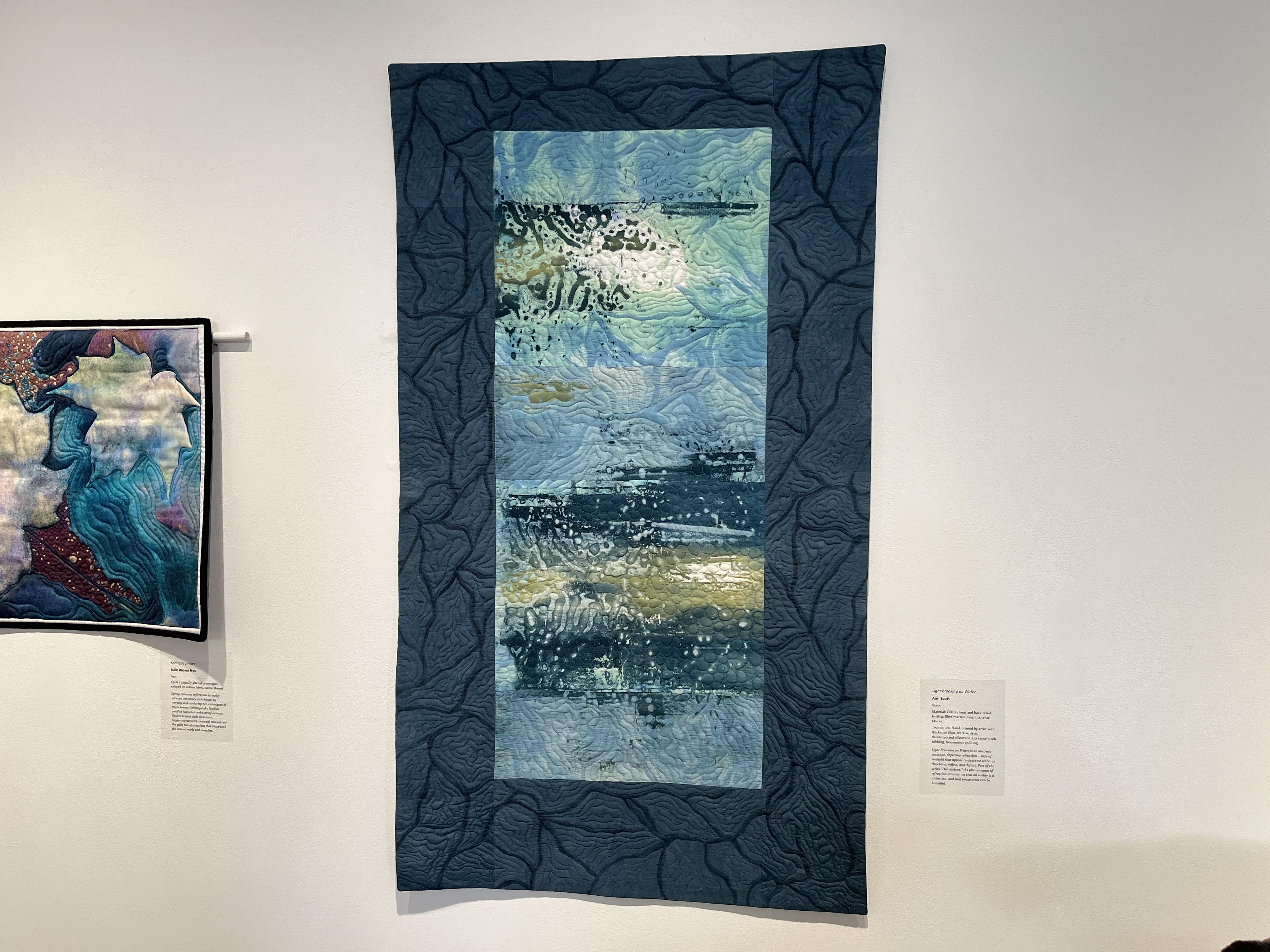
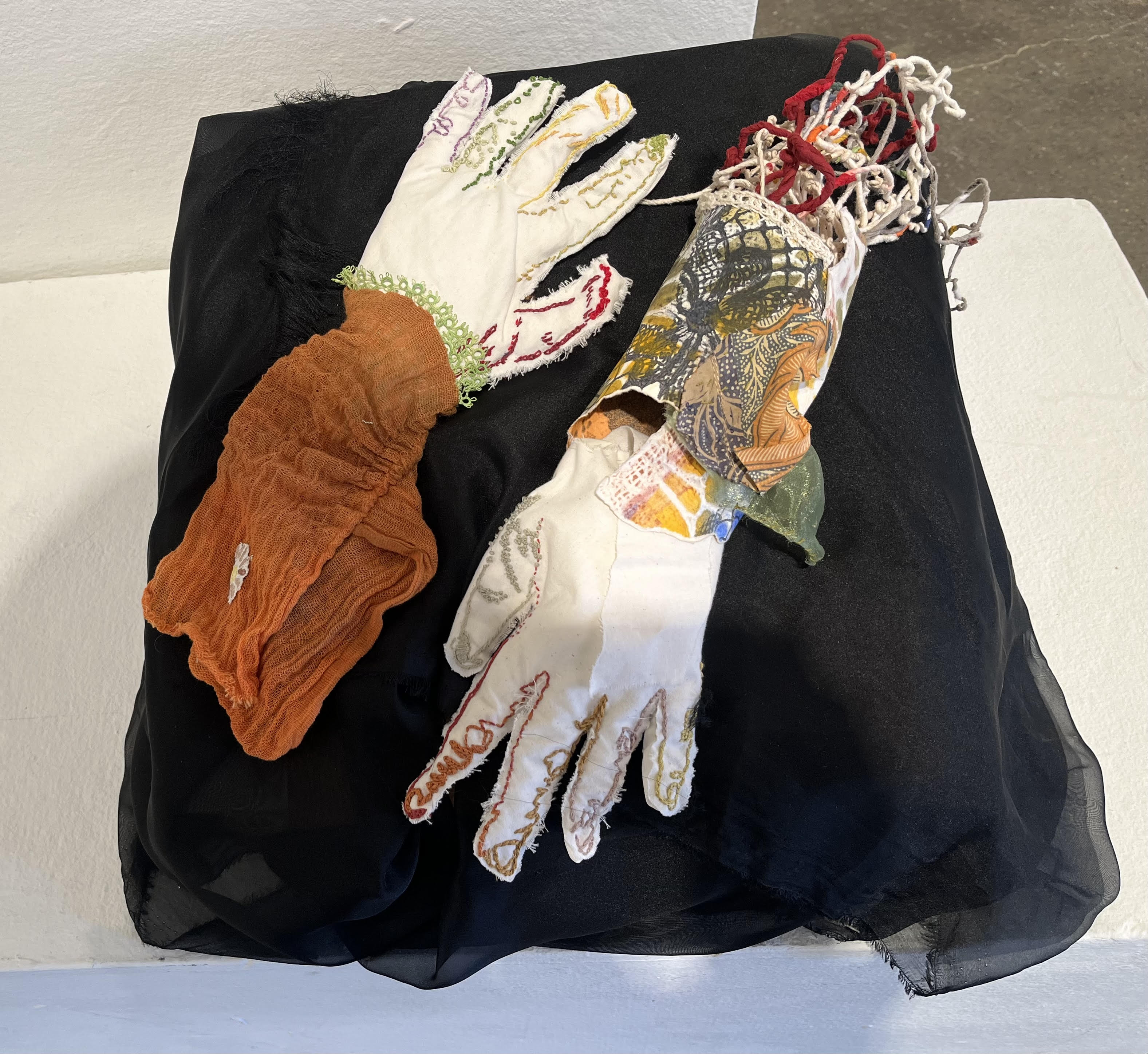
After that, you can see the lovely “Light Breaking on Water,” by Ann Scott. And Sandra Mayo’s “The Way We Touch the World,” with the gloved hands, was intriguing.
What do these pieces mean to the artists? one wonders. What do they mean to me at a moment in time? And do meanings change?
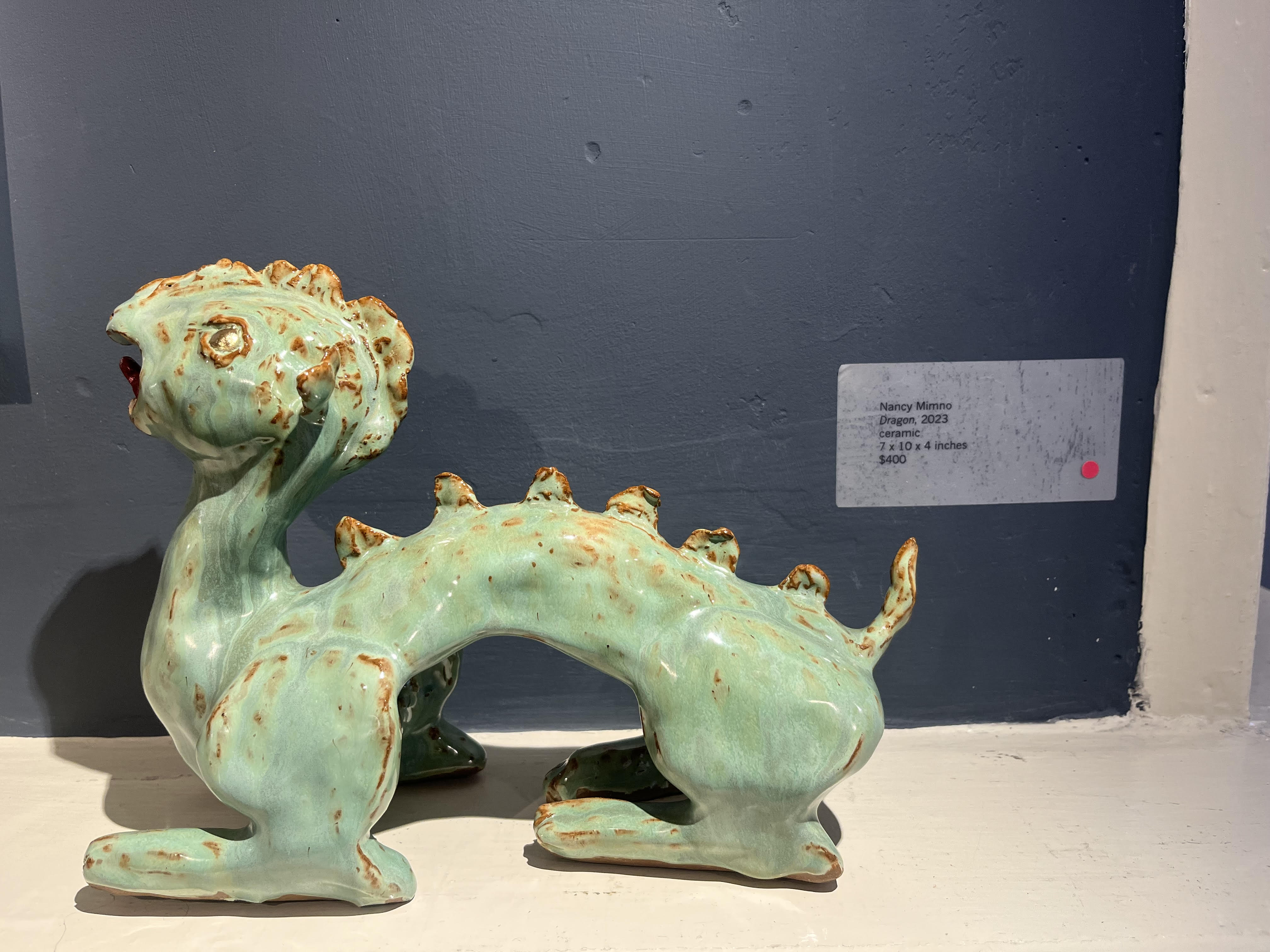
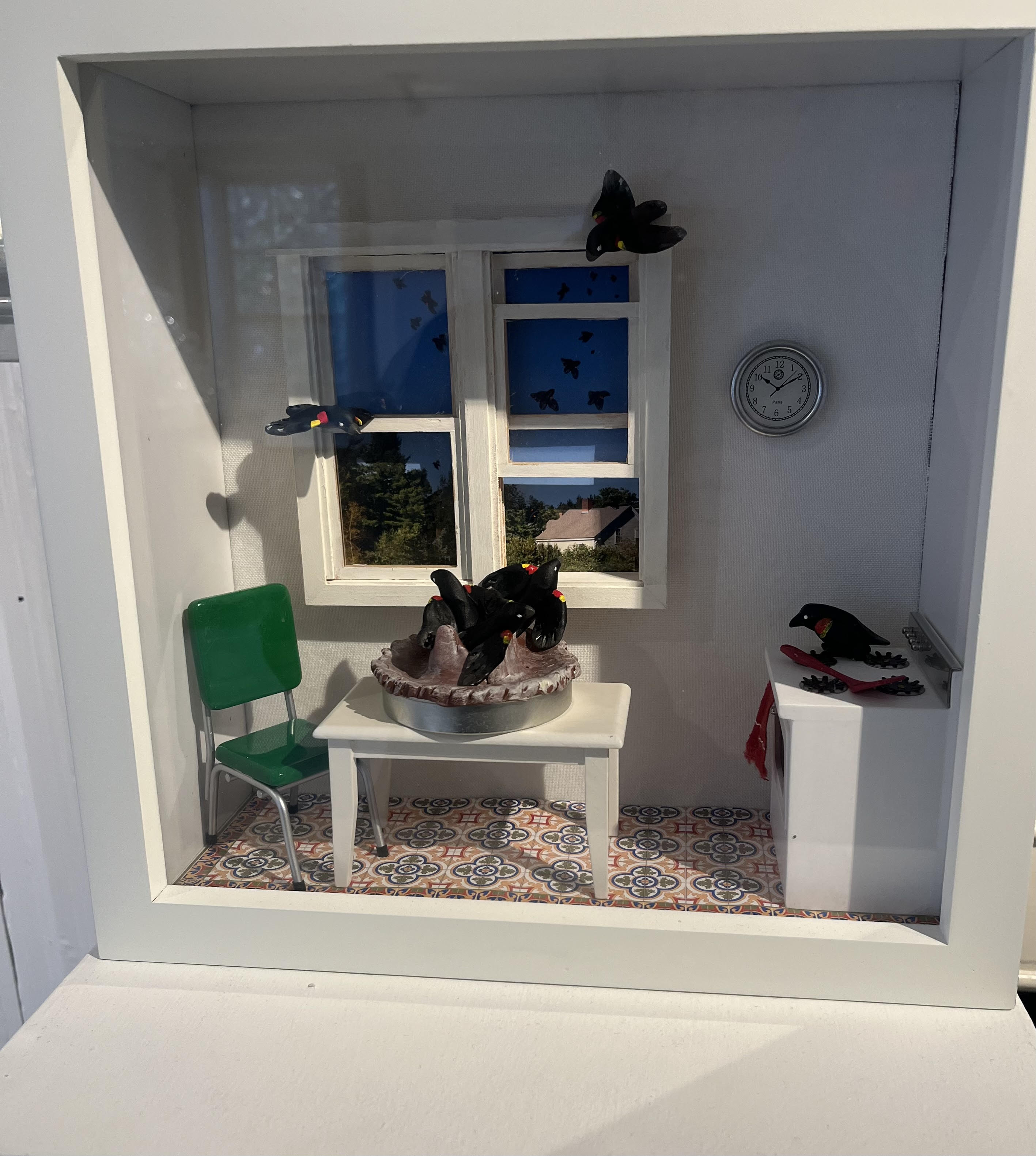
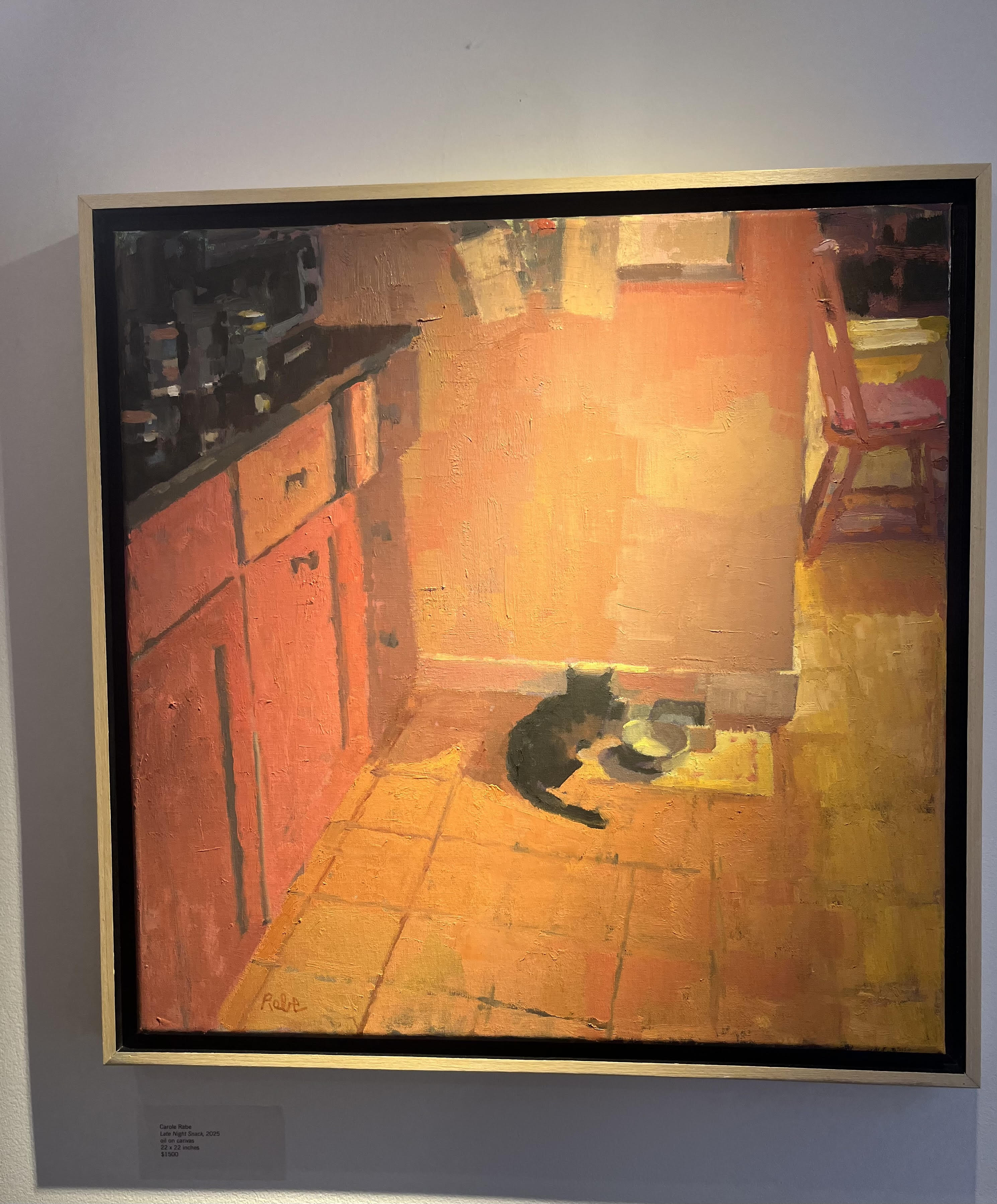
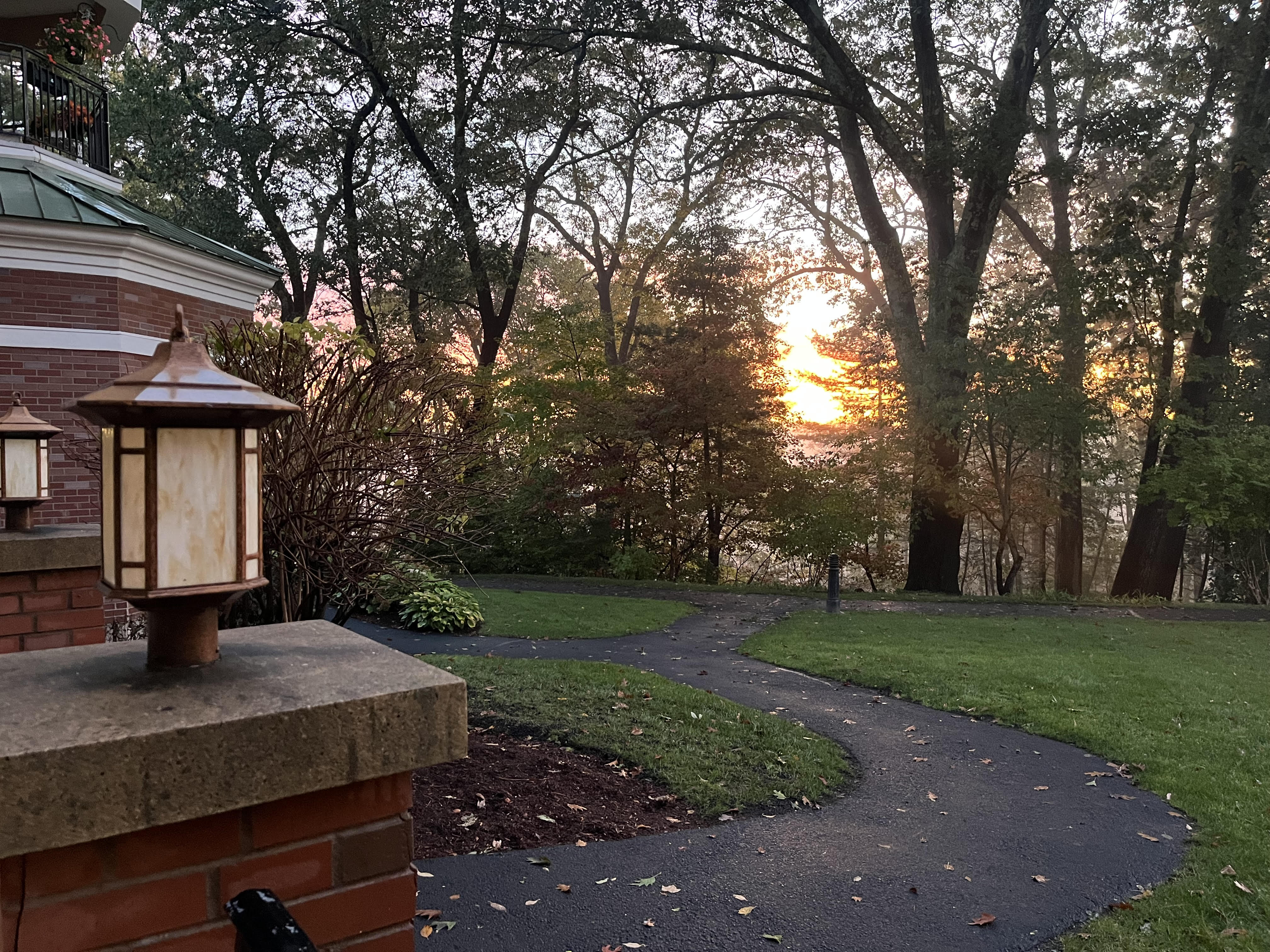
That got me thinking that I never posted pictures of some works that I liked last fall at Concord Art. So I’ll add them now and wind up with my own attempt at an artsy photo. We can call it “Dawn at the Gym.”
Here is Nancy Mimno’s “Dragon.”
Sarah Bossert created “Four and Twenty Blackbirds.”
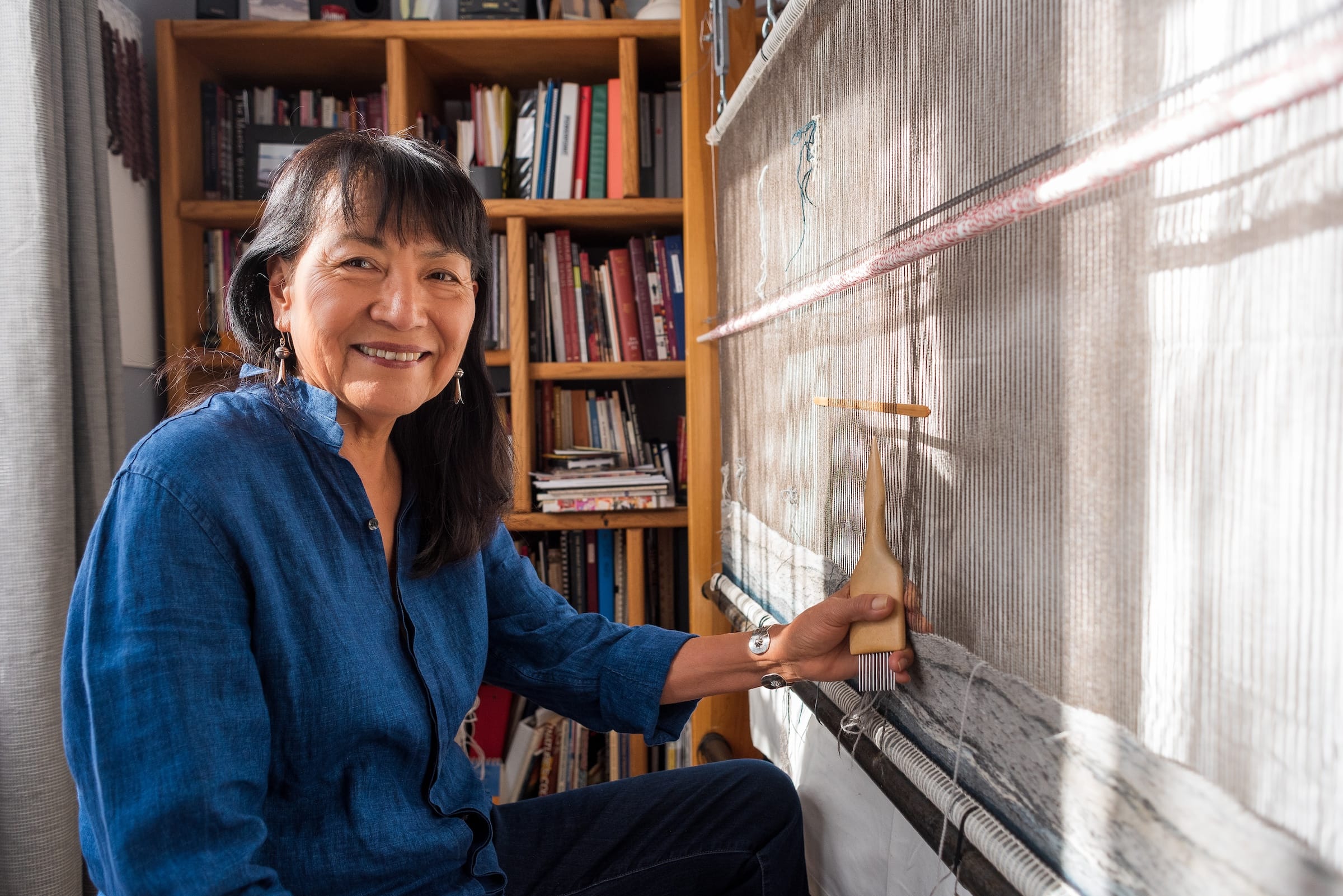
Photo: Peter Ellzey. DY Begay in her weaving studio in Santa Fe, New Mexico, in 2022.
Traditions often gain strength and durability when the spirit behind them is reinterpreted through a new generation’s sensibilities. A case in point: the way the weaving and dyeing of Diné artist DY Begay has enriched a traditional Navajo craft.
They write, “For over four decades, artist DY Begay expanded the expressive range of Diné (Navajo) weaving, transforming the form into a language that is entirely her own. She is a Diné Asdzą́ą́ (Navajo woman), born to the Tótsohnii (Big Water) clan and born for the Táchii’nii (Red Running into Water/Earth) clan. Her maternal grandfather is of the Tsénjíkiní (Cliff Dweller) clan and her paternal grandfather is of the Áshįįhí (Salt People) clan.
“Begay is a fifth-generation weaver who was raised in Tsélání (Cottonwood) on the Navajo Nation, where her family’s sheep flock still resides. Rooted in Diné Bikéyah (Navajo homelands) — from the cliffs of Tsélání to the horizon of the Lukachukai Mountains — her work reflects the blended hues of sunsets, mesas, and mountain ranges, while her use of wool from her family’s flock and natural dyes binds her practice to the land she seeks to honor and protect.
“After graduating from Arizona State University in 1979, Begay moved to New Jersey and immersed herself in the fiber art world of New York City. She studied historic Diné textiles at the Museum of the American Indian, whose collections later became part of the Smithsonian’s National Museum of the American Indian (NMAI). Most of these pieces were created by Diné weavers whose names were not recorded, likely women. She also took inspiration from the work of artists such as Anni Albers, Sheila Hicks, and Lenore Tawney — all of whom trained in modern Western traditions yet studied Indigenous weaving practices. …
“When she returned to Tsélání in 1989, her grandmother, Desbáh Yazzie Nez (1908–2003), saw her weavings and urged her to develop her own compositional sensibility. Begay quickly gained recognition at the Heard Museum Guild Indian Fair and Market as well as the Santa Fe Indian Market, yet she felt restless in her practice. By 1994, that questioning crystallized into a breakthrough: She began developing color hatching, a method of creating subtle gradations and nuanced color interactions that transformed the solid, banded designs of conventional Diné weaving. …
“In August, Begay spoke with us over Zoom from her home in Santa Fe. The interview has been edited and condensed for clarity.
Sháńdíín Brown and Zach Feuer “In Sublime Light: Tapestry Art of DY Begay, the first book dedicated to you and your recent retrospective at the NMAI, you write about watching your mother and grandmother weave in the hogan. …
DY Begay “I don’t remember the very first time I picked up weaving tools and set a loom on my own. I was very young. I do remember standing behind my mother’s loom, watching her pull colored yarns over and around the warps. Her fingers moved swiftly in and out, pressing the wefts into place. Within minutes, geometric shapes stacked and formed into the outline of a Ganado-style weaving. At that age — maybe four or five — I could not quite comprehend how those shapes came together. I was always perplexed and in awe. Everything happened so fast in front of me as her hands composed lines and rows of colored yarn.
“I grew up surrounded by weavers: my maternal grandmother, my mother, and my aunts. Someone was always at the loom, often positioned in a very central place inside the hogan. And we lived in the hogan when I was growing up, and everybody else did too.
“I watched my mother create stepped patterns with hand-dyed yarns, moving with precision and grace. Teaching came through showing. It was a physical action. The word that I always remember, and is still used today, is kót’é — ‘like this.’ My mother said ‘kót’é, kót’é.’ …
SB & ZF “Do you remember the moment when you first began weaving yourself — whether your family set up a loom for you or you started working on theirs?
DB “I was very curious. I tried to hold my mother’s tools, but they were too big for my hands. … Eventually, she allowed me to sit with her once in a while and said ‘kót’é, kót’é.’ I began to get used to the natural action of tapping with the combs. I was about eight years old when I had my own loom. I don’t remember its size. My mother prepared the warp and I used leftover yarn from her bin. I do remember finishing my first weaving, maybe two colors. It was pretty decent for a first attempt. It was a good learning situation because my mother was there. She would sometimes unweave certain parts and we would go on. …
“Most finished weavings, maybe two by three or three by three feet, and some saddle blankets, were taken by my father and my grandfather to the local trading posts to exchange for food, fabric, or whatever was needed. My mother never went to the trading post herself — we didn’t have a vehicle then, so transportation was by wagon or horses. They would roll up the weavings, pack them, and take them to the trading post. …
“In weaving ‘Pollen Path,’ I wanted to share a cultural belief. Among the Diné, we sprinkle corn pollen to honor a new day, to seek blessings, and to bring balance into our lives. Corn itself is a sacred plant. The pollen is collected in late summer, when the tassels of the corn begin to pollinate. We gather it in the early morning, just before the sun rises. For me, ‘Pollen Path’ reflects peace, beauty, and gratitude for life.
“The project began in the summer of 2007, a very good year for growing plants that I use in dyeing my wool. My sister, Berdina Y. Charley, planted local corn seeds she received from our Táchii’nii (Red Running into Water/Earth) relatives. I believe these were heirloom seeds from our Táchii’nii family. …
SB & ZF “How do you translate the experience of walking in beauty, through the landscapes of Diné Bikéyah (Navajo Country) and more specifically your home of Tsélani (Cottonwood), into the two-dimensional form of weaving?
DB “Not only do I have my Tsélani landscape embedded in my mind, but I frequently photograph the surrounding textures at various times of the day to capture different lighting as it reflects on the terrain. …
SB & ZF “Can you tell us about your color palette and the process of dyeing the wool? Is it essential for you to use and make dyes that are from the earth?
DB “I have been practicing and experimenting with natural dyes for quite a while, and I love using local plants to create my color palette. It is both essential and traditional in my culture to use what the earth provides to create dyes for our yarn.
“My palette comes from many sources. I work with common plants such as cota (Navajo tea), chamisa, rabbitbrush, and sage. I also use non-native materials like insects, fungi, foods, and flowers. Each has its own season, and I collect plants according to the time of year.
“The process itself is an experiment every time. I’ve studied many dyeing methods and learned to be attentive to formulas that help obtain and preserve the colors. For me, making dyes from the earth is not only practical but also deeply connected to tradition and creativity.”
More at Hyperallergic, here. No paywall. Subscriptions encouraged.
Photo: Durrie Bouscaren/The World. Inspired by Istanbul’s “deadstock” shops, OhSevenDays uses small batches of fabric to create womenswear. Designer Megan Mummery is pictured above inside OhSevenDays in Turkey.
According to public radio show The World,the textile industry generates an estimated 92 million tons of waste every year — equivalent to a garbage truck full of clothing every second. But today’s article suggests a way to give textiles a second life.
The whole time I read this, I was picturing Cinderella’s little friends among the birds and mice turning the ugly sisters’ cast-off fabrics and ribbons into a gown for the ball. You remember the Disney Cinderella? I’m talking about the pretty gown the sisters destroyed, causing the Fairy Godmother to step in.
Durrie Bouscaren reports at The World, “In the backstreets of Istanbul’s garment districts, there are stores selling bolts and bolts of leftover fabric. …
“These 100-meter rolls of fabric, known as ‘deadstock,’ are the discards of Turkey’s largest clothing manufacturers. And to a growing cohort of designers, they hold the key to reducing waste in the fashion industry.
“ ‘There are big manufacturers in Turkey that do production runs of 30,000 to 50,000 unit pieces. So, the precision in that production is something else,’ said Australian Canadian designer Megan Mummery.
“At that scale, fabric rolls with small tears, stains or other imperfections are immediately removed from the machines. And if a brand miscalculates and orders too many rolls of a specific fabric, it will end up with a surplus.
“In most cases, deadstock fabric rolls are incinerated or dropped off at a landfill. …
“ ‘It’s minuscule for them — one roll is 100 meters,’ Mummery told The World. ‘But for us, it’s gold.’
“Inspired by Istanbul’s deadstock shops, which she explored after moving to the city with her husband in 2015, Mummery began using smaller batches of fabric to create womenswear designs. She named her brand OhSevenDays — a reference to her earliest collections of only seven pieces at a time, and a play on the Turkish word ‘seven,’ for ‘one who loves.’
“ ‘It was really slow at the beginning,’ Mummery said. … ‘And I remember, an influencer once wore a top and posted it, and we got like 20 orders in a day, and it was the most exciting thing ever!’
“Today, Mummery’s designs are a tasteful blend of classic neutrals and airy patterns. Signature bralette tops are paired with matching high-waisted skirts and summery cotton shorts, perfectly at home in the historic Istanbul apartments and garden balconies often featured in her photo shoots. A line of maternity clothes offers options for both the office and casual wear.
“As with many small-scale sustainable brands, OhSevenDays’ price point is higher than that of major retailers. A popular blue patchwork Darcy dress is priced at $240, and a dark denim jumpsuit sells for $150. A breathable, white cotton maternity blouse is $124. …
“Turkey is among the world’s largest exporters of clothing, and a significant amount of deadstock fabric is available in the country, according to [Sibel Ege, an Istanbul-based fashion industry expert who runs a textile consultancy called REN Sourcing]. But few brands are incorporating it into their practices, and even fewer customers are aware of what it is.
“ ‘After COVID, the customers became more aware of the importance of (sustainability), and started to pressure the brands,’ Ege said. ‘But if the customer doesn’t know what it means, it doesn’t make a value at the sales.’
“Mummery and her team work together out of a shared studio that is no larger than 700 square feet. A line of dresses hangs above the machines, while tailors measure, steam and cut fabric — making the pieces from start to finish. That makes the work harder, but more interesting, said tailor Türker Pehlivan.
” ‘It’s challenging,’ Pehlivan said. ‘But in the end, something beautiful comes out — and we’re happy because we made something beautiful.’
“[Mummery] has found ways to use the small size of OhSevenDays to her advantage. Custom sizing can be done according to a shopper’s measurements at no extra charge, if fabric is available — the website notes. …
“Deadstock-sourced pieces are also popular among clothing subscription services, where subscribers receive a selection of clothes every month that can be kept or returned. This reduces the risk of disappointing customers if a popular item runs out quickly. …
“ ‘We say, you know, there might be a little color discrepancy between the products — and most of the boutiques love that actually,’ Mummery said. ‘Because when there’s a dress on the railing and two slightly different colors, they have a story to tell, even in the store.’ “
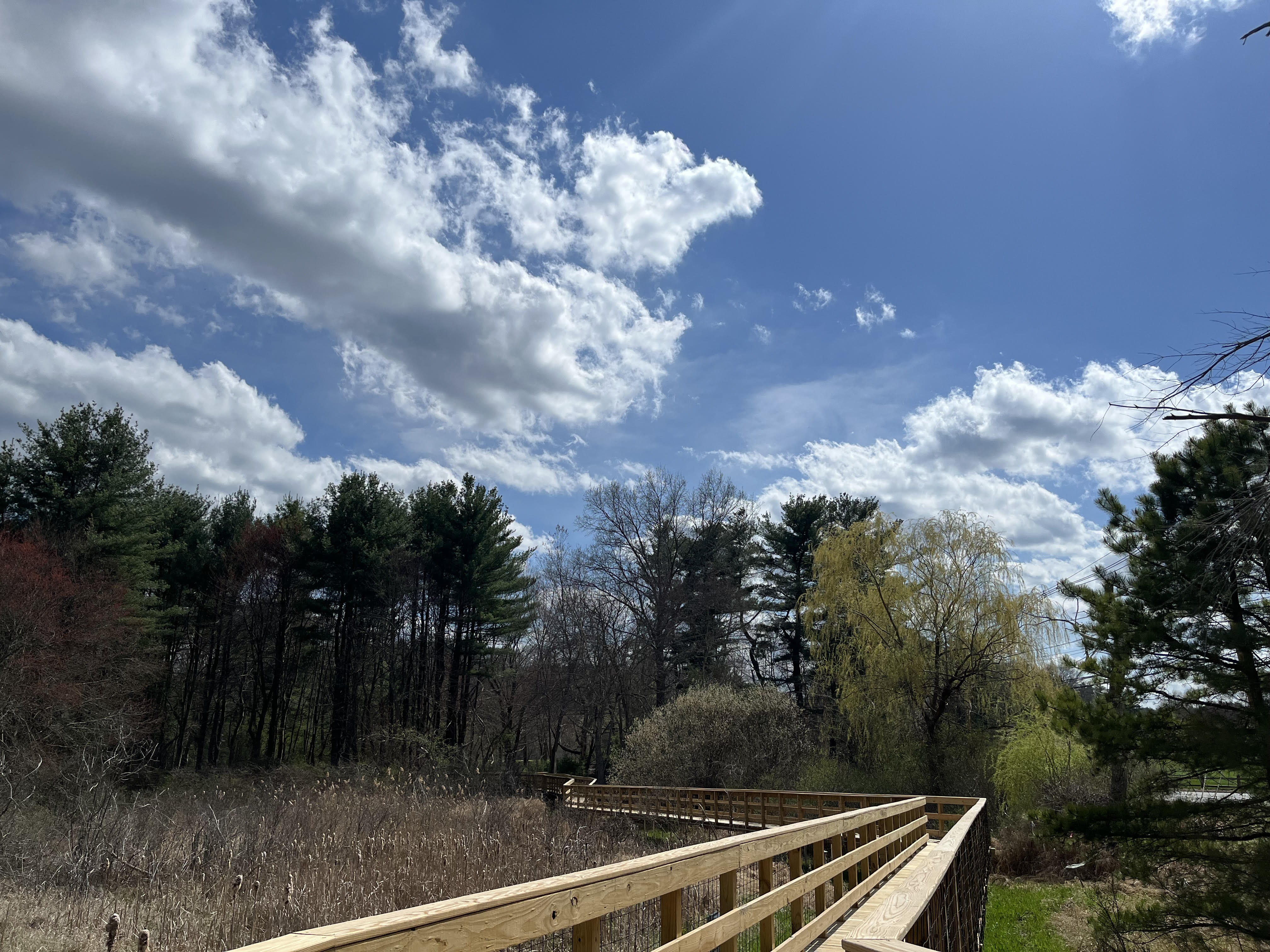
Photos: Suzanne and John’s Mom. (Erik took the photo of my grandson.) Where I like to walk these days.
We had some gorgeous days in April, and May is shaping up nicely, too.
I start my latest photo round-up with the boardwalk my retirement community built according to stringent environmental regulations. I love the feeling of walking in the woods, and right now, wildflowers that were already there are coming up, while residents are planting others with the guidance of a woman specializing in the removal of invasive species.
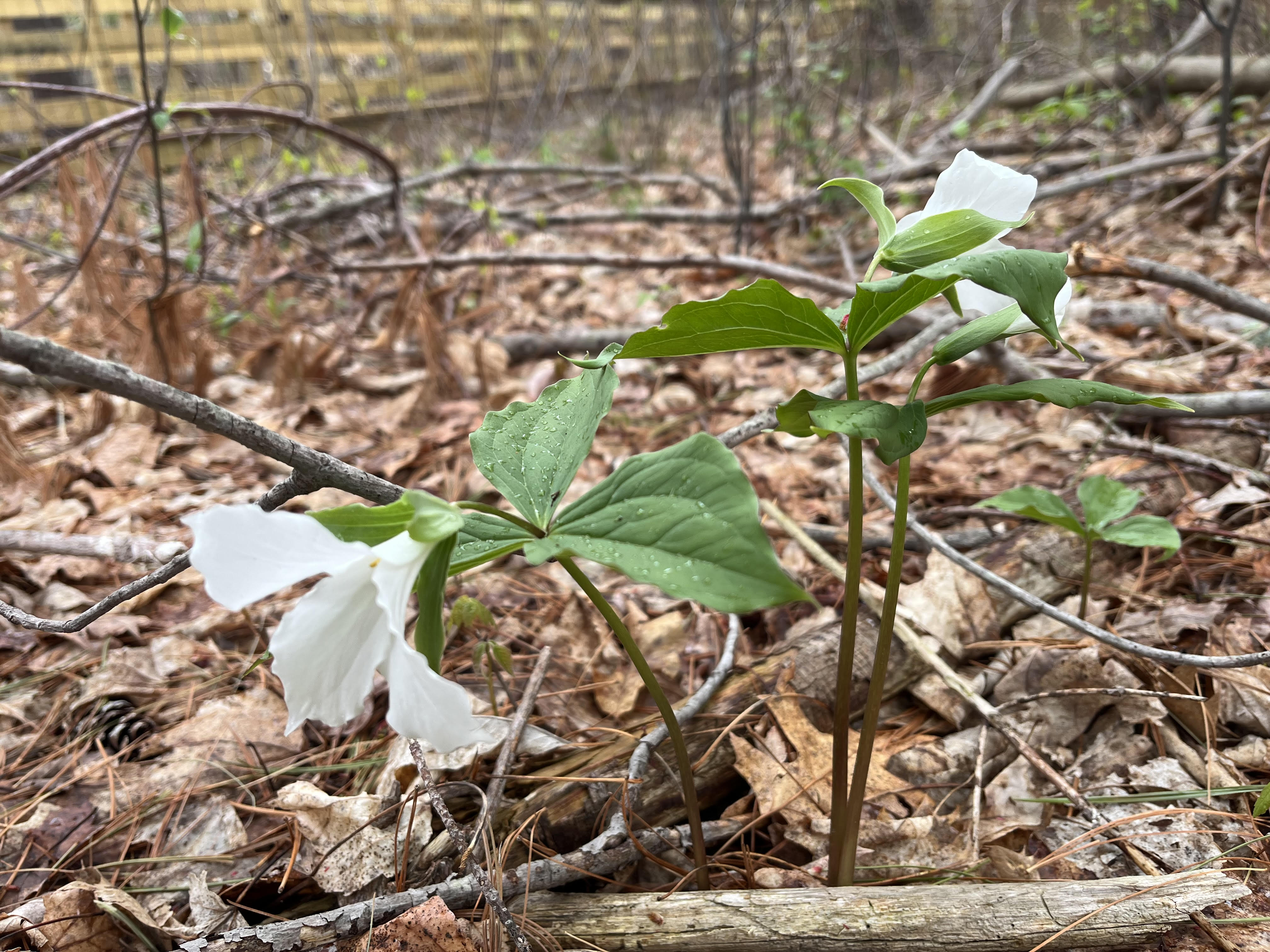
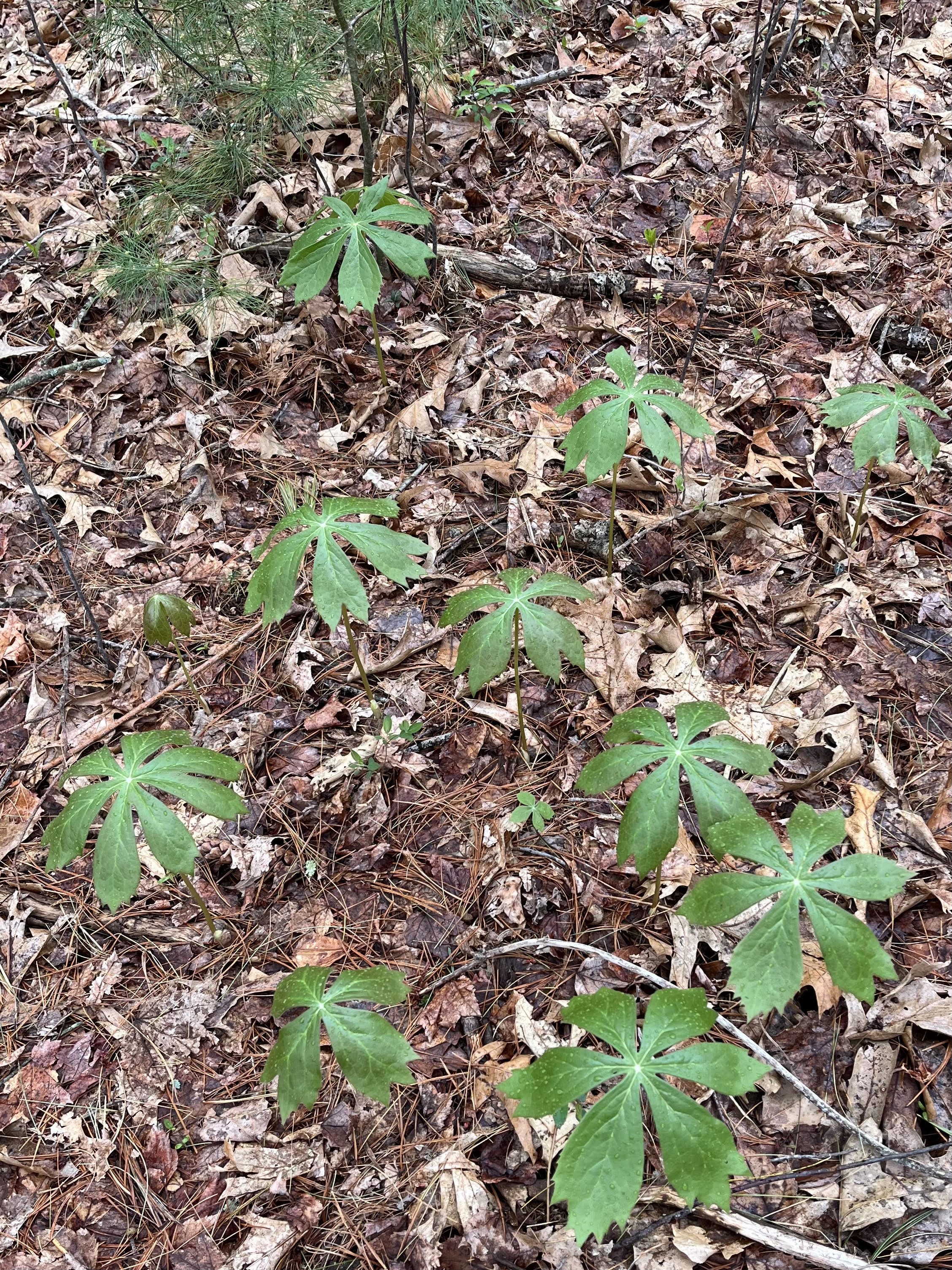
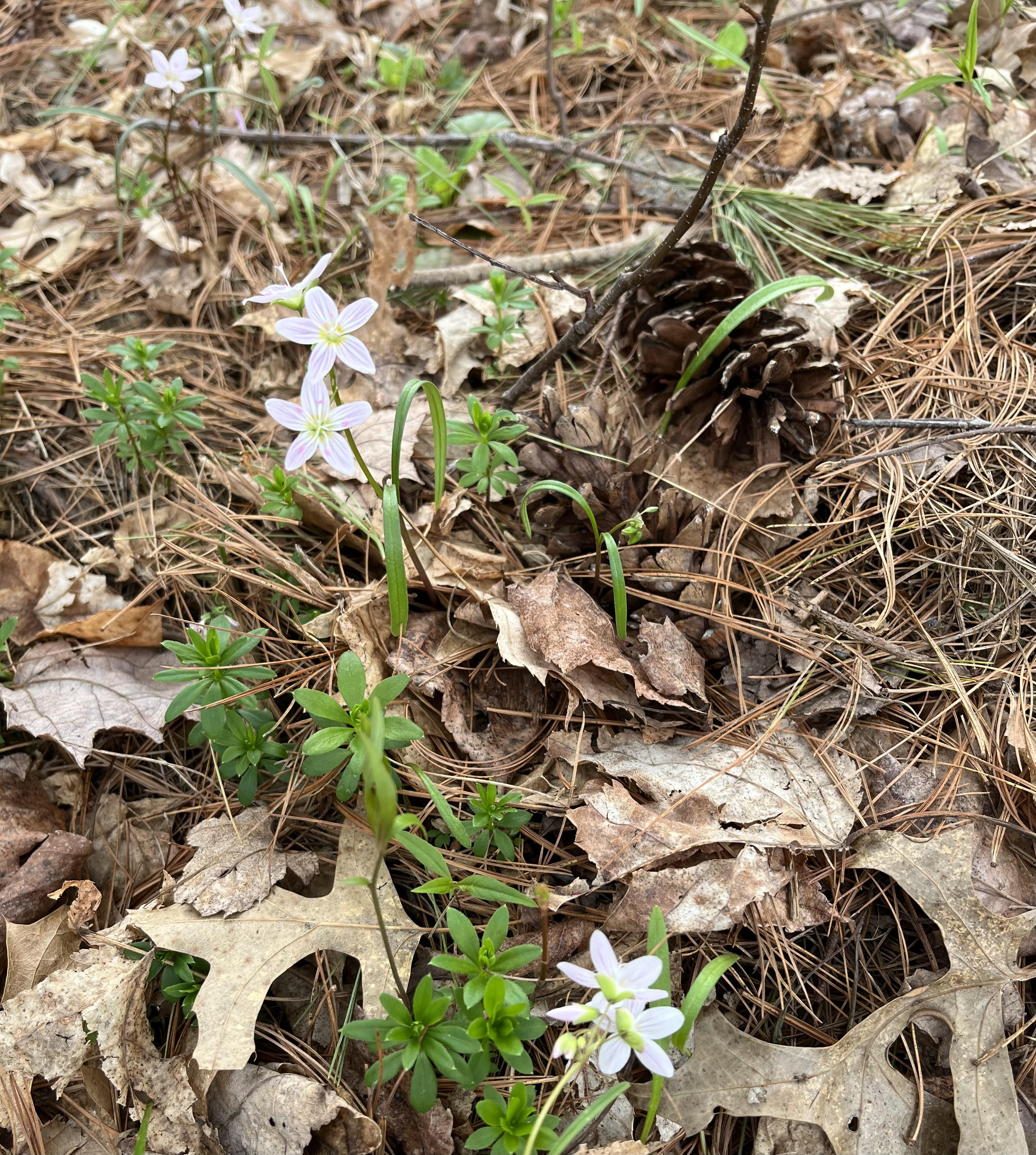
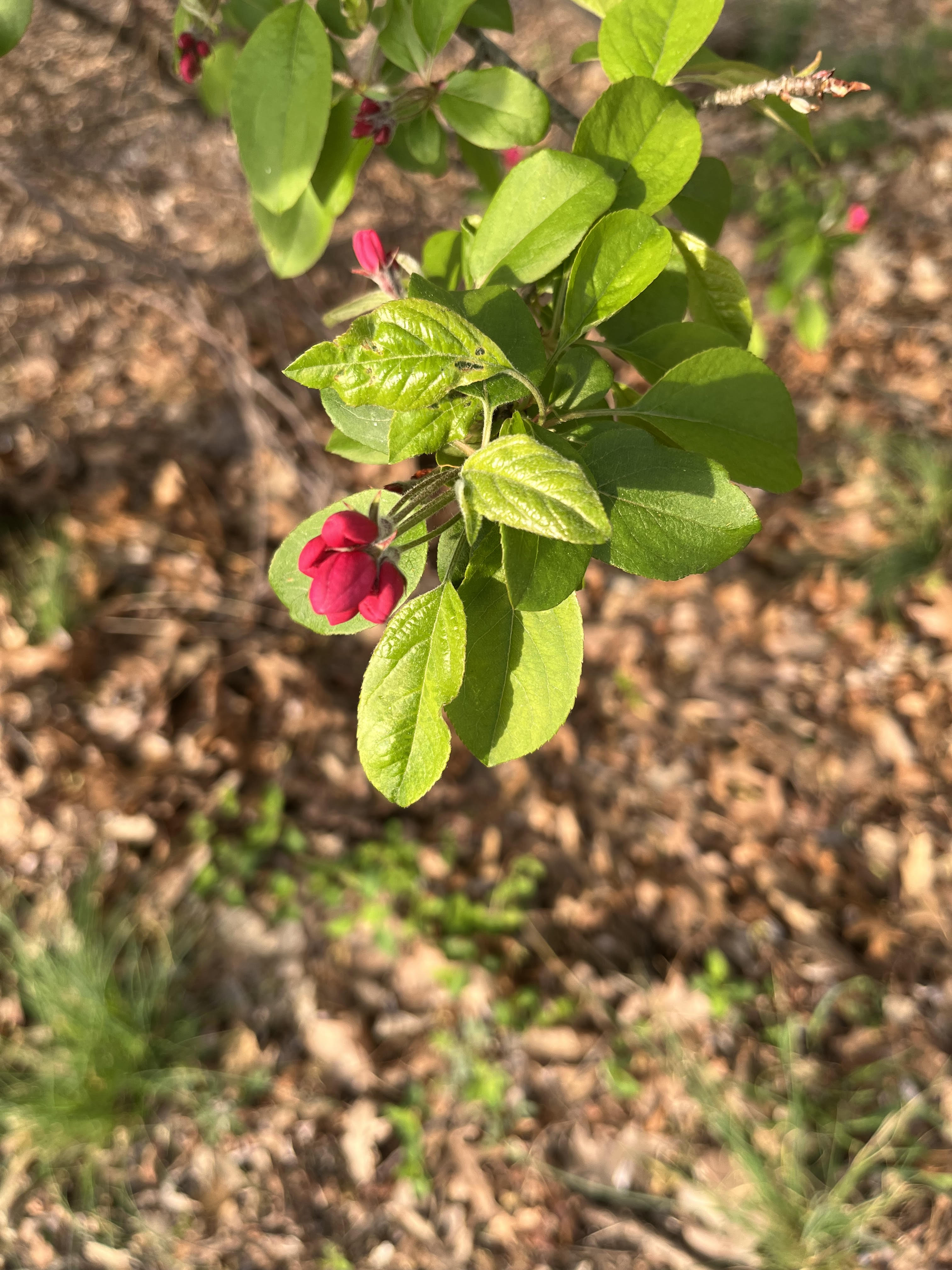
The first photo below is a white trillium. Next in the leaf litter, you see a stand of May apples and a group of Spring beauty wildflowers. The apple tree has buds about to bloom.
Blogger Will McMillan bloomed at my retirement community the other day with one of his deep dives into the heroes of the American Songbook. This time it was Hoagy Carmichael. It’s amazing the forgotten songs Will digs up for his shows — while also presenting classics like “Skylark” and “Stardust.” There was a funny one about a jazz band in the afterlife, where all Carmichael’s departed friends were playing.
In one week, we went to see a grandson in the musical Matilda, which was polished and lots of fun, and the Spitfire Grille, which did not impress.
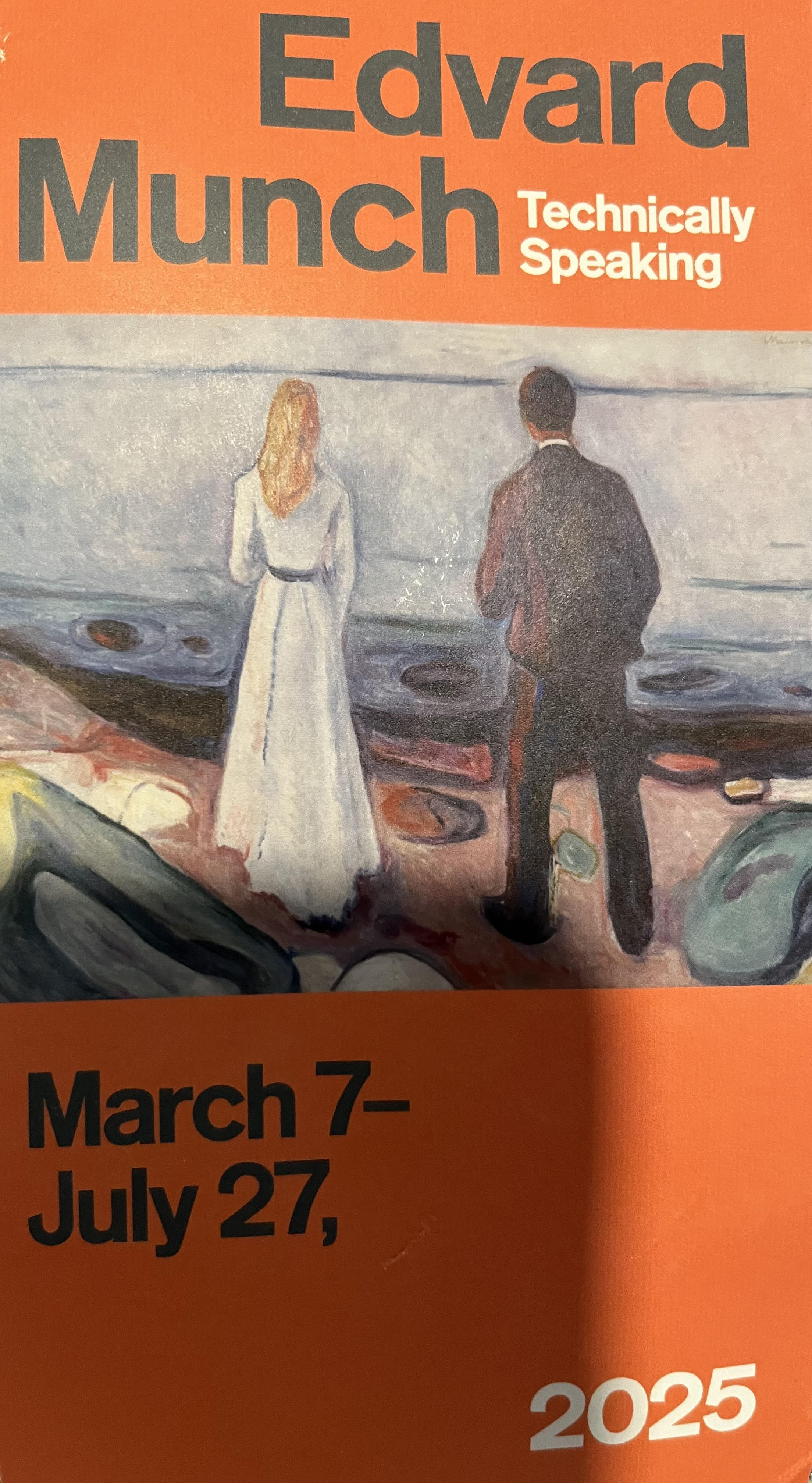
I also attended the Edvard Munch exhibit at the Harvard Museums, which I liked very much. It had paintings as well as a lot of prints in different stages of development to demonstrate Munch’s experiments with technique. The exhibit is there until the end of July, so try to catch it if you are ever near Cambridge, Massachusetts.
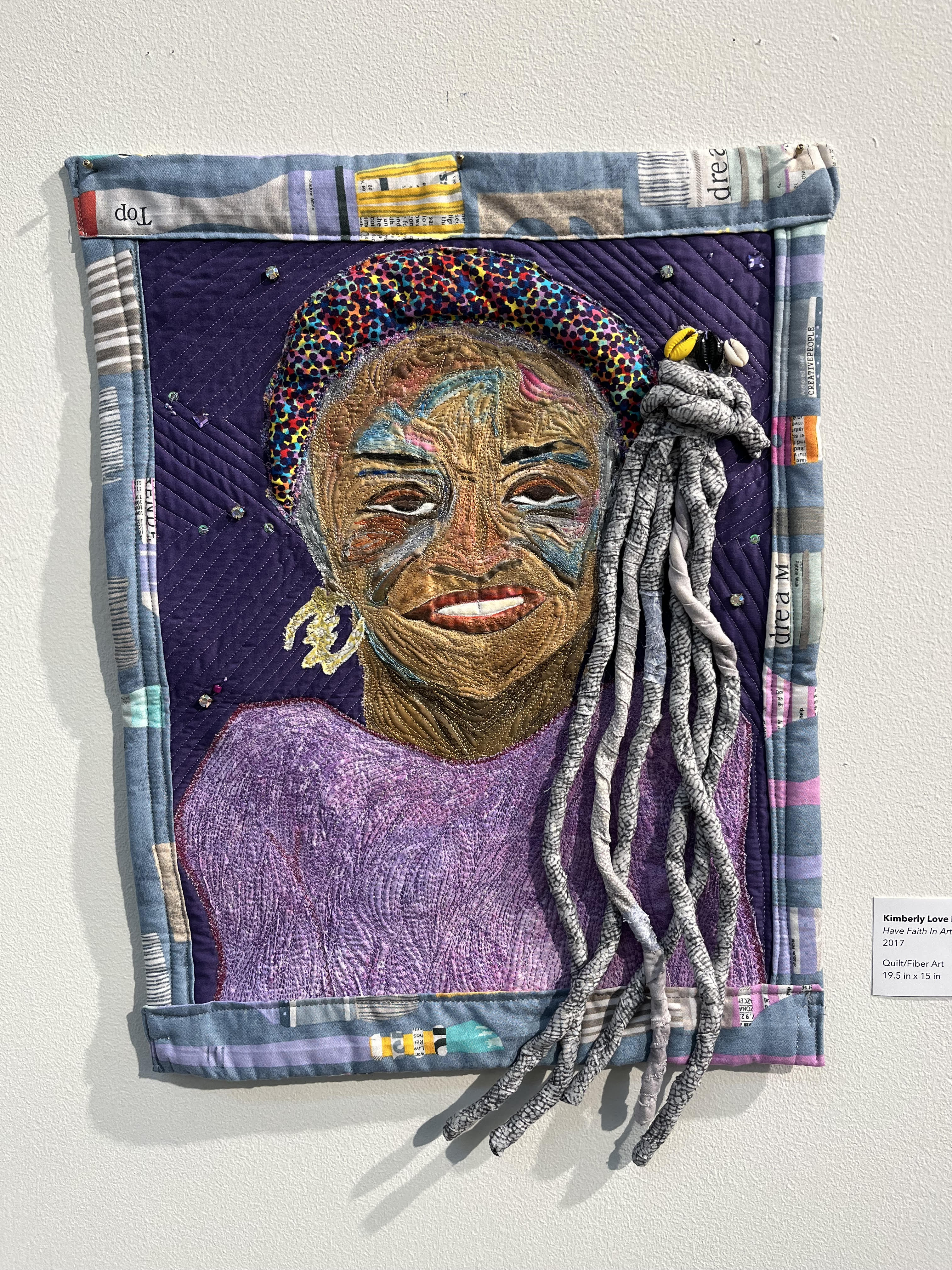
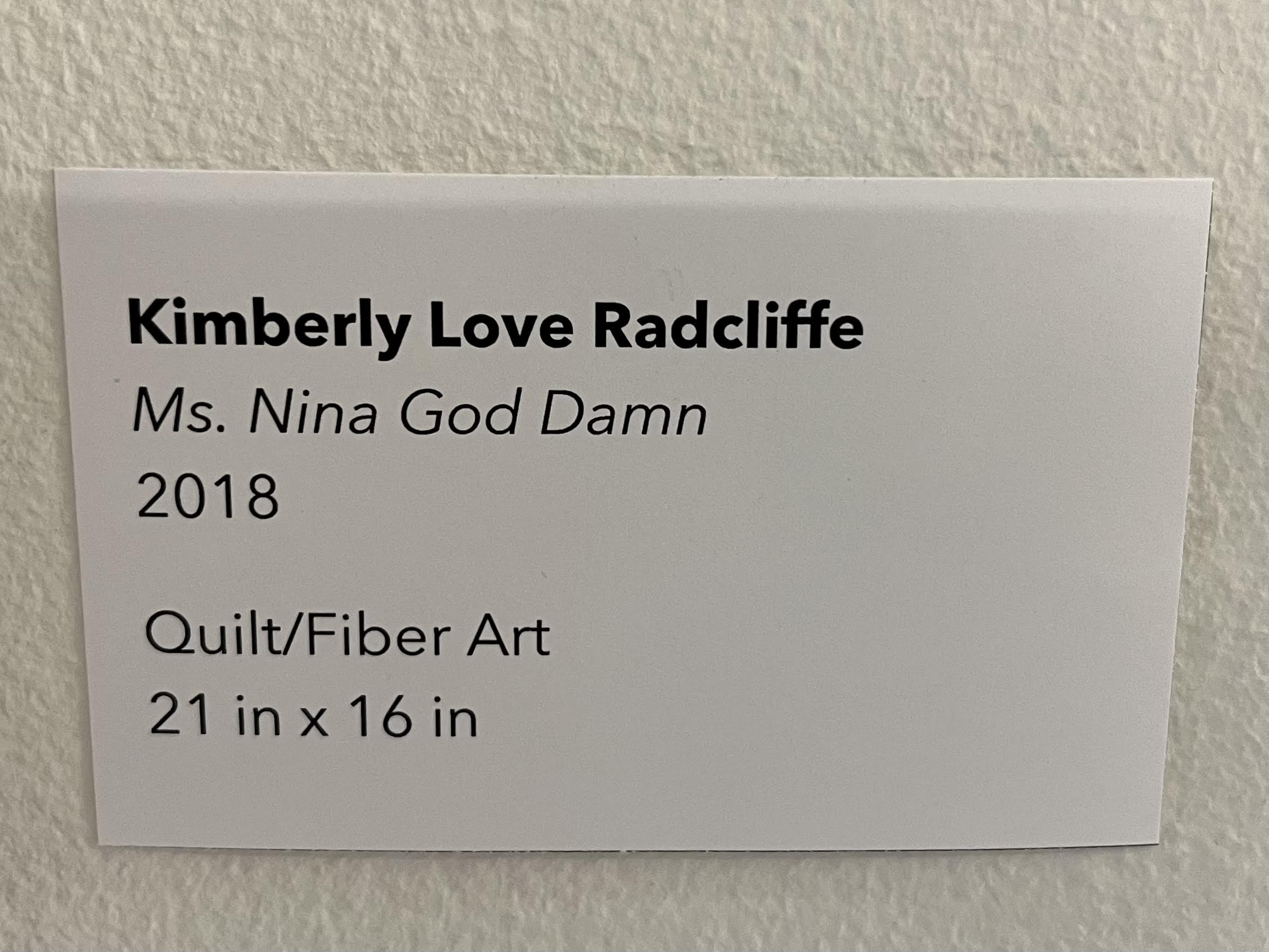
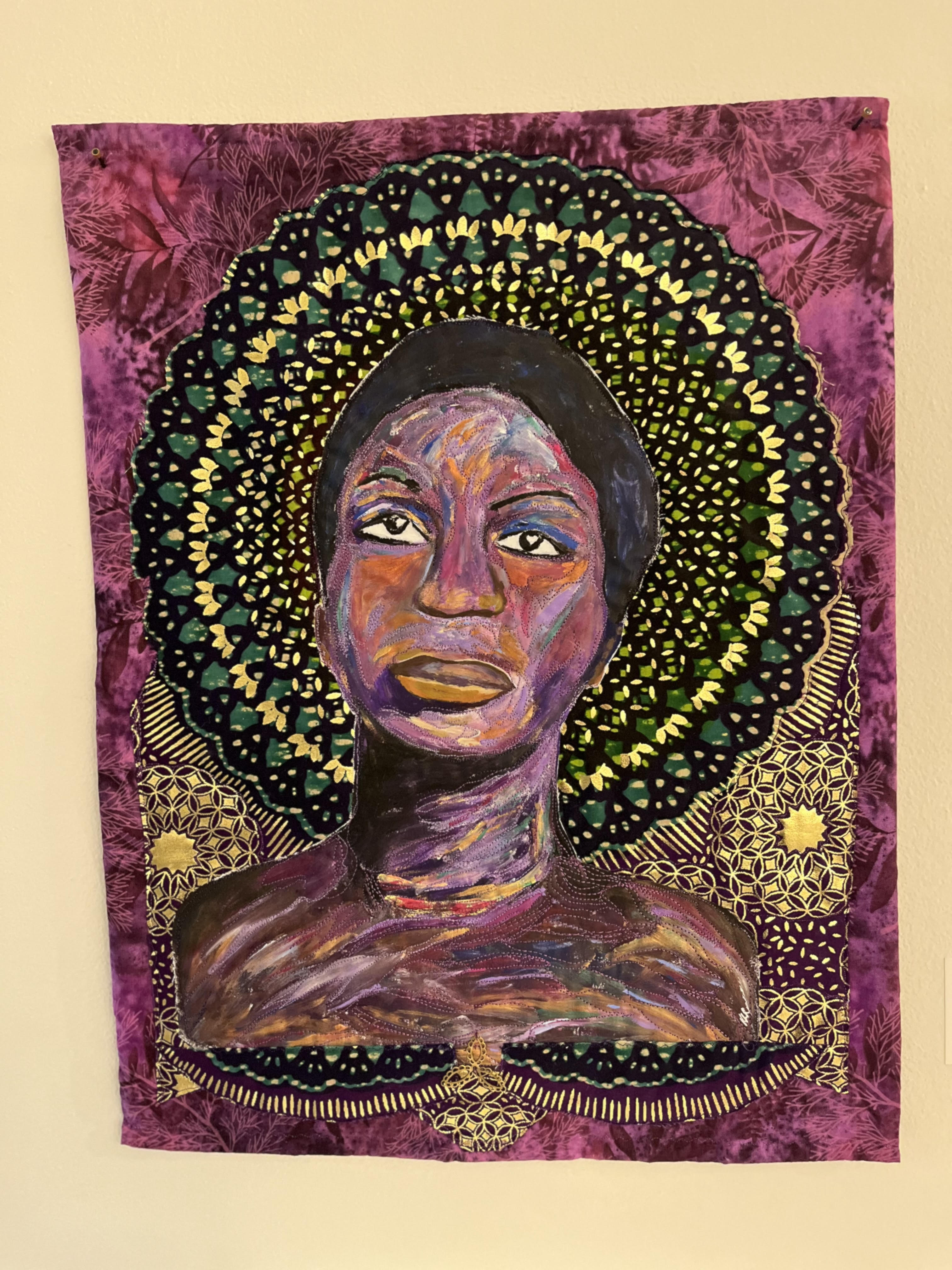
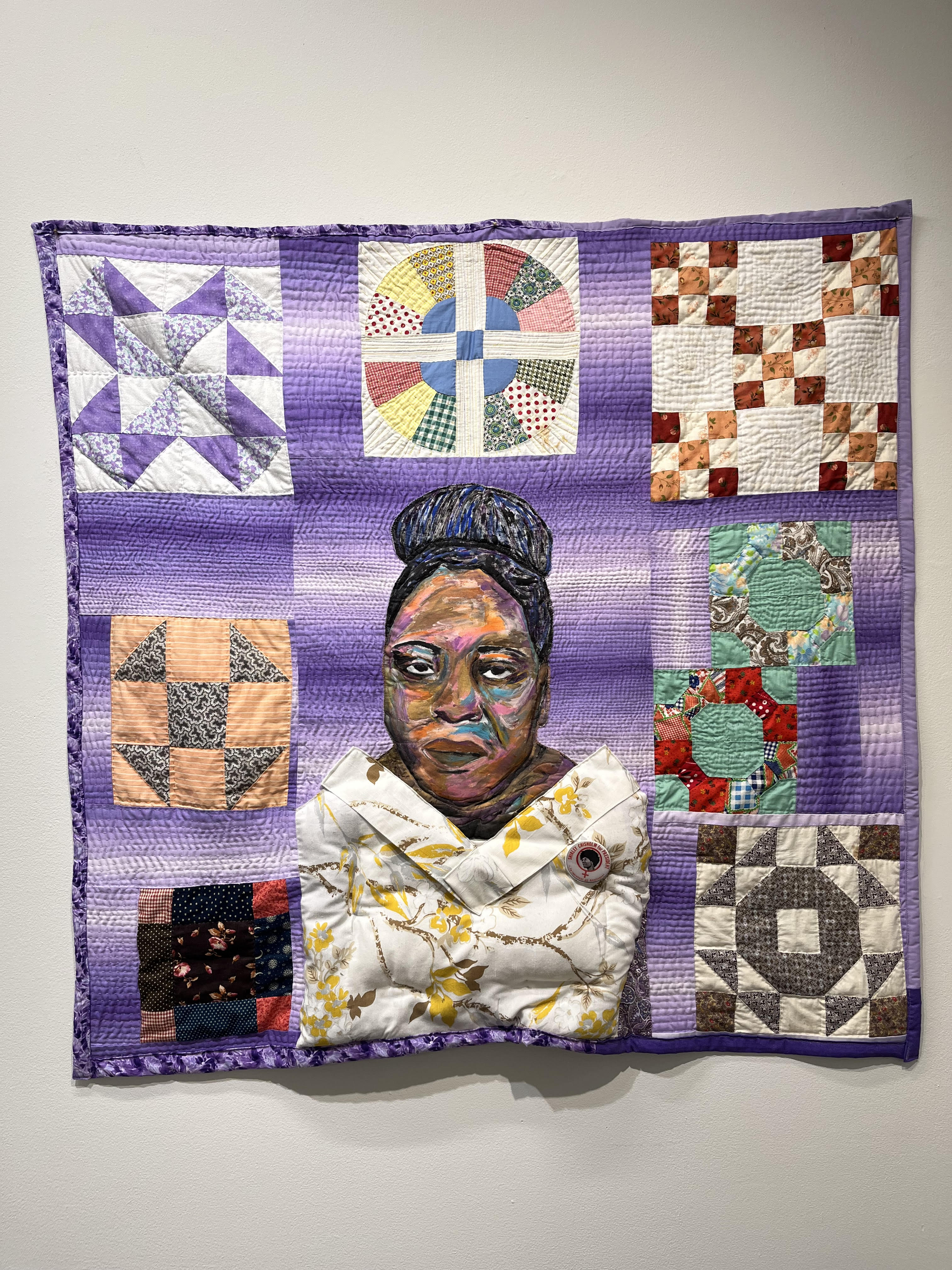
Meanwhile, at Umbrella Arts, there’s a textile show called “Weaving an Address.” The beautiful fiber art here is by Kimberly Love Radcliffe. The first one I photographed she calls “Have Faith in Art.” Then “Ms. Nina God Damn” references singer Nina Simone’s response to the murder of Black Sunday school girls in 1963. And the last Radcliffe I’m showing is a portrait of civil rights icon Fannie Lou Hamer. I just love these works.
Photo: Candace Dane Chambers for the New York Times. Arianne King Comer, an artist, wearing hand-made textiles in her home studio on Wadmalaw Island, S.C. She first learned batiking at Howard University.
I was drawn to this story about about dyeing textiles on the South Carolina mainland and islands after reading Pat Conroy’s amazing memoir The Water Is Wide. That book recounts his 1960s teaching experience among impoverished black children on one of the islands — a sad and moving tale.
I am happy to learn something more upbeat about the islands.
The New York Times says reporter Patricia Leigh Brown “followed South Carolina’s indigo trail from Charleston to Johns Island to St. Helena Island” for this story.
“On a spring morning nearly a decade ago, Leigh Magar was out walking rural Johns Island, off Charleston, S.C., with her ‘snake stick,’ a wooden cane with a jangling Greek goat be. … As she tells it — and she swears this story is true — a beautiful blue dragonfly alighted on her stick and then encircled her, before fluttering toward the woods. She followed it into a thicket of pines, where she discovered a patch of wild blue indigo hidden among the trees.
“Magar, a textile artist and dressmaker partial to indigo-dyed jumpers and indigo-stained silk ribbons tucked into her hair, is at the artful forefront of the ‘seed to stitch’ movement — the growing, harvesting and processing of Indigo suffruticosa, a robust plant that flourishes in the tropics and produces a deep, cherished ocean-blue color, one of humankind’s oldest dyes.
“This benign-looking bush is used in designing garments and batiks. It was a major export in 18th-century South Carolina. Like rice and cotton, the lucrative indigo crop was dependent on the skills and labor of enslaved Africans, who tended the plantation fields and extracted the dye in preparation for shipment to England for its burgeoning textile industry.
“Today, the revival of indigo by a diverse group of artists, designers and farmers is hardly confined to South Carolina. … In the United States, the passion for indigo dovetails with a growing appreciation for nontoxic plant-based dyes, including turmeric and marigolds, and the renewed focus on Africa’s role in contemporary fashion, spotlighted by recent museum exhibitions like ‘African Fashion‘ at the Brooklyn Museum and the Portland Art Museum, and by ‘Blue Gold: The Art and Science of Indigo,’ which opened at the Mingei International Museum in San Diego on Sept. 14 [until March 16, 2025]. …
“Fashion designers like Awa Meité van Til, who is based in Bamako, Mali, draw inspiration from her ancestors. In Africa, her grandmother re-dipped her clothes in what the older woman called ‘the blue of life’ when they aged, van Til recalled by email. In Lagos and other major cities, adire, a woven indigo-dyed cloth historically made by the Yoruba, is a fashion staple. …
“Magar was drawn to indigo after a career designing hand-stitched hats and fedoras for Barneys New York from her shabby chic cottage in Charleston. In 2015, she and husband, Johnny Tucker, an architect and artist, moved to a house on Johns Island. …
“Madame Magar, as she is known professionally, became infatuated with the idea of creating art from Mother Nature and began reading histories about Johns Island indigo. At the time, indigo seeds were hard to come by. Then a local botanist told her about a ‘hermit monk’ deep in the woods who not only had seeds but a thriving indigo garden. …
“The ‘hermit’ turned out to be an affable Eastern Orthodox monknamed Father John, who lives down a rutted sand road. In his black cassock, he had a slightly bohemian air, with a bountiful silver beard and hair pulled back in a tight bun. …
“Father John is adept at ‘resist techniques,’ in which certain areas of a textile are blocked from receiving the dye, most often by applying molten wax (the process is often called batik). He prefers making a golden paste out of rice bran which he then applies through intricately hand-cut stencils to create patterns on fabric, in a centuries old Japanese technique known as katazome.
“He pulled out a small plastic bag full of tiny brown curlicues — they were indigo seed pods (you could hear them rattling). He demonstrated their alchemy in the yard, in tubs — one dye steeped with dried leaves, and a deeper color, from concentrate, its bubbling iridescent surface resembling a liquid stained-glass window.
“When Father John immersed his stenciled textile into the brew, it turned a distressing pickle green. But as he fished it out and exposed it to the air, it transformed into a breathtaking blue, enhanced by intricate white patterns where the rice paste had been. …
” ‘Every country that does indigo honors ancestors through this magical blue,’ said Arianne King Comer, an artist who first learned batiking at Howard University and has an indigo plant tattoo above her ankle.
“ ‘It aligned me,’ she said of her indigo education, which began in 1992, when she made her first trip to Nigeria on a grant to study with Nike Davies-Okundaye, a celebrated textile artist who has built centers for young people to learn traditional arts and crafts. …
“King Comer’s indigo-dyed tunics and silk scarves, sold on her website, practically spill out of her trailer, many employing shibori, a Japanese technique in which cloth is twisted or folded to create different patterns. … She will stay in her DIY outpost until she is able to build a center honoring historical and cultural crafts techniques, through her nonprofit, IBILE. Her work is part of the permanent collection of the Acres of Ancestry/Black Agrarian Fund, a cooperative that supports efforts to secure and protect Black farmlands.”
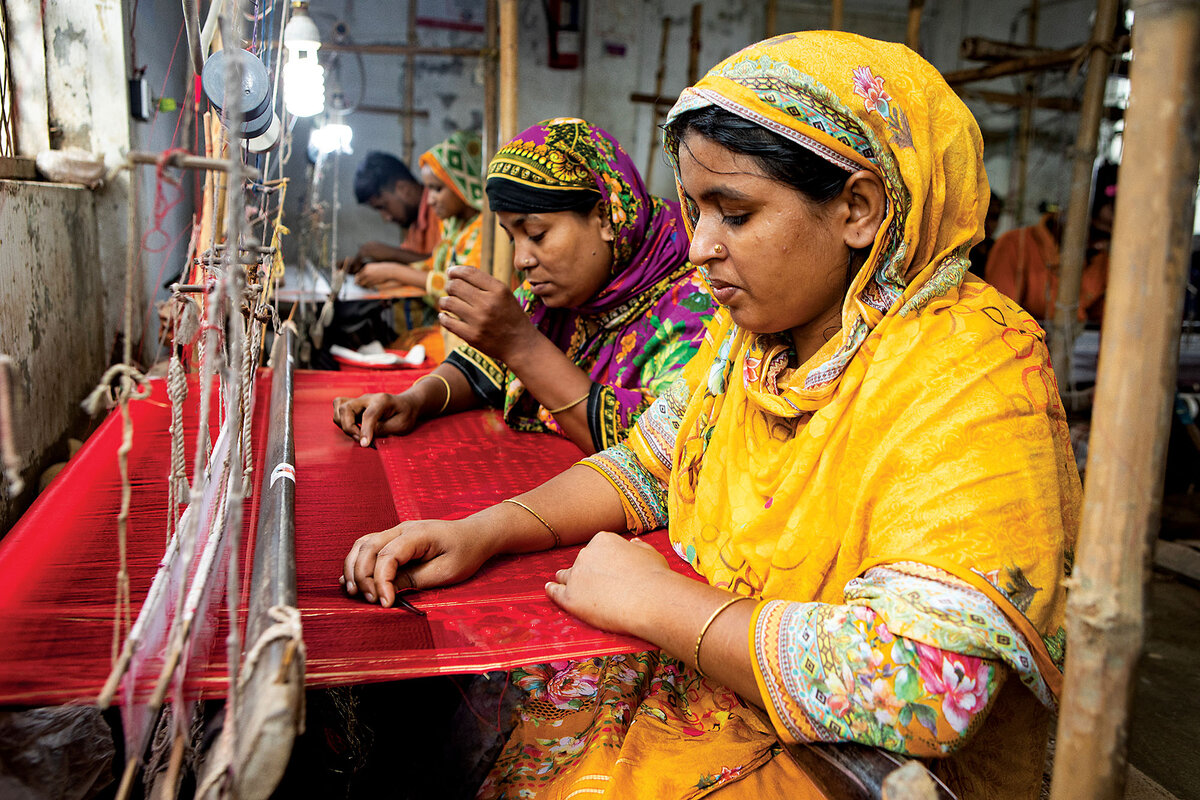
Photo: Melanie Stetson Freeman/CSM Staff. Artisans do “respectful” work on jamdanis at Abul Kalam Jamdani Weaving Factory in Bangladesh.
Recently I wrote about the the Fuller Craft Museum’s exhibit of the Red Dress, an embroidered garment “worked on by 380 individuals from 51 countries, mostly female, many of whom were vulnerable and living in poverty” — women who felt uplifted by an art project that honored their skills.
Today’s post is also about women’s handcrafts.
Sara Miller Llana reports at the Christian Science Monitor, “Two dozen artisans crouch over hand looms threaded with bright-orange and sky-blue cottons. Their fingers nimbly create a jamdani, an intricately woven sari dating back to the [16th century] Mughal Empire. …
“Made of fine cotton or silk, the jamdani was a pinnacle of fashion centuries ago. But in the 19th century, British colonizers brought in their iteration of fast fashion, and the tradition nearly went extinct. …
“After Bangladesh became an independent nation in 1971, the nongovernmental organization BRAC set out to revitalize the weaving practice. It approached artisan families like that of Anwar Islam, owner of this shop. ‘I didn’t think it was feasible, but I was happy to be part of the solution,’ says Mr. Islam.
“Today he employs 120 weavers at Abul Kalam Jamdani Weaving Factory. …
“But this is not just a business success story. … The jamdani is seen as a story of cultural success, too. It’s part of the championing and preservation of objects from sealskin parkas in the Arctic to duck decoys and quilts across the United States that otherwise may be forgotten.
” ‘People have been striving to decorate their lives to tell the world who they are for centuries,’ says Chris Gorman, a deputy director of the American Folk Art Museum in New York. … ‘Without people championing the study and preservation of objects like these, and others, there is the possibility that people will simply forget about them, and it is hard to revive them or prove their relevance.’
“About the time the jamdani was being revived, a women’s collective was coming to life at the northernmost tip of Canada, in the town of Taloyoak.
“Begun in 1972, the group, called Arnaqarvik, garnered a burst of fame in its day with its Inuit parkas, mitts, and boots made from caribou, wolf, and seal and patterned with dyes from tundra lichen and flowers. The collective’s work — including, eventually, duffel-wool ‘packing dolls, or miniature stuffed animals carrying their babies in parkas as the Inuit do — was showcased in New York City and the 1974 Arctic Winter Games in Alaska.
“Yet today, just as the jamdani is enjoying global appeal, the work of Arnaqarvik has been largely forgotten. So the Kitikmeot Heritage Society in Cambridge Bay, in Canada’s Nunavut territory, has set out to restore its memory in a digital archive.
“And to mark the 50th anniversary of the collective, about 250 items in 2021 were sent back to Taloyoak in an exhibition. It was the first time most in the community found out what Arnaqarvik even was. ‘Everybody was really surprised by what their parents did in those days,’ says Arnaoyok Alookee, Arnaqarvik’s co-founder.
“Brendan Griebel, an Arctic anthropologist and manager of collections and archives for the Kitikmeot Heritage Society, says this reconnection is about far more than just the production of goods. ‘Having that physical contact ignites something in the memory and in the senses,’ he says.
“When Arnaqarvik began, the semi-nomadic Inuit of Taloyoak had only gradually moved into this permanent settlement the decade prior. The collective helped the community bridge a gap — between its Indigenous traditions and the new wage economy into which it was settling.
“Judy McGrath co-founded the collective with Ms. Alookee when her husband was posted for work in the Arctic community. She says she still recalls the sense of purpose that craft-making gave all of them. They collected flowers with their children in 24-hour sunlight; they’d use the 24-hour darkness of winter to boil their dyes on the stove. ‘I can still feel the confidence that the skills they had mattered, and the excitement over making new things from the old, from the land,’ Ms. McGrath says.
“In Bangladesh, the rise of the jamdani was also driven by economics, to help artisans whose enormous skills couldn’t find the market for livelihoods. BRAC, the country’s largest NGO, created the brand Aarong to distribute their products. …
“Making a jamdani, which derives from the Persian words jam (floral) and dani (vase), is what weaver Mohammed Monir calls a ‘respectful’ job. … ‘When I see someone famous wearing something I made, I feel proud,’ he adds.
“Today jamdani weaving is included on UNESCO’s Representative List of the Intangible Cultural Heritage of Humanity.”
More at the Monitor, here. No firewall. Reasonable subscription. You can also sign up for their free weekend updates.
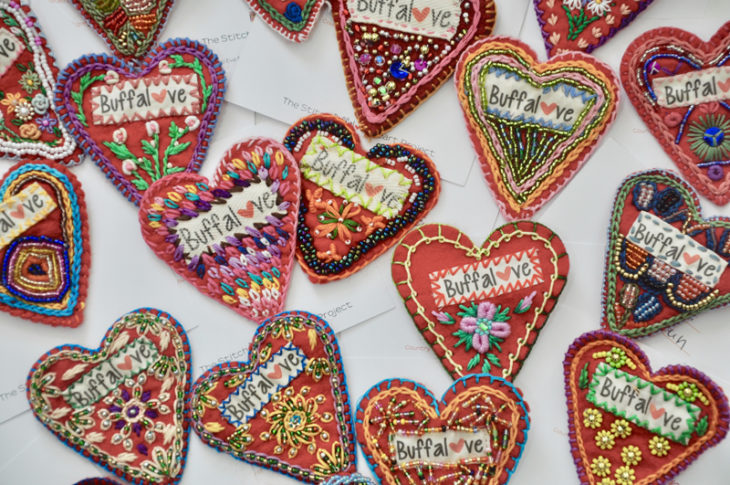
Photo: Stitch Buffalo Stitch Buffalo says it’s “advancing social justice for refugee women in Buffalo, NY, by creating opportunities for cross-cultural exchange and economic empowerment through the textile arts.”
Every individual and every community has its own way of responding to newcomers from other countries.
You would never know it from the headlines, but there are a lot of people who, being curious about foreign cultures or perhaps knowing what it was like for their forebears to be immigrants, feel friendly toward the latest arrivals. Maybe they just smile. Or maybe they work on some integrating initiative, like this charming one in Buffalo, New York.
Maura Christie reports at Spectrum News, “At first glance, it may not seem like much, ‘Embroidery floss, beads, scissors, fabrics, solid colored fabrics,’ said Dawne Hoeg, Stitch Buffalo’s executive director. But these common household items have quite literally bonded refugee women to [the city of Buffalo].
“Stitch Buffalo started as a project back in 2014 as a way to give those women a space of their own to learn and share ideas at different textile workshops.
“Now, five years and a storefront later, workshops are open to anyone in the community and many of the refugees have gone from being students to standing in front of workshops as teachers.
” ‘It’s an exciting opportunity for Buffalo people to come and have an authentic experience learning from a woman from Thailand or a woman from Burma, where she has learned this skill and is willing to share it with us,’ Hoeg said.
‘Some of their stitches are very different from the ones we do and it’s just a beautiful opportunity for a cross-cultural exchange.’
“Women also sell their one-of-a-kind, handmade items in the retail space, anything from pins to bracelets and ornaments. But every two months, that space gets transformed for Second Stitch. The nonprofit uses mainly donated materials, and anything they’re not able to use is sold to the community.
” ‘What we decided to do is to take those materials, sort them, measure them, organize them and turn them back over to the community at a reduced rate,’ Hoeg said. …
“No matter what project the women make next, or how much they sell it for, the love and support they receive from their adopted hometown is priceless.
” ‘It’s the making, but it’s also the selling,’ Hoeg said. ‘When you create something and you see that somebody else finds value in it enough to purchase it, that empowers you, that builds a confidence. That’s what I see happening with the women here is that they are empowered through the skill and the support they receive from the community.’ ”
Find some wonderful pictures at the Stitch Buffalo website, here, and at Spectrum, here.
Hat tip: Beautiful Day. Beautiful Day is a Providence-based welcoming initiative that teaches refugees and other immigrants basic job skills in the process of making a range of fantastic granola products. If you follow them, you will be alerted to new varieties you can buy, and you can read stories from around the country like the Stitch Buffalo story. I like to send their beautiful gift baskets to family members at holidays.
Shows how far we have come from ancestors who let nothing go to waste that making clothes out of leftover fabric is a novelty. But it’s a good idea nevertheless.
Katherine Martinko at TreeHugger writes that Beru Kids is a children’s clothing company in downtown Los Angeles that makes use of textiles that would otherwise be landfilled.
“The garment workers are mostly female,” she says, “and are paid higher than minimum wage (not per-garment, as is usual in the fashion industry).
“What’s really interesting about Beru is that it repurposes deadstock fabrics to make its clothes. ‘Deadstock’ refers to surplus fabric that has not been used by other factories. In LA, it is sent to a warehouse, where Beru’s founder Sofia Melograno goes on a regular basis to purchase whatever textiles catch her eye. Beru has also begun recently incorporating organic, traceable cotton into its garments.”
Traceability means the cotton can be traced back to its original source so it’s possible to assess whether all steps in the supply chain are environmentally and ethically sound.
Martinko adds that because the fashion industry is a huge polluter, finding a use for fabric that would otherwise get thrown away is good for the planet.
I had to share a delightful report from the radio show Studio 360 in which Khrista Rypl looks at the cultural aspects of African textiles.
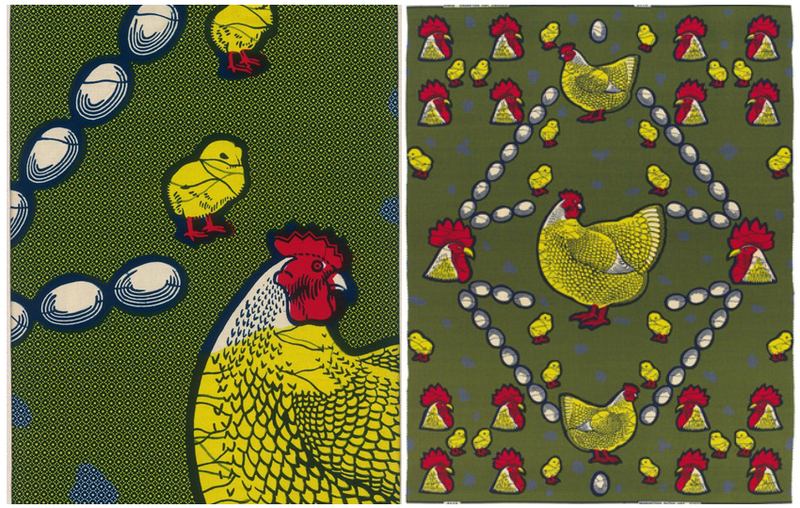
She writes, “African textiles are distinctive for their vibrant colors, bold patterns, and batik dyes that give the fabric a unique crackled texture. But I had no idea that some of the trendiest of these prints are actually designed and produced in the Netherlands by a company called Vlisco.
“Inge Oosterhoff wrote a wonderful deep dive into the history behind the Vlisco textile house, and explained how their designs have remained hugely popular in Africa since the late 1800s. But Vlisco doesn’t just make fabric; they’re known for their printed designs. … Some patterns are designed with different countries in mind, while others are distributed widely around the continent. As the patterns catch on among shopkeepers and consumers, many of them get colorful names like ‘Love Bomb,’ ‘Tree of Obama,’ and ‘Mirror in the Sun.’ …
“Many patterns are sold widely in Africa, and different countries and cultures adopt different meanings and associations. [A swallow] print is a perfect example. The fabric was used for airline uniforms in Togo, so there the pattern is commonly referred to as ‘Air Afrique.’ The pattern also symbolizes asking for a favor, like the hand of a woman in marriage. In Ghana, the swallow refers to the transience of wealth, and the pattern is referred to as ‘Rich Today, Poor Tomorrow.’ It has a similar connotation in Benin, where it’s referred to as ‘L’argent vole,’ where it could either be interpreted as ‘Money Flies’ or ‘Stealing Money.’ ”
More designs and more of Studio 360 report, “Textiles Tell a Cultural History,” here.
You have heard of “slow food” and perhaps “slow money” (a loan with a long time to pay back) and other efforts designed to help us reduce the often meaningless haste of modern life. Well, Cousin Claire has been posting news on Facebook about another slow movement that is sure to intrigue you, Slow Textiles.
Says Slow Fiber Studios on its About page, “We are founded on a simple intention: to offer real-world insight into the multifaceted and holistic practice of textile-making. Slow Fiber Studios™ offers dynamic, hands-on field study programs in diverse areas of the world where textile culture runs deep — India, Mexico, Japan, France, Italy, and on. We believe the best way to understand a philosophy is to see it being lived.”
Here is a description of a 2012 offering: “Special opportunity to travel throughout India with Yoshiko, who has been exploring this country for over 30 years (lived in Ahmedabad in 1983/84 on an Education & Culture Fellowship and frequent 3-month residencies spanning 3 decades). Yoshiko will introduce her friends in India who are involved in welfare, community empowerment, and cultural sustainability projects.
“Tour Highlights: natural dyes, organic cotton cultivation, handloom weaving, khadi, biodynamic farming, architecture, local food and religion, contemporary art and design educational institutions, museums, solar energy development, hand spinning and weaving wild silks and Tibetan wool in Himalayan communities.” More here.
How well I remember the wistful feeling I got in reading the book Lark Rise to Candleford when the beautiful handmade lace was spurned as soon as the factory-made came in. There is something to be said for speed and efficiency, but also something to be said for craft.







 Suzanne's Mom's Blog