Feeds:
Posts
Comments

Posts Tagged ‘theater’

Photo: Lesley Black.
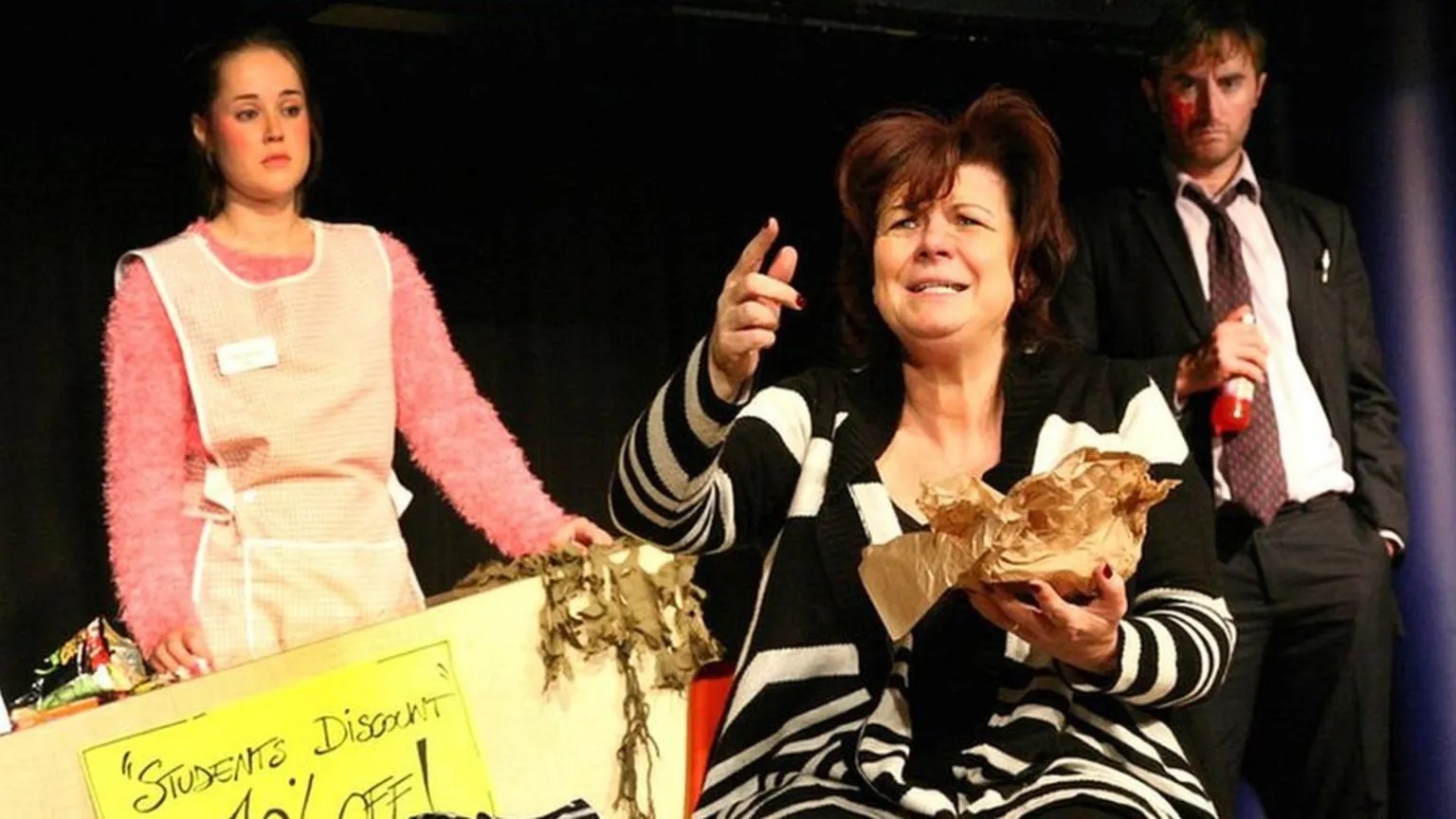
Theater company A Play, A Pie and a Pint produces up to 40 plays a year as well as two pantomimes in the Oran Mor venue in Glasgow, Scotland. Actor Elaine C Smith is pictured above.

I’m in the middle of reading a novel by one of my favorite mystery writers, Ian Rankin, who writes about Scotland. Besides his plots and characters, I love the Scottish slang. Sometimes I even have to look up expressions or words — Teuchter, Slainte, Howff. And it’s not just Gaelic words that are fun, but the Scottish way of putting English words together. For example, “getting mortal” means getting extremely drunk, smashed.

The murder mystery takes place during the offbeat theater festival known as the Fringe, which is why a recent BBC article about a Scottish theater group caught my eye.

Pauline McLean writes, “Established in 2004, A Play, A Pie and a Pint produces up to 40 plays a year as well as two pantomimes in the Oran Mor venue in Glasgow. It has given a platform to established names [and] has also helped new writers get a foothold in the industry, like Liam Moffat, whose play Jack opens the new season. …

“For Juliet Cadzow it is a bitter sweet moment. Her husband David MacLennan was the theatre director who came up with the idea. He died in 2014 after being diagnosed with motor neurone disease. …

“This is what he wrote at the time: ‘The actor Ralph Richardson once described acting as the art of keeping the audience from coughing. And Alfred Hitchcock said the length of a film should be directly related to the endurance of the human bladder. That’s why Colin Beattie and I started “A Play, A Pie, and a Pint.” ‘

“The first show was a play called Hieroglyphics, by Anne Donovan, author of Buddha Da. It was her first stage play. …

“Lunchtime theatre was already popular across Europe but the Scottish offer of a pie made it different, and brought its own challenges.

” ‘It was waiter service when it first started and everyone came and sat at long trestle tables and they were served their pie and It took time when it was busy,’ [actor Linda Duncan McLaughlin] says. ‘They wouldn’t have stopped serving before the play went up. So the waiters were trying to be quiet and and the audience were trying to be quiet but they were still eating.’

“But the concept quickly took off. ‘I think the fact that it was weekly helped,’ says Juliet. ‘If you didn’t like the play that was on that week, there would be a new one next week. And the audience were quite vociferous.

‘They would say to David “I didn’t like that one,” but they’d still come back the next week.’

“Those involved in the shows also liked the challenge of creating a 50-minute show with limited resources and rehearsals. Linda Duncan McLaughlin has written plays, as well as performing in them.

“She says: ‘You’ve got to get what basically is a full play into a fifty minute timeframe. You only have three actors, so if you wanted to write six parts, you’re going to have to be really good at writing doubling up parts and you have to make sure the actors can cope with that. It is limited but it’s a great discipline for a writer. And it really focuses your mind.’

“For some performers, it’s a chance to return to their roots, although Robbie Coltrane admitted his week long run in Peter MacDougall’s play My Father’s Old Suit in 2005 was a daunting one.

” ‘The idea of 500 Glaswegians drinking and having their dinner?’ he recalled in a 2010 documentary. ‘It’s like one of those Frank Sinatra concerts where all you can hear is the knives and forks clattering.’

“[Icelandic] writer Jon Atli Jonassan found the 2009 run of his play The Deep helped him into filmmaking. … ‘No one wanted to make it, but after the production here, we got interest from filmmakers. It was the most expensive film ever made in Iceland and was shortlisted for Best Foreign Film at the Oscars.’ …

” ‘If you’d asked us that first week, I’m not sure we would have been confident that we’d still be going twenty years hence,’ says Linda, who is co-chair of the Scottish Society of Playwrights. ‘It does offer an opportunity for new work to be on every week of the year for forty eight weeks of the year, which no other organization can offer. So it really does have a strong, vital part to play in Scottish theatre culture and long may it continue.’ “

More at the BBC, here.
Read Full Post »

Wigmaking for Theater

Photo: Antonio Olmos/The Observer.
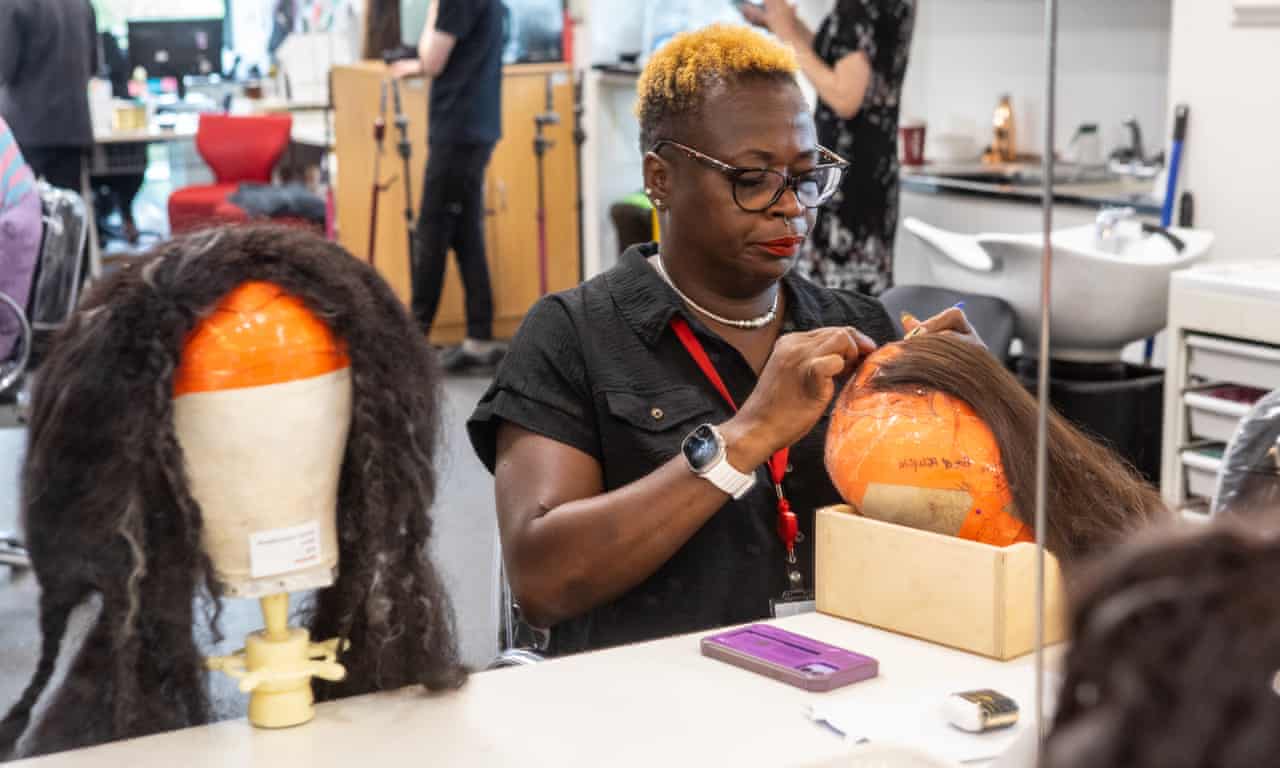
Skilled wigmaker Violet Barrie at England’s RSC [Royal Shakespeare Company].

Although I was in many theatrical productions as a kid, the first time I learned anything about wigs was when I had chemo. I lost my hair and wasn’t brave enough to go to work without any. (John told Suzanne, who was living in Switzerland then, “Mom looks like a little, bald mouse.”) But Dana Farber was known for nice wigs, and I got one there that I liked a lot.

Today’s story from the Guardian is all about wigs for the theater. Which can get complicated.

David Jays writes, “It’s a sunny afternoon in Stratford upon Avon and I’m watching actors become witches. In Georgia McGuinness’s design for Macbeth, the witches seem to be mostly hair. Amber Sylvia Edwards and Dylan Read peer out from mountains of furry locks, each looking as if a yeti has fallen asleep on their shoulders. The tumble of tresses is so heavy, it needs a harness for support. Welcome to the wild world of wigs.

“Some hairpieces are bobby-dazzlers: towers of Restoration foppery, ravishingly long Rapunzels. Others slink by unnoticed, disguised in realism. Who makes them? Who pins them on night after night? To find out, I meet two wig mavens. Sandra Smith is head of wigs at the RSC [Royal Shakespeare Company], and has warmly invited me to spend the day with her team in Stratford. Chris Smyth, meanwhile, only recently began his wig journey: he designed a memorable crimson creation for Jane Asher in The Circle at the Orange Tree in London. …

“The RSC storeroom’s wooden doors conceal mop after mop of blondes, browns and russets. A separate cupboard holds periwigs and judges’ rugs, like a bevy of poodles. This hoard reflects a practice built on sustainability and thrift. Mounds of witchy hair were foraged from the stores, saving thousands of pounds. ‘Nothing goes to waste, even the ratty bits,’ Smith says.

“Wigs, like actors, never retire. ‘We keep them till they die,’ her colleague Lavinia Blackwell says matter-of-factly. … ‘Wigs is an area of theatre that has been drastically cut back,’ designer Tom Piper says. ‘People have disappeared and budgets have gone down. I’m so grateful for somewhere like the RSC, who’ve got the team and a lot of stock.’ …

“Only when I see the foundations for all the team’s creations do I appreciate the challenge of our lumpy, bumpy human variety. Some heads are footballs, some shaped for rugby. The wigs team wrap actors’ heads in clingfilm and wind round sellotape to map the cranium, marking the hairline. …

“Theatrical wigs take quite a bruising, and the hair may be reused, which helps explain why the V&A [Victoria & Albert] collection holds few early wigs – the oldest come from Diaghilev’s Ballets Russes in the early 20th century. Even so, key artifacts indicate their role in nailing character. When Vivien Leigh played Blanche DuBois in the film of A Streetcar Named Desire in 1951, ‘the wig fundamentally made her appear less glamorous,’ [says Simon Sladen, V&A senior curator of theatre and performance] says. Leading theatrical wig-maker Stanley Hall created ‘impoverished, rather thin hair … to point out her highly nervous, worn-out character.’ …

“It’s painstaking work. ‘You tie each hair with a tiny little hook,’ Smyth tells me. How did he acquire the skills? ‘I do drag and I make my own costumes,’ he says. ‘I did a couple of days’ training in wigs and just fell in love, because it’s so difficult. It’s like the dark arts. I will never know everything. Everybody does it differently; it’s a rabbit hole that keeps deepening and deepening.’ …

“Everyone’s route into wig world is different. Smith was studying hairdressing and beauty therapy in Pontypridd when a friend took a job at the RSC, and she visited for work experience. ‘I had a lovely two weeks and I haven’t left since. I’ve been with the RSC for 38 years.’

“I crouch beside Violet Barrie, who ran a salon in Leamington Spa until Covid struck. Hairdressing was a family trade in her Jamaican childhood, so the fascination began early – just as it did when Smith grew up in Wales, watching friends and neighbors who came to get their hair done by her aunt on a Thursday evening. No wonder the wig room feels like a hug. …

“ ‘We invade somebody’s space from the first moment,’ Smith asserts. ‘We’ve got to be really skilled, but equally sophisticated in personal care: 90% of our job is reacting to somebody’s needs.’ The team intuit who is comfortable, who hates to be touched. …

“In the wings, Thérèse Bradley, playing Duncan, rushes up with a huge beam and a hug for Smith. ‘These women!’ she says. However careworn you may be when you sit in the wig room chair, she says, you leave ready for anything. ‘They perform miracles!’ ”

More at the Guardian, here. No firewall. Donations solicited. Check out the wild wigs for the Macbeth witches.

Read Full Post »

Photo: Atdhe Mulla.
The play Negotiating Peace had its premiere at Pristina’s Oda theatre in October, before going on tour. 

Wars eventually end, but the peace that follows is often uneasy. Art can bring some laughs into people’s lives and add to the accumulation of small things that make a more lasting difference.

Philip Oltermann writes at the Guardian, “When political leaders present war as the only solution, it is up to artists to remind people that finding peace is still possible. That is the starting point for a Kosovo-based theatre company, Qendra Multimedia. …

“The lesson it draws, and the genre it chooses to present its findings, is unexpected: the Kosovan playwright Jeton Neziraj’s Negotiating Peace shows the diplomacy of peace as a farce, albeit a necessary one.

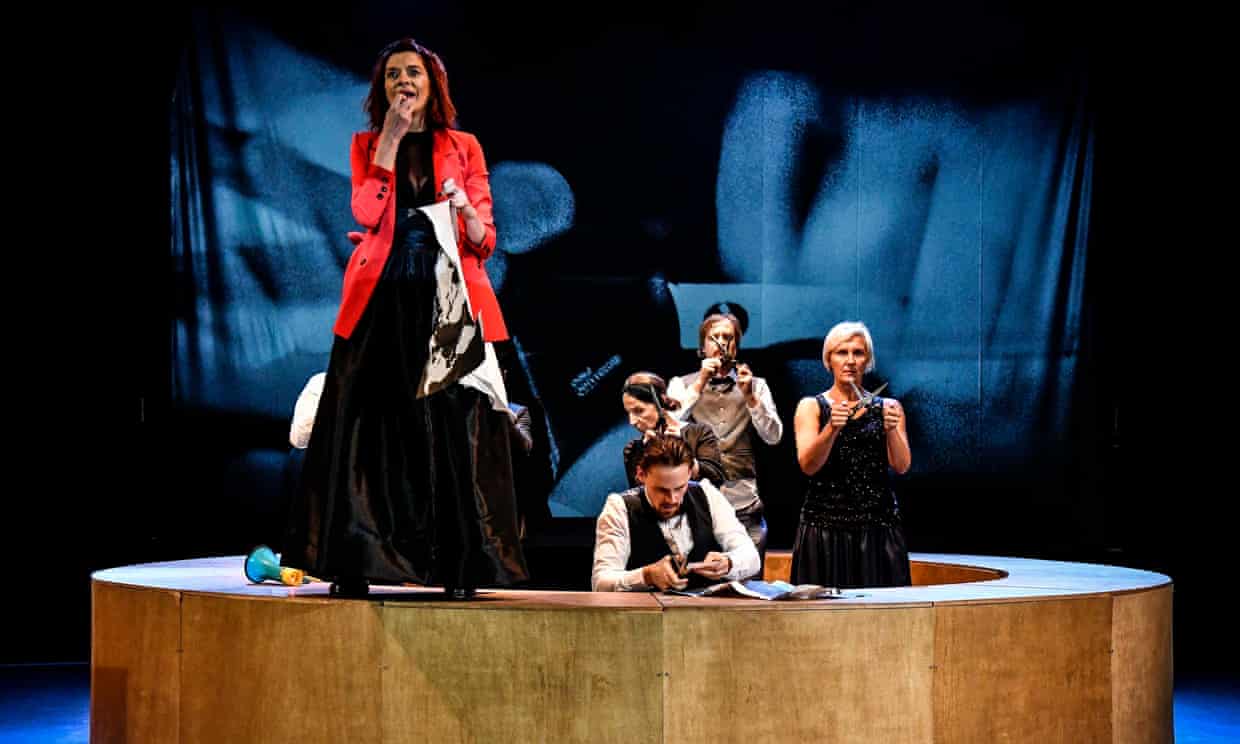
“Dramatizing roundtable talks between the fictional warring countries of Banovia and Unmikistan, the play is a frenzied comedy in which vain generals can only be lured to the negotiating table by promises of Hollywood films celebrating their actions. Opposing parties get drunk while negotiating demilitarized zones, mix up drafts of ceasefire agreements and sign on the wrong dotted line. Maps of disputed territories are partitioned with paper scissors until holy lands turn into showers of confetti. …

“ ‘When you talk about serious things, you must not talk about it in a serious way,’ said Orest Pastukh, a Ukrainian actor who is one of five members of Qendra’s multinational cast with first-hand experience of their country going to war. ‘If we would speak seriously about war and peace, everybody would go mad.’

“The play … is loosely based on the Dayton accords that in 1995 brought a halt to the three-and-a-half-year Bosnian war, the deadliest chapter in the breakup of Yugoslavia. At its premiere at Pristina’s Oda theatre last week, it also mixed in elements of the peace settlement that four years later ended the war in Kosovo. …

“To end that conflict between Serbs and Kosovo-Albanians in the breakaway province, Nato acted more swiftly and aggressively than it had done in the Bosnian war. In downtown Pristina, gratitude for the US’s assertive leadership in the peace talks is still palpable. There is a statue of a waving Bill Clinton, a bust of Madeleine Albright and a street named after Richard Holbrooke. …

“It may seem surprising, therefore, that in Negotiating Peace, moral certitudes come wrapped in sarcasm and not in pathos. The Holbrooke-type character, Joe Robertson, played by Harald Thompson Rosenstrøm, a Norwegian, is not just a ‘beast of peace’ but also ‘a schizophrenic, a brutal Mazarin.’ …

“ ‘When I read Holbrooke’s memoir To End a War, I realized that the negotiating table was also a kind of stage,’ Neziraj said on the eve of his play’s premiere. ‘And a dramatic stage on which actors were acting quite bizarrely,’ involving negotiators staging walkouts and new political borders ‘being drawn on napkins.’

“He said studying the Dayton agreement, as well as the Oslo accords signed between Israel and Palestine in 1993, had robbed him of the illusion that peace talks were structured conversations led by experts in their fields. ‘They are the fruit of the wills of individuals at a certain moment,’ Neziraj said. …

” ‘War doesn’t end when you lay down your arms,’ Neziraj said. ‘We in Kosovo live in an interim state, which is not war but neither a fully fledged peace.’ …

“Neziraj is aware of his own cynicism, and Negotiating Peace eventually manages to snap out of it. Towards the end of the play, the summit looks like a failure: faith in the UN is shot to shreds, there are calls for a second conference organized by the EU.

The chief negotiator appeals to the audience for advice to break the deadlock.

“As the play tours around the Balkans, the company intends to invite different real-life witnesses on to the stage. In Pristina the job fell to Aida Cerkez, a veteran Associated Press correspondent who covered the siege of Sarajevo from the Bosnian capital. Her 10-minute monologue changes the mood of the play.

“ ‘The only precondition for peace is to get everybody around the same table,’ she said after the curtain call. ‘And to get everybody around the same table, you have to militarily weaken the dominant side. As long as one side can think it can win, there’s no reason to sit down at the negotiating table. In Bosnia, that condition was met by Nato bombing. …

” ‘Peace is not the absence of armed conflict,’ she said. ‘In Bosnia we are living the absence of armed conflict, not peace. But that’s not nothing. It’s a lot.’ “

More at the Guardian, here. No paywall.

Read Full Post »

Photo: AP/Yuri Kageyama via Economic Times.
Ten-year-old Maholo is an emerging star in Japan’s 420 year-old Kabuki theater. And he happens to be French.

Having once been turned down for a New Shoreham committee because I was not a year-round resident, I love hearing about famously hidebound organizations that decide to open up. Today’s story is features Kabuki theater opening up.

Yuri Kageyama writes at the Associated Press (AP), “Ten-year-old Maholo Terajima Ghnassia loves watching anime and playing baseball. … And he’s breaking conventions in Japan’s 420-year-old Kabuki theater tradition.

“In Kabuki, all the roles are played by men, including beautiful princesses — a role Maholo accomplishes stunningly in his official stage debut as Maholo Onoe at the Kabuki Theater in downtown Tokyo. … He starts out disguised as a woman, dancing gracefully, before transforming into sword-wielding warrior Iwami Jutaro. He then makes a quick costume change right there on the stage, all while delivering singsong lines in a clear resonating voice unaided by a microphone.

“Out to avenge his father’s death, striking spectacular poses, Maholo performs swashbuckling fight scenes and slays a furry baboon.

” ‘I like “tachimawari” (fight scenes). It feels good, and people who are watching it think it’s cool,’ said Maholo. …

“Maholo’s grandfather, Kikugoro Onoe, appears as the God of War. He praises Maholo’s character, Iwami, and tells him to keep at his art, promising to always be at his side and help him attain his goals.

“Kabuki is typically passed from father to son, the art form largely limited to Japanese men. But Kikugoro Onoe is Maholo’s maternal grandfather; the young Kabuki performer’s father, Laurent Ghnassia, is French. …

“The huge curtain for the stage, which also works as advertising space, is speckled with fluttering dots of purple and orange, designed by French artist Xavier Veilhan of fashion house Chanel. This was Ghnassia’s idea — as an art director, he designs venues, installations, shops and events to market fashion brands, contemporary art and film ventures. …

“Maholo himself isn’t sure yet if he will stick with the strict, demanding art form and someday adopt his grandfather’s stage name, Kikugoro — a prized name in Kabuki passed down through generations of Onoe men.

“Child Kabuki actors go through a difficult transitional period when their voices change with puberty but they aren’t yet mature enough to take adult roles. Only the truly determined ones pull through that stretch to succeed.

“ ‘Unless he is recognized and in demand, he won’t get any roles. He must have the passion. It’s not easy. It’s up to him,’ said Maholo’s mother, renowned actor Shinobu Terajima. She won the Silver Bear for Best Actress at the Berlin International Film Festival for her poignant performance in the 2010 film Caterpillar.

‘It’s not easy, but choosing the harder path makes life more worthwhile. The more hurdles there are, the climb becomes worth it,’ Terajima said.

“Although Japan has been known for discriminatory attitudes toward foreigners and outsiders, Terajima hopes her son’s French cultural background will give Maholo a unique edge in the world of Kabuki. But he may become a film actor like herself, Terajima said.

“ ‘It must be felt. It’s not just the lines you speak,’ she said. ‘I want him to act by digesting within what’s received from the other, and then return that, changing one’s heart with that received energy. That’s fundamental to acting.’ “

More at AP, here. No firewall.

Read Full Post »

Photo: Victoria Onélien/Special to the Christian Science Monitor.
An immersive experience, “Dechouke Lanfè sou Latè” is performed within the audience and features formerly incarcerated women as well as actors to bring home the brutal reality of Haitian prisons. The Quatre Chemins theater festival took place in Port-au-Prince, Haiti, from Nov. 21 to Dec. 3, 2022.

Man, the resilience of the human spirit! Or maybe it’s stubbornness, not resilience. Doesn’t matter. Let us now praise whatever keeps people going in impossible circumstances. In Haiti. for example.

Websder Corneille reports at the Christian Science Monitor, “On a sunny afternoon, some 60 people gather in the small courtyard of Yanvalou Café, the unofficial home of Haiti’s theater scene. It’s the opening of the 19th annual Quatre Chemins (Four Paths) theater festival, but the fact that there’s a full house was never a given.

“For the past three years, Port-au-Prince, Haiti’s capital, has been overrun by criminal gangs. They’ve increasingly terrorized citizens, … blocking freedom of movement since the assassination of President Jovenel Moïse in July 2021. Many citizens have fled their homes in recent months, seeking safety elsewhere – in some cases camping out in public parks because their neighborhoods have become so dangerous.

“ ‘This city is scary these days,’ says Évens Dossous, an educator who came to see the reading of ‘Port-au-Prince et sa Douce Nuit (Port-au-Prince and Its Sweet Night),’ a new play by award-winning Haitian playwright Gaëlle Bien-Aimé. Before leaving home this afternoon, ‘I asked myself, “Is it really worth traveling? Will I be kidnapped?” ‘

“Art, and specifically theater, have a rich history of political resistance in Haiti. Although the unprecedented climate of insecurity has more to do with a vacuum of leadership – there have been no elections since 2016 – than with the overt oppression and censorship that citizens faced under dictatorships in the past, the crowd at Yanvalou today is a reminder that theater remains an act of defiance.

“ ‘You know, life can’t just be about insecurity,’ says Mr. Dossous.

“Colorful murals of well-known artists and thinkers cover the cement walls at Yanvalou, including singer Nina Simone, Haitian dancer Viviane Gauthier, and national anthropologist Jean Price-Mars. The audience at the opening in November makes its way from the courtyard into the restaurant, where chairs are set up facing two lecterns.

“The reading focuses on the lives of two young people, madly in love, in a home in Pacot, a wooded, formerly upscale neighborhood in the heart of Port-au-Prince. It underscores many real-life challenges, like the fragile state of the capital and the difficulty of leaving the house to get food, travel, or go to school or work. But it also dives into bigger questions, such as how to love – oneself and others – when a city is collapsing around you.

“ ‘Theater helps me ask questions about my life,’ says Ms. Bien-Aimé, the playwright, who was the second Haitian in a row to win the prestigious RFI Theatre prize, awarded to emerging Francophone artists. Theater ‘is a living art,’ she says.

“Since the assassination of President Moïse, armed gangs have taken control of some 70% of the capital. … Some 20,000 Haitians are facing starvation, according to the United Nations, the vast majority of whom are located in the capital.

“The insecurity, which includes using sexual violence as a weapon, has led to widespread displacement. Kidnappings increased by nearly 45% in Port-au-Prince in the second quarter of 2022, according to the National Network for the Defense of Human Rights, a Haitian nongovernmental organization. Many believe the gangs are protected by police, politicians, and business elite.

“ ‘The state has agreed to retreat so that armed groups can control the society,’ says Sabine Lamour, a Haitian sociologist at the State University of Haiti, citing research by Haiti’s leading human rights organization, the National Human Rights Defense Network. …

“Micaëlle Charles, the actor reading the lead role of Zily in today’s play, says a lot has changed in Haitian theater over the past three years. She and the entire team putting on today’s show take security precautions she never considered before, such as sleeping over at the rehearsal space. ‘This helps me to hold on, despite the problems in the country or any other problems life might throw my way,’ she says of her passion for the craft. …

“Using theater for social or political commentary isn’t unique to Haiti, but it has a long tradition here. Theater is ‘a weapon of mass awareness that gives the spectator the means to free themselves,’ wrote Félix Morisseau-Leroy in 1955. He was one of the nation’s first writers to create plays in Haitian Creole. Under the Duvalier regime, a father-son dictatorship that ruled Haiti for three decades starting in 1957, Mr. Morisseau-Leroy and others were targeted and exiled for their social commentary and what was perceived as anti-government messages in plays and literature.

“The Duvalier reign was characterized by violence and the suppression of free expression. One of Mr. Morisseau-Leroy’s most prominent works was his Haitian Creole translation of the Greek tragedy ‘Antigone.’ … It was an act of resistance for its message – and its use of the language of the masses. …

“Joubert Satyre, an expert on Haitian theater, told the Christian Science Monitor [that] theater in Haiti plays an important role in social and political struggles. He said, ‘It is this liberating and critical side of the theater that has made it, and that still makes it, suspect in the eyes of autocrats.’ 

“Not that the government is paying much attention to the arts in recent years, says Ms. Bien-Aimé. She’s firmly engaged in a ‘theater of protest,’ she says, but isn’t sure her artwork frightens the government as much as her outright activism. … ‘Today, the state doesn’t even go to the theater,’ she says.”

More at the Monitor, here. No firewall.

Meanwhile, in war-torn Ukraine, theater has gone into living rooms. See a New Yorker story about that.

Read Full Post »

Photo: Dea Andreea/Unsplash.
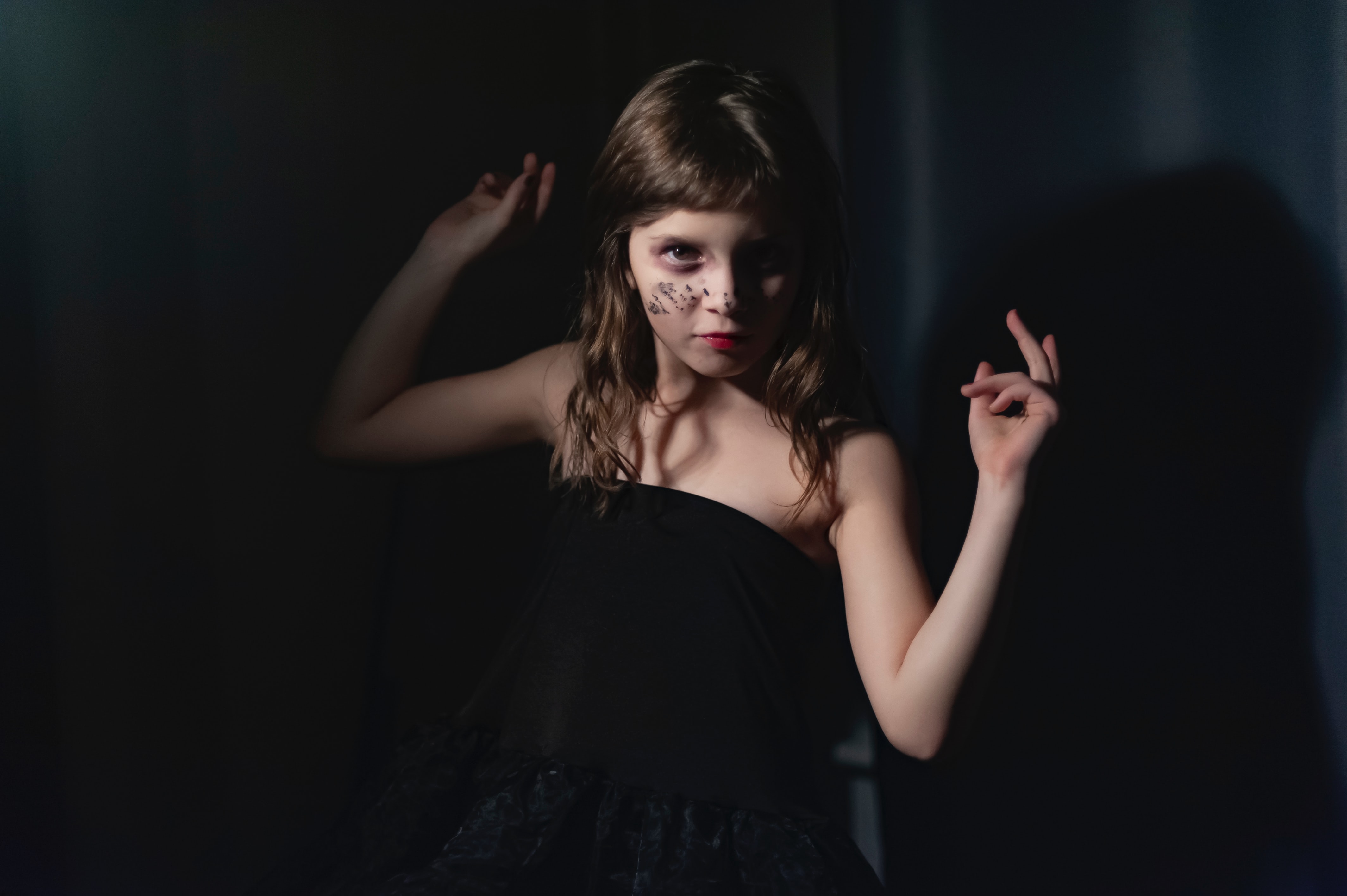
When a child is in a play, she can see what it’s like to be someone else for a while.

You don’t really need a reason to justify doing theater with children. It is just so much fun. But if you need a reason, think about what theater-engendered empathy and active listening can do for kids throughout their lives.

Alexandra Moe writes at the Washington Post, “It’s after school, and the tweens are rowdy with angst. Then two of them, Charlotte Williams, 13, and Tally Vogel, 11, face each other. Williams raises an arm, and Vogel raises her arm to follow. They’re practicing ‘the mirror,’ an improv exercise in a theater classroom, and the room suddenly hushes. It’s indistinguishable which girl is leading, and which is following. When the exercise stops, and the teacher asks how they were able to sync up so completely without speaking, Vogel says, ‘I used my eyes.’

“In other words, she used ‘active listening,’ a type of verbal and nonverbal communication skill that promotes mutual understanding.

“Several studies show communication skills are the most essential skills for navigating American adult life. … These skills are often taught through Social Emotional Learning programs, offered in K-12 schools in 27 states. But they are also a by-product of theater class, according to a recent study from George Mason University and the Commonwealth Theatre Center. The study follows children aged 5 to 18 over six years — the longest look at theater’s impact in kids to date — and finds increases in communication skills across age, gender and race.

“ ‘The longer the kids spent in the theater classes, the more they gained in 21st century skills, like communication, creativity, imagination, problem solving, and collaboration,’ says Thalia Goldstein, the study’s co-author and an associate professor of applied developmental psychology at George Mason University. …

“Parents of young children are familiar with pretend play — the couch is suddenly a frog castle, the floor a lake, and unbeknown to you, sharks are circling your ankles. It may seem like pure fantasy, but in fact, pretend play is the foundation for developing empathy, Goldstein says. It helps young children build emotional understanding, regulation and executive function, the foundational skills that later predict empathy levels. Parents can help foster empathy in children by introducing fiction books throughout childhood, with varied characters, settings and authors, which correlates directly to empathy scores in adulthood. They can let them be the drivers of pretend play, authors of their own stories.

“And theater class is yet another way. It’s the social dynamic of theater, the give and take, the volley of listening and responding, that expands kids’ capacity to read cues, think quickly and creatively, work as an ensemble and see things from another perspective. Theater provides an awareness of space, pausing, waiting for somebody else to talk.

“For children with autism, improv techniques increase eye attention and reciprocity of conversation, says Lisa Sherman, co-founder of Act As If, a communications program that specializes in working with autistic youths. And this is where the arts level the playing field for children of different abilities; they can participate in meaningful ways where language is not a requisite skill.

“A study among K-2 children in San Diego showed that participating in activities in drama and creative movement significantly improved English-speaking skills among children from primarily Spanish-speaking homes. Children with the most limited English benefited the most, says the study’s co-author, Christa Greenfader, an assistant professor of child and adolescent studies at California State University at Fullerton. …

“Connecting is ultimately the goal of communication, and it is the reason the actor Alan Alda began using improv exercises with scientists. Scientists are trained to speak methodically, defend their arguments and use niche jargon, a communication style that doesn’t always land with a general audience, says Laura Lindenfeld, executive director of the Alda Center for Communicating Science. Through improv, they are taught to make mistakes and laugh about it, to ‘give ourselves permission to fail and move on.’

“ ‘When scientists come into a room, they’re like, “Oh man, you’re going to put me through improv?” ‘ she says. But after exercises like ‘the mirror,’ looking intently into other people’s eyes, they realize they can’t succeed unless they’re in touch with the other person. Speaking becomes about making a human connection rather than pushing information — and that’s the point. You may have the most wonderful scientific finding, but if no one understands it, what’s the use?

“Sara Williams, mother to Charlotte, cites theater as the foundation for her daughter’s self-awareness. Charlotte began drama classes at age 5. At 13, she is not afraid to speak publicly or join the student council; she listens and has confidence. ‘They go to these classes and come home feeling energized, like they accomplished something,’ Williams says. And not just the outgoing kids — for the shy, theater opens them up. For children with anxiety, like so many children coming out of the pandemic, ‘the least judgmental place you can be is in a theater class.’ You can keep your personality, and unlike in sports, you’re not competing with anyone.

“In the end, theater is about telling stories. It is one of the best ways to help young people get to know themselves, Dawson says. Stories help us make sense of the world and understand another’s experience.”

More at the Post, here.

Read Full Post »

Photo: Barry Weatherall/Unsplash.
That moment before the show starts.

When I was 10, I was the understudy for Alice in Alice in Wonderland, a big deal in my life. Television director Binny Rabinowitz adapted the book and directed the show for the Antrim Players.

I never miss a chance to tell people that future star of stage, screen, and television René Auberjonois was the Gryphon. The girl who played Alice grew up to be an architect. She actually follows this blog.

Years later, John was also in a production of Alice, not to mention a variety of cool shows after that. He’s still a natural.

Theater stayed a big part of my life after that first Antrim Players show and included a few years with the Teenage Play in Ocean Beach, Fire Island, creating with other theater-loving kids, some of whom went on to fame and fortune (e.g., Tony Roberts, Michael Pressman, Lynn Lavner).

So of course I got a kick out of last night’s living-room production orchestrated by my youngest grandchild, a 7-1/2-year old writer/director. Having commandeered her older brother plus Suzanne, Erik, and me, she rehearsed each of us individually.

I was the Announcer and received a script featuring red marker and curious spellings. I was instructed to pause after each line introducing a performer and to press a button for that person’s specially composed and recorded song.

The show was called The Fantastic Tribes. It went without a hitch until the last minute, when we would have taken our bows together (in the hand-holding, swing-your-arms-up prescribed style) if I could have figured out how to continue recording while also getting myself in the frame. The dismayed director at first wanted a retake, but her brother convinced her that the look on her face when she realized the show was over was actually a perfect ending.

The iPad video evidence has been preserved for posterity and is sure to get someone in big trouble if they ever run for public office.

Read Full Post »

Photo: Kerry Jones.
Artist Kerry Jones turned her old trailer into one of the smallest cinemas in the UK.

Today we have another idea on taking what you have and turning it into something that can delight others.

“Until fairly recently,” writes the BBC, “Kerry Jones’s caravan lay rotting and forgotten about in her garden in Galashiels in the Scottish Borders — a home for discarded bric-a-brac.

“But during the Covid-19 lockdown, the artist and filmmaker saw new potential in the 1980s Swift Pirouette, and resolved to turn it into a tiny, traveling cinema. With a maximum of eight seats, it could be one of the smallest cinemas in the UK.

” ‘It isn’t the first cinema caravan to exist,’ said Kerry. ‘There was one over in Dumfries and Galloway that a friend of mine made at the beginning of the 2000s, that was really inspiring. I’m really interested in projects that involve people out in your community.’ …

“Over the pandemic, Kerry secured a bursary [grant] from the Alchemy Film and Arts charity based in nearby Hawick as part of a local arts program running between July 2021 and December 2023. She used it to renovate the caravan inside and out, swapping the retro mint paneling for a bright red that could be seen for miles. … Inside, she plans to install between six and eight seats, again in a plush, cinematic red fabric.

“Speaking to Mornings with Stephen Jardine, she said: ‘[I’ve] had it for 12 years — it’s been out and about, it’s been used for people to stay, it’s been a spare room. But over the last few years, but it’s just been one of those spaces that you put things in and forget about.’

“Kerry’s caravan cinema project — named Moving Images — [made] its debut at Hawick’s Alchemy Film Festival on 28 April, screening nine short films all made by people in the south of Scotland.

“It comes at a time when Scotland has lost one of its smallest cinemas — the Schoolhouse Cinema in Shetland. This 20-seat cinema, run by local magician Chris Harris, was put up for auction in 2020 after he decided to leave the islands.

“Around the same time another tiny theater opened in the Highland village of Cromarty — a 35-seat facility that took two years to come to fruition.

“Kerry aims to cater for an even more intimate experience, and will be using a small portable projector to save on power without sacrificing picture quality.

“The caravan itself is solar powered, but Kerry said she will borrow a high-quality battery as back-up until she can crowdfund her own.

“Any spare cash will then be put towards taking the caravan on the road — possibly for a tour of free screenings and running filmmaking workshops at local primary schools.

“Kerry added: ‘It’s going to be really adaptable. Selkirk’s market square have said they’d be quite interested in having the caravan there. I’d love to take it out to some of the more rural areas like Duns and Gordon.

” ‘We’re also going to work with a group called Connecting Threads and they’re doing lots of projects along the Tweed [river] — I’d love to see it there, that would be quite magical.’ “

There’s more to read at the artist’s website. “As part of The Teviot, the Flag and the Rich, Rich Soil, our programme exploring the pasts, presents and futures of Hawick and the Scottish Borders and investigating the town and wider region’s cultural identities in relation to land, water, industry, territory, place and environment, Alchemy is offering a number of bursaries to Borders-based artists. These bursaries will support a range of community-oriented projects between July 2021 and December 2023.”

More at the BBC, here, and Jones’s website, Alchemy Film and Arts, here.

Read Full Post »

Photo: Christopher Hopkins/The Guardian.
Back To Back acting ensemble member Mark Deans takes part in a weekend workshop at the Geelong Theatre in Australia. The group, which features people with disabilities, just won the “Nobel prize for theater,” says the Guardian.

I imagine there’s nothing like being recognized for great work when you least expect it. When you are just doing what gives you joy. That’s the recent experience of a specialized theater company in Australia.

Lyn Gardner reports at the Guardian, “A small Australian theatre company made up of neurodiverse and disabled actors has won one of the world’s richest theatre prizes, the DK2.5m (~$371,000) Ibsen award.

“Back to Back, which was established in 1987 and is based in Geelong, were announced as the winners of the biennial prize on Sunday night in Norway. The pioneering theatre company is the first Australian recipient of the award, dubbed ‘the Nobel prize for theatre,’ which goes to an individual or company ‘that has brought new artistic dimensions to the world of drama or theatre.’

“Back to Back is renown for their acclaimed and often confronting shows, like 2011’s Ganesh Versus the Third Reich, which sees the cast members interrupt the show to question their right to perform it, about the Hindu deity traveling to Germany to reclaim the swastika from the Nazis. Their other shows include Food Court (2008), Lady Eats Apple (2016) and The Shadow Whose Prey the Hunter Becomes (2019). …

“ ‘It is such an honor for all of us to get that award and to receive it from that panel,’ [ensemble member Sarah] Mainwaring said. … It’s so rewarding for us to know that we can go on, and build our work.’ …

“Back to Back’s artistic director Bruce Gladwin told the Guardian he was ‘shocked’ by the news. When he was first contacted by the Norwegian National Theatre, which takes part in the announcement, he thought they wanted to collaborate. ‘But in that meeting, they announced that we’d won it. None of the ensemble had any idea that they were in contention for it, let alone that they’d won. They were just so moved that their work was acknowledged at that level.

“Awards are strange because you don’t necessarily make the work to receive them. This just came out of the blue. I feel really honored that this group of international theatre practitioners have been watching the company’s work for close to two decades. They’ve acknowledged the ensemble’s insight as social commentators.’ …

“Norway’s ministry of culture made the announcement on Sunday local time, timed to mark the birthday of celebrated Norwegian playwright Henrik Ibsen.

“ ‘We are proud to be able to honor an outstanding and unique theatre company that asks questions of their audience, of society and of each other through groundbreaking productions,’ said chair of the prize committee, Ingrid Lorentzen. … In a letter detailing its decision, the prize panel praised Back to Back’s shows as ‘some of the most memorable productions of 21st century theatre.

“ ‘There is no need for exposition in their theatre, no overreliance on dialogue, no need for a proximity of performer and role. Back to Back create a theatre that doesn’t follow the rules; they take over spaces that have been marginalized, erased or rendered insignificant … this is a theatre that defies a tick box culture. It’s a theatre – both pragmatic and metaphysical – that gravitates around what it means to live in the fullest sense of the word at this precise moment in history.’ “

More at the Guardian, here.

Read Full Post »

Photo: American Alliance of Museums.
A young visitor is captivated by Dakota, Natural History Museum of Los Angeles County’s full-suit Triceratops puppet.

When Suzanne was a few months old, John was learning about dinosaurs, and we got into a kind of chanting routine reeling off all the fancy names we knew. Baby Suzanne seemed to think they were hilarious. If she was fussy, dinosaur names would distract her and make her laugh.

Dinosaurs and their names have always enchanted small children. To up the enchantment, a museum in Los Angeles has begun experimenting with bringing dinosaurs to life. Sort of.

Ilana Gustafson writes at the American Alliance of Museums blog, “The anticipation of an imminent transformative journey is palpable in the diorama hall at the Natural History Museum of Los Angeles County (NHMLAC), where a Dinosaur Encounter is about to begin.

“During the show, the audience cheers as a young guest, decked out in a bedazzled dinosaur shirt, is called onstage to feed the juvenile Triceratops known as Dakota. … The audience falls into a quiet anticipation as Dakota’s feet shuffle impatiently, her beak opening and closing, indicating that she’s hungry. The child onstage gets closer to the dinosaur, leaf in hand, and reaches their arm out nervously toward her beak. Slowly Dakota approaches. …

“Dakota opens her mouth and suddenly clamps it closed with the leaf in its clutches and excitedly wiggles her tail. The audience cheers as the child onstage, grinning from ear to ear, watches a dinosaur playfully eat a leaf right at their feet. The host of the show thanks the young visitor. …

“The full-suit Triceratops puppet, created by the fabulous puppeteers at Erth, is made of aluminum and plastic boning, foam, and lycra painted with acrylic, and contains an internal speaker and other mechanisms. Inside is a puppeteer … holding the sixty-five pounds of the weight of the puppet on their back, using largely their shoulders and core strength to maneuver it. Many technical elements need to come together to bring the dinosaur to life, but when they all unify in a performance, the audience forgets to focus on the mechanisms at work. …

“This act of relating to the characters on stage is another thing that make theater so powerful. In a study published in the Journal of Experimental Social Psychology, researchers discovered that watching theater can lead to increased empathy, the ability to understand the feelings of others. … I would make the argument that this empathy toward the dinosaur increases intellectual curiosity about these creatures, paleontology, and other related studies. …

“The father of a dedicated fan shared with us in an email the love his son had developed for our puppet, and in turn for the Natural History Museum.

‘Lev didn’t just watch T-Rex and Triceratops. Lev became T-Rex and Triceratops. After each show, Lev would show us his improvisational reproduction of the show we had just watched. He insisted upon silence while he delivered his performance, mirroring and perfectly mimicking the T-Rex right down to lifting his legs, bending over with retracted arms, and delivering his ferocious ‘roar’ while bobbing his head back and forth seeking his prey.’ …

“The designs of the full-suit Triceratops and T. rex puppets were informed by the museum’s paleontologists, including Dr. Luis Chiappe, Senior VP of Research and Collections, who advised the fabricators on how best to merge entertainment with science. The physical characteristics of our juvenile Triceratops and T. rex puppets were based on our paleontological collections and research. The museum’s scientists were keen to have some of the current research on dinosaurs reflected in these creatures. After a performance with our T. rex puppet, known as Hunter, we often get the question from a visitor (young and adult alike), ‘What’s that fluffy stuff all over his body?’ This opens up a conversation about proto-feathers, and how scientists have been able to make the connection between theropod dinosaurs and modern-day birds. …

“The experts at NHMLAC see the value these puppets have in garnering interest and support for their research. Dr. Nathan Smith, Curator at NHMLAC’s Dinosaur Institute, says … ‘The puppets are a truly unique way where we can envision these species as living animals, but also allow visitors to interact with them.’ “

More at the American Alliance of Museums blog, here. If you missed the giant puppet at the San Diego Zoo, you can read about it here. And here‘s a post from last fall on the one that strode across Europe.

Read Full Post »

Photo: Camilla Forte.
Nikkie Bauer sticks social distancing reminders for spectators onto the window of Chicago’s Reckless Records, where she performs her window play.

This story reminds me of being a kid. I had a passion for theater and many impractical ambitions. For instance, I was certain that if I put together a production of “Snow White and Rose Red” from the Brothers Grimm, my friends and I would be welcomed to perform it before a movie at the Lafayette Theatre. The grownups laughed.

In today’s article, frustrated theater people who persevered made surprising things happen.

Camilla Forte writes at American Theatre, “When the pandemic shut down live theatre in March of 2020, the ensemble members behind Chicago’s Stop Motion Plant were in the middle of producing a performance commissioned by Theatre Evolve. With the stages shut down and their play canceled, they found themselves having to pivot.

“As the world adapted to a new reality, the group began meeting virtually to discuss the possibility of producing and performing live theatre in a way that would keep both the performers and the audience safe. Eventually, inspired by Macy’s dioramas [and] Chicago performers who put on ‘porch concerts’ throughout the summer, the concept for Window Plays was born.

“Presented as a ‘walking tour with theatrical displays,’ and running Feb. 19-21, the performance was not a traditional narrative play, but rather a collection of six short individual vignettes performed within the storefronts of six separate businesses in Chicago’s Andersonville neighborhood.

In order to secure each storefront venue, members of Stop Motion Plant went door to door to explain the concept to shop owners.

“After receiving what they described as overwhelming support, the group landed on performing out of the Neo-Futurist Theater, Rattleback Records, Enjoy, Women and Children First, *Play, and Raygun.

“Each two- to five-minute play was acted out on a loop for an hour in its storefront window, allowing audience members to cycle between performances in a way that encouraged social distancing while making the experience accessible to a fairly large number of people. …

“Ensemble member Kevin Michael Wesson … drew on his puppetry background when determining the music and scale for his window play, Badvice. During his two-minute performance, Wesson asked audience members increasingly personal questions through the phone while pressing his hand against theirs through a pane of glass sanitized after every act. After the interaction concluded, he bestowed attendees with an envelope with three pieces of advice —two good and one bad — as a parting gift. …

“[Perry] Hunt placed a cardboard cutout of herself herself behind a screen and illuminated the cutout from behind. She then Facetimed her audience, convincing them the person they were speaking to on the phone was the person whose silhouette they could see in the window, only to reveal she was never actually there. …

“Although the performances were a revival of live theatre, the actors still had to grapple with the challenges of a virtual format throughout the six months it took them to put together the piece. …

“Despite the challenges this format presented, some ensemble members found the innovations born from working around these challenges refreshing. Hunt, for instance, found that working within a more limited format allowed her the freedom to think about theatre in more abstract ways, with this experience being something that will influence her work beyond the pandemic.

“ ‘I think it’s given me permission and space to think about more innovative ways that I can produce art,’ Hunt said. ‘This project has pushed me to be challenged and make challenging things.’ “

More at American Theatre, here.

Read Full Post »

Sometimes there things that we don’t think we can say that instead we put in the mouths of stuffed animals, pets, or puppets. In the early 20th Century, that’s what left-leaning Yiddish puppet masters found themselves doing more and more as international audiences lapped it up.

Eddy Portnoy writes at Smithsonian about Yosl Cutler and Zuni Maud, who “created a Yiddish puppet theater that fused traditional Jewish folklore, modern politics, and a searing satiric left-wing sensibility.

“Both immigrants from Eastern Europe, Cutler and Maud met in the New York offices of a Yiddish humor magazine called Der groyser kundes (‘The Great Prankster’), where both worked as cartoonists and writers of often surreal short stories. They became fast friends and opened a small studio on Union Square, where they sold artworks and painted furniture. Both were tangentially involved in theater set decoration; when Maurice Schwartz, the founder and director of the Yiddish Art Theater, asked the two to create puppets for a scene in a play he was staging at the end of 1924, they jumped at the chance.

“Puppets weren’t a common form of entertainment in Jewish culture. … But in the mid-1920s, puppetry had become hot in American theater. … Schwartz, who had his finger on the pulse of New York’s theater world, saw an opportunity to put puppets in his production of the Yiddish classic Di kishefmakherin (‘The Sorceress’). It would be the first time puppets would speak Yiddish on a Yiddish theater stage.

“But it never happened. … Schwartz decided that the puppets Cutler and Maud had created were too small to see from the house, so he cut the scene. The two would-be puppeteers took their creations home. As a joke, they began taking the puppets with them to the literary cafés they frequented and performed shtick for their friends. Someone suggested they start a Yiddish puppet theater. …

“At the end of 1925, Cutler and Maud set up shop in a space in the Lower East Side in what had previously been a children’s clothing factory. They briefly hired an artist by the name of Jack Tworkov, who had been trained in the art of puppet making by Bufano. During shows, they would set fabric cutting tables and simple wooden benches in front of the stage for the audience: a somewhat ramshackle production with a proletarian feel. Initially performing comic scenes and a modernized version of the traditional Jewish Purim shpil (holiday play), which included a variety of characters from the Lower East Side, they quickly garnered good reviews in New York’s Yiddish newspapers.

“Under the moniker Modicut, a combination of their last names, word spread, and their shows began to sell out. Adding to their repertoire, they included comic playlets, often including parodies of popular Yiddish theater songs. …

“In addition to lauding Modicut’s plays, reviewers noted how finely their puppets were constructed. Although they were caricatures and grotesques, their costumes were deemed authentic, from the silk robes and prayer shawls of Jewish traditional figures to the work clothes worn by Lower East Side laborers. Some of their puppets included unique, culturally relevant innovations, such as the rotating thumb or wagging thumb of a sermonizing rabbi, or the wiggling ears of their emcee. The first time Yiddish-speaking audiences saw homegrown characters on a puppet stage, their reaction was one of sheer joy. …

“They went on tour in 1928, bringing their Yiddish puppets up and down the Eastern seaboard, to parts of the Midwest, and even to Cuba. As they wrote and performed new skits, they became more politicized, actively engaging with and satirizing the news of the day. …

“They traveled to Europe, playing in England, France, and Belgium before heading to Poland, the largest center of Yiddish culture. In Warsaw, they played 200 sold-out shows, followed by 75 sold-out shows in Vilna. Reviews in the Yiddish press were effusive, and journalists were amazed that two ‘Americans’ could present something that was so authentically Jewish. …

“On the back of their European success, Modicut was invited to perform in the Soviet Union during 1931 and 1932. They prepared by writing skits addressing themes such as the oppression of the working class, and featuring sweatshops, corrupt bosses, exploitation, imperialism, the depression, and war. All of this proved popular to audiences in the USSR. …

“They worked together until 1933, when a fight of unknown origins caused them to split up the act. … In May 1935, Cutler went on the road, allegedly to California in hopes of making a full-length Yiddish puppet film, performing in Jewish communities along the way. It was on the road to Denver that Cutler and his puppets met their demise [in a car crash]. …

“Maud was devastated by Cutler’s death. Having worked together so intensely and successfully, he felt awful on account of their earlier falling out. He nonetheless continued to produce art and work in puppetry for the remaining twenty years of his life. Notably, he worked with puppeteer Nat Norbert Buchholz, who later taught the craft to Shari Lewis, who debuted her famed Lamb Chop puppet on Captain Kangaroo in 1956.”

“Cap’n Aroo,” as a kid I know used to say! Though not as insightful as the later children’s TV star Fred Rogers (who also used puppets to speak for him), he nevertheless entertained kids for 29 years. So here’s to puppets on Captain Kangaroo!

Read more about the Yiddish puppeteers at Smithsonian, here.

Read Full Post »

When I was 12, I was a playwright. I’d had a terrific gig as an actor in community theater at age 10 and just fell in love with the whole scene. At 12, I rounded up cousins to perform my play about a talking snowman outdoors for parents. We save things in our family. Not long ago one cousin sent me her tattered, penciled script.

Theater people are often very generous. Most are not celebrities and don’t make good money. The playwright in today’s story did have a successful show on Broadway, but the bulk of his money came from sidelines. When he saw how much it was, he decided to help theater people who were struggling.

As Michael Paulson reports at the New York Times, “Jeremy O. Harris is a playwright, a performer, and a provocateur. And now, he’s a philanthropist.

“The 31-year-old author of Slave Play, which is nominated for 12 Tony Awards, emerged during the pandemic not only as a vocal advocate for the beleaguered theater industry, but also as someone determined to model generosity.

“After years in which he earned very little making theater — he said his total commissions over four years amounted to about $22,000 — this year he made nearly $1 million, primarily from collaborations with the fashion industry and an HBO deal. (Fashion and television pay better than Broadway.)

So in the months since the virus shuttered theaters across America, Harris has:

“He has also used his bully pulpit to champion theater. He sent a letter to President-elect Biden, urging him to revive the Federal Theater Project, and then used an appearance on ‘Late Night with Seth Meyers’ to push that show’s host to rally support for the idea.

“In a telephone interview, Harris explained why in dire times he believes everyone should be committed to ‘protecting, uplifting and sharing,’ adding: ‘Some might call it philanthropy, but I call it upkeep or maintenance.’ These are edited excerpts from the conversation.

How would you describe the kinds of artists or works you’re looking to support?

“I want to make sure that we have a really fertile artistic landscape when we return to the theaters. And I think it’s been pretty evident that I’m really excited about work that’s challenging, that’s scary, that probably wouldn’t get support otherwise. …

“Even before the tumult of this year, you’ve had an interest in highlighting Black theater artists.

“It was so exciting to see myself in Tennessee Williams, in Beckett and Caryl Churchill. But there came a point where I was like, ‘Wait, have Black people never done anything like this?’ And when I discovered that not only had they, but so many had done it to wild acclaim, and yet no one I talked to remembered that acclaim or knew those people, I knew that something had to be done about this cultural amnesia. …

“The $50,000 commissions are above the norm for playwrights. How did you arrive at that amount?

“I wanted to give someone a living wage in New York. I wanted someone to feel excited about spending a year and a half, maybe two, working on one play, and not feeling compelled to work in a coffee shop.”

More at the New York Times, here

Read Full Post »

Photo: Peter J. Thompson/National Post/File
The Royal George Theatre in Niagara-On-The-Lake, Canada, is home to the annual George Bernard Shaw Festival. The National Post reported in July, “Shaw’s are among the only actors, musicians, and theatre workers in the world who still have jobs.”

When Suzanne was a toddler and John about 6, we made the pilgrimage from our home near Rochester, New York, to the famed Shaw Festival at Niagara-on-the-Lake. Curiously, although it’s a June event, I think of the festival every year in December when I hang Christmas tree ornaments that I bought in Niagara-on-the-Lake.

The main focus of the festival is the oeuvre of playwright George Bernard Shaw, but there are other offerings. We took turns babysitting, and I went to see the British concert comedienne Anna Russell (1911-2006), always hilarious.

But I digress. Today’s post is about the Shaw Festival, but not about the performances.

Calum Marsh writes at Canada’s National Post, “About three-and-a-half years ago, Tim Jennings, the executive director and CEO of the Shaw Festival in Niagara-on-the-Lake, decided to undertake some risk analysis alongside his CFO. He looked at potential problem areas, and at concerns that might arise throughout the course of an ordinary season of theatre, and came to a shrewd conclusion: The festival should take out an insurance policy against the threat of a pandemic.

“The policy covered the interruption of planned performances by communicable disease. As a consequence of that remarkable foresight, the Shaw Festival has been able to do the basically impossible …

In an industry that has been universally devastated, the festival has kept its more than 500 employees on the payroll full-time.

“Almost everyone in the field of arts and entertainment has been out of work since the beginning of the lockdown, when live performances became a logistical impossibility. But thanks to the coverage, Shaw’s are among the only actors, musicians, and theatre workers in the world who still have jobs. …

“Given how few people were prepared for such an incredible turn of events — and how many businesses, including major corporations, failed to anticipate such a contingency — the Shaw’s insurance policy doesn’t look merely fortuitous. It looks downright prophetic. Jennings insists he is no Nostradamus. He was simply planning ahead.

‘People keep telling me it was genius,’ Jennings says, reflecting on this extraordinary stroke of luck. ‘It wasn’t actually genius. It wasn’t about this pandemic at all — it was about communicable disease.’

“In his time working in theatre Jennings has seen a minor stomach bug waylay productions on countless occasions. Shaw employs a rotating repertory ensemble; if one of his actors got the flu, ten of them could, and that might stall a show. ‘We took it out for the whole season, thinking that if six actors got ill and we had to shut down for two weeks, we might lose two million bucks,’ he explains. ‘But the policy also very clearly covered a pandemic. That was really a useful piece of good fortune.’

“No insurance policy is perfect, of course, and the Shaw Festival, Jennings points out, is ‘still running into money issues, as one would expect.’ But it is nevertheless the only organization of its kind to have managed to keep so many people employed and working when the actual work they do isn’t feasible.

“The festival has also taken advantage of the CEWS [Canada Emergency Wage Subsidy] to offset the cost of paying its people — including the many actors and musicians who aren’t technically eligible, as independent contractors, thanks to another canny move. ‘Our actors rehearsed on Zoom from March through May, waiting to get back on stage,’ he says. ‘When it became clear that it wasn’t going to happen, we pivoted.’

“Jennings terminated their contracts, instead hiring them on as employees, under the title Education and Community Outreach Specialists.

“[They] made calls to donors, taught choreography to students over Zoom, and performed for the ill in hospice. ‘I was able to rehire all of the artists, actors, and musicians, plus about ten more. All of these artists are able to get back to work.’ ”

Such a nice story! Read more here.

Hat tip: ArtsJournal.com

Read Full Post »

merlin_173066703_e2716cc9-9930-43cf-bddc-793876f48fd6-jumbo

Photo: Dmitry Kostyukov for the New York Times.
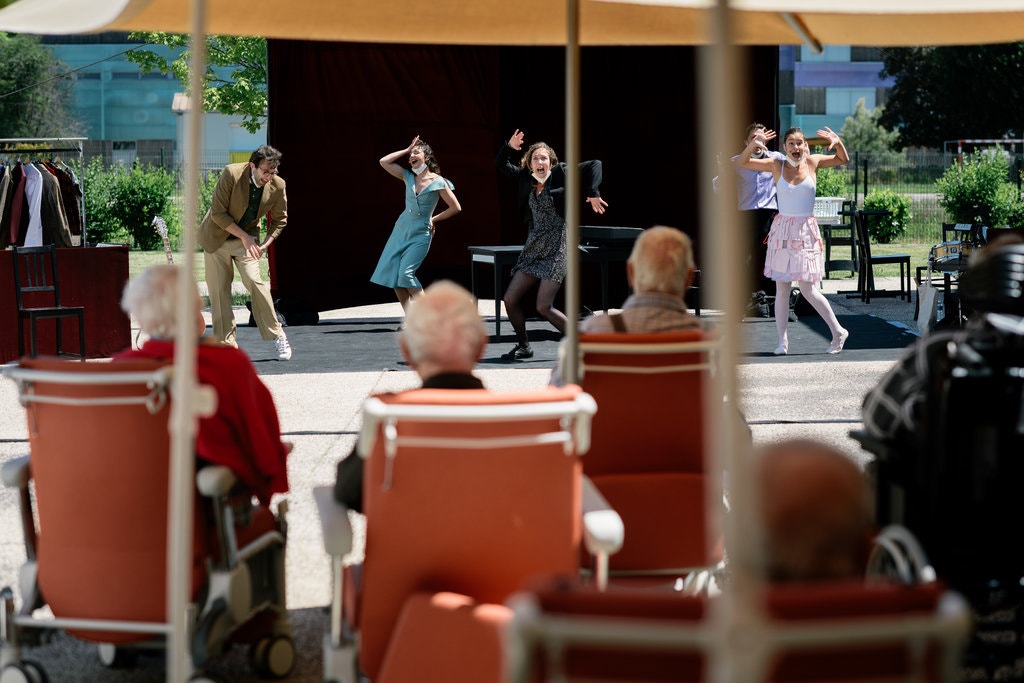
The cast of “Cabaret Under the Balconies,” kept away from their theater by Covid-19, performs at a safe distance for nursing home residents in France.

What hath Zoom wrought? Despite its glitches, Zoom has solved a lot of problems in the coronavirus era and has even introduced new ideas for future activities. Yesterday, for example, one brother and I watched another brother give a lecture on immunology research to a conference — a thing we could never before have imagined doing. Although we hardly understood a word, we both found the experience of watching our kid brother explain obscure transformations of molecules — and gracefully answer all sorts of technical questions — completely delightful.

In today’s story, a theater group in France tapped Zoom to conduct remote rehearsals before performing in front of a live audience.

Laura Cappelle reports at the New York Times, “When circumstances close theaters’ doors, you can count on some performers to find a window to open. Last week in [a] city in eastern France, the residents and staff of a nursing home watched from a safe distance — some from windows and balconies — as five actors appeared in the building’s courtyard in front of a makeshift red curtain. ‘It feels like it’s been such a long time,’ they sang, in a cover of Joe Dassin’s wistful chanson ‘Salut.’ ‘Far from home, I’ve been thinking about you.’

“ ‘Cabaret Under the Balconies’ [was] the first professional theater performance in France since lockdown was imposed on March 17. …

“The relief of the cast was palpable as they performed at the facility, the Ehpad Bois de Menuse. … The 45-minute show was designed to respect social distancing among the cast members as well as between them and the audience, Bréban explained in an introduction.

“Except for one real-life couple, who were allowed to kiss, none of the performers touched. … Bréban, who also performed in the show, capitalized on the actors’ individual strengths, from Antonin Maurel’s clownish energy to Cléo Sénia’s burlesque background.

“Their approach appeared to resonate with the audience, limited to 40 people. (The show was performed twice so that most of the 90 residents could see it.) Many of them were in wheelchairs, yet could be seen nodding or tapping their feet to the beat. In the courtyard, one woman got up, swung her arms and danced with a masked worker from the home. Another teared up as Léa Lopez, a young performer with a lush voice, sang ‘Somewhere Over the Rainbow.’

“Valérie Gonthier, a nursing assistant who stayed by the woman’s side as she cried, said in an interview afterward that music often stirred up emotions for residents who experienced memory loss. The Ehpad has a choir, but French nursing homes don’t typically have the funds to bring in professional performances; Gonthier couldn’t remember anything like last week’s show in the 26 years she has been with the institution. …

“Nicolas Royer, the theater’s director since January, said he disagreed with many French arts administrators who had interpreted government regulations to mean that performances were impossible. He didn’t furlough any employees, instead asking the costume department to make surgical-style masks, welcoming doctors from a nearby hospital in the theater’s guest apartments and hosting training sessions for city workers dealing with the crisis.

“In April, Royer got a call from Bréban, an experienced actress and emerging director who was going stir crazy in her Paris home: She told Royer she was down for anything he dreamed up. …

“The cast of ‘Cabaret Under the Balconies’ rehearsed over Zoom for seven days and, after the relaxing of lockdown in France in May, met in Chalon-sur-Saône for one week of in-person rehearsals — with strict rules. Bréban booked cast members with no health conditions. Daily temperature checks and frequent use of sanitizing gel were mandated, and everyone was offered a coronavirus test.

“By far the most onerous directive for the performers was to maintain a distance from one another of roughly one meter at all times. … ‘We were confident that we were within labor regulations, with an audience that was already confined and highly protected,’ Royer said. …

“The last time I went to the theater, two and a half months ago, Isabelle Huppert headlined Ivo van Hove’s staging of ‘The Glass Menagerie.’ For all the star appeal of that night at the Théâtre de l’Odéon, ‘Cabaret Under the Balconies’ was the more memorable event — a sincere attempt to go back to basics, in the right place, at the right time.”

More at the New York Times, here.

Read Full Post »

« Newer Posts - Older Posts »