Feeds:
Posts
Comments

Posts Tagged ‘Tunisia’

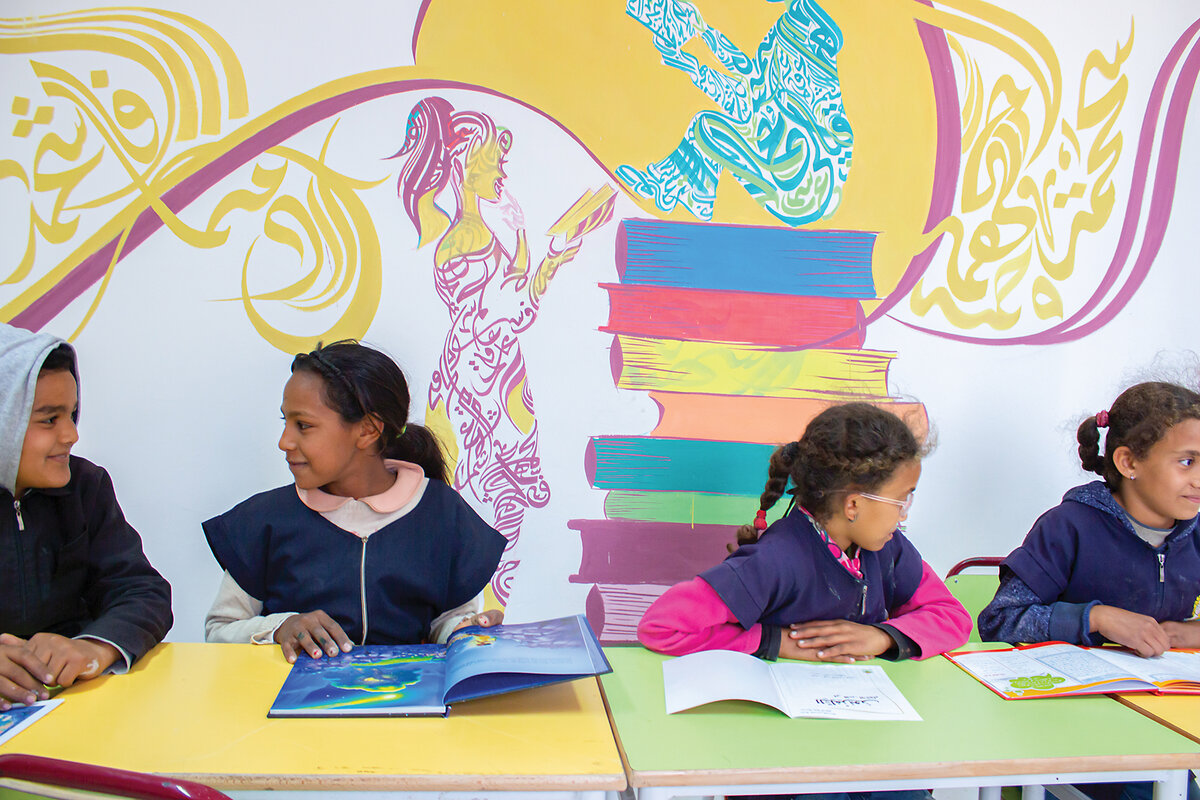
Photo: Meriem Belhiba.
Girls explore colorful storybooks in the newly inaugurated library at Bir El Euch Primary School in Tunisia.

Meriem Belhiba wrote this story for the Christian Science Monitor.

“To children in this hilltop village, their school library is a portal to another world.

“Israa Al Trabelsi and five other 9-year-olds barely stifle their giggles as they weave – wide-eyed with curiosity – through the colorful room. They can plop down into cushioned chairs, look at bright wall art, and, of course, browse shelves bursting with books. The transformative space was built for children to dream in.

“ ‘I’ve learned so much,’ Israa says after taking a seat with a book about faraway lands in her hands. ‘It is also helping me improve my vocabulary and my writing,’ she notes, quickly adding, ‘I want to be a judge.’

“That might seem an unusual ambition for a child in Bir El Euch, a rural community of 1,600 people southwest of Tunisia’s capital, Tunis. But it makes sense when one learns that the man behind the library, Omar Weslati, is himself a judge who knows how precious books can be to children. ‘This project began as a way to reconcile with the child I once was, who had nothing,’ he says.

“Economic inequality has long been a challenge in Tunisia, a country of 12 million people. Widespread poverty in rural areas, high unemployment, and poor infrastructure were key triggers behind the 2011 mass protests that toppled a 23-year dictatorship and touched off the Arab Spring uprisings. …

” ‘I grew up in a rural school without a library, without light, without transportation, and without heating,’ Judge Weslati recalls. ‘As a bookworm, I needed to walk long distances to reach the nearest public library.’

“Launched in 2016, the initiative is led by white-collar professionals, most of whom hail from rural communities. These journalists, writers, judges, and teachers have chipped in funding to create a new library every year. Each one serves hundreds of students and takes thousands of dollars to complete.

“The project’s launch could not have been timed better. The first ‘imagination libraries,’ as they were initially called, were built in the aftermath of the violent extremism that accompanied the Arab Spring. Amid the waves of unrest that ensued across the region, Tunisia has been the biggest contributor of foreign fighters in the world – with Tunisians joining extremist groups in Syria, Libya, Iraq, and elsewhere.

“This was a factor behind the library initiative. ‘Where the book doesn’t reach, the extremist arrives first,’ Judge Weslati says. …

“Besides offering books as a source of inspiration, Judge Weslati’s team began visiting remote schools and sharing members’ personal stories. ‘We wanted to show kids that people from their own soil once dreamed, created, and contributed,’ he says.

‘We never saw this as charity; it’s about cultivation,’ he adds. ‘Planting stories where they hadn’t taken root before.’

“Beyond reading, the initiative led to something more: a writing club for rural youths. Teenagers craft short stories together and publish their work. One of the teens, Molka Hammami, credits her former teacher Jamila Sherif for lighting a spark in her.

“ ‘Reading changed my life,’ Molka says. ‘It pushed me to do more. I was published in the [club’s] collective storybook last year.’ Now she helps run a radio show for the club.

“Ms. Sherif, who has since become a school inspector, emphasizes the stakes. ‘Many kids drop out after primary school,’ she says. … ‘We’re trying to change that – one library, one book at a time.’”’

“Reports have shown that, despite declining school dropout rates across Tunisia, the problem is most acute in rural areas. Donia Smaali Bouhlila, an expert on educational inequality at the University of Tunis El Manar, says inadequate schools and infrastructure in rural areas are among the biggest reasons that students drop out.

“ ‘When learning spaces lack comfort, resources, or consistency, they stop being places of growth and become sources of alienation,’ she says. ‘Every small success – helping a child learn to read, keeping a teenager engaged – represents a meaningful step forward.’

“Safahat, a cultural organization whose name translates to ‘pages’ in Arabic, aimed to serve schools when it was founded in 2020 [but] faced logistical and financial hurdles because of the region’s remoteness. This prompted its team to pivot to a more mobile model: public bookcases. …

“Through its Maktabtena (‘our library’) initiative, the group placed red-and-white boxes of books in hospitals, youth centers, and schools, and on street corners. … Readers are invited to take a book, read freely, and donate their own books if they can. ‘We want to make reading a habit, not a luxury,’ [Khawla Mondhri, a university professor and volunteer leading the initiative] says. ‘If someone takes a book and doesn’t return it, that just means it’s being read somewhere else. ‘And that’s enough for us.” …

“So far, the team has installed 35 bookcases in accessible, safe, and visible spots. To ensure a bookcase is never empty, the team has formed partnerships with municipalities, associations, and individuals.

“ ‘We send books as often as needed. We plant small oaks,’ Ms. Mondhri says. ‘But we dream of forests.’ ”

More at the Monitor, here.
Read Full Post »

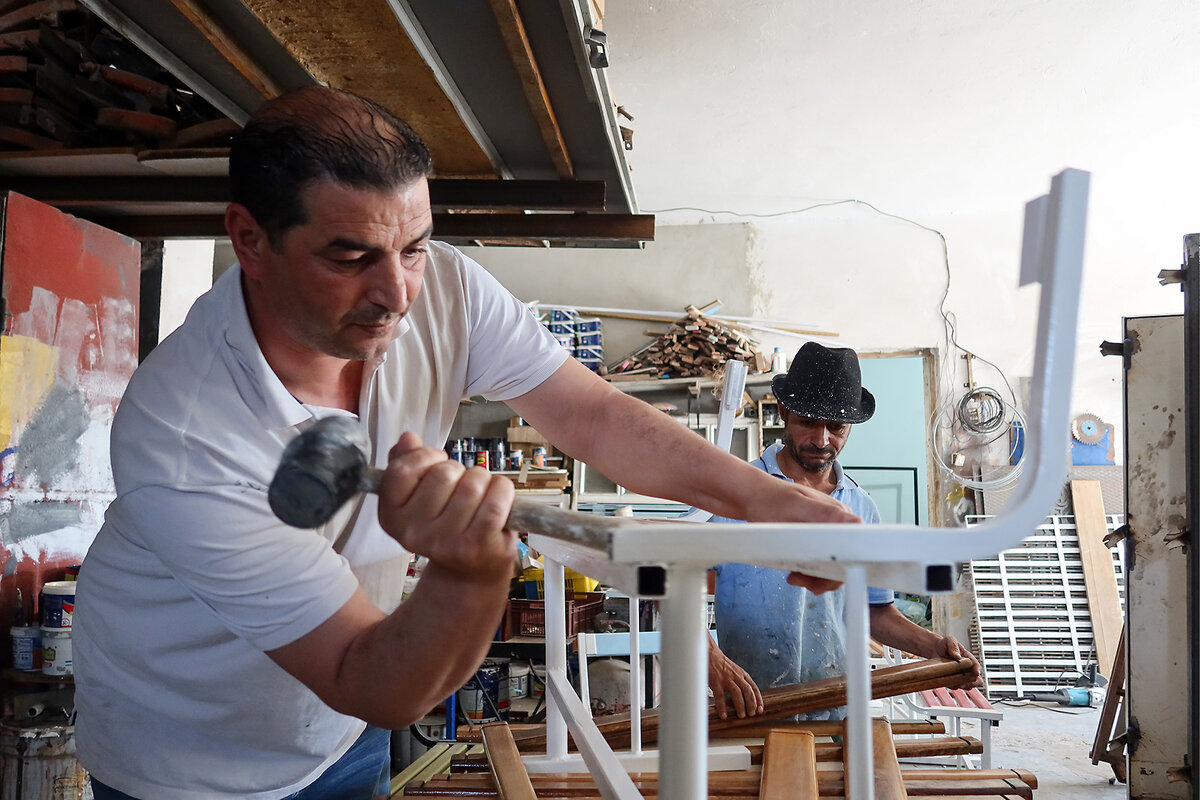
Photo: Erika Page/Christian Science Monitor.
Karim Arfa (left) works on a bench in his workshop in El Mourouj, a neighborhood of Tunis, Tunisia. He often shoulders jobs that government should have been tackling.

You were thinking from this post’s title that it was about the US? No. Not overtly. I certainly am preoccupied with harnessing the power of ordinary people in the US these days.

But no, this post is about Tunisia.

Erika Page writes at the Christian Science Monitor about how good, no-nonsense people can — and do — take civic problems into their own hands. Just because the work needs doing.

“Chadia Jarrahi can still taste the sting of embarrassment she felt when the principal sent her young sons home from school, their clothes too wet and muddy to attend class. From that day on, whenever the river was high, Ms. Jarrahi took the two boys piggyback across the ravine separating her village from the main road on the other side. …

“It’s a common story in the mountainous, interior regions of rural Tunisia, where fewer government resources are directed to infrastructure and services than along the more urban coast. The residents of Al Taraiya, in the northwestern province of Béja, had been fighting since the 1990s for a bridge connecting their community to the only nearby school, mosque, grocery store, and hospital. [Local] officials deemed the project too expensive.

“Then Karim Arfa caught wind of the residents’ plight. In recent years, the building and painting contractor has made it his mission to take on just that sort of impossible-seeming project. Using mainly scrap metal and his own creativity in his workshop in Tunis, he has built much-needed infrastructure and equipment, from furniture for schools to pedestrian bridges.

“Mr. Arfa’s work serves to assure those who have long felt abandoned by their national and local governments that regular people can come up with solutions to entrenched problems – even where resources are scarce. …

“Today, a bright pink bridge stretches from the winding highway to the rolling hills on the other side of the river. Ms. Jarrahi’s children play with other kids along the walkway; neighbors lead donkeys and motorcycles to and from the homes that are just visible across the valley. Residents no longer worry about missing work, running out of places to buy food, or not being able to go to the hospital when rain makes the river swell. …

“The bridge will help reduce absenteeism and school dropouts in the area, predicts Mohamed Jouili, a professor of sociology at the University of Tunis, over email. He also says Mr. Arfa’s initiative ‘encourages other members of the community to recognize their own agency and actively contribute to improving their environment.’

‘If everyone does something small, we can do it all,’ says {Karim] Arfa.

“Mr. Arfa himself grew up in a rural area of Tunisia, some 100 kilometers (62 miles) south of Al Taraiya. He nearly dropped out of school because of the difficulty of getting to and from class. … He eventually opened his own workshop on the outskirts of Tunis. But he never turned away from his rural roots. ‘I wanted to do something to repair their situation, as if I was repairing something for myself,’ he says.

“He started with a school dormitory that burned down in 2018, redecorating the space and then building a new library for the school in an abandoned room. From there, he began repairing desks and chairs in schools and maintenance hole covers for roads. After hearing about a young girl who died crossing a river on foot in 2019, he and his team of volunteers began building their first bridge, in the province of Kasserine.

Steep mountains meant the machinery couldn’t get to the bridge site, so they had to dig out the base by hand.

“ ‘Karim goes to the places the government doesn’t go,’ says Cherif Ait Daoud, a Tunis-based architect who helped design the bridge. …

“The bridge in Béja, Mr. Arfa’s sixth such project, was finished in 2023. ‘One year, seven days, and two hours ago,’ recalls Ahmed Terroui, a resident of Al Taraiya. He and others spent two months helping Mr. Arfa assemble the bridge, often after working long shifts as day laborers on nearby farms.

“The bridge’s railings are made of rods from old school desks, refurbished and repainted at Mr. Arfa’s workshop. Three-fifths of the steel is recycled. Only the cement, gravel, sand for the foundation, and the rest of the steel had to be bought. Officials had predicted that construction could total 2 million dinar (about $635,000). … Mr. Arfa and his team pulled it off for 41,000 dinar. …

“So far, he has relied on donations alone, either in the form of scrap metal or money. But it has been difficult to secure stable funding. 

“As trucks and motorcycles whir by, Basma Ammouri rolls dough into a ball, presses it into a wide circle, and sticks it on the inner wall of an open clay oven to bake. She set up her makeshift roadside bakery across the bridge from her home in Al Taraiya, just after it was inaugurated. She now has reliable access to customers who stop along the highway to buy her traditional tabouna bread. That income helps support her young children.”

When we think, “What can one person do?” it helps to remember people like Mr. Arfa. Even if you can’t build an actual bridge, you can build bridges to others. And then there’s the “stable funding” piece of the puzzle: even small monthly donations to worthy causes help people who do the work you value and lets them know how much they can plan for.

More at the Monitor, here.

Read Full Post »

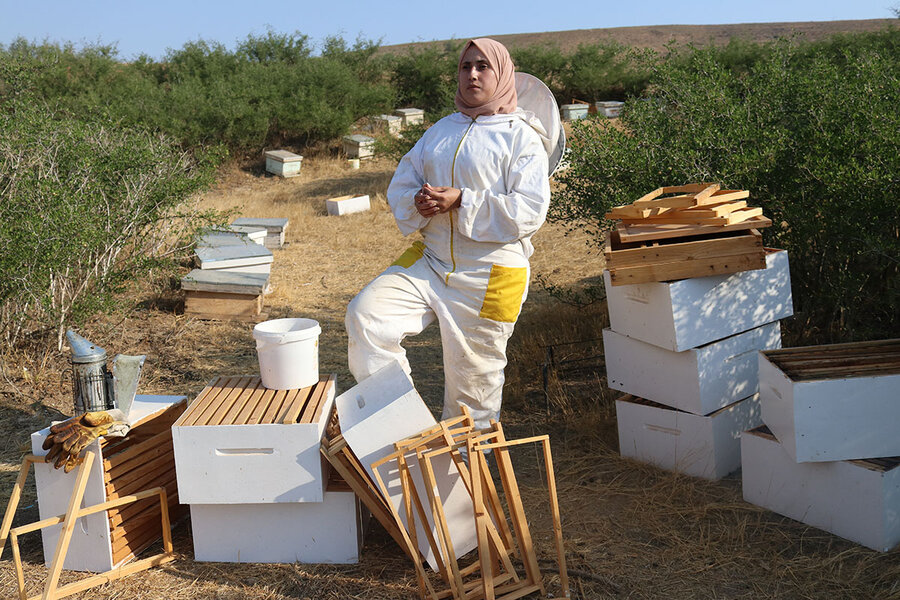
Photo: Taylor Luck.
Apiarist and entrepreneur Hela Boubaker stands next to one of her collections of beehives on a farm in Bizerte, Tunisia.

There are two news outlets I especially love for their focus on parts of the world most US media ignores until there’s a disaster. One is the weekday radio show The World. The other is the Christian Science Monitor. These organizations interview people on the ground in foreign countries, voices we seldom hear with perspectives we know nothing about.

In today’s example, Taylor Luck reports at the Monitor on what extreme heat is doing to beekeeping in Tunisia and how beekeepers are adapting to the warming trends that affect us all.

“Tunisian beekeeper Hela Boubaker keeps a firm smile as she inspects an empty hive box, the 20th hive she has lost due to heat or wildfires this year. Hives are carefully placed in the shade on this farm 40 miles north of the capital, Tunis. At 10 a.m. on a late-August Tuesday, it is already 95 degrees.

“Thirsty bees dive-bomb a bucket of water, drowning for a drink before she can place a sponge as a landing pad.

‘It’s not easy,’ she says as she slides an empty honeycomb frame back into its box, ‘but at the same time, we are not easy: We won’t give up.’

“In this North African country, where nearly 40% of citizens and entire communities rely on farming for their livelihoods, bees are a big business. And to protect their beehives against extreme weather, the nation’s apiarists are turning to innovative solutions. …

“Some 13,000 Tunisians work as full-time beekeepers, according to local farming unions, in addition to thousands more who rely on apiary work as another source of income, producing a combined 280,000 metric tons of honey per year. Yet for those new to beekeeping in Tunisia, the past two years have been no honeymoon.

“Tunisia has seen record-setting scorching temperatures, including dayslong 115-plus-degree heat waves and record 120-degree temperatures in its tree-lined temperate north – the nation’s beekeeping hub – that sparked devastating wildfires in 2022 and again this July. This year the country has also struggled with a record drought, leaving regions without water for weeks at a time.

“According to researchers and apiarists, the extreme weather has nearly halved honey production, from an average of 8 kilos (17 pounds) of honey per hive to 4 to 5 kilos per hive in 2023.

“Ms. Boubaker, an entrepreneur in her late 20s, is finding ways to keep her bees alive. She has developed a patented device and nonlethal method to extract bee venom from her honeybees, drawing exactly 0.01 grams of apitoxin per bee to be used in medical treatments and beauty products. …

“To adapt to a changing climate, Ms. Boubaker is working with other apiarists to better cultivate the rented or borrowed plots of farmers’ land where they place their hives. Increasingly, they rely on drought-resistant and hearty plants such as lemon trees, thyme, and marjoram to ensure year-round nectar and food sources for hives, as more delicate flowers and plants wilt in increasingly hot temperatures.

“Like many apiarists, she rotates her beehives through geographic locations with varying topographies – the mountainous pine-treed north, the more arid south, and the rich fertile farmland around Bizerte.

“Ms. Boubaker’s commute to check on her dispersed 82 colonies is a six-hour, 200-mile round trip that she takes every two days. Yet the geographic dispersal of apiarists’ beehives has led to another, emerging threat to Tunisia’s honey-makers: crime. Specifically, theft. …

“ ‘Only a beekeeper would have the knowledge and equipment to be able to pick up hives and transport them,’ says Ms. Boubaker, who rents fields in gated farms to minimize theft. ‘Unfortunately, people are desperate. When you lose the source of your livelihood, you are desperate to rebuild it. Some may be tempted to steal money. Others steal bees.’

“To help Tunisian beekeepers confront 21st-century challenges, innovators are putting constantly updated apiary data in an app. …

“Says Khaled Bouchoucha, a Tunisian engineer who has grappled with solving Tunisia’s plummeting bee numbers, ‘All the knowledge beekeepers have accumulated for decades and generations is no longer applicable’ in a rapidly changing climate.

“In 2021, Mr. Bouchoucha developed and launched SmartBee, a device and app that provides beekeepers with real-time data on hive temperature, humidity, weight, and mortality rates. …

“With the data, advance warnings, and advice sent to beekeepers’ phones, apiarists are informed when to move overheated hives to cooler areas and when isolated hives have become too cold, or they’re alerted to provide sugar solutions to boost weak bees – a critical service when hives are often dozens of miles away. SmartBee is also an anti-theft device.” 

More at the Monitor, here. No firewall. Subscription price is reasonable.

Read Full Post »

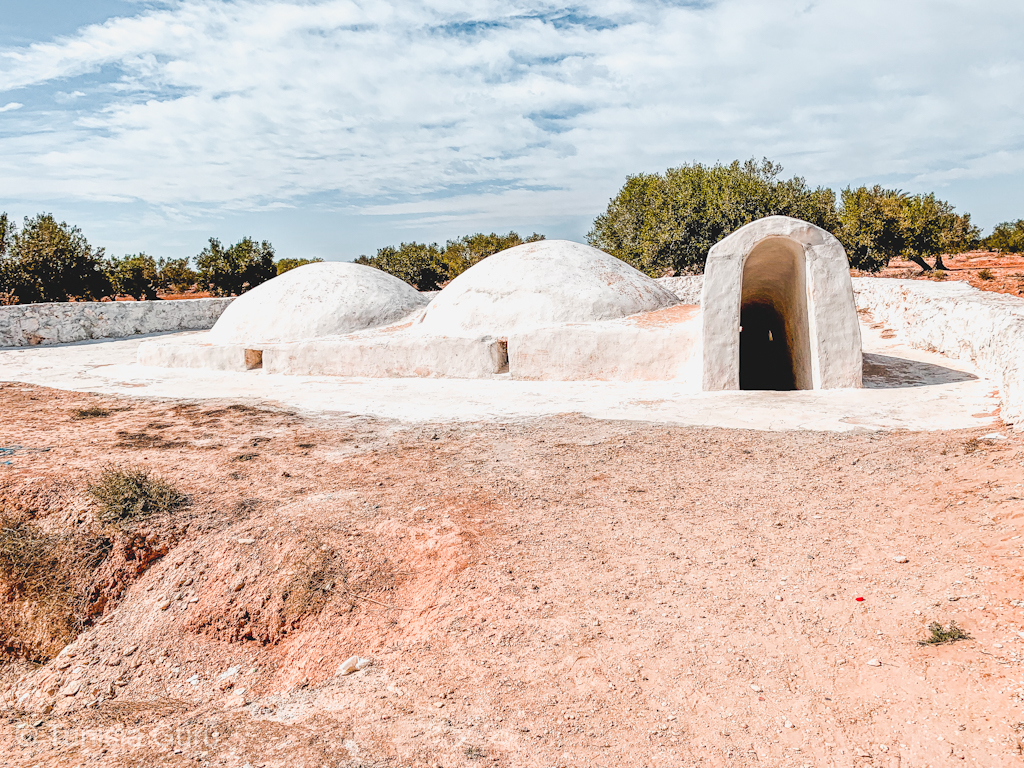
Photo: Tunisia Guru.
An underground mosque on the island of Djerba in Tunisia.

I got interested in finding out more about underground mosques after seeing a photo of one on the island of Djerba in Tunisia — an island thought to be the same that Homer had in mind when writing about the Lotus Eaters in the Odyssey.

An entry at Wikipedia says that underground mosques are “either erected beneath other buildings or lay freely in the ground with an inconspicuous appearance. The prayer rooms in underground mosques are usually very small, and they also have no minarets. Underground mosques are very rare. [The Djerba mosque] served as a hidden place of prayer for the Ibadis.”

From a different Wikipedia page, we learn that the mosque is near Sedouikech, Tunisia, and dates from the 12th or 13th century. “Surrounded by an olive grove, it opens to the outside by a very steep staircase that leads to the main room; next to it is a large underground tank fed by a well. Another of these underground mosques is located on the Ajim road. Not being used for worship, these mosques can be freely visited.”

An underground mosque in Turkey was built only recently, not because worshippers needed to hide like the Ibadis but because underground worship can feel peaceful.

Menekse Tokyay writes at Alarabiya, “The uniqueness of the Sancaklar mosque is that it departs from standard mosque design in a bid to break architectural taboos and encourage worshippers to focus on the essence of the religious space and on the Islamic faith. …

“Strolling around the mosque’s outdoor area, you will notice a long canopy running along one side where two olive trees and one linden tree are located. From this point, you have to descend natural stone stairs to reach the building.

“The cavernous prayer hall of the mosque is large enough to host more than 650 worshippers, while it aims to isolate believers from the outside world and invite them to delve deeper into their inner world.

“What strikes one about the Sancaklar mosque is that its design is humble and simple, perhaps to deepen worshippers’ relationship with their faith, and with this underground concept, visitors can leave behind all the challenges of the outside world. …

“Sancaklar mosque stands in Istanbul’s suburban Buyukcekmece district and is spread over an area of 1,200 square meters. The architecture combines Islamic and Ottoman designs with a modern touch, seemingly free from mainstream architectural typology.

“In 2013, out of 704 projects from 50 countries, the building won first prize in the World Architecture Festival competition for religious places. In 2015, the project was selected for the Design of the Year award, organized by the London Design Museum and it was also shortlisted among the 40 nominees for the Mies Van der Rohe Award.

“The mosque was designed by Turkish architect Emre Arolat for the Sancaklar Foundation. …

“The only decoration on the walls is the Arabic letter ‘waw’ and verse 41 of Surat al-Ahzab, a chapter in the Quran: ‘O you who have believed, remember Allah with much remembrance.’

“The main space is free of any decorative ornaments unlike many modern mosques built recently in Turkey. Daylight penetrates the prayer hall along the Qibla, or Mecca-facing, wall. …

“ Every time I come here for worship I feel an enormous [sense of] inner peace. It is also a place of meditation for me when praying under daylight infiltrating into the hall,’ Asli Karacan, a youngster living nearby, told Alarabiya.”

More at Wikipedia, here and here — also at Alarabiya, here.

Read Full Post »

Have you been reading any of the advice columns on ways to deal with undifferentiated time in a pandemic? The columns with titles like “What day is today?”

Not knowing what day it is was one thing I dreaded before I retired, but I’ve developed my own systems. In today’s article, agricultural time suggests another approach.

Layli Foroudi writes at Sierra, “In the second half of January, I met a friend in Tunis, the capital of Tunisia. He was agitated and said that he needed to go back to his hometown of Gabès. …

“He said he needed to plant trees. It was that time of the year, when temperatures are mild at night and cold in the day — the ideal climate for planting fruit trees. It’s known as the layali essoud.

“In March, I followed my tree-planting friend to Gabès. A few days later, the country went into lockdown to stop the spread of the novel coronavirus. And so, I became a guest in a ghabba.

“The word ghabba means ‘forest’ in Tunisian Arabic. But it also means a plot of farmland within an oasis. The ghabba that I passed my time in was a hectare of land (around 2.5 acres), much of it overgrown with reeds. …

“I didn’t look for a way to leave. I was ready to replace humans with plants, and the uncertainty [with] the work of making things take root.

“The Tunisian traditional agricultural calendar splits the year into unequal slots of time that indicate how crops behave and what activities to carry out. Layali essoud comes just after layali el bidh — the white nights from December 25 to January 13 when temperatures plunge in the night. ‘The plant sleeps, so it is the time to cut it — it doesn’t hurt them,’ explained Hassen Waja, a 74-year-old retired teacher. …

“In Gabès, dates came up often in my conversations with those aged over 50. … Back in the day, dates were the go-to food for breakfast or a snack, and Gabès-grown dates were bought in bulk by nomads because they travel well. …

“The demise of the local date has transformed the oasis, said Nizar Kabaou. … Since the 1970s, he said, Gabès has seen a 60 percent reduction in the surface area covered by date palms. …

“Now, it is the smell of sulfur that is a marker of home. … Since the 1970s, the region has served as a zone for the treatment of phosphate, a key natural resource for the country, used for the production of fertilizers — an irony given the devastating effect the industry has on local agriculture. …

“Cement and phosphate treatment plants [have] exhausted the region’s natural water resources. …

“Water comes every 40 to 50 days and costs three to five dinars per hour ($1 to $1.7), plus a five to 10 dinar bribe for those who want to skip to the head of the line. ‘Before the creation of the industrial zone, the oasis benefited from 750 liters of water per second — from a natural source. Now we are at 150 to 170 liters per second, with a pump. That is the ecological catastrophe that Gabès has undergone,’ said [one man]. …

“In some parts of Tunisia, people still count their days according to the agricultural calendar, though this is rare now. In Gabès, only the farmers still use it, said Waja, the retired schoolteacher. When Waja was a child, he said, ‘the oasis used to be life.’ …

“Ninety-five percent of the population of the Chenini Oasis were full-time farmers, according to Nizar Kabaou. Today, about 20 percent are. But 40 percent still practice agriculture in their spare time, and, in the past five years, Kabaou has seen a small renaissance of part-time oasis farming, which has only grown during the lockdown.

‘This period gives value to the old type of agriculture,’ he said. ‘To live, we need to do our own production. In situations like this, we need to be self-sufficient.’ …

“In Tunisia, the economic toll of the lockdown sparked protests in parts of the country where people were struggling to eat. This did not happen in Gabès, where the ghabba remained. ‘In Chenini, you never go hungry,’ said [farmer Zakaria] Hechmi, who still trades produce with his neighbors. …

“At the oasis, I [read] Flights by Olga Tokarczuk, In one chapter, a character describes two types of time. ‘Sedentary peoples, farmers, prefer the pleasures of circular time, in which every object and event must return to its own beginning, curl back up into an embryo and repeat the process of maturation and death.’ Linear time, which is ‘able to measure progress towards a goal or destination, rises in percentages,’ was more favored by nomads and merchants. …

“When I arrived at my friend’s ghabba, only a portion of the land was still being used to grow fruit and vegetables. Gradually, we began to plant more and clear away reeds that hadn’t been touched in 25 years. No one had the time, and then we did.”

More at Sierra, here.

Read Full Post »

110520maghreb20jews20yashiba

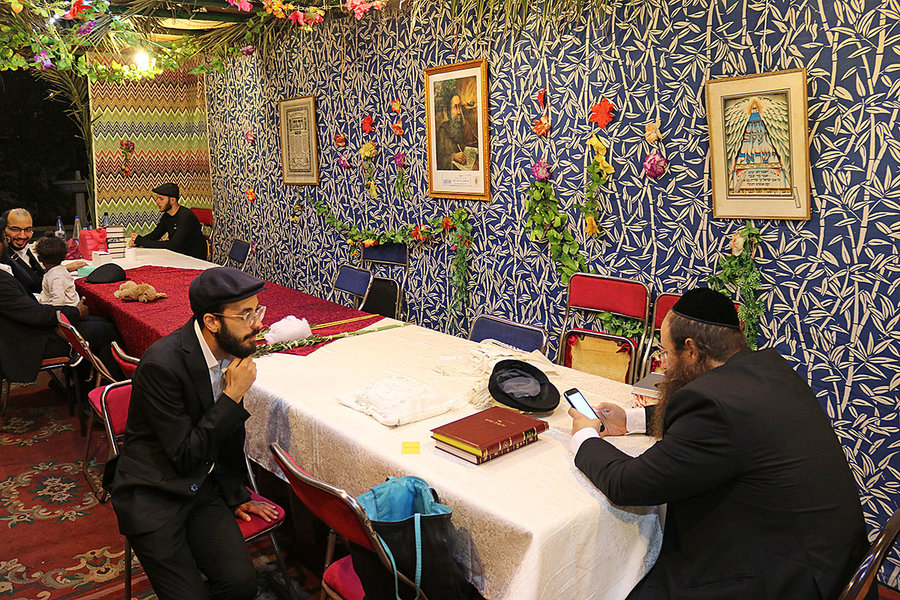
Photo: Taylor Luck
Yeshiva students are seen studying in a Casablanca sukkah hut last October. “Jews and Muslims have a long history of amity in Northern African countries like Morocco and Tunisia,” says the
Christian Science Monitor.

It seems to me that when people want to get along, they do. In the following story, we see how two religions usually depicted at odds have coexisted comfortably in Northern Africa for generations. What isn’t clear to me is how communities can start this kind of positive relationship if they haven’t had it before. There has to be a way.

Taylor Luck reports at the Christian Science Monitor from Morocco, “Even as congregants recite evening prayers at Temple Beth El, the Muslim call to prayer rings out from minarets across the city and into the courtyard, a mix of Arabic and Hebrew filling the dusk sky with praises to God. And as the yeshiva students file out of Beth El (literally, House of God), Mohammed, the gatekeeper, kneels down in Muslim prayer at the synagogue’s entrance.

“This is not a mirage; this is Casablanca. After decades of economic migration and geopolitical tensions that reduced North African Jewish communities from hundreds of thousands to a few thousand people, hope is being rekindled in Morocco and Tunisia that as Jews keep the light of their communities alive, so too does the region’s unique model of Muslims and Jews living side by side.

“For even in a time of global polarization, Moroccans and Tunisians are proving that historical bonds bind, rather than divide, Jews and Muslims, whose shared past they say paves the way for a shared future. …

“In Morocco, a country that is 99% Muslim, whose monarch carries the title ‘commander of the believers,’ a distinct Hebrew culture nevertheless permeates practically every town today. … Moroccans will be quick to tell you that this is not only Jewish heritage, but Moroccan heritage.

“ ‘We have Jewish life from the cradle to the grave in Morocco,’ says Zhor Rehihil, an anthropologist specializing in Moroccan Judaism and curator of Casablanca’s Museum of Moroccan Judaism. …

“King Mohammed VI has promoted the return of the Moroccan Jewish diaspora and Israeli tourism to the country, funding the preservation and renovation of 162 ancient Jewish cemeteries and several synagogues across the country. Under Moroccan law, anyone with Moroccan Jewish ancestry can claim citizenship.

The preamble to Morocco’s 2011 post-Arab Spring constitution enshrines Moroccan Jews as integral to the national fabric, stating that Morocco ‘is a sovereign Muslim state … whose unity is nourished and enriched by its African, Andalusian, Jewish, and Mediterranean constituents.’ …

“ ‘Visiting Arabs and Israelis see the atmosphere in the [Casablanca] streets, signs in Hebrew, Jewish and Muslim families living together in the same apartment building, and they can hardly believe it,’ says Serge Berdugo, secretary-general of the Council of Jewish Communities of Morocco and a community leader. ‘But the fact is, it is not a slogan or some dream, it is daily life for us, and that is a model we need to preserve for the world.’ ”

Meanwhile in Tunisia, “The demand for kosher meat – seen as even more meticulously prepared than by Islamically halal butchers in the capital – is high among Tunisian Muslims as well as Jews.

“On a rainy Friday this October, men and women lined up at the kosher butchery of Amran Fennech, the store name in Hebrew and Arabic, red spicy merguez sausage hanging from the storefront. Ask anyone in central Tunis; hands down, Amran has the best cuts in town. …

“ ‘We are Jews and we are Tunisians – we have specific cuisine, a specific dress, and a specific way of life – you can’t separate one from the other,’ Mr. Fennech says. …

“Historians say the high-water mark of Jewish-Muslim relations may have been over a millenium ago at the time of Al-Andalus, or Islamic Iberia, when the Muslim empire stretched across the Mediterranean to modern-day southern Spain.

“Jews and Muslims had become an intertwined community that was a beacon of science, philosophy, art, and enlightenment while much of Europe was in the Dark Ages. They flourished as the leading scientists and writers: philosopher Moses ben Maimon (Maimonides), diplomat and physician Abu Yusuf ibn Shaprut, poet Moses ibn Izra. …

“For Tunisia’s Jews, communal tensions arose in the second half of the 20th century amid regional crises and the birth of Israel. …

” ‘Every time there was a war in the region, tensions would increase and certain people would direct their anger toward their Jewish neighbors,’ says one 50-year-old Jewish resident, preferring not to speak in the name of the community.

“But in the 21st century, particularly after the 2011 revolution, Jewish Tunisians say they have noticed a marked difference. …

“ ‘At the time of the revolution, there were bigger issues than the Jewish community and the question of Israel; the troublemakers left us alone,’ says Mr. Fennech, the butcher. ‘Now we are all living in a new Tunisia together.’ …

“Officially there are no diplomatic relations between Morocco and Israel, forcing Israeli visitors to receive visas in a third-party country such as Spain. Israeli tourists to Tunisia must fly to the island of Djerba; there are no direct flights to Tunis. But Israeli and European Jewish tourism to Morocco and Tunisia is on the rise; as is the demand for kosher foods and Jewish religious tourism experiences. Locals hope visitors come away with a lesson as well.

“ ‘For the good of the community, for the good of the world, for the good of Morocco, and for the good of Judaism, we must remain to maintain this link between peoples,’ says Mr. Berdugo, the Moroccan community leader.”

More here.

Read Full Post »

In a recent NY Times article, art critic Holland Cotter expressed skepticism that a show of new artists lumped together as “Arab” could work. (Some artists declined to participate for the same  reason.)  The artists in the New Museum exhibit are from “Egypt, Iraq, Jordan, Kuwait, Lebanon, Morocco, Saudi Arabia, Syria, Tunisia and the United Arab Emirates, not to mention Europe and the United States.”

But in the end, he was thrilled with the opportunity to see the new works.

“It’s a big show, intricately pieced together on all five floors of the museum, and starts on the street-level facade with a large-scale photograph of an ultra-plush Abu Dhabi hotel. The image was installed by the cosmopolitan collective called GCC, made up of eight artists scattered from Dubai to London and New York who make it their business to focus on the preposterous wealth concentrated in a few hands in a few oil-rich countries on the Persian Gulf.”

Cotter goes on to describe many of the pieces in detail, here, and concludes with some advice for visitors.

“To appreciate this show fully, a little homework can’t hurt. But really all you need to do is be willing to linger, read labels and let not-knowing be a form of bliss. In return, you’ll get wonderful artists, deep ideas, fabulous stories and the chance, still too seldom offered by our museums, to be a global citizen. Don’t pass it up.”

The show will be up until September 28.

Photo: Ruth Fremson/The New York Times

“Here and Elsewhere” show at the New Museum

Read Full Post »