Feeds:
Posts
Comments

Posts Tagged ‘veterans’

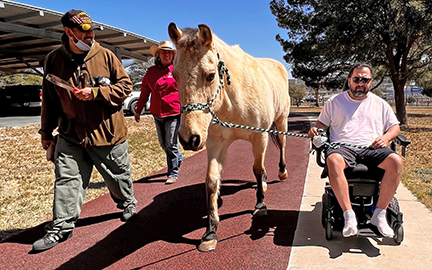
Photo: va.gov.
Army Veteran Carlos Longoria takes a trip on the track with Biscuit.

Whenever it gets close to Veterans Day, I start seeing stories about therapy for traumatized veterans. We know that, inevitably, some of the young people we send off to war will come back in bad shape. And unfortunately, our government spends a lot more on sending them off than on what they may need when they get back.

Often it’s civilian nonprofits that step up, like an arts group in Asheville, North Carolina, that offered supportive pottery classes to vets — that is, before Hurricane Helene. (Click here.)

Today’s article by Jason Kucera describes an ongoing Veterans Administration (VA) initiative.

“Mankind and horses have carried on beneficial, strong relationships with one relying on the speed, endurance, and raw power while the other affection and care. For a US Marine Corps Veteran such as Kody Wall, this special bond saved his life.

“ ‘I moved home to Montgomery (Texas) after my time as a Marine and very little went well. I had a really hard time adapting, so it wasn’t long until I was divorced and sleeping on an air mattress at my sister’s house,’ Wall said.

“During this time, he said he was battling suicidal thoughts, wanting to just ‘give up.’ Though he had been getting his routine care at a Houston VA outpatient clinic, he did not feel comfortable going into an office or trying to work through appointments over the phone. While hopelessness set in, the darkness would soon clear thanks to a unique therapeutic approach focused on his relationship with a horse.

“ ‘My sister pushed me to visit Sunny Creek Ranch as she knew how much I enjoyed being around horses. It was the best thing that could’ve happened for me,’ said Wall. ‘I’ve been attending sessions since 2016 and spend any extra time I have to help.’ He also shares his own experiences with other Veterans attending sessions, which can really help to open them up. 

“Sunny Creek Ranch hosts an intensive equine-assisted therapy Eagala-certified program in this heavily forested, southeast Texas town, just about an hour north of Houston. Launched by Shannon Novak, an Air Force Veteran spouse, the ranch is a partner of Houston VA. …

“She added that for a lot of Veterans and their family members that participate, they find the relationship with these horses to be similar to that of their own personal relationships. ‘Horses are so intuitive, they know everything about you, and they never forget you.’ …

“Houston VA recently began referring Veterans to equine therapy and plans to ramp up referrals to other holistic therapy approaches in the future. ‘Evidence-based talk psychotherapies for trauma are effective, but we know not every Veteran wants to address their trauma by sitting down in an office or virtual appointment with VA,’ said Dr. Shannon Sisco, whole health coordinator at the Houston VA. …

“Wall said working with the horses in equine therapy has helped him learn to communicate more openly with his young son, resulting in a better and more trusting relationship.

“ ‘The challenge in equine therapy is to develop a trusting relationship with your horse, which in many ways brings out lessons about our own relationships and helps us learn new ways of being in them,’ Sisco said.  

“Veterans do not need experience working with horses to participate in the therapy. They will not actually be riding horses, just interacting with them alongside a professionally licensed therapist. ‘The difference between connecting with horses versus people is that it all depends on your actions rather than your words,’ Sisco said. ‘They are watching what you do and listening to your tone. If you’re not earning their trust, they’re going to let you know.’ … 

“Veterans can choose to participate in individual equine therapy sessions, along with immediate family members, or in small groups with other Veterans.  For more information or to request a referral for equine therapy or any of the VA’s Whole Health programs.”

Although this story focused on Texas, there are similar VA programs around the country. Search here on “horses.” More on today’s feature, here.

Read Full Post »

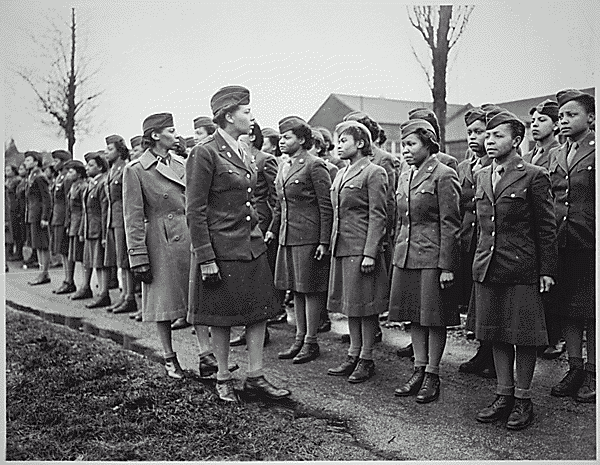
Photo: The Unwritten Record.
African American Women in the military during WW II.

November 11 is Veterans Day in the US. Veterans come in all shapes and sizes and they all deserve recognition. The African American veterans above served in the military in World War II.

A veteran from more recent times was honored in this reminiscence at the Washington Post. Lauren Koshere, a volunteer with Veterans Affairs’ My Life, My Story program and a food service worker at William S. Middleton Memorial Veterans Hospital in Madison, Wisconsin, shared some poignant memories.

“Final Salutes don’t come with much notice, maybe five minutes. But even those of us in chronically understaffed departments can attend. I join a river of co-workers flowing toward Ward 1B: nurses in turquoise scrubs, doctors in white coats, executives in business suits, police in uniform and me in a hairnet and black polyester polo — ‘VA Food Service’ embroidered over the heart — but without my usual stainless-steel tray cart.

“Most of us working in Veterans Affairs hospitals are not veterans. But the nurse standing across from me, in a hall lined with people, must be a veteran: She knows exactly how to stand with respect for a memorial service. I try to copy her posture, feet shoulders-width apart, hands joined behind my back.

“No one speaks. Then the quiet is broken by a single resonant tone. Five seconds of silence. Then another tone. A nurse carrying a brass singing bowl and wooden mallet appears from the hospice unit. She strikes the bowl again. Behind her, another nurse escorts a morgue cart draped in an American flag.

“I think of a hospice patient I’ve been bringing meals to for weeks. He was born in the late 1940s. Every day, his thin form lies at the same angle under a faded Green Bay Packers blanket.

“Until a hot day in July, we had never spoken — I suspected he couldn’t — but he always nodded and made eye contact when I set down his dinner tray. On this day, I pointed to a cup of chocolate ice cream he had ordered. ‘It’s a good day for ice cream.’

“He surprised me by replying, ‘Every day is a good day for ice cream.’

“The gurney comes into full view, and I now see a black baseball cap with a yellow, red and green Vietnam veterans badge resting on the flag.

“When the procession stops, people remove their hats. Veterans salute, and hold it, while the rest of us raise our hands to our hearts. The first notes of a ‘Taps’ recording fill the hallway, and we are locked in stillness. …

“My vision blurs as the song continues, and I wonder how many other funerals are being remembered in this hallway. I hear soft, deep sighs and a few sniffles. …

“As the flag-draped gurney passes on its way to the morgue, I realize it isn’t every day that I’m this close to the sharply defined red, white and blue. Working with veterans reminds me of what millions have invested for the idea of that flag. But it also reminds me of what that flag has asked, has taken. …

“Joseph Campbell said, ‘Affirmation is difficult. We always affirm with conditions.’ But ‘affirming it the way it is — that’s the hard thing, and that is what rituals are about.’

“To affirm unconditionally. To affirm the way it is. Ritual asks us to suspend our noise and our opinions and our egos. For a few moments of sacred silence, we affirm, creating the space where ritual works its power: weaving the personal to the anonymous, the individual to the universal, the known to the unknown.

“During a Final Salute, the deceased veteran’s identity is not disclosed. … The Final Salute on this day has gathered strangers in honor of a stranger. I don’t know whose loved one walks behind the gurney. I don’t know who lies under the Vietnam veterans hat, the American flag. But I did know a veteran who liked the Packers and chocolate ice cream.

“I never saw him again.”

More at the Post, here.

Read Full Post »

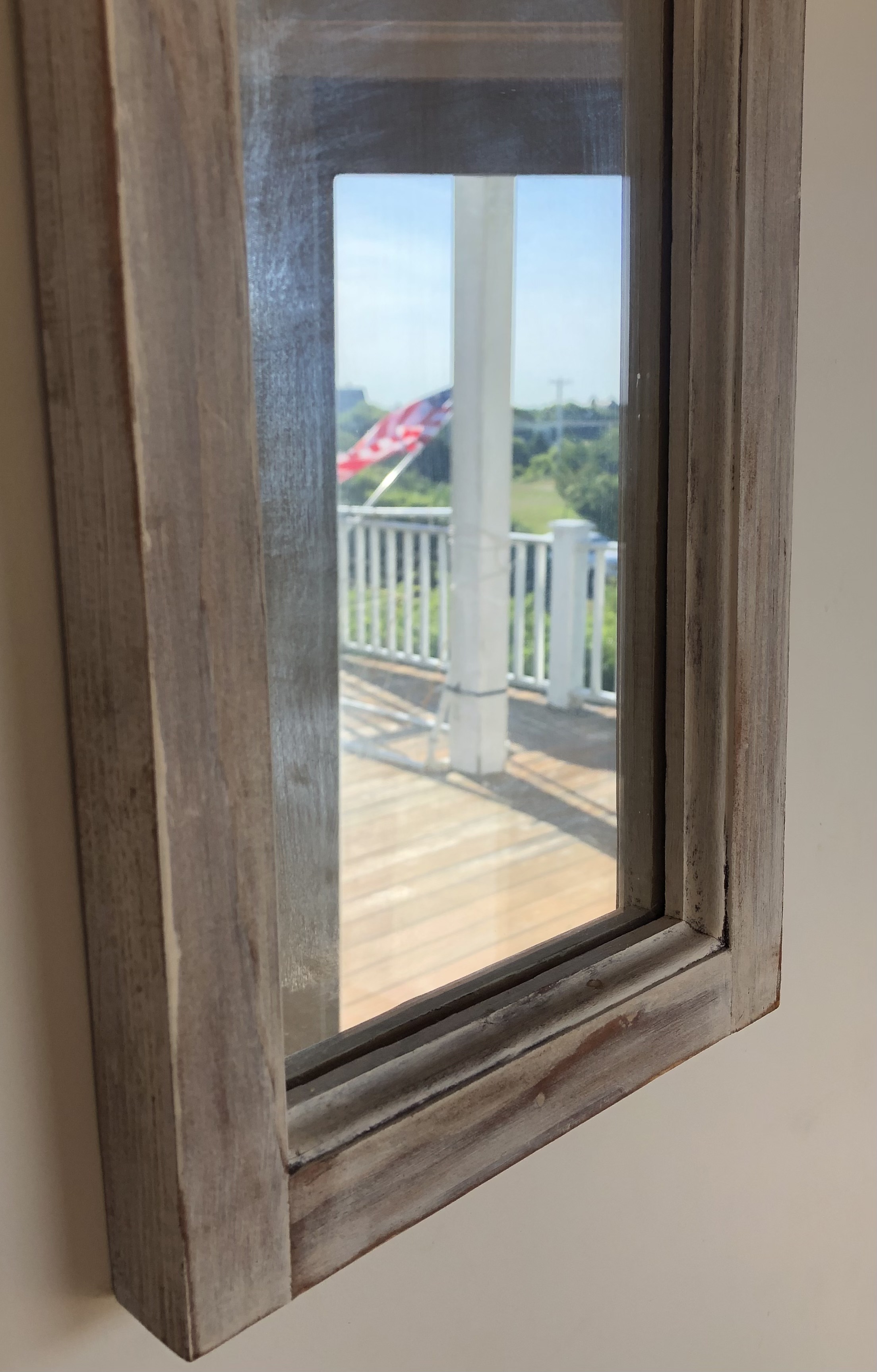
Photo: Suzanne and John’s Mom.
The flag as seen through a window and a mirror.

I may feel ambivalent about the goodness of my country at times, and especially about its wars. But I never feel ambivalent about the people who have died and need to be remembered.

Monday is Memorial Day here, and I thought it would be a good idea to learn more about exactly what we’re memorializing. I know Veterans Day in November specifically honors the sacrifices of veterans, but is Memorial Day different?

Turns out, the details depend on who you talk to. Different groups come at it from different angles. For many years, as I learned from Wikipedia, the commemorations of lives lost during the Civil War were split into those honoring the Confederate soldiers and those honoring the Union dead.

Here are other things I discovered from the entry.

“Memorial Day (originally known as Decoration Day) is a federal holiday in the United States. … It is observed on the last Monday of May. From 1868 to 1970, it was observed on May 30. … Many people visit cemeteries and memorials on Memorial Day to honor and mourn those who died while serving in the U.S. military. Many volunteers place American flags on the graves of military personnel in national cemeteries. …

“The first national observance of Memorial Day occurred on May 30, 1868. Then known as Decoration Day, the holiday was proclaimed by Commander in Chief John A. Logan of the Grand Army of the Republic to honor the Union soldiers who had died in the Civil War. This national observance was preceded by many local ones. …

“Many cities and people have claimed to be the first to observe it. However, in 2022, the National Cemetery Administration, a division of the Department of Veterans Affairs, credited [Southerner] Mary Ann Williams with originating the idea. … The world wars turned it into a day of remembrance for all members of the U.S. military who fought and died in service.  …

“Of documented commemorations occurring after the end of the Civil War and with the same purpose as Logan’s proclamation, the earliest occurred in Charleston, South Carolina.

On May 1, 1865, formerly enslaved Black adults and children held a parade of 10,000 people to honor 257 dead Union soldiers.

“Those soldiers had been buried in a mass grave at the Washington Race Course, having died at the Confederate prison camp located there. After the city fell, recently freed persons unearthed and properly buried the soldiers, placing flowers at their graves. The estimate of 10,000 people comes from contemporaneous reporting,”

Other documented claims of being first, Wikipedia says, come from Virginia, both Jackson and Columbus in Mississippi, and Gettysburg and Boalsburg in Pennsylvania.

Have you ever seen veterans or veterans’ families handing out red paper lapel poppies around this time of year? Here’s the backstory, also from Wikipedia: “In 1915, following the Second Battle of Ypres [in World War I], Lieutenant Colonel John McCrae, a physician with the Canadian Expeditionary Force, wrote the poem, ‘In Flanders Fields.’ Its opening lines refer to the fields of poppies that grew among the soldiers’ graves in Flanders.

“In 1918, inspired by the poem, YWCA worker Moina Michael attended a YWCA Overseas War Secretaries’ conference wearing a silk poppy pinned to her coat and distributed over two dozen more to others present. In 1920, the National American Legion adopted it as its official symbol of remembrance.”

As my neighbors headed off to the annual commemoration at the local Veterans of Foreign Wars, and I just went for my daily walk, I thought about one line from the Wikipedia entry that particularly struck me as a person guilty of neglecting the “memorial” part of Memorial Day: “In 1913, one Indiana veteran complained that younger people born since the war had a ‘tendency … to forget the purpose of Memorial Day and make it a day for games, races, and revelry, instead of a day of memory and tears.’ “

“In Flanders Fields, the poppies blow
“Between the crosses, row on row. …

“We are the dead. Short days ago
“We lived, felt dawn, saw sunset glow,
“Loved and were loved, and now we lie,
 “In Flanders fields.”

Read Full Post »

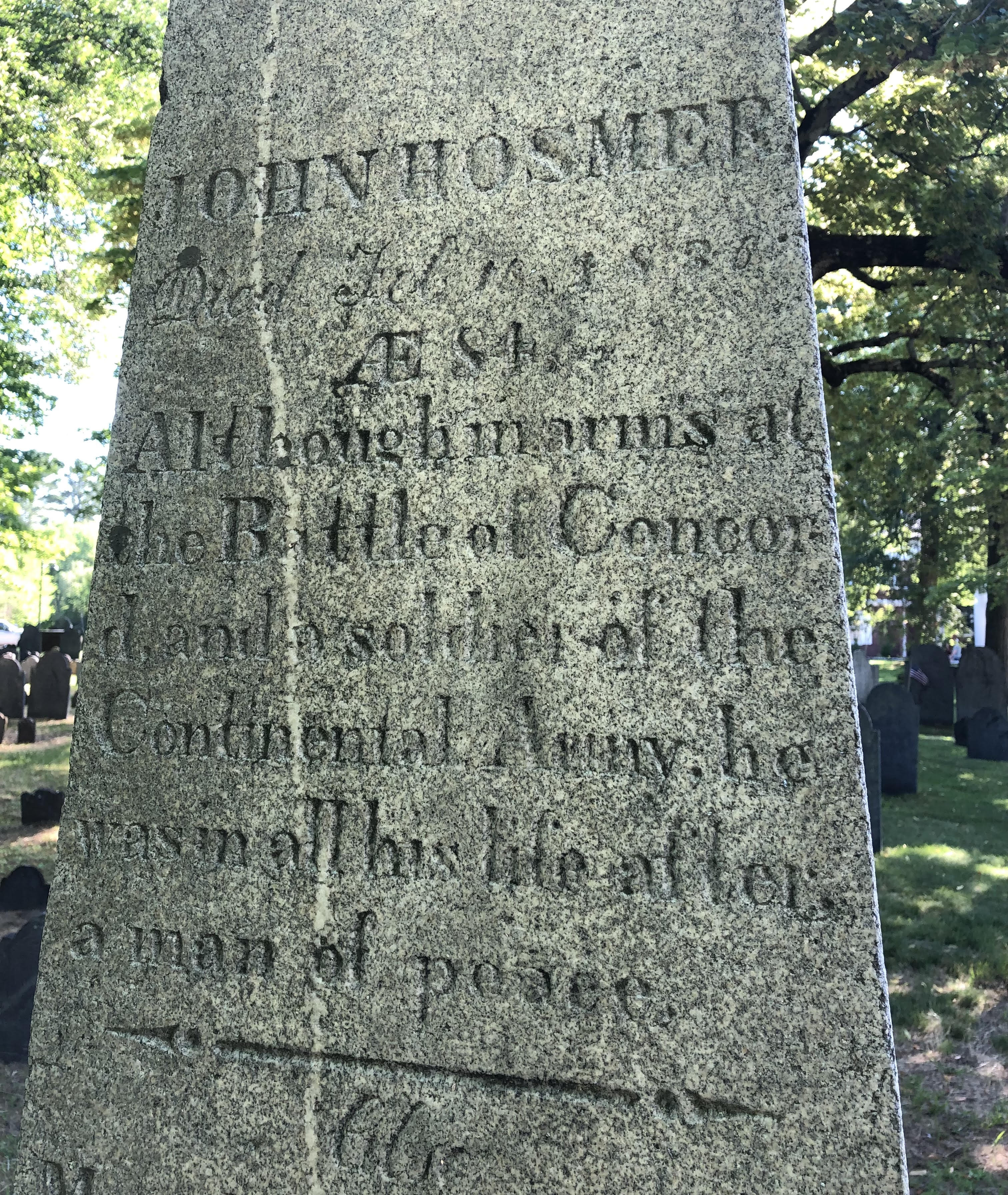
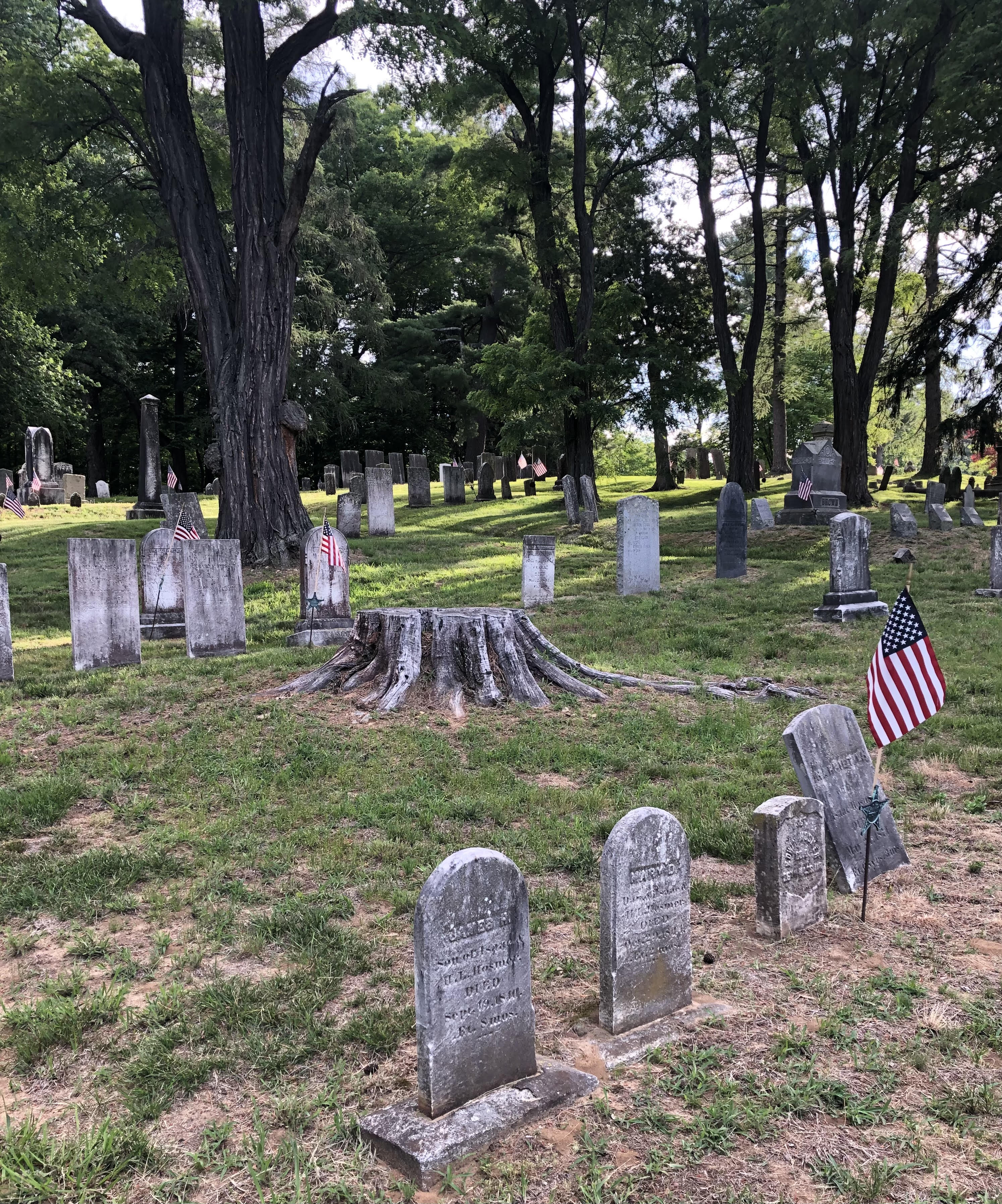
The photos are from two local cemeteries. The first honors John Hosmer, who fought in the Continental Army and “was in all his life after a man of peace.” In the second, you see how the living put flags on the graves of veterans who have died.

In one of the ESL (English as a Second Language) classes where I volunteer, the teacher introduces a citizenship factoid every week as some students plan to take the test to become US citizens. Citizens or not, we all learn something from the test questions.

That made me think that for Veterans Day this year, I should look up the history. The commemoration started after World War I, when many soldiers came home relieved to be alive, only to die of a pandemic not unlike the one that you and I know too well.

The day was originally named for the cease-fire that ended hostilities in the “Great War” but became “Veterans Day” in 1954, when a WW II general who had become president renamed it

Here’s what the US Department of Veterans Affairs has to say.

“World War I – known at the time as ‘The Great War’ — officially ended when the Treaty of Versailles was signed on June 28, 1919, in the Palace of Versailles outside the town of Versailles, France. However, fighting ceased seven months earlier when an armistice, or temporary cessation of hostilities, between the Allied nations and Germany went into effect on the eleventh hour of the eleventh day of the eleventh month. For that reason, November 11, 1918, is generally regarded as the end of ‘the war to end all wars.’

“In November 1919, President Wilson proclaimed November 11 as the first commemoration of Armistice Day with the following words: ‘To us in America, the reflections of Armistice Day will be filled with solemn pride in the heroism of those who died in the country’s service and with gratitude for the victory, both because of the thing from which it has freed us and because of the opportunity it has given America to show her sympathy with peace and justice in the councils of the nations…’

“The original concept for the celebration was for a day observed with parades and public meetings and a brief suspension of business beginning at 11:00 a.m. … In 1954, after World War II had required the greatest mobilization of soldiers, sailors, Marines and airmen in the Nation’s history; after American forces had fought aggression in Korea, the 83rd Congress, at the urging of the veterans service organizations, amended the Act of 1938 by striking out the word ‘Armistice’ and inserting in its place the word ‘Veterans.’ With the approval of this legislation (Public Law 380) on June 1, 1954, November 11th became a day to honor American veterans of all wars.”

I had forgotten why there’s a moment of silence at 11 a.m. on Veterans Day. Good to know. More here.

Read Full Post »

Wednesday is Veterans Day, and I thought I would share something I just learned about how some veterans have continued in public service after being discharged from the military.

Last week, veterans volunteered at the polls because coronavirus concerns were keeping elderly poll workers and others at risk at home.

As Sarah Sicard wrote at Military Times, “Veterans often look for opportunities to continue to serve even after retiring or moving on from the military. In 2020, a number of veterans have taken to volunteering to work the polls at their local election sites.”

Sicard cites Maggie Seymour, who served in the Marine Corps from 2008 to 2017. Seymour wrote on Twitter that she was expecting a baby and “serving as an election judge here in Beaufort. Exposing little fetus to the sounds of democracy!”

Sicard continues, “Veterans across the country have volunteered on Nov. 3 to serve in various capacities, many through the organization Veterans for American Ideals [VIFI]. …

“ ‘We’re trying to get vets engaged as poll workers to assist in pulling off a free and fair election, protect the elderly — who constitute the majority of poll workers — during COVID, and get a new generation involved in their communities,’ said Christopher Purdy, program manager of Veterans for American Ideals, according to Reuters.” More at Military Times, here.

I decided to take a look at the VIFI website, where I found this mission statement. “Veterans for American Ideals is a nonpartisan group of veterans who share the belief that America is strongest when its policies and actions match its ideals.

“We dedicated our lives to our country as citizen-soldiers, and we believe that honor, courage, commitment, duty, and country are not just words, but values worth defending. After taking off the uniform, we seek to continue serving our country by advocating for policies that are consistent with the ideals that motivated us to serve in the first place.

“Our current campaigns are focused on saving the Special Immigrant Visa program for interpreters and translators who served with the U.S. military, protecting refugees, and countering Islamophobia.”

Now, I call that living your values.

Read more at Vets For American Ideals, here — and have a happy, thoughtful Veterans Day.

Read Full Post »

default

Image: Wellcome Collection

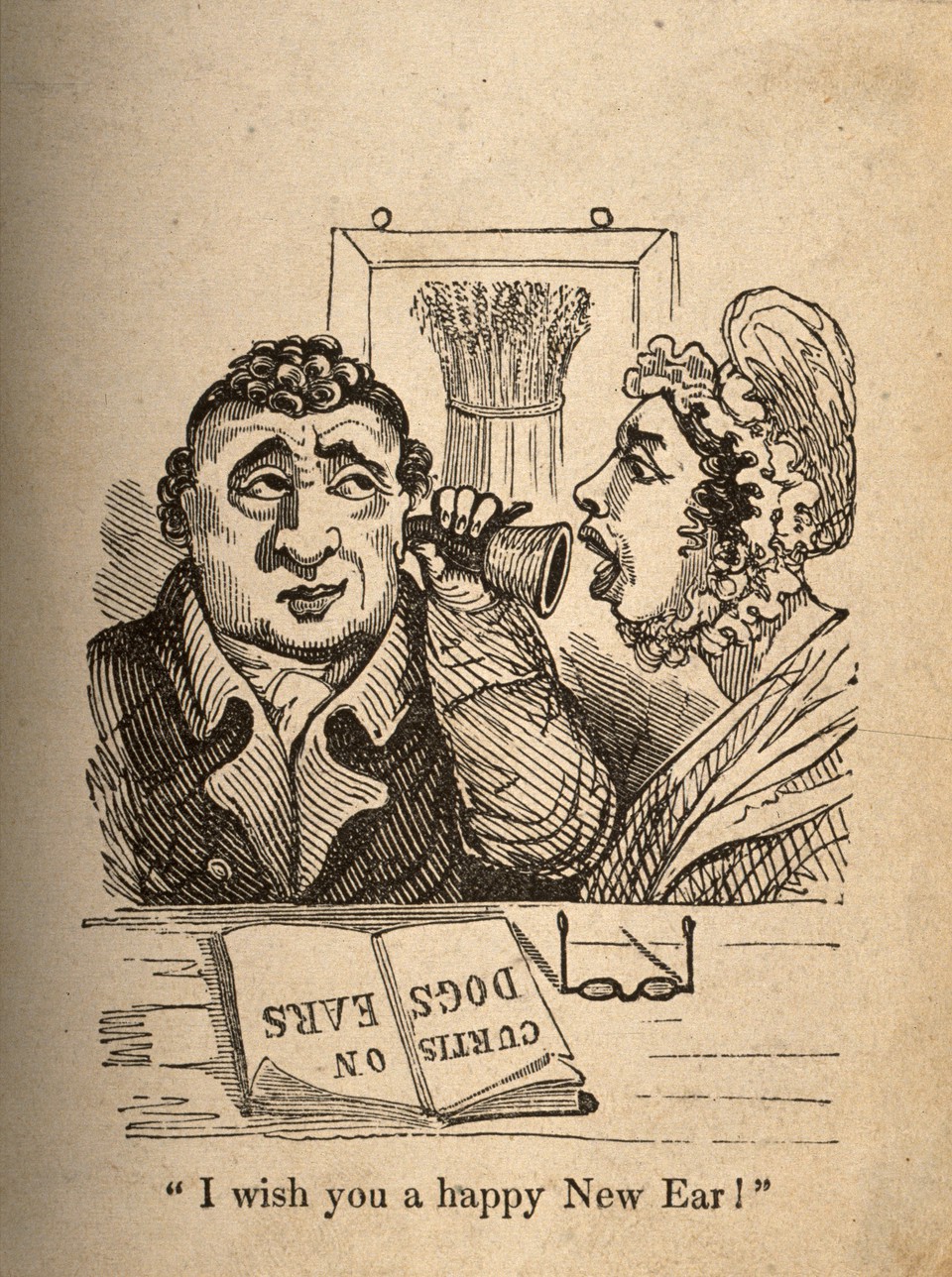
Loss of hearing has been on my mind lately. I’m getting near the age my mother started to lose her hearing. She made it work for her, though, pretending she didn’t hear you when she didn’t want to answer your question.

I, on the other hand, will look into hearing aids. Jane Brody at the New York Times reported recently that getting a hearing aid before your hearing is really bad is associated with slowing the onset of dementia. I like the sound of that.

Meanwhile, at National Public Radio (NPR), we learn that everyone’s hearing is being adversely affected by our noisy world.

Dave Davies at WHYY’s Fresh Air interviews the author of a new book on the topic.

“Our ears are complicated, delicate instruments that largely evolved in far quieter times than the age we currently inhabit — an early world without rock concerts, loud restaurants, power tools and earbuds.

“Writer David Owen describes our current age as a ‘deafening’ one, and in his new book, Volume Control, he explains how the loud noises we live with are harming our ears.

“Owen warns that even small household appliances like food processors and hair dryers can generate noise at levels that lead to permanent damage. He notes that people who live in places without significant background noises tend to experience less hearing loss.

‘There have been a couple of studies done with populations of indigenous people who live in places where there is very little background noise and elderly people in those populations tend to hear as well as infants do,’ he says.

“Owen recommends that people carry earplugs with them — and not be bashful about using them. Recently he popped in a pair of musician’s earplugs before watching Dunkirk, a movie long on explosions and short on dialogue. …

” ‘People who have trouble hearing tend to have more unrelated health issues of all kinds. It, sort of, overworks our brains. If you can’t quite hear what people are saying, you have to work harder to figure it out, and the brainpower that you use to do that is brainpower that you can’t use for anything else. People who have trouble hearing also tend to withdraw. … If you have trouble seeing things, you get glasses. But people tend to put off getting hearing aids for a long time. …

” ‘The largest single purchaser of hearing aids in the United States is the [Department of Veterans Affairs]. The No. 1 and No. 2 service-related health claims made by military veterans are hearing loss and tinnitus. Exposure to gunfire, especially exposure to blast explosions, but then also just the extraordinarily high sound levels of military service, even on a base outside of combat. One of the loudest work environments in the world is an aircraft carrier. And simply sleeping on an aircraft carrier, you can expose yourself to sound at levels that are sufficient to do permanent damage to your hearing. …

” ‘I learned from reading about tinnitus that there’s basically nothing you can do. You can’t make it go away. There is no known cure for it. The therapy for tinnitus is to learn to accommodate it. …

” ‘Sometimes hearing aids can help you. If you have some hearing loss and you eliminate that, you bring up the sound of everything else. Then this phantom noise becomes less bothersome. You can’t hear it as much. A therapist described it to me as, “You’re in a room with a candle. The candle is the tinnitus. But if you turn on the lights, then the candle is less noticeable.” And that’s what sometimes happens with hearing aids with somebody who has tinnitus. …

“Classical musicians — just like rock musicians — experience hearing loss. ‘The impact on your hearing probably has less to do with the instrument that you play than with the instrument that the person who sits behind you plays. So if you have a loud instrument right behind you, you’re the one who gets the impact. … It’s not only in those performances. Musicians practice, especially nowadays, for hours and hours and in small rooms with loud instruments and it takes a toll on their hearing very definitely. …

” ‘The revolution that’s coming is that it’s going to be increasingly possible to buy over-the-counter, less expensive hearing improvement products — hearing aids and other products. … I have a friend who lost a lot of hearing, wears hearing aids. He wore [Bose] Hearphones to a restaurant and found them much superior to his hearing aids — the quality of the sound, the ability to focus on people that he wanted to listen to.”

More at NPR, here.

Read Full Post »

Photo: Robert Galbraith/Reuters/Corbis
Clinging to the top of a vehicle before being rescued by the U.S. Coast Guard from the flooded streets of New Orleans after Hurricane Katrina, 2005. The city’s homelessness problem grew exponentially after Katrina. Then a unique collaborative decided to do something about it.

Homelessness is increasing all over this wealthy, unequal land of ours. And you know what? It’s possible to do something about it. Where there’s a will, there’s a way. Consider this effort in New Orleans, as reported by Jeremy Hobson on WBUR’s Here and Now.

“Across the U.S., more than a half million people have been identified as homeless. New Orleans faced a major crisis in homelessness following Hurricane Katrina.

In 2007, two years after the storm, there were more than 11,600 homeless people in the city. Since then, New Orleans stepped up its effort to tackle homelessness and has brought that number down 90 percent.

“Martha Kegel, executive director of Unity of Greater New Orleans, tells Here & Now‘s Jeremy Hobson the strategy to tackle the ‘unprecedented explosion’ of homelessness in the city following Katrina was threefold.

“First, Kegel says, Unity of Greater New Orleans — a nonprofit leading a collaborative of organizations providing housing and services to the homeless — had to assemble an outreach team that ‘was willing to go anywhere and do anything to rescue and rehouse a homeless person.’

“Second, Kegel says the group put all its effort behind gathering a rent assistance fund. ‘We went directly to Congress,’ she says. …

“And lastly, she says, the team took a ‘Housing First’ approach, which is ‘simply the idea that you accept people as they are,’ whether they are sober or not. … ‘Once they’re in their apartment, you immediately wrap all the services around them that they need to stay stable and live the highest quality life that they can live.

” ‘Actually, this is a very cost-effective approach, because when you think about it, it is costing the taxpayer a tremendous amount of money to leave people on the street. They’re constantly cycling in and out of jail on charges that wouldn’t even be relevant if they had an apartment, things like urinating in public, drinking in public, obstructing the sidewalk because they’re having to sleep on the sidewalk. Homeless offenses, in other words, that are costing the taxpayers a lot of money to be putting them in jail and processing them through the criminal justice system. Their health is deteriorating while they’re out on the street. They’re being taken by ambulance to the emergency room constantly. Those are huge charges.

” ‘Really what you need is, you know, a relatively small amount of money to pay for some rent assistance and they can contribute some of that rent as well with disability benefits or if they’re able to work with, you know, employment income and a little bit of case-management assistance. It really has been proven over and over again in studies to be very cost effective.

” ‘This is permanent housing. How long the rent assistance lasts depends on what people need. And we’re kind of masters at trying to spread what is always an inadequate amount of money as far as it’ll spread. …

” ‘We have reached what we call “functional zero,” which means that we compiled a list using our outreach team [and] using our shelter lists that are updated every night. We housed, in their own apartments, every veteran on that list except nine that had refused housing, mostly because of mental illness. And we continued to work with those nine, at that point, [we] have housed four more of them. Then going forward, we have made a commitment that any time a veteran becomes newly homeless, we house them in an apartment within an average of 30 days or less. And we’ve maintained that now for over four years and we’re extremely proud of that. It is very hard work. It requires a lot of organizations working together — and the VA and the Housing Authority — everybody working together to make that happen.’ ”

Think about those homeless veterans this Memorial Day. If we do “war” to them, can we also do housing with services? It’s about compassion and taking responsibility.

And I like how Kegel says, “You have to love the people in your community and want your community to thrive and care very deeply about the vulnerable people in it, that you’re willing to do, what we say, whatever it takes.”

More here.

Read Full Post »

062518-flag-in suburbia

For Veterans Day, I want to give a thought to the people who wait, the families left behind, the people who love the service member and who try to stay upbeat and keep their worry from showing.

There’s a song that captures what the person left behind feels when alone and not obliged to put up a brave front. It’s called “I’ll Be Seeing You.”

Let’s start with what Wikipedia has to say about the song’s history.

” ‘I’ll Be Seeing You’ is a popular song, with music by Sammy Fain and lyrics by Irving Kahal. Published in 1938, it was inserted into the Broadway musical Right This Way, which closed after fifteen performances. …

“The musical theme has emotional power, and was much loved during World War II, when it became an anthem for those serving overseas (both British and American soldiers). The lyrics begin, in Bert Ambrose’s and Vera Lynn’s recorded versions, with a preamble:

Cathedral bells were tolling and our hearts sang on
Was it the spell of Paris or the April dawn?
Who knows if we shall meet again?
But when the morning chimes ring sweet again

I’ll be seeing you
In all the old familiar places
That this heart of mine embraces
All day through
In that small cafe
The park across the way
The children’s carousel
The chestnut trees
The wishing well
I’ll be seeing you
In every lovely summer’s day
In everything that’s light and gay
I’ll always think of you that way
I’ll find you in the morning sun
And when the night is new
I’ll be looking at the moon
But I’ll be seeing you
I’ll be seeing you


Read Full Post »

Photo: WeWork
Global shared-workspace company WeWork offers coffee, local beer, ample space for community events — and jobs for refugees and veterans.

Here’s a business that expects to do well by doing good. It’s shared-workspace company WeWork, which a news outlet in Philadelphia says has started offering jobs to refugees.

Marielle Mondon at PhillyVoice reports, “WeWork, one of the biggest companies spearheading the transition from traditional offices to millennial-luring co-working spaces, has announced a new commitment to hire 1,500 refugees globally in the next five years.

“The announcement comes just days after the company announced it would also hire the same number of veterans in its offices over the next five years. WeWork began seeking refugee employees through a pilot program based in New York [in 2017], working with the International Rescue Committee for a total of 50 hires. …

“In addition to encouraging WeWork offices to reach their hiring quotas, the company will also help provide refugees with mentorships and language courses. …

“Several other companies have made public initiatives to offer refugees a means of employment as they try to establish their new lives. … Starbucks pledged to hire 10,000 refugees by 2022. … Companies including Chobani and Uber made similar promises.

“WeWork CEO Adam Neumann told the Washington Post that the refugee pledge was … a way to help solve the growing problem of refugee displacement.

“The Post reports that the refugee jobs during the pilot program in New York [involved] workers taking care of the daily maintenance and tenant assistance needed in WeWork spaces.” More here.

You know what? Although the WeWork target client is a millennial, I can easily see an elderly person who can afford office space signing up to use his computer there and hang around young people — the way some older folks use libraries. I wonder if anyone would mind.

Read Full Post »

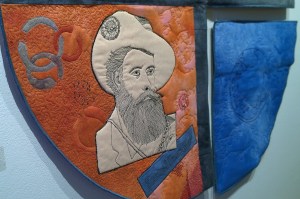
101817-Brush-Gallery-Vets-Ribbens-quilt

My former Minnesota boss, Ann Ribbens, has always quilted, even when her day job was something completely different. Her quilts have been in a number of shows and in a book published by Mary Ann’s company, Quarry: 1000 Quilt Inspirations, by Sandra Sider.

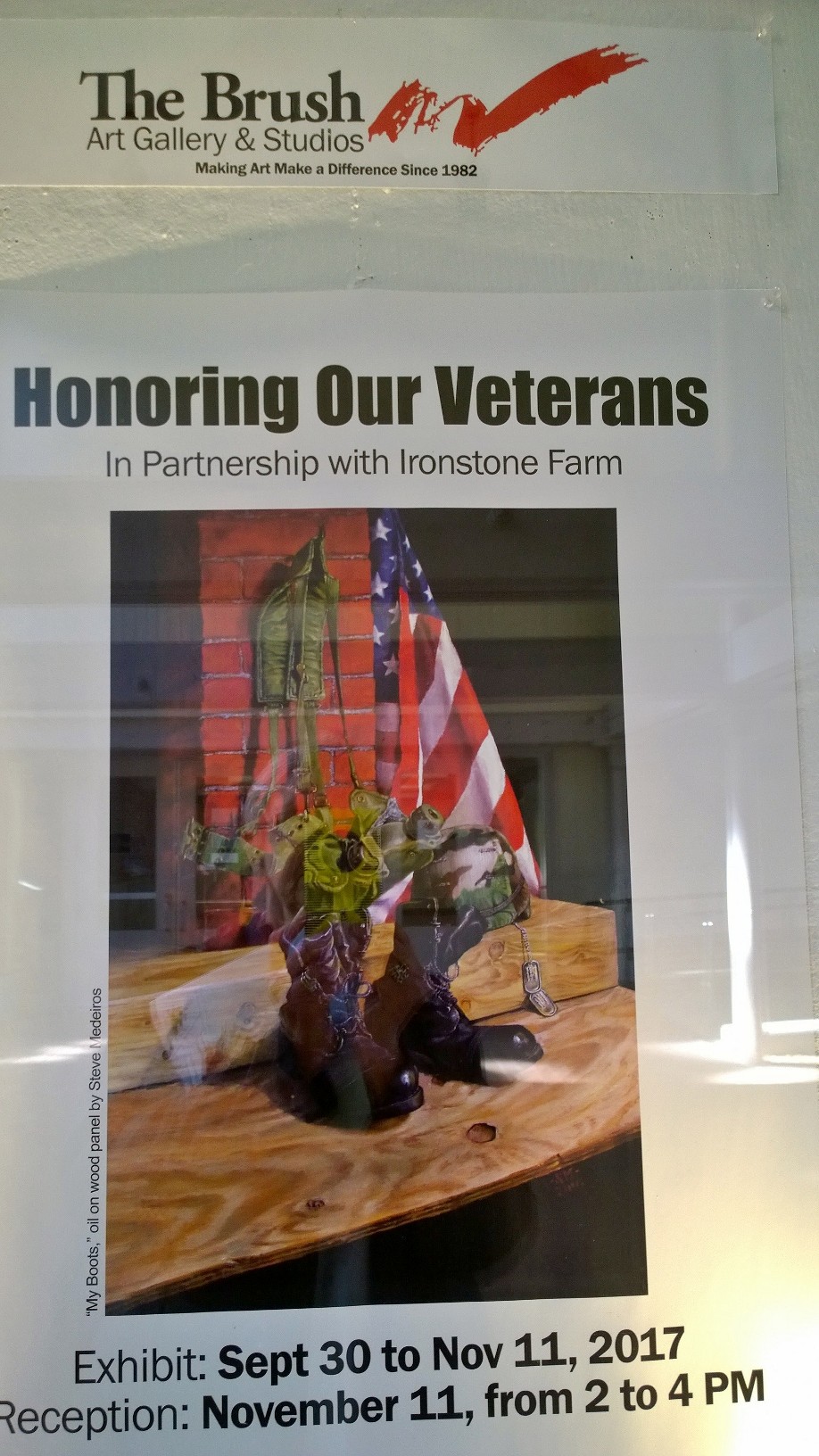
Recently, one of Ann’s quilts was accepted by the Brush Gallery in Lowell, Massachusetts, for an art exhibit honoring veterans. The show was diverse and included military artifacts, paintings, and photography. I thought Ann’s quilt was especially wonderful.

The quilt narrates the stories of three family members who served — one in the Boer War (lower left panel), one in World War II (upper left), and one in Vietnam (upper right). The fourth panel expresses her longing for peace and an end to all that veterans suffer in war and on their return from war.

I love the combination of gratitude and hope that these portraits represent, the war colors expressing the heat of battle and the cool blue expressing serenity.

The exhibit was presented in conjunction with Ironstone Farm of Andover, Massachusetts, which provides veterans who have experienced trauma and anxiety with a healing “equine encounter” one day a week for eight weeks. (“I never thought a horse could teach me so much about myself,” says one participant.)

101817-Lowell-MA-Ribbens-quilt

101817-Boer-War-Ribbens-quilt


Read Full Post »

Shakespeare continues to make headlines, working his magic on people from all walks of life — prisoners, refugee children, veterans, and more.

Recently, New York Times reporter Laura Collins-Hughes interviewed an Army veteran who found Shakespeare helped him over a trauma and who now uses the Bard to help other veterans.

Collins-Hughes writes, “Stephan Wolfert was drunk when he hopped off an Amtrak train somewhere in Montana, toting a rucksack of clothes and a cooler stocked with ice, peanut butter, bread and Miller High Life — bottles, not cans. It was 1991, he was 24, and he had recently seen his best friend fatally wounded in a military training exercise.

“His mind in need of a salve, he went to a play: ‘Richard III,’ the story of a king who was also a soldier. In Shakespeare’s words, he heard an echo of his own experience, and though he had been raised to believe that being a tough guy was the only way to be a man, something cracked open inside him.

“ ‘I was sobbing,’ Mr. Wolfert, now 50 and an actor, said recently over coffee in Chelsea. ‘I didn’t know you could have emotions out loud.’

“That road-to-Damascus moment — not coming to Jesus, but coming to Shakespeare — is part of the story that Mr. Wolfert tells in his solo show, ‘Cry Havoc!’ … Taking its title from Mark Antony’s speech over the slain Caesar in ‘Julius Caesar,’ it intercuts Mr. Wolfert’s own memories with text borrowed from Shakespeare. Decoupling those lines from their plays, Mr. Wolfert uses them to explore strength and duty, bravery and trauma, examining what it is to be in the military and what it is to carry that experience back into civilian life. …

“To Mr. Wolfert, who teaches controlled methods of accessing charged memories, the need to retool a lethal skill set for civilian life is a vital task that the military leaves people to figure out on their own.

“ ‘That’s something that we hold uniquely, I think, as veterans,’ he told [a] class. ‘We know what we’re capable of — even for the so-called peacetime or Cold War vets. The training’s still there. And I don’t care if you’re a clerk typist. You still fired a weapon at a human silhouette.’

“This, he believes, is where Shakespeare can prove an ally: as a means to understand trauma, and to start coming back from it.”

More at the NY Times, here. For more on Wolpert, check out a Shakespeare & Co. interview from last summer, here.

Photo: Folger Theatre
Actor Stephan Wolfert in 2014, performing his one-man show Cry “Havoc!” at the Folger Theatre in Washington, DC. The line is from Shakespeare’s Julius Caesar.

Read Full Post »

Photo: Craig F. Walker/Globe Staff
From left, Army veteran Kevin Faherty speaking with Paul Connor, veteran services coordinator, and Middlesex County Sheriff Peter Koutoujian in January.

A sad fact of war is that those who serve too often come back suffering from emotional trauma or addiction.

Fortunately, there are understanding people who can help them move on. We just need more of them.

Kevin Cullen at the Boston Globe describes what one Massachusetts sheriff is doing to make veterans’ lives more hopeful.

“For the past year, with hardly any attention, Middlesex County Sheriff Peter Koutoujian and his staff have developed an innovative approach that is transforming lives for the better, lowering recidivism rates and raising the odds that those who have served their country can become more responsible, productive citizens.

“[Jan. 13] marked the first anniversary of the Housing Unit for Military Veterans at the Middlesex jail and house of correction, the first of its kind in New England, and really the only one quite like it nationwide. Its acronym is HUMV, or Humvee, an armored vehicle that once protected many of the younger vets in the unit. …

“Koutoujian tapped Paul Connor, an Army veteran, to run the unit. They got a waiver from the state, so that pre-trial prisoners and inmates already serving their sentences could be housed together. The HUMV is set up like a barracks, bunks lined up in the self-contained unit. …

“The men in the unit are broken down into squads, sharing chores and other duties, which builds camaraderie and accountability. …

“Connor’s veteran status makes a real connection with those in the unit. His decade of sobriety, meanwhile, makes him a role model. Like the vast majority of inmates in the general population, most of the vets in the HUMV have struggled with alcohol and substance abuse. …

“Amy Bonneau, a social worker from the Boston Vets Center, runs a support group at the HUMV.

” ‘For a lot of these guys, their underlying issues can be traced back to their service,’ she said. ‘If we don’t treat what got them here, they end up coming back. What we see is the camaraderie that this unit fosters makes them more willing to take the treatment seriously. It’s more than helping themselves. They don’t want to let down their brothers.’

“Connor, still a captain in the National Guard, puts it in terms that everybody in the unit understands.

“ ‘In boot camp, they break you down,’ he said. ‘A lot of these guys come in here broken. We are building them back up.’ ”

More here.

Read Full Post »

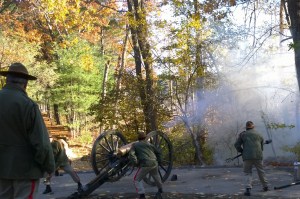
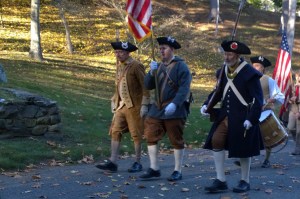
Kristina and I set out for a walk yesterday morning, taking a leaf-covered bike trail and then an offshoot that goes through the cemetery. A loud boom when we were yet a great way off failed to alert me to what might be going on in the cemetery on Veterans Day. But as we got closer we could see cannon, and then it dawned us that we had stumbled onto Concord’s annual flag-retirement ceremony.

After getting a bit of history from costumed representatives of the Concord Independent Battery, we walked over to where retired flags were being burned. Kristina’s church choir led the assembled veterans and supporters in “God Bless America.” The song seemed to take on added weight this Veterans Day, as many of us held in our hearts an America built on the Bill of Rights and the wish to see justice for all.

May our military continue to be asked to defend the bedrock of the American experiment as they always have.

111116-veterans-day-parade-concord

111116-concord-indepedent-battery-canon


Read Full Post »

I like reading that the numbers of socially conscious companies are increasing. Recently, Naz Akyol at Social Enterprise Greenhouse in Providence wrote about one such business.

“Three years ago, active duty airman Michael Gnoato lost his life in a fatal car accident in Wyoming. Major Pettaway, a Marine who knew Mikey since high school, missed the funeral because he was deployed in Afghanistan at the time, but Navy Seabee Sadam Salas was there to speak at their best friend’s funeral. …

“The two young men are the co-founders (as well as CEO and CFO, respectively) of Mike’s Ice, a deliciously novel idea that pays tribute to their fallen friend, and also a social enterprise committed to fighting veteran homelessness and more.

“Sadam and Major [sell] Thai style ice cream rolls that come in seven fun flavors, … a commodity that only recently hit US markets with only a handful of stores in New York City. They also decided to give their venture four wheels and make Mike’s Ice a mobile truck. …

“Everything that is sold at Mike’s Ice is made from scratch, which means the truck needs to be equipped with special ice cream making machines as well as equipment for storing their ice cream bases and toppings. When asked about the greatest challenge they have faced so far, Sadam smiles and says: ‘You don’t sleep a lot.’ …

“Mike’s Ice received a SEG Hub Scholarship from Social Enterprise Greenhouse … [and] is partnered with Backpacks For Life, a nonprofit that provides homeless veterans with backpacks that contain essentials for survival.

‘We are both veterans, and now we are also entrepreneurs, and entrepreneurs exist to solve problems,’ Sadam says. ‘Veteran homelessness, suicide …. these problems shouldn’t exist. These are people who fought for their country.’

More here.

Photo: Social Enterprise Greenhouse

Read Full Post »

I thought today would be a good day to note that, with the right supports in place, veterans who have suffered post-traumatic stress while serving the country can move forward with their lives.

The willingness of some of these service men and women to expose their story in the media strikes me as an extra level of bravery.

Kathy McCabe writes at the Boston Globe about Army veteran Michael Saunders.

“Saunders, who served from 2002 to 2006, deployed twice to Iraq … He started therapy at the VA outpatient clinic in Lynn, where a counselor suggested he focus on a new mission: going to college.

“ ‘She said I would make more money with a college degree,’ said Saunders, who worked for a lumberyard after his discharge from the Army.

“He enrolled in VITAL — an acronym for Veterans Integration to Academic Leadership — a national program that helps veterans transition from soldier to student. VITAL brings VA services, including mental health counseling, to college campuses. …

“According to Pam Flaherty, dean of students, Middlesex Community College had nearly 600 student veterans in 2014-15. In the last year, 70 who have PTSD have taken part in VITAL and received mental health care on campus. …

“The Bedford VA also offers the VITAL program at Bunker Hill Community College in Charlestown, Mount Wachusett Community College in Gardner, Northern Essex Community College in Haverhill, North Shore Community College in Danvers and Lynn, Endicott College in Beverly, and Salem State University.

“Saunders, who graduated from Everett High School in 1999, is in his second year studying liberal arts at Middlesex Community College in Bedford. He has discovered a talent for writing, and hopes to transfer to Emerson College next year.

“ ‘It was a rough start, but I’m doing fine now,’ said Saunders, who also has a job at the college’s Veterans Resource Center. ‘Had the VA not had the service in place here, I wouldn’t have come.’ …

“ ‘I can sit in class now, for an hour and 20 minutes,’ Saunders said. ‘I couldn’t sit still for 10 minutes before.’ He has a lingering fear of crowds, so he adjusted his seat in the classroom.

“ ‘ I have to be able to see the door, and I don’t like anybody behind me,’ Saunders said. ‘If I can’t do that, I can’t focus.’

“For one class, Saunders wrote a story called ‘The Dark Is Afraid of Me,’ a fictional account of a military mission in Iraq.

“ ‘It was really easy for me to tell the story,’ Saunders said. ‘When the professor read the paper, she was like, “You need to go see a publisher, now.”

” ‘Maybe I will.’ ”

More such stories at the Globe, here.

080115-flag

Read Full Post »

Older Posts »