Feeds:
Posts
Comments

Posts Tagged ‘volunteer’

Photo: Steven Wright/Unsplash.

Anyone can post on Wikipedia. I even tried it once myself. But volunteer editors are always checking that you obey the rules. My post on the neglected artist Lucille Corcos was removed because at that time, citations from online links were not allowed.

Today’s story shows what can happen if your Wikipedia entries are mainly another no-no: self-promotion. There’s a lot of self-promotion on Wikipedia, but this guy was especially sneaky.

Nate Anderson writes at Ars Technica, “Quick — what are the top entries in the category ‘Wikipedia articles written in the greatest number of languages‘?

“The answer is countries. Turkey tops the list with Wikipedia entries in 332 different languages, while the US is second with 327 and Japan is third with 324. Other common words make their appearance as one looks down the list. ‘Dog’ (275 languages) tops ‘cat’ (273). Jesus (274) beats ‘Adolf Hitler’ (242). …

“A couple months back, something would have been different. Turkey, the US, and Japan were still in the same order near the top of the leaderboard, but the number one slot was occupied by an unlikely contender: David Woodard, who had Wikipedia entries in 335 different languages. …

“Woodard is a composer who infamously wrote a ‘prequiem’ — that is, a ‘pre requiem’ — in 2001 for Oklahoma City bomber Timothy McVeigh, who had murdered 168 people with a truck bomb. The piece was to be performed at a church near McVeigh’s execution site in Terre Haute, Indiana, then recorded and played on the radio so that McVeigh would have a chance to hear it.

“According to the LA Times, which spoke to the composer, ‘Woodard’s hope in performing the 12-minute piece, he said, is to “cause the soul of Timothy McVeigh to go to heaven.” ‘ …

“Woodard also had a scheme to help save Nueva Germania, an 1880s colony in Paraguay that was designed to let German culture flourish away from the influence of European Jews. … ‘As an artist who is fed up with much of the pretentious nonsense that has come to define Western culture,’ Woodard told SF Gate, ‘I am drawn to the idea of an Aryan vacuum in the middle of the jungle.’

“So what was a guy like this doing with articles in 335 different languages? Inquiring minds want to know, which is why people have posted questions to sites like Reddit over the last year asking about the Woodard situation. …

“A Wikipedia editor who goes by ‘Grnrchst’ recently decided to find out, diving deep into the articles about Woodard and into any edits that placed his name in other articles. The results of this lengthy and tedious investigation were written up in the August 9 edition of the Signpost, a volunteer-run online newspaper about Wikipedia.

“Grnrchst’s conclusion was direct: ‘I discovered what I think might have been the single largest self-promotion operation in Wikipedia’s history, spanning over a decade and covering as many as 200 accounts and even more proxy IP addresses.’

“A network of accounts with an unusual interest in Woodard was identified, and its activities over the last decade were mapped. Starting in 2015, these accounts inserted Woodard’s name ‘into no fewer than 93 articles (including “Pliers,” “Brown pelican,” and “Bundesautobahn”), often referencing self-published sources by Woodard himself.’ And that was just in the English version of Wikipedia.

“From 2017 to 2019, the accounts ‘created articles about David Woodard in at least 92 different languages, creating a new article every six days on average .… They started off with Latin-script European languages, but quickly branched out into other families and scripts from all corners of the globe, even writing articles in constructed languages; they also went from writing full-length article translations, to low-effort stub articles, which would go on to make up the vast majority of all translations (easily 90 percent or more).’ …

“After a reduction in activity, things ramped up again in 2021, as IP addresses from around the world started creating Woodard references and articles once more. For instance, ‘addresses from Canada, Germany, Indonesia, the UK and other places added some trivia about Woodard to all 15 Wikipedia articles about the calea ternifolia.’

“Then things got ‘more sophisticated.’ From December 2021 through June 2025, 183 articles were created about Woodard, each in a different language’s Wikipedia and each by a unique account. These accounts followed a pattern of behavior: They were ‘created, often with a fairly generic name, and made a user page with a single image on it. They then made dozens of minor edits to unrelated articles, before creating an article about David Woodard, then making a dozen or so more minor edits before disappearing off the platform.’

“Grnrchst believes that all the activity was meant to ‘create as many articles about Woodard as possible, and to spread photos of and information on Woodard to as many articles as possible, while hiding that activity as much as possible. … I came to believe that David Woodard himself, or someone close to him, had been operating this network of accounts and IP addresses for the purposes of cynical self-promotion.’

“After the Grnrchst report, Wikipedia’s global stewards removed 235 articles on Woodard from Wikipedia instances with few users or administrators. Larger Wikipedias were free to make their own community decisions, and they removed another 80 articles and banned numerous accounts. …

“In the end, just 20 articles about Woodard remain, such as this one in English, which does not mention the controversy.”

More here.

Read Full Post »

Photo: Zach Mordan.
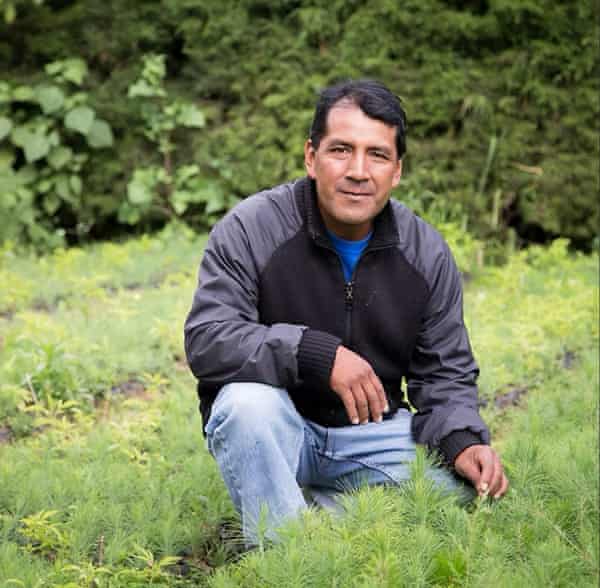
Armando López Pocol, who set up Guatemala’s Chico Mendes Reforestation Project in 1999.

Sometimes I am just overwhelmed at the power of one person to make the world better. It may be the man who starts a regreening project on ruined land. It may be the woman who draws cheery pictures on patients’ insurance bills. It may be you when, after getting a long run-around on a robotic telephone chain, you are kind to the poor schlemiel who is the first human you talk to.

Let’s start with the artist in the billing department. Steve Hartman at CBS, recounts what happened to a patient called Melody Morrow.

“A few years ago, Melody Morrow of New York City hurt her foot and needed physical therapy. However, she said what really made her feel better was paying the bill.

” ‘On the envelope, on the front of the envelope, it had these little music notes,’ Morrow told CBS News of the billing statement she received in the mail, a play on her name, ‘Melody.’ …

” ‘This was a stranger,’ Morrow said. ‘And she was doing that just for me.  And that’s the beauty of it.’ ”  More at CBS, here.

Now let’s turn to Armando López Pocol in Guatemala. Suzanne Bearne has an in-depth report at the Guardian on what he started.

It begins, “Armando López Pocol is showing off some of the thousands of trees he has planted in Pachaj, his village in the highlands of western Guatemala, when he suddenly halts his white pickup truck. Alongside an American volunteer, Lyndon Hauge, he gazes out over a charred field. Clouds of smoke are still billowing from the ground.

“As he walks through the ash-covered field, his optimistic speech turns to sadness and he pauses in silence to take in the barren landscape.

“Before the fire, this 2-hectare (5-acre) plot of land in the mountains of Cantel was home to 2,000 trees, all planted through Pocol’s reforestation project.

“Over a quarter of a century, he and his small team of volunteers and community members have planted thousands of trees, regenerating the landscape of Guatemala’s highlands and mitigating the impacts of the climate crisis, while also generating revenue for local communities.

“Pocol initiated the Chico Mendes Reforestation Project in Pachaj – located 2,400 metres (7,900ft) above sea level and about 6 miles (10km) from the town of Quetzaltenango, known as Xela – in 1999. At that time, the region had suffered extensive deforestation over several decades.

“The organization was named after the Brazilian environmentalist Chico Mendes, who fought to preserve the rainforest and for Indigenous rights until he was murdered by a cattle rancher in 1988.

“ ‘The struggles he went through in Brazil are similar to the ones we go through in Guatemala,’ Pocol says.

“ ‘From the 1960s to the 1990s, there was a lot of deforestation in Cantel, as the wood was used extensively for building houses and as firewood for families,’ he says. ‘I started Chico Mendes to stop the deforestation, as I was worried about climate change and environmental problems in Guatemala, with mining companies destroying the community forests of Indigenous people.’

“He says deforestation is now largely caused by fires during the dry season, and attributes the latest one – the third in his fields so far this year – to an arson attack.

“ ‘We’re losing many tree plantations,’ he says, adding that the region lost more than 100,000 trees to fires in 2023 alone.

‘What keeps my spirit alive are the workers and volunteers showing their support and not giving up.’

“Since he embarked on his tree-planting mission, Pocol has become resigned to the fact that he cannot stop fires. ‘We just don’t have enough staff,’ he admits. ‘It’s expensive to have people out here watching all this land.’

“While he believes some of the fires are due to foul play, he says they have tried to reduce the number by creating fire corridors in the forests. …

“Pocol says his organization has not received any money. ‘We don’t receive funds from the government as we are against mining projects and environmental injustices in Guatemala, and we know that all the funds the government manages come from transnational companies.’ …

“Without a regular income, the Chico Mendes project depends on donations and a ‘volunteering fee’ (equivalent to about [$20] a day), which covers a homestay and three meals. Volunteers gather seeds, source decomposed leaves, fill bags with soil, and plant trees.

“Donations and the volunteering fee are crucial for Chico Mendes, as Pocol sees his initiative as much more than a reforestation project. The organization also supports the community through ecotourism, with funds circulating through the local economy via homestays and treks, as well as volunteers spending money in the village. …

“[Dr René Zamora-Cristales, outgoing director of the Latin American restoration initiative 20×20 at the World Resources Institute] praises Pocol’s work and says Guatemala needs more people like him. ‘Deforestation has always been an issue, but different efforts, such as the one from Armando, have reduced the overall deforestation in the country. We certainly need more local leaders committed to improving the livelihoods of local communities by restoring nature,’ he says.

“Pocol, who works on his project every day without a break, including weekends, and tops up his income in the evenings as an Uber driver, admits he is exhausted.

“ ‘I wake up in the night and wonder what the future is going to be for the project as there’s been a lot of difficult times. But I’ve never given up, and it always lifts my spirits when volunteers come.’ ”

More at the Guardian, here.

Read Full Post »

Photo: Nieman Labs.
Volunteers reading the newspaper for radio listeners who are not able to read for themselves.

I’d like to say a word for radio. Every time a new, shiny technology comes along, we hear that the old ones are dead. Especially radio. Radio is dead more often than than theater.

But I love radio, and I’m not the only one. I love it for news without pictures, because pictures alter the story. I love it for interesting stories that are not news. I can find those online, too, but the human voice is the part that means most to me. I like it better than podcasts, which seem to overdramatize, as if I need scary music to understand the next bit might be important.

In today’s story, from Nieman Labs, Neel Dhanesha reports on a little-known radio service that means the world to a particular audience.

“A few years ago the staff at Aftersight, a nonprofit radio service based in Boulder, Colorado, got an angry call from a man whose child was trying to watch Barney on PBS Kids.

“ ‘All we can hear is you guys reading the paper!’ the man said.

“His child had accidentally switched the audio channel on their TV, and the family had stumbled onto a form of broadcasting that, for the most part, remains hidden away by design: They had discovered a radio reading service.

“When color television arrived in the United States, [it] was the product of many technological breakthroughs, but the one most relevant to our story is the sideband, or subcarrier: a modulated radio wave that can, in essence, carry more information on the same frequency. Color TV worked by sending a black and white picture in the main band of a frequency and a color picture in the sideband, and the two bands would then be recombined in the tubes of a color TV.

“Radio reading services work on the same premise, except instead of pictures they transmit a radio broadcast. Where color TV brought more vibrant pictures to living rooms around the country, radio reading services, which are also called audio information services, have almost the opposite audience: every day, across the country, hundreds of volunteers read newspapers, magazines, and books on the radio for thousands of listeners with blindness or vision loss, bringing them access to local, national, and international news around the clock.

“ ‘I always tell folks we’re on super-secret radio stations,’ said Bekah Jerde, executive director of Radio Talking Books Service, a reading service based in Omaha, Nebraska. She’s also the vice president and treasurer of the International Association of Audio Information Services (IAAIS) a collective of 39 audio information services that are mostly based in the U.S. (and one in Australia). The stations are ‘super-secret’ because they are designed to be used by people with vision impairments and other disabilities that can make reading or turning pages difficult. Thanks to a provision in copyright law, copyrighted materials like books, magazines, and newspapers can be reproduced for free for the sake of accessibility.

“The first radio reading service debuted in Minnesota in 1969 as a side-channel on KSJR — the birthplace of Minnesota Public Radio. That first ‘Radio Talking Book’ schedule included two hours of the Minneapolis Tribune newspaper in the morning and two hours of the Saint Paul Dispatch in the evening, with readings from magazines and books in the intervening hours. More than 50 years later, the live morning newspaper reading — now from the Minnesota Star Tribune and St. Paul Pioneer Press — remains the service’s most popular programming.

“Today there are 79 of the services across the country. … In the past, listeners who wanted to tune into those super-secret stations would have to send in an application for a radio that could pick up their signal or, as the man in Colorado learned, switch their audio language on certain TV channels. But streaming has come for the radio reading services, just as it has for TV.

“ ‘We went online three years ago, which did wonders for our listenership,’ said Michael Benzin, executive director of the Niagara Frontier Radio Reading service in Buffalo, New York. ‘The big restriction we always had was that our listeners needed one of our radios, so we were managing a large inventory of radios, picking them up and dropping them off all the time. But now anybody with an internet connection can play our live feed on a tablet or a cell phone or a computer.’

“The majority of the listeners for these services are over the age of 65 and have aged into vision loss or other disabilities that prevent them from reading the news on their own, Jerde told me. That means they often don’t know how to use technology like screen readers, which don’t play well with many websites anyway. The radio reading services provide their listeners with an experience that’s hard to replicate with a computer: reading a newspaper or magazine from cover to cover, including comics and grocery ads. …

“For many people, especially in rural areas with poor internet access, the reading services’ radio and TV broadcasts are essential lifelines to the outside world. Some of the services even allow people to listen by dialing a phone number.

“ ‘Part of our goal is to go out in different parts of the state, especially the rural areas, and ask how people are getting their information,’ said Kim Ann Wardlow, executive director of Aftersight and president of the IAAIS. ‘We’re trying to figure out if there are other things we should be reading to best serve folks who are seeking hyperlocal information that isn’t necessarily in the traditional newspaper anymore.’ Both Aftersight and the Niagara Frontier Radio Reading Service have started offering programs in Spanish. ….

“Every service in the network is tiny, often run on a shoestring (usually) nonprofit budget: Benzin, in addition to making programming decisions, told me that part of his job as executive director includes mowing the lawn, vacuuming, and washing the windows at the Niagara Frontier service’s office. IAAIS has a program share, similar to the Public Radio Exchange, that allows member stations to share content to help fill the schedule. And while each has its own ways to raise funds, Wardlow, Benzin, and Jerde all told me one thing is the same across the country: the volunteers are incredibly committed to their work.

“ ‘I’ve got volunteers who’ve been coming in every week for thirty years,’ Benzin told me. ‘I’ve been working in the nonprofit world for going on 40 years, and I’ve never had a volunteer base this dedicated.’ ”

I’m thinking of other groups that could benefit: English language learners and people who simply never learned to read. I wish there were more publicity for this service.

More at Nieman Lab, here.

Read Full Post »

Photo: Gordon Noble, University of Aberdeen.
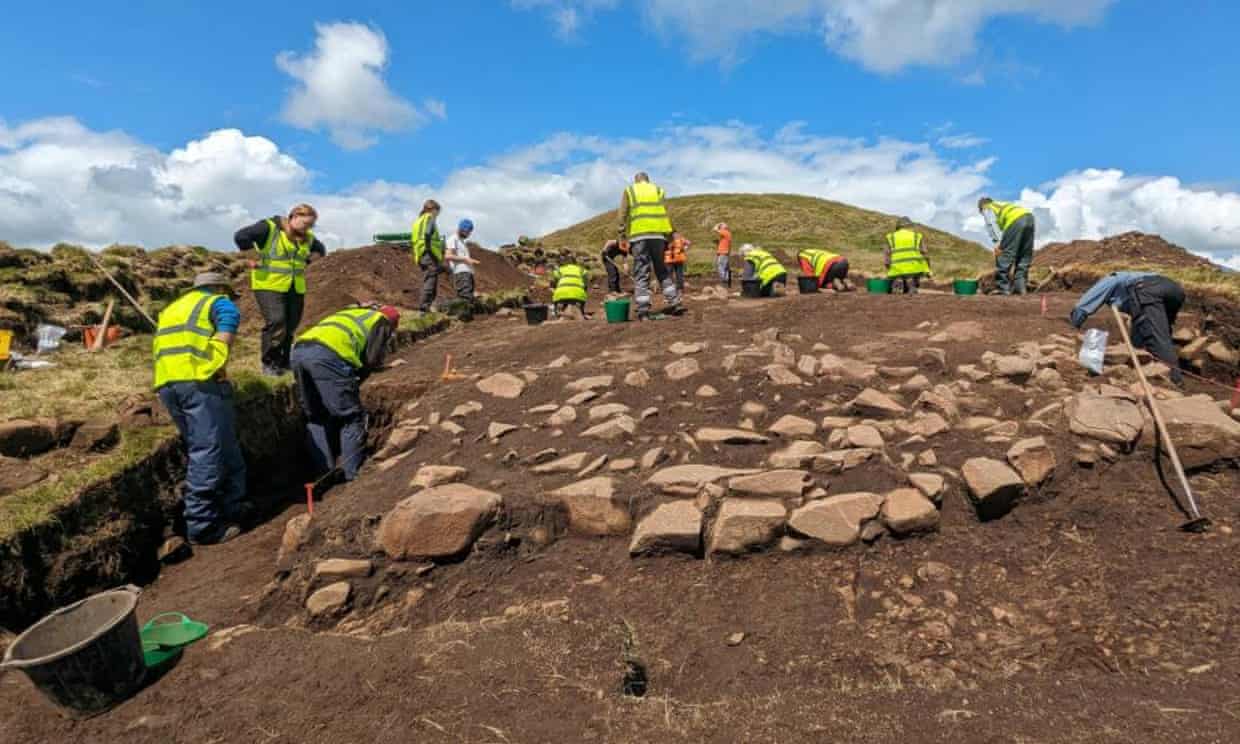
The community archaeological dig at the East Lomond hillfort site. 

Did you ever want to be an archaeologist? I think there was a period in childhood that it interested me, encouraged by gifts of picture books about the discovery of Knossos in Crete. But then I moved off in other directions.

Perhaps you had that experience, too, always wondering what it would have been like. Today there are opportunities to get a taste of that world as a volunteer.

Libby Brooks writes at the Guardian about the thrill of being a citizen archaeologist in Scotland.

“They were moving forward in a line across the 10 sq metre [~108 square foot] trench, volunteer excavators elbow to elbow with academics, and Joe Fitzpatrick was at the far edge.

“He was digging around the hearth of a building, about 60cm (2ft) below surface level, when he hit the earth twice with his mattock and out it popped – a rare bronze spear butt, a metal fitting placed over the end of a wooden shaft to counterbalance the spear head. Covered in Pictish inscriptions, it had remained buried for more than one and a half millennia, and was one of the most groundbreaking archaeological discoveries of 2024 in Scotland.

‘The hair stands up on the back of your neck and you tingle,’ says Fitzpatrick, of the moment he realized the significance of the find. ‘It is special.’

“Fitzpatrick, who has always had a passion for history, got involved with the regular community dig at the site of the East Lomond hillfort, beside the village of Falkland in Fife, as a retirement activity.

“He was working next to Prof Gordon Noble, the head of archaeology at the University of Aberdeen, who was leading the dig: ‘We just looked at each other,’ Fitzpatrick recalls. ‘Two men with their jaws hanging open, dumbfounded.’

“He helped unearth the artifact in July, during excavations organized by the Falkland Stewardship Trust and the University of Aberdeen, which bring together members of the public and students to help uncover settlement remains dating from around the second or third century AD to around AD700.

“He is one of a growing legion of citizen archaeologists, eager volunteers who are sustaining projects across the country even as volunteering more generally is in decline.

“Fitzpatrick says: ‘A lot of people who retire are more aware of keeping active and outdoors, but we also have young people working out what to do after their studies, and the media has broadened archaeology’s appeal with programs like ‘Time Team’ and ‘Digging for Britain’ – it’s not just Oxford dons doing it.’

“An ‘exceptionally rare’ find like the spear butt boosts team morale … says Noble. ‘Community involvement has really ramped up in the past 10 years,’ he says. ‘There’s the excitement of uncovering the past on your doorstep. These volunteers come from all walks of life.’ …

“Although Volunteer Scotland has warned that last year’s Scottish Household Survey results ‘point to a crisis in volunteering,’ for those participating in culture and heritage the numbers remain constant, compared with a drop of four percentage points elsewhere.

“Jeff Sanders, the head of outreach for the Society of Antiquaries of Scotland, says the cost of living crisis has affected individuals and their ability to participate, but also organizations and their capacity to put things on for volunteers. …

“As well as funding challenges, Sanders says there is a push to diversify volunteering – volunteers are often retirees with more disposable income. Sanders also works on the Make Your Mark campaign, which worked with the Scottish Refugee Council over the summer to co-design archaeology taster sessions to attract people who wouldn’t ordinarily get involved in volunteering.

“This ‘continuing upward trend’ in community involvement has prompted Emily Johnston to chart the citizen archaeologist phenomenon as part of her doctoral research at the University of Edinburgh. She has launched a database of community archaeology activities across Scotland, Outreach in Scottish Archaeology (OScA). …

“Says Johnston, ‘A lot of volunteers have been really interested in archaeology from a young age. It’s about creating a tie to your past and gives people a sense of identity.’ “

I love the idea of “taster sessions” for volunteers — in any field. I imagine more people would take on gigs if they knew there was no embarrassment about dropping out. They would keep trying things until they found the right opportunity for them. I tried volunteering with many ESL [English as a
Second Language] organizations until I found the right fit.

More at the Guardian, here.

Read Full Post »

Photo: The Valley Ledger.
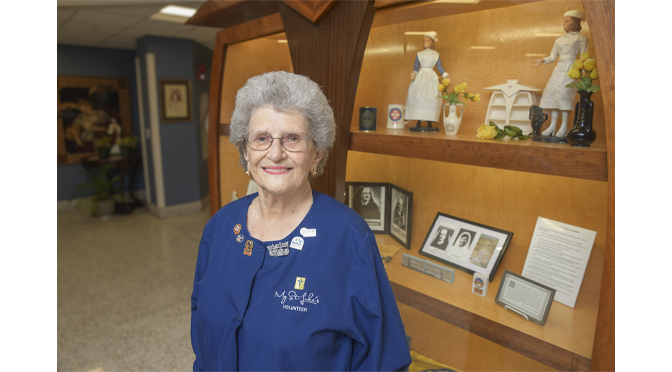
Grace Carr became a nurse cadet in 1944. She is still active as a volunteer at St. Luke’s Sacred Heart Campus in Allentown, Pa.

Nancy L and I, both living in retirement communities, have been fascinated to see how differently we ourselves — and the people around us — age. It’s like we’re making a study of our cohort.

Nancy tells me with a certain awe about an active woman over 100 that she’s met where there are people in their 70s who can barely function. What makes the difference? she wonders. We ponder together whether it’s all genetics, something about the life they’ve lived, a combination of those elements, or what.

From the Washington Post comes a story about an elderly WW II-era nurse called Grace Carr who adds to the wonderment.

Cathy Free writes, “Grace Carr was 17 when she left her family home in the coal town of Freeland, Pa., to pursue a dream she’d had since she was 5 years old.

“ ‘Ever since I can remember, I wanted to be a nurse and work in a hospital,’ said Carr, who as a child spent hours wrapping her dolls in bandages and taking their temperatures. …

“Carr, now 97, is still at it, working exactly where she started: St. Luke’s Sacred Heart Campus in Allentown, Pa., about 60 miles from where she grew up.

“Although she retired from her nursing job at age 62, Carr continued as a volunteer at the hospital, and she now shows up every Wednesday to escort patients to their tests, deliver flowers to rooms and take specimens to the lab.

“ ‘From the time she shows up in the morning until she leaves in the afternoon, Grace always has the same happy smile,’ said Beth Fogel, the hospital’s volunteer engagement specialist, who has known Carr for 20 years.

“ ‘She never shows any weariness and always has the same pep in her step,’ she said. ‘Everyone loves talking to her.’

“Carr has logged more than 6,000 hours as a volunteer, taking only a few months off at the height of the coronavirus pandemic. ‘I love people, and my health is good, so I’m happy to do what I can,’ she said. …

“Carr, formerly known as Grace Malloy, started training to become a nurse at Sacred Heart Hospital during World War II in 1944.

“ ‘When I went to nursing school at the hospital, we all lived on-site in a home for nurses,’ she said. ‘We had classes for most of the day, then we’d go onto the floors and learn about all the usual things nurses did, like making beds, taking temperatures and helping to keep the patients comfortable.’ In her first year as a trainee, she was paid $15 a month.

“The U.S. Army paid for her training on the condition that she serve in the U.S. Cadet Nurse Corps and work in a public hospital like Sacred Heart after graduation, she said. The nurse cadet program ensured that U.S. hospitals didn’t experience nursing shortages during the war. …

“Carr said the Army gave her two cadet uniforms — one for summer and one for winter — and she’d often wear them when she took the train home to visit her parents. …

“When Carr’s boyfriend, Edward Carr, came home from serving in the military, they were married in 1947 — the same year she graduated from nursing school.

“Carr was then hired to work the night shift at Sacred Heart, which she did for more than 20 years while raising four daughters and a son. She laughs when people ask her whether she slept during those years.

“ ‘I’d take little naps,’ Carr said. ‘Then when my husband came home, I’d let him take over until it was time for my hospital shift to start at 11 p.m. I look back on it now and I think, “How in the world did I do that?” … I always felt thankful to be doing something I loved.’

“Carr passed her work ethic along to two younger sisters who followed her into nursing. Her daughter Grace Loring also worked at the same hospital. …

“Loring, now retired after 35 years as a pediatric nurse, picks up Carr at her home in Allentown every Wednesday and drives her to and from the hospital. She said she often wonders how her mother managed it all while she was growing up.

“ ‘I also worked nights when I became a nurse, but I was single, and I could just go to bed,’ she said. ‘My mom was there for us after school, she handled the housework and the gardening, and she made matching Easter outfits for us every Easter.’ …

“ ‘When I was a student nurse, I was working in the maternity nursery and had to take this adorable baby boy to his mother,’ Carr said. ‘That little boy later married my oldest daughter, Janet, and he’s now 78. …

” ‘I’ve been given a lot by the hospital,’ Carr said. ‘So as long as I’m healthy and able, I’m going to keep coming back.’ ”

More at the Post, here, and at the Valley Ledger, here.

Read Full Post »

Photo: Erika Page/The Christian Science Monitor.
Alfredo Paniagua lifts a young girl up to see planet Jupiter through his telescope on a sidewalk in Madrid last February.

It seems that people are more likely to engage with the stars in the summer than at other times of year. I myself see a lot more stars when I vacation in New Shoreham in July because there are fewer sources of ambient light. The stars are more noticeable.

Today’s story is about a man in Spain who loves to show anyone who’s interested the wonders of astronomy.

Erika Page reports at the Christian Science Monitor, “As the rest of the city heads out on a Friday evening, Alfredo Paniagua dons a lime-green vest, loads his 180-pound telescope into a van, and drives into the center of Madrid.

“He sets up the telescope at the mouth of the busy Ópera metro station, a block from the Royal Palace. The sun still setting, he swivels the massive cylinder to an invisible point in the sky and fiddles with the focuser. And then he waits.

“It doesn’t take long for curiosity to pique. Children tug on sleeves and point. Friends dressed for an evening out stop to ask what’s up there.

“ ‘Jupiter,’ says Mr. Paniagua. ‘The view is spectacular tonight.’

“A line begins to take shape, curious passersby waiting their turn to peek through the lens. Mr. Paniagua places a footstool for those who need it and lifts the smallest kids up himself. He shows each viewer how to focus the image. Then he steps back for his favorite part. Eyebrows raised, he watches face after face light up at the sight: a perfectly round ball of bright gas marked by two clear stripes near its equator, tiny to the eye yet big enough to fit 1,321 Earths. Four moons stretch out in a straight line below. …

“It’s a nightly ritual Mr. Paniagua has performed for two decades, whenever the sky is clear. He often stays past midnight, sharing his telescope with hundreds of strangers free of charge. Many leave a donation, which he accepts. … ‘I like to think that they begin to ask themselves new questions.’ …

“[The immensity is] what Ana Afonso Martin says she felt looking through Mr. Paniagua’s telescope. She and three friends just arrived from the Canary Islands for a weekend in Madrid. Jupiter was the last thing she expected to find in the capital.

” ‘We are teeny, tiny, and this is immense,’ she says. ‘If you’re always stuck in your world, and you don’t look up at the sky, you don’t realize that.’

“It’s also what pulled Mr. Paniagua into the fold 25 years ago. At the time, he was working odd jobs, mostly as a metalworker, on the outskirts of Madrid. He heard word of a free astronomy course offered by someone in his neighborhood, and signed up.

“It was Saturn that hooked him, on the last day of the class. From there, he and a few others formed the Agrupación Astronómica Madrid Sur (South Madrid Astronomical Association) and began bringing an old telescope to schools, hospitals, small towns, and whoever invited them. Most of what he has learned he taught himself, though he eventually became a certified astronomy monitor through the Starlight Foundation, a nonprofit dedicated to promoting and protecting the night sky. Over time he realized that to reach the most people, he needed to be out on the street. …

‘A growing dark-sky movement is working to protect the night from light pollution, which grew by nearly 10% every year between 2011 and 2022.” More at the Monitor, here.

Read Full Post »

Photo: Natalie Alcoba.
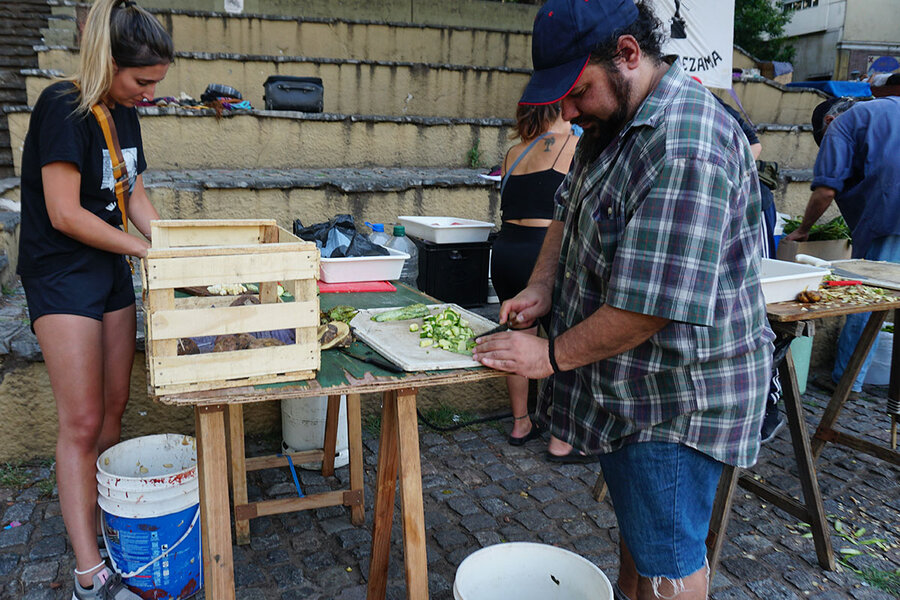
Gerardo Romero and Flor Yciz donate the gift of time to the nonprofit Parque Lezama Olla Popular, preparing
a meal they serve each week to those in need in Buenos Aires, Feb. 6, 2023.

One thing that struck my husband when he returned from over a year of working in China was that Americans do a lot of volunteering. His perception of China at that time was that the government did everything and that citizens didn’t often take it on themselves to help others less fortunate.

Christian Science Monitor reporter Erika Page notes that Argentinians, too, aren’t known for helping strangers, but that young people are leading the way in tough inflationary times.

“Every Tuesday evening,” she writes, “as streetlights flicker on in downtown Buenos Aires, a man named Charlie tidies a section of sidewalk, preparing for his visitors.

“Charlie lives on the street. The volunteers who regularly check in on him as part of their recorrida nocturna, or night route, are an emotional lifeline.

“The team of six sit with Charlie in a semi-circle on the pavement, offering juice, yerba mate, and conversation. They chat about the weather, current events, the neighbors, and when the laughter lulls, they ask Charlie about more immediate concerns, like his health, upcoming medical appointments, and how the police have been treating him.

“There are thousands of people like Charlie living on the streets across the capital, and 43% of the country’s population lives in poverty. It’s a reflection of the unrelenting economic crisis and sky-high inflation that’s enveloping this South American nation. Some 600 volunteers take part in these nightly visits organized by the nonprofit Fundación Sí, underscoring a growing movement of volunteers, fueled by young people, who are working to fill the void where government services and the labor market are falling short. 

“These volunteers may not be well off – or even interested in staying in Argentina long-term – but they offer whatever they can to lift their neighbors up: a hand, an ear, a meal, or simply some of their time. Argentina isn’t known for high rates of volunteerism, but recent data shows that’s changing.

A study published by Voices! Consultancy found that a record 36% of Argentines volunteered last year, including nearly 60% of people between 18 and 24 years old.

“Generosity of time and affection is generally reserved for family and close friends in Argentina, says Constanza Cilley, executive director of Voices! Consultancy. But, ‘there are significant increases [in volunteering] in times of greatest crisis,’ she says. …

“Last year, annual inflation reached 94.8%, sending food prices soaring, and making saving nearly impossible. Most young people no longer expect a higher standard of living than their parents in a country whose social mobility was once a point of national pride. That can cause internal conflict for those who want to do good here. …

“Emilia Maguire, a therapist, has considered emigrating for years, tired of the poverty she can no longer ignore – and which she sees as a reflection of distorted political and economic priorities. She recently joined Fundación Sí’s night routes.

“ ‘Sometimes I get home tired and distressed,’ says Ms. Maguire. ‘But when you connect with things like this that are gratifying, it’s easier to get by, because your focus shifts.’ …

“The Voices! study found a correlation between volunteering and general satisfaction. Some 23% of respondents who said they volunteered last year indicated Argentina as the best place for them to live, compared to only 14% of non-volunteers.

“The group got their start in 2018 with close to nothing, as the value of the Argentine peso began to plummet once again. They’ve since acquired a gas stove and donations from businesses and farmer’s collectives. They invite those who come to eat to help cook as part of the team. …

“ ‘The crisis itself pushes people together, uniting in empathy,’ says Carmela Pavesi, an organizer in her mid-20s. ‘You don’t need a lot of money or a lot of things,’ she says. ‘With the people you have nearby, wherever you are, you can do something with what you have.’ …

“ ‘Today there are more people living on the streets, more people in need, more people begging for money or help,’ says Eduardo Donza, a researcher with the Social Debt Observatory at the Universidad Católica de Argentina.

“The country’s poverty is structural and historic, says Mr. Donza, in large part due to a precarious labor market. Only 35% of the population works in the formal private sector, another 15% in the public sector, leaving half the population doing informal work. …

“ ‘If we don’t generate more wealth, if we can’t create more good jobs, we’re never going to come out of this,’ he says. Volunteering can’t solve these wider issues on its own. ‘But it seems to me like solidarity has increased. That willingness to help matters.’ “

More at the Monitor, here. No firewall.

Read Full Post »

Photo: Hyper Voisins.
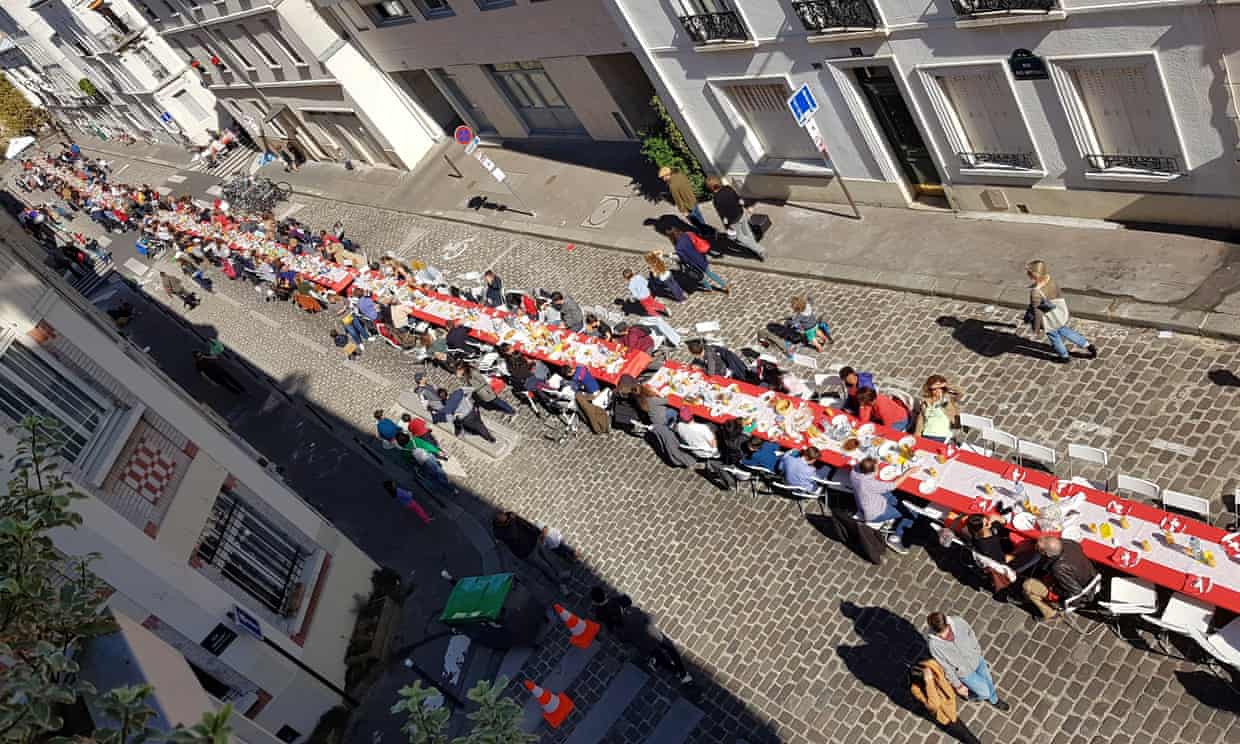
A 705-foot banquet table meant to seat 648 people in a Paris neighborhood that’s seeking a more neighborly lifestyle.

It’s that time of year again — time for our valiant but hopeless block party, when we smile and reintroduce ourselves to neighbors that we will look right through when we bump into them in the market in January. If New England can’t make mutual support and cooperation work, how in the world can Paris?

Peter Yeung at the Guardian describes an experiment in France.

“It was a distinctly un-Parisian revolution although it began on an inner city street. No barricades were assembled to block the nearby boulevards and no radical students hurled cobblestones ripped from the pavement. …

“Instead, a 215-meter-long [about 705 feet] banquet table, lined with 648 chairs and laden with a home cooked produce, was set up along the Rue de l’Aude and those in attendance were urged to openly utter the most subversive of words: bonjour.

“For some, that greeting led to the first meaningful exchange between neighbors. ‘I’d never seen anything like it before,’ says Benjamin Zhong who runs a cafe in the area. ‘It felt like the street belonged to me, to all of us.’

“The revolutionaries pledged their allegiance that September day in 2017 to the self-styled République des Hyper Voisins, or Republic of Super Neighbors, a stretch of the 14th arrondissement on the Left Bank, encompassing roughly 50 streets and 15,000 residents. In the five years since, the republic – a ‘laboratory for social experimentation’ – has attempted to address the shortcomings of modern city living, which can be transactional, fast-paced, and lonely.

“The experiment encourages people not just to salute each other more in the street but to interact daily through mutual aid schemes, voluntary skills-sharing and organized meet ups.

“ ‘The stereotype of a Parisian is brusque and unfriendly,’ says Patrick Bernard, the former journalist and local resident who launched the project. ‘But city living doesn’t have to be unpleasant and anonymous. We want to create the atmosphere of a village in an urban space. [Conviviality] can become a powerful asset, an essential economic and social agent in the construction of tomorrow’s cities.’

“Nearly 2,000 people now attend weekly brunches and apéritifs in local restaurants, cultural outings, memory exchanges, children’s activities and more. During the pandemic, residents mobilized to make masks, deliver shopping to vulnerable neighbors and bake cakes to support a local charity. Crucial, too, is the digital aspect: dozens of WhatsApp groups include those dedicated to repairing broken devices, selling second-hand goods, and sharing healthcare resources. …

“Mireille Roberdeau, an 86-year-old widow who moved to the area in 2000, says the scheme has given her a reason to get up in the morning. ‘I was quite timid before,’ she adds. ‘I wouldn’t speak to anyone. I would scowl at people. But now I look forward to going out. It’s good because my doctor says I need to get out.’

“Roberdeau, now a keen user of the WhatsApp groups was hospitalized in March but says neighbors delivered her groceries when she got home. …

“Beyond the ‘eating, drinking and celebrating as social engineering,’ in the words of Bernard, that defined the initial stages of Hyper Voisins, the long-term targets – aimed at transforming the very nature and functioning of an urban neighborhood – come under four pillars: environment, healthcare, public spaces and mobility.

“It has, for example, collaborated with non-profit Les Alchimistes to install organic waste disposal points in former parking spaces and to turn the matter into compost. Perhaps more radically at a time of strained healthcare provision in France, it is launching a health clinic geared towards local needs. [It] will have a staff of 10 and offer extended opening hours, consultations without appointment and home visits. …

“To reduce local car use by residents and traders, Hyper Voisins plans to buy electric bikes with trailers and install a communal electric bike charger. It is also in talks with the mayor to potentially levy a local tax on unwanted businesses such as estate agents, banks and delivery hubs and give residents a vote on whether they can even move in. ‘We want to promote stores that improve our daily life,’ adds Bernard. ‘If not, like a polluter, they should pay.’ …

“A study by sociologist Camille Arnodin found that Hyper Voisins – and two other community volunteer projects in Paris – had reinforced pandemic resilience, transformed weak neighbourly links into strong bonds, improved social mixing and reduced social isolation. …

“[But it] noted issues over inclusion: the scheme could risk leaving out either those who don’t wish to participate in activities or those who ‘don’t feel included or informed.’ ”

What do you think? Several readers are more intimate with Paris than I am, having been there only once, decades ago. So I would love to hear what you think of the experiment. Good idea? Can’t possibly survive?

More at the Guardian, here.

Read Full Post »

Photo: Noah Robertson/The Christian Science Monitor.
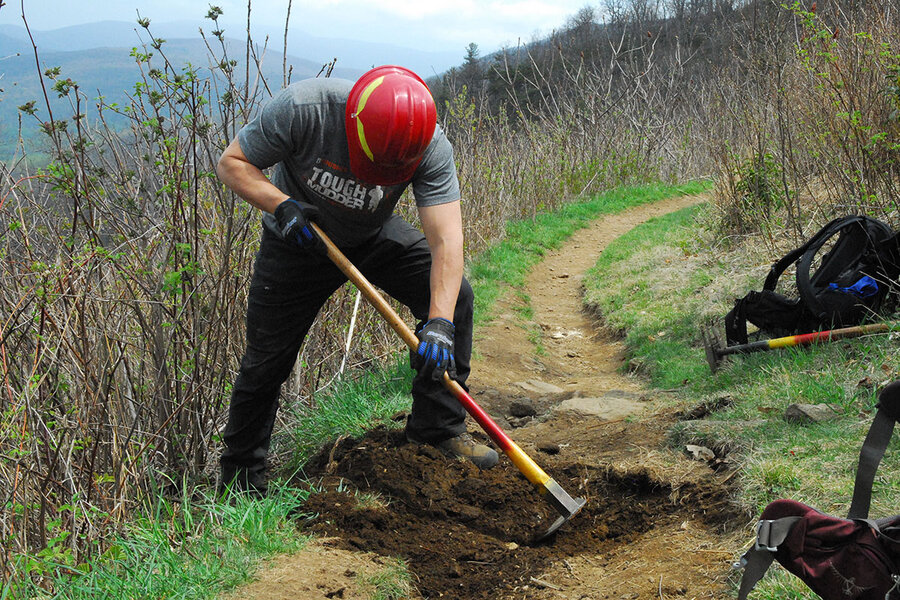
“Trail maintainer Russell Riggs digs an impromptu drain in Virginia’s Shenandoah National Park, May 1, 2022. The drain helps water gently slope down the mountain and off the trail, limiting erosion,” CSM reports.

I grew up at the foot of the Ramapo Mountains and although I never became a serious hiker, I always loved walking in the woods there. The Ramapo Mountains are part of the Appalachians. Today we learn how volunteers maintain the famed Appalachian Trail. Even in a pandemic.

Noah Robertson has the story at the Christian Science Monitor. “The view from Jewell Hollow overlook is hard to beat. More than 3,000 feet above ground in Shenandoah National Park, it’s a 180-degree window into miles of valley and mountains. Surrounded by a mossy stone fence and hiking trails, the sight is one of the best in Virginia.

“But today, Kris English isn’t focused on that. Instead, she’s looking at dirt – grassy green to tan to gravelly brown. 

“She pauses when the ground gets dark. Telling her three-person crew to stop, she teaches them to study dirt like paint swatches (every artist needs a canvas). Darker dirt is wetter dirt. Wetter dirt means the trail will erode faster. 

“Then Ms. English, a technical trail specialist for the Appalachian Trail Conservancy, shows them how to dig a drain. 

“Grabbing a 4-foot hybrid rake known as a McLeod, she clears debris in wide brushstrokes and carves a gentle slope. Five minutes later there’s a comet-shaped channel to guide water down the mountain. …

“Ms. English, leading a training session that morning in early May, helped add a few volunteers to the roster of those who routinely preserve the Appalachian Trail – the East Coast’s 85-year-old, 2,200-mile hikers’ paradise. Her role is professional, but each year a 14-state network of trail crews from Georgia to Maine volunteer hundreds of thousands of hours to keep the trail sustainable, accessible, and clean. 

The pandemic has made it harder. When indoor gatherings were off limits, people went outdoors in record numbers. And, not knowing basic hiking etiquette, they made a mess. 

“That hasn’t stopped the volunteers. Last fiscal year, the Potomac Appalachian Trail Club, which oversees 240 miles of the trail – 101 of which are in Shenandoah National Park – amassed 2,000 more volunteer hours than it did the year before the pandemic. [To] Wayne Limberg, one of the PATC’s district managers in Shenandoah National Park, … the response shows that people understand the Appalachian Trail’s inherent contract. It offers humans an almost unrivaled opportunity to interact with nature. But that agreement takes preservation. 

“ ‘We want to make sure that it can be enjoyed by those of us living now and also future generations,’ says Mr. Limberg, who helped Ms. English lead the training session in May. ‘Trails need to be maintained.’ …

“Humans want to see nature. But nature doesn’t always appreciate the interest. Trails solve that problem by concentrating folks into a single, relatively small path, she says. The arrangement maximizes people’s exposure to nature and minimizes their impact. 

“But this is a fragile agreement. Humans – particularly new hikers – can disturb the forest with litter, graffiti, music, and millions of footprints. Nature, for its part, will always try to take the trail back with weeds, moving water that erodes the path, and fallen trees known as ‘blowdowns.’ 

“Hence, the need for trails creates a need for trail maintainers. And trail maintainers need training. 

“After a series of safety tips, Ms. English walks her group to a set of tools. … The fire rake’s harsh triangles help clear gravel and debris. The mattock’s two ends can dig earth and tear roots. …

“ ‘I could nerd out about tools for a minute,’ she says. And briefly she does, even posing in proper technique – like the relaxed stance of a surfer, not the hunch of an ‘old witch.’

“Maintainers follow several simple rules. Preserve a 4-foot-by-8-foot rectangular ‘trail prism’ free of weeds and fallen trees so hikers can freely walk. Gather litter. Report anything they can’t fix.

“And, perhaps most important of all, guide water. Rain needs to flow down the backslope and off the edge, not pool on the treadway. Otherwise, the path will erode, gather debris, or change shape entirely as months of nature junk accumulates. 

“Official policy is that the treadway should slope down at a 5-degree angle. The reality is almost never that precise. If they want an impromptu level, Ms. English says, a half-filled, transparent water bottle will work.

“Ms. English, Mr. Limberg, and the crew’s other two members remove a rickety log ‘water bar’ and replace it with a fresh channel. Pulling the log up, Ms. English finds two curled millipedes. Mr. Limberg finds a AA battery. 

“In the last two years, litter like that has only become more common. ​​… The motto for seasoned hikers is ‘leave no trace.’ But many of the new visitors during the pandemic hadn’t yet learned the code. The Appalachian Trail has many access points and can’t record each hiker. But the multiple trail maintainers interviewed by the Monitor described a clear increase in use over the last two years. With it, too, they found an increase in waste and degradation – from little bags of dog poop left in a stack at the trailhead to spray-painted boulders. 

“ ‘When you see stuff that frustrates you, you don’t like it, but you realize that’s why I’m here,’ says Jim Fetig, who manages the PATC’s program of paid seasonal trail ambassadors known as ‘ridgerunners.’ ‘You just rise to the occasion and take care of it and move on.’

“To Mr. Limberg, the good news is that trail maintenance is getting back to its natural state. When national and state parks closed at the beginning of the pandemic, his trail crew’s work stopped as well. Even when things reopened, there were capacity limits and required social distancing. …

“It’s been more than 20 years since Mr. Limberg joined the PATC. Two decades of maintenance have reminded him that ‘the mountain always wins.’ No matter how many times he digs drains, whacks weeds, and lifts litter, the trail will need more work. It’s humbling.  But it also gives him a connection to the land he might not otherwise have.”

More at the Monitor, here.

Read Full Post »

Photo: DeansBeans.
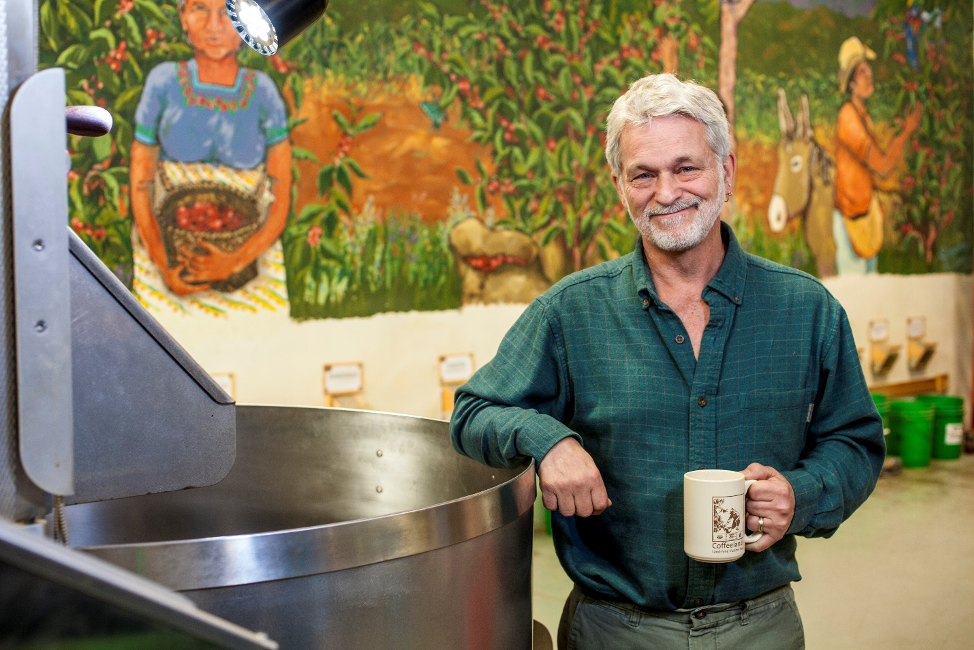
Dean Cycon of Dean’s Beans and his wife decided to go to Poland to help World Central Kitchen feed the influx of Ukrainian refugees. They both have forebears that were chased out of Europe by Russia.

Do you know the legend of the Jongleur de Notre Dame?

My francophone blogger friends should correct me if I get this wrong, but the way I remember it is that a man wanted to present a gift at the statue of the Virgin Mary but was desperately poor. He had a different kind of gift, though — a talent for juggling. The story goes that he juggled with all his heart and soul in front of the sculpture, and it gently bowed its head to him.

That’s the kind of miracle that feels real.

Today people are donating money and whatever talents they have in order to help Ukrainians invaded by Russia. First off, John, my son, who continues to employ optical engineers in Ukraine for remote work.

Another Massachusetts resident, Dean Cycon of Dean’s Beans Organic Coffee, is going with his wife, Annette, to Poland to work with World Central Kitchen, which is feeding thousands of Ukrainian refugees. Dean and Annette both have forebears they say were chased out of Europe by Russia. Their story is detailed at the Greenfield Recorder, here.

Boston doctors, interviewed here, made YouTube videos to teach ordinary Ukrainians how to treat war wounds. According to the Washington Post, The video is less than 40 seconds long — but its creators say it could help save lives in Ukraine.

‘The data we know from the battlefield is that a significant amount of deaths are preventable with taking these steps,’ Eric Goralnick, an emergency medicine physician at Brigham and Women’s Hospital in Boston. …

“Goralnick is the doctor shown acting out the tutorial in the short video, which provides a list of actionable steps written in Ukrainian. Another video, about 4½ minutes long, features a more detailed, step-by-step narration in Ukrainian by Nelya Melnitchouk, a Ukrainian-born oncology surgeon at Brigham and Women’s Hospital.” More.

The nonprofit group End Hunger New England is pivoting from mostly local needs to help Ukrainians, too, but according to the Christian Science Monitor, the group was stumped about how to deliver the meals so far away. Then a Boston-based shipping company, BOC International, stepped up. “It’s handling all the logistics,” the Monitor reports, No charge.”

Along with Asakiyume, I myself have joined a crowd of editor-types to help media people in Kyiv clean up translations of events so the Ukrainians can share the latest on Anglophone social media.

I am so grateful for this opportunity, which Asakiyume, a friend I met 25 years ago when we were both copyediting at a management magazine, offered me.

How it works: bilingual Ukrainians translate local news into English the best they can, then send it to colleagues to check as well as to “proofreaders,” mostly American. As proofreaders, we try to make the English sound more natural.

The organization we are helping works 24 hours a day. I know I’m getting more out of it than I am giving. Talk about real! If I want to sacrifice, I ought to sign up for the sparse 2 a.m. shift.

Read Full Post »

Photo: Filip Mroz/Unsplash.
A coach told his team the day’s workout would be shoveling for old folks at no charge. Where were these guys when I needed them?

I don’t know if there are any coaches reading this blog, but I just had to spread an idea that a football coach at a Pittsburgh high school had after a snowstorm. Over the years, there have been several storms when I was home alone and really needed the kind of help described here. Once the snow was so high, I had to climb over my picket fence.

Cathy Free writes at the Washington Post, “Pearl Moss looked out her front window in Bethel Park, Pa., and was instantly worried. A major snowstorm that pummeled the Pittsburgh area and the East Coast over the weekend had dumped nearly a foot of snow in her driveway, and there was more on the way.

“ ‘I thought, “What am I going to do? There’s no way I can get out there and shovel myself out,” ‘ said Moss, 74, surveying the white landscape on Monday. …

“A few hours later, there was a knock on her door. Moss peeked out and was surprised to see two teenage boys standing on her porch with shovels.

“ ‘I couldn’t believe it — they were going to shovel me out,’ she said. ‘And they didn’t want a single penny to do it.’

“David Shelpman, 16, and Aidan Campbell, 17, live in the same neighborhood as Moss and are on the football team at Bethel Park High School. Head Coach Brian DeLallo had emailed them and other team members Sunday to inform them that their Martin Luther King Jr. Day workout in the school gym wasn’t going to happen.

“DeLallo also posted a notice on Twitter with some instructions. ‘Due to expected severe weather, Monday’s weightlifting workout has been cancelled,’ he wrote. ‘Find an elderly or disabled neighbor and shovel their driveway. Don’t accept any money — that’s our Monday workout.’

“Shelpman and about 40 other team members put on their snow gear and took their assignment seriously.

“ ‘I grabbed some shovels and drove over to pick up Aidan, and we spent the next eight hours shoveling driveways and sidewalks for people that we knew couldn’t do it for themselves,’ said Shelpman, an offensive and defensive lineman for the Bethel Park Black Hawks.

“ ‘It was a fun way to spend the day,’ he said. ‘We just kept going until we’d done six houses. We even skipped out on having lunch. It made me feel like I was a part of something bigger than myself.’ …

“Braedon Del Duca, a guard for the Black Hawks, shoveled out five houses with two of his friends, Colton Pfeuffer and his brother, Tanner Pfeuffer.

“ ‘I like helping other people, and I love the snow, so it was fun to get a workout outside,’ said Del Duca, 16. ‘It was cool to see how happy people were when we showed up.’ …

“ ‘My dad went to school here, and he also used to shovel snow around the community,’ he said. ‘Whenever there’s a snow day, it’s just what you do when you’re on the football team.’

“DeLallo, 51, said the ‘shovel day’ ritual was started in 2002 by former head coach Jeff Metheny, who is now retired.

“ ‘I was on staff as an assistant coach when he started it, and it’s something everyone is proud to keep going,’ he said.

“In Bethel Park, a Pittsburgh borough with about 32,000 residents, community support of the football team is strong, DeLallo noted.

“ ‘Our games are always well attended, so giving back is the right response,’ he said. ‘Most of our kids know the older people in their neighborhoods, and shoveling snow is a way to connect outside of the usual Friday night football game.’ …

“Other high schools in the area do similar service projects in the community, DeLallo said.

“ ‘The feedback has been awesome, but we’re not the only ones making a difference,’ he said. ‘When you get 11 inches of snow, this is something a lot of communities have stepped up to do.’

“Pearl Moss said she’s grateful for the teens, adding that if they hadn’t shown up when they did, she probably would have been stuck in her house for a while.

“ ‘Those kids did a fine job, and I’ll never forget it,’ she said.”

I believe many teens would like to help neighbors but don’t know where to start. Do you have online neighborhood bulletin boards in your area where people can post needs or trade services — say, a batch of homemade cookies for shoveling the front walk?

We have a pretty reliable paid service right now, but I had a new neighbor offer to help out with his snowblower in the last storm, and you can bet I will keep him in mind. I find it’s unusual for New Englanders to volunteer their help in this way. Please correct me if that has not been your expeience!

More at the Post, here.

Read Full Post »

Photos: Ashleigh Whiffin.
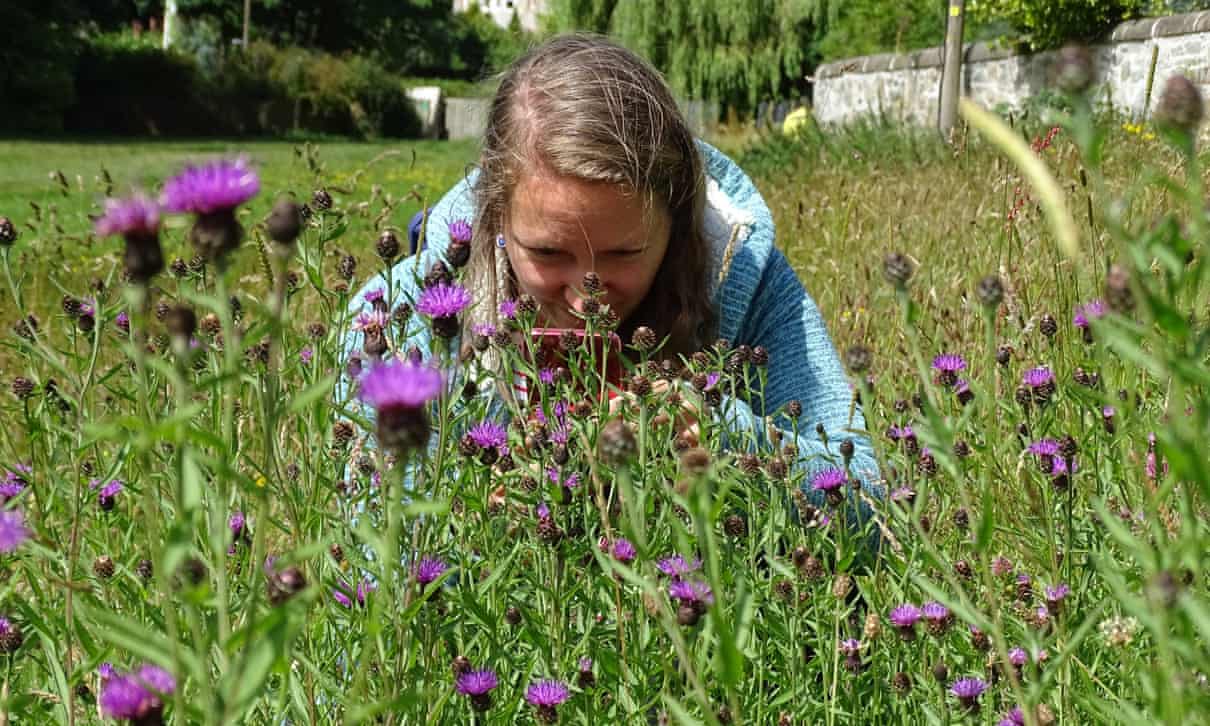
Amateur nature recorders in the UK are providing vital data on beetles, soldierflies, and many lesser-known insects.

Britain’s long tradition of amateur scientists sets the stage for today’s enthusiastic volunteers mapping the nation’s insect population.

Isabella Kaminski writes at the Guardian, “Ashleigh Whiffin’s day job as assistant curator of entomology is to look after National Museums Scotland’s vast collection of preserved insects. But her passion for the creatures doesn’t end when she goes home; in her spare time she spends hours recording and verifying sightings of a specific group of large carrion beetles in the family silphidae.

“ ‘Silphidae are absolutely brilliant,’ Whiffin says from her Edinburgh office. ‘They’re decomposers, so they are really vital for recycling and also have forensic applications. Some of the members in the family are called burying beetles and they actually prepare a carcass, make a nest out of the corpse and then feed on the rotting flesh and regurgitate it for their kids. They’re quite a charming – but also grisly – insect.’

This banded burying beetle in the UK is a scavenger said to be able to smell a rotting carcass from two miles away. I’m thinking it’s a cousin of the endangered American Burying Beetle that John used to study in Rhode Island.

“Wanting to know more about the distribution of silphidae across the UK and how they were faring in conservation terms, Whiffin established what already exists for more charismatic species such as ladybirds: a national recording scheme. …

Whiffin is one of Britain’s tens of thousands of volunteer nature recorders, whose detailed sightings of flora and fauna, or key events in their lifecycles, are vital for keeping tabs on biodiversity as the climate warms, habitats shrink, and pesticides and pollution degrade the quality of land.

“It’s a hobby with a long history in the UK, where amateurs have been stuffing, pinning and pressing specimens for centuries. … These days, records are collated, verified and filtered through a patchwork of recording schemes and local environmental record centres. Many end up in the National Biodiversity Network’s Atlas, the country’s most comprehensive collection of biodiversity information. …

“The Biological Records Centre (BRC), a research institution in Oxfordshire set up in the 1960s, calculated a few years ago that about 70,000 people take part in biological recording each year, although Helen Roy, the BRC’s coordinator of zoological data and research, thinks that is probably an underestimate. Despite years of doom-mongering about the death of natural history as a pastime, the Royal Society for the Protection of Birds’ State of Nature 2019 reports calculated that there had been a 46% increase in the time donated to nature recording since 2000.

“Martin Harvey, who also works at the BRC but runs a recording scheme for soldierflies and their allied families in his spare time, says most insect surveys are run by volunteers. …

“But while there is little concrete data on demographics, recorders admit there is a lack of diversity among those involved. … Says Whiffin. ‘I have to say for the beetle community, that is predominantly white men and that is something that I’m very keen to change.’

“Whiffin has been advertising her recording scheme on social media and running beetle identification courses online to try to reach a wider range of people.

“Biological recording has also benefited from apps such as iSpot and iRecord, which allow citizen scientists to snap a picture of their subject and quickly upload it. …

“Harvey notes that people get involved at different levels, from casual recorders to those who go to ‘extraordinary lengths’ to specialise in a subject or species. … ‘For most, if not all, insects there’s a lot we don’t know and a lot of areas that don’t get recorded very well,’ says Harvey. ‘There’s also basic natural history gaps in how they live, what they feed on, what their lifecycle and behaviour is, and individual volunteer naturalists can and do make an enormous contribution to finding out that sort of information.’ …

“There are now 30,000 records on large carrion beetles from the silphidae family recording scheme combined with historical data gleaned from dusty museum notebooks. This enabled Natural England to commission a recent study on the prevalence of silphidae in the UK, which showed that several species were critically endangered or vulnerable.”

More at the Guardian, here.

Read Full Post »

Photo: AP/Marta Lavandier.
Doramise Moreau is a part-time janitor at a technical school. She spends most of her time shopping for ingredients and helping to cook meals for 1,000 to 1,500 people a week that show up for food at Notre Dame d’Haiti Catholic Church in Miami.

Last week, I finally felt safe enough to go get my hair trimmed and was glad to catch up on Tracie’s year. It was difficult at times, as it was for us all. Her teenage daughter had had a painfully lonely time at home, and her mother was relieved to see her back at in-person school, at least part time.

Tracie really lit up when she talked about giving free haircuts to residents of a nursing home. As she described the grateful things the seniors said to her, it was clear just how happy the volunteering made her.

Today’s story is about another volunteer who lights up when she can help people.

As reporter Cathy Free noted at the Washington Post earlier this month, “Miami Beach has declared a state of emergency because spring break partyers have overwhelmed the city, but across the causeway in Miami’s Little Haiti, a very different scene unfolds: Each Friday night, a school custodian finishes her day job, then spends 12 hours quietly cooking for the hungry.

“Doramise Moreau arrives at the Notre Dame d’Haiti Catholic Church each Friday, where she stays on her feet deep into Saturday morning, pausing briefly for a nap. …

“Less than 10 miles from South Beach, Moreau, 60, lovingly turns bulk-size bags of rice and beans and hundreds of chicken and turkey drumsticks into about 1,500 meals for people in her Little Haiti neighborhood who might not have enough to eat. …

“ ‘I don’t need a lot of sleep. I would rather be here making food for the people. I ask every day for more strength to keep doing what I’m doing.’

“She first volunteered to buy groceries with church donations and prepare a feast once a week, she said, when her pastor, Reginald Jean-Marie, mentioned that he was concerned about hunger in the community.

“ ‘I told him, “Don’t worry, I can do this — I have the time,” ‘ Moreau said. ‘When people are hungry, it is our responsibility to help. I know how hard it can be out there.’

“Moreau grew up with nine siblings in Haiti and often took food from her family’s pantry to give to those who had less than her family did, she said. In 1980, she immigrated to the United States at age 19 and lived with her brother in Miami until she fell in love and started a family of her own.

“When the relationship didn’t work out and she became a single mother, Moreau said, she took two hotel jobs to pay the bills and keep her four kids fed. …

“For her first batch of meals last spring, Moreau made several enormous pots of rice and beans seasoned with her special blend of green and red peppers, onions, cilantro, bay leaves and garlic. She has never used a recipe, relying instead on instinct and what she remembers from watching her aunt and sister cook in Haiti, she said.

“ ‘Who has time to measure? I just chop everything up and toss it in,’ she said. …

“Although rice and beans are a mainstay, Moreau’s fried chicken, roast turkey, baked fish and fried plantains are also popular with the 1,000 to 1,500 people she feeds each week.

“The meals are loaded into two delivery trucks and distributed on Saturday afternoons by volunteers who cruise slowly through the neighborhood in Little Haiti and hand them out to people as they come out of their apartments.

‘Sometimes I go with them to deliver the meals, and it’s rewarding when you see how it helps,” Moreau said. “For some people, this might be the only meal they get for a while.’ …

” ‘American, Spanish, Haitian — I don’t want anyone to go hungry,’ Moreau said. ‘People are suffering during the pandemic. There’s no work, the rent is high, they might not have money to go to the store. This is just one meal, [but] it’s something I can do.’ …

“Jean-Marie, the pastor, urges Moreau to occasionally take off her apron and rest. ‘I ask myself all the time how she does it,’ he said. ‘Not once do I ever hear her complain. We have to beg Doramise to take a rest, but she keeps showing up, day after day. She gives everything she has.’ ”

More here.

Read Full Post »

People like to paint rocks. It’s an art that’s simultaneously permanent and impermanent. In New Shoreham, for example, the beloved Painted Rock is like a mural or community bulletin board (there’s a real bulletin board, too, online). I’ve blogged about it often, including in 2015, here.

In the summer, you need to photograph your artwork quickly because the rock gets painted over faster than you can say Jack Robinson. But an archaeologist would find all the layers still underneath, and the rock itself has probably been there since the last Ice Age.

Similarly, there are small, smooth rocks people paint for sale, for charity, or for gifts. In a May post I wrote about local kids painting rocks during the pandemic and raising money for medical workers.

Meanwhile, the Washington Post has a story on another pandemic-inspired rock project, one featuring thousands of painted rocks from around the country.

Cathy Free reports, “Chris Penny figures that his mail carrier must have spectacular biceps by now.

“Most every day for the past seven months, when the carrier arrives at Penny’s home in Grapevine, Tex., he unloads a few heavy bins and hauls them one by one up the driveway to Penny’s front porch.

“The boxes are filled with packages containing painted rocks, most of them intricate works of art, handmade and mailed from people all over the country. Since the beginning of the pandemic, people have been sending them to Penny so that he and his family can place them along the Parr Park Rock Art Trail — a mile-long public walking path that has become a wonderland of more than 4,000 art rocks. …

‘These aren’t just any rocks — they’re works of art,’ said Penny, 44. …

“The rocks — painted to resemble everything from the Beatles to Mickey Mouse to a face mask — started arriving at Penny’s house ever since he bought a bunch on eBay after noticing a dozen painted rocks scattered along a nature trail in Parr Park. Penny said he knew right away that he wanted to flood the trail with them and make it a destination.

“Penny learned that the colorful rocks he’d stumbled upon were painted by [Grapevine photographer and RV dealer] Ron Olsen and his three grown children in March, after Olsen returned from a trip to Iceland and discovered that Grapevine, a city of around 46,000 people, had practically become a ghost town due to the nationwide coronavirus shutdown. …

“Soon, he and Penny decided to join forces to transform the trail into an artsy attraction for anyone in Grapevine and beyond who wanted to escape the stress of covid-19 for a while.

“ ‘We wanted to make it a getaway for people and give parents something safe to do outdoors with their children,’ said Olsen, 62. …

“Penny, who runs the nonprofit Broken Crayon, focused on helping women and children living in poverty in the United States and Ghana, said the project has provided his family with something fun and positive to do close to home during the pandemic.

“In the early days in March, after he’d painted several dozen rocks with his daughters and bought dozens more online, Penny posted on Facebook, asking anyone who would like to contribute to the project to mail him their rocks and he’d pay for the shipping. …

“Penny said he’s contributed almost $10,000 of his own money for shipping costs (rocks are heavy), although many people now pay to ship their rock masterpieces on their own. …

“All along the nature trail, visitors will now find painted owls, unicorns, tigers and humpback whales, along with the emblems of favorite sports teams, salutes to fallen soldiers and paintings of beloved cartoon characters and classic cars. Somebody even mailed Penny a giant tic-tac-toe board. …

“Penny’s favorite part of the project is that every rock tells a story. ‘Some people have painted rocks in memory of family members who have died, and others have painted memories of high school, like a favorite teacher or a favorite song,’ he said. ‘One woman painted a rock to honor her daughter because she’s serving with the military in Afghanistan and she misses her.’ …

“Whether a rock is painted by a professional artist or a 2-year-old doesn’t matter, Penny said. ‘When it comes down to it, there’s really no such thing as a bad rock,’ he said.”

Check out photos of some beautiful rocks at the Washington Post, here.

Read Full Post »

http3a2f2fcdn.cnn_.com2fcnnnext2fdam2fassets2f191115120957-immigrant-food-columbia-road

Photo: Irena Stein Photography/Immigrant Food
Chef Enrique Limardo says the “Columbia Road” bowl at his restaurant, Immigrant Food, combines elements of Salvadoran and Ethiopian cuisine. A special side dish: opportunities to help recent immigrants.

People say, “I’m upset, but I don’t know what to do.” Or, “I don’t have time to do anything extra.”

Look, when you shop, do you have time put a can in the food pantry bin? Do you have time to write a handful of postcards to voters once in a while? There is always time to put a can in a bin; there are always nonprofits that will accept a tiny bit of volunteering. It adds up.

And here’s the biggest benefit: you will feel better. Was it Ann Landers or Dear Abby who was always recommending helping someone worse off as a cure for nonclinical blues? You just need to find a volunteer gig that fits your interests.

This post is mostly about a cool restaurant in Washington, but be sure to note what the owners are trying to do in addition to presenting delicious, creative dishes.

In November, Catherine E. Shoichet reported at CNN about a new restaurant that opened up in the nation’s capital.

“It’s called ‘Immigrant Food,’ ” she wrote, “and it’s just a block from the White House. The fast-casual spot caters to a weekday lunchtime crowd, with bowls blending cuisines from different cultures around the globe — like a dish that combines Vietnamese spicy-rice noodles with pickled bananas in what the restaurant says is an ‘ode both to Central America’s favorite fruit and to German-style pickling.’

“It also gives diners a chance to donate to local immigrant advocacy groups, all under a slogan aiming to bridge the political divide and find common ground: ‘United at the Table.’

“[Co-founder Peter Schechter] wants people to feel at home here, and to hear the story he’s excited to tell. …

“As the child of immigrants from Austria and Germany, Schechter says he felt like he had to respond to the surge in anti-immigrant rhetoric across the United States.

” ‘This isn’t the America I recognize. … Immigrants have been the foundation of growth and vibrancy. This country has been great again and again and again because of immigrants. …

” ‘Immigrants are feeding America,’ he says. ‘All of the industries that make food, whether it is the picking or the shucking or the meatpacking or the slaughterhouses, (or) in restaurants, the servers, the bus boys, this is an industry that is dominated by immigrants.’ …

“At Immigrant Food, menus available by the door describe each of the nine fusion bowls and five vegan drinks on tap. They also encourage visitors to donate to and volunteer with local immigrant advocacy groups.

“Among the suggestions listed on the restaurant’s ‘engagement menu’: teaching English, visiting detention centers, staffing hotlines and helping with mock ICE interviews. …

“There’s also a photo booth featuring a world map. Diners can point to where their families are from, snap a selfie and get a text message with a frame around the image that says, ‘We are all immigrants!’ …

‘People say, “I’m really upset about what’s happening, but I don’t know what to do,” ‘ Schechter says. ‘And so, you come to this restaurant, we will give you stuff to do — concretely and easily.’

“Local immigrant advocacy groups will also be able to use the restaurant’s upstairs space for things like meetings and English classes, free of charge. And on its website, the restaurant will serve up bite-sized breakdowns of immigration policy issues, dubbed ‘The Think Table.’ …

“The location turned out to be a case of serendipity, Schechter says. ‘[But] I really think it goes beyond the political.’ …

As he sips on a drink called ‘Across the Border’ — which blends cacao, dates, peppers, allspice, vanilla and cashew milk — Robert Evans, 72, says he loves the concept but worries the restaurant might end up preaching to the choir rather than crossing political lines.

“But then again, he says, one day someone who works in the White House might stop by. … In Schechter’s view, immigration shouldn’t be a polarizing topic. He points to polls that show most Americans say immigration is a good thing. And he hopes Democrats and Republicans will dine at Immigrant Food together.

” ‘The table, the restaurant, has always been a place where people unite,’ he says.” More.

By the way, if you’re ever in Providence, the immigrant restaurant called Aleppo Sweets is just fantastic. An extra treat for me is running into one of my former ESL (English as a Second Language) students who’s working alongside her family members there.

Read Full Post »

Older Posts »