Feeds:
Posts
Comments

Posts Tagged ‘cars’

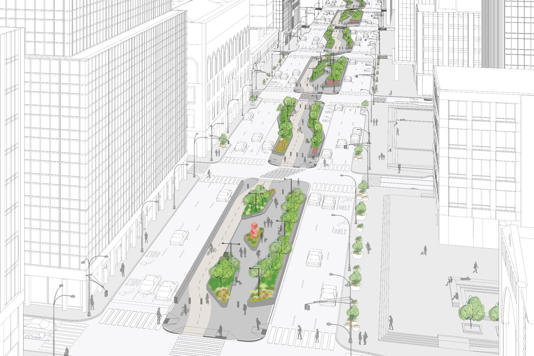
Photo: Starr Whitehouse Landscape Architects and Planners.
Architects have submitted two designs for a park on a section of New York’s Park Avenue. This is the scheme with a bike lane.

Back in the day, when I was going to high school and living during the week with my mother’s sister, Park Avenue was not much of a park. I remember daffodils in spring, but they were surrounded by an iron fence.

Today I learn that there are plans to make big changes. At Markets Today (via MSN), Christopher Bonanos shares his opinions about a proposed park project.

Two summers ago, the city announced that it was taking a good hard look at (as every politician seemed to phrase it) ‘putting the park back in Park Avenue.’ … A century ago, the median down the middle of Park Avenue was much more welcoming than it is today, a place with seating and substantial plantings where you’d consider spending time.

“Starting in the 1920s, the city added a traffic lane on each side by paring the median down to a narrow strip, creating a pleasant but not useful viewing garden. In 2024, the city announced a call for proposals wherein those two lanes would be reclaimed from traffic for leisure and greenery. It was a once-in-a-century opportunity, because the aged Metro-North tunnel running under the avenue is being reconstructed, allowing its roof above to be rethought. …

“The rebuilt mall, the announcement said, would extend from 46th Street, where it emerges from the pass-throughs at the Helmsley Building, up to 57th Street. Each half of Park Avenue would go from four lanes to three. [Recently] we got a first look at plans produced by the firm Starr Whitehouse, and here they are. …

“The biggest difference between the two design schemes is a protected bike lane that snakes its way up the western side of the median, present in one rendering and absent from the other. The proposed park is, unlike its 1910s forebear, not symmetrical or uniform in shape. Carve-outs for left-turn lanes alter its form on every other block. … Bollards at the ends of each section will permanently keep errant (or malicious) drivers out of the median.

“That said, there’s somewhat less greenery and more paving than you might expect: The center islands have no plants at the corners, for example. …

“The best aspect of all: There’s seating! God bless everyone involved for rejecting the tools of hostile architecture and incorporating built-in masonry benches. That makes sense, given that office workers’ lunchtime and smoke breaks are a major use case for this project. They do set up the prospect of clashes between camped-out people and the police (and maybe Park Avenue office tenants’ security teams, too) over those spaces, and at the risk of sounding cynical, you can bet that the cops will prevail. But perhaps those conflicts will not arise as often as you’d expect. Judging by the newish seating in the plaza a few blocks away between Grand Central Terminal and One Vanderbilt, it will not be permanently occupied by unhoused people.

“The bike lanes are, at least when seen at the macro level of these renderings, not quite refined yet. They’re going to need a lot of visual cues and signage to keep walkers, cyclists, and cars out of one another’s way. The bike path runs through the crosswalks, and disabled or slow-moving pedestrians, or those who are simply inattentive, will have to contend with riders zinging through at high speed. If the bike lane is sharply delineated with curbs, that will help a lot. …

“One question that comes up is what knock-on effects will arise from shearing off car lanes. Some of the car trips now using them will simply disappear, as they do every time the inverse of induced demand, known as ‘reduced demand,’ kicks in. … To me, looking at both proposals, the plan that’s all park seems much more workable at a day-to-day ground level. I’d offer that the bike lane might instead be set on the outside edge of Park Avenue, at the sidewalk curbs, away from the median, even if that means shaving a couple of feet off the park to make room. Or we could perhaps shift the bikers over one short block to Madison Avenue. …

“An easy guess is that, if all of this turns out to be popular and successful, similar changes will happen all the way to 96th Street. … The question then becomes whether affluent residents of Park Avenue on the Upper East Side will approve of the greenery more than they will grumble about constraints upon their cars and drivers.

“Given that this is far too businesslike a city to ever go all out and turn an avenue into a full-on park — that is, to build our own version of the Rose Kennedy Greenway — it’s going to be a real public asset.”

More at MSN, here.
Read Full Post »

Photo: PCA Architecture.
The Champs-Élysées will be returned to the French people with wider pavements, bicycle lanes, and more green spaces,” says PCA Architecture.

This post is about a more pedestrian-friendly vision for Paris, but as far as I can tell, it’s still in the imagining stage. Covid, ironically, has helped move things along.

Tim Gibson at the B1M describes what it would be like.

“Mayor Anne Hidalgo has given the green light for the city’s iconic Champs-Élysées to be transformed into an urban garden.

“Traffic congestion has seen the famous boulevard lose its grandeur over recent decades, and many local Parisians have abandoned it in favour of more pedestrian-friendly avenues. Hidalgo hopes to bring the road back to its people by removing its outer lanes, widening pedestrian areas, planting more trees and greenery, and creating dedicated bicycle lanes.

“Plans were first proposed in 2019 by local community leaders who begged the government to restore the road to its former glory. …

“The massive overhaul is part of a £225M project to regenerate Paris’ streets and make the city greener and more people-friendly. Throughout Paris, 140,000 on-street car parking bays will be removed and replaced with vegetable allotments, food composting, playgrounds, bicycle lock-ups and more trees.

Local residents have been consulted on what they’d prefer the spaces to be used for.

‘We can no longer use 50% of the capital for cars when they represent only 13% of people’s journeys,’ deputy mayor David Belliard told The Times.

“ ‘We have to plant greenery in the city to adapt to the acceleration of climate change. We want to make the air more breathable and give public space to Parisians who often live in cramped flats.’

“While plans for the rejuvenation of Paris pre-date COVID-19, the pandemic has expedited the entire process. City-wide lockdowns have shifted the perspective of many Parisians – and others around the world. There is a newfound emphasis on public transport, green spaces, parks and community.

“Hidalgo has become a major proponent of the ‘fifteen minute city,’ where all residents will be able to reach necessary amenities such as shops, parks and offices within a fifteen minute walk or bike ride. …

“Copenhagen continued with plans to become completely carbon-neutral by 2025 and have 75 percent of all journeys be done by foot, bicycle or public transport. Like Paris, the city has started transforming many of its parking bays into areas for plants and trees.

“During the April lockdown, London also shifted space on its roads over to bicycles, expanding its network of cycling lanes.” More at the B1M, here.

I’m hoping Alison, who blogs about her adventures in Paris, will weigh in. Carol at cas d’intérêt, too.

Read Full Post »

Our New Year’s Eves are quiet these days. We watched an Agatha Christie on television and went to sleep. But I’ve been saving a suitable tile from the New York subway system since my October trip to visit my sister, so here it is and Happy New Year!

2018 was not a good year for my sister, who was diagnosed with a bad brain cancer in July. But it was also a year we learned to be grateful for things like a clean surgery and cancer treatments without bad side effects. My perspective changed.

My perspective on the nation and on the future of the planet and my own role in it has also been evolving. I began to suspect that, other than our Bill of Rights, our country may not be as special as we thought. After all, all countries think they are special. And even the Bill of Rights can’t survive unless we commit to protecting it and interpreting it justly. Surely none of those rights were intended to lead to the deaths of thousands of innocent Americans every year. Perhaps 2018 was a turning point.

I’ve also been giving more thought to my role in global warming. Do I make too many unnecessary car trips when I could walk or take public transportation? Do I serve the family too much meat, especially beef? Should I find a way to plant more trees? I know I need to stop sneaking around the local laws against plastic bags and find a sustainable alternative.

I will be writing more about initiatives to protect the planet and will be looking for ideas to apply in my own life from you and from websites like 1MillionWomen. By the way, I learned about 1MillionWomen from a wonderful book called Climate Justice, by Mary Robinson. I hope you will put it on your list. It shows how the poorest communities are the first to feel the crunch of global warming and how, if we pay attention to those communities, we will also be taking arm against the sea of troubles that threatens us all.

Even better, the book shows how extraordinarily effective ordinary people can be when they have simply had enough.

Read Full Post »

“New York City is using poetry to boost traffic safety. The city is installing 200 colorful 8-inch square signs featuring haiku about safety at cultural spots, schools, and high accident areas. In an age when many messages compete for attention, officials hope that ones such as

‘Oncoming cars rush
‘Each a 3 ton bullet
‘And you, flesh and bone’

“will encourage pedestrians to exercise caution.”

So writes the Innovators Insights listserv, linking to the CBS New York news story, where you will find some amused and amusing comments from New Yorkers.

“ ‘What we’ve learned that is that the more innovative the message and with a little bit of humor, or something a little off beat, is much more effective form of communication,’ Transportation Commissioner Janette Sadik-Khan said.”

Reminds me of my October post on traffic mimes in Caracas. Remember? There’s something delightfully incongrous about traffic adminsitrators being the ones, out of all possible professions, to use mimes and haiku to further their work objectives.

But maybe I don’t know much about traffic administrators.

Read Full Post »