Feeds:
Posts
Comments

Archive for the ‘Uncategorized’ Category

Photo: David Levene/The Guardian.
Francis Kéré, outside his Serpentine pavilion in London, is the most recent recipient of the prestigious Pritzker Prize for architecture.

There’s a 7-year-old girl in my family who has been designing buildings this week, complete with elevators, staircases, rooftop playgrounds, and two kinds of dining rooms. With flowers. I can’t help wondering if this is the kind of childhood interest that leads to a career like the one in today’s story.

Oliver Wainwright reports at the Guardian, “Few architects have experienced such a meteoric rise, against such odds, as Francis Kéré. Born in a remote village in Burkina Faso without running water or electricity, he began his career by building a mud-brick school for his community, before being selected to design the country’s national parliament less than 15 years later. Now he continues his unparalleled trajectory, named as the winner of the 2022 Pritzker prize, architecture’s highest international accolade.

“ ‘It is unbelievable,” said Kéré, speaking from his office in Berlin. “I don’t know how this all happened. First of all I am happy and overwhelmed, but the prize also brings a great sense of responsibility. My life is not going to be easier.’

“He is the first black architect to be recognized in the [award’s] 43-year history, reflecting the profession’s overwhelmingly white, male, middle-class bias. …

“ ‘I don’t want to talk about racism directly,’ he said, ‘but this is a field where you need a lot of resources. You really need to be strong and be lucky, as competitions are not always so open. I hope that young people in Africa will see me and know that this is a possible path for them too.’

“Kéré has made a name for himself with a series of schools and medical facilities in Africa that appear grown out of their context, built by local communities with the bare minimum of resources. Often featuring walls of clay-earth bricks, shaded by large, overhanging corrugated metal roofs, his buildings are elegantly tuned to their arid climate – whether in Mali, Togo, Kenya, Mozambique or Sudan – using natural cooling to avoid the need for air conditioning.

” ‘Francis Kéré’s entire body of work shows us the power of materiality rooted in place,’ said the Pritzker jury, chaired this year by Chilean activist-architect Alejandro Aravena. ‘His buildings, for and with communities, are directly of those communities – in their making, their materials, their programmes and their unique characters. They have presence without pretence and an impact shaped by grace.’

“Born in Gando in 1965, Kéré was … the first in his community to attend school, sent away at the age of seven, after which he won a scholarship to study woodwork in Germany. He saw slim prospects for a career in carpentry in a country that had little wood, so he switched to study architecture at the Technical University of Berlin. For his final project he designed a primary school for his home village – and set about fundraising and mobilising friends and family to see it built. It was realized in 2001, for about [$26,000]. …

“Kéré’s Gando primary school set out the basic principles that would go on to define his work, using earth bricks made on site, topped with a perforated ceiling crowned by a thin ‘flying roof.’ …

“Kéré suspended his metal canopy above the classrooms to encourage stack ventilation, drawing cool air in through the building’s side windows and releasing hot air through the holes in the ceiling. The whole village was involved in construction: children gathered stones for the foundations while women brought water for the brick production, beginning a collaborative model of practice that he has continued ever since. The school won an Aga Khan award in 2004, catapulting Kéré to international fame and prompting him to found his practice in Berlin the following year. …

“International commissions including the Serpentine pavilion in 2017, and an installation for the Coachella music festival in 2019, have continued to help him raise funds and awareness of his work in Africa. …

“His biggest project so far, for the national assembly of Benin, is currently under construction, rising out of the ground in the capital, Porto-Novo, in the form of a majestic palaver tree. ‘The site is next to a botanic garden,’ he said, ‘so we proposed to extend the garden and place the biggest tree in the centre, with a debate hall beneath the figurative tree canopy – reflecting how democracy has always been conducted in west Africa.’

“His equivalent project back home, for the national assembly of Burkina Faso in Ouagadougou, is now hanging in the balance, after the president was removed by a military coup in January. Kéré was commissioned in 2015, following a national uprising when the parliament was torched and the then-president hounded out of the country. …

“ ‘I want the people to take ownership over the parliament building,’ he said, ‘so that, one day, when the next revolution comes, they will protect it as their own.’ ”

More at the Guardian, here.
Read Full Post »

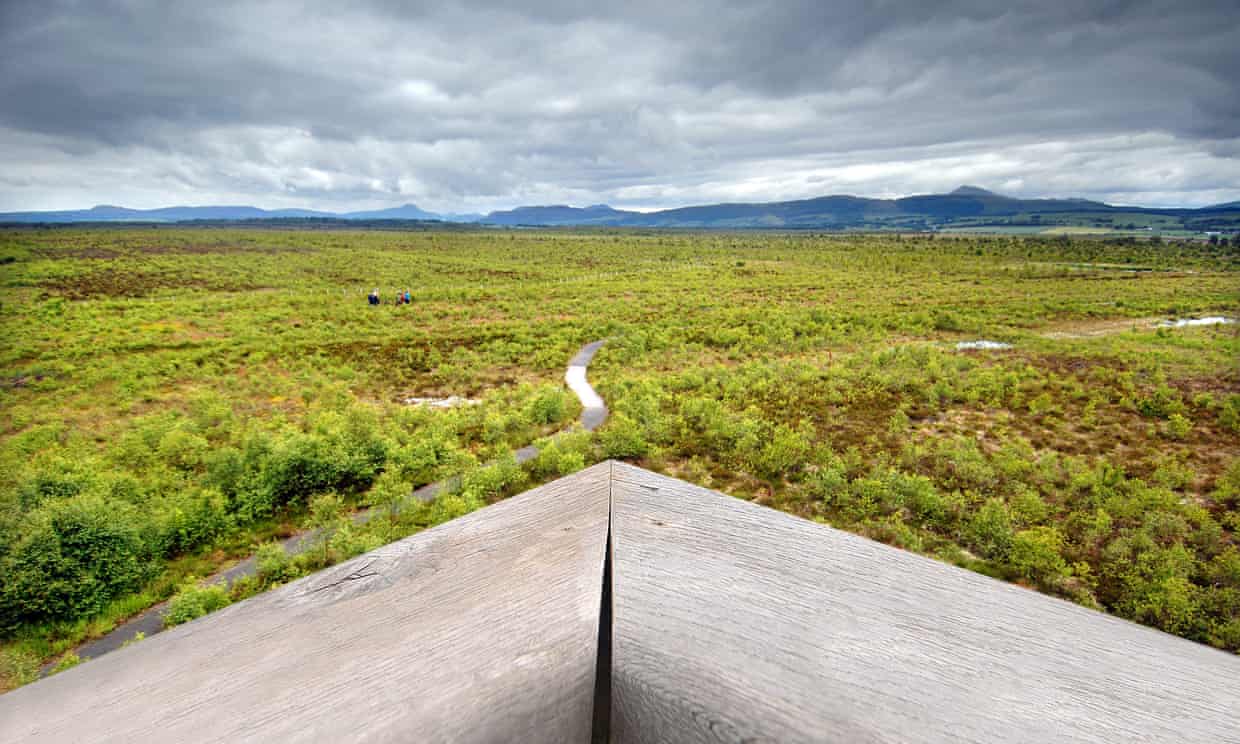
Photo: Dougie Barnett/NatureScot.
Flanders Moss in Scotland has seen the return of key bog plants such as sphagnum (peat moss) and cottongrass — so important now that we know bogs can store the carbon we don’t want in the atmosphere.

My father-in-law sold peat moss, among other agricultural products, for his entire career. He usually got the peat from Canada, although other people source it from places like Germany and Ireland. In Moat, Ireland, our friend James Hackett relied on peat for warming the house. (Burning it was not the best thing for his health.)

Today’s story is about Scotland’s heightened focus on protecting peat bogs so they can store carbon and fight global warming.

Phoebe Weston reports at the Guardian, “Flanders Moss bog is slumped on the flat, farmed landscape of the Carse of Stirling in Scotland like a jelly fungi. It wobbles when you walk on it, and a metal pole goes down eight metres before reaching hard ground. This lowland-raised bog is a dome of peat fed mainly by rainfall and it acts like a single organism – the whole thing has to be looked after for any part to be in really good shape. If it is drained in one area it will affect the water level across the entire bog.

“For much of human history peat bogs have been thought of as wastelands. This 860-hectare [~2,200 acres] site has been hacked away and drained since the early 1800s to make space for fertile farmland below. …

“It is now recognized that peat bogs are among the greatest stores of carbon and, after decades of restoration, the holes in the peat at Flanders Moss have been patched up. Areas that used to be purple with heather are turning green as key bog plants such as sphagnum (peat moss) and cottongrass come back. The bog rises out of the land like a sponge and ‘breathes’ as changes in the weather and water level cause it to swell and contract.

“Researchers in Scotland are tracking ‘bog breathing’ using the latest satellite technology that can detect just a few millimetres of change. … Thanks to the restoration work, the water table has risen [and] is now at the surface. As the bog draws in water from the surrounding land, it helps manage flood risk. Flanders Moss bog has removed [about 2,200 acres] from the Forth catchment, reducing flooding downstream. …

“The Scottish government-funded Peatland Action project, which started in 2012, is helping revive 25,000 hectares [~61,776 acres] of degraded peatland. In 2020, the Scottish government committed [about $300 million] over 10 years to bog restoration in a bid to lock carbon in the land. …

“It takes about a month to process the satellite data for a third of Scotland, which is available through the Copernicus Open Access Hub. The technology is still in development but is likely to be cheaper than ground-based mapping. …

“Despite these restoration efforts, Flanders Moss is still a net emitter of carbon. … Stopping these emissions and preventing further degradation are the primary objectives of the restoration project.

“Bogs work on a different timeframe than humans. They form slowly … taking up to 1,000 years to grow one metre. But [David Pickett, who manages the site with his National Nature Reserve] team has jump-started recovery. ‘We’ve done most of the big work here,’ he says. ‘Now, it’s a question of waiting. The process of fixing this site will last 100 years, and the benefits of work being done now will only be seen by the next generation.’

“It’s easy to see why bogs weren’t popular. They are stores of partly decayed organic matter, which are too acidic and devoid of nutrients to support healthy trees. But this bog is colorful and has a fresh, earthy smell. As well as being a fantastic store of carbon, this ancient, watery land – healthy peat is about 90% water – is also rich in wildlife, including rare lizards, dragonflies and even snakes.

“ ‘There isn’t headline sexy stuff like puffins and seals but you go around the boardwalk and it’s a fantastic place,’ says Pickett. ‘I always used to think bogs must have been named on a Friday after a really bad week. We’re trying to change the perception of bogs but it’s a hard sell.’ ”

More at the Guardian, here.
Read Full Post »

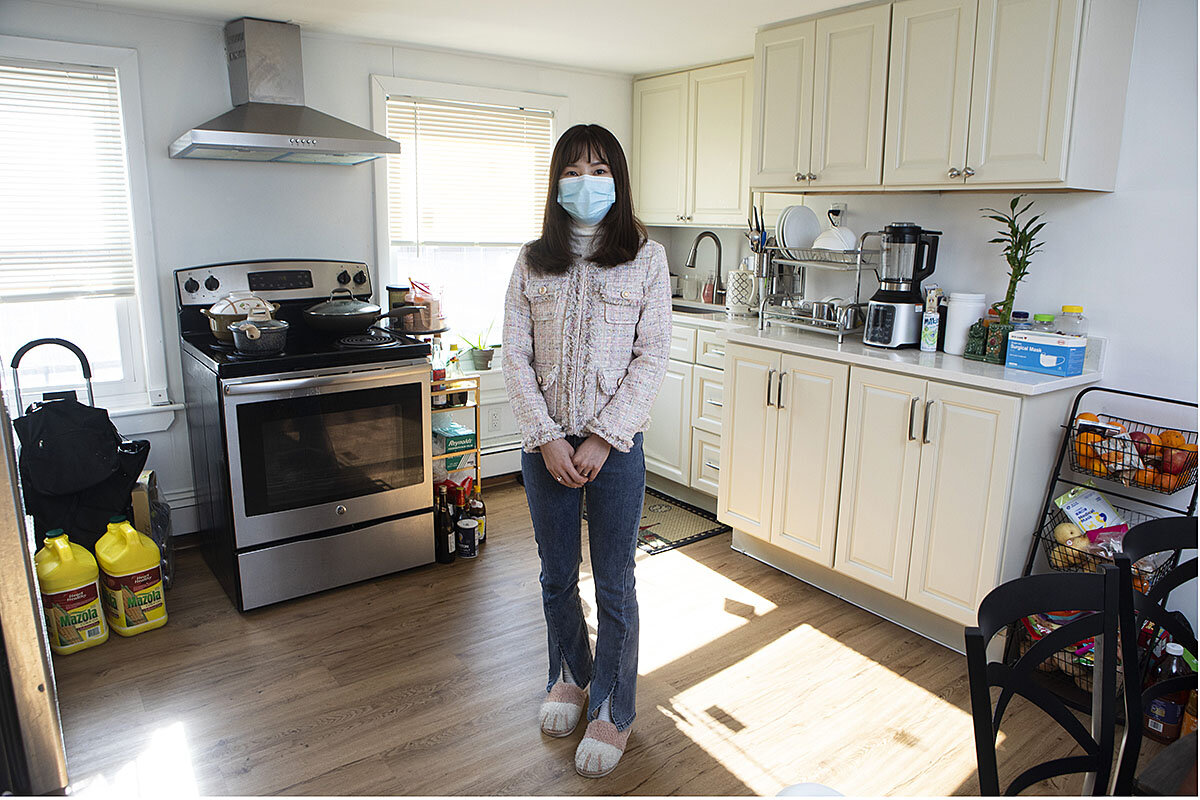
Photo: Melanie Stetson Freeman/CSM.
Meidan “Abby” Lin poses in her apartment in Boston’s Chinatown. She and her husband bought the unit with help from the Chinatown Community Land Trust, which aims to stabilize the community through affordable housing, ownership of land, control of public lands like parks, and the preservation of cultural and historical sites.

One of the biggest challenges for America in these times is housing. Housing can help people with addictions get clean. It can reduce the need for long, polluting commutes to jobs in expensive urban areas, it can give people breathing space to pursue their interests and make better lives for their children.

One of the current experiments in providing housing that people can afford involves community land trusts.

Jocelyn Yang and Alexander Thompson write at the Christian Science Monitor, ‘In March 2016, [Meidan ‘Abby’] Lin; her husband, Yin Zheng; their young son, Yuchen; and Mr. Zheng’s mother left Fuzhou, Chin, … for another port half a world away on the Charles River in Boston.

“They shared their first apartment in Boston’s Chinatown with another family. During nights in that cramped space, Ms. Lin started dreaming of a place she could call her own. But Boston’s soaring real estate prices seemed to put that dream out of reach. Mr. Zheng works at a restaurant. Ms. Lin works at home.

“Then a friend told Ms. Lin about the Chinatown Community Land Trust. … The group was selling apartments at discount prices, and Ms. Lin jumped on the waitlist. But there was only one apartment big enough for her family. ‘I didn’t think we were able to get it,’ she says. All she could do was hope.

“Community land trusts [are] buying their own properties to preserve them as affordable housing in perpetuity and give residents more say over what happens in quickly changing neighborhoods. 

“That mission has gained new urgency over the past year as homeowners reap the rewards of a red-hot real estate market while renters are hit with steep rent hikes, deepening the divide between the housing haves and have-nots. …

“ ‘As neighborhoods change and gentrify really fast, the idea of having community control and having more say about how neighborhoods are changing and who’s going to be able to live in the neighborhood over time, from an affordability perspective, I think becomes really important,’ says Beth Sorce, who works with community land trusts nationwide at the Grounded Solutions Network, an affordable housing advocacy group. …

“Land trusts raise money from donations, grants, and government funds to buy property. Then they lease the house or apartment to a buyer well below market value, but the trust retains ownership of the land.

“This way, occupants typically get an ownership stake in their homes. They build equity over time, but at a rate that is often capped at 1% or 2% a year. The trust, which is governed democratically by residents and neighbors, can decide to whom the dwelling can be sold and at what price, usually through a covenant in the lease. This ensures the property remains affordable.

“The land trust idea was imported to the United States by civil rights activist Charles Sherrod in the early 1970s from the kibbutzim of Israel. Mr. Sherrod saw land trusts as a way for Black Americans to buy agricultural land in the South. …

“Andre Perry, a housing policy expert at the Brookings Institution [has shown] that an ‘intrinsic value of whiteness’ persists at almost every step of home buying from the appraisal to the sale. Minorities, but especially Black people, must pay more and get less. 

“By taking property out of the traditional market, land trusts reduce the discrimination baked into that system and empower communities to actively fight it, Dr. Perry says. …

“In California, justice is what drives Jacqueline Rivera and her fellow housing activists in San Jose. In the heart of Silicon Valley, where even high-paid tech employees struggle to find housing, development was pushing out vibrant Black, Hispanic, and immigrant neighborhoods.

“In community conversations Ms. Rivera and her colleagues held around the city in 2018, land trusts kept coming up. Ms. Rivera grabbed hold of the idea, and by 2020 she was heading up the South Bay Community Land Trust.

“Success has not come easily, though.  By definition, land trusts do not make profits, and fundraising is the biggest challenge they face. To buy their first property, a fourplex in downtown San Jose, they need to fundraise at least $1 million, on top of the half million dollars they need to pay professional staff and make the organization run. Speed is a problem, too. Developers snap up properties with cash in a matter of days, while the land trust moves ‘at the pace of community,’ Ms. Rivera says. 

“Yet, in order to disrupt traditional real estate, land trusts ‘still have to play in the real estate game,’ she adds.

“Advocates stress that land trusts are just one tool in a broader approach to the affordability crisis, but it could be a more effective one with government help. Ms. Sorce, of Grounded Solutions, says state and local governments should invest money in land trusts and change appraisal policies so land trust properties aren’t paying taxes based on their speculative value. With or without such help, land trusts must innovate to succeed.

“ ‘When we think about community land trusts, so many times we think about just the homeownership level,’ says Sheldon Clark, who recently served as president of the board of the Douglass Community Land Trust in Washington, D.C. ‘And that really just doesn’t cover the housing needs that we have.’

“Douglass has units it’s maintaining as permanently affordable rentals and other properties set up as cooperatives. They’ve also helped tenants take advantage of a District of Columbia law that entitles them to buy their unit if their landlord plans to sell.

“Really, land trust leaders say, homeownership is just one aspect of their focus on what Mr. Clark calls the ‘big C’ in community land trusts: the community.

“Douglass organized food drives during the pandemic and helps connect residents to credit unions, as many are unbanked. In Boston’s Chinatown, the land trust helped save a local park.”

Find other examples of how land trusts strengthen communities at the Monitor, here. No firewall; nice photos.

Read Full Post »

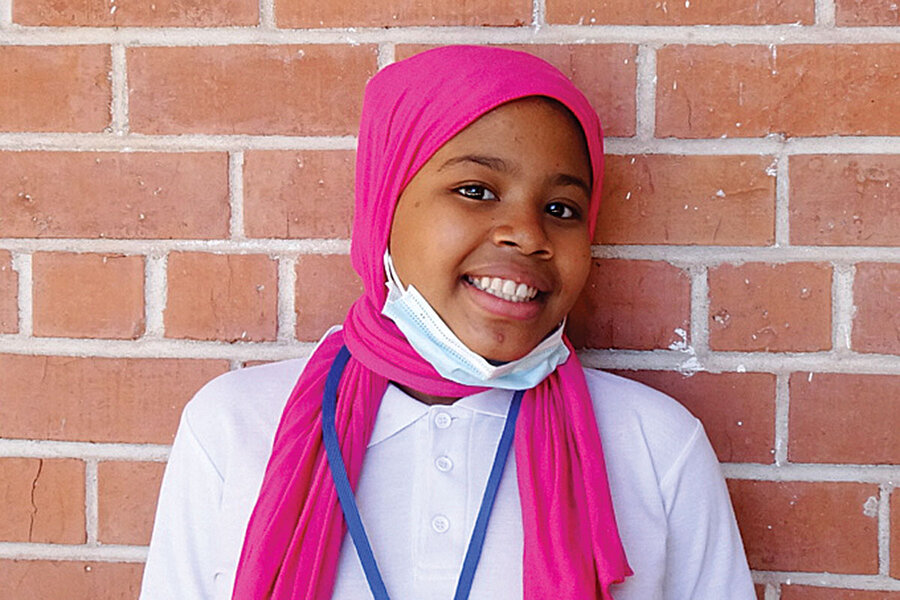
Photo: Kathryn Palmer/The Hechinger Report
Fifth graders were asked to envision the future. “Everyone will have a new house to live in. It won’t matter how much money you have,” said Falhat Hassan, a student at John B. Wright Elementary School in Tucson, Arizona
.

I loved working with fifth graders back when I was a teacher. They are funny, aware of the world, but not yet as rebellious as they are likely to be in a few years.

In a report at the Christian Science Monitor, fifth graders were asked to describe what they expected the world to be like in the future. If you ever get discouraged, hang out with some ten-year-olds.

“One student envisions a watch that tells you when you’re polluting – a sort of eco-nanny on your wrist. Another suggests that teachers might show up in classrooms, not in person, but as holograms. There’s talk of colonies on Mars, and people commuting in flying cars. 

“These are among the ideas to emerge from the fertile imaginations of fifth graders across the country thinking about what the world will – or should – look like in 20 years. As the calendar flips to a new year, the Monitor, in collaboration with the Hechinger Report – a nonprofit education news site – had reporters sit down with students in four cities to give us their predictions of and aspirations for the future. …

“What we found is that they harbor plenty of concerns about tomorrow, sure, but they also exude an innate optimism, a sense of delight and possibility. Their visions represent a journey into cybersecurity and space travel, racism and robots.”

Contributor Lillian Mongeau, of the Hechinger Report, wrote about Hillsboro, Oregon. “One idea, for when we colonize Mars, is that all of humanity could spend a few years on the Red Planet to let Earth ‘rest.’

“ ‘And then when we come back, we’ll try better to not pollute as much,’ says Chandler Stark, a fifth grader at Paul L. Patterson Elementary School in Hillsboro, Oregon.

“Chandler estimates it will take two to five years for Earth to recover from what we’ve done to it, at which point we can all return. The idea was met with nods by three of Chandler’s classmates as they sat discussing the future. … Since Mars is not yet ready for human habitation, these kids agreed that cleaning up our current planet was a top concern.

“ ‘The time to fix it is now,’ says Caden Sorensen. ‘It’s not going to fix itself. And if we do end up colonizing Mars, don’t ruin Mars, too.’

“But while the technology necessary to move to Mars seems likely to be a net positive, these children aren’t interested in every new advancement.

“Technology ‘can bring really amazing good things, but those things could bring some other bad things,’ Caden says, noting that he would warn his future children about the downsides.

“Noelani Velasco Polley agrees. She hopes to one day own an iPhone 21, ‘with 21 cameras on it,’ but for now she’s OK not having a phone at all. …

“ ‘I’m really concerned that there’s going to be more electronics … that people can hack, so more identity theft,’ says Fatima Abdi, who prefers to be called Fati. She also worries about artificial intelligence. … Fati worries racism will get worse, and thinks steps should be taken, short of going to Mars, to save the environment. …

“Chandler hopes to one day compose music for TV shows and video games. Fati plans to be a business owner – she already has an Instagram shop where she sells jewelry. Caden is currently aiming to be a lawyer, but figures he’ll probably change his mind. And Noelani wants to be a scientist or an engineer.

“ ‘I think there won’t be that many jobs in fast-food places’ in the future, she says. ‘I think they’re going to be like, bigger jobs, and people are going to want to be in jobs where they can get more money, because in the future everything is going to be more expensive.’ …

“They say the power to create the future rests in human hands. ‘I think there can be more equality in the world if we just work hard for it,’ Fati says.”

Christina A. Samuels interviewed fifth graders in Woodbridge, Virginia, and saw some of the same concerns.

“In 25 years, schools could be multiple stories, connected by elevators and moving walkways. Scientists will have made greater strides in exploring the uncharted ocean depths and the edges of the galaxy. Humans may even have settlements on other planets. … 

“Belmont’s math and science focus fosters the students’ interest in the environment, as does their location: Less than 2 miles away is Occoquan Bay National Wildlife Refuge, a habitat for migrating birds and butterflies. At Belmont, fourth and fifth graders get extra lessons in STEM subjects, such as robotics and hands-on science experiments.

“The coronavirus has affected the lives of these children since third grade – Prince William just returned to full-time, in-person learning this school year – but the fifth graders don’t like to imagine the pandemic in their future. 

“ ‘Let’s hope the pandemic is over,’ says Jason Rivera. Other viruses may appear, ‘but maybe not very big.’

“Or maybe there will be more warning, Jashua [Alvarado] says. ‘Scientists would be able to tell if a pandemic is going to come to the world like two years before, or one year, or – I don’t know – months,’ she says. …

“The six students … take each question seriously and answer thoughtfully. That’s perhaps not surprising from a group of students who see themselves playing ambitious roles in building a new world in the future – as engineers, doctors, and scientists. …

“ ‘I’m kind of a science nerd and my mom tells me if I want to be a scientist, I have to be working hard for it,’ says Jashua.

“Yanet Hundessa and Anjelica [Jabbie] will be helping other people. ‘I really want to be a doctor because I want to help the elderly,’ Yanet says. 

“ ‘I also wanted to be an engineer or a doctor because I love helping people, and I love building things,’ says Anjelica.

“They also plan to take on problems that grown-ups are now leaving behind. ‘Why don’t we focus on other people that live in different places?’ says Ethan [Ong]. ‘There’s people that are poor that don’t have lots of resources and that don’t have food.’ …

“ ‘People could donate to countries that have poor resources,’ says Sam Aphayvong. ‘If the people didn’t get the resources they need, they could become jealous and start wars.’ …

“ ‘I think people should be kind to each other,’ Yanet says. ‘No racism, and they should help out poor people and everybody will be equal.’ ”

More at the Monitor, here. No firewall.

Read Full Post »

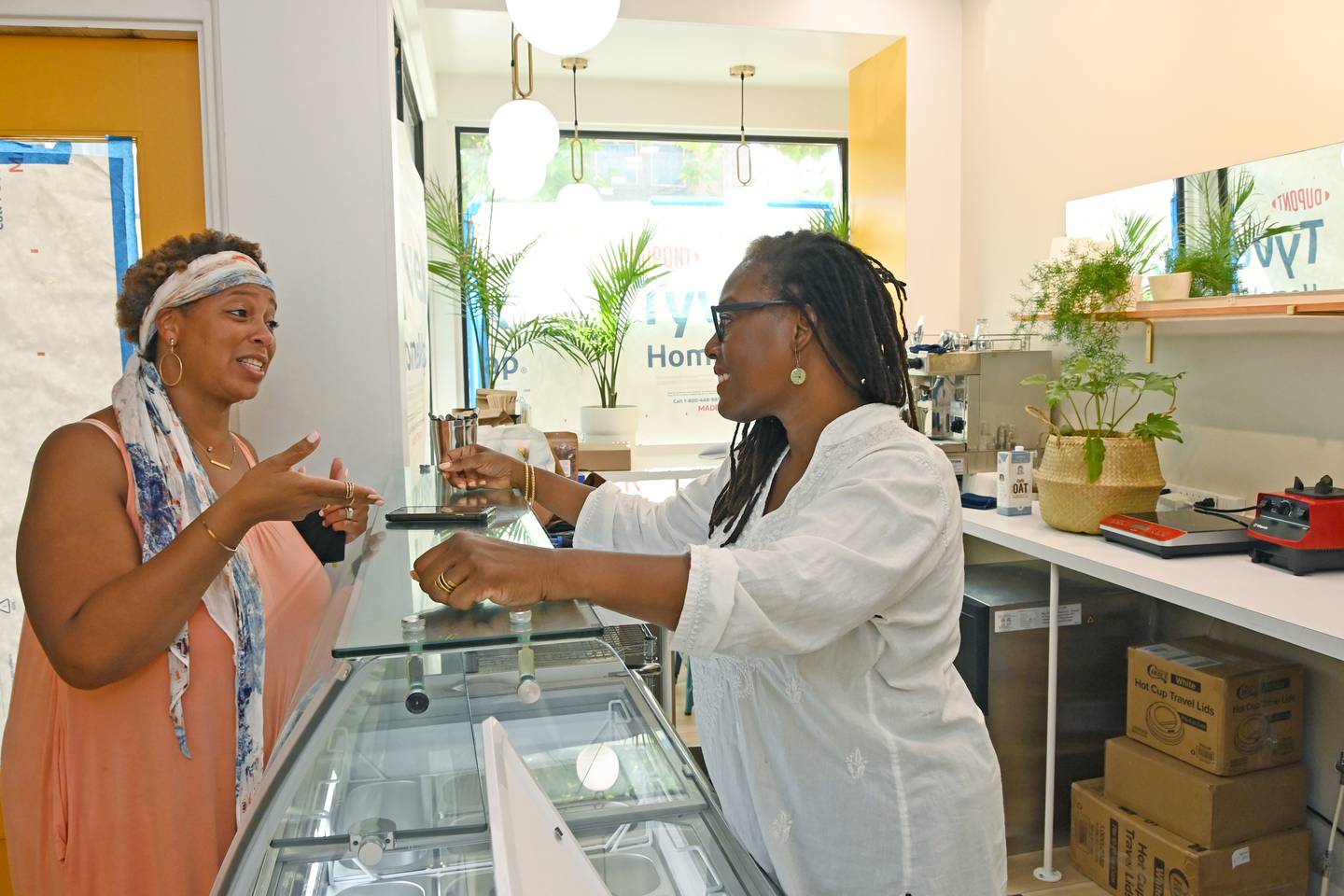
Photo: Kim Hairston/ The Baltimore Sun.
From left, Lynnette Dodson, co-owner of Cuples Tea House, talks with Nicole Foster, co-owner of Cajou Creamery, inside the creamery. “They are among five Black-owned businesses in the 400 block of N. Howard St. that will help to revitalize this long neglected area,” says the Baltimore Sun.

Yesterday I wrote about people pulling together to help Ukraine. There is strength in numbers, as Pete Seeger said in the line that I often quote: “One and two and 50 make a million.”

Another aspect of pulling together is seen in the “solidarity” movement described by Lisa Elaine Held at the Washington Post.

“On a [2021] fall morning, despite the chill in the air, workers at Taharka Brothers Ice Cream were packing a freezer truck and a van with pints of honey graham, peanut butter cup and pistachio. In the office, business metrics on retail performance, catering and home delivery moved across a screen on the wall. ‘It’s a really busy day,’ said Detric McCoy. ‘Even right now, I don’t think I could run it by myself.’

“He doesn’t have to. In December 2020, Taharka officially became a worker-owned cooperative, and McCoy shares responsibilities that would typically fall on one person’s shoulders. …

“In November 2020, popular pizzeria Joe Squared reopened after a covid-19 hiatus with 13 new worker-owners. This fall, the plant-based dessert shop Cajou Creamery also became a cooperative. And in early December, Union Craft Brewing announced it had added six longtime employees as owners and in the future would offer ownership to all employees after five years with the company. …

“Historically, restaurants have been places where power imbalances — between the front and back of the house, star chefs and kitchen staff, servers and customers — were tolerated. The industry also disproportionately depends on the labor of people from marginalized groups — including people of color and undocumented immigrants. …

“ ‘Co-ops have always emerged and scaled during crises,’ said Tori Kuper, the operations coordinator at the New Economy Coalition who is also on the board of the U.S. Federation of Worker Cooperatives. After the 2008 recession, Kuper said, the number of coops in the U.S. skyrocketed, and the spirit of mutual aid that arises during an economic downturn can also lead to interest in what the coalition calls ‘the solidarity economy.’ …

“Baltimore has been tending the fire of its solidarity economy for years, and many look to it as a model, Kuper said. …

Much of the story can be traced back to 2004 and Red Emma’s, a vegan cafe and bookstore that grew out of an anarchist bookstore called Black Planet Books.

“The seven founders set out to create a space for the city’s radical left and thought adding food and coffee to the bookstore would bring in more people, said Kate Khatib, who was one of those originals and is still a worker-owner.

“Worker cooperatives operate in many different ways, and Red Emma’s structure is entirely non-hierarchical. Everyone who is hired starts at the same hourly wage regardless of experience or background and is put on a track to ownership. If all goes well and they pass certain benchmarks over a set period of time, they join a team of worker-owners who share equal decision-making power and profits. Wages increase with time worked, but the highest-paid worker can never make more than twice the lowest. … She said, ‘We really started drilling down into: What does it mean for a business in this sector to be sustainable? And … how do we create jobs that are sustainable?’

“One answer was that they needed capital to buy a space, but traditional banks weren’t set up to lend to a group, and choosing the person with the best credit to take on the loan went against their operating values, since it strengthened the economic power of the most well-resourced owner over others. Red Emma’s began working with other cooperative organizations to fix that issue, which led to a nationwide cooperative lending network and then a local outfit that could provide both funding and technical assistance to worker coops. Today, that organization, the Baltimore Roundtable for Economic Democracy (BRED), connects the city’s growing patchwork of cooperatives.

“Emily Lerman, a project officer at BRED, is also one of the founders of Mera Kitchen Collective, which began as a group of friends hosting pop-up dinners and grew into a catering business that showcases the dishes of chefs from around the world. …

“But even with Lerman’s technical expertise, Mera has struggled to structure its business as a true cooperative. Immigration and visa issues have gotten in the way, as they do for many co-ops, so Lerman and her co-founders have focused on ensuring collective decision-making and on using the expansion to eventually put everyone on the team on salary and start profit-sharing. …

“Nicole Foster and Dwight Campbell of Cajou Creamery started selling ice cream, made from scratch with cashews instead of cows’ milk in such flavors as horchata, baklava and Mexican cacao, out of a new storefront on Howard Street in August. As they got up and running and planned further expansions, they worked with BRED to finalize a cooperative structure with an even more targeted goal: to create opportunity for formerly incarcerated people returning home. …

“Campbell said, ‘We want to give people a chance to show that they are much more than just somebody who served time. We want to give people the ability to dream about a future, to have ownership instead of thinking “I am just a drone. I’m here to work for a paycheck.” ‘ “

More on that at the Post, here.

Read Full Post »

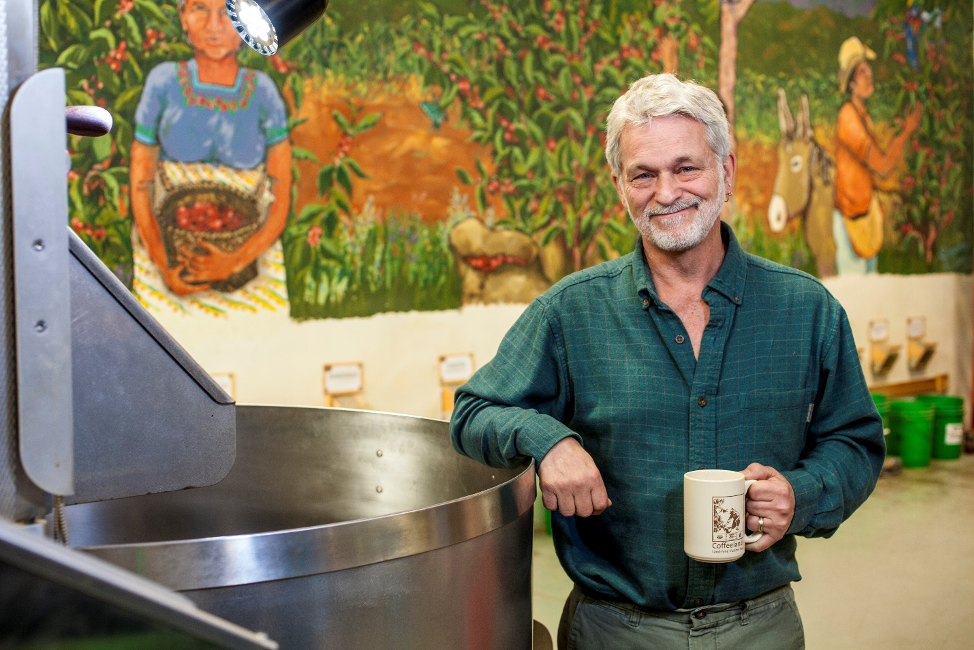
Photo: DeansBeans.
Dean Cycon of Dean’s Beans and his wife decided to go to Poland to help World Central Kitchen feed the influx of Ukrainian refugees. They both have forebears that were chased out of Europe by Russia.

Do you know the legend of the Jongleur de Notre Dame?

My francophone blogger friends should correct me if I get this wrong, but the way I remember it is that a man wanted to present a gift at the statue of the Virgin Mary but was desperately poor. He had a different kind of gift, though — a talent for juggling. The story goes that he juggled with all his heart and soul in front of the sculpture, and it gently bowed its head to him.

That’s the kind of miracle that feels real.

Today people are donating money and whatever talents they have in order to help Ukrainians invaded by Russia. First off, John, my son, who continues to employ optical engineers in Ukraine for remote work.

Another Massachusetts resident, Dean Cycon of Dean’s Beans Organic Coffee, is going with his wife, Annette, to Poland to work with World Central Kitchen, which is feeding thousands of Ukrainian refugees. Dean and Annette both have forebears they say were chased out of Europe by Russia. Their story is detailed at the Greenfield Recorder, here.

Boston doctors, interviewed here, made YouTube videos to teach ordinary Ukrainians how to treat war wounds. According to the Washington Post, The video is less than 40 seconds long — but its creators say it could help save lives in Ukraine.

‘The data we know from the battlefield is that a significant amount of deaths are preventable with taking these steps,’ Eric Goralnick, an emergency medicine physician at Brigham and Women’s Hospital in Boston. …

“Goralnick is the doctor shown acting out the tutorial in the short video, which provides a list of actionable steps written in Ukrainian. Another video, about 4½ minutes long, features a more detailed, step-by-step narration in Ukrainian by Nelya Melnitchouk, a Ukrainian-born oncology surgeon at Brigham and Women’s Hospital.” More.

The nonprofit group End Hunger New England is pivoting from mostly local needs to help Ukrainians, too, but according to the Christian Science Monitor, the group was stumped about how to deliver the meals so far away. Then a Boston-based shipping company, BOC International, stepped up. “It’s handling all the logistics,” the Monitor reports, No charge.”

Along with Asakiyume, I myself have joined a crowd of editor-types to help media people in Kyiv clean up translations of events so the Ukrainians can share the latest on Anglophone social media.

I am so grateful for this opportunity, which Asakiyume, a friend I met 25 years ago when we were both copyediting at a management magazine, offered me.

How it works: bilingual Ukrainians translate local news into English the best they can, then send it to colleagues to check as well as to “proofreaders,” mostly American. As proofreaders, we try to make the English sound more natural.

The organization we are helping works 24 hours a day. I know I’m getting more out of it than I am giving. Talk about real! If I want to sacrifice, I ought to sign up for the sparse 2 a.m. shift.

Read Full Post »

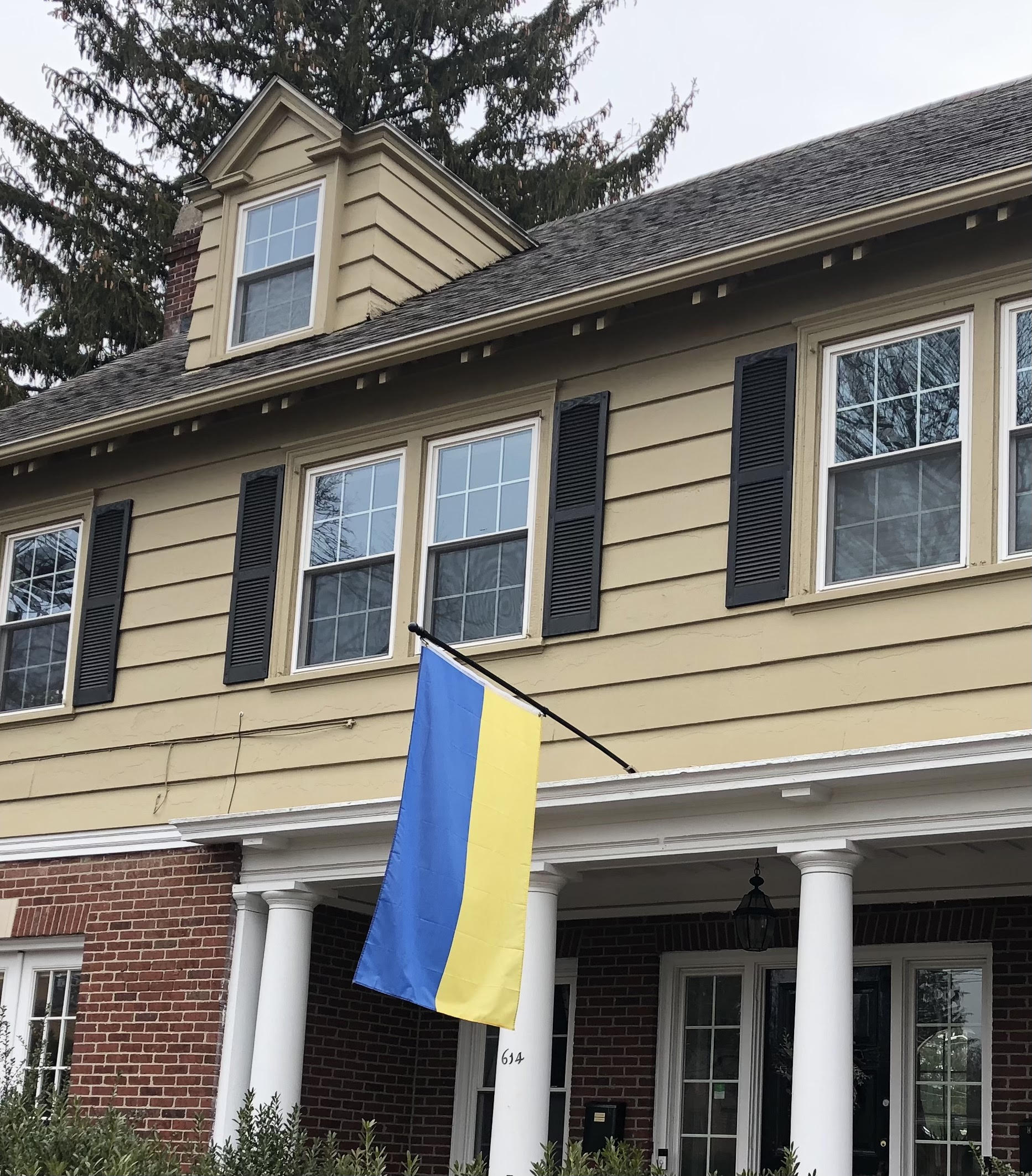
My first photo today is from Pawtucket, Rhode Island, where a homeowner is expressing the solidarity that most of us feel for Ukrainians defending their homeland against a crazed invader.

Some other recent photos also make me think about solidarity — and how good things can happen when folks band together. Remember the WPA? Many of its works are still in use. New Congressional allocations will be doing some of the same kinds of infrastructure projects, thank goodness.

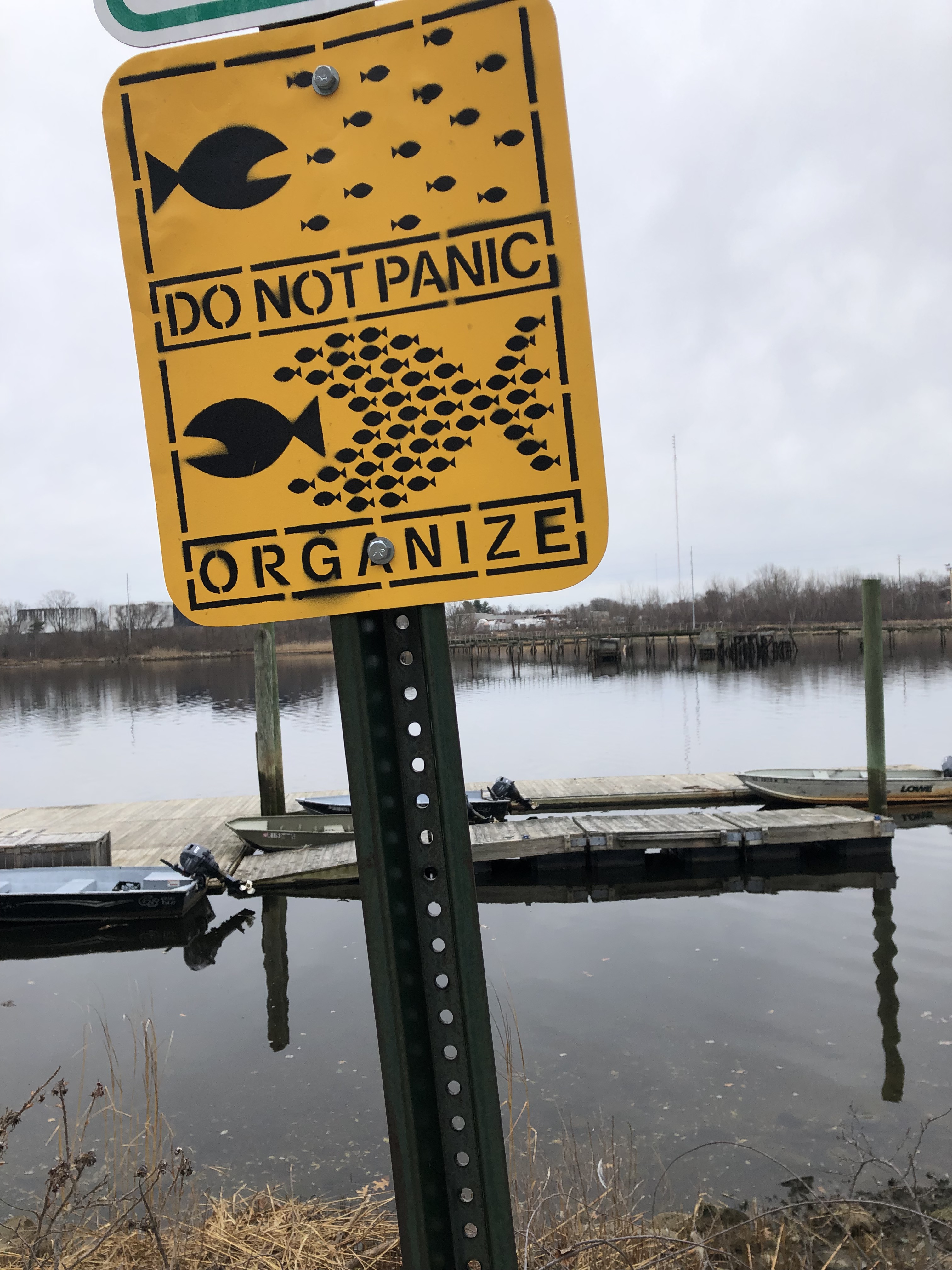
I loved the sign on the bank of the Seekonk River showing the power of “unionized” little fish in a dangerous world.

The photo of the pollinator sign highlights the banding together of neighborhoods in Massachusetts and elsewhere to protect honey bees and other pollinators, guardians of a healthy environment.

Looks like Providence’s official guardian on the river may actually be needed more on the road.

Meanwhile, encouraging signs of spring give us hope that winter won’t keep returning after random warm days. Still, winter can have attractions. Note the bluebirds that have been regular visitors to our feeder.

Read Full Post »

Photo: American Alliance of Museums.
A young visitor is captivated by Dakota, Natural History Museum of Los Angeles County’s full-suit Triceratops puppet.

When Suzanne was a few months old, John was learning about dinosaurs, and we got into a kind of chanting routine reeling off all the fancy names we knew. Baby Suzanne seemed to think they were hilarious. If she was fussy, dinosaur names would distract her and make her laugh.

Dinosaurs and their names have always enchanted small children. To up the enchantment, a museum in Los Angeles has begun experimenting with bringing dinosaurs to life. Sort of.

Ilana Gustafson writes at the American Alliance of Museums blog, “The anticipation of an imminent transformative journey is palpable in the diorama hall at the Natural History Museum of Los Angeles County (NHMLAC), where a Dinosaur Encounter is about to begin.

“During the show, the audience cheers as a young guest, decked out in a bedazzled dinosaur shirt, is called onstage to feed the juvenile Triceratops known as Dakota. … The audience falls into a quiet anticipation as Dakota’s feet shuffle impatiently, her beak opening and closing, indicating that she’s hungry. The child onstage gets closer to the dinosaur, leaf in hand, and reaches their arm out nervously toward her beak. Slowly Dakota approaches. …

“Dakota opens her mouth and suddenly clamps it closed with the leaf in its clutches and excitedly wiggles her tail. The audience cheers as the child onstage, grinning from ear to ear, watches a dinosaur playfully eat a leaf right at their feet. The host of the show thanks the young visitor. …

“The full-suit Triceratops puppet, created by the fabulous puppeteers at Erth, is made of aluminum and plastic boning, foam, and lycra painted with acrylic, and contains an internal speaker and other mechanisms. Inside is a puppeteer … holding the sixty-five pounds of the weight of the puppet on their back, using largely their shoulders and core strength to maneuver it. Many technical elements need to come together to bring the dinosaur to life, but when they all unify in a performance, the audience forgets to focus on the mechanisms at work. …

“This act of relating to the characters on stage is another thing that make theater so powerful. In a study published in the Journal of Experimental Social Psychology, researchers discovered that watching theater can lead to increased empathy, the ability to understand the feelings of others. … I would make the argument that this empathy toward the dinosaur increases intellectual curiosity about these creatures, paleontology, and other related studies. …

“The father of a dedicated fan shared with us in an email the love his son had developed for our puppet, and in turn for the Natural History Museum.

‘Lev didn’t just watch T-Rex and Triceratops. Lev became T-Rex and Triceratops. After each show, Lev would show us his improvisational reproduction of the show we had just watched. He insisted upon silence while he delivered his performance, mirroring and perfectly mimicking the T-Rex right down to lifting his legs, bending over with retracted arms, and delivering his ferocious ‘roar’ while bobbing his head back and forth seeking his prey.’ …

“The designs of the full-suit Triceratops and T. rex puppets were informed by the museum’s paleontologists, including Dr. Luis Chiappe, Senior VP of Research and Collections, who advised the fabricators on how best to merge entertainment with science. The physical characteristics of our juvenile Triceratops and T. rex puppets were based on our paleontological collections and research. The museum’s scientists were keen to have some of the current research on dinosaurs reflected in these creatures. After a performance with our T. rex puppet, known as Hunter, we often get the question from a visitor (young and adult alike), ‘What’s that fluffy stuff all over his body?’ This opens up a conversation about proto-feathers, and how scientists have been able to make the connection between theropod dinosaurs and modern-day birds. …

“The experts at NHMLAC see the value these puppets have in garnering interest and support for their research. Dr. Nathan Smith, Curator at NHMLAC’s Dinosaur Institute, says … ‘The puppets are a truly unique way where we can envision these species as living animals, but also allow visitors to interact with them.’ “

More at the American Alliance of Museums blog, here. If you missed the giant puppet at the San Diego Zoo, you can read about it here. And here‘s a post from last fall on the one that strode across Europe.

Read Full Post »

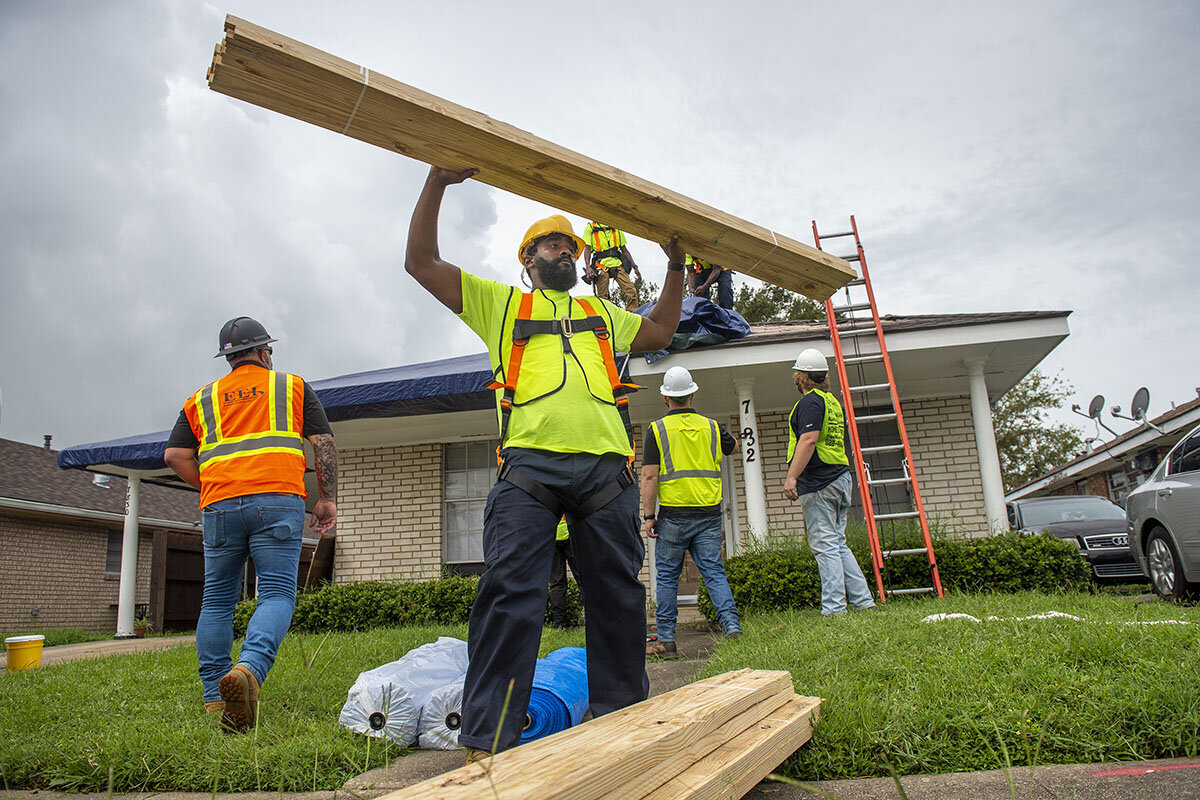
Photo: Chris Granger/The Times-Picayune/The New Orleans Advocate/AP
“Roofing contractors install a temporary roof on a home in New Orleans East, Sept. 8, 2021. FEMA and the U.S. Army Corps of Engineers are overseeing this Blue Roof program to help homeowners recover from the damage cause by Hurricane Ida,” the
Monitor reports.

Can humanity learn from history? Sometimes, yes. According to this September 2021 story, people are learning from climate disasters. Even I, as a child on Fire Island, learned that people who build houses on sand dunes ask for heartbreak. Collectively, the towns on the island learned the same thing.

Marshall Ingwerson wrote this report on collective learning at the Christian Science Monitor.

“In the weeks since Hurricane Ida landed at New Orleans, it has illustrated two very different stories. One is the rising violence of the changing climate. The other, which is only now fully emerging, is the human resilience that has already made the world far safer. …

“The aftermath of Hurricane Ida is now entering what we might call the resilience zone. It can be the most testing, and telling, phase.

“As part of the Monitor’s Finding Resilience project, here is a tale of two cities: The New Orleans hit by Hurricane Katrina 16 years ago and the New Orleans hit by Hurricane Ida late last [August]. 

“They were not identical storms. Ida struck with less sweeping girth than Katrina but more sheer force. They weren’t all that different, either.

“But they hit a different New Orleans. Katrina killed more than 1,800 people. The breaching of the levees put 80% of the city underwater. The blow was nearly existential to New Orleans as we knew it. Three in 10 residents vacated, many permanently. 

“After Ida struck last month, the now-fortified levees held against the surge. The toll in fatalities in Louisiana is at 28. A similar number died in New Jersey as Ida-driven rain flooded the Northeast. The scale of damage and heartbreak is so vastly different that clearly Louisiana is more robust and storm-hardy than in 2005. The population had even grown back in New Orleans, recently surpassing its pre-Katrina numbers.

“Ida has been covered as an example and a warning of the rising violence of climate change, making hurricanes stronger, floods higher, and fires bigger and more frequent in the dry West. And that’s an important context. 

“But here’s another: Even as climate events become more dangerously frequent and potent, humanity has actually become safer – dramatically safer.

“The economist Bjorn Lomborg finds that the number of people killed worldwide by climate-related events in the 1920s, a century ago, was 27 times higher than the number killed over the decade ending 2019.

Corrected for the far higher global population today, the death rate a century ago was more than 130 times what it is today.

“Dr. Lomborg’s point is that when we assess the costs, the dangers, and the difficulties that climate change implies, human resilience and ingenuity is a nontrivial factor. So far, in fact, it has been an overwhelming factor.

“A term like resilience can risk sounding a little minimizing and reductive – just a personal character trait. It is much more than that.

“Those who have been through a hurricane strike report that it is after the winds have gone quiet, the ground dried, and the sun shining in steamy afternoons, only then have they arrived at the hard part – the exhausting building back, the forging ahead, the relaunch into forward motion. …

“Many of the efforts to resuscitate post-Katrina New Orleans were deeply personal, with families making remarkable sacrifices to rebuild the economy and education, much less the roads, bridges, and buildings of the city itself.

“So resilience is a matter of spirit, of finding the heart to come back. But its structure, the ladder resilience climbs, is learning. We pick ourselves up, we learn what we need to learn, and we get to work.

And it’s not just person-by-person resilience that drives the kind of change we have seen. It’s collective.

“Only big, complex teams can achieve what New Orleans accomplished in the past 16 years. The scale of the investment, the engineering, the overlapping interests, the cross-cutting visions and values – only politics can put all that together and sort all that out. …

“Yet humankind has made the world, per Mr. Lomborg’s numbers, more than 99% safer against natural disasters in the last century by scaling resilience. And we do that through the institutions we use to work together. 

“The only way we can learn and then act on as massive a scale as demanded of New Orleans is through the institutions we’ve developed over centuries – whether it’s a city council, a police department, a university, an engineering association, a religious denomination, a news organization, a Supreme Court, or an updated building code.

“It’s the lack of robust institutions that reduce resilience in a country like Haiti – where such institutions were undermined by Western powers for centuries – to a more individual matter. Anyone who has visited the nation has witnessed the sheer energy and unoppressed vitality of the people that crowd the streets of Port au Prince. The spirit is there, but it’s a resilience on foot, a personal challenge, and not yet a resilience that can collectively build safety from the next natural disaster.

“Individual learning can be a flashlight for families, communities, organizations, nations. But it is collective learning, what we achieve together, that holds real power. In fact, civilization itself could be defined as collective learning.”

More at the Monitor, here.

Read Full Post »

Photo: Dan Cameron.
Chumono, Muelle de Alma (2005), site specific art installation near Cucao, Chiloé, Chile.

Today’s article is the first in a Hyperallergic series about a fellowship for curators that one recipient used for a project in Chile. Blogger Rebecca may know the part of Chile that curator Dan Cameron talks about.

He writes at Hyperallergic, “While preparing this project one day, I was perusing Chilean regional news outlets for details about the December 2021 fire that damaged or destroyed a number of houses in Castro, the capital of the Isla Grande de Chiloé, when I noticed that multiple sources referred to the island as a ‘tourist’ destination.

“Maybe it’s the just intellectual vanity that goes with being the sort of curator who leaves New York City to come to a remote corner of South America, but it felt weirdly like a slap in the face to see this little-known (outside of Chile) place that I’d been steadfastly exploring for a future curatorial project seemingly transformed by a single word into a locale that would be for, well, tourists. In my mind it didn’t matter that Chiloé’s famed palafito stilt houses and 17th- and 18th-century wooden churches attract visitors worldwide, or that the more secluded corners of Chiloé I’d scouted on previous trips had everything a moderately resourceful traveler would need for a splendid visit. …

“My flash of pique at reading Chiloé so described is curiously linked to my personal history with Chile, which I first visited exactly 30 years ago. … I’ve returned consistently to Chile over the years, precisely because I thought I wouldn’t otherwise get to know it. This was summarized by the word that the Santiago-based artist Eugenio Dittborn would employ five years later as his title for a survey exhibition I curated of his signature pinturas aeropostales (airmail paintings) at the New Museum: Remota.

In 1992 I hardly knew anybody who possessed firsthand information about Chile, and that made it irresistible.

“During our initial meeting at his studio in Santiago, I shared with Dittborn my very ambitious itinerary, which included Santiago, Valparaiso, Easter Island, and the northern cities of Iquique and Antofagasta. … Dittborn responded that in the future, I should visit the southernmost art museum in the world, in Castro [in Chiloé], and perhaps consider organizing an exhibition there. …

“I finally made it to Chiloé in 2015 with the artist Gianfranco Foschino. … It helped that Gianfranco was personally enthusiastic about organizing a contemporary art exhibition in Chiloé, but what became less clear once we’d made our initial reconnaissance of the island was whether or not MAM Chiloé was the ideal venue for a project that would function largely as a platform for local artists. After spending time with and talking to various artists living on the island, it seemed that, for most, the museum functioned as a venue for artists based in Santiago. If I wanted to see where local artists showed, I’d need to dig a little deeper into the patchwork of regional museums, municipal libraries, gallery-cafés, and community centers, which tended to be scattered all over Chiloé, and on the nearby islands of Quinchao and Lemuy.

“My last time in Chiloé, in November 2019 … I started envisioning Alrededores more as a long-term curatorial endeavor, where instead of artworks appearing for one season and vanishing, some might require years even to come to fruition. That would place the project closer in spirit to the niche that the Chilote artist Chumono opened up with his site-specific Muelle del Alma (‘Pier of the Soul’), which since its 2005 construction has become emblematic of art and nature co-existing on mutually beneficial terms. Thousands of visitors each year park their cars near the village of Cucao and hike nearly three miles through verdant hills and pastures to the westernmost edge of the island.

“There, according to Chiloé folklore, the boatman Tempilcahue will someday ferry them to the afterlife; fittingly, Chumono’s wooden ramp visually beckons visitors up into the sky and out over the Pacific Ocean. …

“The most exciting part of my plan was the possibility that Chiloé’s artists might end up with an international context for their work, without rupturing the sociocultural framework of their lives.

“The art was already there — I had already been surprised by its depth, and it was simply a matter of introducing the world to it. Even if cultural tourism, broadly speaking, was on a temporary hiatus as new waves of COVID spread worldwide, other avenues could bring the public to the art of Guillermo Grez or Anelys Wolf, or to the sole-proprietor storefront Museum of the Accordion in Chonchi.

“The latter, a modest but beloved establishment, preserves an integral part of the musical legacy left through centuries of ships — on which the accordion was that rare instrument capable of surviving adverse conditions — rounding Tierra del Fuego to pass between the Atlantic and Pacific Oceans, which slowed to a crawl after the 1914 opening of the Panama Canal. Part of the original Alrededores concept had been to move the museum’s collection — acquired long ago from sailors who left their accordions for repair and never returned — temporarily to MAM Chiloé, while putting some TLC into the museum’s display and conservation in Chonchi, where exhibits are typically set out on folding tables with hand-written labels.

“This month I’m returning to Chiloé for the fifth time in eight years … in pursuit of something that compels me to return over and over again, and to continue dreaming of a truly marvelous future art exhibition.”

More at Hyperallergic, here, where you can click through the curator’s updates. No firewall, nice pictures.

Read Full Post »

Lead-Poisoned Eagles

Photo: Tri-State Brid Rescue & Research.
Study: Nearly half of bald eagles and golden eagles have chronic lead poisoning, probably from bullets lodged in their prey.

Eagles rebounded when humans stopped using DDT to kill mosquitos. But like most things in life, there’s always something else that comes along. Eternal vigilance is required. Today’s story looks into the reasons many of these eagles are now suffering from lead poisoning.

As Maria Cramer reported at the New York Times last month, “The bald eagle, whose resurgence is considered one of the great conservation success stories of the 21st century, is facing a serious threat: lead poisoning.

“Researchers who tested the feathers, bones, livers and blood of 1,200 bald eagles and golden eagles, another bird of prey in the Northern Hemisphere, found that nearly half of them had been exposed repeatedly to lead, which can lead to death and slow population growth.

“Scientists believe that the primary source of the lead is spent ammunition from hunters who shoot animals that eagles then scavenge, usually during the winter, according to the study, which was published on Thursday in the journal Science.

“Nearly a third of the birds tested also showed signs of acute poisoning, or short-term exposure to lead, according to the study, which was led by scientists from the United States Geological Survey, Conservation Science Global, Inc. and the U.S. Fish and Wildlife Service.

“The effects of lead poisoning are devastating, said Vincent A. Slabe, the lead author of the study and a research wildlife biologist for Conservation Science Global in Montana.

“Lead poisoning can prevent an eagle from digesting food properly, eventually leading to starvation, he said. It can cause loss of locomotion so severe that an eagle will lose the ability not only to fly, but also to move at all, he said. …

“The study, which examined bald eagles and golden eagles from 38 states, is the first to look at the effects of lead poisoning on the bird populations on such a large scale, said Todd E. Katzner, a research wildlife biologist at the U.S. Geological Survey.

” ‘The research also showed that poisoning slowed down population growth rates by about 4 percent for bald eagles and 1 percent for golden eagles. … These percentages seem small, but, over time, thousands and thousands of individual birds are being removed from the population’ because of lead poisoning, Dr. Katzner said. …

“Dr. Slabe said he hoped the report’s findings would help to educate hunters and encourage more of them to switch to lead-free ammunition.

“ ‘This is 100 percent human caused and totally preventable,’ said Laura Hale, president of the Badger Run Wildlife Rehab in Klamath Falls, Ore., whose organization has taken in bald eagles, golden eagles, and different species of hawks that were poisoned by lead.

“In 2018, the group tried to save an eagle that a hunter had found in the woods and was unable to fly and gasping for air.

When Ms. Hale told the hunter that the eagle most likely became sick from feeding on contaminated gut piles … ‘He was horrified. [He] wanted to stop hunting.’ [She] told him that he did not have to stop hunting; he needed only to stop using lead ammunition.

“Many hunters, concerned about effects not only on wildlife, but also on game meat consumed by humans, have been moving away from lead ammunition and have begun using copper bullets.

“Sporting Lead-Free, a hunters and anglers group based in Wyoming that seeks to raise awareness about the adverse effects of lead ammunition, posted a short film with testimonials from hunters who stopped using it.

“ ‘Hunters are conservationists,’ said Bryan Bedrosian, a co-founder of Sporting Lead-Free and a raptor biologist. ‘This does not need to be a polarizing issue.’

“Some hunters hesitate to switch ammunition because of tradition, a mistaken belief that copper bullets are less effective, or because they have a backlog of lead bullets, he said.

“ ‘Then there are still folks who just don’t know,’ said Mr. Bedrosian, who says he uses lead bullets at the range, where he knows the ammunition will not come into contact with wildlife.

“Hannah Leonard, the group’s outreach coordinator, said she hunted with lead bullets until four years ago, when she came upon an emaciated golden eagle hobbling on the ground while she was hunting in Anaconda, Mont.

“ ‘Her talons were really clenched, her wings were drooped,’ Ms. Leonard said. ‘You could tell she was in danger.’

“The eagle later died and Ms. Leonard said the animal rescue group she called to try and save the bird told her the cause of death was lead poisoning. ‘It was a no-brainer for me to switch’ types of ammunition, she said.

“In January 2017, the U.S. Fish and Wildlife Service issued a policy [later reversed] to phase out the use of lead ammunition and fishing tackle used on national wildlife refuges. … The service declined to say whether that policy would be reinstated as a result of the new study. …

“Dr. Slabe said that hunters, once they were educated, would voluntarily stop using lead ammunition. ‘Hunters are very receptive to this issue,’ he said.”

More at the Times, here.

Read Full Post »

Photo: Adria Malcolm/ NYT.
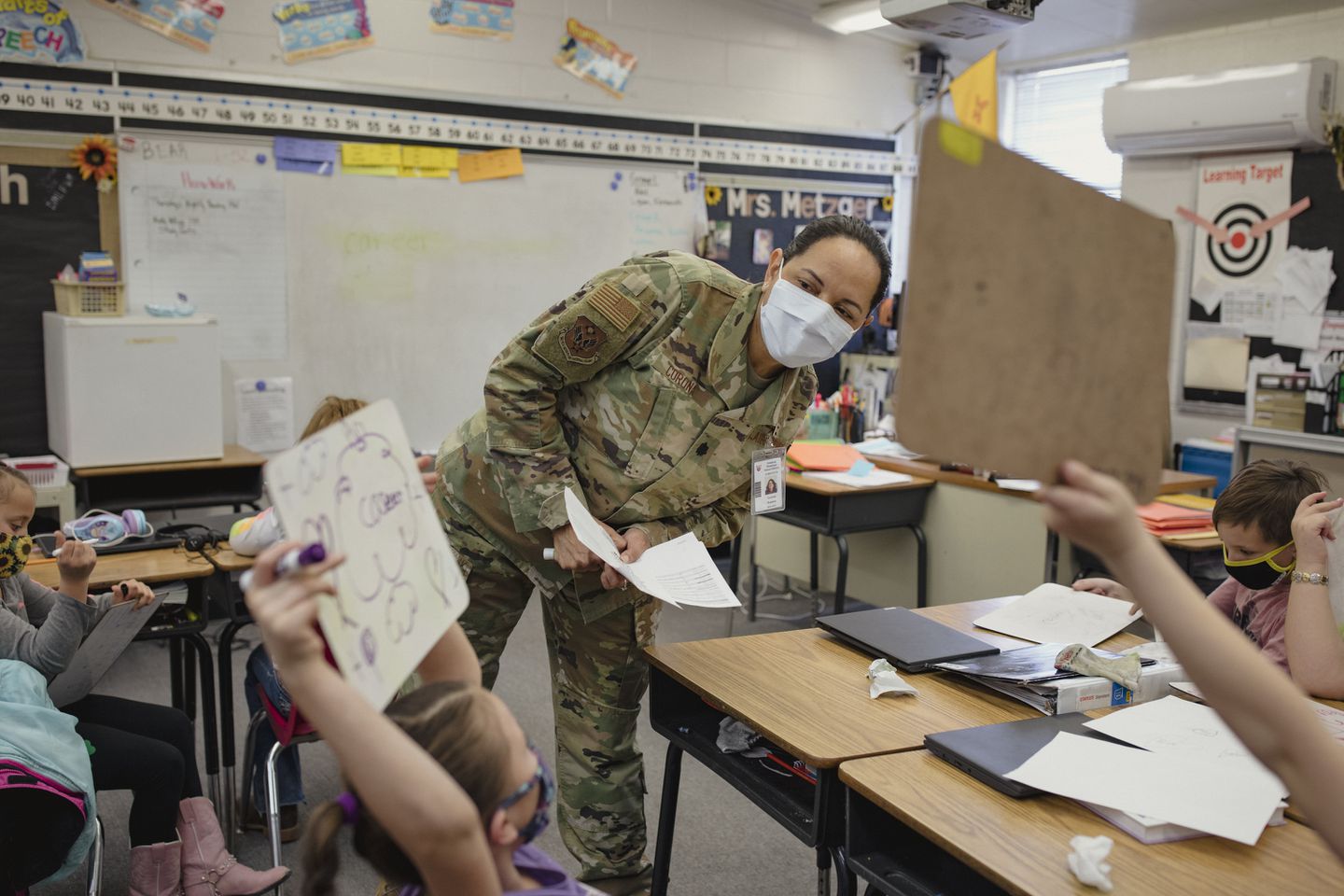
Lieutenant Colonel Susana Corona of the New Mexico National Guard worked as a substitute teacher in a third grade class in Estancia, New Mexico.

When things are bleak, it’s helpful to remember the advice that Fred Rogers’s mother gave him when he was small: “Look for the helpers. There are always helpers.”

On National Public Radio the other day Ari Shapiro interviewed a woman who had just escaped from Ukraine and came back to the border the next day to help people with translation. And yesterday I learned that Asakiyume — from her home in Massachusetts — was helping translators make their English sound more natural. Perhaps I can also help with that.

Many, many people have also stepped up during the pandemic to meet needs wherever they are. Consider this story about a National Guard lieutenant colonel filling in for an elementary school teacher in New Mexico.

Erica L. Green wrote at the New York Times, “The chorus of small voices ringing from a third grade classroom on a recent morning signaled how far Estancia Elementary School had come in resuming a sense of normalcy after the latest coronavirus surge.

“Students in this small, remote community were enthusiastically engaged in a vocabulary lesson, enunciating words with a ‘bossy r,’ as well as homophones and homonyms, and spelling them on white boards.

“But there was also a sign of how far the district, about an hour outside Albuquerque, New Mexico, still had to go. The teacher moving about the classroom and calling on students to use the words in a sentence was clad in camouflage. ‘My substitute is wearing gear,’ one student responded.

” ‘Yes,’ Lt. Col. Susana Corona replied, beaming. ‘The superintendent allows me to wear my uniform. I’m wearing a pair of boots.’

“[Dozens] of soldiers and airmen and women in the New Mexico National Guard have been deployed to classrooms throughout the state to help with crippling pandemic-related staff shortages. Gov. Michelle Lujan Grisham has also enlisted civilian state employees — herself included — to volunteer as substitute teachers. …

“The presence of New Mexico’s state militia — whose members are trained to help with floods, freezes and fires, as well as combat missions overseas — has largely been embraced by schools as a complicated but critical step toward recovery. Teachers have expressed gratitude for ‘extra bodies,’ as one put it.

Students were mostly unfazed but aware that, as Scarlett Tourville, a third grader in Corona’s class put it, ‘This is not normal.’

“Superintendents were given the choice of whether to have the guardsmen and women wear regular clothes or duty uniforms; most joined Cindy Sims, superintendent of the Estancia Municipal School District, in choosing the uniforms. ‘I wanted the kids to know she was here, to know why she was here,’ Sims said. ‘I wanted them to see strength and community.’ …

“ ‘Trying to have school at a time when everybody’s heart was broken was very difficult,’ Sims said. ‘Our mission is to keep hope alive, and the National Guard is helping us do that.’

“Corona, an intelligence officer in the New Mexico Guard … never envisioned that one of her missions would require being armed with a lesson plan, Wet-Naps and dry-erase markers. But nor did she envision watching her own fourth grader try to learn from a teacher through a screen last year.

“ ‘You always have to be ready when there’s a need,’ she said, ‘when there’s a call to service.’ …

“Coronavirus-related illnesses, quarantines and job-related stress have hit many districts hard. But the country’s education leaders say the pandemic is just accelerating trends that were at least a decade in the making. …

“ ‘Crisis is the word we have to use now,’ said Becky Pringle, the association’s president, describing the enlistment of the guard as a ‘stopgap.’ …

“At Belen High School, in a farming community less than an hour south of Albuquerque, the staffing crunch has been felt acutely. … Principal Eliseo Aguirre said he believed the death of a teacher from COVID-19 had a chilling effect on teacher and substitute applications.

“The arrival of Airman 1st Class Jennifer Marquez last month was a ‘blessing,’ Aguirre said. On a recent Wednesday, she was covering a Spanish class — her third subject in two weeks. …

“Veronica Pería, a freshman at Belen, was happy to see [her]. She said her grades suffered last semester when her teachers were absent and random staff members were popping in and out of her classes, leading to inconsistent instruction. ‘It’s better than watching a video or something,’ she said of having Marquez filling in. ‘It’s good to have someone I can go to and ask for help.’ …

“When the call came from the governor, the New Mexico National Guard’s commander-in-chief, Brig. Gen. Jamison Herrera, knew he would have no trouble recruiting volunteers for Operation Supporting Teachers and Families, or STAF.

“Many guardsmen and women had already seen how the pandemic affects students up close, having delivered meals to those at risk of going hungry when schools closed. …

“Although some members have advanced degrees or certifications that could translate to the classroom — a welder is teaching shop class in one district, for example — Herrera, a former teacher, impressed upon his team they were there to accomplish one goal.

“ ‘We are there to support the learning objectives of the teacher, because we certainly know we can’t fill their shoes,’ he said.”

More at the Times, here.

Read Full Post »

Photo: Russ Rowland/Heartbeat Opera.
Professional opera singers Kelly Griffin and Derrell Acon perform with incarcerated singers for Heartbeat Opera’s production of Fidelio in a dress rehearsal at New York’s Metropolitan Museum of Art.

Positive things happen when punishment for people who have committed crimes doesn’t negate their basic humanity. That’s why I like posting stories about enlightened systems (see Norway’s successful rehabilitation process, here) and programs that bring the arts inside the walls.

Anastasia Tsioulcas reported recently at National Public Radio (NPR) about an unusual production of Beethoven’s opera Fidelio, the story of a man who has been imprisoned for political reasons.

“A group of enterprising artists has found a way to bring Fidelio, quite literally, into today’s incarceration system — and to bring the voices of those men and women to the stage.

“In this updated version of Fidelio staged by New York City’s Heartbeat Opera, the main character is Stan, a Black Lives Matter activist who has been thrown into solitary confinement. His wife, Leah, tries to rescue him. The music is still sung in German, but the spoken parts are in English.

“In person, this production is small: there’s just a handful each of instrumentalists and singers on stage at New York’s Metropolitan Museum of Art. … But this production is a much larger effort, notes Ethan Heard, who is a co-founder and artistic director of Heartbeat Opera.

” ‘I revisited the story and was just so struck by the idea of a wrongfully incarcerated man and this amazing woman, his wife, who infiltrates the prison where she believes he’s been kept. And it felt like an opera we could really update for a contemporary American version,’ Heard says.

“Heartbeat first staged its version of Fidelio in 2018 [then updated it] to reflect certain events of the past couple of years, from the nation’s racial reckoning to the Jan. 6 insurrection at the Capitol.

“Stan has been jailed by the corrupt prison governor Pizarro [who exhorts] his cronies to ‘stand back and stand by’ as he plots Stan’s murder. A senior guard, Roc — who is Black himself — comes to wrestle with his position in the system. …

“The emotional apex of any version of Fidelio is a scene in which the prisoners are allowed a brief outing into the fresh air, exulting in a passing moment that feels just a little bit like freedom.

“In thinking about that scene, Heard and co-musical director Daniel Schlosberg hit upon a much larger idea that spoke to what they really wanted this production to address: mass incarceration in America.

“They connected with an old friend of Schlosberg: Amanda Weber, a prison choir director in Minnesota. She in turn helped put them in touch with other such groups. As a result, in Heartbeat’s production, singers from six prison musical groups — a mix of over 100 men and women who are incarcerated as well as about 70 community volunteers — are the ones singing the ‘Prisoners’ Chorus.’

“The groups are the Oakdale Community Choir in Iowa; KUJI Men’s Chorus, UBUNTU Men’s Chorus and HOPE Thru Harmony Women’s Choir in Ohio; East Hill Singers in Kansas; and the group Weber leads, Voices of Hope in Minnesota. …

“Schlosberg says that this moment in the opera [is] some of the most gorgeous music ever written for chorus in an opera, and that is the center, both emotionally and musically. Everything about this piece kind of comes from there.’

“In order to make this collaboration happen, the Heartbeat team had to earn the trust of the singers in prison. Michael Powell is one of those chorus members; he’s also known by the name Black. He was formerly incarcerated in Ohio, at Marion Correctional, and sang in the KUJI Men’s Chorus there. Above all, Black says, they didn’t want to be used as a prop. …

‘When Danny and Ethan came in, it was like the quick feel-out process — let’s see what’s going on there because we don’t want to feel exploited in any way. We already get exploited enough.’

“Derrell Acon is the associate artistic director of Heartbeat. In Fidelio, he sings the role of Roc. Acon says that opera can be a great vehicle for addressing and reflecting social movements. …

” ‘I’m someone who has been impacted by the carceral system. I have a sibling who was incarcerated. … This is not actually a mechanism for justice, but rather revenue,’ Acon continues, referring to the use of privatized prisons. ‘It sits on the backs of Black and brown people.’ …

“Black, the singer from the KUJI men’s chorus, was released from prison in 2020. He’s now the director of outreach and new initiatives for a small non-profit in Columbus, Ohio, Healing Broken Circles, which works with people touched by the justice system. …

” ‘If you really want to try to impact lives or if you care anything about prison justice reform or any of those things,’ Black says, ‘support the arts going into those prisons and support the community coming out of prison.’ ” More at NPR, here.

Music heals. And in case you missed it, see also what music can do for people in a bomb shelter, here.

Read Full Post »

Photo: Biosphere2.
Biospheres in Arizona gather ancient wisdom to aid future generations.

Now that we know human activity is the main reason for dangerous global warming, it’s time to turn to indigenous tribes and learn to step more lightly on Plant Earth. That’s the thinking behind a biosphere project in Arizona.

Samuel Gilbert reports at the Washington Post, “Indigenous peoples have known for millennia to plant under the shade of the mesquite and paloverde trees that mark the Sonoran Desert [in Arizona], shielding their crops from the intense sun and reducing the amount of water needed.

“The modern-day version of this can be seen in the Santa Catalina Mountains north of Tucson, where a canopy of elevated solar panels helps to protect rows of squash, tomatoes and onions. Even on a November afternoon, with the temperature climbing into the 80s, the air under the panels stays comfortably cool.

“Such adaptation is central to the research underway at Biosphere 2, a unique center affiliated with the University of Arizona that’s part of a movement aimed at reimagining and remaking agriculture in a warming world. In the Southwest, projects are looking to plants and farming practices that Native Americans have long used as potential solutions to growing worries over future food supplies. At the same time, they are seeking to build energy resilience.

“Learning from and incorporating Indigenous knowledge is important, believes Greg Barron-Gafford, a professor who studies the intersection of plant biology and environmental and human factors. But instead of relying on tree shade, ‘we’re underneath an energy producer that’s not competing for water.’

“On both sides of the Arizona border with Mexico, scientists are planting experimental gardens and pushing the potential of an ‘agrivoltaic’ approach. Thirsty crops such as fruits, nuts and leafy greens — which require elaborate irrigation systems that have pulled vast quantities of water from underground aquifers and the Colorado and other rivers — are nowhere to be found. …

“Southern Arizona is an epicenter of the movement not just because of the intense environmental pressures that the region faces but because of the presence of the Tohono O’odham Nation southwest of Tucson.

“The Tohono O’odham have farmed in the Sonoran Desert for several thousand years. Like many Indigenous groups, they now are on the front lines of climate change, with food security a paramount concern. Their expansive reservation, nearly the size of Connecticut, has just a few grocery stores. It is a food desert in a desert where conditions are only getting more extreme.

“Since the early 1970s, a group of Nation members have run the San Xavier Cooperative Farm and grown ‘traditional desert cultivars’ in accordance with their ancestral values — particularly respect for land, water and plants.

“Sterling Johnson, a member of the Tohono O’odham Nation, has worked for the past decade to share that expertise broadly. His partner, Nina Sajovec, directs the Ajo Center for Sustainable Agriculture, a Native American-governed food justice organization that several years ago founded its own seed bank and already has distributed over 10,000 seeds to farmers.

“ ‘We’re all about using what is out there,’ Sajovec said. Among the center’s heirloom varieties: 60-day corn, a fast-maturing desert-adapted vegetable, and the tepary bean, a high-protein legume particularly suited to the climate because of leaves that can fold to withstand direct sunlight during the peak of summer.

“Johnson captures precipitation during the Arizona monsoon season to sustain crops on his field in the desert lowlands. ‘It’s using the rainwater,’ he explained, ‘using the contour lines, using your environment and nature to grow food.’ …

“Perhaps even more daunting than the rising temperatures of climate change are the water shortages that many parts of the world will confront. In Tucson, the Santa Cruz River is now dry because of too much diversion and burgeoning demand, according to Brad Lancaster, an expert on rainwater harvesting.

“ ‘The majority of the water that irrigates landscapes and Tucson and Arizona is not local water’ but tapped from the Colorado River, Lancaster said. Unless severe drought conditions reverse and the river level improves, mandatory federal cutbacks mean farmers will lose a significant amount of that critical resource starting next year.

“ ‘The goal is how can we use rainwater and storm water, passively captured, to be the primary irrigator,’ said Lancaster, who lives in a local neighborhood that has been transformed through passive water harvesting into an ‘urban forest,’ with wild edible plants such as chiltepin pepper and desert hackberry lining the sidewalks.

“He is planning a similar system at Tumamoc Resilience Gardens, using basins and earthen structures to spread water across the landscape and reduce channelized flows. Nabhan, who also is involved in the site’s design, sees it as replicable and, more importantly, scalable. …

“ ‘We’ve had 5,000 years of farmers trying out different strategies for dealing with heat, drought and water scarcity,’ said [Gary Nabhan, an ethnobotanist and agrarian activist who focuses on plants and cultures of the Southwest], walking around his own creation at his home in Patagonia, a small town about 18 miles north of the Mexico border. The fenced space holds 40 species of agave, three species of sotol, prickly pear and other varieties of cactuses and succulents.

“ ‘The key concept,’ he said, ‘is that we’re trying to fit the crops to the environment rather than remaking the environment.’ ”

More at the Post, here. Lots of great photos.

Read Full Post »

Photo: Takehiko Kambayashi.
Octogenarian app developer Wakamiya Masako creates fabric designs with Excel art (note her shirt) and also games that older people can win against kids.

I know I’m not the only one when I say that I miss Jimmy the Geek. He would make an initial housecall for computer problems, but after that, he’d solve problems over the phone, usually without charge.

Jimmy died two years ago. And I have managed to take care of myself, techwise, mostly by following his approach to finding solutions.

The common wisdom that old folks need to ask children for tech help gives us a bad rap. Many older bloggers know how wrong that is. We have learned to do all sorts of fancy things with WordPress, for example, adapting when the platform makes its endless “improvements.” My grandchildren have no idea how to do this. They could learn it fast, but I would have to teach them.

You can see why I was drawn to today’s story about Wakamiya Masako, 86, who learned to develop a game app at age 82.

Takehiko Kambayashi writes at the Christian Science Monitor, “Retired from bank management for about 25 years, she has spent a lot of her time helping older friends and neighbors learn to use smartphones, and she’s developed the theory that they have a hard time because there aren’t games and apps aimed at their age group.  

“One possible solution, she thought, was to create a gaming app to encourage and enchant older people into more comfort with their smartphones. …

“Her idea has made her famous at home and abroad for being one of the oldest app developers in the world, lauded by Japanese leaders and global technology executives for transcending age barriers.  

“ ‘Ms. Wakamiya asked me to develop a gaming app in which seniors can beat young people,’ recalls Koizumi Katsushiro, president of Tesseract, a company that teaches computer programming and app development in the northeastern city of Shiogama. 

“But he suggested she create the app herself, and that he would help her. The energetic Ms. Wakamiya took on the challenge, struggling for six months to create the game. …

“In 2017, at the age of 82, she launched Hinadan. The game features Japan’s traditional Hinamatsuri festival, a celebration of Girls’ Day. On the Hinadan app, which takes its name from a tiered stand for displaying traditional Japanese dolls, users must move dolls – puzzle-like – into appropriate positions according to roles: the emperor and the empress, court ladies, and court musicians with instruments. It has now been released in five languages. 

“ ‘I was pleased with the launch. But I did not think it was such a major achievement,’ says Ms. Wakamiya, surprised at the global interest in her work. 

“Hailing her as the world’s oldest app developer, Apple chief executive Tim Cook invited her to the company’s Worldwide Developers Conference in San Jose, California, in 2017. …

“Ms. Wakamiya, who serves as vice chair of the Mellow Club, a Japanese online group for older people, soon found herself on the global speaking circuit encouraging older people to overcome discomfort with technology.

“In 2018, she delivered a keynote address at a United Nations conference in New York on ‘Why are digital skills critical for older persons?’ And she has published several books on aging and technology in Japan, including one titled ‘Life Becomes More and More Interesting After 60.’ …

“In Japan, her advocacy for the use of technology at older ages is particularly notable. Japan has struggled with difficult problems associated with its declining birthrate and aging population, including labor shortages and slow economic growth.

“Those age 65 or older account for 29% of Japan’s population. That’s projected to rise to 38% by 2065, estimates the National Institute of Population and Social Security Research in Tokyo. 

“Ms. Wakamiya began using computers a few years before she retired in 1997 in hopes of socializing online while looking after her aging mother at home.

She says she found that, more than just a new way to expand her circle of friends, computer literacy enriched her life with opportunities to broaden her perspective and satisfy her intellectual curiosity.

“The deficit of online material for older people made her get creative: Using Excel spreadsheets, she saw patterns that she translated into art – designs for fabric and paper fans. She calls it ‘Excel art.’ 

“ ‘Excel looks difficult for seniors. But I came up with an idea of drawing designs using its functions. Then, I got so excited as I was able to produce one new pattern after another,’ says Ms. Wakamiya. … 

“Ms. Wakamiya has taught other seniors how to produce artworks online, using the Excel software as a design tool. ‘It’s very important for seniors to be creative and produce something original,’ she says. 

“Ms. Wakamiya, who sits on Prime Minister Kishida Fumio’s digital policy committee, is known as an information technology evangelist with a mission to get seniors to acquire digital skills. … On her own initiative, Ms. Wakamiya flew to Estonia, which is pioneering the e-Residency concept of digital nations, in 2019 to see how seniors are able to fit in its e-government systems. She also made a speech and held workshops on Excel art during her stay. …

“Hashimoto Kayoko, retired from her career at a major trading house, stumbled upon Ms. Wakamiya at an Apple store in Tokyo, where she was giving an inspirational speech. ‘It was as though rain in the dark sky suddenly turned to a brilliantly sunny day. Ma-chan lights up my heart,’ she says. ‘Ma-chan shows me a can-do attitude.’

“Ms. Wakamiya, who lectures across Japan, encourages older people to be involved in volunteer work especially because many, particularly men, do not know what they are going to do in their post-retirement life. 

“ ‘While you contribute to society, volunteering can help broaden your perspective by meeting and working with those in different age groups. Some of them have high aspirations,’ she says. … 

“Ms. Wakamiya’s life after retirement made her see things differently because, throughout her four-decade career at a bank, most of her acquaintances were in the same business, she says. She recently realized that often, in Japan’s culture of perfectionism, many people are simply so afraid of failure they won’t try something new.

“ ‘You should not worry about failures. There are no such things as failures,’ she says. ‘To just start something new is deemed a success because you still learn in the process.’ ” 

More at the Monitor, here.

Read Full Post »

« Newer Posts - Older Posts »