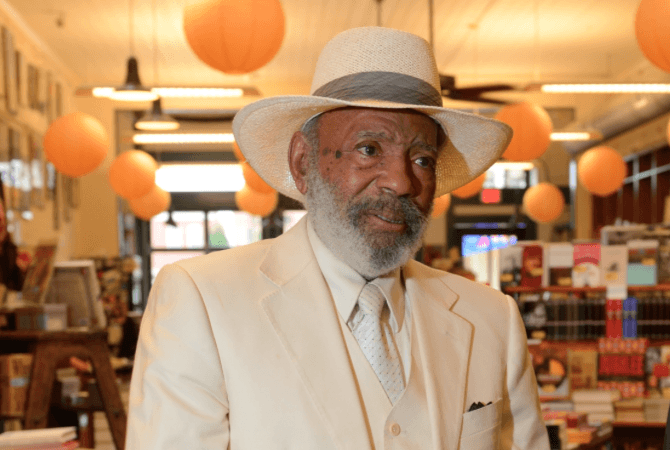
Photo: Ed Meek/ Ole Miss News. Civil Rights icon James Meredith and his immediate family have welcomed into their lives the white relatives descended from their slave-owner ancestor.
My friend Suzanne Lowe, who is white, was doing genealogical research back in the early 2000s when someone gave her a publication written by the man who broke the color barrier at the University of Mississippi. In a flash, she realized she and civil rights icon James Meredith shared the same white ancestor.
Eager to reach out but full of trepidation about what Meredith might say to her, she searched the web for his phone number and called him, explaining who she was. There was a long pause, she says, and as she waited with increasing anxiety, her heart pounded. Then she heard Meredith say, “I’ve been waiting for this call for 50 years.”
Last Sunday, I had the privilege of listening in on a Coming to the Table episode describing how my friend’s white family got to know Meredith’s black family. I can hardly describe how uplifting it was. One of Meredith’s close relatives presented the history of Mississippi slaveholder J.A.P. Campbell and his role in writing the laws of white supremacy. So it was a serious occasion. But we also savored the joy of Campbell’s black descendants at finally being seen and the joy of the white family members who were thrilled to connect.
It is true, as my friend reported when asked in the chat questions, that her outreach to other white Campbell descendants did not meet with universal acceptance. A few were nasty and unbelieving — as if the country hadn’t been through all that with the descendants of Thomas Jefferson and slave Sally Hemings. But others were fascinated and delighted. As Meredith’s son John said, his side of the family always knew they had white relatives. In fact, he said, many black families know they have white relatives. Seeing the white side of the family enjoy their new consciousness had been a big part of the pleasure he experienced.
I learned new things about the disastrous effects of laws preserving white supremacy, at the same time as I got the feeling that the two families were focused on how happy they were to be united. I got no sense that Meredith’s side wanted their new cousins to bear the brunt of national reparations. (I myself believe federal reparations are due — like those that President Ronald Reagan authorized for Americans of Japanese descent after their WW II internment in US concentration camps.)
Everyone was just enjoying having a large, interesting family and new kinds of connectedness.
Photo: Bulletin of the US Fish Commission. The massive Humboldt squid has adapted to climate change. But that’s a challenge for fishing communities who depended on it.
Climate change is forcing the creatures of the Earth to adapt or perish. This is the story of one creature that adapted but, in doing so, forced a more painful adaptation on some human creatures.
Michael Fox reports at PRI’s the World, “On a late afternoon in Kino Bay, Mexico, Gerardo Hernandez is repairing his fishing nets. He strings them out in front of his home, made from old pieces of plywood and corrugated tin.
“He lives along the Gulf of California, the body of water that separates most of Mexico from the Baja California peninsula. Hernandez, a seasoned fisherman now in his 60s, can still remember the time of the giant Humboldt squid — a massive invertebrate that used to grow up to 6-feet long. Their abundance made for a robust squid industry fueled by 2,000 fishing boats — the vast majority being small pangas like Hernandez’s.
‘There were always a ton of squid,’ Hernandez said. ‘You would go out, and you’d see them on the surface of the water. The more squid you took, the more there were.’
“The days of the giant jumbo squid are over now. About 13 years ago, after a hurricane and an abnormally warm El Niño year, the squid disappeared from the Gulf. Eventually, they returned. But by 2015, they were gone again. Scientists attribute the shift to animal adaptation amid a rapidly changing climate.
“Hernandez’s kids say they want him to retire now. But he still goes out fishing every night with other members of his small fishing cooperative, and they mostly catch Pacific Sierra fish and crab. He said he brings home enough — but not nearly as much as he did in the days of the Humboldt squid.
“ ‘They’ve left,’ Hernandez said. ‘They’ve emigrated. Only God knows where they’ve gone.’
“But scientists think they have an idea. They say they haven’t actually disappeared. Instead, the Humboldt Squid that live in the Gulf have shrunk from about 6-feet long to less than a foot, and they’re sticking to deeper depths and cooler waters offshore.
“Stanford University biologist William Gilly said the squid seem to have developed this strategy long ago to deal with fluctuating water temperatures that come with El Niño cycles. … It’s a species that seems evolved to adapt to the warming waters brought on by climate change. At least, that’s the theory.
“ ‘There’s a lot we don’t know,’ said Rufino Morales, a fisheries biologist and the coordinator of the Producto Calamar subcommittee, a Mexican group that researches and supports squid fishers. ‘We assume that the shift is due to climate change, or global warming, or because it coincides with El Niño, but these are scientific theories. We haven’t been able to prove them yet.’
“The squid seem to be adapting. The fishing communities they used to support are trying to as well.
“On a warm afternoon in La Manga, a fishing village about an hour west of the port city of Guaymas, a handful of residents gutted a stack of manta rays, whitefish and parrotfish caught that morning. …
“ ‘When the squid was abundant, this was another Guaymas,’ said Maria Collins, a member of the Francisco Flores small fishing cooperative in town. ‘We lived well.’ When the squid left, a lot of people lost their jobs. …
“Many fisherfolk now work in factories off the highway on the northern side of town. Others are doing construction, gardening or plumbing.
“Some boats began to hunt for jellyfish, which they sell to Asian markets. But the season is short. Locals up and down the coast say none of the catches are doing well. They blame the large sardine ships for overfishing and depleting stocks.
“ ‘We are fishermen in danger of extinction,’ said Hernandez as he repaired his fishing net. ‘I think everything that’s happening in the ocean is our fault. Like, we aren’t taking care of it. Or, we don’t care for it, and there’s the proof.’ ”
Photo: Early Music America. Catalina Vicens often performs on an organetto replica built in 2013 by Stefan and Annette Kepler, who run the Wolkenstayn Gothic Organ company in southern Germany.
For something a little different today, let’s look at a forgotten medieval instrument that a few enthusiasts have brought back to the world’s attention: a handheld pipe organ.
Kyle MacMillan reports at Early Music America last week, “Attend a few organ recitals in a church or concert hall and you’ll know that the instruments can vary widely in size — from behemoths with several thousand pipes to moveable, chamber models with just a handful of stops.
“Almost completely forgotten, though, is that an even smaller kind of pipe organ once existed. Called an organetto, it was typically played perpendicularly on a performer’s lap and was one of the most popular instruments in the 13th and the 14th centuries.
“A contemporary reproduction of this tiny organ will be front and center this week when the Chicago-based Newberry Consort presents Music Fit for the Medicis, featuring works that would have been heard at the powerful family’s court. Showcased will be 14th-century songs and dances taken from manuscripts found in the library of Lorenzo de’ Medici (1449-1492). …
“Featured as the Newberry’s organetto soloist will be Chilean-born Catalina Vicens, an internationally known historical keyboard performer and teacher who lives in Basel, Switzerland, and Bologna, Italy. She is artistic director of the Museo San Colombano, housed in a former monastery in Bologna, which dates to the Seventh Century. She also serves as curator of the Tagliavini Collection, the museum’s prize holding and one of the largest historical keyboard collections in Europe. …
“The organetto fell out of fashion by the 16th century. ‘They weren’t use in anymore, as far as we know, and they didn’t survive,’ Vicens told me.
What experts know today about the organetto comes from its depiction in hundreds of medieval paintings, illuminated manuscripts, and stained-glass windows, and well as the literature of the period.
“The instrument is mentioned, for example, in the Roman de la Rose, a famous medieval poem written in Old French, and the organetto playing of Francesco Landini, a famed 14th-century Italian composer and organist, is described in a novella by Giovanni da Prato.
“Today’s organettos, which are based on this historical imagery and documentation and technical knowledge drawn from larger extant medieval organs, typically have 28 pipes in two rows spanning just beyond two musical octaves.
” ‘From iconography, we see mostly instruments with fewer pipes,’ Vicens said. But balancing historically informed instrument building with modern performance needs, she points out that, ‘for us, it is very convenient to take those models with more pipes, because we want to be able to play more notes.’
“Air is produced by a bellows operated with the left hand while the right plays the instrument’s keys. … Because no original organetto exists, it is impossible to know exactly how the medieval instruments sounded. The aural qualities of today’s organettos vary depending on the builder and are affected by the pipes, which can be made of such materials as copper, wood, or a tin-lead alloy.
“ ‘It does sound like a small organ,’ Vicens said of the instrument, ‘but to the ears of many, also suggested by how it looks, it sounds more like a bagpipe. Or I’ve even gotten people who think it sounds like an accordion.’
“Vicens often performs on an organetto built in 2013 by Stefan and Annette Kepler, who run the Wolkenstayn Gothic Organ company in southern Germany, with pipes in a high-leaded alloy made by Winold van der Putten in the Netherlands. ‘I have sort of a custom instrument by different builders,’ she said. …
“While a student of harpsichord performance at the Curtis Institute of Music in Philadelphia, Vicens became fascinated with the instrument’s sound and how it was produced. That curiosity led her to study the harpsichord’s origins, including how instruments from several centuries ago were constructed and what early repertoire was written for them. Her interest in turn motivated her to learn about other historical instruments like the organ and fortepianos. Drawing on this background in historical performance and her knowledge of the organ and harpsichord, Vicens taught herself to play the organetto in 2009 and 2010 and soon got regular requests to perform on the instrument across Europe and beyond.
“The organetto poses two main hurdles for performers, starting with playing the keyboard with just one hand, which makes it difficult to convey different musical voices at the same time. The larger challenge is manipulating the instrument’s single bellows. ‘I have to breathe like a singer,’ Vicens said, ‘because with one bellow, you need to fill it every time you run out of air.’ “
Photo: IHISADC. Participants in the 2021 Indiana High School Architectural Design Competition.
It makes a difference when professionals offer their expertise to school students. In today’s story we see what happened when an architect returned to his old high school to teach in its STEM [Science, Technology, Engineering, and Math] program.
Victoria St. Martin reports at the Washington Post, “It can happen in an instant: that moment when you go from not knowing what you want to do for the rest of your life, to having absolute certainty about it. For Tarik El-Naggar, it happened in 1970, when he was in the seventh grade working on a project for English class.
“The assignment? Construct a reproduction of Shakespeare’s Globe Theatre out of everyday objects. He built a 2-foot-diameter cardboard model — and an architect was born. … Says El-Naggar, who’s now 63 and co-owner of an architecture and interior design firm, ‘I don’t know what it was about the building. It had all the seating, the stage and the open roof — it was just awesome. It was a lightbulb moment.’
“El-Naggar’s life came full circle when he added ‘high school teacher’ to his résumé nine years ago — building a STEM curriculum with members of the administration at his former school in northwest Indiana. Inside his Valparaiso High School classroom, students have their own lightbulb moments by creating projects using ping-pong balls, cardboard, computers and 3-D printers. ‘Instead of just teaching the basics of architecture, I’m actually really teaching them design theory,’ says El-Naggar, whose class is similar to what he taught at a nearby college.
“And he’s gotten results: [In 2021] his Valparaiso students swept the Indiana High School Architectural Design Competition, winning all nine awards out of 72 entries from eight schools. …
“Valparaiso, a middle-class community about 55 miles southeast of Chicago, began incorporating more STEM courses into its curriculum about six years ago. A school official said the district wanted to place more emphasis on skills such as critical thinking, communication, creativity and problem-solving, and secured several grants from the county redevelopment commission to bolster tools across K-12 classrooms. The high school roughly ranks in the top 10 percent in Indiana, and its standardized test scores in reading and math significantly outpace the rest of the state.
‘There are schools around the country that have great basketball programs. So, what do parents do? You move there because you want your son or daughter to go there,’ says El-Naggar. ‘I want people to look at what we’re doing here and say, “My kids are going to be engineers, architects. They need to be here.” ‘
“For high-schoolers who want to pursue architecture as a career, taking classes with El-Naggar is paying off: In the past three years, all five of the students who applied to university-level architectural programs have been accepted. ‘People were really impressed that I had already had this experience,’ says Henry Youngren, now a freshman at Carnegie Mellon University in Pittsburgh. … ‘It’s really guided me on how I want to live the rest of my life.’
“Brandon Farley, an architect who is the chair of the high school design competition, says he has some records that date back to the 1970s and he’s ‘never seen anything where one school won all the awards.’ It’s rare that judges see high school teachers with formal architectural training, he adds. With Valparaiso High School’s entries, he says, ‘you can see it immediately in the way the students address the problems and their solutions, and in the way that they talk about their designs. It really raised the bar on the competition.’
“Seventeen-year-old Olivia Lozano received one of the awards. ‘It kind of got the ball rolling for me,’ she says of the contest, for which she created a reading room filled with glass windows that opened to the outdoors. ‘Then it turns into a vortex and you’re down in El-Naggar’s classroom like four hours a day, and then you’re here after school, and then you’re here on the weekends and over spring break.’
“El-Naggar says the lightbulb moment for his students today really happens when they first see a 3-D view of their building. ‘The ones that go, “Oh, my gosh,” and they start “walking” through it and they’re telling other people, “Look at this.” ‘ …
“When the University of Notre Dame, near South Bend, Ind., asked him to critique student projects, he met a fellow architect and professor who would help him get his first teaching gig, at Andrews University in Michigan. Once he started, he knew he’d discovered a second passion. Several years later, he was asked to fill in and teach architecture in his hometown at the high school. He welcomed the opportunity to teach five minutes from his home.
“Now his fervor for teaching is gaining more attention, earning him a teacher of the year award from a national project-based-learning group this past fall. ‘We consider ourselves very blessed to have a teacher like him in the classroom,’ says Nick Allison, the school district’s assistant superintendent for secondary education.”
Our local paper is owned by a national chain, Gannett, that cares nothing about our town. It prints generic articles from national outlets like USA Today or towns in other parts of New England and doesn’t get around to printing the library’s schedule or candidate letters until the events are over. Once in a while, it covers a controversial meeting or interviews a school coach — exceptions that prove the rule.
So I was not surprised to learn that a group of prominent citizens, including an experienced journalist, is working to establish a nonprofit competitor here. This is not unheard of. Today’s article from NiemanLab describes one successful effort to save local journalism, only in this case, the nonprofit board built on an established newspaper.
As Sarah Scire wrote last November, “The Salt Lake Tribune has plenty to celebrate in 2021. The first (and so far only) major newspaper to become a nonprofit is financially sustainable and, after years of layoffs and cuts, is growing its newsroom. Executive editor Lauren Gustus announced the news in a note to readers in which the relief of escaping hedge fund ownership was palpable.
“ ‘We celebrate 150 years this year and we are healthy,’ Gustus wrote. ‘We are sustainable in 2021, and we have no plans to return to a previously precarious position.’
“It’s been quite the turnaround. Utah’s largest newspaper escaped the clutches of the hedge fund Alden Global Capital in 2016 only to see its local owner, Paul Huntsman, lay off a third of staff two years later in the face of plunging ad revenue. In 2019, the Tribune made history as the first daily newspaper to become a nonprofit. And then amid the height of the pandemic last year, the Tribune ended a 149-year run of printing a daily newspaper and a 68-year-old joint partnership with the Deseret News. …
Gustus pointed out that hundreds of American newspapers are owned by financial institutions with a well-deserved reputation for making every newspaper they touch worse by gutting newsrooms, selling off assets, and jacking up subscription prices for readers.
“The Salt Lake Tribune’s transition to nonprofit status has been closely watched in the news industry. Does that put additional pressure on Gustus and the rest of the Tribune team? ‘The opportunity for us to prove that this can work is significant and so is the responsibility,’ she said.
“The Tribune grew its newsroom 23% in the last year and will add new reporting roles focused on education, business, solutions journalism, food, and culture in 2022. Gustus also expects to follow the Utah News Collaborative (launched in April to make the Tribune’s reporting available to any news organization in the state) with more multi-newsroom projects centered on saving the Great Salt Lake and the centenary of the Colorado River Compact.
“Other changes include introducing six weeks of paid parental leave and a 401(k) match for employees. In response to readers who said they missed the ‘daily drumbeat‘ amid the weekend edition’s in-depth reporting, the newsroom will publish an e-edition to accompany the Sunday paper. They’re also introducing a second printed edition — delivered by mail, rather than carriers — on Wednesdays at no additional cost to subscribers.
“The Salt Lake Tribune draws revenue chiefly from subscriptions, donations, and advertising. … Subscribers pay for a digital subscription ($80/year), while ‘supporting subscribers’ ($150/year) add a donation on top. In the donations category, members of The First Amendment Society pledge to donate at least $1,000/year for three years while major donors provide one-off gifts and grants.
“The Tribune has about 6,500 supporting subscribers, more than 50 members of its First Amendment Society, and dozens of major donors. (In a bid for transparency, The Tribune forbids donations over $5,000 to be anonymous. You can see the full list here.) Gustus stressed that consistency of support is invaluable.
“ ‘We are so grateful to them [supporting subscribers] because it enables us to plan.’ …
“Gustus says that being ‘relatively lean’ — the newsroom currently stands around 33 reporters, with a handful of open positions — sometimes lends itself to some unusual experiments. The Salt Lake Tribune’s NBA beat writer, Andy Larsen, told his sizable Twitter following he wanted to get 500 new subscribers for the Tribune by the end of the year.
“Larsen had to clarify that this was his own idea and not something his bosses were making him do. … Roughly 24 hours after his first tweet, the thread had earned the Tribune82 new subscribers. In November, roughly halfway through the self-assigned challenge, Larsen said that number had grown to 294 new subscribers.
“ ‘Andy is a gift to Utah,’ Gustus said, noting that Larsen wrote a popular column that dug into Covid data in the state when professional basketball ground to a halt. ‘He has really taken his curiosity and run with it.’
“Looking ahead to 2022, Gustus was brimming with ideas for the newly-enlarged newsroom. The Tribune will continue to investigate the dark history of Indigenous boarding schools in the state, start a conversation about the long-term impacts of children being educated during the pandemic, address water resource issues, and make sure readers have the information they need to vote in November elections.
“Gustus says The Salt Lake Tribune will also be wrestling with what it means to be a nonprofit news organization, beyond its official 501(c)(3) tax status.
“ ‘2021 has been all about finding stability for the Tribune,’ Gustus said. ‘We are so happy to say we’ve arrived in that spot and we don’t want to go back to where we were.’ “
More at NiemanLab, here, and at the newspaper’s website, here.
Photo: Mi Casa. At Genesis , an intergenerational community in Washington, DC, older adults provide care and social support to individuals and families facing vulnerabilities, who in turn, promote the well-being of the elders as they age.”
Because we don’t know the future, we need to make a plan. Catch-22: we can’t make a plan because we don’t know the future.
If we will always be able to handle the usual things that grown-ups handle, we may want to stay in our homes. For couples, if only one of us needs extra care, we may want to be where two lifestyles are possible. If we want to take interesting walks, we need to be where there are interesting walks. If we can’t walk or operate a wheelchair, a walkable neighborhood may not be as important as, say, being around good conversationalists or having easy access to books.
And what about being able to interact with people of other generations?
As Matt Fuchs reported at the Washington Post in September, “Research has shown that older and younger adults need one another: Mixed-age interactions make seniors feel more purposeful, and young people benefit from their elders’ guidance and problem-solving skills. ‘They fit together like pieces of a jigsaw puzzle,’ said Marc Freedman, chief executive of encore.org, a nonprofit group dedicated to uniting the generations.
“But in practice, such closeness can be hard to come by. Many young adults flock to cities, while older people often isolate within the walls of 55-and-over communities. Parts of the country are as segregated by age as race, fewer people are having children, and people live by themselves in record numbers, including 27 percent of adults over 60. …
“One solution is establishing residential communities that are designed to nurture these bonds.
“ ‘There’s a trend toward intergenerational living,’ said Elin Zurbrigg, deputy director of Mi Casa, a D.C. nonprofit that provides mixed-age housing through its Genesis program, in collaboration with city officials. Demand may be rising because of the pandemic, which has exposed loneliness as a serious health issue and has prompted many Americans to move for fresh starts. …
“[Here are some ways] mixed-age communities benefit their residents.
“[First] they cultivate purpose. A shared purpose with neighbors is what Estelle Winicki, a 78-year-old retiree, always envisioned for herself, but finding that wasn’t easy. In Boulder, Colo., she rarely crossed paths with neighbors. … Her therapist suggested Bridge Meadows, which operates two complexes of townhouses in Oregon that bring together seniors, former foster-care children and their adoptive parents. Residents are encouraged to spend time with their age opposites.
“Winicki, who lives at Bridge Meadows in Portland, doesn’t need persuasion. She starts many of her days helping her neighbors’ children get ready for school. ‘It gives me such pleasure to see these kids grow with a strong foundation,’ she said. ‘They know they can rely on me, and I like helping.’
“[Second] they provide mental health support. ‘The first thing you see among all the generations [at Bridge Meadows] is the sense of “I belong” and “I matter,” ’ said Derenda Schubert, Bridge Meadows’ founder and a clinical psychologist. Such an environment allows mixed-age communities such as Bridge Meadows to provide safety nets that protect residents’ mental health. …
“[Third] they offer professional advantages. In other communities, the generational glue is professional. PacArts, a mixed-age building in the San Pedro area of Los Angeles, provides affordable housing to artists. Luis Sanchez, a 53-year-old painter, said he can count on his neighbors whether he’s having a rough patch with health — he’s had two kidney transplants — or his work. An older neighbor has hired him repeatedly to assist with large painting projects. ‘I’ve learned a tremendous amount,’ Sanchez said. ‘She knows techniques and materials I would’ve never used.’
“Eva Kochikyan is a musicologist and teacher residing at Ace 121, a similar building in Los Angeles County. … She grew up in Armenia, where residents socialized regardless of age, but after relocating to Los Angeles, she barely saw her neighbors. In moving to Ace 121, the 41-year-old re-created the experience of a big extended family. …
“Kochikyan recalled her 4-year-old wandering into the building’s communal art studio, sitting right next to an accomplished painter in his 70s and picking up a brush. ‘No lecturing, just working together,’ she said. ‘These connections happen naturally.’
“[Fourth] they may keep older people active. Seniors may get more movement when inspired by the vigor of youth. … Kochikyan thought of a neighbor as an ‘old grandma’ after watching her frown during a solo workout. Since then, though, the baby boomer has befriended a group of children who enjoy kicking her yoga ball with her. During these sessions, her intensity picks up and her face lights up, Kochikyan said, ‘like she drops 20 years off her age.’ ”
Read about other potential benefits and check the most recent research at the Post, here.
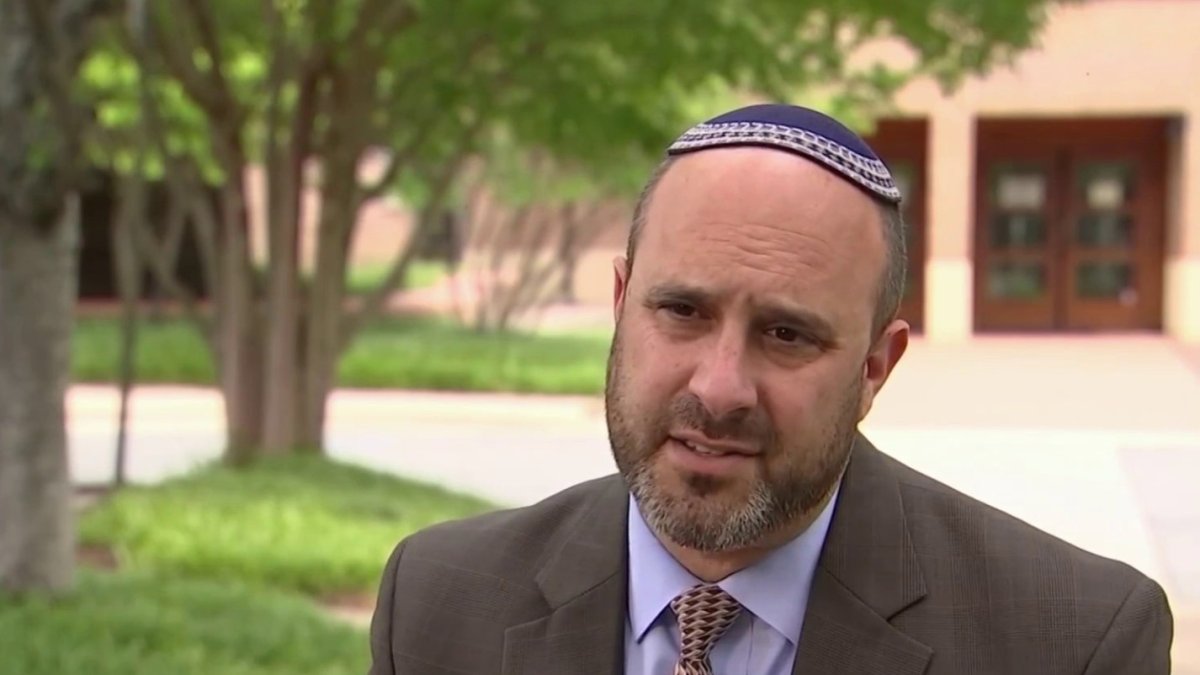
Photo: NBC4 Washington. In Potomac, Maryland, Har Shalom rabbi Adam Raskin has pulled together faith leaders help support Afghan refugees.
When leaders of differing faiths recognize they are all called to do the same kinds of good works, great things can happen. Today’s example is from Potomac, Maryland.
Sydney Page writes at the Washington Post, “Adam Raskin, a rabbi at Congregation Har Shalom in Potomac, Md., knew how difficult the situation was for Afghan refugees in the Washington region.
“Since the historic airlift out of Kabul last year, more than 3,700 Afghan evacuees have been resettled in the District [of Columbia, DC], Maryland and Virginia, overwhelming social service agencies and leaving some refugee families waiting for housing and in limbo.
“Raskin and his congregants decided to help by sponsoring a refugee family.
‘We thought it was very much in line with our values,’ Raskin said. ‘For Jews, many of whom were refugees from places of persecution, there is a special sensitivity for this issue.’
“As members of the congregation began researching the resettlement process, they quickly learned how complicated it can be, and how many resources are required.
“ ‘We could do this on our own,’ Raskin recalled thinking to himself, ‘but wouldn’t it be amazing to collaborate with a Christian and Muslim congregation? … This is a country where religions don’t have to be at odds with each other, but actually where religious communities collaborate and find common ground,’ Raskin said.
“He contacted St. Francis Episcopal Church and the Islamic Community Center of Potomac to gauge their interest in an interfaith initiative, and both congregations were enthusiastically on board.
“ ‘We definitely wanted to get involved,’ said Sultan Chowdhury, who was one of the founding members of the Islamic center, and currently serves as its trustee. ‘God gave us an opportunity to truly learn about each other. It is wonderful to see how close we are.’
“Kathy Herrmann, the parish life coordinator at St. Francis, agreed.
“ ‘I have felt such a kinship with them and such a warmth and love emanating from the other two,’ she said. ‘We all have the same goal to help this family become acclimated and feel the love that we have for them.’ …
“The congregations have recruited volunteers to collaborate, including Stew Remer, who has been a member of Congregation Har Shalom since 1982 and has spearheaded the effort.
“ ‘We created an informal partnership where we are working together to provide support for the family,’ Remer said. ‘It’s amazing that we’re doing this with other organizations.’
“He started by contacting various resettlement agencies to learn more about how to sponsor an Afghan family. He got in touch with the Immigration and Refugee Outreach Center, which connected him with the [Wahdat family — a 36-year-old father, a 30-year-old mother and their 19-month-old daughter].
“For the past month, the congregations have divvied up responsibilities to support the newcomers. The church has taken on a health-care advocacy role, identifying doctors and dentists willing to provide pro bono services for the family. The mosque, meanwhile, has been helping with translation services and assisting with cultural needs, such as providing traditional Afghan clothing. The synagogue has been organizing transportation, legal and financial support, as well as helping the family to apply for food stamps and Medicaid. …
“ ‘We have enjoyed the privilege of being together, trying to understand each other better and propagate peace,’ Chowdhury said. ‘It’s eye opening for all of us, and it’s a blessing.’
“ ‘This isn’t a short-term project. We are in it for the long haul,’ said Herrmann.”
Check out the Post, here. It has details on the State Department’s sponsor program, which guides those who want to help resettle the Afghan families. Americans owe them.
Photo: Casa Dei Pesci. A sculpture named ‘Acqua’ by Giorgio Butini is one of 39 underwater sculptures helping to deter illegal fishing off the coast of an Italian port.
Here’s a creative idea to thwart illegal activity: attract enough sightseers to make it too public to pursue. Today’s story shows how environmentalists, artists, and a fishing community in Italy are collaborating on shared goals.
Veronique Mistiaen writes at National Geographic, ” ‘The stone is asking me to give it the right face: it is thoughtful, quiet,’ says British stone sculptor Emily Young. She carves boldly, clad in a thick jacket, leather hat, sturdy boots, face mask and ear plugs, but no gloves because ‘you need to feel what’s happening with the stone through the tool.’ …
“Young, who has been called ‘Britain’s greatest living stone sculptor,’ has work exhibited and collected around the world, but it is the first time that one of her creations reposes at the bottom of the sea.
“Young’s 18-tonne Weeping Guardian and two other colossal faces (The Gentle Guardian and the Young Guardian), which she carved in Carrara marble with the help of two associates over five days, were lowered down on the sea bed off the coast of Tuscany at Talamone, a town between Florence and Rome, in 2015. There, her massive stone guardians are protecting marine life against gangs trawling illegally at night. …
“Young’s unusual work is part of an on-going project by local fisherman Paolo Fanciulli and his non-profit Casa dei Pesci to try to protect the sea in a creative way. There are now 39 underwater sculptures and marble blocks at Talamone, placed in 2015 and 2020, and another 12 are ready to join them as soon as necessary funds can be raised.
“Bottom trawlers drag their heavy-weighted nets multiple times over the sea floor, scraping it bare and destroying the Posidonia (Posidonia oceanica), known as Neptune grass, a flowering seagrass endemic to the Mediterranean, which forms large underwater meadows and acts as a nursery and sanctuary for all marine life.
“For these reasons, the Posidonia is a protected species included in the EU’s Habitats Directive and the Marine Strategy Framework Directive, and bottom trawling is illegal within three nautical miles from the coast in Italy. But because it is very profitable, and impossible to police the 8000km of Italian coastline, boats carry on at night regardless.
“Now in his 60s, Fanciulli has been fishing around Talamone since he was a teenager. In the 1980s, he started noticing the devastation caused by bottom trawlers and the impact it had on his and other local fishermen’s catch and livelihood. He has been trying to fight them ever since.
“He needed to find another way. ‘He thought: “This is Italy. We do art. If we could put art and conservation together, we might have more impact,” ‘ explains Ippolito Turco, a friend of Fanciulli and president of the non-profit Casa dei Pesci, which they created together for that purpose with the support of several cultural and environmental associations.
“They asked nearby Carrara quarries if they could donate a few stones. Franco Barattini, the president of one of Carrara’s best-known quarries – Michelangelo cave, the very place where the eponymous artist came at the turn of the 16th century to select stones for his iconic David and Pietà statues – promised to donate not a few, but 100 huge blocks of marble.
“Young, along with Italian artists Giorgio Butini and Massimo Lippi, and other artists from four countries, was asked to carve the marble blocks. ‘We all donated our time. I thought it was a brilliant project: it would attract more attention to the problem,’ says Young. …
“The sculptures were placed in a circle, four metres apart around a central obelisk, carved by Massimo Catalani, another Italian artist. A bit further sleeps a mermaid, a collaboration by sculptor Lea Monetti and young artist Aurora Vantaggiato, and a reclining figure by Butini, among other works.
“The marble sculptures create both a physical barrier for the trawlers’ nets and a unique underwater museum, open to anyone either through arranged scuba diving tours or their own dive. “It’s really beautiful and it’s amazing to see how easy it is for nature to recover. …
“The scheme has completely stopped illegal trawling within three miles off shore in front of Talamone as far south as the mouth of the Ombrone river, Turco says. ‘But now the pirate boats have moved north of the Ombrone. Casa dei Pesci plans to protect this stretch of sea as well.’ “
More at the Geographic, here. Needless to say, the photos are wonderful. No firewall.
Back in the days before Covid, my friend Nancy bravely participated in a political discussion group organized by the town’s Council on Aging. The idea was to bring together people on different sides of the divide to listen respectfully and express their views calmly. She found it fascinating, but the respectful and calm aspect ultimately disintegrated and the group is no more. The lesson, I think, is that it can be hard work to do this and everyone needs to remember that an opponent is still a human being.
Chelsea Sheasley has a story at the Christian Science Monitor about two educators who managed the challenge well enough to publish a book on it.
“Rancor over COVID-19 policies, diversity and equity initiatives, and school choice,” she writes, “has divided communities and supercharged school board meetings. Is there any way to find common ground about education amid such divisions? Some people say yes.
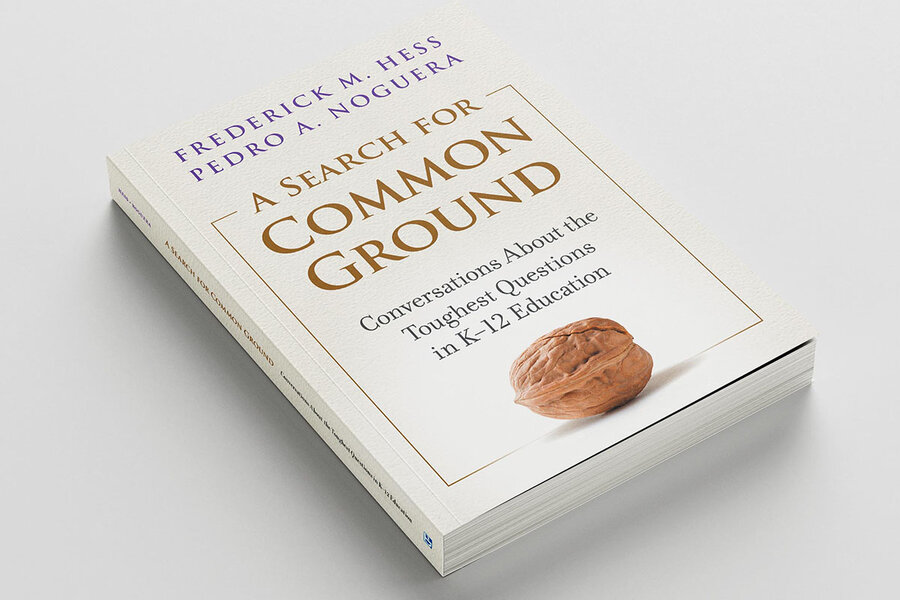
“Frederick Hess and Pedro Noguera, two education policy leaders, published a book [in 2021] – A Search for Common Ground: Conversations About the Toughest Questions in K-12 Education – made up of in-depth emails they shared over seven months to better understand each other’s beliefs and unearth hidden agreement. They currently host a podcast, Common Ground, with recent episodes tackling the role of parents in education and anti-racist education.
“The authors describe themselves in the book’s preface as having ‘spent much of the past few decades on opposing sides of important educational debates, with Pedro generally on the Left and Rick mostly on the Right.’ Dr. Hess is director of education policy studies at the American Enterprise Institute, a conservative Washington think tank, and Dr. Noguera is dean of the Rossier School of Education at the University of Southern California in Los Angeles.
The goal of their exchange, the two write in the book, is to offer a model for those who ‘desire to disagree with grace and explore differences without rancor.’ …
“Fred Campos, from Bedford, Texas, is an elected school board member of the Hurst-Euless-Bedford Independent School District. He was assigned to read the book for a leadership training program he’s participating in with the Texas Association of School Boards (TASB).
“Mr. Campos listened to the audio version of the book twice and says he ‘loves the premise that we should not go to the extremes.’ As a second-term board member, he’s adjusting to a ‘new era’ of more polarization and increased attendance after a fairly quiet first term. The book helped him better understand why some in his community wanted a mask-optional policy – which differed from his position in favor of mask mandates.
“ ‘One thing I think both authors did well is they were complimentary of one another, respectful, and that modeling is huge, whether you’re dealing with parents, other board members, or staff,’ Mr. Campos says. …
“One November night in 2019, Dr. Hess says he was sitting in his office, staring into space, and pondering how to actually model a different style of conversation. He started thinking about who was someone who disagreed with him on major issues and might be willing to engage in a civil dialogue.
“ ‘Education is supposed to be about teaching kids how to wrestle with things, how to look past our differences, and it felt like rather than leaning on this, we’ve been as bad as anyone,’ he says in a phone interview. ‘So I finally said, “I’m a big fan of ‘light a candle rather than curse darkness,’ ” … so I picked up the phone and called Pedro, and he was great about it.’
” ‘I immediately said yes because I appreciated the need for dialogue on these issues, and like him, I was frustrated by the tenor of the debate and the kind of paralysis that I would say characterize the field,’ says Dr. Noguera.
“The two wrote emails to each other from January through July 2020, on 11 hot-button education topics such as school choice, the achievement gap, testing and accountability, diversity and equity, and teacher pay. They also addressed major events that hit while they were writing, such as COVID-19, the shuttering of schools, and the murder of George Floyd.
“Both men say they were provoked at various times by each other’s viewpoints. Because they were communicating in writing, they had time to reflect before responding and gather evidence to back their points. The two found areas of common ground on nearly every topic, especially on teacher pay and testing, after airing their differences.
“In a joint Zoom interview with the Monitor, the pair easily banter with each other, but say it took time to develop rapport. They’re often asked for advice on how to start difficult conversations. Dr. Hess says he thinks anyone can do it, but it takes certain skills.
‘It takes an interest in listening to one another. It takes the habit of pausing on your first “that’s wrong” in order to listen, hear them, and ask a question instead of pushing back,’ he says. …
“Kay Douglas is a former school board member, a senior consultant at TASB, and the instructor who assigned Common Ground to the leadership cohort that Mr. Campos is a part of. She says the book offers a valuable example of intentionally trying to understand and work with others.
“ ‘Otherwise, we are going to self-destruct. People are so stressed and the stress level keeps going up,’ she says.
“For Dr. Noguera, learning how to debate respectfully was something he learned around his kitchen table. When he was growing up, his dad, an immigrant from Trinidad, was a police officer in New York City. He would sometimes bring home friends with conservative views on crime.
“ ‘I was a kid and I’d listen to these conversations and get angry, but because they were adults and I was a kid and I wanted to engage, I had to figure out how to do that respectfully because my parents insisted on respect,’ he says.
“As a professor, Dr. Noguera has invited people who disagree with him on policy to debate him in his classes, because he thinks it makes his ideas stronger and shows that people can disagree ‘without attacking an individual’s personhood.’ Conjuring up the worst intentions about other people, he says, is unproductive and unhealthy for democracy.”
More at the Monitor, here. Although it is not mentioned here, perhaps because the book is based on emails, I’m thinking that tone of voice matters a lot, too.
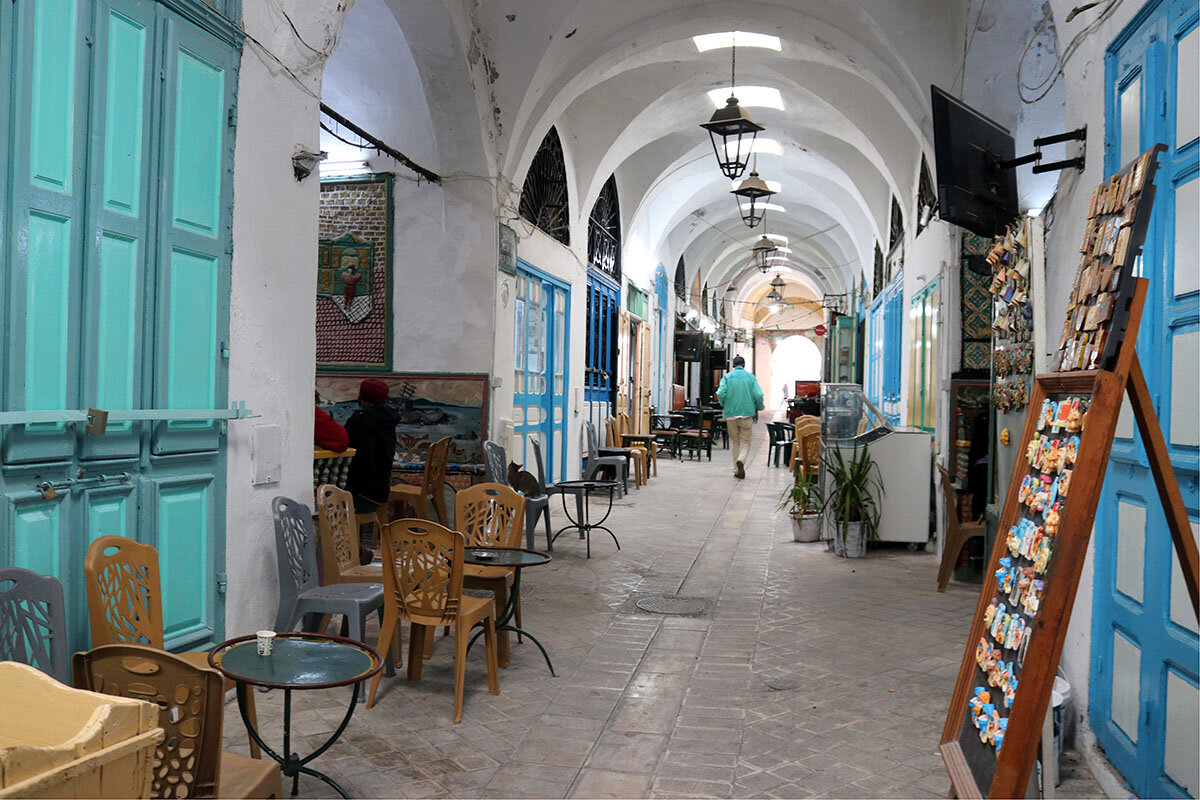
Photo: Taylor Luck. The near-empty Souk Chaouachine, or traditional chachiya hat market, one of many historic souks facing closure from a pandemic-induced recession in the Medina in Tunisia.
The list of pandemic effects just keeps growing. Today’s story addresses what happened after Covid kept tourists from the colorful small shops in Tunis. Just like workers in the US that have decided they need to join unions, Tunisian businesses are realizing there’s strength in numbers.
Taylor Luck reports at the Christian Science Monitor, “It takes one glance to tell all is not well in the Medina. The walled, historic old city of the Tunisian capital – once marked by bustling markets and streams of people hustling between the shops, homes, and government offices along its narrow streets and hidden passageways – is nearly empty. …
‘We are waiting for nothing,’ a chachiya hatmaker says as he shuffles boxed hats from one wall of his shop to the other. ‘We just show up for a few hours out of habit. No one is coming.’
“The Medina’s shuttered shops serve as a stern warning that the pandemic and a recession are threatening to undo the old city’s rich tapestry of families and artisans who have made it their home for centuries. But not, it appears, without a fight.
“Banding together for the first time, Medina business owners and families are trying to reintroduce the UNESCO World Heritage Site to Tunisians and the world, sharing its secrets and inviting people to take part in its history – and save its identity in the process.
“M’dinti, or ‘My Medina,’ the brainchild of Leila Ben Gacem, a social entrepreneur and advocate for Tunisia’s artisans, is an initiative that has united two dozen boutique hoteliers, artisans, and restaurant owners into an economic lobby to advocate for the old city and search for new ways of resilience.
“ ‘By ourselves, we cannot survive the pandemic’s effects,’ says Ms. Ben Gacem, who is also a Medina hotelier. ‘But together we can make changes to improve the Medina.’ …
“For seven centuries, hatmakers, cobblers, silver and goldsmiths, and tailors have occupied craft-specific streets – separate ecosystems within the maze-like Medina. But with no business, unable to afford monthly rent … many of these artisans are now packing it up. … In their place are popping up cafes, cigarette stands, betting outlets, and fast-food joints – their chrome and blue plastic storefronts incongruous with the World Heritage Site’s cobblestone streets and wrought-iron windows. …
“Silversmith Mohammed Sidomou, whose family’s shop has stood on the narrow street of the birket al-fidhah (pool of silver) market for a century, [describes] the pandemic as the ‘greatest challenge’ the Medina has seen in his four decades in business.
“ ‘We have been hit by a revolution, terrorism, instability, but there was always some economic activity to keep us going. With the pandemic, everyone is affected. … It breaks my heart to see the Medina turned into shuttered storefronts. It’s as if the Medina is losing its soul.’
“Compounding troubles are the pandemic-induced jump in international shipping costs, inflation, and the devaluation of the Tunisian dinar, making it logistically difficult or financially prohibitive for artisans to get the raw materials they crafted, pounded, and molded into Tunisian heritage crafts for centuries. …
“The economic downturn is also fraying a unique community of 20,000 people who live in the Medina, including working- and middle-class families and transplants from rural villages.
“Before, residents say, families, shop owners, and artisans supported one another during lean months and years. … Neighbors would loan a few dinars, share groceries, and cook for each other’s weddings. Shop owners and artisans whose businesses were flush would divert customers to other craftsmen they knew were facing a rough patch. …
“Says Mohamed Ali Dweiri, a 26-year-old Medina resident and hotel worker, ‘People have become more selfish; no one is helping each other. This is the biggest change to the Medina I have seen in my lifetime, and it’s sad.’
“Enter M’dinti.
“With no foreign tourism, the joint initiative’s first priority was finding ways to attract Tunisians to the Medina. …
“Since October 2021, M’dinti has hosted weekend activities for families, inviting Tunisians into the district’s historic homes and businesses for culinary classes and workshops with artisans – such as carpenters or cobblers – offering a glimpse into the centuries of knowledge of the maalam, or craft master. …
“ ‘Each activity is bringing 100 guests to the Medina. They are learning there are days’ worth of sights to see, they are appreciating the traditional crafts we fight to keep alive,’ says Mr. Ghorghor, the perfumer. ‘Word-of-mouth is our best hope.’ ”
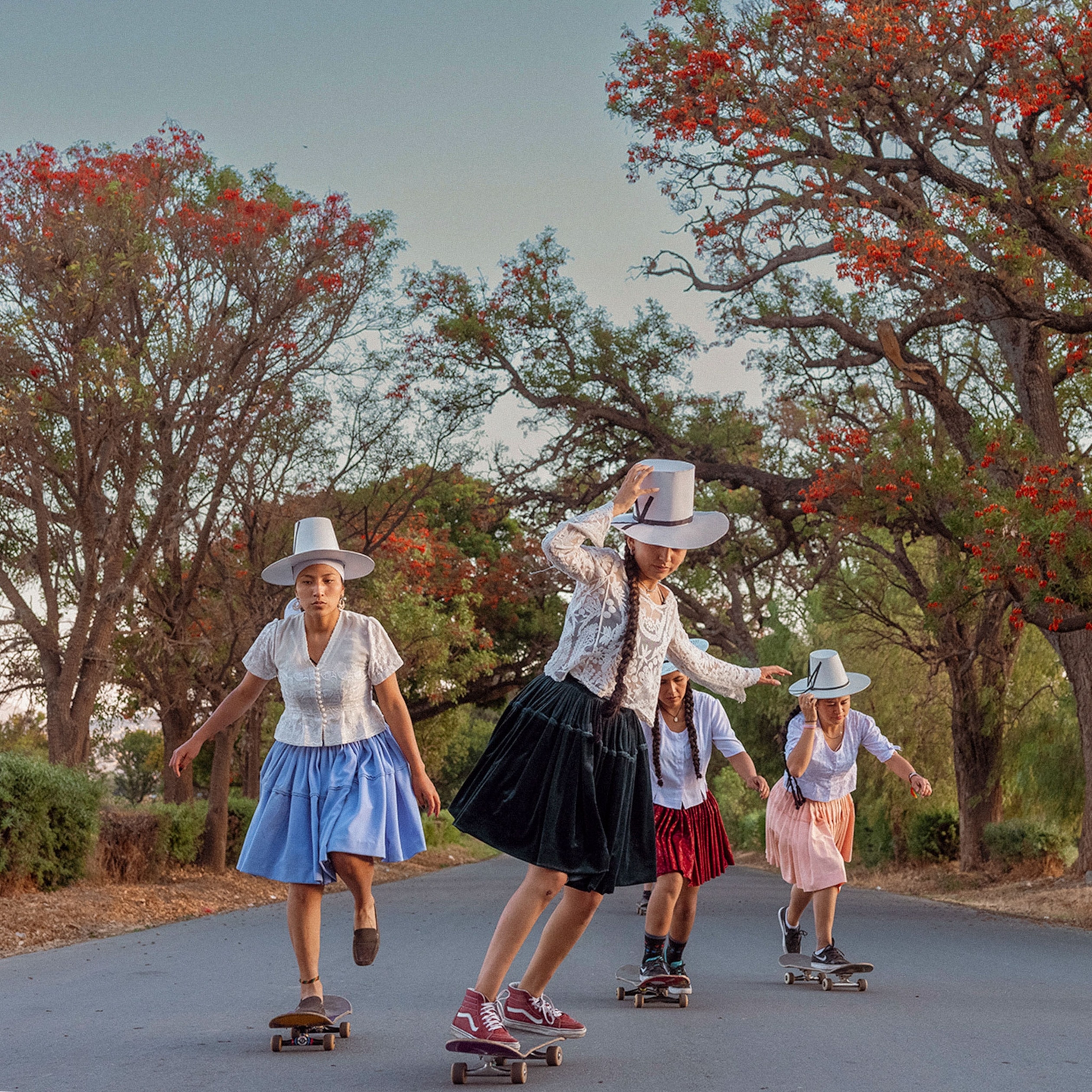
Photo: Luisa Dörr. ImillaSkate athletes practice skateboarding on a downhill road near Cochabamba, Bolivia. They use indigenous attire as a statement against discrimination.
We loved the movie Skate Kitchen about female skateboarders in New York. You may have seen my post about it here. Learning how outsiders find their people, their tribe, was a revelation.
My Cousin Claire knows I love stories like that. I think my whole extended family does. Maybe it’s in our DNA. Claire sent me today’s story about female skateboarders in Bolivia and the reasons they are using their sport to stick up for indigenous people.
Paula Ramón writes at National Geographic, “The colorful polleras are a symbol of identity in the Bolivian countryside. But these voluminous, traditional skirts worn by Indigenous Aymara and Quechua women have also been the object of discrimination, some seeing the appearance at odds with modern identity. Now a group of women athletes has brought them back to the city — donning them during skateboarding competitions — to celebrate the cultural heritage of the cholitas.
” ‘The pollerasare very valuable to me,’ says Deysi Tacuri López, 27, a member of ImillaSkate, founded in 2018 in Cochabamba, Bolivia’s third largest city. ‘I wear them with pride.’
“Tacuri sees in the polleras not only a cultural expression but also a form of empowerment. … More than half of Bolivia’s population is of Indigenous descent.
“Tacuri and fellow members at ImillaSkate also among those with Indigenous ancestors. Some of their relatives still wear polleras.
“ ‘They are my mother’s and my aunts’ clothing, and I see them as strong women. Here in Bolivia, many women in pollerasare the head of their families,’ she said in a telephone interview. ‘For me, mujeres de polleras [pollera wearers] can do anything.’
“Tacuri and her teammates spend long hours practicing moves at Ollantay Park, one of two places in the city with ramps and other structures designed for the sport. …
“ImillaSkate was founded by Daniela Santiváñez, 26, and two friends. She learned to skate as a child thanks to her brother, though it was ‘rare to see girls on skateboards.’ …
“Without women role models to follow in the sport in Cochabamba — and growing tired of listening to her mom’s complaints about her bruises from falls — Santiváñez stopped practicing when she was a teenager. She took up skateboarding again after college, where she got a degree in graphic design. By then, Dani, as her friends call her, discovered she was not the only woman with a passion for the sport.
” ‘One day I was having a conversation with the girls about why all the boys get together to skate — why don’t girls do that?’ recalls Santiváñez. …
“Over the past three years, ImillaSkate has grown to nine skaters. Being an active member means making time to practice every week in order to be able to participate in competitions, and also sharing the same principles of acceptance of diverse groups and traditions. Although the collective is based in Cochabamba, the group has generated a wider audience on social media beyond Bolivia, with more than 5,000 followers on Instagram. They also maintain a Facebook page with more than 7,000 followers, and a YouTube channel where some of their videos get thousands of views.
“Santiváñez clarifies that they wear the skirts only for performances, not necessarily as their street clothing. ‘We do it as a demonstration, as a cry for inclusion,’ she says. … ‘Skateboarding is inclusive, it brings all kinds of people together. …
‘It’s a community, and we’ve taken advantage of this to make the world a kinder place.’
“Tacuri says they first challenged themselves to embrace their own roots. ‘We ourselves have decided to get to know our culture and our identity. We have decided to revalue our clothing and encourage new generations.’ …
“The polleras’ origins date back to the Spanish conquest in the 16th century. Orginally imposed by colonial rulers as a way to easily identify the native population and also have the attire conform to what was being worn in Spain by the poorer people, the skirts eventually were adapted as part of traditional Andean attire, most commonly associated with cholas — Indigenous women from the highlands. Just as their ancestors gave the skirts their own identity by mixing them with patterned blouses, local jewelry, and hats, the skateboarding imillas are making their own modifications to the garment — and trying to remove a stigma.
” ‘The pollera is associated with the countryside, with ignorant people without resources. We want people to understand that there is nothing wrong with wearing a pollera.’ …
“The group didn’t even know where to get the elaborate skirts, so they turned to their grandmothers for help.
“Not all of them jumped on board immediately, concerned they would be stigmatized. Even as the descendant of a mujer de pollera, Luisa Zurita struggled with getting her family to understand the premise behind the wardrobe. Only after she was invited to participate in a local television program for a skateboarding performance did her grandmother give Zurita her blessing — and her favorite pollera.”
More at National Geographic, here. As you would expect of National Geographic, the photos are terrific.
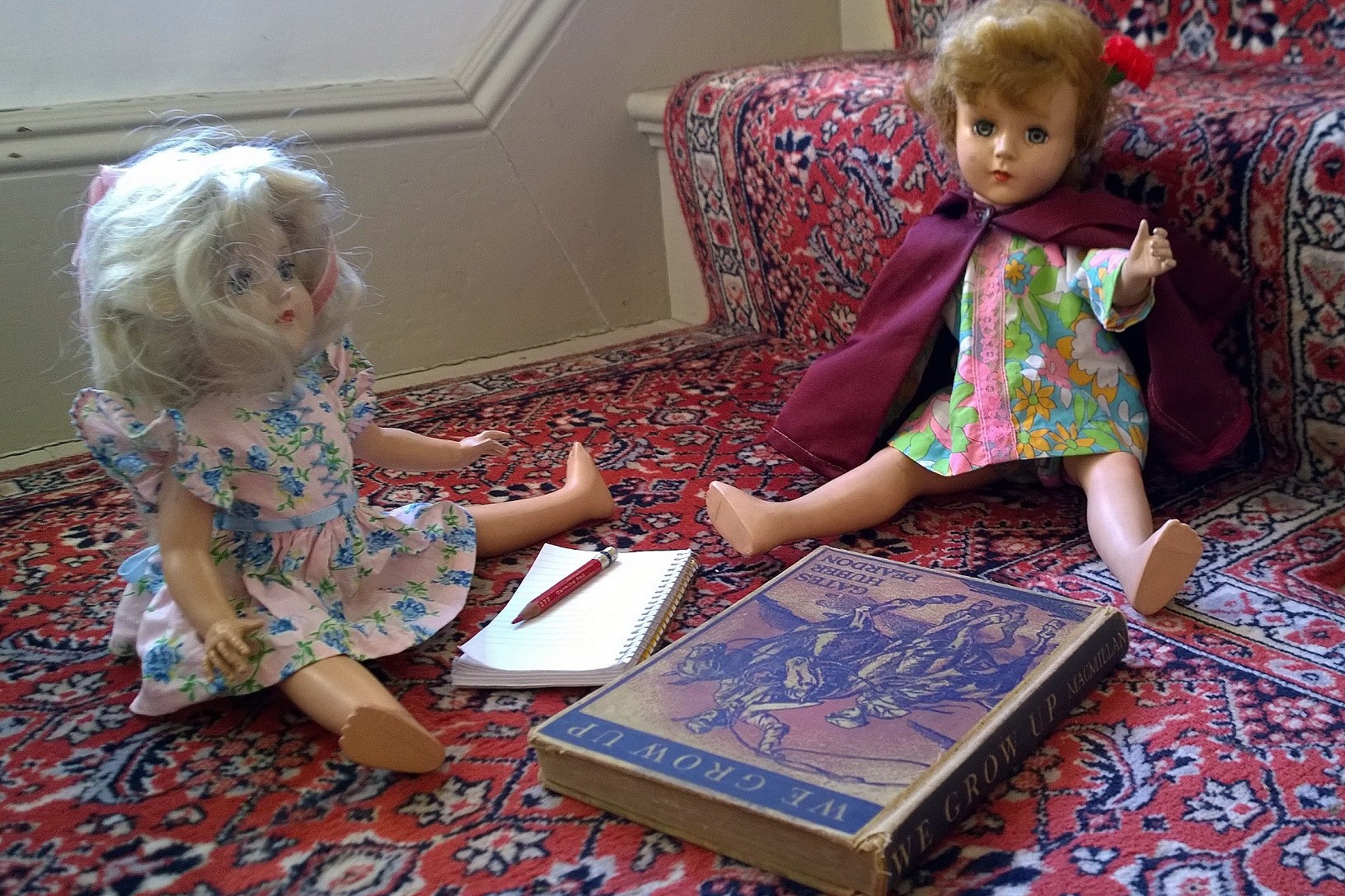
Dolls were an important part of my childhood, figuring prominently in what I called My Little House, a neglected corner of our third floor, and later in My Little School. So I was interested in recent research my husband saw about a role dolls can play in any child’s life.
Hannah Devlin reported at the Guardian, “Playing with dolls encourages children to talk more about others’ thoughts and emotions, a study has found.
“The research suggests that playing imaginary games with dolls could help children develop social skills … and empathy. The neuroscientist who led the work said that the educational value of playing with Lego and construction toys was widely accepted, but the benefits of playing with dolls sometimes appeared to have been overlooked.
“ ‘When children create imaginary worlds and role play with dolls, they communicate at first out loud and then internalise the message about others’ thoughts, emotions and feelings,’ said Dr Sarah Gerson, a neuroscientist at Cardiff University and the lead author.
‘This can have positive long-lasting effects on children, such as driving higher rates of social and emotional processing and building social skills like empathy that can become internalised to build and form lifelong habits.’
“The study, funded by the manufacturers of Barbie and published in the journal Developmental Science, involved 33 boys and girls, aged between four and eight who were given a collection of Barbie dolls and accessories such as an ambulance or horse to play with.
“They were left to play spontaneously, but their speech was monitored and they were also fitted with a specialized cap containing a form of brain imaging technology called functional near-infrared spectroscopy (fNIRS). The technique measures changes in blood oxygenation by shining light through the skull, which makes it possible to track brain activity while the subject is freely moving around.
“The study found that the children talked more about others’ thoughts and emotions, a concept known as internal state language, when playing with the dolls, compared with playing creative games on a computer tablet, such as a hairdressing game or a city-building game with characters.
“They were also more likely to address the dolls in the second person, talking to them directly, whereas the characters on the computer screen they tended to refer to in the third person. No difference was observed between boys and girls. …
“Benjamin Mardell, who researches the pedagogy of play at Harvard Graduate School of Education and who was not involved in the work, said: ‘The hypothesis that playing with dolls provides a scaffolding for young children to take the perspective of another, even if that other is inanimate, seems very reasonable.’ …
“Mardell added that the findings ought to apply to any kind of role-play toy, rather than being specific to Barbies. ‘I’d take a broader view of what a doll is,’ he said. ‘[It could be] any object that the child can invest a sense of other into – a stuffed animal, an oven mitt that talks to them, or even an imaginary friend.’
“Children typically start to show signs of internal state language around the age of four. At this age, they begin to voice their thoughts aloud, indicating that they are considering the thoughts, feelings and desires of themselves and others.
“ ‘These skills are really important for interacting with other people, learning from other people, and navigating a variety of social situations,’ Gerson said. ‘It becomes important for making and sustaining friendships, and how they learn from their teachers, and parents.’ ” More at the Guardian, here.
I’ll just add that dolls or “role-play toys” can be important to a child for other reasons, too. When I was a teacher, a mother told me about my student’s hostility to the family’s new baby. The girl was acting out (calling for help) when she kept throwing a baby doll off the dollhouse roof. I myself probably cherished dolls as substitutes for the baby that left our home when I was four. Long story. The point is that dolls become real little people to a child, and the thoughts and feelings experienced with the little people are important.
You might also like this NPR story on the importance of free play in preschool, here.
A girl photographs a bridge over the foggy Seekonk River.
What’s been hard about the most recent iteration of the pandemic is the feeling of going backwards. For a while, there was a sense of forward movement even though we were still taking some precautions. But with Omicron so transmissible, many of us chose isolation again.
It hit me right before Christmas when a friend stopped by. We both had had three vaccine shots and were used to being together without masks, but because I knew that some of her coworkers were not wearing masks, I decided we had better go back to masking when together. Sure enough, not long after that she caught Covid from a coworker. (Doing OK, thanks to the shots.)
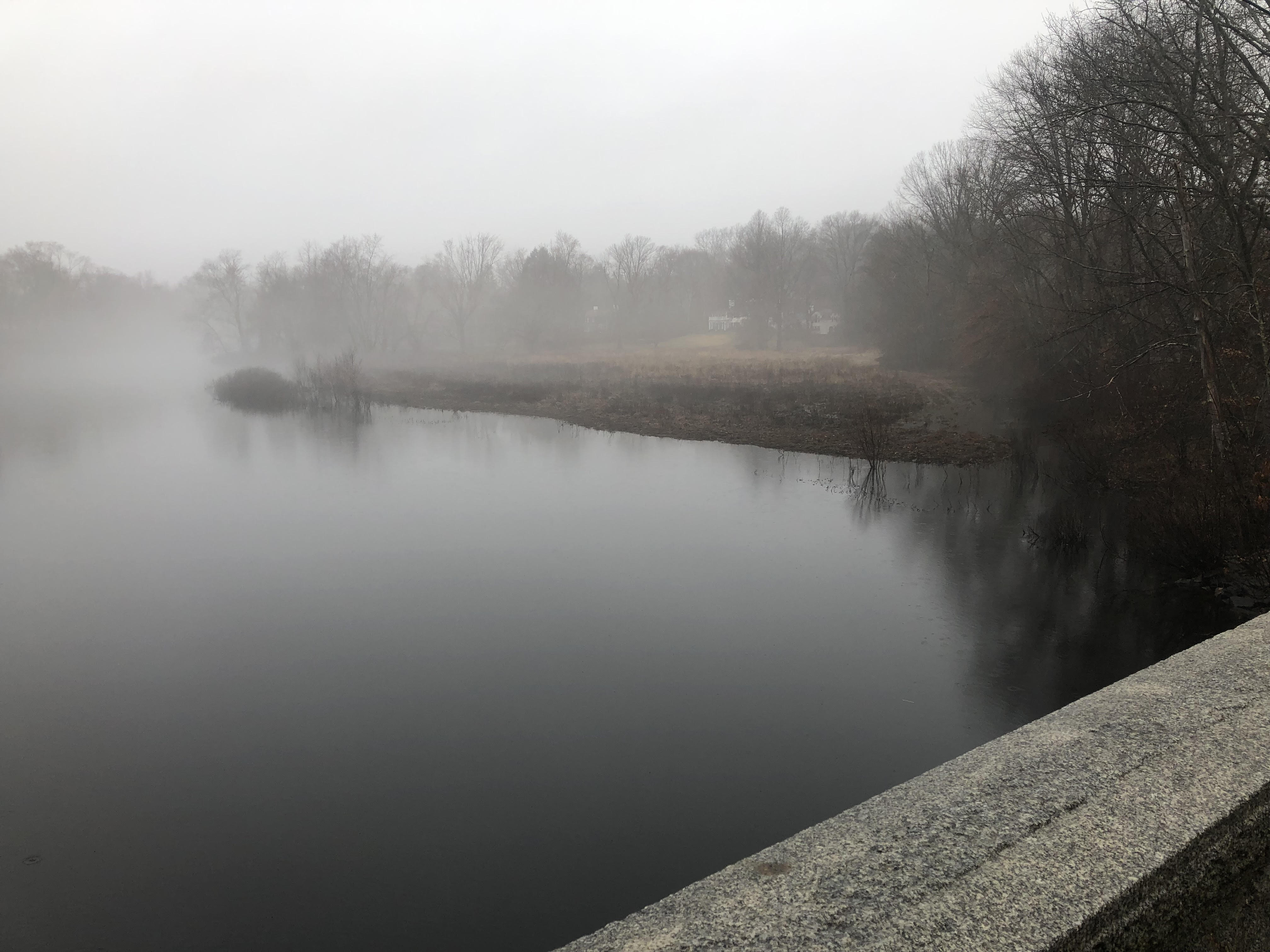
Most of my photos reflect the grayness of this period. The view below of the Sudbury River was taken on New Year’s Day: outlook foggy.
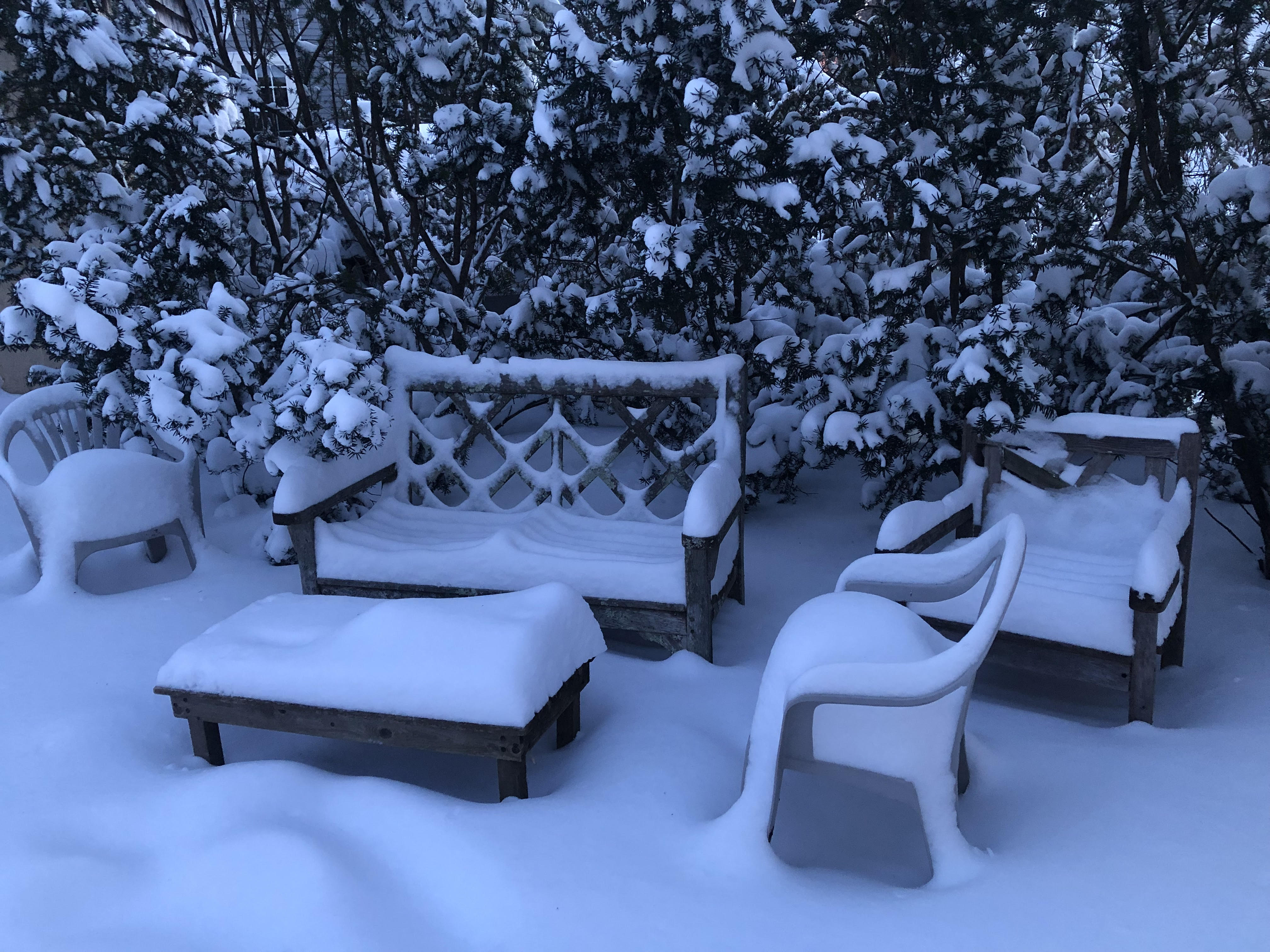
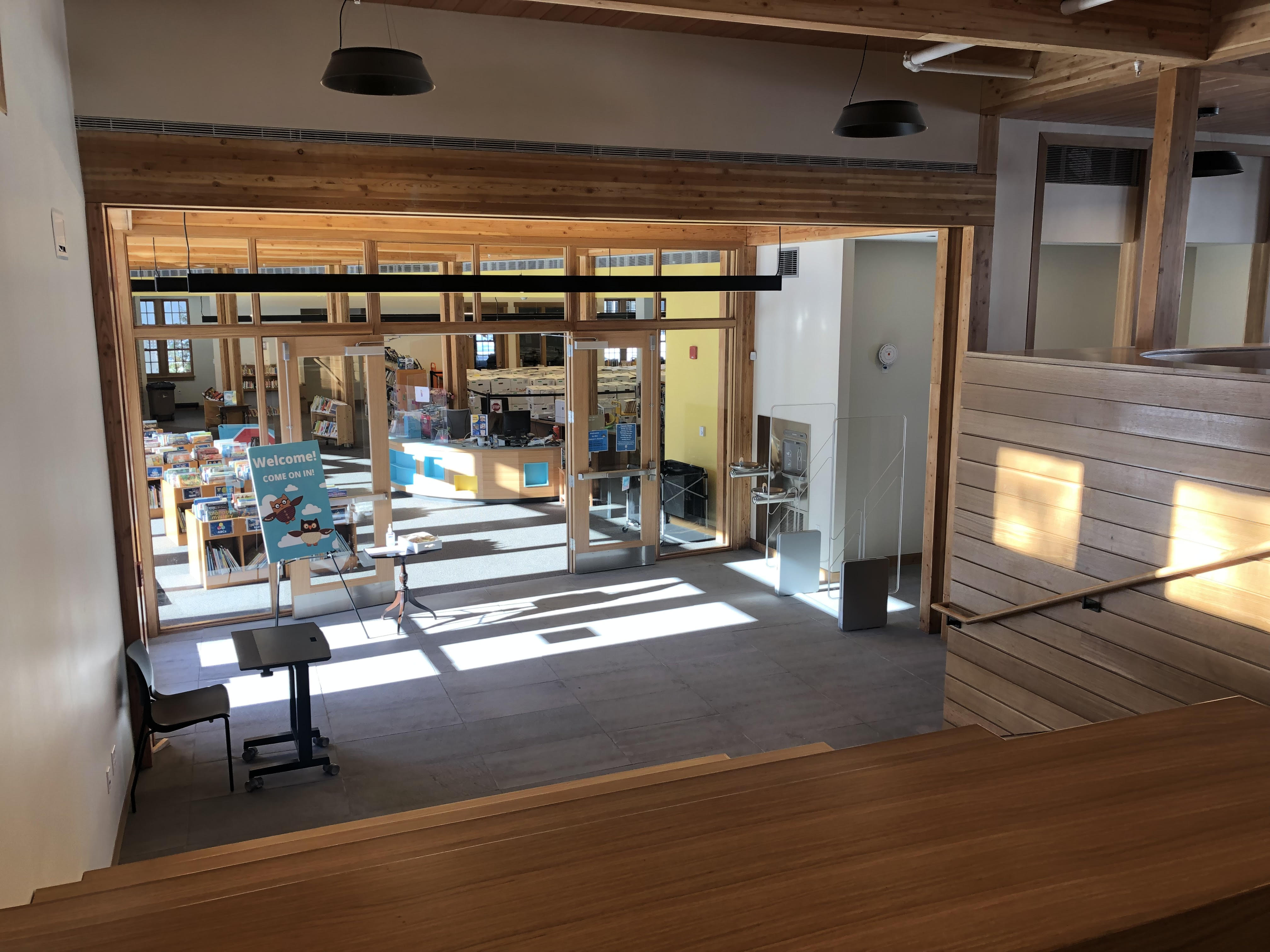
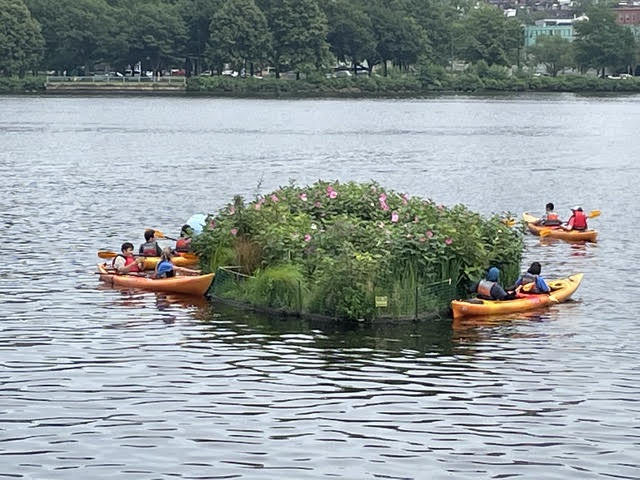
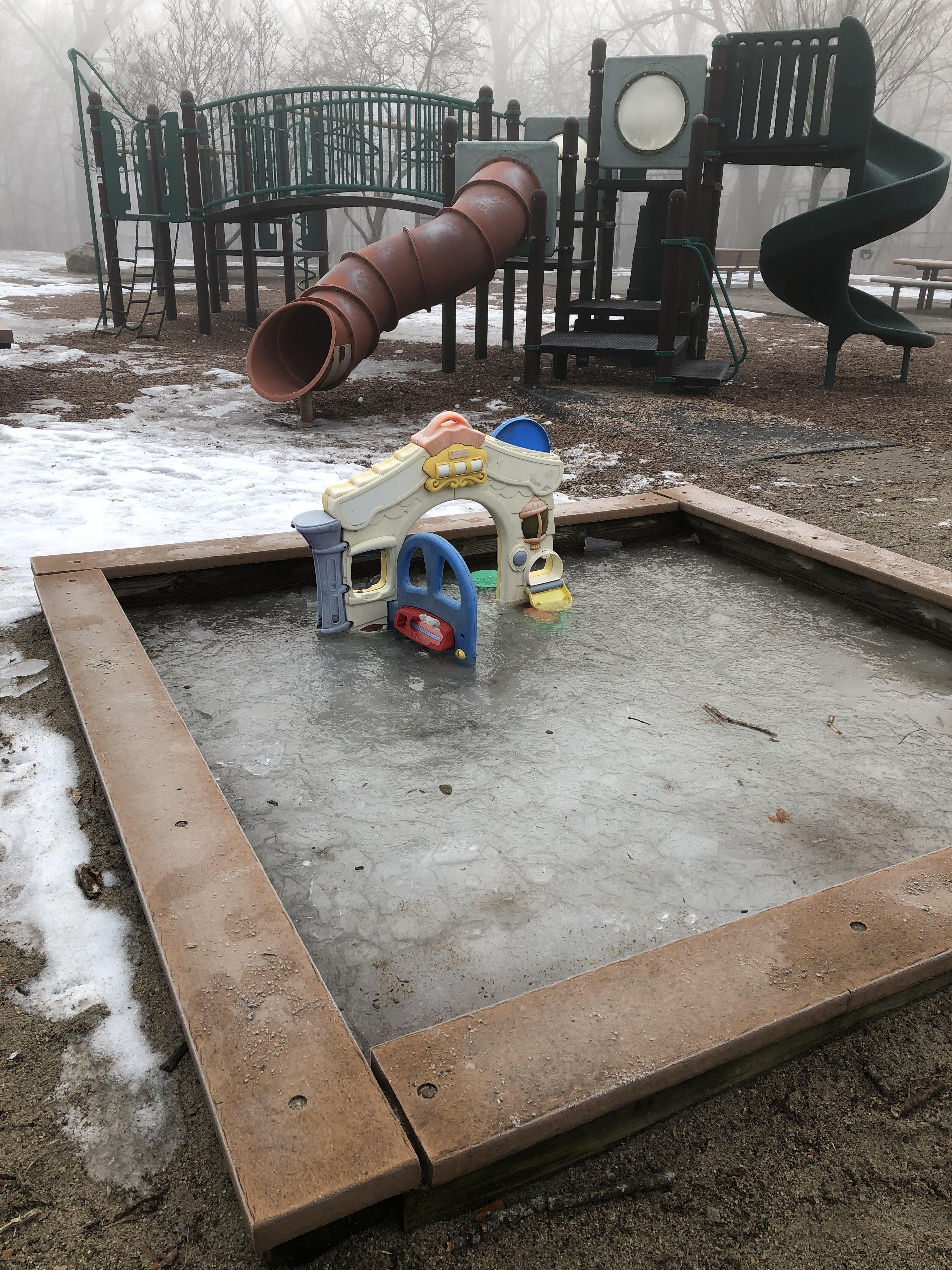
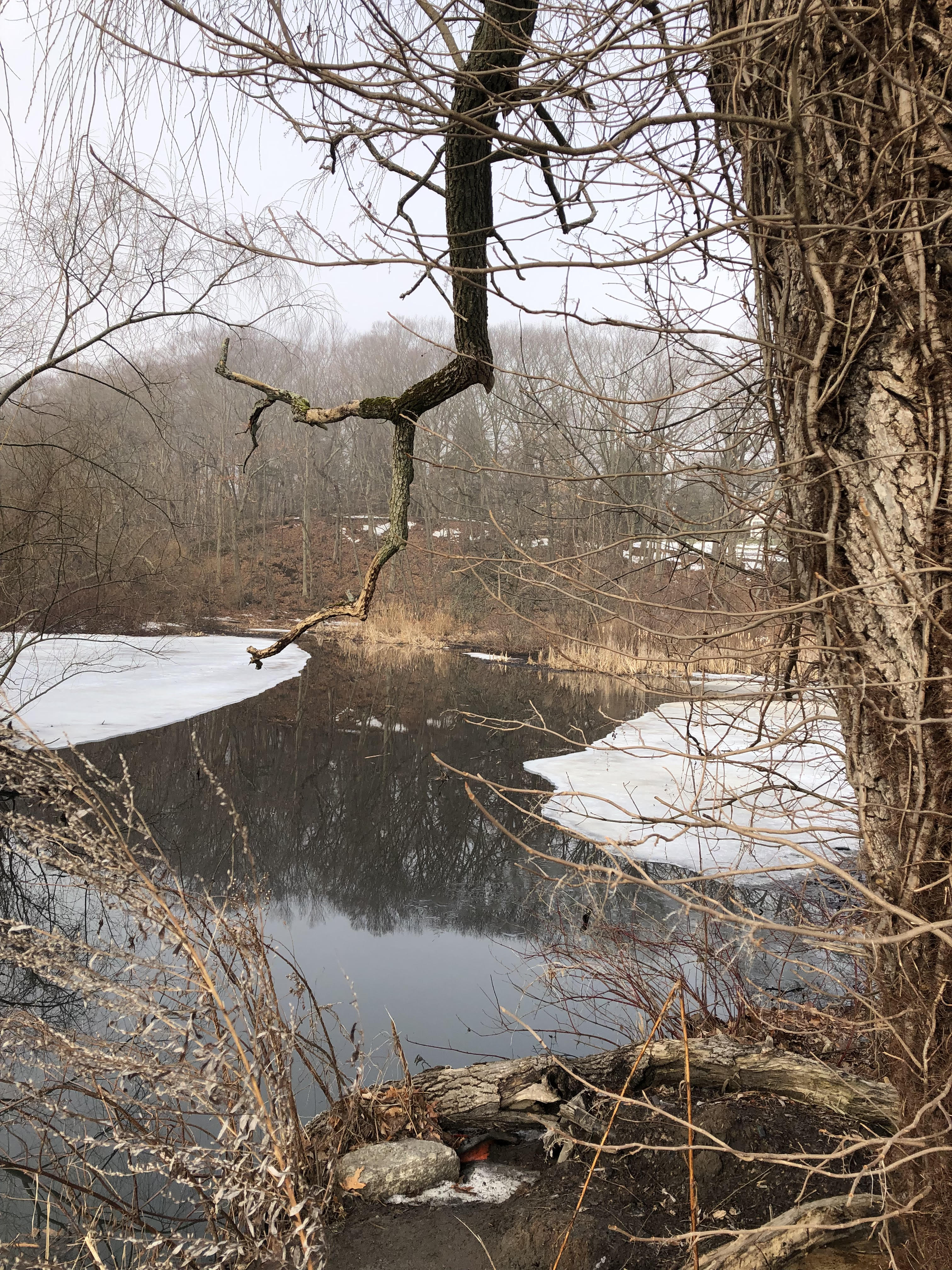
I took a lot of snow photos, as you can see, but I’m also including a sunny one of the library’s brand-new children’s wing, several pictures from friends (Kim Gaffet’s snowy owl, a tiny island that Jean Devine’s students planted last summer), and scenes in Providence yesterday (the girl photographing a fogged-in bridge, an icy sandbox, a pond starting to melt). Sandra M. Kelly made the 2022 photo of snow in New Shoreham, where heavy snow is a rare event.
When I was a child, I went through a period of wanting to be a ballet dancer. It was a thrill to have a small role in the Elysian Fields of Gluck’s Orpheus alongside grown-up ballerinas and opera singers. But as ballet lessons waned, other interests took their place.
Later, as a worrywort adult, when a dancer I knew kept getting injuries, I began to think of ballet as a dangerous sport. Today’s post celebrates a revolution in addressing ballet injuries.
From Nick Miller at the Age: “Is injury common among ballet dancers? Yes. But perhaps not for the reasons you might think. A study in Britain in 2014 found that professional dancers were far more likely to suffer injuries than rugby players: 80 per cent of dancers incur at least one injury a year that affects their ability to perform, compared to 20 per cent for rugby or football players.
“Muscles and joints were the most common sites for injury, according to the British Fit to Dance 2014 survey. Other studies found that over-use was the most common cause of injuries for female dancers while men were more susceptible to sudden, traumatic injuries. And they found that younger dancers were more likely to be injured than older ones. …
“[Matthew Wyon, professor of dance science at the University of Wolverhampton and one of dance science’s leading experts] believes it’s because of the way dancers train.
“ ‘None of their training causes them to get either stronger or fitter until right up close to a performance. Ballet dancers are technically unbelievable. They’ve got an economy of movement we never see in sport. But it means the dance no longer puts a stress on the body. They don’t have that physical adaptation. So, in fact, the better your dancer is, the less fit they are. Because dance doesn’t stress them any more.’
“On the face of it, the lifts and jumps that dancers perform seem to require extraordinary strength. But, behind the scenes, a lot is accomplished by perfect balance; by aligning bones and locking joints so that, rather than relying on muscles to hold your partner aloft, the weight transfers through your frame to the floor. …
“Evidence of their reliance on technique can also be found in dancers’ almost freakish ability to ignore fatigue when it matters.
“In one experiment, Wyon’s team made a dancer exercise until they were ‘absolutely dead on their feet’ and then perform a double pirouette on to arabesque (which is where they stand en pointe with one leg in the air behind). ‘And they could pull it off, even when they were having trouble doing the fatiguing dance in between. As soon as they were being watched, or having the data collected, they could pull it out. This is just a phenomenon and we’re trying to explain it – and it could be how they’re trained.’
“Technique, it seems, honed over hours of practice each day and since an early age, hides a multitude of flaws. Wyon has seen a male dancer ‘built like a stick insect’ who could lift any of the women in the company – purely through ability. ‘His technique was so good for doing it, beautifully. Once. But if you asked him to do it three times, he couldn’t. … They’re always training and dancing at close to their maximum.’ …
“The Australian Ballet is one of a group of pioneering dance companies around the world that have beefed up their in-house medical expertise and are leading the way in the search for better treatment, rehabilitation and – most importantly – injury prevention.
“Dr Sue Mayes is the director of artistic health at the ballet, where she’s worked since 1997 – at first in the littlest room in the building as the company’s first full-time touring physio, now leading a high-tech medical and physiotherapy operation. …
“ ‘We’re [always] going to see if we can do it non-surgically,’ says Mayes, ‘because a dancer loves that swan neck, that hyper-extended shape. If you lose even five degrees of that, it’s going to be obvious to the eye and harder to function with. So, we avoid surgery at any cost – we’ve done very few operations in the last 10 years.’
“For a year, [Benedicte Bemme, an injured dancer] had to run through a simple, repetitive exercise routine involving the movement method Pilates, little jumps, or jogging up and down a stairwell, designed to restore strength and function to her foot.
“It may sound simple, but in ballet it is a revolution. Rather than rushing dancers to hospital, they are experimenting with techniques to painstakingly rebuild the dancer from the inside out. Research published by Mayes and her team looks at each joint and each injury, and assesses what particular types, frequency and power of exercise are best to get a dancer back to the stage.”
Photo: Chris Linder. National Audubon Society government affairs coordinator Tykee James (second from left) has been leading monthly bird walks for congressional staff on Capitol Hill since 2019.
A while back I wrote how the Swiss ambassador in Washington, DC, got people there interested in birding (here). Today a story from Cornell Lab’s All About Birds touts the ability of bird walks to build common ground among government opponents.
Ariel Wittenberg writes, “It’s a busy morning on Capitol Hill when the gaggle of congressional staffers and their boss, U.S. Rep. Alan Lowenthal, gather on the back lawn. … This morning’s meeting isn’t about legislation in the House of Representatives. It’s about three visitors perched atop the chamber’s roof, backlit by the Capitol Dome’s soft gold glow.
“ ‘Will you look at that, House Sparrows sitting on the people’s House!’ exclaims Tykee James, the government affairs coordinator for National Audubon Society, eliciting a muffled chuckle from the dozen legislative aides and interns assembled. …
“He started the walks in 2019 as a way to forge connections with lawmakers and their staff who might work on bird-related legislation. … [And] they serve another purpose: building common ground in a place that is perhaps more partisan now than it’s ever been.
‘If you take down the political barriers and you just bird a little bit, if you calm down, smell the flowers, and look for some feathers, then I think that you can genuinely find where people are coming from and that gives you a better opportunity to find where you can meet in the middle,’ he says. …
” ‘I do no kind of lobbying on these walks.’ Instead, he gives pointers on using binoculars, fields questions about the difference between male and female House Sparrows, and mimics the different caws of Fish Crows and American Crows. …
“ ‘It’s not about me being an expert, it’s about me trying to find ways to connect people with the excitement of it all,’ he says. ‘Being present for moments like this makes you feel connected to birds and to their issues.’
“Congressman Lowenthal is no stranger to bird policy. He (a California Democrat) joined with Rep. Brian Fitzpatrick (a Pennsylvania Republican) to coauthor the that’s being considered in the 117th Congress. The Act would permanently codify protections for migratory birds that were rolled back. …. Reps. Lowenthal and Fitzpatrick have also reintroduced legislation calling for the U.S. to join the Agreement on the Conservation of Albatrosses and Petrels, a conservation treaty that covers 31 species of seabirds.
“But this is Lowenthal’s ‘first bird walk,’ he says, and he is genuinely surprised when James tells him that American Robins aren’t actually robins at all, but a type of thrush.
“ ‘Where are the robins, then?’ Lowenthal asks.
“ ‘They are in Europe,’ James says.
“To Lowenthal, participating in a bird walk is a means to escape the grind of the Capitol, where later in the day he will pay his respects to victims of the Covid-19 pandemic at a ceremony near the Washington Monument before returning to the House chamber for more debate on spending bills.
“ ‘There is so much going on, so much uncertainty and stress,’ Lowenthal says. ‘It’s nice to have a focus outside of ourselves.’
“Even though he doesn’t talk politics on his bird walks, James believes they do have policy impact. For example, the legislative director at Lowenthal’s office, Shane Trimmer, has been on almost every bird walk James has offered. And James says that he ‘suspects’ some cosponsors of Lowenthal’s bipartisan migratory bird legislation may have been inspired by the walks. …
“Today’s bird walk is full of first-timers. One aide from Long Beach, California, tells James he is only experienced at ‘identifying pigeons and seagulls,’ and another confesses she has ‘absolutely no birding experience.’ …
“James says he actually prefers to bird with people ‘who are picking up the bins [binoculars] for the first time. … It’s all about meeting people where they are with the birds,’ he says.
“That, and James hopes observing birds can help staffers and politicians think about their own environments in new ways. That was the case for James, when he started birdwatching during his first job out of college at the Cobbs Creek Environmental Center in West Philadelphia. …
“People of color in the United States are less likely to have adequate access to parks and green space. Lack of green space in communities of color often means those neighborhoods of mostly concrete feel hotter than areas with parks and ample tree cover. The phenomenon, called the heat island effect, can exacerbate health disparities because high temperatures can lead to heat exhaustion and stress, which complicate heart and respiratory conditions.
“The lack of access to green space is no accident, James notes, due to historic discriminatory mortgage lending and other practices that segregated neighborhoods. That’s one reason why, outside of his day job, James advocates for increasing diversity within the outdoors community. Last year, he cofounded Black Birders Week to promote the work of Black naturalists and raise the visibility of Black people within the birding community.”
More at All About Birds, here. For something extra entertaining about ornithology, read my post on so-called “birbs,” here.













 Suzanne's Mom's Blog