Feeds:
Posts
Comments

Archive for the ‘Uncategorized’ Category

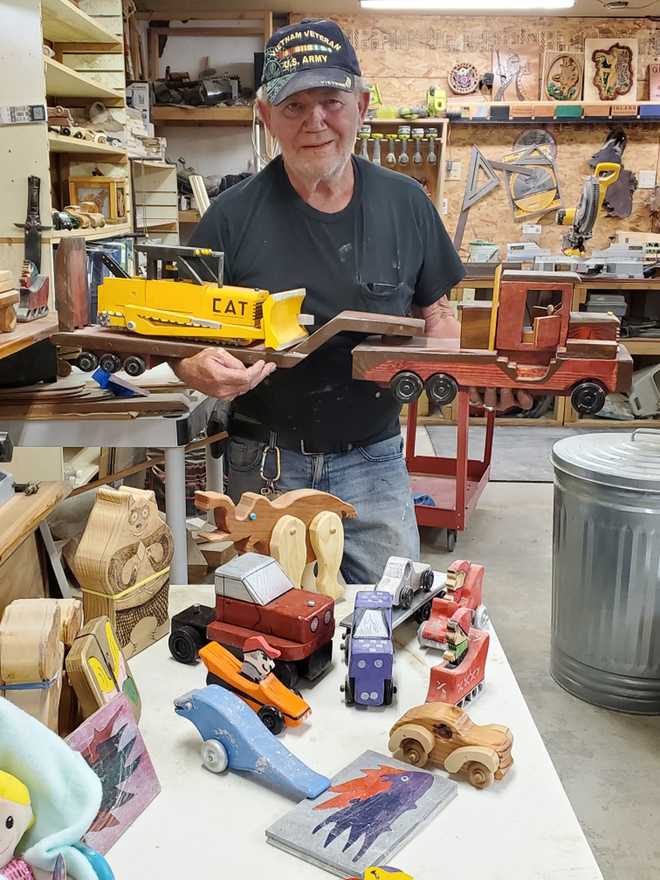
Photo: Sierra Sullivan via KCRA.
Mike Sullivan, 72, says his two older brothers were carpenters who made him toys when he was a child.

I saw this story of good works several places online and saved it for Christmas Day.

CNN’s Amy Chillag wrote, “A real-life Santa’s workshop is churning out toys in Desert Hot Springs, California. A 26-year Army veteran and his wife have spent most of the last decade making toys in a woodshop behind their house. It’s a labor of love that started as a hobby.

” ‘After retirement, I got bored and needed something to do,’ 72-year-old Mike Sullivan told CNN.

“The couple joined a woodworking club and one of their projects was to build toys for kids.

” ‘Christmas time, we had a chance to see the kids get the toys and see how much joy it was,’ said Sullivan.

“They were hooked. … Mike and Judy Sullivan spend nearly every day in the shop.

” ‘We’re both in good health and are able to be out here six to seven days a week for eight to 10 hours,’ Sullivan said. ‘It’s so much fun.’ …

“Mike buys the lumber, the drill bits and saws and makes the patterns — cutting and sanding away. Judy is quality control and decorator.

” ‘I run my hands over all the toys and feel for something that’s not supposed to be there — a loose wheel or splinter,’ said Judy. She also spray paints and decorates. …

“This year, their toys were especially needed with so many parents out of work due to the impact of the coronavirus pandemic on the economy.

“The Sullivans … are extra careful scheduling folks at intervals to come check out the toys. ‘We try to enforce safe distancing and masking,’ said Mike.

“This week, they’re delivering hundreds of toys to a kindergarten class, the Coachella Valley Rescue Mission and a church food pantry. They’ve mailed toys as far away as Indiana and Texas. Not only are the toys free, but the couple pays for the shipping although, they admit, that’s getting tough.

” ‘As long as I can afford it, I can send them where I can,’ he said. …

“The Sullivans’ toys will also be distributed to children during a drive-thru giveaway with social distancing, ‘making sure everyone is safe and happy and healthy.’ …

“The couple makes trains, cars, trucks, pull and push toys (little alligators, elephants), ducks you put on a string and pull along behind you. They also make educational toys: alphabet puzzles, jigsaw puzzles, stackers with different size blocks on a pole. …

“Judy Sullivan said they watch [their grandchildren and great-grandchildren] play with the toys and see what they like and don’t like about them. ‘If they drop a toy on the floor and break the head of a duck, we better reinforce that.’ …

“Mike says while he’s full of shrapnel from his service, that doesn’t slow him down in the toy factory. ‘You have to adapt and overcome.’

He refuses to charge for his toys. Maybe it’s because he knows what it’s like not to have much money.

” ‘My dad was a miner, we were considerably poor,’ said the retired Army first sergeant, who grew up in Montana.

“His older brothers were both carpenters and made toys for him when he was a child. ‘Most of the things I got were handmade toys. They were wonderful toys, I know how much I enjoyed them.’ … Those memories stick with him and he inherited their love of wood. ‘We do it for those who are less fortunate than we are now.’

“Their daughter says her parents spent $19,000 out of pocket last year on supplies (she does their taxes). …

“The hundreds of wheels and axles for the cars, trucks and trains are especially costly. With their kids’ encouragement, they started a GoFundMe to help.

“Mike hopes anyone who wants a Christmas present next year will reach out to him, and he’ll do his best to get it to them, wherever they are.”

More at CNN, here, and at the Washington Post, here.

Read Full Post »

Even though we’re buying smaller and smaller Christmas trees each year and you’d think I wouldn’t be able to cram on decades’ worth of ornaments, I hate to leave anything out.

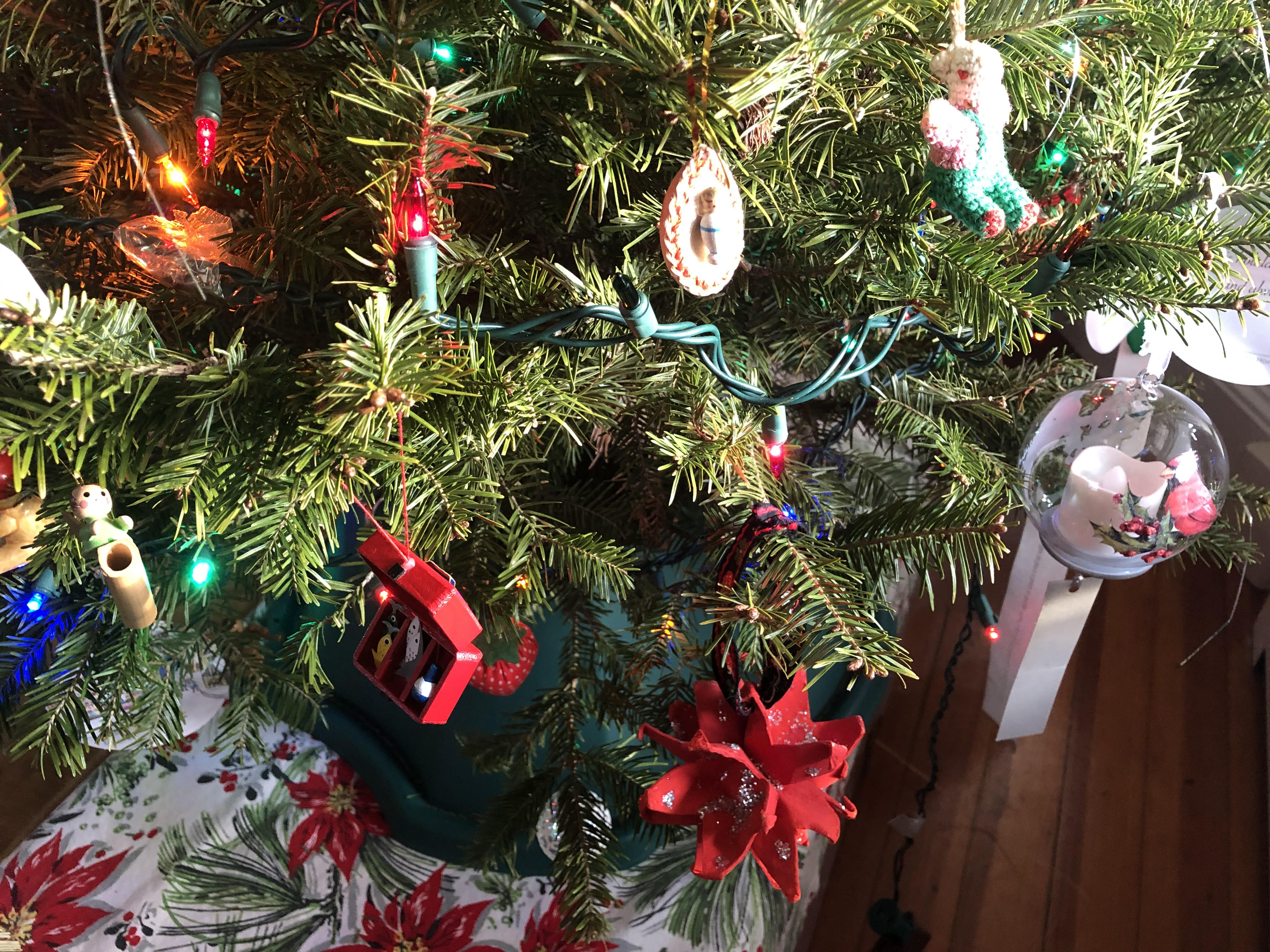
There’s a cross-stitched ornament that John made from a kit when he was four. Numerous decorations were created by my husband’s Aunt Mae, who had an active life past age 100 and made knitted, crocheted, and sequined ornaments that she kept secret as she worked on them during the year.

There are many items made in the Crafts for Christmas workshops at church, which encourages children to make, rather than buy, presents to give. Most were the work of John and Suzanne in the 1980s. Others were made by their own children in pre-Covid church workshops. The wide range of workshop items include everything from Christmas doorknob covers to reindeer ornaments constructed of clothespins.

I love looking at the tiny crocheted figures from China that I found in a shop at Niagara on the Lake when Suzanne was two. They remind me of our time at the Shaw Festival in Canada. My husband and I traded off babysitting so he could see a play and I could laugh myself silly at a performance by the concert comedienne Anna Russell.

I also have an origami star in shiny green paper from someone in an Esperanto group that used to meet monthly at my house.

A little baseball ornament and a tiny box of fishing tackle remind me of early interests of John, who now coaches baseball and teaches kids in the family to fish.

Really far back in time, I acquired a small Christmas stocking for one of my dolls — that goes on the tree, too.

There’s a horse-saddle ornament, a memento from a vacation that the Clymers took out West. And I still hang up a large glass ball from the Lillian Vernon surprise box. I painted “1980” on it back then.

I also hang up quotations looped with a green ribbon, an idea my husband got on a business trip to Singapore, where they hang sayings outdoors.

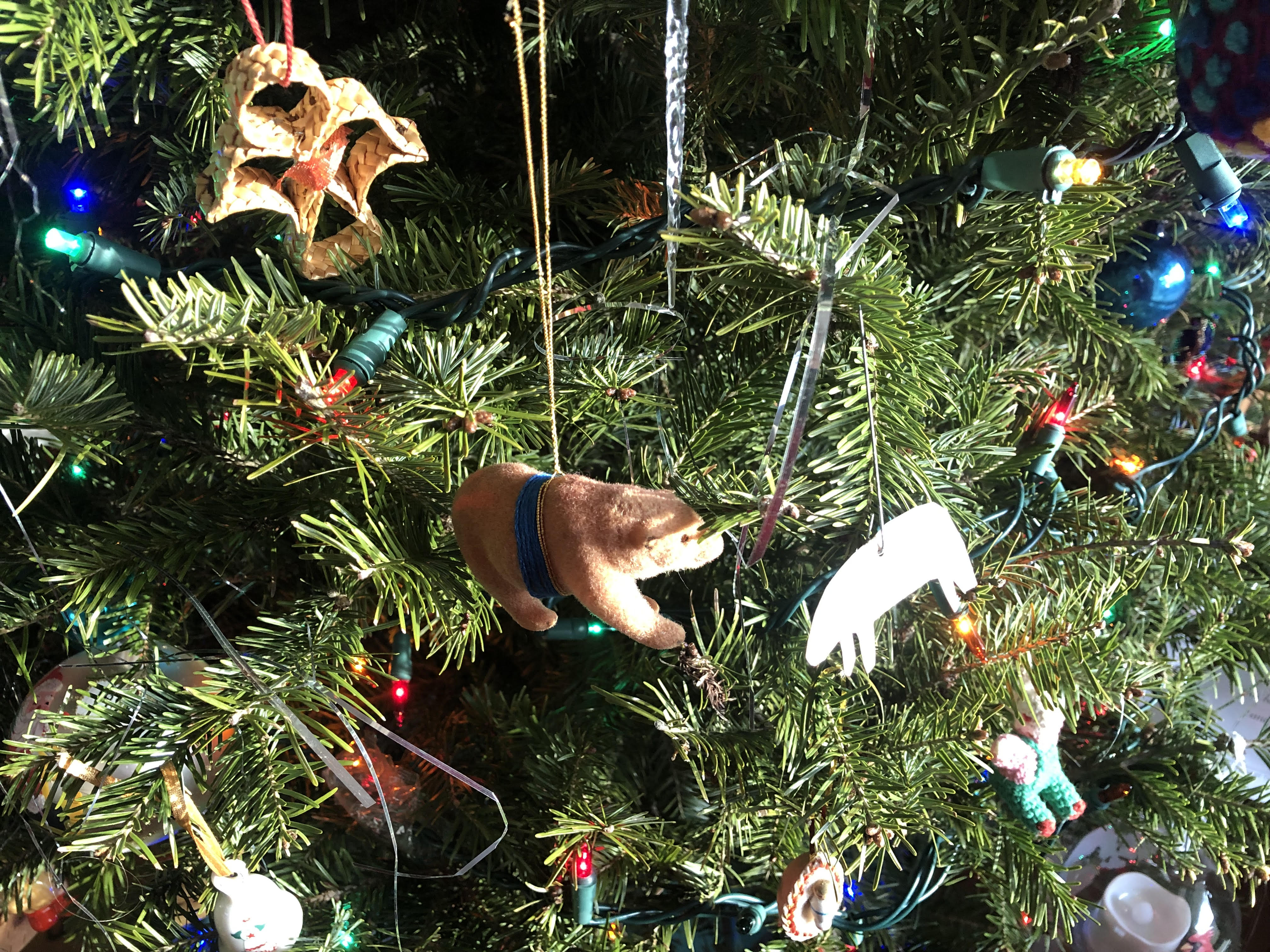
The clunky red-paint-and-sparkles thing you see below is something I made from an egg carton years ago. Recently married, I thought it would be fun to take Crafts for Christmas at the local adult ed after work while my husband took a different class. Can’t imagine how I stayed awake in those days!

Please be sure to notice that hanging near a bear ornament is something white that has the same shape. That is what my husband made for a three-year-old John, who asked him to make another bear. Though not usually into crafts, the guy did his best, and I like seeing his white cardboard bear every year.

Read Full Post »

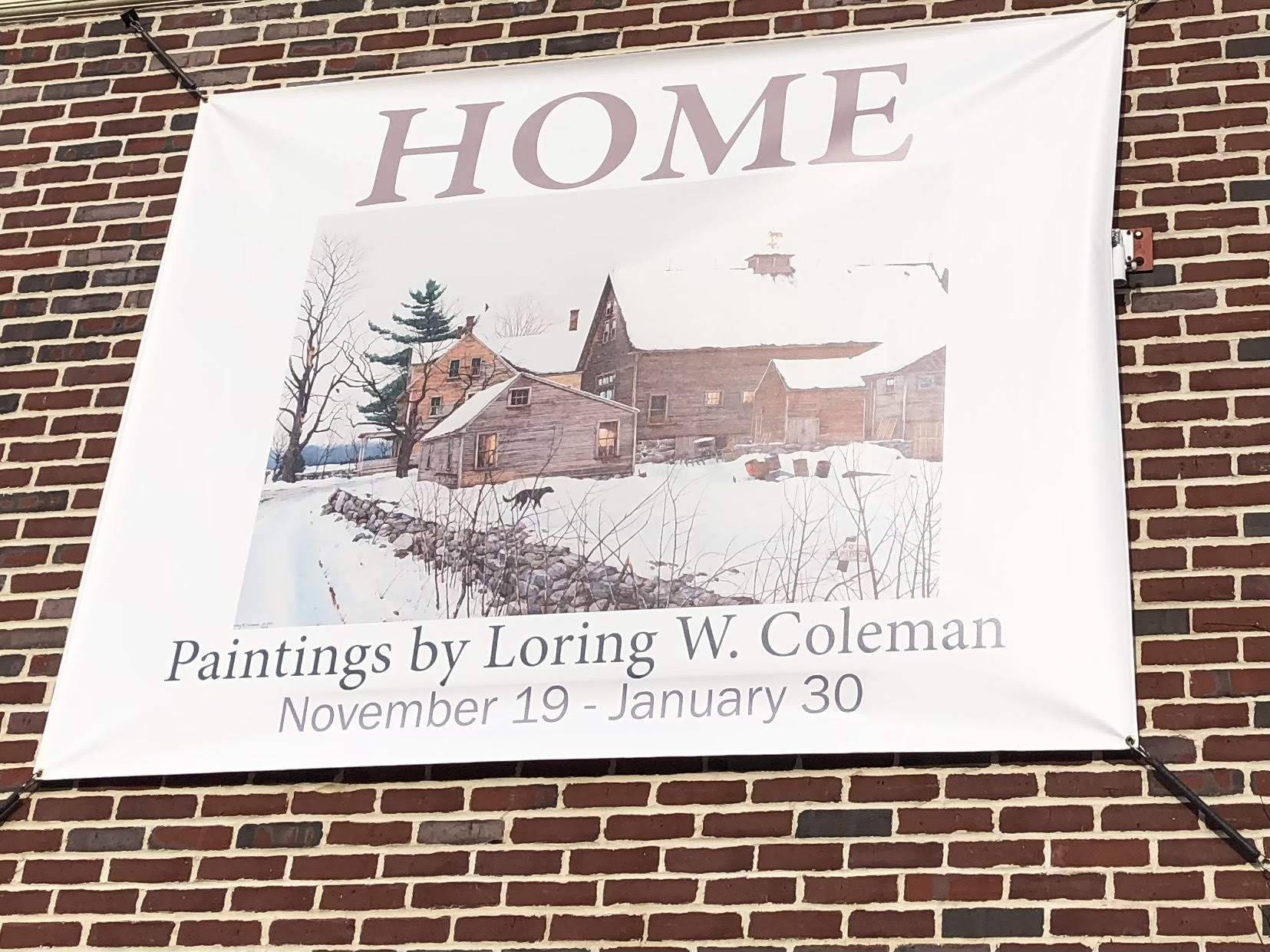
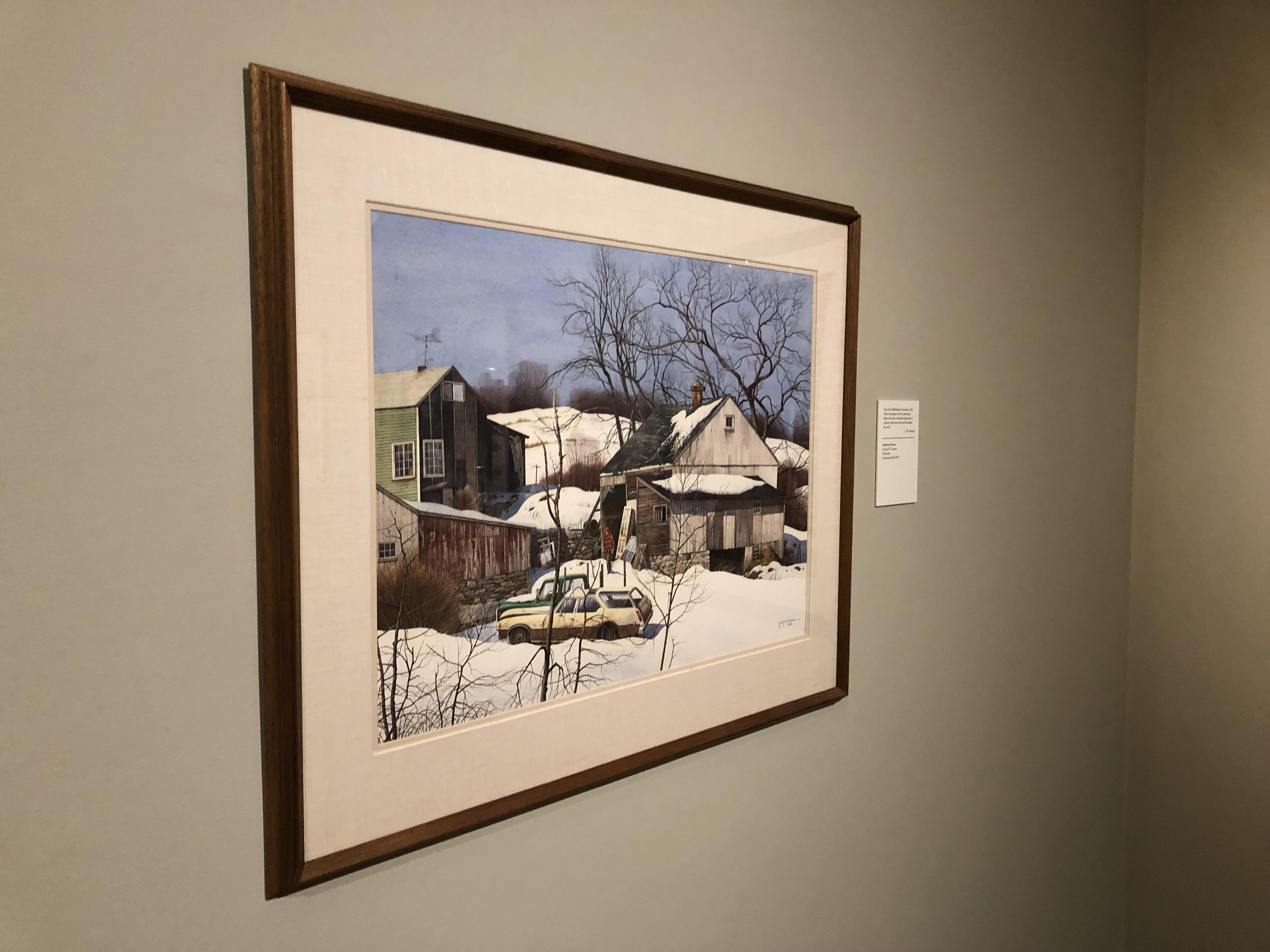
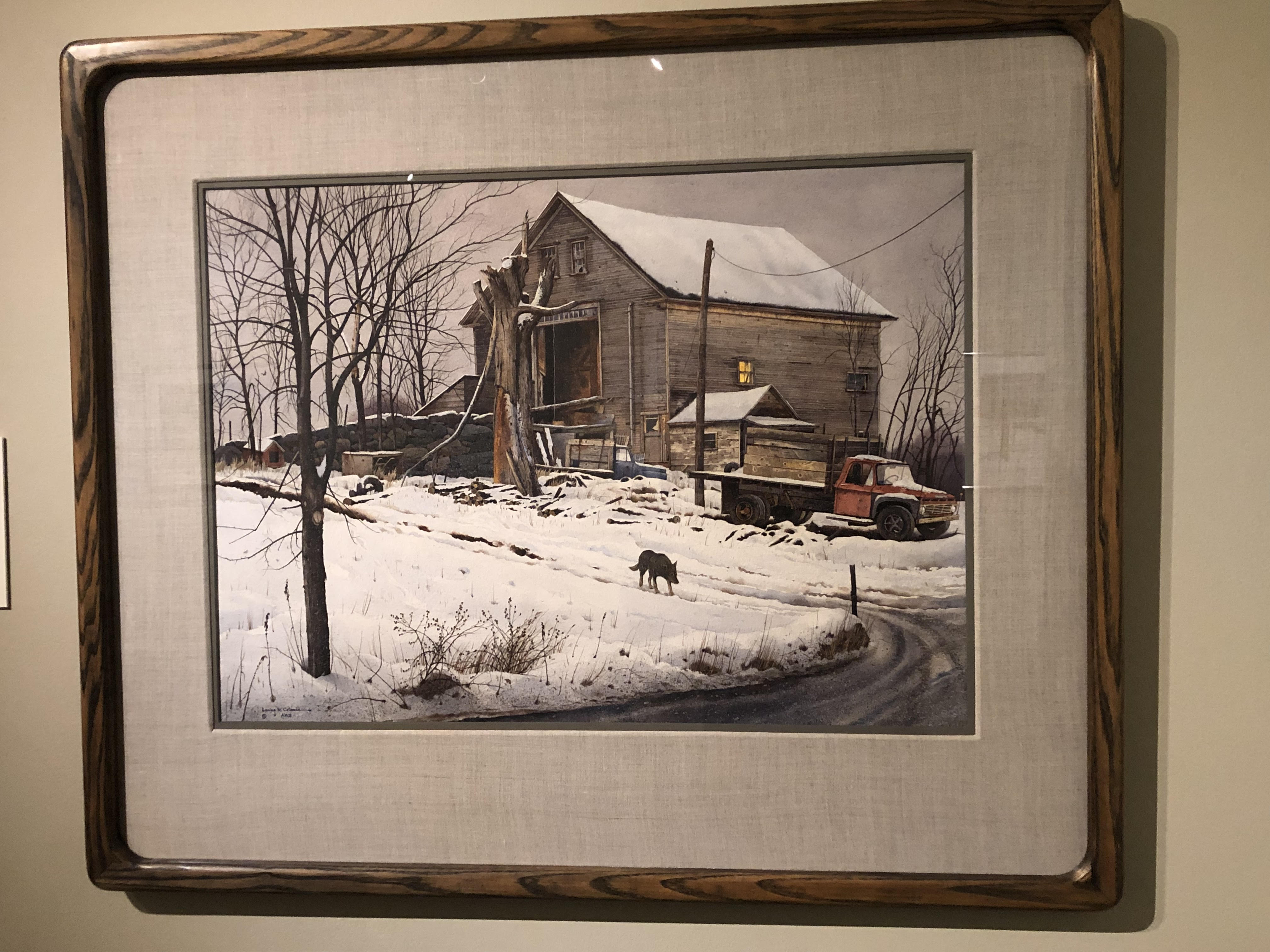
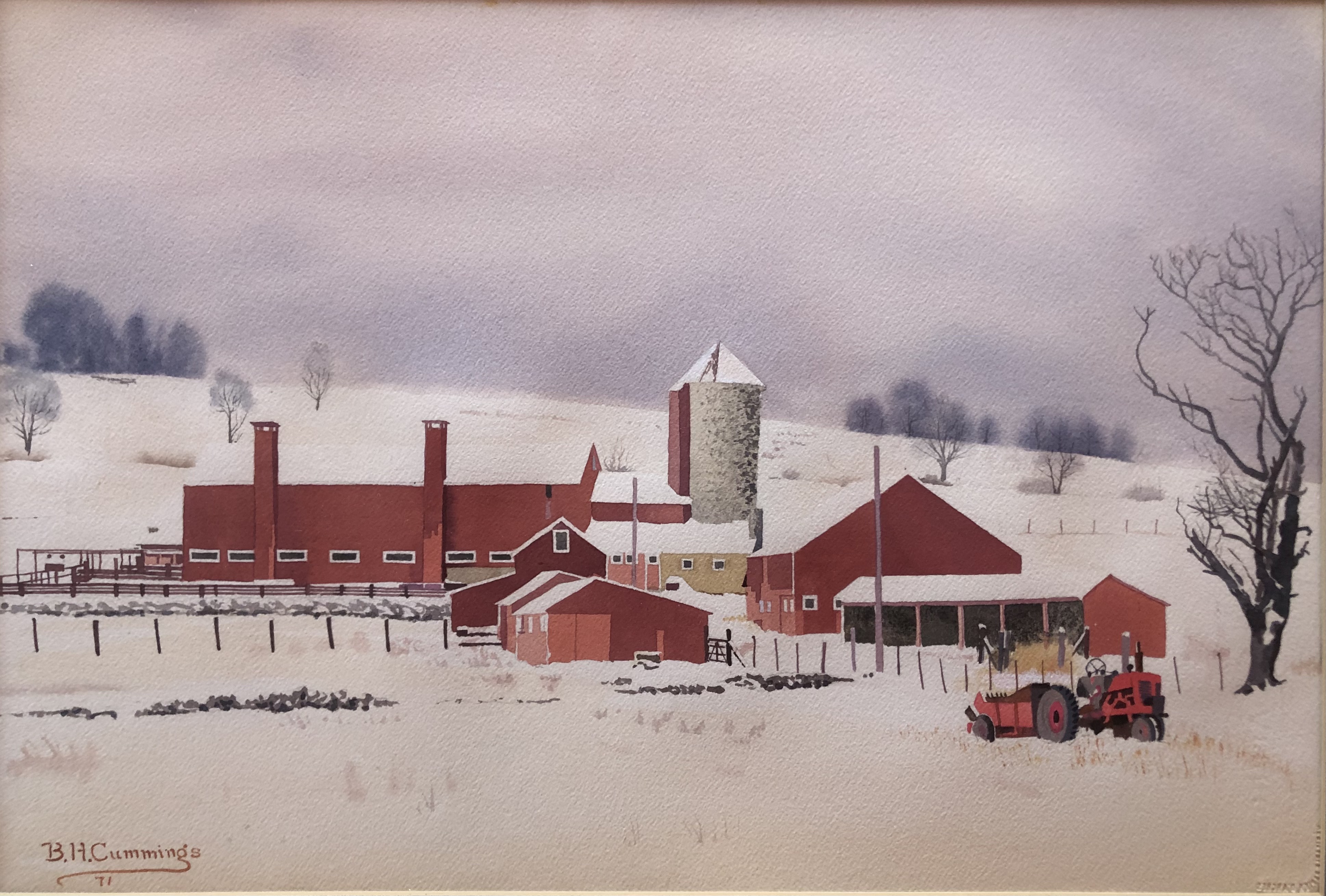
I walked over to the museum the other day, mainly to see the artwork of the late Loring Coleman, a guy in love with ruined New England farmhouses and crumbling barns. He knew how to bring out the beauty and significance of these disappearing landmarks.

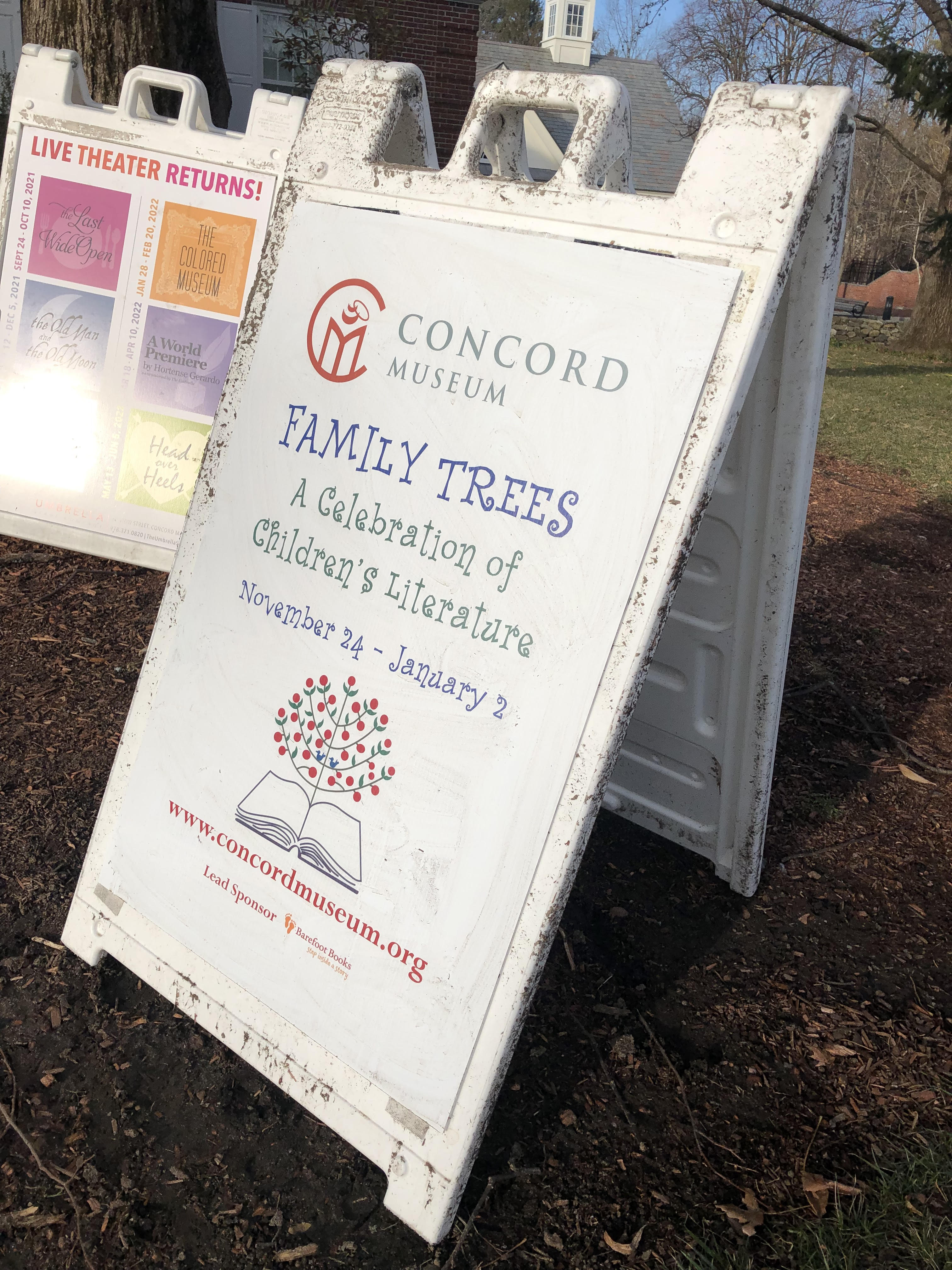
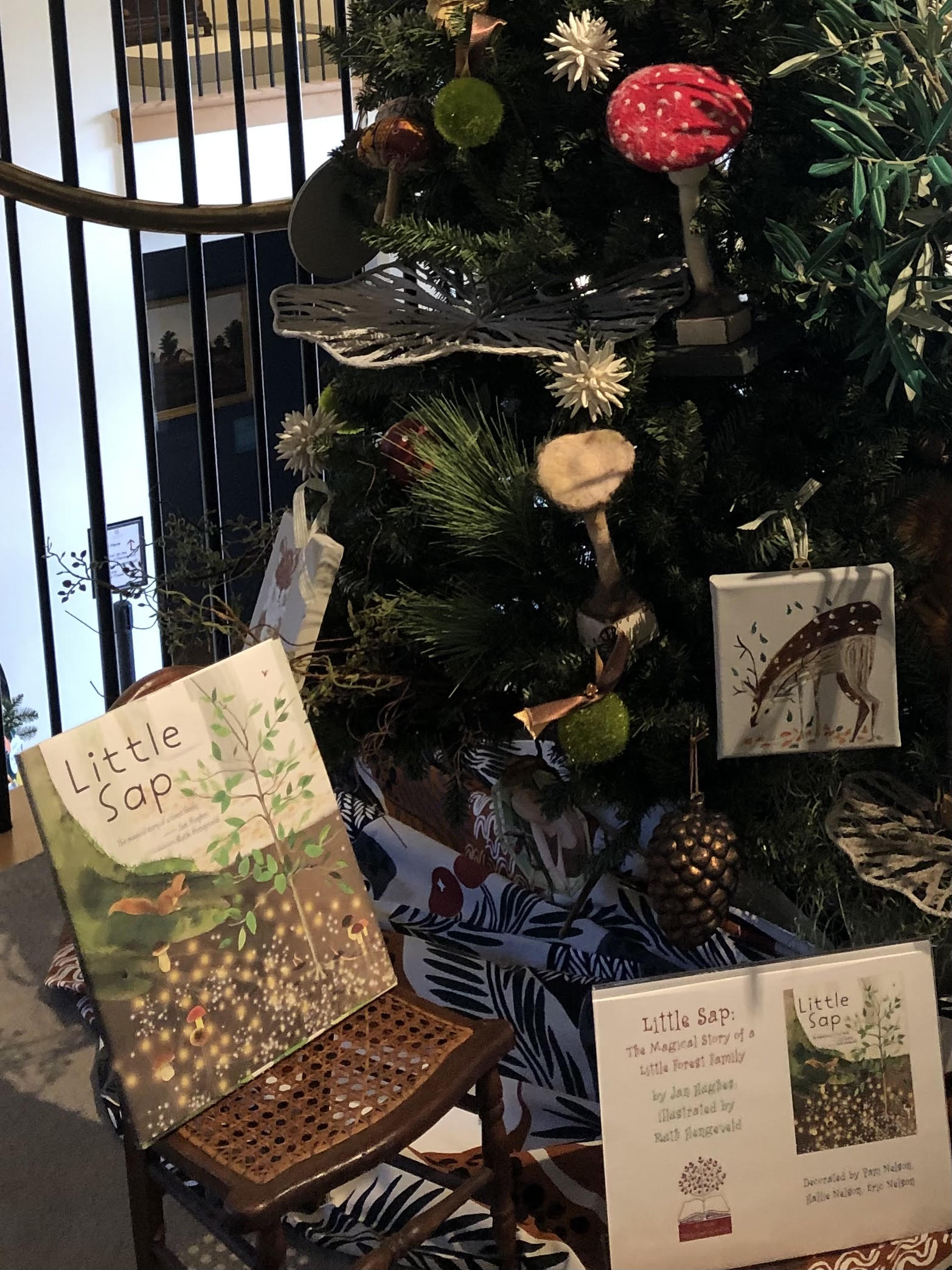
The museum’s annual feature called Family Trees also caught my attention. That’s a community effort in which local families and organizations decorate trees or wreaths with the theme of a beloved storybook.

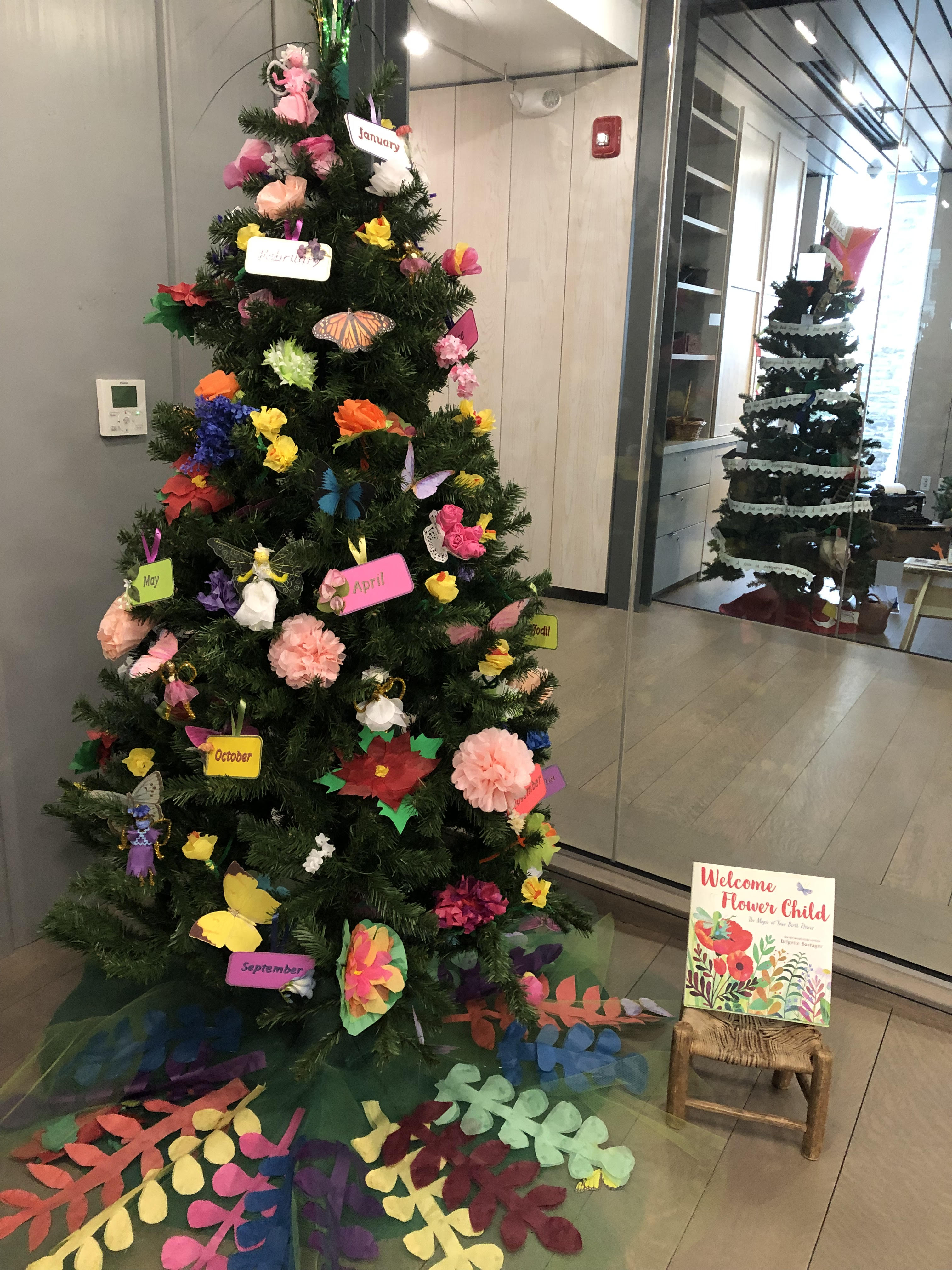
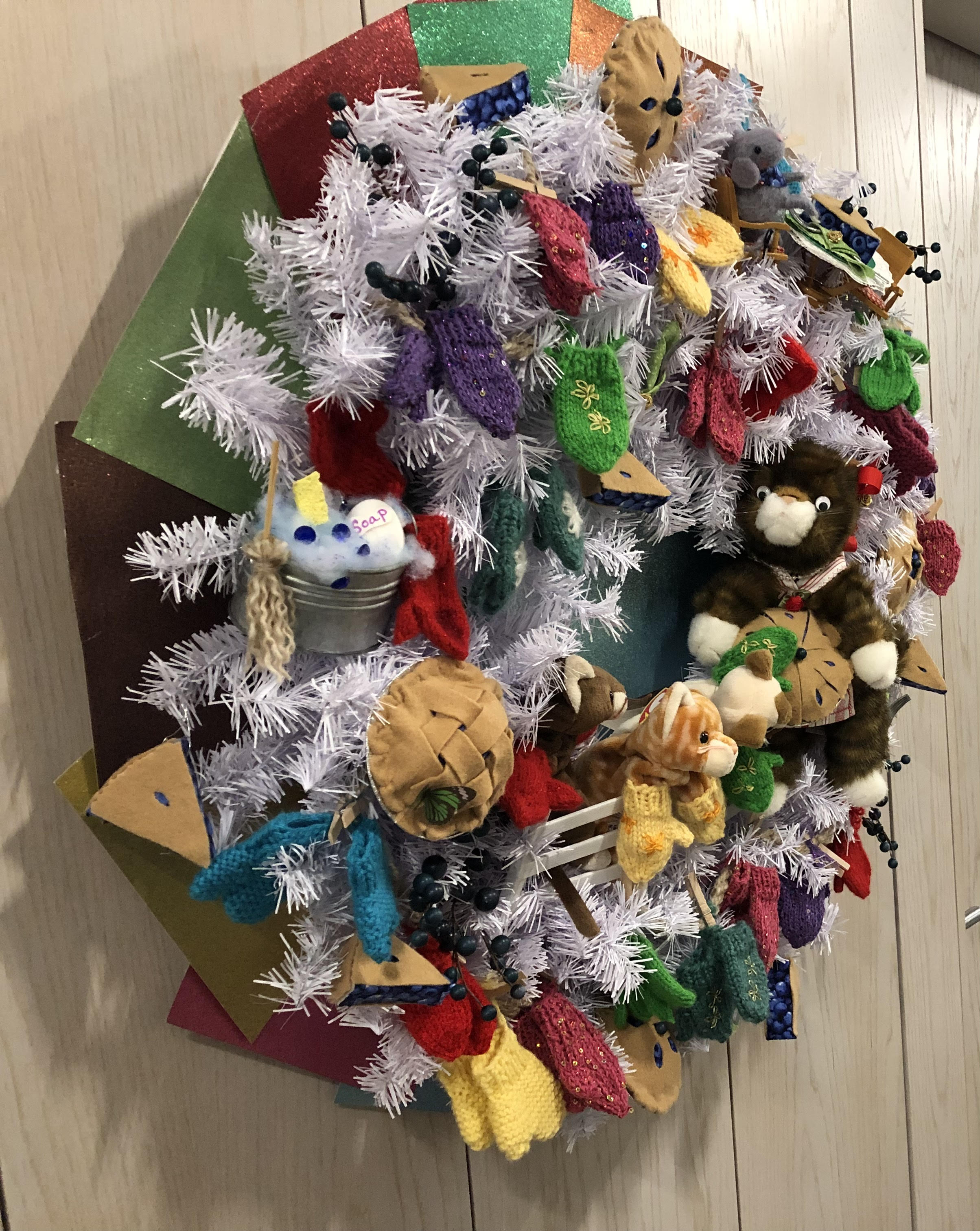
The Garden Club, for example, did a tree this year on a flower-themed picture book, and the Council on Aging made tiny mittens for those famous little kittens who lost theirs. (Lots of skilled knitters at the Council on Aging!) Check out the covers of all the delightful books here.

PS. I’m going to add a beautiful barn painting at the end of this post. It’s by a former neighbor, Ben Cummings, and was brought to my attention by his son, Earle, and his daughter, Caroline. Like many of the buildings featured in the Coleman paintings, these red barns are no more.

Read Full Post »

Bronze apple knocker.

During the Civil War, I was once told, soldiers from upstate New York who knocked apples off trees with their rifles were derided as apple knockers. But as I can’t find that history on the internet, I think it may be apocryphal.

Nevertheless, the expression was definitely used to differentiate New York City folks from every other New Yorker when we lived upstate years ago.

Back then, I said to my mother that I thought someone should make a door knocker in the shape of an apple. Whether she had thought of it before or was responding to my comment, she was the one who took action.

Her little company is long defunct, but whenever I visit a home of people who knew her, I see a bronze apple knocker on their door. My own house has the one above on the back door and another on the front door. If my children are the ones to sell our home one day, I hope they remember to stipulate in the contract that the knockers stay with them — collectors’ items now.

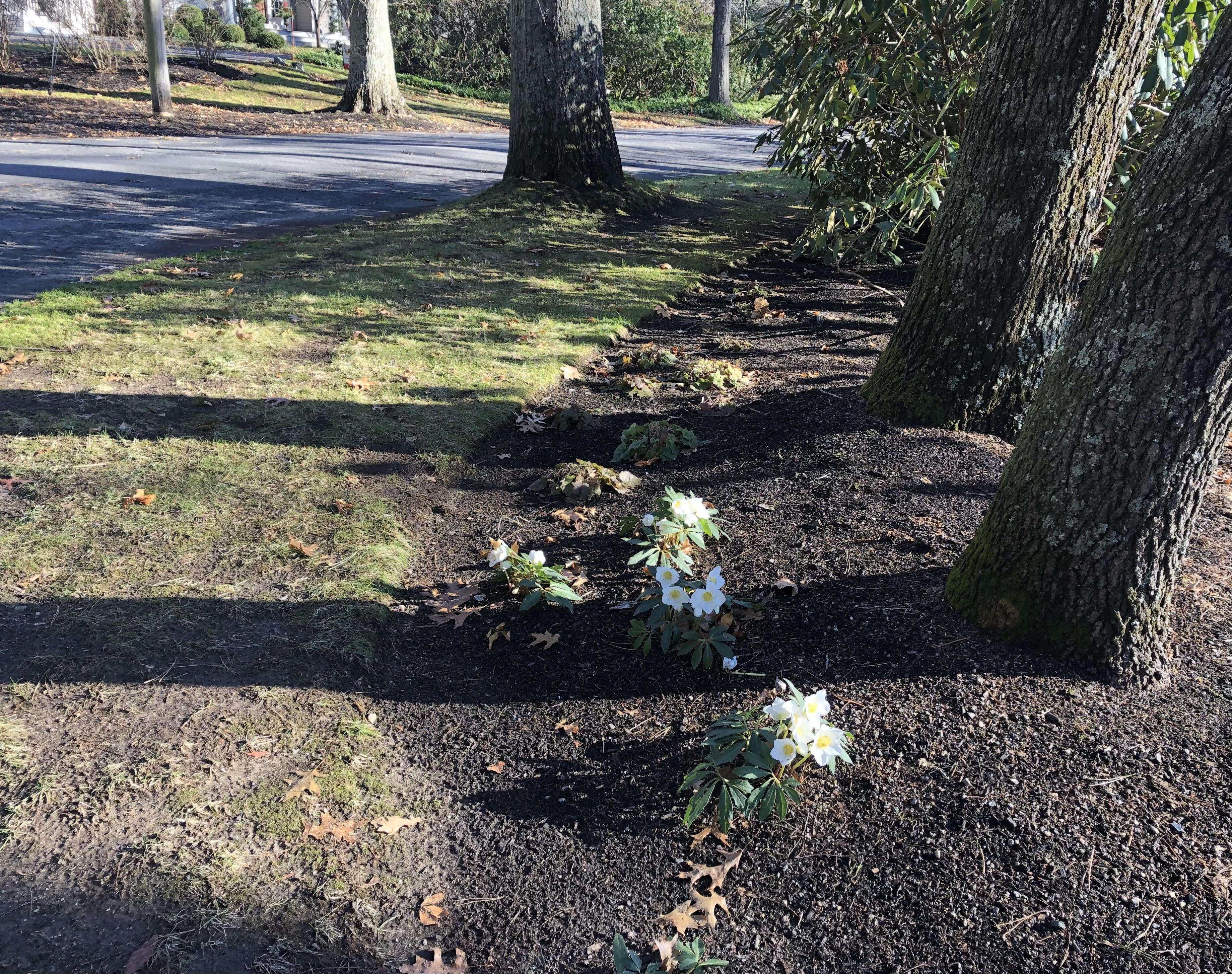
Moving right along, I have a few recent photos to show you. Below is another of my winter hellabore photos. I can’t get enough of these flowers, also called Lenten Rose, which bloom in the coldest weather.

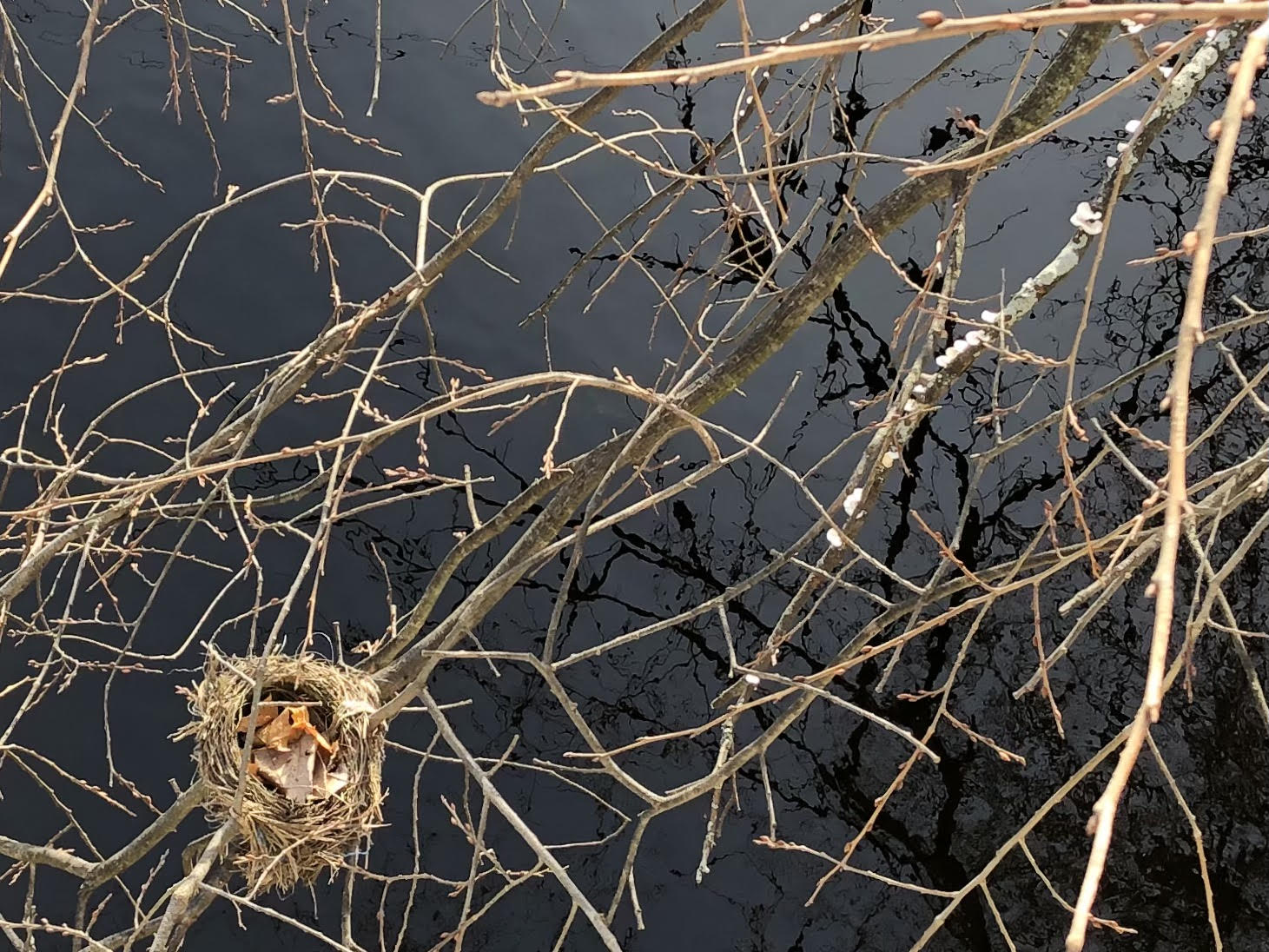
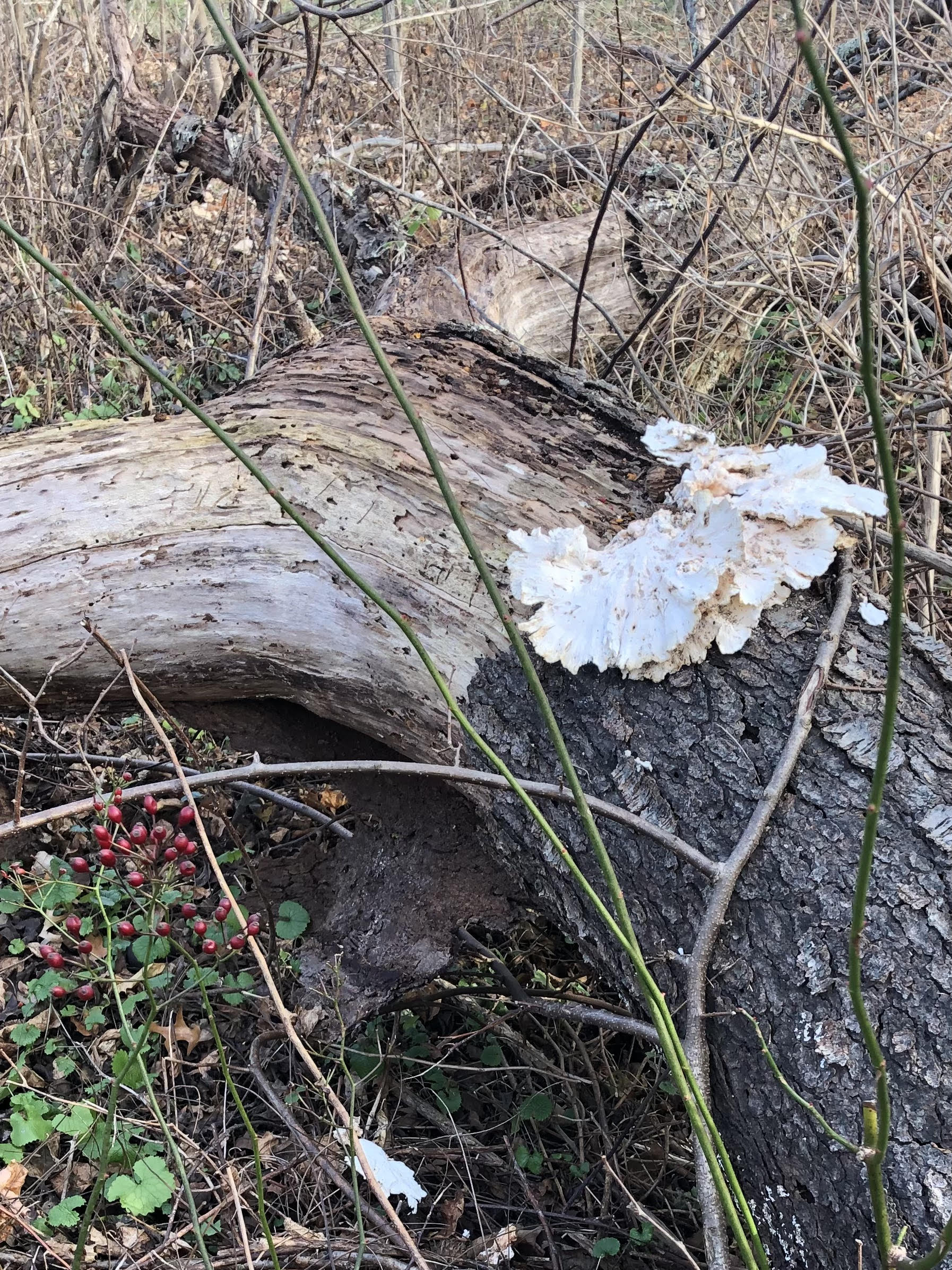
The two snarly-twig photos show an abandoned nest over the Sudbury River and a fancy-dress fungus near the elementary school’s playground.

The post box for Santa reminds me that my youngest grandchild just got a response from her letter to the North Pole — exciting for all concerned. The cheery toy soldier on Main Street points passersby to a staircase leading to a toy shop below.

My husband and I went to our first post-Covid show at Umbrella Arts and especially loved the non-traditional holiday songs. Today, reading headlines about all the well-vaccinated people getting the Omicron variant, we’re probably going back in hibernation like the ground hog that sees its shadow. We’re not post-Covid after all.

I made the chocolate cookies from a recipe in the newspaper. The kids decorated some of them with frosting and sprinkles.

I also have a photo from friends who set off for a Christmas vacation in Hawaii after the guy in the last photo recovered from Covid followed by pneumonia.

Read Full Post »

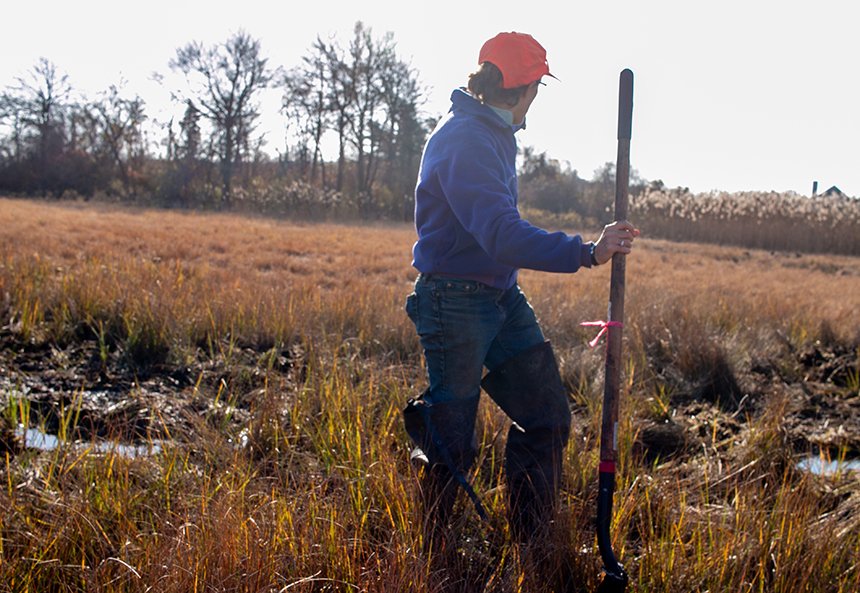
Photo: Caitlin Faulds/ecoRI News.
Save The Bay’s Wenley Ferguson is leading a marsh migration project on Sapowet Marsh in Tiverton, R.I. The goal is to slowly drain pools of standing water, some more than 18 inches deep, to protect marsh grasses and stop erosion.

Today I learned a few things about marshes that I didn’t know. For example, they are supposed to be wet but not too wet. In Rhode Island, one important wetland was dying — until it was given a helping hand.

Caitlin Faulds has the story at ecoRI News. “The grasses are dying. Clusters of broken, denuded stems stand in shallow pools of brackish water, making a patchwork of the low-lying marshlands. The slow balding is invisible from the blacktop of Seapowet Avenue, hidden behind a thick curtain of phragmites. But standing boot-deep in the peat, surrounded by the sulfuric scent of decomposition, the bare ground is clear evidence of the steady saltwater creep happening in marshes across Rhode Island.

“Spartina alterniflora, or smooth cordgrass, is notoriously salt-tolerant and a common feature in saltwater marsh environments.

“ ‘They can grow along the edge of the cove and get flooded twice a day, but they can’t grow in standing water,’ said Wenley Ferguson, shovel in hand. All around, the sunlight glints off pools of standing water, unable to drain and slowly growing with each high tide.

“The average sea level in Rhode Island has increased by about a foot since 1929. Storm surges and king tides have pushed further and further inland. Normally, the marsh would respond to the rising high-water line by matching the migration inland. But with the sea on one side and a dense web of roads, development, cultivated fields, and invasive species on the other — and accelerated sea-level rise on its way — Sapowet Marsh has nowhere to move. …

“Ferguson has been working with the Rhode Island Department of Environmental Management (DEM) at the Sapowet Marsh Wildlife Management Area, a 260-acre state property, for more than five years now. … Under Ferguson’s watch, Sapowet has become home to the largest marsh migration facilitation project in the state — a small counter to the forces at play. …

“The cordgrass roots are taut, but they cut easy. Just one stomp and the shovel sinks through the muck, water pooling up and over the toes of Ferguson’s black rubber boots. …

“Earlier in the week, Ferguson — along with a handful of DEM employees and volunteers — used shovels and a small excavator to dig a weaving network of runnels through the marsh. These shallow creeks will give the pooling water a route out to Narragansett Bay, allowing the area to slowly drain.

If the root zone of the marsh plants is able to dry even slightly, they will grow ‘healthy and happy,’ Ferguson said. Healthy plants build up a stronger root base, and a stronger root base makes a coastline more resilient to erosion and sea-level rise.

“But ‘we don’t want to drain it too fast,’ she said. It has been three days since they dug the first runnels and the water level has dropped only slightly, exposing a few inches of bare mud — exactly as planned. The standing water is thick with unconsolidated sediments and topped by a bacterial mat. If the water rushes out all at once, this sediment will pour into the bay. It’s better to dig in phases and let it settle out in the marsh, maintaining as much high ground as possible. …

“Ferguson fought to keep the peat in the marsh. … ‘These areas will just be a little higher, and they might recolonize,’ Ferguson said. ‘And when I say might — they do recolonize.’

“Within one season, the islands will host new sprouts of cordgrass, or they’ll prove high and dry enough to support clusters of high marsh grasses. The clusters of high grass will make ideal nesting habitat for the saltmarsh sparrow.”

Read about other benefits at ecoRI, here.

Read Full Post »

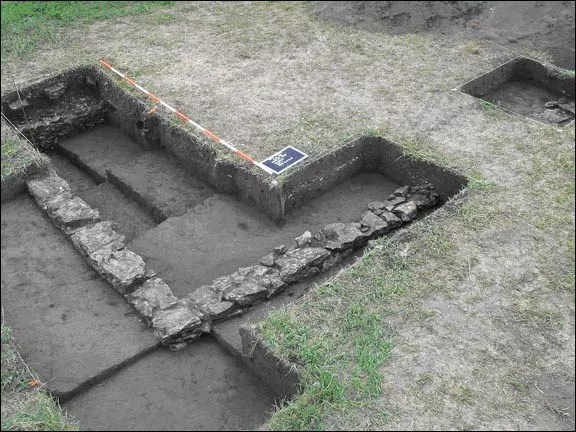
Photo: National Park Service.
Archeological excavation at an integrated community founded by a former slave in Illinois.

One thing that’s interesting about today’s story is that political differences have been set aside in the restoration of an abandoned town founded by a former slave.

Mark Guarino reports at the Washington Post, “As a child, Gerald McWorter often listened to his father tell stories about growing up on a farm in New Philadelphia, Ill. But it wasn’t until a family reunion in 2005 that he fully understood the significance of his lineage: Everyone he met that day was in some way affected by the story of his great-great-grandfather, a formerly enslaved man from Kentucky who in 1836 became the first Black person in the United States to plat and register a town.

“During Frank McWorter’s time, New Philadelphia thrived as a community where Black and White families worked together as equals long before the Civil War was fought to preserve — or destroy — that possibility.

“The revelations have emerged through three decades of archaeological digs, advocacy by local community members, oral histories and family artifacts, letters and research. The momentum was enough to convince Gerald McWorter, 78, that he and other relatives ‘had an obligation’ to ‘become stewards of a story that is bigger than us.’

“Also convinced was Rep. Darin LaHood (R-Ill.), who introduced a bill that would designate the site of New Philadelphia a part of the National Park Service. …

“Frank McWorter was born into slavery in 1777 and grew up on a Kentucky plantation. His White enslaver, George McWhorter, was also his father. Frank was an entrepreneur of sorts whose father allowed him to earn wages outside his hours of slavery in a cave where he foraged and sold materials used for gunpowder.

By 1817, Frank had saved enough money to buy freedom for his wife, Lucy, who was pregnant with their fifth child. Two years later, he was able to buy his own freedom.

“Emancipating 15 other family members would follow, a process that lasted through 1857 — three years after the death of Frank, who came to be known as Free Frank. …

“ ‘It’s often hard for people to get out of their heads that it would take 40 years to buy your family back from slavery. It’s a really heroic story that captured the imagination,’ said Gerald McWorter, a professor emeritus at the University of Illinois at Urbana-Champaign, where he taught African American studies.

“The first person in the McWorter family to actively document Frank’s life was Gerald’s aunt, Thelma McWorter Kirkpatrick Wheaton, who collected family documents, letters and photos as well as interviewed older descendants. Her daughter used that material to write her doctoral dissertation about Frank McWorter, and the University of Kentucky Press published it as a book in 1983.

“Frank McWorter’s dream included buying his own land, and he eventually purchased 80 acres, sight unseen, in Pike County, Ill., along the Missouri border. It was thick prairie then, and the McWorters arrived in 1831 to clear it for growing crops and constructing a town. Descendants of McWorter remained in the area until the late 1990s.

“New Philadelphia existed for half a century. Named after the eastern metropolis that symbolized brotherly love for all races, it was a prosperous frontier town that had a post office, a school, a store, a blacksmith shop and two shoemakers, presumably to supply footwear for runaway enslaved people who passed through on their way to Canada. The town was home to as many as 29 households, and neighboring farmsteads used its services.

“But what distinguished the community was where it was located: just 20 miles from Hannibal, Mo., a bustling river town that served as a major site for auctions of enslaved people. Just over the Mississippi River, African Americans were human chattel and subject to horrific violence, but in New Philadelphia, they freely owned guns, earned good livings and worked the land with their White neighbors. …

“The renewed interest in New Philadelphia began in 1996 after a community group formed to enshrine McWorter’s story on a sign at a rest stop along a state highway next to the cemetery where he is buried. Group founder Phil Bradshaw, a farmer and longtime Republican who is White, said that early on, he would receive ‘nasty notes and nasty comments’ from townspeople about the advocacy. Eventually, those subsided. …

“The community group, the New Philadelphia Association, bought more than 30 acres that Frank McWorter had owned and allowed archaeologists from the University of Illinois and the University of Maryland to dig over several summers to unearth remnants of the town. Although no original buildings remain, the area has walking trails with smartphone-enabled kiosks that tell McWorter’s story. …

“For Gerald McWorter, the integrated town his great-great-grandfather built gives him hope.

“ ‘If New Philadelphia was possible, maybe [racial harmony in] America is possible,’ he said.”

More at the Post, here.

Read Full Post »

Photo: Raphael Alves via Washington Post.
Bored during Covid, an indigenous Brazilian girl started sharing her culture on TikTok, where she is Cunhaporanga_oficial.

Maybe I don’t follow all the right news outlets, but I hear about way more TikTok stories that are positive than negative. Today we learn that a 22-year-old from an indigenous tribe in the Amazon is teaching the world about her culture through playful TikTok posts [Cunhaporanga_oficial].

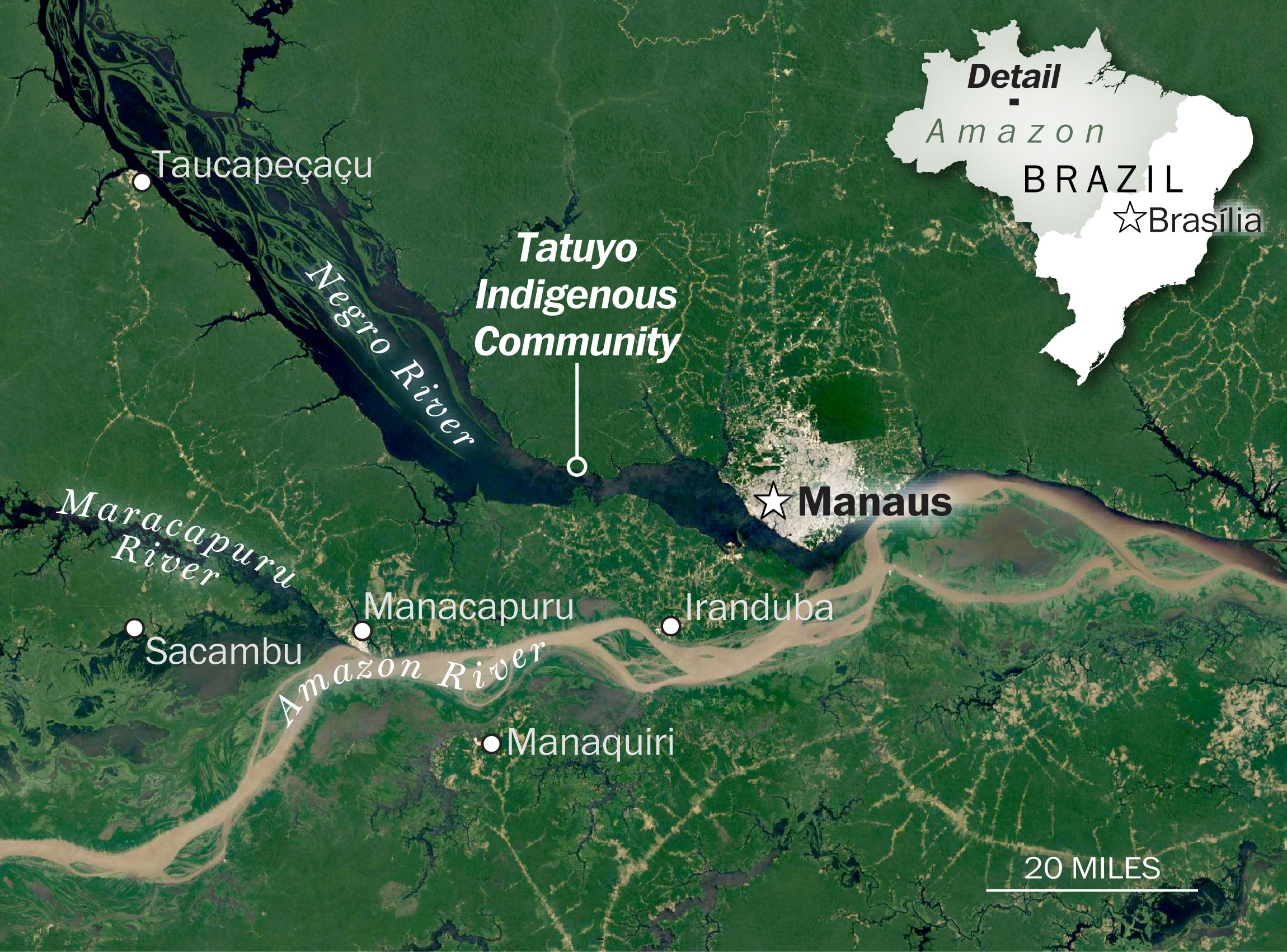
Terrence McCoy reported at the Washington Post, “In the middle of the Amazon forest, along the banks of the Rio Negro, a young woman in face paint was bored. The coronavirus pandemic had cut off the flow of visitors, further isolating this Indigenous village, accessible only by boat. So Cunhaporanga Tatuyo, 22, was passing her days, phone in hand, trying to learn the ways of TikTok.

“She danced to songs, dubbed videos, wildly distorted her appearance — the full TikTok experience. None of it found much of an audience.

“Then she held up a wriggly, thick beetle larva to the camera.

‘People ask, “Cunhaporanga, is it true that you really eat larva?” ‘

“ ‘Of course we eat them! Do you want to see?’

“The bug met its end (‘Mmmhhh,’ Cunhaporanga said), and a new viral star was born — streaming from the most remote of locations. Cunhaporanga’s home is a cluster of thatched-roof huts along the river’s edge, surrounded by nothing but Amazon jungle. The dozens of residents who live here are fellow members of the Tatuyo people. They paint their faces in bright red, wear elaborate feathered headdresses, live alongside squawking macaws that Cunhaporanga warns should not be mistaken for pets, and survive off whatever they can grow or catch.

“All of it is now a vivid backdrop for what has become one of the most dynamic and fastest-growing social media presences in Brazil. In little more than 18 months, Cunhaporanga has collected over 6 million TikTok followers, simply by showing scenes from her everyday life. To her, the activities she posted were unremarkable. But for her growing audience,they brought into sudden intimacy a world that could not have seemed more distant.

“Cunhaporanga offering a bowl of larvae to her family to eat: 6.7 million views. Cunhaporanga brandishing a tool used to make cassava flour: 16.1 million views. Cunhaporanga dancing on the pristine banks of the river — it’s still TikTok, after all — to a viral pop song: 4.1 million views.

“As social media reaches into the Amazon rainforest, one of digital media’s final frontiers, it is opening an unprecedented window into Indigenous life, clearing away the barriers once imposed by geography. For the first time, some of the planet’s most isolated peoples are in daily communication with the outside world without the traditional filters of journalists, academics or advocates.

“ ‘This is an important opportunity,’ said Beto Marubo, a member of the Marubo people, whose village just got the Internet and is already going viral. ‘The Brazilian people don’t know Indigenous people, and from this lack of information has come all sorts of terrible stereotypes like Indigenous people are lazy or indolent or unhappy.’

“The digitalization of Indigenous life is now colliding with some of Brazil’s most powerful political currents. President Jair Bolsonaro rose to power lamenting the size of Indigenous territories and advocating that they be opened up to business interests. … ‘Indians don’t speak our language, don’t have money, don’t have culture,’ Bolsonaro said in 2015 as he publicly plotted a run for the presidency. … ‘How did they come to have 13 percent of the national territory?’

“On one slice of that Indigenous land last month, Cunhaporanga — who speaks flawless Portuguese and considers herself to be fully Brazilian — was walking in the sun, TikTok on her mind. She wanted to continue to show her people’s culture but didn’t know how long she’d be able to. …

“ ‘It’s really expensive,’ she said, still unsure about how to earn much on a platform that’s often difficult to monetize. Some followers have donated a few bucks here and there, but not much. …

“She knows larvae are viral gold. Nearly every video of the squirmy little critters, which are harvested from an Amazonian palm tree and allegedly taste like coconut, brings in millions of views. But when she published that first video, they were, to her, just everyday food — as basic as flour or fish.

“She was stunned by the response: Within hours of the video’s posting, more than a million people had watched.”

More at the Post, here.

Read Full Post »

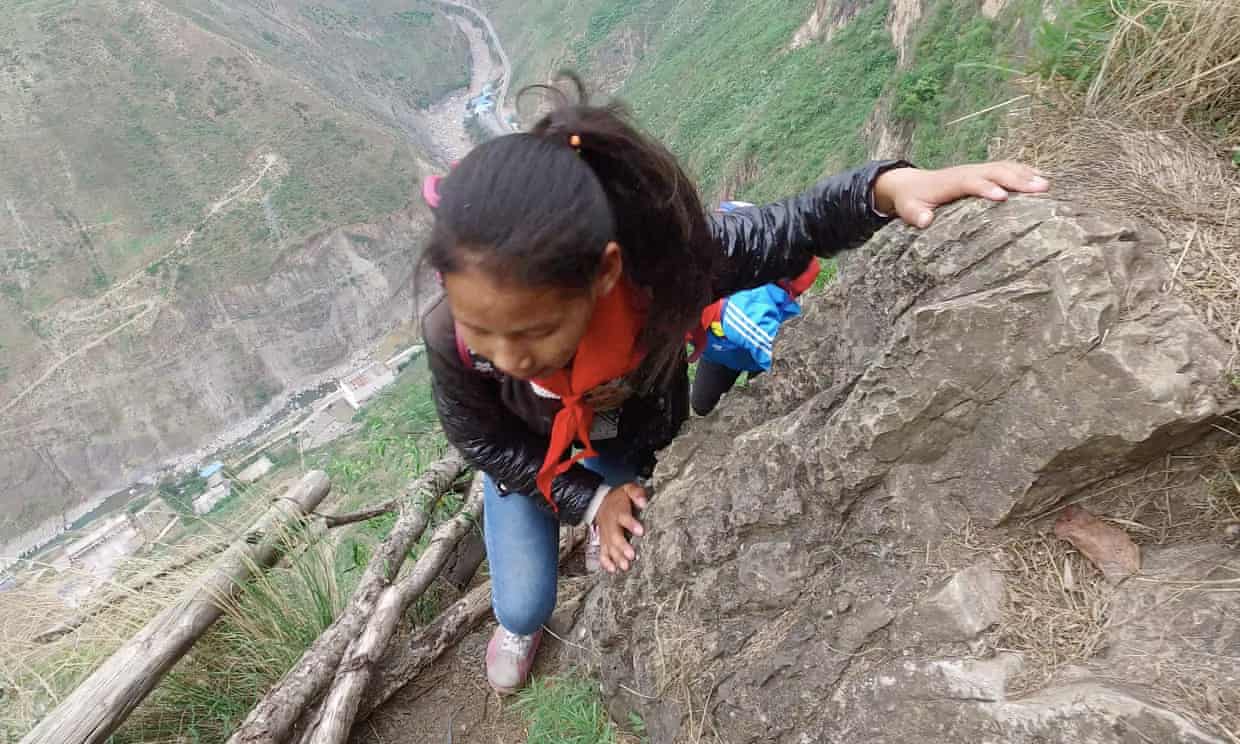
Photo: Feature China/Barcroft Images.
“There are 17 vine ladders on the 800-metre-high way home, but the most dangerous part is a path on the cliff without a vine ladder.In 2016, the Guardian reported this story on children as young as six going to school from Atuler village in Sichuan.

In one of the online English classes where I volunteer, the teacher likes to provide unusual news stories for our adult students to practice their reading on. Recently she gave the class an article from 2016 that astounded us all. After class, I searched online for a follow-up.

In 2016, Tom Phillips wrote at the Guardian, “To attend class, backpack-carrying pupils from Atuler village in Sichuan province must take on an 800-metre rock face, scrambling down rickety ladders and clawing their way over bare rocks as they go.

“Images of their terrifying and potentially deadly 90-minute descent went viral on the Chinese internet [after] they were published in a Beijing newspaper. The photographs were taken by Chen Jie, an award-winning Beijing News photographer. …

“Chen used his WeChat account to describe the moment he first witnessed the village’s 15 school children, aged between six and 15, scaling the cliff. ‘There is no doubt I was shocked.’ … Chen, who spent three days visiting the impoverished community, said the perilous trek, which he undertook three times, was not for the faint of heart.

‘It is very dangerous. You have to be 100% careful,’ he told the Guardian. ‘If you have any kind of accident, you will fall straight into the abyss.’

“So steep was the climb that Zhang Li, a reporter from China’s state broadcaster CCTV who was also dispatched to the mountain, burst into tears as she attempted to reach Atuler village. ‘Do we have to go this way?’ the journalist said as her team edged its way up the cliff face. ‘I don’t want to go.’

“Api Jiti, the head of the 72-family farming community which produces peppers and walnuts, told Beijing News there had been insufficient room to build a school for local children on the mountaintop.

“But the perils were evident. The villager chief told the Beijing News that ‘seven or eight’ villagers had [died] after losing their grip during the climb while many more had been injured. He had once nearly fallen from the mountain himself.

“The trek to school is now considered so grueling that the children have been forced to board, only returning to their mountaintop homes to see their families twice a month.

“Villager Chen Jigu told reporters the wooden ladders used to move up and down the mountain were, like the village, hundreds of years old. ‘We replace a ladder with a new one when we find one of them is rotten,’ he said.”

In the Insider follow-up story, we learn that the government came to the rescue, although not everyone agreed to move. Michelle Mark wrote, “The Chinese government has resettled 84 households who once lived in a remote village at the top of a 2,624-foot cliff.

“The village made international headlines in 2016, after harrowing photos showed young children climbing down the cliff to go to school, descending rickety ladders made of vines and scaling narrow paths without any guardrails or safety devices.

“The villagers have since been moved into apartment buildings near the town center of Zhaojue County in the province of Sichuan, according to the state-run broadcaster CGTN.

“The broadcaster quoted one villager who said Atule’er residents drew lots for their new homes — [the villager] said he was allowed a 1,076-square-foot dwelling because there are five people in his family, and that he was looking forward to accessing services in the new area that were previously unavailable to him. …

“The resettlement of the Atule’er villagers is reportedly part of a broader campaign to house impoverished families in remote villages. The Zhaojue County site is expected to soon house more than 18,000 residents from 4,057 households, according to CGTN.

“Despite the efforts, not all Atule’er villagers were willing to leave their homes. CNN reported that 30 households intended to stay in their clifftop homes, partly due to a newfound tourist economy. Roughly 100,000 people visited Atule’er in 2019, creating some $140,000 in revenue for the village”!

More at the Guardian, here, and at Insider, here.

Read Full Post »

Photo: Mile Marker One.
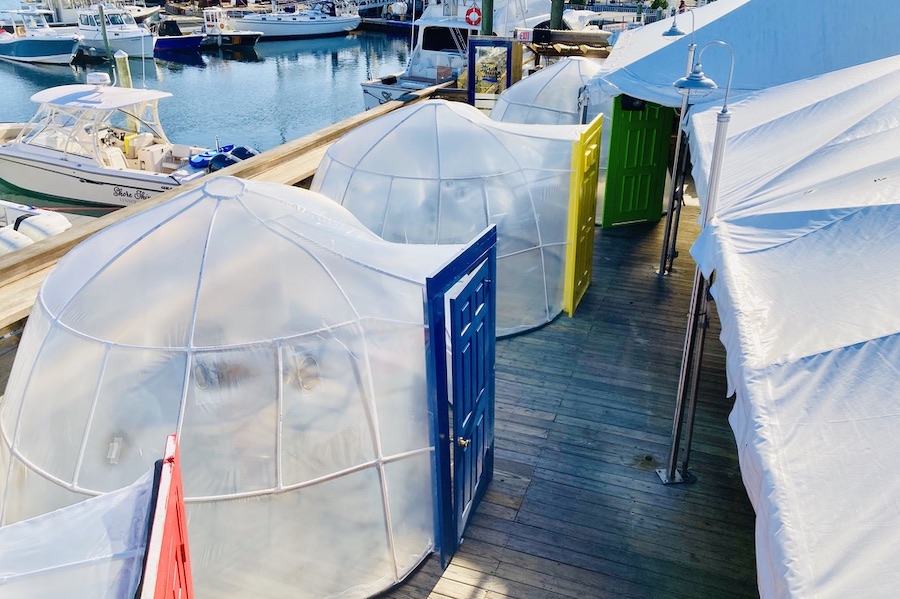
Igloos at Mile Marker One restaurant in Ipswich, Mass.

Plenty of people I know are eating indoors at restaurants again, but I’m still too Covid-phobic. I want to support restaurants by doing takeout, but I am not going to take off a mask indoors unless I know that everyone in the building is triple vaccinated.

One innovation during the pandemic has been the tent for outdoor dining. Although some of those tents look too enclosed for your faithful hypochondriac, I thought it was interesting to read what Carolina A. Miranda had to say at the Los Angeles Times about their evolution.

She wrote, “Over the course of the last year, I’ve eaten enchiladas in a party tent. I’ve gotten COVID-tested in a party tent. I spent a night dancing to house music in a party tent. I’ve seen party tents double as retail shops, church naves, gymnasiums and outdoor living rooms. …

“Last year, as the pandemic isolated us into our respective domestic cocoons, designers took to their AutoCAD to imagine a brave new world of design ‘solutions’ for the pandemic. These included wearable head-to-thigh social distancing shields and space-age cones [But] we’ve learned infinitely more about how to rethink the design of our buildings from the pandemic’s most prominent workhorse: the party tent. …

“It can be staked into soil or anchored on pavement. The simplest models, a standard canopy, can shield you from the sun; more protective ones come with collapsible walls that can be adapted to the weather as needed. …

“The party tent is symbolic of all the other improvised architectures that have arisen during the pandemic: the parking lots turned into eating spaces with twinkle lights and umbrellas; the wooden dining platforms crafted out of plywood and two-by-fours; the izakaya on La Brea whose collapsible walls are actually transparent shower curtains. In Echo Park, Misty Mansouri, the owner of the Lady Byrd Café, has turned an impractical triangle of concrete on her property into an al fresco dining room courtesy of an ebullient agglomeration of Christmas trees and portable greenhouses employed as individual dining pods.

“Temporary structures can even be found in hyper-glam iterations — like the space-age, vented dining pod at Wolfgang Puck’s Spago in Beverly Hills. A 6,500-square-foot modular dining room constructed in the middle of Canon Drive, it was created by VX Design Solutions, a custom fabrication studio, and Choura, an event production company, and was assembled in less than a week. That structure opened in March 2021 and is still going strong. ‘We fill it up every single day,’ says Steve Scott Springer, the restaurant’s general manager.

“Party tents may not be around for the long haul, but they have qualities that are worth integrating into the hardscape of our cities. They offer flexibility and permeability and serve as a reminder that in the mild Southern California climate we don’t always need to encase ourselves in hermetically sealed cells of HVAC. If well-building design issues such as fresh air and sunlight had been gaining currency before the pandemic, COVID-19 and its many variants have made it a matter of urgency.

“ ‘Being able to kick open the doors makes people who are inside those doors feel so much better,’ says architect Oonagh Ryan, founding principal of ORA, an L.A.-based studio that has worked extensively in the commercial and hospitality sectors. ‘And operable windows, those are key.’

“One of ORA’s most recent projects is the design of Agnes, a popular Pasadena comfort food outpost that also contains a cheese shop. Housed in a 1920s stable once employed by the Pasadena fire department, the bulk of the restaurant’s design was conceived before COVID, but a number of programmatic choices made since the pandemic began have helped make the space more resilient.

“The key is flexibility. The street-facing side has operable windows and the rear of the dining room has sliding doors that can be propped open to connect with a patio out back, drawing fresh air through the building. A private dining room likewise opens to the elements. The patio, which harbors additional seating, is protected by a weatherproof canopy that can be pulled back when the weather is mild. It’s an outdoor space that can be used come rain or come shine. And the furniture isn’t fixed, so it can be reconfigured into different densities. …

“When the restaurant opened in June, the surge of COVID-19 infections had tapered off and indoor dining had resumed. But the pandemic made the coming months wildly uncertain, meaning that the design needed to be responsive to shifting health directives. ‘If the pandemic was still going strong,’ Ryan says, ‘we had a plan for how we could rearrange everything into more retail.’ ”

“If the pandemic was still going strong.” Is it? Who knows?

You get several free articles at the LA Times, here, if you’re not a subscriber. I think you will enjoy the variety of party tents in the photos.

Read Full Post »

Photo: Randall Hyman.
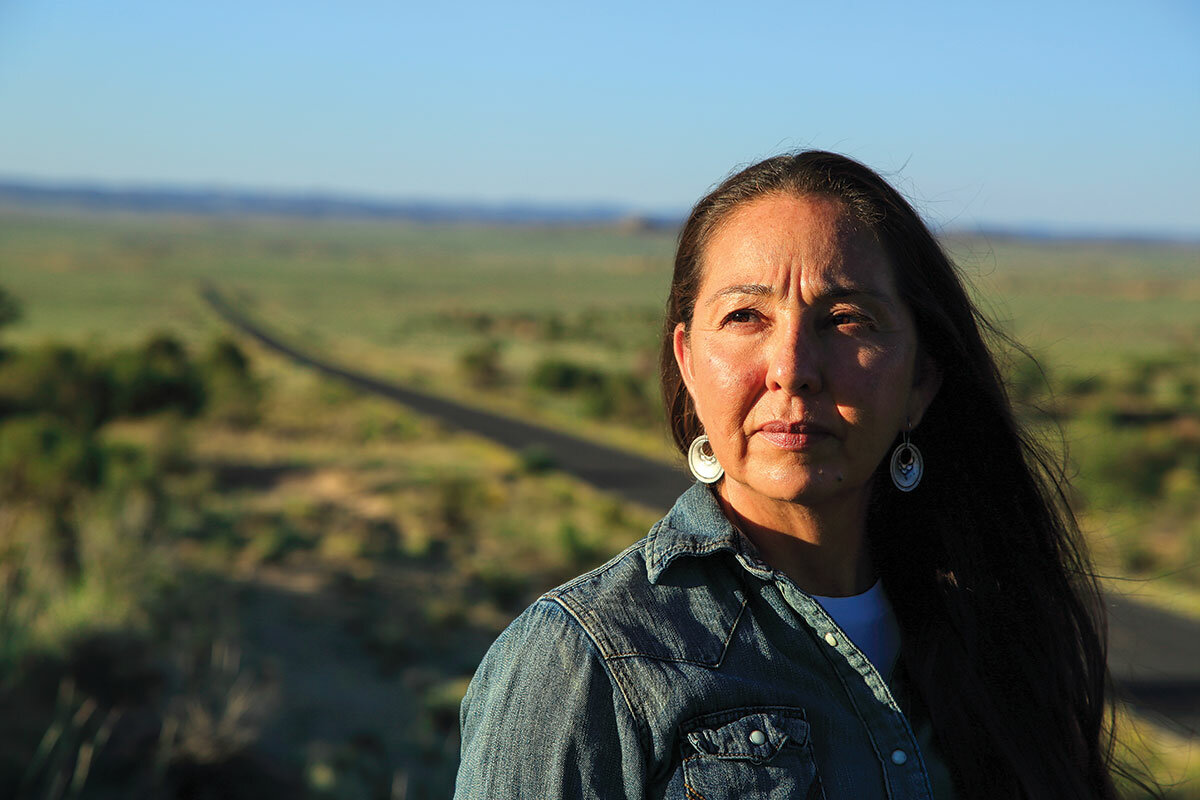
The Christian Science Monitor: “Activist Nicole Horseherder, who heads a nonprofit that seeks to protect water supplies on the reservation, stands on a ridge near Black Mesa in northern Arizona, the site of past disputes over coal mining.”

I’m grateful for the environmental leadership of indigenous people. They were environmentalists centuries before anyone used that word, and I think that paying attention to them will help us learn how to protect our planet.

Randall Hyman reports at the Christian Science Monitor about Navajo women who instinctively understand the importance of the natural world and their community’s place in it — and who don’t give up.

“One who has a master’s degree in linguistics,” Hyman says, “has made green energy a crusade on a reservation where coal, gas, and uranium have reigned supreme for decades, leaving tainted groundwater in their wake.

“Another returned to the Navajo reservation from Chicago to find that fracking had marred large sections of her native land – something she now works to stop in one of the largest methane hot spots in the United States. 

“A third was so distraught by the lack of ballot access on the reservation that she organized getting voters to the polls on horseback – her version of saddle-up democracy. 

“Two others have immersed themselves in politics directly – one as the youngest member of the Arizona State Legislature and the other as one of three women on the 24-member Navajo Nation Council. …

“Their efforts come at a particularly fraught time. Last year, from the vermilion sands bordering the Grand Canyon to the oil-rich scrublands east of Chaco Canyon, the Navajo Nation was hit by a perfect storm – a convergence of soaring pandemic deaths, dwindling energy revenues, and rising unemployment. Amid the chaos, Native women stepped up in what some see as an unprecedented wave. While one COVID-19 relief group raised $18 million in a matter of months, other women redoubled efforts to dismantle policies that have left Navajo (Diné) people vulnerable. 

“ ‘I think that you’re actually seeing a return to the way that Diné society has always been,’ says Nicole Horseherder, executive director of Tó Nizhóní Ání (Sacred Water Speaks), an organization pushing for new energy policies and water protection across the Navajo Nation. ‘Women are coming forward and saying, “I am a leader too. I can make these decisions. I can make better decisions.” ‘ …

“Underneath all the narratives is another factor – the dominant presence of women in Navajo society, where taking charge is rooted in a matrilineal culture. 

“ ‘When you see the destruction in your community, you realize you have to do something,’ says Wendy Greyeyes, assistant professor of Native American studies at the University of New Mexico in Albuquerque. ‘So, women are empowered. A lot of that harks back to our own creation stories. Changing Woman was a very powerful deity who reflected thinking about the longevity of our existence, of the Diné people. This ideology is baked into our DNA as Navajo women – our need to care and nurture and protect our communities, our families.’ …

“A year ago, on a chilly December morning, Nicole Horseherder marked an explosive turning point in her long battle against coal mining. Standing on a slope overlooking the towering smokestacks of the coal-fired Navajo Generating Station in northern Arizona, Ms. Horseherder set her cellphone on livestream and gazed at the 775-foot monoliths glowing in the sunrise a mile away.

“The stacks had been a landmark of the high desert for nearly half a century, symbols of fleeting prosperity and persistent pollution. The power plant serviced major cities of the Southwest and ran the huge Colorado River pumps supplying much of their water, but was among the top 10 carbon emitters in the United States. At precisely 8:30 a.m., a thunderous rumble shattered the clear morning and clouds of smoke mushroomed as 1,500 pounds of dynamite collapsed the stacks. …

“When I caught up with her last August on the Second Mesa of the Hopi reservation deep within the encircling borders of the Navajo reservation, [Horseherder] recalled her journey’s start. Driving to an overlook, she pointed north toward distant Big Mountain. For her, it stirred painful memories. 

“Ownership of the hardscrabble land surrounding Big Mountain, called Black Mesa, had long been an unresolved intertribal treaty issue. It remained in limbo until the 1950s and ’60s, when a Utah lawyer named John Boyden persuaded a minority of Hopi litigants to take it to court.

“True to its name, Black Mesa is underlain by rich coal seams. It is also sacred to the Navajos and Hopis, many of whom opposed outsiders tapping their minerals. But the lawsuit prevailed, eventually forcing the removal of some 10,000 Navajo residents while dividing mineral rights equally between the tribes. Boyden subsequently leased land and mineral rights for Peabody coal company. A half-century of coal mining and environmental controversy ensued. 

“Ms. Horseherder’s epiphany came when she returned home from Vancouver, British Columbia, with a master’s degree in the 1990s and discovered that her dream of leading a pastoral life had turned to dust. The springs that her family’s livestock depended on had run dry. ‘My whole attention and focus shifted,’ says Ms. Horseherder. ‘It became, “How am I going to protect the place where I live – how am I going to bring the water back? And where did the water go in the first place? ” ‘

“Ms. Horseherder became a vocal activist and founded Tó Nizhóní Ání, or Sacred Water Speaks. At the time, Peabody was pumping billions of gallons of water from deep aquifers, mixing it with pulverized coal, and sending the slurry through 273 miles of pipeline to a Nevada power plant. It assured tribal officials that the technology was safe, and many supported the operation because coal mining was a pillar of the Navajo and Hopi economies for nearly 50 years, providing tax revenues and well-paying jobs. 

“But environmentalists contended that depressurizing the aquifer was lowering the water table. While Ms. Horseherder fought Peabody for years – and others lost scores of animals to stock ponds they said were tainted by slurry – the power plant and related activities were only closed when the economics of the operations no longer worked. Wells never recovered, and impacts endure to this day, critics say. ‘What we’d like to see them do first,’ she says, ‘is fully reclaim those lands that they’ve mined, and reclaim the water as well.’ “

More at the Monitor, here.

Read Full Post »

Photo: Earthshot.
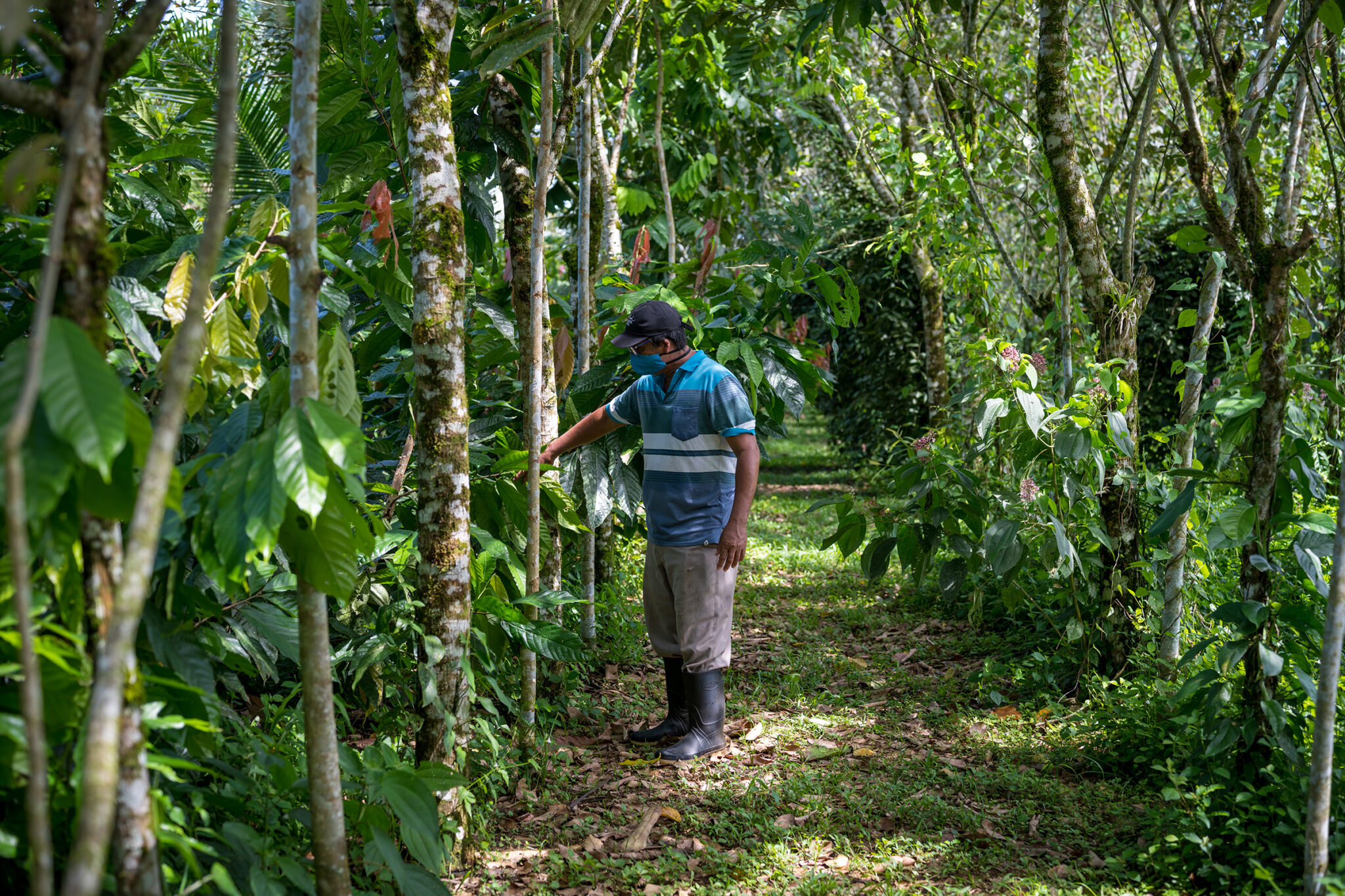
Costa Rica won a Earthshot prize for its success reversing damage to tropical forests by incentivizing landowners to leave unused land alone.

I really liked this story about an effort in Costa Rica that is helping restore tropical forests. A study says that although “it’s not a license to kill” forests, they can come back eventually if humans just leave them alone to heal.

Tik Root writes at the Washington Post, “Deforestation is a global and accelerating threat. But new research shows that tropical forests can recover naturally and remarkably quickly on abandoned lands.

“The study, published [in] the journal Science, found that under low-intensity use, soil on previously deforested land can recover its fertility in less than a decade. Characteristics such as the layering of plants and trees in a forest, as well as species diversity, came back in about 25 to 60 years.

“ ‘I was totally surprised how quickly it went,’ said Lourens Poorter, an ecologist at Wageningen University in the Netherlands and lead author on the paper.

‘These forests can recover very fast and they can do it by themselves.’

“Burgeoning secondary forests are good for the climate as well. They are able to sequester more carbon dioxide from the atmosphere than established forests; like the voracious food intake of a sprouting teen compared to that of an older adult.

“ ‘It does provide a glimmer of hope for this process of tropical reforestation,’ said Meg Lowman, a conservation biologist and author of The Arbornaut: A Life Discovering the Eighth Continent in the Trees Above. ‘My only caution is that I don’t think it’s ever a substitute for the importance of saving big trees and old growth forests.’

“Older forests ultimately store more carbon dioxide than young forests, and deforestation releases those stockpiles, which helps drive climate change. The study found that it took more than a century for the overall biomass of tropical forests — and thus their carbon storage ability — to return fully. The recovery of a forest’s species makeup lasted a similar period.

“The longer time frame for the revival of these key benefits is among the reasons that Poorter says maintaining current forest cover is crucial. ‘First, stop deforestation and conserve old growth forests,’ he emphasized. The fact that deforested land can recover ‘is not a license to kill.’

“A 2019 study estimated that some 5.5 million hectares of tropical forest — an area more than twice the size of Belize — is lost each year to expanding commercial cropland, pastures and tree plantations. But cleared land is often abandoned as cultivation shifts, said Poorter, and researchers wanted to know, ‘Can it recover?’

“The answer is yes. … The subsurface soil, for example, often remains relatively vibrant after deforestation, which enables a faster recovery. The warmth and humidity of the tropics also allow trees to grow extremely fast, with some species climbing more than a dozen feet per year.

“And this all happens largely without human intervention, Poorter said. Seeds, roots and stumps embedded in the soil, or the spread of plants from adjacent forests, kick-start the recovery process. … ‘The conditions are that there has to be nearby forests, and the soil can’t be too degraded.’ “

The Post article continues with Daniel Nepstad, a tropical ecologist and president of the San Francisco-based Earth Innovation Institute, who says, ” ‘The research bolsters the policy argument for a nature-based approach to forest restoration. The cheapest way to get forest back on the land is to let nature do the work.’

“He would encourage governments to incentivize farmers and landowners to protect secondary forests and promote regrowth.

“Organizations such as the Natural Capital Project advocate for similar approaches to ecosystem services restoration. Costa Rica recently won Prince William’s Earthshot Prize for a program that helps reverse deforestation by paying farmers to protect and reforest their land. …

“This paper drew on 77 sites in three continents, comprising 2,275 plots and 226,343 stems.”

More at the Post, here.

Read Full Post »

Photo: KSTP.
Violence interrupters in Minneapolis (above) made 1,400 contacts with community members between May and November and successfully mediated 210 incidents that threatened to escalate into gun violence, according to a city official. Other interrupters may be elderly church members sitting in chairs at key locales.

In a recent opinion piece in the Washington Post, Louis King and Jerry McAfee write about “interrupters,” who work to stop gang violence. Louis King is president and chief executive of Summit Academy OIC in Minneapolis. Jerry McAfee is pastor of the city’s New Salem Missionary Baptist Church.

They write, “On May 28, Gloria Howard, an elder with Shiloh Temple, opened a lawn chair and sat down on one of the most dangerous street corners in North Minneapolis. Every day since, as part of the 21 Days of Peace community organizing project, she and others like her in our city have sat on street corners that are threatened by violence. Through the simple act of publicly taking a seat — staking their claim to a peaceful neighborhood by interrupting violence — they have undoubtedly saved lives.

“The campaign began after three children were shot in Minneapolis over a period of a few weeks this spring [and one]was critically injured.

“Tragic stories such as theirs are occurring in cities across the country, as alarm bells ring in city halls and state capitols about rising violent crime. The problem is due in large part to a loss of trust between communities and law enforcement; disinvestment in neighborhoods and schools where more help, not less, is needed; and decades of failure to keep guns off the streets. …

“Too many leaders are responding by adopting a Nixonian ‘tough on crime’ stance — which usually translates into over-policing and under-supporting these communities. That is a shortsighted non-solution — George Floyd’s murder beneath the knee of a police officer in Minneapolis last year can be traced directly back to policies that respond to crime by emboldening and insulating the police from the community rather than encouraging deeper engagement with the community.

Being a violence interrupter isn’t the only answer, but it is clearly helping in Minneapolis.

“In late May, we joined dozens of community members like Howard as churches and neighborhood associations mobilized in the effort called 21 Days of Peace — based on the idea that it would take at least three weeks for habits to start changing.

“Our group asked the Minneapolis Police Department to identify the most dangerous spots in our neighborhood, the 4th Precinct, and then we went there, pulled out our chairs and sat down. For the past three months, we have conferred daily with the precinct about the number of volunteers (two to 15, usually) and hours needed. We work in shifts, using a sign-up log online. In the winter, we’ll work on relationship-building with young people in the community.

“The precinct’s police inspector, Charlie Adams, tells us that since 21 Days of Peace began setting up in the Northside in ‘hot spots,’ the precinct ‘has seen a reduction in violent crimes in those areas.’ …

“The city’s overall violent-crime statistics have improved across the summer. In June, homicides in Minneapolis declined from June 2020, the first such drop this year. Then the same thing happened in July and August. …

“What makes this simple act of sitting apparently so powerful?

“The people sitting on these corners in their chairs are members of the community. We know our young people, and they know us. But more important, we represent one of the strongest bastions of moral authority left in these areas: the Black church. We draw on the power of congregation — of family, of friends and of community — to try to interrupt the violence.”
Read about other groups doing this work in other cities at the Post, here.

Read Full Post »

Photo: Goldman Environmental Prize.
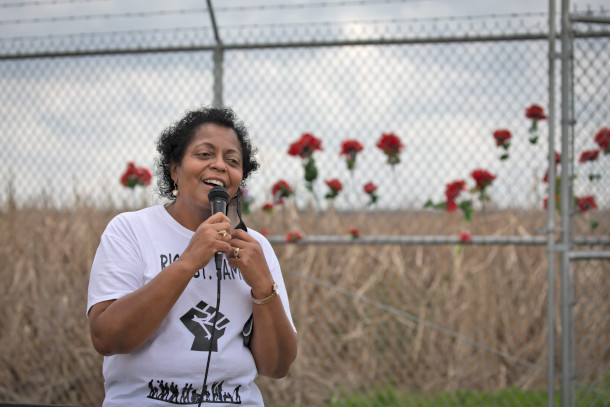
Founder of RISE St. James and 2021 Goldman Environmental Prize winner Sharon Lavigne speaks at the first annual African American Celebration at the grave site of enslaved ancestors at the Buena Vista Cemetery. The land was purchased by Formosa Plastics for a proposed petrochemical complex.

Ever since textile artist Jamie Bourgeois did a fabric-dying experiment with the polluted waters around Louisiana’s Cancer Alley, I’ve been supporting the Louisiana Bucket Brigade and Rise St. James — grassroots nonprofits fighting back against industries like Formosa Plastics.

So I was delighted to see that radio show Living on Earth interviewed a leader of that fight.

“In the aftermath of Hurricane Ida, the communities of the Louisiana region known as ‘Cancer Alley’ were left to deal with destroyed homes, no electricity, and polluted water. That’s on top of the toxic air they breathe every day because of industrial pollution, and Black residents have been fighting for environmental justice there for decades.

“Sharon Lavigne is the founder of RISE St. James and a 2021 Goldman Prize recipient for her work in organizing against a massive Formosa plastics plant, and she joins Host Steve Curwood to discuss the hurricane’s impacts and the health effects of industrial pollution in her community.

“STEVE CURWOOD: The climate emergency is in a downward spiral, as President Joe Biden recently observed when he visited areas hit hard by Hurricane Ida and its aftermath. …

“The poor and disadvantaged are especially hard hit from big cities to places like former farmland along the Mississippi. This 85 mile stretch between Baton Rouge and New Orleans is called Cancer Alley, and it’s the site of some of 150 petrochemical plants, a notorious source of toxic chemicals for locals on a normal day. But in the aftermath of Hurricane Ida many plants released even more pollutants than average as they dealt with high winds, high water and as much as 15 inches of rain.

“Many residents of this region are low income, descendants of the Black slaves who once toiled on the vast sugar plantations of the lower Mississippi. … Sharon Lavigne lives on land bought by her grandfather in St James Parish. She retired as a special education teacher to devote herself full time to advocacy as founder of RISE Saint James, an environmental justice group working to stop even more toxic industrial development in cancer alley. Her organization and others sued Formosa, a Taiwanese company that wants to build an ethane cracking plant nearby. That prompted the Army Corps of Engineers and the courts to require an updated environmental impact statement of the facility and earned Sharon the 2021 Goldman Environmental Prize for North America. …

“SHARON LAVIGNE: I live on the west bank of the Mississippi River in St. James Parish, and Hurricane Ida, it just, it has so much destruction. So many homes have their roof off. Some of the homes are totally demolished. And when it came, it stayed here while it didn’t move fast like it normally moves like hurricanes normally move. So this one was the worst I have ever experienced. …

“In the master bedroom, over half a room, the insulation, and the sheet rock is all on the beat, the carpet is wet. Everything is, I hope, I hope I can salvage the furniture, because that was my mother’s bedroom set. And I hope I can save it but we have to get all the stuff all insulation and sheet rock off of it first, to see how much we can save. … We don’t have electricity right now. We don’t have anything. …

“CURWOOD: Sharon, I understand you’re the founder of RISE St. James. That’s its a grassroots environmental organization. You mobilized against this $12.5 billion plastics manufacturing plant. Now what kinds of toxic pollutants [went] into release? What were the chemicals involved?

“LAVIGNE: Benzene. Benzene is one, and that’s cancer causing. Formaldehyde. There’s a whole bunch of chemicals, a whole lot of greenhouse gases that they’re going to release in the air and into the water. … Even though we have twelve refineries and industries in the fifth district where I live. They don’t care. They want to add some more to us. So once they add this industry to us, we’re not going to be able to live. It’s going to be too much in the air for us to breathe and live. We are having trouble breathing. Now we have people with asthma. We have people with all all types of respiratory illnesses. We have people with cancer all up and down this river. …

“And our governor approved this industry. Our parish officials approved this industry and they live here in St. James. That’s the part that hurt me, because they live here with us. … I don’t care if I don’t have any money. I’m going to fight for my community. And this is where I’ve been all my life. And this is where I want to stay. …

“CURWOOD: What about the location of this plant? …

“LAVIGNE: This plant would be two miles from my home. It would be one mile from a church and a school, public school. And that’s when I said no more. … I didn’t know how many we had, to be honest with you, until I went to a community meeting. And when I went to that meeting, I found out so many things that were going on, and all the chemicals and the people that were sick. One lady was on oxygen and she had cancer. … I said, I asked them, ‘Why don’t we fight from Formosa?’

“And they said, ‘Oh, the governor approved that. And they said the parish council is gonna approve it too and once they approve it, it’s a done deal. There is nothing you could do about it.’ And I told them, ‘We need to do something about it because we have too many. And they said, ‘Oh, Sharon, you are wasting your time. You can’t fight industry.’ …

“I prayed and I asked God what I should do. And he told me to fight. So that’s when I started to fight. I didn’t know what to do to fight. I didn’t know how to do this, this type of thing because I was never involved in involved in environmental issues, I was never involved in anything in the parish. We formed RISE St. James in October of 2018. Then we started meeting other organizations in New Orleans and different places, in that we formed a coalition and we called it Coalition against Death Alley. …

“The governor came down here in 2019, November 1st. … When somebody came to me, and asked me if I will speak to the governor, I said, ‘Sure, I sure would.’

“I said, ‘Governor, I would like you to stop Formosa. Don’t let it come into our neighborhood.’ And this is what he answered me: ‘I’m going to do a health study.’ … I was so hurt. I was so let down because he just threw it off like it was nothing.”

Then the community filed lawsuits. Read more at Living on Earth, here.

Read Full Post »

Photo: Mark Boss.
The Hoover Dam on the Colorado River, on the border between Arizona and Nevada, is one of the 2,400 hydroelectric plants that produce energy in the United States.

I toyed with calling this post “The Farmer and the Cowman Should Be Friends,” from a song in Oklahoma, but I didn’t think anyone besides Will would get it. I just wanted to convey the idea that when opposing sides negotiate in good faith, it’s possible to come to mutually satisfactory agreements. In the case of the energy-sector and environmental adversaries in today’s story, it took a couple of years.

Brad Plumer at the New York Times begins by saying, “The industry that operates America’s hydroelectric dams and several environmental groups announced an unusual agreement [in 2020] to work together to get more clean energy from hydropower while reducing the environmental harm from dams, in a sign that the threat of climate change is spurring both sides to rethink their decades-long battle over a large but contentious source of renewable power.

“The United States generated about 7 percent of its electricity [in 2019] from hydropower, mainly from large dams built decades ago, such as the Hoover Dam, which uses flowing water from the Colorado River to power turbines. But while these facilities don’t emit planet-warming carbon dioxide, the dams themselves have often proved ecologically devastating, choking off America’s once-wild rivers and killing fish populations.

“So, over the past 50 years, conservation groups have rallied to block any large new dams from being built, while proposals to upgrade older hydropower facilities or construct new water-powered energy-storage projects have often been bogged down in lengthy regulatory disputes over environmental safeguards.

“The new agreement signals a desire to de-escalate this long-running war. In a joint statement, industry groups and environmentalists said they would collaborate on a set of specific policy measures that could help generate more renewable electricity from dams already in place, while retrofitting many of the nation’s 90,000 existing dams to be safer and less ecologically damaging.

“The two sides also said they would work together to accelerate the removal of older dams that are no longer needed, in order to improve the health of rivers. More than 1,000 dams nationwide have already been torn down in recent decades.

“The statement, the result of two years of quiet negotiations, was signed by the National Hydropower Association, an industry trade group, as well as environmental groups including American Rivers, the World Wildlife Fund and the Union of Concerned Scientists. Another influential organization, The Nature Conservancy, listed itself as a ‘participant,’ signaling that it was not prepared to sign the full statement but would stay engaged in the ongoing dialogue over hydropower policies.

“Bob Irvin, the president of American Rivers, which has long highlighted the harm that dams cause to the nation’s waterways, said that growing concern over global warming had caused some environmentalists to reassess their longstanding opposition to hydropower.

“ ‘The climate crisis has become a lot more acute and we recognize that we need to generate carbon-free energy whenever and wherever we can,’ Mr. Irvin said. ‘And we do see that hydropower has a role to play there.’

“Mr. Irvin emphasized that his group would still oppose any effort to build new dams on rivers. But that still left plenty of room for compromise.” More at the Times, here.

Devon Ryan has an update from the Stanford Woods Institute for the Environment, where the work of compromise took place: “Key ideas and proposals from an agreement between the hydropower industry and environmental community, facilitated through a Stanford Woods Institute for the Environment Uncommon Dialogue, have been included in the $1 trillion infrastructure package adopted by the U.S. Senate.

“President Biden signed the infrastructure bill, ‘Infrastructure Investment and Jobs Act,’ into law on November 15, 2021, which included over $2.3 billion for the ‘3Rs’ dam infrastructure priorities set by agreements that came out of the Uncommon Dialogue led by Dan Reicher and hosted by the Stanford Woods Institute for the Environment.

In the fall of 2020, [amid] one of the most divisive periods in American history, the hydropower and river conservation communities, traditionally at odds, reached an agreement to work together to address the nation’s more than 90,000 dams.

“The momentous agreement was the result of a two-and-a-half-year Uncommon Dialogue, an ongoing process organized by the Stanford Woods Institute for the Environment that brings public and private sector leaders and researchers together to develop practical solutions to pressing sustainability challenges.

“Now, key ideas from that pact and a subsequent detailed proposal are incorporated into the bipartisan Senate infrastructure bill, including $2.3 billion for the ‘3Rs’ of U.S. dams: Rehabilitation for safety, Retrofit for power and Removal for conservation.”

More at Stanford, here.

Read Full Post »

Photo: Daniil Shvedov.
An eco-playground in the Gorkinsko-Ometyevsky Forest near Kazan.

The problem with headlines is that they tend to focus on bad stuff — a bad leader, say, planning bad moves in a country we know about only from headlines. But a leader can’t be everywhere all the time, and no country is a monolith. Especially not one as big and diverse as Russia.

Alex Ulam has a Bloomberg City Lab story about something going on way out in the semi-autonomous Russian republic of Tatarstan.

“In 2015, Natalia Fishman-Bekmambetova arrived in [Kazan] to oversee a large public works program. Then only 24 years old, she found a city with a population of 1.7 million, a renowned university, grand boulevards and major historic sites, including a Unesco-listed walled Kremlin from which Mongols once ruled.

“But Kazan also was a typical post-Soviet city — surrounded by drab concrete tower complexes and parking lots. Since the fall of the Soviet Union in 1991, little attention had been devoted to revitalizing derelict public open spaces or to building new ones.

“Six years after Fishman-Bekmambetova’s arrival, a massive initiative often referred to as a ‘green revolution‘ has dramatically reshaped this city 450 miles east of Moscow. Tatarstan’s Public Space Development Program, launched by Fishman-Bekmambetova and Tatarstan President Rustam Minnikhanov, has created or upgraded more than 420 projects throughout the republic, including parks, walkways, gardens and other kinds of landscaped areas.

“You don’t have to walk far in Kazan to see how the new public space program has changed the city. Near the center of the city is the Lake Kaban Embankments, designed by the Chinese-Russian consortium Turenscape +MAP and completed in 2017. The project transformed a formerly deserted postindustrial site around three lakes into a waterfront promenade with rows of trees, beds of wild grasses and wooden decks. At night, the area is illuminated by lights inside glowing red benches of diaphanous resin. Huge fountains rise on the lakes; restored wetlands help clean the once-heavily polluted water.

“Southeast of the city, Fishman-Bekmambetova’s team oversaw the rebirth of the 87-hectacre Gorkinsko-Ometevsky Forest, a new park that features a ski hill and an eco-playground along with preserved woodlands and performance spaces, located on a site where local activists successfully defeated the construction of medical centers and a planned road that would have bisected the park.

“The most ambitious project in the works for Fishman-Bekmambetova’s team is the Kazanska River Strategy, a plan for a 22-kilometer stretch of urban river and 68 kilometers of embankment running the entire length of Kazan; it’s one of the largest landscape projects in Russia. More at CityLab, here.

And while we’re feeling surprised about Russia, here’s a story by Fred Weir at the Christian Science Monitor about environmental action in the far north.

Arkhangelsk, a Russian region almost as big as France that borders the White Sea, is a land of permafrost and marshy tundra, with stunted Arctic forest, rolling hills, and labyrinthine lakes and rivers. It’s been inhabited by Russians for almost a thousand years; Indigenous peoples, some related to Finnish Laplanders, have been there much longer.

“People here are very conscious of history. Much of it revolves around their fragile Arctic habitat and the need to preserve it.

“About two years ago, mass popular protest forced Moscow authorities to abandon plans to build a giant waste dump near the village of Shiyes in this Arctic region that had been intended to receive 2 million tons annually of the garbage overflowing from heavy-consuming Moscow. The success of that ‘Stop Shiyes’ struggle launched a lasting ecological movement and ushered in the election of a more environment-friendly local leadership. It also planted surprisingly divergent ideas in some peoples’ minds about how to take that newfound consciousness and turn it toward a permanent transformation. ….

“For Oleg Mandrykin, a local real estate developer from the closed naval shipyard city of Severodvinsk, it served as inspiration to try and get into national politics in order to raise ecological awareness in Moscow. Anastasia Trofimova, an Arkhangelsk doctor, went a different direction, eschewing politics for [business]. And Alexandra Usacheva heads Clean North, a group that interfaces between the public and local authorities to promote ecological education.”

More at the Monitor, here.

Photo: Fred Weir.
Anastasia Trofimova, a doctor, in her shop in Arkhangelsk, Russia. She was inspired by protests against a proposed landfill to launch a business that sells around 700 products made from natural or recycled materials.

Read Full Post »

« Newer Posts - Older Posts »