Feeds:
Posts
Comments

Archive for the ‘Uncategorized’ Category

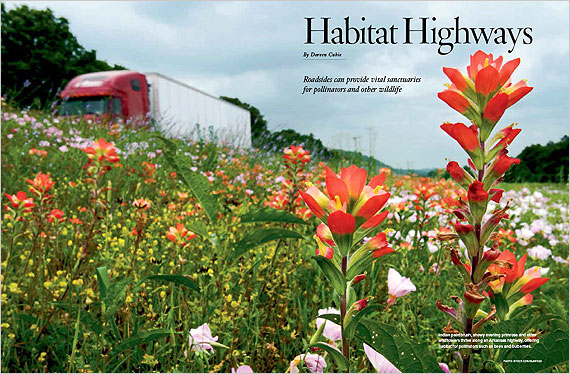
Photo: National Wildlife Federation.
More people are realizing that the 17 million acres of US roadsides are vital sanctuaries for pollinators and other wildlife.

Back in the day, when my mother was active in the Rockland County Conservation Association, I learned more about preventing soil erosion using Crown vetch along the new Thruway than any normal kid should be expected to know. Today the plant is considered invasive and the vision for highway landscaping has evolved.

A recent report from the radio show Living on Earth offers the latest thinking.

“Some 17 million acres of green space line US highways and byways, and it’s vital habitat for pollinators, as well as small voles and mice and birds. Bonnie Harper-Lore, a restoration ecologist formerly with the Federal Highway Administration, tells host Steve Curwood about the value they offer to wildlife and how President Lyndon Johnson’s wife, Lady Bird, helped uplift this elongated haven for creatures and wildflowers.

“CURWOOD: Clover is a crucial source of nectar for many pollinators, especially bees. And as national pollinator week is coming up on June 21, it’s a good time to think about the many ways we can help our endangered pollinators, starting with our highways. It turns out that medians and roadsides offer miles and miles of vital habitats for many pollinators, including bees and butterflies. Bonnie Harper-Lore was a restoration ecologist for the Federal Highway Administration, and is a member of the Commission on Minnesota Resources. Welcome to Living on Earth, Bonnie. … We’re talking about those strips of vegetation along the highways. There’s often commercial or residential property right behind them. So, nationwide, just how much of this habitat is there?

“HARPER-LORE: Well, I think the listeners will be surprised to find out that the area between the pavement and the right of way fence on county, state, and interstate highways adds up to a total of 17 million acres, possibly millions of acres of conservation opportunity. … I always saw roadsides from the beginning of my career 30 years ago as an opportunity to benefit wildlife, small wildlife, small birds, small mammals, and migrating birds also use these same corridors. So if they have places to find food and cover, they are all going to do better and their populations will continue to hold where we need them to hold.

“CURWOOD: By the way, I also understand that this roadside habitat has some of the most endangered habitat in various areas – like there are parts of the original prairie that are protected alongside roads, sort of by accident. You can sometimes find real old-growth trees. I mean, how much of a treasure trove is this territory?

“HARPER-LORE: Well that’s just it: We don’t have a complete inventory of all of our roadside vegetation.

I would indeed like to see [an inventory] because I think we would be surprised at how many remnants of these old forests, old prairies, old wetlands even do exist.

“We began doing a bit of that inventory in 1993 in California – found 19 remnants within a very short time and began protecting them, managing differently, not mowing and spraying as they had in the past. So there are some of these. I mean, it’s surprising that they do exist. I know Florida has also some endangered, I believe, pitcher plants that are growing in their rights of ways and they are now watching over them differently than they have in the past. So if we know they’re there we can do differently.

“CURWOOD: So, give us the big picture as to who are the partners in these pollinator conservation efforts.

“HARPER-LORE: Well, first of all, before President Obama visited Mexico and talked to President Nieto and Prime Minister Harper from Canada and they agreed to work together to protect Monarchs – before that point, there were actually a few states that were doing pollinator-focused efforts. Wisconsin comes to mind in that the Karner Blue butterfly is an endangered species, and they actually put together, I believe, a 20-member partnership quite a few years ago to protect the Karner Blue. [That] partnership was mostly private sector, but some state and county agencies, too. … Every state Department of Transportation basically does its own thing, makes its own priorities, but now that there’s been … a reauthorization act that actually supports pollinators, all of the states will start moving in that direction, especially if they know the public is interested. So public support needs to be there.

“CURWOOD: Tell me about the multistate project known as the I-35 corridor, and what’s been done in terms of Monarch protection there? …

“HARPER-LORE: Back in 1993, a group of six states asked the Federal Highway Administration, where I worked at the time, to work together and get some funding to support their effort to actually restore prairie along the I-35 corridor and to protect any remnants that already existed there. … It runs from Minnesota through Iowa, Kansas, Missouri, Oklahoma and Texas, therefore connecting Mexico to the edge of Canada and of course that’s where the Monarchs fly.

“CURWOOD: What other wildlife uses this roadside habitat? …

“HARPER-LORE: I’ve watched hawks, all kinds of raptors, sitting on the light standards along highways and signposts just waiting for lunch to materialize down there in the vegetation on the roadside. Yes, they do well there because there are lots of mice and voles, other small things possible, plus one that actually motivated reduced mowing here in the Midwest, pheasants and other waterfowl, different kinds of ducks will nest in these rights of ways. …

“It’s because of Lady Bird Johnson that my job even existed with the Federal Highway Administration. I was working for the Minnesota Department of Transportation establishing their wildflower program back in the 1980s when I got an invitation from Mrs. Johnson to come visit with four other states who were also interested in planting wildflowers and we sat and talked with her for two days, and the thing we didn’t know she would do — because she asked us what did we need to be able to do more — within that same year, she saw to it that there was an amendment to the transportation bill that requires all states to use certain percent, not a large enough percent, but a certain percent of their budgets on native wildflowers.”

More at Living on Earth, here.
Read Full Post »

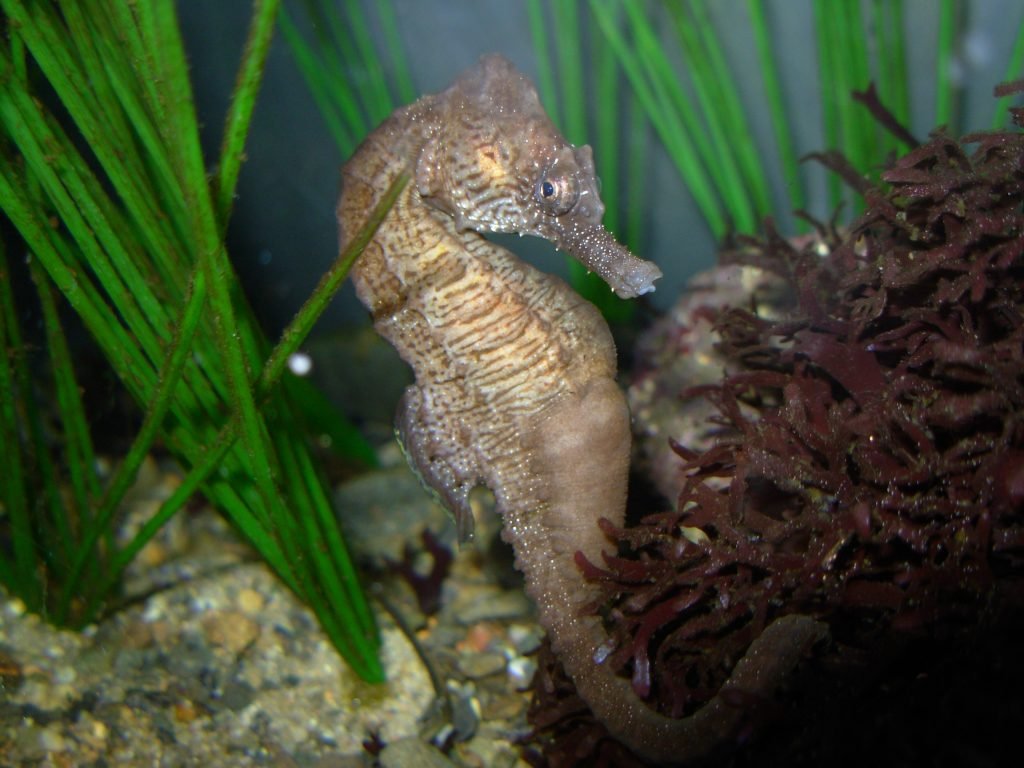
Photo: Seacoast Science Center.
The male seahorse carries from 5 to 2,000 babies in his pouch, depending on the species.

More and more dads take on nurturing roles these days, a great benefit to kids — and moms, too. That got me thinking about perhaps the top nurturing dad of the animal kingdom, the seahorse. So I was pleased to find a blog post about papa seahorses at the Seacoast Science Center at Odiorne Point State Park in Rye, New Hampshire.

Intern Ashley Breault, who in 2016 was an Ocean Studies and Communications student at the University of New England, wrote, “Father’s Day is a great time to thank all the dads out there who step up their game for life’s most important job! Inarguably, the most notable dad in the animal kingdom, the seahorse has some pretty unique traits that qualify them for the #1 dad in-the-sea award!

“There are more than 50 different seahorse species … all of which do something that gives them the title of best dad: they are one of the only species in which the male carries and delivers its babies. …

“After hours of a courtship ‘dance’ that includes synchronized tail movements and twirling, a male and female seahorse will mate. The female seahorse makes the eggs, and during this mating process, transfers the unfertilized eggs to the male seahorse. The male seahorse fertilizes the eggs and is now a proud father, carrying anywhere from 5-2,000 babies in his pouch, depending on the species.

“In here, these offspring will get all the food and oxygen they need to develop. Anywhere from 14 days to 4 weeks later, all these little seahorses will be born.

“Baby seahorses are called fry and once they are born, they are completely independent. Mom and dad leave them to find food and shelter all on their own. Unfortunately, only a few of the thousands born will make it to adulthood. …

“Here at the Seacoast Science Center, you can find seahorses in our Eelgrass exhibit tank. The seahorses at the Center are called White’s seahorses, Hippocampus whitei, and are actually native to Australia, where they are a very common along the coast. These seahorses are typically very small, growing no longer than 20 cm. Our seahorses are fed mysid shrimp 4 times a day and get all the love and care they need. Because they are so small, they can only eat small amounts of food at a time, which is why they get fed so often.

“One seahorse species that you might be able to find in our local waters are Lined seahorses, Hippocampus erectus, which can live as far north as Nova Scotia and as far south as Venezuela.” More here.

You might want to check out Seacoast Science Center’s other blog entries, here, especially the post called “One Ocean,” which has a holistic take on the interconnectedness of all the oceans on planet Earth. “The idea of One World Ocean is a relatively new way of thinking about the saltwater basins we all learned about in elementary school. … Over 70% of Earth’s surface is ocean, and understanding its enormous influence on our planet and our lives on land is the first step to understanding the urgency to preserve and protect this life-giving resource.”

The Seacoast Science Center is open Wednesdays to Sundays, 10 am to 4 pm. They encourage people to buy advance tickets and, if unvaccinated and over age 3, to wear a mask.

Read Full Post »

Photo: Leong Leong.
Leong Leong’s Ray Fishtown in Philadelphia is meant to surround residents with art. A Russian philanthropist is collaborating on the project.

I thought this article about including original art and artists’ studios in residential buildings was interesting. I confess, however, that the extreme wealth of the young Russian woman who is behind the concept makes me uncomfortable. She’s the daughter of an oligarch, and it’s hard for me to believe anyone makes a fortune in Russia without workers suffering. Of course, we also have guys like that.

As Taylor Dafoe reported at Artnet News, “Russian collector Dasha Zhukova, who founded Moscow’s Garage Museum of Contemporary Art, has launched a new real-estate venture with the aim of bringing residential apartments, art studios, and exhibition spaces together under one roof.

“Ray, as Zhukova’s new business is called, already has two major developments underway, in Manhattan and Philadelphia. Its website describes them as ‘vertical villages’ and notes that prices will be ‘accessible.’ …

“Mexico City-based architect Frida Escobedo, who in 2018 became the youngest architect ever commissioned to build London’s Serpentine Pavilion, will lead the design of the 21-story development Ray Harlem.

“The building’s first four floors will serve as the new home of Harlem’s historic National Black Theatre, founded in 1968 by Barbara Ann Teer, and will include spaces for performance, events, and retail. The rest of the building will feature 222 apartments, artist studios, co-working spaces, as well as communal kitchens and libraries. …

“Ray Fishtown, a 110-unit building in Philadelphia designed by the architecture firm Leong Leong, is under construction now and boasts a similar slate of amenities, including a half-dozen street-level artist studios. New York artist Rashid Johnson will create a living greenhouse in the building’s lobby while Philadelphia-based artist Michelle Lopez will add a text-based intervention on the split brick facade. Lopez will also work out of a studio at the development and become its inaugural artist in residence when it opens. …

“Designer Suzanne Demisch, who’s been recruited by Ray to work on the upcoming projects, tells Artnet News that the firm will look to work with ’emerging and established artists, designers, and architects’ who are ‘local’ and ‘forward-thinking.’

“Demisch, who’s worked with Zhukova on various projects for a decade, says the philanthropist first articulated her vision for Ray five or six years ago. … ‘She asked me if I would join her in defying the traditional boundaries of architecture and design in the residential field and [creating] more equitable access to the built spaces of the future.’  

“Zhukova seems to have taken some inspiration for Ray from the Garage Museum building, which was designed by Rem Koolhaas and has proved to be as big a draw as the programming inside, Zhukova told the Wall Street Journal. … 

“ ‘Even if [visitors] had seen all the shows that we had on, they would just stay and hang out in our lobby,’ she said. ‘They would hang out in our cafe for hours on end—just come back day after day because they wanted to be in that environment.’ 

“Each of Ray’s developments will offer its future inhabitants a grip of perks calibrated to the creative culture of their respective cities and neighborhoods, including workshops with local artists and live events sponsored by nearby arts organizations.”

More at Artnet, here, and at Ray Fishtown, here. The pandemic undoubtedly slowed the Ray timeline, but I’m going to keep an eye on it and see how it turns out. I’m especially curious how they plan to deliver the “equitable” aspect as I feel sure they’ll be able to get high-paying buyers with a concept like that.

Read Full Post »

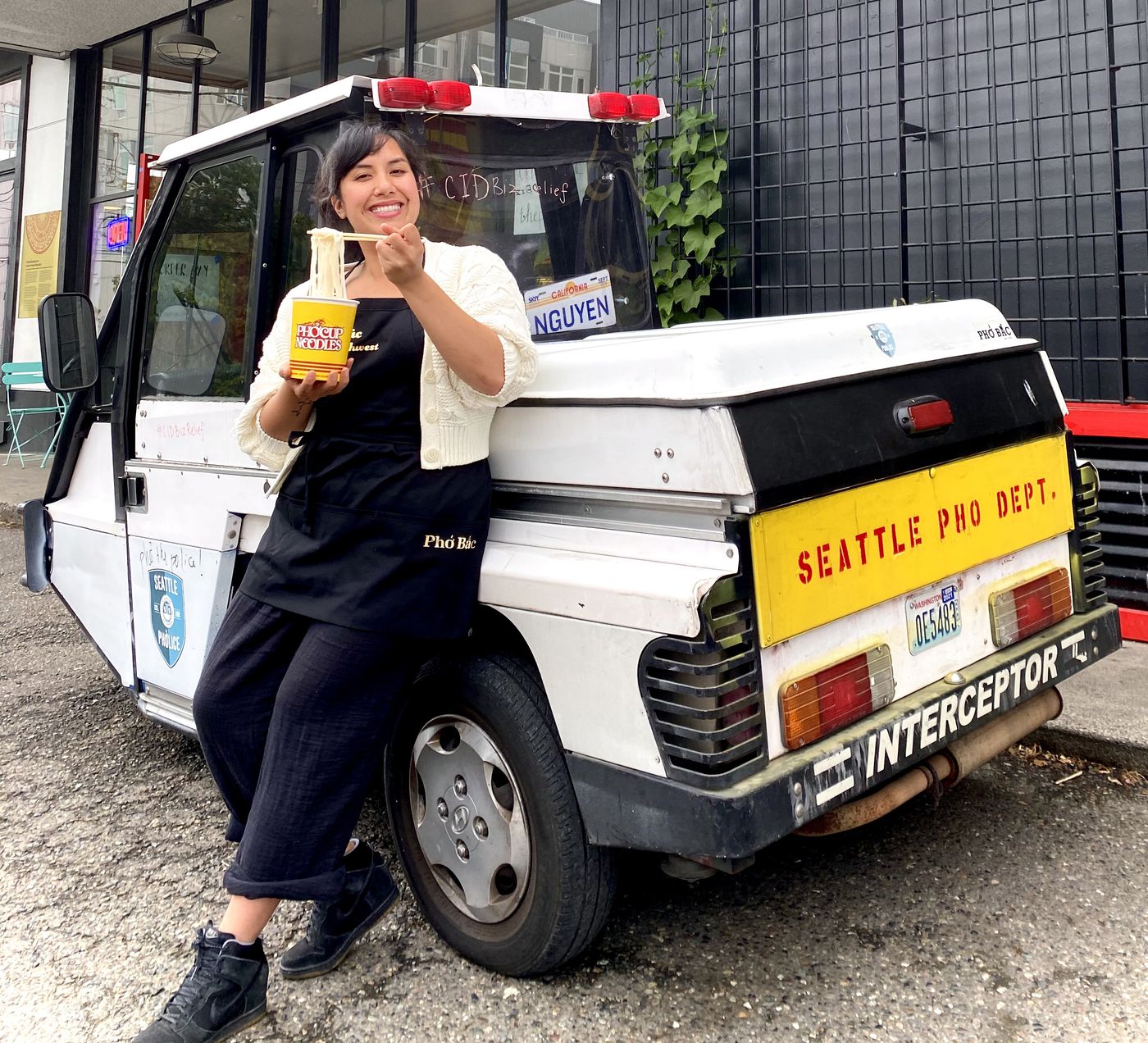
Photo: Yenvy Pham.
The owners of a Seattle Vietnamese restaurant, Phở Bắc, came up with the idea of a “Pho Now” cup and a “Pho Later” meal kit during the pandemic. “Survival mode is in our blood,” says Yenvy Pham.

I like to have a pipeline of possible articles in case I draw a blank some morning. But after Covid changed so much, it seemed like a good idea to check whether last year’s stories were still relevant. So I did a search on the restaurant in today’s article and found that the Covid innovations described here really worked.

In June 2020, Ashley Nguyen wrote at the Lily that Seattle’s Phở Bắc pivoted fast. “On March 13, Yenvy Pham went to New York City to celebrate the grand opening of her friend’s new Vietnamese restaurant, Saigon Social. But as the coronavirus spread, Helen Nguyen — Saigon Social’s chef and owner — decided to cancel.

“By the time Pham flew home to Seattle on March 16, Washington Gov. Jay [Inslee] had ordered restaurants and bars to cease in-person dining. Pham and her siblings, who own and operate several restaurants called Phở Bắc in Seattle, saw sales plummet. … They instituted new safety precautions, made sure their employees had masks and gloves and started pivoting.

“Phở Bắc’s namesake dish is not something people typically order to-go, Pham said. To appeal to their customers, the Pham siblings introduced a ‘Pho Now’ cup that people could eat while sitting on a nearby curb, on their walk home, or in the car. They also began selling a ‘Pho Later’ meal kit, complete with broth, separately wrapped ingredients and assembly instructions. The restaurant started delivering orders using an old parking enforcement vehicle dubbed the ‘Pho Mobile.’

“As it became clear that the pandemic wasn’t going to end anytime soon, Pham and her siblings had to start making tough decisions. They closed two of their four Phở Bắc locations, and they were forced to reduce staff. … But if any of Phở Bắc’s current or former employees need something, the restaurant owners try to help: ‘My restaurant dynamic is very Vietnamese,’ Pham said. ‘It’s very practical. If [workers] need money, help [or] loans, we just kind of do what we can.’

“Operating multiple restaurants during a pandemic isn’t easy, but ‘survival mode is in our blood,’ Pham explained. Her parents, Theresa Cat Vu and Augustine Nien Pham, opened the first Phở Bắc location in 1982, a year after they came to the United States. Ultimately, Theresa and Augustine created a nourishing landmark in Seattle’s Little Saigon: The restaurant takes the shape of a red boat.

“Yenvy Pham and her Phở Bắc partners, siblings Khoa and Quynh-Vy, are dedicated to supporting fellow business owners in Little Saigon as economic fallout from the pandemic persists.

‘It’s my neighborhood, my Little Saigon,’ Pham said. ‘For me, business comes and goes, but the vibe of the neighborhood is so important, and so are the characters here. You’ve got to take care of your own people.’

“They recently donated $5,000 in proceeds from the Pho Mobile to the International Community Health Services clinic, where their sister works as a primary care doctor, and a small business relief fund for business owners in the Chinatown International District. …

“The siblings are also collaborating with other business owners. They added Hood Famous Bakeshop’s mini Filipino-flavored cheesecakes to their menu. Pham let Mangosteen — a traveling Texas-style barbecue joint from chef Thai Ha — take over one of their closed locations to sell brisket and wings with specialty sauces for pickup.

“The pandemic has given people more time to take stock of what’s important, Pham said in late April.

“ ‘I like the world stopping for a second to reassess our morality and get us out of this state of complacency,’ she said. ‘We’re doing powerful thinking about each other, ourselves, about the world. … We’re being more creative too and helping each other out,’ Pham added. …

“Despite the unknowns, Pham is confident that everything will work out. In her family, ‘we either fix it, we take care of it, we accept it, or we move onto something else.’ ”

More at the Lily, here.

Read Full Post »

Photo: Ann Hermes/CSM.
Najari Smith, who founded the bike shop co-op and nonprofit Rich City Rides, stands in front of a mural depicting him on April 9, 2021, in Richmond, California, a town across the bay from San Francisco.

There’s something liberating about riding a bike, as my youngest grandchild learned after taking an REI class in Cranston. She used to be afraid of falling. Now she’s a biking dervish. Today’s post is about another biking enthusiast, who’s been liberating a poor city and making it rich.

Erika Page writes at the Christian Science Monitor, “Najari Smith was down in the dumps the night he first heard the bicycles below his window. He was new to California, lonely, and felt he lacked purpose. On the street below, a costumed parade of cyclists rolled by blasting music. By the time Mr. Smith rushed downstairs to join the party, they were gone.

“Mr. Smith’s journey, though, was just beginning. After that night in 2010, he began riding his bike everywhere and joined every community biking event around. Slowly, his spirits lifted.

‘Shoot, bicycles kind of saved my life,’ he says. He became part of the Bicycle and Pedestrian Advisory Committee of Richmond, California, which improves bicycle infrastructure in the city. During a routine committee meeting, he got his big idea.

“ ‘I thought to myself, “We’re building this infrastructure, but, you know, who are we building it for? Who’s going to use it?” ‘ he recalls. How would he get his community – the Black community – excited about using the bike lanes he was advocating for? And how would he break down the stereotype that Black people don’t bike? He started small – fixing up bikes at the park with local mechanics and giving them out to anyone who wanted one.

“Today, Mr. Smith runs Rich City Rides: a worker-owned cooperative bike shop as well as a bicycle advocacy nonprofit. These two spokes of the organization are distinct, but both serve Mr. Smith’s vision of using bicycles to ‘bring people together for healthy civic change’ in Richmond. Just like the bikes he fixes at the shop, Mr. Smith believes that no one, no matter what they’ve been through, is ever broken beyond repair.

“ ‘He’s the type of leader that seeks out the strength that an individual may have, rather than identifying their weaknesses. … He’ll sit down with folks and try to figure out how to get them involved, no matter what,’ says Robin D. López, who volunteers as a photographer for Rich City Rides and thinks of Richmond as ‘a community of untapped potential.’

“Roshni McGee, the program manager at Rich City Rides and co-founder of the bike shop, agrees. ‘He always tries to, you know, put a little bit of extra pressure on people and make them really be that diamond in the rough,’ he says.

“Rich City Rides is situated on a busy corner of Macdonald Avenue in a neighborhood that locals call the Iron Triangle, notorious for high crime rates and gun violence. Even though they live just across the bay from tony gentrified neighborhoods of San Francisco, many residents struggle to make ends meet. …

“ ‘He leads with love. … He shows that this is what we can do as Black people. We can revitalize our downtown, and we don’t have to be afraid of each other,’ says Jovanka Beckles, a mental health specialist who served on Richmond’s City Council from 2010 to 2018. She says Rich City Rides’ success has inspired other small businesses to open too, helping put the neighborhood on a long-awaited upswing. …

“[The nonprofit arm] plans social and wellness rides, youth programs, and community outreach. Since the nonprofit began in 2012, it has given away more than 1,000 bikes, led hundreds of social bike rides with thousands of participants, and conducted countless youth bicycle workshops. And during the pandemic, Rich City Rides has been distributing grab-and-go meals to families in need – an idea suggested by one of the high schoolers who works at the shop.

“In fact, Mr. Smith says other members of the team, and especially young people, make most of the important decisions. ‘I’m just a connector,’ he says.

“Cameren Howard-Simons is one of those young people who has found purpose through the organization. When he first met the crew at Rich City Rides, he was in middle school, and his mother didn’t want him hanging out in the area because of its reputation.

“Now Cam, a junior in high school, spends most of his free time working at the shop. ‘It’s hard to keep me away from people like this,’ he says with a wide smile, as he tries to get a derailleur to behave on the pink bike that’s hanging from his repair stand. Rich City Rides has kept him out of trouble, he says, adding that it’s one of the few places where kids can be completely themselves, without judgment.

“ ‘You’re wheelieing next to somebody, and they’re clapping, they’re recording you [on their phones], and they’re showing you love – showing you that they actually care about what you do,’ he says. …

“The notion that Richmond is not poor – but rich – guides Rich City Rides. ‘We’re a community that’s really rich in creativity and capacity and ingenuity,’ says Mr. Smith.”

More at the Monitor, here.

Read Full Post »

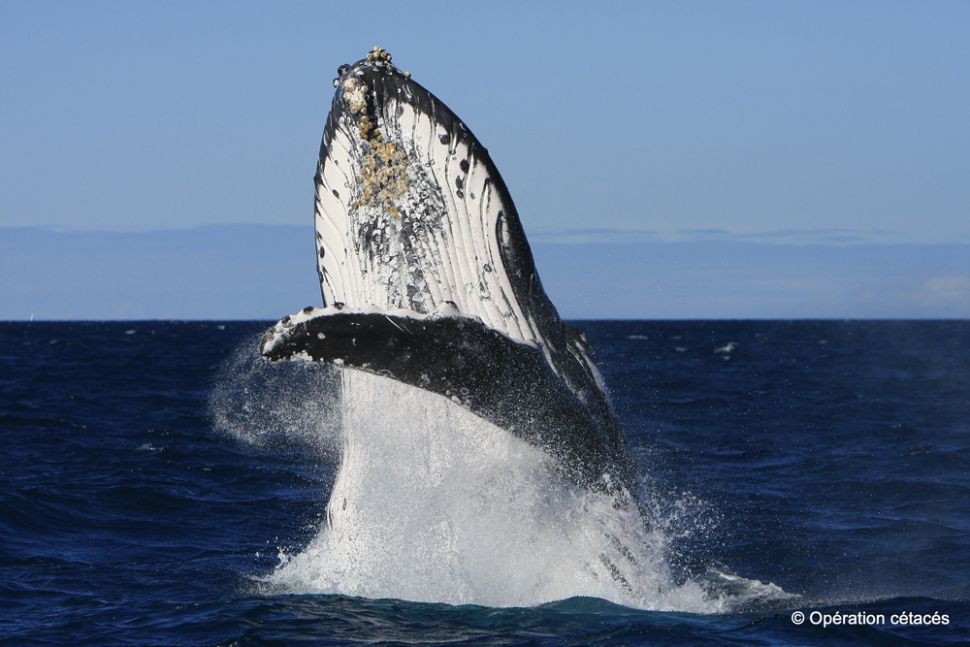
Photo: Opération cétacés.
Humpback whale breaching.

In case you couldn’t get behind the New York Times firewall to read about the whale that tried to swallow a lobster fisherman, here’s the gist of it. It’s a great reminder that all our ancient, impossible-seeming stories, from the Bible’s Jonah to Pinocchio and Geppetto, generally have a basis in fact.

Maria Cramer reported, “It was sunny and clear on Friday morning and the water was calm off the coast of Provincetown, Mass., where Michael Packard was diving for lobsters. His longtime fishing partner, Josiah Mayo, was following him in their fishing vessel, the J&J, tracking him through the bubbles that rose from Mr. Packard’s breathing gear to the surface of the water. The men had already caught 100 pounds of lobster, and Mr. Packard was about 40 feet underwater, looking for more.

“Suddenly, the bubbles stopped, Mr. Mayo said. Then, the water began to churn violently. A creature breached the surface and for an agonizing split second, Mr. Mayo thought it was a white shark.

‘I immediately thought it was the shark encounter that we’d unfortunately been preparing for for years,’ he said in an interview on Saturday.

“Then, he saw the fluke and the head of a whale. Moments later, he saw Mr. Packard fly out of the water.

“ ‘ “It tried to eat me,” ’ Mr. Packard sputtered, according to Mr. Mayo. The whale, a humpback, swam away as Mr. Mayo and another fisherman helped Mr. Packard back into the boat.

“Such terrifying encounters are virtually unheard-of, according to Charles Mayo, Josiah Mayo’s father and a senior scientist at the Center for Coastal Studies in Provincetown, a town of about 3,000 people on the tip of Cape Cod. …

“ ‘I’ve never heard of that ever happening,’ Dr. Mayo said of Mr. Packard’s ordeal. Still, the encounter is explainable, he said.

“The whale, possibly a 32- to 35-foot juvenile that had previously been seen swimming in the area, was most likely diving for food when it inadvertently caught Mr. Packard in its enormous mouth.

“Humpback whales spend much of their time in that part of New England, searching for and engulfing small schooling fish, said Jooke Robbins, director of the humpback whale studies program at the Center for Coastal Studies. They lunge fast, open their mouths and use baleen plates to ‘filter’ the water out before swallowing the fish, Dr. Robbins said in a statement.

“When the whale realized it had caught something that was not its typical prey — in this case, an unsuspecting lobsterman — it responded the way a human who accidentally ingested a fly would, Dr. Mayo said. …

“Mr. Packard told reporters that he was on his second dive, going toward the bottom of sea when he felt ‘this truck hit me.’ His first thought was that a white shark had attacked him, but when he did not feel teeth piercing into him, he realized he was inside a whale.

“ ‘I was completely inside; it was completely black,’ Mr. Packard told The Cape Cod Times. ‘I thought to myself: There’s no way I’m getting out of here — I’m done, I’m dead. All I could think of was my boys — they’re 12 and 15 years old.’ …

“He said he struggled against the mouth of the whale and could feel its powerful muscles squeezing against him. Then, he saw light and felt the whale’s head shaking and his body being thrown into the water. …

“Mr. Packard, who was released from the hospital on Friday, had extensive bruises, but no broken bones.”

More at the Times, here.

Read Full Post »

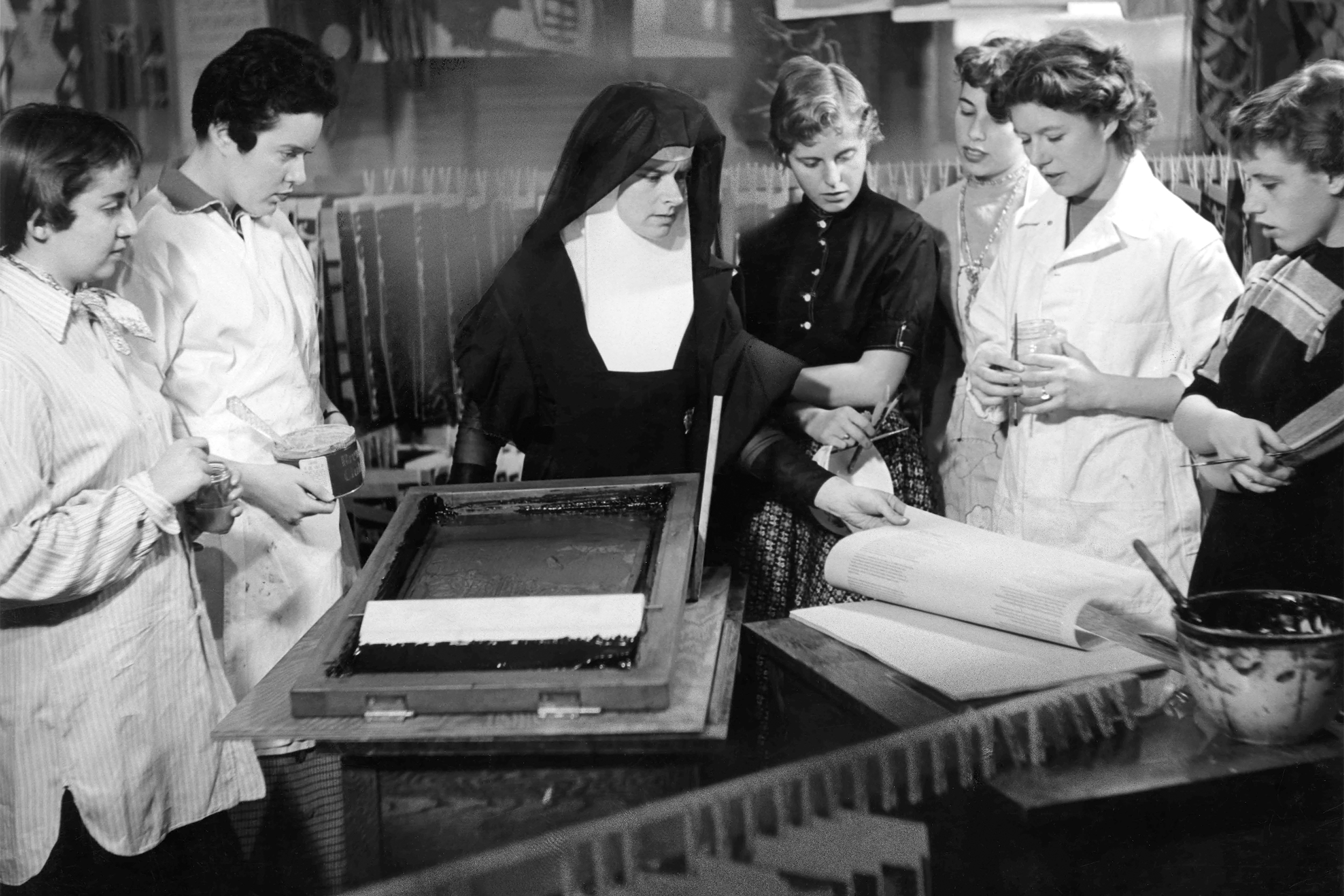
Photo: Corita Art Center, Immaculate Heart Community.
Corita Kent, then known as Sister Mary Corita, with students. “By the 1960s,” notes the Corita Art Center, “her vibrant serigraphs were drawing international acclaim. Corita’s work reflected her concerns about poverty, racism, and war.”

Talent will out. That was certainly the case with Sister Mary Corita, or Corita Kent, who became a force in the Pop Art scene of the 1960s with her focus on social justice.

At the Los Angeles Times, Carolina A. Miranda recently wrote, that 35 years after her death, the L.A. City Council approved historic-cultural monument status for her former studio — “a humble storefront on Franklin Avenue, near Western Avenue that in recent years had been inhabited by a dry cleaner.”

Miranda continues, “If you drew a Venn diagram that brought together Charles Eames, Pop Art, commercial printing, social justice movements, the Second Vatican Council and 1960s Los Angeles, only one person could inhabit the space where those areas intersect: Corita Kent.

“A nun in the order of the Immaculate Heart of Mary for more than three decades, Sister Mary Corita was a well-known educator and artist dubbed the ‘Pop Art nun’ by the press. … In her classroom at Immaculate Heart College, Kent taught the art of silkscreen printing — a commercial form that she adapted to the era of Pop. In the wake of the Second Vatican Council in 1962, which called for a liberalization and modernization of the Catholic liturgy to the realities of 20th century life, she delved into creating work that echoed calls for social justice — be it antiwar efforts, labor campaigns or Black and Chicano civil rights.

“Her work at its most innovative took vernacular culture — commercial logos and graphics, bits of corporate slogans, images from mass media — and reconfigured them into fine art. Art that not only advanced the ways in which these elements were used formally, but that grounded Pop. … As independent curator Michael Duncan wrote of her work in a 2013 catalog: ‘She addressed consumers not of products but of life.’ …

“The [historic-cultural] designation is important not just because Kent was an artist whose work was a critical part of the artistic dialogues Los Angeles was having in the 1960s, but also because she represents the rare woman to be honored in the city’s landscape.

“As the Los Angeles Conservancy noted in its advocacy for preserving Kent’s studio building, only 3% of the city’s more than 1,200 historic-cultural monuments are associated with women’s heritage. … The designation is reflective of a shift in preservationists’ thinking about how we acknowledge history — thinking that is less preoccupied with the pristine historical details of a site than in making sure a wide range of histories are acknowledged in a city’s landscape. Late last year, the 1970 protest route of the Chicano Moratorium was listed in the National Register of Historic Places; early this year, the Church of the Epiphany in Lincoln Heights — a key site of Chicano activism — was added to the list. …

“The storefront that Kent inhabited, where she taught and collaborated with students and created some of her most memorable work, no longer bears traces of her presence. …

“Kent left the space — and Los Angeles — after she withdrew from the Immaculate Heart of Mary order in favor of a secular life in the late 1960s. Part of her departure may have been due to pressures related to her increasingly high profile: At one point, she was featured on the cover of Newsweek. It may have also stemmed from simmering tensions between the liberal Immaculate Heart order and the staunchly conservative Archbishop James Francis McIntyre, who once complained that that the work produced by Kent and the college’s art department was ‘an affront to me and a scandal to the archdiocese.’ In 1970, Immaculate Heart split from the church and is today an independent ecumenical community.

“The studio storefront, which is currently unoccupied, sits on a small corner of a 1.7-acre parcel that also contains a shuttered Rite-Aid. Recently, the plot was acquired by a pair of real estate development companies who intend to turn the site into a Lazy Acres natural foods market. Part of their original plan had been to tear down the studio to make way for additional parking. (Yes, parking.) That plan has since been amended to leave the old studio building intact.

“This comes thanks to the work of many L.A. preservationists, among them the staff at the Corita Art Center, which is located just across the street in a complex of buildings still inhabited by the Immaculate Heart Community.

“ ‘The big question is what’s next,’ says the center’s director Nellie Scott. It’s too soon to say what the developers will do with the property — whether they would sell it or lease it for the purpose of an arts center. ‘We know that there are a thousand more conversations to happen.’ ”

So interesting that a nun used her natural gift in this way. I’m reminded of the French legend about the Juggler of Notre Dame, who was ridiculed for having nothing to give Mary but his juggling. In the story, her statue accepts the gift with a miraculous bow.

More at the Los Angeles Times, here.

Read Full Post »

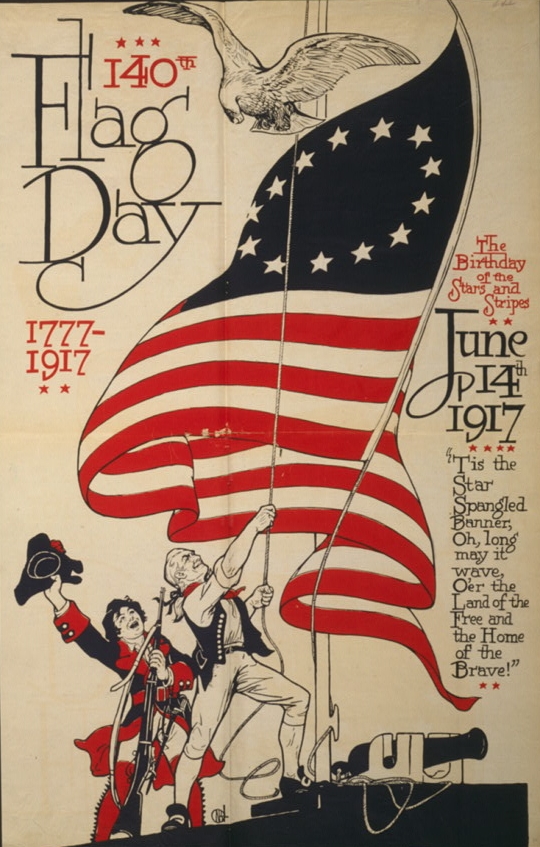
Photo: Library of Congress.
140th U.S. Flag Day poster. 1777-1917. The birthday of the stars and stripes, June 14th, 1917.

Did you know that today is Flag Day? For me, the US flag belongs to everyone who resides here and not to any small ideological group. (Does it happen in other countries that a rabid coterie usurps “ownership” of the national flag?)

I decided to write about the history of this day so you’ll know what’s going on if you see a lot of flags around town today.

Wikipedia says, “In the United States, Flag Day is celebrated on June 14. It commemorates the adoption of the flag of the United States on June 14, 1777, by resolution of the Second Continental Congress, [which] stated: ‘Resolved, That the flag of the thirteen United States be thirteen stripes, alternate red and white; that the union be thirteen stars, white in a blue field, representing a new constellation.’ …

“In 1916, President Woodrow Wilson issued a proclamation that officially established June 14 as Flag Day; on August 3, 1949, National Flag Day was established by an Act of Congress. Flag Day is not an official federal holiday. … However, it is at the president’s discretion to officially proclaim the observance. On June 14, 1937, Pennsylvania became the first U.S. State to celebrate Flag Day as a state holiday, beginning in the town of Rennerdale. New York Statutes designate the second Sunday in June as Flag Day, a state holiday.

“Perhaps the oldest continuing Flag Day parade is in Fairfield, Washington. Beginning in 1909 or 1910, Fairfield has held a parade every year since, with the possible exception of 1918, and celebrated the ‘Centennial’ parade in 2010, along with some other commemorative events. Appleton, Wisconsin, claims to be the oldest National Flag Day parade in the nation, held annually since 1950.

“Quincy, Massachusetts, has had an annual Flag Day parade since 1952 and claims it ‘is the longest-running parade of its kind’ in the U.S.,” but it didn’t happen in the pandemic.

The Patriot Ledger of May 5, 2021, wrote, “The city’s annual Flag Day celebration is back on for this year, with a few minor adjustments. 

“Quincy Mayor Thomas Koch said the much-loved parade will take place once again this June, but the annual flag raising ceremony has been canceled and fireworks have been moved to Quincy Bay. The parade will follow its usual route starting at 7 p.m. Saturday, June 12 and Koch said all of its usual participants have been asked to join in on the fun.

” ‘It may not be as robust as years past based on if our usual groups are ready, but I do expect we will have a decent parade,’ Koch said. ‘And by putting the fireworks in the bay, it spreads everybody out. At Black’s Creek, it’s hard to see them if you aren’t right there.’ 

“The city was forced to cancel its annual Flag Day parade in what would have been its 69th year due to the coronavirus pandemic. The tradition did not completely fall to the wayside, and the Flag Day Committee planned a ‘drive under the flag’ event that gave the city an opportunity to make use of its 30-by-50-foot American flag. The giant flag was hoisted by two Quincy Fire Department ladder trucks on Merrymount Parkway near Veterans Memorial Stadium, and residents drove under it with decorated vehicles cars, vans, small trucks and bikes.

“Koch said parade viewers this year will be encouraged to wear masks when they can’t socially distance.”

A WW II veteran I knew and generally admired once spoke of “fighting for the flag” as literally fighting for the flag. People died for the flag, he said. He did not understand about the literary term metonymy, in which an object is used to represent a concept, like referring to the British monarch as “the Crown.” I tried to say that a country’s flag represents the country and is not literally what people die for. He didn’t see it that way.

Read Full Post »

Photo: Zack’s Cafe via ABC3340.
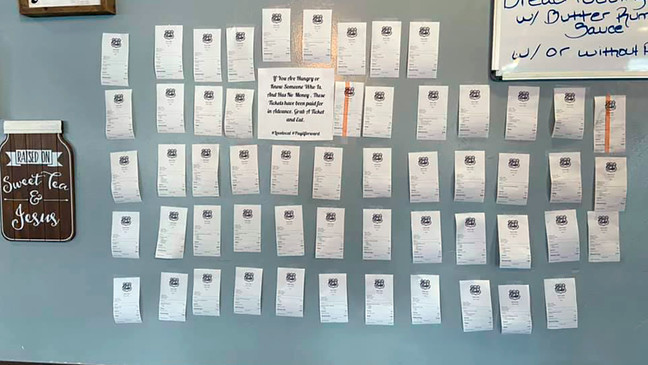
At Zack’s Cafe in Miami, Oklahoma, receipts for pre-paid meals hang on the wall. Zack’s Cafe is among several local restaurants that enabled neighbors to help one another out during the pandemic.

Often in the past there has been restaurant outreach to hungry people who can’t afford a restaurant. I’ve covered a few instances at this blog. But there’s nothing like a pandemic to enable such efforts to really take off. An Oklahoma town, for example, found there was no shortage of customers who would donate meals so others less fortunate could eat.

Last month, Cathy Free wrote at the Washington Post, “In a growing number of restaurants in Oklahoma, the walls are decorated with hanging receipts. Anyone can walk in, pull down a receipt and order a meal free of charge. The receipts are put there by customers who prepay for food and tack them to the wall, leaving them on offer for anyone who is hungry.

“Since early February, restaurants in the northeastern corner of Oklahoma — in towns like Miami, Grove and Vinita — encourage people who are short on cash to pick up a prepaid meal receipt and enjoy everything from three-egg omelets to chicken-fried steak, no tips expected, no questions asked.

‘Maybe if we can show people what it’s like to take care of your neighbor during a time of need, it will spread throughout the United States,’ said Bless Parker, 51, the volunteer mayor of Miami (pronounced my-am-uh). ‘We want to bring back the old hometown values that I saw when I was growing up here as a kid.’

“During the historic Arctic blast earlier this year, Parker helped homeless people get into church shelters, and around that time he and others decided they needed to do something to help people who were having a tough time during the coronavirus pandemic in Miami, a former mining town with a population of about 13,000.

“Sandye Williams, an assistant manager at the Miami Walmart, said she remembered a story she had seen in 2019 about a restaurant in Arkansas where customers had bought meals in advance for those in need and posted the receipts on the wall for anyone to pick up.

“On Feb. 3, Williams tagged Dawg House restaurant owner Jennifer White in a post about the story, saying, ‘Look at this. I would pay for a meal once a week.’ …

“ ‘I loved the idea and thought I’d give it a try,’ said White, 28. ‘I want people in my community to be fed whether they have money for a meal or not.’

“When White posted a sign near the entrance inviting her customers to buy $10 meal receipts and post them on the cafe’s giving wall, word spread quickly in Miami, she said. …

“Hours after Parker’s receipt went up the wall, another local restaurant, Zack’s Cafe, decided to get on board with the idea. And a few days later, Montana Mike’s Steakhouse joined in. …

“The giving wall concept soon spread to surrounding towns, including Vinita, which has a population of 5,423, where Beth Hilburn runs the Hi-Way Cafe on historic Route 66.

“Hilburn, 52, said she invited her customers to buy something extra from the menu such as a slice of pie or a cheeseburger, then post their contribution beneath a sign she printed: ‘If you are hungry or know someone who is … these tickets have been paid for in advance by previous customers. Please grab a ticket and eat!’ …

“The restaurants’ Facebook pages have been flooded with comments about the giving walls from local customers and out-of-towners alike. ‘One of the main reasons I love our small town!’ a Miami resident commented on the Zack’s Cafe page. …

“Some of the free meal recipients have returned to put a meal ticket on the wall to help somebody else once they’re able to, Perry said. She estimates that more than 300 free meals have been ordered at Zack’s. …

“At Montana Mike’s, general manager Jennifer Highton said she recently took a phone call from a man in Chicago who wanted to purchase several meals and add them to the wall.

“ ‘He’s never been here and doesn’t know anything about us, but he loved the idea and wanted to be a part of it,’ said Highton.”

More at the Washington Post.

Read Full Post »

Photo: Reuters.
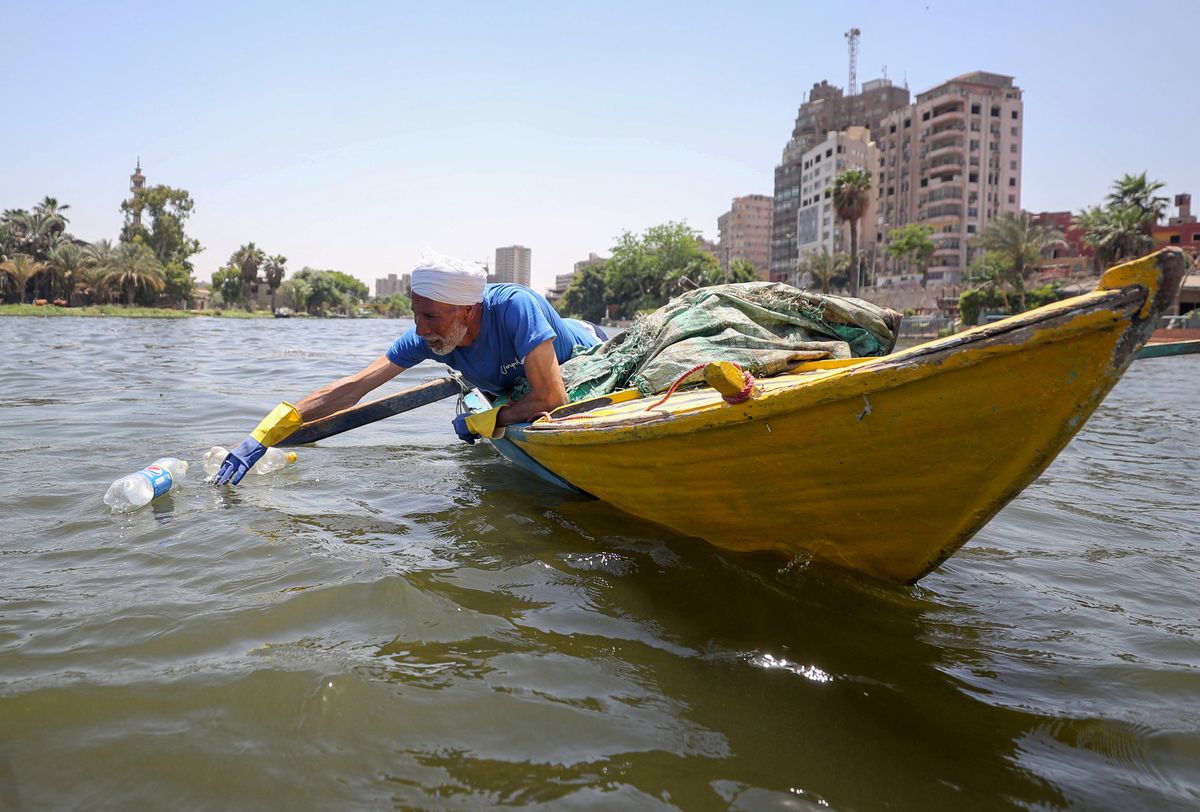
An Egyptian nonprofit has enlisted fishermen from Al-Qursaya, an island near central Cairo, to collect plastics that have been reducing the catch.

At the Center for Biological Diversity, I recently learned about the enormity of the plastics problem in waters where people fish. The website states: “Plastic accumulating in our oceans and on our beaches has become a global crisis. Billions of pounds of plastic can be found in swirling convergences that make up about 40 percent of the world’s ocean surfaces. At current rates, plastic is expected to outweigh all the fish in the sea by 2050.” Yikes!

New efforts large and small are needed to reverse what’s happening. On Twitter, the World Economic Forum is promoting one of the small efforts, which is how I learned about it.

Reuters reports, “For 17 years, Mohamed Nasar has supported his family of five by fishing in the Nile River near the banks of the tiny island of Al-Qursaya close to central Cairo.

“But the 58-year-old says fishermen like himself catch fewer fish every year as the Nile has become clogged with plastic bottles, bags and other waste.

‘The fish get caught in the bottles, and they die,’ said Nasar.

“A local environmental group named ‘VeryNile‘ has asked the island’s fishermen to use their boats to collect plastic bottles from the river. VeryNile says it buys the bottles at a higher price than the general market price on offer from traders or recycling plants.

“The initiative provides a sustainable solution for helping to clean up the Nile, while providing an additional source of income for fisherman like Nasar.

” ‘This job helped us a bit. We come and collect about 10 to 15 kilos (of plastic bottles), we get about 12 Egyptian pounds ($0.7682) for each,’ Nasar said as he sat in his boat collecting bottles. …

“Another fisherman, Saeed Hassanein, said cleaner Nile water would mean more fish.

” ‘On the one hand, the Nile is cleaner, and on the other hand the fisherman now has more than one source of income,’ he said.

“With the help of more than 40 fishermen, VeryNile has over the past year collected around 18 tons of plastic bottles, most of which were sold to recyclers.” More at Reuters, here.

The World Economic Forum, which defines itself as the “international organization for public-private cooperation,” is increasingly focused on addressing the consequences of global warming, and I hope it is serious about that. It’s easy to feel cynical about the forum’s annual conference for the world’s rich and powerful — called Davos because it takes place in Davos, Switzerland — but I have to believe it’s helping to make both the problems and the possible solutions more widely accepted. Besides, I know there are many altruistic people on the staff, like my friend Kai, who was one of them several years ago.

In a recent podcast, Radio Davos discusses initiatives tackling climate change, calling the current decade “the decade of ocean science, and one in which we must get on track for net-zero by 2050.”

So there’s that. Meanwhile, in Egypt, impoverished fishermen are pulling out plastic that corporations, cruise ships, and too many individuals keep dumping.

Read Full Post »

Photo: Chimfunshi Wildlife Orphanage.
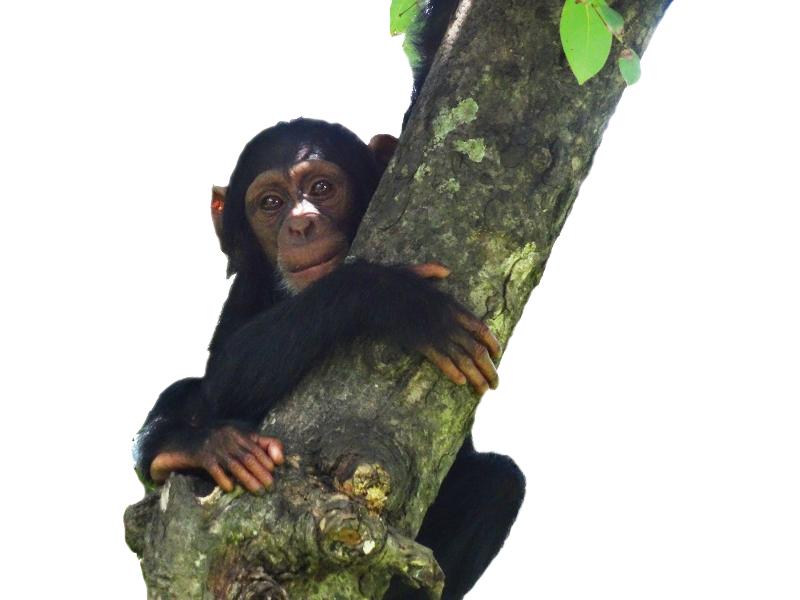
Above is a chimpanzee in the Chimfunshi wildlife sanctuary in Zambia, where an influencer chimp began a tradition of wearing a blade of grass in the ear, a style that continued after her death.

I’ve been thinking about social influencers and whether I can identify contemporary influences that have affected what I do. I know that if someone describes a book in a way that makes it sound like my kind of thing, I go immediately to my library’s website and reserve it. In another example, my behavior is hugely influenced by articles on the latest Covid research. And I’m always joining boycotts to help a worthy cause someone is promoting.

So I thought it was interesting to learn how creatures other than humans do influencing — from silly behaviors to life-and-death behaviors.

Natalie Angier at the New York Times begins with a chimpanzee. “Julia, her friends and family agreed, had style. When, out of the blue, the 18-year-old chimpanzee began inserting long, stiff blades of grass into one or both ears and then went about her day with her new statement accessories clearly visible to the world, the other chimpanzees at the Chimfunshi wildlife sanctuary in Zambia were dazzled.

“Pretty soon, they were trying it, too: first her son, then her two closest female friends, then a male friend, out to eight of the 10 chimps in the group, all of them struggling, in front of Julia the Influencer — and hidden video cameras — to get the grass-in-the-ear routine just right.

” ‘It was quite funny to see,’ said Edwin van Leeuwen of the University of Antwerp, who studies animal culture. ‘They tried again and again without success. They shivered through their whole bodies.’ …

“Julia died more than two years ago, yet her grassy-ear routine — a tradition that arose spontaneously, spread through social networks and skirts uncomfortably close to a human meme or fad — lives on among her followers in the sanctuary. The behavior is just one of many surprising examples of animal culture that researchers have lately divulged, as a vivid summary makes clear in a recent issue of Science. …

“ ‘If you define culture as a set of behaviors shared by a group and transmitted through the group by social learning, then you find that it’s widespread in the animal kingdom,’ said Andrew Whiten, a psychologist and neuroscientist at the University of St. Andrews, in Scotland, and the author of the Science review. ‘You see it from primates and cetaceans, to birds and fish, and now we even find it in insects.’

“Culture ‘is another inheritance mechanism, like genes,’ Hal Whitehead of Dalhousie University, who studies culture in whales, said. ‘It’s another way that information can flow through a population.’ … Genes lumber, but culture soars. In 1980, for example, an observant humpback whale discovered that by smacking its tail hard against the water, the tiny fish on which it preyed were prompted to ball up into tidy packages fit for comparatively easy capture and consumption. The enhanced hunting technique, called lobtail feeding, quickly spread along known lines of humpback social groups, aided, researchers suspect, by the cetacean talent for acrobatic mimicry among members of a pod. Today, more than 600 humpbacks are lobtail feeders. …

“Sperm whales likewise used crowdsourcing to outwit Ahab. In a new study examining whaling logs from the 19th century, Dr. Whitehead and his colleagues determined that when New England whalers first started hunting a naïve population of sperm whales in the north Pacific, they were essentially harpooning fish in a barrel, harvesting untold gallons of the fine spermaceti oil contained in the whale’s distinctive top hat of an acoustical organ. In just three to five years, however, long before the whalers had made a dent in the whale population, their hunting success rate had plunged by nearly 60 percent. …

“Some differences between animal tribes make sense only if viewed through a cultural lens. Liran Samuni, a postdoctoral fellow at Harvard, and her colleagues have been following two neighboring groups of bonobos in the Democratic Republic of Congo. The home ranges of the chimpanzee-like apes overlap considerably … but there is a salient distinction between them. Once or twice a month, bonobos supplement their vegetarian diet with meat, and when these two troops turn carnivorous, they seek out different prey. One group goes after anomalures, which resemble flying squirrels, while the other hunts small antelopes called duikers. ‘No matter where they are, even when the group is together, they maintain the preference,’ Dr. Samuni said. …

“Peter Richerson of the University of California at Davis, who studies the coevolution of genes and culture in humans … is particularly impressed by recent research showing that animal migrations, long considered the essence of mindless instinct in motion, are, in fact, culturally determined. ‘Mountain sheep have to learn their migrations from other sheep,’ he said. Whooping cranes are long-distance migrators, and when their numbers declined so precipitously that there were no adult birds to teach young birds the route, conservationists stepped in and used ultralight airplanes as whooping crane tutors. Even farm animals can be repositories of cultural wisdom, as ranchers discover when they precipitously sell off their entire herd.”

More at the Times, here.

Read Full Post »

Photo: Political Blind Date
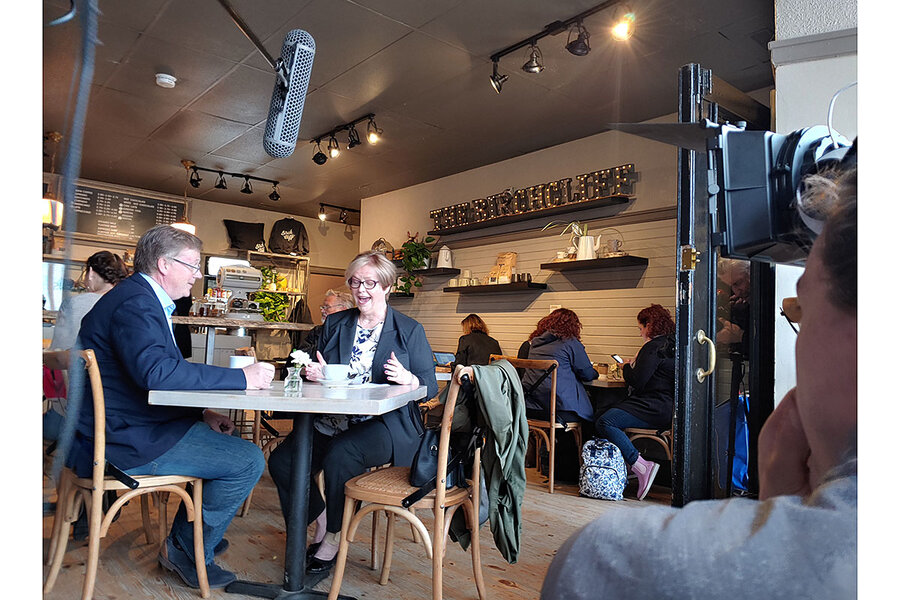
Toronto City Councilors Gary Crawford and Shelley Carroll, who hold very different political views, chat in a Toronto coffee shop during an episode of the TV show “Political Blind Date.”

What if each of us tried to reach across the divide? My brave friend Nancy does it in a class at the Council on Aging, where she actually talks politics. I’m not strong enough for that, but I really do work at nurturing the things I have in common with people whose politics are different. There are always things we have in common. After all, if Earth got invaded by hostile space aliens, we’d all be helping each other out without a second thought.

In Canada, they aren’t waiting for space aliens.

Sara Miller Llana writes at the Christian Science Monitor about a popular television show that has participants reaching across the political divide.

“When Gary Crawford confided to Shelley Carroll on TV that he has a daughter with a disability, the mother who raised a daughter diagnosed with autism replied instinctively, ‘Oh, Gary’ – conveying an empathy so obvious in just two words.

“It’s not that the Toronto city councilors didn’t know one another. They’d worked together in City Hall for the better part of a decade. But more often than not, they were dug in on either side of the chamber, battling over city finances.

“So this meeting, at a cozy Toronto coffee shop, was an intentional step away from those fiery legislative sessions, a way to help two rival politicians find common ground in sustaining North America’s fastest-growing city – even if Ms. Shelley envisions new revenue tools while Mr. Crawford dubs himself a ‘keep taxes low kinda guy.’

“Welcome to ‘Political Blind Date.’ The popular Canadian television show might sound like a hokey reality show for the political set. But for its creators, the aim is to undo some of the stubborn binaries that have built up around contentious issues from gun rights to taxation to immigration to climate change.

“Getting beyond the media scrum, the yelling during parliamentary question periods, the sound bites on nightly news, and the callous swipes over social media, producers set the stage for participants to engage one another with the time and respect that complex problems require.

‘Respect is at the heart of it. Not only are politicians, in the way they are using political rhetoric, not respecting each other; they’re disrespecting their citizenry,’ says Mark Johnston, showrunner of ‘Political Blind Date.’ ‘And at the same time, there’s been a disrespect and dehumanization of politicians.’ …

“With the filming of a fifth season underway, about 50 politicians have already participated, spending two days together with each other’s constituents and wrestling with legalization of marijuana, Indigenous rights, and climate change. It’s not easy: In one episode, a politician who supports gun rights visited a Toronto mother whose children were hit by bullets at a playground. 

“The goal is not to get the two politicians to reverse their positions, something that rarely happens. It’s to slow down and study policies in all their complexity, and to hear the human concerns and perspectives that lie behind their support. …

“During the episode on Toronto city finances, which aired in January 2020, Mr. Crawford hands Ms. Carroll a button to put on. Hers is a big yellow disk with an arrow pointing upward, reading ‘High Property Taxes.’ His reads the opposite, the arrow pointing downward next to ‘Low Property Taxes.’ 

“But after the show, he realizes the buttons don’t make as much sense as he originally thought. They both want their constituents to be able to stay in their homes and rely on services their taxes pay for. …

“He says he’s still a ‘low tax kinda guy.’ But the experience opened him up to a conversation he would not have been willing to have before the episode. And both say they talk more than they ever did before. ‘We’re often understaffed, under-resourced, and really stretched for time,’ says Ms. Carroll. ‘We don’t get to know enough about each other’s personal lives. So you don’t know where each other are coming from. 

“ ‘You can have different politics, but it always helps if you can humanize and say, “OK, I get your point of view and it’s different from mine, but I know where you’re coming from, so let’s work on it,” ‘ she says. …

“Anna-Kay Russell, co-founder and director of funding partnerships for the Canadian Black Policy Network, says this kind of connection between two rivals has a trickle-down effect. ‘The “us versus them” mentality not only seeps into the behavior of our politicians, but down into the mindsets of the voters, and it detracts from the fact that we’re a nation that needs to and should be operating as one, collectively,’ she says. …

“The show has averaged about 195,000 viewers per episode, a solid number for a small network like TVO, says [John Ferri, an executive of TVO, the television network that airs the show,] and it has been optioned to the United Kingdom, France, Israel, and South Africa. The show’s creators are also shopping it to the United States, given all the divisions that have grown amid the pandemic. …

“[Johnston] sees potential even in the explosive political environment of the U.S. ‘It’s easy to sit behind a Twitter account or stand up in a legislature,’ he says. ‘But if you agree to go on a journey with another human being, I just think in general people are going to listen to each other.’ ”

More at the Christian Science Monitor, here.

Read Full Post »

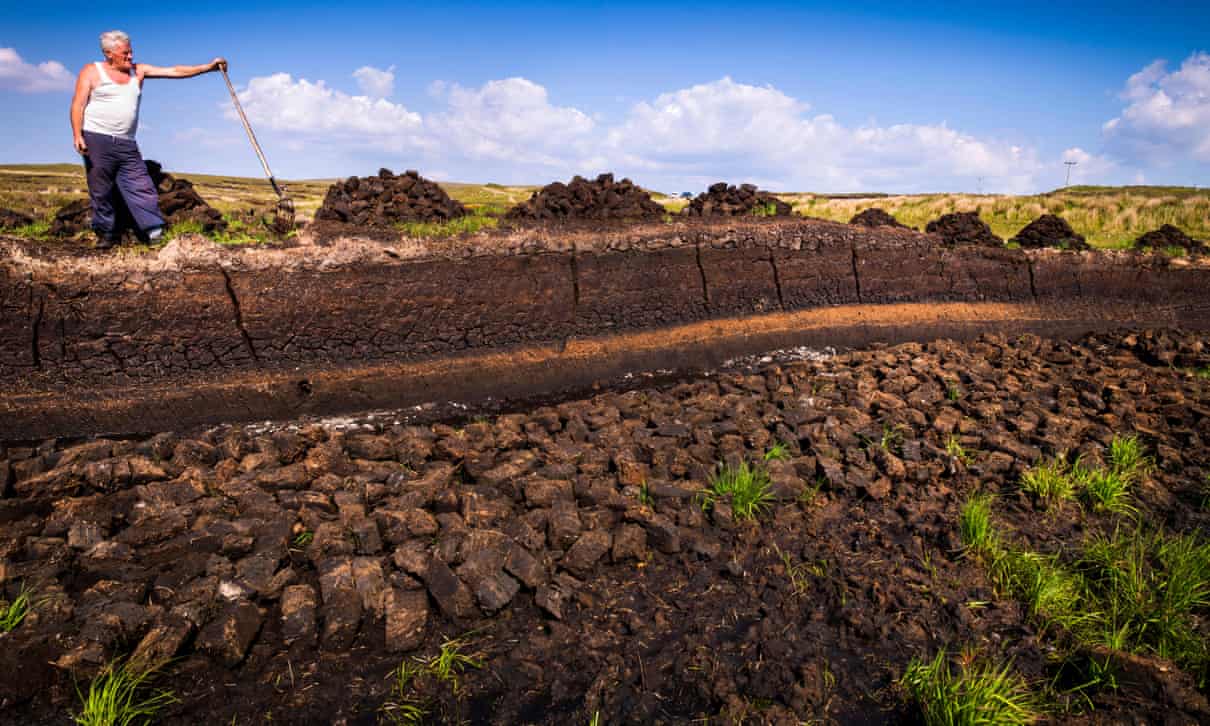
Photo: Photographic/Scenic Ireland/Alamy via the Guardian.
Burning peat increases global warming, which is why commercial operations are closing, but undisturbed bogs have always been great for keeping carbon
from the atmosphere.

My father-in-law was in the peat moss business back in the day. The Philadelphia company he worked for and later ran was called I.H. Nestor. It sold peat mostly for agriculture, but you may know that peat was also burned for heat, especially in Ireland. My friend, the late great James Hackett, and his family always heated their home with peat, with unfortunate consequences for their health.

Today’s story is about the historical value of peat bogs, an aspect that has been mostly unrecognized until now.

Chris Mooney writes at the Washington Post, “Long before the era of fossil fuels, humans may have triggered a massive but mysterious ‘carbon bomb’ lurking beneath the Earth’s surface, a new scientific study suggests. If the finding is correct, it would mean that we have been neglecting a major human contribution to global warming — one whose legacy continues.

“The researchers, from France’s Laboratory of Climate and Environmental Sciences and several other institutions across the globe, suggest that beginning well before the industrial era, the mass conversion of carbon-rich peatlands for agriculture could have added over 250 billion tons of carbon dioxide to the atmosphere. That’s the equivalent of more than seven years of current emissions from the burning of fossil fuels for energy.

“ ‘Globally [peatlands] are only 3 percent of the land surface but store about 30 percent of the global soil carbon,’ said Chunjing Qiu, a researcher at the laboratory, a joint institution supported by French government research bodies and the Versailles Saint-Quentin University, and the first author of the study published Friday in the journal Science Advances.

“The new finding of an ‘ignored historical land use emission’ suggests that even now, we lack a complete understanding of how the Earth’s land surfaces are driving and modulating the warming of the planet. … Scientists have long worried about the potential for massive amounts of carbon being released by northern permafrost, where ancient plant remains lie in a kind of suspended animation beneath the surface. But the peat threat is very similar; in fact, peatlands overlap considerably with permafrost regions.

“Peatlands are a particular type of wetland, one in which dead plant matter does not fully decay due to the watery conditions, and thus accumulates.

In its normal state, peat slowly pulls carbon out of the atmosphere — unless you disturb it.

“If a peatland is drained — as has occurred for many centuries to promote agriculture, especially the planting of crops — the ancient plant matter begins to decompose, and the carbon it contains joins with oxygen from the atmosphere. It is then emitted as carbon dioxide, the principal greenhouse warming gas. …

“To try to get around the problem of missing historical records, the new study simulates the Northern Hemisphere (outside of the tropics) over thousands of years to determine where peat would have likely developed. Over time, the computer model will begin to include growing agricultural activities. It can then be used to analyze different scenarios for how frequently such developments may have occurred on peatland.

“In a middle-of-the-road scenario, where humans would have regularly grown crops on peatlands, the study finds that some 70 billion tons of carbon (over 250 billion tons when converted to carbon dioxide) would have been lost from the soil.

“Importantly, the analysis does not cover all the peatlands across the globe: It only considers Northern Hemisphere peatlands from the year 850 CE onward. Massive losses of tropical peat are even now occurring in countries like Indonesia and Malaysia, for instance, so global losses will be higher. …

“The study is ‘a broad modeling approach with many assumptions, which can all be individually questioned and debated,’ added Hans Joosten, who leads a peat research group at the University of Greifswald in Germany. ‘But the overall message that remains is that drainage of only a small part turns the entire northern peatland resource into a net carbon source.

‘Though peatlands indeed are carbon sinks in their pristine state, they should also be seen as carbon bombs, which explode whenever they are damaged. Keep them wet!’ …

“The new work underscores that major gaps remain in how much we know about the human contribution to climate change, even as we are trying to halt it. With poor understanding about peat locations, and poor reporting about land conversion, experts say, many countries can’t fully account for peat emissions even now. That could raise questions about what has been happening in their land-use sector.”

More at the Post, here.

Read Full Post »

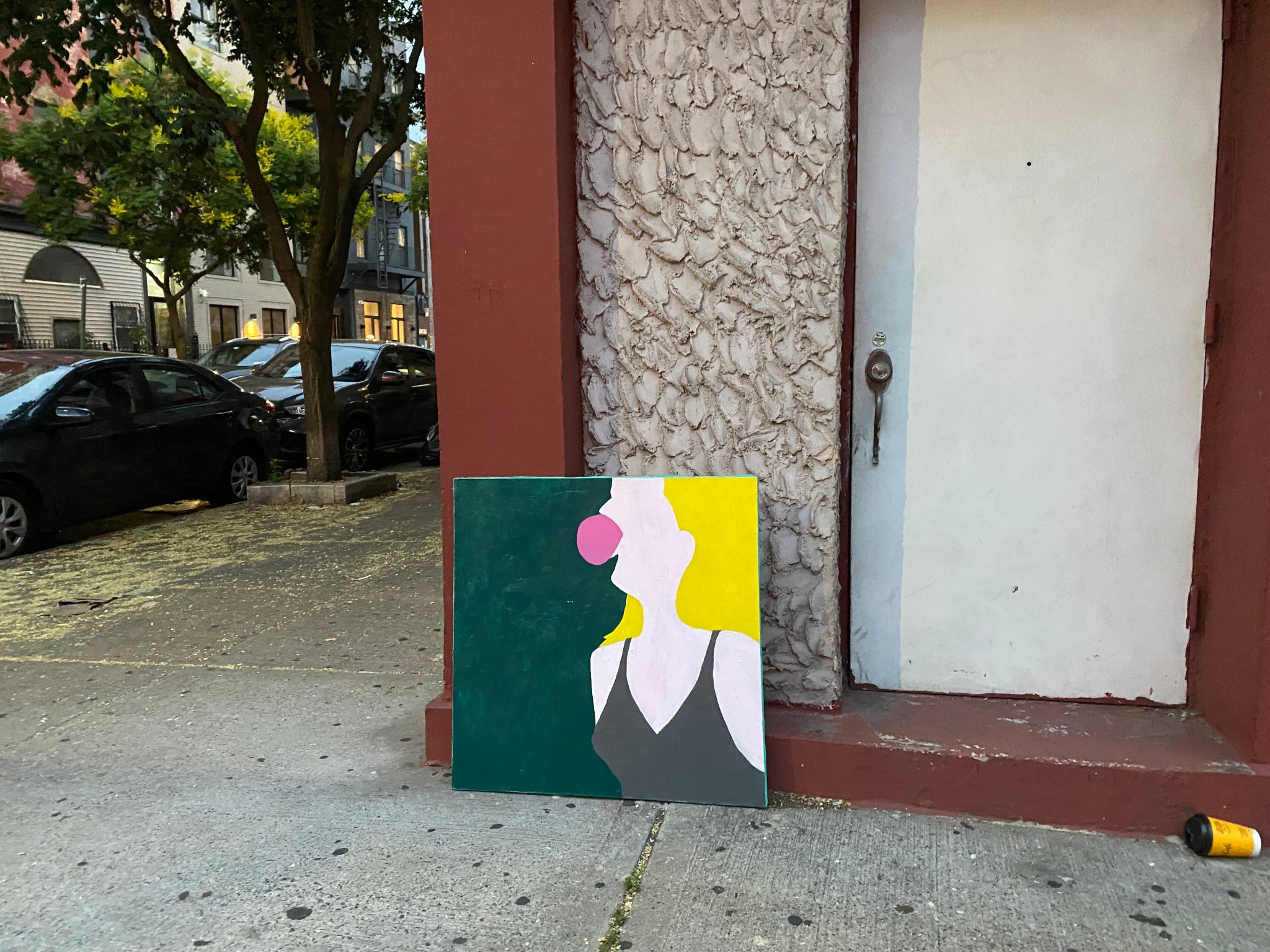
Photo: Hakim Bishara for Hyperallergic.
An abandoned painting in Brooklyn, New York.

When I first started getting serious about the internet in the mid 1990s, the browser I used was Netscape Navigator. Remember that? One thing I really loved about it was the way it put quirky website suggestions at the top of its home page. That was how I learned about the Museum of Bad Art (MOBA) in Dedham, Mass. For a long time I checked MOBA regularly to see what “new” paintings had been rescued from trash cans or abandoned on the side of a road.

I had almost forgotten about MOBA when I read a Hyperallergic story about a similar initiative, an Instagram account called Abandoned Paintings. These paintings are not necessarily “bad,” just no longer wanted. Hakim Bishara of the Soloway Gallery has a report.

“Last summer,” he writes, “while COVID-​19 was still ravaging through New York, I began noticing an unusual amount of discarded paintings on the sidewalks of my neighborhood in Brooklyn. It became an almost daily occurrence as more people moved out to the suburbs or to other states. Instinctively, I started amassing a photo archive of these paintings for a potential project. But as often is the case with new project ideas, I soon found out that someone else has already done it.

“When I stumbled upon artist Jason Osborne’s Instagram account Abandoned Paintings, which has been archiving images of discarded paintings for the last decade, I immediately became a fan. Updated daily with submissions from around the world, it pays a final tribute to these disowned artworks before they fade into the trash heap of history.

“Osborne, an artist with a self-professed fondness for fringe and forgotten art, first started Abandoned Paintings as a blog about unseen paintings in storage facilities of American museums. Soon after, he began documenting discarded paintings that he spotted on sidewalks and trash bins across New York City. …

“In 2011, he [launched] an Instagram account that quickly gained popularity. In time, he started receiving contributions from like-minded fans from across the globe, including France, the United Kingdom, and Chile.

‘As a painting junkie, I like to think of all the other lives that paintings have other than the 10% that we see on the walls of museums and galleries,’ Osborne told Hyperallergic in an interview. …

“According to Osborne, abandoned paintings appear on the streets in cycles, mostly when art students leave their studios at the end of their studies or when people move out of apartments at the end of the month. The mass exodus from NYC during 2020 seemed to interrupt that pattern, adding more abandoned paintings to the streets. …

“With new submissions and inquiries flowing into his DMs daily, Osborne has a handful of anecdotes to share about the different lives that one painting can have. For instance, there have been several cases in which artists reached out to him saying that they identified a painting they had previously sold or gifted to others. One unlucky painting was abandoned twice.

“What’s also interesting is the way that people tend to leave paintings out on the street. Unlike other discarded objects, paintings are often leaned presentably against a wall or a fence, waiting to be noticed and taken. …

“If it were up to Osborne, he would ‘fill entire museums and galleries with discarded paintings.’ But until then, he says, documenting these forlorn artworks has contributed to his understanding of painting in myriad ways.

“ ‘It solved many problems I had in my own work,’ he said.”

More at Hyperallergic, here.

Read Full Post »

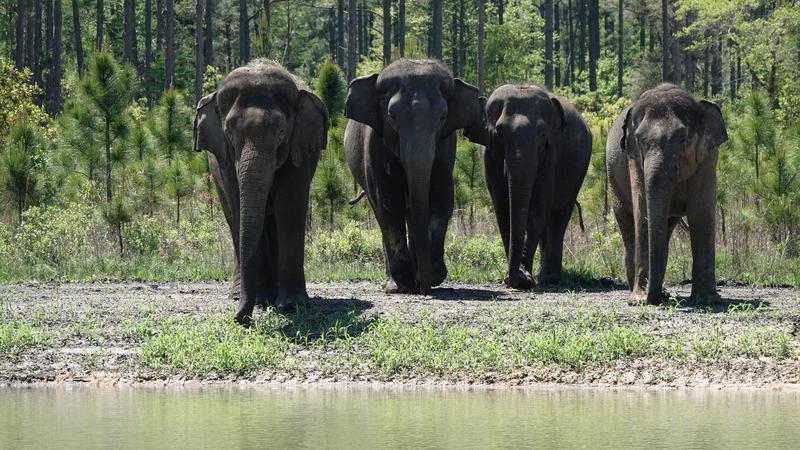
12 Asian elephants have arrived at White Oak Conservation.
Stephanie Rutan / Via White Oak Conservation

Because of the heat wave, I went out for my walk at 5:30 this morning, while it was still pleasant. I saw a bluebird, a couple rabbits, and a snapping turtle that crossed a bridge and launched herself 20 feet into the river. That was her choice.

The subjects of today’s story went a long time without having choices like the ones snapping turtles, wild rabbits, and bluebirds enjoy. Having spent many years doing tricks in the circus, they now reside at a 135-acre sanctuary where staff say they can hide for days at a time. Life is not completely natural, but it’s better than the circus.

Cathy Free reports at the Washington Post, “For about two decades, elephants that performed with the Ringling Bros. and Barnum & Bailey Circus were sent to a reserve in central Florida when they became too old to balance on two legs and parade around arenas doing tricks and dancing for large crowds. …

“In recent weeks, the former circus elephants have begun moving to a 135-acre sanctuary, one that is not affiliated with the circus that for years was accused of mistreating and abusing the gentle giants.

“Three weeks after being let loose in the White Oak Conservation center in Yulee, Fla., the first group of elephants has been exploring the new surroundings, and staff members say they don’t see some of them for days at a time. When they do spy the large animals, they say, they are swimming in the deep end of a pond or having a dust bath, followed by a nap in the shade. They also snack on watermelon and banana buffets.

“Employees say it was an emotional moment to watch the elephants walk out of their barn together for the first time into the lush acreage.

“ ‘There was more than one wet eye that day,’ said Michelle Gadd, who leads the White Oak preserve for endangered and threatened species such as cheetahs, rhinos, okapi, zebras and condors. …

“Ringling Bros. retired all of its elephants in 2016, ending a 145-year tradition, after pushback from the public about the pachyderms being forced to perform. … A year-and-a-half after the elephants were retired, the circus closed shop because of declining ticket sales. …

“Philanthropists Mark and Kimbra Walter arranged to purchase all 32 of the former Ringling Bros. elephants and have them transported 200 miles from Central Florida to Yulee, outside Jacksonville. The Walters bought the 17,000-acre White Oak sanctuary in 2013, and have been expanding it since. …

“Eventually, the elephant portion of the refuge will cover 2,500 acres and feature nine linked areas with enough water holes, forests, grasslands and wetlands to support the entire herd, said Nick Newby, 41, who leads the elephant caretaker team and helped plan the habitat.

“ ‘We wanted it to be as natural as possible, and we wanted to consider the social dynamic as well,’ Newby said. ‘Elephants are very sociable animals, so we like to study them, see what their personalities are like and then try to mix and match them with other elephants they might like to cohabitate with.’ …

“For Newby, who has worked with elephants for 18 years (mostly in zoos), there was a sense of elation as he watched the animals wander through their new home.

“ ‘It’s all about the elephants, so to see them out there doing natural elephant behaviors like swimming, was exhilarating and rewarding,’ he said. …

“Asian and African elephants are endangered in the wild because of loss of habitat and illegal poaching, [Gadd] said. The World Wildlife Fund estimates that there are about 415,000 elephants in Africa, while less than 50,000 remain in Asia.

“Wildlife conservation studies have shown that between 15,000 and 20,000 elephants are held in zoos or are still used by safari companies and circuses around the world. …

“Plans haven’t yet been developed for the public to view the elephants from afar, but Newby said the ultimate goal would be for somebody to look through a pair of binoculars at the White Oak refuge and feel as though they were watching elephants in their natural habitat.

“ ‘The gentle giants at the sanctuary are ambassadors for elephants in the wild,’ he said. ‘It’s our duty to make sure that their future is better than their past, and that their tomorrows are better than their yesterdays.’ ”

More at the Post, here.

Read Full Post »

« Newer Posts - Older Posts »