
Photo: Suzanne and John’s Mom.
If possible, just enjoy the simple things today.
Posted in Uncategorized, tagged dog with flag, fourth of july, parade, summer on July 4, 2024| Leave a Comment »
Posted in Uncategorized, tagged good works, ice cream cart, literacy, pakistan, reading, slums on July 3, 2024| 2 Comments »
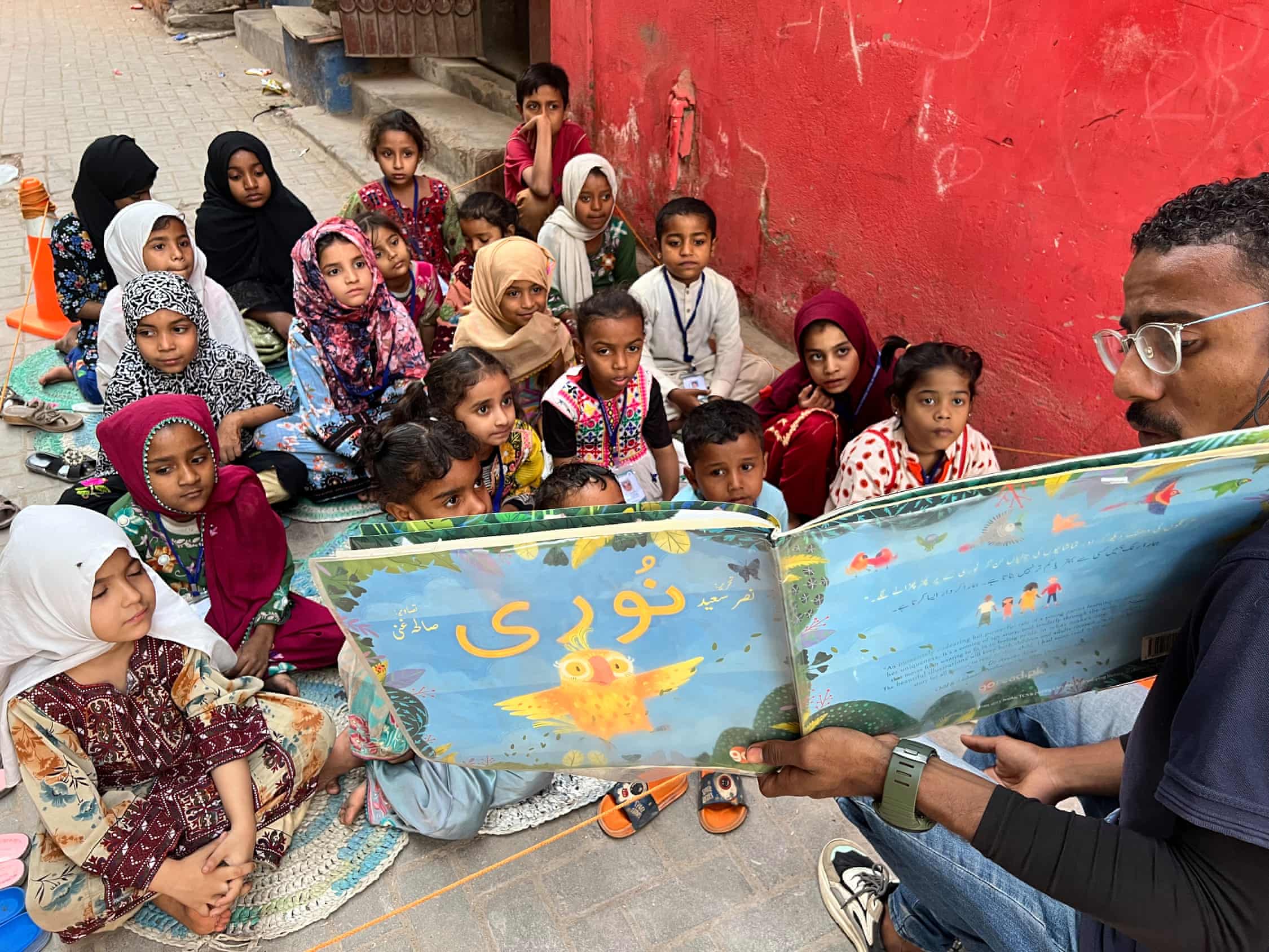
Photo: Zofeen T Ebrahim/The Guardian.
A GoRead worker helps to educate children in Pakistani slums through storytelling. The GoRead director says, “We cannot expect children to want to read if we don’t read to them first.”
If it’s true that Sauron is always collecting his strength to rise again, it’s also true that people who do good never stop doing good. Whatever happens, you can’t completely stamp out kindness or good works. They gather strength, too.
I hate hearing decent people’s defeatism. I like focusing on stories like today’s, stories of people trying to make the world a little better wherever they are.
Zofeen T Ebrahim writes at the Guardian, “Pedaling down a narrow alleyway in Karachi’s crowded Lyari Town, Saira Bano slows as she passes a group of children sitting on the ground, listening to a man reading aloud from a book. The eight-year-old gets off her bike, slips off her sandals, and sits on the mat at the back.
“She has already heard the story from Mohammad Noman, who is entertaining more than a dozen children with the tale of Noori, an insecure yellow parrot. ‘I don’t mind listening to it again,’ says Saira. ‘He’s so funny.’
“Noman, 23, is spending two weeks in Lyari pedaling an old ice-cream cart through its lanes, stopping to read his stories and leaving behind books for the children to borrow. He dropped out of school himself as a teenager but has returned to education and is now studying for his high school certificate.
“He is also one of two storytellers working part-time for the Kahaani Sawaari (Stories on Wheels) program, run by GoRead.pk, which is working to improve literacy among underprivileged communities in Karachi, Pakistan’s largest city.
“ ‘I become a kid when I am around the children,’ says Noman. In the past 18 months, he has visited 30 areas of Lyari, one of the most densely populated and deprived neighborhoods of Karachi, with more than 660,000 residents, mostly from the marginalised Baloch ethnic group.
“ ‘I have learned so much,’ says Noman. ‘It has brought a change in me as well. I’ve become more tolerant of people and developed patience. I think I have a certain rapport with children and they listen.’ …
“Education is free and compulsory in Pakistan yet, according to the UN, it has the world’s second-highest rate of children absent from school, at 44% of five to 16-year-olds. And 77% of 10-year-olds are unable to understand simple text, according to the World Bank. Books and uniforms can be prohibitively expensive in Pakistan. Saira dropped out of school a year ago when her father, who worked in a toy shop, lost his job as Pakistan’s economy was hit by rocketing food and fuel prices. …
“Erum Kazi, GoRead’s program director, says parents have told her how their children have developed a love for reading since the scheme began. …
“Nusser Sayeed, GoRead’s director [and] a former teacher, was inspired to set up the program after seeing ‘very little joy in the lives of children studying in schools in underprivileged neighborhoods.’ Children were growing up without anyone reading them stories, she says, adding: ‘We cannot expect children to read if we don’t read to them first.’ “
More at the Guardian, here. And in a related Guardian story, read about how a camel delivered books to poor children in Pakistan when Covid closed schools, here.
Posted in Uncategorized, tagged conservation, kenya, maasai, protect, ranger, women on July 2, 2024| 2 Comments »
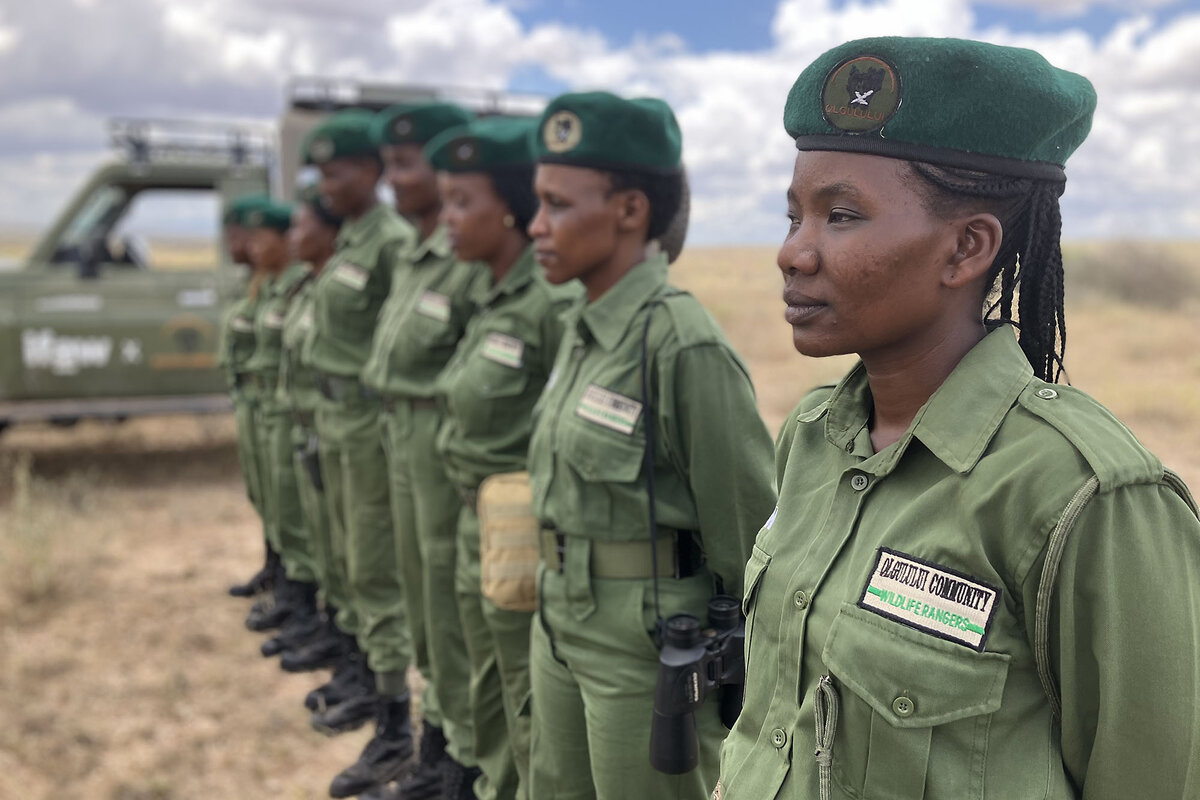
Photo: Lenny Rashid Ruvaga.
Senior Sgt. Purity Lakara (foreground) stands with members of Team Lioness at the Olgulului-Ololorashi Group Ranch. They make up Kenya’s first all-woman ranger force.
Maasai women are breaking out of traditional subservient roles, with some especially adventurous females deciding to serve as conservation rangers.
Lenny Rashid Ruvaga writes at the Christian Science Monitor, “The breakthrough was a bottle of water. For three days, wildlife ranger Everlyne Merishi had been embedded with a group of Maasai morans, or hunters. It was mid-2023, and they were searching for lions that had killed several of their cattle near this national park at the foot of Mount Kilimanjaro. For the Maasai, cows are sacred and considered members of their families. The men wanted vengeance.
“Mrs. Merishi understood that feeling, because she is Maasai herself. That is also why she was convinced there could be a less destructive solution.
“The group had already walked about 25 miles that day when members stopped, exhausted, for a break. Mrs. Merishi and her team began to pass around bottles of water. As the hunters drank, their faces softened and they mustered weak smiles.
“Mrs. Merishi remembers walking over to a group where one of the leaders sat. ‘I told them that I understood their pain and that an injustice had occurred, but I promised that we would ensure that the authorities would relocate these two lions,’ she says.
“Mrs. Merishi is part of an all-woman ranger unit working on Maasai lands near Amboseli National Park in southern Kenya. That’s rare: Globally, women account for only 3% to 11% of all park rangers. Team Lioness, as the Kenyan unit is known, was formed in 2019, part of a worldwide movement to increase those numbers.
“These efforts are important, experts say, because they challenge stereotypes – but also because they help conservation efforts reach a wider audience. In the Amboseli area, for instance, the Lionesses have been particularly effective among the ranger teams at connecting with locals like the Maasai.
“ ‘It’s astonishing to see the incredibly positive ripple effect of employing women from local communities and the benefits on their lives and their communities at large,’ says Holly Budge, the founder of World Female Ranger Week and a longtime advocate for women in wildlife protection. …
“The commander of Team Lioness, Sgt. Purity Lakara, has dreamed of this life since she was a child.
“She grew up in a Maasai village approximately 30 miles from here. Her community placed heavy value on living in harmony with both animals and nature. And when she saw wildlife rangers patrolling the area, she was awed by the sense of authority they projected. There was one problem though: ‘They were all men,’ she says.
“Meanwhile, girls like her were expected to get married young and settle into a domestic life. … But Mrs. Lakara’s parents were determined that she should get an education, and her timing was fortuitous.
“In 2013, Africa’s first all-woman ranger unit, the Black Mambas, was formed in South Africa, and others soon followed in countries such as Zimbabwe and Congo. Supporters of the trend argued that women were more approachable and were able to communicate more easily with other women in the communities where they worked.
“The idea to form an all-woman ranger team in Amboseli came up in 2019. It was the brainchild of a female Maasai elder named Kirayian Katamboi and the International Fund for Animal Welfare, a global charity.
“At the time, Mrs. Lakara had just finished high school. When village elders called a meeting to pitch the new ranger unit, ‘my heart leapt for joy,’ she says. She became one of its founding members.
“Today, Team Lioness is made up of 17 women, each of whom has completed a three-month training in ecology, first aid, and ‘bushcraft’ – or the art of talking to people about conservation. They live for stretches of 21 days at a simple base camp with concrete floors and a sheet iron roof in the Olgulului-Ololorashi Group Ranch, as the Maasai land surrounding Amboseli National Park is known.
“Each morning, the rangers patrol the surrounding area on foot, walking about 12 miles as they look for signs of poaching and survey the wildlife in the area. The women are also responsible for managing occasional conflicts between locals and the animals, which usually flare up when lions or cheetahs from Amboseli cross into Maasai villages and kill cattle.
“In the past, these situations often led to tensions between park rangers, who didn’t take kindly to attempts to kill the offending wildlife, and communities, who often felt authorities wanted to protect animals but didn’t care about the people they harmed.
“However, the honest communication style of Team Lioness and other ranger units from Maasai communities has helped gain trust. They explain the law and people’s rights – like their right to be compensated for cattle killed by big cats from the park. …
“The rangers also give back to the community in other ways. In April 2022, they started a school outreach program where they hope to inspire students – particularly girls – to stay in school and pursue careers in conservation.
“ ‘I beam with joy when I hear the students say, “I want to be like Ranger Lakara or Ranger Merishi,” ‘ Mrs. Lakara says. ‘It means that they see us as role models.’”
More at the Monitor, here.
Posted in Uncategorized, tagged clam garden, environment, good fire, indigenous, irrigation, nature, waffle garden on July 1, 2024| 5 Comments »
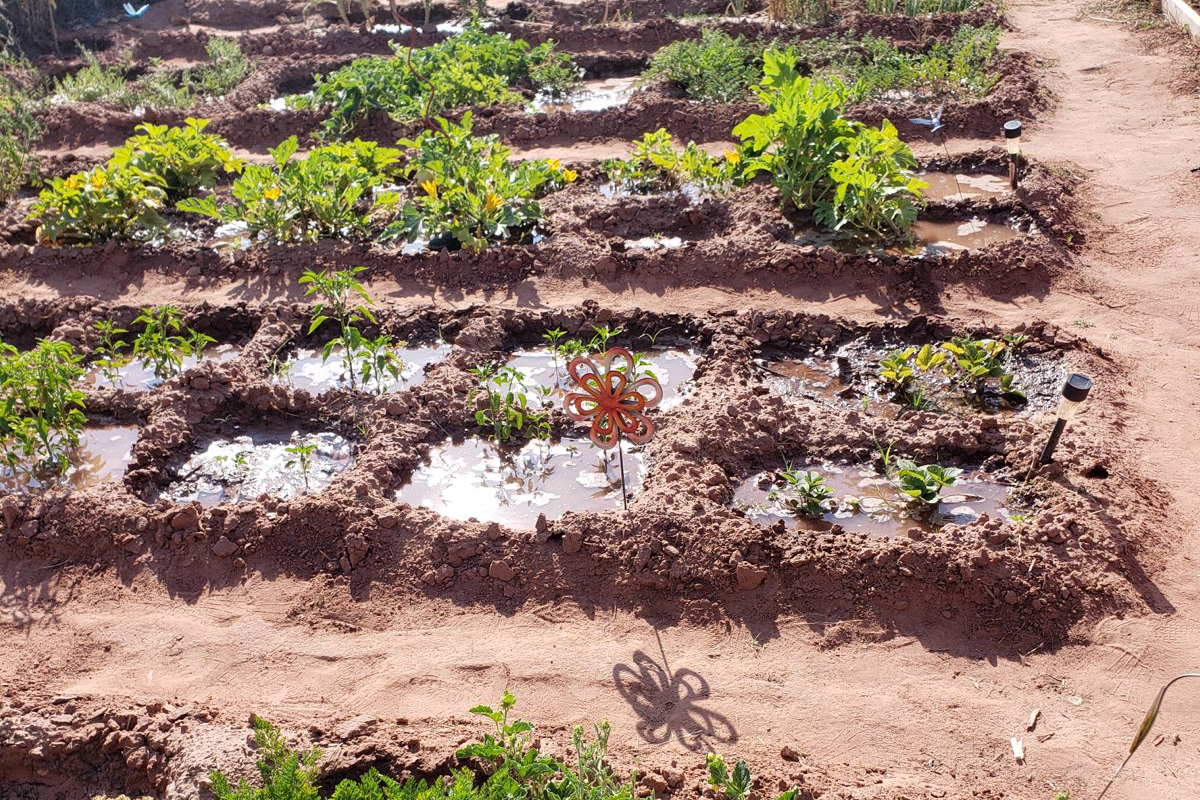
Photo: Curtis Quam via Civil Eats.
According to Civil Eats, “In the face of climate change and persistent droughts, a growing number of people from Zuni Pueblo in New Mexico and elsewhere are adopting the traditional farming practice.”
Some days, reading the news, I just feel fed up with what capitalism has done to the human race — not to mention the planet. I don’t know how to get out of my own role in this mess, but if nothing else, I can at least learn a little about indigenous ways that are different.
Samuel Gilbert describes nine practices at the Washington Post: Zuni waffle gardens, “good fire,” ancient Irrigation, the original carbon capture, dryland farming, restoring salmon runs, resilient seeds, Swinomish clam gardens, and climate-smart design.
“Since the first Earth Day in 1970,” Gilbert writes, “the world has experienced profound ecological changes. Wildlife populations have decreased by 69 percent, the result of habitat loss caused by rapid industrialization and changing temperatures. 2023 was the hottest year on record. …
“Jim Enote, 66, has been planting a traditional Zuni waffle garden (or hek’ko:we in the Zuni language) since before he could walk.
“ ‘My grandma said I started planting when I was an infant tied to a cradleboard,’ said Enote, who grew up on the water-scarce Zuni Pueblo on the southeastern edge of the Colorado plateau. ‘She put seeds in my baby hands, and I dropped seeds into a hole.’
“Enote has continued this ancient garden design, creating rows of sunken squares surrounded by adobe walls that catch and hold water like pools of syrup in a massive earthen waffle. The sustainable design protects crops from wind, reduces erosion and conserves water. …
“Before European settlers traveled to the American West, Indigenous people managed the landscape of northern California with ‘cultural burns’ to improve soil quality, spur the growth of particular plants, and create a ‘healthy and resilient landscape,’ according to the National Park Service.
“ ‘The Karuk have developed a relationship with fire over the millennia to maintain and steward a balanced ecosystem,’ said Bill Tripp, director of natural resources and environmental policy for the Karuk Tribe. ‘A good portion of the resources that we depend on, in the natural environment, are dependent on fire.’
“But in the mid-19th century, Indigenous burning was outlawed. Not only did that cause the Karuk to lose a vital part of their culture, but also, it invited potentially worse wildfires. The burns had reduced the amount of fuel accidental fires feed on. …
“Prescribed burning has returned as state and federal agencies recognize the importance of fire in managing forests. In 2022, California passed legislation affirming the right to cultural fire and is considering another bill (backed by the Karuk Tribe) to reduce the barriers to cultural burns on tribal lands. …
“In New Mexico, there are 700 functioning acequias, centuries-old community irrigation systems that have helped the parched state build water resilience. These acequias — a design from North African, Spanish and Indigenous traditions — were established during the 1600s. … Unlike large-scale irrigation systems, water seepage from unlined acequias helps replenish the water table and reduce aridification by adding water to the landscape. The earthen ditches mimic seasonal streams and expand riparian habitats for numerous native species.
“ ‘It’s a very good and sustainable system to take water from one source and put it into the community,’ said Jorge Garcia, executive director of the Center for Social Sustainable Systems and secretary of the South Valley Regional Association of Acequias. … ‘We need to maintain those knowledge systems, especially if we continue through dry years.’ …
“U.S. forests are carbon sinks, sequestering up to 10 percent of nationwide CO2 emissions. Indigenous forestry can play a critical role in reducing global warming by restoring biodiversity and health to these ecosystems, including the management of culturally significant plants, animals and fungi that contribute to healthier soil.
“ ‘We know that most of the carbon in the forest is stored in the soil, and healthy soil depends on diversity,’ said Stephanie Gutierrez, a member of the San Carlos Apache Tribe and the forests and community program director for Ecotrust. …
“Yet tribal forestry remains severely underfunded and underutilized on public lands. Indigenous Hawaiians are reintroducing ancient food forests once destroyed by overgrazing, logging and commercial agriculture. These biodiverse edible forests increase food security and build nutrient-dense soils that sequester carbon. …
“The Hopi nation in Arizona receives an average of 10 inches of rain per year — a third of what crop scientists say is necessary to grow corn successfully. Yet Hopi farmers have been cultivating corn and other traditional crops without irrigation for millennia, relying on traditional ecological knowledge rooted in life in the high desert.
“ ‘I like to call traditional ecological knowledge the things my grandfather taught me,’ said Michael Kotutwa Johnson, a Hopi dryland farmer and academic. Hopi farming practices include passive rainwater harvesting, myriad techniques to retain soil moisture, and a reliance on traditional seed varieties superbly adapted to the desert.
“ ‘The fact we are able to raise crops such as maize with only 6 to 10 inches of precipitation as opposed to the standard 33 inches of precipitation is outstanding,’ Johnson said.”
Learn about the other techniques at the Post, here.
Posted in Uncategorized, tagged costa rica, ecology, ecosystem, environment, pollinators, reforestation on June 30, 2024| 2 Comments »
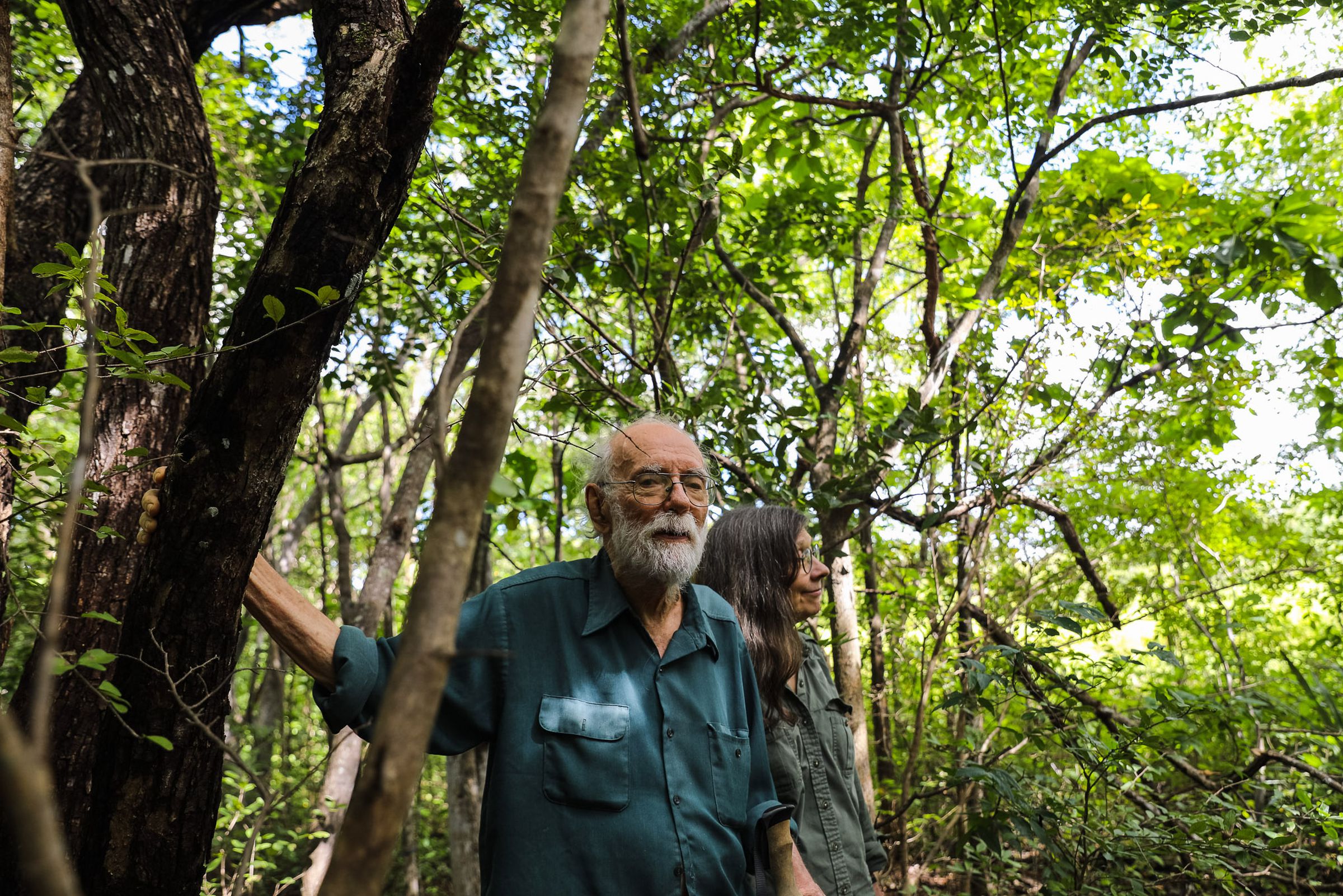
Photo: The Verge.
Daniel Janzen and Winnie Hallwachs, together with other conservationists, has brought forests back to the Area de Conservación Guanacaste (ACG) in Costa Rica — an area larger than the Hawaiian island of Oahu.
Costa Rica, a beautiful country, has the right priorities. It has restored its forests and moved to renewable energy. Justine Calma at the Verge writes about the people behind the reforestation efforts and how climate change is starting to make their work more difficult.
“Ecologist Daniel Janzen wades into the field, clutching a walking stick in one hand and a fist full of towering green blades of grass in the other to steady himself. Winnie Hallwachs, also an ecologist and Janzen’s wife, watches him closely, carrying a hat that she hands to him once he stops to explain our whereabouts.
“Together with other conservationists who have dedicated decades of their lives to this place, the couple has brought forests back to the Area de Conservación Guanacaste (ACG). It’s an astonishing 163,000 hectares [~403,000 acres] of protected landscapes — an area larger than the Hawaiian island of Oahu — where forests have reclaimed farmland in Costa Rica. …
“ACG is a success story, a powerful example of what can happen when humans help forests heal. It’s part of what’s made Costa Rica a destination for ecotourism and the first tropical country in the world to reverse deforestation. But now, the couple’s beloved forest faces a more insidious threat.
“Across the road, the leaves are too perfect. It’s like they’re growing in a greenhouse, Janzen says. There’s an eerie absence among the foliage — although you’d probably also have to be a regular in the forest to notice. …
“There should have been bees, wasps, and moths along our walk, she explains. And plenty of caterpillar ‘houses’ — curled up leaves the critters sew together that eventually become shelter for other insects. …
“The bugs play crucial roles in the forest — from pollinating plants to forming the base of the food chain. Their disappearance is a warning. Climate change has come to the ACG, marking a new, troubling chapter in the park’s comeback story. … What’s happening here in the ACG says a lot about what it takes to revive a forest — especially in a warming world. …
“The dry season is about two months longer than it was when Janzen arrived in the 1960s. Climate change is making seasons more unpredictable and weather more erratic across the planet. …
“María Marta Chavarría, ACG’s field investigation program coordinator … explains it like this, ‘A big rain is the trigger. It’s time! The rainy season is going to start!’ Trees unfurl new leaves. Moths and other insects that eat those leaves emerge. But now, the rains don’t always last. The leaves die and fall. That has ripple effects across the food chain, from the insects that eat the leaves to birds that eat the insects. They perish or move on. And next season, there are fewer pollinators for the plants. ‘The big trigger in the beginning was false,’ Chavarría explains. …
“In 1978, Janzen … recalls in a 2021 paper he and Hallwachs published in the journal PNAS [his front wall was plastered with moths at night]. The title was ‘To us insectometers, it is clear that insect decline in our Costa Rican tropics is real, so let’s be kind to the survivors.’
“That observation in 1978 led the couple to focus their research on caterpillars and their parasites. In 1980, they used light traps to inventory moth species across the country, documenting at least 10,000 species. Since then, however, they’ve seen a steady decline in caterpillars. …
“Hanging a white sheet and lights at the edge of a cliff overlooking a vast stretch of both old and new-growth forests, they photographed moths that came to rest on the sheet in 1984, 1995, 2007, and 2019. The first photograph is an impressive tapestry of many different winged critters. By 2019, that’s been reduced to a mostly white sheet speckled here and there with far fewer moths. Instead of an intricate tapestry of wings and antennae, the sheet looks more like a blank canvas an artist has only started to splatter with a brush.
“Hallwachs and Janzen can see the same phenomenon now standing in broad daylight in the forest across from the field. Just because forests have come roaring back across the ACG doesn’t mean the struggle to survive is over. …
” ‘A lot of the reforestation projects are kind of assuming that trees are mechanical objects,’ Hallwachs says. But they don’t stand alone, not in a healthy forest.
“Merely plant rows of trees, and the result is a tree plantation — not a forest. Bringing back a forest is a much different endeavor. It’s more about restoring relationships — reconnecting remaining forests with land that’s been cleared and nurturing new kinds of connections between people and the land.
“In ACG’s dry forest, they didn’t have to plant trees by hand. By getting rid of the grass and stopping the fires, they cleared the way for the forest’s return. The first seeds blew in with the wind.
“Hallwachs and Janzen recognize them like old friends — stopping next to a Dalbergia tree that was one of the first to grow where they stomped out the fires. Its seeds are light and flat, allowing them to float on a breeze. When those trees start to grow, they attract animals in search of food or shelter.
“Janzen measures each animal up by how many seeds they can hold and then spit or defecate onto the forest floor. ‘When you see a bird fly by, what you’re seeing is a tablespoon full of seeds,’ he says. ‘Every deer you see is a liter of seeds.’ ”
More at the Verge, here.
Posted in Uncategorized, tagged capitalism, co-ownership, owners, share, spain, workers on June 29, 2024| 9 Comments »
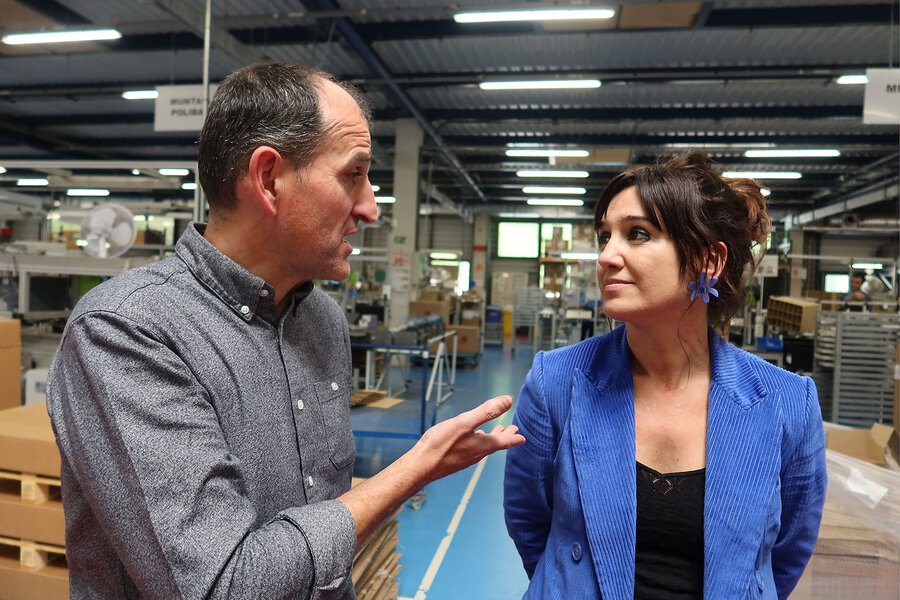
Photo: Erika Page/Christian Science Monitor.
Amaia Salbide speaks with plant manager Ander Jausoro on the factory floor of an industrial plant belonging to Copreci, one of the Spanish companies sharing ownership with workers. “No one is rich. No one is poor.”
Giving workers a piece of the responsibility for a company’s success — and a piece of the profits — is not a new idea. But lately it’s been gaining traction in Spain.
Erika Page reports at the Christian Science Monitor, “At first glance, this could be any industrial factory. Workers wearing protective gloves assemble control panels and heating plates amid the relentless whirring of machinery. Giant yellow robot arms swing back and forth, lining trays with tiny metal parts.
“But there is a reason that each year thousands of visitors from every continent come to this mountainous Basque landscape to study factories like this one. This is the home of the Mondragon Corp., the world’s largest federation of worker-owned cooperatives.
“Copreci, which makes parts for home appliances, is one of 81 Mondragon cooperatives, ranging from manufacturing to finance and retail. By the end of the day, this floor alone will churn out 30,000 gas valves, destined for stoves worldwide.
“Yet it is also churning out a radically different vision of capitalism. For young people especially, capitalism brings to mind wealth inequality, cost-of-living crises, and environmental collapse. …
“The Mondragon Corp. sees itself as a third way, not as an alternative to capitalism, but as an alternative way of doing capitalism – one that can build trust, not widen divisions.
“ ‘The purpose of what we’re doing here is not the machinery or the production process,’ says Amaia Salbide, president of Copreci, on a visit to the factory floor. ‘Those are tools to reach a higher goal of social transformation.’ …
“Mondragon’s nearly 70,000 members, ranging from floor workers to top executives, are co-owners of their businesses. They have voting power at general assemblies, where they weigh in on company strategy and policy. The income disparity between the highest- and lowest-paid employees in Mondragon’s cooperatives is capped at a ratio of 6-to-1, compared with a typical ratio of 344-to-1 in the United States. …
“As the saying around here goes, Mondragon does not create rich people, but rich societies. That means prioritizing quality of life for the employees who live and work in the towns dotting these forested hills rather than maximizing profit for investors.
“ ‘I think of it as a sort of attractive form of capitalism,’ says Nick Romeo, author of The Alternative: How To Build a Just Economy. ‘One that works more effectively for more people but retains some of the benefits of markets and efficiency and competition.’
“Hugo Montalvo knows he could make more money as a sales manager at a regular multinational company. But he wouldn’t trade his middle-class status or the small town where he is raising his two children. At the end of a day’s work, Mr. Montalvo often finds those on the assembly line picking up their children from the same schools as top managers and gathering at the same tables at local bars. The base pay for a Mondragon worker is on average 40% higher than Spain’s minimum wage.
“ ‘Here, no one is rich,’ says Mr. Montalvo, who works for Ecenarro, a Mondragon cooperative. … ‘But no one is poor either. We’re all in that middle range, earning decent salaries.’
“Solidarity permeates the business model. To become a member of a cooperative, a worker invests €17,000 ($18,400), normally bit by bit over time. As for company profit, 60% is reinvested in the business, 30% goes to employees as capital, and 10% is for the local community. At the end of each year, Mondragon reviews each cooperative’s earnings, and companies in better financial positions contribute to those that are struggling.
“ ‘Just as we’ve received in the past, now it’s our turn to give,’ says Mr. Montalvo.
“Back in 2013, he was working for Fagor Electrodoméstico, a Mondragon cooperative that at the time was Spain’s leading home appliance company. When the company went bankrupt in the aftermath of the financial crisis, his job and initial investment disappeared.
“Within two weeks, he was transferred to Ecenarro, and Mondragon covered his membership fee. Of the almost 2,000 people who lost their jobs at Fagor, 95% were relocated within the Mondragon network. During the pandemic, workers came to collective agreements to avoid job losses, including salary reductions. …
“ ‘The cooperative is a creator of wellness, so it has to exist for decades and decades,’ says Ander Etxeberria, who leads Mondragon’s cooperative outreach program.”
As with anything, there are challenges here, too. Get more details at the Monitor, here.
Posted in Uncategorized, tagged Buddhist, climate change, conservation, demon, monastery, restore, tibet on June 28, 2024| 2 Comments »

Photo: Tulsi Rauniyar.
Climate-ravaged monasteries in Lo Manthang, Tibet, have been meticulously restored by the local community with guidance from experts.
Tulsi Rauniyar wrote recently at the BBC about ordinary Tibetans learning to restore Tibetan monasteries, rescuing them from the consequences of climate change.
“Extreme weather is threatening these intricate 15th Century Tibetan monasteries,” Rauniyar reports, “but local people are rising to the challenge to preserve them.
“Tashi Kunga stands before the Kag Choede monastery, built into the Dhaulagiri mountain range on the Tibet-Nepal border. The monk’s carmine robes glint in the rain, as he recounts the ancient legend of Guru Rinpoche’s battle with a demon.
“The legend goes that centuries ago, a demon wreaked havoc on a monastery in Tibet. Guru Rinpoche chased it south to Upper Mustang in Nepal and defeated the demon following a ferocious battle, burying the demon’s remains across the mountain range. The people of Mustang hono The people of Mustang honoured the sacred grounds by building monasteries atop the demon’s body parts.
” ‘And right on the demon’s heart, the capital of Lo Manthang [was built] in 1380,’ says Kunga, pointing towards the narrow alleys, ancient monasteries, and flat roofs adorned with prayer flags of one of the last medieval walled cities in the world.
“For centuries, Lobas, the indigenous people residing here, have thrived in this remote region situated on top of the Tibetan Plateau. One thing that has remained constant is the monasteries, locally known as ‘Gonpas,’ the most treasured heritage of the region. But almost two decades ago, many of these monasteries, which date back to the 15th Century, started crumbling.
“Experts sounded the alarm, attributing the collapse to the severe impacts of climate change. Data indicates a significant increase in the intensity of storms and rainfall across the region. Increased rainfall saturates the rammed-earth buildings, as moisture in the soil is drawn upward into the walls, leading to issues such as leaking roofs and rising damp.
” ‘For us, Buddhists, the paintings and the artifacts in the monasteries are embodiments of the gods themselves, and we can’t worship a half-damaged idol,’ says Kanga.
‘There was no one to repair it. Our heritage was slowly decaying away. We thought the deities were angry.’
“Buddhist monasteries have long been revered as the foundation of Tibetan culture, serving as a vital hub for the creation and safeguarding of both tangible artifacts and profound intellectual traditions. But as unprecedented weather patterns pose a threat to their cultural heritage, local community members have stepped up to restore them. Local people have gained diverse skills, from reinforcing walls to crafting metal statues and restoring paintings.
“Over the past 20 years, a team of local Lobas trained by Western art conservationists have replaced the old, leaky roofs of the temples with round timbers, river stones, and local clay for waterproofing, and have restored the wall paintings, statues, sculpted pillars and the ceiling decorations, giving these centuries-old monuments a new life.
“Luigi Fieni, the lead art conservator at Lo Manthang, has spearheaded the restoration project. Transforming a community of farmers into conservators has been challenging, he says. Most of the Lobas had never held a pen or a paint brush before, and undertook extensive training before they began restoring the 15th Century paintings.
” ‘But it all worked out,’ says Fieni. ‘Tourists visiting Mustang were keenly interested in religion. So we felt these sacred artifacts needed preservation not only for their historical significance but also for sustaining livelihoods here.’
“The team, initially made up of 10 members, has grown to 45 conservators, mostly women, although there was initial reluctance to accept any women in the group. According to local tradition, women are prohibited from touching sacred objects. However, women did eventually take part in the Lo Manthang restoration project.
” ‘It took years of discussion and negotiation with the local clergy and community, but we succeeded in including local women in the wall-painting conservation team,’ says Fieni. …
“Tashi Wangmo, 40, used to spend her time herding yak, collecting and selling herbs, and doing various odd jobs, but it never provided much income. When she received the opportunity to pursue new training and earn a daily wage in the restoration project, she jumped at it.
” ‘It enabled many of us [women] to break free from the limits of our homes, expand our skillsets, and find new opportunities,’ she says.”
More at the BBC, here. No paywall.
If you want to learn about Tibet through some wonderful fiction, check out the Tibet mysteries by Eliot Pattison, starting with The Skull Mantra.
Posted in Uncategorized, tagged alphabet, clicks, coda, communicate, endangered, sperm whale on June 27, 2024| 2 Comments »

Photo: New England Aquarium.
Endangered sperm whales — an adult and calf sighted in the Northeast Canyons and Seamounts Marine National Monument in October 2023.
This is the time of year that people like to go on whale watches. Responsible tour operators know that it’s vitally important not to stress out the whales. But what a thrill it is to see even one! And that can keep people engaged in their welfare.
Meanwhile, scientists are always trying to understand more about them. Consider the new research on sperm whales’ “phonetic alphabet.”
Will Dunham of Reuters wrote at US News and World Report, “The various species of whales inhabiting Earth’s oceans employ different types of vocalizations to communicate. Sperm whales, the largest of the toothed whales, communicate using bursts of clicking noises — called codas — sounding a bit like Morse code.
“A new analysis of years of vocalizations by sperm whales in the eastern Caribbean has found that their system of communication is more sophisticated than previously known, exhibiting a complex internal structure replete with a ‘phonetic alphabet.’ The researchers identified similarities to aspects of other animal communication systems — and even human language.
“Like all marine mammals, sperm whales are very social animals, with their calls an integral part of this. The new study has provided a fuller understanding of how these whales communicate.
” ‘The research shows that the expressivity of sperm whale calls is much larger than previously thought,’ said Pratyusha Sharma, a Massachusetts Institute of Technology doctoral student in robotics and machine learning and lead author of the study published [in May] in the journal Nature Communications.
” ‘We do not know yet what they are saying. We are studying the calls in their behavioral contexts next to understand what sperm whales might be communicating about,’ said Sharma.
“Sperm whales, which can reach about 60 feet (18 meters) long, have the largest brain of any animal. They are deep divers, feeding on giant squid and other prey.
“The researchers are part of the Project CETI (Cetacean Translation Initiative) Machine Learning Team. Using traditional statistical analysis and artificial intelligence, they examined calls made by about 60 whales recorded by the Dominica Sperm Whale Project, a research program that has assembled a large dataset on the species.
” ‘Why are they exchanging these codas? What information might they be sharing?’ asked study co-author Shane Gero, Project CETI’s lead biologist and Dominica Sperm Whale Project founder, also affiliated with Carleton University in Canada.
” ‘I think it’s likely that they use codas to coordinate as a family, organize babysitting, foraging and defense,’ Gero said.
” ‘All of these different codas that we see are actually built by combining a comparatively simple set of smaller pieces,’ said study co-author Jacob Andreas, an MIT computer science professor and Project CETI member. …
“For people, Sharma said, ‘There are two levels of combination.’ The lower level is sounds to words. The higher level is words to sentences.
“Sperm whales, Sharma said, also use a two-level combination of features to form codas, and codas are then sequenced together as the whales communicate. The lower level has similarities to letters in an alphabet, Sharma said. …
” ‘Human language is unique in many ways, yes,’ Gero said. ‘But I suspect we will find many patterns, structures and aspects thought to be unique to humans in other species, including whales, as science progresses — and perhaps also features and aspects of animal communications which humans do not possess.’
“If scientists can decipher the meaning of what the sperm whales are ‘saying,’ should people try to communicate with them?
” ‘I think there’s a lot more research that we have to do before we know whether it’s a good idea to try to communicate with them, or really even to have a sense of whether that will be possible,’ Andreas said.”
More at US News and World Report, here. See also the Smithsonian.
Posted in Uncategorized, tagged iris, midsommar, new england, peonies, photos, weasel on June 26, 2024| 4 Comments »
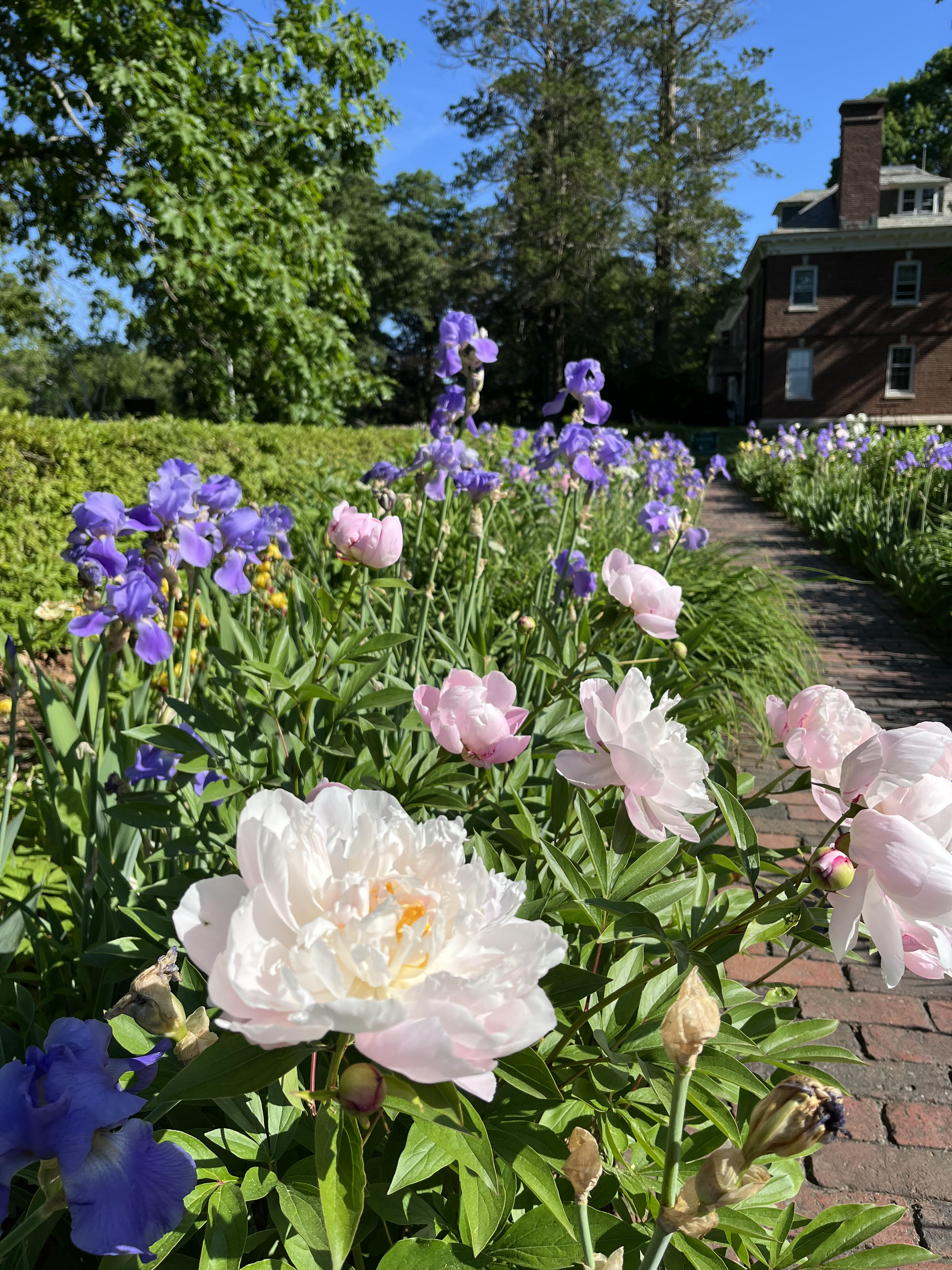
Photos: John and Suzanne’s Mom, except for one.
Midsommar arrived with a heat wave in these parts, and now it’s summer. I decided to round up some things that caught my eye in spring before I start shooting summer.
Above is a Minuteman Park garden at the Buttrick House, featuring iris and peonies.
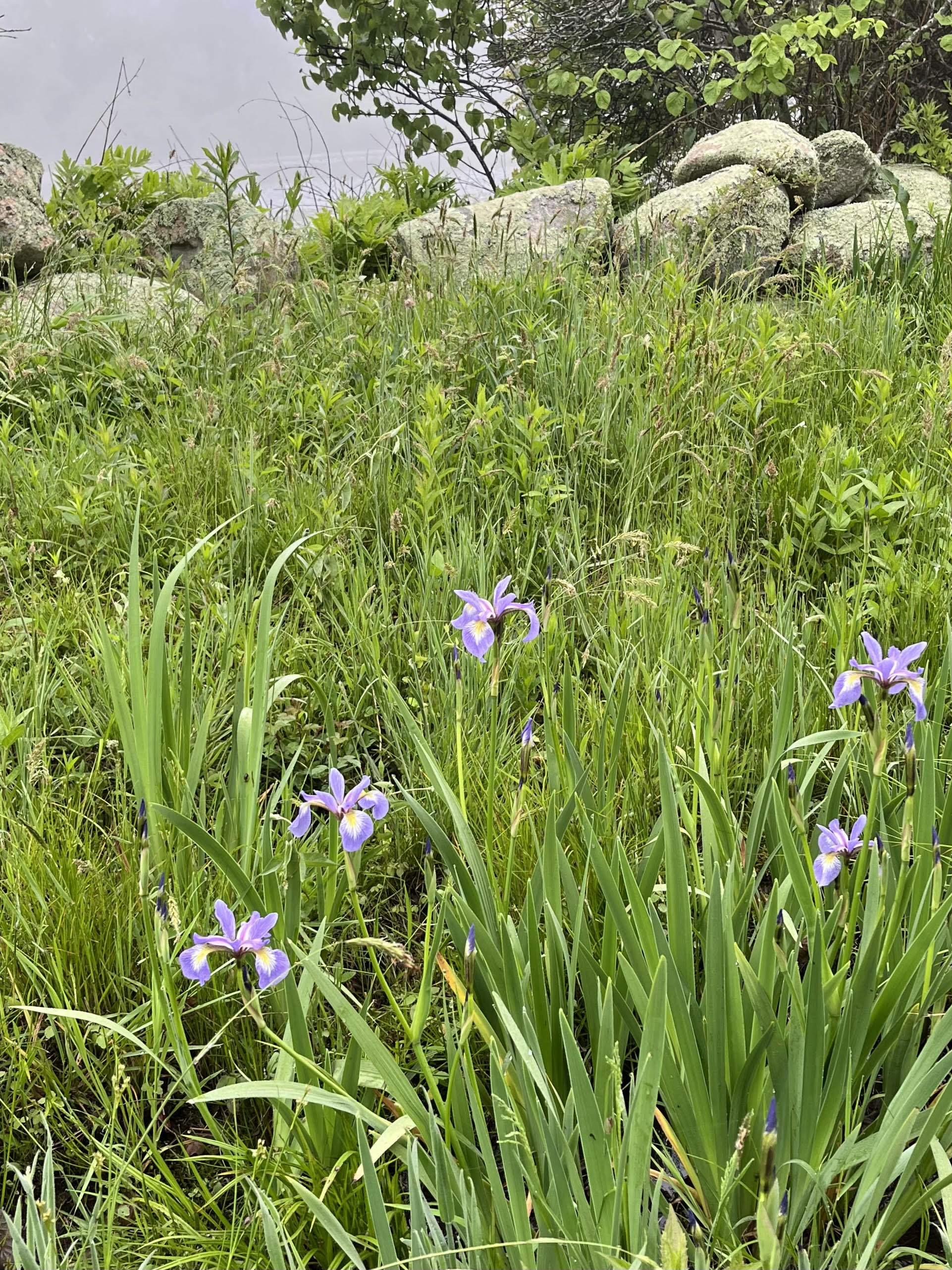
Wild iris bloom near a New Shoreham pond, and a flowery display decorates Wayland Avenue in Providence.
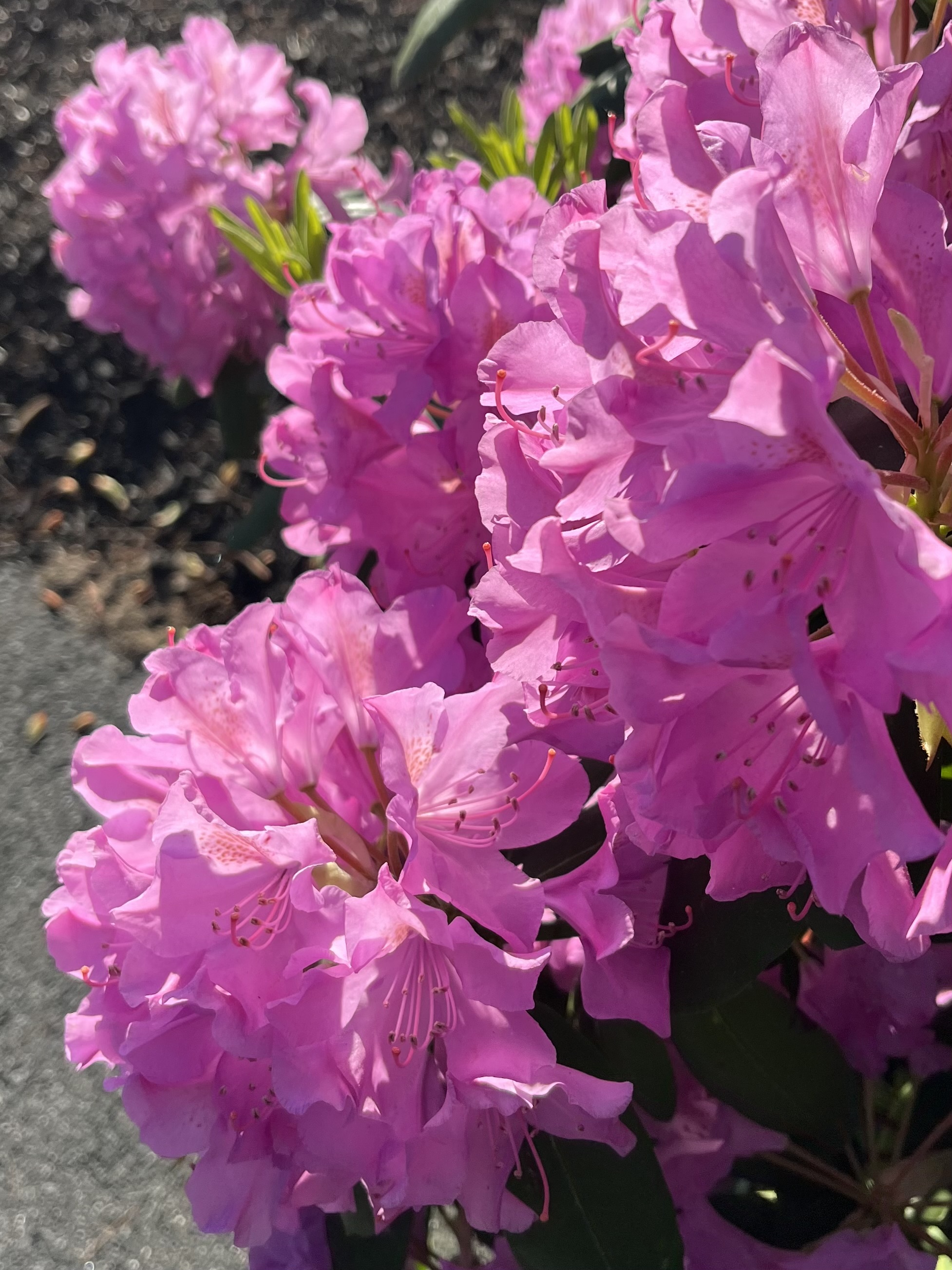
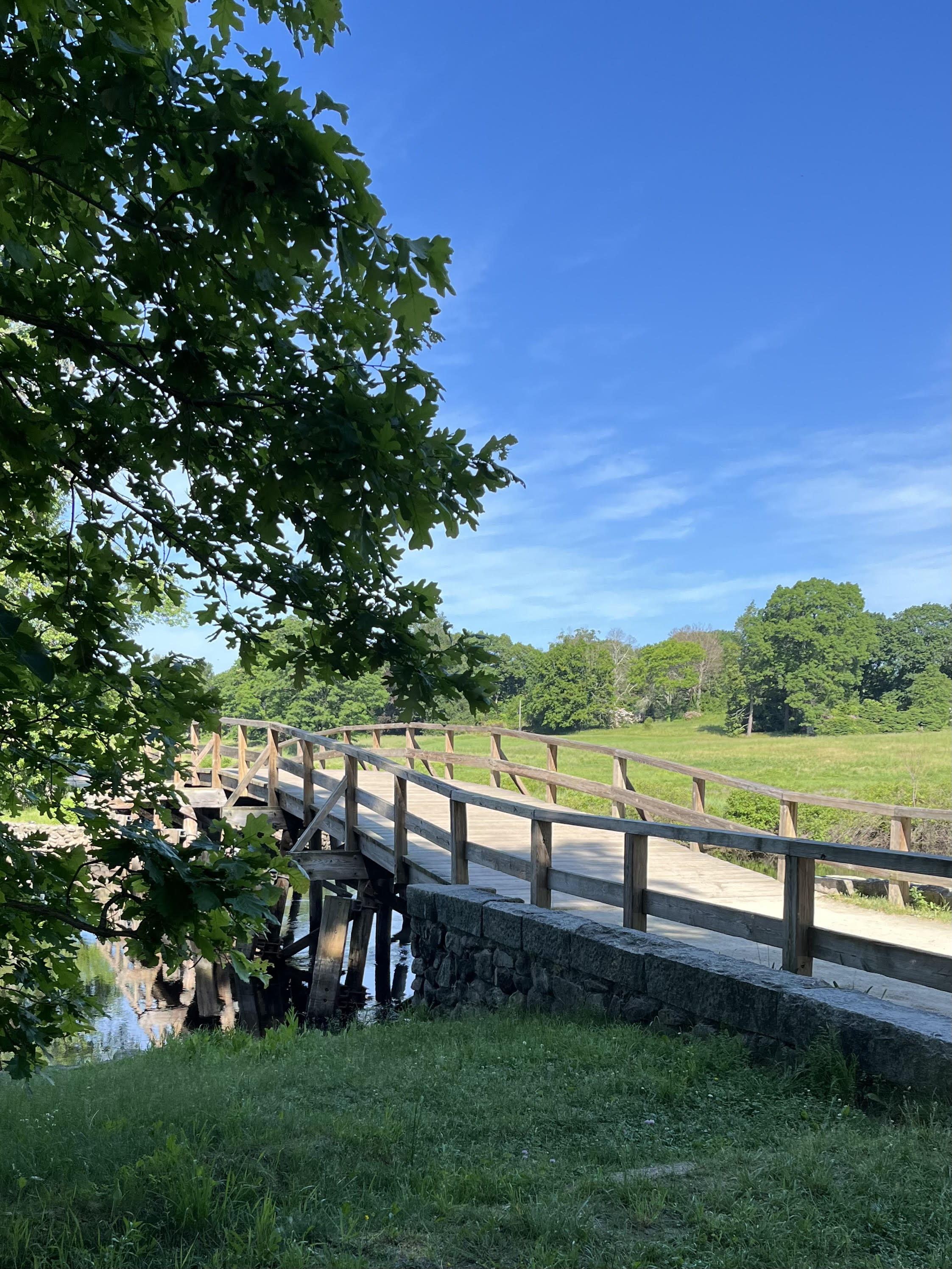
Rhododendrons on my early morning walk. The North Bridge in Concord. A well-loved antique car.
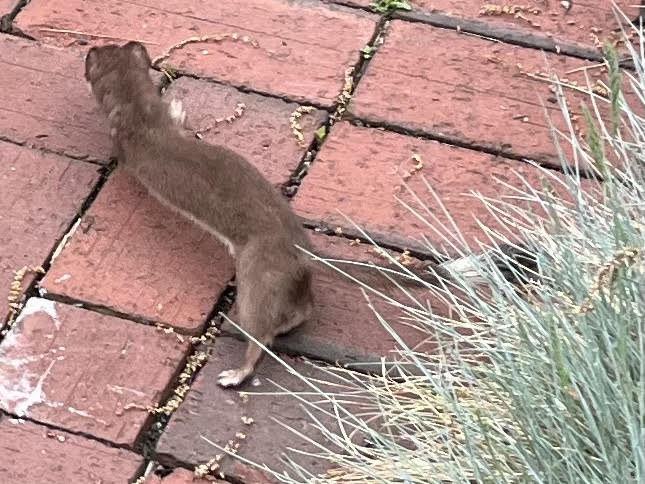
A weasel on the terrace at my retirement community — lots of excitement.
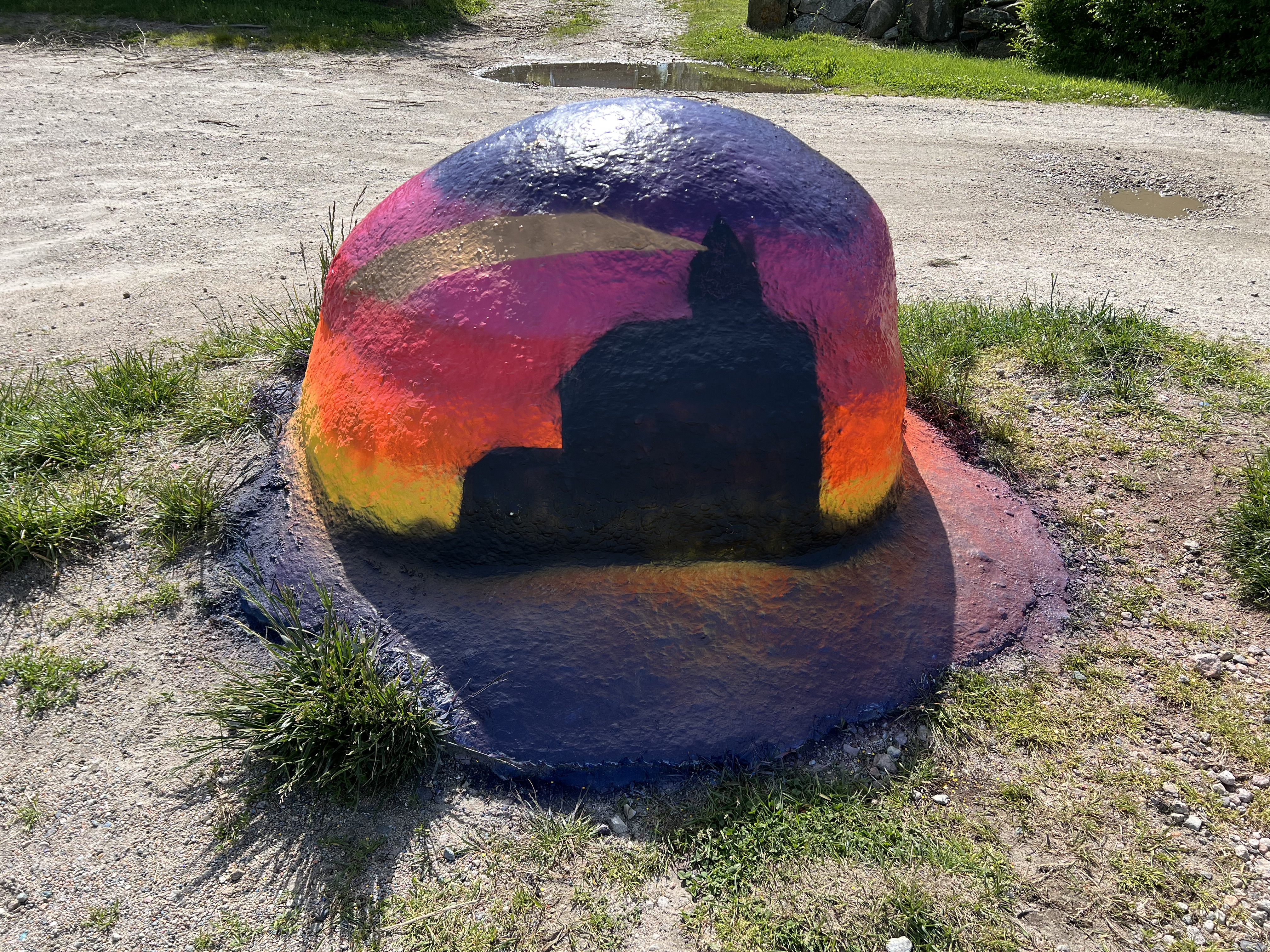
Sandra M. Kelly shot the photo of the Painted Rock, artist unknown. The work shows the island’s North Light, presumably at sunset.
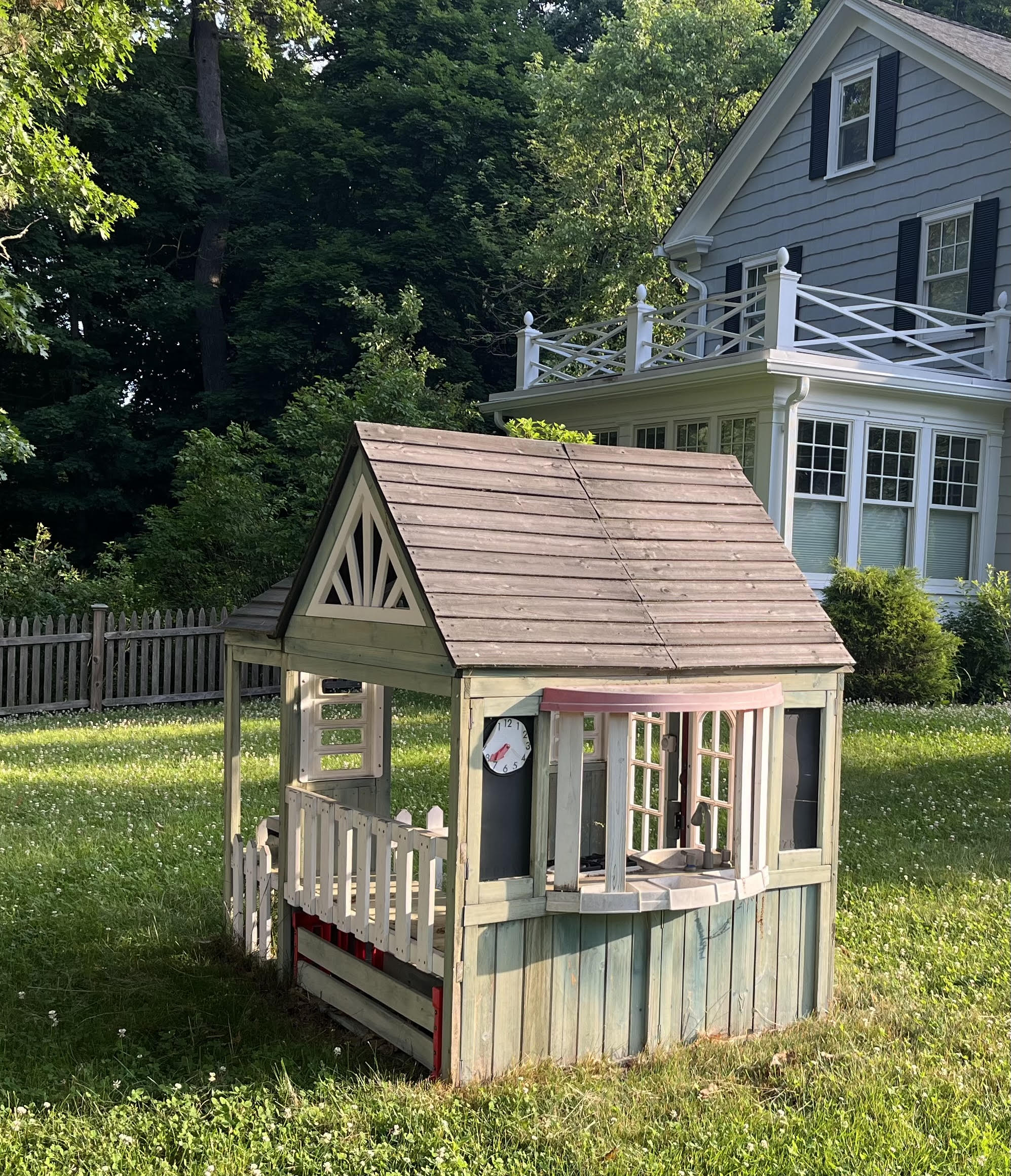
I liked the early shadows at a playhouse I saw on my walk.
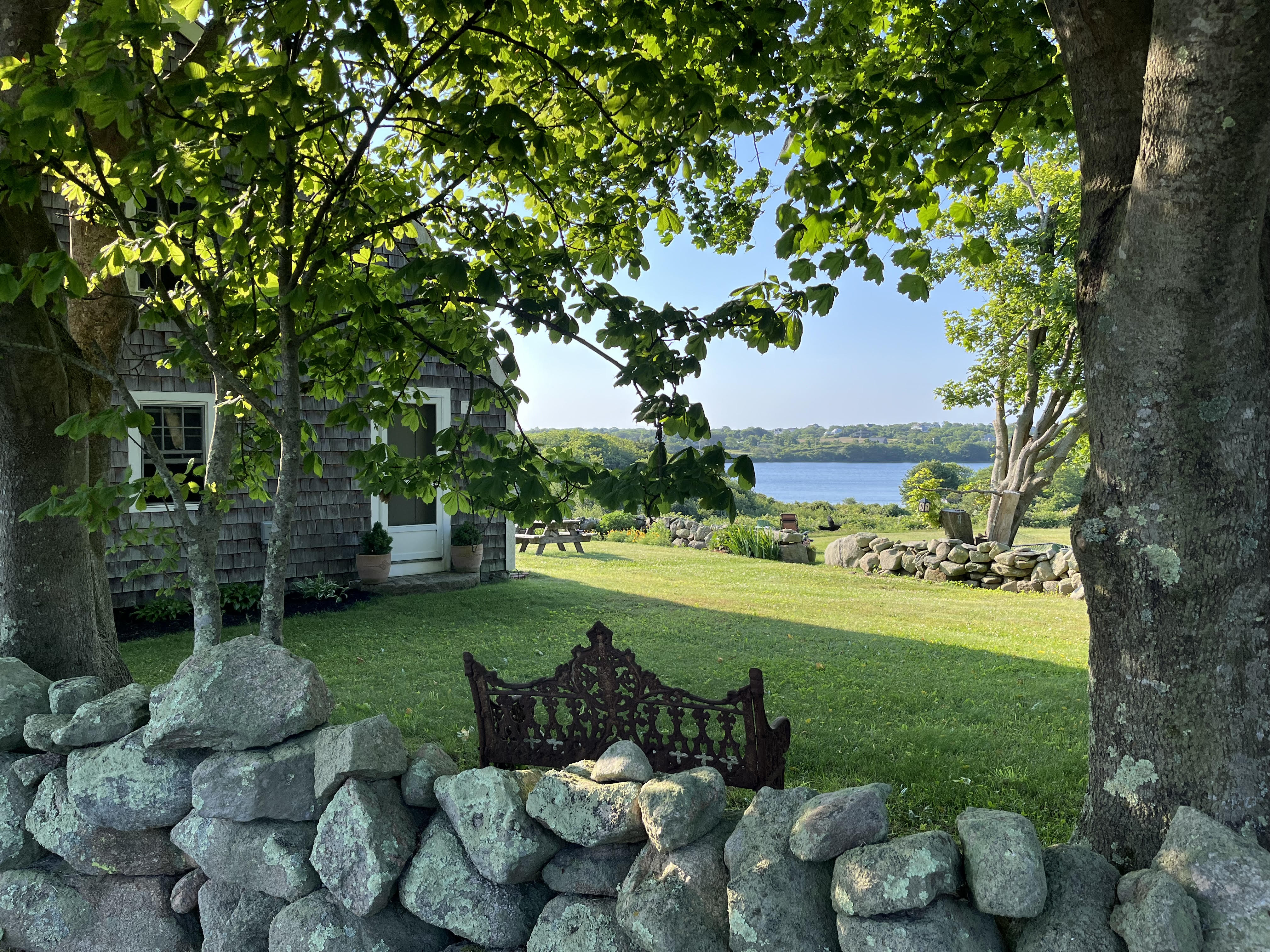
The stone fence near the historic house Smilin’ Through has a sweet view of Fresh Pond.
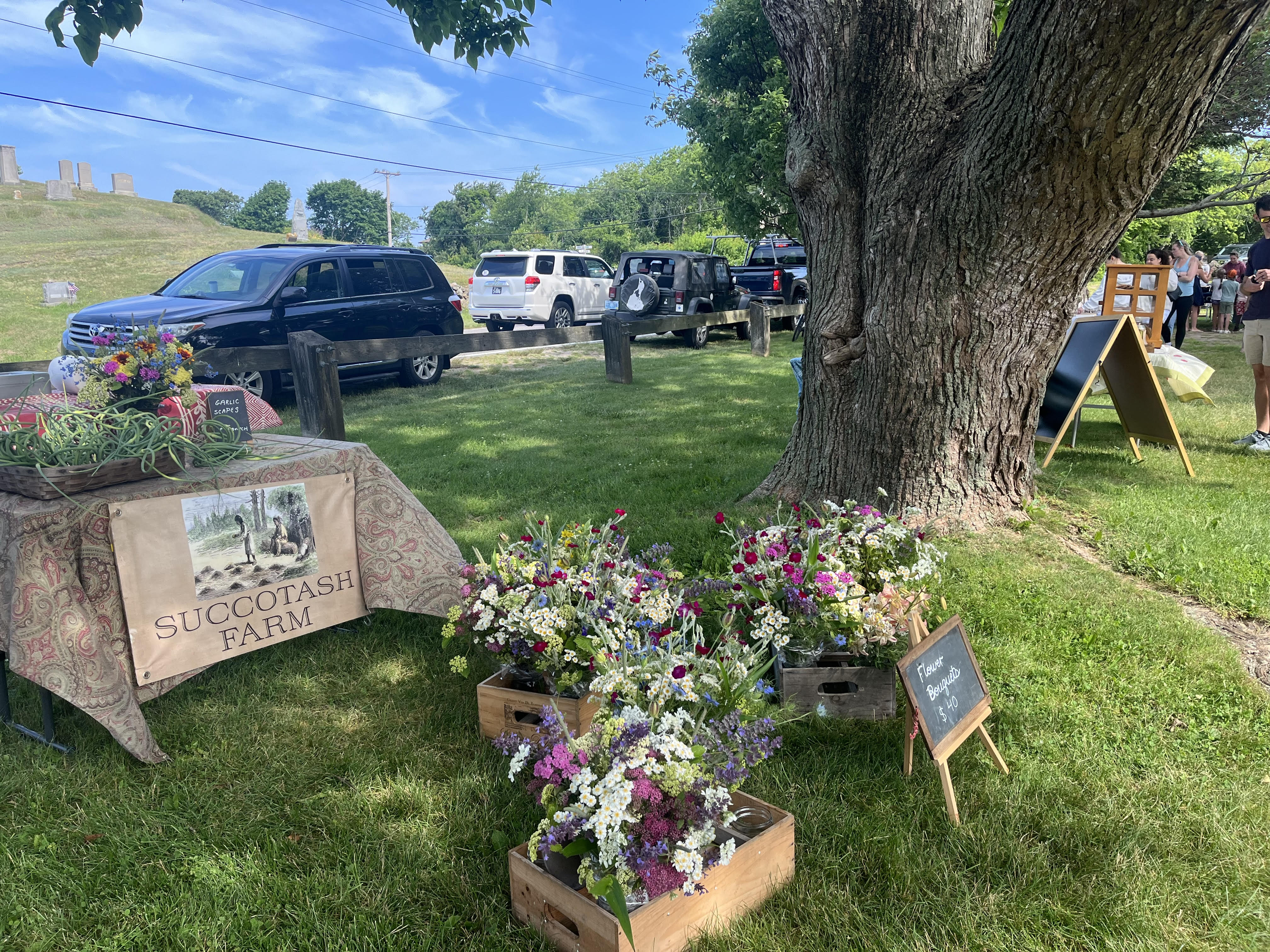
I bought a wonderful carrot-ginger soup at the farmers market. And I talked to a woman who was selling bottle-cap art and making more as she waited for customers.
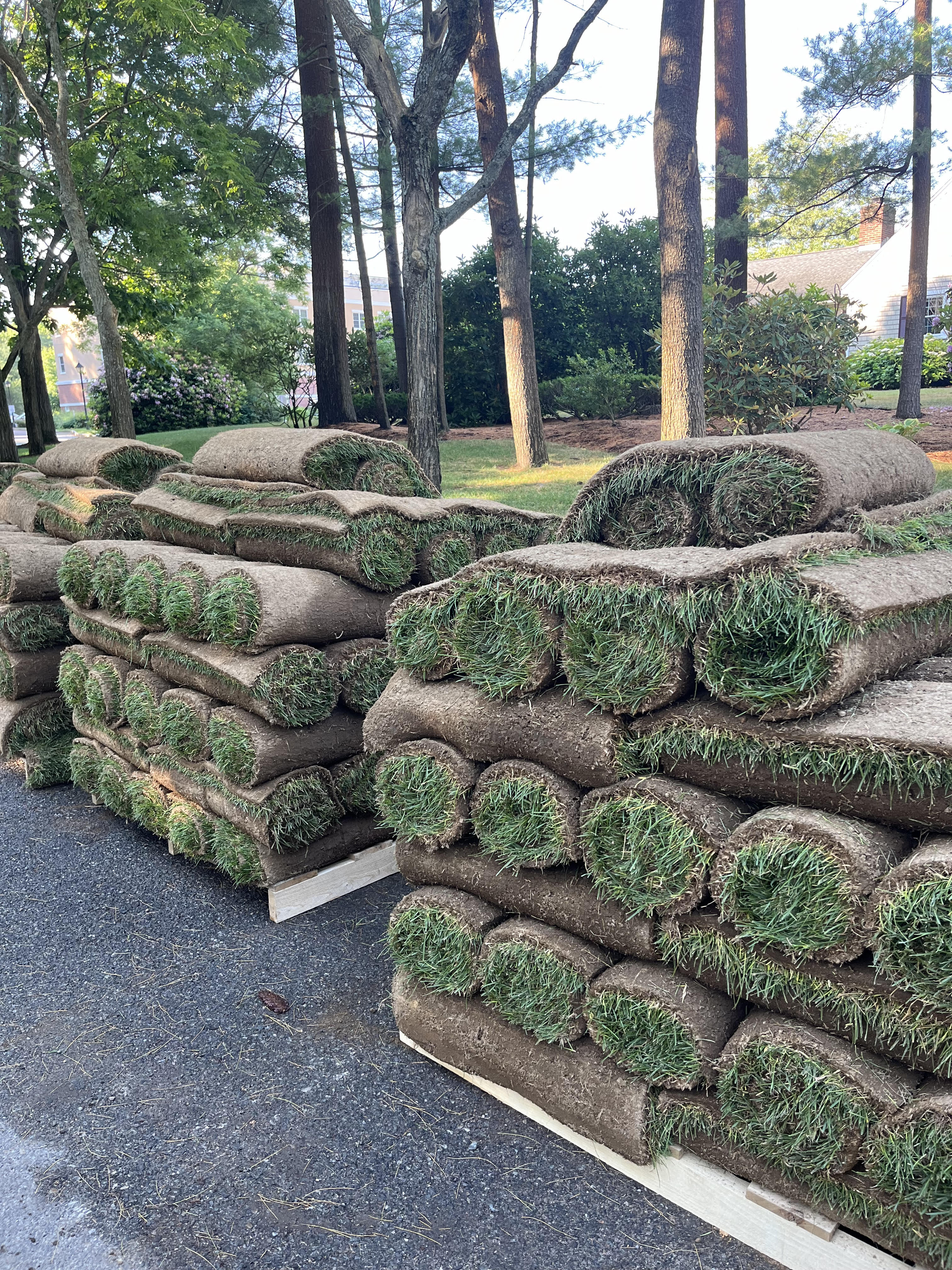
Giant sushi rolls. (Just kidding. It’s sod.)
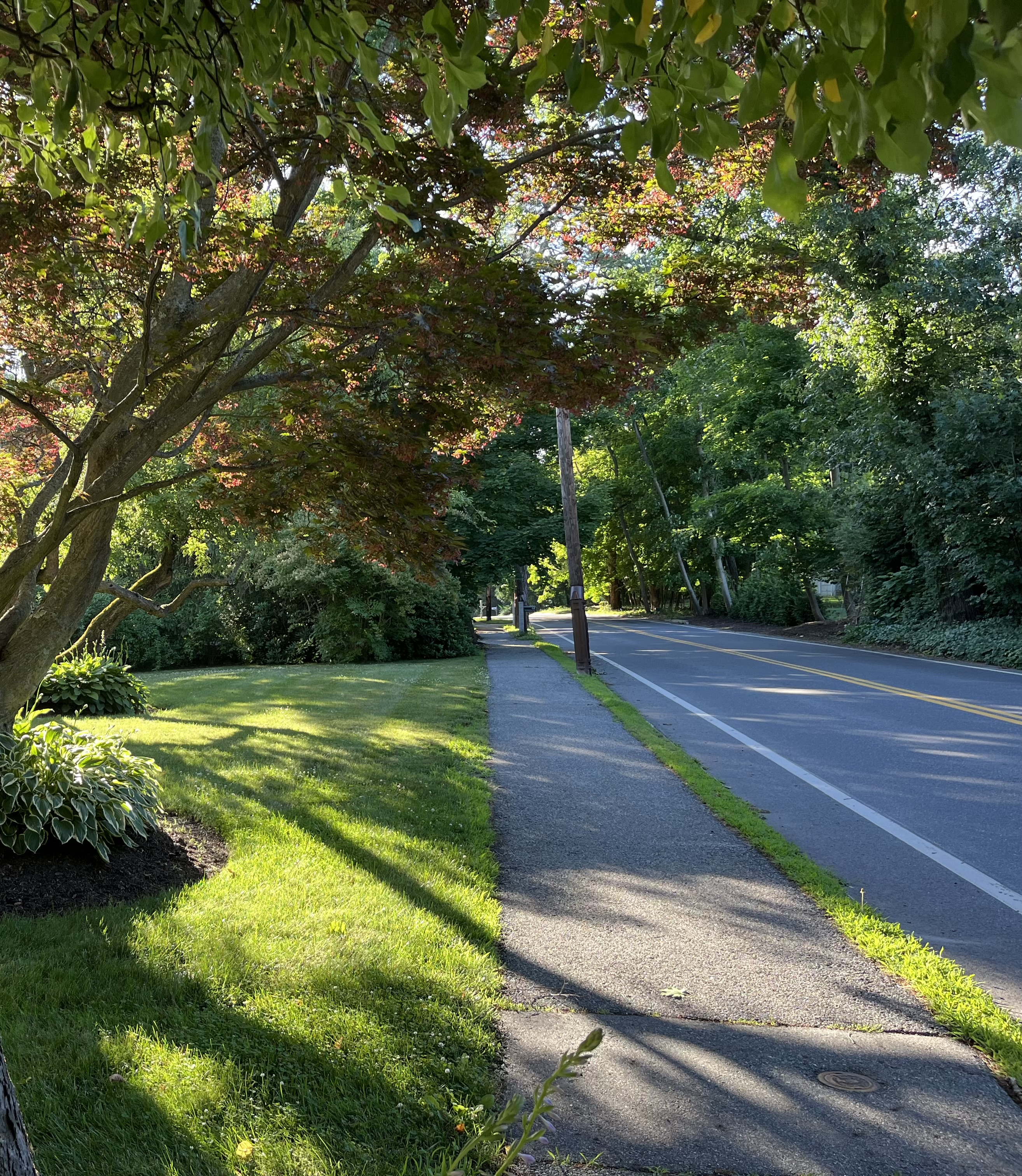
Early morning shadows.



Posted in Uncategorized, tagged Aspen, Pando, root system, tree, utah, world's largest on June 25, 2024| 2 Comments »

Photo: J Zapell/Wikimedia.
The world’s oldest organism, a grove of Populus tremuloides (Quaking Aspen) sharing one root system. From Fish Lake National Forest website.
Here’s something that’s a little hard to believe. Unless you live in Utah, I suppose. It’s a forest with one root system, so it’s technically one tree, and its “genetic integrity has been sustained over a long period time (between 9,000 and 12,000 years),” according to Wikipedia.
I first got interested thanks to Kayleen Devlin’s story “Can Trees Really Live Forever?” at BBC Earth, which focused on ancient gingko trees, mostly in China. But Pando in Utah is said to be the world’s largest tree. And it’s really old.
Wikipedia says, “Pando (Latin for ‘I spread’), the world’s largest tree, is a quaking aspen tree (Populus tremuloides) located in Sevier County, Utah in the Fishlake National Forest. A male clonal organism, Pando has an estimated 47,000 stems (ramets) that appear as individual trees, but are connected by a root system that spans 106 acres.
“Pando is the largest tree by weight and landmass and, is the largest known aspen clone. Pando was identified as a single living organism because each of its stems possesses identical genetic markers. The massive interconnected root system coordinates energy production, defense and regeneration across its expanse. Pando spans 0.63 miles by 0.43 miles of the southwestern edge of the Fishlake Basin in the Fremont River Ranger District of the Fishlake National Forest and lies 0.43 miles to the west of Fish Lake, the largest natural mountain freshwater lake in Utah. Pando is located at an elevation of 2,700 m (8,900 ft) above sea level.
“Pando occupies approximately 106 acres (43 ha) and is estimated to weigh collectively 6,000 tonnes (6,000,000 kg), or 13.2 million pounds, making it the heaviest known organism. Systems of classification used to define large trees vary considerably, leading to some confusion about Pando’s status. In contrast to the General Sherman Tree, the largest single stem tree, Pando is often characterized as an ‘organism’ or ‘plant.’ Pando, however, is a tree and commonly known as the ‘Pando Tree.’
“Within the United States, the Official Register of Champion Trees defines the largest trees in a species specific way, in this case, Pando is the largest aspen tree (Populus tremuloides). In forestry, the largest trees are measured by the greatest volume of a single stem, regardless of species. While many emphasize that Pando is the largest clonal organism, other large trees, including Redwoods can also reproduce via cloning. This leaves Pando in a class of its own being the largest aspen tree, largest tree by weight and, the largest by land mass, combined.“
More at Friends of Pando, here, BBC Earth, here, and Wikipedia, here.
Posted in Uncategorized, tagged cassava, cyanide, food, poisonous, toxic, world crop on June 24, 2024| 7 Comments »
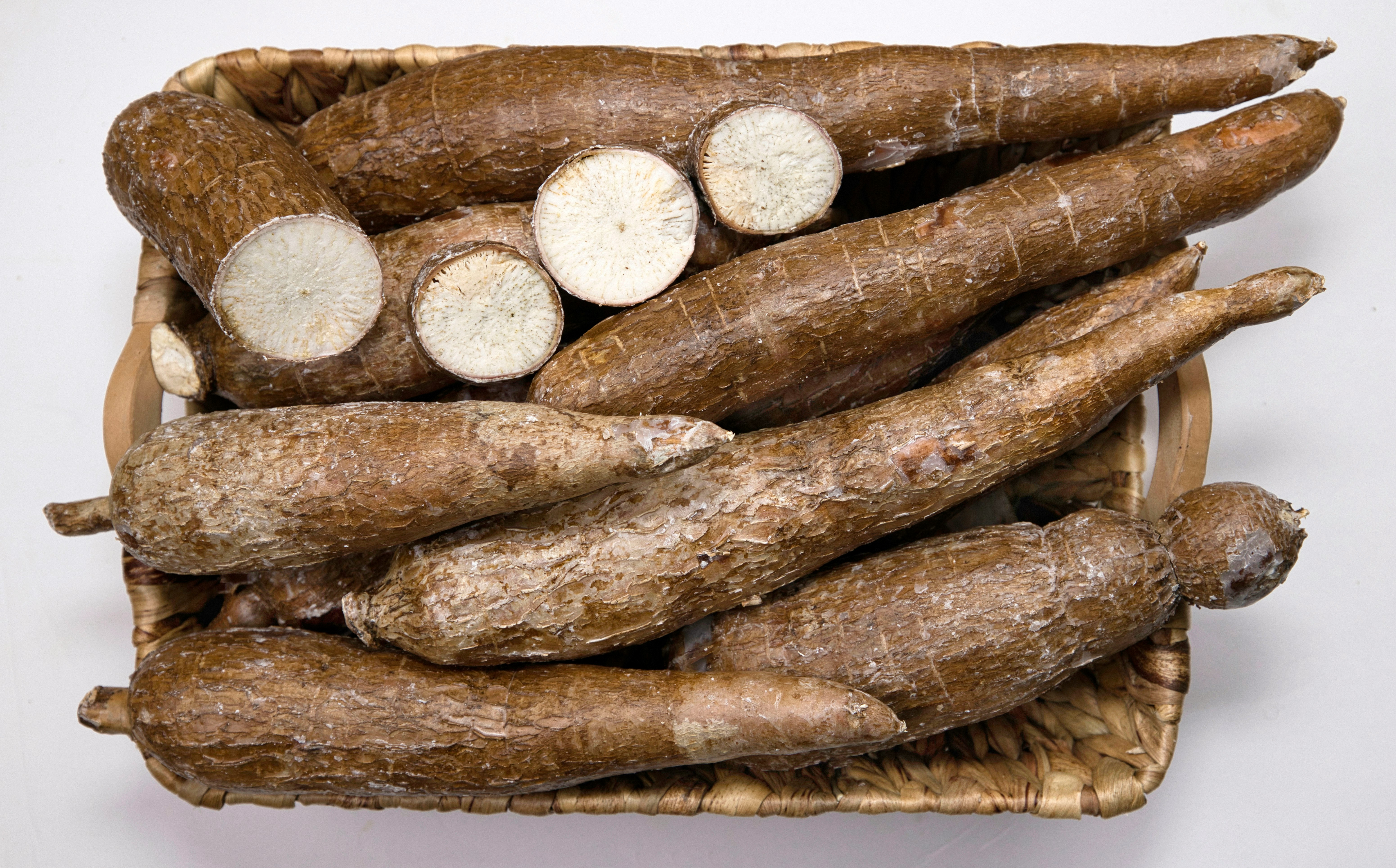
Photo: Loren Biser/Unsplash.
“Cassava’s humble appearance belies an impressive combination of productivity, toughness and diversity,” says the Washington Post. But it has to be detoxified.
As Planet Earth keeps adding more people, many of the crops to feed them are suffering from climate change. What is the answer? Are there foods that are both nourishing and relatively easy to produce?
Stephen Wooding, an assistant professor of anthropology and heritage studies at the University of California at Merced, writes at the Washington Post about a food that is both. It just has a little toxicity problem.
“The three staple crops dominating modern diets — corn, rice and wheat — are familiar to Americans. However, another top crop is something of a dark horse: cassava.
“While nearly unknown in temperate climates, cassava is a key source of nutrition in the Southern Hemisphere. It was domesticated 10,000 years ago, on the southern margin of the Amazon basin in Brazil, and spread from there throughout the region. … There’s just one problem, however: Cassava is also highly poisonous.
“So, how can cassava be toxic, yet still dominate diets in Amazonia? It’s all down to Indigenous ingenuity. For the past 10 years, my collaborator, César Rubén Peña, who is of Cucuna heritage and grew up on the rivers of Amazonia, and I have been studying cassava gardens on the Amazon River and its myriad tributaries in Peru. We have discovered scores of cassava varieties, growers using sophisticated breeding strategies to manage its toxicity and elaborate methods for processing its dangerous yet nutritious products. …
“A little more than 10,000 years ago, [hunter-gatherers] cleared the hurdle with one of the most transformative innovations in history: plant and animal domestication. … Today, almost every rural family across the Amazon has a garden. Visit any household and you will find cassava roasting on the fire, being toasted into a chewy flatbread called casabe, fermenting into the beer called masato, and steaming in soups and stews. Before adopting cassava in these roles, though, people had to figure out how to deal with its toxicity.
“One of cassava’s most important strengths, its pest resistance, is provided by a powerful defense system. The system relies on two chemicals produced by the plant, linamarin and linamarase. These defensive chemicals are found inside cells throughout the cassava plant’s leaves, stem and tubers, where they usually sit idle. However, when cassava’s cells are damaged, by chewing or crushing, for instance, the linamarin and linamarase react, releasing a burst of noxious chemicals.
“One of them [is] cyanide gas. The burst contains other nasty substances as well, including compounds called nitriles and cyanohydrins. Large doses of them are lethal, and chronic exposures permanently damage the nervous system. …
“Ancient Amazonians devised a complex, multistep process of detoxification that transforms cassava from inedible to delicious. It begins with grinding cassava’s starchy roots on shredding boards studded with fish teeth, chips of rock or, most often today, a rough sheet of tin. Shredding mimics the chewing of pests, causing the release of the root’s cyanide and cyanohydrins. …
“Next, the shredded cassava is placed in baskets where it is rinsed, squeezed by hand and drained repeatedly. The action of the water releases more cyanide, nitriles and cyanohydrins, and squeezing rinses them away. Finally, the resulting pulp can be dried — which detoxifies it even further — or cooked, which finishes the process using heat. …
“The Amazonians pushed their efforts even further, taming it into a true domesticated crop. In addition to inventing new methods for processing cassava, they began keeping track and selectively growing varieties with desirable characteristics, gradually producing a constellation of types used for different purposes.
“In our travels, we have found more than 70 distinct cassava varieties that are highly diverse, physically and nutritionally. They include types ranging in toxicity, some of which need laborious shredding and rinsing and others that can be cooked as is, though none can be eaten raw. …
“While cassava has been ensconced in South and Central America for millennia, its story is far from over. In the age of climate change and mounting efforts toward sustainability, cassava is emerging as a possible world crop.
“Its durability and resilience make it easy to grow in variable environments, even when soils are poor, and its natural pest resistance reduces the need to protect it with industrial pesticides. …
“While cassava isn’t a familiar name in the United States just yet, it’s well on its way. It has long flown under the radar in the form of tapioca, a cassava starch used in pudding and boba tea. It’s also hitting the shelves in the snack aisle in the form of cassava chips and the baking aisle in naturally gluten-free flour. Raw cassava is an emerging presence, too, showing up under the names ‘yuca’ and ‘manioc’ in stores catering to Latin American, African and Asian populations. Track some down and give it a try. Supermarket cassava is perfectly safe, and recipes abound.”
More at the Post, here.
Posted in Uncategorized, tagged bagpipe, craft, cricket bat, kilt, makers, neon, protect on June 23, 2024| 4 Comments »
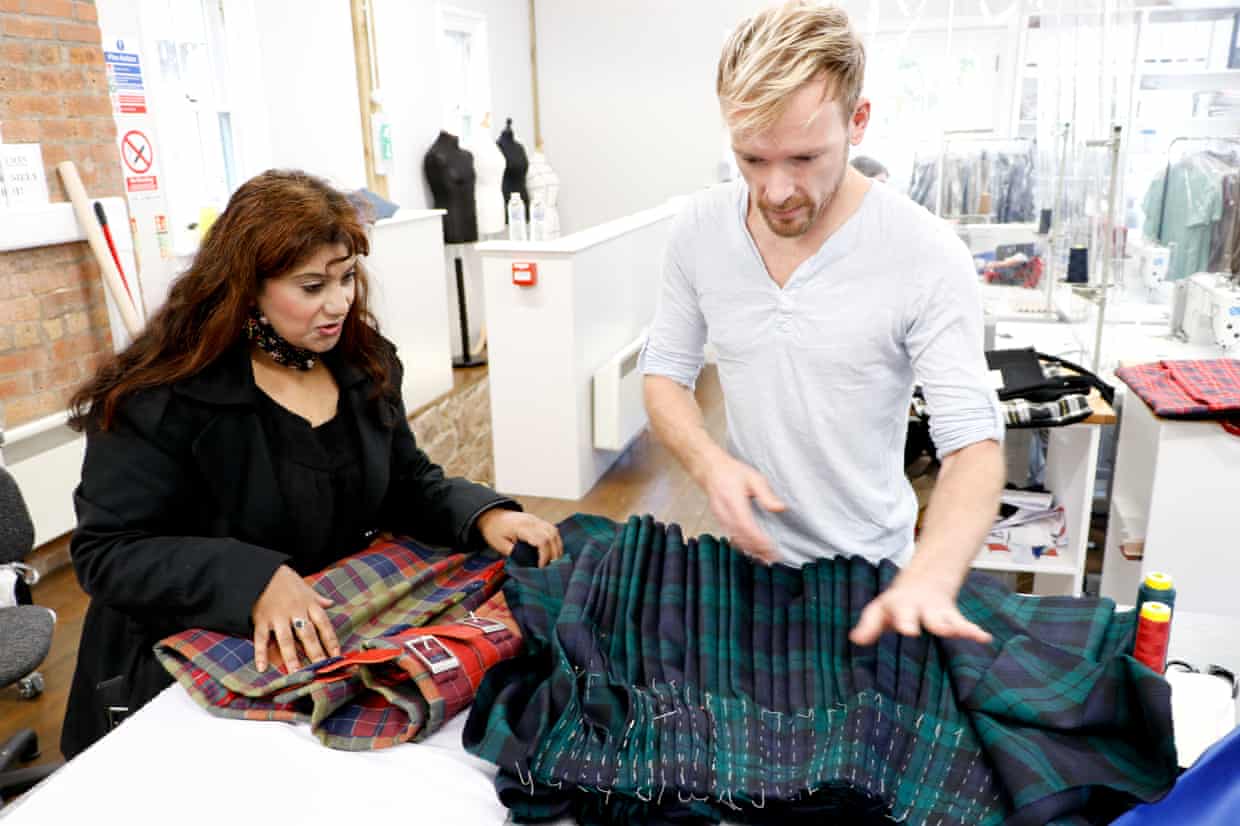
Photo: Iain Brown.
Kilt maker Graeme Bone. A new organization seeks to protect crafts that have fewer and fewer makers.
I don’t think of neon as an ancient craft, but I’m learning that lack of demand for it is endangering its future. It’s right up there with bagpipes.
At the Guardian, Alice Fisher reported recently on efforts to protect and pass along the skills of makers as varied as those who craft neon, kilts, bagpipes, and cricket bats.
“Nick Malyon was seduced by neon lighting at the end of the 1980s while traveling in America,” she writes. …
“ ‘I was introduced to a sign painter and a neon signmaker, and it seemed like an alternative lifestyle to the one I’d left behind. On my return to the UK, I was probably attempting to carry on some American dream by training, but I loved the weird alchemy of illuminating a piece of bent glass tubing – the change from nothing to something.’
“Malyon’s art [was on display in May], during London Craft Week (LCW), at the Vintage Supermarket, a Soho pop-up shop by Merchant & Found that specializes in 20th-century and industrial furniture. His work will represent one of the many endangered crafts on show this year.
“ ‘Over the centuries, crafts have ebbed and flowed; some die out but others grow to replace them,’ says Daniel Carpenter, executive director of Heritage Crafts, the charity that produces the annual red list of endangered skills. ‘But what we’re seeing now is something different – it’s like an extinction-level event.’
“Heritage Crafts’ red list includes gloomy news for British culture. Cricket ball manufacture is extinct in the UK, while cricket bats are on the endangered list alongside kilt- and bagpipe-making. Construction of currach boats and the sporran are also on the critical list.
“Carpenter says that competition from low-wage economies overseas is a key factor. … He says the situation is worse in the UK than in other European countries, but Heritage Crafts has just established a worldwide organization to monitor the situation. ‘There’s less support for training, and government-funded apprenticeships are very hard to access in the UK. They’re not set up for our sector – which is ironic, as apprenticeships were developed by craft guilds in medieval times.’
“Scottish kiltmaker Graeme Bone’s work will appear at LCW’s Craftworks. He retrained with a program offered by the Prince’s Foundation. Previously he was a steelworker: ‘Surprisingly, there are many cross-transferable skills from construction to pattern making – it’s all grids and measurements.’ …
“Rush weaver Felicity Irons, who is also exhibiting at LCW, received a British Empire medal in 2017 for saving the UK’s rush-cutting industry. She was focused on making seating when her rush supplier, Tom Arnold, died. Arnold’s brother was in his 70s and didn’t want to take over the trade, though it had been in his family since the 1500s. He gave Irons a two-hour training session before she took over.
“ ‘But I still get asked if this is my hobby. Though it’s better than it was when I set up – customers would be really rude to me about the prices and I had to stop myself from justifying it. I think it’s staggering that those plants growing in the river are being sent all around the world – our exports are really strong.’
“In June 2024, the UK will ratify Unesco’s Convention for the Safeguarding of the Intangible Cultural Heritage, which means the government commits to protect local crafts, social practices, festive events and rituals. A public register opened in January 2024 for British people to nominate local traditions for our national list. ‘It’s a step forward,’ said Carpenter, ‘but it’s largely symbolic.’ …
“While grants are hard to come by, some awards offer money prizes as well as recognition. The latest winner of the Loewe Foundation Craft prize, an international award, [was] announced in the same week as LCW. [Andrés Anza won.] …
“Abraham Thomas, curator of modern architecture, design and decorative arts at the Metropolitan Museum of Art in New York is one of the Loewe Prize judges this year. He feels some crafts people are adapting to the modern world.
“He says: ‘It’s interesting to note that several artists on this year’s shortlist have subverted traditional techniques and incorporated unexpected, recycled or industrial materials. They appear where other materials might be expected – all with the purpose of challenging craft traditions, legacies and expectations.’”’
“Carpenter also thinks craft is an innate human trait, and the loss of these skills goes beyond being a problem for our manufacturing sector or a waste of talent. ‘We’ve evolved as human beings to be makers,’ he said. ‘So for us to be living 24/7 in the digital world isn’t natural.’ …
“Malyon, though, has resigned himself to the death of his craft in the UK. ‘Since the advent of LED in the 2000s, neon trade worldwide has crashed. Brexit caused a price rise in our materials, all imported from Europe. I’ve never earned much and I work very long hours, but I really enjoy what I do.
“ ‘I just wanted to make neon signs, commercially, for whatever weird reason, so I feel I’ve been lucky. But as far as the UK craft is concerned, I don’t think anyone can stop it from dying.’ ” More at the Guardian, here.
I’m glad to read that someone is still doing work with rushes. A couple of our rush-bottom dining chairs were starting to need attention. Fortunately, the new owners of our house were happy to take them on.
Posted in Uncategorized, tagged 1984, celebration, dystopian, exhibit, George Orwell on June 22, 2024| Leave a Comment »

Photo: Murdo MacLeod/The Guardian.
Artist Hans K Clausen is on track to collect 1,984 copies of 1984 for an exhibition on Jura, the Scottish island where George Orwell wrote it.
Is it 2024 right now or 1984? Remember when 1984 seemed a long time in the future? I do. Now it’s far behind. Meanwhile, the novel Nineteen Eighty-Four seems to many of us to have stopped being fiction.
The Guardian‘s Scotland editor Severin Carrell writes about a celebration of the novel and author George Orwell, an exhibit on the island where he wrote it.
“Copies of George Orwell’s dystopian masterpiece Nineteen Eighty-Four,” writes Carrell, “have been arriving at an artist’s studio in Edinburgh for months. Every shape and size, posted from Ukraine, Hong Kong, Peru, Germany, Cape Cod and Sarajevo.
“Some are in mint condition, others are dog-eared, tea-stained, heavily annotated or turned into graffitied art works. One is a water-stained first edition; one is a secret love letter from a married woman to her first love; another, a graphic novel version, came from Orwell’s son Richard Blair.
“Each has been donated to a unique installation in the community hall of Jura, the Hebridean island where Orwell, in dire poverty and desperately ill, wrote Nineteen Eighty-Four during the late 1940s, to mark its publication 75 years ago.
“Hans K Clausen, a sculptor based in Edinburgh, is collecting 1,984 copies of the book to exhibit on Jura for three days in [June]. It will be an interactive, ‘living’ sculpture where visitors are invited to open and read every volume.
“Many have arrived, often with overseas postmarks and customs stamps, addressed to ‘Winston Smith, care of Hans K Clausen.’ [Winston is the novel’s protagonist.]
“ ‘I don’t see my art project as political,’ Clausen said. ‘It has politics woven through it, but it also has a love story woven through it. … I’m interested in all the layers,’ he said. ‘Often people overlook the romance and the love, and this man trying to find his own humanity. It gets lost in the Big Brother-ness of it all.’ …
“One correspondent, a married woman who called herself Julia, after the hero Winston’s lover, sent in her personal copy as a memorial to her first love, a man also married to someone else, her Winston.
“Clausen said his installation, the Winston Smith Library of Victory and Truth, is designed to be ‘a monument [to] the defiance of the printed word.’ He is still taking donations. … In return, each donor receives an enamelled pin-badge as a gesture of thanks.
“Clausen wants visitors to appreciate the materiality of each volume: the Russian copy printed on coarse paper; the impeccably printed Japanese edition; the hand-cut Canadian volume on thick paper; the musty odor and yellowing edges of the oldest copies; the intense annotations and highlighting in others, and the inexpert repairs with sticky tape to the ones with battered spines. …
“Clausen has worked with secondary school pupils in Edinburgh, London and on Jura itself, with pupils who live there but go to school on neighboring Islay, who have customized copies using paint, scalpels and pens. A teacher and sculptor at Cape Cod community school in Massachusetts cut an intricate Big Brother artwork into his.
“The installation includes audiobooks on cassette and films on DVD. The audiobooks will be broadcast over two wide-mouthed loudspeakers reminiscent of the omnipresent speakers that indoctrinated the citizens of Airstrip One.
“Visitors to Jura will find a desk with a 1940s typewriter and a paperweight, in reference to the object Winston bought in the antique shop above which he and Julia conducted their illicit affair. The [shop] was a front for the thought police. …
“The project has the blessing of the Orwell Society, a group set up under Richard Blair’s patronage in 2011. … Quentin Kopp, the society’s chairman, whose father, George, was Orwell’s commander in the Spanish civil war, said they spent time talking to Clausen.
“ ‘We satisfied ourselves this was a very genuine initiative,’ Kopp said [adding] ‘This book has a clear modern resonance with many things that are going on. It’s staggering how prescient Orwell was.’ ”
More at the Guardian, here.
Posted in Uncategorized, tagged all ages, moscow, philadelphia, playground, sweden, swings on June 21, 2024| 6 Comments »
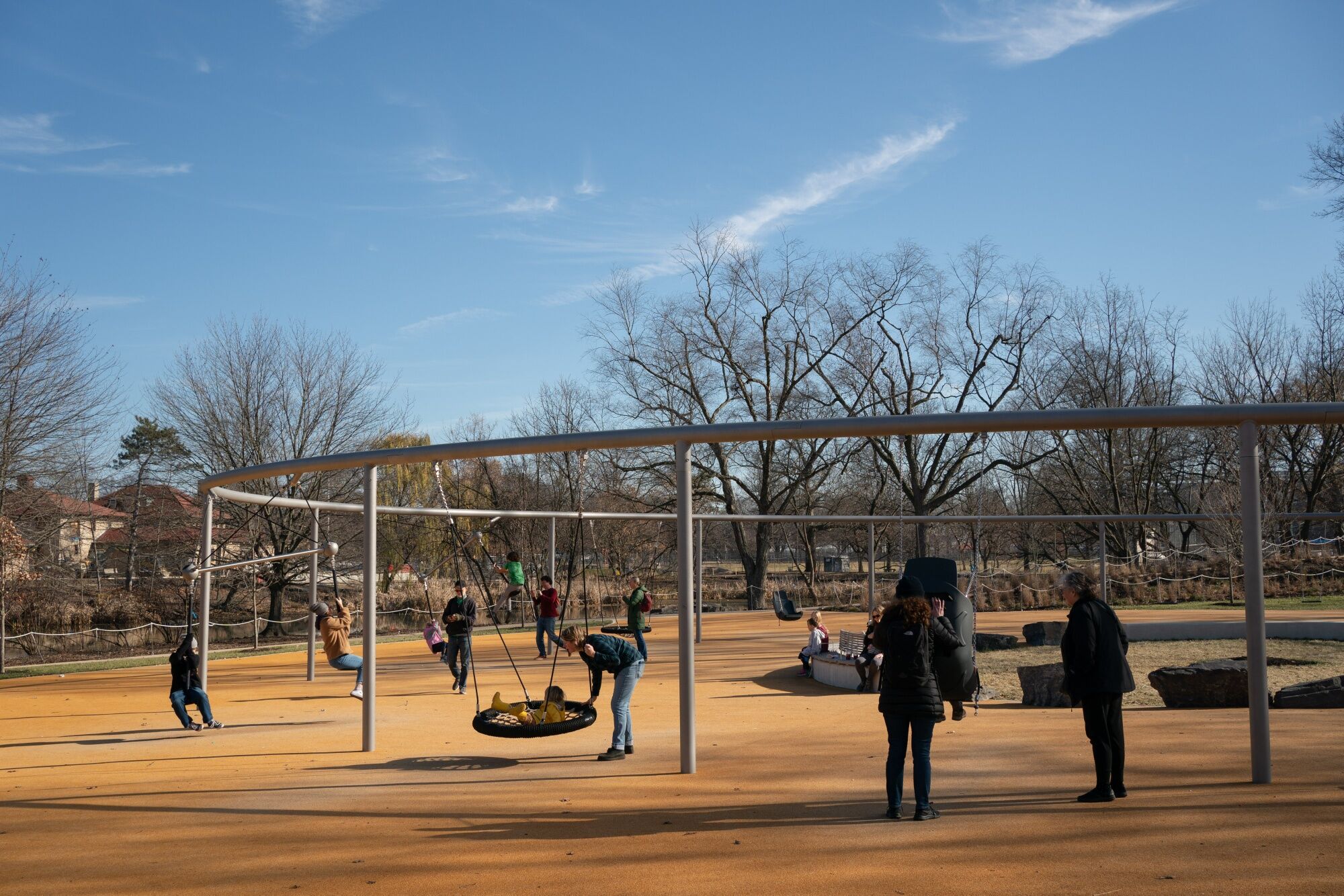
Photo: Caroline Gutman/Bloomberg.
A 20-swing structure for visitors of all ages at the Anna C. Verna playground in Philadelphia.
In the Swedish retirement community where reader Stuga40 lives, there’s a playground for adults. Of course, the Swedes are always ahead of the rest of the world on quality-of-life things, but the idea of all-ages playgrounds is catching on in other countries, too.
Alexandra Lange reports at Bloomberg, “A swing can be the simplest thing: two chains attached to a board, a rope knotted through a disc, a chair suspended from above. Swings appear on ancient Greek vases as instruments of leisure, and in eighteenth century Thailand as vehicles for competition.
“That’s the thing about swings: They can be sociable, but they are also physical. This inviting duality has often been undermined by public safety standards, which discourage swings for more than one person and mandate that they be far apart. After a certain age, swinging solo loses its thrill.
“But at Anna C. Verna Playground at Philadelphia’s FDR Park, on the south side of the city, the largest swing set in North America was designed to test those limits. Not by creating unsafe play, but by transforming those standards into something challenging, unusual, beautiful and rewarding for swingers of all ages.
“The playground, which opened in October and was designed by WRT Design with Studio Ludo as play consultant, features two acres of nature-based play, including seven slides of increasing height and speed, two steel-and-rope ‘birdhouses’ ascended by climbing nets, three log climbers, and assorted shady picnic tables, rock circles and sit-able logs.
“The centerpiece, however, is the 120-by-100-foot elliptical ‘megaswing’ from which 20 different swings of five different types hang in invitation to all the users of the park — from homeschool moms to tailgating Eagles fans, teenagers on a half-day to grandparents with toddlers, all of whom can train, bus, cycle or drive to the park.
“ ‘We are social animals, and play fosters social relationships,’ says landscape architect Meghan Talarowski, executive director of Studio Ludo, who is also a certified playground safety inspector. …
“At a time when many cities and business owners seem to want nothing to do with teenagers, it is refreshing to see a brand new public space issue them an invitation — and to go there and see that happening. Toronto urbanist Gil Penelosa, founder of 8 80 Cities, has long argued that designing a city that works for eight-year-olds and 80-year olds is a city that works for everyone. …
“Talarowski [got] her shot at the Anna C. Verna Playground in Philly, where she nestled a smaller ellipse — still equivalent to the size of a baseball infield — into FDR Park’s existing lagoon, like the thrust stage in a Shakespearean theater.
“ ‘There was this natural curve in the lagoon, and we were trying to connect the play design to the site conditions, without taking down any trees,’ says Allison Schapker, chief operations and projects officer for the Fairmount Park Conservancy, which is working with Philadelphia Parks & Recreation on the multi-phase, climate-sensitive $250 million dollar FDR Park Plan. ‘This is the point, if you are swinging high, you get views back to center city Philadelphia, so we are connected with both nature and the city.’ …
“The Anna C. Verna Playground is phase one in the restoration of FDR Park; the master plan is also by WRT. As part of their commitment to keeping things natural, WRT specified very little paint and plastic: The slides and climbing structures are stainless steel and rope, much of the seating is rocks and logs, the swings themselves are black plastic, plus more metal and rope. The big swing and the playground’s other custom pieces were designed in collaboration with equipment manufacturer Berliner Seilfabrik. Underfoot, the springy safety surface is not the flip-flop colored rubber of most playgrounds, or high-maintenance and inaccessible woodchips, but a permeable and recyclable cork product that comes in a subtle, toasted brown. ‘We feel strongly playgrounds should be sophisticated,’ says Talarowski.
“Sophistication [signals] to users that this equipment isn’t just for kids. As part of their two-year community process, the conservancy ‘did engagement activities on site with kids and their families,’ says Schapker. ‘Overwhelmingly, across every age group, they said they wanted to swing.’ ”
More at Bloomberg, here. Long article. Great pictures. No firewall.
Posted in Uncategorized, tagged art of noticing, breathing, feather, nature, noticing, photo, shells on June 20, 2024| 9 Comments »

Photo: Mary Jo Hoffman.
Palourde clam shells from the Mediterranean Sea, part of Mary Jo Hoffman’s decades-long creative endeavor celebrating the beauty of the natural world.
I’m reading a lovely YA novel celebrating the wonder of the natural world (Gather), so my train of thought today fits right in with the topic of a recent New Scientist article. It’s about a woman with a huge collection of nature photos.
Gege Li writes, “Since 2012, Mary Jo Hoffman has taken one snap a day of the natural objects around her. She explains what lies behind two of them – and what the ‘art of noticing’ has brought to her life. …
“Since 2012, aeronautical engineer-turned-artist Mary Jo Hoffman has taken one photo a day of the natural objects around her. But what started out as a creative challenge to simply get better at art composition has now evolved into a ‘comprehensive way of being,’ she says.
“Twelve years and thousands of photos later, Hoffman still finds beauty in her surroundings, often no further away than her home in Saint Paul, Minnesota. Her book, Still: The art of noticing .. collects 275 photos from her project, two of which are shown [at New ScientistI].
“Pictured in the main image above, are an assortment of palourde clam shells from the Mediterranean Sea, the remnants of a spaghetti and clam dinner in southern France. Hoffman wanted to commemorate the varied coloration of each clam, and this aftermath proved too good an opportunity to pass up.
“[Another photo shows] a feather from a sandhill crane. Hoffman selected this downy number during the moulting season of a resident pair of cranes that have set up their summer nests next to her house.
“Hoffman’s background in aeronautics means her idea of beauty has always bent towards the mathematical – the intricacies of feathers, for example, seen with the naked eye or zoomed in to the finest details, illustrate ‘beauty at every level,’ she says.
“As for the project, ‘I truly feel I have stumbled onto an elegantly simple practice that lets me experience the sacred almost every day,’ she says.” More at New Scientist, here.
“The art of noticing” is also what you’re supposed to do in meditation and breathing exercises, am I right? That sort of thing really calms me down if I need calming down. Some instructors even enccourage noticing each of your five senses slwoly and thoughtfully because when you are just noticing your breath or your sense of smell, say, you don’t get overwhelmed by whirling thoughts.
By the way, blogger Rebecca Cuningham is another photographer who’s an artist at noticing. From Minnesota, too. Check her out.

 Suzanne's Mom's Blog