Feeds:
Posts
Comments

Archive for the ‘Uncategorized’ Category

Photo: Tom Pumford/Unsplash.

New research has come out to support something you probably always knew. Sad music can make you feel great.

Oliver Whang says at the New York Times, “This is the paradox of sad music: We generally don’t enjoy being sad in real life, but we do enjoy art that makes us feel that way. Countless scholars since Aristotle have tried to account for it. …

“[Joshua Knobe is] an experimental philosopher and psychologist at Yale University. … In a new study, published in the Journal of Aesthetic Education, he and some colleagues sought to tackle this paradox by asking what sad music is all about.

“Over the years, Dr. Knobe’s research has found that people often form two conceptions of the same thing, one concrete and one abstract. For example, people could be considered artists if they display a concrete set of features, like being technically gifted with a brush. But if they do not exhibit certain abstract values — if, say, they lack creativity, curiosity or passion and simply recreate old masterpieces for quick profit — one could say that, in another sense, they are not artists. Maybe sad songs have a similarly dual nature, thought Dr. Knobe and his former student, Tara Venkatesan, a cognitive scientist and operatic soprano.

“Certainly, research has found that our emotional response to music is multidimensional; you’re not just happy when you listen to a beautiful song, nor simply made sad by a sad one. In 2016, a survey of 363 listeners found that emotional responses to sad songs fell roughly into three categories: grief, including powerful negative feelings like anger, terror and despair; melancholia, a gentle sadness, longing or self-pity; and sweet sorrow, a pleasant pang of consolation or appreciation. Many respondents described a mix of the three. (The researchers called their study ‘Fifty Shades of Blue.’) …

“Some psychologists have examined how certain aspects of music — mode, tempo, rhythm, timbre — relate to the emotions listeners feel. Studies have found that certain forms of song serve nearly universal functions: Across countries and cultures, for instance, lullabies tend to share similar acoustic features that imbue infants and adults alike with a sense of safety.

“ ‘All our lives we’ve learned to map the relationships between our emotions and what we sound like,’ said Tuomas Eerola, a musicologist at Durham University in England and a researcher on the ‘Fifty Shades’ study. …

“Other scientists, including Patrik Juslin, a music psychologist at Uppsala University in Sweden, argue that such findings clarify little about the value of sad music. He wrote in a paper, ‘They simply move the burden of explanation from one level, “Why does the second movement of Beethoven’s Eroica symphony arouse sadness?” to another level, “Why does a slow tempo arouse sadness?” ‘

“Instead, Dr. Juslin and others have proposed that there are cognitive mechanisms through which sadness can be induced in listeners. Unconscious reflexes in the brain stem; the synchronization of rhythm to some internal cadence, such as a heartbeat; conditioned responses to particular sounds; triggered memories; emotional contagion; a reflective evaluation of the music — all seem to play some role. Maybe, because sadness is such an intense emotion, its presence can prompt a positive empathic reaction: Feeling someone’s sadness can move you in some prosocial way.

‘You’re feeling just alone, you feel isolated,’ Dr. Knobe said. ‘And then there’s this experience where you listen to some music, or you pick up a book, and you feel like you’re not so alone.’

“To test that hypothesis, he, Dr. Venkatesan and George Newman, a psychologist at the Rotman School of Management, set up a two-part experiment. In the first part, they gave one of four song descriptions to more than 400 subjects. One description was of a song that ‘conveys deep and complex emotions’ but was also ‘technically very flawed.’ Another described a ‘technically flawless’ song that ‘does not convey deep or complex emotions.’ The third song was described as deeply emotional and technically flawless, and the fourth as technically flawed and unemotional.

“The subjects were asked to indicate, on a seven-point scale, whether their song ’embodies what music is all about.’ … On the whole, subjects reported that deeply emotional but technically flawed songs best reflected the essence of music; emotional expression was a more salient value than technical proficiency.

” ‘In the second part of the experiment, involving 450 new subjects, the researchers gave each participant 72 descriptions of emotional songs, which expressed feelings including ‘contempt,’ ‘narcissism,’ ‘inspiration’ and ‘lustfulness.’ For comparison, they also gave participants prompts that described a conversational interaction in which someone expressed their feelings. (For example: ‘An acquaintance is talking to you about their week and expresses feelings of wistfulness.’) On the whole, the emotions that subjects felt were deeply rooted to ‘what music is all about’ were also those that made people feel more connected to one another in conversation: love, joy, loneliness, sadness, ecstasy, calmness, sorrow.

“Mario Attie-Picker, a philosopher at Loyola University Chicago who helped lead the research, found the results compelling. After considering the data, he proposed a relatively simple idea: Maybe we listen to music not for an emotional reaction — many subjects reported that sad music, albeit artistic, was not particularly enjoyable — but for the sense of connection to others. Applied to the paradox of sad music: Our love of the music is not a direct appreciation of sadness, it’s an appreciation of connection.”

More at the Times, here.
Read Full Post »

Photo: Laura Colvin/HometownLife.com.
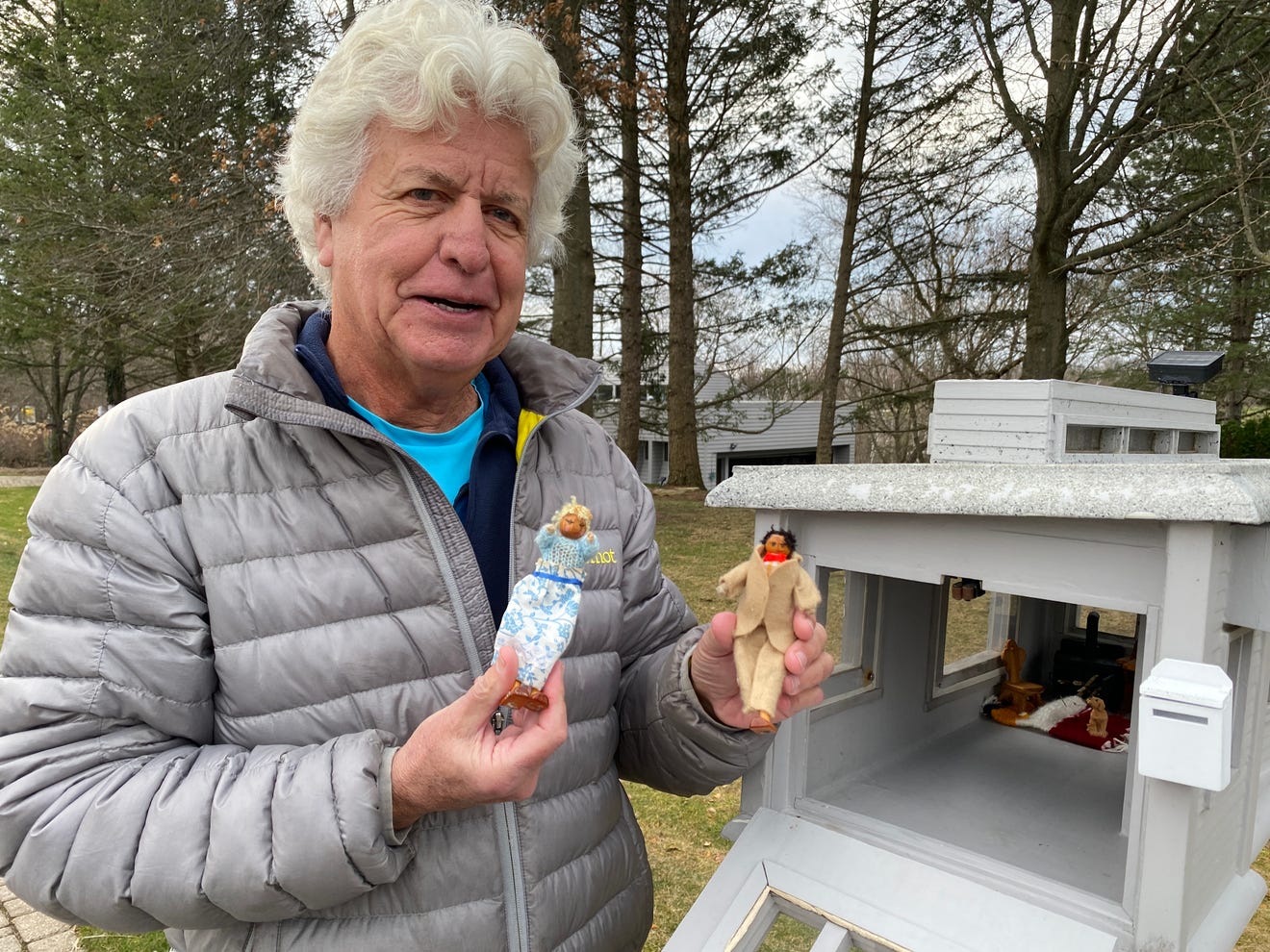
Don Powell shows off his custom mailbox, where a mystery family moved in last year.

I love kindly stealth projects. If you search this blog on the word “stealth,” you will find several I’ve written about.

Today, Cathy Free reports at the Washington Post that a Michigan man who put up an especially nice mailbox got a surprise one day. Tiny dolls had moved in under cover of darkness and decided to stay.

“Don Powell was sliding the usual assortment of envelopes from the mailbox outside of his home when he noticed something out of the ordinary: A tiny doll couple was sitting on a love seat inside the mailbox. A small sticky note was also tucked inside.

“ ‘We’ve decided to live here,’ the message read. It was signed from Mary and Shelley. …

“Powell and his wife, Nancy Powell, had a custom-designed mailbox installed about four years ago to resemble the contemporary white house they’d moved into in Orchard Lake Village, Mich., about 25 miles from Detroit. …

“ ‘I asked the neighbors whether anybody had left dolls in their mailboxes, and everyone told me no,’ he said. ‘So I thought, “This must just be a joke, and whoever left them here will come back to get them.” ‘ …

“A few days passed and nobody retrieved the dolls, he said, noting that he and his wife soon discovered that the small couple had acquired an end table, a throw rug and a pillow. …

“ ‘I left a note of my own, saying that what the home really needed was a refrigerator stocked with food,’ he said.

“The fridge was never delivered. But over the next several months, additional items mysteriously showed up: a four-poster bed, a painting and a wood-burning stove, to name a few.

“More than eight months later, Mary and Shelley are still living rent-free in the mailbox, to the delight of neighbors who now follow updates by Don Powell on Orchard Lake Village’s Nextdoor page. …

“ ‘A homeless couple has taken up residence inside our mailbox,’ he wrote on Nextdoor. … ‘Some people initially thought that I had planted the dolls myself, but that is definitely not the case,’ Powell said. ‘All I did was provide a mailbox. Somebody else decided to make it into a home for Mary and Shelley.’

“Nancy Powell said she can vouch for her husband. ‘Our two sons even wondered if he was doing it, but it was honestly a surprise to us,’ she said. …

“ ‘Whoever is doing this is obviously somebody who is incredibly artistic and clever,’ [the Powells’ next-door neighbor, Terry Falahee] said. ‘Don has a lot of skill sets, but doing something this detailed with dolls isn’t his forte.

” ‘It’s just somebody out there who is having some fun, giving us all a little community humor,’ Falahee said, noting that there are 25 homes in the subdivision, connected to three other neighborhoods of similar size.

“Powell works as a psychologist and is the president and CEO of the American Institute for Preventive Medicine, an organization that helps hospitals around the country implement wellness programs.

“After he and Nancy moved into their home in Orchard Lake Village about five years ago, he said they decided to pay a local craftsman $250 to design a mailbox resembling their house, with lots of windows on the top and sides to let the light in. …

“The interior of the box is roomy, measuring 26 inches long, 15 inches wide and 10 inches high, Don Powell said, adding that it also has solar-powered ceiling lights to illuminate the mailbox at night.

“Although a person can be fined up to $5,000 for putting items without postage inside somebody else’s mailbox, Powell said he could not imagine alerting the authorities and evicting the dolls.

“ ‘I asked our mail carrier if there would be a problem delivering our mail with the dolls in there, and he told me no — there was plenty of room,’ he said. ‘He also said he got a kick out of seeing what was going on inside my mailbox.’

“Every month or two, particularly around holidays, the Powells find something new tucked inside the box for Mary and Shelley.

“Last Halloween, the doll couple temporarily disappeared and were replaced by two small skeletons, he said, and at Christmastime, a decorated tree was left with tiny presents. Powell said whoever left the gifts took them back right after Christmas before he could open the boxes to see if anything was inside. The doll couple has also acquired a cat, he said.

“ ‘It’s getting a little crowded, especially because their cousin Shirley has also moved in with a service dog named Maggie,’ Powell noted.

“ ‘The note left in the mailbox said they were all grateful to find a one-story, because they’d previously lived in a Dutch-style dollhouse,’ he said. ‘I’m assuming that place had more stairs.’

“After packages were left for the holidays, Powell said he added a tiny addition of his own outside the mailbox: a miniature letterbox.

“ ‘I decided it made sense to give them one, since their tiny letters were getting mixed up with ours and could get lost in the mail,’ he said. …

“ ‘People in the neighborhood are enjoying it and stop by sometimes to ask questions,’ he said. ‘They want to know what we’re charging for rent and who mows the lawn. Some people ask if I’ve thought about installing an outdoor camera, but personally, I like the mystery of it.’ “

More at the Post, here.

Read Full Post »

Photo: Sedat Pakay, Hudson Film Works II.
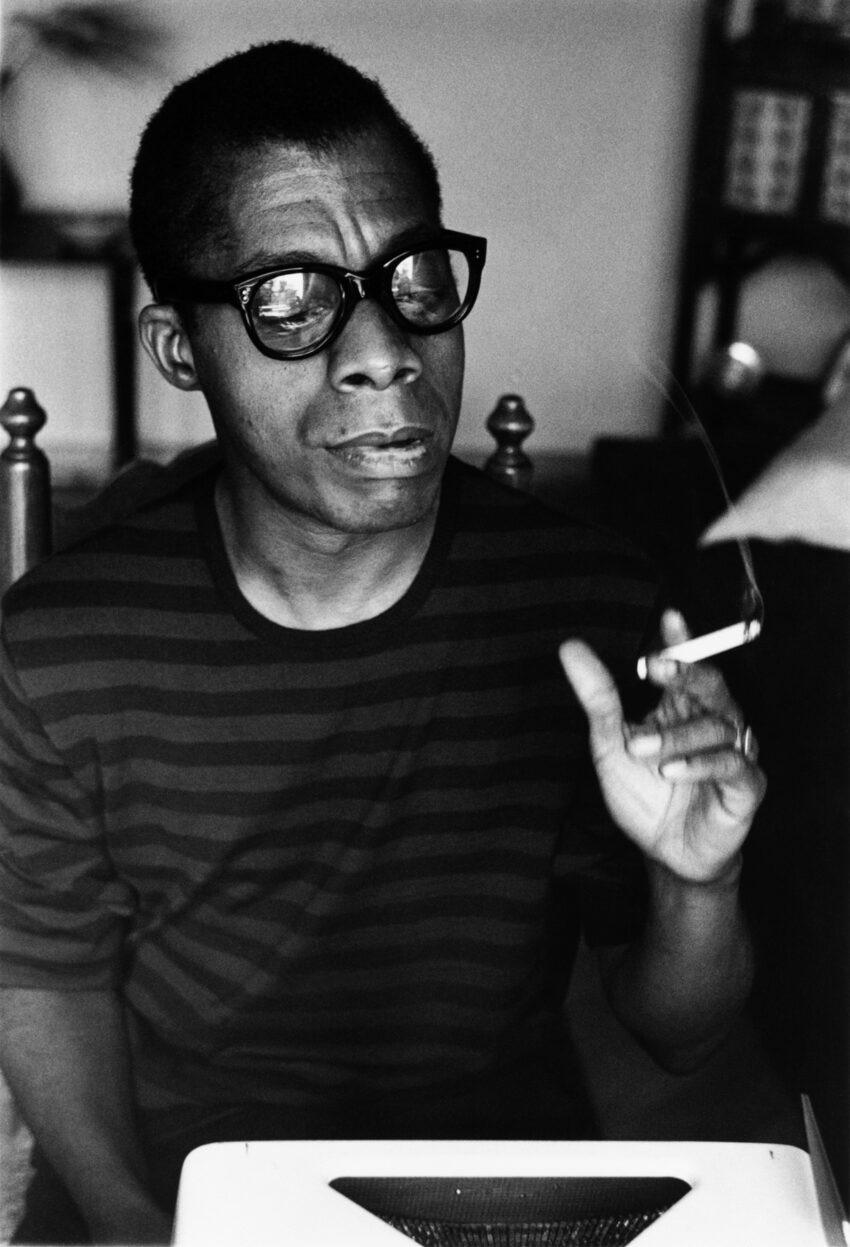
James Baldwin in Istanbul in 1966.

James Baldwin didn’t kid himself about life in America for a gay Black man in the 1960s. He traveled widely and lived for long stretches in countries he found more hospitable. (A 2016 post, here, addresses an effort to preserve a house he bought on the Côte d’Azur.)

I knew about France but not Turkey, which Azareen Van der Vliet Oloomi writes about in the Yale Review.

At the beginning of the “11-minute black and white documentary, James Baldwin: From Another Place, directed by Sedat Pakay and filmed in Istanbul in May 1970, … he turns his back to the cam­era and opens the curtains. A sharp Mediterranean light floods in. Baldwin scratches the small of his back, and we hear him say in voiceover: ‘I suppose that many people do blame me for being out of the States as often as I am, but one can’t afford to worry about that because one does, you know, you do what you have to do the way you have to do it. And as someone who is outside of the States you realize that it’s impossible to get out, the American powers are everywhere.’

“The camera pans over the glittering Bosphorus Strait as American ships glide silently through the passage connecting Asia and Europe.

“Pakay’s film has long been almost impossible to see in the United States, aside from a short clip on YouTube. But in February, it began streaming on the Criterion Channel, and its reappearance is a useful occasion to re-examine one of the most important, and yet relatively unknown, aspects of Baldwin’s career: his time in Turkey.

“At the time Pakay made his film, Baldwin had been living in Istanbul intermittently for almost a decade. He first arrived there in 1961, broke, emotionally spent, and struggling to complete his third novel, Another Country. The Turkish actor Engin Cezzar, who had met Baldwin in New York in 1957 when he was cast as Giovanni in the Actors Studio adaptation of Giovanni’s Room (Baldwin’s sec­ond novel), had given him an open invitation to visit, and follow­ing a demoralizing trip to Israel, Baldwin showed up on Cezzar’s doorstep.

“He quickly made himself at home, and over the next ten years lived irregularly in Istanbul, Erdek, and Bodrum, socializing with the Turkish intelligentsia and a small circle of Black artists and activists who were living in Turkey or passing through.

“Istanbul offered Baldwin a refuge during the tumultuous decade of the 1960s. In a 1970 conversation with Ida Lewis for Essence mag­azine, Baldwin said of his decision to move to the city, ‘It was very useful for me to go to a place like Istanbul at that point in my life, because it was so far out of the way from what I called home and the pressures.’ …

“Baldwin had first left the United States, for Paris, in 1948, and had lived out of the United States for years prior to his arrival in Istanbul. But the clarity and safety afforded by his time there allowed him to more sharply articulate America’s assaultive realities and to give expression to the connections between his personal wounds and the scars of racialized political history. …

“[His] layered inner landscape mir­ror the city’s multifaceted character, with its refusal of neat distinc­tions between tradition and modernity, East and West, Christianity and Islam.

“Istanbul was a liminal space of healing for Baldwin, a writing haven that he saw as having saved his life. As [Magdalena Zaborowska, author of James Baldwin’s Turkish Decade] notes, this may explain why the Baldwin we see in Pakay’s documentary is far more relaxed and at ease than the Baldwin we are accustomed to seeing in American media from that era.

“And yet, Baldwin’s decade in Turkey remains an enigma and a lacuna in our collective imagi­nation. Zaborowska’s is the only book-length treatment of Baldwin’s time there, and even people familiar with Baldwin’s writing are often unaware he ever lived in Istanbul. … What does the warm, vul­nerable, and playful Baldwin captured on film by Pakay tell us about his need to leave America time and again in search of safety?

“The respite Turkey offered Baldwin, combined with Istanbul’s vibrancy and the warmth with which he was received, sparked one of the most prolific periods of his artistic life. In 1961, when he first arrived, he was haggard and exhausted. 

“His trip to Israel had deep­ened his disillusionment with Christianity, and he was still mourn­ing Eugene Worth, a Black socialist and dear friend, who, in 1946, had killed himself by jumping off the George Washington Bridge. In addition, Baldwin had been trying without success to complete Another Country, his courageous and groundbreaking exploration of bisexuality and interracial love.

“Worth’s death, which Baldwin memorializes in Another Country, had devastated Baldwin for years, and he had tried and failed again and again to finish the novel until he was delivered from the strain of severe writer’s block in Istanbul. Baldwin wrote the book’s final sentence while at a party at Cezzar’s house in what he described as ‘the city which the people from heaven had made their home.’ …

“The years Baldwin spent off and on in Turkey coincided with one of the country’s most vibrant and expansive periods. The 1950s in Turkey had been a period of economic decline, ruthless author­itarianism, and iron-fisted censorship, a confluence of negative forces that gave rise to mass mobilization and to student-led pop­ular protests. …

“By 1965, free elections had been restored, and liberal constitutional reform had significantly expanded freedom of speech. The nation’s position as a strategic U.S. ally had been salvaged, but its cultural flowering continued, along with anti-imperialist and anti-capitalist move­ments similar to those that were emerging elsewhere around the world. Baldwin’s work and lived experience spoke directly to the political and aesthetic debates of the time. In Turkey, in a context of cultural ferment, Baldwin was revered as a major American and transnational writer, rather than being put in a position of having to prove his legitimacy over and over.

“Still, even in Turkey, Baldwin could not fully escape America. During the Cold War, relations between the United States and Turkey were founded on military collaboration and cooperation; the United States sent ships to Turkish waters to counter the threat of Soviet expansion, making Turkey a source of anti-Soviet mil­itary aid. As Baldwin said to Sedat Pakay, ‘American powers are everywhere.’ His feelings fluctuated between entrapment, the sense that no matter how far he traveled from the violence in the United States he could not, existentially speaking, ‘get out,’ and the feelings of transcendence and revival that Cezzar’s warm hos­pitality and Turkey itself afforded him.”

More at the Yale Review, here. No firewall.

Read Full Post »

Photo: Anthony Camerlo/Unsplash.
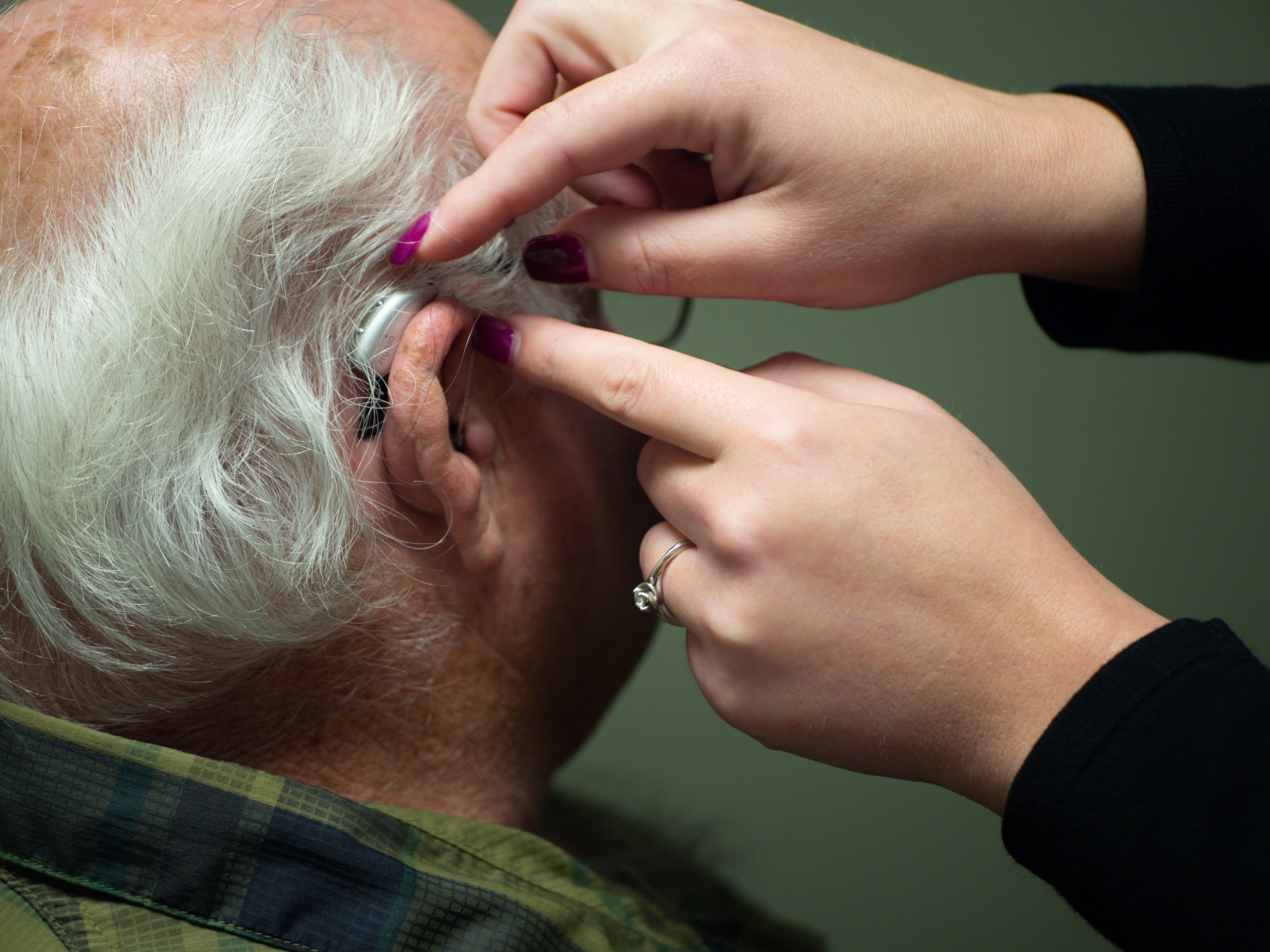
Can you get a hearing test if the only language you know is rare?

Where we live now, it’s more common than not for people to need hearing aids. Whether those people actually wear their hearing aids is another issue, but folks around them seem tolerant of having to repeat — or shout.

One thing I never thought about until I read today’s article is the fact that getting an audiology test can be a problem if you speak an uncommon language.

Lina Tran reports at WUWM, “About four years ago, Maichou Lor was living in New York completing a postdoctoral fellowship, when family members back home in Wisconsin kept telling her that her dad’s hearing was getting worse.

“ ‘He wasn’t responding to conversations even though he had a hearing aid,’ said Lor, now an assistant professor of nursing at the University of Wisconsin-Madison. ‘I brought him in to see his doctor through the ENT clinic here at UW-Health.’

“Lor and her father are Hmong; she joined him at the appointment as an interpreter, since he doesn’t speak English. At the clinic, his physician told Lor there was a limit to what he could offer him.

“ ‘I told her that there was a limitation in the test,’ said Burke Richmond, an assistant professor in the ear, nose, and throat division [at] the University of Wisconsin-Madison. …

“Part of the evaluation is a word recognition test, which assesses when speech is loud enough for someone to understand. It helps doctors identify the severity and type of hearing loss and come up with a treatment plan, such as whether hearing aids will work or if a cochlear implant is viable.

“During the test, patients listen to a recording of words, with instructions to repeat the words as they hear them. But, for the most part, the test is only available in the most common languages. … Few clinics are equipped to treat Hmong-speaking patients. …

“After Lor and Richmond met, they undertook a years-long, interdisciplinary collaboration that resulted in the first Hmong hearing test of its kind.

“Hearing evaluations typically involve a couple different tests. In one of them, patients listen to beeps and tones and press a button when they hear it. ‘That’s easy enough to explain to someone who speaks a different language,’ said Jennifer Ploch, a clinical audiologist involved with the project, then at UW-Madison. …

“When Lor and her father came through his office, Richmond knew about Lor’s research on health disparities. He asked if she wanted to make a Hmong word test with him. …

“The English test is designed to use everyday words like ‘bat’ and ‘kick’ that anyone would understand. At the same time, it shouldn’t be possible for test-takers to predict or guess what the words are without actually hearing them. Historically, one of the ways audiologists have accomplished that is by writing the word list so that it reflects the phonetic make-up of the language.

“ ‘If the language has a bunch of S’s, you want to have a bunch of S’s in the words,’ explained Lynsey Wolter, an associate linguistics professor at the University of Wisconsin-Eau Claire, who led the writing of the Hmong word list. ‘But not too many because then someone will just guess.’

“But no one had studied how frequent different sounds are in Hmong.

“ ‘And there are a lot,’ Wolter said. ‘There are about twice as many consonant sounds in Hmong as in English. Hmong is also a tonal language. The intonation of the word — whether the tone is higher or lower, going up or going down — can change the meaning.’ …

“Wolter said it was critical to work with native Hmong speakers, so she quickly brought two of her students onboard. … Kao Lee Lor, then a senior, was one of the student collaborators. She always loved languages and grew up hearing many of them at home, reflecting the places her parents had lived before immigrating to Wausau, Wisconsin. They were born in Laos and grew up in a Thai refugee camp. They enjoyed television shows, films, and music in Thai, Hmong, and Hindi. …

“To pick words for the list, the students dug through Hmong texts, entering all the words into a massive spreadsheet.

“ ‘We compiled a bunch of different Hmong folklore and folktales, Hmong kids’ books, anything we could find,’ Lor said. Some of the tales were familiar to her and her collaborator, oral traditions that had been passed down from their grandparents and parents. But there was little time to appreciate the stories in a new light; their focus was gathering as many words as they could.

“ ‘Once we were able to extract these words from these texts, we were able to break these words up into [their] parts, and then count the frequency of how much these consonants, sounds, vowels, and tones occurred,’ Lor said. …

“With numbers on how frequent different sounds are in the language, the linguistics team picked words to meet those targets. They wrote four lists of 50 words each, and sent it back to the UW-Madison researchers.

“Word lists in hand, the researchers asked the Hmong community to nominate clear, fluent speakers. Then, to validate the list, they tested the Hmong test against the English version on a group of bilingual speakers. They published their results in December.”

More at Milwaukee’s WUWM, here. No firewall. And for more on Hmong people in America, read the lovely memoir The Late Homecomer.

Read Full Post »

Photo: Dominique Soguel.
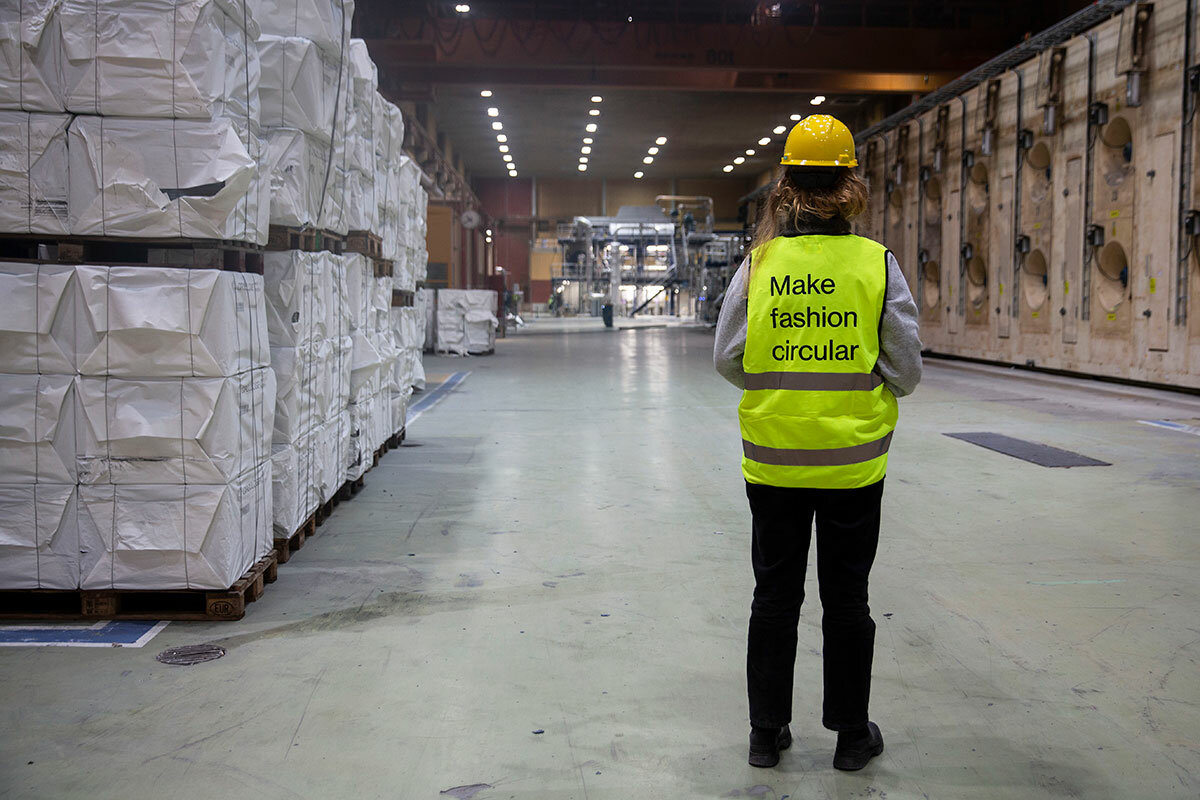
An employee stands in the industrial-scale plant of textile-to-textile recycling company Renewcell in Sundsvall, Sweden, Feb. 7, 2023.

After my youngest granddaughter toured a recycling facility in Rhode Island, she told me that one thing the state recycles is textiles. But in Massachusetts, where a new law forbids putting textiles in landfills, there are few towns that offer services for recycling worn-out clothes. At least there are plenty of outlets for reusable clothes.

In Sweden, some folks are trying to make all clothes — and the materials that go into them — reusable. That’s according to today’s article from the Christian Science Monitor.

Dominique Soguel writes, “Discarded, sorted clothes arrive by ship on the shores of Sundsvall, in the Gulf of Bothnia inlet of the Baltic Sea. But they aren’t bound for a landfill.

“Rather, they are destined for the city’s Renewcell plant, where they will be dissolved and processed into a new substance: Circulose. This material looks like white cardboard, feels like watercolor paper, and – most importantly – can be spun into yarns for textile manufacturers. …

“Renewcell’s patented technology, now available commercially, and successful launch of the world’s first industrial-scale textile recycling plant in Sweden offer a beacon of hope to brands and consumers who care about environmental sustainability.

“ ‘From an environmental perspective, it means that every year, instead of huge swaths of forest being cut down, millions of old jeans and T-shirts are being used rather than them degrading into methane in landfill,’ says Nicole Rycroft, director of the environmental nonprofit Canopy.

“The fashion industry relies primarily on three fibers – polyester, cotton, and viscose rayon – each of which is problematic for the environment.

“Polyester, made from plastic, takes hundreds of years to break down. … Soft-to-touch cotton is grown on vast, water-intensive monoculture farms using large quantities of fertilizers and pesticides. The Aral Sea, once the world’s fourth-largest lake, dried up almost completely, drained by cotton fields in Uzbekistan and Kazakhstan. …

“Viscose rayon is made from tree wood, which sometimes comes from ancient forests. Ms. Rycroft points to the 300 million trees cut down yearly to make viscose rayon, among other textiles. That consumption is slated to double within the next decade.

“On top of all this, much of what the fashion industry produces with these materials ends up as waste. Global production of textile fibers and all apparel creates 110 million metric tons of waste. On average, Europeans produce 33 pounds per year per capita, and Americans about 70 pounds per year.

“Solutions for controlling fashion’s consumption rate range from reducing overproduction and overconsumption to making longer-lasting clothes and embedding circularity into product design. But experts consider fiber-to-fiber recycling – converting textile waste into new fibers that can be used to make clothes or other textile goods – as one of the most sustainable and scalable levers available. …

“The Nordics stand out in Europe for their efforts to reduce the fashion industry’s impact on the planet. Copenhagen Fashion Week imposes sustainability requirements on brands before they hit the runway. Multiple Nordic brands offer recycling options and sell used clothes on their shelves at reduced prices.

“Sweden boasts an impressive secondhand clothes market scene; the world’s first recycling mall, Retuna; and innovative companies like Nudie. Nudie offers customers free repairs on their jeans and a 20% discount on new ones if they trade in old ones. It’s a much-loved service.

“ ‘I really like clothes, but I don’t think it’s necessary for me to buy something new to get the kind of clothes that I like to wear,’ says Tomas Persson after bringing his jeans in for repair to the Nudie shop in Gothenburg. Apart from underwear, he says has not bought a new item of clothing in years – not an uncommon claim in Sweden.

“The development of sustainable textiles is also part of Sweden’s national strategy. That keeps the Swedish School of Textiles and Science Park Borås, both part of the University of Borås, abuzz with the development of high-tech prototypes and design experiments focused on recycling, reuse, and upcycling.

“ ‘We have to find more efficient production processes … and ways of consuming garments,’ says Susanne Nejderås, textile strategist at Science Park Borås. ‘The mean use of a clothing item is around two years. We need to add another eight years to that.’ ”

I’ll just add that consumers are not only demanding sustainability these days, but human rights. There is widespread concern about China using Uyghur forced labor for cotton products. That’s why I buy cotton towels at Patagonia and fair trade cotton clothes from Fair Indigo in Peru (thanks to blogger Rebecca).

More at the Monitor, here. No firewall. Subscriptions welcomed.

Read Full Post »

Photo: Filippo Bertozzo​​, Fabio Marco Dalla Vecchia​, Matteo Fabbri via Wikimedia Commons.
Ouranosaurus bones are among the many wonders found in Niger. For scale, the right femur is about a yard long.

Niger turns out to be a treasure trove for paleontology and archaeology, and as Nick Roll reports at the Christian Science Monitor, the country is working to develop enough local experts to deal with the riches. It’s not so farfetched in a place where nomads are already texting researchers about archaeological finds.

“Goats, cows, and pedestrians wander by the two unassuming shipping containers along a street in Niger’s riverside capital without a second thought. But inside lie nearly 50 tons of dinosaur bones wrapped in plaster – potentially some of the most significant paleontological finds this landlocked West African country, and even the continent, has ever known.

“There are fossils from perhaps as many as 100 different species, some of them from ancient animals never seen before. 

“ ‘Small animals, mammals, flying reptiles, turtles’ as well as a 40-foot crocodile and ‘a dozen large dinosaurs that are new, including huge 60-footers, says American paleontologist Paul Sereno.

“Getting them to the capital was years in the making – and their journey isn’t over. The initial discoveries were made in 2018 and 2019, in the vast expanse of the Sahara Desert. It would take time and funding for a proper dig, though, so the paleontologists covered them up and buried them, hoping the winds wouldn’t expose them to curious nomads or dangerous smugglers. 

“Then COVID-19 hit, shutting everything down until finally, last fall, Professor Sereno could return to unearth the fossils again.  

“ ‘Niger is going to tell Africa’s story during the dinosaur era,’ he says. …

“The bones, soon to be shipped to Dr. Sereno’s lab at the University of Chicago for research, represent paleontology’s latest win against the harsh desert environment of Niger, which is home not only to fossils but also to soaring temperatures, shifting dunes, and various armed groups.

“But Chicago won’t be the bones’ final resting place. The fossils are earmarked to be eventually returned to Niger, where the kernels of a formal paleontology sector are being planted in a country that contains some of the richest paleontological finds in Africa but boasts no paleontologists of its own, or even academic programs dedicated to the field. 

“ ‘Each time, we see that we find new dinosaurs, new fossils that permit us to say that the soil is rich – unlike other countries, and other continents,’ says Boubé Adamou, an archaeologist at the Institute for Research in Human Sciences who, as one of Niger’s foremost experts on excavations, helped lead this most recent expedition. …

“In a convoy speeding through the desert last fall, the team of about 20 found themselves massively outnumbered by scores of armed men riding in machine gun-mounted trucks. Those were just their guards, determined to keep this modern-day Saharan caravan safe from smugglers or bandits roving the dunes. …

“The team, composed of researchers and students from the United States, Niger, and Europe, went to three dig sites over three months. By the time they finished in December, they had unearthed everything from an Ouranosaurus with a 25-foot-long, bony ‘sail’ across the length of its back to the 6-foot thigh bone of a long-necked sauropod. …

“The vast expanses of Niger were [once] anything but dry, as rivers, wetlands, and lakes stretched across what researchers called the Green Sahara, home at one point to dinosaurs, and later, ancient human civilizations with embalming techniques that predate the Egyptians – relics of which were also found on the fall expedition. …

“It’s easy to see why Niger remains off the beaten path for paleontologists, despite its riches. As one of the poorest nations on Earth, it combines rough infrastructure with harsh desert conditions.

“But even if the Green Sahara is a thing of the past, the desert today is anything but desolate. Local nomads who’ve long mastered the difficult terrain have become key to conducting paleontology there, spotting bones and leading expeditions through otherwise unnavigable desert expanses. While the pandemic held Dr. Sereno’s team at bay, nomads kept a watchful eye on the carefully buried treasures, texting him updates. …

“Niger Heritage is a project drawn up by Dr. Sereno, Mr. Adamou, and coterie of international and Nigerien researchers and government officials. It envisions two museums [with] the capacity to not just display the fossils but also, for the first time, conduct homegrown research. …

“Niger’s first paleontologists, it is hoped, might be in undergraduate courses right now. With the right guidance and funding – to do Ph.D. programs outside the country – they could start correcting the lopsided nature of paleontology, where resources and opportunities are concentrated in rich countries.”

More at the Monitor, here. No firewall. Subscriptions encouraged.

Read Full Post »

Photo: Disney.
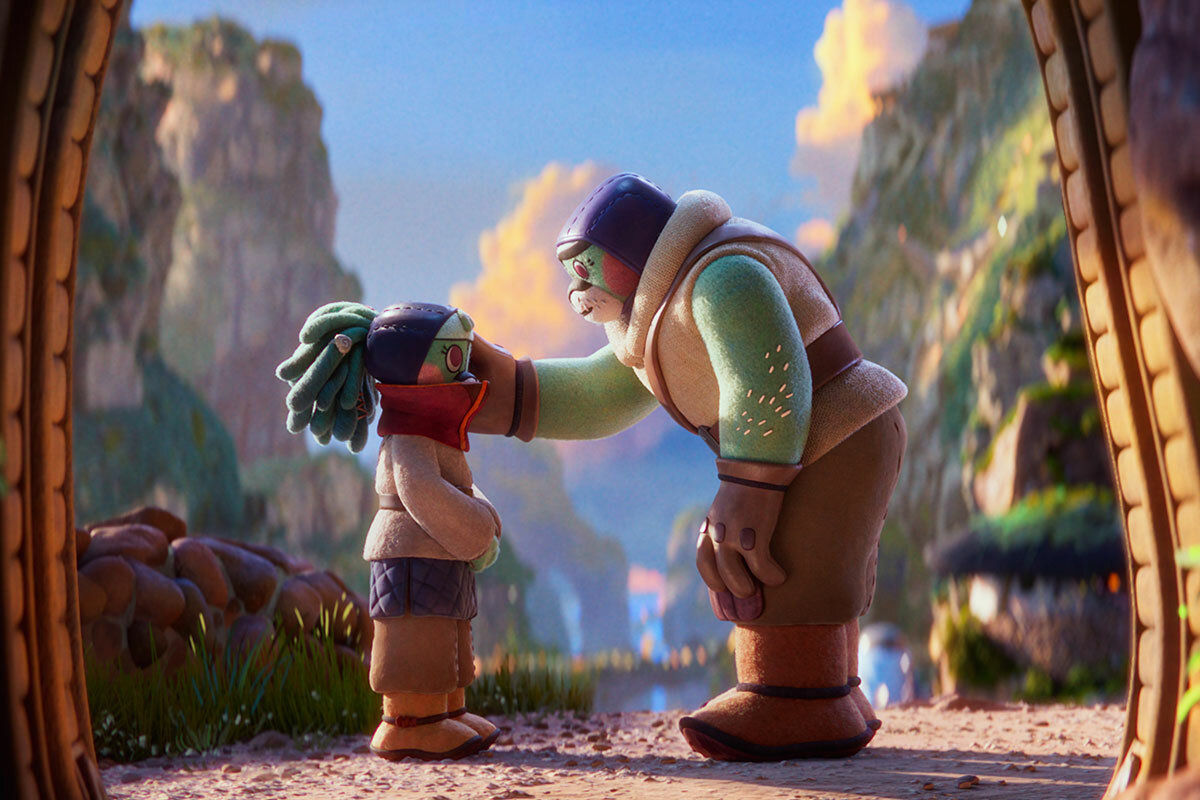
Cape Town residents Nadia Darries and Daniel Clarke co-directed Aau’s Song, the final short film in the second volume of the Star Wars: Visions anthology.

I had just given birth to Suzanne when neighbors offered to help out by taking John to Star Wars. He was five, and that was the moment that Star Wars became a big deal in our family.

It was a big deal around the world, too, and today’s story shows that its lasting popularity in Africa has recently led to Disney and Lucasfilm blessing an African version.

Ryan Lenora Brown reports at the Christian Science Monitor, “When George Lucas first created the Star Wars universe [he] probably didn’t imagine extraterrestrial worlds crawling with fynbos, the brightly colored, prickly shrub land of South Africa’s Western Cape. Nor did he likely envision his Jedi warriors channeling the energy of sangomas, southern African traditional healers. 

“But when South African filmmakers Nadia Darries and Daniel Clarke were asked recently to create their own version of the Star Wars universe for an animated short film, their alien world bore distinct imprints of their Earthly homeland. 

“ ‘We weren’t super intentional about it, but of course we are South Africans, so we are drawing on real experiences from our own world,’ says Ms. Darries, an animator from Cape Town whose work has appeared on the BBC.

“The pair’s 15-minute film, Aau’s Song, is part of a recently released anthology called Star Wars: Visions, in which animation studios from around the world were invited to re-imagine the famous fantasy universe through their own eyes.

The resulting shorts feature Jedi in saris, anime-inspired Sith lords, and lightsaber-wielding teenagers with thick Irish brogues. …

“Since its inception, Star Wars has been the world’s darling. And its films have long had a dedicated following across the African continent. In 2015, for instance, The Force Awakens had the single most profitable opening day in South African cinema history to that point. And the Earthside location of Darth Vader’s twin-mooned home planet, Tatooine, is in Tunisia, where it’s been a popular site of pilgrimage for both local and international fans. 

“But the franchise itself has often been slow to reflect back the diversity of its audience. …

“ ‘As someone growing up in South Africa, my perception of sci-fi and fantasy was that the central character will have pale skin, speak English, and probably be a man,’ says Omar Morto, a South African radio presenter, musician, and lifelong Star Wars fan. 

“In recent years, however, Star Wars has made strides to look more representative of planet Earth, featuring protagonists of color and female characters who actually speak – sometimes even to each other. But its universe is still being imagined, largely, by Westerners. 

“Two years ago, Lucasfilm, the Star Wars production house, released a series of short, Star Wars-inspired films made by Japanese anime studios called Star Wars: Visions. The reaction to that series was so positive, producers said, that they decided to create a second volume, this time featuring animators from around the world. …

“For Ms. Darries and Mr. Clarke, who made Aau’s Song with the South African studio Triggerfish, the project never felt quite so cosmic. They simply wanted to tell a story that meant something to them, Mr. Clarke says. 

Aau’s Song takes place on a planet called Korba. Its inhabitants mine the kyber crystals used in lightsabers, which have been corrupted by the Sith of the Dark Side. Enter Aau, a young girl who has a magical singing voice that can alter the crystals – and a protective father afraid she’ll put herself in danger if she uses it. …

“It [felt natural to Ms. Darries], she says, that the story’s wise woman – a visiting Jedi named Kratu – would resemble a kind of wise woman found in her own family, a sangoma, or diviner. Like Jedi, who often act as peacekeepers and have the power to connect to people’s thoughts, sangomas heal personal and social rifts in part via their connections with the ancestral world. 

“And though the story is about a girl with the power to purify lightsaber crystals, Mr. Clarke says they saw it as fundamentally being ‘about a character healing a poisoned land, which is a very South African story.’ 

“Mr. Morto, the radio presenter, says he can still remember the rainy Cape Town afternoon in the 1990s when his uncle came back from the video rental store with Return of the Jedi. … ‘Since then, it has been my life,’ he says. 

“And so, seeing a Star Wars universe that looked like South Africa in Aau’s Song ‘was special to experience.’ ”

More at the Monitor, here.

Read Full Post »

Photo: Enita Jubrey.
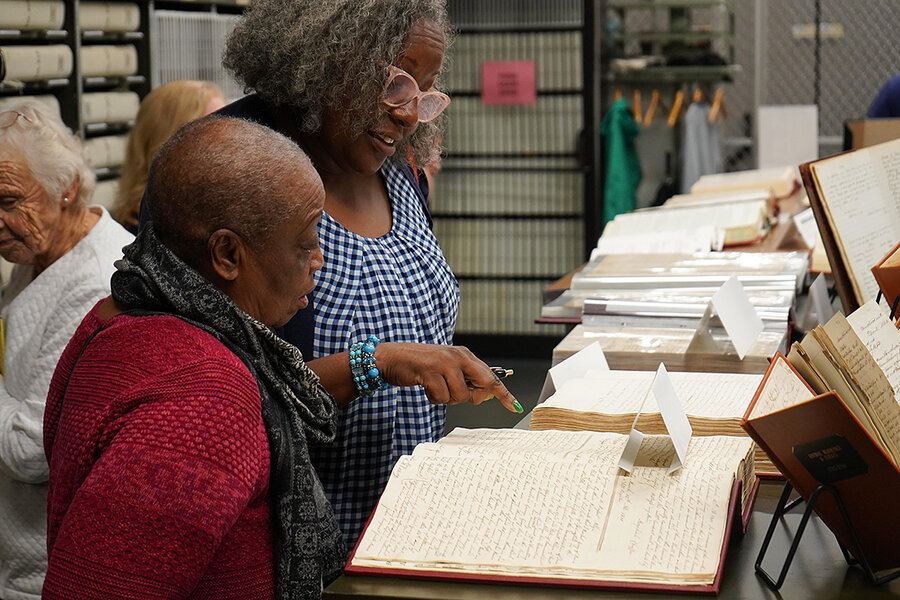
The Citizen’s Academy of Windsor, Connecticut, lets participants view historical documents dating back to the 1600s in the town clerk’s vault. 

Have you heard of the Citizen’s Academy movement? It was new to me. According to the Christian Science Monitor, there are about 1,000 in the United States. They help to build trust in local government and a sense of community.

Sarah Matusek and Sara Lang have a report at the Christian Science Monitor.

“The lifeguard’s legs disappear into the pool. A few tense seconds pass. He emerges with an arm around a limp young man whom he hauls to the deck for CPR.

“The audience applauds. Over a dozen Coloradans on bleacher seats are touring Woodland Park’s aquatic center, a sparkling, tiled complex with ample lap lanes. They convened earlier that April evening to learn about Parks and Recreation … the city department that hires local teens as lifeguards. The evening’s visit is part of an eight-week citizens academy, which ends with a graduation ceremony.

“ ‘It’s been super interesting,’ says Dan Carroll in the pool parking lot. His doubts about the building’s $11.9 million expense to the city were quelled, he says, after learning about its use.

“ ‘I’m going to promote it,’ says Mr. Carroll about the academy program. ‘I think more and more people need to know how the city operates.’ …

“The programs educate civic-minded folks about the gears of local government, and how they might chip in. Proponents also say they have a role to play in shoring up trust.

“ ‘It’s a cheap, easy, very direct way to get meaningful community engagement,’ says Michael Lawson, Woodland Park city manager. …

“The town of roughly 8,000 in conservative Teller County has had its share of community tension recently, with national attention on its school board, which has sparked local protests.

“The city itself, however, doesn’t run schools. Neither does it handle social services like food benefits – that’s the county. Explaining the limited purview of what the city does is a key feature of the citizens academy, Mr. Lawson says. …

“The programs, which go by different names, can last several weeks and are often free. Participants meet local officials like the mayor and visit a range of departments – public safety, waste management, zoning offices – led by local staff. 

“Citizens take advantage of local services daily, like when they turn on the tap or take trash to the curb, but that exists as ‘background noise for most people,’ says [Rick Morse, professor at the University of North Carolina at Chapel Hill School of Government]. Through citizens academies, he adds, ‘that faceless bureaucracy now becomes a person.’

“That’s a lesson the Decatur 101 program in Georgia tries to hit home. Participants receive ‘a book with a picture of all the people that have talked and what their job description is and what they do,’ says Shirley Baylis, business development manager, ‘so they know how to reach each of those people.’

“Dr. Morse conducted a 2016 survey of 658 citizens academy participants across six states. He found 84% of respondents said their program ‘somewhat or significantly positively’ shaped their level of trust in local government.

“A behind-the-scenes look at the water treatment plant in Wichita, Kansas, inspired a perception shift for participant Christopher Parisho. 

“ ‘I already knew it took a while and that it was really expensive, but now I had a better understanding of why,’ he says. … Understanding how your city works doesn’t just help in knowing the right person to field complaints, he adds. It can help someone ‘reach out to the right people when something is done right.’ …

“Several participants say learning about the fiscal responsibility and budgets of their towns is compelling – after all, cities and states can’t rack up debt as easily as the federal government. That includes longtime Woodland Park resident Catherine Nakai. She joined the program in early 2020, between volunteering on a local land-use board and running for City Council. 

‘I understand the budget a whole lot more,’ because of the program, says Council member Nakai. …

“Staffing is one area that citizens academies report as a challenge, in terms of the time commitments the programming demands. [And] broadening access to a wide range of residents presents another hurdle.  

“That’s why Alachua County Citizens Academy in Florida tries to ensure its sessions take place along community bus loops. In Georgia, Decatur 101 offers evening and morning sessions to accommodate different schedules.

“Matt Leighninger, director of the Center for Democracy Innovation at the National Civic League, challenges programs to think beyond the hope that spreading the gospel of government functions will automatically invoke trust. That’s a ‘defensive posture,’ he says, and not always earned. Public officials can also work to better trust their constituents.

“ ‘It’s not enough just to say: Here’s how government works,’ says Mr. Leighninger. ‘The question really should be: Here’s how a government could work,’ with more citizen input.”

More at the Monitor, here. No firewall.

Read Full Post »

Photo: AP/Yuri Kageyama via Economic Times.
Ten-year-old Maholo is an emerging star in Japan’s 420 year-old Kabuki theater. And he happens to be French.

Having once been turned down for a New Shoreham committee because I was not a year-round resident, I love hearing about famously hidebound organizations that decide to open up. Today’s story is features Kabuki theater opening up.

Yuri Kageyama writes at the Associated Press (AP), “Ten-year-old Maholo Terajima Ghnassia loves watching anime and playing baseball. … And he’s breaking conventions in Japan’s 420-year-old Kabuki theater tradition.

“In Kabuki, all the roles are played by men, including beautiful princesses — a role Maholo accomplishes stunningly in his official stage debut as Maholo Onoe at the Kabuki Theater in downtown Tokyo. … He starts out disguised as a woman, dancing gracefully, before transforming into sword-wielding warrior Iwami Jutaro. He then makes a quick costume change right there on the stage, all while delivering singsong lines in a clear resonating voice unaided by a microphone.

“Out to avenge his father’s death, striking spectacular poses, Maholo performs swashbuckling fight scenes and slays a furry baboon.

” ‘I like “tachimawari” (fight scenes). It feels good, and people who are watching it think it’s cool,’ said Maholo. …

“Maholo’s grandfather, Kikugoro Onoe, appears as the God of War. He praises Maholo’s character, Iwami, and tells him to keep at his art, promising to always be at his side and help him attain his goals.

“Kabuki is typically passed from father to son, the art form largely limited to Japanese men. But Kikugoro Onoe is Maholo’s maternal grandfather; the young Kabuki performer’s father, Laurent Ghnassia, is French. …

“The huge curtain for the stage, which also works as advertising space, is speckled with fluttering dots of purple and orange, designed by French artist Xavier Veilhan of fashion house Chanel. This was Ghnassia’s idea — as an art director, he designs venues, installations, shops and events to market fashion brands, contemporary art and film ventures. …

“Maholo himself isn’t sure yet if he will stick with the strict, demanding art form and someday adopt his grandfather’s stage name, Kikugoro — a prized name in Kabuki passed down through generations of Onoe men.

“Child Kabuki actors go through a difficult transitional period when their voices change with puberty but they aren’t yet mature enough to take adult roles. Only the truly determined ones pull through that stretch to succeed.

“ ‘Unless he is recognized and in demand, he won’t get any roles. He must have the passion. It’s not easy. It’s up to him,’ said Maholo’s mother, renowned actor Shinobu Terajima. She won the Silver Bear for Best Actress at the Berlin International Film Festival for her poignant performance in the 2010 film Caterpillar.

‘It’s not easy, but choosing the harder path makes life more worthwhile. The more hurdles there are, the climb becomes worth it,’ Terajima said.

“Although Japan has been known for discriminatory attitudes toward foreigners and outsiders, Terajima hopes her son’s French cultural background will give Maholo a unique edge in the world of Kabuki. But he may become a film actor like herself, Terajima said.

“ ‘It must be felt. It’s not just the lines you speak,’ she said. ‘I want him to act by digesting within what’s received from the other, and then return that, changing one’s heart with that received energy. That’s fundamental to acting.’ “

More at AP, here. No firewall.

Read Full Post »

Photo: Maria Spann/The Guardian.
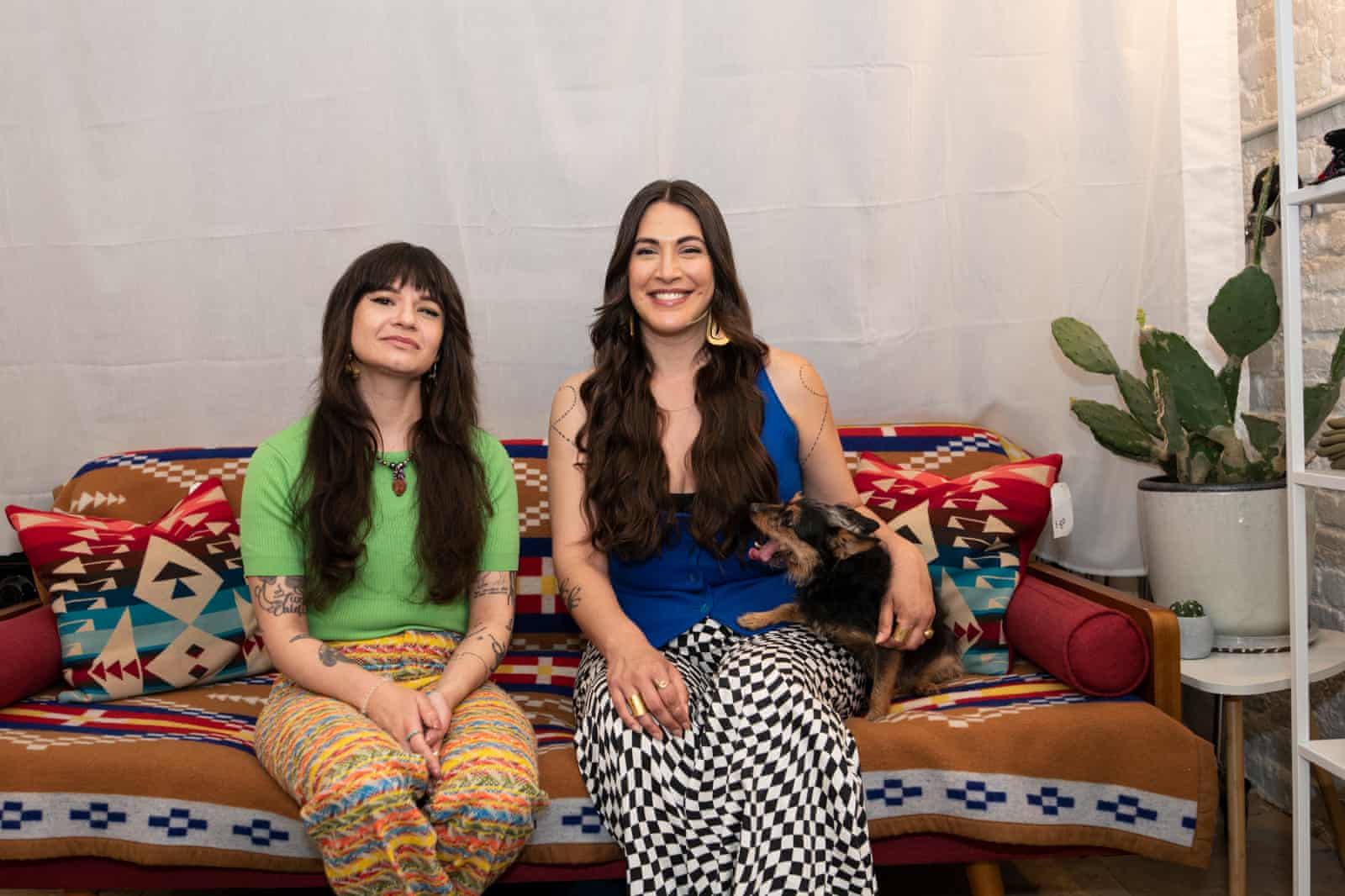
Liana Shewey and Korina Emmerich run a forward-thinking indigenous store in New York.

A friend who had just read Rinker Buck’s Life on the Mississippi was telling me recently how stunned she was to learn details of the Trail of Tears and related horrors visited on natives. Most of us know very little about that and have hardly been aware that indigenous people have been living among us all along.

At the very least, we are noticing them more now, learning more.

In today’s article, Sophia Herring of the Guardian interviews two very visible indigenous women with a new kind of shop in New York City.

“Location, location, location. It can make or break a business,” Herring says. “For Liana Shewey and Korina Emmerich, it was a call to action. When a mutual friend told the activists and creatives – Shewey is an educator and Emmerich is a fashion designer – about a newly vacant storefront on the ground floor of her mother’s Manhattan co-op building, the pair … visited the space. … ‘We jumped on it,’ said Shewey.

“The co-op board wasn’t willing to hand the keys over to just anyone. But their friend’s mother is Navajo, and also the board president. Within days the building had its newest tenant: Relative Arts NYC, a boutique that carries pieces by Indigenous designers and also hosts literary readings, album releases and art installations featuring work by Indigenous artists.

“ ‘It just felt so important for us to have a space, as grassroots organizers in the city,’ said Shewey, who was raised in Stillwater, Oklahoma, and is a member of the Mvskoke (Creek) Nation. Building a store that specializes in goods from Indigenous and many female-owned labels was a natural way to support their community. …

“The merchandise builds on their mission to shatter stereotypes. The entrepreneurs speak to ‘Indigenous futurism,’ an emerging art and design movement that leans away from cliches. …

“Emmerich, who grew up in Eugene, Oregon, and whose father is of Puyallup descent, focused on her own fashion label, EMME Studio, in her late 20s and early 30s. Her work has appeared on the cover of InStyle magazine and in the Lexicon of Fashion exhibition at the Metropolitan Museum of Art. She still makes pieces by special order, and the shop doubles as an atelier. When she spoke with the Guardian, she was rushing to complete a dress that she was making for a producer of Killers of the Flower Moon, the new Martin Scorsese film, to wear to the Cannes film festival. Shewey, whose day job is as an outreach educator at the New-York Historical Society, was speaking from her car, where she was taking a break from a marathon day of teaching four sixth-grade classes.

“The entrepreneurs, who can be found at their shop every weekend, relied on crowdfunding to convert the space into a store. An initial round of fundraising garnered $6,465, which covered shelving units and a sofa from Craigslist. They found a handful of industrial school chairs on the side of the road.

“The pair are breaking even, and still debating whether to form a nonprofit or operate as an LLC. ‘We want Relative Arts to be a greater incubation hub for people to be able to learn, create and work out of,’ said Shewey. …

Sophia Herring: Tell me about what led you both here.

Liana Shewey: I lived in Portland for about a decade and got really integrated into the local rock’n’roll scene. I bartended, worked at a local Starbucks, and then eventually started a music production company of my own with a few friends. In 2014, I moved to the Czech Republic and started organizing around the refugee crisis. I came back in 2016 when everything was happening with Standing Rock. It made me realize my struggle is here and I need to be with my community.

“Korina Emmerich: At 13, I made my first jingle dress regalia, and got very into sewing. I came to New York with two suitcases, a cat and $75. I worked in a boutique and I had my own line. I actually had a lot of success, thanks to a company called Brand Assembly that helps support smaller designers. But you slowly realize with everything in the fashion industry, if you want to do it ethically, you will be poor. I just dreamed that one day I would have a space to be able to share everybody’s work.

“Herring: How do you work as a team?

“Emmerich: We’ve been planning and organizing together for so long that we just naturally gravitate towards each other in our work style. Liana is analytical and does the logistical things as well as planning, and organizing when it comes to programming. I have this more creative, community outreach part of my work where building relationships is such an important aspect. …

“Herring: How do you choose what goes in the store?

“Emmerich: Our goal is to showcase contemporary Indigenous designers who are doing fun, subversive, wearable work, as opposed to the assumption of what Indigenous design has to look like. I want to talk about how Indigenous people exist here and now and we’re doing contemporary work here and now. There’s no rule that says we have to only exist in a historical context.

“Herring: What is it like operating an Indigenous business within a community that so rarely acknowledges it’s on Indigenous land to begin with?

“Emmerich: Even though Relative Arts may be the first of its kind, we are not the first ones to be doing this work. It was amazing to have the American Indian Community House come to open the space on our first day, to say a prayer and give us their blessing.

“Shewey: I’m thinking about how many people come off the streets and buy one of our pieces just because they like the garments themselves. Then they look at the basketball jersey and ask: what is the Salish Sea? [The Salish coast, along the north-western US and Canada, is home to Indigenous nations.] If they didn’t know, they walk out having learned about decolonization. …

“Herring: What is your long-term goal?

“Emmerich: We like to think of Relative Arts as a hub. The plans that we have are so much bigger than just a store. …

“Shewey: We’ve mused that we want it to kind of look like an Indigenous-futurist version of Andy Warhol’s Factory. It would be so wonderful to have thousands of feet, although I doubt Andy ever had to apply for funding.”

More at the Guardian, here. No firewall. Donations encouraged.

Read Full Post »

Photo: Derek Lovley/Ella Maru Studio/UMass Amherst via Newsweek.
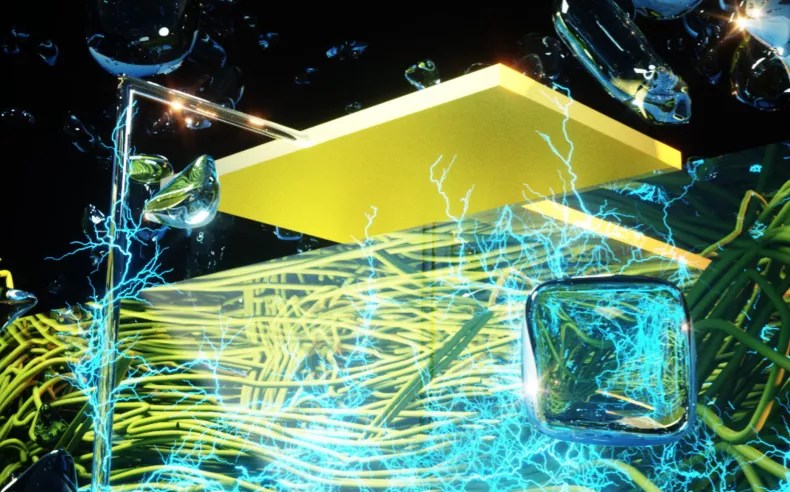
Scientists have figured out how to use nanopores to make electricity from thin air. These 100nm pores harvest electricity from water molecules in the air.

Scientists, thank goodness, are still doing science, despite recent hostility. At the Washington Post, Dan Rosenzweig-Ziff has a cool story on scientific methods being used to unlock the green energy hidden around us.

“Nearly any material can be used to turn the energy in air humidity into electricity, scientists found in a discovery that could lead to continuously producing clean energy with little pollution.

“The research, published in a paper in Advanced Materials, builds on 2020 work that first showed energy could be pulled from the moisture in the air using material harvested from bacteria. The new study shows nearly any material, such as wood or silicon, can be used, as long as it can be smashed into small particles and remade with microscopic pores. But there are many questions about how to scale the product. …

“ ‘It’s like a small-scale, man-made cloud,’ said Jun Yao, a professor of engineering at the University of Massachusetts at Amherst and the senior author of the study. ‘This is really a very easily accessible, enormous source of continuous clean electricity.’ …

“That could include a forest, while hiking on a mountain, in a desert, in a rural village or on the road.

“The air-powered generator, known as an ‘Air-gen,’ would offer continuous clean electricity because it uses the energy from humidity, which is always present, rather than depending on the sun or wind. Unlike solar panels or wind turbines, which need specific environments to thrive, Air-gens could conceivably go anywhere, Yao said.

“Less humidity, though, would mean less energy could be harvested, he added. Winters, with drier air, would produce less energy than summers.

“The device, the size of a fingernail and thinner than a single hair, is dotted with tiny holes known as nanopores. The holes have a diameter smaller than 100 nanometers, or less than a thousandth of the width of a strand of human hair.

“The tiny holes allow the water in the air to pass through in a way that would create a charge imbalance in the upper and lower parts of the device, effectively creating a battery that runs continuously. …

“While one prototype only produces a small amount of energy — almost enough to power a dot of light on a big screen — because of its size, Yao said Air-gens can be stacked on top of each other, potentially with spaces of air in between. Storing the electricity is a separate issue, he added.

“Yao estimated that roughly 1 billion Air-gens, stacked to be roughly the size of a refrigerator, could produce a kilowatt and partly power a home in ideal conditions. The team hopes to lower both the number of devices needed and the space they take up by making the tool more efficient. Doing that could be a challenge.

“The scientists first must work out which material would be most efficient to use in different climates. Eventually, Yao said he hopes to develop a strategy to make the device bigger without blocking the humidity that can be captured. He also wants to figure out how to stack the devices on top of each other effectively and how to engineer the Air-gen so the same size device captures more energy. …

“It could be embedded in wall paint in a home, made at a larger scale in unused space in a city or littered throughout an office’s hard-to-get-to spaces. And because it can use nearly any material, it could extract less from the environment than other renewable forms of energy.”

Well, OK, it needs work. But you know that someone will move this into the practical realm someday. More at the Post, here.

By the way, it is also possible to make drinking water from air. Read about how that is actually happening in Africa, here.

Read Full Post »

Photo: Shanta Nepali.
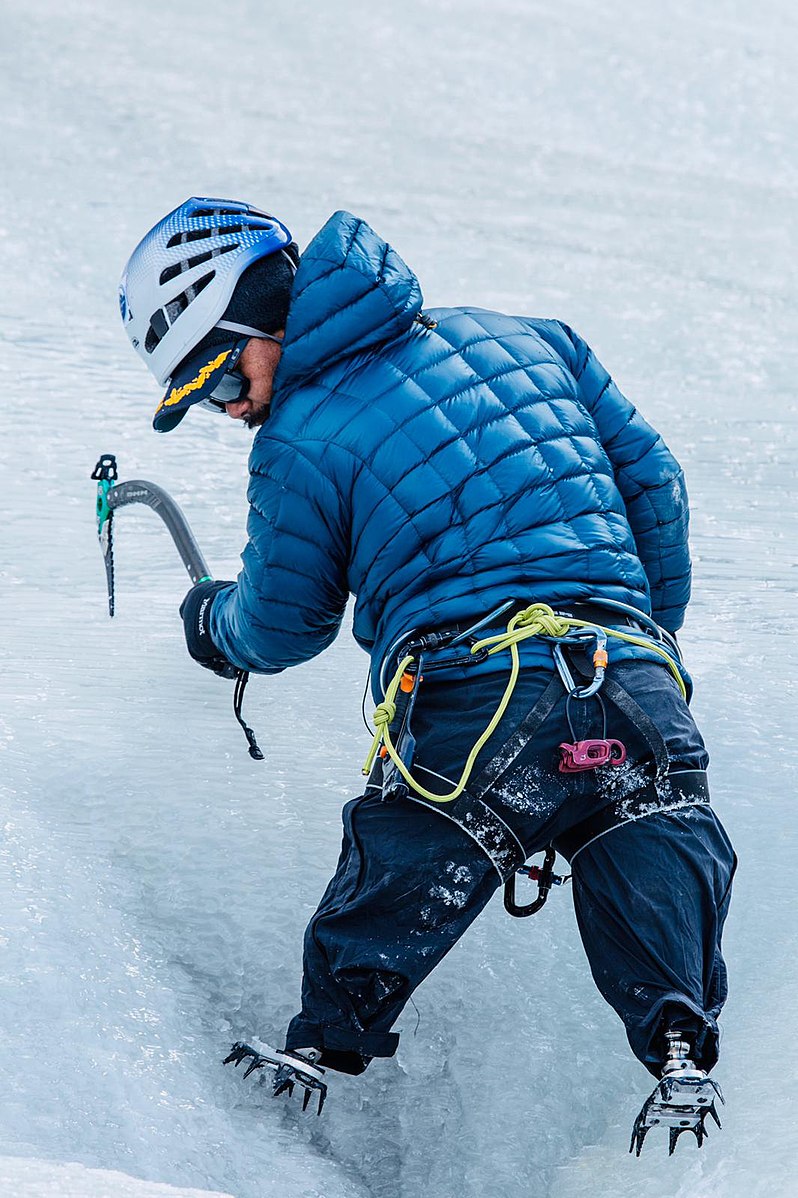
He lost his legs in Afghanistan, went on to summit Everest.

Today’s story reminds me that people can overcome almost anything if it’s important to them — and if they believe they can.

Bryan Pietsch has the story at the Washington Post.

“Hari Budha Magar was born in the foothills of the Himalayas. Growing up in Nepal, surrounded by the mountains and seeing Mount Everest constantly in textbooks and local media, he thought about climbing it someday.

“But school kept him busy, and then at 19, he left his country to join a Gurkha unit in the British army. He saw and skied through mountain ranges around the world on his missions and travels, but he was still ‘thinking about Everest all the time,’ he said in an interview.

“Those bucket-list plans to climb the world’s tallest peak were complicated by an explosion in Afghanistan in 2010 that left Budha Magar with above-the-knee amputations on both of his legs. But after years of preparation — and delays due to the coronavirus pandemic and a rule that sought to keep people with certain physical disabilities off the mountain — Budha Magar made history [in May] by becoming the first above-the-knee double amputee to summit the 29,000-foot peak. …

“Budha Magar was part of a 12-person team led by Krishna Thapa, another Gurkha veteran. The pair served together in the army for three years and were reunited in 2016 as Thapa was planning an Everest expedition.

“ ‘What do you think? I’ve got no legs,’ Thapa recalled Budha Magar asking him. ‘Do you think it is possible I could climb Everest?’

“ ‘We can only try,’ Thapa replied.

“After acclimating to the elevation and the snowy, windy environment at base camp, the team intended to start the journey to the summit on April 17 — exactly 13 years after the explosion in Afghanistan that took Budha Magar’s legs — but poor weather delayed them for weeks. This year’s conditions were especially difficult, Thapa said. …

“Unpredictable wind — despite access to three separate weather forecasting tools — and conditions such as slushy snow [proved] challenging. ‘The snow was soft,’ Budha Magar said, ‘and I didn’t have knees to lift up.’

“Budha Magar said there were times when he wanted to give up, and Thapa said there were a couple of moments when he thought they wouldn’t be able to move forward. But they persisted.

“ ‘Hari kept surprising me,’ Thapa said.

“They summited about 3:10 p.m. [May 19], spending only a few minutes at the peak due to harsh conditions. At the summit, Budha Magar said his tears — happy ones — froze on his cheek. Some on the team had to fetch more oxygen on the descent, and Budha Magar was so exhausted that he slid down on his rear end for part of it. …

“Budha Magar, who lives in Canterbury, England, said his 10-year-old son was especially worried about him attempting the climb. ‘I promised myself, “I’ll come back for you. I’m not going to go die up there,” ‘ he said. …

“Many Nepalese believe that people with disabilities were sinners in their past lives, Budha Magar said.

“ ‘I wanted to show that disabled people can have a happy, successful and meaningful life,’ he said. ‘Our disability might be our weakness, but we can do many other things.’ ”

More at the Post, here.

Read Full Post »

Photo: Jenna Hauck/ Chilliwack Progress.
Children in Canada buying coffee for two strangers at Vedder Park during Watson Elementary’s Kindness Project on March 15. It’s all part of the curriculum.

How do you raise children who are kind? Partly by example. And maybe partly by putting generosity in the school curriculum. It can’t hurt to set aside a time for kids to know the satisfaction of committing random acts of kindness.

Sydney Page at the Washington Post writes about an experiment in Canada.

“While writing report cards several years ago, Jennifer Thiessen was troubled by something. Her third-grade students were being evaluated on subjects such as math and science, but not on life skills — such as social responsibility and kindness.

“ ‘That’s the stuff that I feel is really important for them to learn and carry forward in their lives,’ Thiessen said. … ‘There are so many important life lessons I wanted to teach them outside of the curriculum,’ said Thiessen, a teacher at Canada’s Watson Elementary School in Chilliwack, British Columbia.

“She mentioned her concerns to Kyla Stradling, then a fellow teacher at the school, and they hatched a plan. They assigned their students a project that had nothing to do with standard school subjects. Instead, it was centered on spreading goodwill. They called it the ‘Kindness Project.’

“ ‘If we could be that spark of kindness, we could inspire others to do acts of kindness,’ Thiessen told her third-graders in 2018.

“Students from two separate third-grade classes made cupcakes at home and sold them for $1 during a series of bake sales at the school. They raised about $400 and used the proceeds to purchase small gifts — things like bouquets of flowers, dog treats, chocolate bars and coffees — and handed them out to strangers near the school.

‘The students felt joy inside of them; that they did something that day that mattered,’ Thiessen said.

“Many of the gift recipients seemed ‘caught off guard’ at first, she said, though they were all in when the students explained what the project was about. Some were moved to tears. … She decided to make it a yearly activity for third-graders at the school.

“ ‘This project isn’t about who can read the best and who is best at math,’ she said. ‘This is an everybody project. It doesn’t have any limitations when it comes to ability.’

“For the past five years, third-grade students at Watson Elementary have embraced the Kindness Project. They host several bake sales to raise money, and each class adds their own spin to the assignment. During the pandemic, for instance, students collected funds to put together care packages for front-line workers.

“ ‘Every year, we sit down with them and ask them how they want to spend the money,’ Thiessen said. …

“Occasionally, students can be ‘a little overzealous,’ she said. As she brainstormed with her class this year, one child enthusiastically said: ‘Let’s buy someone a house!’ …

“Given the success of the project, the school decided to broaden it this year to involve five classes — including three third-grade classes, and some students in second and fourth grades. They started selling cupcakes each week at the school in February, and over five weeks, they raised more than $1,000 — the highest amount yet. …

“This year, the 100 students split up into several groups to focus on different initiatives. While one group wrote cards and bought small gifts to hand out to strangers, another put together care packages with essential supplies — including toothbrushes, snacks, gloves, socks and sanitizer — for homeless children and teens. Other students made a ‘teacher appreciation bin’ filled with treats and goodies and dropped it off at a nearby school.

“On March 15, the students and chaperones divided and carried out their various kindness missions. Some stayed at coffee shops surrounding the school, offering to buy beverages for strangers, while others waited around a local park, passing out dog treats and fresh flowers. Several students did a forest cleanup. …

“Though the goal of the project is to start a chain of kindness within the community (one man offered up $20 toward next year’s fundraising effort, Thiessen said), it’s also intended to show the students what they are capable of.

“ ‘I think what I want most for them is to know that it doesn’t matter where you come from or how old you are, you can do something that is good,’ Thiessen said.”

The idea of buying someone a house is not necessarily “overzealous,” I’d say. It shows the kid is already thinking about about adult-sized needs. Isn’t that the point?

More at the Post, here. For a version with no firewall, click on the Chilliwack Progress, here.

Read Full Post »

Since ancient times, people have found all sorts of ways to get themselves on an even keel when they are feeling down. I’m the last person to say folk remedies can cure real depression, but I am interested in the many ways people lift their spirits.

At the New York Times, Christina Caron writes about people who use art.

“When Dr. Frank Clark was in medical school studying to be a psychiatrist, he decided to write his first poem.

“ ‘All that chatter that is in my head, everything that I’ve been feeling, I can now just put it on paper and my pen can do the talking,’ he said, recalling his thoughts at the time.

“Back then, he was struggling with depression and had been relying on a number of things to keep it at bay, including running, therapy, medication and his faith.

“ ‘I had to find something else to fill the void,’ he said. It turned out that poetry was the missing piece in his ‘wellness puzzle.’

“But there’s a ‘really robust body of evidence’ that suggests that creating art, as well as activities like attending a concert or visiting a museum, can benefit mental health, said Jill Sonke, research director of the University of Florida Center for Arts in Medicine. …

“Dr. James S. Gordon, a psychiatrist and the founder of The Center for Mind-Body Medicine, pioneered something called the ‘three drawing technique.’ It is featured in the new book Your Brain on Art: How the Arts Transform Us. …

“If you are one of the many people who have turned to adult coloring books, it may not come as a surprise that research suggests this activity can help ease anxiety.

“Coloring within the lines — of an intricate pattern, for example — appears to be especially effective. One study that evaluated college students, and another that assessed older adults, found that spending 20 minutes coloring a mandala (a complex geometric design) was more helpful at reducing anxiety than free-form coloring for the same length of time.

“Susan Albers, a clinical psychologist at the Cleveland Clinic and the author of 50 Ways to Soothe Yourself Without Food, described coloring as a ‘mini mental vacation.’ When we focus on the texture of the paper and choose the colors that please us, it becomes easier to tune out distractions and stay in the moment, she said.

“ ‘It’s a great form of meditation for people who hate meditation.’

“Listening to music, playing an instrument or singing can all be beneficial, research shows.

“A 2022 study, for example, surveyed more than 650 people in four age groups and asked them to rank the artistic activities that helped them ‘feel better’ during the 2020 pandemic lockdowns. The youngest participants, ages 18 to 24, overwhelmingly rated musical activities as most effective. Across all age groups, ‘singing’ was ranked among the top activities. …

“[Susan Magsamen, an assistant professor of neurology at the Johns Hopkins University School of Medicine and a co-author of the book] noted that music can be effective at reducing stress because things like rhythm and repetitive lyrics and chords engage multiple regions of the brain.

“ ‘I sing in the shower,’ Ms. Magsamen said. ‘I sing at the top of my lungs to the radio.’

“Dr. Clark has continued to write poetry since graduating from medical school and offered some tips for those interested in trying.

“First, banish any thoughts that you aren’t creative enough. … Start with a simple haiku, Dr. Clark suggested. Haikus consist of just three lines — the first and last lines have five syllables and the middle has seven.”

That’s not all there is to a haiku, of course, but it can really get you going with poems. I used it with sixth grade students a lot when I was teaching, not for mental health, but it sure lifted spirits.

More at the Times, here.

Photo: Making art can make you happy. More here.

Read Full Post »

Photo: Story Hinckley/The Christian Science Monitor.
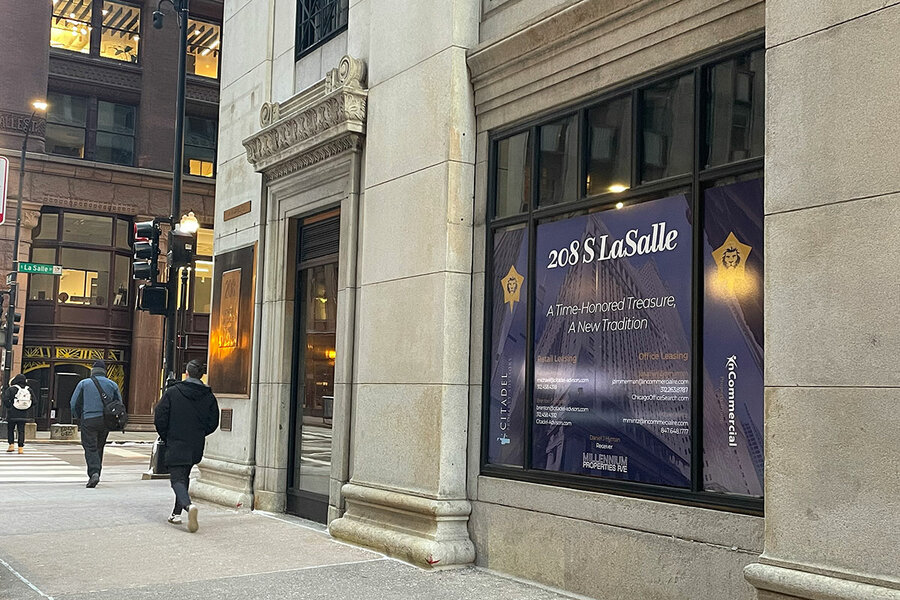
Chicago’s Classical Revival office building at 208 S. LaSalle St. is being converted to residences with 280 planned apartments in the heart of the city’s financial district.

The other day, I was listening to Boston’s Mayor Michelle Wu on Boston Public Radio talking about our region’s severe housing crisis and how she’s working to convert empty office buildings to housing. She aims to make the change incrementally — even a few apartments in each building would make a huge difference.

Boston is not the only city considering this approach.

Laurent Belsie and Story Hinkley report at the Christian Science Monitor, “At the corner of LaSalle and Adams streets in downtown Chicago, the City National Bank and Trust Co. building rises like an elegant monument to the past. Its Doric columns, carved rosettes, and lion’s heads evoke the Classical Revival style popular a century ago. But it’s a deceptive facade.

“The bank, whose name still adorns the front, disappeared in a merger 60 years ago. The building now houses two hotels, offices for professionals and a host of nonprofits, and a British men’s clothing store. And after a city competition to reimagine its financial district, the building will soon change again. The offices will give way to 280 residences: studios, one- and two-bedroom apartments, and amenities like a fitness center and even a private dog run. …

“With fewer workers going to the office, office vacancy rates stand at a 30-year high. Lease revenue is falling, especially in older buildings, and owners are seeing the value of their properties plunge. …

“Developers could upgrade their buildings or convert them to other uses, but in many cases the costs are prohibitive. And a slowing economy, rising interest rates, and tighter lending standards make those conversions even harder. Hanging over them is a cloud of uncertainty: Is the work-from-home movement a permanent change, or just a temporary post-pandemic phenomenon?

“Despite this murky outlook, some cities are charging forward with conversion plans and subsidies. With fewer workers to keep their central business districts vibrant, these cities are hoping to replace them with apartment-dwellers and kick-start a transformation of their downtowns.

“By helping developers convert offices to living units, the mayor of Washington, D.C., hopes to add 15,000 people to the 25,000 or so residents already living downtown. Pittsburgh has cobbled together some $6 million in state and federal funds for its downtown conversion program. Seattle last month put out a ‘call for ideas,’ inviting building owners and architects to come up with new solutions for struggling office buildings.

“Chicago is one of the leaders of the adaptive reuse movement. In March, the city selected the City National Bank building and two other nearby buildings for its LaSalle Street Reimagined project, which aims to revitalize the financial district. Last week, the city chose two more buildings for conversions, which will receive city help and subsidies. In all, the projects will mean more than 1,600 new downtown living apartments in what the city calls one of the largest office-to-residential conversions in the nation.

“ ‘It’s important for the resiliency of downtown,’ says Cindy Chan Roubik, deputy commissioner of the city’s planning and development department. ‘It’s important to have people at different hours of the day and with different uses. You’ll have more people here on the weekends, after work hours, and that provides a vitality.’

“The logic for such conversions makes sense – to a point. … Since the end of 2019, apartment rents have soared around the country while office leasing revenue has slumped by nearly a fifth after adjusting for inflation, according to researchers at New York and Columbia universities

“Also, these averages mask considerable variation. Top-rated office space is holding its own, perhaps because companies want the best amenities to lure their workers back to the office. Less desirable and older office space is seeing much higher vacancy rates.

“And it is precisely these older, smaller office towers that make the best candidates for conversion to apartments. They’re typically easier to reconfigure to meet city codes, such as rules requiring every apartment to have windows. Then there’s the history and architecture, a big draw for some city-dwellers.

“The problems are scale and cost. Even with their recent uptick, the rate of conversions is far too low to solve cities’ office vacancy problem, CBRE says. And the economics are problematic. In a report last month, Moody’s Analytics found that only 35 of the nearly 1,100 office buildings it tracks in the New York City metro area were suitable for conversion. The rest of the buildings are too expensive to make conversions viable, which means either government subsidies or a big drop in office values and rents would be needed.

“Such a drop is precisely what has happened, according to the New York and Columbia researchers. In their analysis of the New York office market, they calculated that the actual value of the city’s office buildings had already fallen by 46% since the pandemic and would edge down to more than 50% by 2029 if the work-from-home trend persists. Those averages include top-rated office space; without that space in the calculation, the declines would be even worse. …

” ‘The unit costs are so high [if you do a conversion, however],’ says Dennis McClendon, a Chicago historian and geographer. For ‘half the cost, you could adapt and build the unit in a walk-up building in an outlying neighborhood.’

“On the brighter side of the ledger, America’s cities have shown remarkable resilience and creativity in keeping up with the times.” 

More at the Monitor, here. No firewall.

Read Full Post »

« Newer Posts - Older Posts »