Feeds:
Posts
Comments

Archive for the ‘Uncategorized’ Category

Photo: Hannah Wright via Unsplash.
The Mekong River, where it passes through Cambodia.

You would think that because I was around in the 1960s, mention of the Mekong River would bring to mind only Vietnam War scenes from television. I do think of those but also of Colin Cotterrill’s Dr. Siri Paiboun mystery series, where the river is a character all its own, and where Laotian characters may cross secretly to Cambodia, Thailand, or Vietnam.

So naturally, research on the river’s improving quality caught my eye.

Stefan Lovgren has a report at YaleEnvironment360. “Among the many ailments plaguing Southeast Asia’s Mekong River, ‘hungry water’ stands out with particular clarity. In recent dry seasons, the Mekong has in places turned a pristine blue as upstream dams rob it of the nutritious particles that normally color the river a healthy mud brown. It’s a phenomenon that can be highly destructive, with the sediment-starved water eating away at unbuffered river banks — hence the ‘hungry’ epithet — and causing harmful erosion.

“It also encapsulates the troubled state of the Mekong, a river that may look healthy on the surface but has grown increasingly sick from a wide range of problems, including dam building, overfishing, deforestation, plastic pollution, and the insidious impacts of a changing climate. During El Niño-induced droughts in recent years, things got so bad that some people suggested the Mekong River was approaching an ecological tipping point beyond which it could not recover.

But events in the past year suggest such doomsday predictions may be premature, especially in Cambodia, which sits at the heart of the Mekong basin.

“Thanks to the last monsoon season, which delivered above-average rainfall to the region, and authorities cracking down on illegal fishing, fish stocks have increased. Fishers along the Mekong have discovered giant fish thought to have disappeared, and the Cambodian government, which has a mixed environmental record, has stepped up conservation efforts.

“Among them is a new government-backed proposal that seeks to turn a particularly bio-rich stretch of the river in northern Cambodia into a UNESCO World Heritage Site. Such a designation, reserved for sites of great scientific or cultural significance, means this part of the river should, at least on paper, enjoy protection from various forms of development, including dam building. …

“ ‘The Mekong is not dead,’ says Sudeep Chandra, director of the Global Water Center at the University of Nevada, Reno, who leads the USAID-funded Wonders of the Mekong research project. ‘We’ve seen huge environmental pressures causing the Mekong to dry up and fisheries to almost collapse. And yet we also see the incredible resilience of this river in the face of those threats.’

“Originating in the Tibetan highlands and winding its way through six countries before disgorging into the South China Sea, the 2,700-mile-long Mekong River is home to the world’s largest inland fishery, with about 1,000 species of fish. Many of the 70 million people living in the basin rely on the river for their livelihoods, whether that is farming, fishing, or other occupations.

” ‘A case could be made that the Mekong is the world’s most important river,’ says Chandra.

“The river’s extraordinary productivity is linked to a giant flood pulse that, in the wet season, can raise water levels 40 feet. With the increase comes sediment that’s essential to agriculture as well as vast numbers of young fish, which are swept into Cambodia’s vital Tonle Sap Lake and other floodplains where they feed and grow.

“But the river’s natural flow regime has been increasingly disrupted by dams, especially those that China began building in the early 1990s in the Upper Mekong and which the country has operated with little regard for downstream impacts. 

“A subsequent frenzy of dam building in Laos and elsewhere, mostly on tributaries to the Mekong, has greatly exacerbated the problem, with dams blocking fish from completing their natural migrations. Already under extreme pressure from overfishing, some fish populations have plummeted, especially large species like the critically endangered Mekong giant catfish, which can grow to 10 feet in length and more than 600 pounds, but is now on the brink of extinction.

“With climate change intensifying, monsoon rains have become more unpredictable. During droughts in 2019 and 2020, the flow of water from the Mekong into Tonle Sap, the largest lake in Southeast Asia, dried up. …

“Mass deaths of fish due to shallow and oxygen-poor water were reported in the lake, and many of the hundreds of thousands of fishers operating on the lake were forced to abandon their work. On the Tonle Sap River, which connects the Mekong and the lake, two thirds of the 60-something commercial ‘dai’ operators working stationary nets, which in years past could each catch several tons of fish in just an hour, had to shut down. …

“However, the river system caught a break with the most recent monsoon season, which runs roughly from June to November, delivering greater than average rainfall to the lower basin and the Tonle Sap Lake region. Although China continued to hold back water to counter its persisting drought, water levels in Tonle Sap rose more than one meter above recent-year averages. With the lake expanding into seasonally flooded forests, which provide excellent feeding grounds for fish, fish populations appear to have been boosted. …

“On a recent visit to the lake, Ngor noticed an increase in medium- and large-size carps, including Jullien’s golden carp, also known as the isok barb, a critically endangered species. There were spottings of other rare fish too, like the Laotian shad and clown featherback, along with increases of more common fish, like the climbing perch and snakehead. Several wallagos, a catfish that can grow up to 8 feet long, could be seen jumping from the open water.

More at YaleEnvironment360, here. No firewall.

Read Full Post »

Photo: Minette Layne/Wikimedia Creative Commons.
Toothed whales like orcas can make astonishingly loud sounds in three vocal registers. How do they do it despite the tremendous pressure underwater?

Do you remember Rudyard Kipling’s Just So Stories? Our favorite growing up was “How the Elephant Got Its Trunk.” I still have a wonderful recording on cassette of my father reading it aloud in his stentorian voice. We loved Kipling’s robust language and used his expressions in daily life. For example, we always said that our Uncle Jim spoke just like the tale’s python rock snake, who lived “on the banks of the great grey-green, greasy Limpopo River, all set about with fever-trees.”

(Is Kipling PC these days? I hope we can take him with a grain of salt. I would hate to lose these stories.)

Hannah Devlin at the Guardian harks back to Kipling in her report on whales with voices.

“The question of how the whale got its voice has been solved by scientists, who have discovered how the creatures use ‘phonic lips’ in their nose to produce the loudest sounds in the animal kingdom.

“The research also reveals that toothed whales, a group that includes killer whales, sperm whales, dolphins and porpoises, use three vocal registers equivalent to vocal fry (a low creaky voice), a normal speaking voice and falsetto.

“The research [was presented] at the annual meeting of the American Association for the Advancement of Science (AAAS) in Washington DC. …

“Prof Peter Madsen, a whale biologist at Aarhus University in Denmark and lead author, said: ‘These animals are producing the loudest sounds of any animal on the planet while being at a depth of 1,000 metres [3,280 feet]. It just seems such a paradox.’

“A central puzzle was how whales manage to generate sufficient flow of air, given that at 1,000 metres below the surface the pressure is so great that the air in the whale’s lungs is crushed to 1% of the volume it would occupy at the surface.

“The latest work shows that as whales dive deep below the surface, their lungs collapse and air is compressed into a small muscular pouch inside the mouth. To make a click, the whale opens a valve on the pouch for about a millisecond causing a high pressure blast of air to pass through a vibrating structure in the nose, called the phonic lips.

“ ‘When the lips slap back together, that’s what makes the click,’ said Madsen. The clicks, used to navigate and hunt prey, can reach volumes equivalent to a very powerful rifle being fired.

“The study, carried out over a decade, used high-speed video recorded through endoscopes, and collected audio recordings, using electronic tags, from trained dolphins and porpoises, and sperm whales and false killer whales in the wild. The researchers approached the huge marine mammals at sea in small boats and waited for them to come close in order to attach lightweight recording devices.

“ ‘Many whales will come up to us and have a look and echo-locate on the boat,’ said Madsen. ‘I sometimes wonder who is studying who – except they don’t put a tag on us.’ The recordings revealed three distinct registers. …

“The analysis, published in the journal Science, showed the whales use two additional registers for social communication. Scientists know that toothed whales have sophisticated social communication abilities, ranging from cooperation during hunting to the signature whistle that dolphins use to identify themselves. Other species, such as killer and pilot whales, make very complex calls that are learned and passed on culturally like human dialects.”

More at the Guardian, here. No firewall. Donations solicited.

Read Full Post »

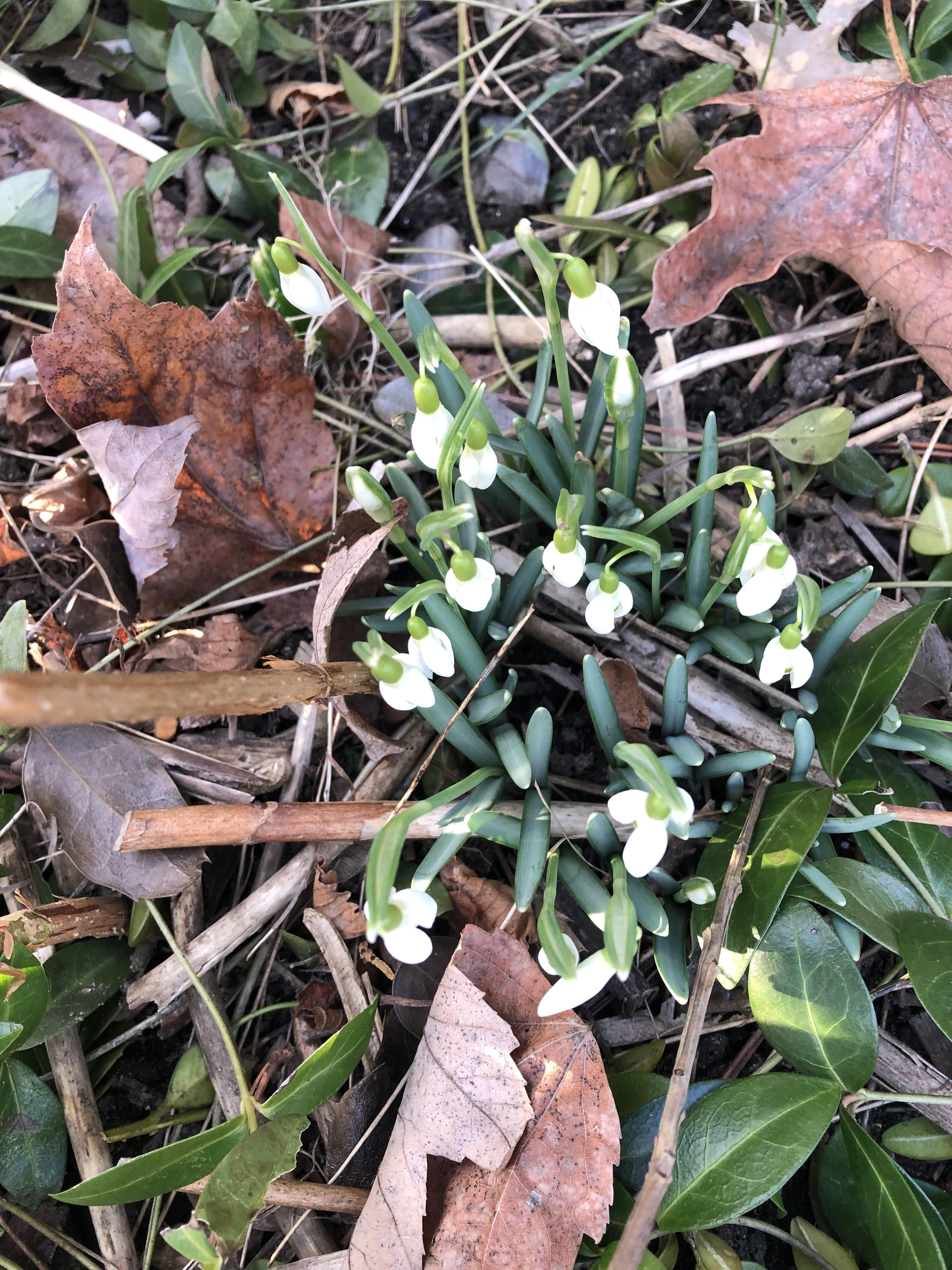
Photo: Suzanne and John’s Mom.
Snowdrops arrive in Massachusetts.

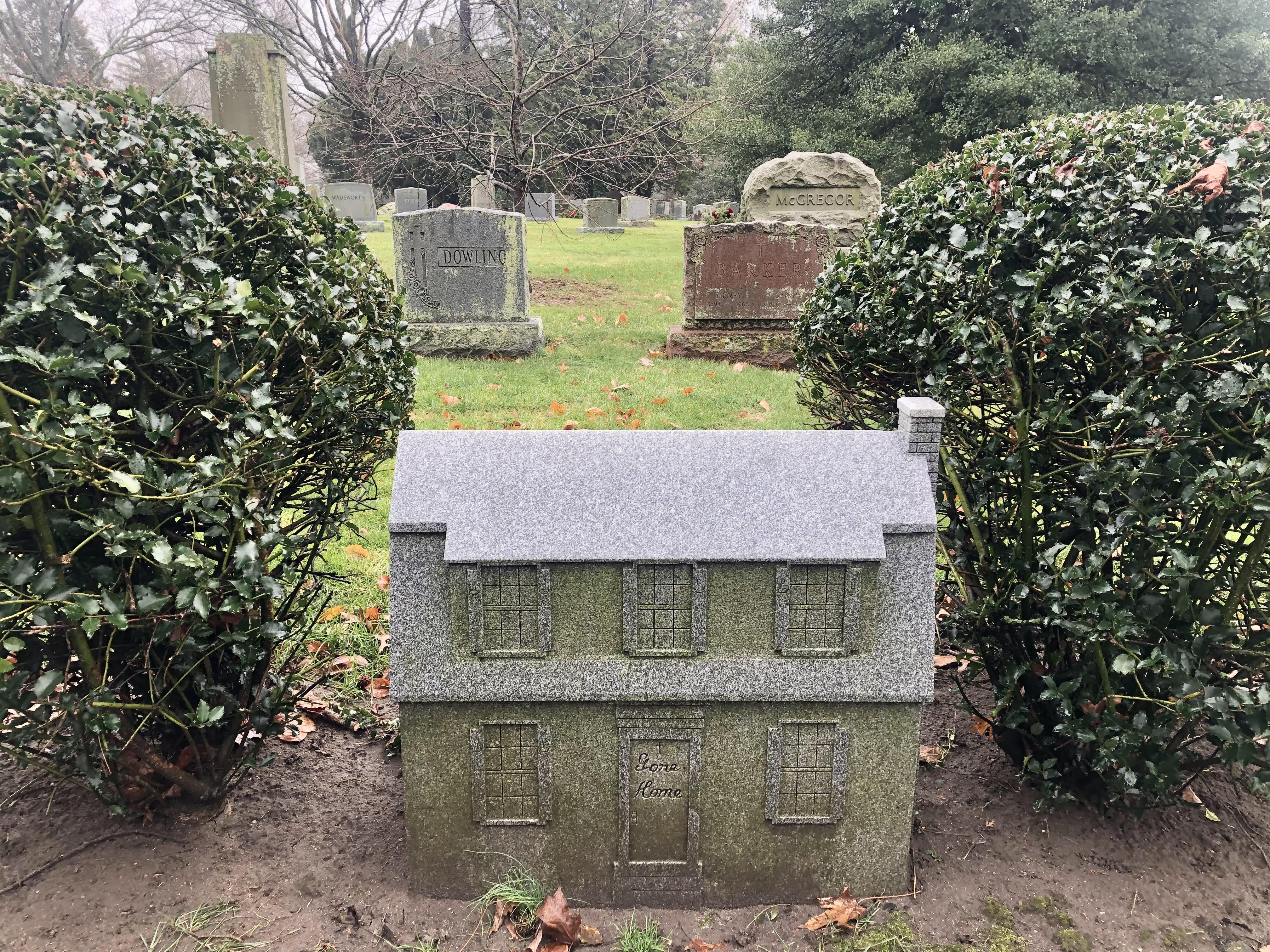
I haven’t posted photos for a while, and now I’m realizing that today’s selection goes way back to early January, when Erik’s mother was still visiting from Sweden. She showed me a garden-like cemetery in Providence where she loves to run — and where we were greeted by the largest gang of wild turkeys I have ever encountered!

I particularly liked the unique headstone below: someone must have felt OK about having a final home in this park.

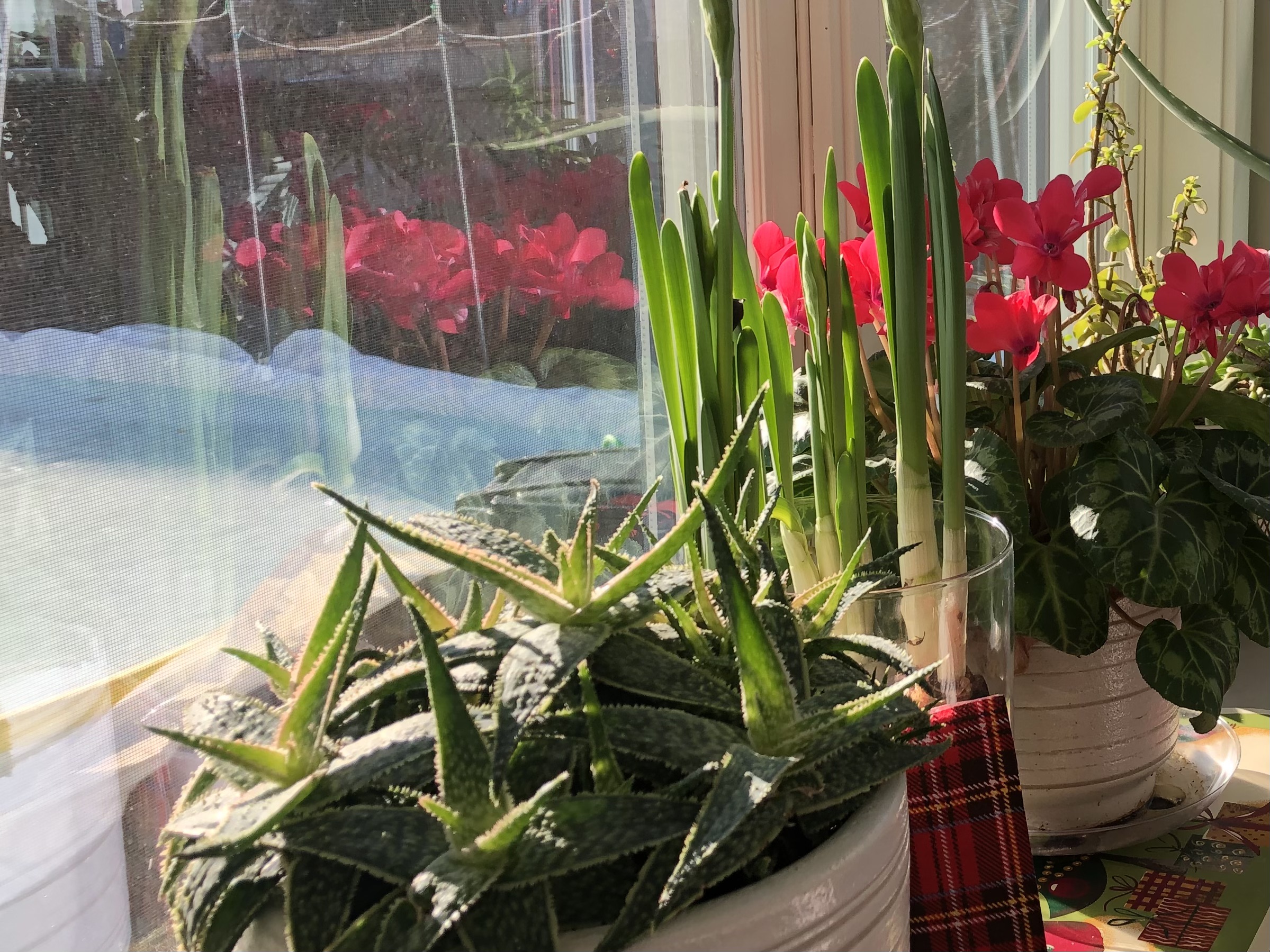
The next photo shows my frosty windshield in February. But indoors at John’s house, warm floral colors were defying the frost.

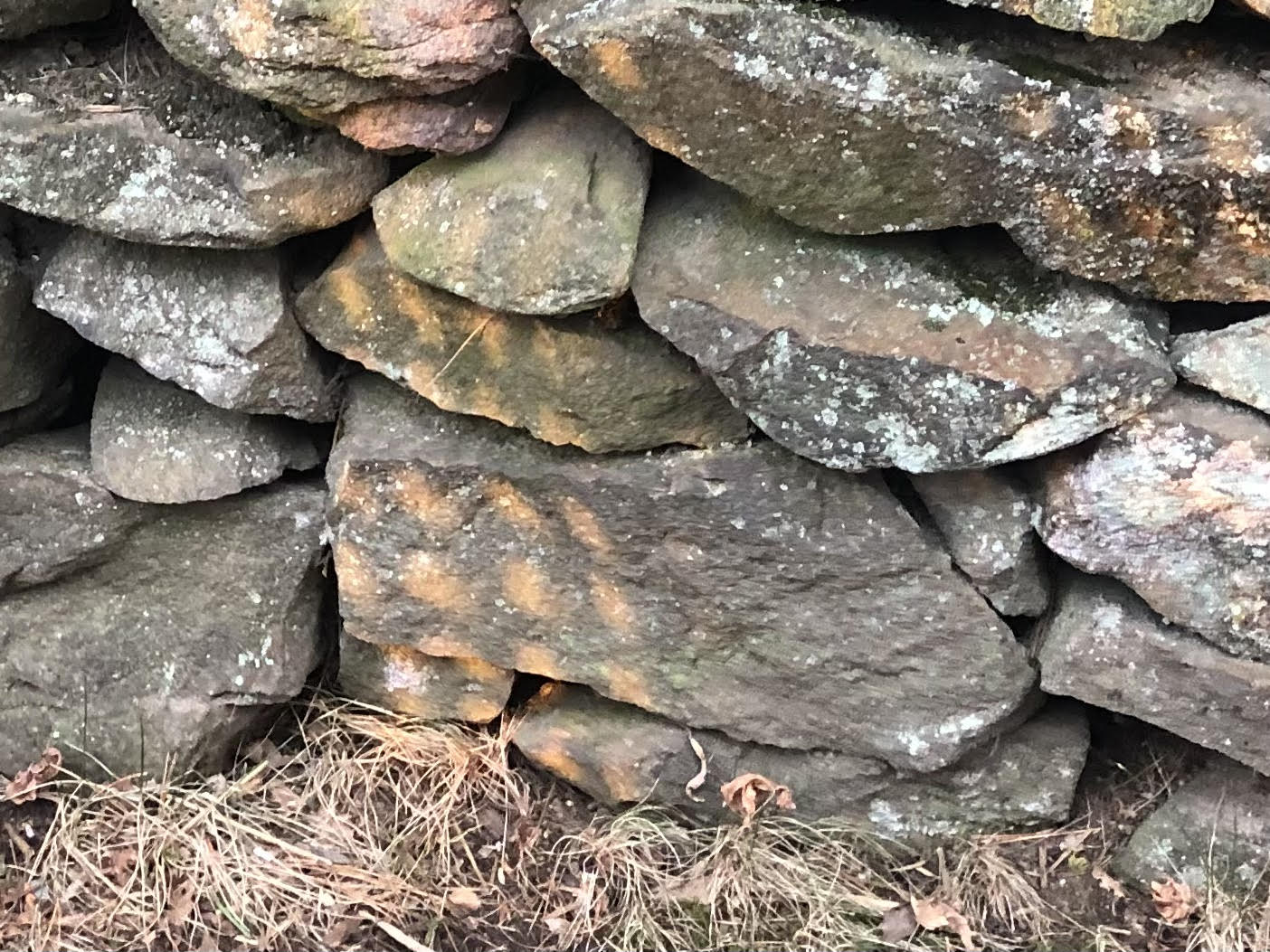
Note that Suzanne’s stone wall has a light pattern on it. It comes from the sunrise over the river in Providence and through her fence. I have to be quick with the camera as the pattern disappears fast.

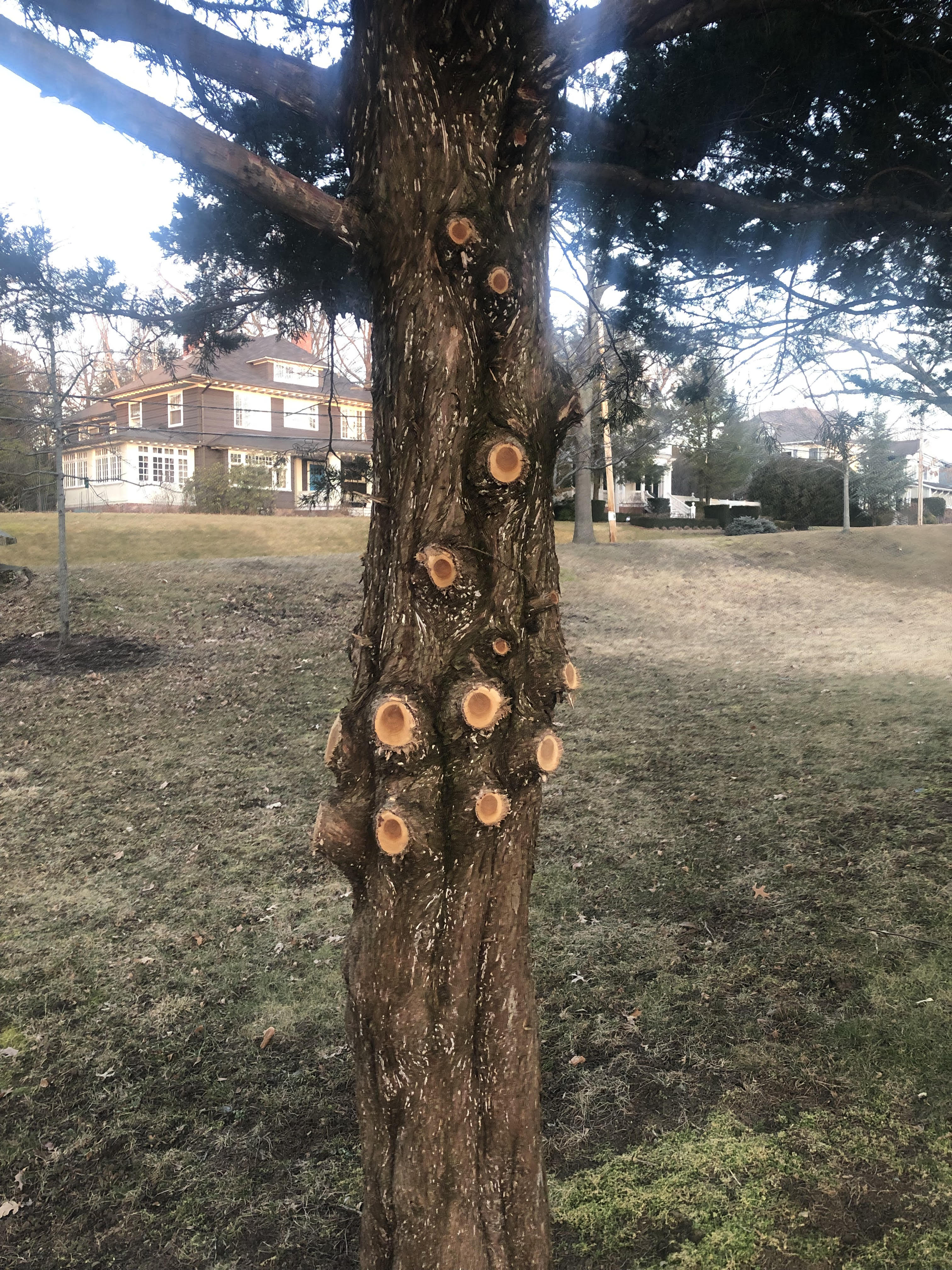
The tree of many eyes was also in Providence. Kind of weird and interesting.

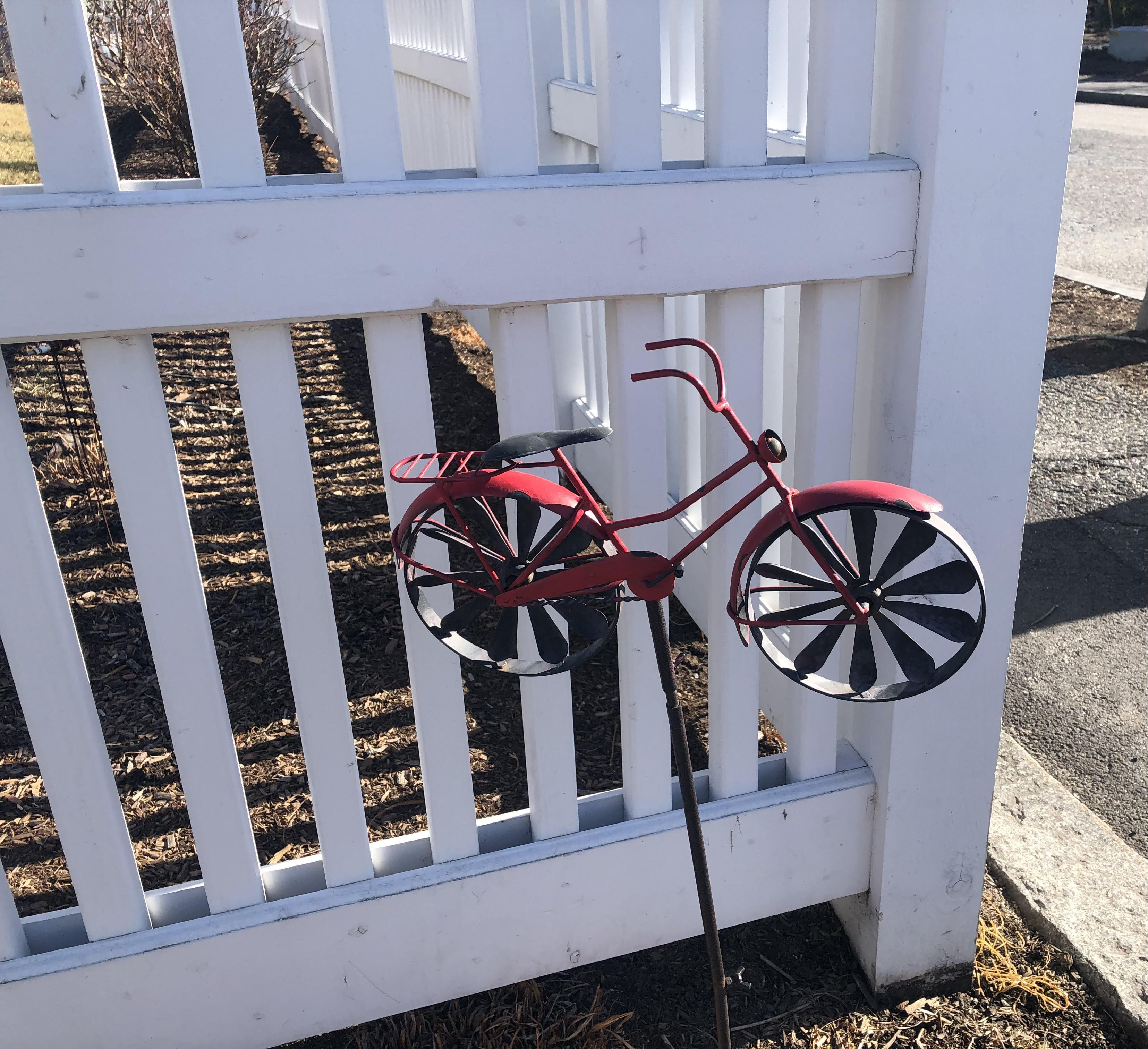
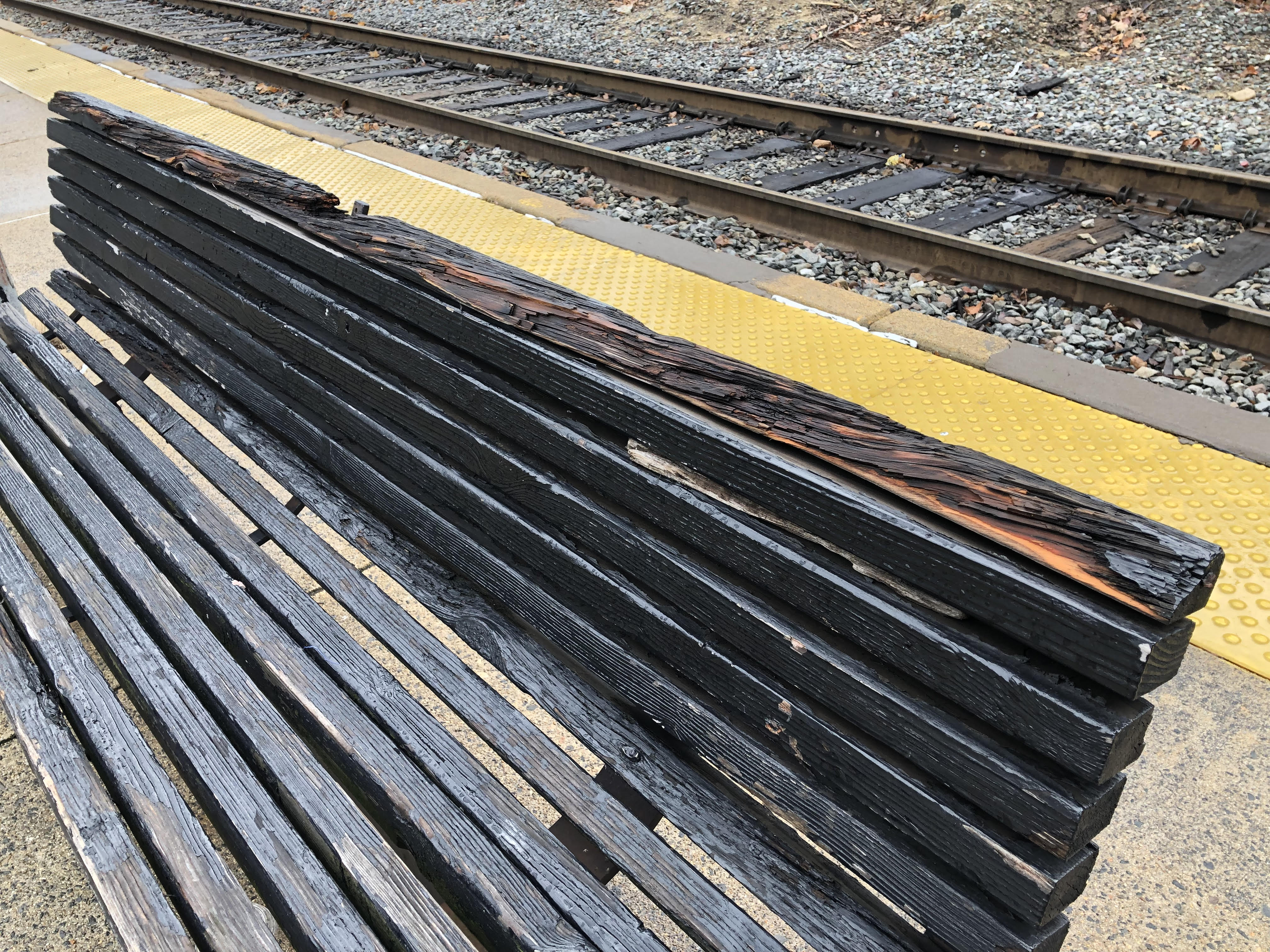
The tiny bicycle is ready for a windy ride. The chewed-up bench at the commuter rail station suggests to me that the train is often late.

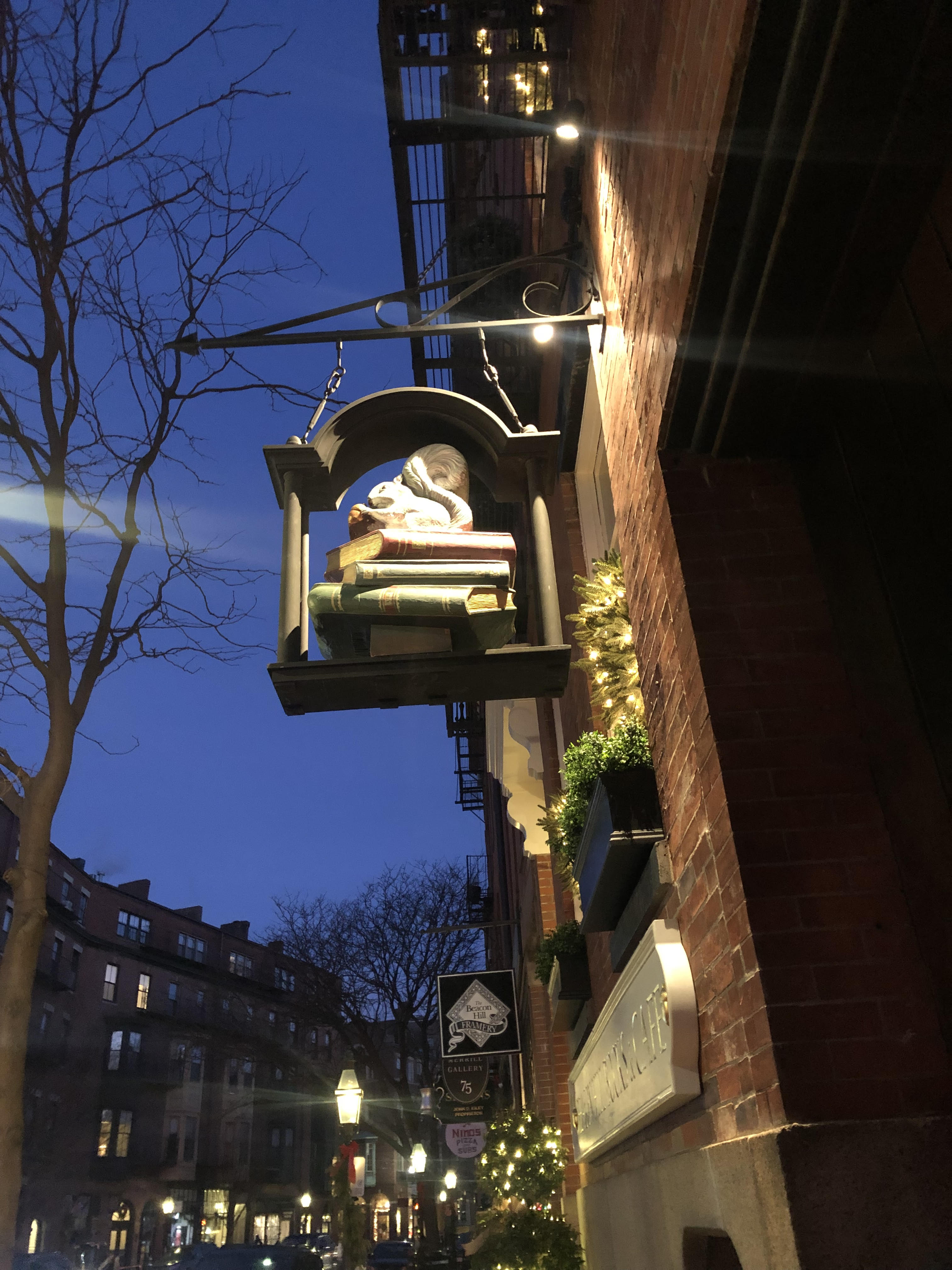
The book store with the literary squirrel in Boston is part of the indie book store resurgence I wrote about recently, here.

There was a mechanical face in the sidewalk near the park. Conducting surveillance, I suppose.

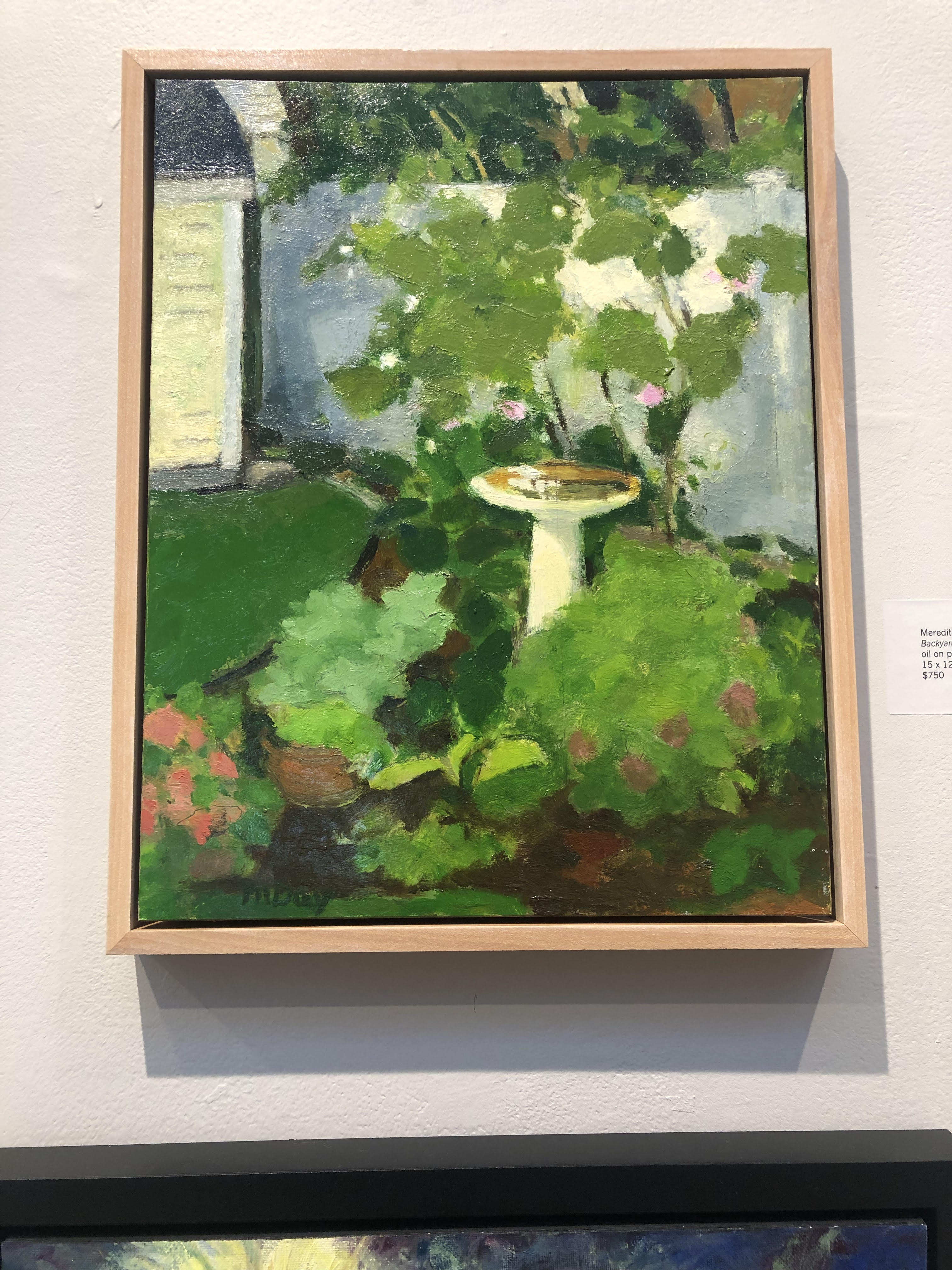
Finally, a spring treat: Meredith Fife Day’s lovely contribution to a recent exhibit at Concord Art.

Read Full Post »

Photo: First Dibs.
Above, a restored 1938 Zenith radio. Stars such as James Dean, Jack Klugman, Martin Landau, Lee Marvin, Walter Matthau, Steve McQueen, Anthony Perkins, Jerry Stiller, Martin Balsam performed on the television version of The Big Story, a show that started on radio in 1947.

The other day, my husband heard a Richard Strauss tone poem that brought back a memory he had of a true-crime show he liked. The Big Story started on radio and later transferred to television, where it attracted an impressive array of guest stars.

I didn’t know The Big Story, but as I learned more, it got me thinking about what a great service radio was — and still is. (When Suzanne and John were little, I had a show of my own at WGMC, a community station in Greece, New York.)

I turned to Wikipedia.

The Big Story is an American radio and television crime drama which dramatized the true stories of real-life newspaper reporters. … Sponsored by Pall Mall cigarettes, the program began on NBC Radio on April 2, 1947. With Lucky Strike cigarettes sponsoring the last two seasons, it was broadcast until March 23, 1955. The radio series was top rated, rivaling Bing Crosby‘s Philco Radio Time.

“Produced by Barnard J. Prockter, the shows were scripted by Gail Ingram, Arnold Pearl and Max Ehrlich. Tom Vietor and Harry Ingram directed the series. … The theme was taken from Ein Heldenleben (‘A Hero’s Life’), a tone poem by Richard Strauss.

“Prockter was inspired to create the program after hearing about a man who was freed from a life sentence in jail by the work of two newspaper reporters in Chicago. Most of the stories in the show dealt with stories about closed cases. Ross Eaman, in his book, Historical Dictionary of Journalism, wrote that the program was ‘originally intended to honor reporters ignored by Pulitzer committees.’ Jim Cox also cited that plan in his book, Radio Crime Fighters: More Than 300 Programs from the Golden Age.

“Each week the program recognized the reporter who wrote the story on which that episode was based and the newspaper in which the story appeared. The reporter received $500, was interviewed on the air and was acknowledged in the introduction, as in this example:

” ‘Pall Mall, famous big cigarette, presents The Big Story, another in a thrilling series based on true experiences of newspaper reporters. Tonight, to Russ Wilson of the Des Moines Tribune goes the Pall Mall award for The Big Story. Now, the authentic and exciting story of “The Case of the Ambitious Hobo.” ‘

“The radio series was adapted for television where it debuted on NBC on September 16, 1949. The series continued to air on NBC until June 28, 1957, after which it appeared in syndication until 1958. The half-hour program was hosted by Robert Sloane, Norman RoseBen Grauer, and, finally, Burgess Meredith. …

“The theme music was two of the main themes from the tone poem ‘Ein Heldenleben’ (‘A Hero’s Life’) by the German composer Richard Strauss. The series was nominated for a Primetime Emmy Award in 1953.”

Now I’m thinking of some of my earliest memories of radio. I had a babysitter who love to listen to a morning show that opened with the song “Pack up your troubles in your old kit bag, and smile, smile, smile.” I know it’s a WW I song, but it was still in use when I was a kid.

I also remember that once when I was trying to fall asleep, I heard a radio drama someone had left playing and was too scared even to get up and turn it off!

What are your radio memories?

More at Wikipedia, here, and at Old Time Radio Downloads, here.

Read Full Post »

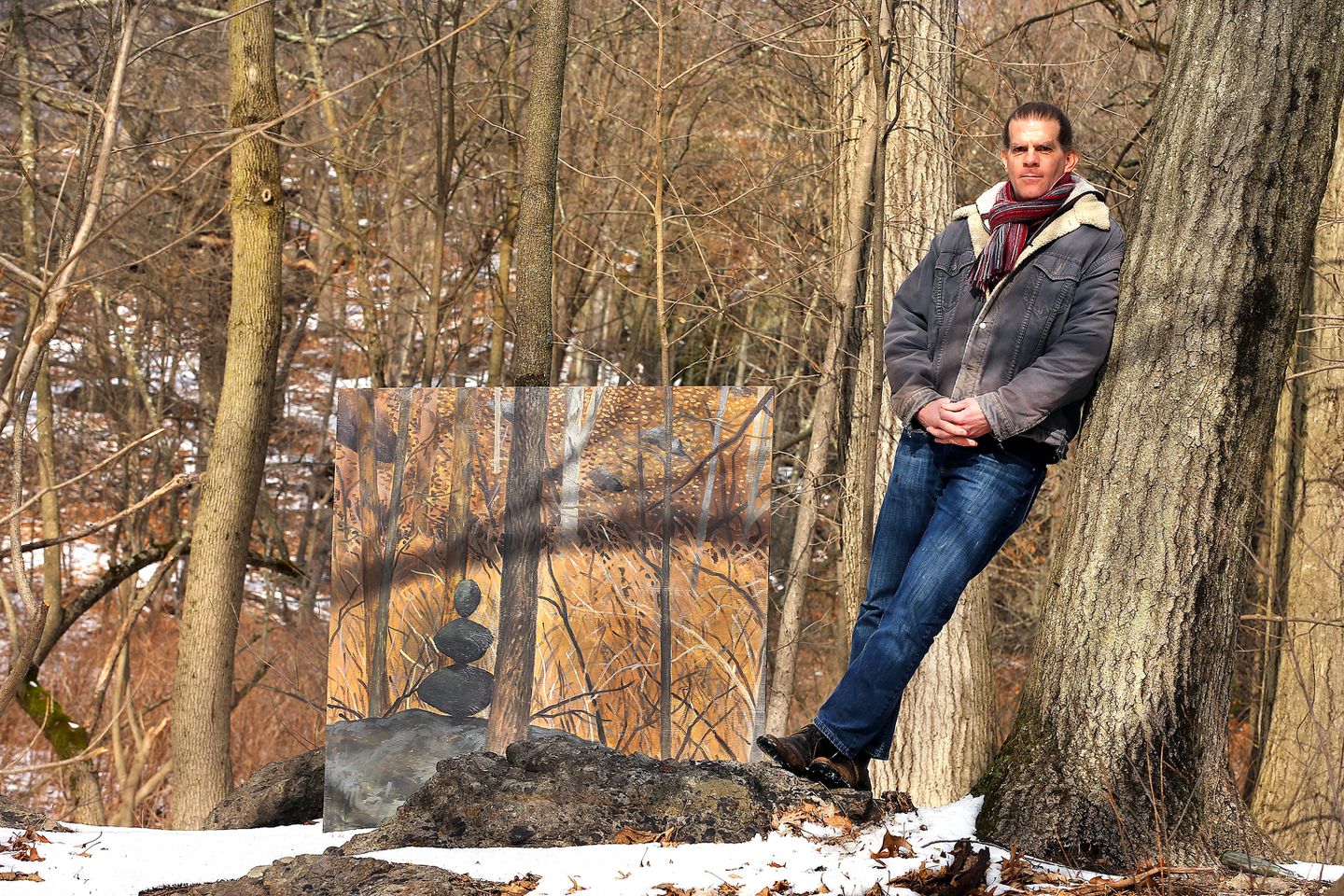
Photo: John Tlumacki/Globe Staff.
Artist and muralist Alex Cook painted two illusion paintings that he placed in Boston’s Franklin Park. The challenge is to keep them from being stolen.

It takes a brave artist to leave work in the woods. Where I live, Umbrella Arts members create art for an annual theme, trusting dog walkers, nature lovers, and connoisseurs to leave the paintings and sculptures in place over a period of months.

In Boston, trompe-l’œil art is appearing in woodland. Steve Annear has the story at the Boston Globe.

“When Jeffrey Jacobs went for a stroll along the trails in Boston’s Franklin Park last month, on a day when winter briefly gave way to spring, he expected to see the usual brown and beige leaves blanketing the ground, bare trees towering overhead, and a smattering of wildlife. But something else caught his attention that day: a clever piece of camouflaged artwork, just off the beaten path.

“The large painting perfectly matched its surroundings, but made it appear as if the trunks of the two trees it leaned against had been partially removed, replaced by a stack of gray stones and a twig wedged between the missing parts as if holding them up.

“ ‘I appreciated the illusion; I thought it was just wonderful,’ said Jacobs, who posted about his discovery on a Facebook page for Jamaica Plain residents. …

“The mysterious mural was one of two paintings recently hidden in a section of the sprawling park known as The Wilderness as part of a project by local artist Alex Cook. …

“ ‘There’s something so magical about coming across something wonderful in the woods,’ said Cook, a muralist by trade whose work is featured prominently on buildings around Boston and beyond. …

“The idea for the project, which he describes as a bit of a ‘treasure hunt,’ came at the beginning of the pandemic, when Cook was temporarily living in New Jersey with his wife’s family.

“After stumbling across a pair of boards from an old ping-pong table in the basement, he was inspired to bring them outside and use them as canvases. …

“ ‘All my projects had evaporated,’ he said. ‘I started making paintings on this thing.’

“Each Monday for several months, Cook would whip up a different mural on the boards, which he leaned against a pair of trees. …

“Some of the last murals he painted in the series were ‘illusion paintings’ that blended in with the natural surroundings and the trees that supported them. They had elements of trickery. …

“The memory of the playful paintings and the joy they brought people recently came back to him. He grabbed a wood panel, packed his art supplies into a bag, and headed out to the trail near his home in Jamaica Plain.

“The result was the first of two, 4-foot-by-4-foot paintings for people to discover on their way through Franklin Park. In a description of the process, which he posted online, Cook said the biggest challenge was reproducing and depicting the natural colors of the backdrop as accurately as possible, so everything lined up.

“ ‘And it’s crazily hard as the light is changing all through the day,’ he wrote. ‘But wicked fun when it works.’ …

“His work has ‘been received so warmly’ by the community, especially on Facebook, where people have marveled at its ingenuity.

“ ‘I appreciate this so much!’ one person wrote beneath a post of his artwork. ‘I walk here every day and finding surprise art is a delight and a treasure.’

“In the category of ‘this is why we can’t have nice things,’ [a painting with] missing trunks was stolen from its spot sometime in the past few days. But Cook is hoping the ‘art bandit’ will return it. …

“ ‘If you find yourself at a party and this painting is on the wall, do us all a favor and bring it right back to Franklin Park.’

“As for the remaining mural, once spring arrives and it no longer matches the landscape, Cook may swap it out for one that fits the season. Later, he’d like to feature his work in a more neutral environment, like an indoor art gallery. For now, he hopes his art continues to bring joy to unsuspecting viewers.

“ ‘I just want people to get a feeling of beauty, of wonder, of mystery,’ he said.”

Cook makes me think of Orson, the youngest of the Easter Egg Artists, who can’t help painting everything he sees. More at the Globe, here.

Read Full Post »

Photo: Josep Lago/AFP/Getty Images.
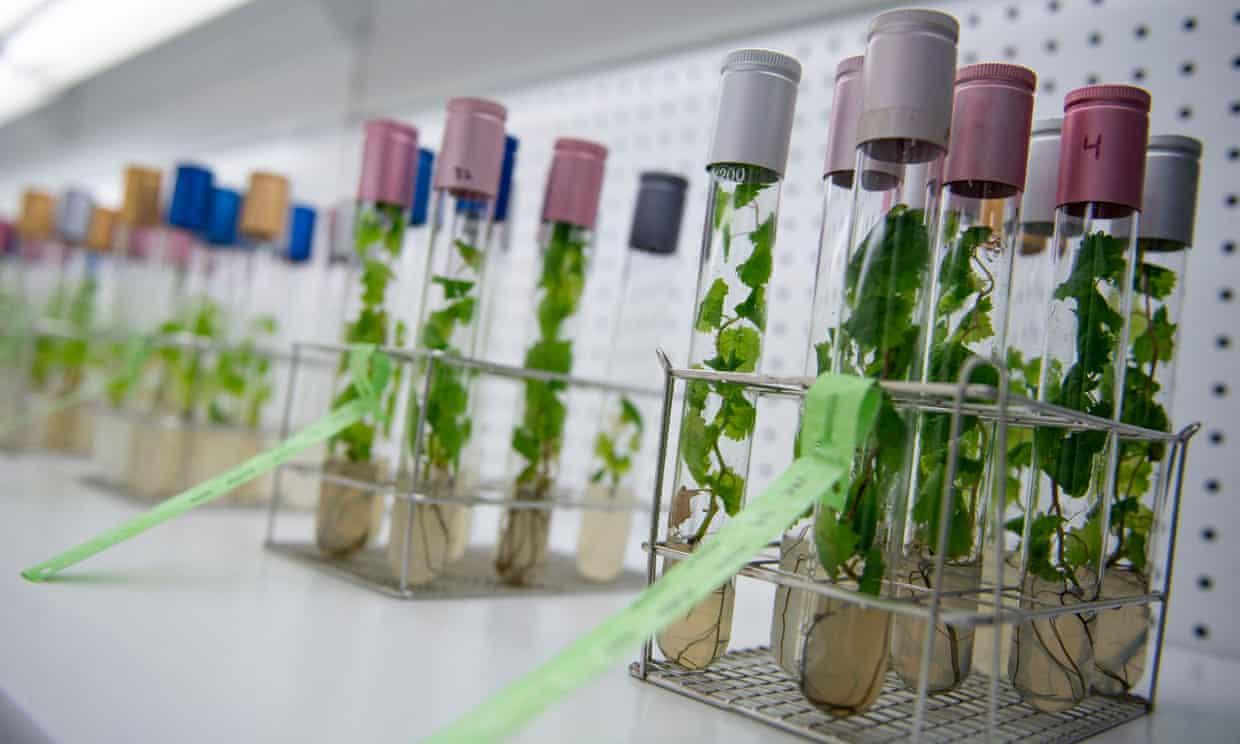
Ancient grape varieties in the laboratory at the Familia Torres vineyard near Barcelona. 

Here we go, Humans! More adapting.

Today’s story is about pragmatic grape growers adapting to climate change by seeking out grapes that can handle more heat. Too bad they have to do this, but what they learn may help other growers — and all of us.

Ashifa Kassam covers the topic for the Guardian: “The ads – tucked in the corners of local newspapers and directed at winemakers – began turning up across Catalonia in the 1980s. ‘If you know where to find any uncommon grape varieties, please get in touch,’ they read.

“Dozens of tips came pouring in, shepherding Miguel A Torres in his search for long-forgotten wine grapes. But it wouldn’t be until a decade later, as the climate crisis began wreaking havoc on vines, that the fourth-generation winemaker realized his foray into the past could play a key role in tackling what lies ahead.

“ ‘I simply wanted to recover the heritage – the ancient traditions and vines – left to us by our ancestors,’ said Torres, the president of Familia Torres winery.

‘And then we realized that some of these varieties take longer to ripen, meaning they might be able to help us in a warming world.’

“It was a glimmer of hope as the wine industry grapples with a changing climate. Extreme weather, drought and steadily rising temperatures have laid bare a crop that is extremely sensitive to change. In Spain, rising temperatures have meant grapes ripening more quickly, leaving winemakers rushing to harvest in hopes of protecting the carefully concocted balance between the fruit’s sugars and acidity.

“ ‘Climate change is the worst threat the sector has ever faced,’ said Torres. …

“In California, vintners are embracing grapes such as mourtaou, a nearly extinct variety from south-western France, to create peppery reds, while some in France’s Cognac region are toppling more than a century of tradition to trial climate-resistant grapes. In Bordeaux, concerns about the climate crisis recently helped to secure the approval of six new grape varieties, including castets, a disease-resistant variety that had been on the brink of disappearing.

“The reasons these grapes fell into disuse varies widely, said José Miguel Martínez Zapater, the director of the Institute of Grapevine and Wine Sciences in La Rioja. Some were abandoned in the late 19th century as the phylloxera plague forced European grape growers to chase efficiency, while others were discarded as winemakers sought to comply with strictly defined appellations or consumer preferences for certain grapes.

“Martínez Zapater’s publicly funded institute is one of several across Spain that have been peering into the past to bolster wine grape diversity – a years-long process that involves identifying the varieties, testing out their characteristics and seeking official approval for their use. … ‘People are finding varieties in different areas that they consider interesting.’

“In Spain – home to a €5bn-a-year wine production industry [$5,390,000,000] whose production outpaced all other EU countries in 2021 – much is on the line. Last year, the country experienced its hottest year since record-keeping began; since 2015 the country has sweltered through four of its hottest years on record.

“At the Agrarian Technological Institute of Castilla y Leon, known as ITACyL in Spanish, two decades of research have led to the recovery of more than a dozen varieties of grapes. The list includes estaladiña, a grape whose last recorded reference stretches back to 1914, and cenicienta, a grape close to extinction before it was revived to make fruity reds.

“ ‘The wines they make are very distinct and interesting,’ said José Antonio Rubio Cano, who heads the viticulture and woody crop department at the institute. … He stressed, however, that the embrace of these long-overlooked varieties is just part of the broader efforts needed as the industry adapts to a changing climate. ‘There’s no one solution,’ said Rubio Cano. ‘It has to be a set of things; we have to pay more attention to the vines, be more aware of how their fruits are ripening and we need to develop a deeper understanding of the vineyard and the different varieties.’ …

“The Caserío de Dueñas vineyard is taking the institute’s research to the next level, planting hectares of eight of the recovered varieties to test out how the grapes behave in a real-world scenario.

“ ‘I find it super-interesting,’ said Almudena Alberca [who in 2018 became Spain’s first female master of wine and is] the technical director for Entrecanales Domecq, the vineyard’s owner. ‘The possibilities are endless.’ …

“Four decades after Torres placed his first ad seeking forgotten grapes, Familia Torres has begun releasing small quantities of wines made from the fruits of his quest, such as forcada and pirene. The wines tell a story that is both steeped in the past and nods at the enormous challenge that lies ahead as the climate crisis tightens its grip, said Torres.

“ ‘I’ve always said that the wine sector is the canary in the coal mine,’ he added. ‘The consequences that vineyards are living through right now should make everyone take notice.’ ”

More at the Guardian, here. No firewall; donations encouraged.

Read Full Post »

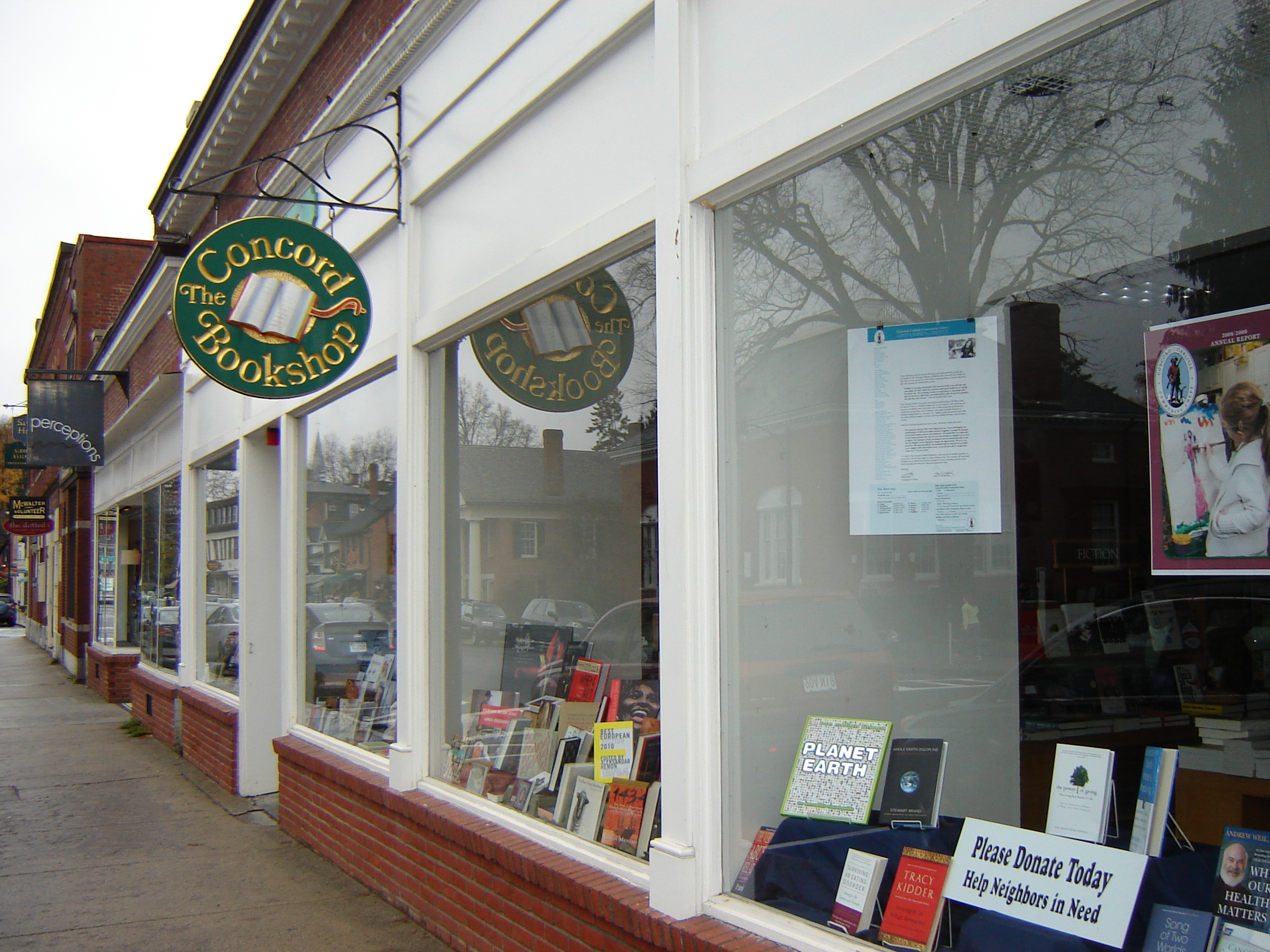
Photo: Suzanne and John’s Mom.
In a rebellion against online behemoths, bookworms are ensuring that local shops survive and even grow.

Do you like to browse in bookshops? Pretty hard to do that online. That’s one reason book lovers have been supporting independent stores, not to mention the unique assistance and advice that shop staff can provide.

Dana Gerber investigated the topic for the Boston Globe last month.

“On the weekends, the line outside the new Beacon Hill Books sometimes snakes out the door. Brookline Booksmith has expanded twice since the pandemic. Later this year, Harvard Book Store will open at the Prudential Center. …

“Indeed, these are optimistic times for independent bookstores in Greater Boston, with four new shops sprouting up in and around Boston since 2020, and more on the way. And what variety bibliophiles have to choose from: There’s a feminist bookstore at Somerville’s Assembly Row, an outpost of a Provincetown favorite coming to the Seaport, and that five-story spectacle on Charles Street.

“ ‘There was a period where there were more stores closing in Boston than were opening,’ said Allison Hill, the CEO of the American Booksellers Association. ‘Now we’re seeing Boston return to being a bookstore town.’ …

“Interviews with more than a dozen local independent bookstore proprietors and experts describe an industry entering a new chapter.

“The pandemic, far from a death knell, galvanized customers to read more, shop locally, and, as the world reopened, indulge a bit more in offline experiences. Federal funds and other investments helped owners stay afloat, or even expand. And for developers and landlords looking to lure people back to brick-and-mortar shopping, bookstores old and new became model tenants. …

“So, how exactly did independent bookstores change their story? [Harvard Business School professor Ryan Raffaelli] says bookstores tend to knit themselves into a neighborhood, offer customers a unique selection of books and ‘sidelines’ (gifts or other products, which tend to have higher margins), and act as a ‘third space,’ away from home and work, where people can gather.

“These are attributes, said Raffaelli, that no algorithm can match. ‘As Boston continues to expand, and reconfigure itself, people are moving into new parts of the city and looking for those similar types of experiences,’ he said. …

“Just take the newest addition to Boston’s bookstore scene: Rozzie Bound Co-op in Roslindale, a neighborhood that has gone without a full-service bookstore for more than a decade. Roy Karp, along with four other worker-owners, opened the 200-square-foot nook in January with the help of more than 150 ‘consumer-owners’ — members of the community who purchased $100 shares in the business.

“ ‘They’re buying the shares because they want to see the bookstore in their community,’ said Karp. …

“In Fields Corner, too, a forthcoming bookstore was willed into reality. Words as Worlds — helmed by Boston poet laureate Porsha Olayiwola and Bing Broderick, the longtime head of the nonprofit Haley House — is slated to open this fall on the ground floor of a new Dorchester Avenue apartment building. The goal, the pair said, is for the store to act as a community hub in a neighborhood that tends to go dark early.

“And it’s clear that sort of space is in demand. The building’s developer collected community feedback and held a vote to help decide what to put on the ground floor. The bookstore prevailed. ‘People want it,’ said Olayiwola. …

“Other bookstores have found success by carving out niches. At Hummingbird Books in Chestnut Hill, which opened last spring, a giant, climbable tree welcomes children to the space. In Assembly Row, readers come from near and far to shop at All She Wrote, a bookstore that carries queer and feminist texts. …

“ ‘People showed up for us and were like, “We need this. We need this type of bookstore in Boston,” ‘ said owner Christina Pascucci Ciampa. ‘Our curation is what makes us who we are.’

“Even at established bookstores, owners are noticing renewed enthusiasm from shoppers that has allowed them to widen their footprints. People are returning in person to Harvard Book Store’s big-name author readings, which make up a sizable chunk of its business and are expected to draw crowds to the new Pru location. ‘They see us as bringing a lot of business to the building,’ said general manager Rachel Cass.

“Meanwhile, Brookline Booksmith has taken over two neighboring storefronts since the pandemic — first to expand their gift section and next to broaden their art and design stacks. The store now takes up nearly half the block. Sales are up ‘double-digit percentage points’ from pre-pandemic, said co-owner Lisa Gozashti.

“ ‘There’s something about it that’s changed,’ said Gozashti. ‘It’s not just browsing. I feel like people are making a day of it.’ “

More at the Globe, here.

If you lack a local bookshop. consider buying online at Bookshop.org, which gives a percentage of sales to indie shops. When my local shop can’t get a certain book, I have found that Bookshop.org has everything I ask for and delivers fast. So even if you are not getting the browsing experience, you are providing it for others in other towns — towns you might someday visit.

Read Full Post »

Photo: Kung Fu Nuns.

The roles of women around the world keep evolving. Today we learn that the traditionally quiet Buddhist nuns of Nepal are branching out — through their practice of kung fu and through good works in the community.

Sameer Yasir reports at the New York Times, “As the first rays of sun pierced through the clouds covering snowcapped Himalayan peaks, Jigme Rabsal Lhamo, a Buddhist nun, drew a sword from behind her back and thrust it toward her opponent, toppling her to the ground. …

“Ms. Lhamo and the other members of her religious order are known as the Kung Fu nuns, part of an 800-year-old Buddhist sect called Drukpa, the Tibetan word for dragon. Across the Himalayan region, and the wider world, its followers now mix meditation with martial arts.

“Every day, the nuns swap their maroon robes for an umber brown uniform to practice Kung Fu, the ancient Chinese martial art. It’s part of their spiritual mission to achieve gender equality and physical fitness; their Buddhist beliefs also call on them to lead an environmentally friendly life.

“Mornings inside the [Druk Amitabha] nunnery are filled with the thuds of heavy footsteps and the clanking of swords as the nuns train under Ms. Lhamo’s tutelage. …

“ ‘Kung Fu helps us to break gender barriers and develop inner confidence,’ said Ms. Lhamo, 34, who arrived at the nunnery a dozen years ago from Ladakh, in northern India. ‘It also helps to take care of others during crises.’

“For as long as scholars of Buddhism remember, women in the Himalayas who sought to practice as spiritual equals with male monks were stigmatized, both by religious leaders and broader social customs. Barred from engaging in the intense philosophic debates encouraged among monks, women were confined to chores like cooking and cleaning inside monasteries and temples. They were forbidden from activities involving physical exertion or from leading prayers or even from singing.

“In recent decades, those restrictions have become the heart of a raging battle waged by thousands of nuns across many sects of Himalayan Buddhism.

“Leading the charge for change are the Kung Fu nuns, whose Drukpa sect began a reformist movement 30 years ago under the leadership of Jigme Pema Wangchen, who is also known as the 12th Gyalwang Drukpa. He was willing to disrupt centuries of tradition and wanted nuns who would carry the sect’s religious message outside monastery walls.

‘We are changing rules of the game,’ said Konchok Lhamo, 29, a Kung Fu nun. ‘It is not enough to meditate on a cushion inside a monastery.’

“Every year for the past 20, except for a hiatus during the pandemic, the nuns have cycled about 1,250 miles from Kathmandu to Ladakh, high in the Himalayas, to promote green transportation. Along the way, they stop to educate people in rural parts of both Nepal and India about gender equality and the importance of girls.

“The sect’s nuns were first introduced to martial arts in 2008 by followers from Vietnam, who had come to the nunnery to learn scriptures and how to play the instruments used during prayers. Since then, about 800 nuns have been trained in martial arts basics, with around 90 going through intense lessons to become trainers.

“The 12th Gyalwang Drukpa has also been training the nuns to become chant masters, a position once reserved only for men. He has also given them the highest level of teaching, called Mahamudra, a Sanskrit word for ‘great seal,’ an advanced system of meditation. …

“But the changes for the sect have not come without intense backlash, and conservative Buddhists have threatened to burn Drukpa temples. During their trips down the steep slopes from the nunnery to the local market, the nuns have been verbally abused by monks from other sects. But that doesn’t deter them, they say. When they travel, heads shaved, on trips in their open vans, they can look like soldiers ready to be deployed on the front line and capable of confronting any bias.

“The sect’s vast campus is home to 350 nuns, who live with ducks, turkeys, swans, goats, 20 dogs, a horse and a cow, all rescued either from the knife of butchers or from the streets. The women work as painters, artists, plumbers, gardeners, electricians and masons, and also manage a library and medical clinic for laypeople.

“ ‘When people come to the monastery and see us working, they start thinking being a nun is not being “useless,” ‘ said Zekit Lhamo, 28, referring to an insult sometimes hurled at the nuns. ‘We are not only taking care of our religion but the society, too.’ ”

More at the Times, here. The pictures are wonderful, but you do need a subscription.

Read Full Post »

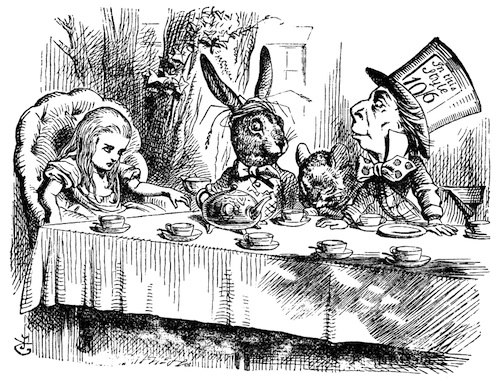
Art: John Tenniel.
The Dormouse in Alice in Wonderland tells a story of sisters at the bottom of a well who were learning to draw “all manner of things — everything that begins with an M … such as mouse-traps, and the moon, and memory.”

When periodicals like the Washington Post block bloggers from linking to their images, we scavenge around for alternative illustrations. Today’s Post article on music and memory made me think of words that begin with an “m,” as the Dormouse did in Alice in Wonderland. The Dormouse even talks about “drawing” memory. Look it up.

Marlene Cimons has a report on music and dementia.

“When Laura Nye Falsone’s first child was born in 1996, the Wallflowers album ‘Bringing Down the Horse’ was a big hit. ‘All I have to hear are the first notes from “One Headlight,” and I am back to dancing … with my brand-new baby boy in my arms,’ she says. …

“When Carol Howard’s early-onset Alzheimer’s worsened, often she couldn’t recognize her husband. She once introduced him as her father. But if she heard a 1960s Simon & Garfunkel song playing, Howard, a marine biologist who died in 2019, could sing every word ‘effortlessly,’ her husband says.

“This ability of music to conjure up vivid memories is a phenomenon well known to brain researchers. It can trigger intense recollections from years past — for many, more strongly than other senses such as taste and smell — and provoke strong emotions from those earlier experiences.

“ ‘Music can open forgotten doors to your memory,’ says Andrew Budson, chief of cognitive and behavioral neurology, associate chief of staff for education and director of the Center for Translational Cognitive Neuroscience at Veterans Affairs Boston Healthcare System.

“ ‘Music can take you back in time, as well as act like a jolt of electricity that can fire up your brain and get it going,’ he says. ‘We all have the familiar experience of going back to our hometown, visiting our high school and feeling the memories come flooding back. Music can do same thing. It provides an auditory and emotional setting that allows us to retrieve all those memories.’

“Scientists who study music’s powerful effects on the brain say that growing knowledge could improve therapy for such conditions as dementia and other memory disorders, anxietystress and depression, learning disabilities and many physical illnesses, such as chronic paincancer and Parkinson’s disease.

Evidence also exists that music prompts the secretion of brain neurotransmitters, such as dopamine, a chemical messenger that plays a role in the brain’s reward/pleasure system. Other studies have shown that music reduces the stress-producing hormone cortisol and increases the secretion of oxytocin, which plays a role in labor and childbirth, as well as in infant-parental bonding, trust and romantic attachment.

“ ‘Music activates different parts of the brain,’ making it an especially versatile tool, says Amy Belfi, assistant professor of psychological science at Missouri University of Science and Technology and principal investigator in its Music Cognition and Aesthetics Lab. ‘We can use it to improve mood, to help us learn, to socially bond with other people. It becomes part of our identity.’ …

“Some experts also see a role for music — which can ease agitation in those with dementia — as an alternative to sedating medications, for example, or as a means of enabling patients to keep living at home.

Frank Russo, professor of psychology at Toronto Metropolitan University, says he believes this ultimately will be possible. He is chief scientific officer of a company that is developing a music player that uses artificial intelligence to curate an individualized play list designed to guide a patient from a state of anxiety to one of calm.

“ ‘One of the really challenging things for caregivers is the anxiety and agitation,’ says Russo, whose research focuses on the intersection of neuroscience and music. … ‘Music has a real opportunity here.’

“Melissa Owens, a music therapist at Virginia Commonwealth University Health, already has seen this in her work. ‘I still find myself in awe of music’s ability to positively change behavior, emotion and even the relationship between a caregiver and their loved one, if even only for the duration of the specific song,’ she says. It provides ‘a moment of normalcy which so much of the time seems lost.’ ”

Read how experts look at the different types of memory involved at the Post, here.

Read Full Post »

Photo: Molly Haley for the Boston Globe.
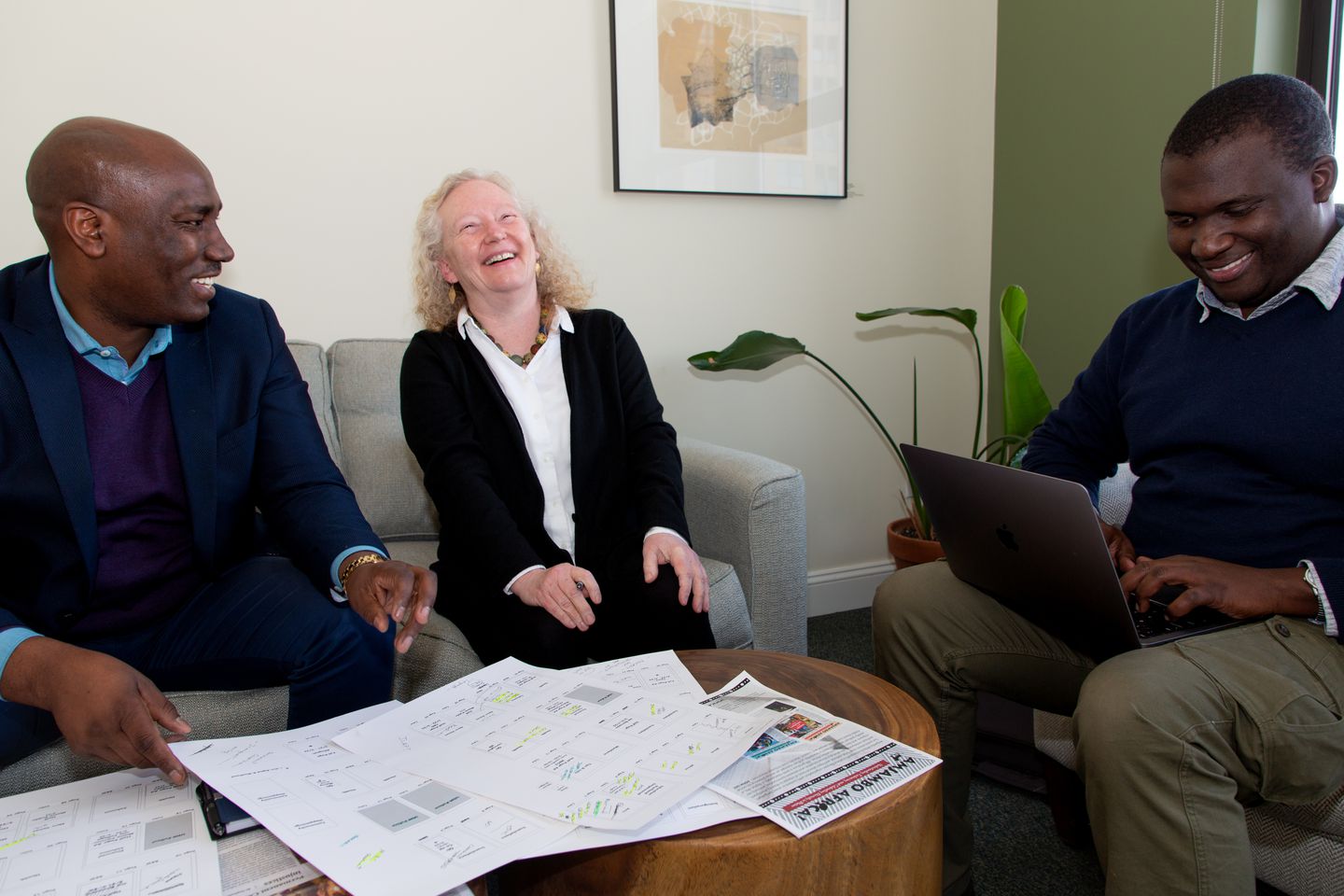
The Amjambo Africa! team: Georges Budagu Makoko, cofounder and publisher; Kit Harrison, cofounder and editor in chief; and Jean Damescène Hakuzimana, deputy editor and kinyarwanda translator [Bantu language]. They make use of a co-working space at the Greater Portland Immigrant Welcome Center.

When I edited a Boston Fed community-development magazine, we had several articles on the resettlement of Somalians in Lewiston, Maine. With some exceptions, Mainers welcomed the refugees because that part of the state had been losing population. But I also read that among the immigrants themselves, the Bantu had a hard time. Prejudices had carried over from Africa. Today’s story focuses on the Bantu community.

Thomas Farragher reports for the Boston Globe about an unusual partnership.

“She is the daughter of a celebrated Washington Post correspondent who wrote from New Delhi and Tokyo, seeking out truth and telling the essential stories of people’s lives. And so, Kit Harrison continues to nurture the journalistic flame. …

“It’s a passion shared, too, by Georges Budagu Makoko, who is the publisher of the newspaper that Harrison edits here called Amjambo Africa!

“It’s a free publication about the African diaspora and immigration. And it’s intended for the eyes of newcomers to Maine with this lofty goal: to build a community by spreading information about its readership throughout Maine.

” ‘We operate on chutzpah and brains and energy and teamwork,’ Harrison told me when I visited her offices here the other day. ‘I grew up abroad quite a bit with my journalist father. I also taught kids in the range of (kindergarten) through eighth grade and the focus for me was always international. … I was constantly trying to teach kids about what we all have in common around the world — and why we can live together peacefully if we try.’ …

Amjambo Africa! [chronicles] the efforts to curb hunger in Africa and the state of the forests of the Congo and the environmental challenges facing Burundian coffee farmers. There are stories about efforts underway in Nigeria, Kenya, and Uganda to address mental health issues — and another one about a center that helps kids in Nigeria with autism. …

“All of it done in seven languages: English, French, Kinyarwanda, Portuguese, Swahili, Somali, and Spanish. …

“Makoko first arrived in Maine in 2002 and thirsted for news about the Africa he had recently fled. He could find none. So, he set out to do something about it.

“ ‘When I came here,’ he told me the other day, ‘I didn’t speak English at the time. I had to take English classes. After that, I was hired by a nonprofit organization that develops housing.’

“The people for whom he provided housing wanted something else from him: help in navigating a bureaucracy without the language skills to do it.

“ ‘So I started thinking: “What can I do to help these people?” ‘ he said. … ‘They need information about how to find their way in the system.’

“Makoko had written a book, Ladder to the Moon. A Journey from the Congo to America.

“It told the story of a growing up in a beautiful peaceful village surrounded by family — a life upended during the genocide in Congo and Rwanda. …

“ ‘But then my book was not enough. I started thinking maybe we can come up with something that will regularly inform the immigrants about resources that are around here, but also the whole community as to why people are coming here and what’s happening where they are coming from.

“ ‘And that’s where the whole idea of the newspaper came from. I didn’t know how to do it. I didn’t know how to start a newspaper. I was thinking I have this idea. And I have zero background in journalism.’

“But Harrison did.

“And so a friendship and a critical collaboration and a partnership were forged.

“The first issue appeared on April 1, 2018, the product of a year’s worth of planning and answering critical questions: Who’s going to read it? Who’s going to advertise in it? How is this all going to work?

“ ‘You can’t print for free,’ Makoko said. ‘That’s an obvious cost that was there. We needed somebody to design the paper. Those are skills that we didn’t have. Kit was very good in writing and doing interviews and coming up with articles — but also translation. ‘You’ve got to understand that this newspaper is published in (multiple) languages.’

“All of that is a tall task. A monumental and important undertaking. And, yet, they have done it. It exists, telling stories about conflict in Ethiopia and about how to stay warm when Maine’s temperatures dip to dangerously low levels. …

“ ‘We’re about to celebrate our fifth anniversary,’ Harrison told me. ‘And we’ve grown. We’ve always been small and we still are. But within that smallness there’s been quite a lot of big reception and a lot of interest. We’re in it for the long haul. But it’s not easy. It’s very challenging to get the finances in place to do what we want to do, which is big stuff.’ …

“ ‘The word Amjambo — by the way — has meaning which you might want to know,’ Harrison said. “It means two things. It’s a greeting. But is also means W-O-R-D. Word.’ …

“ ‘You try to work for the common good, using whatever skills and attributes you happen to have,’ she said.”

More at the Globe, here. And at Amjambo Africa! here.

From a recent issue, you can read Bonnie Rukin’s article, for example. It’s on the Somali Bantu Community Association’s Liberation Farms in Lewiston, where farming skills have translated relatively easily from Africa to America.

“Two large building projects are planned for springtime at the farm – building a goat barn, and also a corn house for processing and storage. Local contractor Scott Doyon will oversee both projects. He has worked with the community before, on several projects. Good Shepherd Food Bank is supporting the goat barn; a State of Maine grant is funding the corn house. In addition, a new small commercial kitchen is going into the building that currently houses the farm stand. The space will allow community members to process produce grown at the farm.” More.

Read Full Post »

Photo: Garrett Houston.
Terrance Jackson came to Virginia’s Barter Theatre as an actor and now leads Barter’s Outreach and its Black Stories Black Voices initiative.

I have always loved August Wilson’s plays about the Black families in the Pittsburgh neighborhood where he grew up. I’ve seen most as many were tried out in Boston during Wilson’s lifetime. But there are other Black playwrights achieving success, and today’s article from American Theatre highlights efforts to help still more develop their skills.

Former Barter Theatre director Karen Sabo writes, “Barter Theatre in Virginia isn’t unique in their current position: It is a predominantly white institution that is currently attempting to better serve audiences and artists of color. But the innovative structure of Barter’s new Black Stories Black Voices program … could well serve as a national model for inclusive art-making that embraces and empowers Black communities at mainstream theatres.

“It may seem like a departure, but in some ways it’s also a continuation. When, 90 years ago, Robert Porterfield founded Barter in his rural, mostly white hometown of Abingdon, Va., in the midst of the Great Depression, he brought New York actors to this Appalachian agricultural area to match unemployed — and in some cases, underfed — actors with local farmers struggling to sell goods to people with little money. The price of admission was 40 cents, or an equivalent amount of produce, dairy, or livestock. ‘Porterfield and his partners accepted almost anything as payment,’ according to Encyclopedia Virginia. ‘A pig was worth 10 tickets, while two quarts of milk bought one ticket.’ …

“Full disclosure: I spent six years working as a director and resident actor at Barter in the early 2000s. My immersion in this organization gave me an appreciation for certain aspects of the institutional culture of this rural LORT [League of Resident Theatres] theatre. …

“During my tenure, Barter had an acting company made partly of out-of-towners — big-city pros who landed at Barter and stayed — alongside some home-grown artists. A few particularly talented local performers made their artistic home at Barter, and the Barter Players, the young, non-Equity company, produced many actors who eventually joined the resident acting company.

“While few would deny that the creation of regional theatres in the United States was a positive development, in their early days these organizations often operated with a kind of cultural imperialism, as they attempted to enlighten or elevate audiences by bringing work from the cities to ‘the provinces.’ In an attempt to better serve its Appalachian population, 20 years ago Barter started the Appalachian Festival of Plays and Playwrights. This encouraged writers to tell the stories of the unique region where Barter is located, and while some of these new plays featured characters who were Black, Indigenous, or people of color, they mostly told stories of the majority-white population of the Southern Appalachian Mountains.

“Just before the pandemic, Katy Brown became Barter’s new producing artistic director, only the fourth in the theatre’s 90-year history. Brown herself is a home-grown leader; I remember seeing her first performance 25 years ago with the Barter Players shortly after she finished college. Like many other predominantly white theatres, Barter has begun hiring more people of color, and producing more shows telling stories of Black Americans. They’ve also designated that at least one play in the yearly Appalachian Festival of Plays and Playwrights be written by a Black artist. But in the spirit of Barter’s culture of empowerment, honoring its region, and developing local artists, they’ve also created the program Black Stories Black Voices (BSBV).

“BSBV is the brainchild of collaborative thinking from many on the Barter leadership team. The first public performance under this new initiative was the 2022 Shine project last April 24, which featured professional actors reading new monologues submitted by Black residents of the counties surrounding Barter. …

“The Barter team wanted input from an authority regarding presenting more inclusive stories. They reached out to Dr. William H. Turner, a known expert on Black life in the South and Appalachia, and Turner suggested that rather than just focusing on producing Black plays, they help create Black playwrights.

“ ‘We wanted people who knew nothing about playwriting to get involved, so that’s where the story collection idea came from, and that came through Cathy,’ Brown said, referring to Barter’s resident playwright, Catherine Bush. Bush suggested asking local people to share stories and then hiring Black artists to help turn stories into monologues. At Shine, those monologues were performed by professional actors, and the Barter team intends the next steps to be turning monologues into scenes and eventually full-length plays.

“But to encourage the sharing of stories, Barter needed to strengthen their outreach and build relationships, especially with communities of color. Enter Terrance Jackson, a Florida native who initially came to Barter as an actor, and who now leads both Barter’s Outreach and Black Stories Black Voices.

“ ‘Our statement of intent is to provide a safe space for Black Appalachian artists to share their stories and showcase their work, while also fostering our Black community with a safe space to see theatrical work,’ said Jackson. … ‘I will be reaching out to different groups and different people, not just Black and brown people, but all types of people, and letting them know that they matter at our theatre, and that they have a place here.’ …

“Jackson summed up his experience with the project so far by saying, ‘Barter is a predominantly white institution still, and we are actively doing our best to, not necessarily to change that, but to make it equitable, and to build a space where all people feel comfortable to work and to see plays. We’re not done creating dope Black stuff — we’re just beginning. And hopefully we do work that really matters to Black folks in Appalachia, but also to the entire theatre world and theatre industry as a whole.’ ”

More at American Theatre, here. No firewall.
Read Full Post »

Photo: National Research and Restoration Center.
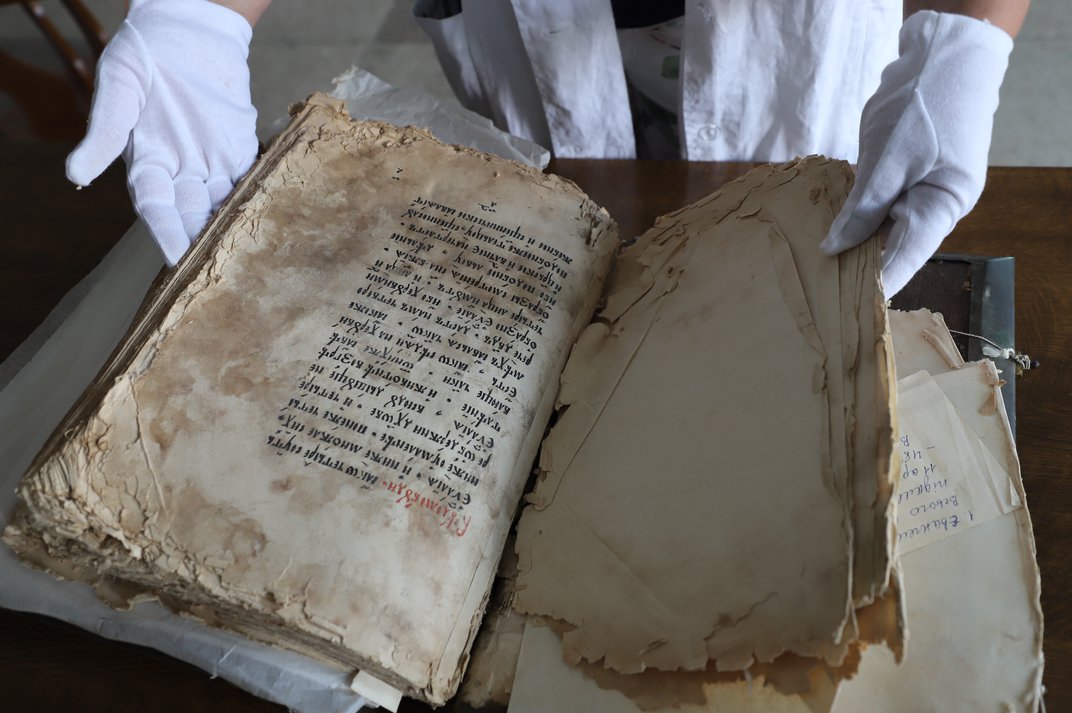
The location of Russia’s attacks, says Richard Kurin at Smithsonian magazine, suggest they target “sites that are significant to Ukrainian history, culture and identity.” (Above, although many items in storage were already in fragile condition, the conservation task is now more difficult.)

Today I have a couple articles about efforts to protect Ukrainian culture since the full-scale Russian invasion.

Richard Kurin writes at the Smithsonian, “Russian leader Vladimir Putin has wrongly made culture both a justification and an object of war with Ukraine. As in other regions of Europe, the population of the geographic region of modern Ukraine reflects a diversity of ethnic migrations and cultural influences, as well as a succession of political rulers and changing boundaries over millennia.

“Putin, though, claims that Ukrainians lack the history, culture and identity worthy of a national state separate from Russia. While drawing on periods of the czarist Russian Empire and the Soviet era to make his case, Putin denies crucial cultural realities.

“The Ukrainian language, the country’s art and its history — including the Slavic-Christian state centered in Kyiv a thousand years ago, the 19th-century flowering of Ukrainian culture and nationalism, the post-World War I Ukrainian republic, the Ukrainian independence movement of the early 1990s and its reaffirming Orange Revolution in 2004 and the Euromaidan Revolution in 2013-2014 — all represent an undeniable Ukrainian identity that is centuries in the making. …

“We take a close look at the ongoing work of hundreds of professionals across a landscape of Ukrainian and international organizations to defend endangered cultural heritage.

“Crucial investigations are underway that will one day provide an accounting of Russia’s devastating war crimes. These attacks are not just random, nor do they represent collateral damage. Rather, they suggest a targeted attack on Ukrainian history, culture and identity, a means toward Putin’s ends — the destruction is a deliberate attempt to obliterate Ukrainian history and culture.

“To support Putin’s wrongful argument that Ukraine doesn’t have a culture and history independent of Russia, his forces figure they can simply bomb away the country’s cultural heritage.

“To date, almost 1,600 cases of potential damage to Ukrainian cultural heritage sites have been documented, including some 700 monuments and memorials, and more than 200 museums, archives and libraries. Notably, more than 500 are religious sites — places of worship and cemeteries — with those of the Ukrainian Orthodox Church specifically targeted. The greatest number of cases are associated with regions of the most aggressive Russian attacks: Kyiv, Kharkiv, Mariupol and Luhansk. And the work of organizations, including the Smithsonian, mobilized thanks to years of cultural heritage training efforts, is aiding the country in its effort to protect artifacts, books, documents and artworks from these insidious attacks. …

“[In 2010], the Smithsonian formally established [Smithsonian Cultural Rescue Initiative or] SCRI under the direction of curator and former U.S. Army  ‘monuments woman‘ Cori Wegener. … As part of SCRI’s expanding research and training activities, [Ihor Poshyvailo, now director of the Maidan Museum in Kyiv] became first a trainee and then an instructor for the program and stayed in close contact with Wegener. …

“Last year, with the Russian invasion of Ukraine on February 24, the lab ramped up its efforts employing [satellites], including some with specialized sensors that can detect heat signatures to record ‘kinetic’ activity. That enables the monitoring of bombings, missile strikes, artillery shelling and fires. Using that data, the lab’s analysts are able to see how closely the heat signatures align with cultural sites. If proximate, they call up satellite photographic imagery to examine possible damage. Given satellite coverage, they can reference images over a period of time to pinpoint when the damage occurred and how extensive it is.” More at the Smithsonian, here. No firewall.
Meanwhile at CNN, there’s a great story about one woman’s quiet campaign to get US museums to relabel Ukrainian art misidentified as Russian.

For example: “Repin, a renowned 19th century painter who was born in what is now Ukraine, has been relabeled on the Met’s catalog as ‘Ukrainian, born Russian Empire’ with the start of each description of his works now reading, ‘Repin was born in the rural Ukrainian town of Chuhuiv (Chuguev) when it was part of the Russian Empire.’ …

“One of Repin’s lesser-known contemporaries, Kuindzhi was born in Mariupol in 1842 when the Ukrainian city was also part of the Russian Empire, his nationality has also been updated. The text for Kuindzhi’s ‘Red Sunset’ at the Met has been updated to include that ‘in March 2022, the Kuindzhi Art Museum in Mariupol, Ukraine, was destroyed in a Russian airstrike.’

“In reference to the recent relabeling process, the Met told CNN in a statement that the institution, ‘continually researches and examines objects in its collection in order to determine the most appropriate and accurate way to catalogue and present them. The cataloguing of these works has been updated following research conducted in collaboration with scholars in the field.’ …

“Semenik told CNN that she channeled her anger about the Russian invasion into her efforts to identify and promote Ukraine’s art heritage, using her Twitter account [Ukrainian Art History, or @ukr_arthistory] to showcase Ukrainian art to the world.

“Semenik is herself lucky to be alive. She was trapped in the Kyiv suburb of Bucha for weeks as Russian forces laid waste to the area last March, hiding out in the basement of a kindergarten before eventually walking some 12 miles to safety with her husband and their cat in tow.

“She began her campaign after a visit to Rutgers University in New Jersey last year. While helping curators there, she was surprised to see artists she always considered as Ukrainian labeled as Russian.”

So interesting! Read more here. No firewall.
Read Full Post »

Photo: Brocken Inaglory/Wikimedia.
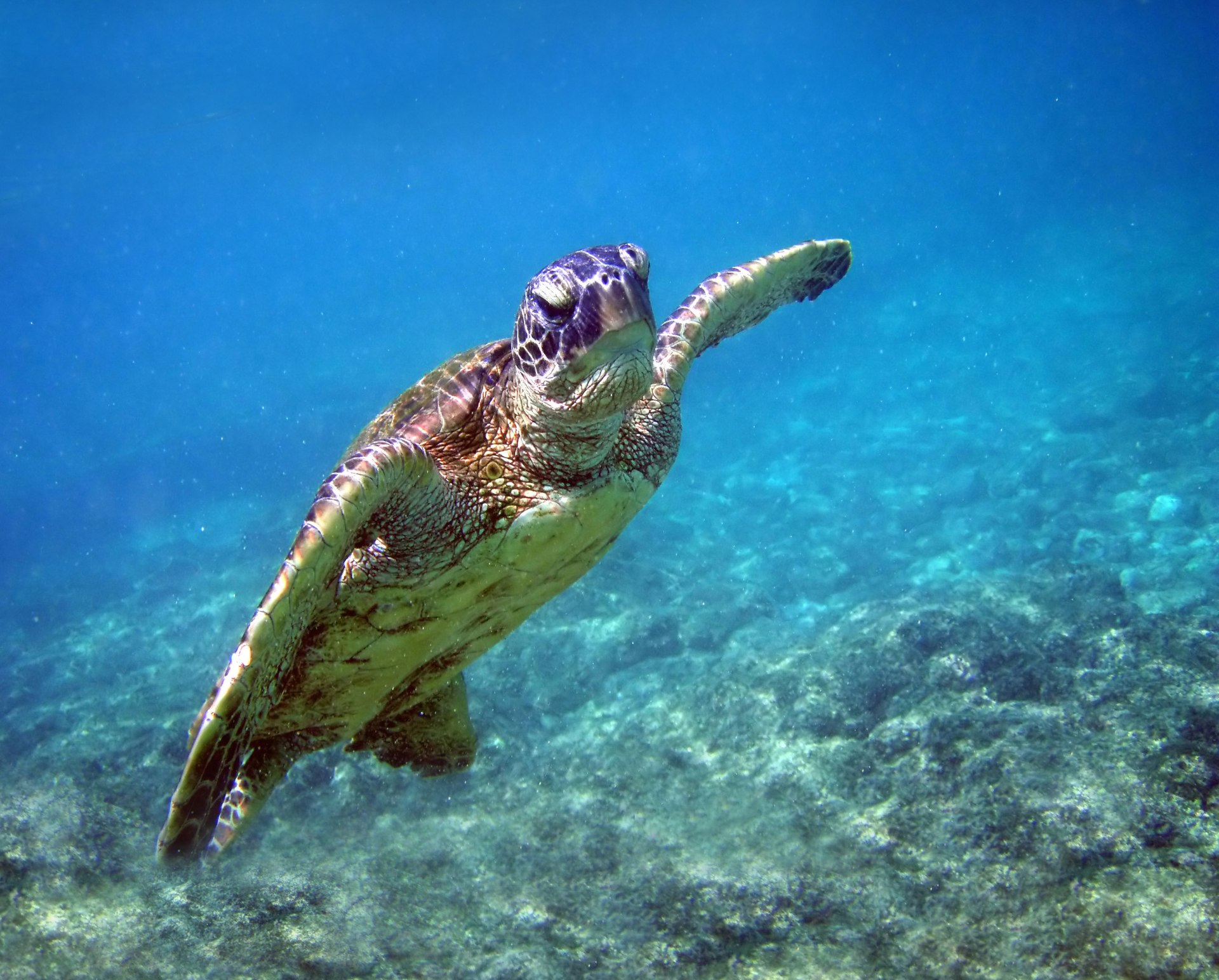
The green sea turtle above is in Hawaii. Others are in Florida, Egypt, and around the world. When threatened species like these get in trouble, they may receive care at a New York rehab center.

Americans are pretty good at volunteering, and there are so many ways to volunteer that everyone should be able to find something that suits them. I like assisting in English classes for immigrants. The volunteers in today’s story get involved with sea turtles under the guidance of scientists.

Dodai Stewart reports at the New York Times, “On a recent Thursday morning, Maxine Montello was at work making breakfast for 48 hungry diners.

“She had a stack of numbered plastic trays, and a clipboard with a list of corresponding menu orders. Methodically, she placed each tray on a scale, cut up pieces of frozen squid and cold raw herring and added them — including heads and tails — measuring just the right amount.

“Pills were hidden inside some of the fish, and Ms. Montello referred to notes about her customers. ‘Some of them don’t like the tails,’ she said. ‘And Number 7 doesn’t like the squid.’ …

“Ms. Montello is the rescue program director at the New York Marine Rescue Center in Riverhead, Long Island, a nonprofit organization stretched to its limits after receiving a record number of sick sea turtles in urgent need of aid this season. …

“The sea turtle swims under the radar. ‘Even people that might spend a fair amount of time on the water in the Northeast might never see a sea turtle,’ said Barbara Schroeder, the sea turtle coordinator for National Oceanic and Atmospheric Administration Fisheries. ‘But they do use Northeast waters extensively.’ …

“The rescue center mainly sees two types of sea turtles: green and Kemp’s ridley. Both varieties generally travel north in the summer and spend winters in warmer waters down south.

“The green sea turtle, a threatened species with a beautiful starburst pattern on its shell, can be found all over the world. The Atlantic Ocean population often nests in Florida and travels as far as Massachusetts in the summer. They live to about 70 years old, growing to three feet long and 350 pounds.

“The Kemp’s ridley sea turtle, a critically endangered species that nests in Mexico and eats crabs in the waters of New England and the Mid-Atlantic States, is smaller, growing to about 100 pounds.

“Once on the edge of being extinct, the Kemp’s ridley sea turtle has ‘a very positive conservation story,’ said Ms. Schroeder. Shrimp trawling and the killing of nesting turtles and their eggs at their very restricted nesting beaches had caused their numbers to plummet into the hundreds, but the Endangered Species Act, signed 50 years ago, has helped stabilize the population.

“Climate change has created new challenges to the turtles’ survival. Warming waters mean that ‘turtles and other species are expanding their normal territory,’ Ms. Montello explained. ‘So more and more turtles are going further north.’ Then, when cold weather arrives, often suddenly, the turtles are stranded. … Sea turtles are coldblooded, so when the water temperature drops, so does their body temperature. They become cold-stunned — similar to hypothermia — and go into a state of shock, washing up on beaches.

“The rescue center, founded in 1996, usually treats about 30 or 40 cold-stunned sea turtles during the winter. Ms. Montello has looked at records dating back to 1980, and said this year’s numbers are concerning. … ‘This year we had 95.’

“Of the 95 turtles found cold-stunned this season, 48 are still alive and in the care of the rescue center. The others were either dead when they washed up or perished soon after.

‘Their survival is dependent on how quickly they’re found,’ said Ms. Montello. …

“A lot is unknown about these creatures’ lives in the New York area, and much of the data comes from stranded turtles, not thriving ones. Ms. Montello’s research plans involve recording turtle behavior using customized video cameras that will be attached with suction cups to the backs of healthy turtles when they are released. …

“After the raw fish was loaded onto plastic trays, Victoria Gluck, a biologist on staff, carried a tray over to a turtle tank and doled out the meals with tongs, piece by piece, to the corresponding patients, whose numbers were written on their backs with nontoxic paint. Two volunteers, Britney Dowling and Cecilia Gonzalez, used nets to keep the other hungry turtles away as Ms. Gluck placed fish in front of each turtle, ensuring that they all got their allotted share; a turtle is supposed to eat 2 percent of its body weight a day.

“In the wild, sea turtles are solitary, so being in a tank alongside others in the rescue center makes some of the residents grumpy. On a whiteboard in the kitchen, the team had compiled a list of ‘tank bullies’: turtles known to push their tank mates or try to steal their food. …

“A veterinarian visits once a week, but otherwise the staff members — eight total, four full time and four part time, all women — and a small army of citizen scientists and volunteers are responsible for spotting cold-stunned turtles and helping them recuperate.” Read the rest of the story at the Times, here.

Read Full Post »

Photo: Dave Herasimtschuk, US Fish & Wildlife Service/Wikimedia.
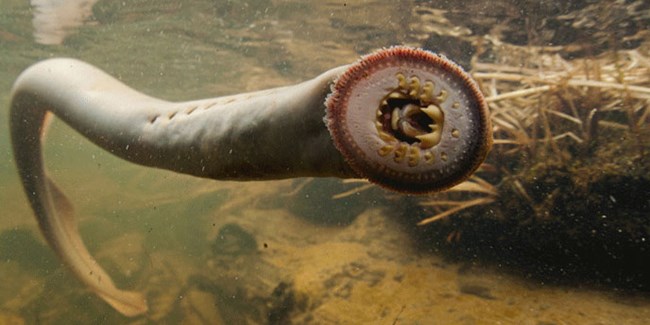
In Washington State, the Yakama Nation Fisheries crew routinely teams up to catch lamprey at an “eeling” hole that’s fed tribal members for generations. Lamprey use the suction of their oral discs to climb rocks at the eeling hole.

I like to explore social media and recently added Mastodon to the places I visit. At Mastodon, you have to join a group (what they call an instance), and I chose the Climate Justice instance. Being with Climate Justice has exposed me to people I haven’t followed before on social media. You won’t be surprised to learn that a topic like climate justice has attracted quite a few indigenous people. They are from all over the world: Sámi from the Nordic countries, Aborigine people from Australia, among others.

B. “Toastie” Oaster is one, a citizen of the Choctaw Nation in Oklahoma. From Toastie, I learned about a publication called High Country News and an article on the Pacific lamprey, an ugly fish with a long, important history.

“Lamprey have lived on Earth for 450 million years. To them, dinosaurs were a passing fad, and the North American continent is a fairly recent development. Lamprey swim out to sea as juveniles, looking for hosts like salmon to parasitize until they are mature enough to swim up some other river to spawn. Adult lamprey are calorie-dense and slow, protecting their hosts and cousins, the salmon, by acting as a predation buffer in another gesture of reciprocal care. 

“Though lamprey play a key role in Pacific watershed ecosystems, they remain understudied outside of tribal fisheries. They’re the target of misplaced disdain, in part because they’re easily confused with sea lamprey, an Atlantic species that caused ecological havoc in the Great Lakes after a 19th century shipping canal allowed them to invade. Pacific lamprey are a different species, in a different ecosystem; they belong here, just like the people they sustain.

“As far back as the memory archive reaches, people have fished for eels in this watershed. Lamprey climb wet rocks with their sucker mouths, so waterfalls are good places to catch them. Celilo Falls was a dangerous place for eeling, so people went to places like Willamette Falls, Celilo’s younger cousin. In its heyday, it was an international destination for summer eeling. Elders remember elders who remember trails that connected the falls to central Oregon. Camps lined both sides of the Willamette and the Clackamas River, which branches off below the falls. 

“Wewa [an elder and tribal councilman of the Confederated Tribes of Warm Springs] and other elders are clear that their ancestors were not nomads. Families returned to permanent homes, making seasonal trips to where food thrived. This non-European approach to agriculture ensures that both people and ecosystems flourish. In its healthy state, the Willamette Valley was a food-producing white oak savanna, bright blue in springtime with flowering carpets of delicious camas roots. That’s where it got its name: ‘Willamette’ is a French corruption of lámt, the Ichishkíin word for blue, Wewa said. ‘They ruined it.’

“For the millions of lamprey that returned from the ocean to spawn in the Willamette Valley, the first obstacle they faced was Willamette Falls. In the late 1800s, settler accounts described the 1,500-foot-long, four-story-high falls as ‘completely covered‘ in eels during the summer runs — three layers deep, in some places. Historical photos give an idea of how the rocks looked blanketed in eels, some latched onto each other’s backs, rendering the boulders as shaggy as mastodons. In the 1940s, European settlers commercially harvested as many as 500,000 lamprey a year, but tribal harvests until that point had kept the population in careful balance. …

“Since industrialization, lamprey numbers have dropped by 90%, largely because of dams. According to some Natives, public antipathy toward the species hasn’t helped. Willamette Falls is one of the last places where there are still enough lamprey to harvest. There, the Confederated Tribes of the Umatilla Indian Reservation, the Confederated Tribes of Warm Springs, the Confederated Tribes and Bands of the Yakama Nation and the Nez Perce Tribe — all of whom retain treaty fishing rights at Willamette Falls — boat upriver between industrial structures to harvest lamprey at the falls. These four tribes comprise the Columbia River Inter-Tribal Fish Commission (CRITFC), an organization that enforces treaty rights and promotes conservation of the basin’s aquatic life. Every year, CRITFC coordinates eeling trips with tribes.

“Eeling teams consist of at least two people: one to hold the net, the other to catch the eels. Plucking them off the rocks is easy enough with cotton work gloves, which provide the best traction against eels’ dolphin-smooth skin. …

“To work a waterfall, crews start at the bottom; eels will spook and stampede if they sense danger or smell blood in the current. Sometimes, eelers use this to their advantage, sticking a net or a trap at the downspout of a rockpool and scaring the eels into it from behind. When a dipnet is full, the crew transfer the catch eel by eel into burlap bags, then carry the pulsing, writhing sacks over the boulders to the boat. …

“While any tribal member can organize eeling trips, the fisheries department conducts its own trips to get eels for elders, those in need and ceremonial uses. The boat’s driver, a teddy-bear-faced man in his mid-50s with a bandanna tied over a loose knot of gray hair, lit a cigarette, apparently the only person unfazed by the cold or the early hour.

“ ‘All this is pretty tame to me,’ he laughed. He said he used to work ’30-hour days’ running a commercial salmon fishing operation at Lake Celilo, where Celilo Falls used to be. He reminisced about his glory days at Willamette Falls in the late ’80s and early ’90s, claiming, with a sly smile, that he caught so many eels, he’s probably the reason they’re in decline. Five thousand pounds in a day, he said. ‘I’ve been there, done that, 30 years ago, 40 years ago.’

“The boat driver is Evans Lewis Jr., a veteran fisherman now serving as the assistant manager of the Yakama Nation Fisheries’ sturgeon hatchery. … Lewis said he knows the best eeling holes from previous generations, where lamprey still gather by the thousands. He pointed out the best route along the boulders: Don’t hug the ridge, he said. Swing out in a wide arc, closer to the water line. He described techniques no one uses anymore: Drilling drainage holes in a metal trash can is easier, he said, than hauling gunny sacks of eels back across the rocks. ‘Nobody fishes like I do,’ Lewis told me and grinned.’ “

Toastie’s long, fascinating article is at High Country, here. You may read four High Country articles for free each month.

Read Full Post »

Photo: Natalie Alcoba.
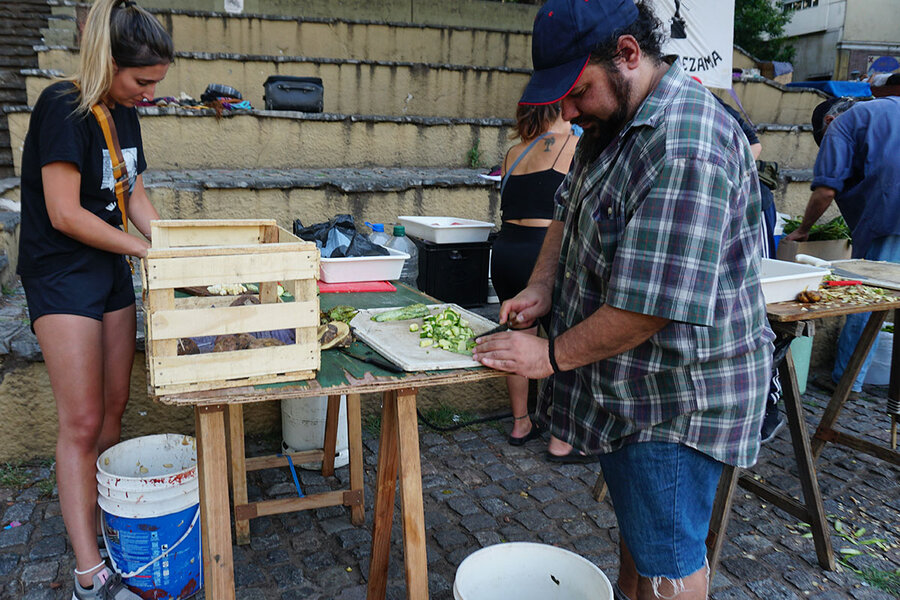
Gerardo Romero and Flor Yciz donate the gift of time to the nonprofit Parque Lezama Olla Popular, preparing
a meal they serve each week to those in need in Buenos Aires, Feb. 6, 2023.

One thing that struck my husband when he returned from over a year of working in China was that Americans do a lot of volunteering. His perception of China at that time was that the government did everything and that citizens didn’t often take it on themselves to help others less fortunate.

Christian Science Monitor reporter Erika Page notes that Argentinians, too, aren’t known for helping strangers, but that young people are leading the way in tough inflationary times.

“Every Tuesday evening,” she writes, “as streetlights flicker on in downtown Buenos Aires, a man named Charlie tidies a section of sidewalk, preparing for his visitors.

“Charlie lives on the street. The volunteers who regularly check in on him as part of their recorrida nocturna, or night route, are an emotional lifeline.

“The team of six sit with Charlie in a semi-circle on the pavement, offering juice, yerba mate, and conversation. They chat about the weather, current events, the neighbors, and when the laughter lulls, they ask Charlie about more immediate concerns, like his health, upcoming medical appointments, and how the police have been treating him.

“There are thousands of people like Charlie living on the streets across the capital, and 43% of the country’s population lives in poverty. It’s a reflection of the unrelenting economic crisis and sky-high inflation that’s enveloping this South American nation. Some 600 volunteers take part in these nightly visits organized by the nonprofit Fundación Sí, underscoring a growing movement of volunteers, fueled by young people, who are working to fill the void where government services and the labor market are falling short. 

“These volunteers may not be well off – or even interested in staying in Argentina long-term – but they offer whatever they can to lift their neighbors up: a hand, an ear, a meal, or simply some of their time. Argentina isn’t known for high rates of volunteerism, but recent data shows that’s changing.

A study published by Voices! Consultancy found that a record 36% of Argentines volunteered last year, including nearly 60% of people between 18 and 24 years old.

“Generosity of time and affection is generally reserved for family and close friends in Argentina, says Constanza Cilley, executive director of Voices! Consultancy. But, ‘there are significant increases [in volunteering] in times of greatest crisis,’ she says. …

“Last year, annual inflation reached 94.8%, sending food prices soaring, and making saving nearly impossible. Most young people no longer expect a higher standard of living than their parents in a country whose social mobility was once a point of national pride. That can cause internal conflict for those who want to do good here. …

“Emilia Maguire, a therapist, has considered emigrating for years, tired of the poverty she can no longer ignore – and which she sees as a reflection of distorted political and economic priorities. She recently joined Fundación Sí’s night routes.

“ ‘Sometimes I get home tired and distressed,’ says Ms. Maguire. ‘But when you connect with things like this that are gratifying, it’s easier to get by, because your focus shifts.’ …

“The Voices! study found a correlation between volunteering and general satisfaction. Some 23% of respondents who said they volunteered last year indicated Argentina as the best place for them to live, compared to only 14% of non-volunteers.

“The group got their start in 2018 with close to nothing, as the value of the Argentine peso began to plummet once again. They’ve since acquired a gas stove and donations from businesses and farmer’s collectives. They invite those who come to eat to help cook as part of the team. …

“ ‘The crisis itself pushes people together, uniting in empathy,’ says Carmela Pavesi, an organizer in her mid-20s. ‘You don’t need a lot of money or a lot of things,’ she says. ‘With the people you have nearby, wherever you are, you can do something with what you have.’ …

“ ‘Today there are more people living on the streets, more people in need, more people begging for money or help,’ says Eduardo Donza, a researcher with the Social Debt Observatory at the Universidad Católica de Argentina.

“The country’s poverty is structural and historic, says Mr. Donza, in large part due to a precarious labor market. Only 35% of the population works in the formal private sector, another 15% in the public sector, leaving half the population doing informal work. …

“ ‘If we don’t generate more wealth, if we can’t create more good jobs, we’re never going to come out of this,’ he says. Volunteering can’t solve these wider issues on its own. ‘But it seems to me like solidarity has increased. That willingness to help matters.’ “

More at the Monitor, here. No firewall.
Read Full Post »

« Newer Posts - Older Posts »