Feeds:
Posts
Comments

Art: Liu Xiaodong
“Thank you 2020.4.9” (2020), watercolor on paper, at New York City’s Lisson Gallery.

People from around the world often perceive New Yorkers as brash, rude. But if you have spent any time in the city, you know there’s another side, a side that is helpful and kind, that will drop everything to give a stranger detailed directions to the Empire State Building or a place to buy the freshest lychee nuts.

During the height of the pandemic, artist Liu Xiaodong seems to have seen the generosity, humanity, and vulnerability of New Yorkers and to have captured it in his watercolors.

John Yau writes at Hyperallergic, “Charles Baudelaire said in his 1863 essay that the ‘painter of modern life’ is the ‘passionate observer’ who can be ‘away from home and yet […] feel at home anywhere.’

“Among contemporary artists, the Chinese observational painter Liu Xiaodong is the closest embodiment of Baudelaire’s ideal that I know. For years, he has been, in the words of Baudelaire, an ‘independent, intense, and impartial spirit’ who observes the ‘ebb and flow’ of the world around him. This has led him to set up a temporary studio near an orphanage in Greenland and one among Uyghur jade miners in China’s harsh northwest. …

“In 1978, when Liu was 15, his family sent him to live with his uncle, who had studied Western painting at the Jilin Academy of Fine Arts and had gone on to become the art editor of a magazine. His uncle taught him watercolor, and showed him the books he had about English watercolors, European oil painting, and the Peredvizhniki, a group of late 19th-century Russian realists who believed that Russia and its people possessed an inner beauty.

“The date of 1978 is significant: it is two years after the death of Mao Zedong, the end of the Cultural Revolution, and the Tangshan earthquake, which devastated the region where he and his family lived. Born in 1963, Liu belongs to a generation that has both witnessed and been directly affected by the convulsive social, political, and economic changes that China has undergone during Mao’s lifetime, and since his death. …

“His instinct to respond to what is directly in front of him with whatever medium he has on hand endows his views with an unrivaled propinquity. He is, to cite Baudelaire, at the very center of the world he is depicting, and unseen by it. …

“[A recent exhibition provided] a visual and written record of a specific area of Manhattan, determined by what he can walk to.

Liu made his watercolors during an extreme period in New York’s history, starting with the empty streets during the first months of the COVID-19 quarantine, and including the Black Lives Matter protests and demonstrations in response to the video-recorded murder of George Floyd.

“Even in this acute moment in our history, he is able to slow down his looking to find and celebrate the beauty of human determination, as well as recognize feelings of wariness and displacement. …

“The watercolor ‘Kitchen Paper cannot be flushed down the Toilet, right, 2020’ [is] a wonderful tonal view of a roll of paper towels resting on a toilet tank, a quick yet careful placing of pale yellows, blues, off whites, and grays. …

“[But] the range of subjects and views underscores a person who is remarkably open to the world, from a blooming tree, to children’s toys left at a park, to an evening view of the top of the Empire State Building, seen between two buildings, to a homeless man’s legs sticking out of a doorway. … You never get the feeling that he is looking for something; there is no hierarchy to what he chooses. …

“As Manhattan transitioned from the largely empty streets of the quarantine to demonstrations and large groups of police, Liu kept looking, kept going out, and kept making watercolors and taking photographs, to work on later.  His attention to detail, to the color and light, is masterful and precise. … The merging of mark and color, and his sensitivity to light and dark, feel effortless, though we know they are not. This is Liu’s genius; there are no signs of hesitation in his work.

“In Liu’s watercolors and painted-over photographs, the viewer encounters scenes in which hand, eye, and intelligence work in astonishing tandem. … We are the lucky beneficiaries of a vision at once candid and sophisticated, open and sincere, witty and compassionate — an unlikely combination in this dark, nerve-fraying, and isolating period in history.”

To see an array of Liu Xiaodong’s New York paintings, go to Hyperallergic, here. And fall in love with that city all over again.
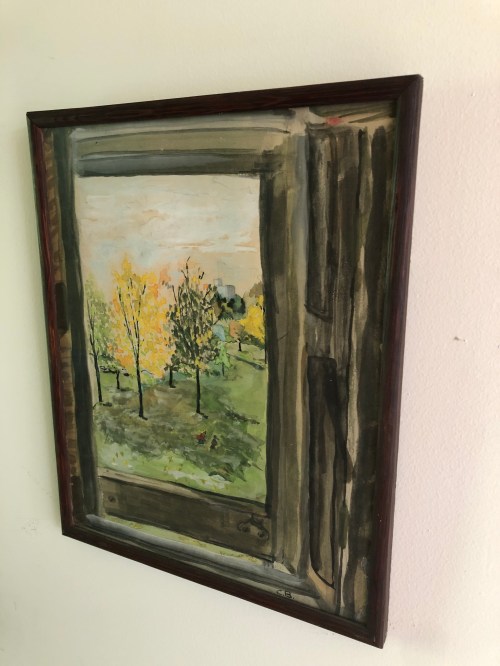
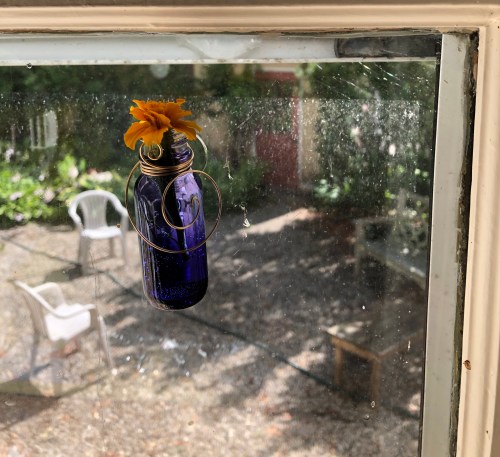
Photo: via Good Morning America
Michelle Brenner, pictured here in an undated handout photo, has been dubbed the “Lasagna Lady” in Gig Harbor, Wash., for making her grandmother’s lasagna and donating it to first responders, laid-off neighbors, and others.

Isn’t lasagna one of the all-time most American comfort foods? It’s the kind of thing you deliver to someone who has just had a death in the family. It has pretty much all the food groups, too.

This is a story about a woman who really loves baking lasagna and decided to use her stimulus check to feed people after she was laid off.

As Cathy Free reported at the Washington Post in June, “After Michelle Brenner was furloughed from her job at a menswear store in Gig Harbor, Wash., because of the novel coronavirus pandemic, she turned to comfort-food therapy.

“Brenner, 45, made herself a huge pan of lasagna using her grandmother’s recipe. Then, in a moment of pride after shopping for groceries (including frozen lasagna) for some of her neighbors, she got on her community Facebook page and wrote that frozen, store-bought lasagna could not compare to the real Italian homemade deal. …

“ ‘If any of you want some fresh homemade, no calorie counting lasagna, please let me know and I will gladly prepare it,’ she wrote. Brenner set aside her $1,200 stimulus check to buy ingredients, and the requests soon began to trickle in. [Soon] so many people started showing up, including strangers, that Brenner lost track. …

“Nearly three months and 1,200 pans later … about eight hours a day, seven days a week, she helps feed people in her community — from hospital workers and first responders to single parents struggling without paychecks. …

“Initially, Brenner set up a pantry in her front yard where people could pick up an assembled lasagna and bake it at home.

“But when the requests began multiplying faster than she could restock her refrigerator with ground beef and cheese, the president of the Gig Harbor Sportsman’s Club offered the clubhouse kitchen for her project.

“ ‘We saw what a great thing she was doing, and we have this nice commercial kitchen that wasn’t being used because of Covid,’ said [the] club’s president. …

“After Brenner used her stimulus check to buy lasagna ingredients for her first 60 giveaways, she decided to start a Facebook fundraiser that quickly netted more than $10,000 — enough for more than 500 pans. Then people began donating what they could — from $1 to $100 — when they picked up their orders.

“ ‘When word got out on social media, people from all over the world started donating to my cause,’ said Brenner, who is single and moved to Gig Harbor from Port Orchard, Wash., six years ago.

“People have contributed more than $22,000 so far, and she said she hopes ‘to be making lasagna for many months to come. … It’s a pan of love,’ said Brenner, who has been living on unemployment assistance since she was furloughed. ‘A lot of the people I make lasagna for have lost their jobs,.’ …

“When she initially started filling her grocery cart with lasagna ingredients, other shoppers sometimes raised their eyebrows as she was clearing store shelves of lasagna noodles and canned tomatoes, she said.

“Then a neighbor dropped off a specially designed T-shirt at her house one day that read, ‘Lasagna Lady.’ The name stuck like wet noodles flung on a wall.

“ ‘Now when people see me loading up, they know that I’m not hoarding,’ she said. ‘And when there’s a shortage of something, like ground beef or pasta, all I have to do is put the word out and somebody will find it for me in another county.’

“She expects to return to work at some point this summer but said she’ll still make time for lasagna.”

More here.

Photo: CNN
Eugene, Oregon, a town of 170,000, replaced some cops with medics and mental health workers. It’s worked for more than 30 years.

Often when society wants to find a better way of doing something, it’s possible to find a model with a track record showing what works and what doesn’t. Consider this non-police response to crises.

Scottie Andrew writes at CNN, “Around 30 years ago, a town in Oregon retrofitted an old van, staffed it with young medics and mental health counselors and sent them out to respond to the kinds of 911 calls that wouldn’t necessarily require police intervention.

“In the town of 172,000, they were the first responders for mental health crises, homelessness, substance abuse, threats of suicide — the problems for which there are no easy fixes. The problems that, in the hands of police, have often turned violent. Today, the program, called CAHOOTS, has three vans, more than double the number of staffers and the attention of a country in crisis.

CAHOOTS is already doing what police reform advocates say is necessary to fundamentally change the US criminal justice system — pass off some responsibilities to unarmed civilians.

“Cities much larger and more diverse than Eugene have asked CAHOOTS staff to help them build their own version of the program. CAHOOTS wouldn’t work everywhere, at least not in the form it exists in in Eugene. But it’s a template for what it’s like to live in a city with limited police.

“CAHOOTS comes from White Bird Clinic, a social services center that’s operated in Eugene since the late 1960s. It was the brainchild of some counterculture activists who’d felt the hole where a community health center should be. And in 1989, after 20 years of earning the community’s trust, CAHOOTS was created.

“It stands for Crisis Assistance Helping Out on the Streets and cheekily refers to the relationship between the community health center that started it and the Eugene Police Department. …

“Said David Zeiss, the program’s co-founder, ‘We knew that we were good at it, [and] we knew it was something of value to a lot of people … we needed to be known and used by other agencies that commonly encounter crisis situation.’

“It works this way: 911 dispatchers filter calls they receive — if they’re violent or criminal, they’re sent to police. If they’re within CAHOOTS’ purview, the van-bound staff will take the call. … It always paired one medic, usually a nurse or EMT, with a crisis responder trained in behavioral health. That holistic approach is core to its model. …

“White Bird’s counterculture roots ran deep — the clinic used to fundraise at Grateful Dead concerts in the West, where volunteer medics would treat Deadheads — so the pairing between police and the clinic wasn’t an immediately fruitful one. There was ‘mutual mistrust’ between them, said Zeiss. … ‘It was an obstacle we had to overcome.’

“And for the most part, both groups have: Eugene Police Chief Chris Skinner called theirs a ‘symbiotic relationship’ that better serves some residents of Eugene:  ‘When they show up, they have better success than police officers do.’ …

“Police encounters with the homeless often end in citations or arrests. Of homeless people with mental health conditions, anywhere from 62.0% to 90% of them will be arrested, per one journal review of homelessness studies. They may end up in jail, not in treatment or housing, and thus begins the cycle of incarceration that doesn’t benefit either party. …

“Most of CAHOOTS’ clients are homeless, and just under a third of them have severe mental illnesses. It’s a weight off the shoulders of police, Skinner said.

” ‘I believe it’s time for law enforcement to quit being a catch-base for everything our community and society needs,’ Skinner said. ‘We need to get law enforcement professionals back to doing the core mission of protecting communities and enforcing the law, and then match resources with other services like behavioral health.’ …

“June Fothergill, a pastor at a Springfield church, [calls] CAHOOTS to pick up the homeless people or people with substance use issues that stop by for free meals.

“Fothergill said while CAHOOTS does its part well — providing immediate services to someone in crisis — there’s still a void when it comes to long-term solutions.

” ‘You can call someone for the crisis, but what are they supposed to do for it?’ …

“They’re better equipped than police to care for the people she serves, she said. But if there isn’t space in affordable housing, Eugene’s detoxing center or mental health facilities, those clients will turn into regulars.’They’re doing what they can do,’ she said. ‘There’s wonderful work going on, but it isn’t adequate at the moment.’ …

“Advocates for limiting the role of police have pointed to Eugene as an example of social service providers and law enforcement working in harmony. But a growing group of dissenters feel there’s little room for police in the movement to fundamentally change the American criminal justice system. Services like CAHOOTS, they say, may function better and more broadly without the assistance of police. Zeiss isn’t sure he agrees.

” ‘Partnership with police has always been essential to our model,’ he said. ‘A CAHOOTS-like program without a close relationship with police would be very different from anything we’ve done. I don’t have a coherent vision of a society that has no police force.’ ”

More at CNN, here.

Photo: Jason Hosking
The kākāpō parrots in New Zealand were suffering from a frequently fatal respiratory disease and needed several months of treatment before being returned to the wild.

There’s a lot of dark news in today’s headlines. I won’t get into it. Looking for a little something positive, I learned about a fat parrot that is no longer on the brink of extinction, thanks to people who are focused on doing good. Such people actually exist, you know.

Kate Evans writes at the Guardian, “Growing up in the north of England, Dr James Chatterton was enthralled by the books of the pioneering zookeeper and conservationist Gerald Durrell and dreamed of saving endangered species. Now, on the other side of the world, Chatterton has done just that, helping to bring the world’s fattest parrot back from the brink.

“Chatterton and his team spent the best part of a year [testing] new treatments on the frontline of a killer disease afflicting New Zealand’s kākāpō. … The respiratory disease aspergillosis began to spread through the endangered kākāpō population [in April 2019], threatening to reverse the gains of the bird’s most successful breeding season in living memory.

“Kākāpo are not just rare, they are also deeply weird: flightless, nocturnal, with fragrant feathers and a comical waddling run. Males ‘boom’ to attract females, and they only breed every three to six years when the native rimu trees [produce] large numbers of seeds. …

“By the end of the southern hemisphere’s summer in February, thanks to intensive intervention by New Zealand’s Department of Conservation (DOC) Kākāpō Recovery Programme, the population of 147 kākāpō had produced more than 80 chicks – a record number. …

“Then one of the chicks died suddenly. It was found to have aspergillosis, a brutal infection in which lumps of fungus form in the birds’ lungs and slowly choke them to death.

“ ‘It’s hard to diagnose, extremely hard to treat, and usually fatal, particularly in wild birds. You usually just find them dead,’ says Chatterton, [manager of veterinary services at Auckland Zoo’s New Zealand Centre for Conservation Medicine]. …

“With aspergillosis, by the time a wild bird begins to display symptoms – or anything unusual shows up in blood tests – it is usually too late to save them. The only way to diagnose the disease in time is using a CT scan or endoscopy to spot fungal growths in the lungs.

“The vets and DOC scientists began mapping which kākāpō had shared a nest with the sick birds and which had been on the same food run. [‘Ahoy! Note the importance of contact tracing,’ says Suzanne and John’s Mom!]

“The 12 deemed at highest risk were evacuated from their home, Codfish Island/Whenua Hou, and taken by helicopter to Auckland. Unfortunately, the city’s veterinary CT scanner was being replaced and was out of action for a crucial five weeks, so the vets took the kākāpō to one of the city’s human hospitals. Though they appeared completely healthy, all 12 were found to have lesions on their lungs.

“That was a stomach-dropping moment, says kākāpō scientist Andrew Digby, who was based on Whenua Hou at the time. …

“Aspergillosis can be treated with oral anti-fungal drugs if you catch it early enough. ‘It’s worked really well with other parrots, but each new species you try needs a different dose,’ says Chatterton. ‘We had birds dying, so we went with a high dose, but worried that in saving some we might kill some.’

“To get the drugs into the birds’ air sacs, the vets also needed to use a nebuliser. Kākāpō may be the world’s fattest parrot, but their airways are still too small for the droplets produced by an adult human nebuliser, so Chatterton tried a paediatric one. It worked – but New Zealand is a small country, and initially only two were available. …

“Volunteer vets arrived to help from around the world. Extra pens were built to house the birds. People brought in sheets and duvets from home to cover the floors, and these had to be washed every day. [People! What does this remind you of?] Others went to the city’s regional parks to gather armfuls of the native plants kākāpō like to eat. Chatterton worked every day for five weeks. …

“Many birds needed months of daily care, but the outbreak was contained. Chicks became juveniles, and while a few died from other causes, most survived and are now counted in the population number: 211, up from just 123 when Chatterton arrived in New Zealand seven years ago. …

” ‘The only chance these endangered species have is if we all work together,’ Chatterton says.”

Amen.

More.

Photo: Morgan Hornsby
Elk on view at the Salato Wildlife Center. Kentucky is reintroducing elk where coal mines are no longer operating.

It’s interesting to me that when people compare the economic benefits of, say, working in the coal business with working in the elk-tourism business, they don’t routinely include the economic benefits of things like better health. High unemployment is a serious concern, but I do know that miners routinely got black lung disease and that there were pollution dangers to their families.

The story that made me think about this was by Oliver Whang at the New York Times.

“On a bright morning early this spring, David Ledford sat in his silver pickup at the end of a three-lane bridge spanning a deep gorge in southeast Kentucky.

“The bridge, which forks off U.S. 119, … spills out onto Mr. Ledford’s 12,000-acre property, which he and his business partner, Frank Allen, are developing into a nonprofit nature reserve called Boone’s Ridge. ..

“When Boone’s Ridge opens in 2022, it will offer a museum and opportunities for bird-watching and animal spotting. Two independent consultants have estimated that it could draw more than 1 million annual visitors and add over $150 million per year to the regional economy. This is in Bell County, in rural Appalachia, which has a poverty rate of 38 percent and an average household income of just under $25,000, making it one of the poorest counties in the United States.

The decline of the coal industry created a multibillion-dollar hole in the economy and left hundreds of thousands of acres of scarred land. But it has also created opportunities.

“Boone’s Ridge is being established on reclaimed mine land, and one of its biggest selling points is a big animal that has only recently returned to Kentucky: elk.

“When Daniel Boone wandered through the Cumberland Gap and into Kentucky in the late 1700s, the state was filled with wildlife. … But in less than a century, land development and hunting decimated or eliminated buffalo, turkey, whitetail deer, river otters, bald eagles, quail and other animals. Elk — their presence enshrined in place-names like Elk River and Elkhorn City — were among the first to go. …

“In 1944, the Kentucky Department of Fish and Wildlife Resources was established and charged with reintroducing animals of all kinds and regulating their numbers for hunting and conservation. Whitetail deer, which numbered fewer than 1,000 after the Depression, now number more than 1 million and generate $550 million in state revenue from hunting licenses, tourism and the sale of rifles and other hunting-related paraphernalia. …

“With most of the region’s threatened game restored, attention turned to restoring other species, among them elk. In 1997, the Rocky Mountain Elk Foundation, an association of hunters, offered to fund a multimillion-dollar six-year plan to airlift more than 1,500 elk to Kentucky from the western United States. …

“The plan was popular; more than 90 percent of state residents supported it. There was only one problem: Each elk eats over 40 pounds of vegetation a day, and the grassland habitats of western Kentucky, where the animals were populous in pre-settlement times, had all been developed. Farm owners did not want half-ton animals destroying their crops,. …

“But in the eastern half, where craggy mountains had previously prevented elk population growth, hunters and conservationists were presented with a remedy to this problem: abandoned coal mines. …

“Unregulated, the environmental effects of mountaintop removal-mining can be devastating and lasting. … But when reclaimed correctly, the landscape can offer opportunities for different kinds of land use, including cattle farming, housing developments and sites for tourism. …

“In 1997, a year before the bridge leading to Mr. Ledford’s land was constructed, 4,000 people gathered on the grassy slope of a reclaimed mine in Perry County as Governor Patton threw open the doors of a trailer and an elk stepped foot on Kentucky land for the first time in more than 150 years. …

“Absent any real predators, the animal’s population has exploded: The state is now home to 13,000 elk and counting, all clustered in the 16 counties of coal country. …

The economic impact is tangible. The state now issues a couple hundred tags for elk hunting each year, and a small market has developed — elk sightseeing tours, elk hunting guides — that adds about $5 million to local economies, according to the state fish and wildlife department.

“The elk industry will not come close to replacing what was lost when coal left, but ‘coal business will not be back,’ said Rodney Gardner, a naturalist at Jenny Wiley State Resort Park in Floyd County.” Read more here.

Now I want to know what Steven Stoll, author of Ramp Hollow: The Ordeal of Appalachia, thinks about all this. Through his book, I was made aware for the first time that when conservation efforts preclude subsistence farming, families often suffer.

Photo: Letters Against Isolation
The Patel sisters from Boston founded Letters Against Isolation, an organization that has sent thousands of cards to seniors during the coronavirus pandemic.

I always liked writing letters as a kid. I think I was about 8 when I made a big push for my friends to send me letters or postcards when I was away over the summer. I liked receiving them and I liked writing back. I still have a great letter from Patsy about seeing a dead rabbit in the orchard. “It was squooshed!” she wrote. But Joan’s parents thought it would be too expensive for her to keep sending postcards. (At the time, postcards were 2 cents.)

Recently I got an unexpected treat — letters from both of John’s kids, ages 10 and 7. Then there’s my niece Barbara. She began writing letters when she was about 10 and holds the record as the most prolific letter-writing kid I have ever known. Today, having passed age 50, Barbara writes long, newsy emails.

Here’s a story about sisters who have managed to sustain a generous letter-writing campaign … with a little help from strangers.

Emily Giambalvo wrote at the Washington Post in June, “Shreya and Saffron Patel usually FaceTime their grandparents in England every weekend, but during the novel coronavirus pandemic, they have typically reached out each day. Their grandmother on their mom’s side hasn’t left her apartment in nearly four months. She lives alone and can no longer socialize at the gym. Some of her younger friends have stopped by, and she leans out her kitchen window to chat. One friend sends handwritten letters.

“When the Patel sisters, who live in Boston, spoke to their grandmother, they noticed her mood improve. She texted them about the cards and showed them to her teenage granddaughters during their video calls.

‘We wanted to share that joy she was feeling with other seniors,’ said Saffron, a 16-year-old who recently finished 10th grade.

“They started Letters Against Isolation in early April with a plan to send cards to seniors at care centers, where residents have lost in-person contact with their family and friends because of the coronavirus. Shreya, 18, who will begin her freshman year at Washington University in St. Louis this fall, reached out to a few local nursing homes, expecting maybe one to respond and ask for 10 cards. Instead, several agreed and hoped to receive a combined 200 cards.

“ ‘We can’t do that on our own,’ Shreya said. ‘We can’t do that on our kitchen table.’

“The sisters reached out to others asking for help.” More at the Post.

Lauren Daley continued the story in July at the Boston Globe: “The response was massive. Overwhelmed, they put out a call for volunteers on Reddit, Facebook, and All For Good. It grew like wildfire. …

“One nursing home staffer says ‘everywhere she looks, she can see the letters and cards stuck up on [residents’] walls,’ says Saffron.

“Post-pandemic, the Patels have no plans to stop. ‘This pandemic has made us aware that senior loneliness is a massive problem — it’s not going away, and it was here before the pandemic started,’ says Saffron.” More at the Globe.

Photo: ICA
The Institute of Contemporary Art’s Watershed building is in East Boston, one of the communities hit hardest by Covid-19. In April, the ICA decided the most important thing it could do would be to provide food to neighbors in need. (Art projects for families get included in the bundles.)

Some artists seem more alert to human needs than the rest of us. That’s something my mother noted after my father had a debilitating stroke in his 40s. The painter friend and the poet friend seemed to more moved by what happened, more empathetic, than many others.

Certainly, in the current pandemic, we’ve seen people in the arts stepping up to offer all kinds of help. Here’s an example.

Grace Griffin reported for the Boston Globe in April, “With its galleries closed to the public, the Institute of Contemporary Art is using its Watershed outpost to feed families in need. … The nonprofit enlisted its catering company, The Catered Affair, to help with a donation drive.

“The ICA also recruited new donors to fund the project. The monthlong drive — launched in partnership with East Boston Neighborhood Health Center, East Boston Social Centers, Maverick Landing Community Services, Eastie Farm, Orient Heights Housing Development, and Crossroads Family Center — distributes family-size boxes filled with fresh produce and dairy products. …

“ ‘We know this is just a drop in the bucket of need,’ said ICA director Jill Medvedow. ‘We are pleased to help in this small way.’ ” More.

Then in late May, Andrea Shea followed up with a story at WBUR radio.

“Now the museum, its catering company and partnering community organizations in East Boston are extending their food distribution program through Sept. 3.

“ ‘What we learned in April … how hard hit East Boston residents are by COVID,’ ICA director Jill Medvedow said Friday.

The struggle to feed families is ongoing, and Medvedow said it highlights life-threatening disparities the largely immigrant East Boston community faces.

“ ‘Not having the nutrition that contributes to one’s health, to one’s ability to take care of your family, to that sense of dignity that everyone deserves,’ Medvedow said. …

” ‘I see this heroism around me,’ Medvedow said, ‘and I feel very lucky to help facilitate this. That’s my role.’

“About four years ago, when Medvedow and her staff embarked on transforming the 15,000 square-foot condemned building into satellite space for the ICA, they were dedicated to building relationships with the people who live there. ‘I never thought then that this would be the way in which we would demonstrate that the arts and the ICA would be a resource in this Boston community,’ she said, ‘But it is.’

“The food boxes also carry on the ICA’s mission to share art. Each one includes a creative project for families isolated at home. Medvedow said the museum is currently in talks with artists about commissioning new activities designed for both solace and stimulation. …

“Initially the effort’s funding was seeded with unsolicited anonymous donations. Now the ICA is funding the food distribution project and welcomes any additional support. …

“By the end of summer the ICA’s Watershed estimates it will provide more than 2,000 boxes of eggs, butter, fresh vegetables and fruit to East Boston families.” More.

Photo: Carol and Brian Smith/Educational Passages
Brian Smith posed with a boat made from a kit at a Massachusetts school. He and his wife found it after it washed ashore on Dalyellup Beach in Australia.

How’s this for a school project? Following a boat you built as it braves the high seas for science.

Steve Annear (who in my opinion gets all the fun assignments at the Boston Globe) reported on the excitement of hearing that the first of several such research boats was found after more than a year.

“After spending 463 days on the unforgiving ocean, the ‘Sacred Heart Star of the Sea’ made its final landing on the shores of Western Australia late last month, plucked from the sand by an unsuspecting couple out for a sunset stroll.

“It was a long and closely watched voyage that began in the classrooms of the Sacred Heart School in Kingston last year, where students assembled the small ship as part of a class project before it was packed with a GPS monitoring system and a weighted keel, and [taken to a launch site] in the Indian Ocean with dozens of personal letters to whomever might discover it one day.

“Now, that day has come. And at its new home on the other side of the planet, the miniature research vessel is being heralded as something of a small-town hero, paraded around to schools and local offices as residents marvel at it.

” ‘This boat is a popular chat topic,’ said William Power, a geoscientist in Australia who had been tracking the boat’s final movements toward land, in an e-mail.

“On July 2, officials from Bunbury posted on Facebook about the vessel’s arrival at a beach in Dalyellup, a southern suburb.

“Though a search party led by Power had scoured the beach a few days earlier, hoping to find the mini-boat, it was Carol and Brian Smith who happened upon the ‘Star of the Sea’ first. …

“Carol Smith said in an e-mail, ‘What caught our attention was the sticker that said, “If found please e-mail” … We didn’t know at the time but groups were looking for the mini-boat.’

“The couple strapped it to their roof rack and took it home. After doing research, they learned the boat was part of an educational mission by students in Kingston, some 10,000 miles away.

The boat was put together by students at the Catholic school in January last year, led by Maine-based Educational Passages, a nonprofit that supplies students with kits to construct the ships, send them out to sea, and track them online. …

“When the 5½-foot boat eventually landed in Australia, its sail and mast were gone, and it was covered in barnacles, Smith said, a sure signs of an arduous journey that lasted more than a year. But the rest was spared, including the letters onboard.

” ‘It was so exciting to open up the waterproof compartment, and see all the intact letters,’ Smith said. …

“Winifred Dick, an English teacher at the school, [helped] get the boat kit from Educational Passages. Dick’s husband, Henry, is a chief scientist at Woods Hole Oceanographic Institution, and was the lead chief scientist on the cruise at Marion Rise, where the vessel was first lowered into the sea. …

“The boat first visited Australind Primary School, where Smith teaches, and is now on display at City of Bunbury offices. It will go on to visit other schools, and later Fremantle, a port city near Perth. …

“At some point the boat will undergo repairs. There’s also talk of sending it back out on the water for another adventure.”

More at the Boston Globe, here.

Photo: Stephanie LeBlanc
Germany has offered to cover the costs of restoring Notre Dame’s upper windows.

Since the horrendous fire at the Notre Dame Cathedral in Paris, lots of ideas for rebuilding have been put forth and numerous groups have volunteered assistance.

This post is about two of those offers: from German glass makers and from Carpenters Without Borders. I’m glad I’m not the one who has to choose among all the ideas. People get emotional about Notre Dame.

In an article at the Art Newspaper, Catherine Hickley wrote, “A year after the devastating fire at Notre-Dame cathedral in Paris, Germany has put forward concrete proposals for its role in the reconstruction including funds from the government and donors and expertise in stained glass and cathedral restoration.

“A fund-raising campaign launched in Germany a day after the fire has raised more than [$51,000 as of April 15] according to a statement issued by Armin Laschet, the prime minister of the state of North Rhine-Westphalia, and Culture Minister Monika Grütters.

‘The reconstruction of Notre-Dame offers an opportunity to become a European symbol of hope,’ Laschet said. ‘For me this reconstruction is also a symbol of German-French friendship.’ …

“The exact scope and nature of Germany’s contribution will be determined in the coming months on the basis of studies on the ground, the statement said, adding that three glass workshops at German cathedrals have the extensive expertise and experience necessary to undertake the restoration of the clerestory windows. Germany would cover the costs of restoring the upper windows, Grütters said.” More.

Meanwhile, in a France24 article, we learn of woodworkers hoping to be allowed to use their traditional techniques in the rebuilding.

“Armed with axes and hand saws, the team of 25 craftsmen and women, who belong to a collective called Carpenters Without Borders, managed to build one of the 25 trusses that made up the wooden roof of Notre-Dame that they say is identical to the original.

” ‘It is a demonstration of traditional techniques on one of the trusses of the framework of the nave of Notre-Dame that serves to show how viable these techniques are from an economic point of view on the one hand and from a technical point of view on the other,’ researcher Frédéric Epaud told AFP.

“Known as ‘the forest’ and built out of vast oak beams, the 800-year-old intricate wooden lattice of Notre-Dame’s knave was completely destroyed in last year’s fire.

“Since then debate has raged over how it should be rebuilt. Some have argued that reconstructing the original roof is impossible as sufficiently old and large enough oak trees no longer exist in France.

“Modern alternatives, such as concrete and steel have been suggested. But Carpenters Without Borders say their work proves the roof can be rebuilt in its original form without huge expense.

” ‘We, in less than a week, with 25 professional carpenters, have entirely built one of the trusses of the nave of Notre-Dame as it was before the fire. One truss, one week,’ the group’s founder and ethnologist at France’s Ministry of Culture, François Calame, told AFP.” More.

An early concept for reconstruction, featuring a glass roof and gardens, is among the many already turned down, and the goal now is to put the cathedral back the way it was. See the Washington Post.

1963-looking-out-windows-BMC

I’m no artist, but once in a blue moon I try watercolor because I find it relaxing. The watercolor above, a view from a window in my college dorm, reminds me of how I learned that Kennedy was shot one sad November day. A girl was running frantically across the campus crying, and I went out of my room to see if anyone knew what was going on.

In the coronavirus era, I feel I’m looking out windows a lot — you know, keeping my distance. Fortunately, outdoor meetings with friends or family and FaceTime can make one feel connected for a bit.

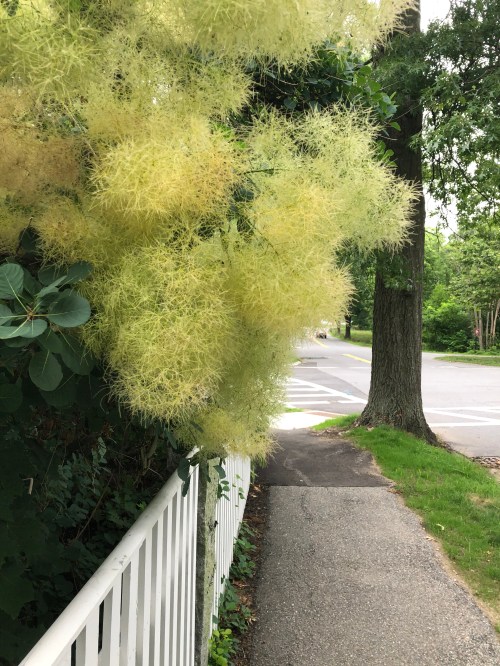
The first photo below shows a tiny vase Kristina gave me the other day. It attaches to the window with a suction cup. After that, I think you will recognize white hydrangea and smokebush. The blueberries belong to a neighbor and the grapes to a local business.

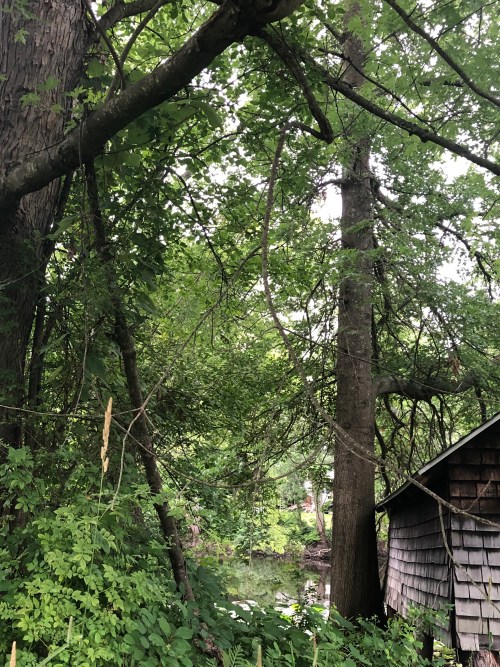
I was glad finally to check out the old shack by the Sudbury River, but the trail that got me there had so much mowed poison ivy, I decided to put my shoes in the machine when I got home.

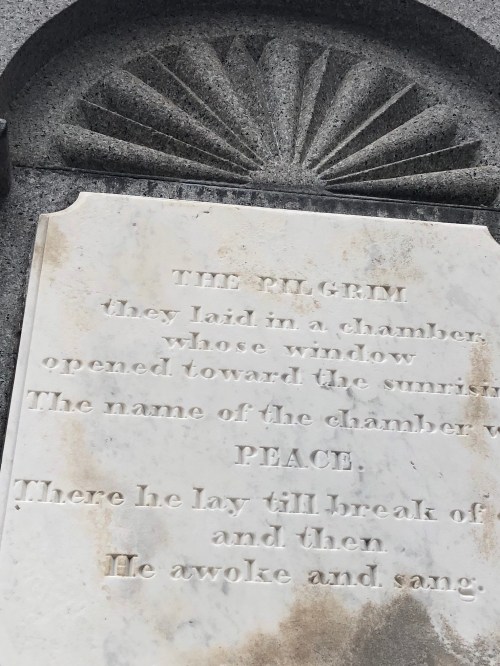
Next we have a tomb inscription — about a window, in a way. It’s from Pilgrim’s Progress, by John Bunyan. I went up for a closer look when I saw the word “Pilgrim” because I thought it might have something to do with our New England Pilgrims. No. It reads in part, “The Pilgrim they laid in a large upper chamber, whose window opened towards the sun-rising. The name of the chamber was Peace.

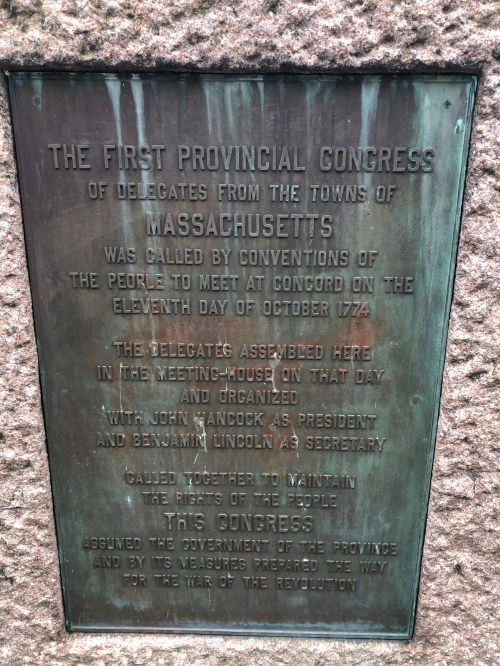
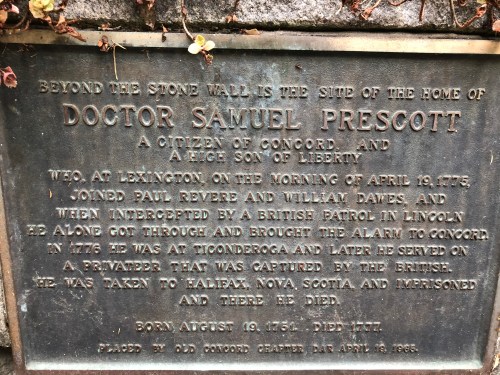
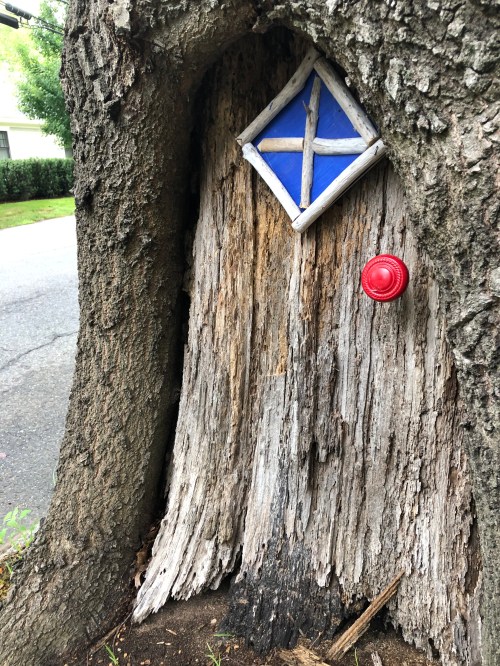
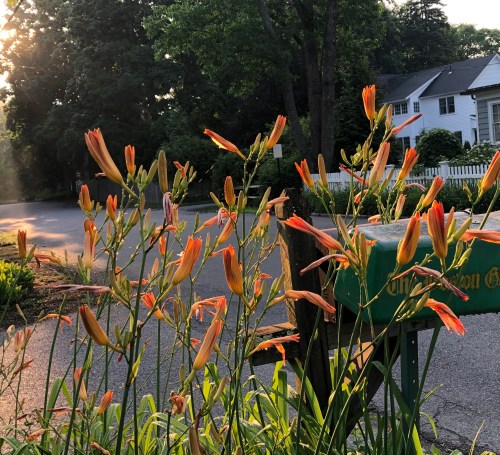
Two plaques follow and testify to the fact that we are loaded with history in these parts. Next, “Owl’s doorknob” has been joined by an additional decorative touch. Wonder what the mystery elf will do next. Then we have photos of day lilies at dawn and purple clematis.

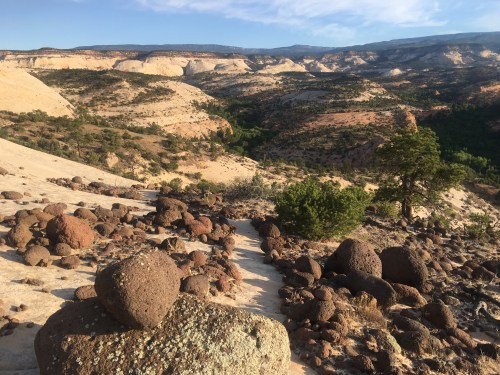
I’ll wind up with some armchair travel. Caroline sent the breathtaking rugged mountain vista from her home in Utah, and Stuga40 sent four pictures from Sweden. First of those is a woodland in Stockholm where she likes to walk and wildflowers she picked. Her last two photos are from the Dalecarlia region a bit further north, where you can get a red-painted wooden Dala horse if you want a souvenir.

071120-window-marigold

070620-under-white-hydrangea

070820-smokebush-ConcordMA

071120-blueberries-ConcordMA

070920-grapes-on-gray-fence

071020-river-shack

070620-John-Bunyan-Pilgrim-tomb-quote

070520-1st-provincial-congress-concordma

070320-Samuel-Prescott-sign

070320-fanciful-tree-additons

070320-sun-on-day-lilies

070320-purple-clematis

062720-Caroline-Cummings-Hoyt-Utah-path

062920-Margareta-walks-in-Stockholm

20200711-wildflowers-from-Stockholm

20200710-flower-wreath-Sweden

20200710-Dalecarlia-Sweden

Photo: Peyton Manker via CNN
Illinois teen Peyton Manker made this gorgeous dress out of duct tape for a scholarship competition.

Oh, my goodness! Human ingenuity! Nothing against animals, but it’s hard to think of any animal — even the dolphin — dealing with misfortune by creating something that lifts the spirit like this. I think the product of this young lady’s resourcefulness belongs in a museum someday. After some future prom, that is.

Kiely Westhoff reported at CNN about the scholarship contest with the theme “Stuck at the Prom.”

“In January, 18-year-old Peyton Manker embarked on her journey to make a prom dress entirely out of duct tape for a contest to win a scholarship. After weeks of working on her submission, the Covid-19 outbreak not only canceled her prom but altered the course of her senior year.

“Manker was not deterred by the fact that she would not get to wear her dress to prom. Instead, she felt inspired to create a dress that ‘documents a part of history.’ Her coronavirus-themed dress features multiple images depicting life during the pandemic. …

‘It wasn’t just high schoolers, it wasn’t just America, it was the whole world being impacted by the pandemic so I wanted to show that,’ said Manker.

“She does so by showing an image of people running away from the giant coronavirus to signify the world trying to avoid catching the disease. Other designs pay tribute to frontline workers and people suffering from mental health issues as a result of the pandemic. …

“She completed the look with a creative array of accessories including a ‘flatten the curve’ face mask. … She believes that her anklet displaying the words, ‘This too shall pass,’ perfectly encapsulates her message. ..

“Manker also wants to encourage a spirit of positivity with her work. She believes that ‘we can have some positive things come out of this whole experience and my dress is an example of that.’ …

“Manker says this is her debut as a duct tape artist. Her previous experience is from making small duct tape wallets and flowers when she was much younger. Four months and 41 rolls of duct tape later, she managed to make something far more elaborate. …

“Manker’s mother posted the dress to Facebook, where the post has been shared over 254,000 times. Manker says it is ‘surreal’ that her work was able to make an impression on people all over the world who commented on the post.

“She says that winning the contest, run by duct tape-maker Duck Brand, would be rewarding because ‘it will mean that people saw all the positivity I was trying to show them.’ Duck Brand will be awarding $20,000 in cash scholarships to the winners in July.” See more views of the Manker’s gown are here. Other Duck Brand prom dresses are here.

Photo: Peyton Manker
This fetching little purse ensures you won’t forget Covid-19.

1956-CAROLINE-BIRTHDAY-no-12

This is a photo from a time when I still liked to celebrate birthdays. I found it while sorting through boxes of old pictures last summer.

I’m the one in the middle with a hat and (typically) eyes closed. The girl to my left in glasses is a blog follower who attended my Sunday School. On her lap is my dear baby sister, who died of glioblastoma last year. To my right is one of two friends from my nursery school days that I keep in touch with on Facebook. The other is standing a bit behind her and to her right, with glasses.

Another of the partygoers has since died. One became a celebrated author and professor. One was ordained and headed a school in Wilmington. Another became an artist. She’s the one sitting next to my sister and wearing a big grin. On her lap is a girl who became a professional weaver. A cousin in the picture taught in inner city schools for years and later went into politics and conservation. I’m not sure what everyone else ending up doing, but I’m enjoying remembering each in turn.

I’ll also mention someone not in the picture, a former neighbor, now known as Caroline, who follows this blog. She helped me one year with writing birthday party invitations. I still remember her line about how the invitee should come “to my humble abode on Haverstraw Road”! Too funny. She thought an invitation should rhyme.

Art: Wayne Thiebaud/ National Gallery of Art

default

Photo: Sinclair Miller/Maryland Zoo via the Washington Post
A wheelchair fashioned out of Legos helped this Eastern box turtle, shown in 2018, to recover from a broken shell.

For your delectation today, I offer you two turtle stories. The Washington Post apparently has a thing about turtles, and that’s great. I do, too, remembering fondly long-ago box turtles in Rockland County, New York.

In the first report, Dana Hedgpeth, describes a clever use of Legos to repair the shell of a badly damaged turtle.

“A turtle that had been injured and had a customized wheelchair built for it from Legos has been released into the wild. [The] male Eastern box turtle had been in the care of the Maryland Zoo in Baltimore. … With a transmitter on its back, officials said they’ll be able to keep tabs on it in its native habitat.

“The turtle’s tale started two years ago when it was found by a zoo employee in the park and brought to the facility. The turtle had a badly broken shell and underwent surgery that involved placing metal bone plates, sewing clasps and surgical wire to keep its shell held together.

“Ellen Bronson, senior director of animal health, conservation and research at the zoo, said … ‘We faced a difficult challenge with maintaining the turtle’s mobility while allowing him to heal properly,’ Bronson said.

“Garrett Fraess, who was a veterinary student and in a clinical rotation at the zoo, said at the time that it was key to ‘keep the bottom of the shell off the ground so it could heal properly.’ …

‘They don’t make turtle wheelchairs,’ Fraess said, so he and a team sketched a customized wheelchair. He sent the sketches to a friend in Denmark who is a huge Lego fan, and she made a wheelchair for the turtle.

“The wheelchair worked because the Lego frame surrounded the turtle’s roughly grapefruit-size shell, and with plumber’s putty it attached to the edges of the upper shell, which got it off the ground and allowed it to move its legs, according to Fraess. …

“The turtle used its Lego wheelchair through the winter and spring of 2019 until ‘all of the fragments were fused together and the shell was almost completely healed,’ according to Bronson. Then they took off the wheelchair and the turtle underwent ‘exercise time’ to build up strength. …

“The zoo has done a project to monitor Eastern box turtles at the park since 1996. They’ve recorded, tagged and released more than 130 wild turtles. The work is used to help conservationists see how the turtles, which are native to Maryland, are doing in an urban setting.” More.

The second article, by Karin Brulliard, is about returning the rare Kemp’s ridley turtle and green turtles to the sea at Assateague, Maryland, a place that (along with Chincoteague) I associate more with Marguerite Henry and her children’s books about miniature wild horses.

“Seven months after washing up on the shores of Cape Cod, Mass., No. 300 stoically scanned the powdery beach while being held aloft by Maryland’s second-highest elected official.

“It was hardly the strangest thing to befall the young Kemp’s ridley sea turtle, a Gulf of Mexico native, since the animal found itself in cool northern waters in November. Its body temperature plunged, making it too lethargic to swim. It was scooped up by volunteers who found it near-dead on shore. It was trucked to Baltimore, then warmed by aquarium workers who named it Muenster and treated its pneumonia.

“The turtle swam in a pool with other injured turtles named for cheeses, and swam some more, not knowing that outside, pandemic-related shutdowns were delaying its return to the Atlantic waters now before it.

“Soon, Lt. Gov. Boyd K. Rutherford (R), jeans rolled up to his knees, placed the turtle into breaking waves as beachgoers cheered this glint of hope at a time of tumult on land. And without a look back, Muenster became the first of 10 Kemp’s ridley and green sea turtles to paddle forth on this late June morning into an ocean. …

“Six of seven sea turtle species are threatened or endangered, their populations driven down by development of the beaches where they nest, pollution of the waters where they forage, fishing nets and lines that accidentally catch them, and hunting and trade. But even against that dim backdrop, the trends for those that swim U.S. waters look fairly positive, according to one recent study: Endangered species protections have helped six of eight populations rise.” More.

Lt. Gov. Rutherford of Maryland cares about turtles? That can only be a good thing.

Sewing Is Back

Photo: eBay
Vintage Singer sewing machine. More people are turning to sewing — or returning to sewing — during the pandemic.

Did you have home ec in high school? Did you ever finish your sewing project? I’m afraid I never did. My project was a puffy cotton skirt in a beautiful shade of blue. I still have the thread on its wooden spool.

I wonder if my wooden spool collection will ever be valuable. After all, as Jura Koncius reports at the Washington Post, sewing and other such homely skills are back in style. Maybe wooden spools, too.

“When the pandemic shut down businesses in mid-March,” says Koncius, “people who ran sewing stores, sold sewing machines and did workshops were in a panic about how they would stay afloat.

‘Then the mask thing happened,’ says Heather Grant, executive director of the Strategic Sewing & Quilting Summit.

“ ‘The mask thing’ began in early April after the Centers for Disease Control and Prevention recommended that people wear face coverings when going out in public to slow the spread of the novel coronavirus. They were not suggesting the hospital-grade variety (which were in short supply and were needed for health-care workers) but basic cloth masks that could be sewn at home.

“ ‘People dragged machines out of their closets or went online to buy new ones,’ Grant says, and stores started selling out of sewing machines, dark fabrics and elastic.

“Bryan Morris, co-owner of the four Washington-area Brothers Sew & Vac stores, says each of his stores was getting 10 or 20 calls a day from people looking to buy or repair sewing machines.

” ‘I was also getting calls from some medical facilities looking for people to sew masks,’ he says. Even now, he says, demand hasn’t slowed down.

“As the stay-at-home weeks wore on, novice and expert sewers alike found themselves with more time to work on projects. ‘People were finishing quilts they had in a drawer for years,’ Grant says.

“Mathew Boudreaux, who lives outside of Portland, Ore., (instagram.com/ misterdomestic) designs fabrics and gives classes all over the country. He has started finishing projects, such as crocheting afghans, that he had never had time to get to.

“ ‘It was a way not to have to think,’ he says. …

“Singer, which sells 56 models of sewing machines ranging from $99 to $400, saw an immediate spike. ‘Our business grew quickly during the pandemic, resulting in almost every model being out of stock in early April,’ says Dean Brindle, chief marketing officer of SVP Worldwide, Singer’s parent company. …

“The company has attracted younger customers and more male customers since the pandemic began, including boys who have taken up sewing to make masks. ‘Roughly 20 percent of our consumers have been men,’ Brindle says. …

“At Bernina, the entry-level Bernette machine (about $199) sold out in a few weeks, says Paul Ashworth, chief executive and president of Bernina of America. …

‘By the end of April, you really could not find a single sewing machine below $500 in the United States,’ he says. …

“Joe Cunningham of San Francisco, who has been quilting for 40 years, lost all of his teaching gigs and seminars for the rest of the year. … He did a lecture and studio tour on Zoom, and then he hosted his first online class. He was skeptical as to how many people would pay $35 for it, but he was thrilled that 268 people signed up for the webinar. ..

” ‘This pandemic could sure change my business,’ he says. ‘This forced me to learn online teaching, and now I actually have more time to quilt.’ …

Latifah Saafir, 44, who has been sewing since she was 10, designs fabrics and patterns for children. ‘There’s not too much out there in product lines for kids, so parents are happy to find these,’ says Saafir, who is co-founder of the Modern Quilt Guild.

“She says stores have increased their orders of her designs, hearing from parents that they needed ways to keep kids occupied. ‘I have one customer who ordered three patterns directly from me so she could teach sewing to her grandkids on Zoom,’ she says. …

“Industry executives are betting people are not going to pack away their machines anytime soon. ‘People are not returning to life as normal for a while,’ Brindle says. ‘We are already in month four, and a lot of people who did come back to sewing will continue.’ ” More at the Washington Post, here.

I got my lovely mask from a talented woman I know on Etsy, here.

Between August 21 and 26, in Karlskrona, Sweden, the Carl International Film Festival will have 30 boat-in screenings.

You already know that drive-in movies are back in style. (Remember this March post?) Today I have a Forbes article describing how the idea of using vehicles for social distancing has expanded in Europe.

Sarah Turner writes, “While many of Europe’s arts festivals have been cancelled this year, including Edinburgh, Bayreuth and Glastonbury, others have turned to 1950s America for inspiration with drive-in performances.

Nowhere more so than Germany, which is, appropriately enough, still the heartland of Europe’s car industry which got on board the trend early with festivals in Leipzig and Dusseldorf, partnering art films with innovative venues.

“The Kunstfest Weimar festival, founded in 1990, encompasses  music, theatre and dance to fine arts and film. One of the three strands to this year’s festival is coronavirus and its impact on both society and individuals. To reflect this, six specifically created productions will be staged at a new venue, the Alte Feuerwache drive-in cinema. …

“In the U.K., various drive-in concepts are also taking shape. In early July the unabashedly feel-good Nightflix festival is part music concert, part film screening with cover bands and classic movies. There are two venues, Colchester in Essex and Newark in Nottinghamshire; options include Abba tribute bands and screenings of Grease, Moulin Rouge and Joker. Around 350 cars will be able to attend each performance, with the modern festival essentials of sourdough pizza and halloumi fries also being on hand.

“The Henley Festival, usually a bastion of black ties and crowd-pleasing performances, is putting on an Alternate Festival between July 9-12 with car-based comedy, theatre and karaoke. After Henley the Car Park Festival will be going on the road, venues include Dudley, Manchester, Northampton and Newbury while film and comedy-based The Drive-In Club will take place at London’s Alexandra Palace.

Live Nation will be putting on drive-in concerts with — among others — Dizzee Rascal and Kaiser Chiefs and the cult musical Six, based on the wives of Henry VIII. …

“In Cornwall, Wavelength magazine will have clifftop drive-in cinema experience at Watergate Bay from late July through to the end of August 2020 alongside a host of on-site socially-distant options including street food, live music, tombola popcorn stands and craft beer bars.

“Held at Trebelsue Farm, with space for over 200 cars and vans, The Wavelength Drive-In Cinema Series will start on Friday 24th, the Cornish-set surf film Blue Juice and continues into late August.

“But it’s Scandinavia that is taking the most innovative approach to the notion of the drive-in festival. Between August 21 and 26, in the Swedish town of Karlskrona, the Carl International Film Festival will have 30 boat-in screenings. Taking place in the Salto Fish Harbour with two LED screens, up to 100 boats will be allowed in, drawing attendees from around 1,600 nearby islands, with food delivered to boats from harbourside restaurants.” More at Forbes, here.

Speaking of social distancing by boat or car, I recently suggested to a friend who can’t go farther than her yard or her car that in winter we should park our cars somewhere six feet apart, open a window, keep the heat running — and continue our weekly visits.