Feeds:
Posts
Comments

Photo: Rose Franklin’s Perennials
A Monarch alights on Butterfly Weed. It also loves milkweed.

Sometimes I find the background for a post in a roundabout way. I heard about Mexico’s Monarch butterfly hero, Jose Luis Alvarez, recently on Public Radio International, which had borrowed his story from the BBC. But because I like to have text to work with, not just audio, I searched online for additional information.

I’m glad I did because practically in my own backyard there’s an organization that’s partnering with Alvarez and helping folks far from Mexico to plant the Butterfly Weed that Monarchs love. Here’s what I learned at Vermont Woods Studio.

According to Peggy Farabaugh, “Jose Luis Alvarez  … is a silviculturist in Mexico who has devoted his life to restoring the forested winter habitat of the Monarch.  [In March 2016] I traveled to Michoacan, Mexico, to meet Jose Luis & see his work. I love Monarchs & we’ve been conserving their summer habit here in Vermont for many years, so I thought maybe we should collaborate and get some Vermont-Mexico synergy going!

“In 1997, Jose Luis created a non-profit called ‘Forests For Monarchs,’ which came to be known as the La Cruz Habitat Protection Program (in the USA) and the Michoacan Restoration Fund (in Mexico).  With donations from people all across the USA, Canada and Mexico, ‘Forests for Monarchs’ has been able to plant nearly 6 million trees.  …

“During the winter Michoacan, Mexico, is home to the entire species of the Eastern Monarch Butterfly (which summers in Vermont). [Illegal] deforestation has devastated the area. … [Jose Luis has] made great progress, but much re-planting still needs to be done.

“Here in rural Vernon, Vermont, a number of friends, neighbors, customers, gardeners and Vernon Elementary School children have been planting milkweed. … We’ve been growing milkweed from seed and giving the seedlings away to fellow Monarch lovers.

“Monarchs summering in Vermont are programmed to migrate to Michoacan, Mexico, in the fall.  There they join the entire population of their species, huddled together in the shelter of the last few remaining acres of their wooded winter habitat.  Mind-boggling, right?  How can an insect (that only weighs as much as a raisin) fly 3,000 miles, to the exact same location its ancestor came from –- when it’s never even been there before? I had to see it to believe it.  So …

“I traveled to Mexico (with my now grown up sons) to meet Jose Luis and we took his Spirit of Butterflies Tour last month. It was amazing.  But we were alarmed to see the extent of deforestation in the area.  Without help reforesting their habitat, the Monarch will soon go the way of the passenger pigeon & that would be just too sad.  So we brainstormed about developing a Vermont-Mexico partnership to help save the butterfly.

“Besides being a forester, Jose Luis is an internationally renowned speaker. He’s been featured in numerous documentary films by the BBC, National Geographic, the Canadian Broadcasting Channel and others. He’s been an advisor and guide to researchers, scientists, photographers & videographers from all over the world as they seek to save the Monarch. His work has been written about in newspapers including the Wall Street Journal & The New York Times.

“So we thought we should bring Jose Luis up to Vermont and New England for a speaking tour to raise awareness about the Monarch’s plight. I guess I got a little carried away and volunteered to help Jose Luis Alvarez plant a million trees in the Monarch’s over-wintering area of Mexico.” More here.
The Vermont Studios post was written originally in 2016 and updated last August.

Photo: Fernando Laposse/BBC
Jose Luis Alvarez is protecting Monarch butterflies by planting deforested areas with the trees they need when they winter-over in Mexico.

https://butterflywebsite.com/foundats/lacruz/project.cfm

041119-New-York-sunrise

Today I wrapped up my latest visit to New York, where I spent time with my sister and her husband. The city was great in both rain and sunshine. I loved every minute spent in Central Park — amazing at all times of year, but especially in spring. I also enjoyed an exhibit of JRR Tolkien’s art and letters at the Morgan Library (available only until May 12) and my visits with a number of my sister’s friends.

The first picture is of dawn on the Upper West Side. Next are flowering trees near the West Side Community Garden, followed by photos of the garden itself. How terrific to see that much prime real estate being used in this way!

I photographed the Tolkien poster, but no picture-taking was allowed inside the actual exhibit, alas. Tolkien was a fascinating artist as well as a writer of fantasies like The Hobbit and the Lord of the Rings trilogy. Among the works shown at the Morgan were the illustrated letters from Father Christmas to Tolkien’s children, which I showed you in 2018, here.

The concluding pictures are from Central Park. I can’t get over what an artist the landscape architect Frederick Law Olmstead was to create so many diverse vistas showcasing nature, never disrupting it. There are wonderful rock formations, hills and valleys, grottoes, woodland paths, waterfalls, streams …

It’s also impressive to observe how residents and city government alike use and cherish the park these days. I remember a time when I wasn’t supposed to go near it when walking my aunt’s corgi in the morning. Nowadays, the mornings are filled with bikers, walkers, runners, dogs — and the lucky people whose work commute is on foot through all that beauty.

041219-New-York-is-blooming

041219-West-Side-Community-Garden

041219-.community-garden-in-spring

041119-Tolkien-at-the-Morgan

041119-Central-Park-playground

041119-daffodils-and-bench

041219-.flowering-trees-Central-Park

041219-red-bud-and-forsythia

041119-Lagoon-Central-ParkJPG

041219-SuzannesMom-as-photographer

Photo: Margarita Talep/Dezeen.com
Chile-based designer Margarita Talep has created a sustainable, biodegradable alternative to single-use packaging, using raw material extracted from algae. Natural vegetable dyes such as cabbage, beetroot, and carrot produce different shades.

As scary as the photos of plastic-filled oceans, rivers — and whales — may be, I remind myself that many people are working to cut out plastic in their lives and others are inventing biodegradable plastic substitutes.

Consider this story by Natashah Hitti at Dezeen.com, “Chile-based designer Margarita Talep has created a sustainable, biodegradable alternative to single-use packaging, using raw material extracted from algae.

“Disappointed by the abundance of non-recyclable materials currently used to contain food products, Talep decided to develop her own eco-friendly packaging that would stand in for plastic. …

“According to the designer, the material only includes natural matter, including the dyes used to colour it, which are extracted from the skins of fruits and vegetable such as blueberries, purple cabbage, beetroot and carrot.

“The basic mixture is made up of a polymer, a plasticiser and an additive, with the amounts of each ingredient varying depending on the desired consistency of the final product. …

“To make a material that bears a close resemblance to thin plastic, Talep boils the agar mixture to around 80 degrees celsius, before transferring the molten liquid onto a mould.

“When the liquid drops to a temperature below 20 degrees celsius, it takes on a gel-like consistency. This is then left to dry in a well-ventilated environment with a constant temperature, until it becomes similar to paper or thin plastic.

“The bioplastic packaging is especially suited to containing dry food products. It is best sealed with heat rather than glue in a bid make the end result as natural as possible. …

“The material takes around two months to decompose in summer temperatures, depending on the thickness, and about three to four months to decompose completely in winter.

” ‘I believe that bio-fabrication will be an important part of future industries,’ said Talep. ‘As long as all the processes of extracting these raw materials and their manufacture are done with environmental awareness. But it is not enough just to create new materials. These different solutions to the huge environmental problem must work in parallel with other action.

” ‘Different nations should implement action plans for reducing the amount of plastic waste produced by introducing more circular economy projects, keeping plastic in a cyclical system to prevent it from ending up at landfill or in the sea,’ Talep suggests.”

Read more at Dezeen.com, here. The zine has lots of other great ideas for making a more sustainable world.

Also, to read about young people who are taking action, check out Kids Against Plastic, here.

Amazing Paper Birds

Photo: Calvin Nicholls
Wilson’s Bird of Paradise rendered in paper.

Some people seem to make a beeline straight from childhood to the work that will define them. People like Mozart, for example. Others have a long, circuitous route to greatness. Malvolio weighs in on the puzzle in Shakespeare’s Twelfth Night: “some are born great, some achieve greatness, and some have greatness thrust upon them.”

Pat Leonard writes at Living Bird that Calvin Nicholls came to his amazingly great art a bit by accident.

“The daily commute to his attic studio is short and steep. The road to success for Canadian artist Calvin Nicholls has been much longer. He’s spent the last 30 years perfecting an unusual art form that is all about light, shadow, shape—and illusion. Nicholls is a paper sculptor who creates fantastically detailed birds and other animals that seem to leap, lean, or flutter straight out of their frames. His career evolved from drawing, model-making, sculpting, photography, and periodic doses of serendipity.

“ ‘It’s so clear in my mind—it was 1983,’ says Nicholls. ‘I had my own graphic design studio in Toronto. I met a fellow who was manipulating paper to produce areas of highlight and shadow to create the feeling of depth in two dimensions. We worked on a restaurant menu concept together and I could see the potential in this technique. I got playing with paper sculpture myself and it was just so much fun.’

“At first, Nicholls created his sculptures as a method for creating his final product, a photograph that could surprise viewers by seeming three dimensional. The technique turned out to be a hit when Nicholls introduced it to some of his clients. He showed photographic prints of his work in an art show in Ontario in 1990, but he also wound up selling sculptures of a Snowy Owl and Mallard as well.

“ ‘I was focused on the prints and trying to make two dimensions look like three,’ Nicholls says. ‘Then clients would say, so where’s the artwork? And I thought, yikes—I never even thought about displaying the artwork! I still marvel that I didn’t know then that the original artwork could be as interesting as the illusion created in the prints with sophisticated studio lighting.’

“Switching focus to the original artwork meant reducing the depth of his sculptures so they could be framed and so the jumble of foam core supports and toothpicks underneath didn’t show when the piece was viewed from an angle. It took a lot of time and experimentation. But the end result is an uncanny illusion of depth from layers of paper that are only about an inch thick. …

‘What makes the sculptures work is thinking about anatomy and how [feathers] flow a certain way on the musculoskeletal structure,’ says Nicholls. ‘I have to get a sense of the skeleton and the muscles and what they do in certain gestures.’ ”

Read more and see the great pictures at Living Bird, here.

Photo: Steve Morgan/Alamy Stock Photo
Working on the Pelamis wave power converter in Orkney. The British island is leading the way on renewable energy generation.

This story about Orkney in the British Isles holds lessons for governments everywhere. If you are serious about generating the kind of energy that can save the planet, you have to invest. Orkney did so because energy from the mainland was costly and because the island had a wild amount of wind. But Orkney didn’t stop there, and now it’s leading the way for the rest of the world.

As Robin McKie reports at the Guardian, “It seems the stuff of fantasy. Giant ships sail the seas burning fuel that has been extracted from water using energy provided by the winds, waves and tides. A dramatic but implausible notion, surely. Yet this grand green vision could soon be realised thanks to a remarkable technological transformation that is now under way in Orkney.

“Perched 10 miles beyond the northern edge of the British mainland, this archipelago of around 20 populated islands – as well as a smattering of uninhabited reefs and islets – has become the centre of a revolution in the way electricity is generated. Orkney was once utterly dependent on power that was produced by burning coal and gas on the Scottish mainland and then transmitted through an undersea cable. Today the islands are so festooned with wind turbines, they cannot find enough uses for the emission-free power they create on their own.

“Community-owned wind turbines generate power for local villages; islanders drive nonpolluting cars that run on electricity; devices that can turn the energy of the waves and the tides into electricity are being tested in the islands’ waters and seabed; and – in the near future – car and passenger ferries here will be fuelled not by diesel but by hydrogen, created from water that has been electrolysed using power from Orkney’s wind, wave and tide generators.

“ ‘A low-carbon renewable future, which is much talked about elsewhere, is coming early to Orkney,’ says ethnographer Laura Watts in her book Energy at the End of the World: An Orkney Islands Saga. The book, published by [MIT Press], tells the intriguing tale of how Orcadians have begun to create their own low-carbon future against incredible odds and with only a little help from the mainland. …

“Orkney is leading Britain’s drive toward a carbon-free future. And the critical, vital ingredient in this revolution has been the manner in which islanders have turned the energy of the winds into a reliable source of power. Low-lying and exposed to both the Atlantic Ocean and the North Sea, Orkney is battered by winds and gales throughout the year. Rainstorms sweep the islands with unbridled savagery, tear down sheds, rip slates from roofs, and can take out metres of coastline in a night. You don’t need an umbrella here, you need a riot shield, one islander told Watts, who has been a regular visitor to Orkney for the past decade. …

“In the early 1980s, Britain began experiments aimed at developing turbines that could turn wind power into electricity – at a test site on Burgar Hill, on Orkney. ‘However, the UK pulled the plug on it and instead the Danes and Germans went ahead and developed wind turbine technology – because their governments invested in it,’ says Watts. ‘They put in millions. The British government did not. We could have had a UK wind energy industry but we just did not invest.’

“The impact of wind turbine technology in Orkney was nevertheless profound and islanders took to its generation in a big way. ‘Orkney used to import its power but now generates, on average over the year, electricity that fulfils 120% of its own needs,’ says Watts. ‘So you have all this energy. The question is: what are you going to do with it?’

“Watts outlines the three options open to islanders: build a new cable so it can export its excess renewable energy to the mainland; use more electricity on the islands; or turn its excess renewable power into another fuel – such as hydrogen – and then store it. Finding the right course is likely to have a profound impact on Britain as the nation looks to the example set by Orkney and embraces its low-carbon future. …

“Energy cannot be simply collected from a wind turbine and exploited later when conditions are calm and windless – because there is as yet no reliable way to store it. It is a basic drawback that Orcadians are now tackling. On the Orkney island of Eday, a device known as an electrolyser – powered by renewable energy sources – splits water into its two elemental components: hydrogen and oxygen. The former can be stored and later burnt to generate electricity when needed. Already a fuel cell – powered by locally derived hydrogen – is being used to generate electricity for berthed vessels on one Orkney pier.”

Pretty exciting stuff, don’t you think? More at the Guardian, here.

032919-Moon-by-Joseph-Wheelwright

I’m headed off to New York soon to spend some time with my sister. Regular readers know she was diagnosed with a bad cancer last summer, but she is stable with ongoing treatment and living a normal life. I hope to get good pictures on my travels, but in the meantime, here are scenes from my own backyard.

The first is from an art exhibit called “The Moon: Eternal Pearl.”  I particularly liked this Joseph Wheelright sculpture. The gallery itself (once a stop on the underground railroad) is always pleasant to visit, especially right after an opening reception when there are flowers everywhere. I liked how the gold dome of the UU church shows up beyond one flower arrangement.

When the gallery isn’t open, you can still enjoy the curious outdoor sculptures, like this elephant and ostrich.

The blue photo is from a blues concert I attended recently. The musicians are actually just doing a sound check here. The next three pictures are from my walks around town, including my walk on a new piece of the Bruce Freeman bike trail on a former railroad bed, which technically isn’t open yet but is so enticing that lots of people are using it. The trail has been taking decades to complete because of lawsuits by abutters. They will soon find out it is an asset, in my opinion.

I’m not sure if I posted the library’s children’s-book quilt already, but I want to be sure that quilting friends see it.

032919-art-opening-bouquet

032919-First-Parish-Church-Concord

033019-elephant-in-the-yard

033019-ostrich-at-Concord-Art

033119-sound-check-for-blues-concert

040319-leaves-and-shadows

032919-treehouse-next-door

032919-detritus-on-the-trail

040319-child-book-quilt-Concord-MA

Photo: Michael Bradley/AFP/Getty Images
Man Kaur of India celebrates after competing in the 100-meter sprint in the 100+ age category at the World Masters Games in Auckland, New Zealand, in April 2017.

It was Erik who sent the story about a 101-year-old champion runner. He sent it to his mother and my husband, too, in case we want to take up athletic competition at our advanced ages. The woman in the story got a late start on running, and although I am not interested in running, I always like stories about late starts. Especially stories about starting something big after age 90.

As Chhavi Sachdev reported at National Public Radio (NPR) in 2018, “Man Kaur is 101, but her routine could tire most 20-somethings.

“Every day she wakes up at 4 a.m., bathes, washes clothes, makes tea, recites prayers until about 7 a.m. Sometimes she goes to the Gurdwara, the place of worship for Sikhs, other times she prays at home.

“And then she goes to the track for an hour of sprinting practice. And she’s not just doing it for fun. A competitive runner, Kaur is a world record holder in her age group for several categories and is now training for the Asia Pacific Masters Games in Malaysia. …

“She was declared the brand ambassador for a nonprofit organization called Pinkathon, which raises awareness of women’s health issues — and encourages running as a way to improve physical fitness. At the Pinkathon announcement event, Kaur was literally mobbed by gushing women, many of whom started running in their 30s and 40s. …

“The diminutive Kaur hasn’t been a lifetime runner. Far from it. She started running in 2009, when her son, Gurdev Singh, 79, urged her to take up track and field. …

“What made him take his then 93-year-old mother to the track? It was mainly a whim, he explains — but also a desire to keep her fit. ‘She was very well, with no health problems, and she moved fast. So I took her to the university track with me and asked her to run 400 meters. She did it, slowly, and I thought “Yes, She can do it.” ‘

“Kaur enjoyed it enough to want to return. She liked running, she said. And quickly she started to improve. Two years later, given how well she was doing, her son registered her for international events he was participating in. Kaur agreed with no hesitation. And she hasn’t stopped. …

“Since starting her competitive career, Kaur has run in meets in Canada, Malaysia, New Zealand, Singapore and Taiwan. And she’s nailed 17 gold medals.

“In Auckland, New Zealand [in April, 2017] she won gold for the 100-meter and 200-meter runs as well as two new sports: javelin and shot put. In those two events, she’s sometimes the only contestant in her age bracket, so winning gold is a sure thing. But she doesn’t just show up. In Auckland, Kaur broke the master category world record in javelin with her 16-foot throw. …

“To improve her speed, Kaur tries to go to the track every day. Three days a week, she does shot put and javelin practice; the rest of the week, Singh puts her through her paces on the track. On sprint days she does runs of 30 meters, 40 meters and 50 meters. These are alternated with days when she does 100-meter and 200-meter runs.

” ‘And if the weather is inclement, I go to the gym and lift weights,’ she says.”

Read about her early life and future plans at NPR, here.

Photo: Reuters

Did someone read you Rudyard Kipling’s Just So Stories when you were a child? My father read them to me. My favorite was “The Elephant’s Child.”

“In the High and Far-Off Times the Elephant, O Best Beloved, had no trunk.” I loved hearing about the elephant’s child’s “satiable curiosity.” I loved the way the characters talked. The bi-colored python rock snake on the banks of the grey-green, greasy Limpopo River all set about with fever trees spoke just like my Uncle Jim.

Recently, an article in the Guardian reminded me of Kipling’s fanciful stories about how animals looked before they acquired their characteristic traits. It was an article about the whale.

Riley Black wrote, “Whales used to live on land. This fact never ceases to amaze me. Even though every living species of cetacean – from the immense blue whale to the river dolphins of the Amazon basin – is entirely aquatic, there were times when the word ‘whale’ applied entirely to amphibious, crocodile-like beasts that splashed around at the water’s edge. This week, paleontologists named another.

Peregocetus pacificus – as named by a seven-strong paleontologist team led by Olivier Lambert – is [a mammal] that was excavated from the bed of an ancient ocean now preserved in Peru. … This was a whale that still had arms and legs, the firm attachment of the hips to the spine and flattened toe-tips indicating that Peregocetus was an amphibious creature capable of strutting along the beach. Yet conspicuous expansions to the tailbones of Peregocetus are reminiscent of living mammals, such as otters, that swim with an up-and-down, undulating motion … different from the side-to-side swish of most fish. …

“There are two points that make Peregocetus stand out. The first, Lambert and colleagues point out, is where Peregocetus was found. This early whale wasn’t discovered in ancient Asia, like many others, but in South America. It’s the first of its kind to be found on the continent, and from the Pacific side, at that. This is something of a surprise. Clearly whales were eminently seaworthy long before they became more streamlined and lost their hindlimbs. Finds such as Peregocetus, as well as the related Georgiacetus from North America, indicate that walking whales were capable of crossing entire oceans.

“But, more importantly, Peregocetus is a reminder of what wonders still await us in the fossil record. … Peregocetus [stands] in our fossiliferous imagination with its hind feet on the land and front paws in the water. The whale certainly adds to our understanding of how and when cetaceans took to the seas, but the most powerful fact of all is simply that such an unusual and unexpected creature existed.” More here.

Photo: Kalume Kazungu / Nation Media Group
The Flipflopi dhow made entirely from recycled marine plastic being prepared on January 24, 2019, to start its inaugural journey from Lamu to Zanzibar.

I like listening to Public Radio International’s The World because it gives me a window on what’s going on in other countries. People living elsewhere on Plant Earth often know what’s going on in the US, but here most of us have blinders on. It’s as if nothing happens anywhere else unless it affects us directly and immediately.

But all people are concerned about the things that concern us, and many are taking action unheralded in America. Some of the most energetic environmentalists are the residents of poor countries who’ve been most hurt by climate change (see Mary Robinson’s eye-opening book Climate Justice) or who have the most plastic clogging their waterways and beaches.

Consider this story about Kenyans trying to raise the consciousness of their own countrymen and others in Africa.

Kalume Kazungu and Eunince Murathe reported in January at Kenya’s Daily Nation, “The dhow made entirely from recycled marine plastic, the world’s first, has set sail from Lamu Old Town and is headed to Stone Town, Zanzibar. … Aboard 16 crew members, all who were involved in the invention of the vessel, will sail south along the coast of Kenya. …

“The Flipflopi’s maiden journey is meant to raise awareness about marine plastic pollution. … It is sailing for approximately 50 to 80 kilometres a day whilst simultaneously broadcasting the #Plasticrevolution message to a global audience. …

“The Flipflopi team will make several stops where they will be visiting schools, communities and government officials as they discuss solutions and changing mind-sets concerning plastic wastes and the importance of maintaining a clean environment free of plastics.

“[Dhow builder Ali] Skanda said he is confident that the Flipflopi will assist in raising awareness on the danger of using plastics and dumping them anyhow along the beaches.

” ‘We are set for our journey to Zanzibar. We will be passing through various towns along the Coast where we will be making some stops to educate the dwellers on how they can maintain clean beaches as well as avoiding plastic disposal on our ocean beaches.

“ ‘Through the Flipflopi invention, we hope people around the world are inspired to find their own ways to repurpose already used plastic so as to maintain clean beaches which are free of plastic wastes,’ said Mr Skanda.

“Mr Shafi Shetai, a Flipflopi crew member, said he believes the dhow will serve to reinforce the need for continued adherence to the already existing plastic ban since it demonstrates how the increasing amounts of plastic garbage can affect not only marine life but also the lives of residents and the economy.

“Mr Shetai said apart from the existing ban on plastic bags, the government should also ban other plastic materials used daily including straws since they are also posing a challenge to the environment. …

“The venture is aptly named the Flipflopi Project as the boat was built by traditional dhow makers led by Mr Skanda using thousands of repurposed flip-flops and ocean plastic collected on beach clean-ups along the Kenyan Coast. Limiting themselves to locally available technology and materials, the builders collected discarded plastics, shredded them into small pieces, then heated them and remolded them. They then carved the plastic parts exactly the same way they would do to wood.”

Read more at the Daily Nation, here. And for additional details, check out the UN Environment press release on the topic, here.

Photo: Sara Weber
On the scarf that German citizen Claudia Weber knitted to record her train commute, gray represents within five minutes of the timetable, pink within half an hour; red means a severe delay. She sold the scarf on eBay to raise money for a German train charity.

I was a train commuter for many years, and although there were often delays, they weren’t usually as horrendous as those in the winter of 2015, when you could wait two hours on an outdoor platform for a train that was supposed to be close at hand.

Last year’s delays on a train route in Germany led to an enterprise I never would have thought of. It not only gave a commuter an outlet for her frustration, it ended up raising money for a good cause.

Palko Karasz has the story at the New York Times. “Claudia Weber is a seasoned commuter, and she loves to knit. Over the past year, as her train journey from a town in the Bavarian countryside to Munich was replaced with a bus service during track repairs, stretching to two hours or more from a scheduled 40 minutes, she had a novel way of working out her frustrations. …

“When she got home each evening, she simply added two rows of wool to a striped scarf she was knitting: gray for delays under five minutes, pink for up to 30 minutes and red for a delay of more than a half-hour or delays in both directions.

“The resulting four-foot ‘Bahn-Verspätungsschal,’ or ‘rail delay scarf,’ has become something of a social-media sensation. Put on eBay to raise money for a Germany charity that provides free assistance to people at train stations, it sold [in January] for 7,550 euros, or about $8,650, to an undisclosed buyer. …

“Ms. Weber, 55, an office clerk at a travel agency, said in a phone interview, … ‘I understand the problems they’re having. There’s more and more commuters every year, but on the other hand I spend a lot of time waiting.’

“Her daily journeys take her between Munich and her home in Moosburg, northeast of the city, along the Isar River. …

“The scarf resonated with a lot of commuters in Germany and around the world, who live with the frustration of daily delays. After Ms. Weber’s daughter Sara, a journalist in Munich, posted a picture of the scarf on Twitter, it soon drew 23,000 likes and nearly 400 comments, as well as interview requests from local and international news media. …

” ‘It has become somewhat of an urban myth that Germans are always on time and trains in Germany run on time, but it’s not always true,’ [Sara Weber] said, reflecting on why the post resonated with so many people. … Experts have been warning for years about aging infrastructure in Germany, and delays and cost overruns in giant projects have hurt the country’s reputation of efficiency. …

“For her part, Claudia Weber has taken the Munich-Moosburg train for 25 years and has no intention of stopping. She considered driving, she said, but calculated that it would save her neither time nor money.

“ ‘I know I was complaining, but I’m still grateful I have that service,’ she added.”

That’s exactly how I felt about my commuter train. It was invariably better than the alternatives.

More at the New York Times, here.

Photo: Thomson Reuters Foundation/Rina Chandran
A small farm on top of a mall grows herbs and leafy greens in a high-tech urban farming model that could improve Singapore’s food security.

As agricultural land becomes more scarce around the world, we can all learn from the way tiny Singapore is using rooftop gardens to help feed the population.

Rina Chandran at Reuters writes, “Visitors to Singapore’s Orchard Road, the city’s main shopping belt, will find fancy malls, trendy department stores, abundant food courts — and a small farm. Comcrop’s [6,450-square-foot] farm on the roof of one of the malls uses vertical racks and hydroponics to grow leafy greens and herbs such as basil and peppermint that it sells to nearby bars, restaurants and stores. …

“Comcrop’s Allan Lim, who set up the rooftop farm five years ago, recently opened a 4,000-square-metre farm with a greenhouse on the edge of the city. He believes high-tech urban farms are the way ahead for the city, where more land cannot be cultivated. …

“Singapore last year topped the Economist Intelligence Unit’s (EIU) Global Food Security Index of 113 countries for the first time, scoring high on measures such as affordability, availability and safety.

“Yet, as the country imports more than 90 percent of its food, its food security is susceptible to climate-change and natural resource risks, the EIU noted.
With some 5.6 million people in an area three-fifths the size of New York City — and with the population estimated to grow to 6.9 million by 2030 — land is at a premium in Singapore.

“The country has long reclaimed land from the sea, and plans to move more of its transport, utilities and storage underground to free up space for housing, offices and greenery. …

“Urban agriculture currently produces as much as 180 million metric tonnes of food a year — up to 10 percent of the global output of pulses and vegetables, the study noted. Additional benefits, such as reduction of the urban heat-island effect, avoided stormwater runoff, nitrogen fixation and energy savings could be worth $160 billion annually, it said. Countries including China, India, Brazil and Indonesia could benefit significantly from urban agriculture, it said.

” ‘Urban agriculture should not be expected to eliminate food insecurity, but that should not be the only metric,’ said study co-author Matei Georgescu, a professor of urban planning at Arizona State University.

” ‘It can build social cohesion among residents, improve economic prospects for growers, and have nutritional benefits. In addition, greening cities can help to transition away from traditional concrete jungles,’ he said. …

“At the rooftop farm on Orchard Road, Lim looks on as brisk, elderly Singaporeans — whom he has hired to get around the worker shortage — harvest, sort and pack the day’s output.

” ‘It’s not a competition between urban farms and landed farms; it’s a question of relevance,’ he said. ‘You have to ask: what works best in a city like Singapore.’ ”

The article was reprinted by the World Economic Forum and can be found here. One weird thing about this story: There are still small farms in the countryside, but they are not as efficient as the rooftop gardens and will be cleared — to give the land back to the military. Now, that is truly bizarre.

Photo: Diego Rinaldi/Casa di riposo per musicisti, Fondazione Giuseppe Verdi
The exterior of Casa Verdi, founded by famed Italian composer Giuseppe Verdi in the late 1890s.

Facebook has decided I like stories about kind people because I linger over some with spooling captions. It keeps showing me items that are “Similar to Posts You’ve Interacted With.” It may be that I like such stories, but I never click on Facebook’s suggested links because I definitely don’t want Facebook knowing anything about what I like. (OK, I admit that’s a lost cause.) If the site weren’t the best way for me to connect with Carole, who I have known since nursery school and who has Parkinson’s now, I don’t think I’d be there at all.

The following post on the kindness of Giuseppe Verdi didn’t come from Facebook. It came from a site that gives me loads of other ideas for blog posts, ArtsJournal.com.

It’s where I learned about Rebecca Rosman’s National Public Radio [NPR] report on “Casa Verdi, a retirement home for opera singers and musicians founded by the famed Italian composer Giuseppe Verdi more than 100 years ago.

“Soprano Lina Vasta spent her career performing in Italian operas around the world. Twenty years ago, she settled at Casa Verdi. The tiny singer, who uses a cane to get around, won’t reveal her age (through a translator she admits to being ‘over 65’), but she still enjoys singing bits of The Barber of Seville around the home.

“Vasta came to Casa Verdi with her husband when they both retired from singing. Since he died, this is all she has. But with ‘a beautiful house, a piano, a very nice garden, nothing is missing here — it’s perfect. Grazie, Verdi,’ she says. …

” ‘In Italy, Verdi isn’t considered only a composer, only a musician, but kind of a national hero,’ [Biancamaria Longoni, the assistant director of Casa Verdi], says. ‘He used his operas to give voice to people — to humble people, to modest people, to poor people.’

“Many of Verdi’s own former colleagues found themselves living in poverty toward the end of their lives. At that time, there were no pensions for musicians in Italy. …

“Using his own fortune, Verdi built the retirement home for opera singers and musicians, a neo-Gothic structure that opened in 1899. The composer died less than two years later, but he made sure the profits from his music copyrights kept the home running until the early 1960s, when they expired. Today guests pay a portion of their monthly pension to cover basic costs – food and lodging — while the rest comes from donations. …

“Casa Verdi has an extra 20 rooms set aside for conservatory students aged 18 to 24. … Armando Ariostini, a baritone in his early 60s, comes to Casa Verdi every Wednesday to visit the guests, some of whom are his former colleagues. And while Ariostini himself is still several years away from retirement, he says he knows exactly where he’ll be hanging up his hat once he leaves the opera stage for good.”

More at NPR, here.

032019-snowdrops-on-first-day-of-spring

My first glimpses of snowdrops and crocus blooms in 2019 may not look like much as photographs, but if you’ve ever lived where winter temperatures go below zero, you know what the first flowers mean to everyone in the Northeast. Hooray! Celebration time!

The other joy is the quality of the sunlight, which I have tried to capture a little here. All these Massachusetts rambles feature the welcome, warming sun.

The Paddington Bear birdhouse is from the bookshop collection that I wrote about here. The chimney against the brilliant blue sky is atop the Colonial Inn. The little stone by the Main Streets Café flower box says, “Start each day with a grateful heart.”

The meditative circle of stones on a bench was outside Emerson Hospital’s wellness center, which includes meditation in many of its classes.

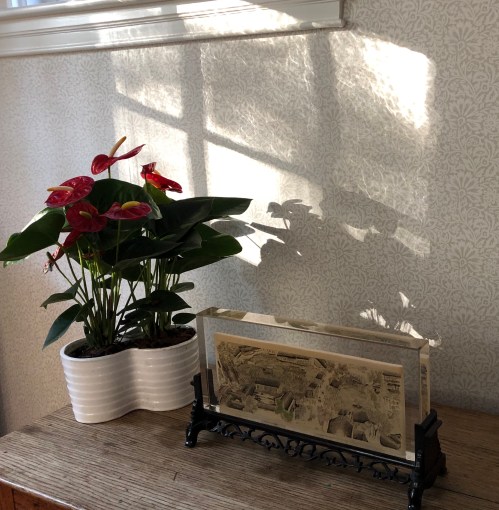
Shadows from objects in a window caught my eye on my way down the stairs. The garage door is a favorite photography subject for me, probably because of the light. The cardinal and the bird feeder make me think of the wonderful children’s biography of artist Horace Pippin called A Splash of Red — a reference to one of the self-taught artist’s signature touches. My older granddaughter likes looking for the splashes of red in the book.

The last photo is of a quiet street in early morning light.

032019-early-sign-of-spring

031619-Paddington-birdhouse

032819-Colonial-Inn-Chimney-and-lichen

032119-start-each-day-with-a-grateful-heart

032019-rock-circle-at-wellness-center

032019-clay-bird-shadows-in-window

031719-garage-window-in-sunlight

032819-Cardinal-and-red-bird-feeder


032419-sunlight-Sunday


Photo: Alamy
Binghamton University researchers have found that Easter Island’s moai statues were built close to sources of fresh water. A new study adds weight to the idea that communities competed through monument building, not violence.

There’s always something new that research can reveal, even in parts of the world that seem to have been endlessly studied.

Consider this report on the Easter Island statues by Nicola Davis at the Guardian. “The huge stone figures of Easter Island have beguiled explorers, researchers and the wider world for centuries, but now experts say they have cracked one of the biggest mysteries: why the statues are where they are.

“Researchers say they have analysed the locations of the megalithic platforms, or ahu, on which many of the statues known as moai sit, as well as scrutinising sites of the island’s resources, and have discovered the structures are typically found close to sources of fresh water. …

“ ‘What is important about it is that it demonstrates the statue locations themselves are not a weird ritual place – [the ahu and moai] represent ritual in a sense of there is symbolic meaning to them, but they are integrated into the lives of the community,’ said Prof Carl Lipo from Binghamton University in New York, who was co-author of the research. …

“It is thought the monuments represent ancestors and were linked to ritual activity, forming a focal point for communities, but the reason for their locations was previously a mystery. … The team focused on the east of the island, where various resources have been well mapped …

“After finding no link to the proximity of rock used for tools or for the monuments, they looked at whether the ahu were found near other important resources: gardens spread with stones in which crops like sweet potatoes were grown, sites linked to fishing, and sources of fresh water. The island has no permanent streams, and there is little evidence that residents relied on the island’s lakes.

“However, fresh water passes through the ground into aquifers, seeping into caves as well as emerging around the coast. … The results of the new research, published in the journal Plos One, reveal proximity to freshwater sites is the best explanation for the ahu locations – and explains why they crop up inland as well as on the coast.

“ ‘The exceptions to the rule about being at the coast where water comes out actually are met by the fact there is also water there – it is found through cave locations,’ said Lipo, adding historic wells were found to explain some ahu locations apparently without fresh water. …

“He says the study also adds weight to the idea that communities competed and interacted through monument building, in contrast to the idea that islanders engaged in lethal violence over scarce natural resources – something Lipo says there is little evidence for. …

“And community and cooperation, stresses Lipo, were crucial in construction of the monuments. ‘Anything that brings you together is going to make you stronger and allow you to survive,’ he said. ‘I think that is the secret to Easter Island.’ ”

More at the Guardian, here.

Photo: Joe Carter/British Ministry of Defence
A moai stone statue at the Hanga Roa quarry, Easter Island.

Photo: Aventura Mall
Louise Bourgeois’s Eye Benches are among the impressive works of art at Miami’s Aventura Mall.

When Suzanne was a toddler, I loved going to the mall, Eastview Mall in Victor, New York, so she could run around. Even today, I may go to a mall for my walk when the weather is bad. But on the whole, I avoid the typically oppressive atmosphere of malls. This one in Miami would have to be an exception. It’s a real art gallery.

Alexandra Peers writes at Architectural Digest, “About a dozen years ago, [real-estate developer Jackie Soffer] began buying artworks for the 2.8-million square-foot Aventura Mall, one of the largest in America. …

“A few malls have art, a very few have good art, but almost none have the button-pushers and immersive installations that the Aventura Mall features. Artists on view include pioneers or buzzy contemporary players like Louise Bourgeois, Wendell Castle, Lawrence Weiner, Julian Opie, and Daniel Arsham. There’s a 93-foot-long slide by artist Carsten Höller, who had another one in London’s Tate Modern museum.

“At first glance, it all seems highly unlikely, but — much like Steve Wynn’s groundbreaking Bellagio Hotel, which signaled to a certain set that the luxury property in Las Vegas had Picassos — the art immediately and wordlessly brands the shopping center.

” ‘Mall has slightly negative connotations,’ Soffer notes, but in Aventura, given its size, longevity (it opened in 1983 and has expanded repeatedly since), and events program, it means to be ‘a real community center.’ Plus, the art is an audience attraction — and great selfie bait.

“[Soffer] concedes that there’s also a popular and much-photographed ‘Love’ sculpture on New York’s Sixth Avenue, near the Museum of Modern Art. But she brags happily, ‘That’s red and blue. Ours is a red, blue, and green artist’s proof!’

“Not all the mall’s retail-art mash-ups go smoothly, of course. One October, sculptures by Ugo Rondinone, a series of Easter Island–style heads atop a plinth of weathered wood, were installed in a gloomy corridor. A few weeks later, a store tenant asked when the Halloween decorations were being taken down. He found them ‘scary,’ given their tucked-away locale. It was a classic case of bad placement, laughs Soffer, who adds that the works have been moved to a wide-open area and are quite popular now. …

“Perhaps the biggest surprise of having the art collection in the mall, says Soffer, has been the unexpected number of adults, rather than kids, who want to take pictures with the pieces. An outdoor fountain of spouting bronze gorillas and animals by The Haas Brothers is, if anything, even more popular when bad weather forces the mall to turn off the water—because fans can get much closer to the figures.”

See more of the art here.

Photo: Leo Diaz/ Aventura Mall
Carsten Höller’s Aventura Slide Tower.