Feeds:
Posts
Comments

Photo: Monica LeRossignol
After a devastating wildfire, Bob Wilson, a Southern California real estate developer, gave $1,000 to each of Paradise High School’s 982 students and 105 employees. He is pictured here with student Trevor
LeRossignol.

Compassionate people pop up everywhere. I try to keep my attention focused on that as much as possible. In this example, a wealthy developer was moved to put money behind his compassion after the devastation of the 2018 wildfires in Paradise, California.

In November, Brianna Sacks wrote at BuzzFeed News, “Monica LeRossignol and her son are still stunned by the freshly printed $1,000 check, a gesture that’s brightened the difficult, surreal reality of rebuilding their lives after losing their home and most of their community in Paradise, California.

“On Tuesday night, her 17-year-old son, Trevor LeRossignol, and hundreds of other students, parents, and faculty members from Paradise High School gathered at Chico High School, as they have every week since the Camp fire leveled their town, to catch up, give hugs, rifle through donations, and eat some warm food. But this gathering had a major bonus.

“Bob Wilson, a Southern California real estate developer, was there giving out $1,000 to each of Paradise High School’s 982 students and 105 employees, totaling about $1.1 million in donations.

” ‘I gave him a hug,’ LeRossignol said. … Like thousands of others, the 46-year-old lost everything in the catastrophic wildfire, which has killed 88 people, torched more than 153,000 acres, and destroyed 14,000 homes. The mother, her son, fiancé, two nephews, and six other family members fled for their lives and are now crammed into two bedrooms at a friend’s house in the nearby city of Chico. …

“A few weeks earlier, as the Camp fire continued to burn around Paradise, Wilson came across a story in the Los Angeles Times about the students of Paradise, most of whom lost their homes. It delved into the uncertainty facing Paradise Unified School District and its class of seniors who were readying to graduate.

“The 89-year-old told BuzzFeed News that Paradise High School’s plight stuck with him, reminding him of his own ‘carefree’ days as a teenager. …

‘I made up my mind in five minutes,’ the businessman said Wednesday morning from Chico. ‘I had some of the most profound experiences in my life in high school because I was still able to be a kid, and it broke my heart to think of the experiences these kids were missing.’ …

“About two weeks later, Wilson was flitting between about 10 tables set up inside Chico High’s hallways, handing out envelopes containing a letter and personal check addressed to each student, teacher, and custodian, which he had personally stuffed from one of his offices in Los Angeles. …

” ‘It was a really unique, cool way to give,’ [Paradise High Principal Loren] Lighthall said of Wilson’s donation. ‘It’s been rough, especially for high schoolers who need their friends and there’s no way to get together.’ …

“Two days after the fire tore through their close-knit, rural California town, Lighthall, who has been principal for two years, started a GoFundMe for Paradise High, a ‘high-poverty”‘ school where 67% of students qualified for free lunch last year. Almost every one of the nearly 1,000 students lost their home and ‘everything they own,’ he said. …

“For now, Lighthall explained that their main goal is getting the kids their credits however they can. More at BuzzFeed, here.

By the way, it’s sad that BuzzFeed and other news outlets have had to lay off so many reporters lately, people who come up with good local stories like this one. The news model is changing nationwide and we need to pay for journalism in new ways. My husband and I pay to read the Boston Globe online, the New York Times, and the Guardian. I also have a membership in the investigative news site Talking Points Memo. Online ads are not enough to keep these vital services going.

Photo: Dani Hemmat
The elongated rocks seen above are called lithophones and are used to make xylophone-like music. Found in Colorado as well as other parts of the world, they are 6,000 years old.

Do you sometimes imagine being a person in a completely different period of history? What would it feel like? One thing I’m pretty sure of: you would behave has if your time period was the only one.

But today, let’s imagine living 6,000 years ago, before the European invasion, in what is now Colorado. Let’s imagine having an urge to make music.

Dani Hemmat writes at the Left Hand Valley Courier, “Colorado has rocks that, well, rock. They are called lithophones, and a local archaeologist who first came across these strangely shaped stones 40 years ago is finally sharing their musical story.

“Longmont archaeologist Marilyn Martorano first laid eyes on the long, baguette-shaped rocks almost four decades ago, as a volunteer at what is now Great Sand Dunes National Park and Preserve in southern Colorado.

“The clearly hand-shaped stones, which had been discovered in the area, were housed in the on-site museum when Martorano first saw them. They were a strange set of artifacts for which no one had yet determined a use. Martorano put them back into their drawer, assuming that someday someone would figure out their purpose.

“Thirty years later, Martorano borrowed the rocks from the museum to study. While many had postulated that the rocks were tools for grinding, the absence of typical marks led Martorano away from that theory. She studied for three years, without success.

“The day before she was to return the rocks to the museum, a friend sent her a video that showed a collection of stones from Paris — stones that looked exactly like those she’d been studying. The rocks, musical stones classified as lithophones, had been found all over the world, but never in Colorado. After watching the video, Martorano started tapping the mysterious stones, and their purpose was suddenly clear. …

“ ‘The rock is very dense, usually volcanic, granite or basalt. In order to be shaped, it can’t be hit too hard or too soft,’ Martorano said.

“She presented some of her findings and artifacts during her open-to-the-public presentation on Nov. 8 at Front Range Community College (FRCC). FRCC instructor and Niwot musician Michael DeLalla had heard about Martorano’s work on public radio, and reached out to her. …

“Martorano demonstrated the different tones achieved by hitting the lithophones with wood, antler and bone. The lithophones produce sounds ranging from the sound of tapping on a crystal glass, to a wooden marimba, to a xylophone.

“ ‘Out of the 22 artifacts we studied, we got a minimum of 57 notes out of them. That’s at least two different notes from each stone,’ Martorano said. …

“While most of the stones Martorano has studied have come from the San Luis Valley area, lithophones have been found in the eastern plains of Colorado and near Salida as well. One Colorado percussionist, Jeff Shook, has found several lithophones while digging post holes.”

More here.

Photo: Tom Goldman/NPR
Reporters at rural Oregon’s profitable
Malheur Enterprise keep the news flowing while other local papers nationwide are folding.

This morning I read that television is expanding like crazy, no end in sight. Wasn’t the internet supposed to kill off television? Wasn’t television supposed to kill off radio? It seems to me that new technologies don’t necessarily destroy everything that went before the way cars destroyed horse-drawn carriages. It all depends on whether the old technology finds a new way to meet needs that still exist.

Consider local newspapers. Many are folding — and it’s definitely scary because that’s where big stories often break. But there’s still a need for local news, and I think someone will fill it. In rural Oregon, a small newspaper survived and became profitable by hiring a salesman and improving quality.

Tom Goldman at National Public Radio (NPR) has the story.

“The Malheur Enterprise was founded in 1909, and, like many other newspapers, was languishing. But in the past few years, its circulation has surged and it has won several national awards. … [It] has boomed in the past three years.

” ‘Boomed’ is a relative term when it comes to a rural weekly. Paid subscriptions are at about 2,000. But during a recent week, more than a third of Malheur County’s roughly 30,000 residents read the paper’s online edition. And advertising dollars, the lifeblood of a small newspaper, are way up.

” ‘Our overall revenue is more than triple what it was three years ago,’ says Les Zaitz, the paper’s editor and publisher. ‘Circulation is probably double. We’re profitable, and there are not a lot of papers in the United States that can say they’re profitable.’ …

“Zaitz, 63, was a longtime, award-winning investigative reporter for the Oregonian, the state’s largest newspaper. He is a two-time Pulitzer Prize finalist. But he has always had a passion for small-town papers. Which is why, in 2015, he tabled his retirement plans and bought the Enterprise with family members. The paper, at the time, was almost out of business. It was filled with gossip and press releases.

” ‘It wasn’t delivering much in the way of real local news,’ Zaitz says, adding, ‘[it] had one reporter who primarily focused on high school sports. … It had not had an ad salesperson in 10 years. … There was just no doubt in my mind that if we turned around the news product, and got a salesperson in, we could make the thing profitable pretty quick.’

“Sure enough, the Enterprise now is a serious, award-winning newspaper.

“This spring, the paper won a prestigious national Investigative Reporters and Editors award for its coverage of a case that rocked Malheur County. A man released from the state hospital after claiming he faked his mental illness was accused of killing two people after being freed. The Enterprise was the first weekly paper to win the IRE Freedom of Information award. …

“Reporter Pat Caldwell, who has been a journalist for 22 years, says Zaitz has transformed the way he works. ‘It’s all about detail,’ Caldwell says, ‘detail, detail, detail. Y’know? And why, why, why, why? Why are you doing this? Why is this happening? Who pays for it?’ …

“Zaitz has earned his readers’ trust with his devotion to bedrock principles of journalism. He acknowledges it also helps that he is one of them. His hands are thick from bucking hay and fixing barbed wire fences on his ranch about 100 miles outside Vale. But being on the inside doesn’t mean he and the Enterprise pander. … Enterprise reporting has angered local politicians. Some still don’t talk to Zaitz or his reporters.

” ‘Public officials who’ve evaded scrutiny for decades here aren’t very fond of us in some quarters,’ Zaitz says. ‘But the good public officials, those who are trying to do a good job, they recognize that we are doing our job and we are holding them accountable and we’re making them better governing officials. And they don’t object to that. Because we try to be accurate; we try to be fair. While they may have to salve the sting of a particular story, that sting wears off and they appreciate what we’re doing. …

” ‘Rather than worrying about what’s going on in journalism at the national level,’ he says, ‘let’s turn the periscope around and let’s rebuild from the small guy up. And I think that’s going to have more influence in the long run.’ ”

More at NPR, here.

Photo: Parish of East Baton Rouge Recreation and Park Commission
Kids in Baton Rouge, Louisiana, compete in a sack race using equipment provided by the local parks and recreation commission. Mobile playgrounds designed to fight childhood obesity are catching on nationwide.

Did you always have some kind of gym class in elementary school? Something that kept kids running around and exercising even if it was only Dodge Ball? I did.

In recent decades, many schools have seen cutbacks in classes that are important for both intellectual growth and overall health — arts, music, gym, and more. Concerned communities are doing whatever they can to make up the difference.

Christine Vestal writes at the Washington Post, “In a state with the fourth-highest rate of youth obesity in the nation, the Baton Rouge parks and recreation agency wanted to lure Louisiana kids away from their screens and into the parks to get moving.

“But the low-income youths who needed exercise the most weren’t showing up at the parks. Officials learned that they didn’t have transportation, and their parents were too busy working to take them. So they decided to take the parks to the kids.

“With money donated in 2012 by corporate sponsors and a portion of their parish budget, the local parks and recreation agency, known as the Baton Rouge Recreation, or BREC, bought a box delivery truck, painted it with bright colors, and filled it with scooters, hula-hoops, balls, slack lines, trampolines, sidewalk chalk, and jump ropes.

” ‘The idea came to us one day while we were watching a bunch of kids turn flips on an old mattress someone had discarded near the office,’ said Diane Drake, who directs BREC’s playground on wheels. ‘We realized it wouldn’t take much to get kids moving if we put it right in front of them.’

“Naming the mobile playground BREC on the Geaux (a Cajun play on words for the word ‘go’), the agency in 2013 started what would become a daily program by holding community events at housing complexes, churches, parks, and schools in low-income neighborhoods.

“If peals of laughter and swarms of activity are any indicator, BREC on the Geaux was an immediate success, Drake said.

‘‘ ‘Once word spread, children would come running out of their apartments as soon as we pulled into the parking lot,’ Drake said. ‘It was all we could do to unload the equipment before they grabbed it and ran off.’

“A year after it began, BREC officials drove the mobile playground to a meeting of the National Recreation and Park Association in Charlotte.

“Since then, BREC has received dozens of e-mails and phone calls from other cities seeking advice on how to start a similar program, Drake said. …

“Transporting the joy and the health benefits of play to kids in underserved neighborhoods isn’t a new idea. A concept called ‘Play Streets,’ in which local volunteers work with police and health officials in urban neighborhoods to temporarily block traffic so kids can play, has been thriving for decades in places like London, Chicago, New York, and San Francisco.

“But the idea is now starting to take root in small- and medium-size cities — and in a handful of rural towns — where low-income children and adults are even more susceptible to obesity than in the nation’s urban centers, according to a June report from the Centers for Disease Control and Prevention. …

‘‘BREC started its mobile playground project with $110,000, half from the Blue Cross Blue Shield of Louisiana Foundation and half from the parish budget. A Play Streets project funded by the Robert Wood Johnson Foundation supported play events in four diverse low-income rural communities last summer — Warrenton, N.C.; Talihina, Okla.; Oakland, Md.; and Cameron, Texas — on a much smaller budget: $6,000 for a handful of community events. …

“In Baton Rouge, Louisiana State University’s Pennington Biomedical Research Center found that similar events sponsored by BREC resulted in children getting about 50 percent more physical activity, as measured in Fitbit steps, compared with weekdays and weekends without Play Street events.”

More here.

Photo: Our Home Louisiana
Baton Rouge Recreation celebrates a new mobile-playground truck with Pennington Biomedical Research Center’s Elizabeth Gollub, an evaluator of the anti-obesity initiative.

Photo: Francis Pakes
The view from the Icelandic prison that a criminology researcher asked to stay in.

Abusing people who commit crimes is no longer considered effective for keeping them on the straight and narrow after they serve their time. For a different approach, consider Iceland, where two of the five prisons actually have no locks.

Francis Pakes, a professor of criminology at the UK’s University of Portsmouth, took a firsthand look and wrote about his experience for the Conversation.

“Iceland is a small country tucked away on the edge of Europe. It has a population of only about 340,000 people. Iceland’s prisons are small too. There are only five, altogether housing fewer than 200 prisoners. Of these five, two are open prisons. …

“When I asked the prison authorities in Iceland if I could spend a week in each of the two open prisons they were surprisingly receptive. I got the impression that they quite liked the idea: a foreign academic who wanted to get under the skin of these places by assuming the role of a prisoner. They promised to keep a room free for me. I was grateful and excited. I was going to experience both prisons from the inside. …

“The absence of security features was striking. The first prison I stayed in, Kvíabryggja prison in the west of the country, had little in the way of perimeter security. There is, however, a sign instructing passers by to keep out – mainly aimed at tourists. I could simply drive up to the small, mostly single-storey building and park up. I then walked in (yes, the doors were open) and said hello. …

“It was clear from the outset that prisoners and staff do things together. Food is important in prisons and in Kvíabryggja the communal dining room is a central space. It is where prisoners have breakfast, lunch and dinner together with staff. Prisoners cook the food, and with an officer they do the weekly food shop in a nearby village. Food was plentiful and tasty. It is considered bad form not to thank the prisoner chefs for their efforts. And you have to clean up after yourself. …

“Prisoners have their own room keys but they leave their doors unlocked, pretty much at all times. This is a potent symbol: life in Kvíabryggja is all about trust. I found that difficult at first, knowing that my passport, rental car keys and research notes were all in my room. In the end I did what prisoners do and even slept with the door unlocked. I slept like a baby. …

“It was the informality of the interactions that struck me most. We watched football together. … I got teased a bit of course, as all prison researchers do. But prisoners also shared gossip and many prisoners and staff alike shared very personal, even intimate feelings and stories with me. When Pétur gained his freedom and his dad arrived to pick him up, he hugged many prisoners and staff goodbye, including me. We all got a bit emotional.

“Kvíabryggja is of course still a prison. Many prisoners feel frustrated, angry, anxious, struggle with their health and worry about the future. But the environment is safe and the food a delight. There is contact with the outside world, generous visiting arrangements, and there is always a listening ear. As prisons go, this means a lot.

“This remote prison and with no more than 20 prisoners, and around three staff around at most at any time, is a tiny community. Prisoners and staff smoke together in the cramped but ever busy smoking room. They need to get on.

“Life is defined by these informal interactions. This is not necessarily easy. This prison population is highly mixed. There are female prisoners, foreign nationals and prisoners of pensionable age or with a disability all mixed in together. …

“The importance of getting on is a take away message. This is far harder to achieve in large busy prisons where new prisoners arrive and leave every day. But just like community policing works best if most public interactions are friendly, a prison is a more positive place if most interactions are friendly and benign too.”

More at the Conversation, here.

Sharing Recent Pictures

092318-sudbury-river-meadow-in-sept

012519-sudbury-river-meadow-in-january

Transitions. In September, the meadow along the Sudbury River was green. Last week it was ice.

As kids, John and Suzanne used to skate on the meadow as soon as the river’s overflow ice was strong enough. Perhaps the wooden posts have something to do with a new generation planning to play there. Nowadays, John puts up a backyard rink in winter — just the thing for his family of skaters.

The next photo was taken by my sister in New York City. She says it’s unusual for Riverside Park to have icy puddles like that — one more example of the weather we’ve been experiencing in the Northeast. In my town, Thursday’s deluge came on top of melting snow and ice, and kept my husband bailing out the basement all day.

Next, you see our neighborhood before dawn and after dark, at sunrise and at sunset, in light and in shadow.

I had to include some lovely fungus, of course, and a message in stone that persons unknown left at a pocket park downtown.

012319-nell-finds-lots-of ice-riverside-park

012019-bird-feeder-in-blue-dawn-snow

012319-snow-at-night

010219-striated-sunrise

011119-red-sky-at-night

011119-early-sunshine-garage-door

010919-sun-stripes-in-suburban-neighborhood

123118-fungus

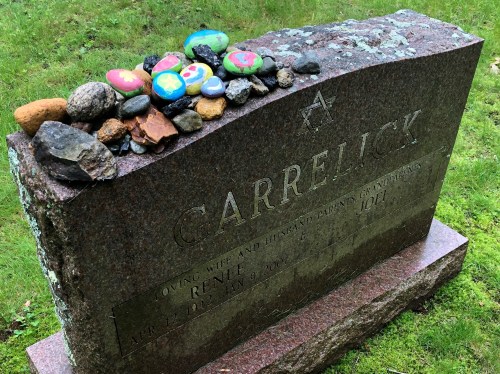
122218-lucky-stones-in-sunlight

Photo: Nick Hagen
Shelving for lights and hydroponic growing trays at Planted’s initial locale. The company aims to grow and sell food for profit while benefiting a blighted community.

After suffering one of the worst downturns of any city in the country, Detroit has benefited from young people looking for affordable housing and from a lot of artistic and economic experimentation. (Search this blog on “Detroit” for an array of stories.)

In one example, an urban farm aims to be both profitable and a boon to residents of a food desert.

Brian Allnutt writes at Model D Media, ” ‘I never had a dream of being an urban farmer, or farming really, until I started feeding people.’

“That’s what Kimberly Buffington says about the transformation that led her to start a non-profit and in turn a for-profit urban farm. 12 years ago, while working in the pastorate of a suburban church, she began to wonder why they were doing mission-work in South America, but nothing closer to home. Through a friend who worked at Trader Joe’s, she began picking up donated food from one of its stores each week. …

“She eventually realized, however, that just providing food wasn’t solving the underlying problem of food insecurity. … Buffington imagined that by growing produce herself she could help provide jobs and establish another local food source.

” ‘It creates food security in our community,’ she says. ‘We don’t have to ship our lettuce from the Central Valley of California.’

“But instead of a traditional soil farm, Buffington started Planted, a hydroponic farm on Detroit’s east side that will focus on growing for local restaurants, institutions like universities and hospitals, and meal-kit companies like Hello Fresh and Blue Apron. …

“Perhaps her biggest selling point [was] producing a number of things locally like herbs and greens that are normally brought in from California and Mexico, especially in the winter months. This would cut down on transport costs and deliver a fresher product.

“Buffington received funding and support from Michigan Women Forward (MIWF), an organization looking to change the investment ecosystem by making loans to women and other underserved individuals. …

“Says Carolyn Cassin, president and CEO of MIWF, ‘We funded Kimberley’s pilot project, which she did in one of her partner’s basements.’ …

“This was the first time they had funded a hydroponic operation, which is a system for growing crops that uses soil-less media like gravel or rock-wool to grow plants in a solution of nutrients dissolved in water. Growers have the ability to control most of the factors that go into producing food, allowing them to grow plants more quickly and with a minimum of pressure from pests and disease. …

“Energy will remain one of the major costs for a business of this kind. Buffington believes that constructing their own building, with attendant geothermal climate-control and solar panels, will help insure long term sustainability. …

“They currently employ eight people in full- and part-time positions. ‘We’ve got the potential to hire a lot of farm hands over time,’ Buffington says. ‘And we’re really committed to a livable and better-than-livable wage. Our business model allows us to do that as we’re successful.’ …

“One of those Buffington has brought on board is local grocer Meg Burritt who previously worked with Blue Apron and other grocers. …

” ‘I can speak from experience,’ Buritt says, ‘I think the way that Planted could interact with these type of companies that are modeled after Blue Apron is to provide a more regional supply for things like tender greens that do travel far, but perform much better if they travel shorter distances.’ …

” ‘As our business becomes profitable we’ll be able to donate products weekly to Eden Gives that will go out into the community,’ she says. …

“For Buffington, it’s a labor of love. ‘It’s joy-filled work every day,’ she says. ‘It’s hard work, it’s concentrated, it’s fast-paced. But there’s a lot of joy in it because every person who connects is happy to be here.’ ”

More here.

Photo: Mark Brodkin Photography/ Getty Images
After archaeologists found steps and postholes on either side of a ramp, they concluded the pyramid builders were able to haul from both directions, shortening the time to complete construction.

What were you taught in school about how the pyramids in Egypt were constructed? The story has always been partly guesswork, like the story of Stonehenge and the giant statues on Easter Island, narratives that change as new bits of data are uncovered.

Kevin Rawlinson writes at the Guardian, “The mystery of how, exactly, the pyramids were built may have come a step closer to being unravelled after a team of archaeologists made a chance discovery in an ancient Egyptian quarry.

“Scientists researching ancient inscriptions happened upon a ramp with stairways and a series of what they believe to be postholes, which suggest that the job of hauling into place the huge blocks of stone used to build the monuments may have been completed more quickly than previously thought.

“While the theory that the ancient Egyptians used ramps to move the stones has already been put forward, the structure found by the Anglo-French team, which dated from about the period that the Great Pyramid of Giza was built, is significantly steeper than was previously supposed possible.

“They believe the inclusion of the steps and the postholes either side of a rampway suggests the builders were able to haul from both directions, rather than simply dragging a block behind them. The team believes those below the block would have used the posts to create a pulley system while those above it pulled simultaneously. …

“Dr Roland Enmarch, a senior lecturer in Egyptology at the University of Liverpool and the co-director of the project that made the discovery, the Hatnub Survey, … told the Guardian that … the alabaster quarry itself, as well as the inscriptions they were there to study, had been known to Egyptologists for a long time, having first been found by Howard Carter – the discoverer of Tutankhamun’s tomb.

“His team’s original focus was not on the ramp leading down into the quarry, but on properly documenting the inscriptions found there. But their attention was soon drawn to the former’s construction – and what it could tell them about how pyramids were built.

“They said the inscriptions allowed them to date the ramp to around the time of the Pharoah Khufu, or Cheops, who built the Great Pyramid.” More here.

It’s amazing how archaeologists keep deepening our knowledge of the past. At the same time, the use of slave labor in building these monuments remains almost too painful to think about. And it reminds me that although slavery is no longer accepted as normal, we still face huge challenges to obliterate it.

Photo: Roger Mastroianni
Audiences in depressed regions nationwide identify with characters who lose their jobs in Lynn Nottage’s award-winning play
Sweat.

Oskar Eustis, artistic director of the Public Theater in New York City, has done a service to struggling communities around the country where his Mobile Unit has performed a play about factory closings.

Although I myself usually like a little something upbeat at the end of a play, I totally get the relief and catharsis of a bleak story that replicates an audience member’s bleak situation. Being heard, being recognized, can be the beginning of moving forward.

Elizabeth Pochoda explains how the show that did one tour of the country and hopes to get funding for more is helping people move beyond the devastation of communitywide job loss.

“Oskar Eustis, the Public’s artistic director, may be best known for commissioning Angels in America,” Pochoda writes, “but his most radical move is a recent one: sending the theater’s Mobile Unit on its recent five-state, 18-city tour through the heartland to perform Lynn Nottage’s Pulitzer Prize–winning Sweat, a traditional theater piece about race and class in Reading, Pennsylvania, as a metal-tubing plant closes and lives are fractured. Most of the action takes place in a local bar as friends experience the loss of every certainty that work bestows, including that of friendship. …

“The Mobile Unit has done far more than drop in for an evening of theater. Along with community organizations, public libraries, Rotary clubs, humanities councils, and whoever else is interested, it has encouraged lectures, discussion groups, story circles, and art pieces in the weeks before and after staging a free performance of Sweat. …

“I met [Chiara Klein, the Mobile Unit’s national project leader,] in Kenosha, Wisconsin, where Sweat played at the local headquarters of the United Auto Workers, the once-powerful union that ruled the city until American Motors and Daimler-Chrysler closed all but one of their plants in 1988, putting 5,300 people out of work and blighting the cityscape for years to come.

“The union-hall venue might seem too obvious for a play about a city where labor is flat on its back, but Sweat has also played to receptive crowds in Minnesota towns with no history of manufacturing and in places as tiny as Hayward, Wisconsin, a town in the rural north where 150 people, both tribal and non-tribal, were as receptive as the audience in Erie, Pennsylvania. That doesn’t surprise Lynn Nottage, who has visited five of the tour cities; people who feel invisible and unheard, she tells me, whether they are black, white, old, young, rural or urban recognize themselves in her play….

“By performing in high-school gyms, a Masonic temple, a cafeteria, and a food pantry — places that don’t announce the evening as an exclusionary arts event, the Public’s Mobile unit has attracted the people it wants to reach.

“Some 200 of them entered the union hall on October 16 and not all of them were white and over 50. A number of older African Americans and some young people of both races were there as well. The Mobile Unit frames the evening to create an atmosphere of mutual regard and goodwill deliberately at odds with that in the play. …

“There is a stage here, but the players will not use it. Instead, they will perform in a small space hemmed in by our chairs. It works well for the barroom scenes where friendships are frayed and no one has anywhere to turn. We are in on the action. …

“At the play’s end, its uneasy note of hope fades away and the audience is given time to reflect by filling out a questionnaire asking them their ZIP Code, ethnicity, gender, emotional response to the play, its relevance to their community, and even what media outlets they turn to for news. … This interlude may be responsible for the candor of the ensuing conversation led by Klein. …

“An African-American woman described it this way: ‘It’s a feeling of being overpowered. A job goes away, a family has to find its way in a new place; then the drugs.’ A 21-year-old white man said he saw himself in the characters and cried that he too had no future. Several people responded to the decibel level of anger in the play and saw it as emblematic of how quickly everything now turns to shouting.”

Read the article at the Nation, here. The play itself is grim, but with the release of emotions some in the audience may feel strengthened in their efforts to build a future on top of the ruins.

A Minotaur in Toulouse

Photo: Eric Cabanis/Agence France-Presse — Getty Images
Looming over mere mortals, a Minotaur strode through the streets of Toulouse, France, for an immersive art exhibition in November.

There are days I think that artists will save the world.

We have too many real-life monstrosities weighing us down. If we make the mistake of watching the news before bedtime, evil forces get into our dreams. Along with the demons comes a sense of helplessness — a feeling we ought to do something about this, but we don’t know what.

But fantasy monsters? Oh, yes, please! The more wildly imaginative artists we have, the more fantasy monsters, the better for me. I would absolutely love to look out the window one morning and see a giant mechanical spider. I would also love the feeling that I’m not responsible to do anything about it.

Alissa J. Rubin writes at the New York Times, “Imagine looking out the window one morning and seeing a gigantic spider perched on the roof of a neighboring building — its eight legs extending to the street below. Then you walk downtown and realize that a 50-foot-tall creature with the head of a bull and the body of a man was looming above you.”

In November, the French city of Toulouse gave “itself over to an immersive form of street theater, bringing to life creatures like the giant spider and the Minotaur, the mythical monster from Greek mythology that is half bull and half man and said to have lived in the center of a maze on the island of Crete.

“Both creatures are the conception of François Delarozière, the artistic director and leading creative force behind La Machine, a theater company that works with technicians and designers to fabricate mechanical creatures on a vast scale and creates public spectacles around them. …

“Mr. Delarozière described his goal to local news outlets as making the city and its residents all part of a vast work of art by giving them a common topic to react to so that they would ‘talk to each other’ and ‘the whole city becomes a place of theater.’ …

“The Minotaur is made of unpainted lime tree wood and metal. It has been constructed to seem as real as possible and even makes the sound of breathing as it moves.

“Apparently ‘asleep,’ he was pulled along by some of the 16 technicians who coordinate his movement, his peaceful but powerful breathing heard above the crowd’s chatter. His arrival, which constituted Act I of the drama, was accompanied by a cast of scores of actors, opera singers and musicians.

“On Friday morning came Act II. Toulouse residents and visitors found him the following morning still asleep in the middle of one of the main squares. But he soon roused and began to move through the streets.

“By evening, the spider, named Ariane, was awake as well, and was poised on the top of the Hotel Dieu.”

More at the New York Times, here.

Photo: John Waire/Washington Post
Richard Antoine White behind the scenes during the filming of “R.A.W,” a documentary about his life and musical career.

What is it about tuba players and altruism? Maybe I should say, What is it about Baltimore tuba players?

Not long ago I wrote a post about a Baltimore tuba player’s inspiring outreach to young impoverished musicians (here), and now I have a related story about a tuba player who grew up poor in Baltimore and now mentors kids.

Tim Smith writes at the Baltimore Sun, “Richard Antoine White looks back on his life — poverty and an unsettled family life growing up in [the Sandtown section of Baltimore]; tuba studies at the Baltimore School for the Arts, Peabody Institute and Indiana University; his current jobs with the New Mexico Philharmonic and University of New Mexico — and sums it up simply: ‘The American Dream is still alive and well.’ …

“White’s successful pursuit of that dream has been chronicled in the documentary ‘R.A.W.’ (White’s initials) by Baltimore filmmakers Darren Durlach and David Larson, co-founders of Early Light Media. …

“ ‘I feel honored and humbled that they wanted to do a film about me,’ says White, 45. ‘There was an awe factor when they showed up in Albuquerque. I thought, you guys are really going to follow me around with a camera? But I trusted them to tell this story appropriately.’

“Storytelling is a specialty for Durlach and Larson. They formed their production company not only to make a living (clients for their video work include companies and foundations, local and beyond), but also to give themselves an outlet for spotlighting worthy individuals and causes. … The duo decided to direct that interest into Invisible Thread, a venture they envisioned as a series of ‘people-driven stories.’ …

“[Their first film] had a screening at the Baltimore School for the Arts, where Durlach and Larson met the school’s director, Chris Ford.

“ ‘We were talking with him about an idea we had for a feature film about the arts, specifically arts education, in our culture,’ Durlach says, ‘how the arts are misunderstood, underfunded, and underutilized. And Chris said, “You know who you need to talk to is Richard White.” …

“ ‘The second we met Richard, we fell in love with him and were inspired by him,’ Durlach says. … For several days, the filmmakers shadowed White to chronicle his life in Albuquerque, where he is principal tuba in the New Mexico Philharmonic and associate professor of tuba/euphonium and associate director of the Spirit Marching Band at the University of New Mexico.

“The action then shifted to Baltimore, where more filming took place at the Baltimore School for the Arts and Peabody. The filmmakers also accompanied White to places in Sandtown, where he spent difficult years as a child and had largely avoided revisiting.

“ ‘Family members would sometimes let my mom and I sleep on a couch,’ White says. ‘Sometimes I slept under a tree or in an abandoned house. My mom had problems with alcoholism and finally gave me up. Her foster parents took me in. …’

“After White’s life smoothed out with the help of his foster parents, he found himself drawn to music — first the trumpet, then the tuba, which he learned partly with the help of a self-teaching tape. That gave him the confidence to go to the Baltimore School for the Arts, ready to audition for admission. … White gained admission.

“ ‘That proved to be a good decision on our part,’ Ford says. ‘He was an incredible worker. Through sheer grit, he was pushing past everyone. And he was a delightful individual throughout. ….

“ ‘Richard moved from someone who needed a handout to someone who now puts his hand out to help others,’ Ford says. ‘He’s been really powerful mentoring some of our kids.’ ” More at the Baltimore Sun, here.

Photo: Terry Smith/ AthensNews.com
“The American Woman,” a sculpture by the late David Hostetler in the Wolfe Garden on Ohio University’s College Green, is part of the 144-mile Ohio Art Corridor.

How encouraging to see communities embrace initiatives that lift people’s spirits and to read that towns are actually spending money on those things! It’s true that parks, trees, and art in a municipality offer economic benefits, but things are also worth doing just because they’re good.

I bet that Ohio’s 144-mile arts corridor, which is meant to lure tourism dollars to an area that has been struggling in recent years, is pretty successful at making the locals feel happy. Nothing wrong with happiness. Nothing wrong with a sense of pride and well-being.

Nancy Trejos writes at USA Today, “Southeastern Ohio is trying to attract visitors by giving them something unique to look at. … The founders believe The Ohio Art Corridor is the largest outdoor gallery in the world, surpassing one in Stockholm that covers 70 miles.

“ ‘Our desire is to draw people out of the big cities, to take a drive through the beautiful Appalachian country of Ohio, to learn, grow, and have experiences that they otherwise would not have,’ says Rebekah Griesmyer, executive director of The Ohio Art Corridor.”

Reporter Fred Kight from Athens News has more.

“The corridor extends 144 miles through Athens, Morgan, Fairfield, Muskingum and Pickaway counties. It currently consists of eight sculptures and two large murals, and organizers hope to add new works.

“ ‘I love the idea. … Public art is wonderful,’ said Athens Mayor Steve Patterson. …

“Griesmyer said, ‘We are attempting to draw people to small cities and towns with outdoor art. It is a huge project, and we couldn’t be more excited to see it implemented and adopted by cities like Athens.’ …

“In order to be included on a Corridor map, the art must [now] meet three criteria. It must be outdoors and free; it must be large; and if the art is not large (over 12 feet) as one piece, it must consist of three sculptures in one place.”

The idea’s originator is Griesmyer’s brother-in-law, David Griesmyer. He “operates a metal fabrication business in Malta, across the Muskingum River from McConnelsville. Creation of the Corridor combines his love of art with a desire to bring new life to the region.

“ ‘This part of Ohio is so rich with beauty, talent and creativity,’ he said. ‘I see southeast Ohio as a large stone ready to be carved, only to reveal a masterpiece hidden within.’ ”

More at the Athens News, here, and at USA Today, here.

Photo: WGRZ-TV
This section of the Ohio Art Corridor is located on the Muskingum Parkway across from the Morgan County Fairgrounds.

Good Work, Suzanne!

Just sharing the news that an antique locket from Luna & Stella, my daughter’s company, is in the February issue of Vogue magazine. Even though it’s partially hidden inside the model’s shirt, we’re pretty excited to see it — and the credit for the company.

More vintage lockets at Luna & Stella.

feb2019-luna-and-stella-antique-locket-vogue-magazine

Photo: Eric Helgas for the New York Times
Tiny books, called dwarsliggers in the Netherlands, are the size of a cellphone and feature extremely thin pages that a reader can flip horizontally as if scrolling.

When I was a kid, I loved the Golden Book collections that the publishers miniaturized. I still have the set I got for my own children, and I notice that my grandchildren are drawn to the surprising size. So I’m guessing that a kind of tiny book already popular in Europe is going to take hold in the US, not just with kids.

Alexandra Alter writes at the New York Times, “As a physical object and a feat of technology, the printed book is hard to improve upon. Apart from minor cosmetic tweaks, the form has barely evolved since the codex first arose as an appealing alternative to scrolls around 2,000 years ago.

“So when Julie Strauss-Gabel, the president and publisher of Dutton Books for Young Readers, discovered ‘dwarsliggers’ — tiny, pocket-size, horizontal flipbacks that have become a wildly popular print format in the Netherlands — it felt like a revelation.

“ ‘I saw it and I was like, boom,’ she said. ‘I started a mission to figure out how we could do that here.’

“[In October], Dutton, which is part of Penguin Random House, began releasing its first batch of mini books, with four reissued novels by the best-selling young-adult novelist John Green. The tiny editions are the size of a cellphone and no thicker than your thumb, with paper as thin as onion skin. They can be read with one hand — the text flows horizontally, and you can flip the pages upward, like swiping a smartphone. …

“Mr. Green was already familiar with dwarsliggers, which he first saw several years ago, when he was living in Amsterdam (the term comes from the Dutch words ‘dwars,’ or crossways, and ‘liggen,’ to lie, and also means a person or thing that stands out as different). In the last decade or so, the format has spread across Europe, and nearly 10 million copies have been sold, with mini editions of popular contemporary authors like Dan Brown, John le Carré, Ian McEwan and Isabel Allende, as well as classics by Agatha Christie and F. Scott Fitzgerald. …

“ ‘Like a lot of writers, I’m a complete nerd for book making and the little details that make a physical book really special,’ Mr. Green said. ‘It didn’t feel like a gimmick, it feels like an interesting, different way to read.’ …

“Dutton and Mr. Green are hoping that younger readers from a generation that grew up with the internet and smartphones might be receptive to the concept of a miniature flipbook.

“ ‘Young people are still learning how they like to read,’ Mr. Green said. ‘It is much closer to a cellphone experience than standard books, but it’s much closer to a book than a cellphone. The whole problem with reading on a phone is that my phone also does so many other things.’ …

“Ms. Strauss-Gabel began her mission to import flipbacks to America this year, when she received Dutch editions of two of Mr. Green’s novels. She was startled by their size and ingenious design — the spine operates like a hinge that swings open, making it easier to turn the pages. She contacted the Dutch printer, Royal Jongbloed, and asked if Dutton could become partners with the company to print English editions. …

“But getting English flipback editions of Mr. Green’s books proved endlessly complicated. Jongbloed is currently the only printer in the world that makes them, using ultrathin but durable paper from a mill in a village in Finland. The first sample pages that Jongbloed sent looked cluttered, with letters and words crammed too close together. …

“ ‘I have no idea how people will respond to this,’ Mr. Green said. ‘They’re objects that you almost can’t get until you’re touching them.’ ”

More at the New York Times, here. I expect that one-handed reading will improve life in crowded subways, where commuters are likely to need the other hand just to hold on.

Photo: AbeBooks
Remember these?

Photo: Dezeen
A new prosthetic leg allows an amputee ballet dancer to go on pointe. The designer imagines whole dances on pointe.

Generations of little girls in my family have taken ballet classes, and probably each of them has spent more than an hour or two dreaming of life as a prima ballerina. After a while, though, little girls get interested in something else or the challenges become too daunting.

Now imagine just how daunting it would be for an amputee who is determined to dance.

Ali Morris writes at the design magazine Dezeen, “Pratt Institute graduate Jae-Hyun An has created a prosthetic leg that allows amputees to perform ballet like never before.

“Unlike regular artificial limbs, which are designed to mimic the human body, the Marie-T enables amputee ballet dancers to enhance their performance.

“Made up of three components, Marie-T features a weighty foam-injected rotational moulded foot, with a stainless-steel toe and rubber grip that help provide the dancer with balance and momentum during rotations.

“In mainstream ballet, dancers typically move in and out of the pointe position – when all body weight is supported by the tips of fully extended feet within pointe shoes.

“However, because of the immense strain on the foot and ankle of a performer, it is impossible for a ballet dancer to constantly perform in this position.

“Jae-Hyun An, who studied on the Pratt’s Industrial Design programme, designed the carbon-fibre Marie-T to enable amputees to dance on pointe throughout a performance.

“New York-based An said the design, which is named after 19th-century Swedish ballet dancer Marie Taglioni, could encourage amputees to develop a new choreography that has never been achieved by mainstream ballerinas.

” ‘I wanted to explore what would happen if you could allow a person to perform on pointe 100 per cent of the time,’ said An, who developed Marie-T over the course of four months. …

“During research, An realised that a weak ankle can twist and cause a ballerina in pointe position to wobble. In response, An designed a strong and stable ankle area that helps the ballerina stay in balance.

“The ankle connects to a slightly curved carbon-fibre limb which helps absorb the shock from the impact of the ballet dancer stepping forward. The limb is topped by a 3D-printed socket with steel round head screws.

“Ill-fitting prosthetic limbs can cause blisters and rashes on dancers, so An designed the Marie-T so that the parts can be easily switched out when they become well worn or need to be resized. …

” ‘In my research I came across Viktoria Modesta and she re-interpreted performance with her prosthetics. It was visually so powerful and opened a completely new area of prosthetics for me. I fell in love with the idea of designing something that could expand the artistic and cultural scene of a community with prosthetic users.’

“To continue developing this project in the future, An hopes to collaborate with an amputee dancer who has their own vision for prosthetic ballet.

” ‘The design of the prosthesis will change to fit the dancer, but also to match the specific movements of the newly developed choreography,’ he explained. ‘However, until I meet this dancer, I will continue to develop as a designer.’ ”

More at Dezeen, here.