Feeds:
Posts
Comments

shmds7f6uui6rb4spbyzc5zfb4

Photo: Katherine Frey/The Washington Post
Stores along Main Street in the refugee-welcoming town of Ellicott City sustained severe damage after flooding in May. Grateful refugees were determined to help out after all the kindness shown them.

Not only do refugees contribute to both the US economy and the budget, but many are eager to return kindnesses shown to them when they were first finding their way in an unfamiliar land. In this article, Syrians did some fund raising for a small, flooded town that had welcomed them. Terrence McCoy reported the story for the Washington Post.

“The first time Majd AlGhatrif saw this historic mill town of colonial buildings at the confluence of the Patapsco and Tiber rivers [in Maryland], he thought of Syria.

“The structures, built of gray stone, and the history they evoked, reminded him of the timelessness and architecture of his hometown, Sweida, in southern Syria. He soon bought a house here, in 2013, then opened Syriana Cafe & Gallery, in 2016, and came to view everything about Ellicott City’s people — their kindness and decency — as an antidote to the fear others were expressing over Syrian immigrants like him.

“So when floods again ripped through here in May, killing a Maryland National Guardsman, closing businesses up and down its historic district and producing images of destruction recalling the floods of 2016, he vowed to do anything he could to help a community that had become his own.

“The result of that vow came to fruition [September 22] at Syriana, where he presented the city with a check for $10,000, which he had raised from Syrian Americans from all over the country who had seen the destruction and wanted to show their gratitude not just to Ellicott, but also to the United States for accepting them.

We wanted this to be a payback from Syrian Americans to a generous America,’ said AlGhatrif, a physician at Johns Hopkins Bayview Medical Center, handing an oversize check to community leaders.

“The check was a rare bit of good news in a city that has survived 246 years but is now reckoning with its own mortality — one more town grappling with existential questions, as the globe warms and natural disasters increase in frequency and ferocity. …

“The community is considering a sweeping $50 million plan to mollify future damage from flooding, but it would require the demolishment of as many as 19 buildings, cleaving out a piece of history in a city whose livelihood to a large degree depends on that very history.

“What we have to realize is that if we don’t do something, the town will die,” said Howard County Executive Allan Kittleman (R). … After the last flood, he said, ‘the calculus changed.’

“AlGhatrif witnessed that firsthand. … He knew that the community meant a lot not just to him, but also to other Syrian immigrants and refugees. His cafe employed several who, after years of fear during the Syrian war, had come to feel safe in Ellicott City.

“One was Safa Alfares, 17. She was born in Aleppo, whose scenes of war and bodies still dominate her thoughts. [She] had arrived expecting to face Islamaphobia. …

“But as she learned English, in which she became fluent in less than two years, and after she found a job at Syriana, her sense of foreboding gave way to something she had not experienced since the beginning of the war: calm.”

This is such a touching story. Read more here.

Hat tip: @bostonmigration ‏on twitter.

 

Detective Archaeologists

2251

Photos: British Museum
Tello in Iraq is the site of one of the oldest cities on earth. After the fall of Saddam, looted treasures ended up in London and, thanks to archaeological detective work, have been returned. Today the site is protected by both Iraqi archaeological police and a local tribe.

When you think something is lost forever, hold on to hope. If looted archaeological fragments that have been smuggled to another country can be identified and returned, you can find the family heirloom you put in a too-safe place. You can find the delight you once took in simple things back when you were too young to read the news.

Maev Kennedy reported for the Guardian in August, “A collection of 5,000-year-old antiquities looted from a site in Iraq in 2003 after the fall of Saddam Hussein, and then seized by the Metropolitan police from a dealer in London, will be returned to Baghdad this week.

“It comes after experts at the British Museum identified not just the site they came from but the temple wall they were stolen from.

The eight small pieces had no documentation of any kind to help the police, but the museum experts could literally read their origin.

“They included cone-shaped ceramics with cuneiform inscriptions identifying the site as Tello, ancient Girsu in southern Iraq, one of the oldest cities on earth recorded in the earliest form of true written language.

“The inscriptions named the Sumerian king who had them made almost 5,000 years ago, the god they were dedicated to, and the temple. And by an extraordinary coincidence the museum had an archaeologist, Sebastian Rey, leading a team of Iraqi archaeologists at the site, uncovering the holes in the mudbrick walls of the temple they were torn from, and the broken pieces the looters had discarded. …

“Iraqi ambassador Salih Husain Ali [said] the protection of antiquities was an international responsibility and praised the British Museum and its staff ‘for their exceptional efforts in the process of identifying and returning looted antiquities to Iraq.’ …

“St John Simpson, the assistant keeper at the Middle East department of the museum, said: ‘Uniquely we could trace them not just to the site but to within inches of where they were stolen from. This is a very happy outcome, nothing like this has happened for a very, very long time if ever.’ …

“The site of the Eninnu temple at Tello is now protected, not just by the reformed Iraqi archaeological police, but by a local tribe. …

“With no apparent way of tracing their origin, they sat in police stores until some of the antiquities cold cases were reopened with the reforming of the Met’s art and antiquities squad, and brought to the museum earlier this year. …

“The museum experts hope their methodology could be used to create maps of specific sites and types of antiquities, making the work of looters much more difficult.”

More at the Guardian, here. Wouldn’t you like to reach across time and tell the craftsman of the sweet little bull below that people in 2018 are still enjoying it?

Treasures looted from the site of an ancient city in Iraq include a tiny marble amulet of a bull.

1793

PUBLIC WORKS Musical Adaptation of William Shakespeare's
TWELFTH NIGHT

Conceived by Kwame Kwei-Armah and Shaina Taub 
Music and Lyrics by Shaina Taub
Choreography by Lorin Latarro
Directed by Oskar Eustis and Kwame Kwei-Armah

Featuring Kim Blanck (Femal

Photo: Joan Marcus
From left, Daniel Hall, Lori Brown-Niang, Shaina Taub, and Shuler Hensley in “Twelfth Night” at the Public Theater’s Shakespeare in the Park. Brown-Niang’s peignoir is usually “the first to go” on exceptionally hot nights when the feathers start shedding.

On this second day of fall in Massachusetts, the temperature was only 45 degrees at 6 a.m., when I wrote this. I felt very glad that 2018’s overpowering heat and humidity were past.

I can only imagine what it must have been like for outdoor actors under fierce stage lighting in summer 2018. At American Theatre, there’s a fun article about designing costumes for actors performing in all kinds of weather.

Billy McEntee wrote, “Across the country, as actors and audiences endure rain, heat, and bugs to present and partake of free professional performances of the Bard’s classics, one group of designers has a special challenge: costume designers. …

“ ‘Designing for outdoor environments is challenging yet fascinating,’ said Ying-Jung Chen, the costume designer for Independent Shakespeare Company’s ‘Titus Andronicus’ in Los Angeles. … ‘I’ve learned a lot through each outdoor experience about fabric technology and construction techniques.’ …

“It’s the dry heat that can prove most threatening. Evenings in the summer can stay above 80 degrees in Southern California; couple that with acrobatic performances, bushy wigs, and blaring stage lights, and actors are sure to sweat through even the thinnest of fabrics. …

“But heat invites more than just exhaustion and sweat; it’s also a magnet for bugs, something that Chen had to account for when creating stage blood for her costumes.

” ‘Blood is integral to Titus,’ Chen says. ‘My recipe was successful in past indoor productions. With a corn syrup base, it’s easy to wash out, edible, and realistic. But when doing outdoor performances, the sugar-based corn syrup attracts bugs. Fortunately, the theatre company has years of outdoor performance experience and provided a great recipe that’s washable, edible, and doesn’t allure insects.’ …

“Rain is no stranger to American Players Theatre in Spring Green, Wisc., though the threat of precipitation doesn’t change the creative process. As costume designer Robert Morgan succinctly puts it: ‘Design first, problem-solve later.’ He’s the costume designer for APT’s ‘As You Like It’ (running through Oct. 7). …

“ ‘Shoes are covered with non-slip dance rubber,’ he says. ‘But evening dew can make our outdoor stage slippery, so at APT we add sand to paint’ to give the stage’s surface extra traction.

“As in L.A., Morgan must also consider sweltering temperatures. This includes having freezer packs on hand for actors to wear beneath their costumes and crafting a ‘heat plan.’ which is ‘meant to accommodate the actors’ well-being on exceptionally hot, muggy nights and matinees under an unforgiving midsummer sun,’ Morgan said. …

“Oppressive heat and humidity are staples of New York summers as well. After a successful first run in 2016, Andrea Hood returned to design costumes for the Public Theater’s current Shakespeare in the Park production, ‘Twelfth Night,’ a Public Works musical adaptation with songs by Shaina Taub. …

“Hood plans not only the intricacies of [the] fabrics but also how costume pieces may adjust with unexpected precipitation. ‘Fuchsia feathers often come loose on [the character] Maria’s peignoir in “Twelfth Night,” ‘ she notes. ‘It isn’t the most practical costume for an outdoor space, so if it’s raining she would likely skip that change altogether. It’s the one piece that would probably not go onstage in the rain.’

“But a light drizzle doesn’t always signal a costume adjustment, or even a cancelled performance. In fact, its effect—combined with stellar acting, of course—can be as spellbinding as any theatrical flourish, more dazzling than any stage magic.

“ ‘Last year it was pouring for the first night of tech for “As You Like It,” ‘ Hood recalled. ‘The actors didn’t get into costume at all.’ Instead they wore street clothes, covered with plastic ponchos. ‘It was wonderful,’ she enthuses. ‘By midnight there were only five actors left running a number over and over again, still managing to smile. I loved being in the audience watching them—the rain didn’t even matter.’ ”

More at American Theatre, here.

savoirbedsxnationalgallery_savoir_felix_with_jan_van_de_cappelle__a_shipping_scene_with_a_dutch_yacht_firing_a_salute__detail__portr-1080x1446

Art: Jan van de Cappelle
Photo: Savoir Beds
Detail from “A Shipping Scene with a Dutch Yacht firing a Salute” (1650) used on a bed’s headboard.

I thought this was an interesting idea, but if I were going to have art that close to my pillow, I would want it to be soothing, wouldn’t you? A yacht firing a salute would surely wake me up.

Monica Uszerowicz reports at Hyperallergic about a new concept in headboards.

“When Gherardo di Giovanni del Fora painted ‘The Combat of Love and Chastity’ sometime between 1475 and 1500, he was likely illustrating two of the poet Petrarch’s ‘Triumphs,’ translating the allegories into a visual battle of love and the thing that quells it. …

“The London’s National Gallery’s website states that the work is part of a series, ‘probably made for a piece of Florentine furniture towards the end of the 15th century.’

“It’s unclear if British bed maker Savoir Beds’ National Gallery Collection, which debuted earlier this year, was an attempt to accomplish the painter’s vision. … Savoir Beds, known for their hefty price tag and their extraordinary contents (think cashmere made from the necks of Mongolian goats), have partnered with home décor specialist Andrew Martin and London’s National Gallery to create custom beds, each upholstered with artwork on the headboard and the base.

“ ‘The Combat of Love and Chastity’ is one choice, but you can make your own: every single artwork owned by the National Gallery can be reproduced onto a selection of handmade beds. … Claude Monet’s ‘Water-Lilies, Setting Sun’ (1907), spread across the Harlech Savoir No. 2, will cost you £29,587 [$38,679]. …

“They’re calling it ‘the fine art of sleeping beautifully.’ But why now — why this sort of patrician indulgence? Alistair Hughes, Savoir Beds’ Managing Director, told Hyperallergic over email that ‘our clients and artisans have always seen our mattresses and designs as works of art.’ ” OK. And?

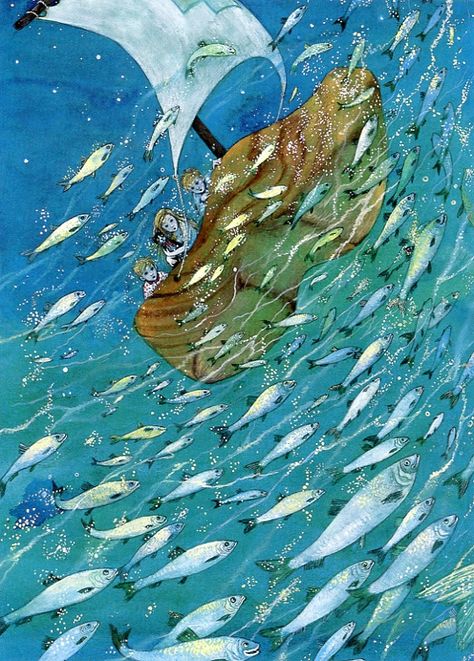
Well, just for fun, what work of art would you want on your headboard if you wanted to go that route instead of giving the money to some worthy cause? I would probably pick something with a moon and stars from a children’s book. Maybe one of the Wynken, Blynken, and Nod illustrations. Someone has collected a glorious array of different artists’ illustrations of that poem, here.

More on the extreme beds at Hyperallergic, here.

632aeccc4e42db4463570117b37b43d7-chloes-closet-wooden-shoe

September in Massachusetts

091418-sandhill-crane-at-dusk

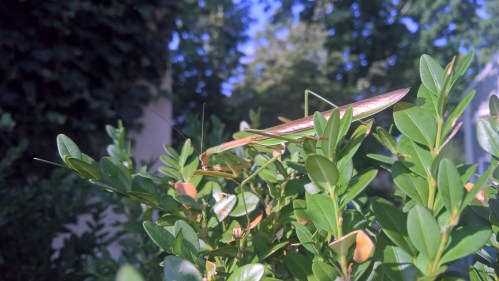
September is already more than half over. How did that happen? Before it’s time for photos of Jack o’ Lanterns, here are a few pictures of September in Massachusetts. Most were taken by me, but the lovely praying mantis photo is my husband’s.

The star clematis has gone berserk all over town this September. So pretty. The herb garden is behind my church, as are the church sexton’s lovingly tended bonsai trees. Mist is rising over the community garden in the early morning.  I shot the ear of corn in the garden of the Old Manse. The great-looking fungus was along the conservation trail by the river. I do find fungus extraordinarily intricate and beautiful. If you’re on Instagram, follow @chasonw for some great examples.

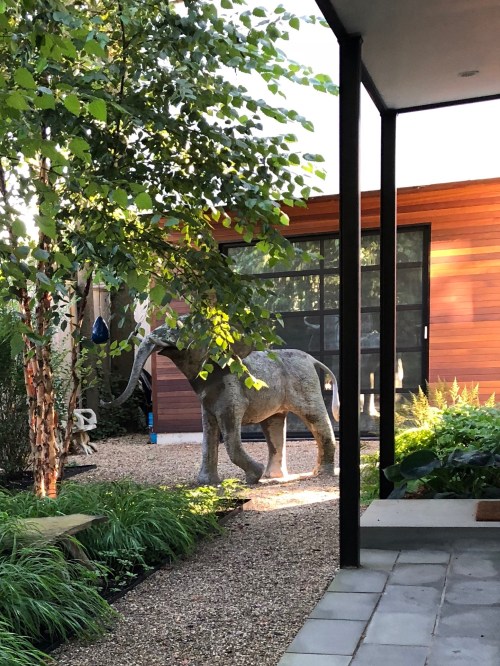
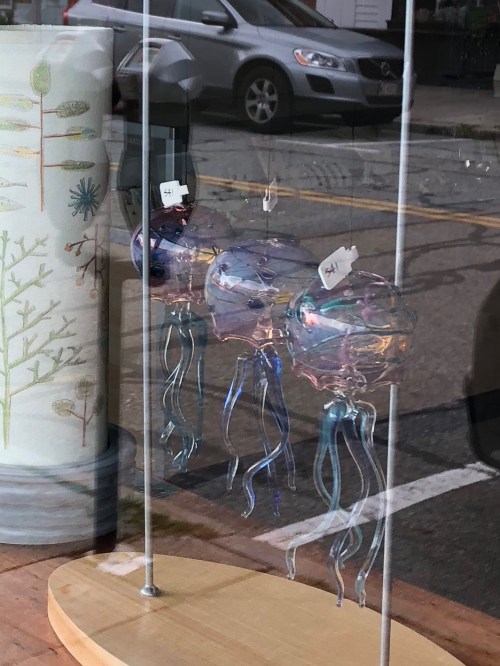
The elephant looks real but is a statue at a home in my neighborhood. Not a street I usually walk down, so I was really taken by surprise when I passed it recently. The offbeat ceramics are in the window of the Lacoste/Keane Gallery, and the glass jellyfish are in a shop called Artisans Way.

I wind up this array with an end-of-summer farmers market, where a tiny boy with a tiny guitar was emulating a musician and a little girl was making friends with a goat.

091118-praying-mantis-by-JRE-ConcordMA

091218-star-clematis

090418-church-herb-garden

090418-the-Bonsai-master-excels

090418-mist-over-community-garden

090418-ear-of-corn-Old-Manse

091618-fantastic-fungus

091618-fungus-along-conservation-trail

091618-neighborhood-elephant-sculpture

090718-multicolored-morning-glories

090718-ceramics-at-Lacoste-Gallery

090718-OMG-glass-jellyfish

090818-guitar-inspiration-ConcordMA

090818-girl-meets-goat

Walking in New York

091818-witch-flies-over-moon

I’m still getting used to having an iPhone and was surprised to learn that my new one was counting my steps. When my husband told me that in Japan, walking 10,000 steps a day is considered ideal for good health, I wondered if I could manage that. At home, it means taking two constitutionals a day, a feat I doubted I would be able to keep up in the winter.

But in New York City, no problem! One day this week I walked more than 16,500 steps without thinking twice. New York is just such a fun place to walk — so much to look at, constantly entertaining. Maybe the storefronts don’t change numerous times a day, but the array of people does. And their pushcarts, fruit stands, clothes, behaviors.

People seem so uninhibited in New York that you could express your inner self to an unheard-of degree and no one would blink. Of course it’s sad that some people on the streets clearly have mental illness. But being used to living around them seems to free up New Yorkers not to care much what people think of their own behavior. I watched one guy oblivious of furiously honking rush-hour traffic and blocking a whole lane while he tried to hook a car to his shish-kebob trailer after work.

Another slammed into wet leaves on a rented Citi Bike and wiped out with a loud crash in the middle of an intersection, picked the bike up, and went on his way. If that happened where I live, it would be on the front page of the local bugle the next Thursday.

Most of what I saw happened too fast for me to get a picture, but I include a couple things that stayed still.

It’s relatively quiet to walk along Riverside Drive in the early morning, and many people and dogs do. Other people sit on the benches and read the paper or drink coffee. This worn park bench had a plaque I particularly liked. It says, “The friends of Susan G. Schwartz honor her and remember how she taught us to sit still.”

Going home today to sit still.

091918-remember-how-she-taught-us-to-sit-still

091918-New-York-car

091918-alligator-in-New-York


image

Photo: CTV News
In 2009, people in New York took turns reading a poem by the late Indian spiritual leader Sri Chinmoy in 111 languages — and broke a Guinness record. For organizer Ashrita Furman, this was just one of many world records to his credit.

As I walk around New York City, I like reading the electronic kiosks that provide information about the city. Other people walk with their heads bent to their phones. I like the kiosks. Among ads and pieces of practical information that the city wants people to know, are brief factoids about the city’s history.

One tidbit that caught my eye on a recent trip highlighted the day that a poem was read in 111 languages outside city hall. My interest in languages and poetry led me to investigate this feat for the blog. But I soon discovered that for the event’s organizer, neither poetry nor language was a motivator. He’s into breaking records.

Clare Trapasso reported on the 2009 event for the New York Daily News.

“Reciting poetry in Zulu may not seem like much of a talent, but it landed Ashrita Furman in the record books — yet again. Furman, 54, of Jamaica, Queens, became the first person to hold 100 Guinness Book of World Records simultaneously Tuesday after assembling a group that recited a poem in 111 languages at City Hall Park. The bunch took turns reading ‘Precious,’ by the late Indian spiritual leader Sri Chinmoy. … More than 100 participants — followers of Chinmoy from around the globe — recited the poem in languages ranging from Dzongkha to Picard.

“Furman, a health-food store manager, has earned about 230 Guinness records since 1979, when he did 27,000 jumping jacks in five hours. Earlier [in 2009], Furman broke the record for eating the most M&Ms with chopsticks in a minute. He ate 38. Over the last 30 years, the man who has broken a record on every continent — including the fastest mile on a pogo stick in Antarctica and the fastest mile on a kangaroo ball on the Great Wall of China — has seen many of his own feats toppled. …

” ‘As a kid I was always fascinated by the Guinness Book of World Records. But I was very unathletic and I never thought I could,’ Furman said. It was only when he discovered meditation as a teenager that he said he started to believe in his own abilities – however quirky they might be.

” ‘I believe we all have an inner strength that we very rarely use,’ Furman said.”

More at the Daily News, here.

screen-shot-2012-07-15-at-10-09-57-am

Photo: MTA Arts for Transit
Faith Ringgold’s mosaic “Flying Home: Harlem Heroes and Heroines (Downtown and Uptown),” 1996, is one of the pieces of subway art featured in a PBS documentary.

I’m always amazed by the beauty of the mosaics in the New York subway, even the ones that merely tell you what street you’re at. It makes me happy to see that the city values them, too, and periodically cleans up the oldest ones. They go back as early as 1901.

My sister alerted me to an excellent PBS documentary about recent additions to the art in the subway system. You can read about it at the website Mosaic Art Now.

“For a delightful immersion into the history and current activities of the enormous underground museum that is the New York subway system’s Arts For Transit program, treat yourself to WNET Channel Thirteen’s free one hour video called ‘Treasures of New York: Art Underground.’ …

“Mosaic artist Steven Miotto gets major face time. His decades-long collaboration with artists of all stripes is a fascinating story in itself. When selected by a commissioned artist as a collaborating partner, he gets into their minds and hearts, leading them through the complex process of translating their vision and their graphic designs into mosaic ‘paintings for eternity.’ …

Faith Ringgold, speaks eloquently and nostalgically about the series of paintings – now mosaics – that portray the heroes of her Harlem childhood. Writers and musicians fly across the cityscape in flattened but vivid characterizations. I had the opportunity to interview her when she was in Miami last year, and she spoke about the challenges of trying to ‘make it’ as an African-American artist dealing with political themes at a time when the galleries favored the abstract.  Click here (http://bitly.com/yxGJ3R) to listen to that interview with her.”

See some of the beautiful new mosaics and watch the video here.

If you are up for more on transit-system art, be sure to check out an excellent article by Sarah Hotchkiss at KQED about what’s going on with San Francisco’s Transbay system, here.


1000

Photo: Glenn Castellano
A design by Meredith Bergmann of suffragists Elizabeth C. Stanton and Susan B. Anthony, the first Central Park statue depicting real women.

Other than fictional characters like Alice in Wonderland, females have not been represented among Central Park’s statues. A new sculpture, of suffragists Elizabeth C. Stanton and Susan B. Anthony, is the first step in changing the all-male array of historical figures in the park.

Nadja Sayej reports at the Guardian, “In 1995, the artist Meredith Bergmann was working on a film set in Central Park when she noticed something was off.

“ ‘I noticed then there were no statues of women,’ said Bergmann. ‘There was a wonderful Alice in Wonderland sculpture, but there were no sculptures of actual women of note and accomplishment.’

“Now, 23 years later, Bergmann has created the winning design for a bronze statue of New York suffragists Elizabeth C Stanton and Susan B Anthony, who fought for women’s right to vote. Bergmann’s creation will be erected in Central Park on 26 August 2020, coinciding with the centennial of the ratification of the 19th amendment ‘Votes for Women.’ …

“There are only five public statues of real women in New York City (excluding fictional characters like Alice in Wonderland and Mother Goose), while there are 145 sculptures of men, including statues of William Shakespeare and Ludwig van Beethoven, who are both in Central Park.

“ ‘We are happy to have broken the bronze ceiling to create the first statue of real women in the 164-year history of Central Park,’ said Pam Elam, the president of the Monumental Women campaign, which is backing the statue. …

“The statue has a long scroll that snakes from a desk down to a ballot box, which is meant to represent the change they made to the 19th amendment – but it doesn’t stop there. The scroll will detail the voices of over 20 other women, including Ida B Wells-Barnett and Sojourner Truth, with quotes written chronologically from 1848 to 2020. …

“While the quotes are currently kept under wraps, a few potential teasers have been posted on the group’s Instagram account. For example, Shirley Chisholm, the first black congresswoman, once said: ‘You don’t make progress by standing on the sidelines, whimpering and complaining, you make progress by implementing ideas,’ while Maya Angelou once said: ‘We may encounter many defeats but we must not be defeated.’ …

“[Says] Elam, ‘Women’s history is such a treasure chest of inspirational stories, it gives us courage to keep fighting for women’s rights and achieve equality in our lives. We want to get their stories out there for people to be energized by their contributions.’ ” More at the Guardian, here.

I’m in New York this week to be with my sister as she winds up six weeks of radiation and chemo. If I see any statues of women, I’ll be sure to share a picture.

candid2012-8362

Photo: Year Up
Ana Vargas took part in the Year Up program, which helps many young adults from low-income backgrounds earn college credit, gain skills, and land jobs after serious internships with partner companies.

This was a great idea when it started in 2000, and it’s a great and successful idea now that it has spread to many US cities. It’s all about helping motivated young adults who can’t afford college to get a decent foothold in the job world.

Allison Hagan writes for the Boston Globe, “When Gerald Chertavian started Year Up in 2000, the nonprofit set out to help 22 young adults from low-income Boston neighborhoods earn a decent wage.

“The organization has come a long way from that modest beginning. A new study has found that 4,100 Year Up participants from 21 cities across the country are benefiting from the largest earnings gain associated with any workforce program in US history.

“The research was part of the Pathways for Advancing Careers and Education project sponsored by the US Department of Health and Human Services’ Administration for Children and Families. It reported that Year Up group members earn 53 percent more than economically disadvantaged young adults who did not participate in the program. The findings said Year Up increased total hours worked by three to four per week and graduates earned nearly $4 more per hour than members of a control group that were part of the study.

“Under Year Up, young adults from low-income backgrounds — ranging in age from 18 to 24 — with a GED or high school diploma can earn college credit while gaining skills in areas such as information technology, quality assurance, and testing applications to assess functionality. Upon completing the yearlong program, graduates earn on average $17.41 an hour, which amounts to $34,000 per year and triumphs over the state’s $11 minimum wage.

“Researchers analyzed Year Up alongside eight other workplace development programs. … It ‘absolutely shows that we can enable people to lift themselves out of a situation of poverty and into a good job, and therefore should be investing in people and seeing them as assets instead of social liabilities,’ [Chertavian] said.

“Year Up students spend six months learning an array of skills such as time management, networking, and leadership. The next six months are devoted to an internship with one of Year Up’s corporate partners, which include 40 Boston-based companies every year. The money that affiliated corporations pay to get interns covers 59 percent of the program’s operating costs, according to Year Up. Combined with sponsorships and private donations, that leaves only 2 percent of the national program’s $150 million budget to public funding. …

“Bank of America Corp. has hired 690 Year Up interns, while State Street Corporation has hired 700, according to Chertavian. State Street reports that it converts 60 percent of Year Up interns into full-time employees.

“ ‘Year Up has opened a new talent pipeline for us that we’ve been able to take advantage of with terrific results,’ said Mike Scannell, senior vice president and president of the financial firm’s philanthropic arm the State Street Foundation.”

More here.

Some years ago I interviewed Year Up founder Gerald Chertavian for a government magazine that hadn’t yet learned to post its articles in html. Here is a pdf. The thing that struck me most about this man is that he was so grateful for being mentored in the urban high school he attended that he volunteered for Big Brother throughout his own college years and then, after selling a successful company at a fairly young age, sought a way to take mentoring to scale.

americanchaffseed2

Photo: Masswildlife
American chaffseed has been found in Massachusetts after 50 years, and nature-lovers are cheering.

Maybe finding a plant that was thought to be extinct in Massachusetts doesn’t rate high with you amid all the distressing things happening in our world, but I will take good cheer where I can find it. And botanists are certainly excited.

Steve Annear reports at the Boston Globe, “State wildlife officials and local botanists are sprouting smiles after the ‘Holy Grail’ of plants was discovered this summer, a ‘jaw-dropping’ find that puts to rest a decades-long search in Massachusetts.

“According to the Massachusetts Division of Fisheries and Wildlife, in July, Rhode Island botanist Doug McGrady located an abundance of the plant ‘American chaffseed’ growing on a relatively small patch of land on Cape Cod.

“The discovery is particularly exciting because American chaffseed has been listed as a federally endangered species since 1992 — and it hasn’t been seen in Massachusetts in more than five decades, officials said. …

“ ‘There are historic records of American chaffseed along coastal plains from Massachusetts to Louisiana,’ they said. ‘But populations declined over time due to habitat loss and fire suppression.’

“After McGrady found the plant, MassWildlife staff visited the site to further confirm that it was, indeed, American chaffseed. While there, they counted over 2,600 stems, officials said. …

“The plant is currently listed as growing in New Jersey, North Carolina, South Carolina, Georgia, Florida, Alabama, and Louisiana, according to the US Fish and Wildlife Service. …

“In a video posted on MassWildlife’s Facebook page … State Botanist Bob Wernerehl can be seen crouching down in front of a patch of American chaffseed, as he explains the significance of the plant.

“ ‘In Massachusetts this rare plant is so rare it has never been seen since 1965, despite numerous attempts to search for it,’ Wernerehl says. ‘So this is a brand new find of this very rare and special plant.’ …

“He said when botanists went out to the site where the plant was found — an area he can’t divulge because it’s endangered — the population was ‘really good.’

“ ‘It wasn’t just a meek little population hiding out. It was pretty big,’ he said. ‘They look healthy, and they should theoretically reproduce and continue good solid population numbers over time.’ ”

More at the Boston Globe, here. Next up for lost species: How about the Ivory-billed Woodpecker? Stranger things have happened.

657

Photos: Indonesian Marine Affairs and Fisheries Ministry
Children on the island of Bangka in Indonesia receive free goggles in a bid by the maritime affairs minister to engage them early in caring for endangered reefs.

It’s never too early to get children interested in nature. And anyone who has contact with young children can help provide experiences that will one day make them want to protect the environment. I’m sure reader Will McM. does that in his Making Music Together classes, and I know my kids and their spouses do that.

Meanwhile across the world, a maritime affairs minister sees hope in her country’s very youngest. Kate Lamb reports for the Guardian, “Indonesia’s maritime affairs minister has come up with an unconventional way to help preserve precious reefs from marine pollution: distribute boatloads of free goggles to children in the archipelago’s remote coastal regions.

“An avid snorkeler who is known for blowing up illegal fishing boats, minister Susi Pudijastuti said she wanted to give the next generation of Indonesians ‘the eyes’ to fully appreciate their marine environment.

“During visits to Indonesia’s remote eastern areas, home to the ‘Coral Triangle’ and some of the most diverse marine life in the world, the minister said she noticed Indonesian children watching tourists snorkelling for hours, not fully understanding what they were doing.

“ ‘I just realised in one moment: how can we ask them, how can we push them to take care of the beauty of the underwater world if they don’t even see how beautiful it is,’ she said, ‘I realised, what we see, they don’t see.’ … Visiting Banggai Laut in Sulawesi, one area where goggles had been distributed, the minister said children were swimming and jumping around, amazed by their reefs. …

“In a country suffering from chronic maritime waste, the minister hopes the initiative will encourage young Indonesians to appreciate their reefs, and in turn inspire them to protect their marine environment. Indonesia is the world’s biggest marine polluter after China, discarding 3.22m metric tons of waste annually. …

“Susi said she was angered when she saw plastic ‘at the beach, on the shore, on the reef, everywhere,’ and took measures to reduce usage in her own ministry. Single-use plastic is banned at Indonesia’s maritime affairs and fisheries ministry, and at all its ministerial events.

“Susi told the Guardian she looked forward to the day when Indonesia could ban single-use plastic altogether.” More at the Guardian, here.

Speaking of single-use plastic, I have recently learned that straws are dangerous to sea turtles and intend to stop using them. But recently at an earthy-crunchy juice bar, plastic straws were all they had. Disappointing. Everyone needs to do their bit.

Indonesian students on the island of Belitung receive free goggles.

1280

p1020171-1440x812

Photos: UNHCR/Anders Aalbux
Kerstin and Åke are Swedish senior citizens who say they have learned a lot from the young refugees who are
their IT guides and are recommending the service to their friends.

Although I generally bristle when assumptions are made about older people not knowing how to use a smartphone or computer, I have to admit that technology ignorance does characterize many seniors. So I’m not going to get on my high horse about young immigrants to Sweden sharing IT knowledge with the elderly and using the experience to improve their Swedish. I think it’s an important win-win — especially as Erik’s mother has explained to me that there needs to be more effort to help refugees learn Swedish.

Anders Aalbu writes for UNHCR, the UN refugee agency, “It is a Saturday in Karlskoga, in the middle of Sweden. Kerstin and her husband, Åke, have each brought their smartphones, a tablet and a laptop. They’ve got a slew of questions, and they admit they might have already asked some of them. But Setrag and his colleague Sara don’t mind. A repeated question is just another opportunity for them to practice Swedish.

“While working as an IT guide, Setrag speaks slowly. But so do the seniors who come to the public library every Saturday to learn how to use their computers and smartphones. They don’t mind that their teachers are refugees, as speaking slowly makes it easier for them to understand each other.

“Wearing his blue IT guide shirt, Setrag patiently explains to Kerstin: “But now you want to travel by bus, so you have to open another app, because this one is for buying train tickets,’ Setrag says. As the app loads, Setrag explains to Kerstin that the initial message that shows up is a one-off. ‘You’ll only see this the first time. It’s supposed to give you an idea about how to use the app,’ he explains as he points to the spot saying ‘Next.’

“Setrag Godoshian, 20, came to Sweden from Syria in 2014. He has spent three years in the introductory programme learning Swedish. A certain level of Swedish speaking skills was needed for him to become an IT guide. Now Setrag gets to speak lots of Swedish, has his first important job in Sweden, and he’s more integrated in the local community. In return, numerous seniors are improving their IT skills.

“Sara Alaydi, 20, is also a Syrian refugee, who arrived in Sweden in 2015. Becoming an IT guide has led to major changes in her integration into the Swedish society. ‘It has helped me so much. I’ve become more social, for instance, also at school. My experience from the job as an IT guide helps with all the group work we have in class,’ she explains. ‘Elderly people tend to speak a little bit slower, which makes it easier for us. And it also makes it less nerve-racking to talk to them, so we constantly get a chance to practice,’ Sara says. ‘And we’re more confident speaking with them, even though we make mistakes,’ Setrag adds. …

“IT Guide Sweden started in 2010. Its founder, Gunilla Lundberg, was approached by two teenagers, both having just arrived in Sweden, and in need of a summer job. Gunilla asked what they were good at, and the answer was ‘we’re good with computers.’ Today, IT Guide is present in more than 20 Swedish municipalities and employs about 200 young IT Guides. …

“IT Guide Sweden was nominated for the Swedish Door-Opener Award for 2018, an award recognizing Sweden’s best integration initiatives.”

Read here about how working as an IT guide often provides young immigrants with good references as they move into the job world.

Marketing and spreading the word about IT Guide to elderly Swedes is one part of the job for these young refugees.

p1020184-1440x812

Nordens Ark

381eecfeb1f38bd712220707554effe2baaa738f

Photo: Nordens Ark
Nordens Ark in western Sweden is dedicated to protecting and preserving endangered species.

Two of my grandchildren had a happy time this summer at a Swedish park that is dedicated to protecting and preserving endangered species. The children’s Swedish grandmother told me that the pony rides and other attractions draw families in to Nordens Ark and then get them interested in supporting the sustainability mission.

From the paark’s website: “Nordens Ark is a private non-profit foundation that works to ensure endangered animals have a future. We are engaged in conservation, rearing, research and training, as well as doing what we can to increase public awareness of biological diversity. Much of our work is done in the field, both in Sweden and overseas.

“We strive to strengthen populations of at-risk species by releasing individuals into the wild, and by improving the habitats in which they live. In Sweden, Nordens Ark has national responsibility for breeding and releasing, among others, the peregrine falcon, white-backed woodpecker, lesser white-fronted goose, green toad and several beetle species.

“Since the turn of the millennium hundreds of mammals and birds born at Nordens Ark have been released into nature, among them otters in Holland, European wildcats in Germany and lynxes in Poland. We have reinforced the Swedish peregrine falcon population with more than 175 individuals, and Sweden’s amphibian population with some 10,000 animals.”

More at the website, here. Sweden Tips lists the park in its survey of Sweden’s best zoos. If you want to visit Nordens Park, you can also find lots of enthusiastic comments at Trip Advisor, including “a fantastic place for a photographer” and a recommendation to come at feeding time.

Someone I know, 3-1/2, took a pony ride at Nordens Ark in Bohuslän, Sweden, this summer. The park encompasses more than [900 acres] and includes pastureland, woodland and animal facilities.
073018-first-horseride


05lenape2-superjumbo

Photo: Dolly Faibyshev for The New York Times
In a ceremony at the Abrons Arts Center in New York, Emily Johnson acknowledges the Lenape tribe, which inhabited Manhattan before Europeans arrived. The bonfire event is part of an initiative by artists called “land acknowledgment.”

It’s interesting to me that at the same time that nationalism and harsh attitudes about migration are sweeping the Western world, some very different movements are gaining traction. One is the increased acknowledgment in some English-speaking countries that Europeans were once interlopers, too.

Siobhan Burke writes at the New York Times about arts groups starting to pay attention to first residents.

“On an evening in early June, before the sun had gone down, a bonfire blazed outside Abrons Arts Center on the Lower East Side. Handmade quilts lined the steps of the outdoor amphitheater. Anyone walking down Grand Street could come in and take a seat. As a group of singers arranged themselves around a large cylindrical drum, the choreographer Emily Johnson stood up to speak a few careful, welcoming words.

“ ‘I’d like to acknowledge and pay my deep respect to Lenape people and elders and ancestors — past, present and future,’ she said. She gestured toward the ground and in the direction of the East River. ‘I acknowledge and offer deep gratitude to this Lenape land and water that supports us, as we’re gathered here right now together, and I invite you to join me in that acknowledgment, that respect and that gratitude.’

“In recognizing Manhattan’s original inhabitants — the Lenape (pronounced len-AH-pay) — and their ancestral homeland, Lenapehoking, Ms. Johnson was taking part in a ritual that, with her guidance, has become increasingly common at New York performing arts spaces in the past year.

“Routine at public gatherings in Australia, New Zealand and Canada, the custom of Indigenous land acknowledgment, or acknowledgment of country, has only recently started to gain traction in the United States outside of tribal nations. In New York City the practice is sporadic but growing, occasionally heard at high-profile cultural and educational institutions like the Whitney Museum of American Art and New York University. …

“Ms. Johnson, 42, a Native Alaskan artist of Yupik descent, has been the catalyst for much of that progress in the city’s dance scene. … Wherever she tours, she publicly honors — and engages with — the Indigenous people of that place.

“And behind the scenes she has been working to strengthen relationships between predominantly white institutions and Indigenous communities, to ensure that more Indigenous voices are heard at all organizational levels, from the artists onstage to the board of directors. That process, she said, begins with institutions recognizing where they are: on land taken from Indigenous peoples. …

“For the inexperienced, speaking an acknowledgment can be awkward at first. Hadrien Coumans, a co-founder of the Lenape Center, said false starts were to be expected. …

“While land acknowledgment might be a mere formality in some contexts, Mr. Coumans emphasized that he sees it as something much greater, an invitation to consider and appreciate where, really, you are standing.

“ ‘We’re part of a living being,’ he said. ‘Earth is a living entity, so in acknowledging land, what we’re really doing is acknowledging life. Not nationalism, not patriotism. Life.’ ”

More at the New York Times, here.