Feeds:
Posts
Comments

0321-ddp-finland-homeless

Photo: Gordon F. Sander
Residents at a Housing First facility near Helsinki, Finland. Emmi Vuorela, right, is the resident coordinator. 

“Housing First” is a model that parts of the United States have adopted on a limited scale. It provides housing to homeless people without making behavior changes a prerequisite. The theory is that a person is more likely to get off an alcohol dependency, say, if he has the stability of shelter.

Now Finland has not only seen the wisdom of the concept, it has decided to go much bigger and provide every homeless person with housing. It’s amazing what can be accomplished when a society as a whole makes up its mind to do something sensible. Sensible because the program not only helps individuals but pays for itself.

Gordon F. Sander writes at the Christian Science Monitor, “As anyone who has visited Europe recently can attest, the scourge of homelessness has reached epidemic proportions.

“The only exception to the trend is Finland, according to FEANTSA, the European Federation of National Organizations Working with the Homeless. There, homelessness is, remarkably, on the decline.

“Per the latest statistics, the number of homeless people in Finland has declined from a high of 18,000 30 years ago, to approximately 7,000: the latter figure includes some 5,000 persons who are temporarily lodging with friends or relatives. In short, the problem has basically been solved. ..

“Finland opted to give housing to the homeless from the start, nationwide, so as to allow them a stable environment to stabilize their lives.

“ ‘Basically, we decided that we wanted to end homelessness, rather than manage it,’ says Juha Kaakinen, CEO of the Y-Foundation, which helps provide 16,500 low-cost apartments for the homeless. …

The elimination of homelessness first appeared in the Helsinki government’s program in 1987. Since then virtually every government has devoted significant resources toward this end.

“Around 10 years ago, however, observers noticed that although homelessness in general was declining, long-term homelessness was not. A new approach to the problem was called for, along with a new philosophy. …

“The concept behind the new approach was not original; it was already in selective use in the US as part of the Pathways Model pioneered by Dr. Sam Tsemberis in the 1990s to help former psychiatric patients. What was different, and historic, about the Finnish Housing First model was a willingness to enact the model on a nationwide basis.

“ ‘We understood, firstly, that if we wanted to eradicate homelessness we had to work in a completely different way,’ says Mr. Kaakinen, who acted as secretary for the Finnish experts. … ‘We decided as a nation to do something about this.’…

“One of [the] goals was to cut the number of long-term homeless in half by producing 1,250 new homes, including supported housing units for tenants with their own leases, and around-the-clock presence of trained caring staff for residents who needed help. …

“As far as the not inconsiderable cost of producing the 3,500 units created between 2008 and 2015 – estimated at just under $382 million – [Sanna Vesikansa, the deputy mayor of Helsinki] declares that ‘the program pays for itself.’ As evidence, she points to a case study undertaken by the Tampere University of Technology in 2011. It showed society saved $18,500 per homeless person per year who had received a rental apartment with support, due to the medical and emergency services no longer needed to assist and respond. …

” ‘That doesn’t cover the contribution to the economy [from] residents who moved on from supported housing and got jobs,’ she adds.”

More at the Christian Science Monitor, here.

Photo: West End Phoenix
Journalists at other outlets love the idea of this hyperlocal, print-only newspaper and are tapping their inner paper boy to help out.

There’s nostalgia in this story but also a hint of things to come. As entertained as I am by the image of journalists helping out a pal by delivering newspapers (visions of my husband’s long ago paper route), I’m really counting on the idea of high-quality, hyperlocal, print-only papers sprouting up everywhere. When giants falter, something new fills the vacuum.

Kristen Hare writes at Poynter, “Almost six months ago, a Canadian rock star started a community paper. Amazingly, that’s the least interesting thing about West End Phoenix.

“It’s non-profit and ad-free. It comes out every five weeks. It’s created by a staff of six. Subscriptions cost $75 for the year. It covers Toronto’s West End. And it’s not online. …

“It’s been almost a year since Dave Bidini, the rocker/author/founder, first decided to start a print-only community newspaper. … He’s learned a lot in the past year about the power of patronage (ahem Margaret Atwood), how hard it is to get to subscription goals (they’re at 2,100 and figure 3,200 gets them to sustainability) and what’s possible when people believe in what you’re doing.

West End Phoenix offers home delivery thanks to 50 volunteers. Among them are three journalists who don’t work as journalists for West End Phoenix. Instead, they’re paper … men.

“Brendan Kennedy is an investigative reporter for the Toronto Star. Josh Visser is managing editor of Vice Canada. And Brad Wheeler is an arts reporter at The Globe and Mail. All three know Bidini.

“Visser worked with him at the National Post, he said in an email, ‘and felt guilted into helping him. That’s the truth, but I also live in the community, work in journalism and think the Phoenix is a really cool initiative and wanted to help out. I could also use the exercise.’ …

“Wheeler was an early subscriber, and when his copy wasn’t making it up to his second-floor apartment, he sent a complain-y email and asked if they needed people to help deliver. After he sent that email, Wheeler worried that he sounded snarky, ‘but sure enough, they did need people and they gave me a route that was fairly near my place.’ He now delivers in the Riverdale neighborhood.

“And Kennedy, a fan of Bidini’s band, Rheostatics, interviewed Bidini as a college journalist. They stayed in touch, and when the call went out for people willing to deliver papers, Kennedy signed up. …

“ ‘The idea of riding around my neighborhood on my bike and delivering this paper, it just felt kind of romantic to me.’ …

“That sense of nostalgia appealed to Wheeler, too. He was a paperboy and said that his first delivery day felt like Christmas morning.

“ ‘And then that first hill took all the romance out of it.’

“Wheeler thinks the Phoenix’s appeal has something to do with a yearning for things that are more tangible and less corporate. …

“People want something real and honest, he added. ‘Honest’s a good word for what Dave’s doing.’

“But honest does not pay salaries. Newspapers in Canada, like the U.S., are evaporating. West End Phoenix is the only newspaper to have started in the country last year, Bidini said. …

“Growing subscribers will be key, [Visser] said, along with support from patrons. …

“ ‘It’s all uphill,’ Wheeler said. ‘I don’t know what I got myself in for here.’ ”

More at Poynter.

Photo: Australia Nuclear Science and Technology Organisation
Australian wetlands researchers behind the Feather Map invite citizen scientists to send feathers and include an explanation of where the feathers were found.

I recently saw a great quote on twitter from a Rhode Islander about what he learned years ago when he visited post-apartheid South Africa: “I learned that the power that you have to change big things is entirely about how strong of a community you can form.”

That quote came to mind as I was reading about how researchers in Australia are enlisting the enthusiasm of citizen scientists to address the challenges of wetlands protection. That may not sound as important as ending apartheid, but wetlands are expected to play a big role in the fight against global warming.

Livia Albeck-Ripka had a report at the New York Times.

“One day in April 2016, Kate Brandis opened a weathered envelope, mailed to her from suburban Sydney. Instead of a letter inside, she found the feathers of an Australian white ibis. A day or so later, another envelope arrived, stuffed with more feathers. In the days following, more began to come.

“Soon, Dr. Brandis, who is a research fellow at the University of New South Wales’s Center for Ecosystem Science, was receiving three to four envelopes a day containing the feathers of birds from across Australia, including those of pelicans, wood ducks, cormorants, herons and spoonbills. …

“Two years before, she had put out a call to the public to send her fallen feathers of wetland birds so she could analyze where they came from, in an effort to map how the birds are moving between the country’s disappearing wetlands. …

“Wetlands — which include swamps, marshes, lakes, mud flats and bogs — are biodiverse ecosystems that can improve the quality of water and mitigate damage from flooding and pollution. But since the beginning of the 20th century, some estimates say, more than half the world’s wetlands have been lost, largely because of human activities. …

“Now, the impacts of climate change — which can include less rainfall in some areas, changing river flows and flood patterns, and potential saltwater intrusion into inland bodies of water — are further threatening some of Australia’s wetlands, and the birds that rely on them for breeding. …

“ ‘When our floodplains flood, which is only every couple of years, these birds come together in the hundreds of thousands to breed,’ Dr. Brandis said. But when the water recedes, the birds disband. …

“Where do the birds come from, and where do they go afterward? ‘Because we don’t track our birds, we have no idea,’ she said.

“Traditional tracking methods, like banding birds, have not fared well in Australia. … Many birds, like the ibis, have a high mortality rate. Another factor is simply Australia’s size: Inland birds often go to places where people do not.

“For that reason, Corrie Kemp, a 73-year-old retiree from Queanbeyan, New South Wales, made a special effort to collect feathers for Dr. Brandis’s project from among the most remote corners of Australia, in western Queensland. ‘We made a point of going places where no other people where going,’ Mrs. Kemp said, adding that she and her husband, Peter, had devoted an entire three-month trip to collecting feathers, during which she kept a diary of her discoveries and often corresponded with Dr. Brandis. …

“Bird feathers, like human hair and nails, are made of a protein called keratin. As the feathers grow, the keratin keeps a record of the bird’s diet, much like the rings of a tree. By analyzing a section of a feather, Dr. Brandis and her team can get a snapshot of the bird’s diet while the feather was developing.

“Feathers from chicks — which have spent their entire lives at one wetland — are particularly useful to researchers, providing what Dr. Brandis and her team call a ‘fingerprint’ of each place. By comparing the diet record of adult feathers against this information, researchers hope to map which wetlands the birds have been using, and how healthy those wetlands are. …

“Dr. Brandis said the possibilities were endless when studying animals’ tissue for clues about their environments, their habits and their origins. ‘It’s like the tip of the iceberg.’ ”

Read more about the Feather Map of Australia here and here.

Photo: David Bedard
An example of the resurgence of indigenous theater is
Our Voices Will Be Heard, directed by Larissa FastHorse. It was performed at Perseverance Theatre in 2016 in Alaska. 

Another way that culture gets shared, revitalized, and preserved is through theatrical performances. Alaska and Hawaii, in particular, are seeing a resurgence of indigenous theater.

As Frances Madeson writes at American Theatre, “The pace at which producers of Hawaiian and Alaskan Native theatres are creating original offerings specific to their lands and peoples and mounting them on their mainstages ranges somewhere in the giddy spectrum between prestissimo and full-tilt boogie.

“ ‘We’re experiencing a Native arts revival right now,’ said Alaska Native playwright Vera Starbard, whose autobiographical advocacy play Our Voices Will be Heard was performed in Juneau, Anchorage, Hoonah, and Fairbanks. …

“Part of the exhilaration comes as a result of resources to match the rhetoric of support for Native theatre arts. In 2016 Starbard was granted $205,000 from the Andrew W. Mellon Foundation to sustain her while she creates three full-length Alaska Native plays over three years. …

“There is also an attitudinal shift by institutional gatekeepers toward inclusion of Native theatre artists, some of whom have been maintaining the vision for a very long time with minimal support.

“The first Hawaiian-language play presented at the Kennedy Theatre at the University of Hawai‘i at Mānoa was in February 2015, ‘in the theatre’s 51st season,’ said Tammy Haili’ōpua Baker, who wrote it. … She repeated for emphasis: ‘Half a century to get anything Hawaiian on that stage.’

“But now that the vessel’s been unstoppered, there’s a growing groundswell of audience demand for shows with Native-centric realities and expression.

“ ‘The success of Our Voices was completely community-driven,’ said Starbard. …

“Tlingit actor and playwright Frank Henry Kaash Katasse said he sees a category shift. ‘Indigenous stories are now seen as American stories.’ …

“Katasse teaches theatre in schools to Alaska Native kids, and encourages them to take acting seriously. ‘They didn’t even know this was a career option,’ he said.

“Indeed, to keep pace with demand, artistic directors Harry Wong III at Kumu Kahua Theatre and Eric Johnson at Honolulu Theatre for Youth (HTY) on Oahu, and Art Rotch of Perseverance Theatre in Juneau and Anchorage, are prioritizing both actor training and play development. …

“In Fairbanks, Alaska, [Allan Hayton, language revitalization program director at Doyon Foundation] pursues theatre as a vehicle for cultural and linguistic survival.

“ ‘We are restoring balance,’ Hayton said. ‘In indigenous tradition theatre is performed to achieve something for the people and balance for the world in the natural environment. Theatre is a healing art form in which we can address very serious and difficult issues safely, and offer a larger healing for society.’ …

“For Starbard, Alaska Native theatre artists literally standing on thousands of years of storytelling tradition have nothing to prove.

” ‘Our goal as Native artists and theatremakers is not to develop this “uncultured” audience so they can come in and understand what a Western theatre is like. I think that’s the attitude taken sometimes,’ she said, choosing her words with great care. ‘I’m proud of Native artists who are pushing back against this mindset. It’s not about how we can help our people adapt to the Western theatre, but how we can help Western theatre to be an even more dynamic and beautiful thing.’ ”

More here.

Photo: Zuma Press
A game called pelota mixteca helps to keep an ancient language alive.

I never thought about it before, but there are languages that go with certain pursuits. For example, the vocabulary of ballet is French, so when you are learning ballet, you are learning a little French.

Here’s a story about a sport that relies on the vocabulary of an indigenous people, helping to preserve not only the words but also cultural pride.

Walter Thompson-Hernández writes at the New York Times, “The men gather at an open field in a recreation area of the San Fernando Valley [of California] every Sunday, putting chalk to the dusty ground to draw the boundaries of a game that has been a weekly ritual as long as many can remember. After they are done, these men and others who filter in cluster into distinct teams, tossing a six-pound rubber ball to warm up.

“On a recent Sunday, one of them, Jorge Cruz, 39, lifted a 15-pound glove studded with nails and other ornamentation in the air. He glanced back at his teammates and asked, ‘You guys ready?’ in Zapotec, an indigenous Oaxacan language, before bouncing the ball on a cement slab known as el saque and hitting it toward the opposing team.

“This is how you start a game of pelota mixteca, a ballgame said by its players in California to have originated hundreds of years ago in Oaxaca, Mexico, though theories abound about whether it is an offshoot of an ancient Mesoamerican game or a European sport brought to the New World. Wherever it arrived, it serves not only as a pastime: It is also a way of keeping its players’ culture alive, and serves as a network for an immigrant community throughout the West Coast. It has even spawned an under-the-radar international tournament. …

“Oaxacan players who speak indigenous languages like Zapotec and Mixtec travel to the pasajuegos (games) every week from Southern and Northern California cities, and each makes the journey to the San Fernando Valley for many of the same reasons. …

“Because a majority of the pelota mixteca players live in communities where Spanish or English are spoken rather than Zapotec, second-generation Oaxacan children are less likely to preserve that language or any of the other indigenous languages spoken during play. …

“A number of Oaxacan youths are making efforts to ‘revitalize’ these indigenous languages by playing sports like pelota mixteca and making frequent trips to Oaxaca. It provides an environment free from the stigma or the expectation to adopt Spanish. …

“Pelota mixteca continues to be played in relative obscurity every Sunday, but a younger generation of players has appeared on the field. Mr. Cruz now brings his son Jorge, 15, and his nephew, Miguel Angel, 9, to the games with him every weekend, as his father once did more than 20 years ago.”

Says the younger Jorge Cruz, ” ‘I feel empowered and excited that I’m playing the same game that my ancestors did. … If I have children one day, I’m going to teach them this game, too, so that they don’t lose our heritage.’ ”

More here.

Photo: Jessica Ojala
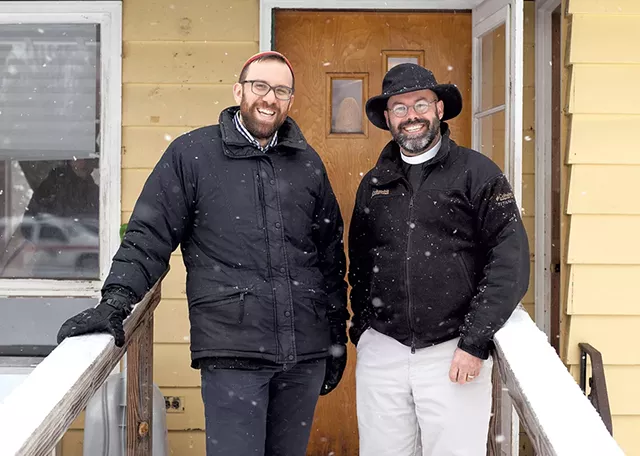
Rabbi David Fainsilber (left) and Rev. Rick Swanson are working with law enforcement and volunteers to combat winter homelessness in Vermont.

Vermont gets really cold in winter, and the most recent winter was especially brutal. That is why a coalition of volunteers, religious leaders, and law enforcement officers have banded together to combat homelessness. Seeing families with young children living in their cars in bitter, brutal weather made them say, Enough is enough.

Reports Mark Davis at Seven Days Vermont, “An improbable alliance of religious leaders, law enforcement officials and volunteers quietly opened Lamoille County’s first homeless shelter. The sheriff’s department owns the Yellow House in Hyde Park, and a band of volunteers and sheriff’s deputies has been staffing it since the first frozen weeks of February.

“The shelter isn’t getting any government funds or charitable donations; in fact, it hasn’t been officially ‘approved’ by the town. But the Yellow House has hosted a steady stream of guests this winter. …

“The number of people without housing in Lamoille County swelled from 22 in 2016 to 64 in 2017, including 34 children, according to an annual survey by the Vermont Coalition to End Homelessness. But the closest shelters were more than an hour away, in Burlington and Vergennes.

“Organizers tried without success for three years to open a permanent shelter in nearby Morrisville. They concluded that it’s easier to beg forgiveness than to ask permission and opened the Yellow House with little public notice.

” ‘It’s a “Let’s just do this” approach. Enough is enough. There simply can’t be families and individuals out in the cold anymore,’ said Rabbi David Fainsilber of the Jewish Community of Greater Stowe. ‘I appreciate all the questions and concerns people may have. And yet, at the end of the day, I personally have to ask myself, Did a family stay out of their car and have a warm place to stay?’

“Organizers such as Fainsilber envisioned Yellow House as a winter-only endeavor. The Hyde Park planning and zoning offices gave the shelter temporary verbal approval before it opened, according to backers, but will spend the coming months mulling over whether to grant official permits. No hearings have been scheduled.

” ‘I’m hoping it’s not a battle. But if it is a battle, I’m committed, because the interfaith community is, too,’ said Sheriff Roger Marcoux Jr., a key backer of the project. …

“Part of the problem is the nature of rural homelessness, according to shelter advocates. In Burlington, the itinerant people who congregate downtown are highly visible. But the homeless in Lamoille County tend to live out of sight in an unheated camp in the woods, or in cars, so residents don’t appreciate the size of the population. …

“In late December, temperatures plummeted to minus-25 degrees, and Rev. Rick Swanson of Saint John’s in the Mountains Episcopal Church heard that people were sleeping in tents in the woods. Swanson opened the doors to his Stowe church. One man came in from the cold and spent several nights sleeping inside, by the altar. …

“Religious leaders reached out to Marcoux, the longtime sheriff, who is elected to his post and enjoys broad discretion in setting program and budget priorities within his jurisdiction. Marcoux wasn’t just cooperative; he offered to host the shelter.

“The Yellow House is part of a complex of abandoned buildings across the street from the Lamoille County Sheriff’s Department in Hyde Park village. …

“To head off any potential community concerns about safety, he pledged on-duty deputies would regularly stop by. …

” ‘I’m in the business of protecting the public, and I feel like I’m doing that,’ Marcoux said. ‘Why are people living in cars when I’ve got a house I’m heating?’ ”

More.


Mother’s Day is a week from today. Be sure to check out Suzanne’s antique lockets and contemporary birthstone jewelry at Luna & Stella.


Photo: Bjørn/Book Towns
The book town of Fjærland, Norway. About 30 or 40 villages around the world have a high concentration of booksellers who are drawing visitors and building the local economy.

When I was writing my March post about Hobart, an upstate New York village that boasted five bookstores, I learned that the idea of being a “book town” wasn’t an entirely new concept. In fact, there may be as many as 40 book towns around the world.

Unsurprisingly, someone has written a book about them. Sarah Laskow interviewed Book Towns author Alex Johnson for Atlas Obscura.

“What makes a book town? It can’t be too big — not a city, but a genuine town, usually in a rural setting. It has to have bookshops — not one or two, but a real concentration, where a bibliophile might spend hours, even days, browsing. Usually a book town begins with a couple of secondhand bookstores and later grows to offer new books, too.”

Atlas Obscura: “What makes a good book town?”
Alex Johnson: “Well, they’re all very picturesque. That’s one of the reasons they generally get picked. They’re away from cities, so rents are low. … Often, they’ve been in places where economically things have been a bit slim, or the population’s been decreasing as the younger people move away into the cities. Hay-on-Wye, in Wales, was the first one, and it started in 1977.

“How have book towns changed over the past few decades?
“I think they’re actually quite similar to when [bookseller] Richard Booth came up with the idea. He started Hay as a book town very much to regenerate it — to provide employment, keep people in Hay, and provide an actual tourist destination. … Book towns are tiny little places, and people wouldn’t come to them otherwise. …

What does it take to set up a book town that will survive?
“They’ve got to be sensible about providing a large amount of bookshops. You can’t do it with one or two. You need plenty. You need to cover a range of things. Some of the most successful ones have been where it’s not just bookselling. There are publishers or printers or artists or designers. …

“Nearly all bookstore owners, especially secondhand ones, have their own interests. So they tend to specialize in things anyway. … A few places [have] quite a strong central group, but most of them are quite loose. They nearly all have booksellers associations, but it’s quite like a friendly cooperative. …

“If someone wanted to understand the range of book towns, what four or five would you send them to?
“I would definitely go to Hay. … Paju Book City in South Korea. There’s a huge number of publishers and printers there, as well as books. … Clunes, in Australia, has done a very good job of building themselves up. Originally it was a gold rush town, and they quite often shoot films there. …

“Wigtown, in Scotland, is a good example of a place that’s really regenerated. Twenty years ago, it was having a really tough time — shops and industries closing, people moving out. And they’ve absolutely turned it around.

More here.

Photo: Jorge de la Quintana
A ballerina admired impoverished acrobats performing at Lima, Peru, traffic lights and decided to offer them a better opportunity. In the photo, members of her D1 Dance Company rehearse.

Once upon a time, a privileged young lady, a ballerina with an international reputation, saw the face of aspirational poverty on acrobats performing in traffic and decided to offer them an opportunity.

Dan Collyns writes at the Guardian, “Vania Masías vividly remembers the first time she saw acrobats somersaulting at a traffic light on a visit to her home city in 2004. She was at the peak of an illustrious career as a ballet dancer in Europe – but before long, she would leave it all behind it to nurture the raw talent she found in the streets of the Peruvian capital. …

“She was so inspired by the abilities of the teenage acrobats she encountered in Lima she set up a pilot project to teach them to dance – not ballet, but hip-hop. …

“It began on the self-taught gymnasts’ home turf in Ventanilla, a tough neighbourhood near the city’s port. Masías arranged to meet them on the shanty’s sand dunes where they practised their flips. The response was overwhelming.

“ ‘I thought I was going to meet with three kids,’ she said. ‘When I arrived, there were more than a hundred kids.’ …

“In 2005 Masías formed the D1 Cultural Association: part dance school, part non-profit organisation seeking to create young leaders and promote positive social change through the arts.

“D1’s social arm, which is 85% self-sufficient thanks to the school’s private classes, works with 7,000 children and young people in the capital and has schools in the Peruvian cities of Ica and Trujillo. More than 100,000 children have passed through the programme over the years, says Masías.

“Among them is Eddy Revilla, who at 13 became his family’s breadwinner somersaulting at traffics lights in downtown Lima.

“ ‘I was earning 300 soles a week [£66/$92] and here in Peru – that’s money! I could help my family and they started to thank me,’ says Revilla, now 25.

“But after blacking out in mid-air doing a somersault, Revilla auditioned for D1, and is now a member of the group’s professional dance company.

“ ‘When we started nobody thought that you could make a living from dance. Now it’s an amazing opportunity for young people,’ says Revilla, who also teaches hip-hop to paying students at D1’s dance studio. …

“Masías acknowledges that only a few of the young students will eventually follow a career in dance, but she says that the act of dancing itself gives them the confidence to transform their circumstances. …

“Masías has encouraged her dancers to embrace their provincial roots through fusing traditional Peruvian and urban styles.

“ ‘It’s in their blood, in their veins,’ she says. Dancers who had been ashamed of their origins ‘now fight to say where they come from,’ she says.”

More at the Guardian, here.

Photo: http://www.a-r-e-d.com
The Mobile Solar Kiosk, invented by Rwanda’s Henri Nyakarundi, is one of 10 renewable energy startups highlighted by Africa.com.

Great ideas for renewable energy are blooming in Africa, where it’s important that energy be both accessible and affordable. Africa.com recently rounded up ten of the most promising technologies.

“Africa has an immense energy crisis,” says the website. “In a continent with a population of close to 1 billion, over 625 million people are without power. According to the International Energy Agency, that makes up 68% of the population. This is ironic considering the fact that Africa has an abundance of natural resources available.

“For instance, the continent has a large coastline where wind power and wave power resources are abundant and underutilized in the North and South. Africa has much greater solar resources available than any other continent because it is the sunniest continent on earth.

“Energy is an essential factor for the reduction of poverty and economic growth. Major sectors like agriculture, education, communication, and technology all require abundant, consistent, and cost effective energy to spur the much needed development of the continent.

“Currently, many African nations already have small scale solar, wind, and geothermal plants that provide energy in rural areas. These modes of energy production are becoming very useful in remote locations, because they bridge the gap created by the excessive cost of transporting electricity from large-scale power plants. …

“Here we look at ten startups that are utilizing the vast amount of the continent’s renewable energy potential. …

“Mobile Solar Cell Phone kiosk is an alternative solar-powered mobile kiosk that charges phones and connects communities in Rwanda. It was founded by Henri Nyakarundi — a Rwandese who lived in the United States — after struggling with charging his phone whenever he went back to Rwanda or Burundi for holidays.

“He also noticed that even though many people had cell phones, they faced a challenge with charging their devices. It is estimated that over 70% of the population in Rwanda own a cell phone; however, at the same time, World Bank estimates that less than 25% of the Rwandan population has access to electricity.

“Prompted by this need, Henri sketched his first design on a piece of paper. He devised a solar-powered kiosk that can be towed by a bicycle and provides concurrent charging for up to 80 phones. The Mobile Solar Cell Phone Kiosk uses a franchise model that is low income and motivated by entrepreneurial objectives.”

Others on the website’s list include M-Kopa, which “sells solar home systems to low-income earners by allowing them to pay in installments over the course of a year using mobile money”; Shakti, “a South African startup that provides an alternative energy solution to thousands of households that do not have access to electricity”; electric vehicles; LED lights; and “batteries in a bottle.” More at Africa.com.

(I need to mention that the website seemed to slow down my computer, but no real damage was done.)

Ballet in Egypt

2016-635897543773346986-334

Photo: Magda Saleh collection
Egypt’s first prima ballerina, Magda Saleh, as she is today and in ballets of
the 1960s and 1970s.

I like to include stories about Egyptian culture whenever I see them because of my special connection to two naturalized citizens who were born in Egypt. Here is an intriguing New York Times article by Brian Seibert about an Egyptian who excelled at ballet and even performed with the Bolshoi in Moscow.

“Once upon a time, the Egyptian ballerina Magda Saleh danced the dream role of Giselle in Moscow as a guest star with the mighty Bolshoi Ballet. …

“Recently, in the elegant Upper East Side apartment that she shares with her husband, the American Egyptologist Jack Josephson, Ms. Saleh, 73, recounted how her life had been ‘punctuated’ by shifts in Egyptian political history. …

“In the era just before she was born, Egypt was no longer a protectorate of Britain, but British influence was still high. Her father, who would become a prominent academic, studied agriculture in Scotland and brought home a Scottish bride, Ms. Saleh’s mother. Their children spoke English and Arabic at home, French at school. …

“Her first ballet teachers were British, and she traveled to Britain to study ballet. By then, though, Egypt had undergone a revolution and soon it was at war with Britain. Young Ms. Saleh was called home, where she discovered that her British instructors had left.

“But the Egyptian government was now friendly with the Soviet Union, and new teachers arrived. In 1959, the Egyptian Ministry of Culture created an Academy of Arts, with a Higher Institute of Ballet, and imported teachers from the Bolshoi to run it.

” ‘This was unprecedented in Egyptian history,’ Ms. Saleh said. ‘We have this very ambiguous attitude toward dance and especially women dancers …

“ ‘None of this would have been possible,’ she continued, ‘but for a confluence of time and circumstance and one man, the first minister of culture’ — Tharwat Okasha, an army officer with vision and tenacity. …

“Ballet education came filtered through translation, with old Russians who had fled to Egypt during the Russian Revolution converting the instructions of the newly arrived Soviet dancers into broken Arabic.

“Yet the school developed rapidly, and in 1963, Ms. Saleh and four other female students were offered scholarships to study at the Bolshoi in Moscow. She was 19 — or ’19 going on 11,’ she said, ‘because we were so sheltered.’ Now they were on their own in the bitter cold of the grim Soviet capital, sitting on radiators before class to thaw. …

“The experience was tough. ‘But character forming,’ Ms. Saleh said. ‘The Russians taught us with love. Not love for us. Love for dance. They instilled this in us.’

“Back in Cairo, diplomas in hand, they wanted to dance. So the ballet institute mounted ‘The Fountain of Bakhchisarai,’ a 1934 Soviet ballet about a Polish princess abducted by a Tatar Khan. The Egyptian public loved it. The president, Gamal Abdel Nasser, awarded the dancers the Order of Merit.

“Even more meaningful to Ms. Saleh was the praise of a poor old man after a performance in the southern backwater of Aswan. ‘People had insisted that Egyptians wouldn’t accept Egyptian ballet,’ she recalled misty-eyed. ‘But we were right!’ ”

Read more and see some lovely pictures at the New York Times, here — and also here, at Ahramonline.

Bryn-Mawr-mayday

Photo: Bryn Mawr College
Students dance around the May pole as part of an ancient spring tradition. A local men’s college used to try to steal May poles in the dead of night. One year a May pole ended up in a swimming pool.

As important as International Workers Day is, please don’t forget about the ancient May Day, the one that welcomes spring with flower baskets deposited at doors and with dances that weave ribbons around a May pole. It’s sweet and fun.

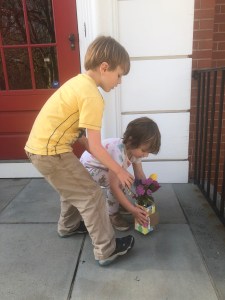
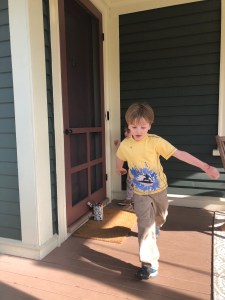
My children used to leave little bouquets of violets and daffodils and tulips on neighbors’ doorsteps. A babysitter showed us how to make baskets using wallpaper from discontinued sample books and a stapler. The kids would ring a neighbor’s bell, then run and hide. If anyone asked us later whether we knew anything about the nice flowers they found outside their door, we always said we had no idea what they were talking about. Which made it pretty obvious, actually.

I remember Mrs. Pulhamous saying to me, “Oh, I’m going to be so sad when your children grow up!”

Recently, I was sorting through files and was reminded that when Suzanne was in Girl Scouts, we made baskets for retirement home residents and received very sweet thank-you notes. I still think the Girl Scouts would be a good organization to carry on the tradition.

050118-secret-May-Day-mission

050118-ring-bell-and-run

Photo: Rajpot
A stool painted by Travelers, or Gypsies.

A while back, I started following Romani Arts (@romaniarts) on twitter, which is how I learned about a Scotland-based nonprofit that validates and promotes Gypsy culture. It’s called Rajpot.

From the website: “RAJPOT was established as a voluntary organisation by individuals from varying backgrounds, including Scottish Gypsy Travellers, with a view to establishing an inter-cultural arts centre that would enable people from indigenous and seldom heard cultural communities, often oppressed communities, to give voice to their experiences and allow their stories to resonate across cultural boundaries, deploying a multi-art format: visual arts, craft-making, performance art (drama, story-telling, music, poetry recital, etc.) …

“The word ‘Rajpot’ derives from the Scottish Gypsy Traveller language of Cant and usually refers to someone considered to be ‘mad’. …

“The creator embraced this humorous view of himself in designing the plans for the centre, where a large pot, typically used by Gypsy Travellers, occupies pride of place on an outside fire at the heart of the design; the symbolic value should be apparent to any Gypsy Traveller, many of whom preferred historically to cook in a large pot on an open fire.”

Rajpot’s History page offers additional background: “The origins of Scottish Gypsy Travellers, or Nackens, are commonly held by experts to be traceable to North-West India. It is believed that Gypsy warriors were expelled from India and gradually migrated westward around 1000 AD.

“Official records note the arrival of Romanies in Scotland around 1505, several years before the earliest record of their presence in England at Lambeth Palace.

“Research has noted that ‘cultural osmosis and intermarriage’ ensued between the Romanies and a group of pre-existing craftsmen referred to as ‘tynklers’; this name emerged on account of the tinkling noise they made in the production of tin wares.

“The art of tinsmithing was a widespread occupation among Gypsy groups throughout Europe. On that basis, the tinsmiths may have constituted an earlier band of Gypsy migrants who self-identified with the new arrivals.”

I have no way to evaluate whether that history is accurate. (You might check Wikipedia.) But the impulse to create an organization that honors an often misunderstood population seems a worthy one.

On a related note, this is a lovely photographic book on Travelers by two women from my old high school: Irish Tinkers.

There’s been a bit of a drought in my picture taking. I got so tired of winter, and now in spring I’m reluctant to shoot the same photos I shoot every year. Although when you think about it, it’s kind of beautiful that the same crocus, hellabore, and winter aconite pop up over the same creative neighbor’s stonewall year after year.

We’ve finally had some spring in New England. The very best sign of that was a lemonade stand I saw yesterday.

Two young girls were selling lemonade and flavored iced tea ($.75, mint leaves optional) and Rice Krispies Treats ($.25) while playing duets on the clarinet and violin. They told me they were raising money for a charity that provides instruments and music lessons to children in Haiti.

They were adorable. One girl pointed out their homemade signs. She said, “We didn’t have any big cardboard to make signs, so we got pizza for dinner last night.” The pizza box provided the needed cardboard.

The other pictures are pretty self-explanatory. The crocus flowers peeked up just before we had one of our numerous late snowstorms. The gorgeous architecture and shadows are thanks to the preservation ethos in Providence.

I was thrilled to see the opportunistic pansy poking through a stone curb. And the trout lilies. I had to take two shots of the trout lilies, the only wildflowers that still flourish after I took a walking class in local conservation lands 25 years ago.

(No worries: I didn’t steal flowers from the woods but was able to buy several varieties of wildflowers at a plant sale. Sometimes a solitary May Apple shows up near the trout lilies in my yard, but it is sad and lonely. The trillium never had a prayer as it is fussy about soil and likes to hang with a group. Perhaps the wild geraniums will bloom this year.)

042818-lemonade-for-worthy-cause

042818-young-musicians-raise-money


041218-crocus-blooming-before-storm

042318-Providence-architecture-and-shadows


042218-pansies-in-wall

042118-trout-lily-stucco-wall


042118-trout-lily-brick-wal


Photo: Målerås
Glassworkers in the Målerås factory in Sweden. The company successfully brought on refugees when it was short-handed.

This story combines two of my great interests: Sweden and helping refugees. Erik’s homeland showed compassion by taking in 32,000 asylum seekers in 2015, but in a win-win scenario, some Swedish design companies have benefited.

Alicia Brunker writes at Architectural Digest, “Rather than fear that refugees will take jobs away from locals, the Nordic country views Syria’s tradition of handicraft skills as a way to smoothy integrate its people into their own design-centric society. This mindset is especially true for the design community in southern Sweden, also known as Småland, a vast region that family-run glass workshops and international heavyweights, such as IKEA, call home. …

“Five years ago, the Scandinavian design purveyor began working with the women’s co-operative [Yalla Trappan ] to offer marginalized groups opportunities for livelihood, including Syrian refugees who have settled in southern Sweden without employment. As a way to give them economic independence, IKEA hired 10 women to work at their Malmö store, offering sewing services. …

“Whether a local customer needs a quick repair to their Ektorp sofa cushion or requires custom embroidery, the women at IKEA’s Malmö store will take the order at their sewing atelier and stitch it off-site.

“Beyond in-store sewing services, IKEA has recently teamed up with the Jordan River Foundation, opening up a production center in Amman. … At the facility, the Jordanians and an IKEA designer collaborated on a new range of textiles — including pillows, rugs, and baskets — that meld both culture’s styles into a single object. …

“The Jordanians lay the yarn on the floor and weave by hand on their feet. However, with IKEA’s ultimate goal of making these women employable in the future, they plan to teach the refugees more modern stitching practices with machines for upcoming collections.

“Inadvertently, IKEA has also provided employment for refugees through their annual Art Event. This year, the design giant enlisted local glassworks company Målerås to work with international artists on a limited-edition series of contemporary glass figurines.

“During the production process, the factory was short-handed and decided to add a dozen new contractors, four of which were Syrian refugees, to their workforce. Though they didn’t have glass-making experience, the men were familiar with working with their hands. Through an eight-month training period, the refugees learned the various steps of production and they picked up on their new country’s language and culture. …

“Benny Hermansson, owner and CEO of Gemla Möbler, the country’s oldest furniture factory, says the practice of working with craftsmen from other regions dates back to the 19th-century. … One of the [Syrians] who joined Gemla worked at a furniture company back in Syria, crafting headboards and cabinets out of wood. …

” ‘There are fewer and fewer schools educating students in these fields,’ [Hermansson] says. ‘It has become difficult to recruit people with the right competence. We have a need, and so do these refugees.” More here.

This is reminding me of a Syrian carpenter that I helped out a bit last year. He was thrilled to find work in Rhode Island installing insulation. I wonder if he has gotten into woodworking since then.