Recently, Simone Orendain wrote a story for the Christian Science Monitor‘s “People Making a Difference” series on a Philippine man who helps kids.
“For the past 30 years [Harnin] Manalaysay has been a father figure and mentor to hundreds of youths in Cavite City, just south of Manila. … Half the young people he has helped were out of school and on the streets – neglected, abused, or abandoned. The other half were in school but on the verge of slipping into gang life …
“A majority of the young people [he has helped] have gone on to become professionals in fields such as finance, education, marketing, and psychology, Manalaysay says.
“Some have become rock stars of the philanthropic world. Kesz Váldez, his 16-year-old adopted son, won the 2012 International Children’s Peace Prize – the children’s equivalent of the Nobel Peace Prize – for starting, at the age of 7, a foundation to help street children live with dignity and understand their rights.”
Manalaysay began his good works at 17, when, having run away from a violent father and some risky behaviors of his own, he found religion and “came across some kids in ragged clothes outside his new church making a lot of noise as they gambled with the loose change they had just begged for. He felt bold enough to scold them for making a ruckus.
“He asked if they were in school. They said no, so he started giving them basic lessons in reading and ABCs. The number of students grew, and he decided to tap some high school teachers, who recommended student volunteers. But he found that even those kids came from unstable families and needed help, too, including lessons in self-esteem and self-respect. Club 8586 was born. …
“Manalaysay credits his mother with this philosophy.
His earliest memories were of her selling home-cooked snacks that she would then give away to the poor once she earned enough to pay for the family’s needs.
That lesson in selflessness and love has stuck with him, and he has tried to pass it along to all of the kids whose lives he has touched.”
Last spring, Sandra and Pat were in Italy, and on one adventure, they toured a company that is very serious about the art of making balsamic vinegar. They learned that a special barrel is started when a new baby is born and ages slowly for years under careful surveillance.
From the website: “Boni’s Acetaia is located, together with its almost 100 years tradition, in the first hills just outside of Modena, in Solignano di Castelvetro. Grandfather Arturo, at the beginning of XX century, started taking lovely care of wooden barrels in which he produced Traditional Balsamic Vinegar in its acetaia in Castelvetro. …
“There are many varieties of Balsamic Vinegars that differ one from the other because of the age and aromas. Boni’s Acetaia apart from Balsamic Vinegars aged in casks made with commonly used woods offers precious products aged in casks made of special local and now rare woods.”
From the museum site: “The visitor enters a section in which he can see the processing steps for the production of Balsamic vinegar, from the grape harvest … The visitor can see the tools used in the grape collection, the pressing machines and the vats, the copper pot ready for the [cooking] and the barrels under construction. In the attic reconstruction the visitor can smell the balsamic perfume of the vinegar in the barrels, among which the barrels of a very ancient set of vessels belonging to the Fabriani family, which lived here. …
“Finally comes the aging stage, during which the vinegar’s characteristics reach true perfection. These three stages take place in a series of barrels of different woods (cherry, chestnut, mulberry, oak, false acacia, ash tree and juniper) and decreasing size. Each type of wood gives to the vinegar a specific characteristic such as a certain colour, flavour or taste.
“Only after 12 or 25 years of maturing the product reaches that surprising balance of aromas and flavours that allows it to bear the title of ‘protected origin denomination’ (DOP). Walking into the following room the visitor can admire the tools used for the annual operations to carry on in the Acetaia. Here there is a 1785 bottle of Balsamic Vinegar, and its content was tasted a few years ago.” More.
I am learning there is more to vinegar than meets the eye.
Graffiti is not what it used to be. At the Studio 360 radio show, Jack D’Isidoro recently reported on an American city that wanted to be a tourist destination for murals on every wall.
“For decades, street art was bemoaned as a symptom of urban decay and detritus — a sign that system had lost control. …
“Times have changed, however; mainstream culture now recognizes that street art can be iconic, sensational, and good for business.
“But what if it was created with the intention of being a public good, as a tool that could revitalize and beautify a neighborhood? Richmond, the capital of Virginia, decided to find out.
“Now in its fourth year, the Richmond Mural Project brings internationally renowned mural artists to install pieces (with the building owners’ permission) throughout the city. The mission: create the highest concentration of murals in the world, turning Richmond into a global destination for street art lovers.
” ‘I thought, “I can make a change in Richmond,” ‘recalls Shane Pomajambo, a Washington, D.C., art gallery owner and organizer of the project. Initially, he had met with the mayor and city council members with the intention of creating an arts district within the city, but it quickly expanded into a wider effort …
“With a total of 84 murals since the project’s inception, it’s inspired local artists as well, who have added to the impressive displays across Richmond’s brick walls.”
Some readers of Suzanne’s Mom’s Blog (Asakiyume, for example) share my interest in obscure, threatened languages. Here is an ancient one that was new to me: Whistling Turkish.
Jay Walz reported in a 1964 NY Times article, “The whistler forms his ‘speech’ with tongue curled around his teeth so that the ‘words’ are forced through lips that are not puckered in the conventional whistling style; they are tensely drawn flat across the face. The palm of the left hand is cupped about the mouth, and high pressure is applied from the lungs.”
Sindya N. Bhanoo added to the science in the September 3, 2015, NY Times, “Unlike all other spoken languages, a whistled form of Turkish requires that ‘speakers’ rely as heavily on the right side of their brains as on the left side.”
In the New Yorker, Michelle Nijhuis describes a town that is unfortunately losing its whistling, “Kuşköy is remarkable not for how it looks but for how it sounds: here, the roar of the water and the daily calls to prayer are often accompanied by loud, lilting whistles — the distinctive tones of the local language. Over the past half-century, linguists and reporters curious about what locals call kuş dili, or ‘bird language,’ have occasionally struggled up the footpaths and dirt roads that lead to Kuşköy. So its thousand or so residents were not all that surprised when, a few years ago, a Turkish-born German biopsychologist named Onur Güntürkün showed up and asked them to participate in a study. …
“In 1964, a stringer for the Times reported that children in Kuşköy were learning to communicate by whistling before they started school, and that both men and women regularly gossiped, argued, and even courted via whistle. Three years later, a team of visiting linguists observed that whistling was widely used in both the village and the surrounding countryside. But Güntürkün found that few, if any, young women had learned the language, and that, although some young men were fluent whistlers, they had learned the skill as teen-agers, more out of pride than any practical need. … In a small town filled with nosy neighbors, texting affords a level of privacy that whistling never did.”
I liked this Marketplace radio story on Duluth, a very cold place where people are managing to grow lettuce and fish in the same water year-round.
Chris Julin reports, “Tony Beran is standing in the kitchen at the Lake Avenue Restaurant in Duluth, Minnesota, with a head of romaine lettuce in one hand and a clump of curly lettuce in the other.
” ‘They’re beautiful,’ he says.
“Beran’s the executive chef, and one thing he likes about these bunches of lettuce is how clean they are. ‘They’re grown aquaponically instead of in dirt,’ he says. ‘Which is wonderful in the kitchen. It’s less labor for us.’
“Another thing he likes about this lettuce is that it was grown just up the road. The restaurant features local ingredients, and Beran serves locally grown lettuce all year, which is a bit of a trick in a place like Duluth. Last winter, the temperature was below zero 23 days in a row.
“But it’s always warm in the greenhouse at Victus Farms, where Beran’s lettuce came from. It’s about an hour’s drive from Duluth in a little mining town called Silver Bay.
” ‘These are all our babies,’ says Mike Mageau, as he shows off his latest lettuce crop. [He’s a] professor of geography at the University of Minnesota Duluth. He runs a program in environment and sustainability, and this indoor farm is a research project. …
“Most of Mageau’s lettuce is floating. Each plant is stuck into a hole in an inch-and-a-half-thick sheet of polystyrene foam. The foam rafts float in pools in the greenhouse, and the lettuce roots dangle through the foam into the water.
“The fish live in a neighboring room. They’re tilapia, and they swim in nine round plastic tanks, each one about six feet tall. Waste from the fish gets pumped over to fertilize the plants in the greenhouse, and some of the pools in the greenhouse grow algae and duckweed that come back into this room to feed the fish.”
Learn more about this continuous loop and the cost to set one up at Marketplace. People commenting on the website say the concept isn’t new, but it was new to me.
Photo: Chris Julin Mike Mageau, a professor at the University of Minnesota Duluth, grows lettuce year-round — indoors.
Two grandsons are starting school this week and overcoming shyness, which got me talking to John about what happened one time when I was a shy first grader.
My family had stayed an extra month on Fire Island that year, which meant that when I got to first grade on the mainland, I didn’t know any of the routines. For example, I didn’t know what the lined paper that appeared on my desk after recess was for. (It turned out it was not for drawing a picture of a girl.)
Another routine was morning attendance. We would all sit quietly at our desks, and when Miss Dobbins called our name, we would say, “Here.”
This particular morning, I was really not feeling at all well but was too shy to raise my hand in the middle of a ritual. I didn’t want anyone to look at me.
But becoming increasingly desperate, I made up my mind that when my name was called, I would go up to the teacher’s desk and tell her I felt sick.
Miss Dobbins called my name. I got out of my seat quickly and hurried up to her desk and opened my mouth to say, “I feel sick,” and vomited all over her lap.
She didn’t get mad, just asked another teacher to hold the fort while she cleaned up and got me some help.
People looked at me after all.
(One always feels an urge to come up with a moral for every tale one tells children, but I don’t think this tale has one. Stuff happens to everyone. Even grandmas.)
Swedish friends of ours have a home on the Greek island of Samos, where boatloads of refugees are landing every day. The family is collecting donations, buying bread, water bottles, diapers, and such, and delivering them to exhausted but grateful families. I will paste here the Facebook translation of the Swedish post, which may not be quite accurate, but you get the picture.
My Mom wrote yesterday:
It has blown hard in the last few days. Looking from the terrace, you can see the coast guard boat coming with inflatable boats on a trailer full of refugees. In the night 200 came, many families with children. Got together with J– and shared out approximately 100 bagettes without meat (Bedun Lachum) but with potatoes, eggs and mayonnaise, croissants, biscuits — also gave out diapers and wipes. The kids have priority always. The next delivery is 50 packages of diapers and 120 packages biscuits. Another 2000 Bottles of water were ordered.”
I love the idea of making use of perfectly good food that otherwise would be thrown out. Despite initial skepticism from the neighborhood where the Daily Table grocery was to open, customers are really grateful for the access and the low prices.
Taryn Luna the Boston Globe quotes the founder: ” ‘Our job at Daily Table is to provide healthy meals that are no more expensive than what people are already buying,’ said Doug Rauch, the founder of Daily Table and former president of Trader Joe’s. ‘We’re trying to reach a segment of the population that is hard to reach. It’s the working poor who are out buying food, but who can’t afford the food they should be eating.’ …
“Rauch has built relationships with suppliers to divert garbage-bound products to his shelves. He’s careful to point out that it doesn’t mean the food is ‘bad,’ expired, or unsafe to eat.
“A vendor at Haymarket, for example, donated a couple hundred pounds of summer squash he intended to throw away after the food didn’t sell. Daily Table expects to sell it for 59 cents a pound. Rauch said he has also purchased vegetables that grocery stores reject because of blemishes or other cosmetic problems that don’t affect the quality of the product.”
The Globe’s Yvonne Abraham visited after the opening: “They can’t keep the cucumber-pear-mint smoothies and salisbury steak on the shelves at Daily Table. The food emporium in Dorchester’s Four Corners has been slammed in its first week, with 300 customers a day, and three times more locals than expected signing up for free memberships.
“Everybody who works at the store — the managers wheeling out food, the white-coated kitchen staff making carrot soup behind the big picture window, the cashiers in bright T-shirts — looks exhausted, and happy.”
From the Daily Table website: “Daily Table is a not-for-profit retail store that offers our community a variety of tasty, convenient and affordable foods that will help you feel and be your best; food that will keep you moving forward, not hold you back. We provide both ‘grab-n-go’ ready to eat meals, and a selection of produce, bread, dairy and grocery items all at prices that will put a smile on your face, and designed to fit within every budget. Many of our items are prepared fresh daily in our own kitchen onsite. …
“There are plans to open additional stores in both the greater Boston area and additional cities across the country.
“Working together we can help reduce both the effects of poor eating habits caused by challenging economics, and the impact that wasted food and its precious resources has on our environment.”
The Christian Science Monitor series People Making a Difference (“ordinary people taking action for extraordinary change”) has so many great leads, I have to restrain myself from using one every day. The Monitor staff don’t write all the stories but, like me, harvest from hither and yon.
This story, about “sack farming,” is from the Thomson Reuters Foundation, which I wouldn’t have known about either but for the Monitor.
Caroline Wambui writes, “Central Kenya’s Nturukuma region is not kind to farmers – its erratic rainfall, desert vegetation, and drying riverbeds push most people into making a living through trade rather than agriculture.
“Jane Kairuthi Kathurima toiled for years as an animal herder in the semi-arid conditions of Laikipia County, but struggled to feed her family – until she discovered sack farming, which has transformed her life and those of her children.
“ ‘Being in an environment where food was scarce and lacking in nutrition, I had to find an alternative way to survive,’ said Kathurima. …
“Sack farming involves filling a series of bags with soil, manure, and pebbles for drainage, and growing plants on the top and in holes in the sides. The sacks allow people to grow food in places with limited access to arable land and water.
“Two years after setting up her sack farm, Kathurima now grows enough vegetables – including spinach, lettuce, beets, and arugula – to feed her family and sell the surplus to the community. … Now she is supporting other food-insecure farmers by encouraging them to think differently.
“The group behind sack farming in Kenya is GROOTS (Grassroots Organizations Operating Together in Sisterhood), a global network of women-led groups which help women solve problems in their communities by changing the way they do things.
“Rahab Ngima Githaiga, vice chairman of one of the GROOTS member organizations, says sack farming has empowered women and changed lives by improving family nutrition and enabling children to go to school.”
Photo: Thomson Reuters Foundation/Caroline Wambui Jane Kairuthi Kathurima cuts kale at her sack farm in central Kenya. She grows enough vegetables to feed her family, selling the surplus to the community.
I was delighted when Will McMillan asked me to review his Blame Those Gershwins CD, with music composed by Steve Sweeting, who also is on piano.
I think the first time I became aware of singer McMillan was in a production of the musical Tortoise, in which he played a sweet, low-key guy unimpressed by the hectic modern world. But I may have seen him in television ads when he was a little boy. He’s been performing that long.
I’ve listened to this CD several times now, and I’m really loving it. The title song playfully borrows themes from the greats — the Gershwins, Cole Porter, Johnny Mercer, Jerome Kern, Irving Berlin, and more. It tells the story of a fan who finds more comfort in the American Songbook than in the unreliable world of romance (but who is also able to poke fun at himself).
I ought to think twice;/Should I really be relying on Kurt Weill for advice?/Life doesn’t rhyme like lyrical knowledge/You get from Rodger and Hartenstein College.
The lyrics for that song are written by Sweeting, who wrote the words for several of the other songs. The joyful “Bounce to the Wave,” with words by Betina Hershey, had me thinking of swing dancing but may suggest other bouncy activities to you, including children jumping on a new mattress. One tune was created for a lovely ee cummings poem that I wish we had known about when Suzanne and Erik got married. The cummings poem we chose was more obscure. In fact, I told the congregation, “We don’t know what it means, but we like the way it sounds.” (“Not even the rain has such small hands.)
McMillan wrote the lyrics to several songs, including “Stuff,” in which he ponders his good fortune in experiencing the beauty and peace of nature and compares those wonders to other “stuff” we collect in our getting and spending world. He asks, “What have I done in some other life, to be blessed with this stuff,” reminding me of an uncharacteristically plaintive Elaine Stritch singing “somewhere in my youth and childhood/I must have done something good.”
Sweeting’s gentle, wistful persona in “Wait” is self-critical for hoping that something wonderful will happen without action on his part — and for being so resigned. “I sit and watch a year or ten just slip away/I let life come to me,/If it doesn’t,/Say it wasn’t meant to be.”
I really loved each song for its different strengths: the carefree “Let’s Go to the River,” the hopeful “What Am I Doing Alone,” the wise and accepting “Let It All Go,” in which Sweeting suggests that if a poem fails to flow and a friend fails to know when you need a friend, “Maybe the answer/is to love a poem and to write a friend.”
This is music for the thinking music lover. It is thoughtful without being cerebral. It doesn’t talk down to the listener. The questioning, patient vibe suggests a tentativeness that is a kind of strength, a self-knowledge that is OK with not having all the answers and an openness to receiving the joy that is offered. Amazon has the CD. And iTunes. It’s going to be my companion in the car at least until I have all the lyrics memorized.
Oh, and kudos to Doug Hammer, McMillan’s longtime piano collaborator, for the recording and mixing on this one.
McMillan and Sweeting’s launch party is October 2 in Somerville, Mass. Call 617 628 0916. Or check Brown Paper Tickets online.
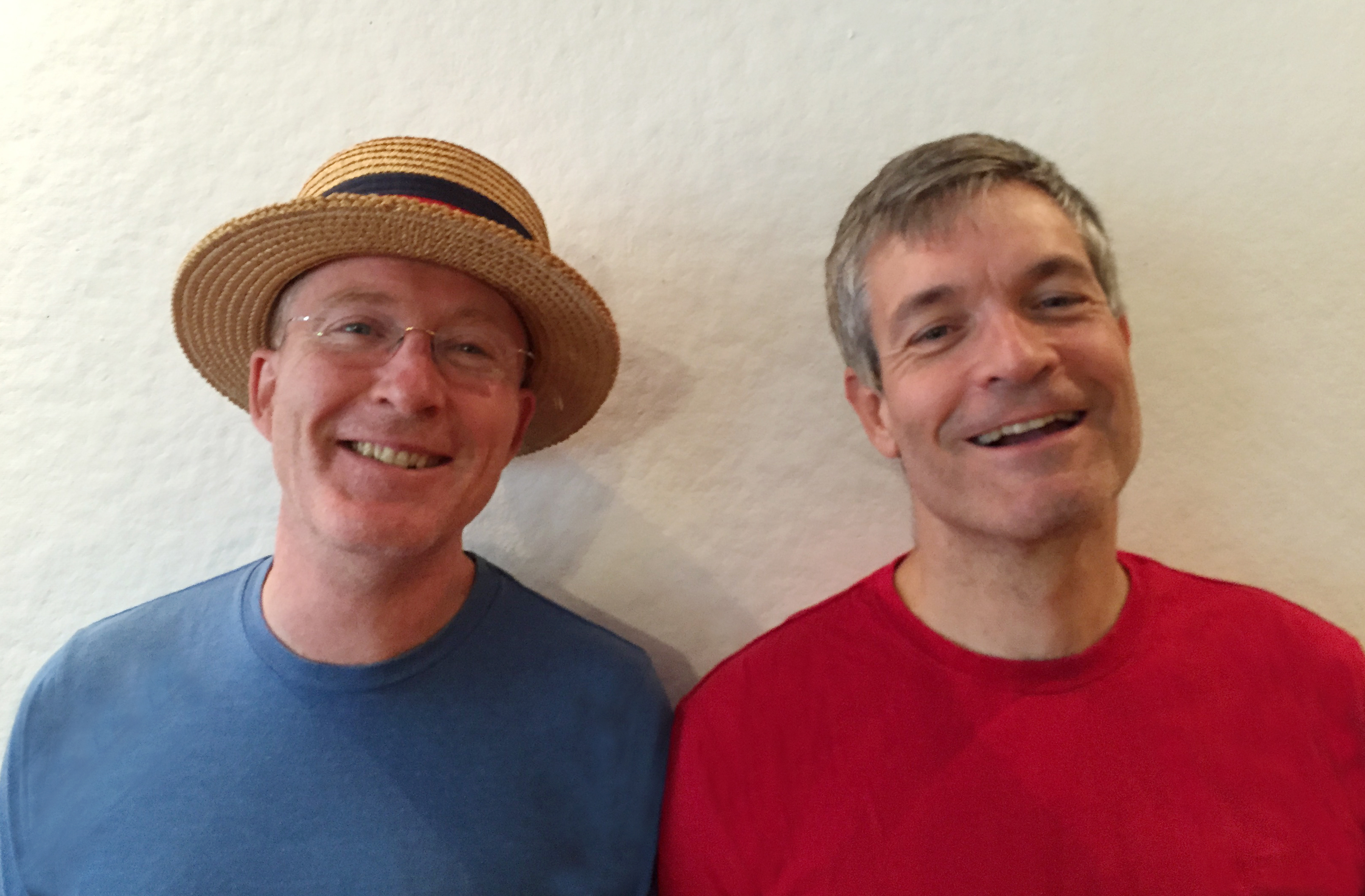
Will McMillan and Steve Sweeting, the guys behind the jazzy, bluesy CD Blame Those Gershwins
Nice to run into Judith and Paul at the annual downtown farmers market. We always talk shop a little because we worked together in the ’90s. I was interested to hear she is back doing writing for our former colleague Kate, currently a principal at leadership consultancy SweetmanCragun.
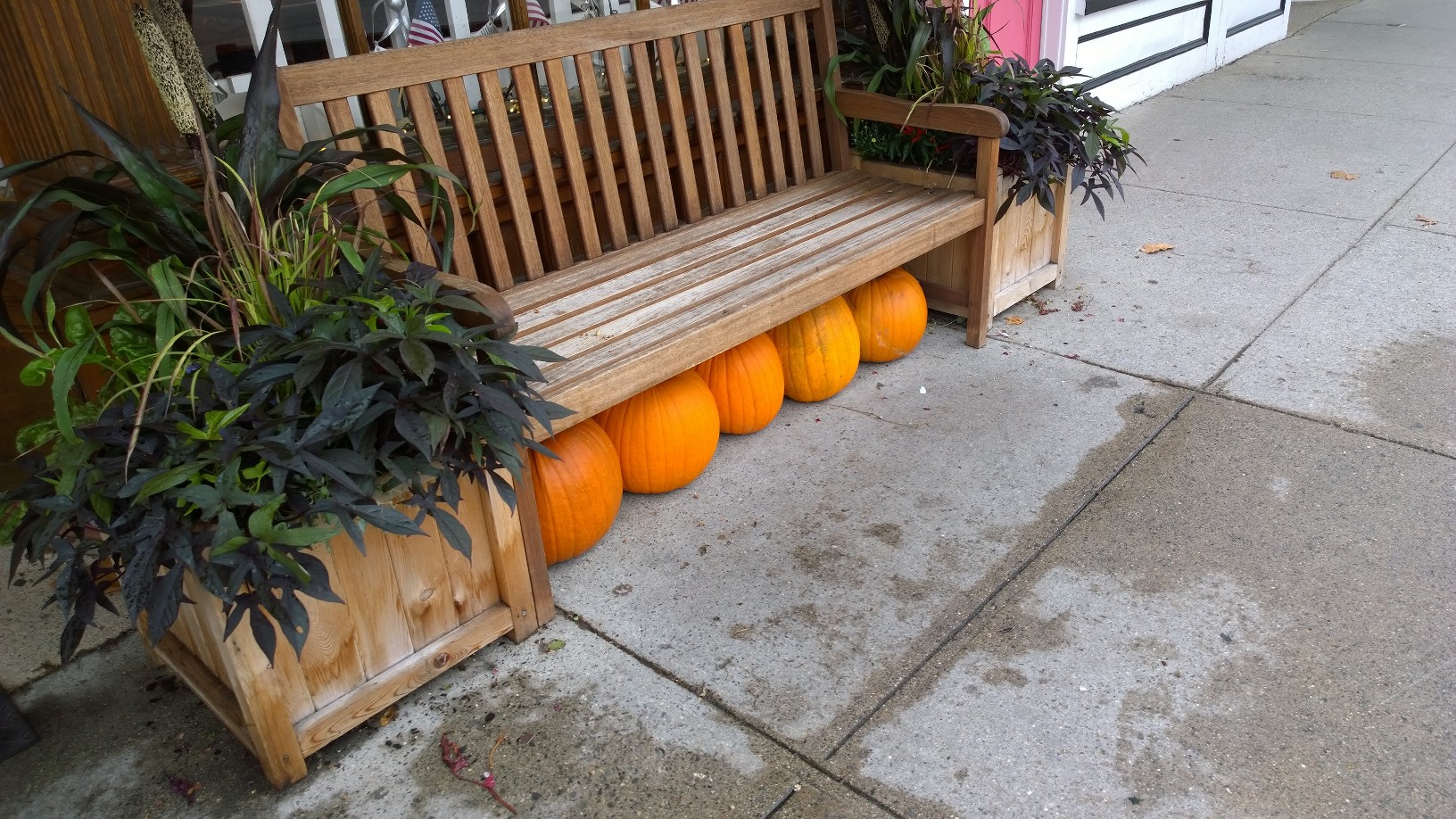
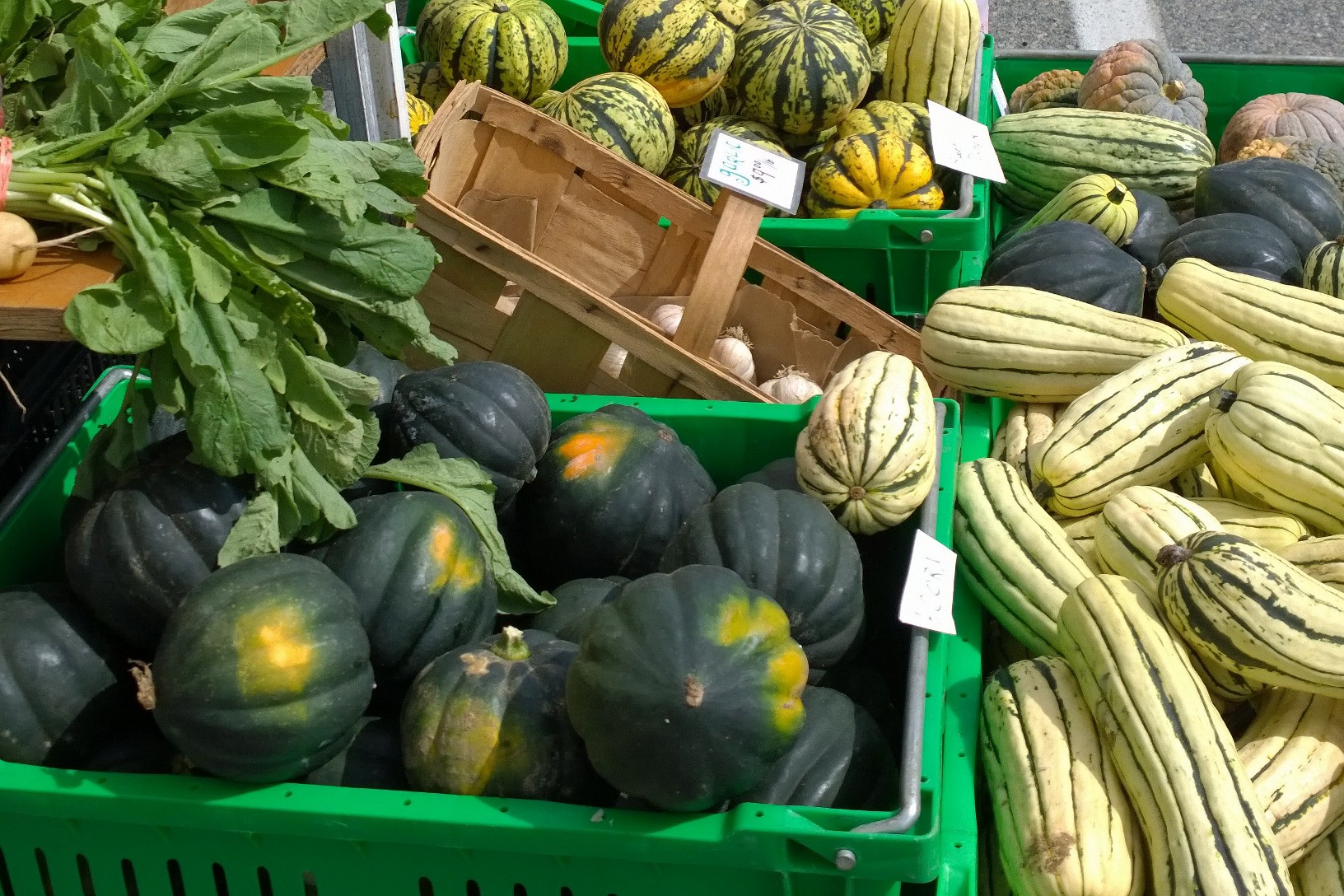
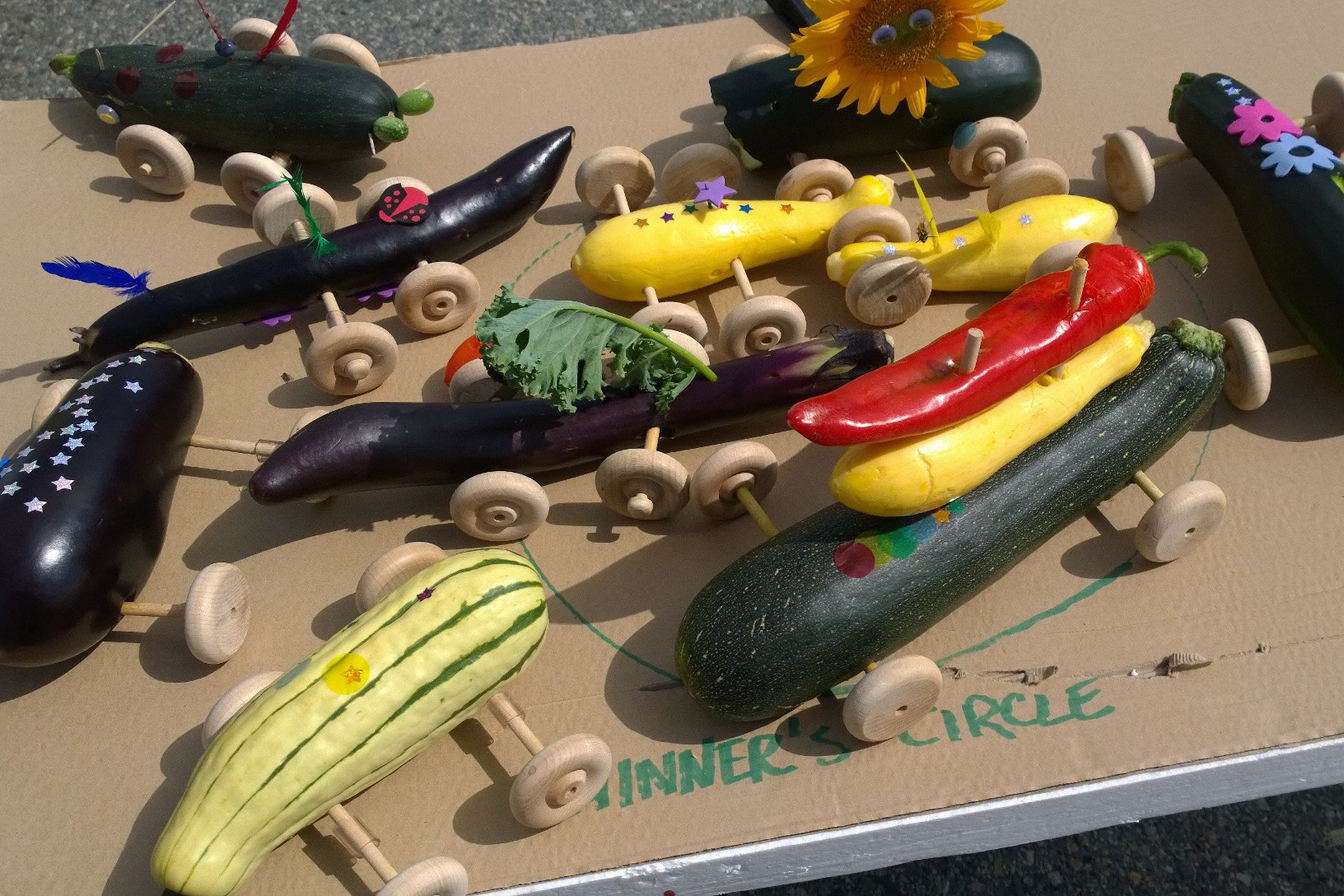
Now about these pictures: Main Streets Café is always creative with their seasonal displays. I don’t know that I would think of lining up pumpkins under a bench. The squashes are from Hutchins Farm. First Root Farm’s display includes radishes, beets, and carrots. The chrysanthemums and asters were tempting, but the car was parked too far away for me to carry a big plant.
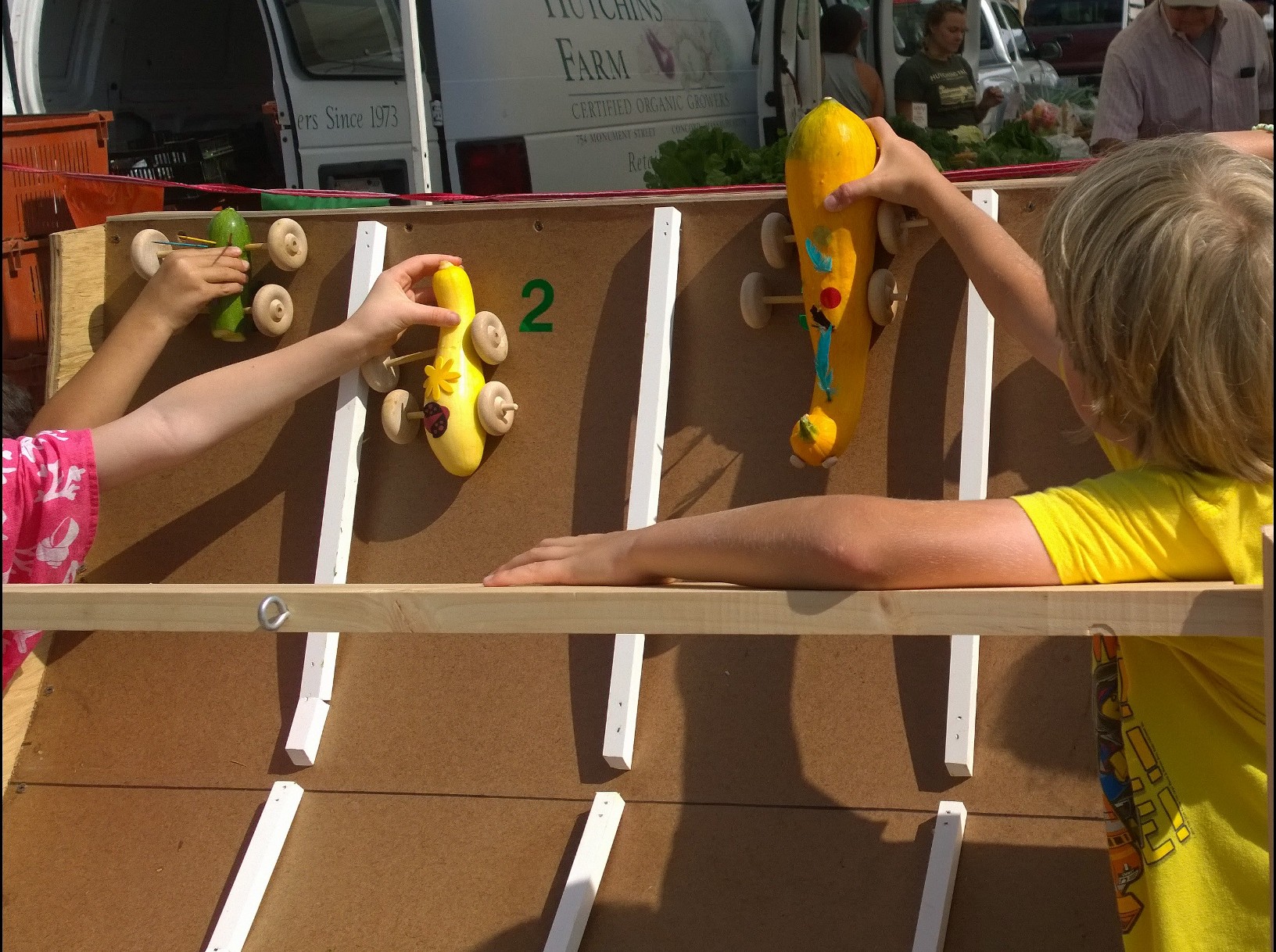
Finally, please note the funny vehicles the kids are racing. I include a close-up of several late-model vegetable cars. (Pick a squash; add wheels.)
If you are in Providence on Sunday, do stop by the flea market and see what Suzanne is selling. As she writes on the Luna & Stella website, bargains will be had.
“My husband gazing at a tray of rings I have prepared for our first sample sale, asks, what’s wrong with them?
“What’s wrong with them? Well, nothing. A slightly included emerald, a band that came in a millimeter to wide or too flat, a bale a tiny bit too large, a style we decided not to put in the assortment because we already had something similar.
“They’re beautiful, he says.
“We are having our first ever sample at the Providence Flea at 345 South Main Street in Providence this Sunday, September 13. If you have never been to the Flea, it’s a outdoor juried market inspired by the wildly popular Brooklyn Flea. We love the vintage/modern mix of the Flea, and the idea a shopper could find a great vintage charm from one of the other sellers and mix it on a necklace or bracelet with one of our charms.
“In addition to our full price line … we’ll be selling our almost perfect samples for 50 – 80% off the original prices. That ring of trays you see? With genuine rubies, emeralds, aquamarine, etc set in sterling silver or dipped in 18K gold? Most will be $30, nothing over $50. These are prices you will never see on our website. ”
More at Luna & Stella, the contemporary birthstone-jewelry company for which I blog. (“Write whatever interests you, Mom.”)
Two people I know got attention for their writing this week.
Ronnie Hess, a friend from childhood summers on Fire island, won a 2015 Hal Prize from Write On, Door County, Wisconsin, for a story about Tina Hess, her mother. “Judge Michael Perry awarded the prize to ‘The Red Shoes,’ ” says the nonprofit’s website.
The mission of Write On, by the way, “is to facilitate and promote writing in Door County by nurturing the work of writers, supporting readers and audiences, and developing opportunities that encourage broad participation. …
“Write On received our nonprofit status in January, 2014. Since then, over 100 programs have been offered, reaching over 1,000 people in every portion of the county and beyond.” More here. And you can read Ronnie’s essay here, starting on p. 48.
In other news, poet Kate Colby, a friend of Suzanne and Erik, got a Publishers Weekly (PW) star for her latest collection, I Mean.
Says PW, “The book’s parts function in tandem as tools via which the author, in various degrees of obsession, contextualizes and re-contextualizes her life, her experiences, and her work: ‘I mean the walls/ are braced/ against themselves// I mean brace yourself// I mean to take the house down/ with its own components.’ ” More from Publishers Weekly.
Although I can’t use everything, I am interested in posting excerpts from your poems or your other writing. Feel free to send something small to suzannesmom@lunaandstella.com.
“In rural Uganda,” writes Madeline Bishop for Global Envision, “light streams from the Ssenyonjo family’s windows through the night. The children inside sleep soundly, free from worry of snakes and thieves. They are prepared for the morning’s classes after an evening of study. What’s more, their lungs are healthy – no one wakes with coughing fits or fevers.
“But for nearly one-fifth of the world’s population that does not yet have solar power like the Ssenyonjo family, this vision of clean energy is still a dream. Some 1.3 billion people live without access to electricity. …
“Many companies are now taking on the achievable goal of increasing access to clean energy across the globe.
“For their solar programs to be successful, these companies focus on tailored marketing strategies to make sure the products are affordable, accepted, and culturally appropriate for the people who could most benefit from them. …
“Some solar manufacturers and energy distributors are helping people skirt [up-front] costs through creative financing models. …
“Customers can finance their own solar systems for less than what they would otherwise be spending on kerosene. [African solar company] M-KOPA reports a savings of $750 per household over the course of four years and 125 hours of fume-free lighting each month.”
Read about the wide variety of approaches to this work in developing countries here, including why Barefoot College has a “training program for grandmothers, who are more likely to stay put and use their knowledge for the good of their communities. … They learn how to install, maintain, and repair the solar systems and, upon graduation, receive a monthly salary for their work.” Hear, Hear!
Over at radio show Living on Earth, “Steve Curwood spoke with farmer and author Audrey Levatino, who has written Woman Powered Farm: Manual for a Self-Sufficient Lifestyle from Homestead to Field. …
“CURWOOD: Why did you decide to write a book about farming specifically for women?
“LEVATINO: Well, women were coming up to me at the farmers’ market and asking about what I did and were very interested. Many of them wanted to know how to get into farming and growing things themselves, and so they wanted advice and instructions on how to get started. …
“CURWOOD: Audrey, what do women farm more typically as opposed to men?
“LEVATINO: That’s a great question, and that’s another thing that I really investigated when I was writing the book. And many women get into this farming business. It starts off as just wanting to provide the best and healthiest, most local food that they can for their families. So women are growing a lot of different things, but in many cases it is healthy, delicious, seasonal food. They know exactly where it came from, so that their children and their husbands and their neighbors can have the best food possible.
“But the other thing that I discovered as I got further into my research and interviewed lots of women farmers in my area and around the country is women are just amazingly creative: they grow herbs and other medicinal plants to make cheese, salves and tinctures. Women also tend to farm — when they do livestock — smaller animals. You know, things that are a little more manageable. And sometimes it’s for fiber — sheep and llamas and alpacas — other times it’s for milk, such as using goats to make cheese.” More here.
Audrey’s farm, Ted’s Last Stand, is located near Charlottesville, Virginia.
Photo: Michael Levatino
Audrey Levatino grows specialty cut flowers and sells them at local farmers’ markets to florists and restaurants, and for weddings.