At the website This Is Colossal, Christopher Jobson writes about time-lapse videos of Joe Mangrum’s spontaneous sand paintings.
“Artist Joe Mangrum (previously) was just in Zuidlaren, Netherlands, where he was commissioned by the Doe Museum to create 8 temporary sand paintings over a period of 11 days. All of Mangrum’s paintings are spontaneous and evolve as he works, a grueling physical process that involves dozens of revolutions around the artwork as he adds new details and flourishes by pouring brightly colored sand. All eight artworks were photographed as he worked and turned into time-lapse videos, three of which are included here. The sand paintings will remain on view through October 30, 2015. You can follow more of Mangrum’s work on Facebook.”
Jobson wrote in a previous post about the work, “Since 2006 artist Joe Mangrum has taken to the streets of New York, Chicago, San Francisco and elsewhere armed with sacks of colored sand that he sprinkles by the handful to create sprawling temporary paintings. Each work is spontaneous in its design and evolves as Mangrum works, spending upwards of 6-8 hours hunched over the ground to complete each piece. The artist estimates he’s completed nearly 550 paintings over the last few years. A graduate of the Art Institute of Chicago, his paintings have appeared at The Corcoran Gallery, the Museum of Arts and Design in NYC, as well as The Asia Society. He also made a recent appearance on Sesame Street. ”
See the videos here. The sand paintings are like berserk mandalas; in the videos, they are alive.
Cambridge knows how to make artists feel welcome, even cherished. Recently the city had a poetry contest, and the winners are getting their poems embedded in the sidewalk.
Steve Annear writes at the Boston Globe, “Cambridge officials received hundreds of submissions from residents hoping to make their mark as literary legends through the city’s first-ever ‘Sidewalk Poetry’ contest this spring. In the end, only five scribes emerged victorious.
“In March, the city put out a call for poets to participate in the project. Winners were promised a permanent display space for their musings — the poems would be imprinted in the freshly poured concrete as Department of Public Works crews replaced sidewalk slabs cracked or damaged during the winter.
“The response was great, said Molly Akin, the Cambridge Arts Council’s marketing director. More than 300 submissions flooded in from writers ranging in age from 4 to 95, according to organizers.
“A special committee that included workers from the [Department of Public Works], representatives from the local libraries, members of the Arts Council, and Cambridge’s former Poet Populists helped select the finalists. …
“Below are the names of the winners, and their poems:
Rose Breslin Blake Children, look up
Cherish those clouds
Ride grey ponies over their hills
Feed the shiny fish
Boo the big bear
Chase the gloomy giant
Giggle with the geese
Sing with the lambs
Cherish those clouds; they cherish you
Rest on their pillows.
Benjamin Grimm I could not forget you if I tried.
I have tried.
Ty Muto Your blue-green glances
My heart skips double dutch beats
Caught in your rhythm
Carolyn Russell Stonewell Sun takes a bite of
mango as it sets.
Its last rays
run down my cheek.
Elissa Warner A Mother’s Wish
Little boys, little treasures
Shine like lights from above
My son, my only one
My wish for you is that you wake
One day when you are old
And feel raindrops on your cheek
Tears of joy from my heart
For you to keep
I’ve never managed to catch the herring run, but I’d like to see it with grandchildren sometime. The celebration for the Mystic River herring migration offers all sorts of extras, as I learned from the newsletter of the Mystic River Watershed Association, or MyRWA. (I’ve been receiving the newsletter since John’s stint on the board some years back.)
“The annual Herring Run and Paddle includes a 5K run/walk race, three paddling races (3, 9, and 12 miles), educational booths, children’s activities, and more. All events are held at the [Department of Conservation and Recreation] Blessing of the Bay Boathouse in Somerville.”
MyRWA reports, “The Mystic River Watershed supports two species of herring: Alewife (Alosa psuedoharenous) and Blueback Herring (Alosa aestivalis). Both species, collectively called river herring, are anadromous. This means they spend most of their lives at sea and return to rivers—like the Mystic—to spawn, or lay their eggs.
“In colonial times and earlier, herring in the Mystic River were extraordinarily abundant. But from the 1900’s until today a much smaller population of river herring is present. …
“According to the Herring Alliance some river herring runs on the Atlantic Coast have declined by 95% or more over the past 20 years. In 2006 the National Marine Fisheries Service designated river herring as a species of concern. Population decline may be associated with numerous factors including by-catch [catching them by accident when fishing for something else], habitat loss and degradation, water pollution, poaching, access to spawning habitat, and natural predators.”
Read more here. And remind me next May that I want to visit a fish ladder.
I heard about poet Terrance Hayes on the radio show Studio 360. He is the winner of a MacArthur Fellowship, among other honors, and a University of Pittsburgh writing professor. Kurt Andersen interviewed him.
“Hayes grew up in South Carolina, where he was one of the only black students at a very preppy high school. But he says that race didn’t define him as a kid. ‘I was a basketball player, and I ran track, and I was a visual artist.’
“With all his accolades, invisibility hasn’t been too much of an issue for Hayes. But as a theme, it’s certainly present in his work. His poem ‘How to Draw an Invisible Man’ plays with Ralph Ellison’s take on black invisibility in the eyes of white society. ‘The thing that I’ve decided is, I don’t want to be invisible, but I’d like to be transparent. I want people to see what I’m thinking and see through me,’ he says. ‘I’m about 6’6’’. You know, I don’t have trouble walking into a room. I would prefer to be more invisible, in fact, than I am.’ ”
Listen to the interview at Studio 360. And read a review by Jonathan Farmer, at Slate, of his latest book of poems.
Photo: Becky Thurner Braddock
Poet Terrance Hayes. His new book of poems is called How to Be Drawn.
I used to write theater reviews, and I was doing a Google search not long ago on the name I used when, lo and behold, I found that I was in a footnote in a book on theater — specifically Portrayals of Americans on the World Stage, by Kevin J. Wetmore.
An essayist in the book had cited a TheaterMania review of Family Stories: A Slapstick Tragedy, by Biljana Srbljanović, a strange, dark play about children surviving in wartime. I saw the footnote at Google Books and couldn’t see the whole chapter, but it looks like it was about Srbljanović’s view of the Ugly American.
I can’t tell you how tickled I was to be footnoted. I had no idea that anyone had wanted to use that review. I have been equally excited and surprised the few times I got an acknowledgment (for doing not much) in friends’ books: Unseen Warhol, Balm in Gilead: Journey of a Healer, and Pen Pal. What a thrill!
Danielle Skraastad and Emma Bowers in Family Stories: A Slapstick Tragedy
I thought I would like to learn some Swedish because my grandson is bilingual, and I’m sure his sister will be, too. I figured I could try reading their storybooks, and they could help me.
A co-worker told me about a free online language site called Duolingo. The first time I checked, it didn’t have Swedish, but it keeps adding languages. Now whenever I have little bits of time, I try to do an exercise.
My grandson thinks my pronunciation is pretty hilarious, but I do believe Duolingo is slowly moving me forward. The short lessons are lots of fun. They often include funny explanations of why Swedish has certain forms, and they always lob a few easy questions my way (especially after a series of mistakes) so I feel like I’m getting somewhere. You can click one button to have a voice say the words at a normal speed and another button to have her say it slo-ow. When a lesson is complete, trumpets sound.
John explained the company’s unusual business model to me. I get lessons for free because I am supplying Duolingo with data about the kinds of mistakes people make with language. Duolingo can sell the data to a search engine that wants to refine its guesses about what bad spellers and the like are really looking for.
Here’s a Tedx talk in which a charming 12-year-old boy says learned English in eight months just using his computer. He tells Matt Dalio, CEO and Chief of Product at Endless Mobile that he loves technology, especially creating animations.
As a longtime believer in “one and one and 50 make a million,” I am not surprised to learn that some big environmental problems are being successfully tackled through small-dollar grants.
Karen Weintraub writes at the NY Times, “In Pakistan and India, the blind Indus River dolphin, one of the most endangered species, swims a shrinking stretch of water, trapped by development and dams. …
“Overfishing, habitat loss and pollution threaten species in so many places that research and conservation organizations cannot do all that is needed. So, with the aim of making a dent through small, targeted efforts, the New England Aquarium, which sits on Boston’s downtown waterfront, has for 15 years awarded microgrants to projects across the globe. …
“The aquarium’s Marine Conservation Action Fund has paid out $700,000 since 1999, supporting 122 projects in 40 countries on six continents. Elizabeth Stephenson, the fund’s manager, calls these projects ‘stories of hope for the ocean.’
“The grants are modest. One researcher, Rohan Arthur, used his $6,700 payout from the fund to buy a ‘secondhand, beat-up compressor’ to fill his scuba tanks. But the support allowed him to maintain his critical assessment of coral reefs in the Arabian Sea off the west coast of India.
“Dr. Arthur, a senior scientist at the Nature Conservation Foundation in Karnataka, India, said that in some ways, he preferred the scale of the New England Aquarium gifts. …
“Small grants, he said, offer more freedom, but can still be transformative. …
“Gill Braulik, a dolphin expert based in Tanzania, used a … grant in 2011 to teach Pakistani scientists to take over her research on a blind dolphin species that lives only in the Indus River. …
“In 2011, a $6,000 aquarium grant allowed her to train the local researchers in complex survey methods and analysis. Now, two groups of local scientists have led the work. ‘They really don’t need me anymore,’ she said.”
Paul put something on Facebook today that I had to share: artist Peter Cook’s living chair, eight years in the making.
This takes topiary to a new level. Like people who created rock sculptures from flowing water in China, a process that could take generations, the people who do this kind of tree shaping have to be patient.
No overnight results. We are not talking about boxwood pagodas cut with shears. No elephants rampant. I am reminded, rather, of a bench at my grandfather’s in Beverly Farms. This bench got started when my mother was a child and a board was fastened between two saplings. As time passed, the growing trees drew the board into their thickening trunks until, by the time I was a child, there was a very sturdy seat in the woods.
Wikipedia says, “Tree shaping has been practiced for at least several hundred years, as demonstrated by the living root bridges built and maintained by the Khasi people of India. … Contemporary designers include ‘Pooktre’ artists Peter Cook and Becky Northey, ‘arborsculpture’ artist Richard Reames, and furniture designerDr Chris Cattle, who grows ‘grownup furniture.’ ” Everything you need to know about the history and practice of tree shaping is at Wikipedia, here. And be sure to check out Pooktre, too.
My husband’s spring visit to the Arnold Arboretum and a guided tour by Andrew Gapinski, manager of horticulture, got us looking up information on witch hazel.
Steve Kemper at Yankee Magazine had this to say: “Witch hazel grows from southern Canada to Florida and from Minnesota to Texas, but it flourishes most densely in the eastern half of Connecticut. Not quite a tree but more than a shrub, witch hazel has speckled gray bark, a slim trunk typically just a few inches in diameter, and a bushy top that ends well shy of 20 feet. For three seasons of the year, it’s inconspicuous in the understory.
“But after all the leaves have fallen and the last aster has succumbed to frost, witch hazel displays its exuberant eccentricity, bursting into festive yellow blossoms that Thoreau compared to ‘furies’ hair, or small ribbon streamers.’ At the same time, the previous year’s blossoms have ripened into hard fruits, which now explode, propelling the small seeds up to 30 feet. …
“The Native Americans called this strange plant ‘winterbloom’ and ascribed special powers to it. They used it as a cure-all, steeping the bark and branches to make a tea … which they put on cuts, bruises, insect bites, pinkeye, hemorrhoids, and sore muscles — maladies for which witch hazel is still used. “
At the Boston Globe, David Filipov adds, “Native Americans used witch hazel as a cure-all. So did the early European settlers. … Because of that, Dickinson Brands Inc., the world’s largest producer of witch hazel, has quietly prospered here, in what is arguably the witch hazel capital of the world.
“Owners and employees say they have avoided the layoffs, furloughs, and pay cuts that have benighted so many companies. And in this season of shrinking sales and mounting losses, the privately owned company says it has experienced double-digit growth. …
“Sometimes the product’s rich history as an all-round remedy intrudes upon the company’s attempt to place the Witch Hazel brand as a gentle skin-care product for the modern woman.
“ ‘Back in the day, they used to use it a lot on the animals’ who had cuts and scrapes,’’ [an employer] recalled. ‘As a matter of fact, most of the race horses of today use it. After they work out, they wipe the horses with it. Yep, cools the horses down.’ ”
I can hardly keep up with all the delightful-sounding children’s books that Maria Popova describes at Brain Pickings, but my local bookstore is benefiting in any case — not to mention, my grandchildren.
Here is one book that sounds worth checking into.
“In Tell Me What to Dream About,” writes Popova, third-generation artist Giselle Potter — who has previously illustrated such treasures as Gertrude Stein’s posthumous alphabet book and Toni Morrison’s darkly philosophical allegory for freedom — offers a whimsical take on lucid dreaming, that irresistible longing to choose our own nocturnal adventures.
“Potter tells the story of two sisters who, at bedtime, offer each other ideas for possible things to be dreamt that night — a tree-house town, a world where everything is furry, a fluffy world where clouds are worn as sweaters and eaten as treats, teeny-tiny animals feasting on teeny-tiny waffles. What emerges is a colorful celebration of children’s minds.” More here.
When I was a child, the oldest of a few others, I told stories after lights out, mostly about Sammy Seal, who snuck out through a hole at the bottom of the aquarium at night, had adventures, and got back before the authorities noticed his absence. Wish I could remember an adventure.
I’m thinking, What would I like to dream about tonight? I would like a dream in which all the people I know who are going through bad things just now were healed. And then I would wake up and it would be so.
Here’s a green-transportation update from the radio show Living on Earth.
“ELF stands for Electric, Light and Fun, And this particular Elf is an invention that launched with a Kickstarter in 2013. As Living on Earth’s Helen Palmer reported, it’s a human- and solar-powered, covered tricycle that aims to create a commuting revolution, and might just help combat climate change. Now two years on from the Elf’s Kickstarter campaign, its designer and developer, Rob Cotter, tells Living on Earth’s Helen Palmer how successful the invention has proved. …
“COTTER: Many years ago I was working for Porsche and BMW more on the race-car side of things — and I was living in Southern Calif. — and they were building the Gossamer Condor and Gossamer Albatross — the pedal-powered aircraft — not too far from me, so I kind of linked up with those folks. … I became vice president of land for human-powered vehicles, I built a 62 mph tricycle about 30 years ago — and once I realized you could go highway speeds at one horsepower — I realized how inefficient everything is that we do. …
“PALMER: [Elf] uses no gas at all: just human-power, sun-power and a battery pack with a 30-mile range. It’s not built for highways though — only for local roads, and bike trails, as federal regs say a bicycle can’t go faster than 20 miles an hour. Cotter says if enough people who drive about 30 miles a day climbed out of their cars and into an Elf, the effect on greenhouse gas emissions could be startling. …
“COTTER: Each one of these on the road takes about 28 tons of CO2 out of the atmosphere per year — so 100 of these on the road are equivalent to a 4-megawatt wind turbine at about 20% of cost. … The base price is $4,000 [and] we have over 400 orders or reservations currently, just from our website.
“PALMER: And that was before the Kickstarter campaign got underway — they reached their $100,000 funding goal in 12 days, and 40 people have actually paid for the vehicles. …
“COTTER: We actually worked with an organization in San Jose that trains homeless people to become bicycle mechanics, so we went there as kind of a test pilot to see who could build this and how, and in a week’s time we taught them how actually to build ELFs, and maintain them, and service them …
“COTTER: People are using them all winter long in places like Canada. They’re pulling trailers, 500, 600-pound trailers around with snow-blowing equipment and yard equipment on there. They turn them into food trucks. There’s a gentleman in Pasadena that has a gelato freezer on the back … One gentleman rode from Ontario, Canada, to Key West, Florida, on his Elf all on secondary roads and bike paths. But the thing that amazes me most I think is people with disabilities that are using the Elf to increase their mobility. So, this one woman, she broke both her legs in 20 places and doctors said she would never walk again without assistance. And she purchased an Elf, she lowers herself in it, and takes off on electric power, and when she can she goes ahead and just rotates the pedals. And six months later, she’s riding 22 miles a day and able to walk without a cane.”
Where I work, they try to treat employees a couple times a year to little parties. It doesn’t hurt. If you’re having a down day, you can always find something to like about the higher powers making the effort. The first photo shows a few employees at the Cape Cod-themed event on the garden floor of our building. On offer were music, mini golf, lobster sliders, watermelon-blueberry smoothies, and other summertime edibles.
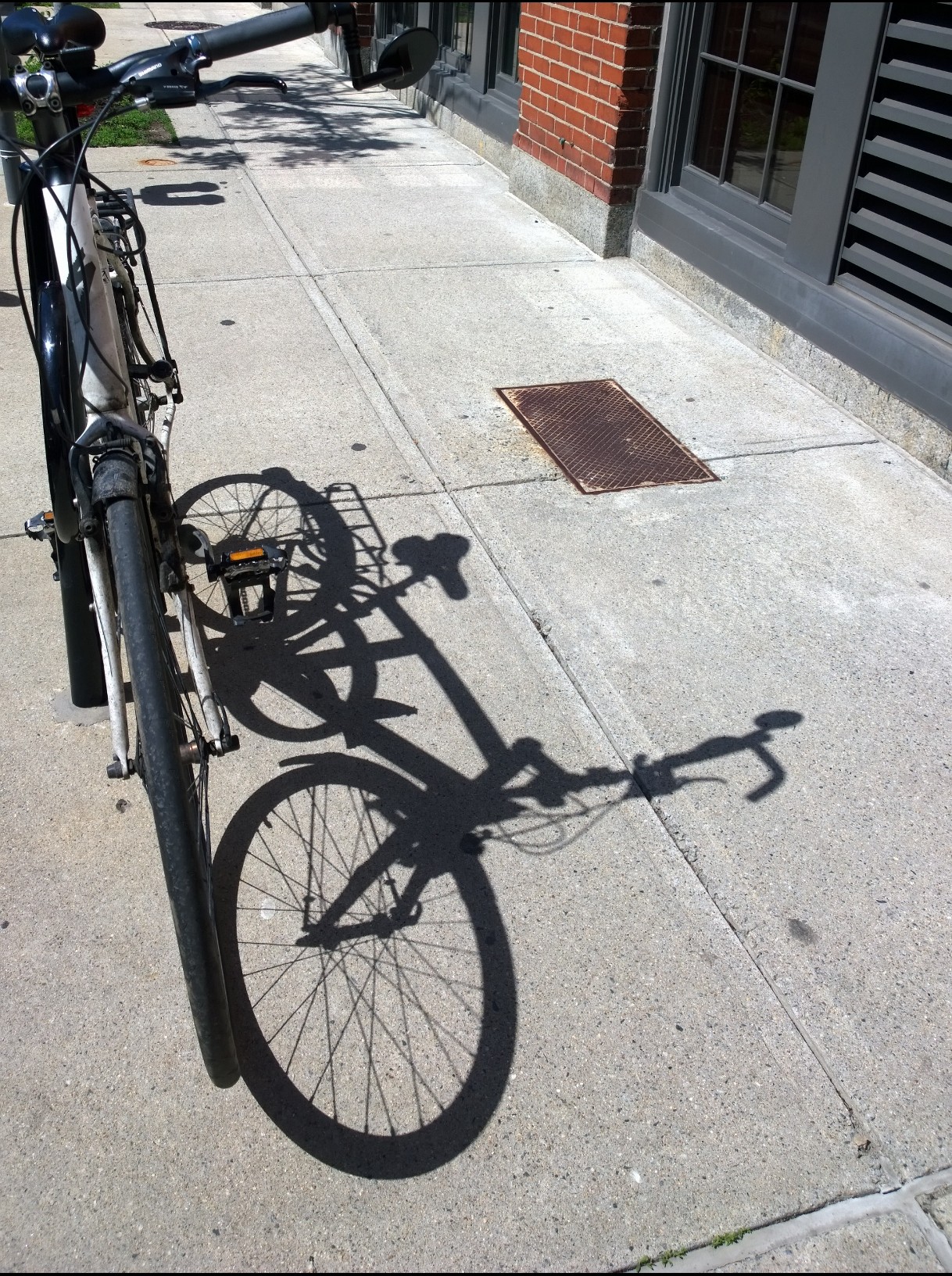
I am also posting a real beach I visited last weekend, with lovely rosa rugosa all around the path. My other shots show the shadow of a bike on a sunny day in Fort Point, landscaping at a home on Beacon St., and an exotic flower in front of Barefoot Books, which does a nice job with plantings.
Asakiyume came for a visit, by the way, and we had lunch and a lovely chat. I will wait to get her permission to post a picture I took of her. But I can activate your visual imagination by telling you that the photo is from a walk in the woods, where Asakiyume spotted an elastic band between two trees and immediately realized someone must be trying to teach themselves tightrope walking. I would never have figured that out. The photo shows her testing her skill. Such a lovely metaphor for the multiple balancing acts we had just been discussing. Turns out it’s hard.
I probably wouldn’t have known that Frederick Douglass spent time in Ireland if I hadn’t read the Colum McCann novelTransAtlantic. McCann likes to take historical events of different time periods and imagine the parts we can’t really know. In TransAtlantic, he wove together a historic 1919 flight from Canada to Ireland, the Douglass lecture tour of Ireland and his horrified witness to the famine there, a servant girl’s emigration to the United States and her role in the Civil War, and the rather thrilling negotiations to bring resolution to the Troubles between Protestants in Northern Ireland and Catholics.
According to an initiative called the Douglass/O’Connell Project, “Douglass was greeted in Dublin, Belfast, and Cork by enthusiastic crowds and formed many friendships on his trip, most significantly with Daniel O’Connell, a figure still revered in Ireland today for his role in Catholic emancipation and his fierce opposition to slavery. O’Connell and Douglass shared the stage just once, in September 1845 at a rally in Dublin, but retained a mutual respect and affection until O’Connell’s death less than two years later — and Douglass acknowledged O’Connell’s influence on his philosophy and worldview for the rest of his life.
“The Frederick Douglass/Daniel O’Connell Project is a living legacy to the leadership of these two men and the causes they championed by strengthening the bonds of friendship between Ireland and the United States, encouraging greater understanding between the diasporas of Africa and Ireland in America, and fighting injustice and human rights abuses throughout the world.”
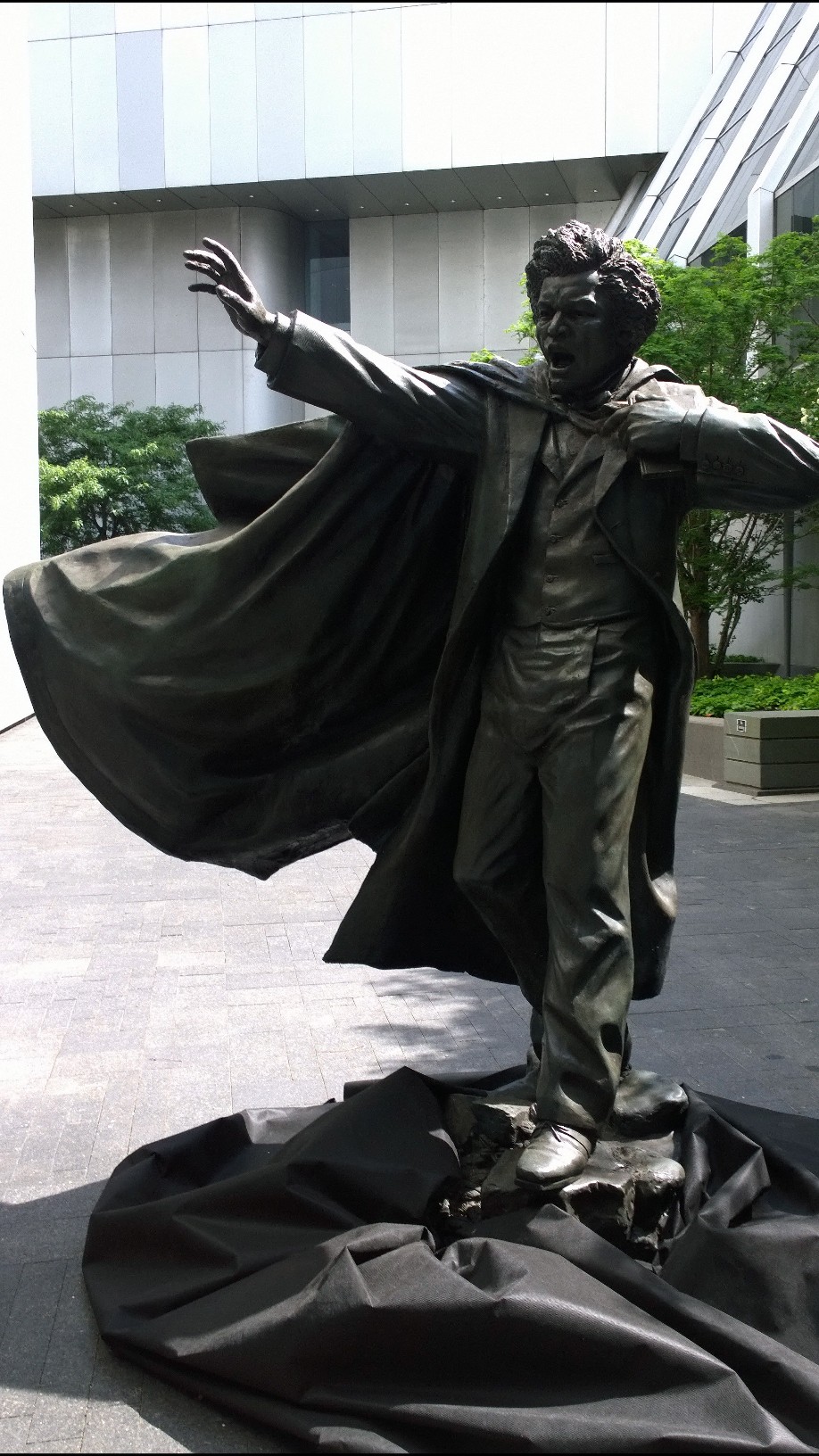
Which brings me to how I happened to be able to take a photo of the Irish statue of Douglass today. The Center for Race Amity in Boston is partnering with the Douglass/O’Connell Project on a celebration this weekend, before the statue goes on tour. Isn’t it magnificent? Andrew Edwards is the sculptor.
There will be a preview of the public television film Douglass and O’Connell Saturday at the Museum of African American History at 7 pm, followed by a lecture by Don Mullen, the author of Bloody Sunday. On Sunday there will be festivities in the Greenway from 1 pm to 5 pm.
In a recent post, we described homes being made out of shipping containers. But an architect friend cautioned that it’s not easy to get all the permits for something like that, asking, “How many how many people do you know who would welcome a container home in their neighborhood?”
Well, here’s a story about shipping containers recycled for something that might be more manageable.
Yvonne Abraham writes at the Boston Globe, “On a blah gravel lot in East Boston sits an especially cool example of the human ability to invent and adapt. Spend enough time here, and even the most dedicated pessimist might feel hopeful about the future.
“It’s not much to look at from the outside: four recycled freight containers, painted a friendly shade of green, sharing a patch of land with some trucks at the base of Eagle Hill.
“But inside those containers, it’s spectacular. Disco-lit by thin ribbons of red and blue LED lights, all manner of leafy greens grow in long PVC planters that hang from the ceiling in tight rows. The hydroponic plants are watered and fed by an ingenious, and remarkably efficient, irrigation system. Lush and bursting with flavor, they’re neatly harvested in seconds and then it’s on to restaurants all over the city.
“These containers — which make up an operation owners Connie and Shawn Cooney have named Corner Stalk — hold the equivalent of a four-acre farm. The Marblehead couple came to farming just a couple of years ago. Connie, 63, taught in public schools for 35 years, and Shawn, 61, was a tech entrepreneur. …
“They both wanted to try something new, and they believed in what the guys who make the containers — Boston-based Freight Farms — are doing: creating computer-controlled environments that can grow produce year round, anywhere where there’s electricity and a water supply.” Read how the business grew — and where it’s headed — at the Boston Globe.
A young man I know on the train was interviewed on a National Public Radio program about his unusual brain and what scientists are learning from it.
Jonathan was born without a cerebellum. His father, Richard, who also used to take the train, told me how he worked with Jonathan from his earliest days to prove the doctors wrong about what he would be able to do in life.
Jon Hamilton writes at NPR, “Since his birth 33 years ago, Jonathan Keleher has been living without a cerebellum, a structure that usually contains about half the brain’s neurons. This exceedingly rare condition has left Jonathan with a distinctive way of speaking and a walk that is slightly awkward. He also lacks the balance to ride a bicycle.
“But all that hasn’t kept him from living on his own, holding down an office job [at the Institute for Community Inclusion] and charming pretty much every person he meets. …
“Jonathan is also making an important contribution to neuroscience. By allowing scientists to study him and his brain, he is helping to change some long-held misconceptions about what the cerebellum does. And that, in turn, could help the hundreds of thousands of people whose cerebellums have been damaged by a stroke, infection or disease.
“For decades, the cerebellum has been the ‘Rodney Dangerfield of the brain,’ says Dr. Jeremy Schmahmann, a professor of neurology at Harvard and Massachusetts General Hospital. It gets no respect because most scientists only know about its role in balance and fine motor control. …
“Research on Jonathan and people like him supports the idea that the cerebellum really has just one job: It takes clumsy actions or functions and makes them more refined. ‘It doesn’t make things. It makes things better,’ Schmahmann says.
“That’s pretty straightforward when it comes to movement. The brain’s motor cortex tells your legs to start walking. The cerebellum keeps your stride smooth and steady and balanced.
” ‘What we now understand is what that cerebellum is doing to movement, it’s also doing to intellect and personality and emotional processing,’ Schmahmann says.
“Unless you don’t have a cerebellum. Then, Schmahmann says, a person’s thinking and emotions can become as clumsy as their movements. …
“His sister, Sarah Napoline, [says] her brother is a great listener, but isn’t introspective. …
“Jonathan also needed to be taught a lot of things that people with a cerebellum learn automatically, Sarah says: how to speak clearly, how to behave in social situations and how to show emotion.
“Yet Jonathan is now able to do all of those things. He’s done it by training other areas of his brain to do the jobs usually done by the cerebellum, Schmahmann says.
“It’s taken decades, Richard says. He adds that it couldn’t have happened at all if his son were less resilient and determined.”