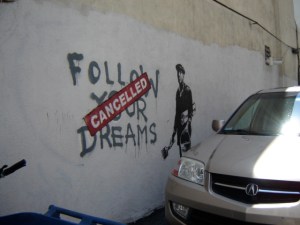
I am intrigued by street art, and have blogged a few times about the British street artist Banksy. For example, here.
So I wanted to share Nicholas Barber’s article “The Full Banksy Experience” at More Intelligent Life.
“Last week I was driving home along an unlovely stretch of main road in east London,” writes Barber, “when I saw what looked like a billboard on the side of a building. It had a friendly message printed in neat black letters: ‘Sorry! The lifestyle you ordered is currently out of stock.’
“It took a few seconds to process. It was definitely pithy, and definitely cheered me up at the end of a boring drive, but what was it? An advert? Did it have The Economist’s red logo at the bottom? Or was it … could it be … a Banksy?
“A few days later, an item in the local paper confirmed that it was indeed a Bansky, and a photo was on the artist’s website. I felt as if I’d lucked into a new artistic experience.
“The pleasure you get from a Banksy comes from the whole process: the chancing upon on an artwork in the unlikeliest of places, the speculation over how it got there, the uncertainty over whether it’s his or not, the subsequent authentication, and then the knowledge that it might have been rubbed out by the time you return.”
That is similar to my own reaction, except for the fact that I knew what I was looking for. And to this day, it has not been “authenticated.” Do you think it looks like a Banksy?
New research by Simone M. Ritter et al. in the Journal of Experimental Social Psychology seems to corroborate the truth of the old cartoon series “A Change Does a Man Good.”
You probably don’t remember the mild little cartoons in the series, but they tended to show situations like a man in a fedora scolding a police officer for parking next to a fire hydrant. Change can make one feel good.
It can also make one more creative.
In “Thinking Creatively: Just Add Milk” at Miller-McCune (now called Pacific Standard), Tom Jacobs describes an interesting experiment Ritter and her team conducted.
“Dutch university students were asked to prepare a breakfast sandwich popular in the Netherlands.
“Half of them did so in the conventional manner: They put a slice of bread on a plate, buttered the bread and then placed chocolate chips on top. The others — prompted by a script on a computer screen — first put chocolate chips on a plate, then buttered a slice of bread and finally ‘placed the bread butter-side-down on the dish with the chocolate chips.’
“After completing their culinary assignment, they turned their attention to the ‘Unusual Uses Task,’ a widely used measure of creativity. They were given two minutes to generate uses for a brick and another two minutes to come up with as many answers as they could to the question: ‘What makes sound?’
“ ‘Cognitive flexibility’ was scored not by counting how many answers they came up with, but rather by the number of categories those answers fell into. For the ‘What makes sound?’ test, a participant whose answers were all animals or machines received a score of one, while someone whose list included ‘dog,’ ‘car’ and ‘ocean’ received a three.
“ ‘A high cognitive flexibility score indicates an ability to switch between categories, overcome fixedness, and thus think more creativity,’ Ritter and her colleagues write.
“On both tests, those who made their breakfast treat backwards had higher scores.”
I like thinking about all the ways that the sign in a local shop window — “Craft Butchery” — could be read. Maybe the term is familiar to you, but it struck me funny. “We butcher arts and crafts”?
I guess it all depends on the meaning of “craft.” Small craft, as in small craft warning? “Hurricane predicted. Ignore this small craft advisory and invite craft butchery.”
If I saw the sign in Salem, I might conclude it was short for witchcraft butchery, but I still wouldn’t know if it was butchery by witchcraft or butchery of witchcraft.
Well, as you likely assumed straight off, the store sells cuts of meat. And the butcher is an artisan in his field.
Living on Earth, a national radio program produced in Somerville, Massachusetts, has interviewed an interesting guy who makes audio recordings of nature.
He may record, for example, what a woodland sounds like before a logging company comes in and what it sounds like after clear cutting. He may record the sounds of insects in trees. He says it is nearly impossible to get away from man-made sounds when recording nature.
Listening to his recordings early this morning resulted in my listening for the birds more on the walk I took later. (And I turned to see a very jubilant cardinal.)
“Few have heard the world as Bernie Krause has. Originally trained as a musician, he spent years recording the most famous musicians of the 1960s and 70s. Then he left the studio to explore the origins of music in nature. Krause has recorded wild sounds in places few have ever been or even dreamed of. Living on Earth’s Ike Sriskandarajah listens in.” Listen here or read transcript.
Those of us who go to work on the commuter rail or on the subway (the T) have a love-hate relationship with our public transportation system. Probably more love than hate since we forgive everything, always reminding ourselves how much more we would hate sitting in road traffic listening to the same news headlines repeated multiple times. We just make sure to carry a book and snacks in case of train breakdowns.
Take tonight. When I got down to the platform, the numbers of commuters seemed ominous. Even more ominous was the recorded message that kept telling us our train was “arriving” even though we know it never says “arriving” more than once for any train.
My boss said, “Don’t you have the option of taking the commuter rail from North Station?” Good point. I set off on foot, caught a number 4 bus, and landed at North Station in reasonable time, but for a later train.
The country badly needs good mass transit, and I think focusing on cars, gas, and roads is misguided. We riders get mad at the T and often complain about how it spends its money, but man, it sure is old and beat up! It’s held together with string — and the efforts of people who work all night on repairs to try to get the system functioning by 5:30 a.m. every day.
Now the T has made a 45-minute documentary on its night-time moles. If you don’t have time for the whole documentary, here’s a taste.
Another WordPress blogger, Piper Street Sound, “liked” one of my posts, so I went and looked at a couple of his. He’s a musician, and he produces a kind of music that is new to me. I read this post and in the comments section asked for more explanation.
The blogger answered on his blog, “It’s sort of reggae combined with a style of Peruvian pop music called Chicha that grew out of Cumbia’s spread across South America out of Colombia and with the youths of the 60′s and 70′s picking up electrified instruments, emulating US and UK rock music. So it is pretty layered as far as the musical influences go, part Jamaican, part Peruvian Psychedelia and then a heavy dose of electronic elements. … Here is a link to the best compilations of Chicha music available today. It also has a good explanation of what Chicha is”: Roots of Chicha.
Did you catch the National Public Radio story on backwards running? Who knew that there are actually competitions in backwards running? I thought it was something kids do, and only for a minute or two.
“Achim Aretz holds the Guinness World Record for running the half marathon, backward. But now, the 27-year-old German athlete says he’s tired of doing something almost no one else does and wants to head in a new direction. Reporter Caitlan Carroll caught up with him in Hanover, Germany.” Listen to the Interview.
What would Lewis Carroll do with this? I immediately thought of the Red Queen from Through the Looking-Glass.
” ‘Well, in our country,’ said Alice, still panting a little, ‘you’d generally get to somewhere else — if you run very fast for a long time, as we’ve been doing.’
” ‘A slow sort of country!’ said the Queen. ‘Now, here, you see, it takes all the running you can do, to keep in the same place. If you want to get somewhere else, you must run at least twice as fast as that!’ ”
Pretty much anything Lewis Carroll wrote has always made perfect sense to me.
I went to the concert of an oboe-playing friend Sunday. The 3 p.m. event coincided with the anniversary of the earthquake and tsunami that took place a year ago in Japan. My friend, of Japanese heritage, was moved by the music he was playing, and so was I. The modern pieces really sounded like an earthquake to me. I had visions of Poseidon, the Bull from the Sea, rising up in anger against humankind, and later of hope dawning.
The Charles River Wind Ensemble, where my friend plays, has a new conductor. I liked Matthew Marsit’s energetic style and his explanations of the pieces. Marsit, a clarinetist himself, is also a conductor at Dartmouth College, where he practices his belief in music outreach to lower-income communities.
“An advocate for the use of music as a vehicle for service, Matthew has led ensembles on service missions in Costa Rica and Philadelphia, Pennsylvania, collecting instruments for donation to schools, performing charity benefit concerts and offering workshops to benefit arts programs in struggling schools. His current work at Dartmouth allows for outreach projects in the rural schools of New Hampshire and Vermont, working to stimulate interest in school performing arts programs.” Read more.
I think musicians can be very giving people. Indian Hill Music in Littleton, Massachusetts, offers scholarships and more. Someone I know on the board tells me that Indian Hill has “a program to bring music instruction to schools in the region that have cut out music due to budgetary constraints. They also offer free concerts, a Threshold choir (music for dying patients), and a number of other outreach efforts.”
In Providence, Rhode Island, Community MusicWorks demonstrates how music builds community and teaches social responsibility. You can read about this and other innovations in Rhode Island’s creative economy here.
Nancy Greenaway, also known to readers of this blog as the Snowy Owl Poet, just told me about two New England poetry events taking place this spring.
The ninth annual Block Island Poetry Project, featuring Rhode Island Poet Laureate Lisa Starr, will be offering four workshops, starting in April 12 and going to May 13. Former U.S. Poet Laureate Billy Collins will be there there May 12 and 13. I include a photo of Collins from the event website.
The other event is scheduled for a city best known for witches: “The fourth Massachusetts Poetry Festival will be held Friday, Saturday, and Sunday, April 20–22, in historic Salem. The three-day event, which will bring 1,500 poets and poetry lovers to the city, will showcase a variety of extraordinary local and regional poets, and engage the public through poetry readings, interactive workshops, panel discussions, music, film and visual arts, and performances geared toward a diverse statewide audience.” Check the line-up. It looks super.
(I see that my brother’s longtime friend Michael Ansara is on the advisory board!)
Dutch artist Peter Gentenaar makes stunning paper sculptures that Nathaniel Ross at Inhabitat (“design will save the world”) describes as “soaring through the air like flying jellyfish. …
“Peter Gentenaar’s art was born out of the limitations of what he could (or couldn’t) create with store-bought paper. So with the help of the Royal Dutch Paper Factory, he built his own paper factory and devised a custom beater that processes and mills long-fiber paper pulp into the material you see in his artwork. He saw the potential that wet paper had when reinforced with very fine bamboo ribs, and he learned to form the material into anything his imagination would allow.”
Check out the machine Gentenaar uses to create his paper. You can buy one. He describes it thus:
“A machine suitable for beating long fibers, flax, hemp or sisal, as well as for beating soft and short fibers like cotton linters. The machine is built in stainless steel and has a bronze bedplate. The bronze bedplate has the same curve as the knife roll, this gives effective grinding/beating over a surface of: ± 20 x 10 cm. The distance between the roll and the bedplate can be finely adjusted. Also the weight under which the fibers are beaten can be varied from 0 to 60 kilo’s. This means you can use the beater on very delicate fibers and on very strong and rough fibers as well. I never have to cook my fibers. There is a factory guarantee on the beater of one year. At present I’m getting a CE mark, which ensures certain safety standards. There are over 70 beaters of this type sold over the last 12 years and they are all still working.”
The other day John brought up the topic of Andrew Carnegie. Whatever else might be said about this 19th Century steel baron, you have to give him credit for putting so much of his fortune into philanthropy, especially libraries.
Today John Wood is carrying on that work in impoverished countries around the world. As Nicholas Kristof writes in the NY Times, “Wood’s charity, Room to Read, has opened 12,000 … libraries around the world, along with 1,500 schools. …
“He has opened nearly five times as many libraries as Carnegie, even if his are mostly single-room affairs that look nothing like the grand Carnegie libraries. Room to Read is one of America’s fastest-growing charities and is now opening new libraries at an astonishing clip of six a day. …
“He also runs Room to Read with an aggressive businesslike efficiency that he learned at Microsoft, attacking illiteracy as if it were Netscape. He tells supporters that they aren’t donating to charity but making an investment: Where can you get more bang for the buck than starting a library for $5,000? …
“ ‘In 20 years,’ Wood told me, ‘I’d like to have 100,000 libraries, reaching 50 million kids. Our 50-year goal is to reverse the notion that any child can be told “you were born in the wrong place at the wrong time and so you will not get educated.” ‘ ” Read more.
The Poem-a-Day service of the Academy of American Poets featured two of my favorite poets this week. I love the personable vibes from these women, the particularity, the quirkiness.
My father got me interested in poetry, giving me a volume of Emily Dickinson and telling me I could “get started” on her, but he admitted that he didn’t think there were any “great” women poets. I think he was wrong about that. I don’t know if he ever changed his mind.
Dear March – Come in –
How glad I am –
I hoped for you before –
Put down your Hat –
You must have walked –
How out of Breath you are –
Dear March, how are you, and the Rest –
Did you leave Nature well –
Oh March, Come right upstairs with me –
I have so much to tell –
I got your Letter, and the Birds –
The Maples never knew that you were coming –
I declare – how Red their Faces grew –
But March, forgive me –
And all those Hills you left for me to Hue –
There was no Purple suitable –
You took it all with you –
Who knocks? That April –
Lock the Door –
I will not be pursued –
He stayed away a Year to call
When I am occupied –
But trifles look so trivial
As soon as you have come
That blame is just as dear as Praise
And Praise as mere as Blame –
My father used to say,
“Superior people never make long visits,
have to be shown Longfellow’s grave
or the glass flowers at Harvard.
Self-reliant like the cat—
that takes its prey to privacy,
the mouse’s limp tail hanging like a shoelace from its mouth—
they sometimes enjoy solitude,
and can be robbed of speech
by speech which has delighted them.
The deepest feeling always shows itself in silence;
not in silence, but restraint.”
Nor was he insincere in saying, “Make my house your inn.”
Inns are not residences.
Twenty years ago I helped out on what local people jokingly refer to as the Concord Passion Play: Little Women. It’s performed every 10 years by the Concord Players because (a) author Louisa May Alcott lived at Orchard House in Concord and (b) she was a founder of the theater group that became the Concord Players.
Kate Clarke is directing the show this year, and she just got some great publicity in the Boston Globe.
“ ‘Preparing to direct the play, I started to do some research and was fascinated to discover just how meaningful the book is to so many people,’ Clarke said.
“ ‘Even the rock star Patti Smith wrote in her recent memoir that “Little Women” was what made her feel as a young high school student that she could be an artist. It motivated her to go to New York and become a performer. I started thinking, “Good Lord, Jo March is everywhere! Why do people find her so compelling?”
“ ‘That’s the question I’ve been tackling with this group of actors. Yes, it’s about the Civil War era, and the societal restrictions that females were under at that time. But the fact that the book’s popularity has endured reflects what compelling characters these young women were.
“ ‘This story is so uniquely Concord and yet reaches far beyond the boundaries of Concord, just as it is a story about the 1860s that also brings up a lot of contemporary issues,’ Clarke said.” Read more.
Here’s photo by Jon Chase for the Boston Globe. Pat Kane, an incredible costume designer, is in the middle. (I don’t think she remembers, but the first time she worked for the Concord Players was when I sought her help on a one-act I directed, Stoppard’s After Magritte.)
Today I walked over to the Moakley Courthouse on Boston Harbor to see an art exhibit that the Actors’ Shakespeare Project put together with youth in detention. It consisted of large photographs in which a young person, sometimes in costume, acted out a word from Shakespeare. I did not feel that the presentation in the low-ceiling hallway did the works justice — and having to go through metal detectors to look at them is a bit of a downer — but the concept is positive.
Deborah Becker of WBUR reported that the photographs were part of a larger effort to turn young offenders around with the help of art: “Using the arts as a way to heal and transform is the theme of an exhibit at Boston’s federal courthouse. The artists are children who have been involved with the Massachusetts Department of Youth Services (DYS), the agency that handles youngsters charged with crimes.
“At a recent reception of the artists and DYS officials, 17-year-old Ricky Brown was among the young people proudly describing his work. He helped paint a mural that covers the entire wall of a DYS district office in Springfield. He says it sends a message about kids in the juvenile justice system.
“It brightens up the whole building,” Brown said. “It makes sure to say that we’re not only there to get locked up. It’s there to let people know that we do work together, we do do something positive.”












 Suzanne's Mom's Blog