Not long ago, I listened to a certain “Living on Earth” radio broadcast with amazement. A woman was explaining how she made up her mind to live without plastics. She did not make the effort sound easy, but she did make me think of ways I might cut back.
The “Living on Earth” account begins,”We live in a plastic-filled world. It’s used in almost everything, from cars to chewing gum to prescription drug bottles. Five years ago, Beth Terry decided to stop consuming plastic and she’s survived to tell the tale. Host Bruce Gellerman talks with Terry about her new book, ‘Plastic Free: How I Kicked the Plastic Habit and How You Can Too.’ ”
Terry tells the host, “Five years ago, almost to the day, I stumbled across an article about the plastic pollution problem in the ocean. And what completely blew my mind, and broke my heart, was this photo I saw of a dead albatross chick on Midway Island, thousands of miles from civilization — halfway between the United States and Japan. And it was just the carcass; it was full of plastic pieces. Like the plastic that I used on an everyday basis — things like bottle caps, things that didn’t come from the middle of the Pacific Ocean — they came from us. I just had to change. …
“I didn’t commit to stop using the plastic I already had, first of all, and I don’t recommend that anybody go through their house and purge the plastic and throw it away, because that’s just so wasteful, I think. But when my computer broke and it couldn’t be fixed — my first step is always to try and fix things and make them last as long as possible — but, when it couldn’t be fixed, I looked on Craig’s List and I found a secondhand computer.”
My own worry about plastics is how unstable the components are and how chemicals may escape into the air we breathe and the water we drink. When plastics are heated, as in a microwave, they can be dangerous. Please use ceramic containers for warming food in your — er — plastic microwave.
Read more of Terry’s alternatives to buying new plastics at “Living on Earth.”
Photograph: Beth Terry, with the plastic she collected in the first half of 2007.
I love artists. They come up with the wackiest ideas. And often the ideas have bypassed the rest of us because they are in fact so incredibly sane.
In the July 27, 2012, Boston Globe, Stephanie Steinberg writes about two such artists.
Carla “Repice, 40, and Geoffrey Cunningham, 37, who met while studying at Lorenzo de’ Medici school of art in Italy, started the performance art project Office of Blame Accountability [in 2007] while working on a separate project in California. The two artists, now self-proclaimed ‘blame accountants,’ were frustrated by the lack of accountability by the media, government, and individuals. …
“Repice had recently purchased a red 1920s telephone at a flea market. As they sat on a bench outside Cal State Fullerton Grand Central Art Center in Santa Ana discussing whom to blame for personal and countrywide problems, Repice brought up the idea of the phone representing an emergency call.
“ ‘We were talking about blame accountability, and there was this red phone, and we thought, “OK, let’s create an office. . . . Let’s place a desk on the sidewalk and facilitate a space where people can engage this idea of blame and accountability,” ’ ” she said.
“Within an hour, they set up a desk and placed a typewriter, mock blame forms, and, of course, the telephone on top. They then started asking random passersby, ‘Do you have any blame to place?’ ”
The lovely part is that the “blame accountants” also ask people to consider their own role is the thing they are blaming on others. The results can be quite touching. Read more.
A NY Times article I saved from November 24, 2009, remains as inspirational as when I first read it.
In “Learning His Body, Learning to Dance,” Neil Genzlinger writes that “Gregg Mozgala, a 31-year-old actor with cerebral palsy, had 12 years of physical therapy while he was growing up. But in the last eight months, a determined choreographer with an unconventional résumé has done what all those therapists could not: She has dramatically changed the way Mr. Mozgala walks.
“In the process, she has changed his view of himself and of his possibilities.
Mr. Mozgala and the choreographer, Tamar Rogoff, have been working since last winter on a dance piece called ‘Diagnosis of a Faun.’ It is to have its premiere on Dec. 3 at La MaMa Annex in the East Village, but the more important work of art may be what Ms. Rogoff has done to transform Mr. Mozgala’s body.
“ ‘ I have felt things that I felt were completely closed off to me for the last 30 years,’ he said. ‘The amount of sensation that comes through the work has been totally unexpected and is really quite wonderful.’ ”
Choreographer Rogoff saw Mozgala perform the role of Romeo in a production by Theater Breaking through Barriers in March 2008 and knew she wanted to create a dance piece for him.
“Originally, [Ms. Rogoff] envisioned a simple study, maybe 10 minutes long. Mr. Mozgala’s expectations when he agreed to the project were equally narrow: he said that he thought that she would either merely create a dance that made use of the physical abilities he already had or, after seeing his limitations, tell him, ‘Thanks but no thanks.’ ”
It turned out that their expectations were way too narrow. Read more.
Photograph by Andrea Mohin at The New York Times shows Gregg Mozgala rehearsing with Emily Pope-Blackman.
Tom Jacobs alerted me to a piece he published at Pacific Standard, a publication that reports on studies in the social sciences.
Newly published research, he says, provides some support for the notion that children by nature want to help others.
“ ‘From an early age, humans seem to have genuine concern for the welfare of others,’ concludes a research team led by Robert Hepach of the Max Planck Institute for Evolutionary Anthropology. …
“But how exactly do you discover a toddler’s motivation? The researchers took a novel approach: by looking straight into his or her eyes.
“They note that our pupils enlarge in response to emotionally stimulating sights, and deduced this could provide an indication of what specifically prompts kids to perk up and take notice. Are they aroused by the sight of someone in need—or, perhaps, by the realization that they could play the hero by helping?
“Their experiment featured 36 2-year-olds, who viewed a scene in which an adult needed help reaching for a can or crayon. One-third of the children were allowed by their parents to help the person in need (almost all did so); another third were held back from providing assistance.”
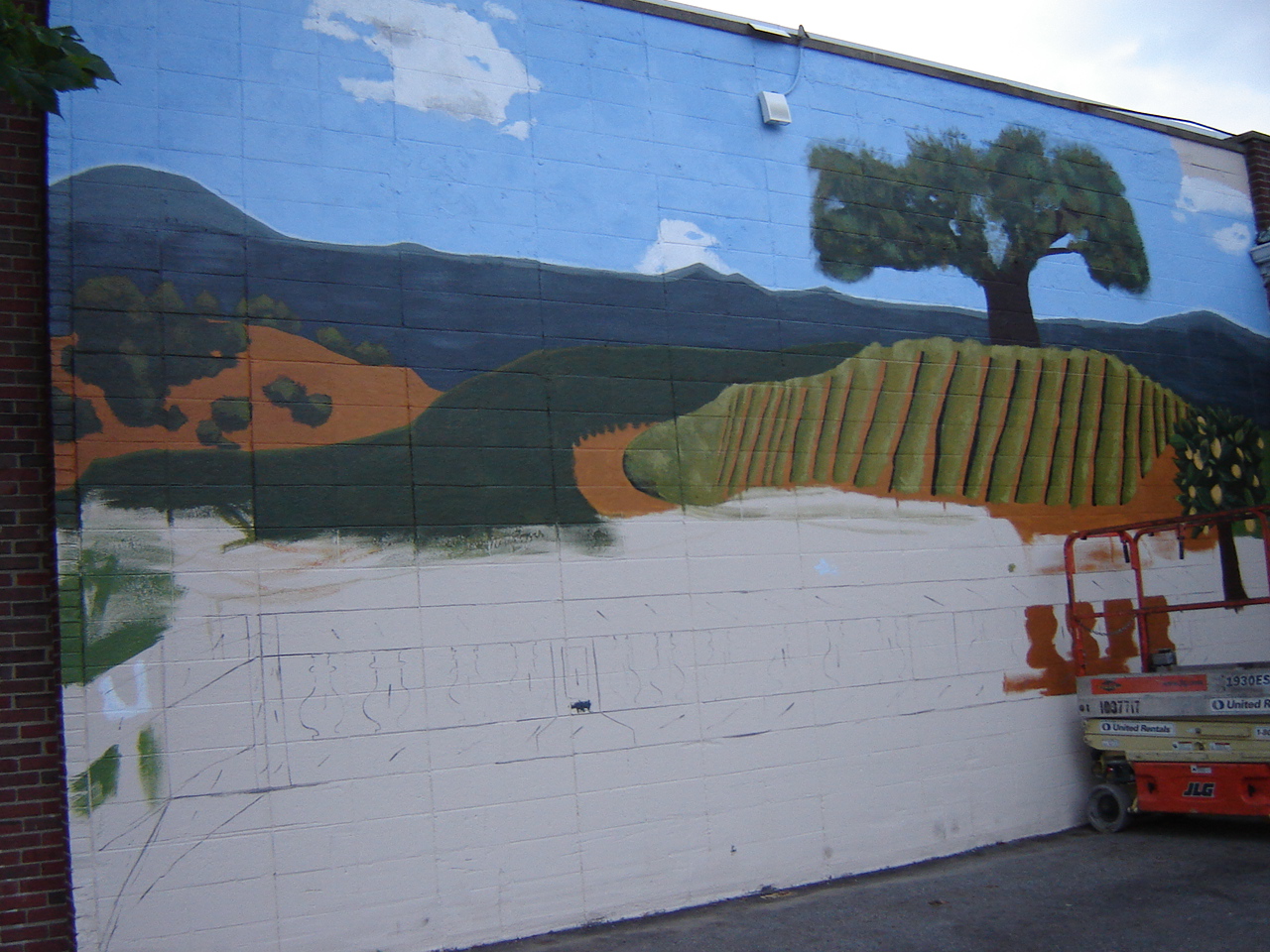
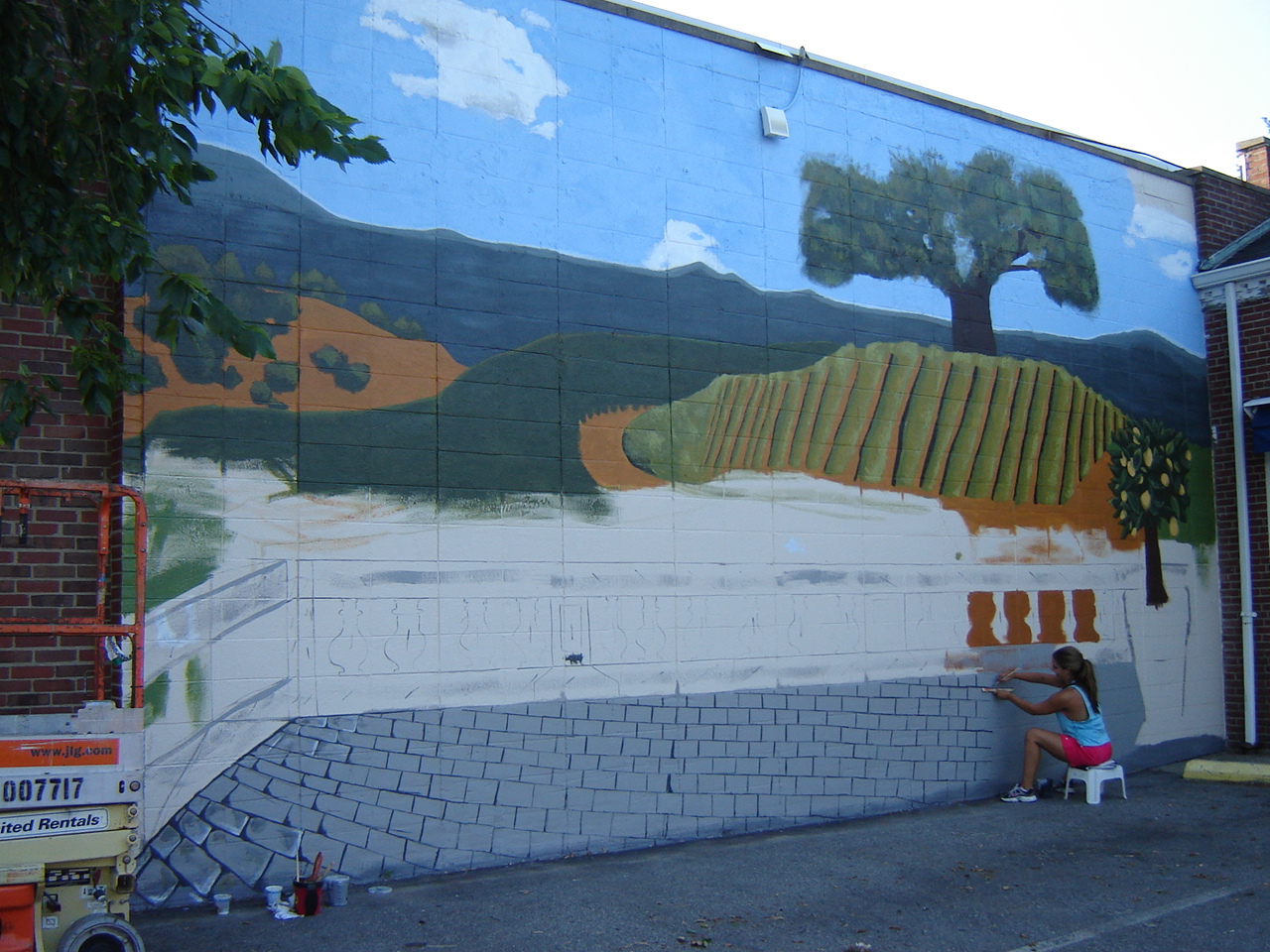
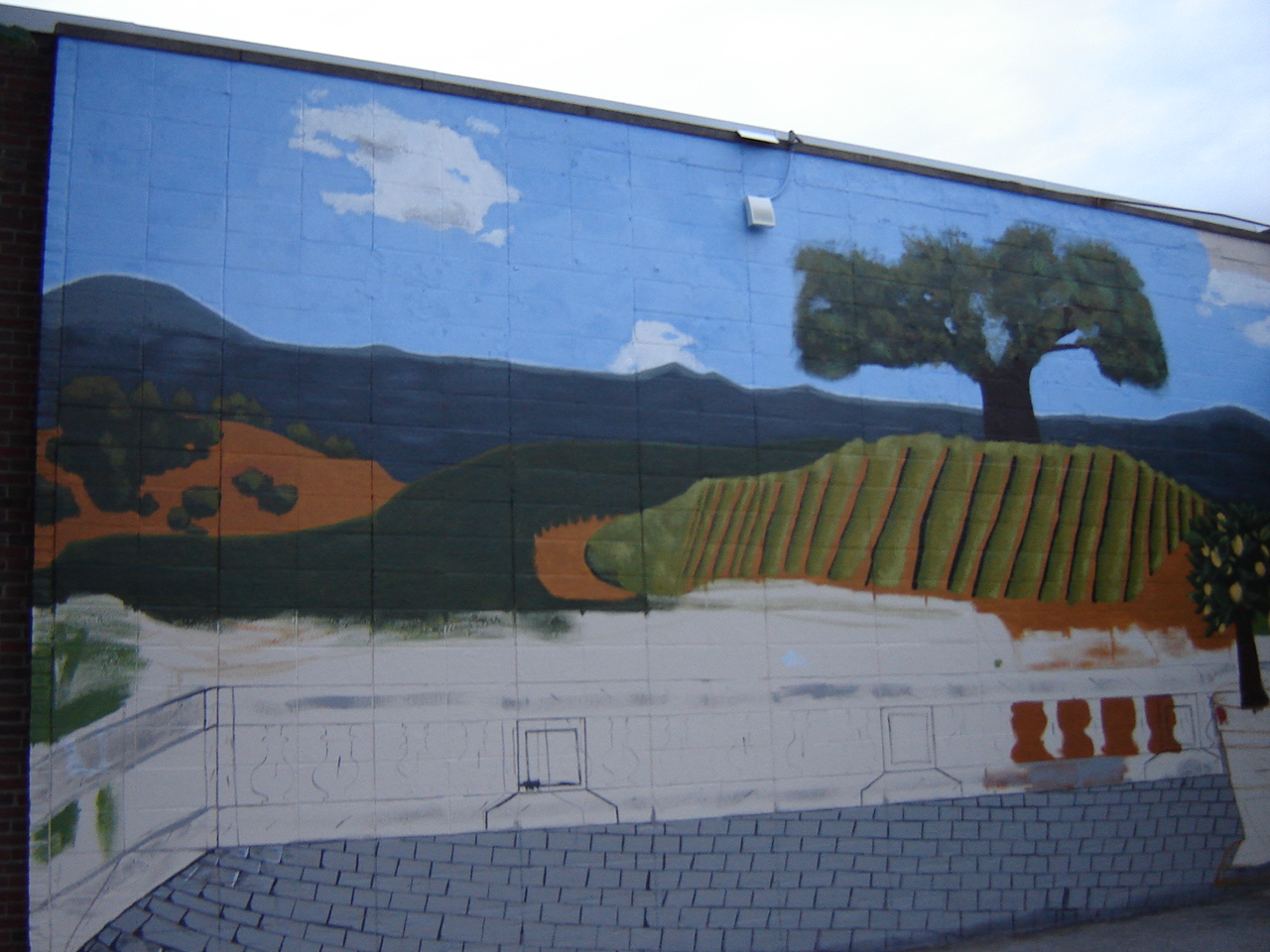
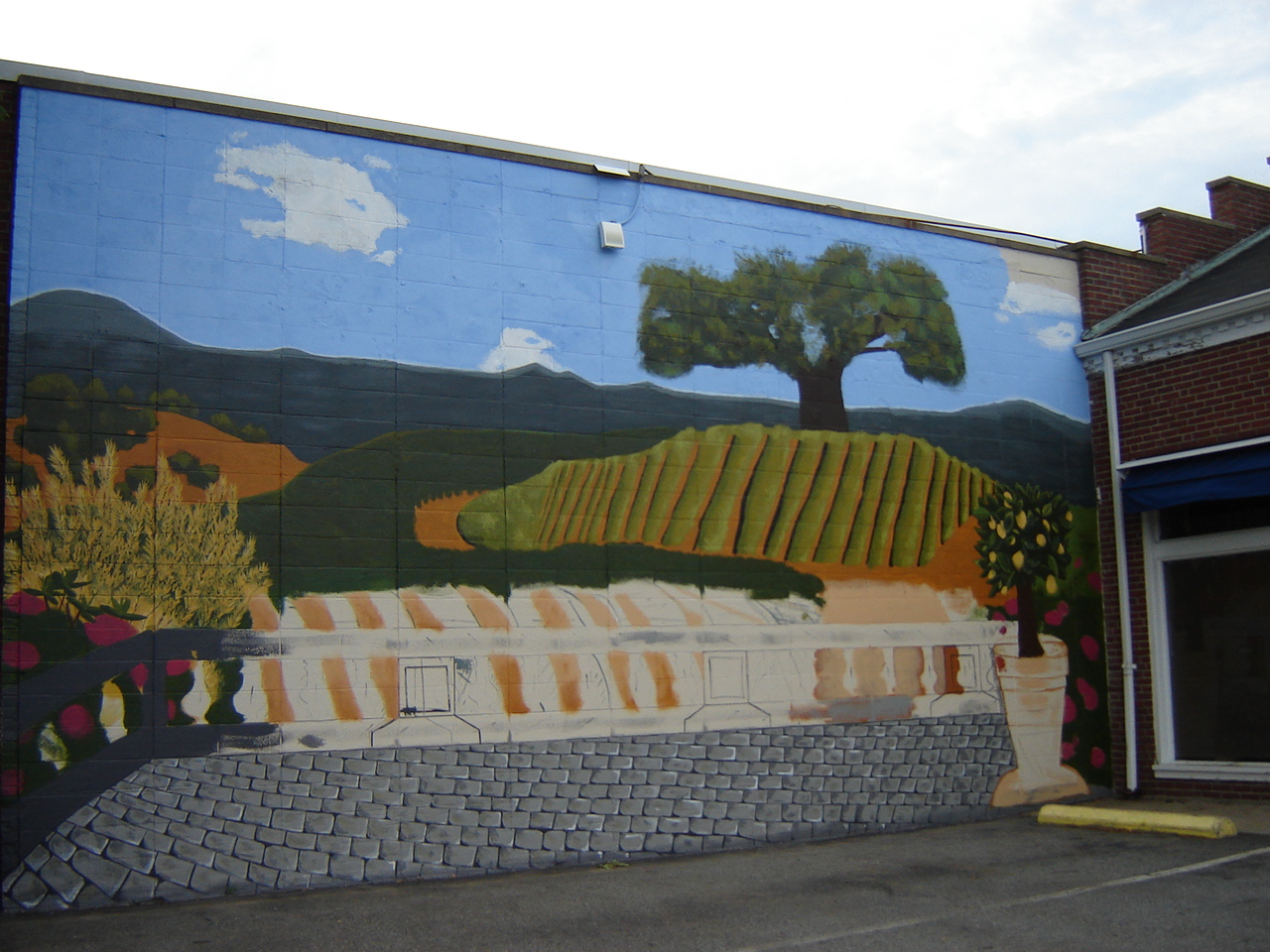
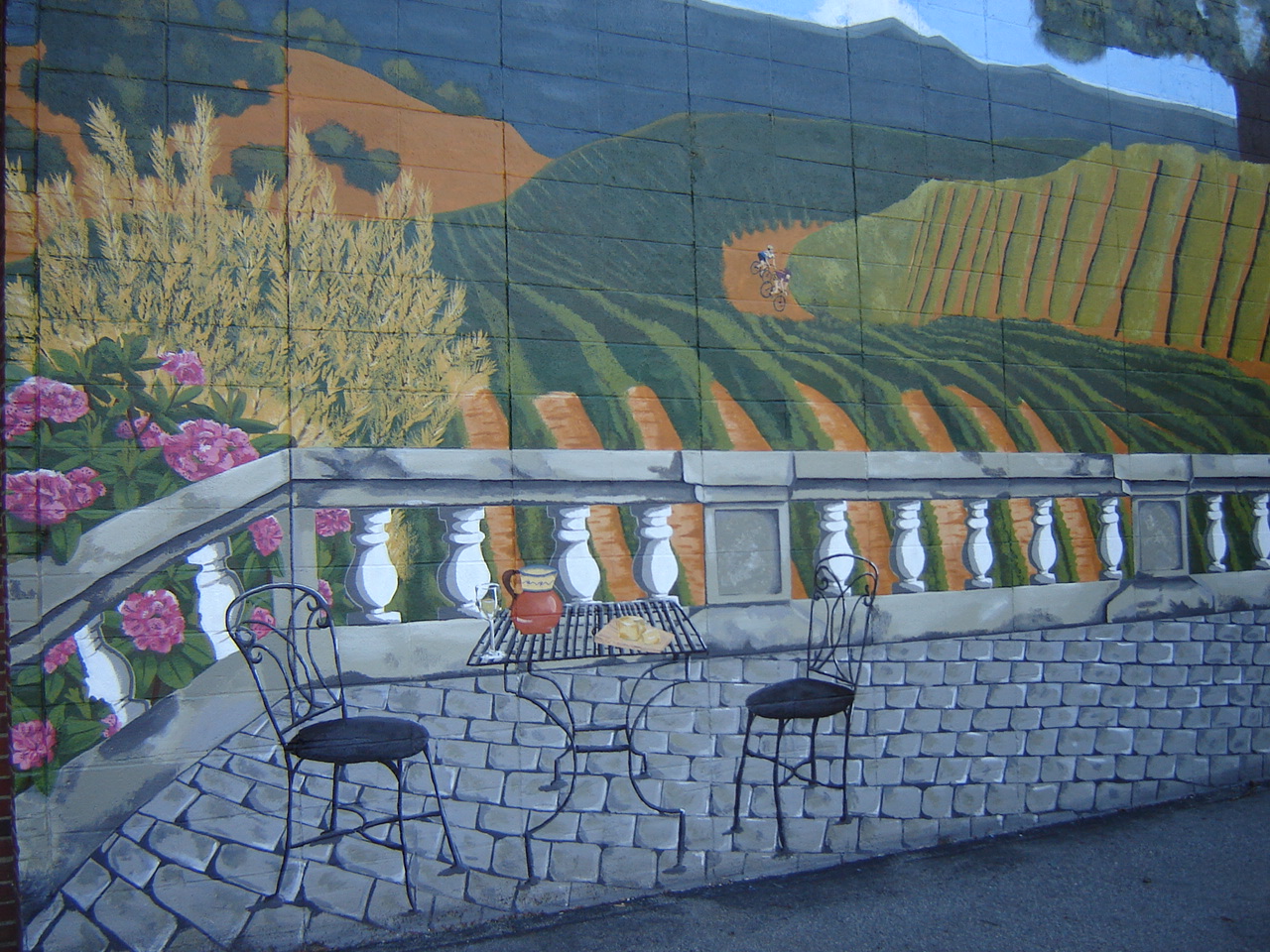
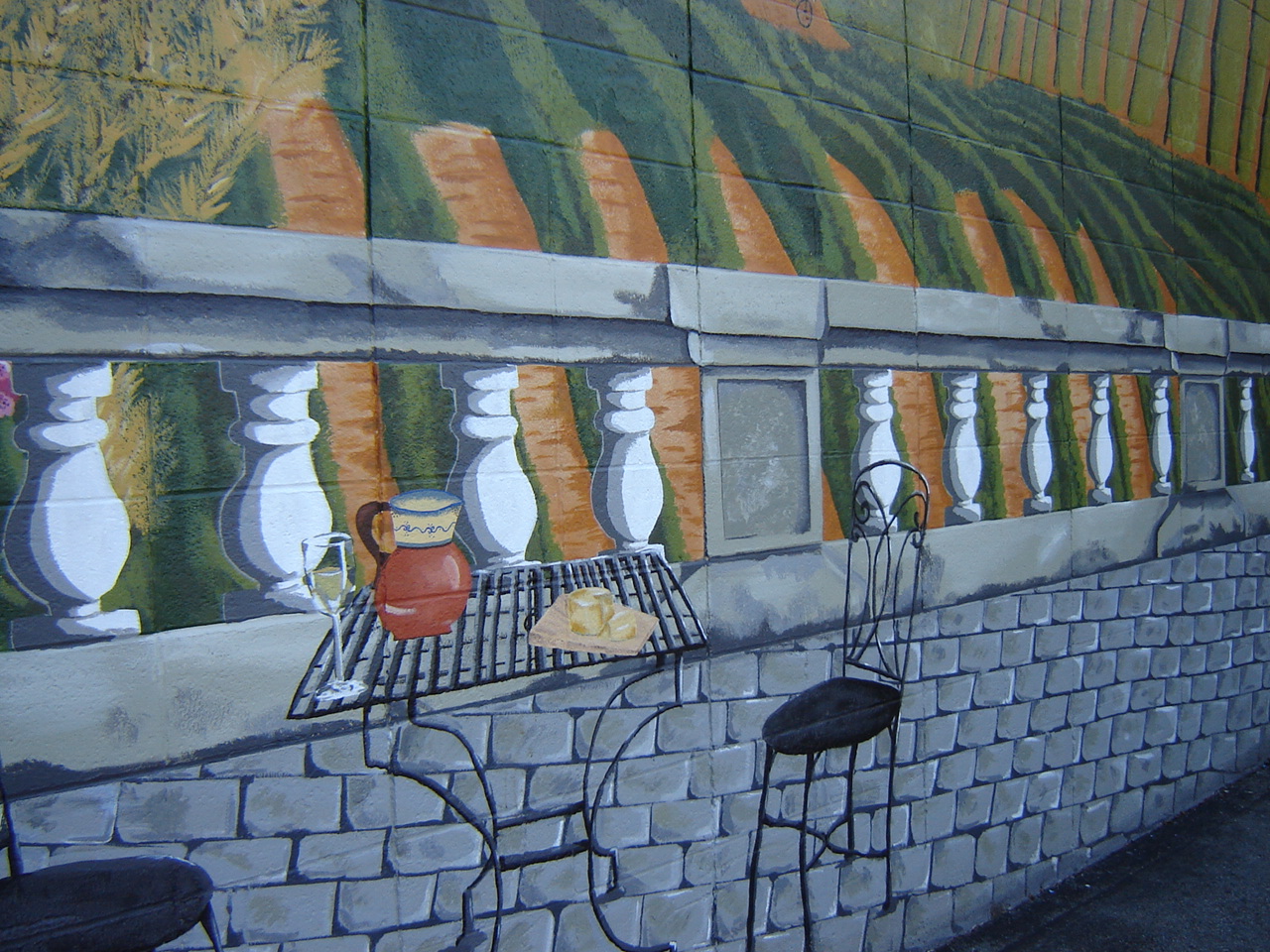
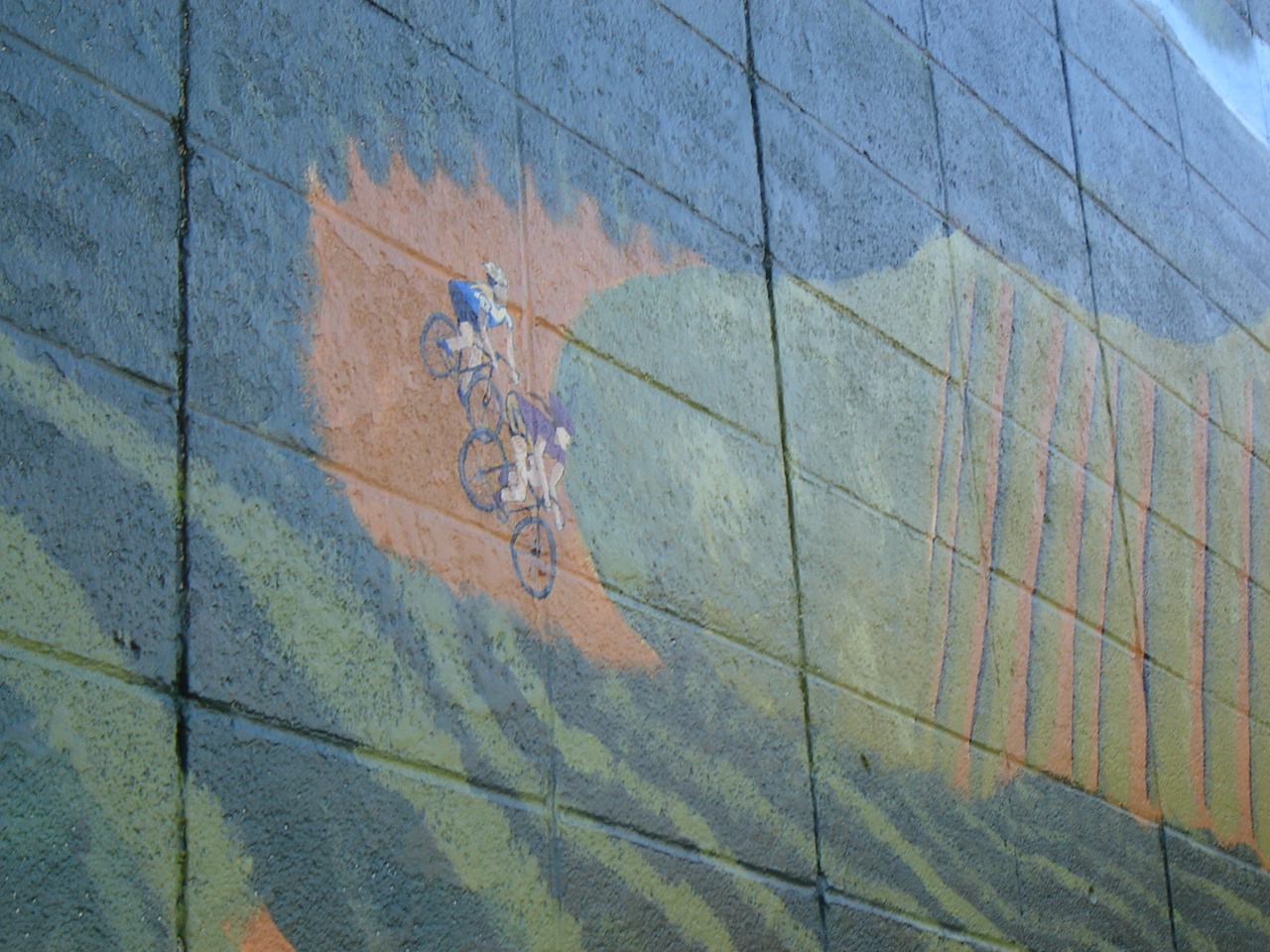
All through one of Concord’s hottest summers, Sophie has been creating a mural of Tuscan vineyards for Period Realty. Take a look at the progression. I especially like the latest touches showing a tasting table and distant bicyclists.
Lately, it seems that lot of young people want to make the world a better place and are starting nonprofits to do so.
Marian Daniells writes in the Boston Globe about one young activist, who attends Northeastern University.
“Mike Behan spends six months out of the year in Njabini, Kenya. But it’s no safari vacation. Behan, 21, is the cofounder and CEO of Njabini Apparel, a nonprofit company selling handcrafted accessories made by landless and handicapped mothers in the Kenyan settlement.
“A rising senior at Northeastern University, Behan first visited Njabini in June 2010 as a volunteer with Flying Kites, a nonprofit group that supports orphaned children in Kenya. With Flying Kites’ help, Behan then started Njabini Apparel with Tom Mwangi and marketing director Erin O’Malley (both volunteers with Flying Kites) in August of that year. By October, they were selling hats and scarves. Most of Njabini Apparel’s sales are done online, or by volunteers for Njabini Apparel and Flying Kites. …
“Participating mothers are able to immediately earn four times the average national income (equivalent to $780), which is then driven back into the local economy.” Read more. It will make you feel good.
Lucy Wanjiku at Njabini Apparel, a nonprofit cofounded by Mike Behan that sells handcrafted goods made by landless and handicapped mothers in the Kenyan settlement. Photograph: John Deputy
Today I walked down to 300 Summer St. for one of the Channel Café’s great lunches and to see the latest in the Fort Point Arts Community Gallery.
The exhibit, a touring show organized by Terra “Touria” Fuller, features unusual carpets woven by Zahra, a cave-dwelling nomad in Morocco, and Mouhou, a subsistence farmer.
Touria also created a documentary. In “Living with Barbarians and Cave Dwellers … Fuller moves to the pre-Saharan desert plains of Morocco from 2008-2010 and integrates into an Amazigh village and learns the survival skills necessary to live with a family of cave-dwelling nomads on the edge of the village. Over two years, she follows along and documents their lives. This is a rare look into a private and fiercely independent nomadic people made possible by the patient friendship Fuller built with the villagers and cave dwelling society.”
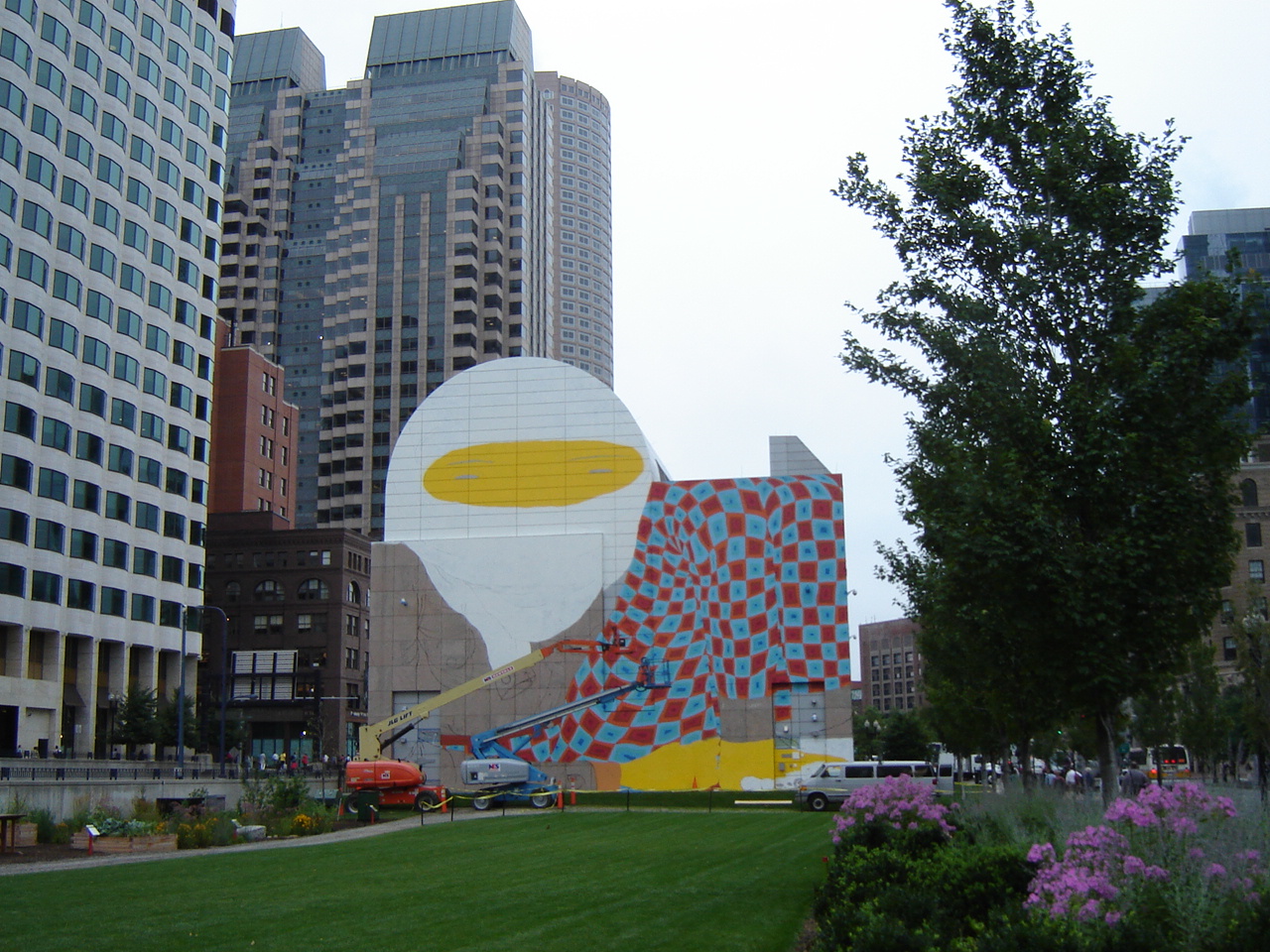
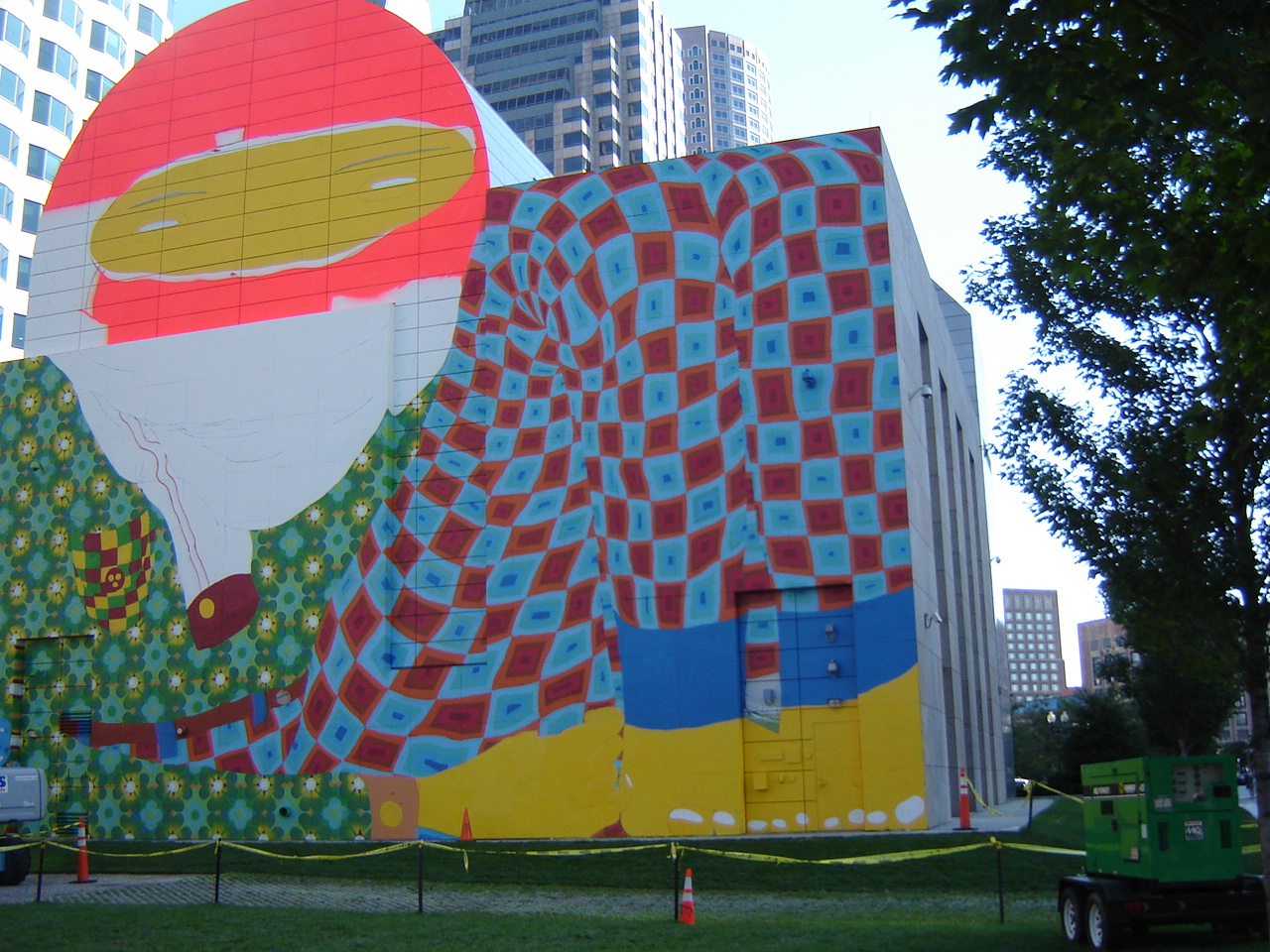
There is a huge structure in the middle of the Greenway that the inventive Sam and Leslie of Uni Project fame once envisioned as a projection screen for summer film festivals. It houses the Big Dig’s ventilation system.
About a week ago I was walking past and noticed what looked like window washers cleaning it. I thought, “Now, why would anyone want to wash that thing?”
A couple days later I saw why. Prepping the canvas.
This is in Dewey Square, where less than one year ago Occupy Boston pitched camp.
Now, writes Geoff Edgers in the Boston Globe, “That’s where Os Gemeos (‘the twins’), famous in the street art world for creating towering cartoonish figures with bright colors and grimacing expressions, began work on their first Boston piece. Depending on weather, they’ll need a little over a week to craft the mural on a wall of a Big Dig ventilation building and a second, smaller piece on the Revere Hotel near Boston Common.
“The pieces are part of the first solo museum exhibition in the United States for Os Gemeos. The Institute of Contemporary Art show, featuring paintings, mixed media works, and installations, opens Aug. 1.”
Read more and check out other art by these guys at the Globe.
You might also like to read the museum’s description of the brothers’ upcoming the exhibition:
“This August the ICA will present the first solo exhibition in the United States of works by the Brazilian brothers Otavio and Gustavo Pandolfo. Best known as Os Gêmeos, the twins are a major force in graffiti and urban art. The twins have a deep bond; they are tireless collaborators and say that they often experience the same dreams. In an effort to share their dreams with the world, they depict their visions in surreal paintings, sculpture, and installations: human figures with removable faces, exploding bursts of color, and room-size heads installed with shanty interiors.”
This blog uses WordPress site statistics, and it appears that early this morning someone from a country called Réunion visited Suzanne’s Mom’s Blog.
I admit to ignorance. I don’t think I have ever heard of Réunion.
So I looked it up. It’s an island in the Indian Ocean.
“Réunion Island (in French, La Réunion ) is a multicultural society composed of people originally from France, Mozambique, India, China, Madagascar, and the Comores. Islanders use their ethnic origins to define themselves as Cafres (African ancestry) Z’oreilles (born in mainland France), malabars or Tamouls (from Tamil Nadu southern India), Z’arabes (from Gujarat in northern India), Chinois (from China), Malgaches (from Madagascar), Comores (from Comores), Petits blancs (poor rural whites living in the highlands), or Creoles blancs (white landowners). The term Creole today also applies to people with a mixed ethnic background. All the residents of the island are administratively French citizens.”
You might also send me your best guess as to why someone from this island a world away landed at this blog. Could the Réunion visitor have been the person who searched on the words “Arab mom blog”? Or was that the visitor from Bulgaria?
I love reading what people search on and trying to guess how they landed here. This is not an Arab mom blog or any kind of mom blog, but since I have “mom” and “blog” in the title and sometimes mention family from Egypt, Google decides to send folks here.
Manolo, head of audio at SoundCloud, explained to a few of us in the office last week how SoundCloud works.
The way I understand it, SoundCloud is sort of like a YouTube for audio except that you may have to pay. A lot of musicians use it. It’s good for social-networking purposes because it’s fast. You don’t need to download a separate player to hear the audio. It starts playing automatically, as you can see below.
Manolo said something about “two weeks free,” but I’m not sure I understand that part yet. The clip below, from a South African nonprofit is one track that seems to be free at any time. There are other tracks from magazines like the Economist, which I assume the owners want you to use and won’t charge.
But if you want to upload your music, bird calls, or soundbites, I guess that’s where you have only two free weeks.
If anyone understands this better, please let me know. I want to experiment.
Hear kids at the Children’s Radio Foundation in South Africa wish a happy 94th Birthday to Nelson Mandela.
My husband saw a story about this on a German television station.
It seems that in the English towns of Todmorden and Hebden Bridge (names that could only have been invented by a hobbit), stealth farmers are growing vegetables and telling everyone to pick and eat.
At Eat Local Guide,Vincent Graff quotes a cheerful officer at a police station where vegetables are planted and harvested without the station’s permission.
” ‘I watch ’em on camera as they come up and pick them,’ says desk officer Janet Scott, with a huge grin. It’s the smile that explains everything.
“For the vegetable-swipers are not thieves. The police station carrots — and thousands of vegetables in 70 large beds around the town — are there for the taking. Locals are encouraged to help themselves. A few tomatoes here, a handful of broccoli there. If they’re in season, they’re yours. Free.
“So there are (or were) raspberries, apricots and apples on the canal towpath; blackcurrants, redcurrants and strawberries beside the doctor’s surgery; beans and peas outside the college; cherries in the supermarket car park; and mint, rosemary, thyme and fennel by the health centre.
“The vegetable plots are the most visible sign of an amazing plan: to make Todmorden the first town in the country that is self-sufficient in food.
” ‘And we want to do it by 2018,’ says Mary Clear, 56, a grandmother of ten and co-founder of Incredible Edible, as the scheme is called.” More from Eat Local here.
At the Guardian, reporter Tracy McVeigh is equally enthusiastic:
“There is an extraordinary sign on the outside of a well-tended West Yorkshire vegetable garden: ‘Help yourself.’
“In the same town this summer, people will be helping themselves to sweetcorn growing around the police station. Compost and watering cans seized in drug farm raids find use in the local gardens. And come the autumn a trip to see a local doctor will be a pick-your-own free-for-all as the health centre’s grounds have been turned into orchards.
“Grieving families who want a rose bush at the graveyard are encouraged to think productive – in one case leading to a remembrance garden of broccoli.
“Meanwhile, commuters can snip fresh herbs from the beds and pots outside the railway station. It’s all kept weeded by an army of local people who give up an hour or so on the occasional Sunday. More from the Guardian.
The Manhattan Paris Saint-Germain soccer team is made up of both rich and poor boys from many cultures. Coach Wilson Egidio thinks the team’s diversity is part of its success.
Vivian Yee has the story at the New York Times. She writes that Amara, for example, “joined the team after an eagle-eyed former player for Mr. Egidio spotted him playing on a Bronx playground. [He] wound up scoring the goal that made Paris Saint-German the first Manhattan youth club to reach the national playoffs.
“For the players, their coaches and parents, the team’s diversity is a source of success as well as pride. Their international styles, they say, add fluidity and creativity to their game.
“Combined with Mr. Egidio’s Brazilian approach — he grew up in Brazil and played professional soccer there — that could be key in the national tournament.”
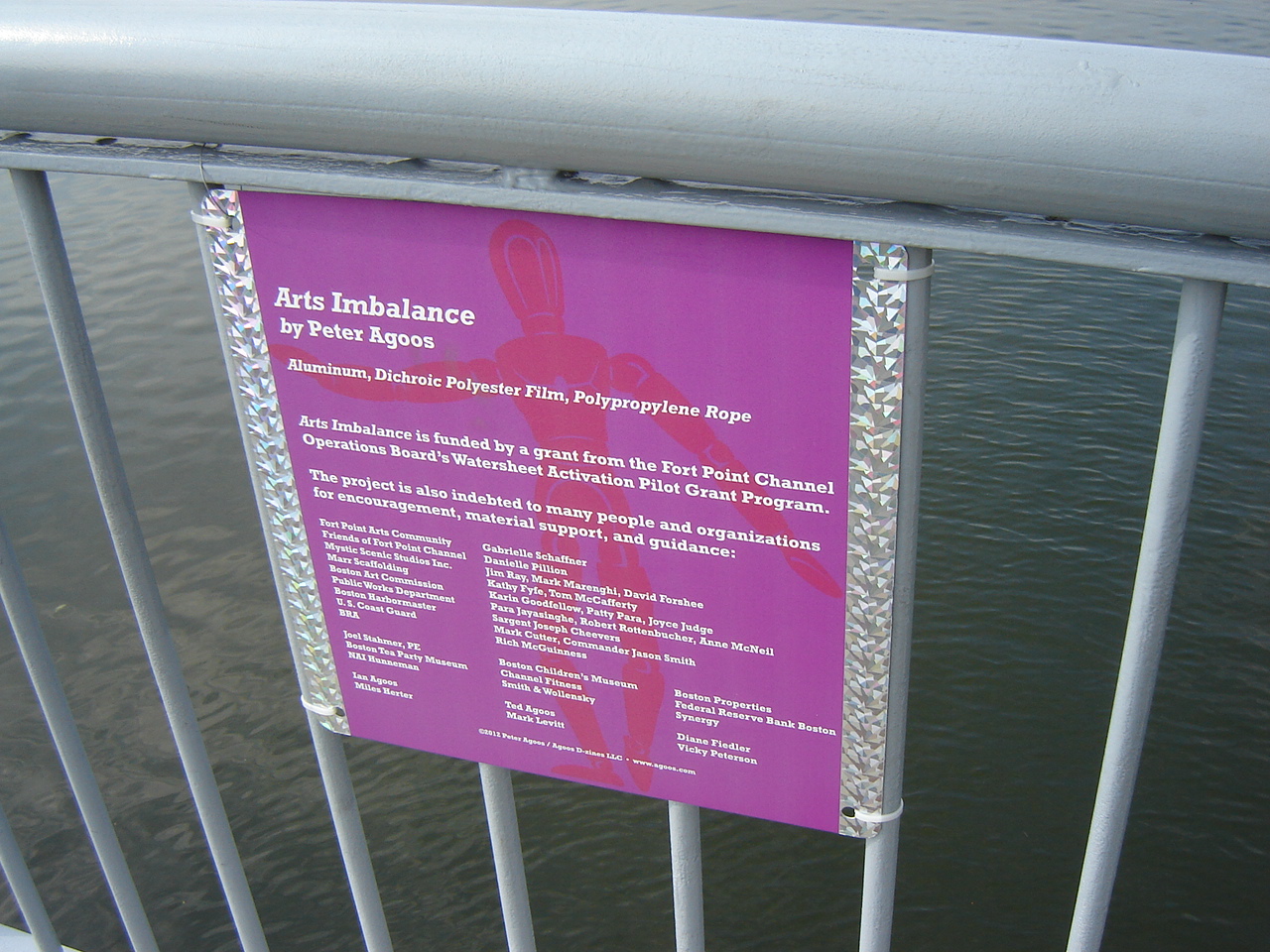
John and two college friends rented a motor boat in Fort Point Channel Friday to see the sights of Boston Harbor. But first they motored near my building so I could wave as they passed under this piece of public art.
The Mystic Scenic Studios site explains the art:
“A designer named Peter Agoos approached Mystic Scenic Studios with the idea of creating two life-sized human figures made of aluminum to hang above the Fort Point Channel in Boston.
“Mystic Metal’s, Mike Onischewski, fabricated the figures from an aluminum sheet; [they] were then covered with refractive dichroic film with the help of David Forshee, also of Mystic Scenic Studios.
“The piece was installed on July 2, 2012, with a team of 12 volunteers who worked from a small boat on the water and a scissor lift on land. The piece was strung from a 300-foot yellow tightrope between the Samson Post structure on Summer Street and the counterweight tower on Congress Street. The life-sized figures were counterbalanced on the rope and inspired by a classic articulated wooden artist’s manikin.”
Sunday evening I went over to Concord Academy to hear Seán Curran talk about how he creates choreography. Betsy, one of the dancers from his company, did a beautiful job of demonstrating what he meant.
As a little boy growing up in Watertown, Seán said, he waited eagerly for the mail that brought Look magazine. He liked to cut out pictures and make collages with them.
He says that his approach to choreography is similar. He arranges many snippets or dance phrases in different ways. His challenge is to edit down the many ideas so that the choreography doesn’t topple from too much weight.
I make collages, too. I have always liked the idea of taking a bunch of random things people have said and trying to make a play out of them, for example.
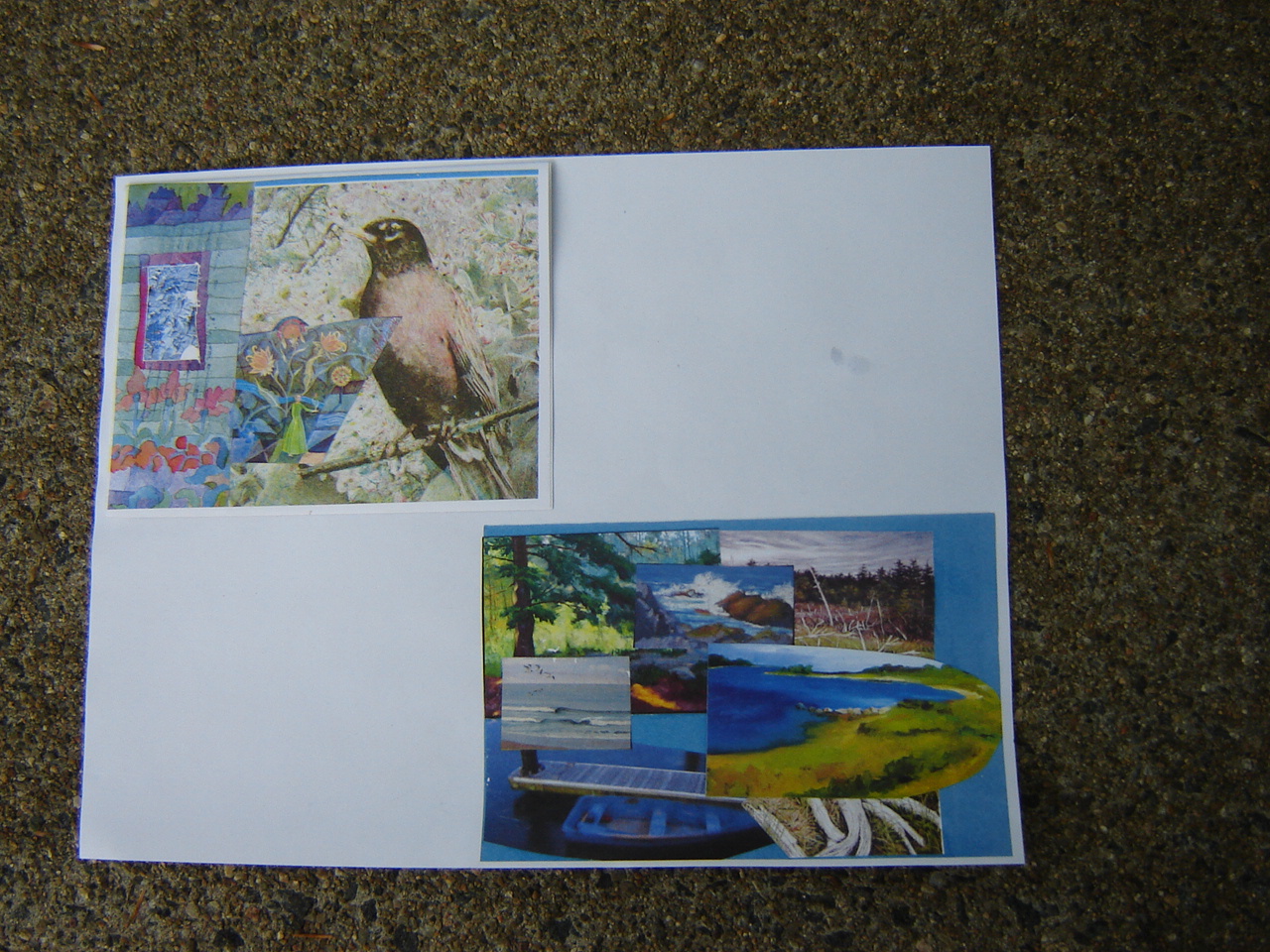
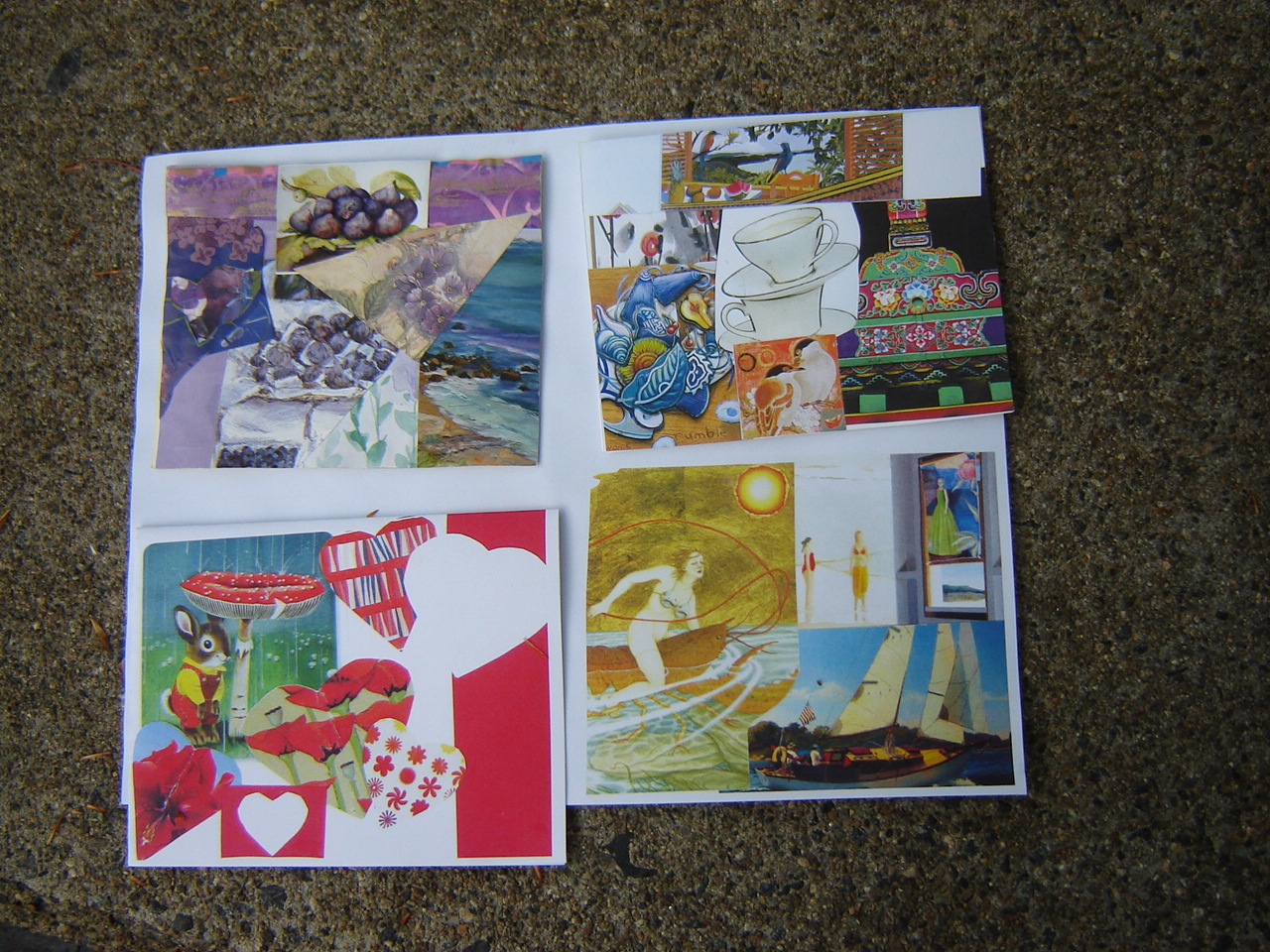
I also make collage greeting cards. I keep a box of promising pictures, cut from magazines and gallery postcards. I go through the whole pile and set aside maybe 20 items that somehow remind me of the person for whom I am making the card. Then I edit them down to the few pieces that will be best for the particular occasion.
All that happens before I cut the shapes and decide on how to arrange them. Sometimes I do a cutout of a cutout and put something else in the space: for example, I cut a vista out of a painting of a window and put a girl in the space (bottom right).