The happy faces say it all. The circus is good for Baghdad.
An article by Michael S. Schmidt and Zaid Thaker in today’s NY Times describes the scene. “There were not any tigers because the animals were stuck in Egypt. There were dogs, however, but they were not [the promised] poodles. And the big snake, well, the snake had become sick and had to be evacuated …
“A circus coming to town may be a routine event in most cities. But in battered Baghdad, even if it was not the Greatest Show on Earth, the arrival of the circus was yet another small step in this city’s efforts at building a more normal life. …
“There is not a commanding ringmaster. What it does have, though, are dancers jumping rope, a woman swinging from a trapeze (without a net, but with a harness), and a grand finale of a man clad in an Iraqi flag plunging swords down his throat. …
“Faisil Falleh, 56, who took his family to the circus on a recent night, said, ‘I haven’t seen anything in my life like this.’ …
“Promoter Jasim Mohammed Saeed said, ‘Nobody is working in this business in Iraq. It is just us.’ ” Read more here.
If you want to go, it’s $12 for adults, $6 for teens, and free for children. The cotton candy — “lady’s hair” in Arabic — is $1.
I like to sing this old blues song to toddlers, “I like the way you walk, I like the way you walk, You my babe, I got my eyes on you.”
I was thinking about that song recently when a relative who’s an orthopedist said my toddler grandson walks just like his mother.
The doctor is a connoisseur of walks, which he says are like signatures. I believe him. I often recognize people from afar by their walk. And in detective stories, any perp who wants to do a thorough job of disguising himself puts a pebble in a shoe to throw off his walk.
When I read an article in the Boston Globe indicating that most of us walk all wrong, I thought, “Is it a good idea to change your signature?” Look what happened when left-handed children were forced to become right-handed.
Actors can learn to speak in a new way for a role. Newsmen can get rid of their accents. But if something is a deep part of who you are, can you change it, even to save your joints?
“[Cara] Lewis studies the way people walk and believes that if they can learn how to move properly, taking the stress off their hips, they may avoid the injuries and joint deterioration that often lead to a hip replacement down the road. …
“ ‘They may not be pushing with their foot as much as they should be,’ Lewis said, ‘or they may be taking too long of a step, so their leg ends up far behind them.’ …
“The plastic and metal robotic device she designed, which is strapped around the pelvis and thighs, weighs about 11 pounds and is powered by an air compressor attached to each thigh — think bicycle pump — that is turned on by the researcher at the precise point when a person walking on a treadmill needs some correction. For instance, the compressor can exert pressure on the front of the thigh to shorten a stride.”
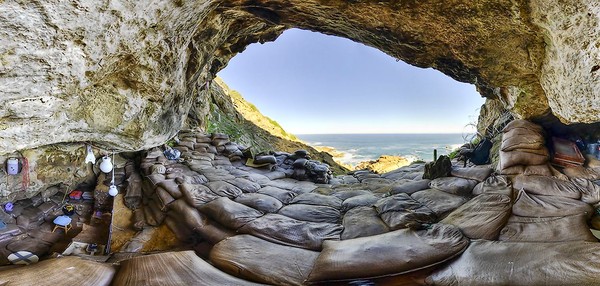
“In a tiny South African cave,” writes Amina Khan in the Los Angeles Times, “archaeologists have unearthed a 100,000-year-old art studio that contains tools for mixing powder from red and yellow rocks with animal fat and marrow to make vibrant paints as well as abalone shells full of dried-out red pigment, the oldest paint containers ever found. (Photo by Magnus Haaland / October 5, 2011)
“The discovery, described in [the 10/14/11] edition of the journal Science, suggests that humans may have been thinking symbolically — more like modern-day humans think — much earlier than previously recognized, experts said. Symbolic thinking could have been a key evolutionary step in the development of other quintessentially human abilities, such as language, art and complex ritual.
“The artifacts were uncovered at a well-studied site called the Blombos Cave, which sits by the edge of the Indian Ocean about 180 miles east of Cape Town. The two shells, lying about 6 inches from each other, had a red residue from a soft, grindable stone known as ochre. Ochre is rich in iron compounds that usually give it red or yellow hues, and it is known to have been used in ancient paints.”
It is lovely to think that the longing to be creative is something innate. Now we know that at least 100,000 years ago, people were experiencing that urge and acting on it.
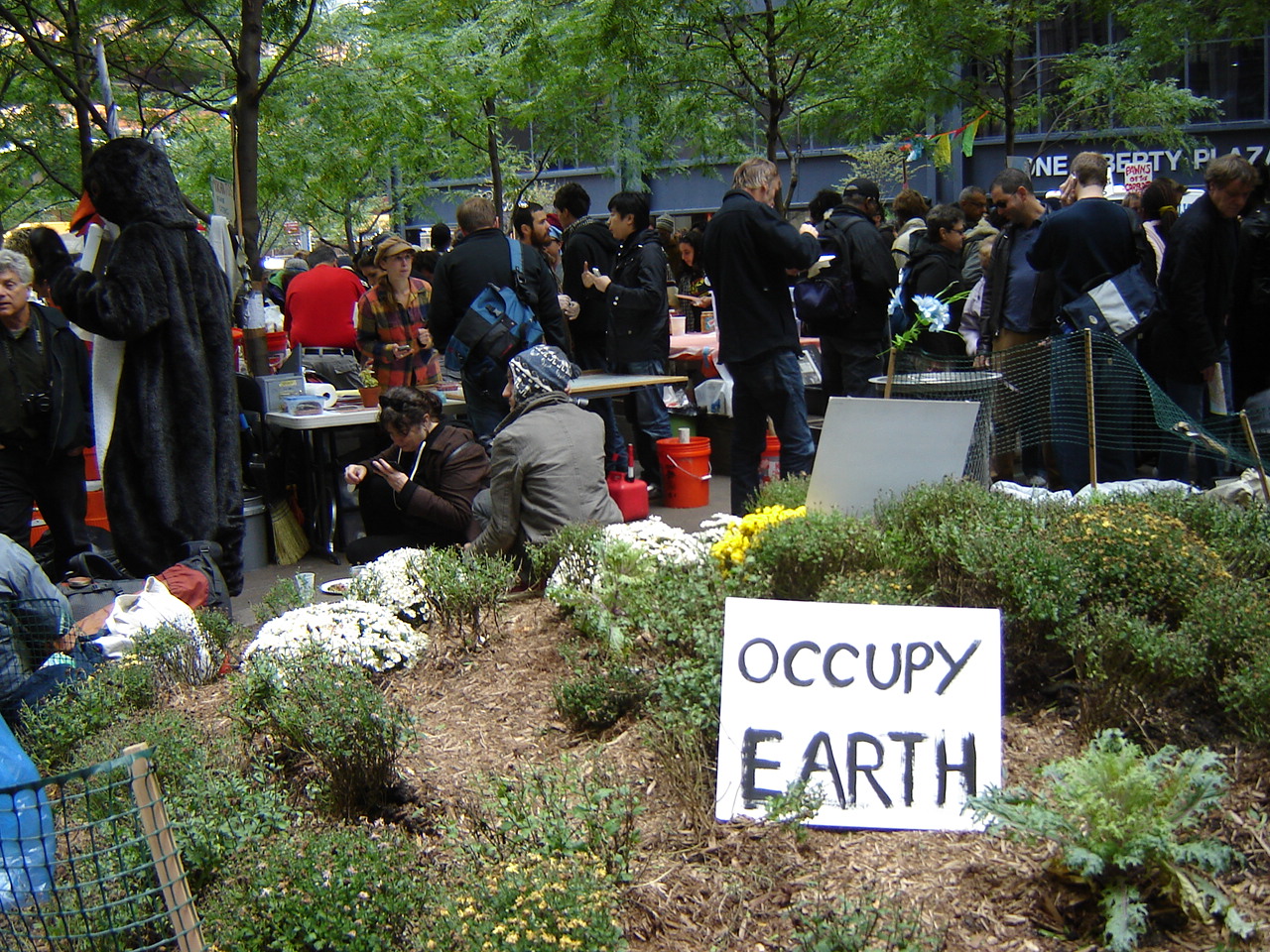
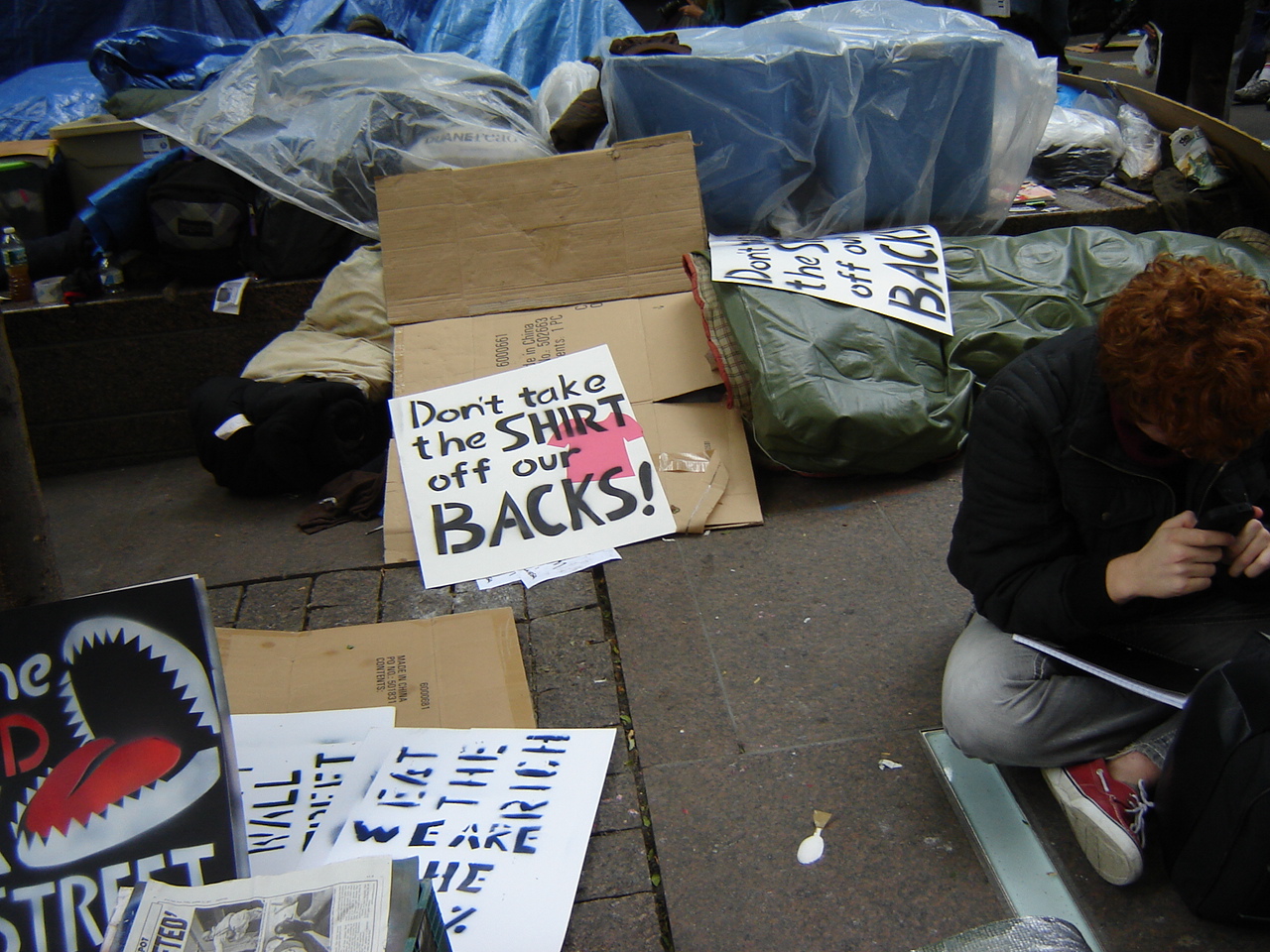
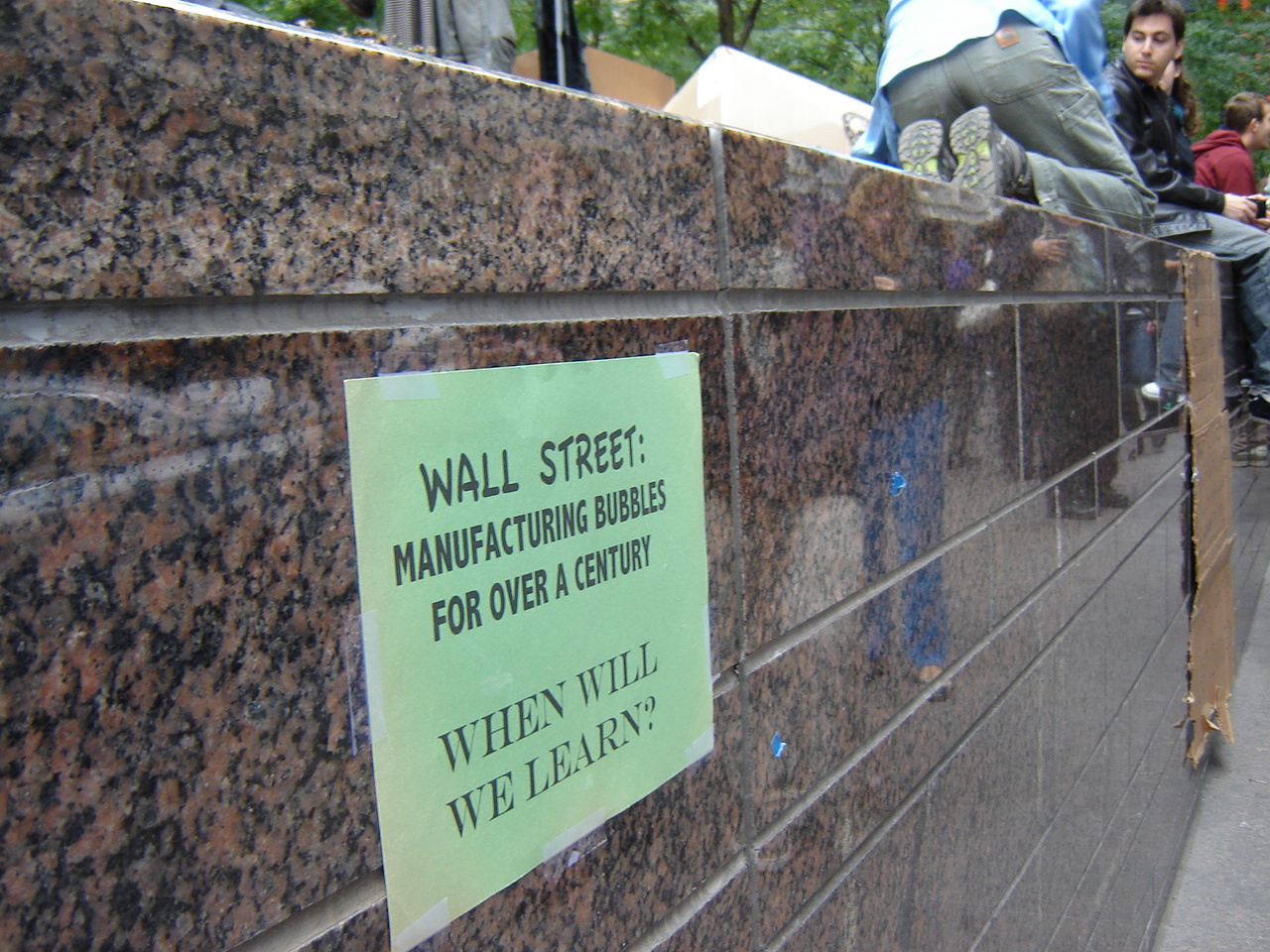
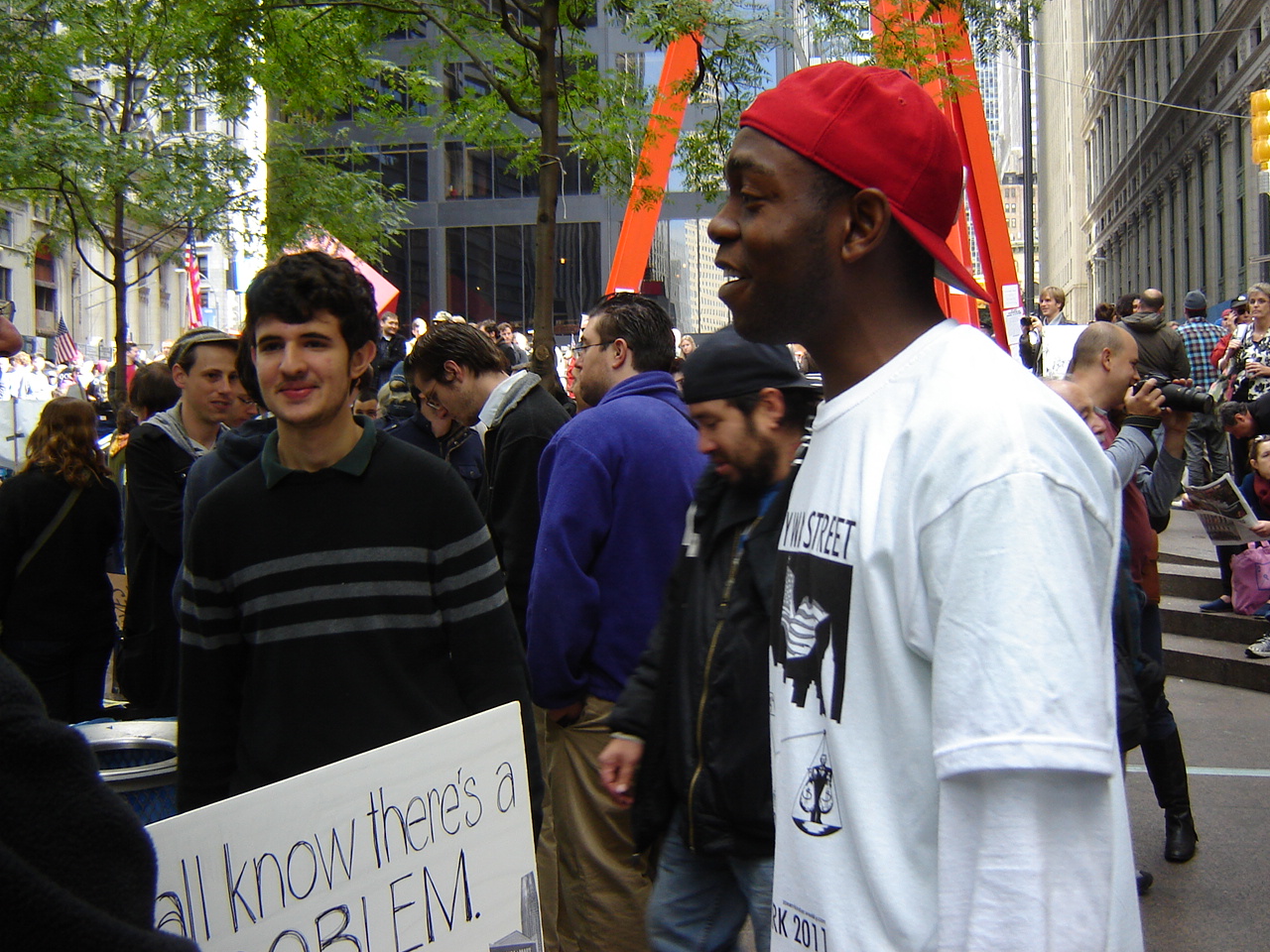
I couldn’t resist the pull of Occupy Wall Street yesterday, and I think that was true for most of the tourists in the Ground Zero area.
Everyone had a camera out, and most occupiers were taking advantage of being on display by holding up signs for their causes or handing out flyers. Souvenir buttons were on sale. A brass band whooped it up. Both occupiers and visitors danced.
I got to thinking about the documentary I saw in September on how to start a revolution. The movie was about the work of 80-something Gene Sharp, an influential exponent nonviolent ways to overthrow despotic regimes. (See my blog entry here.) After the screening, I listened to Sharp as he answered audience questions. One thing he said was that he believed the uprising in China’s Tiananmen Square in 1989 failed because the organizers were winging it and didn’t have an adequate plan for next steps.
Today’s Occupiers also seem to be winging it. But they are not aiming to overthrow the government, and I’m not sure it matters that a central theme has yet to stand out. I’m willing to wait and see what emerges. In the meantime, here are pictures from Saturday.
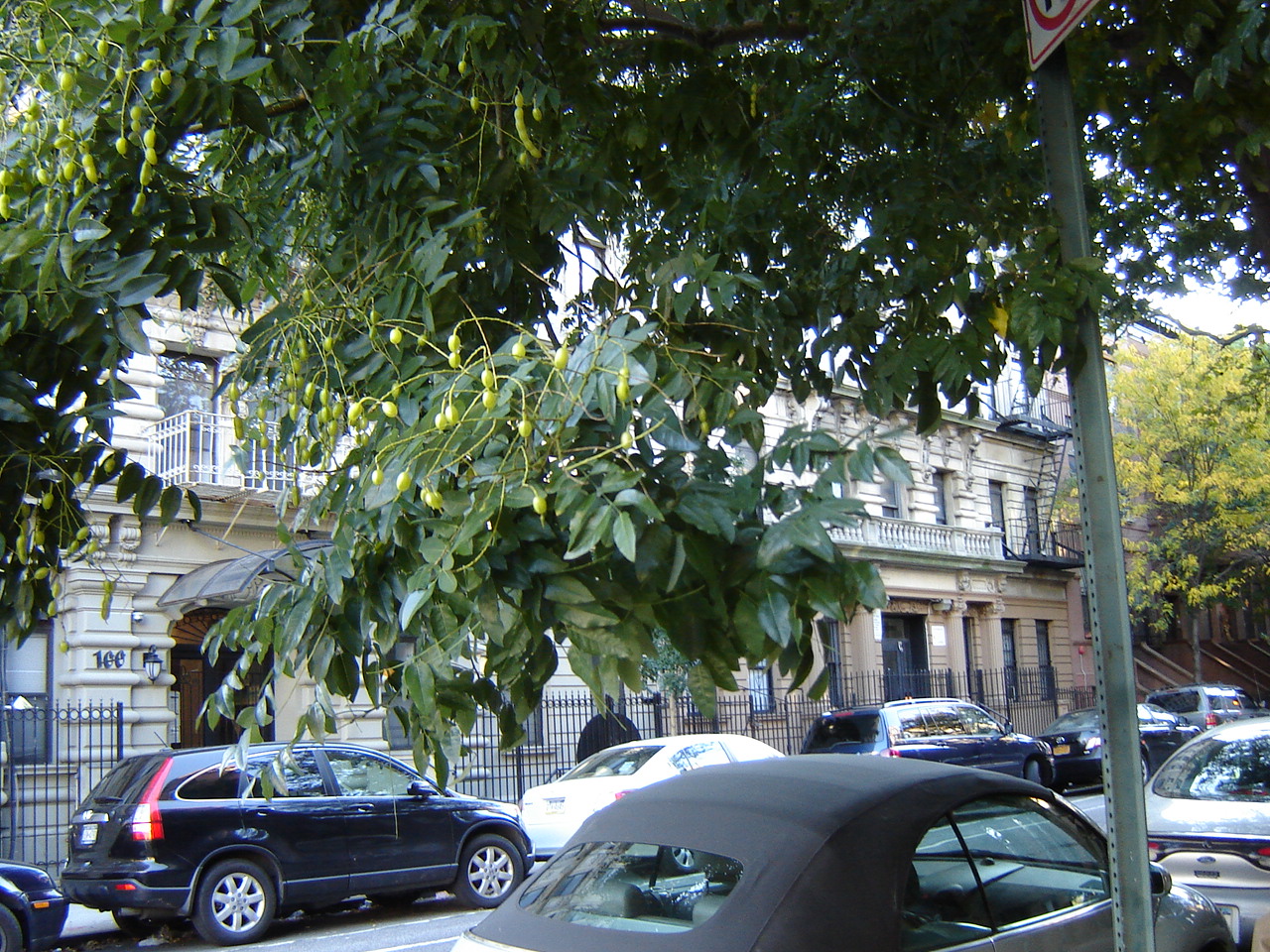
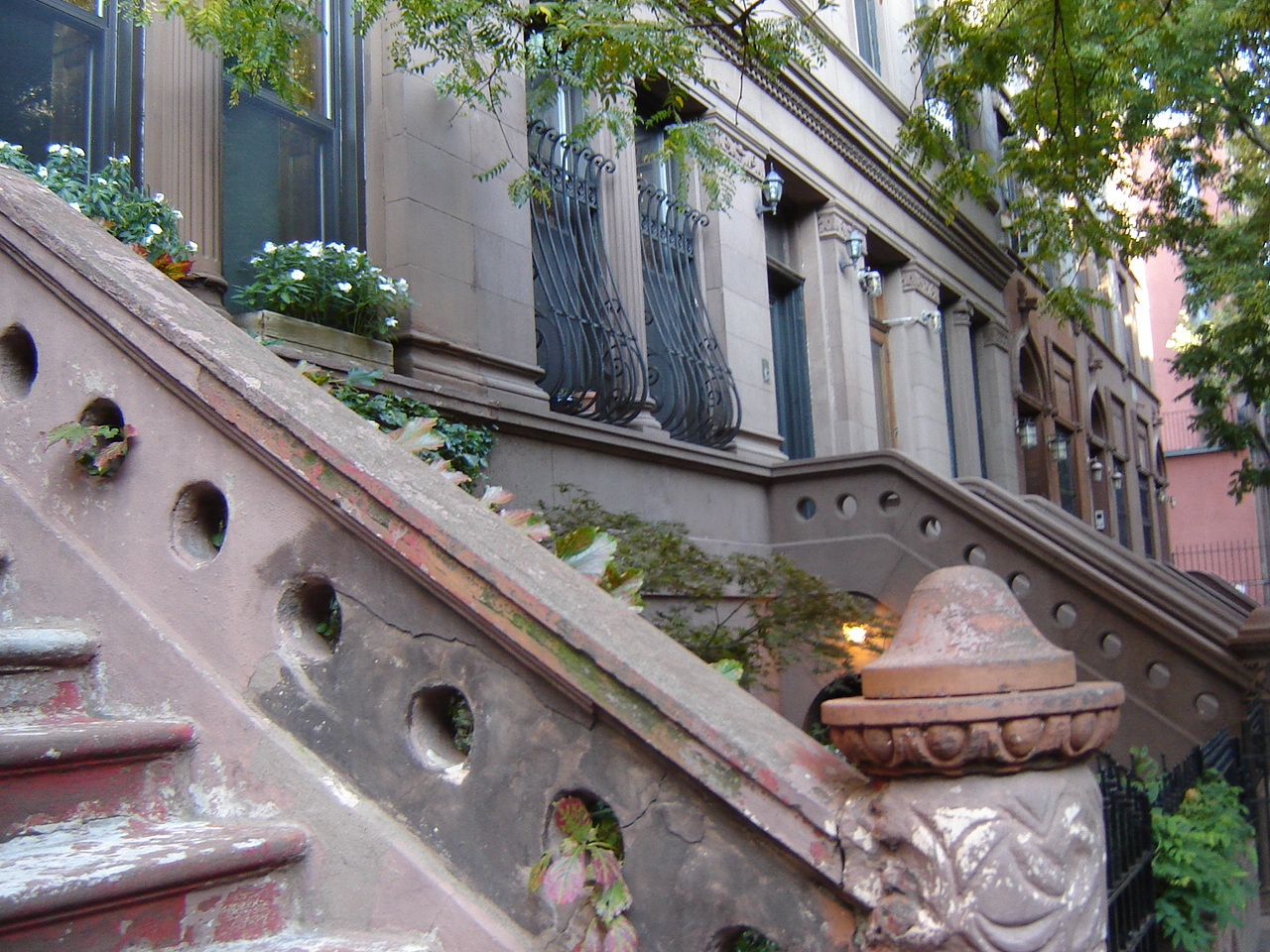
I’m in Harlem this weekend with five other family members in a leafy neighborhood, mostly very quiet.
Well, not always quiet in the middle of the night when, on more than one occasion, I’ve woken up wondering, “Should I be calling 911?” Fortunately, last night’s commotion didn’t seem like a true 911 issue. Her: “Don’t touch me! Don’t touch me! Don’t touch me!” Him: “But I love you!”
I went back to sleep.
Margareta and Jimmy, mostly recovered from the jetlag caused by a long flight from Sweden on Wednesday, spent Friday afternoon wandering around Chelsea art galleries.
They got a kick out of taking the bus back north, watching as the mostly white clientele became the mostly black clientele, observing the people interactions, and trying to understand the rapid English conversations. (Of course, like most Swedes, they are great at English, and a whole bunch of other languages.)
Margareta was fascinated by one episode that took place as the bus approached Harlem. A boy of about 10 tried to sneak on behind his friend. It seemed that he did not have the bus pass that is routine for New York school children. Margareta was impressed that the driver was not too stern and just told him to have the pass next time. Meanwhile a woman on the bus, possibly from his school, told the boy not to worry, that the school would help him get a new pass.
A couple years ago, buried under unwanted catalogs with every mail delivery, I decided to join Catalog Choice. It’s easy to use (if intitially time consuming).And I think I have really stemmed the flow.
Catalog Choice saves your address and all the different ways that companies spell the names of people in your household, and each time you go to the website, you just report the name of the new catalog you have received. They already have most of them in their database.
You may also check a box from a list of possible reasons that you no longer want the catalog (help the environment? don’t like those products?). And if you want to get fancy, you can say that you would be willing to receive the catalog once a year or twice.
At first I couldn’t bring myself to cut LL Bean or Gardeners Greenhouse, but eventually I realized that as long as I’m on some lists, those lists might get shared. And I can always look online for what I want from favorite companies.
Catalog Choice notifies vendors of your wishes or (in some cases) provides a template for you to use if they have ascertained that the vendor insists on being notified a special way. Every year, the program works out more of the kinks, so keep it in mind and have less to recycle at the holidays.
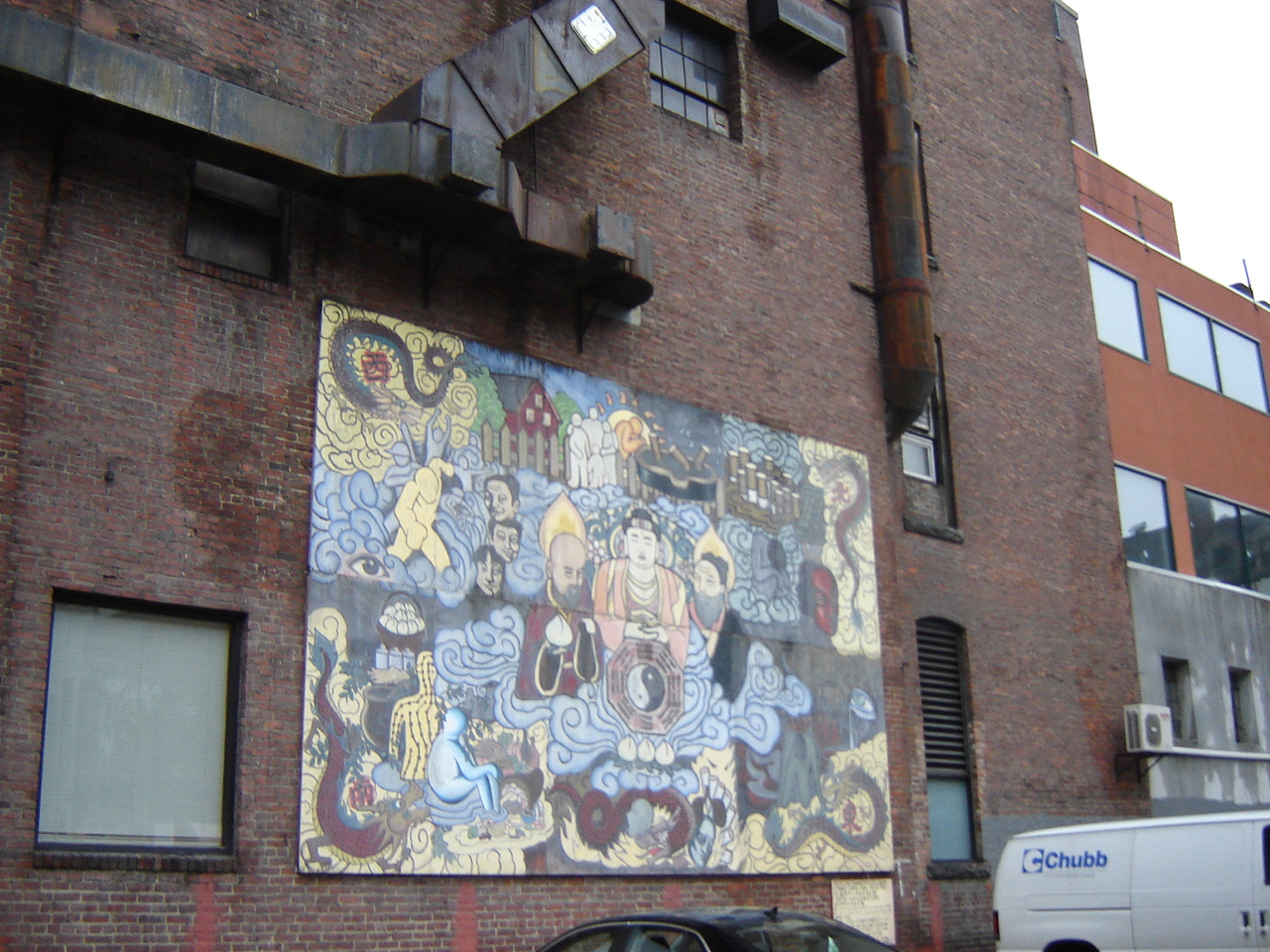
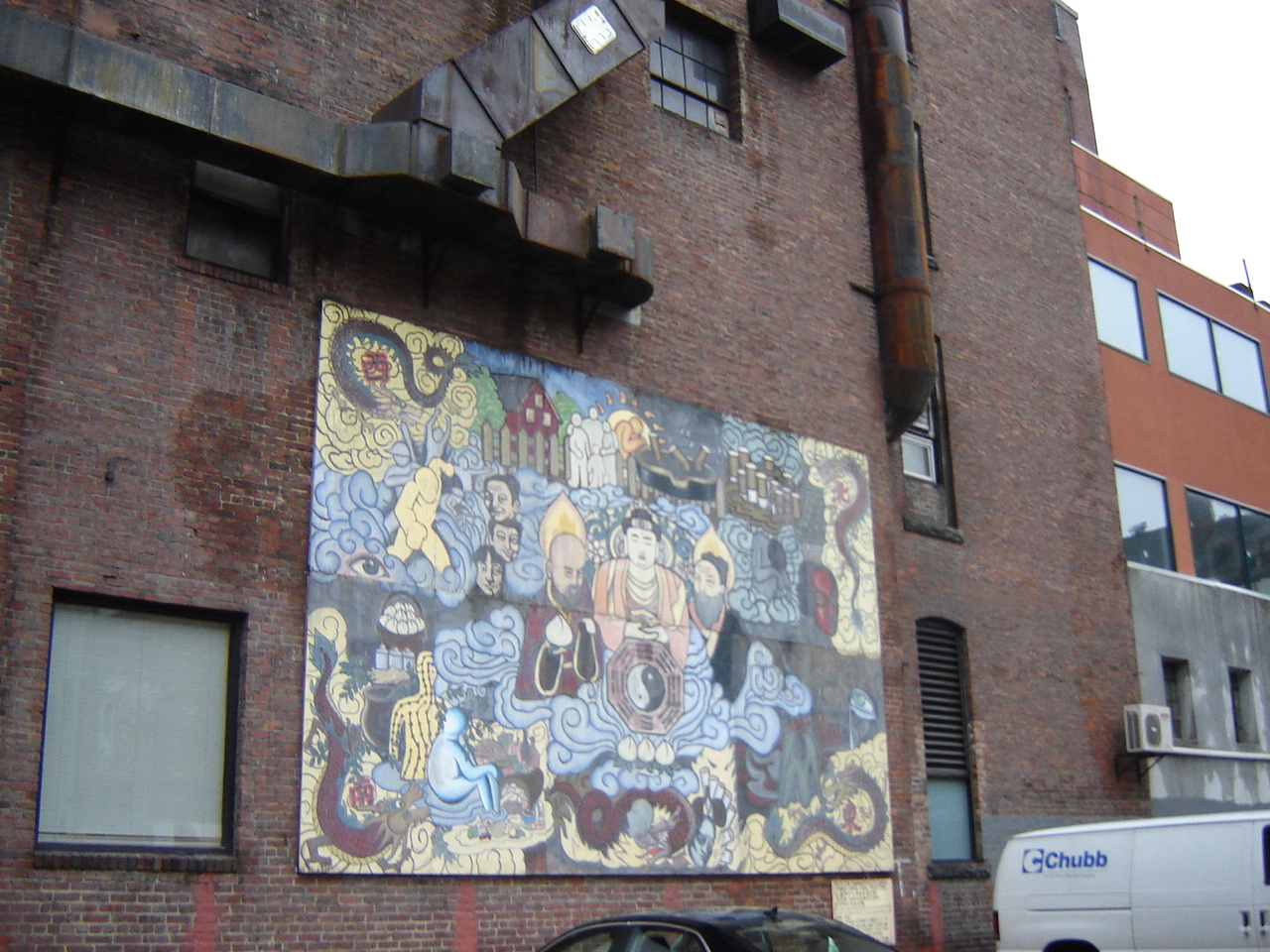
I got up close to read the sign, which said the South Cove Community Health Center Tobacco Control Project that had created the mural in 1998. The Boston Youth Fund site adds more: “This mural was commissioned by the South Cove Health Center as part of their antismoking campaign. It was funded in part by the Massachusetts Department of Public Health. The mural depicts the path to a healthy lifestyle from cigarette addiction.”
Your eyes are drawn to the Buddha-like figure in the center and the yin/yang symbol, but if you look more closely, there are giant cigarettes throughout the scene. This photographer got sharper pictures.
Much as I love projects like this, I do wonder if they meet their intended goals. Did more people quit smoking? How about the people who created the mural? Was the goal to have youth working on something constructive? Did they continue to be constructive in their lives?
I remember when the storekeepers in my hometown were worried about getting their windows soaped on Mischief Night. They decided to partner with the school to have young people create nice window paintings for them at Halloween. I was one of those kids. Did that prevent store windows from getting soaped? Little Miss Goody Two Shoes would no more have done mischief on Mischief Night than have flown to the moon. The initiative may not have hit the intended target.
The online magazine Salon has a story this month about New Guinea tribe members taking up Facebook.
Anthropologist and filmmaker Jonnie Hughes writes, “Ping! The other day, I got a Facebook friend request in my in box. … Intrigued, I opened it up, to find that this was no ordinary future friend (from the past) – it was a man I’d met while making a film about a tribe from the Sepik Valley in Papua New Guinea. It was a man who was born and raised in a remote hunter-gatherer society, where, to this day, the women spend their time searching out wild sago palms in the swamps to pulp into flour for pancakes, and the men hunt monstrous saltwater crocodiles in tea-colored jungle rivers at night with nothing more than spears. My new Facebook friend no longer joins these hunts – he’s an elder and has managed to find some income in the embryonic Sepik tourist industry …
“I’ve long since ceased to view the cultures of the Sepik tribes with the romantic and naive preconceptions that we in the West routinely assign to hunter-gatherer societies. I know, from having lived with these people in their magnificent A-frame stilt houses, that Sepik tribes are as modern a group of people as any of us – people who, like you and me, must constantly interrogate and adapt the culture they have inherited so that it best suits the changing world about them. But even I was astonished to discover that a community that only recently learned that arrows could fly better if they had feathers on their shafts was now into Facebook.” Read more here.
ArtsJournal.com sent me to this article describing a ballerina posed on the Wall Street bull. The article suggests that one of the many tipping points that led to the Occupy movement was this image of a dancer. I like to think that the arts can spark a movement, although I think the Arab Spring played a bigger role in this case.
“When Vancouver-based Adbusters presented the idea to the world, it did so in the form of a poster that featured a dancer posed on the shoulders of the Wall Street bull statue, a foggy clamour of demonstrators behind her. The poster asked the question, ‘What is our one demand?’ Activist groups seized on it, as did the hacktivist group Anonymous, and a collective began to form. …
“To hear tell from [Vancouver-based] Adbusters founder and editor Kalle Lasn now, the question of that one demand still needs to be answered concisely and directly. But as the movement overspills Wall Street, he describes it as the most successful in the 22 years he and his magazine have been advocating ‘culture jamming.’ ” Read more. The Kalle Lasn interview is at Seattle’s Crosscuts.com (“news of the the great nearby,” whatever that means).
As intrigued as I am that a ballerina poster could have been a tipping point for a movement, I think the question, “What is our one demand?” is even more intriguing. I would like to spin off from that and ask, “What is the one thing you want (in general, not public policies necessarily)?” Could you name the one thing? I think this is different from making a wish and blowing out candles. But maybe not. I will give it some thought myself.
Steve McGonagle is a set designer whose community-theater work always amazed me back when I was a reviewer. One set that stands out in my mind was his huge train engine charging toward the audience in the Vokes Players performance of On the Twentieth Century (not to mention all the scene changes for that old-time musical).
Recently, Steve returned to school, to Boston University, to get his PhD, and he mentioned to me that he and other students were working on a BU Fringe Festival entry. (I blogged a bit about the original, 50-year-old Edinburgh Fringe Festival here.)
On Sunday my husband and I went to see the 90-minute opera in the black box space upstairs from the Huntington Theater. It was wonderful in every way, not least because Steve designed and built a beautifully plausible Golden Gate Bridge with only a $200 budget.
The new Jake Heggie opera, Three Decembers, was based on a Terrence McNally play. The story revolves around a self-centered and overbearing stage diva. Her grown children find her maddening and hurtful but still important to them. The acting was subtle and true to life in a way that opera seldom is, for me anyway. And we were amazed at the clarity of the words sung by the cast from BU’s School of Music Opera Institute. (We got the “blond cast” and understood that there was also a “brunette cast” to give more students opportunities.)
We admired the variety of styles and moods in Heggie’s score, some of it wonderfully lyrical. Three Decembers had a libretto by Gene Scheer and was directed by Tomer Zulun. Allison Voth was music director. More here.
Have you read any of the articles in the NY Times about the Russian art collector who saved Uzbek folk art and modern Russian art from destruction by collecting thousands of pieces for his museum? The museum was long unknown to most of the world, located as it was in a remote desert area of Uzbekistan (near the dried up Aral Sea), a region called the Republic of Karakalpakstan.
The first Times story, published in January 1998, is posted here. It stunned the art world. Igor Savitsky, who died in 1984, had seen the beauty of the modern art that was considered “degenerate” by Stalin and the post-Stalin Soviet Union. He tracked down artists and artists’ relatives and squirreled the works away in the desert museum.
Savitsky was sly and often got government functionaries to pay for an acquisition without their realizing what it was exactly. Many thought his museum housed only the ancient artifacts uncovered in state-sponsored Central Asia archeological digs. The collector even got government money for devastating works by a woman who had been sent to the Gulag. He didn’t tell the authorities that the pictures detailed the horrors of the Gulag but said they were of Nazi concentration camps.
Recently the Economist magazine offered a pretty comprehensive summary of efforts that government entities, nonprofits, and banks have made to get people who do not use banks (the unbanked) into the banking system. The push is not only because banks want customers. In fact, many of the new programs for reaching the unbanked require banks to make big concessions.
The bigger concern is that low-income people and immigrants get taken advantage of by payday lenders, check cashers, and the like.
One program that is now in several U.S. cities actually started with the innovative Bank On San Francisco. Bank On San Francisco emerged to meet a need. First, a broad range of stakeholder groups evaluated why low-income people often preferred using payday lenders. Having found that the customers liked the hours, locations, and apparent clarity about costs, the groups developed a system that could meet more needs. (In New Haven the police were involved in a similar effort because too many immigrants carried all their cash on their persons, and that led to too many muggings.)
I’m interested in this issue, and so I was intrigued by a NY Times story on traveling tellers rural India.
“Swati Yashwant, a 29-year-old mother of one, is part of a growing legion of roving tellers intent on providing bank accounts to the nearly 50 percent of India’s 300 million households that do not have them. Using a laptop computer, wireless modem and fingerprint scanner, Ms. Yashwant opens accounts, takes deposits and processes money transfers for farmers and migrant workers in this small town 70 miles south of Mumbai, India’s financial capital.
“To reduce the risk of robbery or theft, no transaction by law may exceed 10,000 rupees (about $212). And in practice, many amount to no more than a dollar or two. But with the bulk of India’s population living in villages that have never had a bank branch, Ms. Yashwant, with her electronic devices, is a missionary of financial modernity.” Read more here.
The Indian idea looks like one that might be gainfully imported to the United States.
I subscribe to a listserv out of Harvard called Innovators Insights. It culls public-policy articles from all over. When you sign up, you pick general topics you want to hear about. (I can explain more if you ask.)
Today I received a link to a story about a new program in California to help foster children who have to change schools a lot. It sounds like a reasonable idea although I imagine some people might object to being in databases.
“Sacramento County, California, is now employing a database for foster youth to ensure that they can transition to new schools with fewer problems. Foster Focus tracks students’ grades, credits, course schedules, residential history, educational plans, the identity of their social worker, and other data so that students are no longer placed in the wrong grade level or in classes they have already completed when they enroll in a new school. The county has also developed another database that compiles foster home addresses, making it easier for social workers to place students in residences near their schools. Agencies across the country are soliciting the county’s advice as they seek to replicate these databases.” Read more here.
In a related story, U.S. Congressman James Langevin (Rhode Island) has been working to pass a federal law to prevent identity theft of foster youth. It is a serious issue as their personal information passes through many hands. I wonder if a database like the one in California makes this less of a problem by having everything in one place.
Yesterday’s NY Times Dining section had a delightful story about all the food being delivered to Occupy Wall Street. Donations have come from far and wide, and people have self-organized to distribute it and do the washing up. The story is here.
“Requests for food go out on Twitter and various Web sites sympathetic to the protesters. And somehow, in spontaneous waves, day after day, the food pours in. …
“Platters and utensils are washed on site. The soapy runoff slides into a gray-water system that’s said to draw impurities out through a small network of mulch-like filters. …
“Members of the [food] crew sometimes fail to show up in the morning because they were arrested the night before. (Then again, as many a chef will tell you, that happens in a lot of restaurants.)” …
“Telly Liberatos, 29, the owner of Liberatos Pizza on Cedar Street in the Financial District, said he has received orders from places like Germany, France, England, Italy and Greece, as well as every region of the United States.
“ ‘It’s been nonstop,’ he said. ‘The phones don’t stop ringing. People from California order the most at one time.’ Someone from the West Coast had called in the biggest delivery: he wanted 50 pizzas dispatched to the park.”
You might enjoy knowing that Asakiyume’s blog offers music suggestions for the 99 percent. Check it out. (I borrowed the picture from downtownmonks.blogspot.com.)
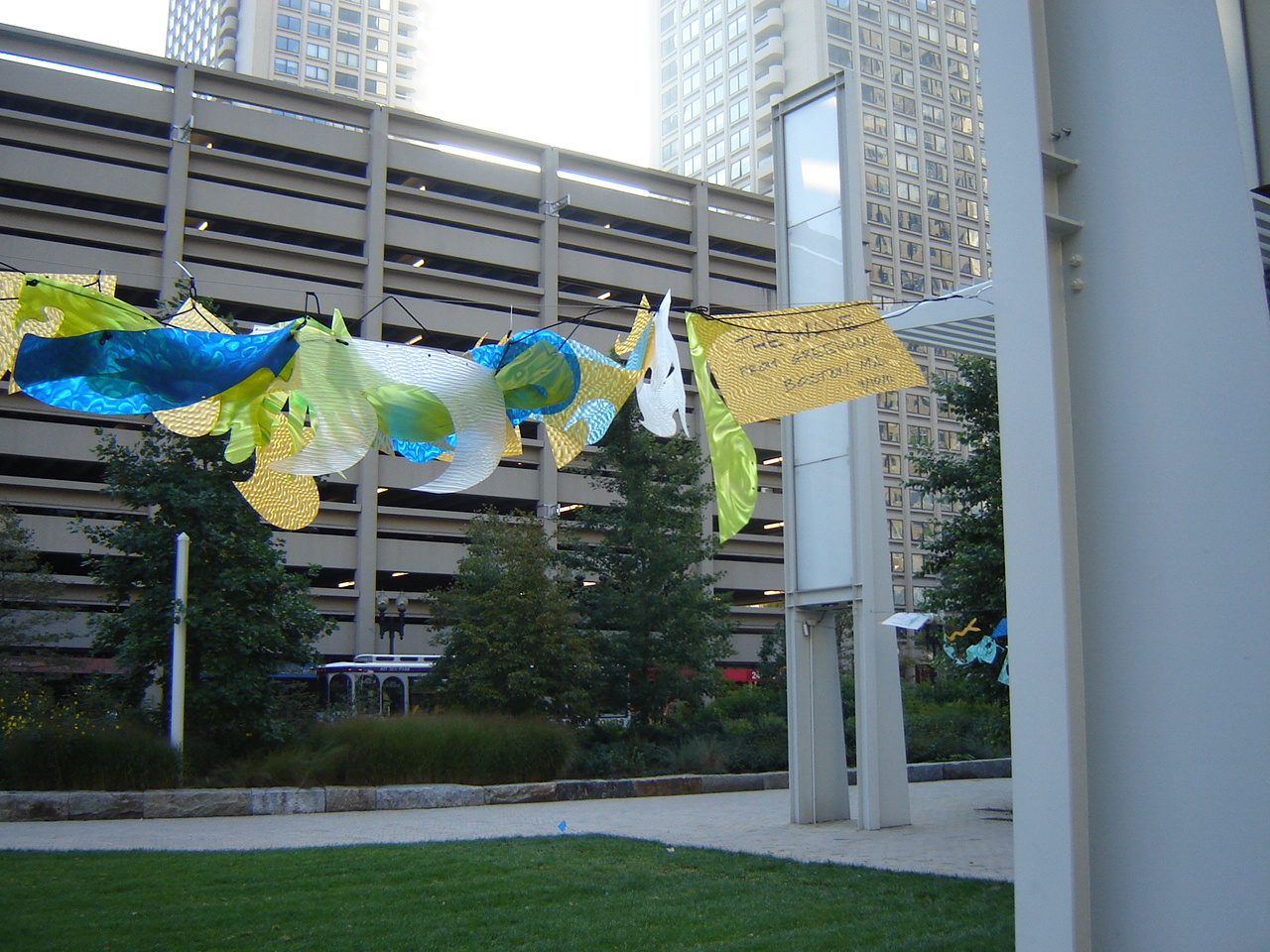
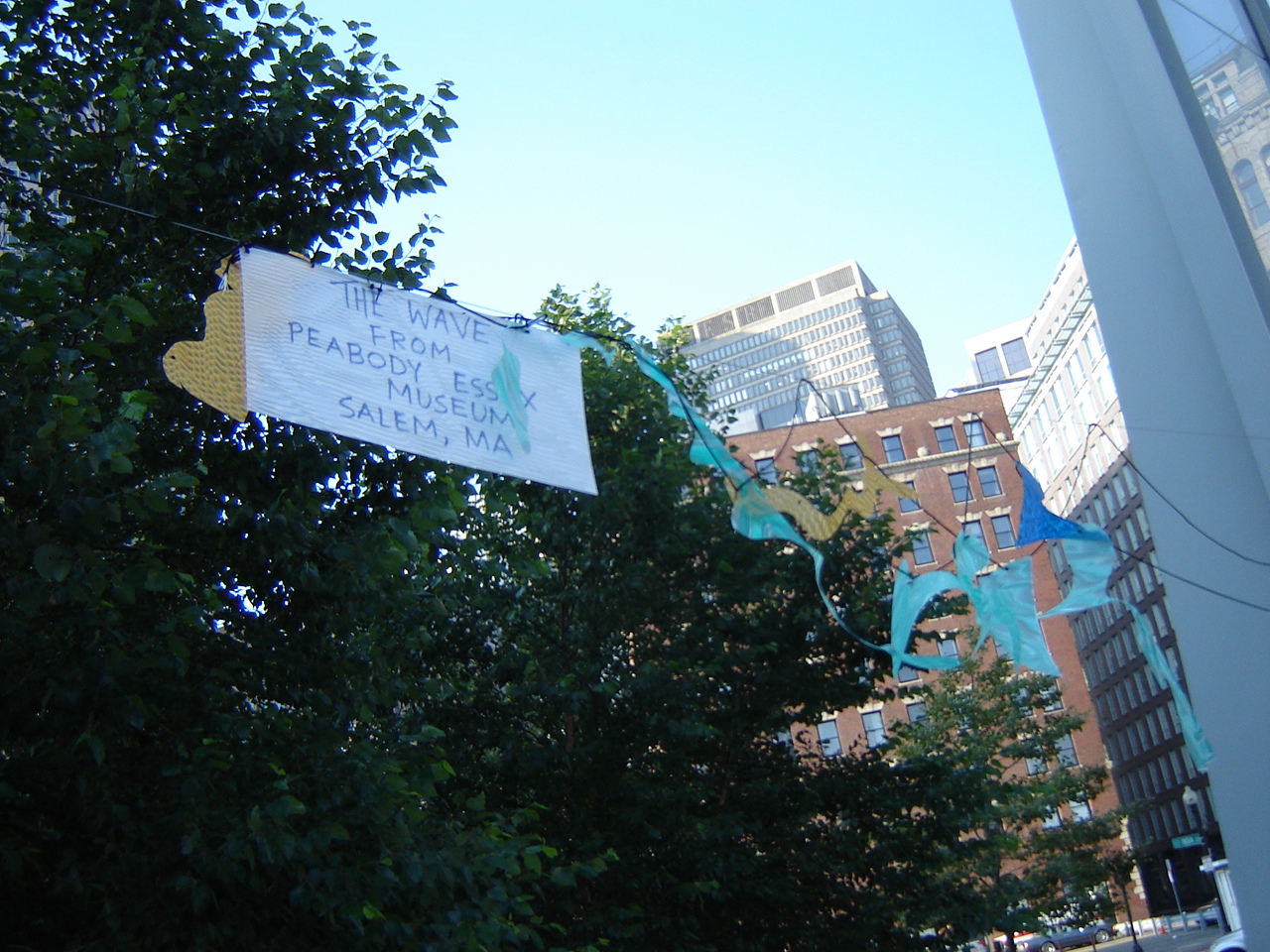
More curiosities seen on the Rose Kennedy Greenway in Boston: Waves. The first wave pictured below has a sign saying, “From the Greenway.” The second says, “From the Peabody Essex Museum, Salem, MA.”
This website helps to explain that an urban collaboration led by artists Susan Hoffman Fishman and Elena Kalman is behind this project, “The Wave: An Interactive Public Art Installation Fostering Global H20 Awareness.” I love it, but it didn’t raise my water awareness immediately because I had trouble figuring out what it was. Thank goodness for Google.
A couple weeks ago, I wrote to the Greenway people (and to the city of Boston) about bikers who were using the Greenway paths despite signs saying not to use “bicycles, skateboards, personal transportation, i.e. Segway.” I like that people bike instead of use cars, but not on footpaths. The signs cause walkers to lower their guard. I’ve seen near misses.
The city wrote me: “Thank you so much for your email. It is illegal to ride on the Greenway. We at the City of Boston are aware of this issue. We will be installing a bike lane on the road for the cyclists this season. Research shows that that bike lanes dramatically reduce sidewalk riding.”
The Greenway people wrote: ” For the safety and enjoyment of all Greenway visitors, biking is not permitted anywhere in the parks. When our horticultural and maintenance staffs witness a cyclist, they will ask them to dismount; City of Boston Police Department handles enforcement. … The City of Boston installed five new Hubway stations along the Greenway. This fall, the City will be installing painted bike lanes onto the street which will help alleviate the problem in the parks.”
(At the moment the Boston police are more preoccupied with Occupy Boston. They arrested 141 Occupiers early Tuesday because they had spread into the Greenway from Dewey Square. Funny how a few days can change one’s perspective. Today the concerns of the Occupiers and the concerns of the police both seem more serious than bikes on footpaths.)


 Suzanne's Mom's Blog