There’s a new think tank at Babson College in Wellesley, Massachusetts, one that’s focused on food access.
Food access, food “deserts,” and sustainable agriculture are big issues these days, and Food Sol founder Rachel Greenberger believes that addressing the challenges must involve bringing together all the stakeholders, even agribusiness.
Greenberger refers to her strategy as the “uncommon table,” writes Kathleen Pierce in the Boston Globe. “Located at Babson’s Social Innovation Lab, the company seeks to identify how so-called food deserts — geographical areas without access to a grocery store or fresh food — are formed, and how to make healthy food sustainable for all. …
“Greenberger, a 33-year-old Babson MBA graduate who studied food-system dynamics and consumer behavior in the sustainable food movement, came up with the concept for a company similar to a think tank, but centered on action. By creating a digital map to pinpoint food-related issues, Food Sol intends to highlight pressing topics such as food deserts and fair trade, linking experts in the field with would-be entrepreneurs to ignite working relationships. …
“Food Sol intends to foster ‘a way into thinking about innovation in the food-supply chain, whether it’s creating more cooperatives or building agribusiness in Fall River,’ says Cheryl Kiser [executive director of Babson’s innovation lab]. ‘We are a laboratory where people can come and engage in conversation.’ ”
The theory is that companies will pay to engage in a food think tank like this. In fact, Kiser hopes to involve Cargill Inc., Monsanto Co. , PepsiCo , the Coca-Cola Co., and more. Read more here.
The mention of entrepreneurs who might address food issues is reminding me of two young women who recently launched shipping-container grocery stores in food deserts. Read about that in this NY Times article.
“Carrie Ferrence, 33, and Jacqueline Gjurgevich, 32, were in business school at Bainbridge Graduate Institute in Washington State when they noticed that many local neighborhoods were ‘food deserts,’ without easy access to fresh local produce and other grocery staples.
“Their answer was StockBox Grocers, a company that repurposes old shipping containers as small grocery stores. The company won $12,500 in a local business plan competition and raised more than $20,000 online in a Kickstarter campaign to finance its first store, which opened in the Delridge neighborhood of Seattle in September.”
In a Yes!magazine op-ed, reprinted in the Christian Science Monitor, Marc Freedman of Civic Ventures writes about his favorite topic: the potential of older Americans to contribute beyond retirement.
“With big thinking,” he writes, “there is a chance to tap the talents and experience of the ‘baby boom’ generation to solve longstanding social problems, from health care to homelessness, education to the environment. There is a chance to turn an older population into a new workforce for social change.
“Some people, like Gary Maxworthy, are leading the way … [Around age 60] he thought a lot about his old Peace Corps dream and the prospect of returning to it. In the end, he chose a more manageable domestic option, VISTA, part of the AmeriCorps national service program. VISTA placed Maxworthy at the San Francisco Food Bank, where he discovered that—like food banks throughout the state of California—it was primarily giving out canned and processed food. It was all they could reliably deliver without food spoiling.
“Maxworthy knew that California farmers were discarding tons of blemished but wholesome fruits and vegetables that were not up to supermarket standards. He launched Farm to Family, a program that in 2010 distributed more than 100 million pounds of fresh food to needy families in California.” Read more.
For those who are interested in “encore careers,” check out Encore.org, by Civic Ventures, “a nonprofit think tank on boomers, work and social purpose.”
When Suzanne started the birthstone-jewelry business Luna & Stella a few years ago, I didn’t make the connection right away.
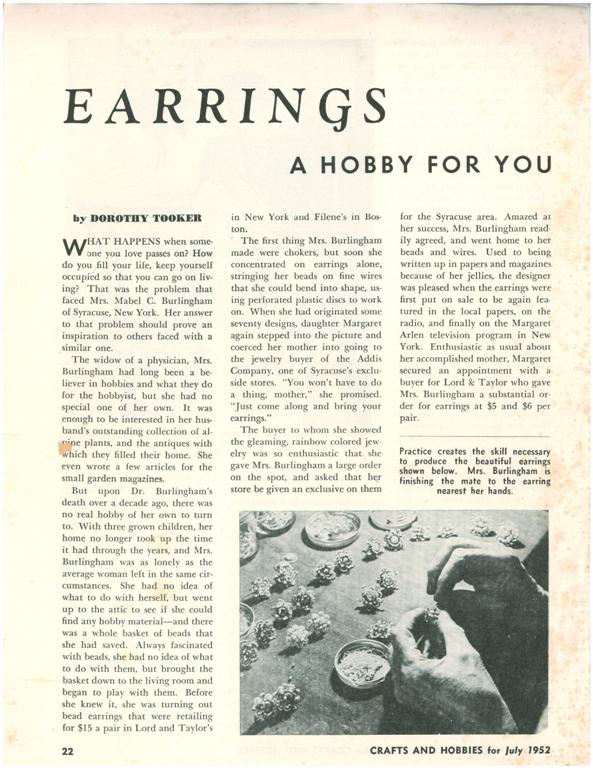
Suzanne never knew my grandmother Mabel, but Mabel (the woman I called Garkie from an early age) was also an entrepreneur, best known for jellies like Cinnama-Tang and for jewelry. I remember seeing her on black & white daytime television in New York when she was interviewed about her ventures.
My cousin Margot was going through the personal items of my late Aunt Maggie (Margot’s mother and Garkie’s daughter) and unearthed articles and artifacts. Here are samples. Styles have changed, but the urge to sell something creative has not.
I went to a conference today on how industry and higher-education entities can collaborate better to prepare students for the jobs that companies want to fill. There was a big crowd, and among the speakers were U.S. Senator Sheldon Whitehouse of Rhode Island and Connecticut Governor Dannel Malloy.
I was especially pleased to hear panel member Gerald Chertavian and catch up with what his nonprofit has accomplished in the past few years.
Starting in college, Chertavian volunteered as a Big Brother, and the experience had a profound effect on him. After he went to Harvard Business School, launched a company, and sold it, he decided to invest in helping motivated youths aged 18-24 who lacked the money, networks, or opportunity to get a good education or decent job.
So he founded Year Up. He built on his list of corporate contacts to make internships a key part of a training program that ended in jobs.
Interested young people had to have a high school diploma or GED and demonstrate through the application process (which involves getting references) that they are serious. They earn a stipend during a year of training in either financial-industry or tech skills. They learn workplace behavior and business communication. At the same time they get college credits at an affiliated school, which most students decide to put toward a degree after their year in the program. Companies have found the Year Up youths invaluable, and some are changing their HR requirements to allow in more people without a bachelor’s already in hand.
At the conference, Chertavian acknowledged that in spite of having helped 5,000 students over a decade through Year Up programs around the country, the organization was not big enough to achieve its ambition of a major impact on the opportunity divide. To scale up, he said, Year Up is partnering first with a college in Baltimore that will use the approach. It hopes to keep expanding the new model after Baltimore.
There are a lot of great You Tube videos that might interest you — some about the Year Up program, some about Chertavian, some about the students. Here is one.
My friend Alden, the oboist, is in considerable demand around the area. A good oboe player is hard to find, and he is very good. I have seen him solo with the Charles River Wind Ensemble and also take part in a lovely performance of Handel’s Messiah.
On Saturday night Alden played oboe with the Melrose Symphony, where a young piano soloist got a nice ovation. Alden writes, “In fact, the audience clapped between each of the movements he played. It was such a nice reception because he really is so talented and such a genuinely sweet, talented kid.” Read about it here.
The Melrose Symphony bio says, “Kadar Qian, 13, is a native of Westford, MA. As an award-winning pianist he has appeared with the Salem Philharmonic and Cape Ann Symphony in addition to over 60 performances in Massachusetts, Connecticut, and New York City. Qian recently appeared on the NPR radio show From the Top performing the Goldberg Variations by J.S. Bach, heard locally on 99.5 All Classical. Qian is a high honor roll student at Stony Brook School in Westford and has been a member of the math team since third grade, winning top prizes at the Academic Math League competitions. He was recently elected as Vice-President of the student body.”
We had a great time at the Concord Festival of Authors Friday night. The brainchild of book maven Rob Mitchell, the festival has been going strong for about 20 years and lasts a month. The authors and topics are always amazing.
The event we most wanted to see this year featured a panel of mystery writers: Archer Mayor, Spencer Quinn, and one whose books I know well, S.J. Rozan. The fans of these three novelists — and of Concord-based moderator and author Mark De Binder — filled the lobby of the Concord Library to overflowing.
I already knew from the Lydia Chin/Bill Smith mysteries that S.J. had a wacky sense of humor, but Mayor and Quinn also were hilarious in talking about their work and their lives. My husband said, “Who knew mystery writers were funny?”
Read about S.J. at the festival here and at her own site here.
“In her new novel, Ghost Hero, American-born Chinese P.I. Lydia Chin is called in on what appears to be a simple case. An art world insider wants her to track down a rumor. Contemporary Chinese painting is sizzling hot on the art scene and no one is hotter than Chau Chun, known as the Ghost Hero. A talented and celebrated ink painter, Chau’s highly prized work mixes classical forms and modern political commentary. The rumor of new paintings by Chau is shaking up the art world. There’s only one problem—Ghost Hero Chau has been dead for twenty years, killed in the 1989 Tiananmen Square uprising.” We enjoyed hearing S.J. read a passage from Ghost Hero, in which she had Bill Smith adopt her grandfather’s Russian accent and locution.
Quinn made me envious of his blog’s success. It attracts hordes of people who love his canine protagonist so much that they upload photos of their pets to be the dog detective’s friend. Perhaps if I weren’t such an eclectic blogger …
If I had one reliable focus, though, I’d get bored.
I was chatting with a colleague in the washroom today, asking what she was doing this weekend, and she said she was going to New York to cheer for her brother in the marathon. She also mentioned in a proud but modest way that there was an article about him in today’s NY Times. We went and looked for the article, and I realized I had already read it word for word.
What an unusual brother! Kevin Dwyer decided as a child to be a dancer and had a ballet career, all while suffering from cystic fibrosis. The youngest in a family of seven children, he was the fourth to have CF. He didn’t tell people.
Although he and his siblings have a mutation of the disease that means it is not as severe as for many, it takes a real toll. Nevertheless, this weekend Kevin is running a marathon. His aim is to raise money for Team Boomer (started by the retired quarterback Boomer Esiason), which funds much-needed CF research.
The NY Times writes that Kevin has “chronicled [his marathon training] in a lively blog, Kevin Running. When he goes out this Sunday, he will have lung capacity of 58 to 60 percent.
“ ‘I can beat this, in one little way,’ he said. ‘For at least one day, I can beat it. We’ve trained at 11-minute miles, but I think we will go kind of slow, maybe 11:45 or 12 minutes, so I can take everything in. Take everybody in. Make it a celebration.’ ” Read more.
I highly recommend chatting with colleagues in the washroom. I have learned so much that way!
Miller-McCune.com tweeted today that the National Endowment for the Arts has new data on where artists are finding work.
Four of the six New England states are among the states with the most arts jobs: Vermont, Rhode Island, Massachusetts, and Connecticut.
“The report on artists in the workforce supplements and expands upon a 2008 paper, which found about two million Americans list a job in the arts as their primary source of employment. That comes out to 1.4 percent of American workers.
“New York heads the newly released state-by-state list, with artists making up 2.3 percent of its labor force. California, home to the film and television industry, places second with 2.0 percent.
“Not far behind are Oregon and Vermont, each of which has a workforce in which 1.7 percent of workers are artists. That means they exceed the national average by a substantial 20 percent.
“ ‘Writers and authors are especially prominent [in Oregon and Vermont],’ the NEA report notes.
“Also exceeding the national average: Colorado and Connecticut (where artists make up 1.6 of the labor force), and Hawaii, Rhode Island, Massachusetts, Maryland, Washington, Nevada, and Minnesota (at 1.5 percent).”
Although there likely to be different perceptions of what kind of work constitutes arts employment, I find the report interesting. And since I know anecdotally that there are arts jobs in Maine and New Hampshire (the two New England states not among the top few), I can’t help hoping that some organization will do an in-depth study of the region. Unfortunately, ornery New Englanders don’t often think regionally.
And more generally, what are the reasons some states have more arts jobs? Public policies? Landscape? Accident?
A new exhibit organized by the Cooper-Hewitt National Design Museum in New York demonstrates the power of design to make life better for disadvantaged people.
“This is a design show about remaking the world … And that’s thrilling,” writes Michael Kimmelman, “whether it’s happening in Cupertino, Calif., or Uganda, where H.I.V. infects hundreds of people a day, and the latest news cellphone-wise has been the design and distribution of a text-messaging system that spreads health care information.
“In Kibera, an area of Nairobi, Kenya, and one of the densest slums in Africa, the challenge was different. Traditional wood and charcoal fires cause rampant respiratory disease there. Refuse fills the streets. So a Nairobian architect designed a community cooker, fueled by refuse residents collect in return for time using the ovens.
“From cellphones and cookers to cities: in Thailand, a public program called Baan Mankong Community Upgrading has, for the last eight years, been improving conditions in hundreds of that country’s 5,500 slums, bringing residents together with government and nongovernment agencies to design safer, cleaner places to live.”
You will also enjoy reading about slum (favela) painting in Brazil and what a new coat of paint can do for building residents’ skills while lifting their spirits.
We watched the movie “Bill Cunningham New York” Saturday, and a more modest protagonist would be hard to find.
A fashion photographer who focuses less on the runway than on what people are wearing on the street, he knows all the fashionistas but lives in a rent-control apartment with a shared bathroom and thousands of photographs in file cabinets and prefers to eat at McDonald’s. He wears a series of simple blue workman’s jackets because the camera bumping against his chest wears them out. He traverses New York on a bicycle and is on his 29th (the others got stolen). He is not a paparazzi. In one scene in the documentary, he shows no interest in filming Catherine Deneuve at a glitterati event because “she wasn’t wearing anything interesting.” He is immune to the allure of celebrity.
Not too many people are immune to celebrity. Consider Baudelaire.
ArtsJournal.com asks if the 19th Century French poet was the first modern casualty of celebrity and points us to this essay by Stefany Anne Golberg at Drexel University’s online publication The Smart Set.
“The problem was this: Baudelaire wanted to shield his private life. So he made himself into a public entity. Yet, as he did, Baudelaire became the public persona he created. As he surrounded himself with layers of artificiality, the ‘real’ Baudelaire became hidden even from Baudelaire.” Read more.
Probably not a good idea to buy into one’s own image making.
I’ve been thinking about angels and how almost anyone might be an angel at any moment in time. An ex-con who rescues a baby from a burning building is an angel to that baby’s family.
When I read this Boston Globeessay by Carlo Rotella (Boston College director of American Studies) I thought that — even though they all mispronounced his name — the people shouting encouragement as he ran a grueling marathon were angels to him that day. Especially a stranger he calls Mustache Man.
“Thank you, Mustache Man of Lowell,” Rotella writes, “and the rest of you no-r-pronouncing Samaritans along the race route. You said my name, badly, when I badly needed to hear it.”
And I’m thinking of a particularly nice thing that happened to me some years ago, after a dark time with chemo. Two completely unconnected friends chose Thanksgiving Day to acknowledge some little favor, which I learned was more than “little” to them. It was such a treat to receive their e-mails, one from China! I felt touched by two angels that Thanksgiving.
P.S. I hope it will not detract too much from the high-minded tone of this post if I do a kindness for Suzanne and point to the angel wing at Luna & Stella, the company that gives me permission to blog on “anything that interests me.”
This week I heard Mahzarin Rustum Banaji, a Harvard psychology professor, speak about unconscious bias, or blind spots. She conducted experiments with the audience to show (a) that there are things we see but simply don’t register consciously and (b) that we have unconscious biases that we may not want to have.
She showed a video of a basketball game, with two blurry films superimposed. Audience members were supposed to concentrate hard on how many times the ball got passed. After showing it, Banaji asked if anyone had seen anything unusual, and only one person mentioned seeing a woman walk through the basketball game carrying an umbrella. Most of us had no memory of that.
Banaji said a colleague at Yale has observed some brain activity in people who are “not seeing” that woman, but registering her presence doesn’t rise into the conscious zones. (Apparently only 1 to 10 percent of our brain function is conscious.) If Banaji hadn’t pointed out the woman by showing the video a second time and if I was still unaware of her walking through the game, I wonder if the next time I saw a woman with an umbrella I would think of a basketball game and wonder why.
Banajee said that our eyes have not evolved past 500,000 years ago, when people did not deal with 2-D representations, so some 2-dimensional info cannot be processed even today. None of the audience could believe, for example, that in a slide showing two perspectives of a table, the table was the same size in each drawing. We could not see it even when she proved it was true.
Other tests showed that we associate women more with household tasks, and men more with the office, even though we think we have left those views behind. In one slide the same AP editor had described a black Katrina victim swimming with a loaf of bread as “a looter” and a white couple doing the same as having “found” supplies in a a store.
You probably also know that until people auditioned for orchestras behind a screen, without the judges knowing anything about the candidates, there were few women selected. The judges had no idea that they had been deciding on the basis of unconscious bias. They believed they’d been really trying to find qualified women musicians. I asked if in a workplace it would help to point out to people in a nice way when something they said might unintentionally have sounded biased. She said people don’t like to hear that about themselves, but she recommends people from one minority group advocating for people from another group. For example, a gay person might advocate for a woman’s right or a white woman might advocate for an Asian immigrant.
I have always loved puzzling out subliminal messages and asking myself why I react in a mysterious way to certain innocuous things. Even when I was a child, I sensed something about hidden messages. I once pointed out a model in a magazine to my mother and said I thought the woman was beautiful. My mother said it was more important for the woman to have a “beautiful character.” For a couple years afterward, if I could get my mother sitting down, I’d point out women in magazines and ask if she thought they were “beautiful by character.” (She got tired of this game pretty fast.)
Even today, when I see an ad for Calvin Klein, say, or Tanqueray gin, I study the models and ask myself what daily life we are supposed to intuit from the photo. Drug addict who is very creative but depressed? Ad company CEO? Saxophonist?
Someone is sending nonverbal messages to my unconscious mind. What are they?
Who wouldn’t love this story? Remember the mime Marcel Marceau? Now try to picture him directing traffic in a crazy intersection.
According to an article in the Canadian Press, by Christopher Toothaker (really his name), “Caracas, Venezuela, is placing over a hundred mimes on its busy streets to admonish reckless drivers and pedestrians. The mimes, dressed in clown-like outfits and wearing white gloves, may frown and gesticulate the command of ‘stop’ to motorcyclists roaring towards crosswalks or wag their fingers at jaywalking pedestrians. Although some reprimanded motorists have predictably hurled insults, mimes have reported that most people have reacted agreeably. Caracas is following the example set by Bogota, Columbia, which has successfully used mimes in a broader effort to increase commuter civility.”
Let’s bring back the Works Progress Administration and employ people as mimes. I can think of lots of intersections that need them, mostly in Boston. (But learning to be a mime is probably not as easy as it seems.)
****
With the increase in vehicle crimes
Caracas has turned to some mimes.
They’ve slowed down the speeding,
Which no one was needing,
And inspired these few awkward rhymes.
Your turn. (If you use the French pronunciation, “meem,” that opens a whole other slate of rhyming options.)
P.S. Isn’t there a literary character — probably in Dickens — who keeps “dropping into poetry”?
I blogged a while back about a prison arts program that seemed to help some offenders discover a more positive, less antisocial side of themselves. Today I have a similar story, this one from England.
“Allowing prisoners to take part in art [projects] can help cut reoffending rates in half, according to a report commissioned by the Arts Alliance. The group of charities has voiced concern that in tough economic times such projects may be cut.” Nick Higham of the BBC reports in a video clip here.
I admire people who have the faith in human nature to try to reach society’s lost souls with arts or yoga or meditation or any other enrichment.
My second cousin, Alex, went to college in Cambridge, Mass., and did an internship teaching meditation techniques to some serious cases at the Suffolk County jail. She loved it and was inspired to go to graduate school and work with others in trouble.
Her mother tells me her latest internship is with a social services agency an hour and 20 minutes away. “She is managing several extremely challenging cases and spends a lot of time making home visits in dismal housing projects. Her days include fighting for housing for her clients, calling the police when bruised and beaten women answer the door, mediating confrontations between single moms who are managing 3-9 children and school officials who won’t let a child ride the bus due to behavioral issues. Her clients have been victims of domestic and other forms of violence and most have substance abuse issues. Her job is to find resources to rehabilitate troubled families. She is learning fast how to be the ultimate problem solver, confidante and counselor. Most of all, she is extremely happy and energized by the challenge.”
I am in awe that this tough work makes Alex happy and energized. We are lucky to have people like that on the front lines.







 Suzanne's Mom's Blog