Feeds:
Posts
Comments

Photo: Suzanne Kreiter/Globe Staff.
Lacey Kohler, Urban Greening Projects co-ordinator and Cristiane Caro, cofounder of Pearl Street Garden Collective, worked in the new microforest in Providence, Rhode Island.

I have posted a lot about Miyawaki urban forests in Massachusetts, thanks to my friend Jean (Biodiversity Builders), who showed me several she’s helped to create. I didn’t know that similar work was afoot in nearby Rhode Island.

These efforts are all about what a dense little forest can give to a city neighborhood where there’s very little nature left. It can remove dangerous carbon from the atmosphere while spreading biodiversity all around, making the city a healthier place for both humans and critters.

Ed Fitzpatrick reports on the Rhode Island venture at the Boston Globe, “The asphalt grid of South Providence is lined with multifamily homes and concrete sidewalks. But along Pearl Street, one lot stands out.

“It’s lush and green, with nearly 270 trees packed into a 1,000-square-foot lot. Officially called the Pearl Street Garden, it contains a tiny forest in the middle of the urban jungle.

“ ‘Microforests’ like this one are cropping up in places ranging from Elizabeth, N.J., to Cambridge, Mass., to Pakistan. South Providence has two, both along Pearl Street, created by Groundwork Rhode Island and the Pearl Street Garden Collective. …

“ ‘This isn’t habitat restoration on the scale that is needed in terms of the world,’ said Jacq Hall, director of special projects at Groundwork Rhode Island … but it is a really great way, especially in a city, for people to become very in close touch with biodiversity and why it’s important and why it’s also beautiful.’

“In May, more than 100 people came out to plant the microforest. …

“The pocket forests adhere to the ‘Miyawaki method’ devised in the 1970s by Japanese botanist Akira Miyawaki, which calls for planting a wide variety of local trees in large numbers and in very tight quarters. …

“Massachusetts now has at least 20 microforests, according to Alexandra Ionescu, a Providence resident who is associate director of regenerative projects at Biodiversity for a Livable Climate, a Cambridge-based nonprofit that promotes ecosystem restoration to address climate change. …

“Rhode Island is the smallest and second most densely populated state in the nation, and a 2022 study found it contains 139 square miles of asphalt, concrete, and other hard surfaces, amounting to 13 percent of its land area. Hall said the benefits of forests and tree-lined streets are not distributed evenly in Rhode Island. …

“[Hall said], ‘We’re trying really hard to go back into those places that have been aggressively paved over and try to work in little bits of nature to bring those benefits to more people.’ …

“Hall said microforests help combat climate change because they grow so quickly. With plants packed close together, they both collaborate and compete for resources, racing to reach the sun first. She said research shows forests grown using the Miyawaki method grow 10 times faster than a traditional landscape planting. …

“Hall said projects such as this received a big boost in funding from the federal Inflation Reduction Act of 2022. ‘It was a historic moment,’ she said. …

“Groundwork Rhode Island and the Pearl Street Garden Collective are now looking for other funding sources” because of federal curbacks.

More at the Globe, here. And if you want to know more, search this site for “Miyawaki.” Or just click here.

Photo: AP Photo/Charles Krupa.
A detail of the 2025 Ig Nobel award, one of many that get awarded by the Annals of Improbable Research magazine for silly sounding scientific discoveries that often have surprisingly practical applications.

If your serious research gets an award for sounding silly, it’s a good idea to put your sense of humor on display and accept the free publicity. That’s what winners of the Ig Nobel have learned to do. Some researchers even hope they’ll be chosen.

Michael Casey writes at the Associated Press, “A team of researchers from Japan wondered if painting cows with zebralike stripes would prevent flies from biting them. Another group from Africa and Europe pondered the types of pizza lizards preferred to eat.

“Those researchers were honored [in September] in Boston with an Ig Nobel, the prize — a hand made model of a human stomach — for comical scientific achievement. In lieu of a big paycheck, each winner was also given a single hand wipe.

“ ‘When I did this experiment, I hoped that I would win the Ig Nobel. It’s my dream. Unbelievable. Just unbelievable,’ said Tomoki Kojima, whose team put tape on Japanese beef cows and then spray painted them with white stripes. Kojima appeared on stage in stripes and was surrounded by his fellow researchers who harassed him with cardboard flies.

“As a result of the paint job, fewer flies were attracted to the cows and they seemed less bothered by the flies. Despite the findings, Kojima admitted it might be a challenge to apply this approach on a large-scale.

“The year’s winners, honored in 10 categories, also include a group from Europe that found drinking alcohol sometimes improves a person’s ability to speak a foreign language and a researcher who studied fingernail growth for decades.

“ ‘Every great discovery ever, at first glance seemed screwy and laughable,’ Marc Abrahams, master of ceremonies and editor of the magazine, said in an email interview ahead of the awards ceremony. …

“The 35th annual Ig Nobel prize ceremony is organized by the Annals of Improbable Research, a digital magazine that highlights research that makes people laugh and then think. It’s usually held weeks before the actual Nobel Prizes are announced.

“The ceremony to celebrate winners [began] with a longtime tradition: the audience pelting the stage with paper airplanes. Several of those who couldn’t attend had their speeches read by actual Nobel laureates including Esther Duflo, who won the Nobel Prize for her experimental approach to alleviating global poverty.

“There was also a mini-opera about gastroenterologists and their patients, inspired by this year’s theme which is digestion. …

“There was also a section called the 24-second lecture where top researchers explain their work in 24 seconds. Among them was … Trisha Pasricha, who explained her work studying smartphone use on the toilet and the potential risk for hemorrhoids.

“When any winner appeared to be rambling on too long, a man wearing a dress over his suit would appear at their side and repeatedly yell, ‘Please stop. I’m bored.’

“Other winners this year included … a team of international scientists that looked at whether giving alcohol to bats impaired their ability to fly.

“ ‘It’s a great honor for us,” said Francisco Sanchez, one of the researchers from Colombia who studied the drunken bats. ‘It’s really good. You can see that scientists are not really square and super serious and can have some fun while showing interesting science.’

“Sanchez said their research found that the bats weren’t fans of rotten fruit, which often has higher concentrations of alcohol. Maybe for good reason. When they were forced to eat it, their flying and echolocation suffered, he said. …

“Among the most animated of the winners was a team of researchers from several European countries who studied the physics of pasta sauce. One of the researchers wore a cook’s outfit with a fake mustache to accept the award while another dressed as a big ball of mozzarella cheese got pummeled by several people holding wooden cookware. They ended by handing out bowls of pasta to the Nobel laureates.”

More at AP, here. Fun pictures.

Photo: Charlie Rubin/Kasmin, New York.
An example of sculpture by Alma Allen, ‘Not Yet Titled‘ (2024). He is the artist chosen by a conservative art group to represent the US in the 61st Venice Biennale.

With all the sinister goings-on in the world, you might think that something strange in the art world would be the least of our worries. But this creepy story really got under my skin, and I’m wondering what the artists among you have to say about it.

Ben Davis reports at Artnet that the administration “has picked its artist for the 61st Venice Biennale. After months of speculation and much confusion, the artist to represent the U.S. will be Mexico-based sculptor Alma Allen, in a pavilion organized by curator Jeffrey Uslip. The sponsor is the American Arts Conservancy (AAC).

“But what is this organization, now vaulted front and center of the international art conversation, which no one I know has ever heard of? I was perplexed. So I took a spin around the internet to get a sense of what its chops were. Here are some observations.

“If no one has heard of the Tampa-based AAC, this is because it was founded only in July of this year. The press release is so poorly edited that it repeats the same quote by executive director Jenni Parido twice.

“The fact that this gaffe stands, four months later, as AAC takes on the most high-profile job in the arts, might put into question their professionalism in organizing a major international art exhibition. …

“Parido is an enigma on the art scene. According to her LinkedIn, her primary work experience is as the founder of Feed Pet Purveyor, a Tampa vendor specializing in natural foods for pets, which she ran from 2014 to 2023. …

“Frank Bardonaro was named president of the AAC board of directors in late August; he’s the CEO of the Houston-based Brock Group, a conglomerate that provides scaffolding, insulation, and the like for industrial and commercial customers. John Mocker, who serves as board secretary, is head of a pipe distributor, LB Industries.

“Mocker distinguishes himself as arty in this company because his biography identifies him as a collector of ‘American and international art.’ I’m interested! All I was able to find out, though, was that he also had a bit part in the unknown 2024 Abigail Breslin feature Chapter 51 directed by photographer Tyler Shields. …

“Ryan Coyne joined the AAC board as treasurer in September. He is best-known for running Starboard, a digital marketing, media, and government relations business. Among other things, it owns BizPac Review, which promises ‘breaking news and analysis unfiltered by the liberal bias that has eroded the media’s credibility.’ Starboard is probably best known for purchasing Parler, the right-wing Twitter clone, in 2023. Coyne also runs We the People Wine, ‘America’s Favorite Patriotic Wine.’

“Finally, AAC vice president Janet Steinger is a socialite married to superstar Palm Beach personal-injury lawyer Michael Steinger. …

“ ‘The Conservancy brings together a national network of curators, scholars, educators, artists, and patrons who believe in the transformative power of the arts,’ AAC boasted when it launched. Let’s take a look at what that means. The advisory board includes: curator Jeffrey Uslip, who is helming the Alma Allen pavilion in Venice, socialite Mackenzie Brumberg, socialite Nicola Verses … Nicole McGraw, a Palm Beach art dealer and former CEO of Jupiter NFT Group [now] ambassador to Croatia … artist Brendan Murphy, who made a diamond-encrusted spaceman sculpture for a Four Seasons in Riyadh … photographer, artist, and Web3 entrepreneur Brandon Ralph. …

“One name on the advisory board list, Madison Wright, remains an unknown, as the AAC site does not identify or provide links for its advisory board, just names. ‘Mathew Taylor’ and ‘Michelle Taylor’ are also listed. ‘Mathew’ seems to be a misspelling of ‘Matthew.’ It probably refers to a filmmaker who goes by both M.A. Taylor and Matthew Taylor, depending on whether he is directing films about conservative politics or art. He has directed both Marcel Duchamp: The Art of the Possible (2019), about the famed father of conceptual art, and Government Gangsters (2024) [about] Kash Patel‘s book about a deep state conspiracy. …

“The other big initiative AAC is pushing is the ‘Passport to Patriotism: America 250’ exhibition, which it says will happen next year. ‘Children ages 5–15 are invited to submit original works that express what patriotism means to them,’ for possible inclusion. …

“The ‘children’s art’ used to illustrate the contest has the hallmarks of very bland A.I., including [one] where Lady Liberty has six fingers, and the stripes on the flag inexplicably flip colors. …

“A bare-bones official website for the U.S. pavilion now exists. On Instagram and Facebook, AAC posted a short statement about the vision of the show.”

Maybe I read too many murder mysteries, but the thin online presence of these entities sure do suggest the shell companies I’m currently reading about in a novel by Richard Osman.

More at Artnet, here.

Photo: Emily Mesner/Anchorage Daily News.
Lenora Ward, general manager at KOTZ radio station, listens to a 2022 dog-sled musher interview while on-air at the station in Kotzebue.

Few places in the US rely more heavily on public radio than Alaska. That is why people who care about Alaska rushed to bridge the gap after the current Congress decided public radio is not needed.

Iris Samuels reports for the Anchorage Daily News, “An Alaska fund has raised $3.5 million as it seeks to replace federal funding rescinded by Congress for public radio and television stations.

“Amid fundraising efforts, station leaders say they are already beginning to cut some programming. …

“Congress in July voted to rescind $1 billion in federal funding for public media across the country. … Two of Alaska’s three-member congressional delegation voted in favor of the rescission, which eliminated roughly $15 million intended for more than two dozen stations in Alaska. …

“Sen. Lisa Murkowski was one of a few Republicans in Congress who attempted to salvage the federal funding that Congress members themselves had approved last year, pointing to its importance in alerting Alaskans to natural hazards like tsunamis, earthquakes and fires.

“In a recent call hosted by a coalition of Alaska public radio and television stations, PBS President Paula Kerger said that Alaska is at the forefront of national fundraising efforts intended to — at least temporarily — supplant federal funding with money from private donors and foundations. …

“Kerger said she was ‘deeply grateful to Sen. Murkowski, who really fought for us more than any other member of Congress.’

Alaska stations banded together in the days following the July rescission vote to, with the Alaska Community Foundation, establish the Voices Across Alaska Fund, which in its first two months raised more than $3.5 million.

“The funds came from 80 donors, which include individuals, corporations and foundations in Alaska and in the Lower 48, according to Alaska Community Foundation spokesperson Ashley Ellingson. The funds will be disbursed to stations [based] on stations’ needs, Ellingson said. …

“Alaska Public Media President Ed Ulman said that since the rescission, new donors have begun giving, or existing donors have upped their contributions. …

“Funds will be distributed to Alaska stations, which are also independently fundraising, several station managers said in recent days. Even as they have pivoted to fundraising efforts, the station managers reported making several targeted cuts to their programming in response to the loss of federal funding.

“Alaska Public Media, the state’s largest public station, has paused Alaska Insight, a television news program that was broadcast across the state. Ulman said Alaska Public Media has also cut its education programming and is considering cutting Debate for the State, a program that features candidate forums for statewide offices. …

“Gretchen Gordon, general manager of KUAC, a station serving Interior Alaska, said the station has cut overnight broadcasting, eliminated some national radio programs and lost television service in Nenana in response to the federal funding cut. Gordon said KUAC is ‘determined to find ways to restore lost programs and services.’

“Kristin Hall, general manager at KYUK, which serves Bethel and the Yukon-Kuskokwim Delta, said the station lost $1.2 million in federal funding, and could eliminate more than half its staff by the end of the calendar year.

“Justin Shoman, president and general manager of KTOO, said the Juneau-based station may need to adjust its coverage of the Legislature. Gavel Alaska, a live-streaming service for legislative hearings, press conferences and trial hearings, costs more than $1 million annually to run and receives no state funding, Shoman said. Until the rescission, federal funding made up more than a third of KTOO’s annual budget. …

“The federal funding cut comes after a yearslong refusal by Gov. Mike Dunleavy to spend state dollars on public media. Starting in his first year as governor, he repeatedly vetoed funding intended for public radio stations. This year, the Legislature did not fund the grants for public radio in the budget. …

“ ‘It’s not lost on many of us that the Legislature has every single year put in funding, in particular for rural public radio,’ said Ulman. ‘And yet, there is one individual who has the power of the veto who exercises that veto and goes against — I’m just going to say it — the will of the people.’

“When Begich, Alaska’s lone U.S. House member, voted in June to claw back federal funding for public media, he reasoned that public broadcasting was no longer essential because Alaskans now use ‘pervasive cellular, satellite, and wireline technologies.’

“But Gordon, with KUAC, said many Interior residents do not have access to broadband internet. … ‘Our lawmakers need to understand that a little better,’ she said.”

Will the new fundraising levels last? Only time will tell. More at the Anchorage Daily News, here. And do read about how an Alaska public radio station saves lives, here.

Photo: John and Suzanne’s Mom.
Chunghie Lee‘s bojagi style “No-Name Women Paper DuRuMaGill”: photo images silk-screen-printed on Korean mulberry paper dyed with ground oriental ink stick. At Lexington Arts in Massachusetts.

My friend Ann, the textile artist, put me on to a new/ancient type of quilting and fabric art. It’s from Korea and it’s called bojagi.

According to the websit for Beyond Above Publications, “Bojagi (Bo-Jah-ki), or wrapping cloth, is the ancient Korean folk tradition of making pieced textiles for both everyday and ceremonial use. Originally made by anonymous housewives to fulfill a practical need along with an artistic impulse, Bojagi and its techniques have recently gained attention outside of Korea due to the increasing interest in the value of handmade items, as well the use of recycled materials and the politics of sustainability in textiles and contemporary art.”

I would never know about this type of thing, but Ann is on every email list imaginable for textile art in Greater Boston and beyond. So one day I headed over to Lexington Arts and Crafts to see contemporary bojagi by artist Chunghie Lee.

Apart from appreciating Lee’s skillful needlework, I was struck by her use of sustainable materials: previously used fabrics, mulberry paper, and ground-up ink sticks for red and black dyes. Especially moving was her focus on “no-name women,” the anonymous people behind this technique to make scraps of cloth go far. Women unknown and unappreciated.

You have to look closely to see them. Lee brings them into her work with silk screens of old-time photos, barely visible. Which is why for this piece I am showing you only a close-up.

Close-up of silk bojagi “no-name women” piecework by Chunghie Lee.

Here is more detail from the publishing company Lee founded with Jiyoung Chung, a visual artist inspired by the Joomchi papermaking tradition.

“From traditional women’s work to contemporary sustainable textiles, bojagi works include delicately pieced and hand-stitched traditional bojagi, reinterpreted bojagi, wearable pieces, installations, and wall hangings.

This uniquely Korean art form made by anonymous ancestors has evolved from functional works into a contemporary art form that is embraced worldwide.

“Since the late 14th century, every household, from the royal palace to the thatched-roof hut in a mountain village, has found these wrapping cloths indispensable. The tradition of making and using bojagi was established during the Josun Dynasty (1392 – 1910), when women were restricted from leaving their households. To spend the long, tedious hours of the day, girls were taught to sew at age ten, and needlework became a big part of their lives as they moved into  adulthood. This folk art tradition was the only escape from the sequestered lifestyle of Korean women, and provided them with an artistic outlet for creative expression.”

Chunghie Lee adds, “I see this patchwork as a metaphor for human life. We may feel ourselves to be as random pieces of fabric, alone and without meaning, but God’s hand places us together in a beautiful composition, which has great harmony and meaning. As artists of all nationalities, generations and heritages, we discover we are all alike, and have been saving and making beautiful things with discarded fabric and other materials. In the eyes of artists, fabric scraps can be transformed and repurposed to fulfill the design and vision of the creator.”

More on bojagi at the website for publishing company Beyond Above, here. Follow Lee on Facebook, here.

Below, Chunghie Lee’s contemporary version of Korean piecework, followed by her careful stitching for “No-name Woman with Head Covering.”

Photo: Sam Frost/The Guardian.
Loz Samuels, creative director of the tiny Theatre of Small Convenience, believes that in the digital age it is ‘really important’ to keep places like this alive. 

People care about having the arts in their lives. It’s not all about big donors wanting to show themselves in designer clothes at a charity ball. Although they are needed, too.

It’s mostly about the audience.

Jessica Murray writes at the Guardian about how a threatened UK theater, housed in what was once a Victorian public toilet, was brought back to life.

“Perched on a sign above a tiny stage draped with red velvet curtains are the Latin words Multum in parvo. Meaning ‘much in little,’ it has become the motto of this minuscule establishment in the Worcestershire town of Malvern.

“This is the world’s smallest commercial theater, with room for 12 people – or 16 with some standing – that has been brought back to life by local residents after falling into disrepair and at risk of demolition.

“Called the Theatre of Small Convenience, it was once a Victorian toilet and measures just [108 square feet] – the stage itself is a snug [16 square feet].

“ ‘Places like this are so rare now,’ said Loz Samuels, the theatre’s creative director and co-founder of the community interest company which runs it. …

“The theatre was created in 1997 by Dennis Neale, described as a local legend and eccentric performer who spent 19 years putting on puppetry shows in the space that captivated local children. In its heyday it was a much-loved and unique claim to fame for Malvern, with the theatre entering the Guinness World Records in 2002.

“But after Neale’s retirement in 2017, the building fell into disrepair and was badly damaged by a fire caused by a dehumidifier. With a destroyed roof, damp floor and damaged walls, local residents began to fear it would be lost for ever, especially with talk of a development next door. …

“Along with local volunteers Jan Birtle and Dibah Farooqui, [the community interest company] acquired the building from the council and raised [$22,000] from the local community to help get the renovation off the ground.

“ ‘It needs replastering, it needed rewiring, it needed a new floor, it needed underfloor heating. There’s obviously no room for heaters,’ Samuels said. …

“The theatre’s deep blue walls are adorned with a vivid gold constellation – with stars ‘sponsored’ by local residents – while intricate wooden carvings frame the stage.

“The challenge hasn’t been plain sailing, and Samuels has fears for the long-term future of the theatre. The team were recently rejected for Arts Council funding, and … with just 12 seats, making the space financially viable will take some creative thinking.

“Set to open its doors in October [2025], the theatre’s first show is Sceptre, a seance-themed immersive show designed specifically for the space. There are plans for a Narnia-style Christmas grotto and even weddings in the future.

“ ‘It is a challenge to find work that fits in here,’ she said. ‘But I feel like the building creates opportunities, you’ve just got to be imaginative. You can make real sensory experiences because you can control the light. As soon as you step foot in here, you forget the world outside, you could be anywhere.’

“Neale, who still lives locally, has also given the project his blessing and recorded a message that will be played at the start of future performances.

“ ‘I think what he did is so quintessentially English and so special,’ Samuels said. ‘He’s really happy, although I think at first he was a bit like, Who is this crazy woman?  …

“Samuels is urging performers and artists with original ideas for the space to come forward, and despite some nervousness, is optimistic for the future of the venue.

“ ‘I feel like it’s a strangely magical place and I just believe that the universe will look after it somehow,’ she said.”

More at the Guardian, here. No paywall.

AI Reads the Unreadable

Photo: R.L. Easton, K. Knox, and W. Christens-Barry/Propietario del Palimpsesto de Arquímedes.
AI was used to translate this palimpsest with texts by Archimedes.

In general, I am wary of artificial intelligence, which one of its first developers has warned is dangerous. I use it to ask Google questions, but it’s a real nuisance in the English as a Second Language classes where I volunteer. Some students are tempted by the ease of using AI to do the homework, but of course, they learn nothing if they do that.

There’s another kind of translation, however, that AI seems good for: otherwise unreadable ancient texts.

Raúl Limón writes at El País, “In 1229, the priest Johannes Myronas found no better medium for writing his prayers than a 300-year-old parchment filled with Greek texts and formulations that meant nothing to him. At the time, any writing material was a luxury. He erased the content — which had been written by an anonymous scribe in present-day Istanbul — trimmed the pages, folded them in half and added them to other parchments to write down his prayers.

“In the year 2000, a team of more than 80 experts from the Walters Art Museum in Baltimore set out to decipher what was originally inscribed on this palimpsest — an ancient manuscript with traces of writing that have been erased. And, after five years of effort, they revealed a copy of Archimedes’ treatises, including The Method of Mechanical Theorems, which is fundamental to classical and modern mathematics.

“A Spanish study — now published in the peer-reviewed journal Mathematics — provides a formula for reading altered original manuscripts by using artificial intelligence. …

“Science hasn’t been the only other field to experience the effects of this practice. The Vatican Library houses a text by a Christian theologian who erased biblical fragments — which were more than 1,500-years-old — just to express his thoughts. Several Greek medical treatises have been deciphered behind the letters of a Byzantine liturgy. The list is extensive, but could be extended if the process of recovering these originals wasn’t so complex.

“According to the authors of the research published in Mathematics — José Luis Salmerón and Eva Fernández Palop — the primary texts within the palimpsests exhibit mechanical, chemical and optical alterations. These require sophisticated techniques — such as multispectral imaging, computational analysis, X-ray fluorescence and tomography — so that the original writing can be recovered. But even these expensive techniques yield partial and limited results. …

“The researchers’ model allows for the generation of synthetic data to accurately model key degradation processes and overcome the scarcity of information contained in the cultural object. It also yields better results than traditional models, based on multispectral images, while enabling research with conventional digital images.

“Salmerón — a professor of AI at CUNEF University in Madrid, a researcher at the Autonomous University of Chile and director of Stealth AI Startup — explains that this research arose from a proposal by Eva Fernández Palop, who was working on a thesis about palimpsests. At the time, the researcher was considering the possibility of applying new computational techniques to manuscripts of this sort.

“ ‘The advantage of our system is that we can control every aspect [of it], such as the level of degradation, colors, languages… and this allows us to generate a tailored database, with all the possibilities [considered],’ Salmerón explains.

“The team has worked with texts in Syriac, Caucasic, Albanian and Latin, achieving results that are superior to those produced by classical systems. The findings also include the development of the algorithm, so that it can be used by any researcher.

“This development isn’t limited to historical documents. ‘This dual-network framework is especially well-suited for tasks involving [cluttered], partially visible, or overlapping data patterns,’ the researcher clarifies. These conditions are found in medical imaging, remote sensing, biological microscopy and industrial inspection systems, as well as in the forensic investigation of images and documents. …

“The researchers themselves admit that there are limitations to their proposed method for examining palimpsests: ‘The approach shows degraded performance when processing extremely faded texts with contrast levels below 5%, where essential stroke information becomes indistinguishable from crumbling parchment. Additionally, the model’s effectiveness depends on careful script balancing during the training phase, as unequal representation of writing systems can make the deep-learning features biased toward more frequent scripts.’ ”

More at El País, here. What is your view of AI? All good? Dangerous? OK sometimes? I can’t stop thinking about the warning from Geoffrey Hinton, the ‘godfather of AI,’ that it could wipe out humanity altogether. 

Catching Up with Photos

Photos: John and Suzanne’s Mom.
Photos from Massachusetts.

I wanted you to see a few recent photos. The one above is of a cake that Lisa and her daughter Emmie made for a family birthday, an exercise they apparently perform regularly. This time the cake was for a great niece who wanted pistachio. Isn’t it great?

The day I was visiting them Lisa and I had a walk in the cranberry bog near her house. See the view through the trees. The gnawed tree that follows was along a well-traveled trail in a different town that seemed like a surprising place for a beaver to work.

Also surprising to me is the way the sun seems to rise from a hole in the ground near our parking lot. A kind of cliff in that location creates the magical effect. It’s hard to capture the feeling.

Near a big indoor rink where our granddaughter plays ice hockey, is an adorable little old-time farm we had never noticed, although it’s only one town away. Note the old-time refrigerator indoors.

From my walks: a decommissioned church that is now a youth theater, a decorative birdhouse, a fierce sculpture in Boston honoring the Bruins, Boston’s ice hockey team, and a fire and rescue boat on Boston Harbor.

Next we have Jill Goldman Callahan’s hanging at a local gallery. She calls it “Safety,” a title I kind of get although she may mean something different. The impressive auditorium is in Groton, Massachusetts, where we went for a free lunchtime concert. On that particular day the concert was performed by five of the education wing’s jazz teachers.

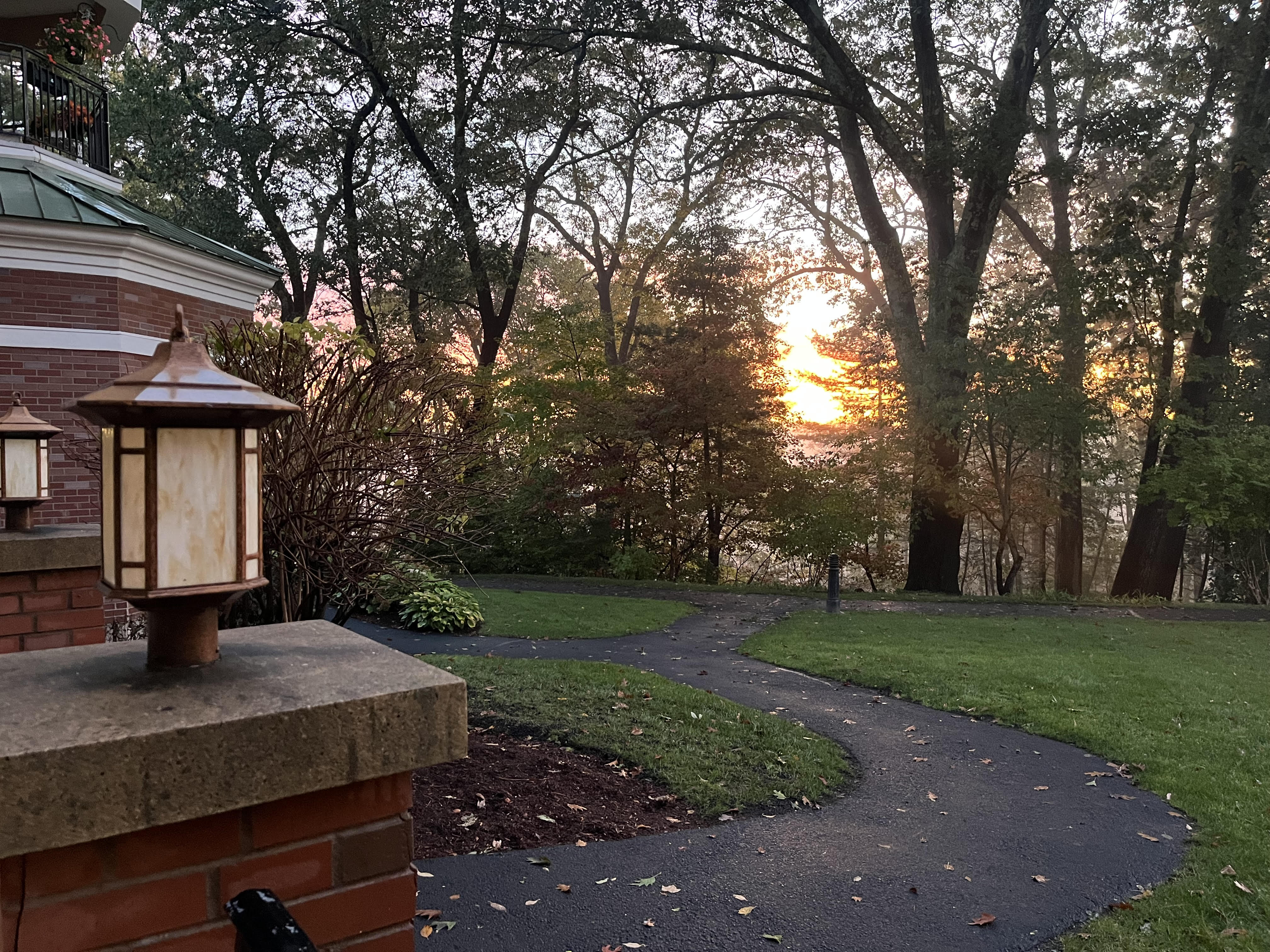
Lastly, a scene I never tire of photographing: the view of dawn from our fitness center.

Photo: Alfredo Sosa/CSM.
Community MusicWorks, a program that allows students to use stringed instruments at no cost, is shown presenting its end-of-year gala in Providence, Rhode Island.

When I was visiting Nancy on Thursday, we talked about an amazing new music hall and school in our area and how it provides free noontime concerts to all comers. My husband and I had just attended one where some of the jazz teachers performed new compositions.

Looking at the huge crowd reminded me what music means to people, and how the word “free” in connection with “music” can make a real difference in people’s lives.

Troy Aidan Sambajon reports at the Christian Science Monitor about how it can make a difference for low-income children.

“The melodies drifting from Community MusicWorks’ spacious building are more than just the sounds of young musicians practicing. They are the heartbeat of the neighborhood.

“For 28 years, an after-school program run by the Providence, Rhode Island-based nonprofit has been reimagining what access to classical music education looks like. Community MusicWorks operates in areas of the state where K-12 students might not otherwise be able to afford to play stringed instruments. The program allows students to use instruments at no cost, offers mentorship, and hosts free concerts and workshops for the wider community to attend.

“Eli Arrecis, 10, is starting his fourth season in CMW this fall. On the last day of summer camp in late July, he and his fellow campers are performing original songs for their parents, using violins, violas, cellos – and shakers they crafted out of cardboard.

“Since joining the program, Eli listens to music with a newfound appreciation and even picks up sheet music at home to read for fun. His parents hope to enroll Eli’s siblings in the program. …

“In an era when many schools’ arts budgets are dwindling, CMW offers something increasingly rare: a space where young people find joy, purpose, and camaraderie through music.

“CMW’s beginnings were modest. In 1997, while he was a senior at Brown University, Sebastian Ruth launched the program with a $10,000 grant and a vision for what he termed ‘musicianship working for positive social change.’

“Mr. Ruth grew up in Ithaca, New York, and was first inspired by a high school violin teacher, who encouraged him to think about the social and spiritual impact of music on people. He and a small team rented a tiny storefront in Providence’s West End neighborhood – one of the city’s most diverse but also most economically disadvantaged areas – and began offering free violin lessons. …

“Within a few years, CMW expanded to the building next door to accommodate its growing after-school program. Hundreds of students later, CMW has cemented its place in the neighborhood with a new state-of-the-art facility, which opened in September 2024. …

“The three-story building has a performing arts center, group practice rooms, an instrument repair workshop, and plenty of space for lessons. Financing for the $15 million project came from state and local funds, as well as individual donations.

“AlexisMarie Nelson started her CMW journey in the sixth grade in 2006. It led her to study violin and viola and to eventually graduate from the Boston Conservatory at Berklee College of Music. Now a program coordinator at CMW, she says … ‘The connections that we’re making are so important.’

“Inside the building, teens such as Cesar Mendez shuffle in and out of lessons and jam sessions. They engage in soul-searching discussions about music and identity.

“ ‘This place feels like home,’ says Mr. Mendez, an 18-year-old violist who joined the program nearly a decade ago. ‘It’s just full of life.’

“But the real impact goes beyond mastering scales. ‘The arts aren’t just about skill-building or learning to play an instrument,’ Mr. Ruth says. ‘It’s a different way of being with other people. Many communities, particularly urban communities, are just doing a disservice to the children by not having adequate opportunities to learn the arts.’ …

“Notes Cecil Adderley, chair of music education at Berklee College of Music and president of the National Association for Music Education. ‘It’s a way to model how to excel at something artistic.’

“Even if students never go pro, he adds, they’re using their creativity as well as fostering collaboration and a sense of belonging. ‘You’re learning not just how to be a musician – but how to be a better neighbor.’ …

” ‘A lot of the time, we talk just so we don’t feel alone in the questions we have,’ says Mr. Mendez, who will study biomedical engineering at the University of Rhode Island this fall.”

More at the Monitor, here.

Photo: Jordan Freeman/Sam Shoemaker.
Sam Shoemaker made a kayak entirely from mushrooms.

Mushrooms! What next?

This week I chatted with Ann about a class where she learned to use mushrooms for natural dyes. And you may remember a post, here, about human caskets made from mushrooms.

But, wait! There’s more, says Open Fung, a nonprofit advancing the future of fungi-based technologies, materials, and the arts. Their latest endeavor: making a kayak from mushrooms.

Lisa Kwon reports at the Guardian, “On a clear, still morning in early August, Sam Shoemaker launched his kayak into the waters off Catalina Island and began paddling. His goal: to traverse the open ocean to San Pedro, just south of Los Angeles, some 26.4 miles away.

“But upon a closer look, Shoemaker’s kayak was no ordinary kayak. Brown-ish yellow and bumpy in texture, it had been made – or rather, grown – entirely from mushrooms. His journey, if successful, would mark the world’s longest open-water journey in a kayak built from this unique material.

“With his phone, GoPro camera, walkie talkie, and a compass affixed to his life vest, Shoemaker left shortly before 6am in order to avoid the worst of the swells in the forecast. But three hours in and powering through his ninth mile, the coastline still out of sight, Shoemaker began feeling seasick.

“Suddenly, he heard the sound of a large animal breaching the waters. To his left, a fin whale flashed its glistening tail, then trailed slowly behind him. As the 50-ft creature followed him for three more miles, Shoemaker found the strength to finish out the maiden voyage … which took him 12 hours.

“As he stumbled onto shore with his mushroom kayak still intact, the artist and mycologist embraced his friends and family. …

“Shoemaker began his career as an artist creating sculptures with propagated mushrooms. Upon returning to Los Angeles after graduating from Yale with an MFA in 2020, he began exhibiting artwork that captured the unique behavior of mushrooms as they grew out of hand-built ceramic vessels and blown glass. … Shoemaker now belongs to a small community of scientists and artists exploring the potentiality of fungal innovation as an alternative material that could be used in everything from kayaks and buoys to surfboards.

“Their focus is on mycelium … a pivotal connective tissue in the animal kingdom. Mycelium-based materials in an aquatic context are known as AquaFung, a term coined by Shoemaker’s mentor Phil Ross, an artist and the co-founder of a biotechnology company called MycoWorks that engineers mycelium-based materials including a mushroom ‘leather‘ that can be used in furniture, handbags and biomedical equipment. After cofounding MycoWorks, Ross cofounded Open Fung. …

“Ross argues that AquaFung has many of the appealing properties as plastic – such as being lightweight and buoyant – but without the harmful footprint. …

“Shoemaker began working on his first mycelium boat in 2024. …

He modified a used fishing kayak to serve as his fiberglass mold, then grew the mycelium network inside the mold …

“Shoemaker meticulously dried the resulting kayak composite structure using fans over the course of several months. …

“Confident in his prototype, Shoemaker began searching for appropriate support. Shoemaker met Patrick Reed, the lead curator of the Pasadena-based arts organization Fulcrum Arts, in December 2023 through mutual friends. After a studio visit, Reed was blown away by everything that the artist had to show him. … Shoemaker completed his second mushroom boat in June; grown from the same wild Ganoderma polychromum mycelium. …

“The completion of Shoemaker’s boat marks the second ever water-tested mushroom boat to be made after Katy Ayers, who holds the Guinness World Record for growing, then testing, what was then the world’s longest fungal mycelium boat on a Nebraska lake in 2019.

“ ‘A lot of people really didn’t think it was possible,’ says Ayers, who grew her boat after being inspired by a documentary called Super Fungi. …

“Ayers and Shoemaker credits mycology pioneers like Ross for making the technology more accessible. And mushroom-based materials are slowly beginning to pop up in the mainstream: In 2021, Stella McCartney made headlines with its launch of the world’s first-ever garments made from lab-grown mushroom leather, in consultation with Ross.”

More on the future of fungal materials at the Guardian, here. No paywall: Please consider offering some financial support to the Guardian.

Photo: Rory Murphy.
Chemical dyes are often toxic for the environment and bad for human health, and that is why the National Theatre in London is planning to use natural dyes from a rooftop garden in its costumes.

My friend Ann is deep into using natural dyes for her textile art, and she even grows the plants that are used for those dyes. It is not just that she is concerned about all the synthetics in our environment, she loves the colors that nature produces.

In London, the National Theatre is on the same track.

Helena Horton  writes at the Guardian, “Squint at the roof of the grey, brutalist National Theatre on London’s South Bank and you might be able to spy a riot of color spilling from the concrete. This is the theater’s new natural dye garden, from which flowers are being picked to create the colors for the costumes worn in the theater’s plays.

“Chemical dyes are often toxic for the environment and bad for human health, so the costume designers at the theater are experimenting with using flowers including indigo, dahlias, hollyhocks, camomile and wild fennel to create the vivid colors used in their productions.

“The textile artist, Liz Honeybone, is buzzing with excitement about the opportunities the new garden is bringing. … She has been very concerned about the health impacts of using harsh, synthetic chemical dyes, which require users to be swaddled in protective clothing. …

“ ‘There used to be a thing called dyer’s nose, which is basically when the aniline dyes came in,’ Honeybone said, ‘They used to destroy your nasal membrane.’ …

“The theater is planning to use natural dyes from the garden in every production at the South Bank going forward, starting with Playboy of the Western World, which is on this autumn and winter.

“Claire Wardroper, costume production supervisor at the theater, said it was ‘a beautiful early 19th century piece, with lots of nice woolly jumpers, because it’s set in rural Ireland, and we can certainly get some nice colors into them.’ …

“They are trying to bring a gentler, more environmentally friendly way of dyeing into the mainstream. ‘We are saying that if you want to use this horrible synthetic dye, you can do that, but you can achieve this beautiful look by using a natural dye, and we can do it a little bit slower and a bit more sort of organically,’ said Honeybone.

“Wardroper added: ‘It’s unfortunate to say, but the theatre and film and anything creative in one-shot opportunity entertainment has a history of being incredibly wasteful.’ …

“Honeybone said: ‘It’s been such a good harvest. My indigo is more than I can cope with. I’ve got three shows going on at the moment, so I’ve had to recruit people to help me.’

“People may imagine the colors extracted from flowers will be muted compared with synthetic dyes, but Honeybone said this could not be further from the truth and she has been able to create neon greens and yellows. ‘Our forefathers were drowning in color. They loved it, it wasn’t hard to get and all the tapestries that were up on the wall were a riot of color. What we’re seeing now is the sad, faded leftovers,’ she said.

“Honeybone says she has become ‘obsessed’ with natural dyeing. ‘My daughter gave me a bunch of flowers on Mother’s Day, and I noticed there was some golden rod in it, so whisked that out and dyed with it just to see what it yielded. And it was the most glorious, strong yellow.’

“The garden is not only used for dyes but also as a refuge from the hustle and bustle of the theatre. The pair said actors were frequently seen pacing among the flowers, or sitting down on benches to learn their lines.

“The space is also a haven for wildlife. The grey concrete of the South Bank does not have a huge amount to offer pollinators, and they have been swarming to the garden to sample the nectar from the varied dye plants.

“Wardroper said: ‘We’re seeing so much more wildlife, like hummingbird moths, and we’ve got bees on the National Theatre roof which produce honey for the National Theatre. And they’re loving the variety of plants that we’ve planted as well. These are a new stock of plants that they just haven’t had access to. So the bee person that comes in and caters to the bees is very happy.’

“The pair hope that most if not all of the costumes at the theatre can eventually be produced using natural methods. But for now, Honeybone is enjoying the opportunity to start using these dyes.

“She said: ‘This is such an all round sensory experience, totally engulfed in the smells and the feeling. … It is just wonderful.’ ”

More at the Guardian, here. (Gotta love that someone in this earthy-crunchy field has a name like Honeybone and that Wardroper oversees the wardrobe!)

Photo: Jaida Grey Eagle via MPR News.
Among her many accomplishments, Twin Cities-based author Marcie Rendon writes a mystery series about indigenous investigator Cash Blackbear. 

I read a lot of mysteries, and I gravitate toward those about different cultures, often outside North America. But indigenous cultures here are equally foreign to me, which is why I have enjoyed Marcie Rendon’s Cash Blackbear series, about a tough young Ojibwe woman who investigates crimes against members of Upper Midwest tribes, often women.

I have several articles here for you to click on if interested, but I’m going to focus on what the Minnesota-based McKnight Foundation said about Rendon when they gave her an award.

“The McKnight Foundation is pleased to announce the selection of Marcie Rendon for its 2020 Distinguished Artist Award—a $50,000 award created to honor a Minnesota artist who has made significant contributions to the state’s cultural life. Rendon, an enrolled member of the White Earth Nation, is a writer whose poems, plays, children’s books, and novels explore the resilience and brilliance of Native peoples.

“ ‘Marcie brings a strong and necessary voice to so many genres,’ said Pamela Wheelock, McKnight’s interim president. ‘She has created a tremendous body of work, including poetry, plays, lyrics, and award-winning crime novels, all while raising up other Native voices in our community. Her commitment to making art in community embodies what a distinguished artist means to Minnesota and to McKnight.’ …

“A gifted storyteller and prolific writer, Rendon is the author of the award-winning Cash Blackbear mystery series, set in Minnesota’s Red River Valley. The first novel in the series, Murder on the Red River, earned the 2018 Pinckley Prize for Debut Novel, and the second, Girl Gone Missing, was nominated for the Mystery Writers of America – G. P. Putnam’s Son’s Sue Grafton Memorial Award. Rendon … is also the author of four nonfiction children’s books, including Powwow Summer (Minnesota Historical Society Press, 2013).

“Rendon’s plays include Sweet Revenge, chosen for the Oklahoma Indigenous Theatre Company’s 2020 New Native American Play Festival. She has also curated and produced a variety of Native-focused performances at the History Theatre, the Minnesota Fringe Festival, and Patrick’s Cabaret. She is the founder of Raving Native Theater, a platform that brings voice and visibility to other Native American artists and performers.

“ ‘We are more resilient than we are traumatized,’ said Rendon. ‘Art keeps us thriving, not just surviving. I try to make room for other Native artists. Every time someone steps forward, it makes room for others to step forward.’ …

“Rendon’s poem ‘Resilience’ is also included in US Poet Laureate Joy Harjo’s digital project ‘Living Nations, Living Words: A Map of First Peoples Poetry,’ which will join the permanent collection of the American Folklife Center at the Library of Congress.

“Rendon’s awards include a 2020 Ensemble/Playwright Collaboration Grant from the Network of Ensemble Theaters and the Playwrights’ Center, and a 2020 Covid-19 artist grant from the Tiwahe Foundation for demonstrating resilience during the pandemic. Rendon was named a 2018 50 Over 50 honoree by AARP Minnesota and Pollen Midwest and received Loft’s 2017 Spoken Word Immersion Fellowship with poet Diego Vazquez. …

“Said Sandy Agustin, a member of the Distinguished Artist Award selection committee, ‘Whether she is writing about boarding schools, incarceration, or the epidemic of missing and murdered Indigenous women, she is nurturing Native voices and amplifying communities that are too often unheard, especially Native women.’

“Born in northern Minnesota in 1952, Rendon was a voracious reader, creative writer, and poet from an early age. While studying criminal justice at Moorhead State College in the early 1970s, she was part of a group of Native student activists who successfully demanded the launch of the university’s first American Indian studies department.

“After moving to the Phillips neighborhood of Minneapolis in the late 1970s, she worked as a counselor and therapist, while raising her three daughters. In 1991 she saw a performance by Margo Kane, a Cree-Saulteaux artist, that inspired Rendon to share her own poetry and writing with a wider audience. …

“She is currently collaborating with artist Heather Friedli on an upcoming installation at the Weisman Art Museum about the high rates of incarceration among Native women.”

I have read most of the Cash Blackbear books (there’s a new one just out), and I find the urgent educational energy of the series both its strength and its weakness. Rendon feels empowered by a need to educate unenlightened readers like me, and I appreciate what she’s doing. After all, injustices continue and indigenous women in particular still disappear at an intolerable rate. I’ll just say that sometimes the mission overwhelms a good yarn.

More at the McKnight Foundation, here. See also Minnesota Public Radio, here, and Visual Collaborative, here.

A Library in the Subway

Photo: Biblioteka Publiczna w Dzielnicy Targówek m.st. Warszawy.
A library has opened in a new metro station in Warsaw. 

Fans of libraries know that libraries have a way of popping up in all sorts of unlikely — even inimical — places. If you search on the word at this blog, you will find stories about libraries on horseback, in impoverished countries, in war zones, and wherever people find comfort from reading.

Jakub Krupa reported for the Guardian about a new library in a Polish subway station.

“An ‘express’ library has opened in a new metro station in Warsaw, aiming to provide an appealing cultural space to encourage residents and commuters to forgo smartphones in favor of books and, thanks to fresh herbs growing in a vertical garden, a dash of subterranean greenery too.

“The stylish Metroteka [in] the Kondratowicza M2 line metro station in the Polish capital’s Targówek district offers two reading areas for adults and children, as well as a space for public readings and events.

“About 16,000 books are on offer. … Readers can return them on site or through a street-level parcel locker for books, available 24/7.

“Visitors can study or work in a communal area, borrow a laptop to browse the internet, or simply sit down with a complimentary coffee or hot chocolate to unwind after rush hour travel on the metro. …

” ‘Our dream is for Metroteka to become an educational and cultural centre, and not just a place where you borrow your books from,’ says the deputy director of Targówek library, Grażyna Strzelczak-Batkowska. …

“She says the unique subterranean location brings the library closer to busy commuters, ‘both geographically and in terms of time you need to spend on getting the book.’ …

“More than 400 books were leased on the first day, mostly recommended school readings, as well as travel guides and ‘all sorts of how-to books.’

“The library’s innovative model aims to encourage Poles to read more. The annual survey by the National Library of Poland found that only 41% of respondents had read at least one book in 2024, down from the high 50s in the late 1990s and early 2000s, as people turn to TV, streaming services, and phones for entertainment instead.

“These numbers are higher than in southern Europe, but lower than in the Nordic countries, or even the neighboring Czech Republic, the National Library’s director, Tomasz Makowski, says.

“He says there are historical reasons for it – with Poland losing 70% of libraries in the second world war, ‘we had several generations that did not see their parents or grandparents in front of a wall of books’ – but also cultural as ‘reading is not something associated with adulthood,’ but with ‘schools, teachers, librarians, and usually mothers reading to children.’

“ ‘Opening a library in a metro station is like a dream for us,’ Makowski says, as it challenges that stereotype. ‘Libraries should be beautiful and open; inviting, not intimidating. It’s not a shrine, but a place where you can spend time freely, take part in discussions, public consultations, or meet people,’ he says.

“He says the National Library has also opened a ‘loud’ reading room, breaking with the tradition that such areas need to maintain silence, where ‘no one shushes you or tells you to keep quiet. To our surprise, it’s still pretty quiet, but they also talk, give tutoring, different kinds of lessons.’ ”

Good photos at the Guardian, a free paper, here.

What do you think of the library’s chances? I love the optimism behind this effort but can’t help picturing what the subways I know well are like. Has anyone else commuted to work this way?

The Story of the Jukebox

Photo: Lisa Guerriero.
A restored 1946 Wurlitzer jukebox model 1015, known as “the Bubbler” for the bubble tubes on its front.

In the 1950s, when the jukebox was at the height of its popularity, one of my brothers received for Christmas a magnificent toy version. I remember it lighting up in bright colors when you turned it on. It could not exchange records like tan authentic jukebox, but it was real enough to become the wonder of the neighborhood, at least for a while.

At the Smithsonian, Steven Melendez reminds us that the basic concept was launched long before the 1950s.

“In 1889, a San Francisco tavern called the Palais Royale debuted a hot new attraction: a modified Edison phonograph that, when a customer inserted a nickel, played music from a single wax cylinder. Electrical sound amplification was still years away, so customers had to insert stethoscope-like tubes into their ears to hear anything. …

“Despite this unwieldy setup, the machine reportedly brought in more than $1,000 (some $34,000 today) in less than six months, and coin-operated music machines soon proliferated in bars, at drugstores and even in new listening parlors across the country. Alas, poor sound quality meant selections couldn’t be soft or subtle, so popular offerings included such earsplitting numbers as John Philip Sousa marches and the novelty whistler John Yorke AtLee performing popular ditties of the day. By the early 1900s, the machines struggled to compete against player pianos and other automated instruments that could entertain whole venues with higher-quality audio. …

“Record players continued to improve in quality and volume, and pay-to-play phonographs made a huge comeback in the 1920s, paving the way for the jukebox era. In 1927, the Automatic
Musical Instrument Company unveiled the first amplified, multi-record coin phonograph.

“Jukeboxes — they took on this nickname in the 1930s in reference to African American ‘juke joints’ of the South — introduced the world to music on demand, for far less than buying a record (and on better equipment than people had at home). … Danceable big-band numbers and tunes like the ‘Beer Barrel Polka’ were early hits, and the irrepressible popularity of jukeboxes soon rocketed artists like swing impresario Glenn Miller to national fame, creating an audience for loud, catchy, rollicking tunes. …

“Jukebox operators came to account for a majority of record sales, as they frequently changed out selections to keep customers dropping nickels. Using meters within the machines, operators could track which tunes were most popular at which locations, and they programmed boxes accordingly, offering a mix of national hits and more regionally specific selections. The latter included many tunes by Black and working-class musicians, in folk genres such as country and blues that tended to get scant airplay on the radio of the day but soon found appreciative listeners on jukeboxes. 

“By the early 1940s, about 500,000 jukeboxes dotted the country, sometimes inspiring too much of a ruckus: Newspapers frequently reported on bar fights over music selections. …

“Jukeboxes had a chance to prove their patriotic bona fides during World War II, when they provided vital entertainment on military bases and at troops’ canteens, sometimes on machines donated by public-spirited American operators — not a single nickel required. …

“After the war, stylish and streamlined jukebox cabinets in diners let teenagers listen to rock ’n’ roll at volumes generally impossible (or at least inadvisable) to achieve at home. Jukeboxes became indelibly associated with 1950s youth culture. … The format of hit-after-hit music queues also helped inspire teen-friendly Top 40 radio, replacing older formats that defaulted to playing several songs in a row by a single artist.

“Over the next couple of decades, jukeboxes would see their numbers dwindle as fans turned to other sources of entertainment, including increasingly high-fidelity home stereos, television and the transistor radio.”

Teddy Brokaw continues the jukebox story at Smithsonian with a description of how mobsters saw easy money in the phenomenon.

“The jukebox,” Brokaw reports, “with its all-cash business model and fungible record-keeping, showed clear potential for tax evasion and money-​laundering operations and quickly caught the attention of organized crime.

“By the 1940s, Mafiosi, foremost among them Meyer Lansky, had pioneered the typical racket: Buy up all the jukeboxes in an area and lease them to businesses in exchange for 50 percent or more of the take. But the scheme’s true brilliance was its scope: The mob owned not only the jukeboxes, but also, often, the record companies supplying the discs and the contracts of the artists cutting the records. It was a masterpiece of vertical integration, and it worked gangbusters.

“By the mid-1950s, one enterprising gangster — Chicago Outfit member Jake ‘Greasy Thumb’ Guzik … controlled 100,000 of America’s half-million jukeboxes and was raking in several million dollars a year. 

“With made men at the helm, the jukebox industry relied on hits — of both kinds. Mobsters could make or break an artist’s career through their control over what made it into the machines and thus climbed the charts. And beatings, bombings and even murders were just ‘one of the liabilities of the business,’ as a Wurlitzer sales executive testified to a Senate investigative committee in 1959. Jukebox owners who didn’t play nice risked seeing their machines destroyed, while rival jukebox distributors who refused to cut the mob in on their operations were whacked on more than one occasion.

“The jukebox may be a relic of a bygone era, but the mob’s influence in jukeboxes remains. As recently as 2018, a reputed mobster was gunned down. … The victim’s funeral procession was led by a car carrying — what else? — a jukebox made of flowers.”

More at Smithsonian, here.