Feeds:
Posts
Comments

Photo: International People’s College.
Leisure time at an unusual school in Elsinore, Denmark. Some Ukrainian young people have found new ideas there for a stronger post-war democracy.

In Denmark, a non traditional high school called a “folk high school” is the model for a movement in Ukraine to build the strengths needed for a strong participative democracy. You could say “a folk school with Ukrainian characteristics.”

Amanda Leigh Lichtenstein reports at the radio show the World about work at “the International People’s College, a residential school located on a tree-studded campus in Elsinore, a historic town just an hour by train from the capital. …

“The IPC, one of Denmark’s oldest folk high schools, focuses exclusively on global affairs, and all classes are taught in English.

“[Marta Kostiv], a 23-year-old student from Lviv, said that she heard about the chance to study at the IPC when she was still in Ukraine. 

“ ‘I saw in one of their group chats that IPC is proposing a scholarship for Ukrainian students, so I applied for it, and I’m really glad.’ …

“Since Russia’s full-scale invasion began, 27 students from Ukraine have been accepted to study at various Danish folk high schools across the country as part of a special endowment to encourage young Ukrainians to learn about democratic change and civil society-building — a purpose aligned with the overall history and aim of the Danish folk high school system. 

“Denmark’s 70 folk high schools are residential colleges where young adults come to live and learn together for up to six months with no grades or exams.

These schools embody the concept of bildung — a German word for a learning approach that blends personal, civic and moral development through shared values like cooperation, empathy and dialogue. 

“The idea for the endowment came from a small group of educators in Ukraine with Bildung in Ukraine, a nongovernmental organization that believes that bildung holds the key to the country’s future.

“ ‘A very clear message from [Bildung in Ukraine] was to please open your schools for our youth because they need something meaningful to do while the country’s in a state of war,’ said Sara Skovborg Mortensen, who oversees international partnerships with the Association of Danish Folk High Schools. ‘And we need to prepare and democratize [and] build strong individuals for a time after the war.’

“A 24-week semester at the IPC costs about $6,500, which the special endowment makes free of charge. Students can apply to attend any type of Danish folk high school; they emphasize everything from gymnastics to the arts to spirituality. 

“At the IPC, residents do everything together, sharing meals and cleaning up in the kitchen, working on class projects, attending cultural nights, hanging out in the library and partying together on the weekends. 

“Students and faculty say the school’s emphasis on small-group dialogue and personal storytelling helps them break through cultural barriers and stereotypes.

“ ‘The classes are different, so we have choir, we have intercultural communication, Asian studies, we have all of that, even gardening. And my goal was to try everything I could,’ said Kirill Karuna, a 22-year-old student from Kyiv. ‘You just cannot help but fall in love with this whole concept.’ 

“Karuna originally applied to stay 12 weeks but was convinced to stay the full 24 weeks and said that he does not regret it — he even discovered his love for filmmaking here. 

“ ‘What I’ve learned about myself is that it’s all right to deviate from society and be on your own,’ Karuna added, ‘but don’t go to extremes and don’t leave the [community] for too long.’ … 

“Kostiv admitted that ‘even if you move abroad, you can’t get rid of your problems,’ [adding] that she is eager to return to Ukraine, find meaningful work and continue to build her life there. ‘The thing I will [return with] is curiosity,’ Kostiv said, noting how she was encouraged to explore the arts and try new things. …

“The 19th-century thinker N.F.S. Grundtvig is credited as the creative genius behind the folk high school system. 

“ ‘He was a priest. He was a poet. He was a politician. He was a pedagogical thinker. And he was a philosopher. And basically, Grundtvig’s thought was that we need to educate the Danish population — the sons of farmers — who only had very little education at that time,’ said headmaster Soren Launbjerg. …

“Over time, folk high schools flourished as a fundamental force in the formation of Danish consciousness. Many leaders and activists around the world would later turn to the folk high school system as a working model for civic engagement, nation-building and democracy. 

“Julie Shackleford, an American anthropologist and teacher at the IPC, oversees the school’s archives in a few crowded offices bursting with historical documents, records and relics. …

“ ‘In Denmark, they went from an absolute monarchy to democracy overnight. How do you participate in that when … you’ve never had a voice before? What do you do? So, people needed some training in finding their voice,’ she said. …

“Elena Tochilina, one of the founding members of Bildung in Ukraine, has been in residence at the IPC in Denmark since February to learn more about the folk high school system and find ways to adapt to the Ukraine context. 

“Tochilina said that the need for social change in Ukraine erupted in 2013-2014 with waves of large-scale protests calling for massive political reforms that became known as the revolution of dignity.

“ ‘We were very clear that revolutions sometimes are needed, but it’s better to evolve through self-development, through education,’ Tochilina said. 

“About a year and a half before Russia’s full-scale invasion into Ukraine, the group outlined plans, created a road map, established a nongovernmental organization and purchased land for the school. ‘When the war started, of course, everything stopped,’ Tochilina said. 

“But the war has also crystallized the need for democratic values in Ukraine, she said.  

“ ‘And it seems like we’ve got the key, we’ve got the knowledge of how to educate a critical mass of people who will be voters in the future and will be making more conscious choices,’ Tochilina said.

“The folk high school system offers a blueprint for ‘installing a new mindset’ among Ukrainian youth, Tochilina said, but not everything is directly transferable to a Ukrainian context. For example, Tochilina said the IPC’s habitual morning singing gave her flashbacks to mandatory, Soviet-era Young Pioneer camps she attended as a child. 

“ ‘You always have to be in the group and you have to stay in the group … I can notice some of these socialist traces in Danish society,’ she said, adding that the Ukrainian approach will require far more flexibility — and freedom.”

More at radio show the World, here. No paywall.
Saving Afghan Joy

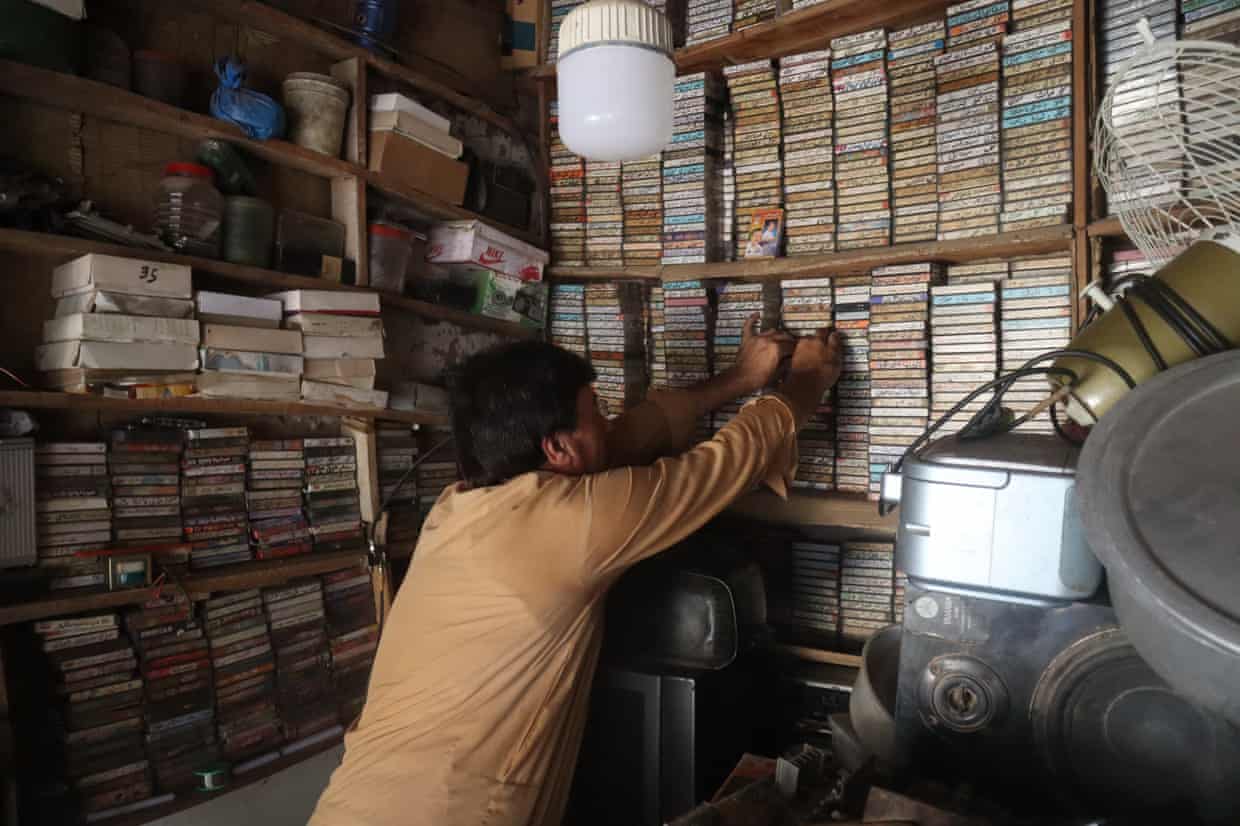
Photo: Shah Meer Baloch.
Afghan refugee Mohammed Hasan Zamri in his shop in Pakistan, where he keeps his collection of rare music cassettes from his homeland.

For the Afghan diaspora, you have to celebrate joy where you find it. In October, for example, Afghan friends lit up social media because of an unexpected triumph in cricket.

“I had a quick shower and was heading towards the office when I learned about Afghanistan’s phenomenal cricket victory against Pakistan, with the news dominating my socials,” Shadi Khan Saif exclaimed in the Guardian. …

“The team’s phenomenal performance has lifted up not just the devastated nation but millions in the Afghan diaspora, including in Australia. At Dandenong Park in Melbourne’s south-east, hundreds joined in on the traditional Attan dance to mark the victory. The scenes in Kabul and other cities in Afghanistan were equally charged with joy and celebration.

“Amid international isolation, Afghanistan’s cricket team has once again proved itself as the only source for the Afghans to connect with the outer world. Afghanistan’s tri-color flag – now replaced with the white Taliban flag – and the Republic-era anthem are still kept alive by the cricketers on the world stage.”

As unusual as was that moment of delight, it is clearly not the only way Afghans seek out joy. Some turn to a collector in Pakistan who is saving Afghan music for posterity.

Shah Meer Baloch reports for the Guardian, “Afghan music fans from Kabul and Jalalabad have crossed the border to the city of Peshawar in Pakistan to offer thousands of rupees to Mohammed Hasan Zamri’s workshop for just one cassette.

“Zamri, an Afghan refugee, refuses them all as he continues his quest to copy and, one day he hopes, digitize his collection of more than 1,000 rare and old Afghan music cassettes of various genres.

“It is his contribution to help preserve a musical culture that existed for centuries before the Taliban existed.

“Since retaking control of the country in 2021, the Taliban have imposed their rigid interpretation of Islam, restricting and even criminalising music and arts. In July, they publicised a bonfire of seized ‘illegal’ musical instruments, reminding Afghans that the sale of instruments was a punishable offense.

“ ‘The Taliban just use religion as an excuse to ban music and say it is haram, prohibited, in Islam. This is not true and it is part of our culture for centuries, but the Taliban have senselessly put a ban on it, says Zamri.

“Zamri fled Afghanistan during the Soviet invasion and went back for a few years after the war had ended and the Taliban had started to consolidate their power. He left again in 1996 and has been running a workshop fixing tape recorders and TVs ever since.

“Most of the space in his small workshop is taken up by stacks of cassettes, neatly arranged on a wall opposite the entrance. His collection includes tapes of renowned Afghan musicians including Munawar, Nashenas, Taj Mohammad and Haikal.

“ ‘I have done recordings of many singers myself who had fled Afghanistan in the 1990s or had come to Peshawar, which has been a thriving hub for Afghan refugees and musicians,’ he says.

“ ‘The love for music is there but the musicians, music and art is banned in the Taliban’s Afghanistan. Today, we have many singers but because of the ban, they cannot perform. They have fled Afghanistan.’

“Listening and copying his cassettes, Zamri reminisces of times when Afghan audiences could enjoy music and culture with freedom – the same freedom afforded to musicians and artists, men and women. … ‘The people who have heard these songs or lived through the era are the ones who come to buy cassettes. …

“ ‘Naseema, Kashan, Benazir and Zarghona were the best female singers who dominated Afghan music three to four decades ago. Now, if they do not allow men to sing or create music, how will they allow women?’

“Until [August], Zamri was unknown to many Pashto-speaking people until local media featured his attempts at saving Afghan music cassettes. He has since received both threats and messages of appreciation.

“ ‘I have been threatened on Facebook from people to stop my work and they would burn down my shop and that this is against Islam. But there were some positive and appreciative comments too. …

” ‘Some people are addicted to smoking, some people love pets and some are fond of many other things. I am addicted to Afghan music. It is my hobby and passion,’ he says.”

More at the Guardian, here.

Artist Ernie Barnes

Art: Ernie Barnes.
Photo: Ernie Barnes Estate, Ortuzar Projects and Andrew Kreps Gallery.
Ernie Barnes’s “The Sugar Shack” (1976) sold well above its estimate at a Christie’s auction in 2022.

I’ve been thinking about artists whose popularity often seems to put them beyond recognition by the “academy.” Can they be taken seriously by serious people if they are popular? If their works are deliberately priced to be affordable, does that mean they are not valuable?

Adam Bradley writes at the New York Times about the long underappreciated artist Ernie Barnes, who is having “a moment” now that he has died.

Bradley writes that “in the 1970s, buying a print of Ernie Barnes’s ‘The Sugar Shack,’ the iconic 1976 dance club painting that adorns the cover of Marvin Gaye’s album released that spring, ‘I Want You,’ and appears in the credits for the classic sitcom Good Times (1974-79), required nothing more than mailing a $20 check to the artist’s West Hollywood studio.

“In 2022, the second of two originals — inspired by a childhood adventure of sneaking into a famed dance hall to watch couples drag and sway to the live performances of Clyde McPhatter or Duke Ellington — came up for auction at Christie’s, selling for $15.3 million. The buyer was the Houston-based energy trader and high-stakes gambler Bill Perkins, 54, who won a bidding war against 22 other prospects. This vast divergence of price belies a convergence of spirit: The countless individuals hanging inexpensive prints on the walls of bedrooms and barbershops share with Perkins (and no doubt with the other wealthy collectors who bid the painting up to more than 76 times its high estimate) an ineluctable desire for the nostalgia and affirmation that Barnes’s work conveys.

“Barnes, who died in 2009 at 70, left a paradoxical legacy. He was an artist of the people — most especially of Black people — selling reproductions at prices that enabled everyone to own something beautiful. He was also an artist to the rich and famous; he sold many of his original works to athletes, movie stars and musicians, from Kareem Abdul-Jabbar to Grant Hill, Diana Ross to Bill Withers, Harry Belafonte to Sylvester Stallone. He was among the most visible artists of the ’70s, with millions seeing his paintings on television each week; yet his work was excluded from major museum collections.

“The unprecedented price paid for ‘The Sugar Shack,’ Barnes’s most recognizable work, has changed everything — and nothing at all, inviting a wider (and whiter) audience to revisit an artist whose reputation among Black Americans is unassailable. More than a dozen years after his death, Barnes, long a popular painter, has become an important one, with all that term entails: a hot global market for his work (pricing out many of Barnes’s original collectors); newfound interest from museums; and, most immediately, a major gallery exhibition scheduled for next year at Ortuzar Projects in New York, which will invite a deeper look at Barnes’s varied career.

“Ernest Eugene Barnes, Jr., was born in Durham, N.C., in 1938, and grew up in a segregated neighborhood known as the Bottom. His father was a shipping clerk for Liggett & Myers Tobacco Company and his mother worked as a domestic.

“In his 1995 memoir, From Pads to Palette, Barnes recalls using sticks as a child to sketch undulating lines ‘in the damp earth of North Carolina.’ By the time he was in high school, Barnes had grown close to his full height of 6 feet 3 inches and finally gave in to the football coach’s entreaties for him to play offensive lineman.

“By 1956, he had 26 college scholarship offers; he enrolled at the historically Black North Carolina College (now North Carolina Central University), where he studied art. Though Barnes found support for his artistic endeavors on campus (he sold his first painting, ‘Slow Dance,’ a precursor to ‘Sugar Shack,’ for $90, to the recent alum and Boston Celtics guard Sam Jones), he often faced bigotry beyond it, and this led him away from art. The Baltimore Colts selected Barnes in the 1960 N.F.L. draft, and he played for four other teams in a six-year career before leaving the game because of the physical toll of injury and the psychic toll of delaying his true calling as a painter. …

“Barnes worked for a short period in the off-season as a door-to-door salesman, and as a construction worker building crypts. Then, with the endorsement of the business mogul and San Diego Chargers owner Barron Hilton, Barnes crashed the American Football League owners’ meeting to make a pitch to become the first official painter of a professional sports franchise. Many of the owners ignored him; one heckled him.

“But another, Sonny Werblin of the New York Jets, offered to pay him a player’s salary to become the team’s official painter. After a year, Barnes had built up enough of a portfolio for Werblin to sponsor Barnes’s first solo show, at the famed Grand Central Art Galleries in Midtown Manhattan. Barnes was 28. His work, which rendered football as modern-day gladiatorial spectacle, was stylized and dramatic. One could see within it the stirrings of his mature aesthetic: his loose and gestural handling of human form, his passion for portraying bodies in motion.

“His athleticism was far from incidental to his art. … Barnes understood the human body not from the outside in, in the studied manner of a draftsperson, but from the inside out, through his knowledge of how bone, muscle and ligament move in concert. …

“Barnes’s 1966 New York show might have marked his triumphant emergence into the artistic mainstream. Instead, it was greeted with indifference. ‘It was a shock to me,’ Barnes said decades later. If the art world was going to reject him, then he would reject it. ‘When I found out that I didn’t have to belong, really, to that world, he said, ‘that was much more assuring to me as a human being.’ …

“He expanded his subject matter to suit a broader audience, directing his eye for physicality toward everyday life. What does it look like to walk down the street with swagger, to hoist a heavy bag at day’s end, to jump double Dutch? Inspired in part by the Black Is Beautiful movement of the photographer Kwame Brathwaite and others, Barnes began producing works that would comprise a show titled ‘The Beauty of the Ghetto. It opened in 1972 at what was then known as the California Museum of Science and Industry and traveled the country for seven years. …

“In 1973, he met with the television producer Norman Lear, who was preparing a new program provisionally titled The Black Family. Lear was so taken with Barnes that he proposed not only using Barnes’s paintings on the show but also making the family’s eldest child, J.J. (who’d be portrayed by the actor Jimmie Walker), an artist himself. …

“ ‘His work is really about joy and positivity,’ says Ales Ortuzar, 47, who along with Andrew Kreps co-represents Barnes’s estate. ‘Those are two things that have traditionally been dismissed in the art world.’ Indeed, irony has no place in Barnes’s artistic worldview. His canvases are domains of earnestness and striving, of unalloyed celebration and pride. …

“ ‘There are a number of folks who will say, “Oh, his work has a $15 million price tag on it,” ‘ says [Derrais Carter, 39, a professor of gender and women’s studies at the University of Arizona and the curator of the Barnes exhibition at Ortuzar Projects]. ‘ “Let me pay attention to it.” And I’m like, “Well, Black folks never needed no $15 million to own that work.” It’s been in dens, college dorm rooms, on faded album covers, the whole nine. These [paintings] are like talismans, anchors of home.’ ”

More at the Times, here.

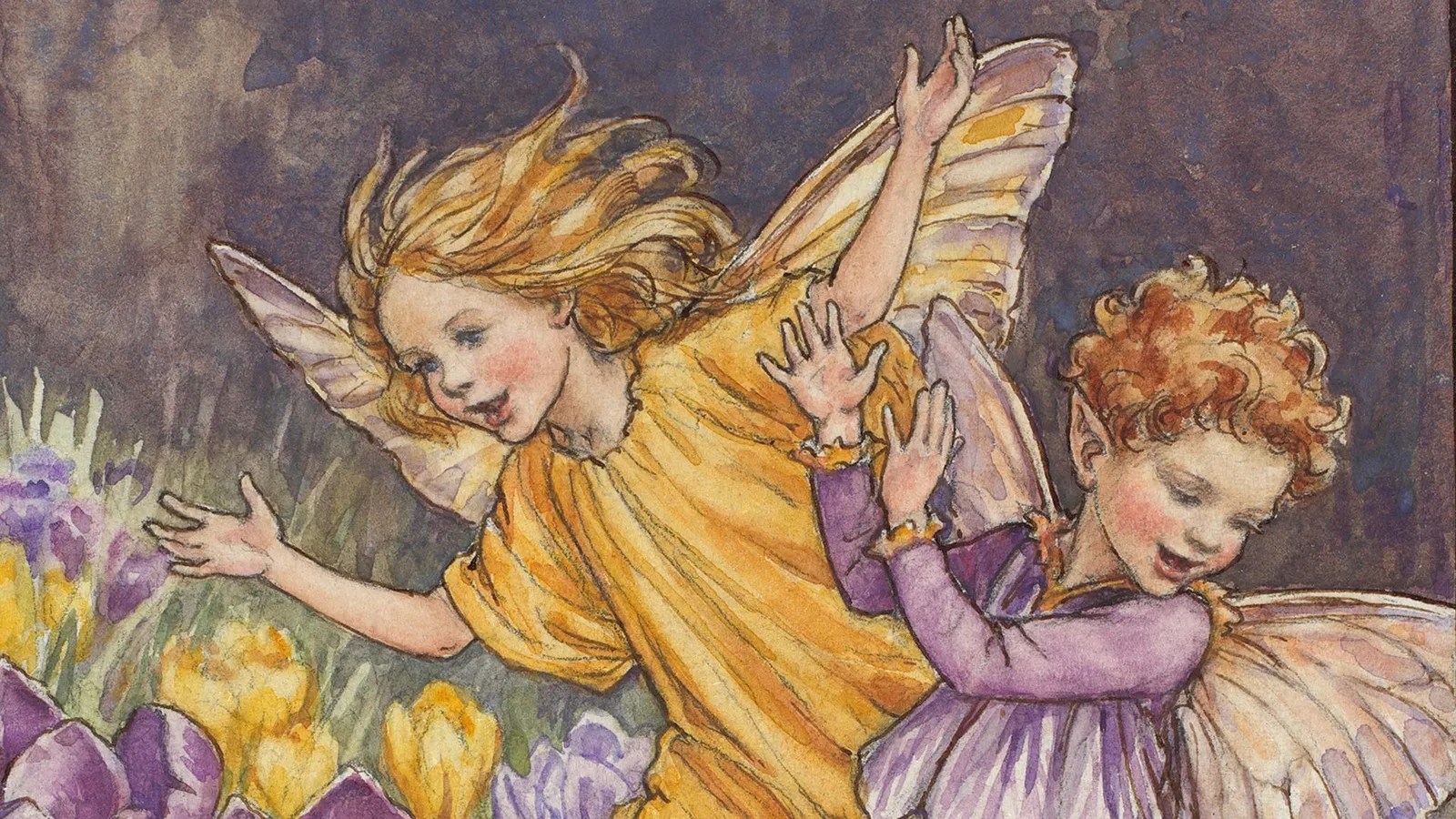
Fairies Forever!

Photo: Estate of Cicely Mary Barker, 1934 Flower Fairies.
The Crocus Fairies from Flower Fairies of the Spring – the watercolors are still popular today with “fairycore” fans, the BBC opines.

Hannah will remember my devotion to the subject of today’s post. Fairies. I have always been into fairies, and long ago Hannah joined me in bringing them to life.

Meanwhile in the UK, the BBC’s Holly Williams writes this about them: “Imagine a fairy. Is the picture that appears in your mind’s eye a tiny, pretty, magical figure – a childish wisp with insect-like wings and a dress made of petals?  

“If so, it’s likely you’ve been influenced by Cicely Mary Barker, the British illustrator who created the Flower Fairies. 2023 marks 100 years since the publication of her first book of poems and pictures, Flower Fairies of the Spring – an anniversary currently being celebrated in an exhibition at the Lady Lever Gallery in Merseyside, UK.  

“The Flower Fairies’ influence has endured: they have never been out of print, and continue to be popular around the world. … Barker’s delicate watercolors certainly helped cement several tropes we now consider classic – almost essential, in fact – in the iconography of the fairy: they are miniature, sweet and youthful, they are intertwined with plants and the natural world, and they are distinctly twee.

“Yet her drawings were also ‘firmly footed in realism’ points out Fiona Slattery Clark, curator of the show. … Barker drew children from the nursery school her sister ran in their house in Croydon near London; each was assigned a flower or tree, and Barker’s detailed illustrations were botanically accurate – she would source samples from Kew Gardens, says Slattery Clark. Even the petal-like wings and fairy outfits were closely based on plants: an acorn cup becoming a jaunty cap, a harebell becoming a prettily scalloped skirt. 

“The Flower Fairies were an immediate hit – but Barker was far from the only artist of her era to find success with fairies. In fact, fairy fever swelled within the United Kingdom for over half a century, reaching something of a peak around the time the Flower Fairies emerged in 1923. Over 350 fairy books were published in the UK between 1920 and 1925, including in Enid Blyton‘s first fairy foray, a collection of poems called Real Fairies in 1923. Fairy art even had the stamp of royal approval: Queen Mary was a fan of Ida Rentoul Outhwaite‘s ethereal drawings, and helped popularize them by sending them in postcard form. …

“But for many hundreds of years, they were not necessarily tiny and fey, but grotesque or fierce elemental forces, capable of great darkness. ‘In 1800, if you thought your child was a fairy it would have been like demonic possession – you would have put that child in the fire to drive out the fairy,’ points out Alice Sage, a curator and historian.

“Yet within 100 years, the whole conception of fairies completely changed. … Fairies became a fashionable subject for Victorian artists, often taking inspiration from Shakespeare’s A Midsummer Night’s Dream and The Tempest. John Anster Fitzgerald, Edwin Landseer, John Everett Millais, Joseph Noel Paton, Arthur Rackham and even JMW Turner – among many others – painted supernatural sprites from the 1840s onwards. But there was still a sense of otherworldly strangeness in many of their depictions – as seen in the work of Richard Dadd, who made his hyper-intricate fairy paintings while living in a Victorian asylum. …

“Barker never made any claims for fairies being real – ‘I have never seen a fairy,’ she wrote in a foreword to Flower Fairies of the Wayside. But it is worth noting that she first published the Flower Fairies at a moment when the desire to believe in magical beings was at a rare high. In 1920, Britain was gripped by the story of the Cottingley Fairies, after two girls claimed to have photographed fairies at the bottom of their garden in West Yorkshire – and were widely believed.

“Their beautiful photographs were created by paper cut-outs, floating on hat pins. Although many were skeptical, they nonetheless also fooled many of the great and the good – the photographs were brought to prominence by no less than Sir Arthur Conan Doyle, the author of Sherlock Holmes, who wrote a whole book about it, The Coming of the Fairies, in 1922.

“Cousins Elsie Wright and Frances Griffiths were aged 16 and nine when they took the first photos. Many years later, in the 1980s, they admitted it was a hoax, explaining that they kept up the pretense that the fairies were real a because they felt sorry for the middle-aged men, like Conan Doyle, that so wanted to believe. …

” ‘For Conan Doyle, it was all about a search for another realm of being that related to life after death, vibrations, telepathy, telekinesis – this fascinating world on the edge of the limits of human perception,’ says Sage. ‘And obviously that’s connected to the loss of his son in World War One.’ …

“Sage is pleased to see the Flower Fairies exhibited in a fine art context at the Lady Lever gallery. For a long time, men painting fairies has been considered art – but when women do it, it’s just silly flowery stuff for children. ‘This is fine art – it’s mass, popular fine art,’ insists Sage.”

More at the BBC, here. No paywall. If you live in the UK, you have until November 5 to see the fairy exhibit at the Lady Lever Art Gallery, Port Sunlight Village.

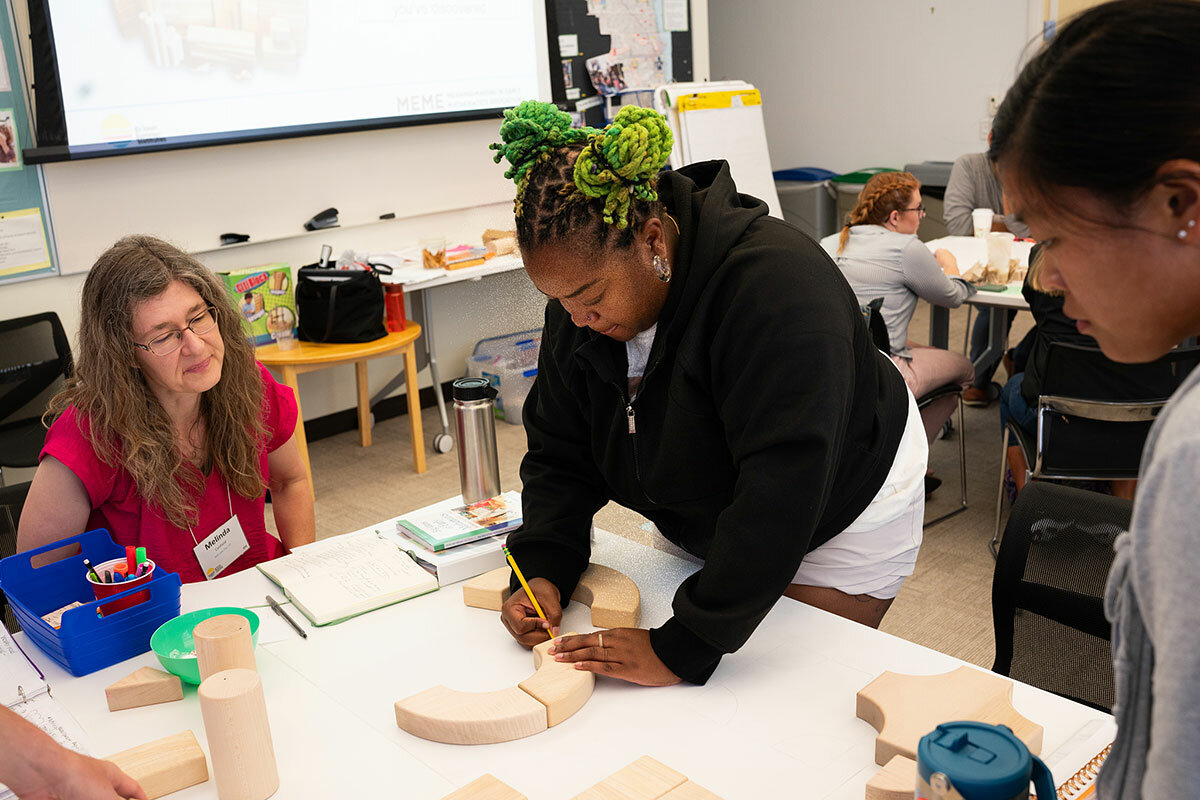
Photo: Camilla Forte/The Hechinger Report via CSM.
Ivory McCormick (center) attends a math conference July 12, 2023, in Chicago. The Atlanta teacher says her school’s math specialist helped change the way she feels about teaching the subject.

I can identify with the teachers in this story who have a math phobia. I had to teach all subjects to 10-year-olds for a couple years and was relieved that my school offered a math consultant. I had never trusted my math — although that had a lot to do with parental perceptions.

Ariel Gilreath, of the Hechinger Report, researched an interesting program designed to help teachers of young students gain confidence in the critical foundations of math. The story is shared at the Christian Science Monitor.

“In July, in a packed classroom in downtown Chicago, a group composed mostly of early elementary teachers and child care workers read a story about ‘Wendi,’ a fictional preschool teacher who loves reading but struggles in math. 

“Even though Wendi was drawn to early education where ‘math was so easy,’ she still felt unsure of her skills. In the story, she decided to skip math concepts, leaving them for the teachers her students would have next year. 

“Across the room, people nodded their heads as they listened.

“ ‘I am Wendi. Wendi is me,’ said Ivory McCormick, a kindergarten teacher from Atlanta. Several educators in the classroom identified with Wendi, and that was the point. Decades of research shows that math anxiety is a common problem for adults, and surveys show it particularly affects women, who make up nearly 90% of elementary teachers in the United States.

“Put simply, a lot of elementary school educators hate the prospect of teaching math, even when the math concepts are beginner level. 

“Researchers at the Erikson Institute, a child development-focused graduate school in Chicago, started the Early Math Collaborative 16 years ago to provide educators with research-backed professional development to help them better teach young students math. One of the goals of Erikson’s annual four-day summer math conference, where the teachers read Wendi’s story, is to assuage their anxiety by exploring how young children learn math and strategizing activities they can do in the classroom. 

“Because math competencies build on each other, with skills like counting and learning shapes forming the basis of later knowledge, it’s critical that students receive a solid foundation in the subject, education experts say. The U.S. has long trailed many other developed countries in terms of student math performance, and then scores tanked during the pandemic. …

“ ‘If you look at how a child is doing with math when they enter kindergarten, that’s the best way to predict how they’re going to be doing with math later, all the way up through eighth grade,’ says Jennifer McCray, an associate research professor at Erikson. …

“When Ms. McCormick started teaching preschool five years ago, she felt anxious about teaching a subject she didn’t feel confident in. ‘Math was something I always had to work really hard at, and it seemed like I never really got that much better at it,’ she says. 

“Teachers who doubt their math ability often worry they will transfer their math aversion onto impressionable students, educators say. There are studies that validate this fear: First grade students who were taught by teachers with heightened anxiety about math performed worse in the subject than their peers who were taught by less anxious teachers, one study from 2020 found.  

“Math specialists say it is a pervasive issue in elementary classrooms, where educators are typically expected to teach every subject, and it often leads to teachers spending less classroom time on math content. …

“At the Erikson Institute’s summer conference, teachers gained practice on concepts they’d use in their classrooms. They drew maps to describe directions: Rosie the hen traveled over the fence, and under the tree branch, and through the river, for example. They built large 10-sided shapes out of colorful blocks. The exercises benefited their own math skills, too. 

“ ‘There’s a misbelief that in order to teach early childhood math, you don’t really need to know math well,’ Lauren Solarski, a consultant and coach with the Early Math Collaborative at Erikson, told the group of educators. ‘But having that deep content knowledge, research finds, makes you then able to draw out what’s happening in a child’s play around math – what they’re doing – and know those trajectories, know the math inside and out so that you can be that expert when you’re with the child.’

“That doesn’t necessarily mean early childhood teachers need to be experts in advanced geometry or algebra, says Lisa Ginet, director of program design and operations at Erikson. But it does mean they need to know how different lessons that may not seem to be related to math are connected to mathematical thinking and to topics students will learn as they get older. …

“For Ms. McCormick, the early ed teacher from Atlanta, attending Erikson’s professional development conference was the next step in her journey to building up her math confidence. This year, Ms. McCormick moved up to teaching first grade at the Galloway School in Atlanta after teaching preschool and kindergarten classes at the school for several years. She credits her school’s decision to hire a math specialist last year with helping change the way she feels about teaching the subject. …

“ ‘This past year, I have kind of revamped my thoughts about what math can be and the ways that we teach it in order to make kids want to learn about it and be enthusiastic about it. Because the way we present it to them holds so much more weight than I think I ever realized.’ ”

More at the Monitor, here. No paywall, but your subscription will support good journalism.

Photo: Maria Lupan via Unsplash.

At one of Suzanne’s first adult jobs she got to name some product colors. We always thought that sounded like fun. We still remember a pink color she named Flirt.

Heather Schwedel at Slate recently edited a submission by the woman behind some wild nail polish names: Amy Fisher at Butter London, which carries polishes called Yummy Mummy , Molly Coddled, Waterloo Blue, to name a few.

“My name is Amy Fisher, and I’m the senior brand and marketing manager for Butter London. I’ve been with the brand for about three years now. I do everything from naming our nail polishes and other products to creating them. I also help with some of our sales and retail. But everyone is always curious about the naming part.

“When we’re coming up with a new product — I’ll use our nail lacquers as an example — we usually start with a color. We’ll take a look at our full assortment: What do we think is missing and what is the white space in that category? Each season, we physically take our nail lacquers and our product and lay them out in front of us and see what colors are missing. We like to keep a very unique and curated assortment. So sometimes if we’re going to launch a new shade, that means we have to discontinue another one.

“Once we review that, we also look at trend data. What’s the trend right now? What’s the trend going to be in a year from now when we’re launching this? We’ll also look at past sales data. If we had a shade a couple seasons ago: How did that perform? Do we want to bring that shade back or a similar color? And we look at feedback from our customers. We get a lot of inquiries from customers about old shades that they want us to bring back.

“The naming really comes along once we have those shades or colors, whatever the product might be. Typically we come up with the name once we have the final-final shade. …

“We typically have a theme or general story that we want to tell with the shades, so we’ll do a small brainstorm with our copywriter. We’ll take that theme and then bounce ideas off of each other. It might take three to five days before we’re ready to come back to the table with some ideas. But it doesn’t really take that long to come up with a name, honestly. Sometimes it’s a brainstorm meeting. Sometimes it’s an email chain. …

“I, along with Julie Campbell, who’s the general manager of the brand, will choose the final name that we would like to proceed with and then our copywriter takes it to our regulatory team. The regulatory team makes sure that we can use the name from a legal standpoint. Sometimes there are trademarks and things of that nature that we need to be careful of. If we have to go back to the drawing board we do so, but usually for shade names, it’s pretty seamless.

“The brand was founded in 2005 in London. It was acquired by an American company a few years ago, but we really do want to stay true to those British roots and keep things cheeky and fun and really British-inspired. In my opinion, an example of a perfectly named Butter London product is All Hail the Queen, which is one of our hero nail lacquers. I absolutely love that name. It’s British, the color is beautiful — it’s like a shimmery taupe. Some other names include Cotswold Cottage — that one’s also a taupe—and Bang On!, a deep teal.

“We’ll sometimes utilize British dictionaries, and we do lots of Googling since everyone is actually American. … And then we also have a team that helps with our search engine optimization keywords. Sometimes they’ll come to the table with words that we can incorporate for a more 360-marketing approach when people are searching for different nail lacquers online. …

“I can point to our Fall 2021 holiday collection. I helped with two names in particular. One was Tickety Boo, and it was a very fun, shimmery pink overcoat. And then Proper Do was another one. That was a really beautiful, deep purple.

“I’m still developing a sense of what words sound like what color. One of our shades that we launched this past spring was called Bespoke Lace, and lace is obviously very indicative of white. That was this beautiful white sort of matte glitter overcoat. It kind of looks like lace when you apply it. But sometimes the names have absolutely nothing to do with the shade. With Tickety Boo, which means something like ‘in a jiffy,’ it’s just such a fun saying that it seemed to go well with the fun glittery overcoat. But Proper Do, which is slang for a fancy social event, that doesn’t really scream purple.

“At any rate, you just want to be fun, whimsical, and British. You really have to nail that. Sometimes a darker shade is a little bit more serious. Something like that can be a little bit harder than maybe a glitter or something like that. …

“Naming is definitely one of the more fun things I get to do, I would say, because I get to be creative. But I know there are probably people who think I sit around all day naming nail polish. Even my mom, sometimes she’ll be like, ‘What do you do again?’ It’s way more than just coming up with fun names. You know, there’s the research, there’s the retail side of it that I have to do. I think maybe people would be surprised by the amount of research that we have to do and staying on top of the trends. … But at the end of the day, it is fun. I can’t lie — it is fun.”

Can’t help thinking all this is going to be done better by ChatGPT, especially since Tickety Boo does not mean “in a jiffy.” What do you think?

More at Slate, here. No firewall.

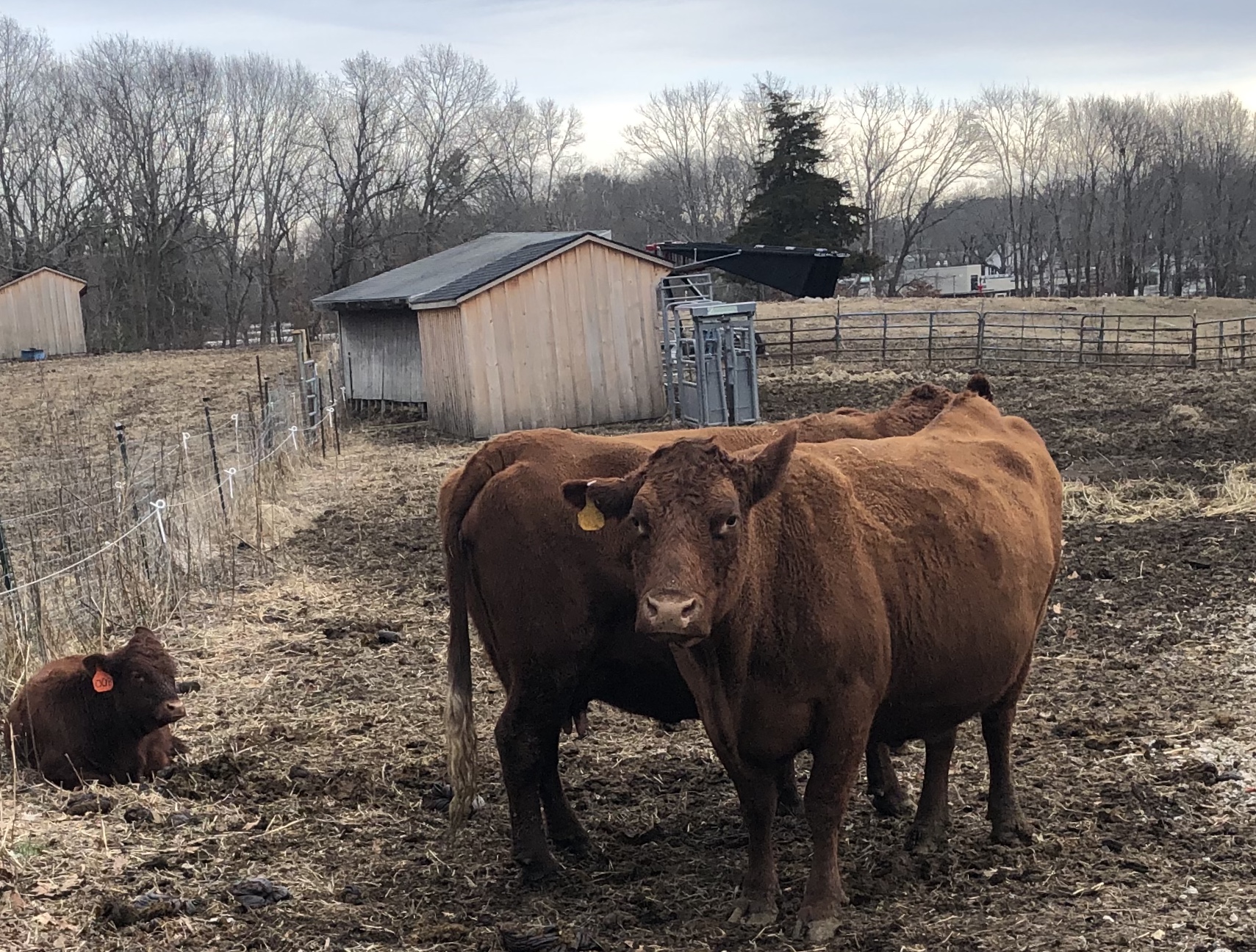
Photo: Suzanne and John’s Mom.
Cattle at Codman Farms, Lincoln, Mass. “Cows are often described as climate change criminals,” says Grist, “because of how much planet-warming methane they burp.” But, Grist adds, raising ruminants can also lead to deforestation, making alternatives to meat doubly important.

The other day at dinner, my husband regaled Sally and me with the latest on Europe’s use of mealworms as alternative proteins. The idea of eating mealworms — straight, no chaser — was not appealing to me even though I know they often sneak into the packaged nut and grain products we buy at the store. Which is why I freeze those products for 24 hours. I suppose I eat frozen mealworms that way, but it’s inevitable.

Grist magazine reported recently on the damage that livestock agribusinesses do to the planet when they cut down trees to graze more animals.

Max Graham says, “To feed the world’s growing appetite for meat, corporations and ranchers are chopping down more forests and trampling more carbon-sequestering grasslands to make room for pastures and fields of hay. … The greenhouse gases unleashed by this deforestation and land degradation mean food systems account for one-third of the world’s human-generated climate pollution.”

At Nature magazine I learned that alternative proteins are gaining traction in France, of all unlikely places. The focus is not on eating insects straight.

Rachael Pells writes at Nature about “the world’s largest vertical insect farm — home to at least 3 trillion mealworm beetles (Tenebrio molitor). The company’s chief executive and co-founder, Antoine Hubert, says that the beetles have a good life, as far as being an insect goes. Each of their stacked plastic trays is kept at an optimal 60% humidity and a balmy 25–27 °C. Nutrition, growth and moisture levels are all recorded for analysis, and human visitors are allowed to inspect the trays only from a distance — to prevent contamination of this prized ecosystem.

“The beetles are raised in this way from larvae to adult, at which point they meet a quick death in steam before being harvested into oil, protein and fertilizer.

“Insects have come under the spotlight over the past few years, as scientists seek alternative sources of protein to feed the rapidly expanding global population. A direct nutritional comparison shows that edible insect species have greater protein potential than do conventional meat products — 100 grams of mealworm larvae produces 25 g of protein, whereas 100 g of beef contains 20 g of protein. Insects also have a high food-conversion ratio when compared with livestock.

“To produce the same amount of protein, for example, crickets require around six times less feed than do cattle, four times less than sheep, and half that of pigs and chickens. But various attempts by companies to market insects as a mainstream food source in Europe and North America have fallen flat and largely been dismissed as a fad. And some researchers have concerns about the effects on the environment, ranging from whether escaped insects might disrupt local ecosystems to the impact of insect ‘factories.’ So why farm insects at all?

” ‘The world is facing a huge food sustainability crisis,’ explains Huber, an environmental engineer. ‘Insect protein is one very realistic and obvious solution to mitigating some of those challenges,’ he says.

“With the global population expected to reach almost 10 billion by 2050, United Nations forecasters have warned that food production will also need to increase by as much as 70%.

“However, because mealworm burgers are, at the moment, unlikely to sell out in your local supermarket, Ÿnsect grows insects for animal feed. This is given to fish, pigs and poultry, taking the pressure off conventional agricultural land use.

“The use of vertical farming has grown rapidly over the past few years, spurred on, in part, by advances in LED lighting, the cost of which fell by 94% between 2008 and 2015. Several start-ups (including Infarm in Berlin and Aerofarms in Newark, New Jersey) use the system to produce vegetables such as lettuce for human consumption. And the global market of the vertical-farming industry is expected to grow from US$3.7 billion in 2021 to $10.5 billion in 2026.

“Meanwhile, sales of plant-based alternatives to meat that are designed to reduce the demand for cattle farming — an industry responsible for 65% of all livestock emissions — seem to be stalling. When meat-substitute company Beyond Meat in El Segundo, California, went public on the stock market in 2019, its share price rose by 163%. But after the initial excitement, sales slowed, and they have remained about the same since 2020.”

As with most innovations, there are caveats. Get the details at Nature, here. And for a report on livestock and deforestation, check out Grist, here. No paywalls for either one.

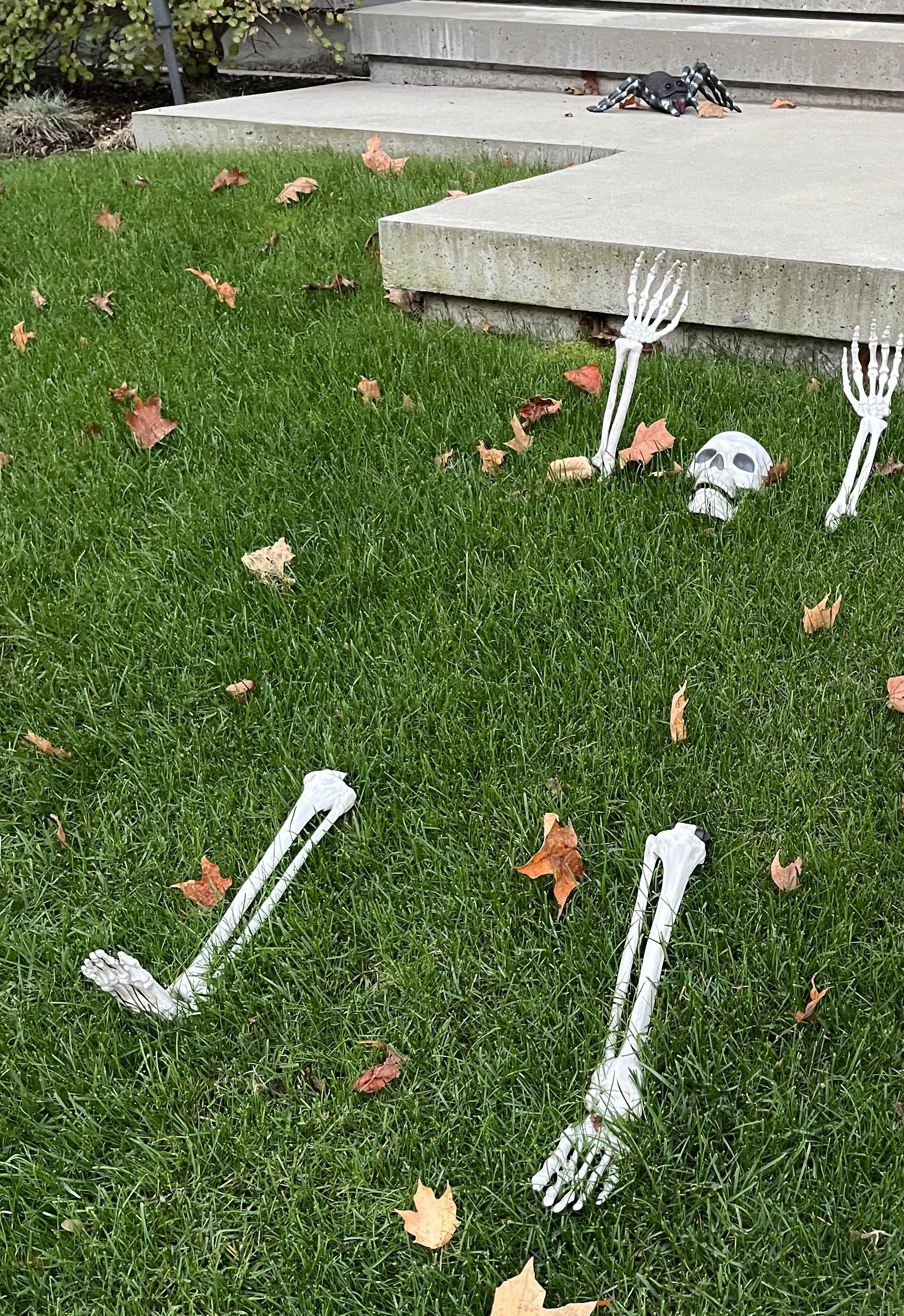
Halloween

Photo: Suzanne and John’s Mom.
Houses in Rhode Island compete for the honors as scariest.

Are you ready for Halloween? Knowing how much Halloween means to children, I wonder if it can still be fun in a retirement community. It’s probably not enough to put on a witch’s hat and call a Reuben a “tongue & cheek sandwich.”

But adults are mostly old children, after all, so here are a few that jump into Halloween with both feet.

There are paddle-boarding witches in Oregon. Portland Living on the Cheap, here, writes about “a convoy of witches on stand-up paddle boards gliding along the Willamette River against the backdrop of Portland’s skyline. …

“If you love paddle boarding and want to join in on the bewitching fun,” adds On the Cheap, “dust off your witch or warlock costume and fly to Willamette Park. Participating is free. … Organizers do ask that all participants are experienced paddled boarders, wear a [personal flotation device] and leash, and have a whistle and waterway permit.”

Not to be outdone, New York City has a Halloween dog parade for all ages. Elaine Velie at Hyperallergic, here, says, “Each year, thousands of New York City dog lovers gather at Tompkins Square Park in Manhattan’s East Village for the Halloween Dog Parade. Proud paw-rents and non-pet owners alike line up to admire the creativity of their fellow New Yorkers and see some of the cutest pups in all five boroughs.

“The 33rd edition of the beloved event was briefly postponed earlier this year after planning it proved a bureaucratic nightmare of never-ending permits and exorbitant fees.

“Thankfully, the parade was saved after City Councilwoman Carlina Rivera brought the issue to the mayor’s office, which reduced the permit fees, and dog food company Get Joy agreed to sponsor it. The festival returned to ‘by far the biggest’ crowd in history, according to Tompkins Square Dog Run ‘head pooper scooper’ Joseph Borduin, who fields press emails.

“This was the first time the parade took place on the street, and around 600 pawed participants strolled down Avenue B for a few blocks before turning into the park.” Check out some delightful pictures at Hyperallergic. No firewall.

Also at Hyperallergic, here, there’s a story from England, where a giant pumpkin mosaic has set a world record. That is to say, it’s a mosaic made with pumpkins (and other gourds), not a mosaic of a pumpkin.

Maya Pontone reports, “A new Guinness World Record for the largest mosaic made of gourds was set last Wednesday, October 18, by a family-run farm in the British city of Southhampton. In a massive horticultural display honoring Tim Burton’s 1993 film The Nightmare Before Christmas, the record-squashing artwork features over 10,000 multicolored pumpkins and gourds laid across more than 2,000 square feet.”

I’d love to hear about pumpkin and Halloween nuttiness involving adults that you know, or know about.

First photo below: Suzanne and John’s Mom.
Second photo: Elaine Velie,
Hyperallergic.
Third photo: Guinness World Records
.

Photo: Fernando Cortes via Inside Higher Ed.

Unless people are committed to the “ain’t it awful?” worldview, they probably respond in more positive ways to pitches about hopeful progress than pitches describing how dire everything is.

In an opinion piece at Inside Higher Ed, Stephen Porder agrees, noting that climate-change education is more likely to be effective when students learn that there is hope.

Porder writes, “The first year I taught Introduction to Environmental Science was 2007, the year after the release of An Inconvenient Truth. The class was full of eager students, most of whom would have described themselves as environmentalists. … I was there to teach them the science — basically how to use hypothesis testing, data and analysis to convince them the world is going to hell. They didn’t need much convincing.

“The endless description of problems, with little emphasis on solutions, is a hallmark of almost all environmental science and studies textbooks. After 20-plus years teaching in this field, I’ve come to think that our relentless focusing on the negative is, at best, missing an opportunity. … My more recent experiences teaching about solutions, rather than problems, suggests that a healthy dose of positivity even in the face of profound environmental challenges will reach a broader audience, gain more traction and diversify the people working on the admittedly wicked environmental challenges of the 21st century.

“Back in 2007, I walked into the classroom, fresh out of my Ph.D. and postdoc, eager to share the wonders of environmental science. I marveled at the data from the group run by Charles Keeling, who measured rising carbon dioxide in the atmosphere at the observatory on Mauna Loa in Hawai‘i. … I dove into the details of carbon isotopes to demonstrate just how we knew that the rise in carbon dioxide was a result of fossil fuel combustion, as opposed to natural sources. The course was definitely a science course —but looking back I realize each bit of data and analysis was perfused with pessimism. …

“Still, my course evaluations were good. … These good evaluations came from students who were mostly self-selected environmentalists — passionate about ‘saving the planet.’ They were bright, motivated and talented. … Other equally bright, motivated and talented students didn’t take the course. I wondered why.

“Having talked to many such students since, I’ve learned many felt a bit excluded. The environment was a worry for them, as it is for most of us, but it wasn’t their primary worry. They also felt like environmental studies or sciences was not a place where they could explore solutions. They felt that there was a relentless focus on what was wrong, rather than how to put it right. Finally, they felt like the problems we were describing were going to be fixed by people beyond the environmental field.

“I’ve come to agree with them. I, at least, was not doing enough to train problem-solvers. I’d been training people to cleverly document problems. I don’t think I’m the only one in the field who’s fallen into that trap. …

“I handed off Introduction to Environmental Science to a younger professor a few years ago, and from here on out I’m focusing on solutions, not problems. Climate solutions. Agricultural solutions. Deforestation solutions. They exist. They are not perfect and involve hard trade-offs. But their existence should be front and center in our teaching.

“Just putting ‘Climate Solutions’ in a course name dramatically changed my student enrollment. Surprisingly, very few environmental studies and sciences students signed up. Instead, students majoring in economics, political science, engineering, applied math and a variety of humanities fields appeared in my classroom. … Like all my students, they were united by their climate anxiety. But they came for, and responded to, the idea of solutions.

“This eclectic group brought a wealth of different interests, skills and weaknesses to the class and was eager to learn from each other about different approaches to overcoming the 21st century’s biggest environmental (I would argue societal) challenge. They were thrilled at the opportunity to contribute to a better future, even if the environment was not their top priority (for some it became a top priority when they learned there were things they could actually do to make a difference). Many had felt unwelcome in environmental studies/sciences, which often demands a political and philosophical homogeneity of its participants.

“As an example of this, a senior applied math major told me he had been searching for a field where his math could have impact. He had never taken an environmental class before (despite plenty of environmental angst) in part because he didn’t feel welcome or like he fit in with environmentalists. He now works doing data analytics for a solar power company. …

“Solutions are picking up speed. Technological advances in transportation (electric vehicles), space heating (heat pumps) and electricity production (renewables) have made extraordinary leaps since I started teaching. Given that transportation, space heating and electricity generation make up more than 70 percent of all fossil fuel emissions, this is huge news! We should be teaching about it at every level and helping our students gain the skills to push these revolutions forward as engineers, community organizers, investors and so on.

“Already these advances have cooled our future. A decade ago, we were headed for four to five degrees Celsius warming by century’s end. Now three degrees Celsius is more likely. Anyone who studies climate knows that’s still way too much warming to be safe, but it’s also a huge step in the right direction. You may not hear that in most environmental science classes, or in the news, but you should. Even better news is that most of what precludes keeping that number to two degrees Celsius is political, not technological. That wasn’t true when I started teaching, so we need to update our curricula to reflect this remarkable progress.

“I don’t mean to be overly optimistic. The challenges to a stable climate future are enormous. … But by relentlessly beating a drum of negativity in the absence of hope, we’re driving away brilliant young minds that could help make the world a better place.”

More at Inside Higher Ed, here. No paywall.

Photo: Diane Walker via Exeter Cathedral and Hyperallergic.
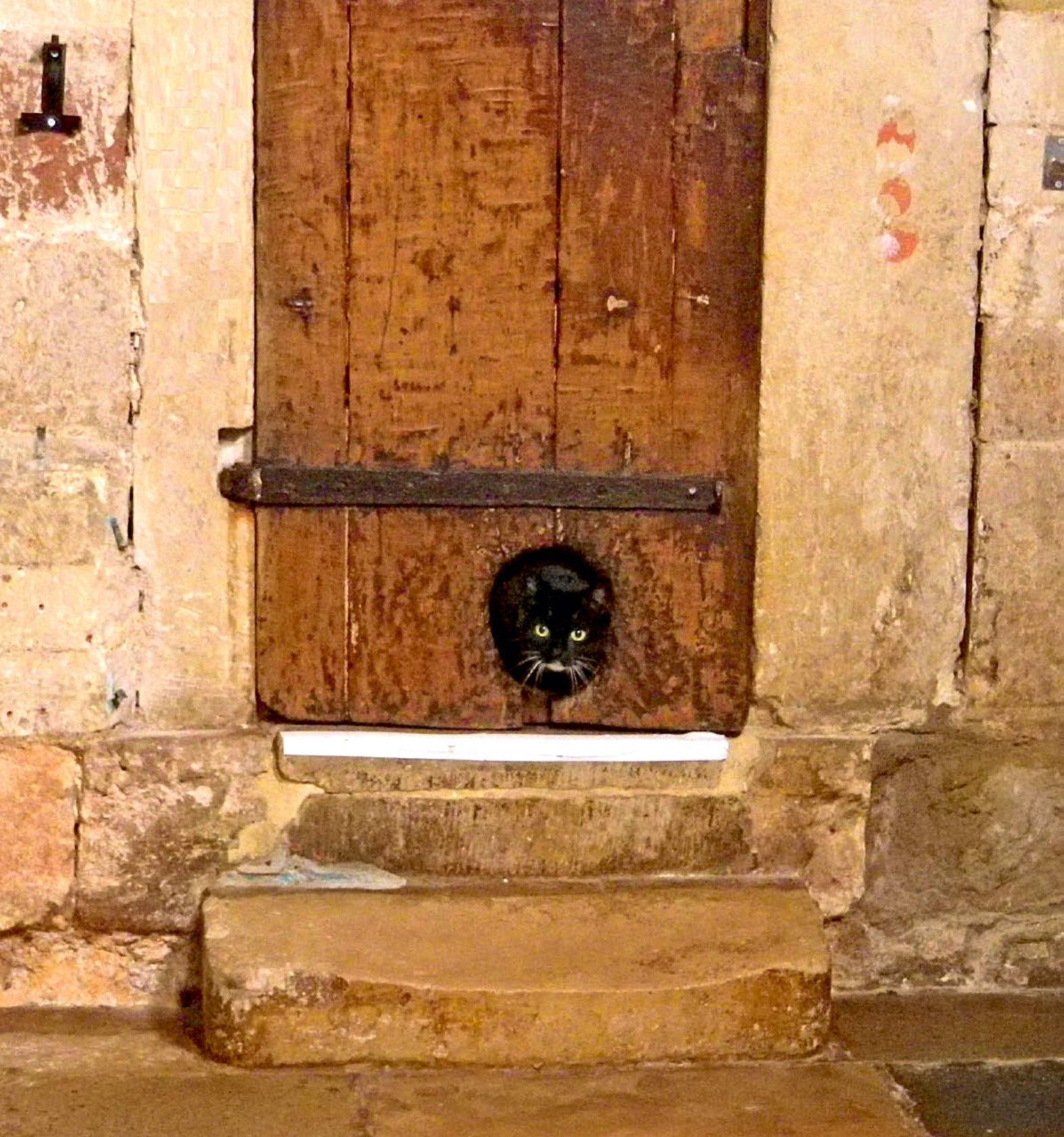
The 400-year-old door hole in the Exeter Cathedral in Devon County, UK.

Are you ready for a silly post? It’s silly, but it has a serious side. Especially for cat owners. Rhea Nayaar introduces the topic at Hyperallergic.

“There are a few rumors floating around about the invention of the handy cat door through which our beloved friends pass in and out as they please, but how far back does it go, really? Apparently for centuries, as the Exeter Cathedral in Devon county, England, is gaining attention for a 16th-century circular door hole for the resident pest control cat.

A circular hole was cut into the bottom right side of the painted panel for pest control cats to keep mice from the sacristy, and thus, the painting was dubbed ‘Madonna della Gattaiola‘ (c. 1458), or ‘The Virgin of the Cat Flap.’

“Historian and author Diane Walker told Hyperallergic that cathedral records indicated that the door in question was installed in 1376, when the space behind it was renovated and outfitted for a large astronomical clock. The clock’s mechanics were lubricated with animal fat which attracted mice down the line, and by 1598, per the records, then-Bishop of Exeter William Cotton had paid carpenters to make a hole in the door so his mouser cat could take care of the problem.

“ ‘The idea that the hole was cut to enable the bishop’s cat to catch mice in the space where the clock mechanism was located does lead to a re-think of the “Hickory, Dickory, Dock, the mouse ran up the clock” nursery rhyme,’ Walker told Hyperallergic

“ ‘The story is normally illustrated with a picture of a mouse running up the outside of a long-case clock,’ Walker continued. ‘But it makes much more sense that the idea of a mouse running up a clock would be associated with an ancient clock mechanism, such as that at Exeter Cathedral, where the original mechanisms included weightlines making an easy climb for a mouse attracted to the lubricating tallow.’

“The best part of it all is that the cathedral actually had cats on the payroll throughout the 14th and 15th centuries — 13 pence a quarter, according to written records. It’s unclear how the cats received their wages. …

“Cuteness aside, even Walker admits that while this is a very old cat door, it’s unlikely to have been the first. The 14th-century church of San Giorgio in Montemerano, Italy, has its own cat hole cut into a painted door that’s now preserved and on display. A 15th-century painting on panel of the Virgin Mary by an anonymous local painter who went by the nickname ‘Master of Montemerano’ was reportedly adapted into a door at the church. A circular hole was cut into the bottom right side of the painted panel for pest control cats to keep mice from the sacristy, and thus, the painting was dubbed ‘Madonna della Gattaiola‘ (c. 1458), or ‘The Virgin of the Cat Flap.’

“But humans have relied on cats for pest control long before the 15th century. Ancient Egyptians were known for pedestalizing cats and honoring deities with cat-like features. One would think that cat doors would have been folded into Ancient Egyptian architecture and design considering the cultural reverence for felines, but two Egyptologists confirmed with Hyperallergic that they haven’t come across any such invention in their research.

“Cairo-based professor, archaeologist, and archaeozoology expert Salima Ikram said that while cats were ‘definitely used for pest control,’ the geography and climate of Northeast Africa meant that homes and buildings were more open-air so doors weren’t used often. And University of California, Los Angeles professor and architectural Egyptologist Willeke Wendrich told Hyperallergic that field researchers ‘hardly have any actual doors that have survived from antiquity.’ “

More at Hyperallergic, here.

Are you a cat person and do you have a cat door? I like cats myself and am all for indoor pest control. But I worry a lot about cats killing birds outdoors.

Did you know this? “Predation by domestic cats is the number-one direct, human-caused threat to birds in the United States and Canada. In the United States alone, outdoor cats kill approximately 2.4 billion birds every year. Although this number may seem unbelievable, it represents the combined impact of tens of millions of outdoor cats. Each outdoor cat plays a part.”

So says American Bird Conservancy, here. So if you have a cat door like the one at the Exeter Cathedral, think twice about using it.

Photo: The Nicholson Project.
The Uptown Singerz are a DC-based intertribal Native American Northern powwow drum group that performs powwow, ceremonial, and in some cases political songs.

We are all enriched when previously below-the-radar groups begin to share their culture more widely. The featured article for today is from the Washington Post and highlights a cultural collaboration by members of several indigenous tribes.

Dana Hedgpeth writes, “When Nick Courtney came to D.C. seven years ago to work on education issues, he missed his Native American tribe in Washington state.

“Longing to connect with other Native Americans in the region, the 31-year-old member of the Makah Tribe helped form the Uptown Singerz, a Native American drum group that shares and celebrates their heritage.

“ ‘D.C. is a transient city because folks come and go, so that can be hard,’ said Courtney, who lives in Baltimore. ‘I still long for my own culture, but this fills my cup. It’s a bond, and I’m a part of something that’s allowed me to build a community here. It’s like a family for me.’

“In the United States, roughly 9.7 million people — or about 3 percent — of the overall population — identified themselves as being American Indian or Alaska Native in the 2020 Census. Fewer than 1 percent of people in the District, Maryland and Virginia said they are American Indian or Alaska Native.

“There are more than 500 federally recognized tribes in the country, and more than 70 percent of American Indians live away from their tribal reservations or communities.

“Being a part of Uptown Singerz gives members who are far from their tribes’ home ‘a renewed sense of community and family every time we sing, every time we drum,’ said Mary Phillips, the group’s lady backup singer (as the role is officially called by Native Americans), who is from the Omaha Tribe in Nebraska and the Laguna Pueblo Tribe in New Mexico. …

“The Uptown Singerz … practice several times a month and perform up to 20 events a year in theaters, rallies, community events and Native American gatherings and powwows in the D.C. region to showcase their talents and educate the public. They, along with the Zotigh Singers — who are from the Kiowa Tribe of Oklahoma and live in Waldorf, Md. — are one of the few American Indian drum groups in the D.C. region.

“ ‘Having the Uptown Singerz is so important because they help keep our culture alive here in D.C.,’ said Angela Gladue, 38, who is a powwow and hoop dancer. A Cree and a member of the Frog Lake First Nation in Alberta, Canada, Gladue moved to Northeast Washington six years ago and got to know other American Indians in the area, along with the drum groups. …

“The Uptown Singerz typically play around one large drum made from wood and dried animal hide. Sometimes they play smaller hand drums. Considered sacred and often used at events and some ceremonies, the drum for many American Indians represents the heartbeat of Mother Earth.

“They follow the Native American tradition of having only men sit around the drum. Women stand behind them and join in the singing because ‘women carry the sacred water of life,’ empowering them to ‘absorb or change the energy of the people around them or the energy of the drum,’ Phillips said. …

“For Gladue, hearing the drum and seeing American Indians from different tribes gather and dance was a special moment. … ‘People will ask, “Indians are still here?” To be around other Natives and not have to explain myself makes me feel good.’ “

More at the Post, here.

Seed Art at State Fair

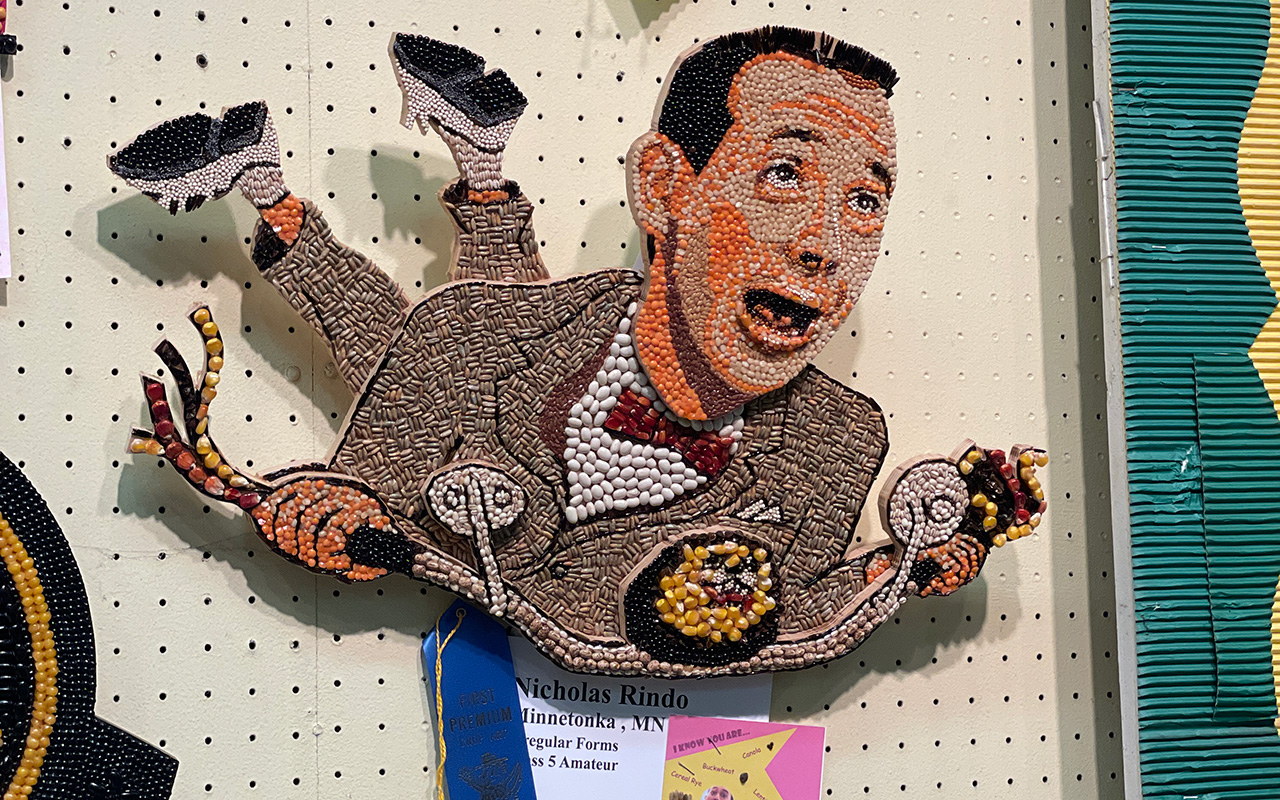
Photo: Isabella Segalovich/Hyperallergic.
Nicholas Rindo’s “I know you are…” (2023), is made from cereal rye, buckwheat, flax, pearled barley, poppy, quinoa, rainbow flint corn, sweet lupine, red millet, viking corn, wild rice, navy beans, lentils.

What is your favorite exhibit at state fairs? One of mine is seed art. It looks like it would be fun to try.

Isabella Segalovich of the art magazine Hyperallergic went to the Minnesota State Fair and has this report on the seed art of 2023.

“The longest line at the second biggest state fair in the United States wasn’t for the prize cows, roller coaster rides, or various deep-fried foods served on a stick: It was for the seed art. 

“The wait was worth it. Past scores of vintage seed sacks and neatly stacked corn cobs vying for Best of Show ribbons, visitors craned their necks to marvel at the bounty of intricate mosaics made completely out of seeds at the Minnesota State Fair, which ran from August 24 to September 4. While the vast majority of participating crop artists were Minnesotans, the country’s only state fair seed art competition has also graciously expanded its dozens of categories to include out-of-state competitors, as long as they stick to one rule:

Every seed must be grown in Minnesota. 

“I was struck not just by this craft’s painstaking nature but also by the diversity of its subject matter, which ranges from impressive portraits and still lifes to timely pop culture references and biting political commentary. This year’s show included tributes to lost luminaries (Judy Heumann, Paul Reubens aka Pee Wee Herman), hot pink Barbie memorabilia, OceanGate (‘the little sub that couldn’t’), excitement over Minnesota’s marijuana legalization, displays of support for trans youth and adults, clap backs to Ron DeSantis (‘Minnesota, where woke goes to bloom!’), and lots and lots of yacht-smashing orcas. 

“This year there were over 400 submissions of crop art, which covered both seed art and the adjacent (also delightful) scarecrow competition.

“ ‘It has grown tremendously from the very beginning,’ said Ron Kelsey, superintendent of farm crops at the fair, who was 24 when seed art first bloomed in 1965. …

“During those first years, most artists arranged seeds into natural scenes, like flowers and landscapes, until hairstylist Lillian Colton changed the game by introducing seed art portraiture. Her hyperrealistic mosaics of figures like Abraham Lincoln, Ernest Hemingway, and Barbra Streisand raised the bar for crop artists at the fair. 

“Today, artist Liz Schreiber sits where Colton once did at the demonstration table, meticulously placing tiny quinoa and flax seeds to create a bullfrog. Schreiber is the artist behind this year’s commemorative fair poster, an incredibly detailed and boldly designed amalgamation of iconography that Minnesota fairgoers hold dear. ‘It’s very meditative,’ Schreiber told MPR News. ‘It’s kind of like doing a puzzle.’ 

“ ‘A crop art picture can take dozens and, in many cases, hundreds of hours to complete,’ said Joel Alter, a former political researcher and seed art newcomer who won a second premium ribbon this year. Many find that time passes quickly, as they enjoy the thrilling and addictive process. ‘Some people get started with it and they can’t stop,’ ” said Kelsey.”

More at Hyperallergic, here. There’s no paywall but subscriptions are encouraged.

Affordable Music Studio

Photo: Melanie Stetson Freeman/CSM Staff.
Kyle Johnson (left) and Jonathan Hua-Phan create beats in a studio Aug. 24, 2023. Musicians can rent studio space for as little as $10 an hour – as opposed to the $100 an hour average rate in Boston.

Music belongs to everyone, but sometimes making music is expensive, especially if you need a soundproof studio with electronic bells and whistles. Fortunately, there are options.

Alessandro Clemente writes at the Christian Science Monitor, “Sanyé Mylo’s eyes twinkle with excitement. He is standing in the sound booth of The Record Co. in Boston, eager to bring his creation to life.

“ ‘This place is a musical creative sandbox,’ he says. With the press of a button, his latest rap track fills the room. As the speakers blast Mr. Mylo’s beat-pulsing rhythms, it’s hard to resist the urge to dance. ‘I didn’t know spaces like this existed,’ says Mr. Mylo, who grew up in the low-income neighborhood of Dorchester. ‘It’s the community. It’s the mission. It’s the energy. It’s more than just the environment.’

“Mr. Mylo is one of the young musicians in Boston who, thanks to The Record Co., has turned his music into a full-time occupation. The sound studio, located amid a graying backdrop of warehouses on Massachusetts Avenue, is an unexpected island of creativity and hope.

“Founded in 2010 by Matt McArthur, The Record Co. aims to give musicians more affordable access to creative workspaces and introduce the world of music to those who may have never considered their place in it.

“Mr. McArthur understands this challenge firsthand. As a music technology student at Berklee College of Music, he was frustrated by the high costs of renting time in production studios. …

“On average, a recording studio in Boston costs more than $100 per hour to rent. Mr. McArthur’s vision flipped that model on its head. He saw a recording studio not as a sanctuary for wealthy people but as a community hub available to all.

“He took out loans, collected donations, and opened a studio in a tiny basement in Cambridge, Massachusetts. Slowly but steadily, Mr. McArthur expanded it and eventually rented a new property to include rehearsal spaces and production suites.

“Today, The Record Co., with a full-time staff of more than 20 people, is a state-of-the-art, 12,000-foot facility that can be rented for as little as $10 per hour. Each month, it receives about 1,000 reservations, and around 3,500 musicians pass through its doors.

‘We don’t care if you’re good or trying to do it for a living,’ says Mr. McArthur. ‘Our philosophy is that every single person deserves to express their musical creativity.’

“At The Record Co., the ethos is clear: Music belongs to everyone, and so does the space to create it. The building has been shaped not only with an ear to acoustics but also with an eye to inclusivity, ensuring it is as welcoming to a musician in a wheelchair as to one who walks in with a guitar slung over their shoulder. …

“Beat the Odds serves low-income communities to help young people channel their energies into creative pursuits, and confront and discuss their mental health challenges. Thanks in part to the music production facility available at The Record Co., the group continues to expand its reach. It recently received a $600,000 grant from Boston Mayor Michelle Wu to finance its after-school programs. …

“Since rental fees don’t fully cover the operational costs, The Record Co. relies on donations. As a graduate of Berklee with her own memories of scraping by as a poor music student in Boston, Rachel Jordan says her investment feels personal. Now head of marketing for a tech startup in California, she says she welcomes the opportunity to help eliminate barriers to producing music, and she is committed to attracting investors to believe in the value of The Record Co.’s mission.

“ ‘There are so many quantitative ways to measure impact,’ says Ms. Jordan, ‘but sometimes the most meaningful way is through one human story at a time. We can talk about the economic impact of a thriving arts community, and that matters. But the artists themselves also tell the story of impact so well.’ …

“The Record Co.’s purpose becomes more meaningful in the context of the neighborhood surrounding it, which struggles with addiction and homelessness.

“In Boston, the stretch where Massachusetts Avenue intersects with Melnea Cass Boulevard is known as Methadone Mile, a reference to the addiction treatment centers that share the same block as the studio. Mr. McArthur, who lives in the neighborhood, acknowledges the challenges facing those with addictions, noting, ‘I’m not delusional to think that somebody is going to kick a chemical habit just because they got in the studio one day.’ Yet he holds that music offers a positive alternative to counter the pull toward destructive behaviors.

“Mr. Mylo can attest to the transformative power of music. He felt the one-size-fits-all educational system stymied his creativity. College seemed more like an insurmountable debt rather than an opportunity to learn and grow.

“A friend introduced him to Beat the Odds and The Record Co. Here he felt that his talent was not only recognized, but also nurtured.. .. Walls, built from years of distrust and self-preservation, began to crumble, recalls Mr. Mylo.  

“Now he works not only as a musician but also as a producer and mentor for new musicians who join Beat the Odds.”

More at the Monitor, here. No paywall.

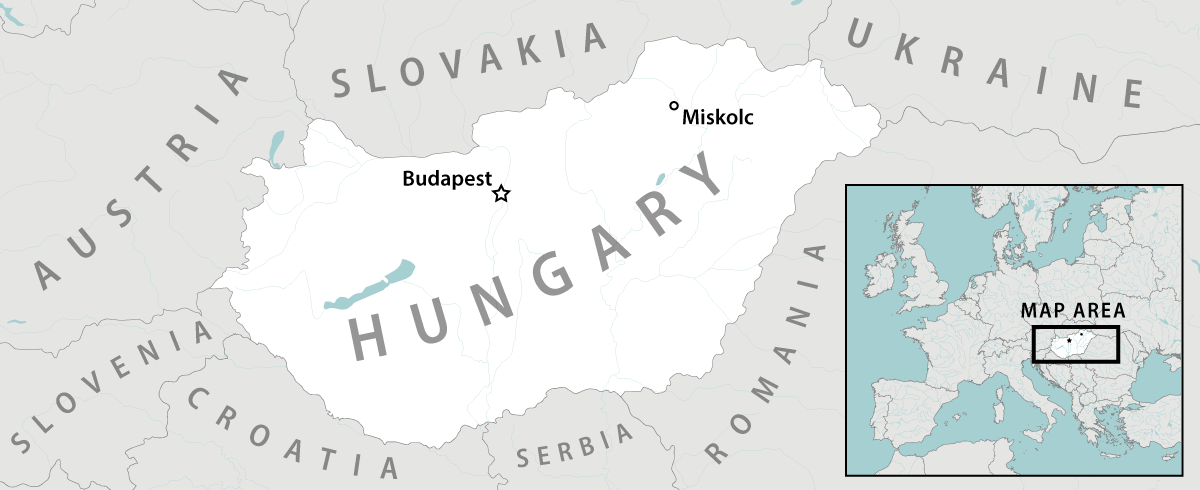
Map: Jacob Turcotte/CSM Staff.
Map showing the location of the Roma school that borrows from Buddhism.

Oppressed people have many things in common even when they live on opposite sides of the world. So the wonder is that they don’t learn from each other more often, as the Roma in today’s article have learned from the “untouchables” of India.

Marc Loustau has the story at the Christian Science Monitor.

In Miskolc, Hungary, “Classes begin with a gong, not a bell, at the Dr. Ambedkar School. Each morning, 125 students in grades nine through 12, all from the local Romani community, enter the school grounds beneath a brass plaque embossed in both Hungarian and Hindi. The text marks the life of the school’s namesake, Bhimrao Ramji Ambedkar, India’s first post-independence minister for law and justice.

“The inscription finishes by invoking the school’s religious mission: ‘[Dr. Ambedkar] is a Buddhist saint,’ it reads.

“Dr. Ambedkar never set foot in Hungary, much less in the provincial northwestern city of Miskolc where the school was established in 2006. But members of Hungary’s Roma community learned about Dr. Ambedkar’s transformative work, in which he helped outlaw India’s caste system last century and improved the lives of his fellow Dalits in India. And they recognized a kindred spirit.

“The Dr. Ambedkar School is working to empower intellectual and political leaders from within Hungary’s Roma community, based on the Indian social reformer’s example. And while his neo-Buddhist worldview may seem like an odd bedfellow for Roma activism, the two are finding remarkable synchronicity among the school’s students.

“ ‘The role of the school is more than that of an educational institution, but rather a community institution that treats students with respect and dignity, providing a sense of hope and respect to Roma who are otherwise treated as outcasts by the mainstream society,’ says Jekatyerina Dunajeva, a political scientist with Central European University’s Romani Studies Program. ‘What permeates the culture of the school is a keen awareness of justice, fairness, and opposition to oppression.’

“Dr. Ambedkar was a leader in India’s independence movement in the 1930s as well as a member of the country’s oppressed Dalit group. In 1956, he founded the neo-Buddhist movement, also known as Ambedkarite Buddhism, which looked at Buddhism as a vehicle for social reform. In particular, neo-Buddhism turned into a means for Dalits – who face rampant discrimination at the bottom of Hinduism’s caste ladder – to leave the system that was oppressing them.

“Romani activist János Orsós learned about neo-Buddhism in the late 1990s by reading a biography of Dr. Ambedkar.

Then in 2005, he traveled to India, from which the Roma ethnic minority originally emigrated nearly 1,000 years ago. There he saw that both members of the Roma community and Indian Dalits struggle with problems like racism, discrimination, and segregation.

“In his memoir about finding Buddhism, Mr. Orsós noted he was most impressed by his visits to Dalit Buddhists’ schools.

“ ‘The Dalit people run these institutions themselves, not white people,’ he wrote, ‘I saw people like me take their destiny into their own hands through Buddhism and that is what I wanted to do.’

“Hungary’s educational system is highly segregated. Many Romani children attend Roma-only schools that are often underfunded and staffed by poorly trained teachers who do not understand Roma’s distinctive culture and history. Today, 60% of Romani children drop out of school, compared with 8.9% of the general population.

“Mr. Orsós believed that his Roma community could be empowered and emboldened by Ambedkarite Buddhism’s basic principles: educate, agitate, organize. So he founded the Dr. Ambedkar School in 2006.

“The school draws its 125 students from Miskolc, which has a population of around 161,000, and its surrounding villages, of which around 58,000 are Romani, according to Hungary’s 2012 census. Teachers prepare students for Hungary’s national graduation exams in areas like mathematics, literature, and history. But students also learn lessons drawn from Dr. Ambedkar’s life of activism.

“ ‘I would call myself an activist, too,’ student János Kun says. Like Dr. Ambedkar, Mr. Kun has grown up in extreme poverty and struggles against racism.

“ ‘There are eight of us in my family,’ the 20-year-old says. ‘Six of us children live in one room.’ His parents have only a sixth grade education, and he will be the first of his family to graduate from high school. He is the eldest child and helps care for his younger siblings in a house without running water.

“Romanis and the Dalits are the same, Mr. Kun says, down to their social status. ‘We are a caste,’ he declares. ‘We are at the very bottom level of society. But I’m not embarrassed to be poor.’ …

“The biggest threat to the school’s future [is the government’s] ‘work-based society’ program. Under this scheme, the government lowered the mandated school attendance age from 18 to 16, and expanded government work programs to provide employment to young people. [Prime Minister Viktor Orbán] has promoted the idea that those who aren’t succeeding in school should be diverted into the workplace where they can practice practical trades.

“But the work-based society program creates problematic incentives for Romani students, who are already struggling against discrimination in hostile school environments, to leave and seek out an easy and immediate paycheck.”

Find out why at the Monitor, here. No paywall.

Photo: Harlem Honeys and Bears.
Formed in 1979, the Harlem Honeys and Bears Swim team teaches seniors ages 64 and over, how to survive in the water, as a therapy for chronic illness, and to promote health and wellness in general.  

Reading today’s story about water ballet in Harlem, I am remembering how much I enjoyed the synchronized swimming class I took a long time ago. I still find the move called skulling useful in the water.

Laure Andrillon reports at the Washington Post about a senior group in Harlem that uses the practice for both socialization and health.

“Monica Hale recently turned 69,” writes Andrillon, “but she says she still feels like a youngster every time she dives, swims upside-down or practices the ‘barrel,’ a sophisticated move she usually attempts with a trusted synchronized swimming partner.

“Hale, who is Black, became fascinated with synchronized swimming as a child while watching the champion swimmer and movie star Esther Williams, a White woman, perform in water musicals on television. ‘She would do these fabulous turns and come up at the surface like a flower,’ Hale recalls. ‘I remember thinking, I want to do this one day. But you never saw Black people doing this. You never saw Black people very much in the water at all.’

Today, Hale is the proud captain of the Harlem Honeys and Bears, a synchronized swimming team for seniors 55 and older, whose current members are between 62 and 101 and almost exclusively Black.

“Like Williams, the Honeys and Bears create and perform what used to be called ‘water ballet’ — synchronized choreographed routines accompanied by music — in addition to competing in traditional swim races. But instead of Hollywood, Harlem is their home, and part of their mission is teaching younger Black swimmers. …

“It is a survival skill still deeply lacking in the African American community. … At their biweekly practices, Hale spends most of her time in the shallow end of the pool, teaching basic skills to recruits, some of whom don’t know how to swim when they join the team. She holds their hands while they submerge their faces in the water and cradles them while they learn to float on their backs. …

“The Honeys and Bears also hold monthly meetings to share ideas about how to spread the message that swimming can be learned by anyone, at any age. They find purpose in trying to bridge the racial gap that makes Black people of their generation less likely to swim than White seniors.

“Team members say synchronized swimming takes care of the body and the mind, and being part of a close-knit team is a way to work out and socialize at the same time. Their impressions are borne out by research, which finds that swimming offers a full-body workout that’s easy on injured or arthritic joints — a common problem for older people. It also de-stresses and burns calories, and it’s good for the heart.

“The Honeys and Bears perform at local pools, in other boroughs of New York and even out of state. Since the early 2000s, they have also traveled as a team to race individually during the state and national Senior Games, always sporting matching red sweatsuits. Some use a cane or a walker to access the pool deck, and sometimes employ a lift to slip into the water. But once they float in what they nickname their ‘fountain of youth,’ they feel more capable than when on land.

“The Honeys and Bears started gathering at the ‘bathhouse,’ an old name for what is now called the Hansborough Recreation Center, in 1979. … It was their way, they say, of reclaiming the swimming pool, a place where many team members did not feel welcome or comfortable for most of their lives.

“Some migrated to Harlem from states where interracial swimming was not allowed until the Civil Rights Act outlawed segregation in public spaces in 1964. Others grew up in New York, where pools were not officially segregated, but ‘a de facto racially segregated use was in place,’ historian Jeff Wiltse writes in Contested Waters: A Social History of Swimming Pools in America.

“ ‘When I was a little girl, my brother and I would go to the pool on colored days,’ explains Rasheedah Ali, 87, a member of the team who lived in Cincinnati before moving to Harlem in 1967. …

” ‘Of course, we need to remember our past,’ she says. ‘But we should also tell the story of whom we became — a bunch of joyful Black elders who thrive in the water.’

“Born and raised in Harlem, Gerterlyn Dozier, 89, remembers swimming in the late 1930s at what was then called Colonial Park on 146th Street, instead of the Thomas Jefferson pool on 111th Street, just a few blocks from her building. ‘If you had dark skin, it was too dangerous for you to wander’ near the closer pool, she says, because of hostile White neighbors. …

” ‘[Today] we make it a party,’ says Dozier with a burst of youthful laughter. ‘Hopefully, our kids will feel like they belong in this space and this sport. And by the time the next generation comes, the statistics will have changed.’ ”

More at the Post, here, and at Columbia Community Service, here.