Feeds:
Posts
Comments

Photo: The Guardian.
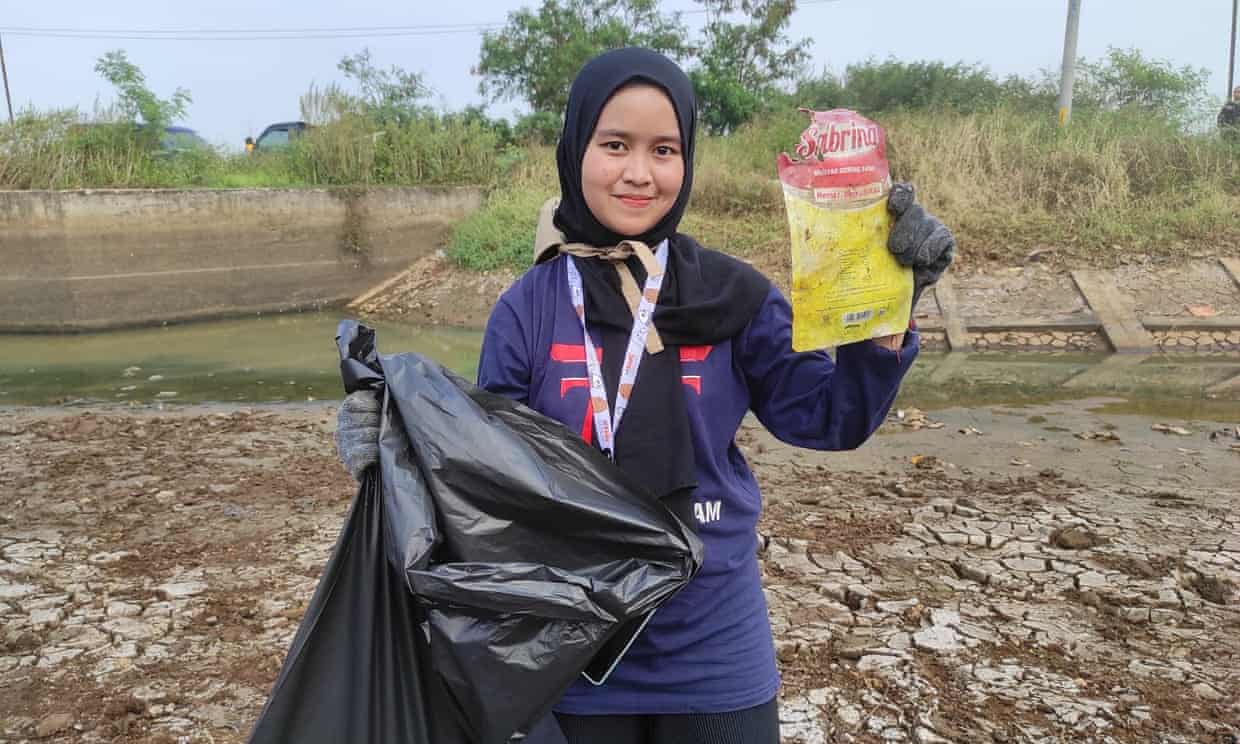
Resti Khairunnisa, 22, is a follower of Pandawara on TikTok. She joins other followers in collecting plastic waste from the Bandung dam in Indonesia. 

The young people will save us all. They certainly shouldn’t have to, but it restores our faith in humanity when we see them taking “arms against a sea of troubles” and not wasting time blaming those of us who deserve blame.

What is the secret of their strength? Perhaps not knowing what’s “impossible” enables people to do it anyway.

Guardian reporter Ardila Syakriah has this story from Indonesia.

“They started as flood victims, now they are touted as local heroes for cleaning up the rivers and beaches of Indonesia’s third largest city, Bandung in West Java, amassing over 9 million followers on TikTok and Instagram in the process and influencing others across the country to join the fight against pollution.

“The Pandawara group is five men in their early twenties and was formed in 2022 after flooding caused by rivers clogged with rubbish damaged their homes. … On TikTok, their profile – @pandawaragroup – contains over 100 short videos of their river and beach clean ups, earning them millions of views and totalling over 100 million likes.

“ ‘We have a team of river hunters who identifies rivers with urgent trash issues, where flooding can happen after rainfall,’ Pandawara member Gilang Rahma told the Guardian.

“The Greater Bandung area where they live produces 2,000 tons of waste each day, 10 to 20% of which doesn’t make it to landfill and often ends up in rivers. The vast mountain of waste produced in the region has exceeded landfill capacity by 800%, according to West Java official Prima Mayaningtyas. …

“Pandawara began modestly in 2022, cleaning up rivers around their neighborhood, protected by rubber hand gloves and boots. As they became full-time online celebrities-slash-activists, they were invited to meet government officials and receive partnership deals. As their popularity grew, so did their cleanups, which spread to other islands in Indonesia. 

TikTok went as far as to deem some videos as sensitive content because the sight of decaying rubbish might be considered disturbing by some viewers. …

“ ‘Sometimes when we call for volunteers, thousands would sign up but we could only select dozens due to limited space. At other times we don’t limit the number. These are for when we can’t clean up by ourselves,’ Gilang said, adding that the group hoped to use the social media platform to raise gen Z’s awareness of pollution.

“Pandawara’s latest call saw 600 people, including local government staff and officials, join the clean up of 17 tons of waste from the Bugel dam in Bandung regency, which is connected to West Java’s longest river, on 27 July.

“One of them was 22-year-old Resti Khairunnisa, who went straight to volunteering after finishing a night shift. Resti, who lives nearby the dam, said she had been inspired by Pandawara’s videos and would not hesitate to jump in even with limited protective gear.

“ ‘I haven’t slept at all. I’ve been concerned about waste pollution, but this is my first time taking action,’ she said after three hours of cleaning up, her sandals fully covered by mud.

“Another volunteer, 21-year-old university student Imam Ahmad Fadhil, himself a victim of floods, said he had been following Pandawara since before they became famous and lauded the group’s consistency. But he maintained that community-based initiatives were not enough.

“ ‘Some people know littering is wrong, but there is no waste facility in their village, nor do they have the tools to transport the waste, so they are left with no other options,’ he said.

“West Java official Prima Mayaningtyas acknowledged the need to improve waste management and people’s behaviors amid growing waste volumes, as the government looks to complete the construction of its estimated [$265 million] waste to energy plants by 2030.”

More at the Guardian, here.
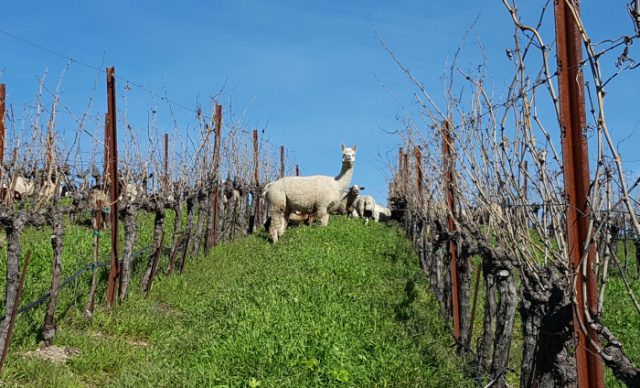
Photo: Tablas Creek.
Sheep and alpaca graze among dormant vines in the Tablas Creek vineyard, Paso Robles, California.

Contemporary consciousness has come to a supremely traditional way of life: winemaking.

Patrick Schmitt writes at the Drinks Business, “Moët Hennessy, Jackson Family Wines and Torres are adopting a ‘regenerative’ approach to viticulture – but what does it involve, and why are these famous producers making the move?

“[The] the main aim of regenerative viticulture is to increase the amount of carbon held in the ground, and to do this, farmers must ditch the tilling, because the best way to destroy carbon in the soil is to turn it.

“In short, disturbing the ground exposes it to UV light, which is an oxidizing force, and breaks down the organic matter in the soil. And a soil with less organic matter is less sponge-like, and less able to absorb and hold water and nutrients. … Tilling the soil also disrupts the soil microbiome, killing the good microbes and insects that help fight pests and diseases. …

“For Justin Howard-Sneyd MW, who, heads up courses on Sustainable and Regenerative Viticulture at the UK’s Dartington Trust, a regenerative approach is vital to reverse the damage done to agricultural soils, and make viticulture sustainable, without detrimental effects on grape quality.

“Speaking last month at the IMW Symposium in Wiesbaden, he told more than 500 attendees at the three-day event that the world has … ‘just 60 harvests left,’ should current rates of soil erosion continue.

“[He said] that the origin of the regenerative movement was the Dust Bowl of the 1930s in the US, where deep ploughing and drought saw the destruction of virgin topsoil in the Great Plains of central North America, forcing tens of thousands to abandon the land. …

“For Justin, a regenerative approach to viticulture carries additional advantages of being applicable to any farming philosophy, with no strict practices, while being ‘science-led.’

‘It is about trying as much as possible to create a complex, balanced, diverse ecosystem of life in the vineyard by working with natural forces.’ …

” ‘If you are organic but plough a lot and use a lot of copper, then you can actually have fairly unhealthy soil.’

“To promote the techniques and benefits of regenerative approaches to wine production, a little over 18 months ago the Regenerative Viticulture Foundation was established. …

“[Justin] mentioned at the symposium that Jackson Family Wines had committed to converting all its vineyards to regenerative techniques by 2030, while Torres was moving towards the approach on more than 500 hectares of organic vineyards, and Moët Hennessy was also adopting the philosophy, most notably at its Provençal property, Château Galoupet. … Concha y Toro is experimenting with regenerative approaches in Chile. …

“The approach can improve soil health, reduce the need for increasingly expensive inputs, be they organic or synthetic fertilizers, as well as create a vineyard that is more resistant to weather extremes – particularly periods of heat and drought. …

“Mimi Casteel [said] that permanent ground cover in her vineyards had kept her soils wetter and therefore cooler during a recent period of extreme heat in Oregon. … Antoine Lespès – who heads up R&D at [Domaine Lafage in Roussillon] – told the Drinks Business in December last year, ‘Because we have a low amount of rainfall, every drop that falls from the sky needs to be cultivated.’

“To ensure this, Lespès said that a permanent ground cover was key for increased infiltration, and a high-level of organic matter was important to retain the moisture. He also said that the ground cover, which can be rolled or mulched, prevents water loss by shading and protecting the soil.

“Other techniques are necessary too, however, from planting to follow the contours on sloping ground to prevent run-off during heavy rainfall, to the use of agroforestry for shade, along with biochar for increased water infiltration and retention, and, finally, a good combination of rootstock and grape variety. …

“But it was also an emphasis on applying regenerative viticulture to large-scale production that was stressed at the IMW Symposium, and particularly by Jamie Goode, who, as the author of Regenerative Viticulture, also spoke on the farming philosophy. …

“ ‘If this approach to farming is going to make big impact, then it’s not just something we want rich people to do on a small vineyard for wines selling for $100 a bottle – it’s also for big farms selling wine at €1 per litre.’ [And it’s] important that wine producers ‘say goodbye to herbicides. … Clear earth is a major problem, not so much the chemicals. It’s the same problem with organic herbicides: nothing is growing there.’

“However, should one leave a permanent ground cover, and ditch the tilling, the plants that sprout in the vineyard do need to be kept in check. … California’s Tablas Creek, which is a pioneer in regenerative viticulture, has a herd of 250 sheep that it successfully uses to keep weeds at bay in its vineyards.”

More at the Drinks Business, here. No paywall.

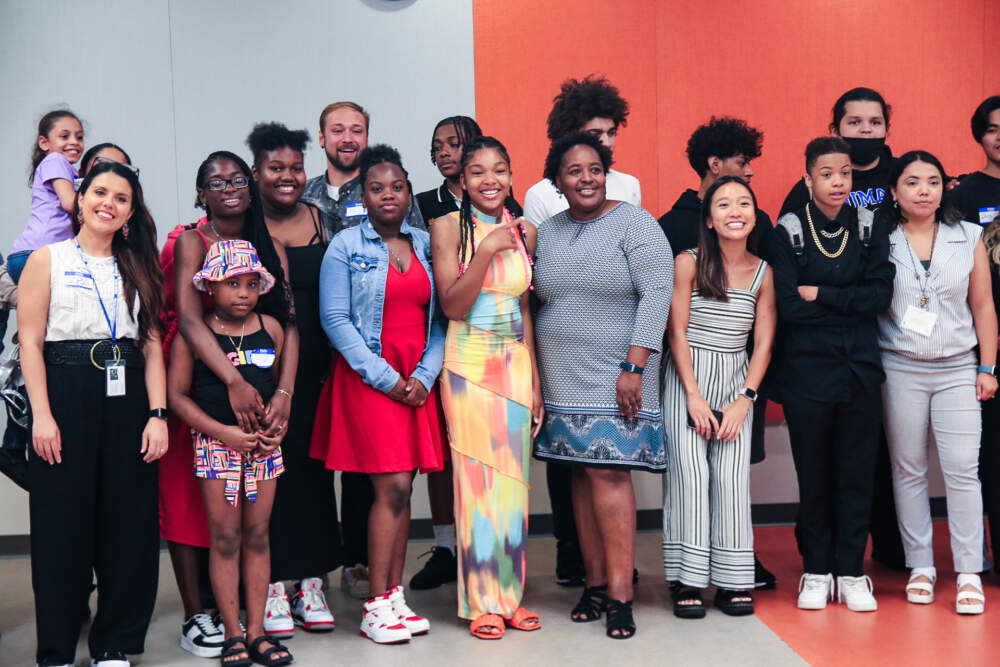
Photo: Emily Piper-Vallillo/WBUR.
Program mentor Meshell Whyte with students who participated in the 2023 UMass Boston Summer Program in Urban Planning.

Today’s story is not only about addressing troubling effects of climate change in cities but also about encouraging young people in the communities most affected to be part of finding solutions.

Emily Piper-Vallillo reports at WBUR, “Boston students recently wrapped up a month-long study of extreme heat in Roxbury, exploring ways to mitigate the crisis and its impact on residents through the field of urban planning.

“Nearly 30 high school students participated in the University of Massachusetts Boston Summer Program in Urban Planning, which concluded [in July] with a presentation at Roxbury Community College. …

“The program introduces students of color from environmental justice communities like Roxbury and Dorchester to careers in urban planning and design. It’s part of a larger effort to diversify the field of urban planning, which remains overwhelmingly white.

“ ‘Only 5.2% of Boston’s planners are non-white, in a city where just in the city alone, 28% of our population is African American,’ said Ken Reardon, co-founder of the program and chair of UMass Boston’s Department of Urban Planning and Community Development. …

“Built as a working class community at a time when extreme heat was not as common as it is today, Roxbury has densely packed buildings with few trees, according to the students’ presentation. Many spaces are exposed to direct sun. Slides and swings in neighborhood playgrounds were constructed with heat-absorbing materials, making them unusable when temperatures rise.

“In fact, the students found that air temperatures in Roxbury are, on average, 10 degrees warmer than at Boston’s Logan Airport.

“They made this discovery by collecting 135 temperature readings across 38 Roxbury locations to identify the hottest spaces. Readings ranged from 83 to 102 degrees Fahrenheit, with the highest temperatures collected on sidewalks and at bus stops.

“Collecting data was grueling, said Blue Hills Regional Technical student Aidan Luciano. He and his peers hit the streets with remote sensors recording the humidity and heat index during the month of July — when temperatures sometimes rose above 100 degrees.

“ ‘[But] it’s going to pay off in the end because we are going to be helping other people,’ Luciano said. ,,,

“One group designed a new cooling children’s playground on RCC’s campus. Scheduled to open in 2025, the playground will replace a parking lot near the historic Dudley House site. After further community input, the final design will incorporate many ideas from the students themselves, said Ruben Flores, special projects manager at Roxbury Community College.

“Flores was particularly impressed by the inclusion of splash pads and water misters to reduce the temperature of the playground.

“Participating students received college credit from UMass Boston and were paid around $15 an hour.

“Paying students was an important part of making this opportunity accessible to low-income students of color who are less likely to be able to afford unpaid internships, Reardon said.

“Beyond collecting temperature data, students sought to understand how Roxbury residents experience extreme heat, said TechBoston student Neicka Mathias.

“Over the course of July, students interviewed nearly 100 Roxbury residents about coping with rising temperatures. The most common suggestion for improvement they heard was to increase the number of water sources throughout the neighborhood.

“Students also worked with residents to identify public spaces in Roxbury where heat mitigation solutions are most needed. These include areas where  people frequently wait for public transit or line up outside favorite local restaurants. …

“ ‘Give a chance to these communities of color that are outside the spaces where decisions have been made and they will show you great work,’ Flores said.”

More at WBUR, here. No firewall.

Photo: Crops for the Future via Wikimedia.
Cañihua, a native grain of the Andes of southern Peru and Bolivia, is supremely adapted to high altitudes, according to Crops for the Future.

We have yet to figure out how to feed the whole planet, but here and there, investigators are finding that little known sources of nutrition used by small populations may offer hope in a warming climate.

Tibisay Zea has an example at the Public Radio International (PRI) program The World.

“Trigidia Jiménez was born in an Indigenous village in the Andean mountains of Bolivia at 14,000 feet above sea level. She grew up in a family of farmers, and she loved working the land. 

“But like many others in her town, she moved to the Bolivian capital in search of new opportunities and eventually became an agricultural engineer. She worked and got married, but after 15 years of being in the city, she realized she wanted to return to the mountains. 

“ ‘I needed to be in touch with the sun, fresh air and work our land,’ Jiménez told The World over Zoom. 

“Back in the Andes, she started thinking about an ancestral green that was almost extinct — cañahua. It’s similar to the quinoa plant and virtually unknown outside of Bolivia and Peru. 

“ ‘That’s what our ancestors used to eat every day. A cup of cañahua for breakfast,’ Jiménez said. ‘We make it like oatmeal.’

“Cañahua is ‘nutritious, high in protein, amino acids and iron.’ It has also proven to be very adaptable to climate change, according to Jiménez. …

“Jiménez started small, with about an acre of land, producing enough grain for just one family. Two decades later, cañahua is being produced on approximately 5,000 acres. 

“Bolivia’s government offers subsidies to low-income families to buy cañahua, and that’s helped build the market. …

“ ‘We realized that we’ve been reliant on too few food crops,’ Jeff Maughan, a professor of molecular genetics at Brigham Young University in Utah, told The World. …

“Twenty years ago, Maughan and other researchers at BYU got interested in quinoa as a higher protein crop for subsistence farmers in the Andean region. Today, quinoa is everywhere — from your favorite supermarket to fancy restaurants. Maughan and his team have successfully introduced the South American grain in Morocco, Rwanda and Saudi Arabia. …

“Trigidia Jiménez earned international recognition for helping to revive cañahua cultivation. ‘Cañahua made me a stronger woman,’ she said. ‘Powerful and happy.’

“It’s also helped sustain the local communities where it’s produced. Jiménez is now looking at ways to expand her business and export the ancient grain to the United States.” More at PRI, here.

Now, you may have heard as I did that the newfound popularity of quinoa has made it to expensive for the Peruvians it came from to afford it. I did an online search to see what I could find.

According to a study described at National Public Radio, poor Peruvians have actually benefitted from the demand for quinoa, especially farmers who grow it. The real concern is that “export demand has focused on very few of the 3,000 or so different varieties of quinoa, prompting farmers to abandon many of those varieties.

” ‘Those varieties, created by Andean farmers, are the future of quinoa, to adapt to things like climate change,’ says Stefano Padulosi, a [Bioversity International] specialist in underused crops. … He would like to see some sort of global mechanism to reward Andean farmers for their role in creating and maintaining quinoa diversity.’ ” More here.

That insight may be something for promoters of cañahua to think about, too.

Snoop Dog Helps Out

Photo: WJCL via CNN.
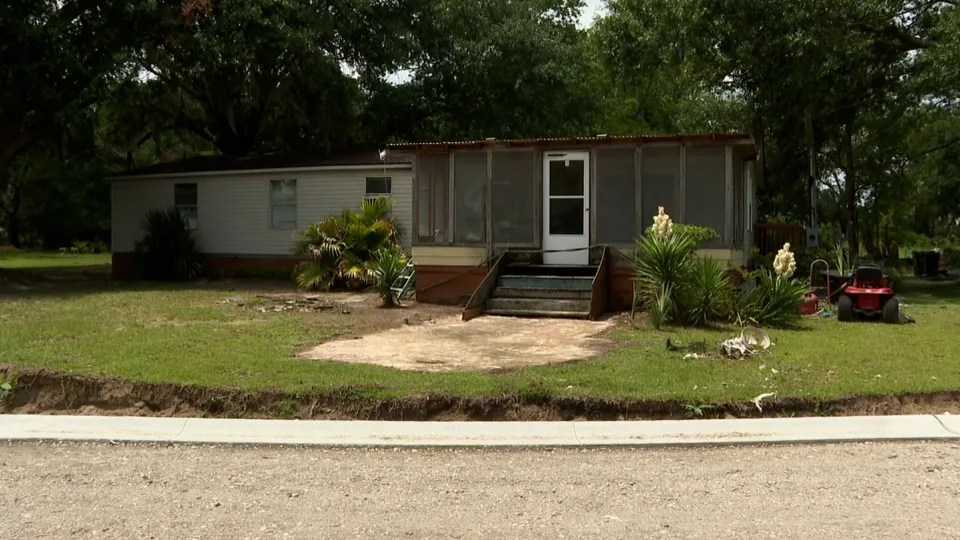
The home of Josephine Wright, 93, on Hilton Head Island, where resort development has encroached on the rights of Gullah Geechee people for generations.

We often read about how in “the old days” the powerful usurped the rights of minorities and paid expensive lawyers to take their land. Alas, it’s still going on.

Nicquel Terry Ellis reports at CNN, “Josephine Wright and her late husband, Samuel Wright Sr., moved from New York to Hilton Head Island, South Carolina, nearly 30 years ago to seek peace and relaxation on a family-owned property.

“The 1.8-acre parcel of land had been in her husband’s family since the Civil War and it was there that they carried on family traditions, hosted Thanksgiving and Christmas gatherings, planted trees and bushes and built a porch, Wright said.

“Wright, who is 93, acquired the deed to the land in 2012 after her husband died in 1998, her granddaughter, Tracey Love Graves, said. Now, Wright’s beloved land is at the center of a legal battle with a property developer looking to build a residential development next door. According to the Post and Courier, Georgia-based Bailey Point Investment, LLC is planning to construct 147 homes.

“Graves said Bailey Point had previously showed up at her grandmother’s house and offered $30,000 for Wright’s land, which she declined.

“The developer later filed a lawsuit in February 2023 against Wright claiming that her satellite dish, shed, and screened-in porch were encroaching on the developer’s land and delaying the construction of new homes.

“The lawsuit asked for the removal of the structures and sought ‘just and adequate compensation for its loss of the use and enjoyment’ of their property, and expenses related to delays in development.

“Wright and Graves said they have since removed the shed and satellite dish and were preparing to downsize the screened porch when Wright decided to file a counterclaim. …

“Wright’s counterclaim, filed April 25 and amended in June, accused Bailey Point of a ‘constant barrage of tactics of intimidation, harassment, trespass, to include this litigation in an effort to force her to sell her property.’

“The counterclaim also accused the developer of ‘trashing her property, going onto her property cutting brush and shrubs, littering, causing dirt and debris to cover her automobile, house and contents.’ The claim said Wright had been ‘deprived of the peaceful enjoyment of her property.’ …

“The legal battle is drawing renewed attention to the historic expropriation of Black-owned land. Wright told CNN she is concerned the developer is using well-known pressure tactics to get her to give in and sell her land. …

“Bakari Sellers, a civil rights attorney and CNN political commentator who is advocating for Wright, said land battles with developers have historically been an issue for the Gullah Geechee people – descendants of Africans who were enslaved along the lower Atlantic coast and forced to work on rice, indigo and Sea Island cotton plantations. Wright’s late husband was Gullah Geechee.

“ ‘Their land is so valuable,’ Sellers said. ‘They (developers) have been doing this for years. This is not new.’

“Wright says she hopes that her fight will inspire other Black landowners in Hilton Head Island to defend their property. …

“Wright’s land fight has garnered the attention of celebrities, including NBA star Kyrie Irving who donated $40,000 to a GoFundMe created to raise money for her legal fees. Filmmaker Tyler Perry also shared Wright’s story on Instagram saying, ‘Please tell where to show up and what you need to help you fight.’ “

Rebecca Carballo and Amanda Holpuch add at the New York Times, “Ms. Wright’s granddaughter Charise Graves, who lives on the property, said that loud construction has sometimes begun around 6:30 a.m. and that she and other family members have often dealt with noise and construction workers. An aunt who had also been living there, and is a defendant in the lawsuit, moved to Florida in February because she couldn’t handle the noise and stress of the situation, Ms. Graves said.

“Ms. Graves estimated that she has spent $6,000 to cover the costs of responding to the developer’s complaints and to hire a lawyer. The family created a GoFundMe to help pay for the legal battle and property taxes. Snoop Dogg donated $10,000 to the fund-raiser. …

“Ms. Graves said she planned to use some of the more than $300,000 raised so far to create a foundation in her grandmother’s name that aims to support other families who are trying to keep their property.”

More at CNN, here, and at the Times, here.

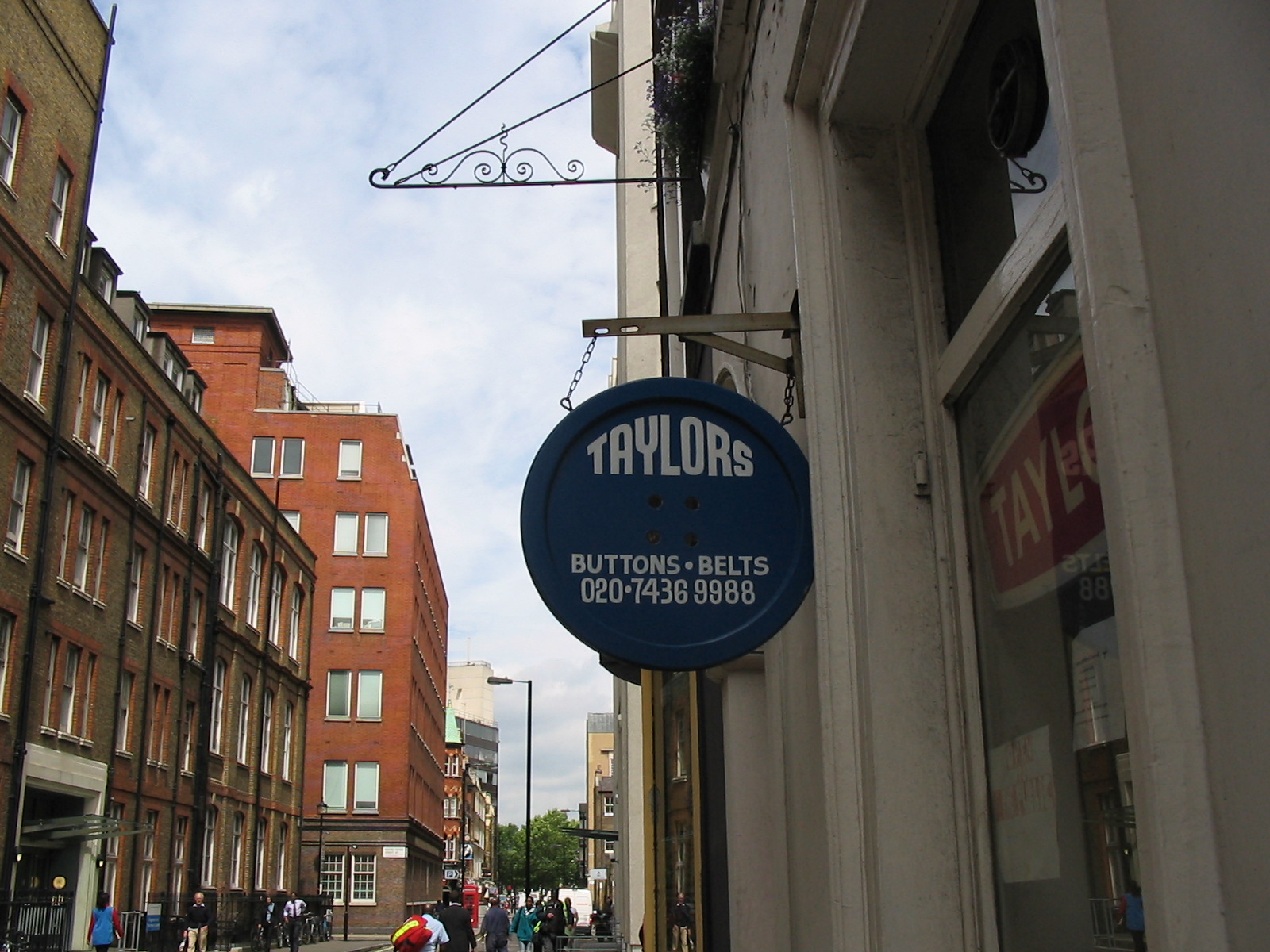
Photo: Taylors Buttons.
The Taylors Button Shop has been established in London over 100 years.

A long time ago, a parent family at the Elwanger-Barry Nursery School in Rochester, New York, closed down their button business and donated a lifetime supply of buttons to the school. Poured into an indoor sandbox, the buttons became one of the two favorite play centers of three-year-old Suzanne. The fuzzy box and the button box.

That’s one reason I’m interested in button stories. And when an editor from last year’s Ukraine social-media project (see this post) wrote on Facebook about a 100-year-old button store in London she visited, I had to learn more.

The Gentle Author at Spitalfields Life interviewed Maureen Rose of Taylors Buttons for a bookshop’s blog:

“Taylors Buttons is the only independent button shop in the West End. It’s more than 100 years old and it’s only been owned by two families in that time. It was founded by the original Mr Taylor; then there was Mr Taylor’s son, who retired in his late eighties when he sold it to my husband,” Maureen Rose said.

“I was a war baby. My mother was from Whitechapel and she opened her own millinery business in Fulham at nineteen. She got married when she was twenty-one and ran her business all through the war. As a child, I used to sit in the corner and watch her make hats, but I didn’t take up millinery – something I regret now, as she was very talented and she could have taught me.

“I helped my mother for a while: I did a lot of buying for her in Great Marlborough Street, where there were many millinery wholesalers. There was a big fashion industry in the West End: I used to go to see the collections from houses like Hardy Amies and Norman Hartnell. It was so glamorous. Now it’s all gone.

“My late husband, Leon Rose, first involved me in this business. He started his career in a button factory learning how to make buttons. Then his uncle, who had a factory in Birmingham, got in touch to say, ‘There’s a gentleman in town who’s retiring and you should think about taking over his business.’ So he did.

“My mother went in to help when he needed someone for a couple of hours a day, and then – of course – there was me! I’ve been working here for more than 40 years now and since my husband died in 2007 it has been a one-woman show.

“Every button tells a story and I have no idea how many there are in the shop. Some are more than 100 years old, but most I make to order. You send me the fabric – velvet, leather or whatever – and I’ll make you whatever you want. We used to do only small orders for tailors: two fronts and eight cuff buttons for a suit. Nowadays I do them by the hundred. I don’t think Leon ever believed that was possible.

“Anybody can walk into my shop and order buttons, but I get a lot of orders for theatre, television, film, fashion houses and weddings. I get gentlemen who buy expensive suits that come with cheap buttons: they come here to buy proper horn buttons to replace them.

“My friends ask me why I have not retired, but I enjoy working here. What would I do at home? I’ve seen what happens to my friends who have retired: they lose the plot. I meet nice people in the shop and it’s interesting. I’ll keep going for as long as I can.”

Interview originally published on the Spitalfields Life blog by The Gentle Author. 

More here. And there’s detailed button information at the Taylors Buttons website, here, where you can also learn that Dickens lived in the building once. Hat tip: Ro.

A Whale of a Whale

Drawing: Ivan Iofrida.
Skeletal drawing of Perucetus colossus, an ancient marine animal probably bigger than the blue whale.  

Scientists have been studying the ancient bones of what may have been the heaviest animal ever. There’s a certain amount of speculation involved, as they don’t have enough bones. In Dino Grandoni‘s story at the Washington Post, one researcher says what they really need is a skull.

But will they find one in the Peruvian desert?

From the Post: “In this corner, weighing up to 190 metric tons, is the blue whale. This behemoth still swimming in Earth’s oceans is the current titleholder for the heaviest animal to ever exist — living or dead. …

“Fossils of this ancient leviathan’s bones recently dug up from the deserts of Peru suggest it may have weighed up to 340 metric tons, challenging the blue whale’s status as the most massive ever in the animal kingdom.

“When Alberto Collareta first laid eyes on the boulder-sized vertebrae of the extinct animal, he couldn’t believe what he was seeing. He wondered how a creature that large could even move around.

“ ‘I was in front of something unlike anything I had ever seen,’ said Collareta, a University of Pisa researcher and co-author of a study published [in August] in the journal Nature describing the freshly unearthed species of giant prehistoric whale.

“Dubbed by its discoverers Perucetus colossus, or simply P. colossus, the titanic animal may not be just a record setter. P. colossus is also compelling scientists to reconsider their ideas about how animals are able to grow to gigantic sizes.

“ ‘This is another way in which you can get big,’ said Hans Thewissen, a paleontologist and whale evolution expert at Northeast Ohio Medical University. With a body that looked vaguely like that of a manatee rather than a blue whale’s, it clearly did something different than other whales to maintain its huge mass.

“But not everyone is convinced this colossus, while undoubtedly big, is truly more massive than a blue whale. The research team acknowledges their estimates for the animal’s body mass range widely, from 85 tons all the way up to 340 tons. The team exhumed only a partial skeleton without a skull, leading some scientists to say more fossils are needed before anyone names a new heavyweight champion of the animal kingdom. …

“In the animal kingdom, it’s usually good to be big. It’s easier to deter predators, care for young and move about when an animal is large and in charge. But there are many factors that weigh against an animal’s growth. On land, one of the biggest is gravity itself. Legs can only be so strong to support a heavy frame.

“In water, buoyancy helps aquatic animals balloon over eons to gargantuan sizes. Blue whales and their relatives [appeared] after a sudden rise in ocean upwelling provided them with abundant krill, their favorite meal, which helped fuel their growth.

“[Fossilized] remains of the P. colossus required multiple field campaigns to exhume from the foot of a mountain in southern Peru’s Ica Valley after its discovery 13 years ago. The animal’s scientific name means ‘colossal whale from Peru.’ The specimen today is housed at the Natural History Museum in Lima.

“Its bones were thick and compact, more like a hippopotamus than a blue whale, suggesting it did not pursue a fast-moving prey such as krill. It must have done something different to sustain its weight.

“The research team instead said P. colossus may have fed off the seafloor, munching on sea grass, feasting on bottom-dwelling animals or scavenging on carcasses.

“There are a few issues with some of those hypotheses. For one, no whale is known to feed on plants. And it would take a lot of dead animals to sustain a scavenger as big as P. colossus. ‘I have a hard time thinking how many carcasses would be needed to sustain this animal,’ Thewissen said. …

“The research team admits their ideas about their discovery’s diet are speculative. And they acknowledge there is a wide range in their estimates of the whale’s size, due to the skeleton’s many missing pieces and to the uncertainly about how best to put flesh to bone in 3D models.

“ ‘We have been extremely conservative in our approach and do not provide one single estimate but a range of values,’ said Eli Amson, a researcher at the Stuttgart State Museum of Natural History in Germany who also co-wrote the paper.

“Noting that the lower estimate of 85 tons is still ‘larger than some adult blue whales,’ he said his team cannot be definitive about whether P. colossus or the blue whale is heavier.

“ ‘But we can claim with a great degree of certainty that its weight was in the ballpark of that of the blue whale,’ he added.

“The only way to get a better idea of what P. colossus’s life — and girth — were like is to find more fossils. The research team plans to continue roaming the Peruvian desert for bones. Near the top of the wishlist is a skull, which would help solve the riddle of what exactly P. colossus ate to get so big.

“ ‘We really do need a skull,’ Collareta said.”

More at the Post, here. And at Wikipedia, here.

Photo: Rob Schoenbaum/The Guardian.
A Swedish coastguard diver exits the water after inspecting a wreck.

So many different kinds of work in the world! Today’s article, from the Guardian, describes an unusual job in Sweden. It involves going underwater to protect old shipwrecks from looters.

Miranda Bryant writes, “Among the rocky shores and wooden summerhouses of Dalarö, an exclusive Swedish summer retreat, there was little to indicate anything other than a typical summertime scene on the Stockholm archipelago.

“It was only as the coastguard boat reached a discreet yellow buoy that there was any suggestion of the 17th-century shipwreck lying, preserved, 30 metres beneath it. ‘STOP,’ read a sign. ‘Marine cultural reserve.’

“Bodekull, built by the English shipbuilder Thomas Day, is believed to have run aground in 1678 and sunk while transporting flour to the Swedish naval fleet in Kalmar, down the coast in south-east Sweden.

“Thanks to the Baltic’s brackish water protecting the wreck from shipworms, the 20-metre-long ship remains on the seabed, upright and largely intact, full of relics that are still being discovered. Two of its three masts poke up towards the sky in their original position.

“But now Bodekull faces a human threat to its existence. Authorities say that it is among thousands of historic wrecks across the Nordics that are at risk from plundering.

“On a monitoring operation last week, experts shared photographs with the Guardian that show that objects are vanishing from shipwrecks.

“Those responsible are believed to be a diverse array of offenders, from light-fingered sport divers in search of souvenirs to criminal gangs looking for high-value objects to sell. Such is the scale of the problem that the coastguard is now regularly sending divers down to monitor at-risk sites.

“ ‘The plundering problem isn’t just a Swedish problem, it’s a Baltic Sea problem,’ said Jim Hansson, a marine archaeologist at Vrak, the museum of wrecks, citing the sea’s low salinity and comparatively shallow average depth of 55 metres.

“These unique conditions, as well as the existence of an estimated 100,000 shipwrecks, make the Baltic a ‘mecca for marine archaeologists,’ he said. But it’s also increasingly attracting looters. Around Stockholm alone, Hansson knows of six wrecks that have been looted by international and Swedish divers. …

“ ‘Sweden has one of Europe’s longest coasts so it’s a lot of water to guard and it isn’t easy,’ said Hansson. …

” Coastguard divers normally work on environmental disasters, inspect ships for drugs and weapons and help police looking for murder weapons. ‘It is very unique for us to be part of this,’ [Patrick Dahlberg, a coastguard commander] said. …

“[On August 1] Coastguard diver Patrik Ågren said he didn’t see any evidence of tampering as he emerged from recording the contents of a tool drawer on the ship containing planes, sledgehammers, a basket and carpentry equipment. … Video footage he recorded during the dive will be compared with previous footage to check for changes.

“But on a later dive they discovered that a wheel on a cannon had been removed, a deck beam collapsed and a wine bottle moved since they last visited in January. While some of the changes may have been caused by nature, Hansson said it was difficult to see how the wheel and wine bottle could have been moved without human intervention. …

“Hansson said removing relics from wrecks prevented them from building a full picture of the type of ship, where it was going and what it was doing.

“ ‘We collect all the puzzle pieces just like a police or coastguard investigation,’ he said. ‘That’s why it is super important that objects are not moved because it is like ripping the pages from a book. In the end all you will have left is an empty shell.’

“Amid heightened tensions with Russia after its invasion of Ukraine, allegations of spying and Sweden’s hopes of imminently joining Nato, it is a critical time for the Baltic.

“But Hansson said that cultural monuments could also be used in war. ‘What happened with Nord Stream [gas pipeline bombings] could similarly happen with national cultural heritage monuments like shipwrecks. The first thing that happens with big conflicts is that you erase a nation’s integrity and history.’ ”

More at the Guardian, here.

Photo: Brian Barlow.
Artist Jeffrey Gibson will represent the U.S. at the Venice Biennale in 2024, the first Indigenous artist to have a solo exhibition in the U.S Pavilion at the international art event.

One doesn’t think of State Department functionaries as knowing who in the US art community would be best to represent the country in an international exhibition, but if they tap knowledgable consultants and look at recipients of MacArthur “genius” grants, that should help them decide.

Chloe Veltman writes at National Public Radio (NPR), “The U.S. State Department has selected an Indigenous artist to represent the country at the 2024 Venice Biennale.

“Jeffrey Gibson, a member of the Mississippi Band of Choctaw Indians and of Cherokee descent, will be the first such artist to have a solo exhibition in the U.S. Pavilion at the prestigious international arts event.

“That’s according to a statement this week from the U.S. Department of State’s Bureau of Educational and Cultural Affairs, the government body responsible for co-curating the U.S. Pavilion, alongside Oregon’s Portland Art Museum and SITE Santa Fe in New Mexico. …

“The last time Indigenous artists appeared in the U.S. Pavilion at the Biennale was in 1932 — and that was in a group setting, as part of a mostly Eurocentric exhibition devoted to depictions of the American West. …

“Said Kathleen Ash-Milby, curator of Native American Art at the Portland Art Museum, and one of the co-commissioners of Jeffrey Gibson’s work in the U.S. Pavilion at the Venice Biennale, ‘It grouped native people together and didn’t really focus on their individuality as much. There were Navajo rugs on the floor. There were displays of jewelry. Many of the artists were not named.’

“Ash-Milby, who is also the first Native American curator to co-commission and co-curate an exhibition for the U.S. Pavilion at the Venice Biennale, told NPR her team selected Gibson because of the artist’s wide-ranging, inclusive and critical approach to art-making.

” ‘His work is multifaceted. It incorporates all sorts of different types of media,’ the curator, a member of the Navajo Nation, said. ‘But to me, what’s most important is his ability to connect with both his culture and different communities, and bring people together. At the same time, he has a very critical lens through which he looks at our history as Americans and as world citizens. Pulling all those things together in the practice of an American artist is really important for someone who’s going to represent us on a world stage.’

“Born in Colorado and based in New York, Gibson, 51, focuses on making work that fuses together American, Native American and queer perspectives. In a 2019 interview with Here and Now, Gibson said … ‘There’s this gap historically about these histories existing on the same level and being valued culturally. … My goal is to force them into the contemporary canon of what’s considered important.’

“A MacArthur ‘Genius’ Grant winner, Gibson has had his work widely exhibited around the country. Major solo exhibitions include one at the Portland Art Museum last year and, in 2013, at Boston’s Institute of Contemporary Art. His work is in the collections of high-profile institutions like the Museum of Modern Art in New York, the San Francisco Museum of Modern Art and the National Gallery of Art. Gibson participated in the 2019 Whitney Biennial. …

“The details of Gibson’s contribution for the 2024 Biennale are mostly under wraps. Curator Ash-Milby said the artist is working on a multimedia installation with the title ‘the space in which to place me’ — a reference to a poem by the Lakota poet Layli Long Soldier.”

Check out his art at NPR, here. No paywall.

See also Mark Trecka’s comments on poet Long Soldier at the Los Angeles Review of Books: “In ‘Three,’ Long Soldier writes: ‘This is how you see me the space in which to place me / The space in me you see is this place / To see this space see how you place me in you / This is how to place you in the space in which to see.’ The lines of this poem form a box on the page, in which the negative space is the center of attention.”

Photo: Society6.
Blind alphabet.

I know two people who are losing their sight, but not well enough to ask if they are learning Braille. I always wondered if that is what I would do if I lost my sight, realizing of course, that it is more likely to happen when I’m older and learning takes longer.

Here is a bit about the changing world of Braille by Sophia Stewart at Publisher’s Weekly.

“A few times a day, a strange, pulsating sound fills the Boston headquarters of the National Braille Press. Thun-thun. Thun-thun. This is what employees of the nonprofit braille publisher call the office’s ‘braille heartbeat,’ generated by an assortment of printing presses — 50-year-old Heidelbergs and modern big-roll embossers alike — pumping away in the basement, producing books and other reading materials for blind readers.

“NBP has been at the forefront of braille publishing since 1927, when it was founded by the blind Italian immigrant Francis Ierardi — a classmate of Helen Keller’s at the Perkins School — as a weekly newspaper serving Boston’s blind community. Demand was so great that it went national after just three months. Since then the organization has expanded far beyond a single publication. Today, NBP produces and distributes braille books, reading materials, and technologies for the nation, with clients ranging from individual blind readers to the Library of Congress.

“Bringing braille to young readers in particular is central to NBP’s mission. ‘Our goal is to support braille literacy,’ said NBP president and CEO Brian MacDonald, and fostering that literacy depends on early intervention. As part of its ongoing efforts, in 1983, NBP launched one of its flagship programs, the Children’s Braille Book Club. The first-of-its-kind subscription service pioneered the ‘print/braille’ book format by distributing mainstream children’s books with added braille. (Under the 1996 Chafee Amendment to the U.S. Copyright Law, nonprofits can reproduce copyrighted works in forms that make them accessible for people with disabilities that impact reading.)

“When Harry Potter and the Deathly Hallows was published in 2007, NBP drew headlines by hosting a midnight release party, complete with accessible editions of the book. Scholastic sent NBP the manuscript early in order for it to be transcribed, and the office had to cover its windows and employ an armed guard to protect what was at that point the most valuable manuscript in the world. Staff worked around the clock to ensure the braille volumes were ready in time.

“The work paid off, and on the evening of July 20, young readers in wizard costumes descended on NBP’s offices to unbox their copies of the final Harry Potter book at the stroke of midnight, just as their sighted peers were doing throughout the country.

“What makes NBP unique is its publishing arm. NBP is the only organization in the U.S. that publishes its own books by blind authors for blind readers. Editorial director Kesel Wilson, who had a long career in traditional publishing at companies such as Scholastic and Pearson before joining NBP, commissions and edits original titles.

“The number of new books varies each year because Wilson, who said she’s ‘deeply connected’ to the community NBP serves, commissions titles based on ‘actual demand.’ When she has an idea for a book, she speaks with NBP authors and readers to gauge whether it would meet an immediate need. As a result, NBP has become known for its technology books, which include manuals for various software, operating systems, apps, and devices, as well as lifestyle titles on topics including cooking, fitness, and online dating. Recently, NBP published a guide to emoji, reproducing 97 face emoji as tactile graphics to help blind readers identify the differences among them, which ‘can be as subtle as a lifted eyebrow,’ Wilson said.

“The publishing arm is largely subsidized by what MacDonald called NBP’s ‘exploding’ B2B business producing brochures, tests, textbooks, business cards, airline safety guides, and more. In 2021, for example, NBP produced 35,000 large-print and braille menus for Starbucks stores. These kinds of projects allow it to sell its own books below cost, despite the enormous expense of producing braille, through its own online bookstore. The bookstore is the primary sales outlet for NBP’s titles, which the press promotes at the National Federation for the Blind’s annual convention as well as other related conferences and gatherings.

“ ‘We sell our books at the same price as a print book,’ MacDonald said of the online store, ‘because we don’t think it’s fair for a blind person to pay more, even though braille costs three to four times more to produce.’

“Producing braille books largely falls on the shoulders of specialized publishers like NBP, but some editors think mainstream publishers could be doing more. In 2016, DK senior editor Fleur Star, who works in the U.K., helped launch the DK Braille Books series, which to date comprises five children’s books that combine print, braille, printed images, and tactile images.

“The idea for the series, produced in partnership with the Royal National Institute of Blind People, arose in 2013, when Clearvision, a postal lending library of print/braille children’s books, visited DK’s London offices and outlined how mutually legible print/braille books can unite blind and sighted readers. Star and several colleagues were moved to action.”

More at Publisher’s Weekly, here.

Zimbabwe Women Speak Out

Photo: The Guardian notes that women are at the forefront of a seminal moment in Zimbabwe literature. 

The African nation Zimbabwe, formerly a British colony called Rhodesia, has suffered years of trauma perpetrated by every side in the conflicts. But when women start publishing books in record numbers, you can bet the country is moving into a new and better phase.

Tawanda Mudzonga reports at the Guardian, “A handful of events, says author Siphiwe Gloria Ndlovu, define her generation. ‘The war, the HIV crisis, migration and the brain drain, and the creation of the Zimbabwean diaspora.’

“They have not been topics that the country’s rulers want spoken of and many who have spoken frankly about Zimbabwe have been imprisoned or persecuted. But a new generation of female novelists is exploring the people, the political problems and the history of this complicated and still fledgling nation.

“ ‘I wanted to talk about what had happened. What does 40 years of a postcolonial country look like, and what does 40 years of a postcolonial country look like for us,’ says Ndlovu, author of the award-winning The Theory of Flight

“Ndlovu and her contemporaries, who include Novuyo Rosa Tshuma, Sue Nyathi and Valerie Tagwira, follow in the footsteps of celebrated author Tsitsi Dangarembga, whose 1988 book, Nervous Conditions, was the first published novel that had been written in English by a black Zimbabwean woman.

“Ndlovu’s lyrical writing has reimagined how stories about post-independence Zimbabwe are told, and reflected some of the country’s darker moments. …

“Ndlovu comes from Bulawayo, in the Matabeleland region. In The Theory of Flight, she writes about the Gukurahundi massacres, committed in the 1980s under the direction of Robert Mugabe, which killed an estimated 20,000 people, predominantly ethnic Ndebele from Matabeleland and Midland regions.

“Postcolonial Zimbabwe has been defined by a narrative in which the ruling Zanu-PF party explains its valiant efforts and sacrifice to liberate Zimbabwe, but the events of Gukurahundi do not feature in the country’s history books.

“ ‘What happened in the 80s, in this part of the country – it left something unresolved that needed to be resolved. A lot of writers decided the best way to do that is to write about it.’

“Novuyo Rosa Tshuma explores the same period in her debut book, House of Stone. ‘I didn’t know much about Gukurahundi, and it was the act of writing House of Stone that helped me sit with it and unpeel those layers,’ says Tshuma, who is also from Bulawayo. ‘We didn’t speak about it in my family. We knew it happened, but we were always encouraged not to talk about it. …

“ ‘If you notice the forms of violence that have come after that, experienced in the 2000s, what we are experiencing stemmed from that period, and also from the liberation period. That’s why I think it’s important to look at that time – it helps us to frame and think about and understand why we are where we are.’ …

“The novel is not available inside Zimbabwe. [Says] Tshuma, ‘That made me sad because I had envisioned this as a book that speaks to Zimbabweans directly. I’m talking to my people.’

“Dr Tinashe Mushakavanhu, a research fellow in African and comparative literature at the University of Oxford, says this is a seminal moment in Zimbabwean literature. ‘It’s exciting. … At the turn of the millennium, it is the women writers who have been carrying the burden of Zimbabwean literature.’ …

“The excitement comes at a price. ‘It is a burden to carry because Zimbabwe is not a forgiving country, especially if you choose to use your voice, if you are opinionated,’ Mushakavanhu says. … ‘In terms of the abuse one gets, the name-calling, you do not find that when male writers are writing Zimbabwe.’

“Sue Nyathi, whose novel, An Angel’s Demise, was published in 2022, says there is risk associated with writing. ‘The politics is such that there’s a lot of censorship. You can’t just write what you like without fear.

“ ‘That’s why people write books like Animal Farm. They use satire. There’s a fear of persecution when writers express themselves in their stories, and self-censorship.’ …

“Valerie Tagwira was afraid of the repercussions from her novel The Uncertainty of Hope, published just after the government’s Operation Murambatsvina (Clear Out the Trash), a slum clearance operation which displaced thousands of people in 2005. … ‘[My cousin] said: “Why are you being so reckless? Writing about this, we could end up being targeted.” ‘ …

“Tagwira asked her publisher if she thought it would be seen as a political book. ‘I was a bit scared because of what my cousin said.’ Her publisher assured her it wouldn’t be, and cautioned her against self-censorship. …

“Other success stories are white Zimbabwean Bryony Rheam with her award-winning debut novel, This September Sun, and Violette Kee-Tui and Fatima Kara who have written about Zimbabwe’s mixed-race and Indian communities respectively, in Mulberry Dreams and The Train House on Lobengula Street.

More at the Guardian, here. No firewall.

Photo: Asif Hassan/AFP/Getty Images.
A resident with her flood-resistant hut made from bamboo at a cost of about $87.

The news of floods this week is tragic. In Libya a dam suddenly broke, wiping away villages, and even near me, a quixotic rainfall — 11 inches in about 6 hours — submerged many homes in one city while the rest of the region was untouched.

Pakistan, of course, has suffered worse. That’s why it’s extra interesting to read about a sustainable, cost-efficient way that some poor areas there are rebuilding.

Zofeen T Ebrahim writes at the Guardian, “A year ago, Shani Dana’s mudbrick house was swept away in the worst floods on record to hit Pakistan. More than 1,700 people were killed and 900,000 homes damaged or destroyed. Sindh province, where Dana lives, was the worst affected.

“While waiting for government money to rebuild her home in Wasram village, in the Tando Allahyar district, word reached Dana that the Heritage Foundation of Pakistan (HFP), founded by a renowned architect, Yasmeen Lari, was building one-room homes in neighboring Pono village.

“The buildings ‘looked like rounded chauhras [traditional huts], but were octagonal in shape and the walls were much sturdier,’ says Dana.

“The foundation agreed to help Wasram rebuild and in March the HFP team joined villagers to construct 50 new homes. Prefabricated bamboo frames were built on meter-high raised platforms. Walls made of bamboo canes were fixed and plastered with mud mixed with rice husk and lime, and radial-style conical roofs were fitted. Four solar panels, six water hand pumps and 25 toilets were also built.

“ ‘This will not be swept away if the floods come again. It is not built at ground level, it’s airier and brighter since there is a window – ours didn’t have one before – and also looks much neater, since the walls and floor are plastered,’ says Dana outside her new home. …

“The HFP has helped build more than 5,000 chauhras since September [2022]. ‘In the next two months, I should be able to build another 2,600 homes,’ says Lari, who is urging every villager who has built their home to help 10 others build theirs.

“A year after the floods, tens of thousands of people are still waiting for help to rebuild. Organizations like HFP and the NGO Karachi Relief Trust have been stepping in.

“About 250 of the 1,000 one-room homes KRT is building in villages across Sindh, Punjab and Balochistan provinces … are being built using burned-earth bricks or cement blocks with roofs made of steel girders and precast cement slabs. ‘The houses we built in 2010 have survived and aged well,’ said Ahsan Najmi, the trust’s architect. …

“The Sindh People’s Housing Foundation (SPHF), which is overseeing the rebuilding, hopes 50,000 one-bedroom ‘resilient’ cement, brick and steel homes will be livable by September. It has enough money to cover the cost of 350,000 homes, but needs at least $500m to finish all the work. …

“However, Lari questions the cost of the project and believes rebuilding could be cheaper and more sustainable. The houses SPHF is asking people to build cost 300,000 rupees [~$1,030] each, about the same amount KRT’s homes are costing.

“HFP homes, which are made of fully cured bamboo, the ends of which are covered with lime to protect them from termites, cost just 25,000 rupees. The lime in the plaster and bamboo also absorb and store carbon from the air, helping mitigate the effects of the climate crisis.

“ ‘I’m not doing anything new. I may have tweaked the design, but the material used is age-old, indigenous and easily available,’ says Lari, who began her humanitarian work after a 7.6-magnitude earthquake shook northern Pakistan in 2005. …

“Lari, who is this year’s recipient of the Royal Institute of British Architects’ royal gold medal, one of the world’s highest honours for architecture, says she would like the government to adopt sustainable alternatives to housing. ‘I am happy to provide any assistance if they would like to provide a better quality of life for the poor,’ she says. ‘Our design is open source, available free. We can also identify many trained master artisans. It is up to the government. We are there to further the cause.’

“An essential part of Lari’s work is involving communities in the rebuilding process so they learn a trade. While the foundation pays for the bulk of the materials and brings its expertise, local people collect the mud and rice husk, and provide the labor.”

More at the Guardian, here. No firewall. Donations encouraged.
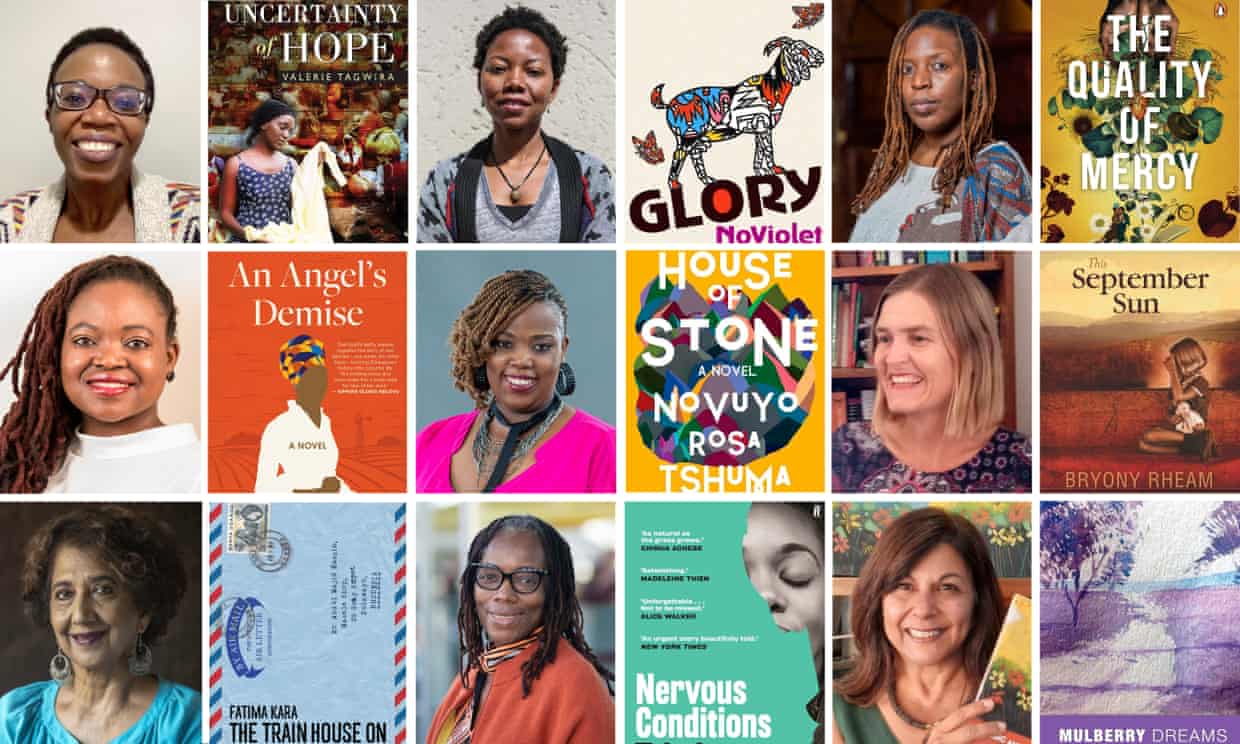
Photo: Vincent Tullo/The Guardian.
Tony Tulathimutte won the Whiting award for his first novel, Private Citizens. To support his writing, he gives workshops that have launched other writers.

The other day I heard a watercolor artist talk about having an MBA and an investment career before switching to art. Several people in her audience noted that most painters don’t have such a good foundation for income and often support themselves with more menial jobs.

A recent interview in the Guardian shows a Brooklyn novelist finding a still different way to support his art.

Isabel Slone writes, “The list of past guest speakers at Crit, the writing workshop that author Tony Tulathimutte runs out of his Brooklyn apartment, reads like a veritable who’s who of 21st-century literary greats. … And while Tulathimutte describes himself as ‘literally just some guy’ on his website, he’s won an O Henry award, and former students like Beth Morgan and Rax King have gone on to earn lucrative book deals and win highly prestigious prizes.

“Tulathimutte, 39, founded Crit in 2017 after winning the Whiting award for his first novel, Private Citizens. While he had previously taught courses at Sarah Lawrence College and the University of Massachusetts, and led workshops for indie companies like Sackett Street Writers, these gigs came and went.

“Running his own school seemed like a more sustainable way to make a living while maintaining his career as an author (Tulathimutte announced the sale of his second novel, Rejection, earlier this year). According to the US Bureau of Labor Statistics, writers and authors earn on average $69,510 a year, while an alarming Authors Guild survey showed that its members drew a median income of $6,080 in 2017, down 42% from 2009. …

“Crit accepts nine students per session. They meet twice a week (Wednesdays and Fridays) over the course of two months. Spots cost $800, netting Tulathimutte approximately $30,000 per year. He supplements his income by accepting freelance writing assignments and visiting-faculty positions. He is currently a thesis adviser at Brooklyn College.

“In the six years since Crit’s inception, Tulathimutte has managed to build not just a successful side hustle, but a thriving community of writers. He hosts book swaps, parties, even a dedicated Slack channel where alumni can chitchat, form casual writing groups and perhaps land a connection to the agent or editor who will launch their career.

Guardian: What was the impetus for founding Crit?
“Tulathimutte: I just thought I could design the class I would have wanted to take. Most MFA programs function more like book clubs or discussion groups, where people are reading your work and giving feedback. I try to do formal pedagogy in the class, so I came up with 16 lectures breaking down different aspects of craft and process, such as ‘What is plot? or ‘What is dialogue?’ Students find the career-oriented class especially of interest because [practical matters] very often get neglected in the academy. It’s the last class of the course and it goes on indefinitely. My record is 11 hours and 45 minutes.

Why is it important for you to teach practical skills like money management?
“Most working writers I know slap together a bunch of different sources of income. On the side, I take visiting faculty gigs, pitch articles, freelance as a novel editor and writing consultant, and shoot author photos. Plus, there’s the very occasional windfall from book-related things like speaking engagements and selling foreign rights or film and TV options.

“I teach students how to cobble together different income streams to create something workable. Usually I talk about whatever grants, fellowships, residencies, contests, funded MFAs and other things I think are worth applying for, but I’ve also talked about Roth IRAs, eligible tax deductions from writing income, speakers bureaus, negotiating freelance rates, loan forgiveness programs and so on.

“Does it feel harder to make a living as a writer now than it did in the past?
“It’s definitely harder now, with so many media companies and publication venues folding and ever fewer places to publish book-related content. …

“Crit students have landed 12 book deals to date. What about your classes gives them a competitive edge?
“I think that a lot of my students would have succeeded just fine eventually. I could point to some writers and say, ‘I introduced them to their agent,’ to others, ‘I made X and Y notes on their manuscript,’ but who knows if that increased or decreased their selling prospects. …

How have you managed to get the word out?
“In the beginning, my only marketing strategy was to ask a couple of my more famous friends, like Jenny Zhang [and] Carmen Maria Machado, to retweet me. The slight bump in visibility was enough to get a handful of people signing up for the first few classes. After the first year, the balance shifted to 50/50 Twitter and word of mouth. Now it’s almost entirely word of mouth.

“How do you manage to convince people like Jonathan Franzen to visit your class?
“I email them. … Jonathan Franzen was a massive get, obviously. He asked me to moderate one of his book launch events for Crossroads in 2021 and after the event I asked if he’d like to guest and he said yes. I just figure there’s no harm in asking.”

More at the Guardian, here. No firewall. Can’t agree it’s harder now. Read New Grub Street.

Lost Mayan Kingdom

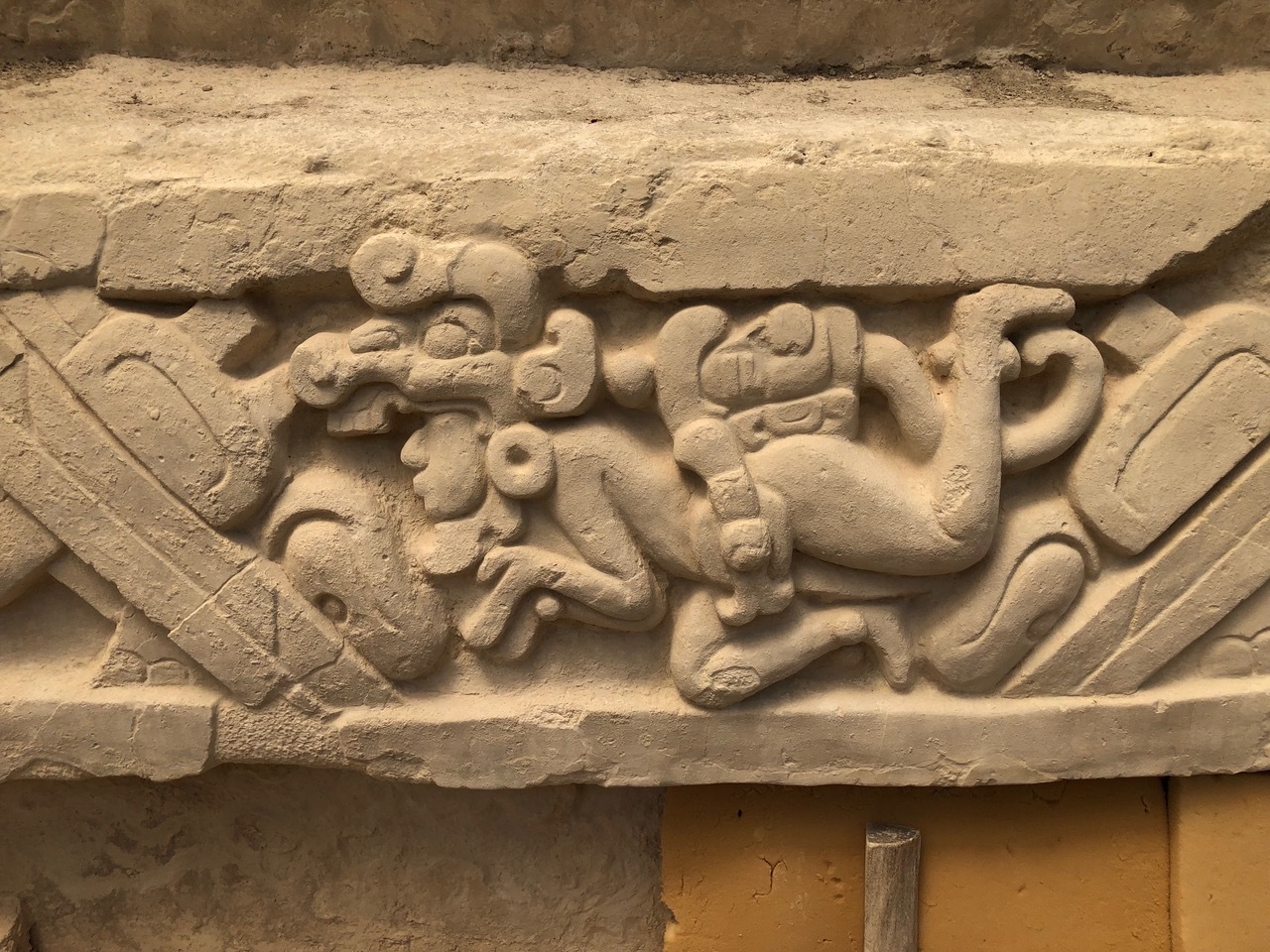
Photo: Richard Hansen.
Some of the elaborate carvings researchers uncovered from the Preclassic Maya.

New tools make it possible for archaeologists to discover sites that were densely covered with vegetation. In Guatemala, as a result, almost every day leads to surprising revelations. You wouldn’t think that new insights on the Mayan culture would create controversy, but read on.

Maya Pontone reports at Hyperallergic, “Scientists have uncovered an extraordinary network of Preclassic Maya multi-tiered cities, towns, and villages that date back to 1,000 BCE in Guatemala. The findings indicate a previously unknown culturally and economically complex kingdom-state, dispelling previous beliefs of ‘sparse early human occupation in the Maya Lowlands’ and raising new anthropological questions about this ancient society, according to a research report published in the Cambridge University Press journal Ancient Mesoamerica in December.

“Using airborne light detection and ranging technology (LiDAR), the archaeologists were able to map out 964 lost settlements, which they consolidated into roughly 417 ancient towns, villages, and cities. The team also identified over 100 miles of interconnected roadway. The clusters of sites were found within the Mirador-Calakmul Karst Basin (MCKB), an area that spans northern Guatemala and southern Campeche, Mexico. Like much of the Maya Lowlands, this basin has historically been difficult for archaeologists to explore due to its dense tropical forest terrain, according to the report. New technologies such as LiDAR, however, have created more opportunities in recent years for scientists to conduct this research.

“Beginning in 2015, researchers conducted two aerial surveys using LiDAR at altitudes as high as 2,100 feet. Remote sensing technology works by bouncing pulses of light off of surfaces. The time it takes for these pulses to return to the sensor is then used to determine the distance between the receptor and the surface, allowing scientists to build a detailed map of an area’s environment.

“These analyses found ‘dense concentrations’ of sites including ceremonial and religious complexes, massive triadic constructions, at least 30 ball courts, reservoirs and terraces, defensive structures, villages, and a web of raised causeways. The labor that such constructions would have required suggest ‘a power to organize thousands of workers and specialists,’ the report reads, from lithic [stone] technicians and architects to legal enforcement and religious officials.

“One of these labor-intensive constructions identified from the LiDAR surveys includes the pyramid of Danta. Located east of the El Mirador settlement, this monumental complex stands 236 feet tall, and researchers estimate it required ‘between 6 and 10 million person-days of labor’ to erect.

“Additionally, outside of small marshes, the MCKB lacks perennial bodies of water, which forced the ancient Maya to build alternative systems for water collection and management. Researchers identified 195 artificial water reservoirs, or aguadas, as well as a series of major reservoir systems including dams and canals. 

“Richard Hansen has been researching the early Maya in northern Guatemala for over 38 years. As the director of the Mirador Basin Project, he has been recognized for uncovering major ancient sites in Central America. But in recent years, critics have accused his practices of going against the wishes of local Guatemalan communities. Last month during the Los Angeles Times Festival of Books, demonstrators disrupted a talk Hansen was giving at the University of Southern California, shouting ‘This is stolen land!’ …

“Hansen has also received backlash for his work on the Mirador-Calakmul Basin Maya Security and Conservation Partnership Act, a bipartisan-backed bill introduced to the Senate in 2019. The proposed bill aimed ‘to create a sustainable tourism model’ that would give ‘low-impact, controlled access’ to the MCKB. … While Hansen argues that this bill would provide protections for the area and support local communities, critics have claimed that the act would open up the basin to large-scale tourism.

“In response, Hansen claims that all these criticisms stem from the same source — an alleged misinformation campaign orchestrated by organized crime groups in Guatemala who ‘do not want the security and conservation of that area.’ He said his research has always supported the economic and educational development of communities by hiring and training locals.”

We will have to stay tuned to see how this all shakes out.

More at Hyperallergic, here.

Iron Age Woman Warrior

Photo: Historic England Archive.
An aerial view of the Isles of Scilly, with St Martin’s in center left and Tresco and Bryher in the background. 
A discovery on Bryher has led to insight into women warriors.

Today’s archaeological story is set in a British island cluster with a name that sounds like “silly.” A discovery there adds to the evidence that there have always been women who have served in male bastions.

Caroline Davies reports at the Guardian, “For decades archaeologists have puzzled over whether the stone-lined burial chamber, which was discovered in 1999 on Bryher Island, contained the remains of a man or a woman.

“Excavations revealed a sword in a copper alloy scabbard and a shield alongside the remains of the sole individual, objects commonly associated with men. But a brooch and a bronze mirror, adorned with what appears to be a sun disc motif and usually associated with women, were also found. The grave is unique in iron age western Europe for containing both mirror and sword.

“Now a scientific study led by Historic England has determined the remains are that of a woman, a discovery that could shed light on the role of female warriors during a period in which violence between communities is thought to have been a fact of life.

“Original attempts to establish sex by traditional methods, such as DNA analysis, failed because of disintegration of the bones. All that could be seen of the skeleton was a dark soil stain where the body had once lain, with only small pieces of bone and teeth. …

“Scientific advances, in particular the development of a sophisticated technique at the University of California, Davis, meant it was possible to test tooth enamel, according to research findings published in the Journal of Archaeological Science: Reports.

“Dr Glendon Parker, an adjunct associate professor in the department of environmental toxicology at UC Davis, said: ‘Tooth enamel is the hardest and most durable substance in the human body. It contains a protein with links to either the X or Y chromosome, which means it can be used to determine sex. This is useful because this protein survives well compared to DNA.

“ ‘Our analysis involved extracting traces of proteins from tiny pieces of the surviving tooth enamel. This allowed us to calculate a 96% probability that the individual was female.’

“The main form of warfare 2,000 years ago is likely to have been raids – surprise attacks – on enemy settlements. The mirror and weapons found in the grave are all associated with warfare.

“It is thought that mirrors may have be used in the iron age for signaling, communicating and coordinating attacks. They also had ritualistic functions, as a tool to communicate with the supernatural world to ensure the success of a raid or ‘cleanse’ warriors on their return.

“Dr Sarah Stark, a human skeletal biologist at Historic England, said … ‘Although we can never know completely about the symbolism of objects found in graves, the combination of a sword and a mirror suggests this woman had high status within her community and may have played a commanding role in local warfare, organizing or leading raids on rival groups. …

” ‘This could suggest that female involvement in raiding and other types of violence was more common in iron age society than we’ve previously thought, and it could have laid the foundations from which leaders like Boudicca would later emerge.’ ”

I guess all British people know who that is, but since I don’t, I went to Wikipedia.

“Boudica was a queen of the ancient British Iceni tribe, who led a failed uprising against the conquering forces of the Roman Empire in AD 60 or 61. She is considered a British national heroine and a symbol of the struggle for justice and independence.

“Boudica’s husband Prasutagus, with whom she had two daughters, ruled as a nominally independent ally of Rome. He left his kingdom jointly to his daughters and to the Roman emperor in his will. When he died, his will was ignored, and the kingdom was annexed and his property taken. … The historian Cassius Dio wrote that previous imperial donations to influential Britons were confiscated and the Roman financier and philosopher Seneca called in the loans he had forced on the reluctant Britons.

“In 60/61, Boudica led the Iceni and other British tribes in revolt. They destroyed Camulodunum (modern Colchester) … at that time a colonia for discharged Roman soldiers. Upon hearing of the revolt, the Roman governor Gaius Suetonius Paulinus hurried from the island of Mona (modern Anglesey) to Londinium, the 20-year-old commercial settlement that was the rebels’ next target.

“Unable to defend the settlement, he evacuated and abandoned it. Boudica’s army defeated a detachment of the Legio IX Hispana, and burnt both Londinium and Verulamium. In all, an estimated 70,000–80,000 Romans and Britons were killed by Boudica’s followers. Suetonius, meanwhile, regrouped his forces, possibly in the West Midlands, and despite being heavily outnumbered, he decisively defeated the Britons. Boudica died, by suicide or illness, shortly afterwards. The crisis of 60/61 caused Nero to consider withdrawing all his imperial forces from Britain, but Suetonius’s victory over Boudica confirmed Roman control of the province.”

More at the Guardian, here. No firewall. Donations encouraged.