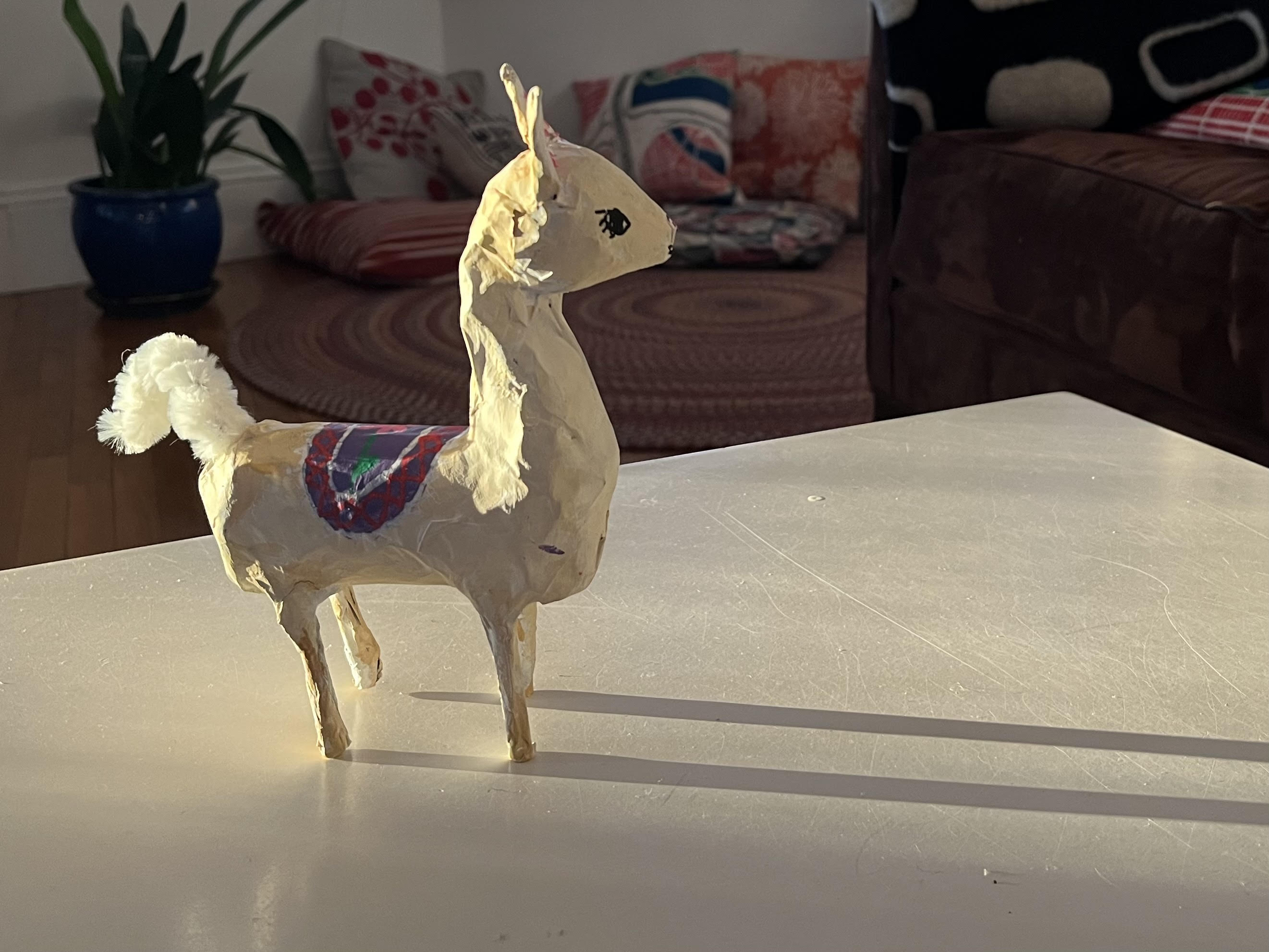
Photo: Suzanne and John’s Mom. Paper maché llama by my younger granddaughter.
We’ve had so many gray days this winter, I assigned myself the job of taking a photo whenever the sun is out creating shadows. I don’t always manage it, but at least I make a point of noticing and thinking about something that would have made a good photo: the shadow of the wilted flowers I was carrying to the compost bin (I couldn’t shoot it one-handed), the shadow of pine branches on an old shed (the modern combination lock would have spoiled the shot).
Today, I’m starting with the early morning shadow of an artistic grandchild’s llama. (Or did she say it was an alpaca?)
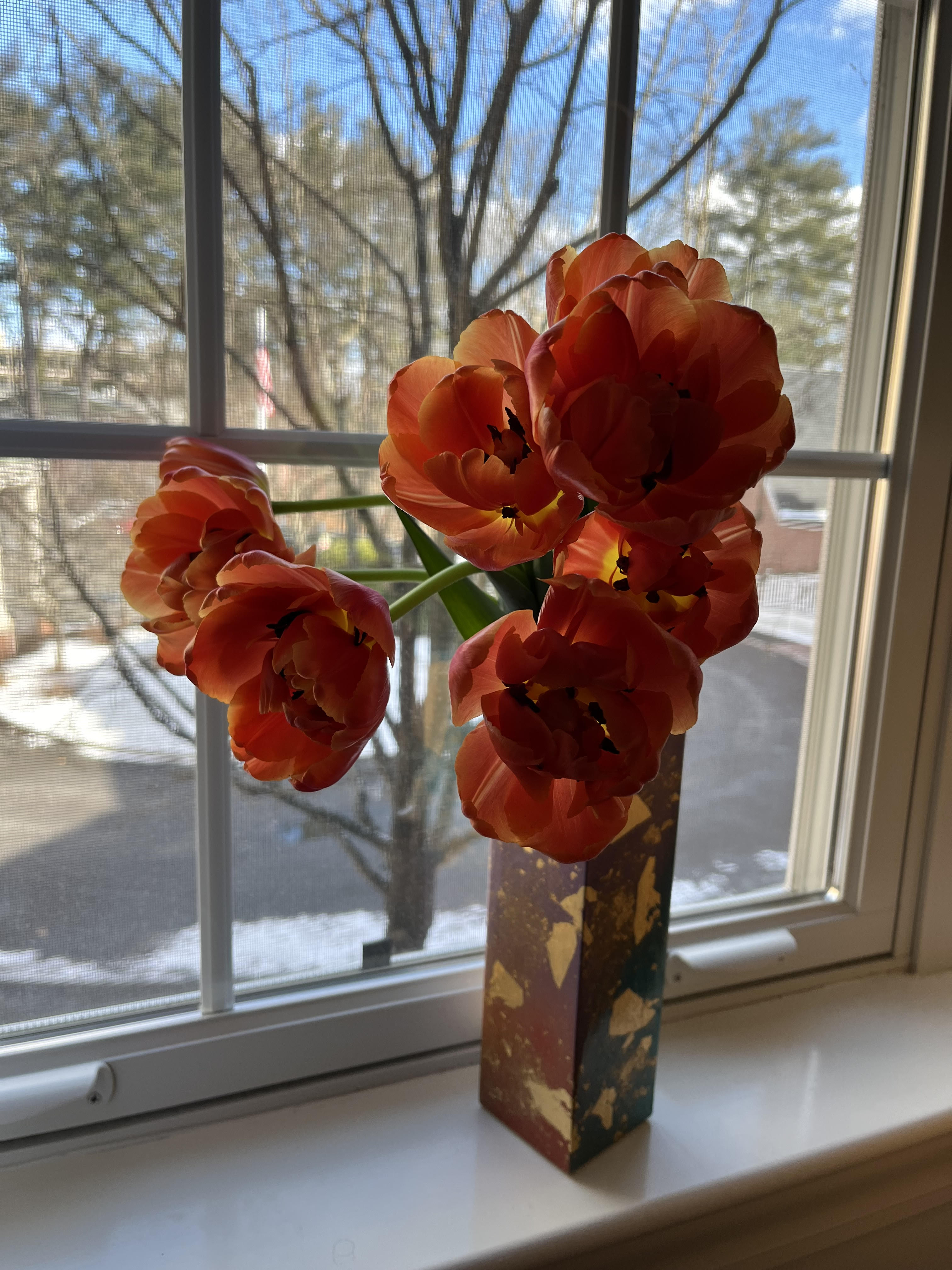
Here are the flowers before they went to the compost bin. Then the garden plots near the bin, waiting under blue sky and a blanket of snow for spring and new uses for compost. Blue sky with pine cones. Blue sky in the creek. Blue sky in the rail trail mural.
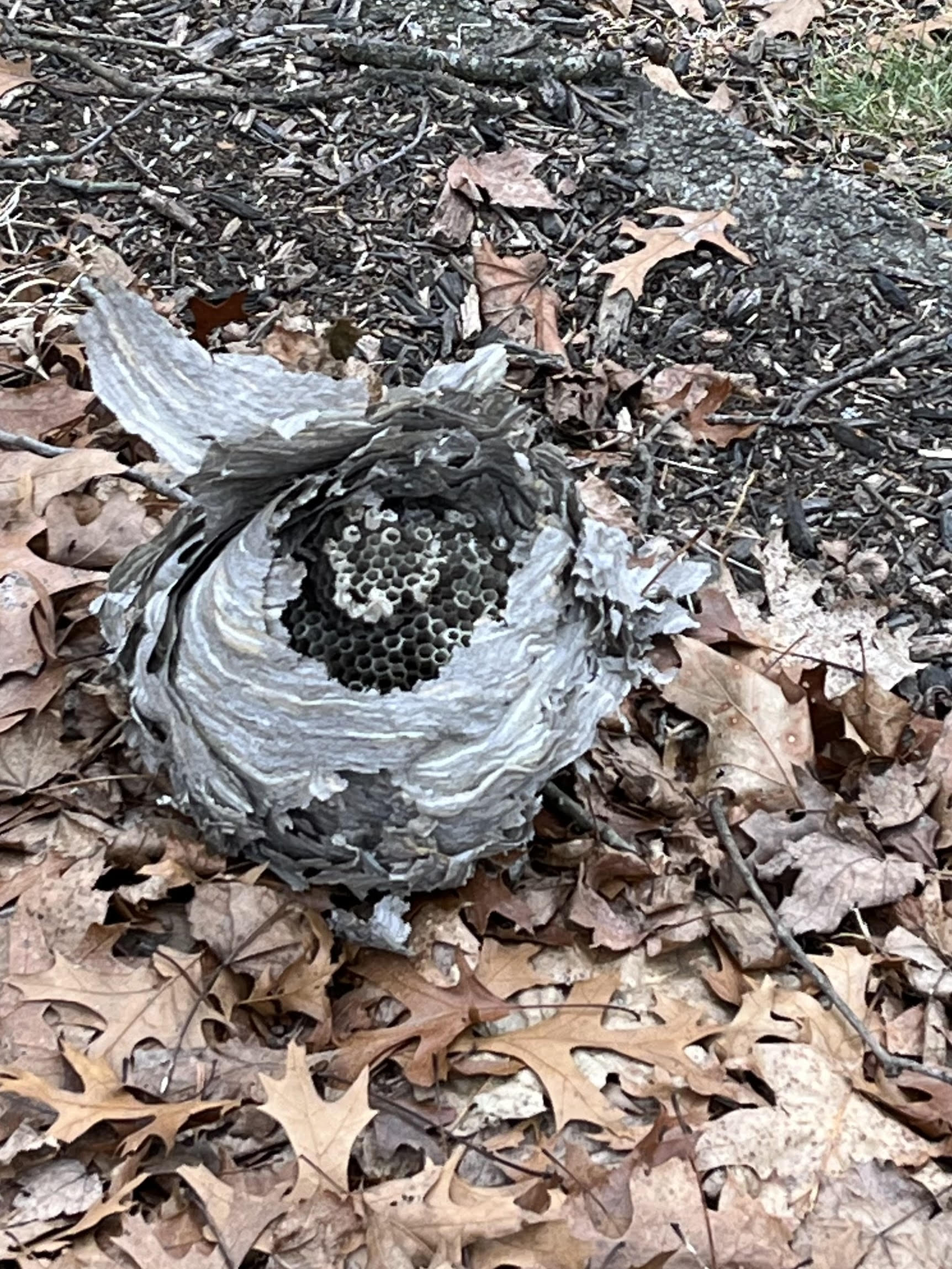
Next we have blue juniper berries and the wasp nest’s fate after the big wind.
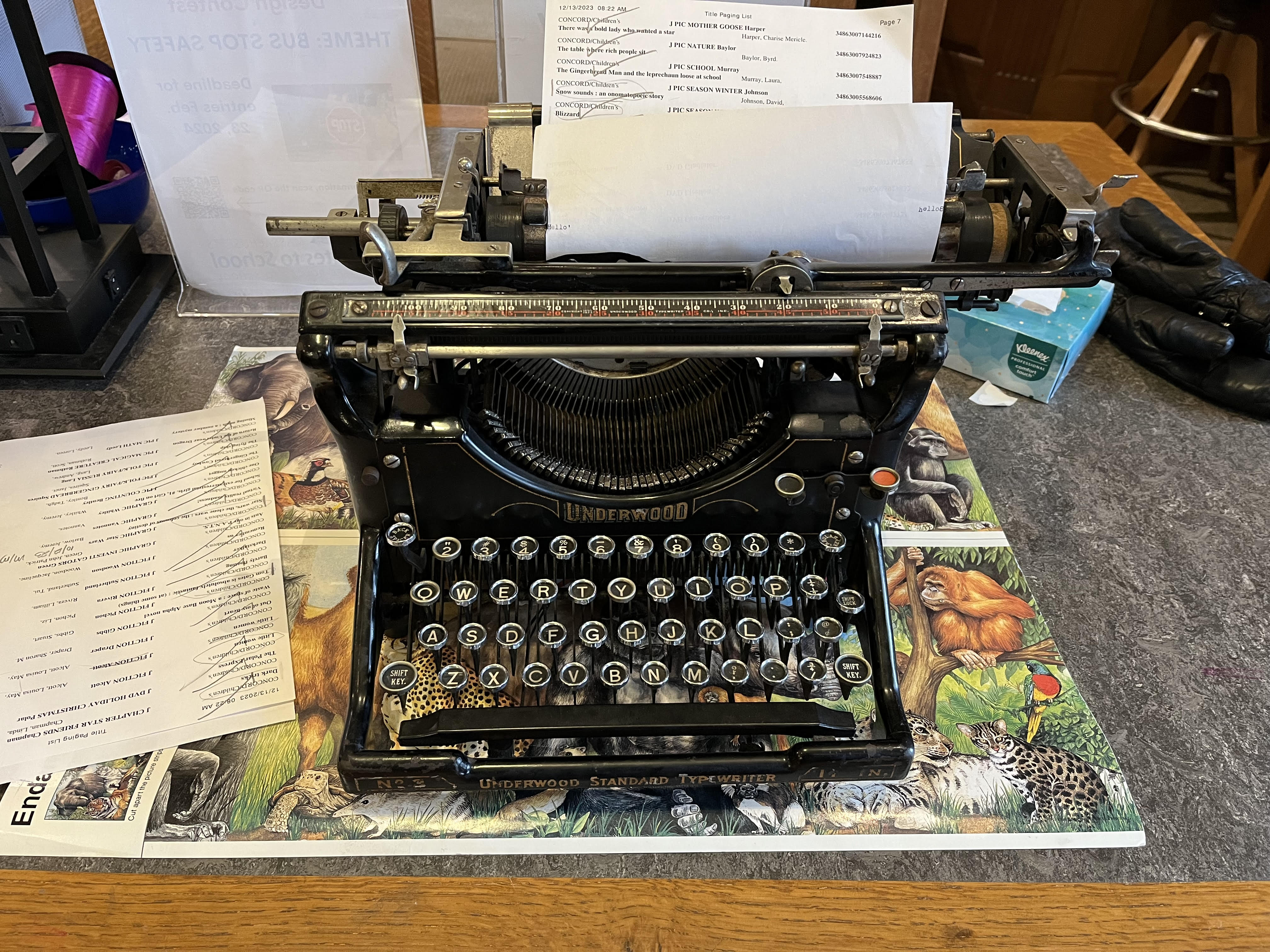
Moving indoors to the local library, I noted the old-time typewriter that kids are invited to play around with.
Also indoors are two works newly exhibited in my retirement community: Bayda Asbridge‘s take on San Diego and her delightful “Our Village.”
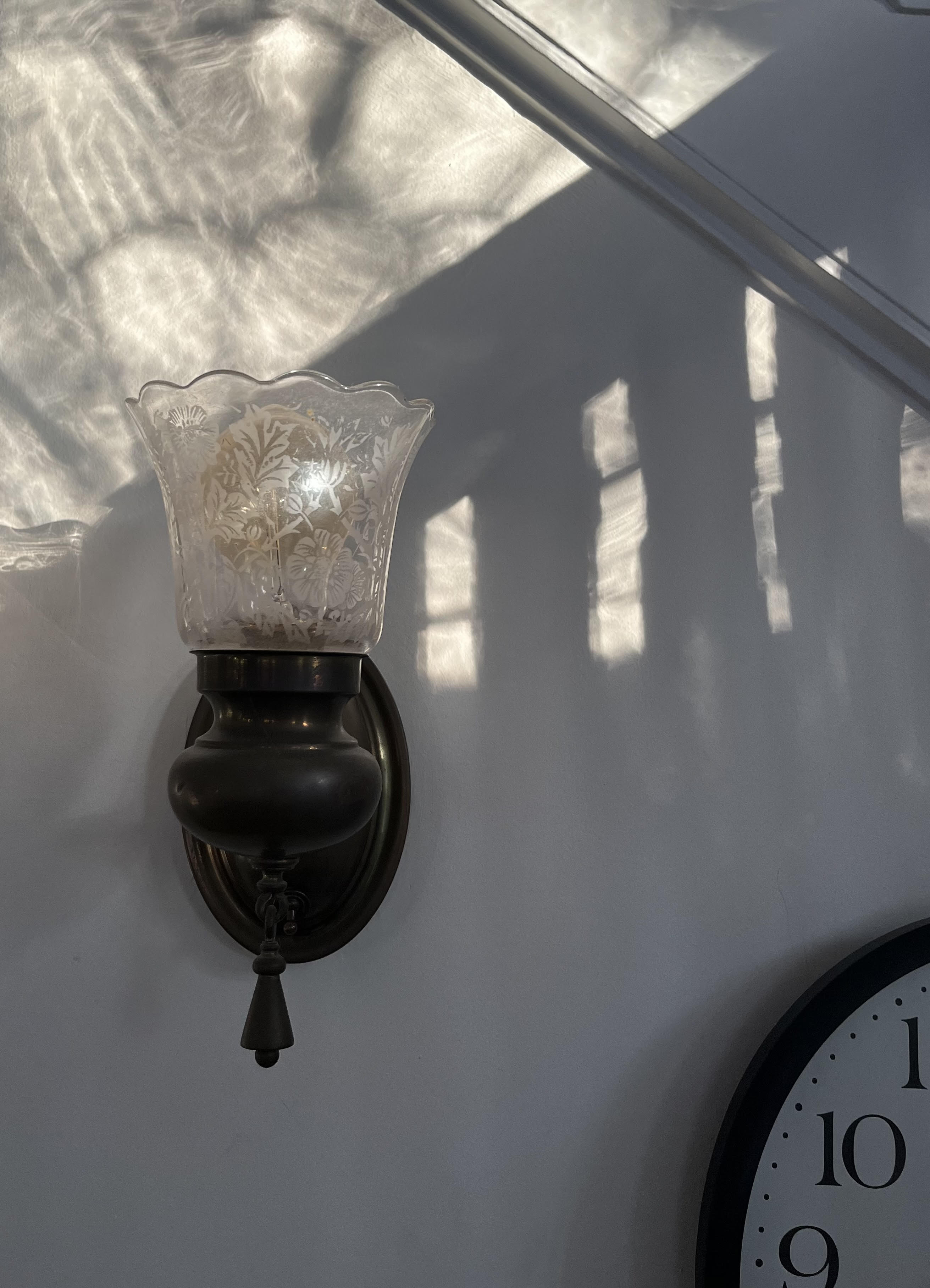
Finally, I was planning to shoot only Suzanne’s light fixture and the shadows, but then the clock spoke to me.
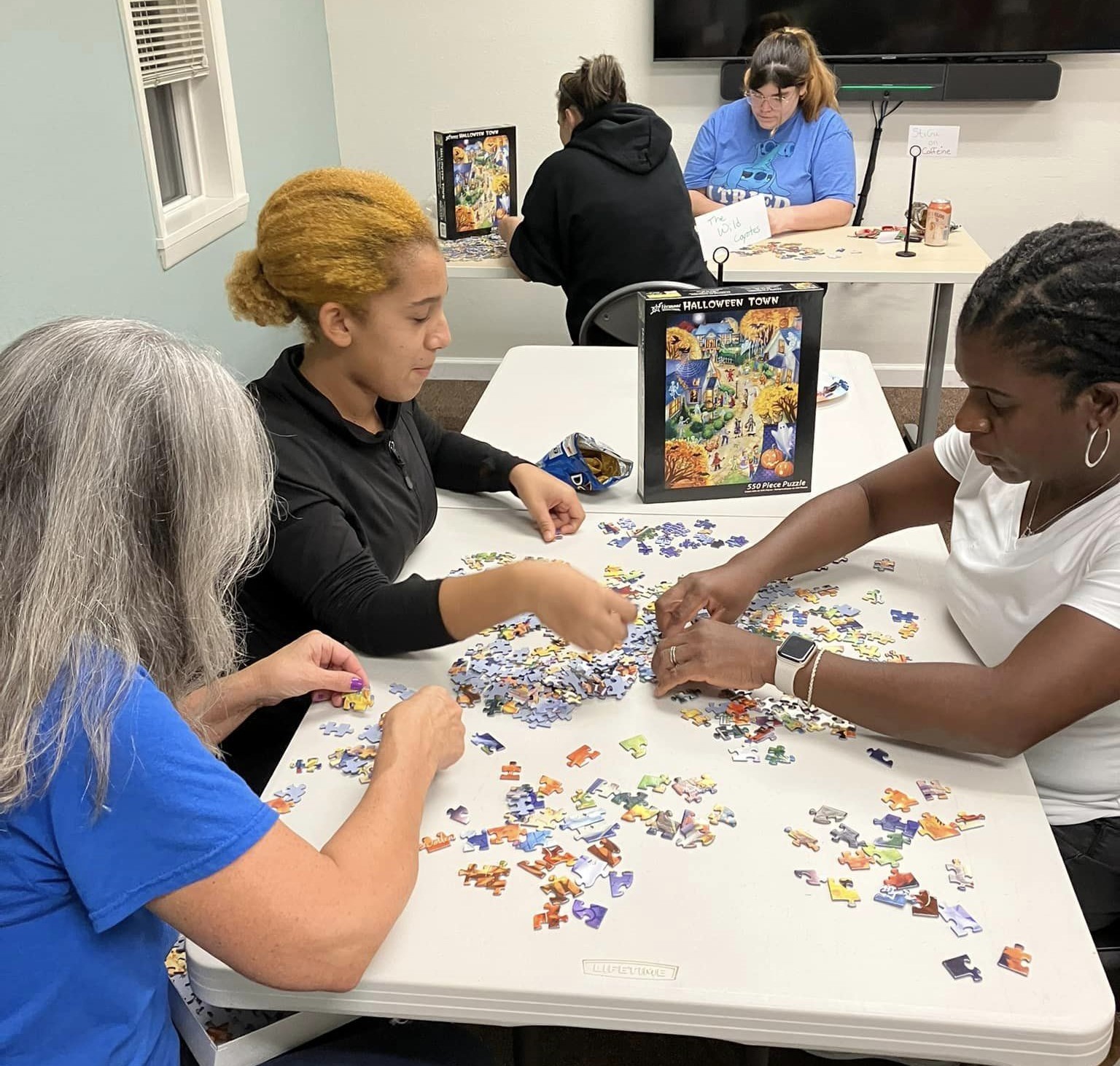
Photo: Clatskanie Library District via Oregon ArtsWatch. The Clatskanie Library hosted a Halloween puzzle race last fall. “We want to be the community hub,” says library director Maryanne Hirning. “I want everyone to find something at the library.”
It would be hard to overstate the value of a library to a community, a refuge in so many ways. Remember the safe haven in Ferguson, Missouri, during the riots that erupted after the police killing of black teen Michael Brown? I have been following that library on Twitter since 2014 and am impressed with their services in calmer times, too.
At Oregon ArtsWatch, Amanda Waldroupe writes that libraries are often the heart and soul of rural communities.
“During the celebration of [the town of] Maupin’s centennial anniversary last year, its public library – the Southern Wasco County Library – printed a second edition of Chaff in the Wind: Gleanings of the Maupin Community.
“Chaff in the Wind is a history of Maupin and Wasco County that the library’s Friends’ group originally published in 1986. The library commissioned new chapters covering Maupin’s history since then.
“Another era also needed to be added: There was nothing about the region’s history before white people settled there, even though Native Americans had lived in the region for hundreds of years. So, Valerie Stephenson, the library’s director, reached out to the Confederated Tribes of Warm Springs.
“Delson Suppah, the Warm Springs’ cultural program coordinator, agreed to contribute – but not through writing a book chapter. Like many Indigenous cultures, the Warm Springs tribe conveys its history through oral storytelling. In two events, Suppah gave an oral history of the Warm Springs tribe’s history and presence in the area.
“Grant funding – in this case, $4,000 from Oregon Humanities – paid for the events and republishing the book. Without the grant, Stephenson said, none of it would have happened. …
“Oregon’s public libraries are well loved and well used, with one of the highest per capita circulation rates in the country.Public libraries are among the last institutions that are free and open to the general public, making them a natural gathering space for adults and children. …
“Libraries have always played a critical role in early literacy: teaching kids how to read, hosting summer reading programs, and reading and story time events for different age groups. Libraries were also early adopters in providing free access to computers and fast, broadband internet.
“Even before the COVID-19 pandemic prompted libraries to begin offering virtual and online services, libraries’ services were expanding to take on roles that blend information literacy, social, and community services. Library staff are increasingly being trained in basic mental health crisis response and how to administer Narcan or naloxone to people experiencing an opiate overdose. To serve growing numbers of immigrant communities, libraries are acquiring books in languages other than English, bilingual books, and hiring staff who speak languages in addition to English, especially Spanish.
“In many communities, libraries are a place where people experiencing homelessness can spend the day, where senior citizens find social interaction, and where kids can go after school.
“ ‘Libraries are places where people from all different backgrounds can interact,’ Buzzy Nielsen, a program manager for the State Library of Oregon, said. …
“That is especially the case in rural Oregon, where libraries are often the only places that host arts and cultural events.
“[Southern Wasco County Library] has a conference room large enough to host governmental, board, and other community meetings. The library hosts social workers from the Wasco County Health Department, who come to meet with residents and process applications for the Oregon Health Plan, SNAP benefits, disability, and other services. …
“Clatskanie’s library has started a young adult book club and hosted classes on flower arranging and cookie decorating, both taught by local business owners. …
“Libraries have also created Libraries of Things, where patrons can check out items ranging from e-readers with pre-downloaded e-books; ukuleles and other musical instruments; pots, pans, and other cooking equipment; fishing poles; and for kids, telescopes and science kits. …
“Libraries of Things reflect their community. Harney County’s library checks out canners, dehydrators, and other items necessary to preserve food.
“Wi-Fi hotspots are another common offering. Stephenson, Hancock, and others said the availability of fast, broadband internet in rural Oregon can be nonexistent. …
“Hancock said, ‘We have a lot of spots that aren’t served by internet companies.’ The library’s ten Wi-Fi hotspots are always checked out with holds placed on them. ‘They are hugely popular, she said. …
“With the expansion of library services, circulation has dramatically increased for a library’s most fundamental offering – books. [Maryanne Hirning, director of the Clatskanie Library District] said book circulation has increased by 400 percent. Other librarians say that once someone attends an event at a library, they are more likely to consider other services the library offers, become a member, and check out books.”
Blogger Laurie Graves has long understood that librarians are superheroes. And through her Great Library fantasy series, she shows that threats to libraries can be a matter of life and death.
Photo: Getty Images. This is a poster for a little known Gilbert and Sullivan musical called Utopia Limited, 1894.
Recently a long-lost George Gershwin musical came to light. Because my friend Lynn, a retired cabaret artist and songwriter, was a Gershwin fan from an early age and a friend of George’s brother Ira in later years, I sent her the link to the story. She was thrilled.
Finding new work by a hero would thrill anyone. That’s why the Englishman in today’s article is going all out to find a missing Gilbert and Sullivan, even making his email public.
David Sillito writes at the BBC, “A call has gone out for people to check shelves and lofts for a missing opera. The original score of Gilbert and Sullivan’s Utopia Limited was sold in 1915, but its whereabouts are unknown. …
“Musical researcher Colin Jagger has been tracking down [Gilbert and Sullivan’s] original scores, saying current copies often have mistakes and omissions.
” ‘The [current] score [of Utopia Limited] is completely unreliable. The only way [to be sure] is to go to Sullivan’s autograph manuscript,’ he said.
“When the operas were first created, copyright law, as understood today, barely existed, and so the company that performed the works, D’Oyly Carte, kept tight control of the scores and any copies. The versions used today often reflect how D’Oyly Carte performed the works, rather than Gilbert and Sullivan’s original intentions. …
“The objective now is to return to the originals, and create complete and corrected scores. But the project cannot be finished until the lost opera is found.
” ‘All of these manuscripts … you can access mostly in the UK or one or two in the US. So I can go into the British Library and I can look at The Grand Duke in Sullivan’s own hand, and I can take photographs of it. I can study it away from the library as well. And I can go (online) to the Morgan Library in New York … and I can see a beautifully done copy of the manuscript of Trial by Jury. They’re all there except for one.’
“Utopia Limited is one of Gilbert and Sullivan’s less successful works. It’s a story based around the problems and consequences of the introduction of limited liability laws in the 19th Century. Essentially, it’s a satire about business people leaving their creditors in the lurch.
“The score was sold at auction in 1915 for 50 guineas to Sir Robert Hudson of Hill Hall in Essex. Sir Robert died in 1927 and Hill Hall went on to house prisoners-of-war, and later became a women’s prison. Where the score for Utopia Limited went is a mystery.
“Colin Jagger is convinced it has survived and is sitting on a shelf somewhere. … ‘It would be awful to think it had been thrown away. … Somebody maybe doesn’t know they’ve got it or they might not know who Gilbert and Sullivan are.’ “
Photo: NOAA [National Oceanic and Atmospheric Administration]. The return of seagrass in Florida is a hopeful sign for the embattled manatee.
One doesn’t normally think of Florida politicians as being big environmentalists, but whatever their motivations for supporting cleaner water, one has to cheer them for putting some funding behind it. Florida treasures like the manatee need the help.
Richard Luscombereports for the Guardian, “A picturesque expanse of water along Florida’s space coast is offering a modicum of hope for the state’s embattled manatees as wildlife officials review whether to restore the beloved sea cows to the endangered species list.
“The recovery of seagrass, the manatees’ favorite food, in Mosquito Lagoon means that an emergency hand-feeding program that has kept many of the starving aquatic animals alive over the last two winters can be discontinued, at least temporarily.
“While scientists say this might be only a small step in the wider fight to rescue a species that has seen a record die-off in recent years from water pollution and habitat loss, what’s happened at Mosquito Lagoon offers signposts to how the manatees’ battle for survival might ultimately be won.
“ ‘At least in a portion of the lagoon, we are seeing a rather rapid resurgence of the Halodule variety of seagrass that, even if we don’t know exactly how it happened, does tell us that it’s much more resilient than we might have been thinking,’ said Dennis Hanisak, a professor of marine botany at Florida Atlantic University’s Harbor Branch Oceanographic Institute, and director of its seagrass nursery. …
“Hanisak and his team, in partnership with the Florida fish and wildlife commission (FWC), have focused their restoration efforts on the lagoon in northern Brevard county, one of the most popular feeding grounds for manatees during the colder winter months.
“That’s where the majority of manatee deaths, an unprecedented 1,100 in Florida in 2021, 10% of the population, and another 800 in 2022, occurred. They were part of what federal and state authorities classify as an ongoing unusual mortality event (UME) with the majority of fatalities through malnutrition and starvation, a reflection of the loss of about 90% of the lagoon’s seagrass to algae blooms and pollutants.
“It’s too early to say exactly what role the seagrass nursery project has had there; Hanisak says it has ramped up in size and resources in recent years as wildlife agencies respond to the disaster with improved funding.
“It’s one of several projects underway in Florida [and] a prominent component of a catalog of FWC manatee habitat restoration schemes, themed mostly around improvements in water quality and aquatic vegetation, that experts believe has potential to turn years of declining numbers into a robust recovery. …
“[In January], Florida’s governor Ron DeSantis announced a $100m award of state funds for water-quality improvements in the Indian River Lagoon, one of North America’s most biologically diverse waterways. The cleaner the water, the better the seagrass. …
“Hanisak and his students have steadily been building the capacity of the seagrass nursery at multiple locations. That seagrass will ultimately be transplanted into the Indian River Lagoon and elsewhere. …
“It remains to be seen if this year’s drop in manatee deaths in Florida is a one-off, or represents the start of a recovery. But more abundant seagrass in Mosquito Lagoon, which led to the welcome suspension of the experimental lettuce-feeding project, bodes well.
“Lawmakers also appear to be at least partly on board. Thompson said the Florida legislature provided an additional $20m in fiscal year 2022-23 to the FWC to enhance captive manatee support facilities and manatee habitat enhancement to supplement the previous year’s $8m. …
“Patrick Rose, a veteran aquatic biologist and executive director of the Save the Manatee Club [said] the extra funding, which his group lobbied for, is welcome [but] ‘a drop in the bucket literally to what needs to be done.’ Ultimately, Rose said, manatees need clear, clean water to survive. Without it, seagrass will not flourish. …
“ ‘Nutrients are the direct cause of harmful algal blooms which have been so intense that they literally cut the light off to the seagrasses, and the seagrasses die,’ he said.”
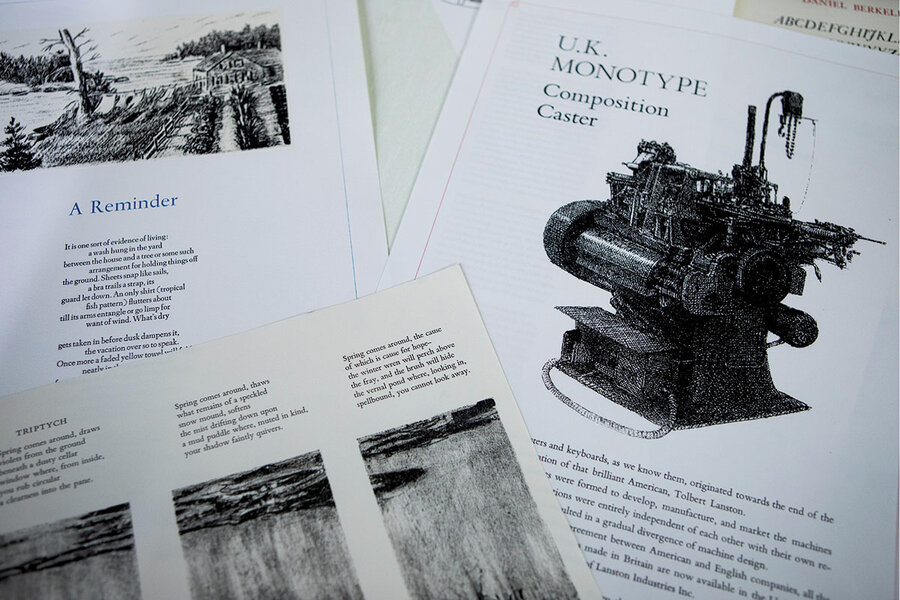
Photo: Melanie Stetson Freeman/CSM staff. In his Maine shop, master printmaker David Wolfe uses machines from bygone eras to create.
Don’t you love the look of old-time lead type printing? I once ordered sweet business cards from a New Shoreham letterpress, no longer operating, and Suzanne has often used Jacque’s Offset in Providence. Today’s story is about a letterpress in Maine that got some attention in the movies.
Jennifer Wolcott reports at the Christian Science Monitor, “Visitors to David Wolfe’s printing shop in Portland, Maine, can’t miss the statuesque Civil War-era Tufts hand-press machine that stands tall near the front door. It exited that same door several years ago, headed for a movie set.
“For its cameo in the 2019 film, his ‘Little Women machine,’ as he calls it, was hauled down to Massachusetts. Mr. Wolfe accompanied it, dressed in 1860s costume for his role as the printer of Jo March’s book. Yet as he recalls, laughing, ‘Only my hands made the cut.’
“Wolfe Editions is a place buzzing with activity. The master printmaker and fine artist treasures his many letterpress machines not only for their place in history, but also for their ability to help him craft exquisitely beautiful books, prints, posters, and more. They are essential tools for daily production, ones that stand out in an ever more high-tech world.
“Rather than using bits and bytes, Mr. Wolfe prints just as Johannes Gutenberg did when he developed the process of letterpress printing in the 15th century to make his famous Bible: Letters are cast in lead, then locked together, inked, and pressed into paper.
“ ‘The computer didn’t kill my business. It made it stronger,’ he says, noting that he’s also benefited from recent interest in the lost art of letterpress printing. ‘The product I make is high end, and computers took over all the other stuff.’ …
“On a recent afternoon, he has just paused production of an edition of John Steinbeck’s Of Mice and Men while waiting for a shipment of handmade paper. He’s using the time instead to create designs for one son’s new canned cocktails company (his other son is a printer). He’s also teaming up with artist and friend Charlie Hewitt to design a poster commemorating the anniversary of Muhammad Ali’s fight in Lewiston, Maine.
“Mr. Hewitt has known Mr. Wolfe for 20 years, has collaborated with him on multiple projects, and happens to have a studio right next door. He says it’s important to the printmaker to pass down the old techniques to a new generation. ‘He is always training and teaching others. He is incredibly generous, remarkably skilled, and brings so much to every medium,’ Mr. Hewitt adds. …
“Mr. Wolfe’s letterpress and hot-metal casting machines, about 10 in all, fill his spacious shop – a former bakery. Despite their age and frequent use, the devices appear impeccably cared for. …
“Not only is he passionate about his work, but it suits him. ‘Letterpress printing couldn’t be more tedious,’ he says. ‘But I like tedium.’ … Lately he’s been mentoring an apprentice, a student from nearby Maine College of Art & Design, who shares his taste in music and also for tedium. ‘I’ll ask Claire to put away the type,’ he says, ‘and she’ll respond, “Oh, I love putting away type!” ‘ …
“Mr. Wolfe has taught at schools in Maine including Bowdoin College, Haystack Mountain School of Crafts, and Gould Academy. He’s also shared his expertise further afield, at Dartmouth College in New Hampshire and Penland School of Craft in North Carolina.
“He most enjoys the workshop format, for its small size and short duration. ‘It’s more intense when you have to cover a lot in a short amount of time, and students in workshops are typically motivated and excited about learning.’ …
“Mr. Hewitt recalls a project he and Mr. Wolfe worked on together: the illuminated neon ‘Hopeful’ sign mounted in 2019 on the roof of Speedwell Projects, a nonprofit gallery in Portland. ‘I wanted to use the word “Hopeful,” and I scribbled it on paper for David,’ he explains. ‘I needed a master printer to facilitate the process and create the font.’
“Mr. Hewitt says he was elated with the design – inspired by the building’s history as an auto dealership, typeface from the badge of a 1940s Packard, and his own love for 1960s counterculture. …
“For his part, Mr. Wolfe relishes collaborations like that one: the process of give and take, the creative energy, the mutual admiration. Or as he puts it, ‘I enjoy helping people realize their ideas. It broadens my scope, and artists are pushing the mediums beyond what they were using before.’ “
Photo: matusgajdos17/500px. Australian researchers say concrete could be 30 percent stronger with charred coffee grounds.
Longtime coffee drinkers know that coffee is good for all sorts of things besides waking you up. Coffee grounds are great in compost, for example, and provide useful nutrients for your garden — nitrogen, potassium, and phosphorous.
But coffee grounds for construction projects? At ScienceAlert, Tessa Koumoundouros describes new research showing the possibilities.
“We could be producing concrete that’s 30 percent stronger by processing and adding charred coffee grounds to the mix, researchers in Australia discovered. Their clever recipe could solve multiple problems at the same time.
“Every year the world produces a staggering 10 billion kilograms (22 billion pounds) of coffee waste globally. Most ends up in landfills. ‘The disposal of organic waste poses an environmental challenge as it emits large amounts of greenhouse gases including methane and carbon dioxide, which contribute to climate change,’ explained RMIT University engineer Rajeev Roychand.
“With a booming construction market globally, there’s also an ever increasing demand for resource intensive concrete causing another set of environmental challenges too.
” ‘The ongoing extraction of natural sand around the world – typically taken from river beds and banks – to meet the rapidly growing demands of the construction industry has a big impact on the environment,’ said RMIT engineer Jie Li. … ‘With a circular-economy approach, we could keep organic waste out of landfill and also better preserve our natural resources like sand.’
“Organic products like coffee grounds can’t be added directly to concrete because they leak chemicals that weaken the building material’s strength. So using low energy levels, the team heated coffee waste to over 350 °C (around 660 °F) while depriving it of oxygen.
“This process is called pyrolyzing. It breaks down the organic molecules, resulting in a porous, carbon-rich charcoal called biochar, that can form bonds with and thereby incorporate itself into the cement matrix. …
“The researchers [are now] testing how the hybrid coffee-cement performs under freeze/thaw cycles, water absorption, abrasions and many more stressors. The team is also working on creating biochars from other organic waste sources, including wood, food waste and agricultural waste. …
“Said RMIT engineer Shannon Kilmartin-Lynch, ‘Inspiration for my research, from an Indigenous perspective, involves Caring for Country, ensuring there’s a sustainable life cycle for all materials.’ “
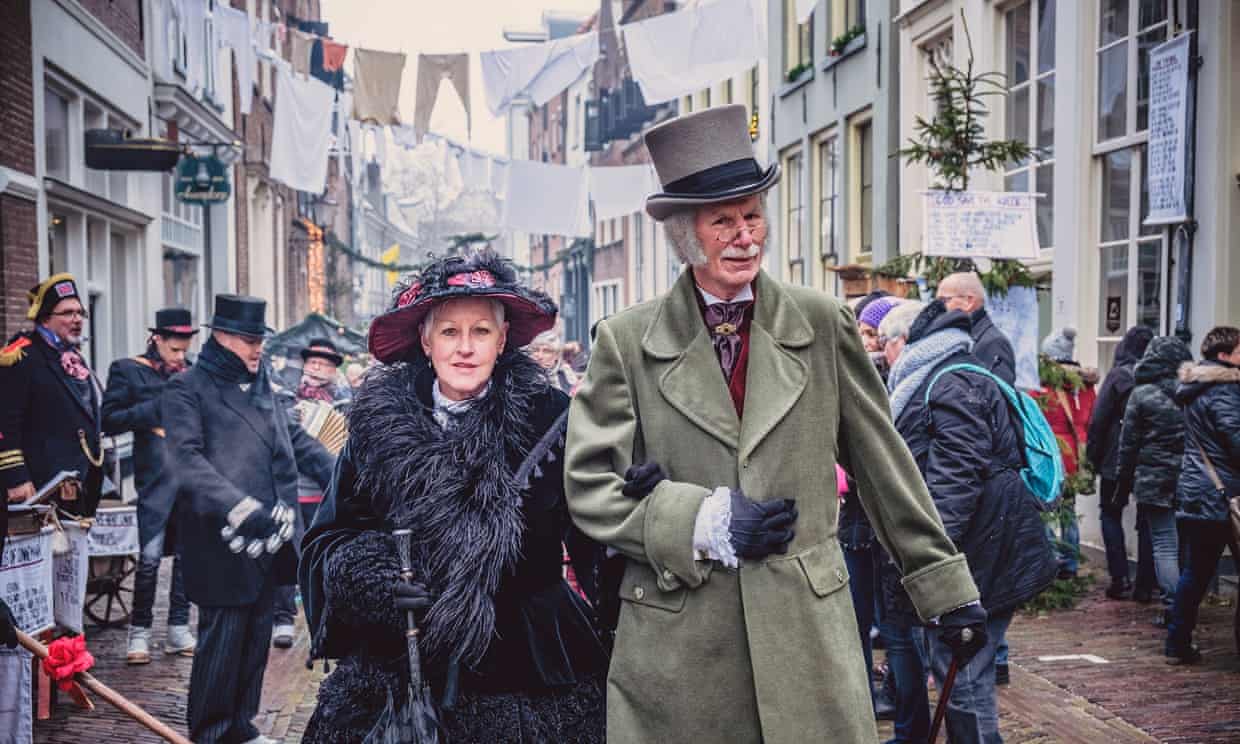
Photo: Sander Korvemaker. Despite no known historical connection with Charles Dickens, this Dutch town plays host to an annual Dickens festival, the world’s largest.
Today’s story about a town that loves Charles Dickens drew me in because I also love Dickens. That is, I love his novels. With the exception of The Old Curiosity Shop and Barnaby Rudge — neither of which I liked — I have read them all multiple times. But I have also read about the man himself and am pretty sure he was not a very nice guy.
The surprising Dickens festival that Senay Boztaswrites about at the Guardian focuses on both the novels and the guy.
Boztas reports, “Soon after limited Sunday trading started in the Netherlands, an anglophile shopkeeper in the small city of Deventer decided it could all be a bit more fun.
“ ‘My 82-year-old mother, Emmy Strik, is England-minded because my grandfather always went to England and read a lot of Dickens,’ said her daughter, Liesbeth Velders, who now runs the Dille & Kamille homeware store. ‘So when we were going to open on Sunday, she decided to make it a fancy-dress party – except the fancy-dress party got a bit out of hand.’
“Decades later, Strik’s experiment in literary frivolity has gone further than she could have imagined. The event she began in 1991 to commemorate Charles Dickens has run for 33 years, with a two-year break during the Covid pandemic.
“Despite no known historical connection with the author, Deventer, in the eastern province of Overijssel, now plays host to what is believed to be the world’s largest Dickens festival. This weekend [in December 2023], 950 volunteers will fill the streets of the ancient Bergkwartier, performing street theatre and selling hot punch and Victorian treats. There are strict rules for actors and traders: no [sneakers], modern watches or mobile phones.
“Among the expected 125,000 visitors will be Ebenezer Scrooge, Tiny Tim, Queen Victoria, Miss Havisham, beggars, thieves and, for the first time, Dickens himself.
“Ojon van Strijland, a bookseller and volunteer at the Dickens Kabinet museum, said he and Strik had learned while on a trip to Kent, where Dickens spent much of his childhood, that authenticity was essential.
“ ‘Years ago, Emmy and I went to [the city of] Rochester’s Dickensian Christmas festival to seek inspiration but there were things there we would not want,’ he said. ‘There were people walking around with Christmas lights on, Santa hats and polyester costumes.’ …
“Strik amassed almost 1,000 authentic costumes, collected enough Dickensian items to fill a museum and grew the Dickens Festijn with commercial sponsorship and support from Events dEVENTer. She has now – largely – handed over the reins to her daughter.
“ ‘We can’t roast chestnuts in big drums any more; there’s a fist-thick book of rules from the fire brigade and the police, but it’s still a real festival,’ said Velders.
“The festival has huge local status. One couple’s 50th wedding anniversary is being incorporated into this year’s edition, while 62-year-old system administrator Wessel Lindeboom is polishing insults in multiple languages for his dream role of Scrooge. …
“At a time when Dutch children’s reading skills are declining, some hope the festival will encourage a wider love of literature. ‘A lot of the visitors have never read a Dickens book but everyone recognizes Scrooge, who walks around calling “humbug!” and insulting people,’ said Velders. ‘There are also storytellers who recount the story of the books.’ …
“The mayor of Deventer, Ron König, hopes visitors will have an enormous amount of fun but also take home a more profound message. ‘The festival beautifully portrays the differences between rich and poor, an issue we are still trying to tackle.’ …
“Peter Jan Margry, professor of European ethnology at Amsterdam University, believes this kind of event provides a welcome break, particularly in dark days. …
“ ‘The festival of Christmas is also about stepping out of your own time into an atmosphere of carols and Christmas trees and a flight from reality,’ he said. ‘But it’s also a form of occupying yourself, a type of tourism, stepping out of your daily life, that you see in all fantasy and live action role-playing. … It’s about stepping into another world.’ “
I hope my blogging friends at Cook and Drink will weigh in on this aspect of life in their beautiful and surprising country.
More at the Guardian, here. No firewall. Subscriptions encouraged.
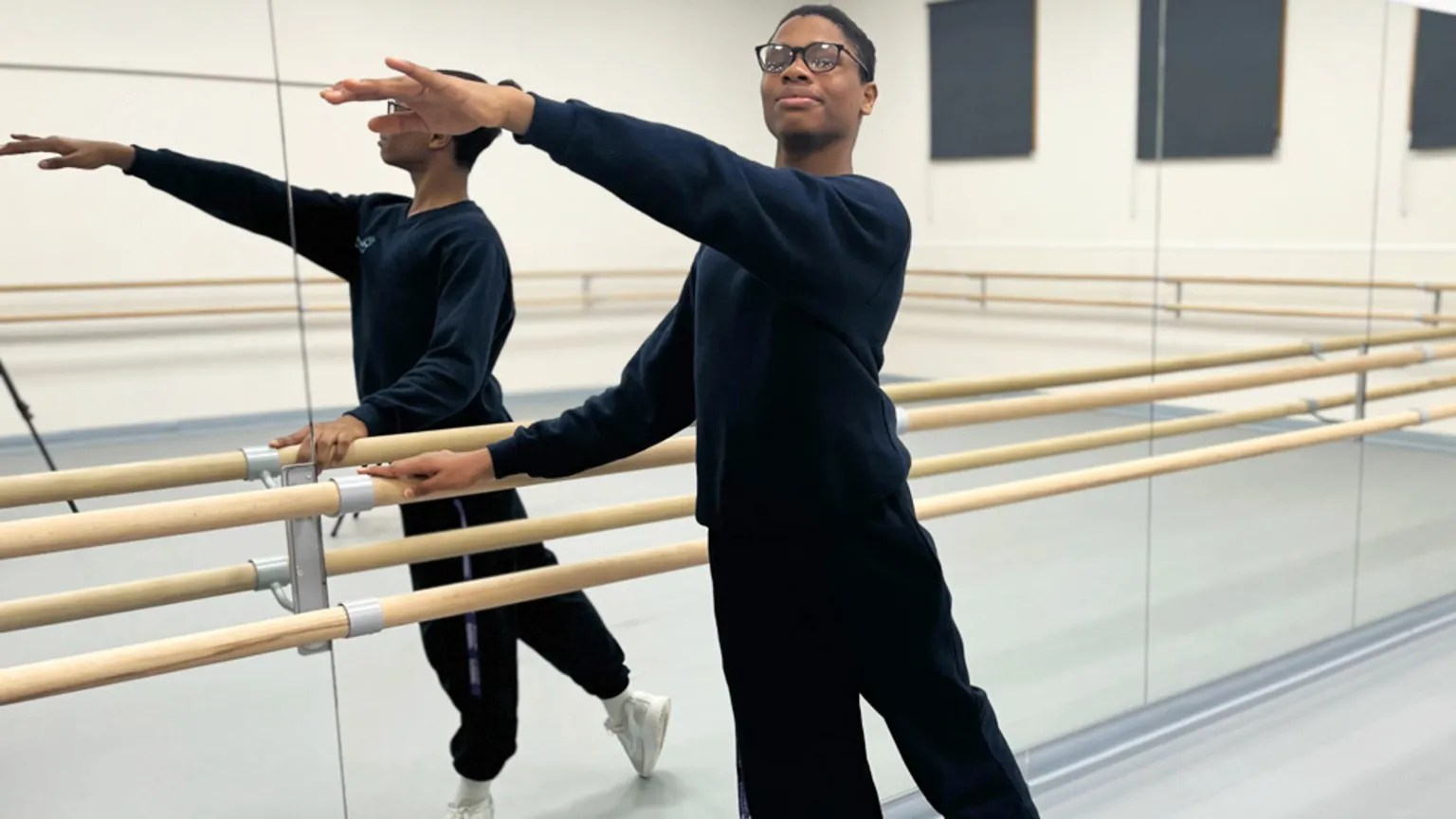
Photo: BBC News. Said Anthony’s mother, “People were telling me that this type of dance is not for boys. But it’s what he loves doing, so I let him go for it.”
The other day, my husband and I were talking about the discovery of the very young Judy Garland (scroll down here) and how the pressures of being a child star really messed her up. Fortunately, many parents of child stars since then have learned to keep a steady hand on the tiller.
Consider the story of the young Nigerian dancer that Jenna Abaakouk writes about at BBC News.
“Dubbed Nigeria’s viral ballet dancer, 13-year-old Anthony Madu’s life has changed beyond recognition over the last three years after his dance moves and internet fame catapulted him from his modest home in Lagos to one of the UK’s most prestigious ballet schools.
“It was his dance teacher who filmed the young boy in June 2020 as he practiced pirouettes barefoot in the rain.
“Afterwards, he uploaded the video to social media where it caught the eye of Hollywood actress Viola Davis who shared it to her huge following on Twitter. … It led to Anthony being offered a scholarship at the Jacqueline Kennedy Onassis School at the American Ballet Theatre. However, Covid-19 restrictions at the time meant the training had to take place online.
“It was then that Anthony was given a chance to study at Elmhurst Ballet School in Birmingham — which had seemed to him an unattainable dream. …
“Sitting in one of the school’s practice studios, he shyly admits it has not been an easy transition. ‘For the first year, it felt really, really hard trying to adjust to like the weather compared to Nigeria and also missing home as well,’ he says.
“However he has how settled down and enjoys the strictures of his new dance regime. ‘I video call my mum every day and hang out with my friends. Here, we do more classical ballet. It has to be precise, like having the arms right.’ …
Without the chance for formal training, he taught himself through watching videos and copying moves that fascinated him.
“It was a hobby that surprised his family. ‘When he was five years, I saw him dancing. I thought: “What is wrong with you?” ‘ Ifeoma Madu, Anthony’s mother, who still lives in Lagos, tells the BBC. ‘People were telling me that this type of dance is not for boys. But it’s what he loves doing, so I let him go for it,’ she says.
“As Anthony’s interest developed, his family moved to a different neighborhood of the city so he could attend the Lagos Leap of Dance Academy. …
“Mike Wamaya, a ballet teacher in Kibera — Africa’s largest informal urban settlement — in Kenya’s capital, Nairobi, is impressed by Anthony’s story.
” ‘It is very rare to see young boys getting scholarships from Africa to go outside to dance,’ the 48-year-old, who has more than 250 children taking his classes, tells the BBC. … Mr Wamaya admits too that many young boys on the continent do not pursue ballet because of the social stigma associated with it. ‘People are very homophobic and as a male dancer you are called gay. … This built a lot of resilience in us. We got teased a lot but I’m very happy that my students used the teasing to prove those people wrong.’ …
“Anthony has already inspired other young people in Nigeria and the rest of Africa to pursue their dancing ambitions. His journey is also to be shown to a much wider audience as Disney is making a documentary about it. Called Madu, it is currently in post-production. …
“Life in Birmingham is also broadening Anthony’s horizons, as there is more on offer academically at Elmhurst. ‘When I was in Nigeria, I didn’t do things like art. But now I love drawing. And learning other dances too. Aside from ballet, contemporary is my favorite,’ he says. …
” ‘There might be struggles along the way but remember it’s just temporary and it will be worth it in the end.’ “
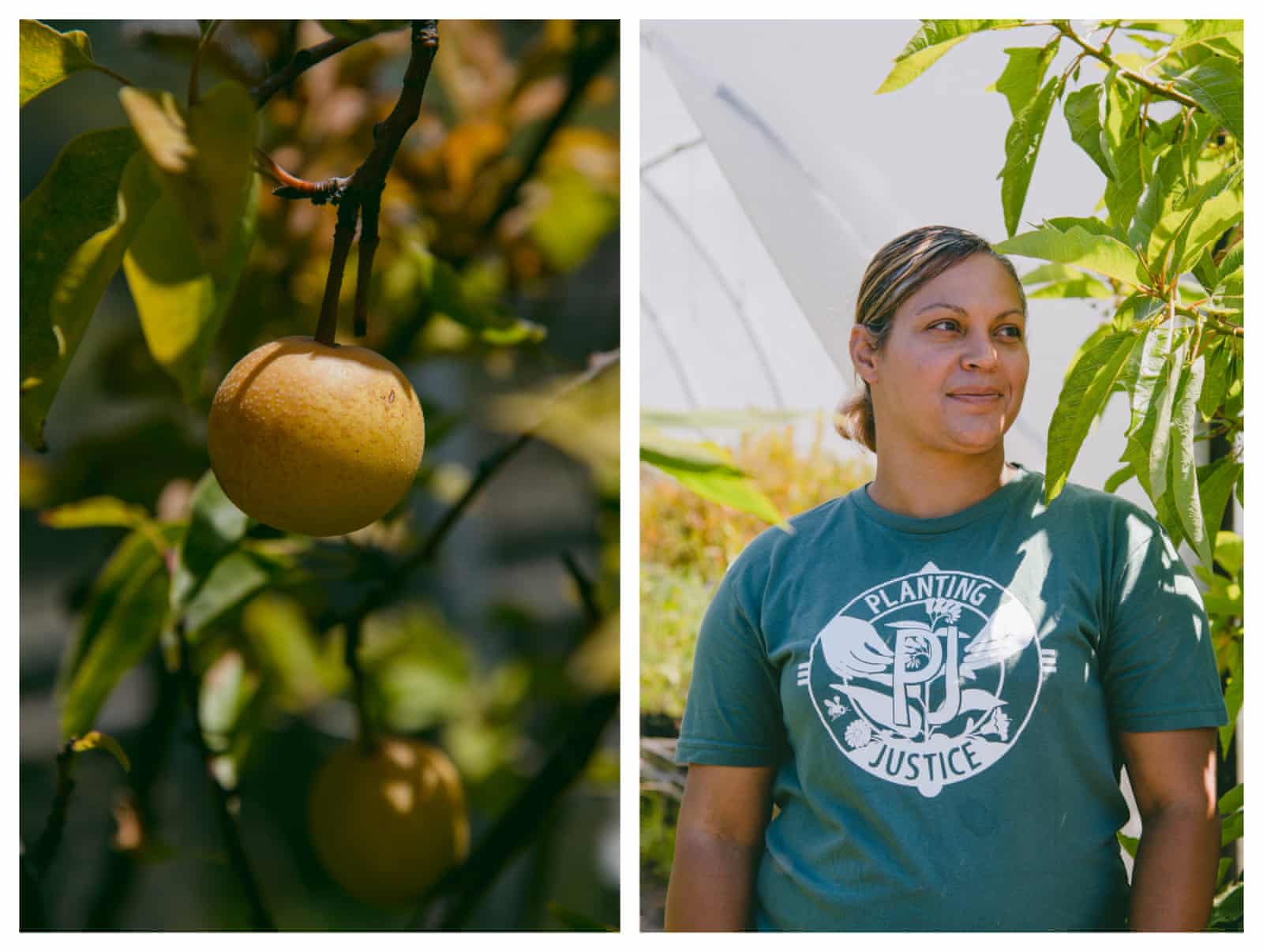
Photo: Marissa Leshnov via the Guardian. From the Guardian: Sol Mercado says her work as a gardener has brought her comfort and helped to reconnect with her roots.
Can Nature turn a life around? We’ve had a number of articles suggesting the answer is yes. Among others, our 2023 story about a traumatized Iraq veteran who discovered hiking in the wilderness.
Now Caitlin Yoshiko Kandil, of the Guardian, describes the role that an urban garden can play in life after prison.
“When Sol Mercado was incarcerated, one of her few sources of comfort was to dig her hands into dirt. Coming from a family of sugarcane and coffee farm workers in Puerto Rico, a love of gardening was in her roots. But it wasn’t until she was in prison and started participating in a gardening program that she truly connected with this part of her heritage. …
“Mercado – who was released a year and a half ago – now works for Planting Justice, a food justice organization based in Oakland, California, that tackles inequalities in the industrialized food system, from the underpayment of food workers to the lack of fresh produce in low-income neighborhoods.
“Planting Justice addresses food sovereignty with marginalized communities – in particular people who have been affected by the criminal justice system – through gardening workshops in prisons and jails, such as San Quentin state prison, and jobs for those formerly incarcerated.
“For Mercado, 36, the organization helped turn her life around. …
“ ‘What I learned in prison is that if I want to change, if I want to blossom, I need to work on myself and remove unhealthy things from my life,’ she said. ‘It’s the same as a plant. A plant, if you don’t weed it, if you don’t prune it, if you don’t water it, it’s not going to grow and give fruit.’
“Planting Justice’s two-acre (nearly 1 hectare) nursery – which grows more than 1,200 varieties of plants – is tucked between a busy highway and a railroad line in Sobrante Park, a low-income, predominantly Black and Latino neighborhood that’s long been a food desert with no grocery stores within walking distance. The land the nursery sits on once belonged to the Indigenous Ohlone people, so Planting Justice is working with the Sogorea Te’ Land Trust, a local organization that helps facilitate the return of Indigenous land to Indigenous people; once the transfer is complete, Planting Justice will lease the land from them.
“Founded in 2009, Planting Justice has installed 550 edible gardens at schools, community centers and homes; hosts education programs for local youth; distributes produce to local residents; gives away free fruit smoothies at Bay Area Rapid Transit stations; and sources produce for the Good Table, a nearby cafe where diners pay what they can afford.
“As part of a new initiative that started this year, Planting Justice is also planting 1,000 fruit trees – apple, pear, pomegranate, peach, olive and fig trees – in East Oakland homes for free.
“Like Mercado, many Planting Justice employees were formerly incarcerated. Some came to the organization through re-entry programs and partnerships in jails and prisons, while others found their way after their release.
Planting Justice says its recidivism rate is 2%, far lower than California’s rate of nearly 50%. …
“Bilal Coleman said he first heard about Planting Justice while incarcerated at San Quentin state prison, north of San Francisco. He was coming to the end of his 20-year sentence and was participating in a partner program called Insight Garden – and Planting Justice was advertising that it was hiring people returning home to the San Francisco Bay Area.
“Coleman said that gardening is in his roots. “Ever since I can remember, there’s been a garden in my family,” he said. But that wasn’t the immediate draw to Planting Justice; it was the security of having a job lined up after his parole, benefits and good pay – salaries start at $19 an hour. ‘It was a chance to get on my feet before I actually paroled,’ he said. …
“Planting Justice’s presence can be felt throughout Sobrante Park, revitalizing a neighborhood that’s long been in decline. Sobrante Park has been ‘underresourced and overpenalized for generations, where there aren’t the same food options,’ said Julia Toro, nursery office manager.
“Covonne Page, Planting Justice’s land team lead, was born and raised here, and recalls a time when things were different. The 33-year-old said that he and his friends would ride inflatable rafts on the San Leandro Creek, which was lined with wild blackberry bushes and filled with lizards and turtles. Most houses had fruit trees and vegetable gardens in the back yard, and families would trade their harvest so that everyone had their fill of oranges, loquats, lemons and plums. This bounty meant the community ate well; Page remembers his grandmother’s blackberry cobbler and his grandfather’s plum jam. …
“But years of disinvestment, longtime residents leaving – often for prison – and environmental degradation have decimated this landscape, Page said. … By bringing fruit trees back to people’s yards and teaching them how to garden, Planting Justice is not only offering much-needed jobs to the community; it’s revitalizing its food culture and sovereignty.”
More at the Guardian, here. No paywall. Great photographs by Marissa Leshnov.
Photo: Stefano Giovannini for N.Y.Post. “Reading Rhythms is ‘not a book club’ but ‘a reading party,’ says the NY Post, ‘where about 60 to 80 bookworms gather to read” in company — not all the same book, just whatever they happen to be reading.
Here’s an idea whose time has come: gatherings where people who love reading read whatever they like in the same place at the same time and maybe take a few breaks to socialize. It’s called a “reading party,” and the foursome behind the concept calls themselves Reading Rhythms.
Molly Young writes at the New York Times, “On a cold Monday in December, 65 people were gathered for Reading Rhythms, an event that bills itself as ‘not a book club’ but ‘a reading party.’ The parties, which began in May, take place on rooftops, in parks and at bars. The premise is simple: Show up with a book, commit to vanquishing a chapter or two and chat with strangers about what you’ve just read.
“The attendees that night, each of whom had paid a $10 entry fee, were the lucky ones: 270 people were on the wait-list to get in. …
“The idea for Reading Rhythms emerged when four friends in their 20s — Ben Bradbury, Charlotte Jackson, John Lifrieri and Tom Worcester — discovered a shared sense of alarm over the deterioration of their book consumption. The causes were what you’d expect: annihilated attention spans, too much socializing, the treacherous enchantments of the iPhone.
“Bradbury and Worcester, who are roommates, hosted the first event on their rooftop. A playlist was compiled, 10 friends showed up with books, everyone read for a bit and talked about what they’d read, and then … went home.
” ‘I got an hour of reading done and I hung out with some of my best friends, which I’d wanted to do anyway,’ [Bradbury] said. ‘That doesn’t usually happen.’ …
“The four solidified a format, gave the series a name, planned additional parties, opened up the invite list and started an Instagram account. Since May there have been parties in New York, Los Angeles and (of all places) Croatia. …
“At the event this month, none of the guests seemed to operate under the illusion that they’d reinvented any wheels. And ‘glorified library’ actually described the ambience well: Seating included antique armchairs, deep sofas and velvety settees; flickering votive candles emitted an amber glow; hot toddies and beer were available. …
“As the founders continued to host parties, they settled upon a structure. Attendees are given a name tag and half an hour to find a seat and settle in. A host then gets up before the crowd and explains the night’s schedule: 30 minutes of reading, a break, 30 more minutes of reading and then a set of discussions organized around loose prompts. Parties are held early in the week to capture gentle, non-weekend energy.
“Lifrieri, one of the founders, suggested everyone pluck an idea from what we’d just read and ‘turn to a stranger’ to discuss. An icy dart of trepidation shot through my body at the command, but to a stranger I turned: Dilvan, 29, who was reading Michael A. Singer’s The Untethered Soul.
“Dilvan shared a paragraph that she’d highlighted and we discussed its implications, which turned out to be mutually troubling. Conversation turned to other topics: Dilvan had moved to the United States from Turkey for college, specifically to study in ‘a cold location’ featuring snow. The idea of weather-based school selection was fascinating to me. Dilvan landed in Minnesota, which satisfied her temperature requirements and also prompted her to learn English rapidly thanks to the absence of other Turks in the area. …
“Reading postures varied. Some attendees sat cross-legged with a book resting lapwise. Others were curled up on a sofa. Many adopted a modified ‘The Thinker’ position. One man read his book standing ramrod straight, like a marsh bird. Not once did a cellphone chime.
More at the Times, here, and at Reading Rhythms, here.
Photo: Sarah Matusek/The Christian Science Monitor. Nixon Garcia, a teaching artist at El Sistema Colorado, conducts students at the music school in Denver.
People sometimes forget that we need more immigrants, not fewer. Their contributions to the economy are well documented. In 2021, for example, they contributed more than $500 billion just in taxes (see Forbes here). Not to mention that they willingly apply for necessary jobs that go begging, sometimes for years.
And there are other contributions getting less attention. Consider what this one musician is doing. Sarah Matusek wrote about his work recently at the Christian Science Monitor.
“A few dozen children in Denver settle into seats, violins and violas in hand. With short cropped hair and a focused gaze, Nixon Garcia observes from off to one side. …
“This is a fall show-and-tell for parents at El Sistema Colorado, a free music school that prioritizes kids from low-income families. The Denver program was inspired by the original El Sistema in Venezuela, which since its founding in 1975 has sparked similar projects around the world. …
“With flutters of his hands and flicks of his wrists, the 22-year-old conjures up simple songs that he learned as a boy in the Venezuelan program. He’s brought that same sheet music to students in the United States, along with hopes for asylum. Working as a teaching artist at the Colorado program, he’s come full circle.
“ ‘El Sistema has been my second home throughout my whole life,’ says Mr. Garcia, who teaches in Spanish and English.
“The original program’s catchphrase, ‘tocar y luchar‘ – or ‘play and fight’ in English – has evolved into a personal mantra of perseverance for the young conductor who can’t imagine returning home. By the time he left Venezuela, in 2022, says Mr. Garcia, he’d been kidnapped three times.
“Backdropped by mountains in northwest Venezuela, the town of La Fría sits near the Colombian border. Mr. Garcia’s family, who ran a poultry farm there, enrolled their son in the popular music program at a young age. …
“At age 5, he began learning the Venezuelan cuatro, which has four strings. Later on came the clarinet. As a teenager, Mr. Garcia began teaching other El Sistema students – a key mentorship feature of the program – and developed a love of conducting. But basic needs were stark; some students he taught sat on the floor, because there weren’t enough chairs. And beyond the solace of class, violence lurked.
“When he was a young teenager, in 2015, a criminal group, called a colectivo, kidnapped him and his family at a gas station. The group held them for several hours, his family says, and demanded thousands of dollars for their release.
“Venezuela, meanwhile, devolved into further economic, political, and human rights crises under President Nicolás Maduro, causing millions to flee. Mr. Garcia began attending pro-democracy protests. …
‘You can see how everything is terrible. But in the end, you still love your country,’ he says. ‘You don’t want to leave.’ …
“Mr. Garcia was captured again by an insurgent group on his family farm in La Fría. Yet neither was he safe at college in another city, Mérida, where he studied engineering. … Although his family had arranged private security for him in La Fría, they decided that he had to leave. …
“A tourist visa that his family had secured some years prior still hadn’t expired. That became his ticket to the U.S. last year. Yet even as he moved into his cousin’s home in Monument, Colorado, an hour south of Denver, the adjustment was isolating. … A family member suggested he retreat to nature, take a moment to breathe. A prayerful hike in the nearby mountains, Mr. Garcia says, helped right his course.
“Inspiration struck, tuning-fork clear: Why not return to music? A Google search for nearby orchestras yielded a name he knew. The young conductor, in awe, reached out to El Sistema Colorado. …
“Mr. Garcia started out as a volunteer at El Sistema Colorado before the federal government issued the asylum-seeker his work authorization. That allows him to work legally while his asylum case moves forward. Now paid, he teaches groups of strings-learning students in an orchestra group called Allegro.
“The teaching artist is a ‘positive light’ at the music school, says Ingrid Larragoity-Martin, executive director of El Sistema Colorado. ‘He’s passionate about kids, and he knows how to work with them.’ …
“Meanwhile, he awaits the outcome of his asylum application, which may take years. Mr. Garcia says he wants to ‘work, make a life, and try to share as many things as we can from our country.’ ”
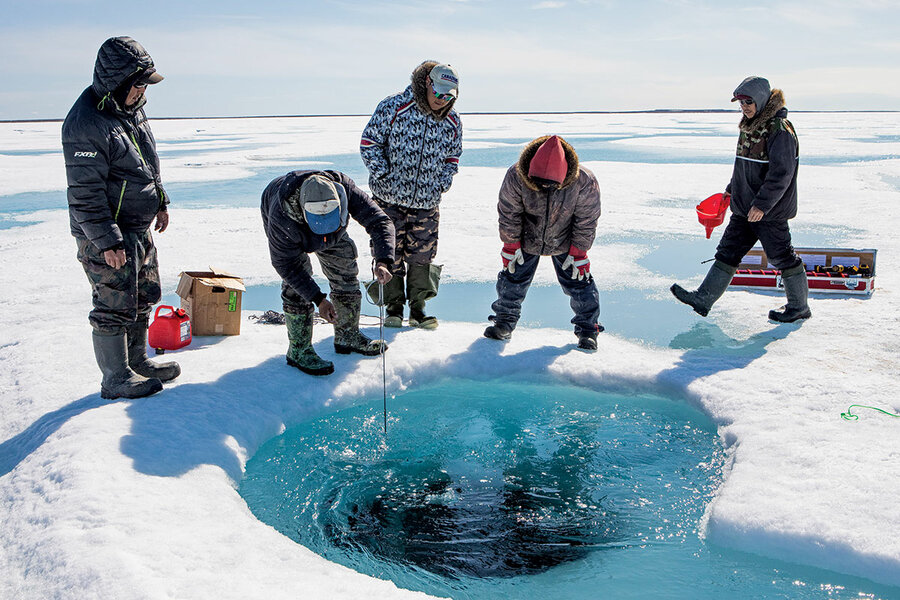
Photo: Melanie Stetson Freeman The Christian Science Monitor highlights indigenous “Guardians” who made a “hole in Arctic Ocean ice – a window on climate-related changes – where they monitor water quality and measure ice thickness.”
Cold parts of the world are threatened. The cold-loving people who live there are deeply concerned and are monitoring the losses for climate scientists.
Sara Miller Llana writes for the Christian Science Monitor, “Masked against the Arctic glare in orange-tinted sunglasses, Tad Tulurialik is a modern conservation ‘Guardian’ of his fast-melting homeland.
“At the start of an early summer workday that never sees the sun set, he kicks his all-terrain vehicle into gear. Safe in his ancestors’ knowledge of sea currents and ice fissures, he navigates a course right off the edge of the Canadian shore onto the aqua iridescence of the frozen Arctic Ocean. He’s following older Guardians to a manmade hole in the ice shelf, a window toward understanding climate-related changes in the sea.
“Even out on the ocean surface, his rifle is always swung over his shoulder. Wherever he sees a caribou or musk ox, it’s an existential given that he’ll take it. Food security isn’t found in a grocery aisle in this northernmost Canadian mainland settlement, tellingly named with the Inuktitut word for a caribou hunting blind.
“In some ways, as a government-paid conservation Guardian in training, the 24-year-old Mr. Tulurialik is doing what he’s done his whole life. Like most Inuit boys, he was ‘on the land’ as soon as he could walk. His childhood was spent on tundra and on sea and lake ice to hunt and fish with his grandparents, who raised him. His life was marked not by school grades but by first fox trapped, first polar bear shot. These were such priorities that he dropped out of high school.
“That could have made him part of Canada’s persistent social inequality – Indigenous youth in some of the remotest parts of the country, undereducated, underqualified, and often losing touch with rich traditions and fleeing homelands for economic opportunity. Except today, he’s part of a solution, as a member of Canada’s Indigenous Guardians, a conservation corps working in 170 far-flung Indigenous communities.
“Guided and taught by elders, he and other young Inuit born since 1989, when warming of the Arctic turned precipitous, are part of an effort to safeguard their homelands and their cultural ‘right to be cold.’ They’re also helping Canada achieve international conservation commitments made last year, when it led a global pledge at the United Nations Biodiversity Conference in Montreal to protect 30% of its land and oceans by 2030.
“For Mr. Tulurialik, who worked in construction and sewer maintenance after leaving school, a paid job as a conservationist is a dream: ‘I never thought I would work and get paid for what I grew up doing.’
“Together, he and his Guardian colleagues are tasked with creating a sustainable future, transforming Western-style conservation work into something that more closely resembles a traditional Indigenous environmental ethos. Guardians blend science with Indigenous knowledge in a budding conservation economy dependent on the transfer of knowledge from elders to youth.
“The ultimate aim of the Guardians’ work in Taloyoak is to use their sustainable Inuit practices – learned orally over millennia – to support the creation and maintenance of an Indigenous Protected and Conserved Area. The size of Maine, it is one of more than 90 in development across Indigenous Canada. Here in northern Nunavut territory, the IPCA conservation plan is led by the local hunter and trapper association.
It’s nurturing an economy of land-based jobs and markets as an alternative to a future in extractive industries in a territory long eyed by mining and oil interests.
“The land will be protected from development, conserving both biodiversity and a way of life based on sustainable hunting and fishing – while sequestering huge amounts of carbon, the culprit in global warming.
“ ‘This is a win-win situation’ … says Paul Okalik, the first premier of Nunavut who now works with Canada’s World Wildlife Fund (WWF), which is supporting Taloyoak’s efforts. …
“Indigenous lands, from the Brazilian Amazon to Hawaii coastlines to Canada’s high-latitude forests, represent 20% of the globe but hold 80% of the world’s biodiversity. Inhabitants have stewarded the land for centuries. Yet in a warming climate, their homelands are in some of the most at-risk environments.
“The Arctic is this nation’s – and arguably the world’s – crisis point. Here, warming is happening at up to four times the rate of the rest of the world, leading to melting permafrost, retreating glaciers, and receding sea ice. This has broad implications for the global ecosystem. Arctic ice melt slows ocean currents and makes the oceans more acidic – changes that have global implications for both climate patterns and sea habitats. Increased melting also creates what scientists call a ‘positive feedback loop’: As dark water replaces white snow on ice, the surfaces of the ocean and Earth absorb more sunlight rather than reflecting it. This causes even more warming. …
“Taloyoak locals have already worried about warming changing their ways. Last summer was the Northern Hemisphere’s hottest on record. The year prior, Taloyoak recorded its all-time hottest temperature of 78.8 F. Locals stayed home rather than go outside in, for them, the unbearable temperature.”
Imagine the high 70s being unbearable! The rest of North America will be learning about “unbearable” soon — if it hasn’t already.
The Monitor‘s long and intriguing feature on the work in the far north is here. No firewall.
Photo: ReelShort App/Crazy Maple Studio. Want a short soap opera for Valentine’s Day?
Has there ever been a soap opera that wasn’t about romance? Even hospital dramas are mostly about jealousy and staff affairs. But given that typical plots take years to come to a resolution, entrepreneurial geniuses have popped up to meet a need.
Learn about the 60-second soap-opera episodes that are gaining a contemporary audience.
Claire Moses reports at the New York Times, “When Albee Zhang received an offer to produce cheesy short-form features made for phones last spring, she was skeptical, and so, she declined. But the offers kept coming. Finally, Ms. Zhang, who has been a producer for 12 years, realized it could be a profitable new way of storytelling and said yes.
“Since last summer, she has produced two short-form features and is working on four more for several apps that are creating cookie-cutter content aimed at women. Think: Lifetime movie cut up into TikTok videos. Think: soap opera, but for the short attention span of the internet age.
“The biggest player in this new genre is ReelShort, an app that offers melodramatic content in minute-long, vertically shot episodes and is hoping to bring a successful formula established abroad to the United States by hooking millions of people on its short-form content.
“ReelShort is owned by Crazy Maple Studio, a company in Northern California that is backed by the Beijing-based digital publisher COL Group.
“ReelShort’s titles include ‘The Double Life of My Billionaire Husband,’ ‘I Got Married Without You’ and ‘Bound by Vendetta: Sleeping With the Enemy.’ The shows are formulaic: The plotlines include romance and revenge, the characters are archetypical and the dialogues are simple.
“The extremely short genre became popular in the Asia-Pacific region during the pandemic, and Joey Jia, the chief executive of Crazy Maple Studio, took notice.
“ReelShort aims to get people hooked as quickly as possible, with much of the action happening in the first few super short episodes. ‘This is a pay-as-you-go model,’ Mr. Jia said. ‘If people are confused by the story, they leave.’
“The cost of making these features is relatively low, $300,000 or less, according to Crazy Maple Studios. The crews are small and partly made up of recent film graduates in Los Angeles, according to actors who worked on the productions.
“Viewers can watch dozens of minute-long episodes on ReelShort for free via multiple platforms, including YouTube and TikTok. But at some point, they must either pay or watch ads to unlock subsequent episodes. Sometimes people pay as much as $10 or $20 to keep watching, Ms. Zhang, the producer, said. …
“In the United States, ReelShort is trying to succeed where the short-form content company Quibi failed. … While Quibi focused on more highbrow content with A-list stars, ReelShort is doing the opposite: It’s giving people juicy plot points, from werewolves to evil step mothers to secret billionaire husbands to more werewolves.
“ ‘We learned a lot from Quibi,’ said Mr. Jia. … ‘To build a successful mobile app, you need to find out your core audience,’ he said. And that audience is women who love soap operas. …
“In total, more than seven million people downloaded ReelShort in the United States in 2023, on Apple and Android phones combined, according to data.ai. …
“Kasey Esser, a Los Angeles-based actor who has worked on short-form shows for ReelShort and other apps, described the format as this generation’s soap opera. He drew a comparison to channels with made-for-TV content, such as Hallmark.
“ ‘People know exactly the story they’re going to be getting, but they will still watch it,’ Mr. Esser, 34, said. ‘They will still love it.’
“For the actress Samantha Drews, ReelShort was a chance to play different types of characters. ‘I can say now that I’ve been cast in 15 to 16 features in the last few years,’ Ms. Drews, 25, said. ‘That’s not something every actor can say.’ “
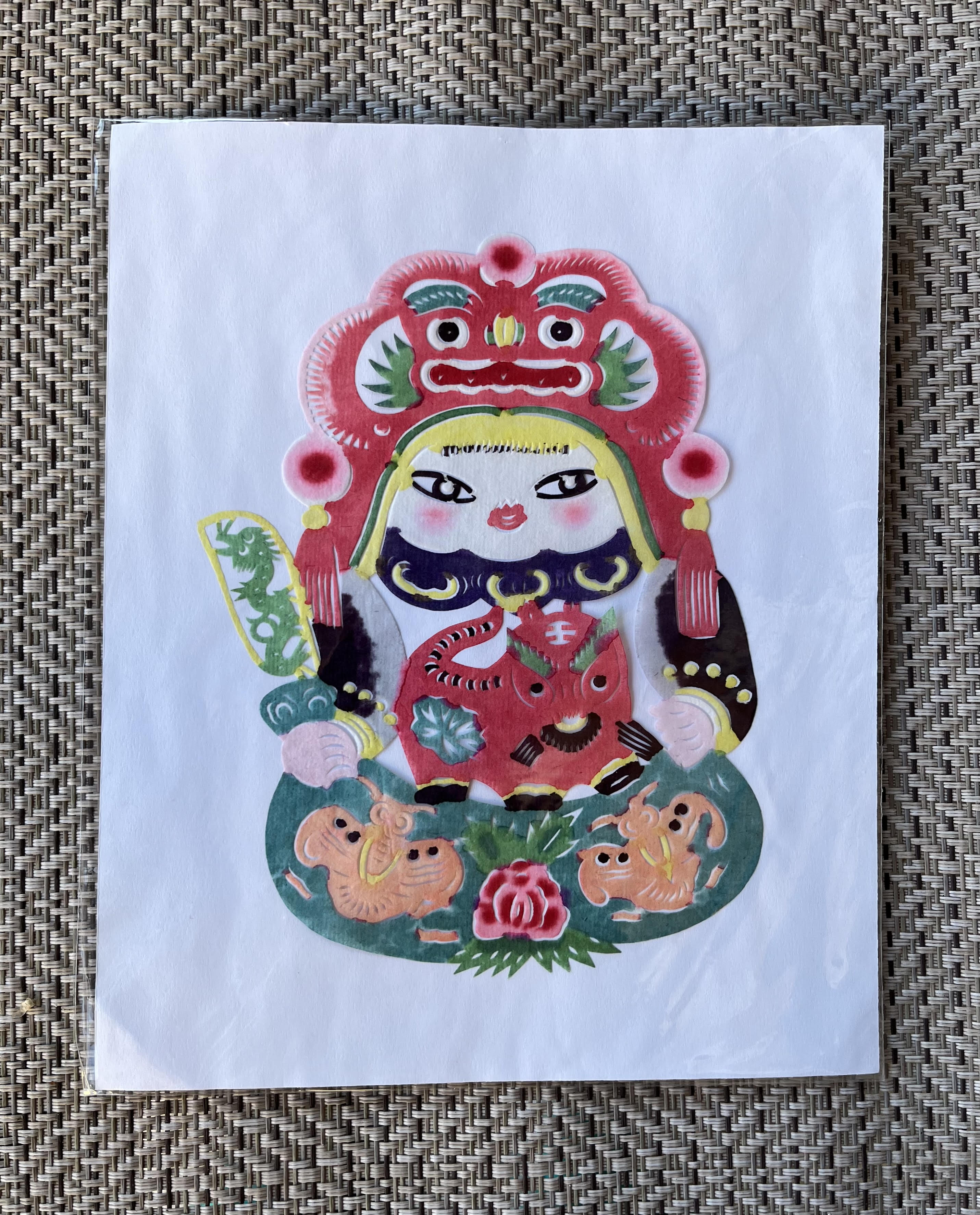
Photo: Suzanne and John’s Mom. I’ve had thisChinese paper cut-out for years. I no longer remember where it came from.
Happy Year of the Dragon! The Wood Dragon to be specific. (In case you’re wondering, the other Chinese zodiac dragons are Water, Metal, Earth, and Fire.)
As China and much of the world celebrate the traditions of Lunar New Year, I want to share an article about a woman in China who is keeping another ancient tradition alive — paper cutting.
Ann Scott Tyson reports at the Christian Science Monitor, “With uncanny precision and attention to form, Yu Zeling snips away at the thin red paper. Her scissors seem to glide magically into place. After several minutes, she unfolds her creation: a bold and smiling Chinese zodiac pig.
“An award-winning master of the ancient Chinese folk art of paper cutting, Ms. Yu fills her studio with cutouts of animals, people, and scenes so vivid that they seem to leap from the walls. Rich with symbolism, her art embodies village life in Ansai, a rural district in Shaanxi province on China’s rugged Loess Plateau. Ansai is a center of paper cutting – recognized in 2009 by UNESCO as an Intangible Cultural Heritage of Humanity. …
“Ms. Yu and others are working to keep the folk art alive, even as it evolves away from its roots as adornment for farmhouses and local celebrations. Indeed, the Ansai native is serving as a rare bridge between the most skilled paper-cut artists of the 1980s – a golden era in paper cutting – and a new generation of heirs. …
“Growing up in a hamlet deep in an Ansai valley, surrounded by terraced fields, Ms. Yu came to paper cutting in the late 1970s as naturally as she breathed the earthy air. ‘We were very poor, and when it was time to celebrate the [Lunar] New Year, we all put paper-cuts in the windows,’ she says, recalling the holiday at her childhood home – a cave dug from a hillside – where her family of 10 eked out a living growing corn, beans, and sorghum. …
“The art originated in China in the centuries after paper was invented in A.D. 105. … Full of auspicious symbols from peasant life, the decorations heralded good weather, many offspring, long life, wealth, and happiness. …
“Just as Ms. Yu was beginning to learn paper cutting, after she left elementary school in 1978 at the age of 12, China’s shift toward market economics and social opening began allowing for a revival of traditional culture. Using discarded newspaper, Ms. Yu first practiced cutting the image of a Chinese national flag that she saw in a school textbook. She says she ‘cut it 100 times’ before she was satisfied. Then her aunt took over, introducing her to increasingly complicated traditional motifs. …
“Meanwhile, a research scholar named Chen Shanqiao began trekking from Ansai’s county seat into the hills and valleys to rural villages, rediscovering the true meanings embedded in the paper-cuts. Their power astonished him. In the mid-1980s, he recruited a few older village women who were masters in the craft to come teach at Ansai’s Cultural Center.
“Ms. Yu married farmer Jiang Zhicheng, who admired her passion and skill. Inspired, Mr. Jiang took a few of his wife’s works to the local market in 1987, but he couldn’t sell them. So he went farther, riding his bicycle more than 25 miles to Ansai’s Cultural Center. Seeing the fine pieces, Mr. Chen immediately bought the paper-cuts and invited Ms. Yu to come train with the master artists. …
“After years of training, Ms. Yu became a master in her own right, winning one award after another. Her works are on display in museums. But she’s humble about her achievements. ‘I was, and still am, a farmer,’ she says with a smile. … ‘I make paper-cuts based on life,’ she says. ‘Here in northern Shaanxi, we feed the pigs and till the land and care for the children.’
“Hoping to carry on and grow the folk art, Ms. Yu volunteers to teach at free community training sessions. Paper cutting is also taught in Ansai’s public schools. … As Chinese villages empty out and rural rituals fade, Ms. Yu is aware of the need to go beyond perpetuating traditions and embrace new paper-cut experiments. …
“The most elaborate paper-cut in her studio is a large and ornate circular design that weaves together layer upon layer of significance: In the center, a snake (man) encircles a rabbit (woman), symbolizing marriage. Surrounding them is a ring of pomegranates (the seeds of which represent many children), peaches (the Chinese name for ‘peach’ is also the word for ‘longevity’), and Buddha’s hands (a kind of citrus fruit representing bliss). A final outer rim, resembling a woven flower basket, also signifies longevity.”
More at the Monitor, here. Check out photos of the cutting process. No firewall.
As everyone knows, it’s hard to avoid plastic. The other day I found on the floor tiny pieces of one of those mesh bags that oranges often come in. I may be overthinking everything, but I was stumped about how to dispose of it. If I flush it, it goes into our water system. If I put it out for the landfill, the result is ultimately the same. And now we’re hearing that plastic particles are even getting into the clouds.
Nicola Jones writes at YaleEnvironment360, “Plastic has become an obvious pollutant over recent decades, choking turtles and seabirds, clogging up our landfills and waterways. But in just the past few years, a less-obvious problem has emerged. Researchers are starting to get concerned about how tiny bits of plastic in the air, lofted into the skies from seafoam bubbles or spinning tires on the highway, might potentially change our future climate.
“ ‘Here’s something that people just didn’t think about — another aspect of plastic pollution,’ says environmental analytical chemist Denise Mitrano of ETH Zürich University, in Switzerland, who co-wrote an article last November highlighting what researchers know — and don’t yet know — about how plastics can change clouds, potentially altering temperature and rainfall patterns.
“Clouds form when water or ice condenses on ‘seeds’ in the air: usually tiny particles of dust, salt, sand, soot, or other material thrown up by burning fossil fuels, forest fires, cooking, or volcanoes. There are plenty of these fine particles, or aerosols, in the skies. …
“Until recently, when chemists thought of the gunk in our air, plastics did not leap to mind. Concentrations were low, they thought, and plastic is often designed to be water repellent for applications like bags or clothing, which presumably made them unlikely to seed cloud droplets. But in recent years, studies have confirmed not only that microscopic pieces of plastic can seed clouds — sometimes powerfully — but they also travel thousands of miles from their source. And there are a lot more particles in the air than scientists originally thought. …
“ ‘The people who invented plastics all those decades ago, who were very proud of inventions that transformed society in many ways — I doubt they envisaged that plastics were going to end up floating around in the atmosphere and potentially influencing the global climate system,’ says Laura Revell, an atmospheric scientist at the University of Canterbury in New Zealand. …
“Global annual production of plastics has skyrocketed from 2 million tons in 1950 to more than 450 million tons today. And despite growing concerns about this waste accumulating in the environment, production is ramping up rather than slowing down — some oil companies are building up their plastic production capacity as the demand for fossil fuel declines. To date, more than 9 billion tons of plastic has been produced, and about half of it has gone to landfills or been otherwise discarded. Some project that by 2025, 11 billion tons of plastic will have accumulated in the environment. …
“In recent years, several studies have suggested that microplastics (pieces less than 5 millimeters in length) and nanoplastics (smaller than approximately 1,000 nanometers) were being transported long distances through the air. In 2019, for example, researchers found microplastics in the Pyrenees that had arrived via rain or snowfall. In 2020, Janice Brahney of Utah State University and four coauthors published a high-profile Sciencepaper revealing high amounts of plastic in federally protected areas of the United States. …
“Brahney’s extensive U.S. dataset also opened the door for modelers to figure out where, exactly, all this plastic was coming from. ‘It’s a really beautiful data set,’ says Cornell University’s Natalie Mahowald, who did the modeling work.
“Mahowald took the plastic concentrations Brahney had cataloged and mapped them against atmospheric patterns and known sources of plastics, including roads, agricultural dust, and oceans. On roadways, tires and brakes hurl microplastics into the air. Plastic winds up in agricultural dust, notes Mahowald, in part from plastics used on farm fields and in part because people toss fleece clothing into washing machines: the wastewater flows to treatment plants that separate solids from liquids, and about half the resulting biosolids get sent to farms for use as fertilizer. As for the ocean, Mahowald says, big globs of plastic in places like the Pacific Gyre degrade into microscopic pieces, which then float to the surface and are whipped up into the air by chopping waters and bursting air bubbles. …
“Exactly how aerosols affect climate has been a critical sticking point in climate models, and many of the details are still unknown. Different aerosols can change the climate by either reflecting or absorbing sunlight, which can depend, in part, on their color. Black soot, for example, tends to have a warming effect, while salt reflects and cools. Aerosols can land on the ground and change the albedo, or reflectivity, of ice and snow.
“Aerosols also affect cloud formation: different bits and pieces can seed more and smaller droplets of water or ice, making for different types of clouds at different elevations that last for different amounts of time. High-altitude, thin, icy clouds tend to warm the Earth’s surface like a blanket, while low-altitude, bright and fluffy clouds tend to reflect sunlight and cool the Earth.”
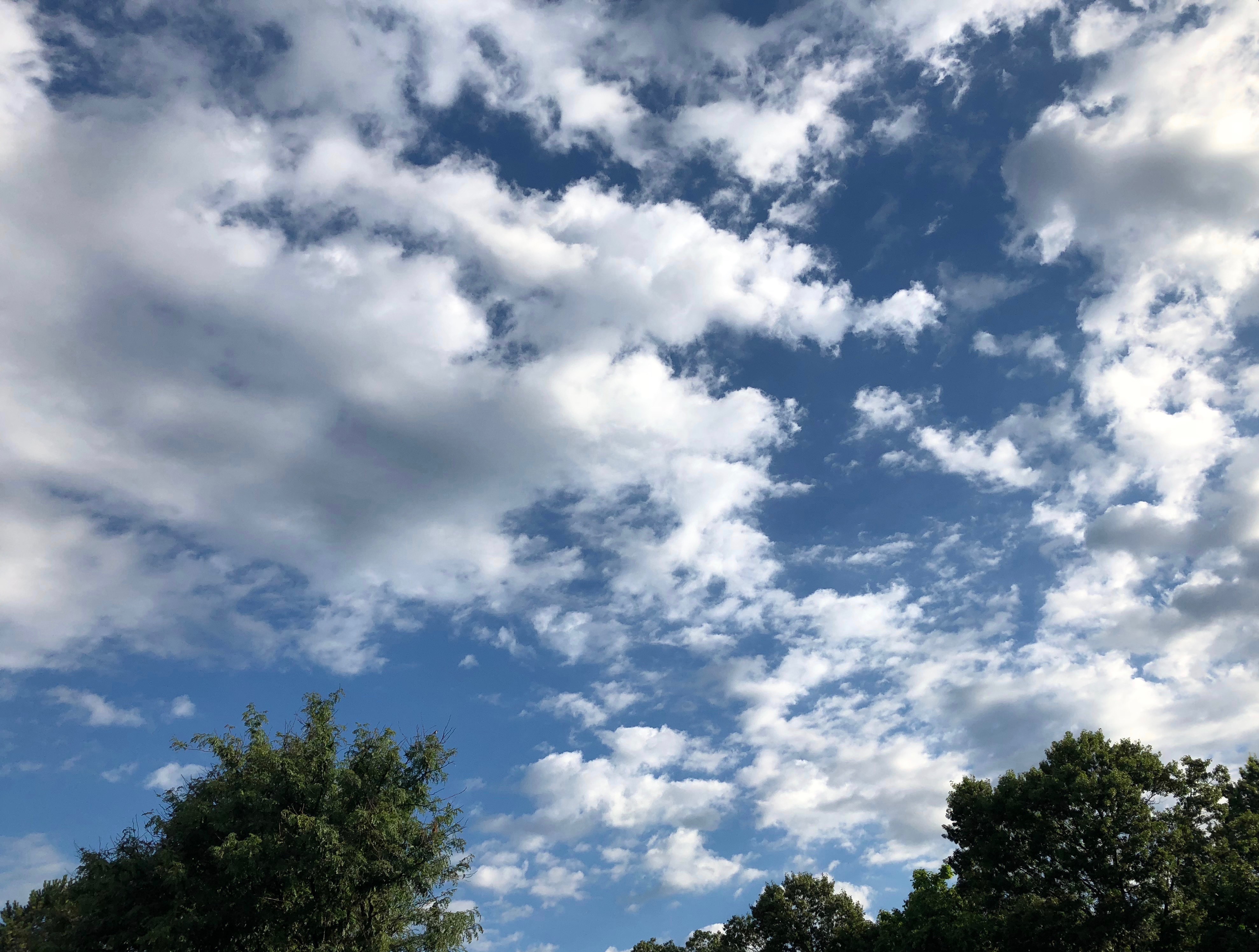
More at YaleEnvironment360, here. Rebecca of Fake Flamenco was speculating not long ago about clouds and whether they have started looking different. Do 20th century cloud photos from your region look different from those taken recently?