Feeds:
Posts
Comments

Photo: Kate Laster.
Kate Laster’s paper cutout “Waiting Game” (2022).

I’ve been reading almost more than I can bear lately about the Holocaust, so when I saw this unusual use of a Jewish paper-cutting tradition at Hyperallergic, it really spoke to me.

Isabella Segalovich wrote, “April 5 marked the first night of Passover. Upholding Jewish tradition, we reclined in our chairs, sang boisterously, and drank ample wine. We reveled in the joy and safety many of us are thankful to have in the present while holding close the memory of those that came before us. Alaskan-born Jewish artist Kate Laster carves those memories into delicate paper cuts. Then, she dunks that paper in the ocean.

“ ‘My art is about the people we carry with us,’ she told Hyperallergic in an interview.

“Laster’s first memories are of snow floating on water. She grew up moving from place to place in rural Alaska, from temperate rainforest of Juneau to the icy treeless wilderness in Utqiaġvik. In a world ‘dense with imagination,’ as she described it, she learned to whittle scraps of wood into small figures while hearing stories and poetry by a warm fireside. She said she first saw language being used as a ‘visual medium in the sense of people putting time aside and really either being in nature or being in warm space talking.’

“Today, she uses the visual force behind letters themselves, cutting paper into vibrant collages with fragments of poems — some collected, some written by her. The paper is thoroughly weathered as stencils, multiplying its message as it’s doused in spray paint again and again. Then, she painstakingly laminates the paper by hand, using ‘really scruffy bits of tape.’ The ritual is completed at sundown when Laster dips her works into the Pacific Ocean. As the paper undulates and floats, she understands the waves, part of a living, ‘primordial soup,’ to be reading the text on the pages.

“Laster’s youth in Alaska is proof that the Jewish diaspora spreads far beyond the urban landscape. But for all of us, Jewish practices are deeply tied to the natural world. Festivals begin with the setting sun. … As the great star sets, Laster lifts the text up from the water. And as drips fall off its edges, she uses the hollow paper cut as a viewfinder, so words are filled with the sky. 

“The water that laps at Laster’s paper cuts is of the same body that carried our ancestors as they wandered the world, searching for home and safety. “…

“Laster is one of growing number of anti-Zionist American Jews. For those who do not wish to move to Israel, it’s common to lift up and celebrate the beauty of the diaspora. Following the love of movement, this celebration is also a deep love of the places we find ourselves now. For the Laster, that place is the Bay Area, where the Mexican and Chicano paper-cutting tradition of papel picado is tied to trees lining the Mission, a historically Latinx neighborhood. Chinese paper cuts — 窗花 chuāng huā, or ‘window flowers’ — bloom in glass panes. …

“But this artist’s work is also a part of her own ancestry. Jewish paper cutting is a centuries-old tradition that used to be much more commonplace. It was practiced by both professionals and amateurs at home, not only for marriage contracts or ketubot, but also for holidays like Shavuot and Sukkot. Laster now sees herself as a part of the newest generation carrying it forth. With no other materials needed than paper and a sharp edge, she sees the beauty in paper cutting’s accessibility.

“The belief that everyone has a fundamental right to engage with and create art is central to Laster’s work, both in and outside of her visual practice. She runs suggested donation-based art history classes, and has held a position as a studio assistant at Hospitality House’s Community Arts Program, a free-of-charge art studio for unhoused and low-income residents of the Tenderloin. Today, she works as a studio facilitator at the NIAD Art Center, a creative space for artists with disabilities. …

“ ‘Printmaking and paper cut in general are about accessibility, making a message, a transmission, go as far as possible,’ she said. Laster is also in the tradition of modern Jewish graphic arts: Words that dance and shout diagonally across the page recall the utopian dreams of the 1920s Eastern European Kultur-Lige (Culture League) artists like El Lissitzky and Nathan Altman. …

“Messages can be interpreted differently depending on who hears them. ‘This is the struggle of sharing, of trying to convey anything you feel to someone else. And knowing once it’s public, it can be altered and transformed and interpreted,’ Laster noted. ‘I revel in that.’

“Laster’s work is also deeply personal, as she grieves the loss of her father during the COVID-19 pandemic. In ‘Kaddish Reunion’ (2021) a self-portrait shows the artist sitting by her father’s bedside. Spray-painted shapes bleed into each other. The text typical of her pieces is replaced by swirls, stars, and leaves. Shadows of these words return in another laminated book. Lovingly saved scraps from past paper cuts are laminated alongside a plastic bag that says ‘THANK YOU.’ The only full words are on the cover: ‘I don’t know how to say goodbye.

“Laster’s father was a pilot of a small bush plane. As a child, she studied the dense text and cartoons of flight emergency manuals, replicated today in her shining messages of grief, love, and hope. Perhaps the Haggadah is another kind of emergency manual: a guide on how to keep on going?

“On Passover, we remember those that came before us and those that we lost. … We taste the bitter herbs of longing and grief, but also wash down dry matzoh with sweet wine. And most importantly, we argue, laugh, and tell stories of our survival.”

More at Hyperallergic, here. No firewall. Check out the short video of a paper cutout floating on water.


Photo: John and Suzanne’s Mom.
Do we know what’s in our drinking water? University of British Columbia researchers are working on an experimental material to remove toxic “forever chemicals” from water. 

As soon as we learn about a new hazard to humans, it seems, science labs pop up to address it. Lately, we’ve been hearing a lot about “forever chemicals,” dangerous compounds that are often in drinking water. Thank goodness, a variety of labs are on the case.

For example, as Allyson Chiu reports at the Washington Post, Canadian researchers “have developed a method to filter toxic ‘forever chemicals’ from water and potentially destroy the long-lasting compounds permanently.

“Commonly known as ‘forever chemicals’ because they can persist in the environment for years, these hazardous compounds have long troubled environmentalists and regulators. Their harmful effects on human health are well documented, but their ubiquitous use and the challenges in breaking them down have complicated efforts to eliminate them.

“Pressure to do so is growing. In March, the Environmental Protection Agency proposed the nation’s first drinking-water standards requiring water utilities to reduce levels of PFAS — perfluoroalkyl and polyfluoroalkyl substances.

The new technology, described by one of its developers as a ‘Brita filter, but a thousand times better,’ could help address the problem, experts say.

“ ‘The potential impact will be huge,’ said Madjid Mohseni, a professor of chemical and biological engineering at the University of British Columbia who led the research. …

“Polyfluoroalkyl and perfluoroalkyl substances are a class of thousands of different chemicals with varying properties. The highly durable chemicals have been used for decades to make nonstick cookware, moisture-repellent fabrics and flame-retardant equipment, and they are found in other commonly used consumer goods such as cosmetics and food packaging.

“Several U.S. states and other countries have banned certain types of PFAS, and many major companies say they have discontinued their use, but the compounds have shown up in the water supplies of communities across the country and the world. The chemicals have been linked to infertility, thyroid problems and several types of cancer.

“Technologies already exist to remove PFAS from water, but Mohseni and other experts say these approaches have limitations.

“Activated carbon, for example, can filter what is known as long-chain PFAS but does not as effectively trap the shorter-chain variants of the chemicals. Short-chain PFAS, some of which can be toxic at low doses, are becoming more prevalent as many manufacturers use them as a replacement for the long-chain compounds.

“Existing methods also typically create waste products that contain high concentrations of PFAS, which often end up in landfills or are incinerated, said Erik Olson, a senior strategic director at the Natural Resources Defense Council.

“From landfills, the harmful chemicals could leech back into the environment. Burning them is not ideal, either. ‘Only extremely high-temperature incineration can even start to destroy PFAS,’ Olson said. ‘Normal incineration just simply sends PFAS up the smokestack.’

“Mohseni said the material his team developed — which looks like tiny porous plastic beads — can remove long- and short-chain chemicals at rates that match or exceed industry standards. The PFAS it captures could be stripped away, also making the beads potentially reusable or recyclable, he said.

“Additionally, Mohseni said, the team engineered techniques designed to break the leftover PFAS down into harmless compounds.

“The beads eventually could be used in products to filter water in homes, industrial sites and at municipal levels, he added. However, for in-home applications, users would have to send the used filters to centralized locations for regeneration or recycling, and for the PFAS to be broken down fully — somewhat like how some used coffee pods are sent back to manufacturers for recycling, Mohseni said.

“His team’s findings have been published in several peer-reviewed journals.

“Although the technology is promising, experts not involved in the research say it has yet to be proved in real-world settings at scale. The UBC research team has launched pilot trials in British Columbia, but none of the sites are yet sources of drinking water. …

“Removing the chemicals from water and breaking them down is only part of the solution to the PFAS problem, said Cora Young, an associate professor of chemistry at York University in Toronto who studies the chemicals.

“ ‘Destroying PFAS that already exist is a useful thing, but a lot of other approaches have to be used to actually reduce its impact as an environmental problem,’ Young said.”

More at the Post, here. Good on you, Canada!

Photo: Fatih Aktas / Anadolu Agency / Getty via the Atlantic.
Cleaning up from the fierce tornado that struck Mississippi in March 2023.

Sometimes people who have suffered become hardened to the misfortunes of others. But very often when they see suffering, they want to reach out and help.

Daniel Wu reported recently at the Washington Post about refugees from Ukraine, currently living in Minnesota, who rushed to provide assistance in Mississippi after the March tornado.

“The seven Ukrainians set out just before midnight to make the long drive to their destination,” Wu wrote. “They were on an aid mission to a grimly familiar scene of devastated communities and leveled homes.

“But the refugees were thousands of miles from their homeland and the war that changed their lives. Their journey wound down Interstate 55, starting in Minnesota, where they had resettled just months earlier, and ending in a disaster zone wracked not by bombs, but by the wind: several towns in Mississippi recovering from a devastating tornado that killed at least 25 in late March.

“Dmytro Fedirko, a 34-year-old former van driver, puzzled through American road signs on his first road trip in the country. With him were couple Denys Pavliuk and Viktoriia Hasiuk, 19 and 18, who had arrived in the United States 10 days before. Iryna Hrebenyk, a 51-year-old hairdresser turned forklift operator for Home Depot, tried to stay awake — she joined the group after a night shift, with only a few hours of sleep in between.

“They had all been in the United States for a few months at most, thrust by war from cities and towns across Ukraine into new lives in Minnesota that had not yet settled — they had immigration forms to complete, job interviews to prepare for and families to support.

“But they said they decided, without hesitation, to put that on hold last week upon hearing news of the tornado that leveled towns in Mississippi. They made the 16-hour drive south to donate bottled water and volunteer with aid workers, buoyed by the idea that they could help a community facing a similar struggle to theirs.

“ ‘We had to leave our home,’ Pavliuk told the Washington Post in Ukrainian, in an interview interpreted by Hrebenyk. ‘And they don’t have a place to go back, either.’ …

“Pavliuk’s group had all been helped by the same nonprofit organization, the American Service. Aswar Rahman, a Minneapolis-based digital producer, founded the agency in March 2022 after visiting the Polish-Ukrainian border and seeing the challenges facing refugees there, he said. A month later, when the Biden administration’s Uniting for Ukraine program created a path for Ukrainians with an American sponsor to secure two-year stays in the United States, the American Service started helping refugees resettle in Minneapolis.

“Rahman said he was struck by the kinship that grew in the apartment building where the American Service found housing for Ukrainian refugees. Those who had been there for a few weeks or months were quick to help with the myriad challenges facing new arrivals: like buying SIM cards, applying for Social Security numbers and completing post-arrival immigration forms.

“ ‘I feel like I have a big family,’ said the American Service’s Minnesota director, Sofiia Rudenko, who arrived in the United States from Ukraine in late December. ‘realized that last week, I didn’t even cook because my neighbors kept feeding me every day.’

“That spirit convinced Rahman that the refugees wouldn’t hesitate to help other communities in need, too. When he saw news of the March 24 tornadoes that devastated Mississippi towns, he pitched the idea of taking a team to deliver aid. Rudenko, 22, thought it was a great idea. …

“Everyone leaped at the proposal. The team of eight — seven recent Ukrainian arrivals, accompanied by Rahman — had to turn down additional volunteers because they no longer had room in their cars, Rahman said. None of the Ukrainians had been in the United States for longer than three months. Pavliuk and Hasiuk didn’t mind that it had been less than two weeks since they arrived. …

“The group piled into two cars late Monday night and drove to Memphis, where they rented a U-Haul van and bought several pallets of water bottles from a Costco. The Ukrainian group paid for the water themselves against Rahman’s protests, he said. …

“Rahman contacted the nonprofit Volunteer Mississippi to ask where the group could be of use. A coordinator directed them to a school being used as a distribution center in the city of Belzoni. They distributed the water in Belzoni on Wednesday. In the afternoon, the group drove farther south to Silver City and helped unload additional trucks of aid and supplies. …

“Rahman said their donation, about 13,000 bottles of water, probably wasn’t much compared with those by large corporate donors. But the backstory of the Ukrainian volunteers resonated, both in teary exchanges with other workers on the ground and with Volunteer Mississippi’s coordinators. …

“The group returned to Minneapolis on Thursday evening, just in time for several people to make their shifts at the Home Depot and for Pavliuk to make a weekend job interview.

“Now, the seven Ukrainians will resume the new starts they’re pursuing for themselves. All of them are grappling with the devastating toll that the war is taking on Ukraine and their family members there. But the trip to Mississippi lifted their spirits, Rudenko said, and the American Service is looking for other ways that the refugee community can volunteer in Minneapolis.

“ ‘That’s something that is special about our community,’ Rudenko said. ‘Because we want to share, to give, and to keep doing that because we feel better, and we feel that we are not alone.’ ”

More at the Post, here.

Photo: Dale Robinette/ Lionsgate Publicity.
Emma Stone and Ryan Gosling are not primarily dancers, but thanks to coaching, they did a good job dancing in the film La La Land.

Fred Astaire and Ginger Rogers were film stars who were best known for dancing. But what if your stars need to dance but know no more steps than the average partygoer? For stunts, you get stunt experts, but do you also get experienced dancers to stand in? Can’t imagine how that would work.

Haley Hilton has the answer at Dance Magazine, “From Patrick Swayze lifting Jennifer Grey above his head in Dirty Dancing, to John Travolta and Uma Thurman doing ‘The Twist’ in Pulp Fiction, to Emma Stone and Ryan Gosling tapping their way through ‘A Lovely Night’ in La La Land, dancing Hollywood A-listers have made simple steps iconic on the silver screen. Behind the movie magic and clever choreography is a hard-working choreographer, navigating the challenges unique to actors with varying levels of skills in dance. Leading industry choreographers Chloé Arnold, Marguerite Derricks and Mandy Moore [say] creating choreography for celebrities takes a different set of skills — and amount of time — than working with elite professional dancers.

“ ‘With dancers, you know they can do anything you come up with,’ says choreographer and tap dancer Chloé Arnold, who created the moves for Ryan Reynolds, Will Ferrell and Octavia Spencer for the 2022 holiday film Spirited. ‘Whereas with celebrities, you have to first build trust, then take the time to discover how their body naturally moves.’ Uncovering strengths is the first step: For example, certain actors­ might have an innate musicality. Once a choreographer is aware of that, they can highlight that strength while avoiding steps that magnify their weaknesses.

“Marguerite Derricks, who choreographed for the Amazon Prime series ‘The Marvelous Mrs. Maisel’ from 2016 to 2022, believes that adaptability is essential when choreographing for A-listers. ‘Once I have the script, I go into a studio with an assistant and put together movement ideas,’ she says. ‘Then I take those ideas to the actors, but I’m very ready to change up the moves. Right when I walk in, I tell them I have hundreds of ideas in my pocket, so if we try something that looks great and feels good we continue. If not, I will remove it and start playing with new ideas.’

“Derricks, whose movement has been featured in more than 50 films and 40 television shows, cultivates an open dialogue with performers and a low-stress environment in the studio. ‘It’s not about pushing a style or an idea on actors, but going in as their confidant and cheerleader, and making them feel comfortable,’ she says. ‘When they see my patience, they are more patient with themselves.’

“When La La Land choreographer Mandy Moore works with celebrities, she makes sure that she will have ample time to teach them to dance. ‘On set, things can change and shift, and if the actor understands the basics of movement and weight changes, as well as the choreography, they will be able to make changes without melting down.’ She, too, enters the rehearsal space with an open mind. ‘I am someone who preps everything to a T, knowing it could all change the first second I get into rehearsal,’ she says. …

“Having an A-lister on a project will bring attention to the work, but for these three choreographers, the benefits extend far beyond that. ‘What actors bring to the choreography is so rich — they totally embody the character,’ Derricks says. ‘I get so excited because I know that in some ways, they will take my movement deeper than even dancers can.’ That’s why Derricks encourages dancers to take acting classes. ‘You can kick and spin and pas de bourrée, but the magic is how you put it all together in a story. Acting brings greater depth to your dancing.’

“The Spirited celebrities shared their genuine enthusiasm for tap with their massive fan base—as well as their appreciation for the dancers on set. … ‘Everyone was so kind, and there were no big egos,’ [Arnold] says. ‘If one of the actors grasped something and the other didn’t, they would respond with comedy. If the steps didn’t work out and needed to be changed, they were trusting. They could have challenged me or pushed back, but there were no excuses.’ …

“ ‘So much of choreography is reading the room,’ Derricks says. ‘When working with actors for the first time, I want them to know that I am here for them. I’m not here to win an award. I will do whatever I can to help make them comfortable and confident for the scene.’

“Building that confidence is no easy task. Moore says she’s found many actors have been told they’re not good dancers, leading to insecurities. ‘It’s time-consuming, but you need to help them believe in themselves,’ she says. ‘It’s almost like therapy — you don’t want to feed into their complex. You want them to leave you loving dance.’ One of the ways Moore fosters confidence in the rehearsal studio is by not having mirrors on the walls. ‘I don’t want them to get critical of how they look,’ she says. She also holds off on filming portions of rehearsal until the dancers are ready.

“Navigating difficult personalities is another potential challenge. When casting dancers, choreographers can choose who to work with, but when they are part of a larger work with celebrities, they don’t have that luxury. Arnold does all she can to change the energy in the room. ‘If you are seeing negative things, introduce alternatives,’ she says. ‘Dress for the betterment of the space. Sometimes I will come in wearing a message T-shirt that says something uplifting. Be kind, lead by example and make sure the rest of the cast feel supported by you.’ ”

More at Dance, here. No firewall. Nice pictures from movies.

Photo: What Cheer Flower Farm.

Today’s story shows, among other things, that if you pick a really good name, you’re halfway to your goal. Who wouldn’t be drawn to a charity with a name like What Cheer Flower Farm?

And wait till you hear what it does! Frank Carini’s ecoRI News story was originally reported in 2018.

“The place was a complete mess, but a trio of determined women was going to buy it anyway, as soon as the seller removed about 50 tattered mattresses from the dilapidated building.

“The 2.7-acre property was covered with wind-blown trash. More than a year later, the three women are still picking up broken glass. … They ripped up poison ivy by gloved hand, and brought in a tractor to help tear down the overgrowth. The empty factory with a brick facade, largely vacant since the 1990s, has no running water or electricity, is covered in graffiti, has been the victim of arson, and has been gutted of all scrap metal.

“ ‘The property was neglected for years,’ said Shelby Doggett, who, at 25, is the youngest of the three buyers.

“The women, Doggett, her mother, Marian Purviance, and Anne Holland, bought the derelict property for $525,000, so they could give away flowers.

What Cheer Flower Farm was incorporated [in October 2017] and it acquired the former site of the Colonial Knife Co., forgotten industrial land in the heart of the city’s Olneyville neighborhood, not far from Route 6, this spring.

“After the sale became final, the first two essential items the women had delivered were a port-a-potty and a truckload of compost.

“This new urban farm, at 46 Atwood St., only began its growing season two months ago. The seeds were planted late in the season because there was plenty of other work to do first. For one, the property was covered in pavement.

“Some 4,000 square feet of parking lot was torn up and transformed into an organic raised-bed ‘field’ of flowers, both perennial and annual. Purviance, the farm’s horticultural director, has years of garden cultivation and management experience.

“ ‘I worked in the fine-gardening business for a long time, and I worked for very high-end clients. A lot of them really didn’t even appreciate what it was to have a garden and how much a flower really means,’ said Purviance, 57, a 30-year resident of Providence.

‘I get so much more satisfaction out of working on this project than I did working for people who take that for granted.’

“The nonprofit flower farm with two full-time farmers — Purviance and Doggett, who as the program director also handles the administrative side of things; Holland is the communications manger — and with support from volunteers, grows organic flowers on a brownfield site.

“They give their product away to ‘people who deserve flowers but don’t have access,’ Purviance said.

“To supply those people who deserve flowers, What Cheer Flower Farm has partnered with Amos House, the Ronald McDonald House of Providence, and Meals on Wheels of Rhode Island. The women deliver bouquets and buckets of cut flowers to these institutions and other partners.

“About 90 percent of the flowers currently being grown at the farm were started from seed by Purviance in her kitchen and in a friend’s basement. The rest of the plants were donated by Green Animals Topiary Garden in Portsmouth. …

“Besides brightening people’s lives with free flowers — 1,000 have so far been donated — the nonprofit’s mission also includes reversing urban blight, creating a job training center for Rhode Island residents to help them enter the state’s $2.5 billion ‘green’ economy, and making Providence famous for urban flower farming.

“Chicken manure from Scratch Farm and horse manure from a gentleman farmer in Rehoboth, Mass., have been used to build soil. … The farm rents a meter from Providence Water, which allows it to use a fire hydrant for watering. The water is stored in donated tanks of various sizes.

“Where the dilapidated building now stands, the co-founders envision a barn, classroom space, an office, and space for lease. …

“What Cheer Flower Farm has applied for a brownfield remediation grant with the Rhode Island Department of Environmental Management. An ongoing inventory assessment didn’t find elevated levels of polychlorinated biphenyls (PCBs). The owners have worked with the National Resources Conservation Service and David Foss of Wilcox & Barton Inc., a Vermont-based environmental consulting firm.

“The property is in better toxic shape than the new owners predicted, but there’s still much work to be done. Much of that work will revolve around fundraising. As a 501(c)(3), the organization will rely on grants, donations, volunteers, and kindness. They also plan to host fee-based workshops for hobby gardeners and amateurs.”

From the farm’s website: “Our staff are busy working on growing, rescuing and giving away flowers. You can visit as a volunteer, or as an artist who wants to work outside en plain air or as a group seeking a tour. …

“What Cheer Flower Farm is a nonprofit dedicated to bringing solace, joy and healing to the people of Rhode Island via flowers as well as supporting our local floral economy via job training.

“We grow, rescue and give away 100,000 flowers per year and are on track to expand to giving away 300,000 flowers per year in the next five years. We never sell flowers – all are given away freely via our network of local nonprofits and organizations serving Rhode Islanders including hospitals, senior services, recovery centers, shelters, hospices and food pantries. …

  ” 2022 Achievements

  • “92,000 flowers grown, rescued and given away
  • “$50,000 grant won from United Way/Social Enterprise Greenhouse
  • “Relaunched Flower Festival named ‘The Best Thing to Do in RI’ by The Boston Globe.”

More at ecoRI News, here. No firewall.

Photo: Wikimedia.
Devastation on the island nation Vanuatu (near Australia) after Cyclone Pam in March 2015. Vanuatu is one of the countries most vulnerable to climate change. Already this year it was hit by two Category 4 cyclones, blamed on global warming.

Today’s story by Michael Birnbaum at the Washington Post could be subtitled The Mouse That Roared. That’s because a tiny nation vulnerable to climate change is pushing the world’s highest court to take a stand.

“The small Pacific island nation of Vanuatu won a major victory to advance international climate law [in March] after it persuaded the U.N. General Assembly to ask the world’s highest international court to rule on the obligations of countries to address climate change.

“The request for an advisory ruling from the International Court of Justice is expected to clarify the legal obligations of countries to address climate change — and to create a path for them to be sued if they fail to do so. The U.N. effort was a significant outcome for Vanuatu, an archipelago nation of 320,000 people that is suffering from climate-change-driven natural disasters. In recent weeks, it was hit by two Category 4 cyclones, the severity of which its leaders blamed on global warming. Thousands of people are still living in shelters.

“The country has used its moral authority and ability to stage action at the United Nations to achieve outsize results on climate issues. The U.N. General Assembly approved the measure by acclamation, with neither the United States nor China standing in the way of the effort despite uncertainty in advance whether they would seek a formal up-or-down vote.

“[The] decision was also a measure of how much global attitudes about the urgency of addressing climate change have shifted in recent years. A similar effort in 2011 by two other island nations, Palau and the Marshall Islands, failed at the United Nations. This time, Vanuatu obtained co-sponsorship from more than 120 countries, including Britain, France, Germany and other industrialized nations with a long history of high emissions.

“ ‘It is a matter of basic survival for us,’ Vanuatu Climate Change Minister Ralph Regenvanu said in an interview.

‘We can’t do anything economically and politically because we don’t have any power. What we can use is our sovereignty as a United Nations member state.’ …

“Having the International Court of Justice weigh in creates a ‘pretty clear pathway to recognizing that states have a duty not only not to violate fundamental human rights, but states have a duty to avoid transboundary harm through activities under their control,’ said Carroll Muffett, president of the Center for International Environmental Law, a D.C.-based nonprofit that works to use international law to address ecological issues.

“He compared an advisory ruling to consulting a lawyer while being engaged in behavior that falls in a legal gray zone.

“ ‘It’s like when you send a note to your lawyer, and you get a lawyer’s note back saying what you’re doing is illegal,’ he said. ‘It puts you on notice that you could be held accountable for your actions.’ …

“As Vanuatu gained support for the U.N. action, it was careful to try to build consensus, with its leaders saying they are not suing anyone nor seeking to create new international obligations. Instead, they say, they are seeking to clarify how preexisting international agreements apply to climate change. …

“Neither the United States, which is the world’s largest historical emitter, nor China — which is soon poised to overtake the United States on that count — opposed the measure. The two superpowers have been competing for influence among Pacific island nations as they seek to project power across that ocean, giving the small countries outsize leverage despite their minuscule economies and populations.

“But even as the United States stood aside and allowed the referral to be approved without objection, a U.S. diplomat also said the Biden administration believes diplomacy is a better way to achieve action on climate issues than inside a courtroom.

” ‘Launching a judicial process, especially given the broad scope of the questions, will likely accentuate disagreements and not be conducive to advancing our ongoing diplomatic and other processes. In light of these concerns, the United States disagrees that this initiative is the best approach for achieving our shared goals,’ diplomat Nicholas Hill told the General Assembly after the measure was approved, speaking on behalf of the State Department.

“Vanuatu’s policymakers said they had tried to craft their work in a way that would win broad acceptance.

“ ‘We have deliberately tried to make this as noncontentious as possible,’ Regenvanu said. ‘Once we get the question before the court, then the process of submissions begins, and there might be a slight change of tactic there. Because obviously we want the highest level ambition in that opinion.’

“The effort began four years ago in a classroom at the University of the South Pacific in Fiji. Law students there decided that an advisory opinion from the International Court of Justice could be an effective tool to advance climate justice. They worked to convince their governments to follow suit.

“Vanuatu has also promoted a global fossil fuel nonproliferation treaty, advocating a total phaseout of oil, coal and gas as quickly as possible. And it has been a leader on international efforts to create a system to compensate the worst-hit countries for ‘loss and damage’ from climate change.”

More at the Post, here.

Photo: Luana Rigolli/T293 Gallery).
Art by Dylan Rose Rheingold, “Hot Skates” (2022), oil, acrylic, paint pen on canvas. Although growing numbers of artists question the value of signing their works, Rheingold is one who has chosen to sign.

When my mother died, there were decisions to be made about several works by our neighbor, the Abstract Expressionist Richard Pousette-Dart. For most of his career he rebelled against the custom of signing work. But toward the end of his life, he came around to the idea that in the art market, his family and friends needed to have his signature. He offered to sign our paintings. We sold some and kept some. The photographs and brass jewelry were never signed.

Anoushka Bhalla wrote recently at Hyperallergic that the issue of signing keeps coming back in the art world.

“It all began during the early Renaissance when a young Raphael Santi forwent the long-held tradition of co-operative art making under guild systems to autograph his first painting, ‘The Mystical Marriage of St. Catherine.’

“While Raphael was modest in breaking long-established customs, obscuring his signature within decorations behind a Virgin Mary figure, his male successors centuries down the line would not remain as bashful. The signatures of Picasso and Keith Haring are far more familiar than that of, say, Helen Frankenthaler. …

“Signed artworks by male artists fetch astounding prices in the secondary market as compared to their female counterparts. A recent study states that ‘For every £1 a male artist earns for his work, a woman earns a mere 10p.’ The same study also states that ‘while the value of a work by a man rises if he has signed it, the value of a work by a woman falls if she has signed it, as if it has somehow been tainted by her gender.’ Female artists have long been conscious of this gender disparity, with some feeling paralyzed against the market and choosing to forgo their signatures to make their works more ‘collectible.’ Are these artists signing away their autonomy too?

“I spoke to Baseera Khan about these troubling statistics. A femme artist of color, they were the subject of a solo exhibition at the Brooklyn Museum in 2021. ‘No, I don’t sign my works. I think it’s an old tradition,’ they declare. ‘I don’t think I’m valued because of my gender, because I’m a femme artist, quite not as much as the male artists — and that’s a fight.’ …

“Artists Julie Torres and Ellen Letcher, who operate LABspace, an artist-run gallery in Hillsdale, New York, often find themselves in awkward positions, having to ward off collectors who demand signatures from their artists and sometimes even return works for them to be signed. But for others, like Lucia Hierro, whose work was recently acquired by the Guggenheim Museum, and who often does not sign her pieces, says she will stand her ground. There is a finality to signatures, she says, which she dislikes.

“[Although Xayvier Haughton] makes art that is difficult to collect, he feels defenseless in the face of powerful collectors who make sure to somehow obtain his signature before acquisition. He acknowledges this as a conscious decision on his part. Installations are notoriously difficult to collect, and that in itself is an anti-market statement. … While Haughton wants to adhere to his principles, he doesn’t want to be blacklisted in the art world — which he feels is the fate of artists who defy the desires of collectors. In this fickle art-world bubble, he’s attempting to hold onto his autonomy by forgoing his signature.

“But some disagree with this sentiment. Bhasha Chakrabarti, also an emerging artist, who works in painting, sculptures and installations, is a skeptic. ‘I find the idea of making installation with the motivation of evading the market to be disingenuous…. If you make art and are functioning within the gallery system, you’re not evading the art world,’ even though, she adds, she feels suspicious of the art world’s deep stake in capitalism. When I mention the Eurocentric history of asserting ownership via signatures on artwork, she counters, citing Sufi mystic poets who claimed authorship after each recital. …

“Artist Chiffon Thomas approaches the dilemma more philosophically. Thomas, whose solo show Staircase to the Rose Window was on view at PPOW Gallery in Tribeca last year. … Over time, he explains, he stopped signing his works and acquired an existential approach to art-making. He realized he wanted to capture a sense of universality in his art, to the extent that he grew uncomfortable using his childhood, his family, or any personal signifiers. …

“But perhaps the most compelling response comes from a young artist, Dylan Rose Rheingold. As more painters shy away from signing their works on the front of their canvases, Rheingold realizes this is an empowering act as a woman. Nevertheless, she will occasionally sign as ‘Dylan,’ a traditional male name, although she also uses the more feminine ‘Dylan Rose,’ and lately she is using her full name, Dylan Rose Rheingold, boldly asserting ownership over her art.

“Her resolve strengthens when she explains passionately a recent encounter she had with a ‘big collector who owns a big gallery in New York. … When I met him, he told me that I should drop my middle name because my work would be a lot more valuable. People would not assume I’m a woman.’ She countered with ‘I’m happy to take my chances.’ ”

More at Hyperallergic, here. No firewall but memberships are encouraged.

Photo: Inquilinxs Unidxs Por Justicia (United Renters For Justice) via NextCity.
A collective of Minneapolis renters, now known as the Corcoran Five, were key to winning a landmark $18.5 million class-action settlement against their landlord. Not long after, in 2020, they signed a purchase agreement for the five buildings in question and began turning them into a tenant-run co-op.

Do the little guys ever win? They do if they organize. As Evicted author Matthew Desmond reminded readers at the New York Times, ” ‘The weapons of the weak are always weak weapons,’ the French historian Lucien Bianco once wrote. It’s true. Paper flowers, homemade noisemakers: it’s not much. … But you cannot deny that that was, and has always been, a true power in American life.” 

In his 2020 article, Desmond dug into one particular organizing success, beginning his story with a Minneapolis City Council meeting that took place in May of that year.

“Vanessa del Campo Chacón rose to speak. An immigrant from Veracruz, Mexico, who ran an in-home day care from her small apartment, Chacón spoke in Spanish, and a bearded young man knelt by her side and translated. This was Roberto de la Riva, co-director of Inquilinxs Unidxs por Justicia (United Renters for Justice), a tenants’ rights organization that also goes by the abbreviation IX. ‘I’m hours or days from being evicted, and I don’t think the city has deemed this pertinent enough to be involved and to take responsibility,’ Chacón said. ‘We want dignified homes,’ she continued. ‘I’m asking for my daughter and for all the families that are here.’ 

“As she spoke, two other tenants approached the dais and, standing behind the council members, unfurled a huge yellow banner that read, ‘Don’t Evict Vanessa.’

“ ‘I’m sorry,’ the council president, Lisa Bender, interjected. ‘We can’t allow people to come back behind the dais.’ … She was sympathetic to the tenants, but she also had a meeting to run. Before Bender could finish, the room erupted. …

“After a bailiff escorted the tenants off the dais, Vanessa’s neighbor, Chloé Jackson, approached the lectern, pressing her hands together as if in prayer. A Black woman with plastic-rimmed glasses, Jackson was raising her teenage son, Trayvon, on the $15.69-an-hour wage she earned at the airport iStore. ‘We don’t know exactly how long any of us have,’ Jackson said. … ‘You guys get to go home tonight, sleep in the comfort of your beds,’ she said. ‘We have to wonder about this every single night.’

“This was not the first time Jackson and IX organizers had confronted the City Council. For years, Jackson, Chacón and other residents of five buildings in the city’s Corcoran neighborhood had been involved in a prolonged battle against their landlord, Stephen Frenz, and his business partner, Spiros Zorbalas. The tenants had mobilized for better conditions, resisted evictions and participated in a rent strike. They had banded together and pushed the City Council to revoke Frenz’s rental license. It eventually did, stripping his ability to collect rent. But Frenz still owned the apartments where Jackson and Chacón lived. He wanted everybody out so he could renovate and sell to the highest bidder. The tenants had another idea: They wanted Frenz to sell to them.

“Today, in the pandemic economy, millions of renters are at risk of eviction. Even the expanded provisions supplied by the CARES Act — the $600-a-week supplements to states’ stingy unemployment insurance — weren’t doing enough to shield many renting families from homelessness. … Watching this looming eviction crisis take shape, I’ve often thought of those Minneapolis tenants, whom I followed over the last year and a half. I went to report on them — the security guards, store clerks and night-shift custodians — because I wanted to see what happened when a group of tenants organized against a pair of landlords who owned hundreds of apartments generating, as of 2016, a net operating income of approximately $300,000 a month (or $3.6 million annually). Over the course of my reporting, I saw the tenants reimagine — and then reinvent — what stable, affordable housing could look like in their community. I saw them fight,” wrote Desmond in the Times, “and I saw them win.”

The lengthy article goes on to describe key players. Jackson, for example, was not always an activist. Far from it. Desmond explains how it happened gradually.

“Near the end of 2017, Roberto de la Riva knocked on Chloé Jackson’s door on 22nd Avenue South. Jackson opened the door, sighed and asked, ‘Why do you people keep knocking?’

“Born and raised on the South Side of Chicago, Jackson moved to Minneapolis in 2013, after the Mall of America hired her in its housekeeping department. She was 28 and had an 8-year-old son. Three years earlier, she became the legal guardian of three teenagers, after their mother, Jackson’s aunt, died. She and her boyfriend kept food on the table — she worked at McDonald’s; he was a mechanic — until all three of her cousins were out of the house. By that time, she needed a break and figured a new city might do the trick.

“In Minneapolis, she found a $625-a-month, one-bedroom apartment in the Corcoran neighborhood, within walking distance of the Lake Street light-rail stop. Giving her son the bedroom, Jackson slept in the living room by a pinkish-orange salt lamp and an 8-by-10-inch photograph of her mother. Jackson took a series of jobs, finally landing at the airport iStore, where she was working full time when de la Riva knocked on her door. As its assistant manager, Jackson woke up at 2:30 each morning; got breakfast ready for her son; fed her cat, Kitty; and hopped on the light rail to the airport, arriving at 3:40 a.m. to open the store.

“When Jackson first moved in, she found her landlord, Stephen Frenz, to be fairly responsive. But seeing the condition of the units inhabited by her neighbors, many of them undocumented immigrants, changed her perspective. Jackson often pulled out a bucket or two to catch the leaks. But to sit at a neighbor’s table for coffee, she often had to step over some half-dozen buckets. Many units had roaches and mice, filthy carpets. (Frenz told me that Jackson’s leak and those of other tenants were mended and that tenants’ lack of cleanliness caused the pest infestations.) ‘I felt so bad,’ Jackson remembered. ‘These are people who didn’t know English, and I felt like this man was taking advantage of them.’ …

“Jackson began warming to the idea of buying the properties. She had long tried to avoid this path, hoping to live a quiet life. But haltingly at first, then all at once, Jackson was becoming, as they say in the movement, ‘politicized.’ “

I can’t cover the whole Times article here, but I recommend anything Matthew Desmond writes. I do want to share this part this part of the story for Mother’s Day: “On May 18, Jackson was sitting in her apartment, on a Zoom call with other IX organizers. In the middle of their meeting, several organizers received a simple text from Eddie Landenberger of Land Bank Twin Cities. It read: ‘We closed.’ Landenberger’s text let everyone know that they had finally done it. They had bought the Corcoran Five.

“The tenants yelled and whooped. …

“ ‘Why’s everyone screaming?’ Jackson’s son, Trayvon, asked, coming out of his bedroom. He was 16 now, handsome and half a foot taller than Jackson.

“ ‘Son, come here,’ she said. ‘We closed on the buildings.’

“ ‘Oh, Mom,’ he said, reaching out in embrace. ‘I’m so proud of you.’ ”

The Times article is here. For a version of the story without a firewall, see reporter Cinnamon Janzer at NextCity, here.

Lady Slippers in the wild will soon turn pink.

A real New England spring is tender, touching. The seasonal changes are not always dramatic or photogenic. I would have liked to share with you, for example, the carpets of tiny, blue forget-me-nots I saw all along the edge of a field yesterday, but my phone camera is not sensitive enough. In a photo, they would look like an undifferentiated smear of white.

Still, there is plenty to show, and I hope it’s all welcome, especially to those in the South who are already wilting in the heat of summer.

I found the Lady Slippers along a woodland trail. They will soon turn pink.

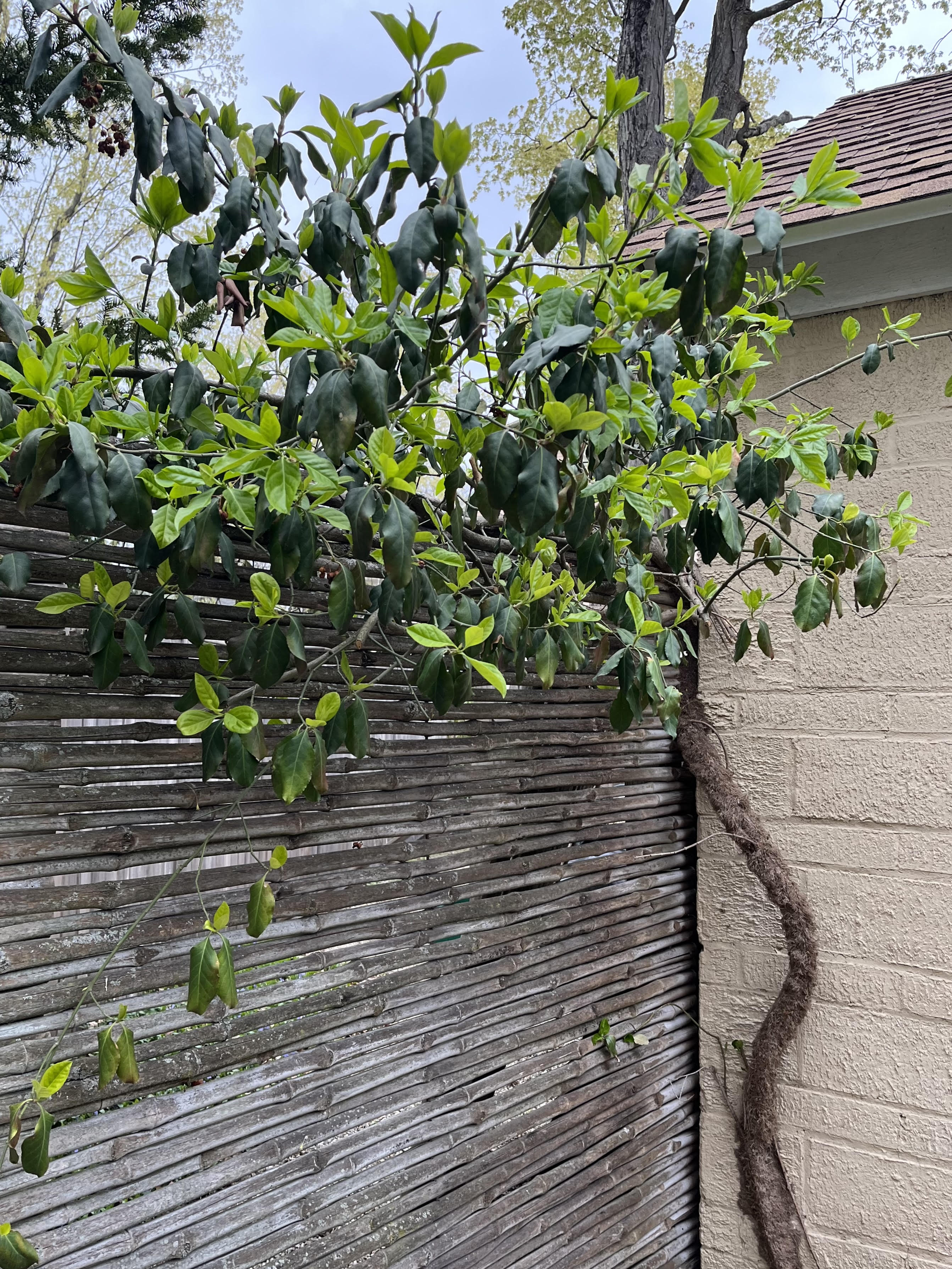
I liked the way the euonymus below spoke of new and old growing along together.

Wish I could share how wonderful those lilacs smell — or the fragrance everywhere of little lilies-of the-valley.

The quirky fairy bridge on the campus of Butler Hospital in Providence reminded me of similar ones in New York’s Central Park that filled me with delight during that sad year I was visiting my ailing sister.

In the next photo, I wanted to capture how tired that old wheel looked in the energetic sunshine.

I liked how the stone wall nurtures its floral decorations.

Erik finished the tree house — a triumph of his and a small child’s imagination and will.

After the crabapple blossoms come a couple of the signs I can never resist, including one honoring a local Korean War hero, featured in the recent film Devotion.

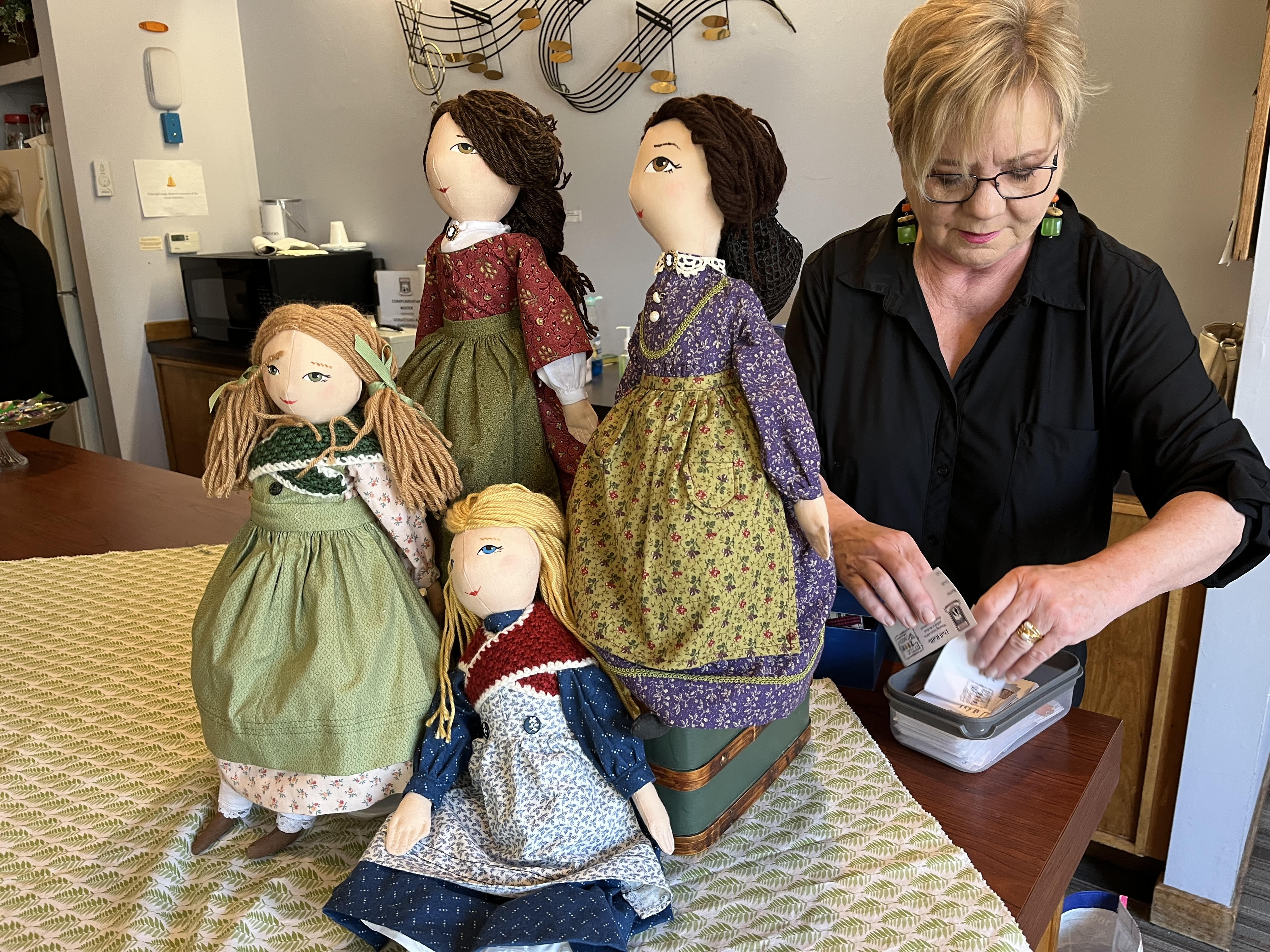
The talented costume designers for the decennial production of Little Women honored a local author with dolls featuring the main characters in her book. A lucky theatergoer with the right ticket number got the dolls after the show.

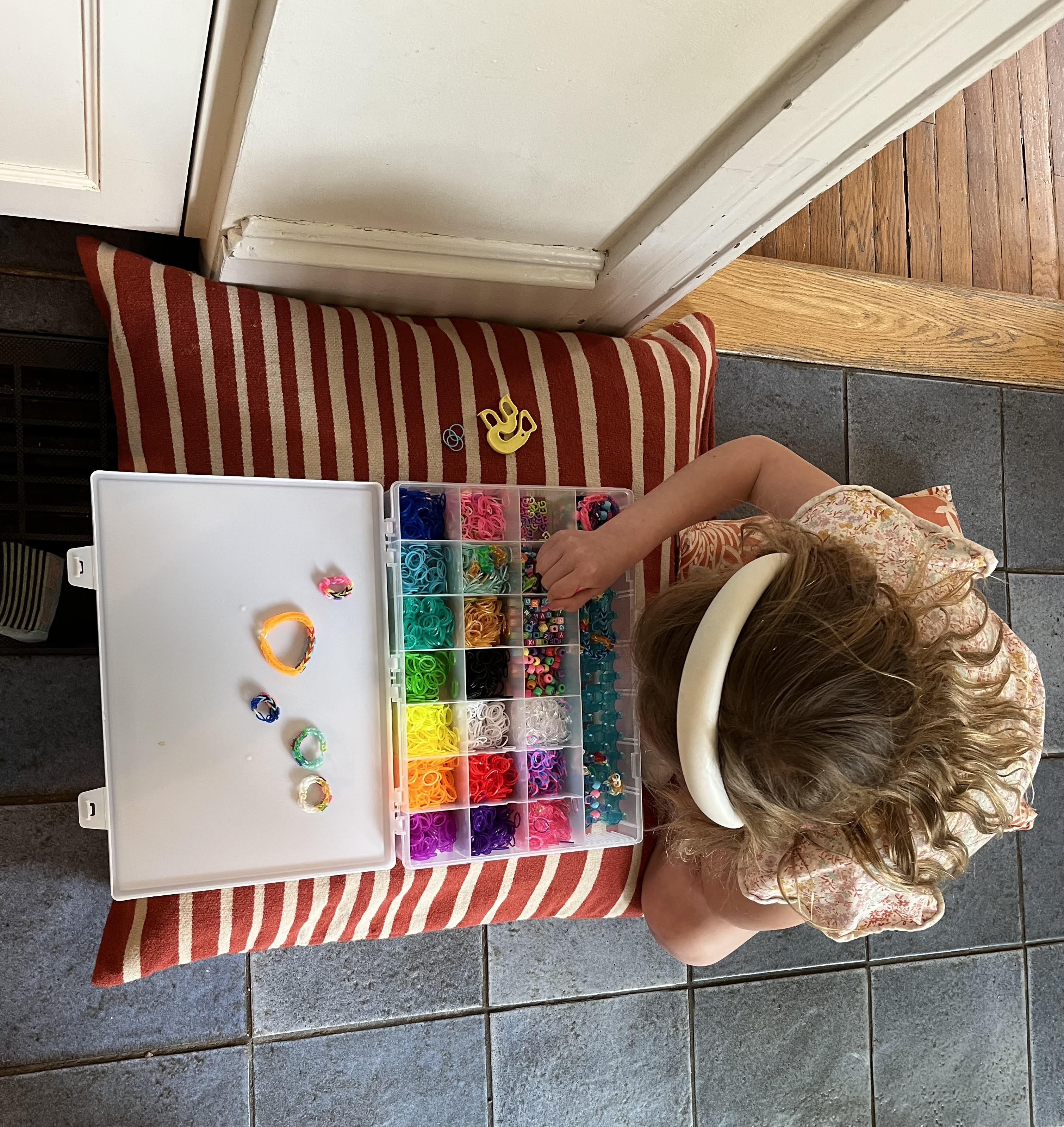
A little crafter is oblivious to all on a sunny spring day.

Singer sewing machine just like the one I sold to woman in Oklahoma years ago.

A nice thing happened to me recently. I got a phone call out of the blue from a woman in Oklahoma who had bought my old sewing machine on eBay years ago and kept my contact information. A real surprise.

She responded to my recorded message as if she were talking to me in person. “Yes, Ma’am. This is Margie M—. I had bought a sewing machine around 2014, I’m not sure. But anyway I was just wondering about it. I love the machine and wish I’d a called sooner. [She give her number.] Thank you and have a blessed day.”

I called her back. She was utterly charming. She said she’d wondered if the seller of the machine was even still alive, and she wished she’d called sooner. She’d had a number of sewing machines, but mine was the best. She said either I took very good care of it or I didn’t use it much. (I didn’t use it much.)

We talked a little about what was going on in her life, about ailing family members and how she was caring for them. At the end she wished me a blessed day again.

I think the experience of chatting with someone like Margie, a stranger with a very different life in a very different part of America, made it a blessed day, all right.

Photo: Brett Seymour.
A trove of spices was found in the stern of the ship by Brendan Foley and a team of archaeologists. It had been there for centuries.

For those of us who hope that one day the lost island of Atlantis will be found, any story about underwater discoveries of ancient artifacts is thrilling.

Line Sidonie Talla Mafotsing writes at Atlas Obscura, “Built 1485, the Danish warship Gribshunden served as the flagship and mobile seat of government for King Hans of Denmark and Norway. In the summer of 1495, Hans set sail for Kalmar, Sweden, where he was set to negotiate with Swedish leader Sten Sture the Elder. The goal of the mission was to convince Sten Sture and the Swedish council to give up their sovereignty and rejoin the Kalmar Union, which had unified much of Scandinavia under a single ruler (and which Sweden had left a few decades before, despite the union being named for a Swedish town).

“The ship itself had a role to play: to show Hans’s authority to the Swedish council. It was also laden with goods — from gunpowder weapons to artwork to delicacies — to demonstrate his power.

“However, while anchored in the Baltic Sea near the port of Ronneby, Sweden, Gribshunden mysteriously caught fire. Though the king wasn’t on board at the time, many crewmen were, in addition to all those pricey goods. Although the exact number of deaths is unknown, many of the crew of 150 were on board when the ship sank to the bottom of the Baltic with its precious cargo. …

“In the 1970s, a local diving club came across a mysterious wooden wreck there, in 33 feet of water. It wasn’t until 2001 that the first archaeological excavations of the ship began, after one of the divers told local archaeologists about what they had found. It was another decade before the remains were identified as those of Gribshunden. All through the excavation of the wreck, remarkably preserved by the cold waters of the Baltic, amazing and sometimes odd artifacts have emerged and attracted media attention. In 2015, there was a nearly perfectly preserved wooden ‘sea monster’ figurehead. In 2019, archaeologists discovered a well-preserved rare Atlantic sturgeon. Further excavations in 2021 revealed something even more remarkable: a treasure trove of spices, plant material, fruits, nuts, and cereals, that somehow survived underwater for more than 500 years.

“In a study published in the journal PLoS ONE, Brendan Foley and Mikael Larsson, archaeologists at Lund University in Sweden, examined the finds for new insights into how nobility lived and ate during the Middle Ages, and shed light on how these organic materials survived so long underwater.

“Foley and a team had been excavating the stern when they made the finds. ‘We think, but we’re not sure, that the back part of the ship is probably where the highest ranking individuals were situated,’ says Foley. They sifted through the sand and silt and revealed almond shells and peppercorns. They recovered thin strands of saffron by hand. ‘We took four samples of botanical assemblage that included both local and exotic spices, fruits, and vegetables,’ says Larsson, including black mustard, dill, clove, ginger, cucumber, grape, and berries such as blackberry and raspberry. ‘The botanical remains that really stand out are the exotic spices,’ he says. Clove, ginger, and saffron had never been found before in the medieval Baltic.

Larsson says that their work is the first anywhere in the world to find saffron in such a setting. …

“Though the geographical origins of saffron are not completely understood, it is thought to have originated in the eastern Mediterranean, and been grown in Southwest Asia and the Mediterranean basin. Ginger is believed to have originated in Southeast Asia, and cloves are native to Indonesia. Black pepper comes from South India. Despite this time being known as the ‘Dark Ages’ in Europe, the finds show that Scandinavia wasn’t just a backwater of the world economy. …

“[One] question focuses on how these delicate organic remains were able to survive in the Baltic. ‘It’s a mystery,’ says Foley. ‘We don’t know, we didn’t find any containers.’ When they found the saffron, it was just in a lump in the sediment. ‘No glass jar around it, no ceramic jar, no wooden box, no silver box,’ he says. It may have been stored in some sort of fine textile bag that disintegrated over the years—but somehow the spice remained.

“ ‘The Baltic Sea is really weird,’ Foley says. For one, it has the lowest salinity found in the global oceans. This, combined with low temperatures and low dissolved oxygen to feed microbes, have given the Baltic a reputation for remarkable preservation of archaeological material, specifically wooden shipwrecks.”

More at Atlas Obscura, here. No firewall.

Photo: Daguerre Val de Loire via the Guardian.
The family thought their painting was a fake, but it turned out to be an authentic work by Pieter Bruegel the Younger, “L’Avocat du village” (“The Village Lawyer”). It sold at auction for $850,000.

It can sometimes happen in families as younger generations come along, new people marry into the family — and those who know the history of a painting on the wall die off — that the importance of a work becomes something no one takes seriously.

I remember the husband of a babysitter John had when he was three scoffing about a painting his wife said was a Turner. I believed the babysitter was better informed. Today I wonder where that painting is.

Jonathan Edwards reports at the Washington Post about a similar situation.

“Malo de Lussac entered the tiny, dimly lit TV room in October, expecting the unremarkable as he assessed the value of the art and artifacts in his new client’s home in northern France. Then, a painting caked in dust and almost entirely hidden by a door caught the auctioneer’s eye.

“Pay it no mind, his client told de Lussac. Yes, the family had long called it ‘The Bruegel,’ but it was an affectionate dig at a painting that was clearly a fake.

“Turns out, the family joke was a hidden masterpiece, a genuine work of Pieter Bruegel the Younger, a 17th-century Flemish artist. Painted more than 400 years ago, ‘L’Avocat du village’ — or ‘The Village Lawyer’ — sold [in March] at auction in Paris for the equivalent of about $850,000 — the result of a discovery that de Lussac described as one of the most thrilling of his career.

“ ‘I was very, very surprised,’ de Lussac said.

“His coup started out as a workaday assignment: Travel from Paris to a client’s home in northern France to estimate how much their artwork and artifacts would sell for at auction. Because of the home’s size, he’d blocked out the entire day to accomplish the job.

“For the first hour, everything went as expected. After a half-hour of chatting and building a rapport with the owner over coffee, they started touring the house by surveying the living room. They then moved to the kitchen. Everything fell within de Lussac’s expectations: furniture, china, some ‘interesting’ but relatively unimportant paintings.

“They moved on to a TV room, where his client directed his attention to some 19th-century paintings they thought would be of the most interest. … Then de Lussac spotted part of a painting covered in dust and mostly obscured by a door. He shut it to get a look at the entire work. The brushstrokes, the colors, the canvas material: It all rang true with de Lussac’s knowledge of Bruegel the Younger. Born in Brussels around 1564, Bruegel was the eldest son of Pieter Bruegel the Elder, one of the most prominent artists of the Flemish Renaissance in Flanders, a Dutch-speaking region of what is now Belgium. …

“ ‘My heart was beating so hard,’ de Lussac said.

“The owners broke the bad news: The painting had long been regarded as a knockoff by the family. Their forebears had purchased it in the late 1800s, and it spent the next century bouncing to different houses as younger generations inherited the work. …

“But acting on his hunch, de Lussac pressed the current owner. Everything he observed jibed with what he knew of Bruegel the Younger, who had painted several works depicting the same scene of a Spanish official collecting taxes from Flemish peasants.

“The owners were skeptical but willing to let de Lussac send the painting to a Bruegel expert in Germany. In December, they got word: It was genuine.

“[DeLussac] said that he believes the original buyer purchased it as a genuine Bruegel, and that knowledge of its authenticity was lost to time.”

More at the Post, here. At the Guardian, there is an earlier version of the story without a firewall, here.

Photo: Pinterest.
Seadragon, an elusive marine animal found in the waters around Australia.

Everyone in my family loves the ocean and the creatures that live in the ocean. Yesterday my oldest grandson was regaling me with stories of stripers swimming near where he surfs, crabs nibbling his toes, and a too-close-for-comfort encounter with a seal. His sister told me about last weekend’s visit to Mystic Aquarium in Connecticut and her subsequent internet research on sand sharks. She was relieved to learn that Rhode Island has very few shark attacks.

Australia seems to harbor some of the most exotic sea creatures, and today’s story is about another aquarium breeding one of them — the seadragon.

Remy Tumin reports at the New York Times, “For more than a decade, researchers at the New England Aquarium in Boston have been trying to breed some of the most elusive and enchanting fish under the sea. Lacy and delicate, sea dragons live only in the waters along Australia’s southern coast, and their small habitat and limited range make them an ideal candidate for in-captivity breeding.

“Since 2008, the aquarists have tried to replicate the sea dragons’ natural habitat. They have changed the temperature of the sea dragon tank to match the seasons of the southern hemisphere. They have adjusted the amount of light in the exhibit. They got a taller tank. None of it worked.

“ ‘I had kind of given up and thought it’s never going to happen,’ said Jeremy Brodt, an aquarist and galleries manager at the New England Aquarium. And then, ‘out of the blue,’ Mr. Brodt said, ‘it happened.’

“Last May, aquarium staff members discovered that a male weedy sea dragon was successfully carrying his mate’s eggs. … The eggs had hatched in mid-July, and [aquarists] have been raising 18 baby dragons since then. …

“Aquarists hope that breeding these fickle creatures in captivity will lead to fewer sea dragons being collected from their native sea grass habitat, which is under increasing stress from climate change and runoff from storms. Sea dragons, which are primarily of the leafy or weedy varieties, are not currently threatened, but the Australian government has strict regulations that allow only a limited number of them to be collected for public display in aquariums. Still, scientists are worried that the animals’ already limited habitat may be contracting.

“ ‘They’re a great, phenomenal animal, they get people’s attention,’ Mr. Brodt said. ‘It’s a way to get that message across and talk about these unique animals and the issues that they’re facing.’ …

“Like their sea horse cousins, male sea dragons are responsible for carrying the species’s eggs to term and can have more than 150 eggs attached to their tails. Their elaborate mating ritual involves male and female sea dragons mirroring each other, moving together as they spin upward through the water. During their dance, the female sea dragon transfers her eggs to a patch on the underside of her partner’s tail, where he fertilizes and carries them. If the transfer is interrupted somehow — by competing love interests, for example, or even clumsiness — the eggs may drop or end up unfertilized.

“No one has ever seen a leafy sea dragon mate in the wild, said Greg Rouse, a marine biologist at Scripps who was not involved in the New England Aquarium’s project. … To protect the male sea dragon from bumping the eggs off his tail, aquarists at the New England Aquarium moved him to his own smaller holding tank to be monitored. Once the eggs hatched, the team gently removed the baby sea dragons and placed them in a tank stocked with highly nutritious food. …

“ ‘They’re pretty impressive specimens when they’re adults,’ Mr. Brodt said. ‘That first year, it’s crazy. They’re about two centimeters when they hatch and look like floating grape stems. They grow about one centimeter a week for several months.’

“So what made this a successful pregnancy? The researchers were considering moving some of the adult sea dragons out of their display and into a larger tank to give them more space to float when they discovered the egg transfer had already occurred in the existing exhibit. Two developments may have helped the breeding effort, Mr. Brodt said: The aquarium had a surplus of live food to dole out (adult sea dragons are primarily fed frozen food with some live supplements), and because of natural population fluctuations, there were fewer sea dragons in the tank at the time. …

“Dr. Rouse, the Scripps marine biologist, said both food and space were likely factors in the success. Because sea dragons ‘bond up as pairs in the wild and they don’t hang around in big groups, maybe they get a little bit disturbed if there’s too many in a tank with them,’ Dr. Rouse said. … Even so, the hormonal ‘synchronization’ between a male and a female has to line up perfectly. Moon phase and water temperatures also probably play a role in their reproduction.”

More at the Times, here. Wouldn’t you love to be able to say to someone who asks you about your work, “Lately I’ve been raising ’18 baby dragons’ “?

Art: John Everett Millais.
Pre-Raphaelite artist Elizabeth Siddal was the model for the drowned Ophelia of Shakespeare fame. She is not known for her art but for looking lovely in death.

I never thought about this before, but I read a critique the other day that claimed Western culture has an unhealthy admiration for pictures of beautiful dead girls — starting at least with the painting by John Everett Millais of the drowned Ophelia from Hamlet, if not earlier.

That’s a new reason to see something different in the painting. And here’s another reason: the model herself may have been victimized, or at least marginalized.

Richard Brooks writes at the Guardian, “She is immortalized as the drowning Ophelia in John Everett Millais’s celebrated 1850s painting and as the auburn-haired model for several pre-Raphaelite artists in the mid-19th century. After dying prematurely aged 32, Elizabeth Siddal was marked down for decades as a depressive and laudanum addict, and was portrayed as such in Ken Russell’s 1967 BBC film Dante’s Inferno – named after her husband, Dante Gabriel Rossetti.

“More recently, she has been mythologized in several TV dramas and novels – even as a vampire victim.

“Only now, with The Rossettis exhibition opening on 6 April at Tate Britain, will Siddal finally be judged for what she really was and achieved – a considerable artist in her own right.

“Admittedly, she had some bouts of poor health and suffered, not surprisingly, after giving birth to a stillborn daughter in 1861. However, this exhibition, with several previously unseen works, will show Siddal as an independent woman who was not just a talented artist but also had a strong influence on the career of Rossetti. …

“Siddal was untrained as an artist, as a teenager working in clothes shops in central London where she taught herself to design dresses. She was introduced to the pre-Raphaelites just as the group formed in 1849, before meeting Rossetti and becoming the model in his Rosso Vestita portrait. In 1852, she sat for Millais’s Ophelia and other pre-Raphaelites such as William Holman Hunt.

“She then began to draw and paint herself, encouraged by Rossetti and her patron, John Ruskin, who gave her an allowance. She also wrote poetry.

“And yet during the 1850s, as she began a relationship with Rossetti … her work was dismissed by the pre-Raphaelites as a ‘pale imitation’ of Rossetti. There were even claims that Rossetti helped paint her watercolors. Regarded as an appendage to her husband, she remained unknown during her lifetime. …

“However, ‘The Rossettis,’ featuring 17 of her drawings and watercolors, along with Jan Marsh’s forthcoming biography, Elizabeth Siddal: Her Story, plus new research by Glenda Youde, a York University art historian, highlight her as a skilled artist.

“They also prove that she had a real influence on Rossetti by comparing and contrasting the work of the two artists in the exhibition. ‘They were together, after all, in the same studio,’ says Youde. ‘You can see her effect on the style in paintings which Rossetti did himself either during her lifetime, or especially afterwards.’

“This view is supported by Marsh. ‘In many cases it was Rossetti who was adopting and responding to her ideas and execution,’ she says.

“The exhibition also contains a remarkable poem, dedicated to her by Rossetti. ‘The Portrait,’ which illuminates the power of a portrait to bring back memories of a dead loved one, was one of several kept inside a leather-bound book that in 1862 Rossetti buried beside her body in Highgate cemetery in north London.

“Seven years later the book was removed after the tomb was, controversially, opened. Owned for many years by the University of Delaware in the US, a loose sheet of paper with Rossetti’s original crossings-out and changes for ‘The Portrait’ will be seen for the first time at the Tate. Alongside will be Rossetti’s most famous portrait of Siddal – ‘Beata Beatrix.’ …

“There is, however, one unsolved mystery. Siddal is known to have completed one self-portrait – a rendering showing her red locks and stern expression. Siddal painted it in 1853, but it has not been seen publicly for more than a century, although it was photographed about 50 years ago. This photograph is in the exhibition’s catalogue.”

More at the Guardian, here. All I know is Rossetti wrote one of the saddest poems ever, “The Woodspurge,” which I always thought was after the death of this young wife. I memorized it in high school for a poetry assembly, and I still know it by heart. But now I have just looked it up and learned it was written before he even married her. No one seems to know what was troubling him when he wrote it. Hmph.

Photo: Buda Musique via the BBC.
Emahoy Tsegué-Maryam Guèbrou, the composer and piano-playing nun who died March 26 at age 99. The BBC reports she led an “extraordinary life, which included being a trailblazer for women’s equality and walking barefoot for a decade in the isolated mountains of northern Ethiopia.”

Here’s a woman who had a long and fruitful life, dying at 99 after making her mark as a nun, a musician, and a proponent of women’s equality. You may be surprised to learn of the advantages a girl could have back in the day if her family was connected to Ethiopian royalty.

Brian Murphy reports at the Washington Post, “Emahoy Tsegué-Maryam Guèbrou, a classically trained musician who once abandoned music for a hermit-like life as a nun in her native Ethiopia and later returned to the piano with a genre-defying blend of Western and Ethiopian influences, died March 26 at her convent in Jerusalem. She was 99. …

“The styles explored by Sister Guèbrou (the title Emahoy is equivalent to ‘Sister’ for a nun) were so singular in sound and structure that music scholars often puzzled over the main source of her inspiration — seamlessly mixing forms such as jazz, chamber music and rhythms from her homeland. …

“Her work was brought to a larger audience in recent years on the soundtrack for the Oscar-nominated documentary Time (2020) about a two-decade saga for an inmate and his family; and as music on the Netflix race-and-prejudice drama Passing (2021).

“Sister Guèbrou, meanwhile, spent long stretches in solitude inside the Ethiopian Monastery of Debre Genet, or Sanctuary of Paradise, in Jerusalem, where she lived since 1984 in a single room adorned with her artwork of icons and angels. …

“In her few specific comments on her musical influences, she expressed admiration for the European classical canon including Frédéric Chopin and Johann Strauss. Yet she stayed rooted in the five-note melodic runs common in Ethiopian music, while also exploring the flowing richness of Eastern Orthodox chants or the distinctly American sounds such as jazz or the old-timey snap of ragtime. …

” ‘Just within the first five or 10 seconds of the song, we have invocations of European modernism, of Ethiopian traditional music and of the links between Ethiopian Orthodoxy and a broader Judeo-Christian tradition,’ said Ilana Webster-Kogen, an ethnomusicologist at the University of London’s School of Oriental and African Studies.

“ ‘Getting all of that musical information within about five seconds of listening means that comparing her to anyone else wouldn’t make sense,’ she added.

“There was a decade, however, when Sister Guèbrou played nothing at all.

“She was a rising young talent as a teen, studying for two years under Polish violinist Alexander Kontorowicz in Cairo and then was offered a scholarship to London’s Royal Academy of Music. Sister Guèbrou never made clear what happened next. For some reason, she was blocked by Selassie’s government from traveling to London.

“She was devastated. For nearly two weeks, she refused to eat. She ended up in a hospital in Ethiopia’s capital, Addis Ababa. Her family feared she was near death. Weak and ailing, Sister Guèbrou said she slept for an entire day.

“ ‘When I wake up, I had a peaceful mind,’ she told the BBC in 2017. ‘I was changed. And I didn’t care for anything.’

“She left music behind. At 19, she joined the Gishen Mariam monastery in Ethiopia’s northern highlands. For the next decade, she barely left the monastery grounds, where she slept in a hut on a dried-mud bed. She noticed many of the nuns and monks were barefoot. She gave up shoes as well.

“She had already experienced huge swings in her life. She was raised in privilege in a family that had deep connections in the Ethiopian royal court, including her father’s work in diplomatic and liaison roles. She and her sister, Senedu, attended a Swiss boarding school and soaked in Western music and art.

“After Italian forces under Benito Mussolini invaded Ethiopia in 1935, Sister Guèbrou and her family were placed under house arrest and later sent to POW camps in Italy for two years. Three of her brothers were killed in the fighting. (She composed the 1963 piece, ‘The Ballad of the Spirit,’ in their memory.) …

“At nearly 30 years old, she decided to see how her fingers felt back on the piano keys. The music flowed. Now, however, it was more infused with the meditative sounds and chants from the monastery.

“ ‘I said to myself, “I have nothing. I have music,” ‘ she recalled. ‘I will try to do something with this music.’ …

“In 1974, a coup toppled Selassie and ended Ethiopia’s monarchy. Anyone favored by the ousted royal regime, including Sister Guèbrou and her family, was now under suspicion and closely monitored. When Sister Guèbrou’s mother died in 1984, she moved permanently to the monastery in Jerusalem, always seen in public in the flowing religious garb that covered her head. …

“ ‘We can’t always choose what life brings,’ she told the BBC. ‘But we can choose how to respond.’ ”

More at the Post, here.