Photo: Mark Holley. Archaeologists exploring Lake Michigan’s Grand Traverse Bay uncovered a rock with a possibly prehistoric carving of a mastodon and stones arranged in a Stonehenge-like manner.
There’s always more to discover right under our feet. Or in the case of today’s report, under our boats.
In November, Archaeology World reported on some recent discoveries in Lake Michigan.
“Archaeologists found something much more fascinating than they got credit for when searching under the waters of Lake Michigan for shipwrecks: they uncovered a rock with a prehistoric carving of a mastodon, as well as a collection of stones arranged in a Stonehenge-like manner.
“In modern archaeology, the use of remote sensing techniques is common: scientists regularly survey lakes and soil for hidden objects.
“Archaeologists uncovered sunken boats and cars and even a Civil War-era pier at a depth of around 40 feet into Lake Michigan’s Grand Traverse Bay, using sonar techniques to search for shipwrecks, but among all these, they found this prehistoric surprise, which a trained eye can guess by looking at the sonar scans photos in this article.
” ‘When you see it in the water, you’re tempted to say this is absolutely real,’ said Mark Holley, a professor of underwater archaeology at Northwestern Michigan University College who made the discovery, during a news conference with photos of the boulder on display in 2007. ‘But that’s what we need the experts to come in and verify.’
“The boulder with the markings is 3.5 to 4 feet high and about 5 feet long. Photos show a surface with numerous fissures.
“Some may be natural while others appear of human origin, but those forming what could be the petroglyph stood out, Holley said.
“Viewed together, they suggest the outlines of a mastodon-like back, hump, head, trunk, tusk, triangular-shaped ear and parts of legs, he said.
“ ‘We couldn’t believe what we were looking at,’ said Greg MacMaster, president of the underwater preserve council.
“Specialists shown pictures of the boulder holding the mastodon markings have asked for more evidence before confirming the markings are an ancient petroglyph, said Holley.
“ ‘They want to actually see it,’ he said. Unfortunately, he added, ‘Experts in petroglyphs generally don’t dive, so we’re running into a little bit of a stumbling block there.’
“If found to be true, the wannabe petroglyph could be as much as 10,000 years old – coincident with the post-Ice Age presence of both humans and mastodons in the upper midwest.”
Don’t you love archaeology? I love even the “discoveries” that turn out to be untrue — like the Cardiff Giant that my family visited often in Upstate New York when I was a child. Imagine the creativity and hard work that went into pulling off a hoax like that! Of course, I prefer hoaxes that have been found out, not the ones that are still fooling people.
Photo: Henry Nicholls/Reuters. Residents take shelter inside London’s Roehampton Library, Dec. 14, 2022. The library is being used as a “warm bank,” according to CSM, welcoming members of the community to spend time there in the winter months as an alternative to heating their homes amid increased energy costs.
After Russia invaded Ukraine a year ago, oil prices and heating costs went up for everyone. And rather than help people out, oil companies gave their windfall profits back to themselves. In the long run, that can only help to spur alternative energy development. But meanwhile, folks are just trying to keep warm.
Natasha Khullar Relph writes at the Christian Science Monitor, “String lights, boxes full of postcards to share a story, or a sign on the door that lists the top five David Bowie songs with the message, ‘Come in and argue’: There are many ways to make people happy to come out of the cold and into a public warm space, says Maff Potts. The key, he adds, is to make sure they feel welcome and not judged.
“ ‘What gets people in is that it’s not a church. It’s not a charity,’ says Mr. Potts, who founded Camerados, a social movement that’s been opening public living rooms in communities across the United Kingdom since 2015. ‘There’s no fixing, no answer. There’s just permission.’ …
“While the U.K. Health Security Agency is encouraging people to warm their homes to at least 18 degrees Celsius (64.4 F), more than 3 million low-income households cannot afford to heed this advice.
According to analysis by the Joseph Rowntree Foundation, around 710,000 households across the U.K. cannot pay for warm clothing, heating, and food, with approximately 2.5 million households – a fifth of all low-income households – going without both food and heating.
“And with power prices hitting record levels and energy costs double what they were last year, warm spaces have popped up all over the country. To avoid any potential stigma, they’re being presented as communal spaces where people can come to chat rather than charitable offerings of heat or food. While the main reason someone would go to a warm space or public living room is most likely to be warmth, it’s the camaraderie and conversation that keeps people there. …
“Britain’s poor people face the worst winter in living memory, tweeted former Prime Minister Gordon Brown in December. ‘A year ago we talked about people having to choose between heating and eating, now many can’t afford either,’ he wrote. Two-thirds of the country will be in fuel poverty come April, which includes 70% of pensioners [retirees] and 96% of single-parent families with two or more kids, he noted. …
“If you’re struggling to pay to heat your home, you only really have three options, says Matt Copeland, NEA’s head of policy: You could rack up debt with your energy supplier, ration your energy and use less than you need to stay warm, or simply turn off the heating, the impact of which can be significant. Research shows that more people die from cold homes than they do from alcohol’s short- and long-term effects, Parkinson’s disease, or traffic accidents.
“ ‘We know of households with prepayment meters who just can’t afford to top them up at all,’ says Mr. Copeland. ‘They’re going days, weeks, and sometimes months without access to energy.’ …
“Where the government is failing, communities are stepping up. ‘It is completely absurd that one of the 10 richest countries in the world can’t put a sufficient priority on things and make the right choices so that we have somewhere to keep people warm,’ says Mr. Potts of Camerados, whose public living rooms are now being used as templates for warm spaces around the country. After almost 30 years of working with people at the margins, Mr. Potts says he doesn’t have faith that the solution lies in the civil service. …
“An LGBTQ+ community space in Brighton. A bakery in North Yorkshire. A gaming cafe and ‘geek culture’ store in Ipswich. A vegetarian restaurant in Tunbridge Wells. A brewery in Devon. A former shoe store in Worcestershire. Warm spaces are popping up all around the country, in all manner of ways, in a community effort that started organically, from the grassroots, without a central organizer.
“In addition to community halls and churches, hotels, hairdressers, and cricket clubs are opening up their doors for anyone who needs some warmth, some company, and perhaps even a drink. Even legendary soccer club Manchester United has gotten in on the action and is offering Old Trafford, the club’s stadium, as a free warm hub, with its restaurant, the Red Café, opening its doors on Monday and Wednesday evenings ‘to help those facing difficult months ahead.’
“The Warm Welcome campaign, an organization that has encouraged thousands of faith groups, charities, and businesses to provide such public spaces, said they’d seen 80,000 people use their facilities during December’s cold snap. The campaign notes that there are now warm spaces in every town and city in the country, and lists over 3,200 venues on their website, which include spaces run by local authorities, charities, and businesses. …
“ ‘What we have in Brighton and Hove is a tremendous community-mindedness among residents. Despite the stark reality facing residents this winter, people have stuck together and they’ve really helped each other through some of the starkest problems,’ says Brighton and Hove City Council Leader Phélim Mac Cafferty, who notes there are more than 40 warm spaces available to the public across the city. …
“This nationwide response to the energy crisis is unique in how much of a community effort it is. The effort to create warm spaces was neither government- nor council-led, nor the work of any one particular organization. As the need became obvious, first volunteers, then organizations, and later local councils jumped in feet first.”
From “The Ants Go Marching” song, via Kylie Van Dam.
When I was young, I remember being horrified and fascinated to learn that hospitals sometimes use live maggots in wound care because of their precision.
Maggots clear away gangrene and leave healthy tissue. The UK National Health Service says, “They also help fight infection by releasing substances that kill bacteria and stimulate the healing process.” It’s called biosurgery.
Now researchers are finding that ants also have medical uses. Dino Grandoni has the story at the Washington Post.
“The ant oncologist will see you now.
“Ants live in a world of odor. Some species are completely blind. Others rely so heavily on scent that ones that lose track of a pheromone trail march in a circle, until dying of exhaustion.
“Ants have such a refined sense of smell, in fact, that researchers are now training them to detect the scent of human cancer cells.
“A study published []in the journal Proceedings of the Royal Society B: Biological Sciences highlights a keen ant sense and underscores how someday we may use sharp-nosed animals — or, in the case of ants, sharp-antennaed — to detect tumors quickly and cheaply. That’s important because the sooner that cancer is found, the better the chances of recovery.
“ ‘The results are very promising,’ said Baptiste Piqueret, a postdoctoral fellow at the Max Planck Institute for Chemical Ecology in Germany who studies animal behavior and co-wrote the paper. He added, however: ‘It’s important to know that we are far from using them as a daily way to detect cancer.’
“Stretching out their pair of thin sensory appendages atop their heads, the insects detect and deploy chemical cues to do almost everything — find food, swarm prey, spot colony mates, protect young. This chemical communication helps ants construct complex societies of queens and workers that operate so in sync with scent that scientists dub some colonies ‘superorganisms.’
“For his study, Piqueret’s team grafted pieces of a human breast-cancer tumor onto mice and trained 35 ants to associate urine from the tumor-bearing rodents with sugar. Placed in a petri dish, the silky ants (Formica fusca) spent significantly more time near tubes with urine from the ‘sick’ mice compared with urine from healthy ones. …
“The way we diagnose cancer today — by drawing blood, taking biopsies and conducting colonoscopies — is often expensive and invasive. Animal behaviorists are imagining a world in which doctors one day tap species with keen senses to help spot tumors quickly and cheaply.
“Dogs can sniff out the presence of cancer in body odor, past research has shown. Mice can be trained to discriminate between healthy and tumor-bearing compatriots. Nematodes are attracted to certain organic compounds associated with cancer. Even the neurons of fruit flies fire in the presence of certain cancerous cells.
“But ants, Piqueret suggested, may have the edge over dogs and other animals that are time-consuming to train.
“Piqueret conducted the research while studying at the Université Sorbonne Paris Nord in France. During covid lockdowns, he brought silky ants into his apartment outside Paris to continue his experiments. He chose the species because it has a good memory, is easy to train and doesn’t bite (at least not hard). …
“Piqueret’s team plans to test ants’ ability to sniff out the markers of cancer in urine from actual patients. …
“If ants are ever used in cancer screening, Piqueret wants to make one thing clear: No, they will not need to crawl on you.
“ ‘There will be no direct contact between ants and patients,’ he said. ‘So even if people are afraid of insects, it’s fine.’ “
More at the Post, here. Interested in the wonders of ants? Follow this professor: @alexwild.
Photo: Nick BanKo/CNN. No, it’s not a shark. A bystander captured video of dolphins in the Bronx River in January, the first time they had been seen in the once polluted river since 2017.
Whenever I start feeling that saving the environment is hopeless, I remind myself that the Erie River no longer catches fire.
Now I can also think about what has changed at a formerly filthy river in New York’s Bronx borough.
Cathy Free reports at the Washington Post, “Nick Banko paused during a bike ride in New York City’s Starlight Park on a Monday afternoon [in January] when he saw something unusual in the Bronx River.
“Two dorsal fins were circling in the water, not far from where he was standing. They briefly disappeared beneath the river’s surface, then popped up again.
“Banko said he couldn’t believe what he was seeing: dolphins.
“ ‘I told myself, “Hold on, let me go to the dock and get closer,” ‘ said Banko, 22. ‘When I did, it was like they almost sensed my presence. Both of them passed through the surface of the water, showing their fins once more.’
“Banko quickly took a video of the dolphins, then posted it on Instagram with an all caps caption [asking for information.] A few days later, the New York City Department of Parks and Recreation shared his encounter on Twitter, where it has been viewed more than 2 million times.
“ ‘It’s true — dolphins were spotted in the Bronx River this week!’ NYC Parks posted. ‘This is great news — it shows that the decades-long effort to restore the river as a healthy habitat is working.’ …
“A parks spokesperson wrote later in a statement. ‘Make sure that they’re comfortable during their visit by giving them space and not disturbing them.’
“Two days later, there was another sighting of two dolphins in Brooklyn, although no one is certain if they were the same pair. People immediately started sharing videos of them on social media. …
“ ‘There was no wildlife in the Atlantic Ocean off [Long Island] and N.J. when I was a kid,’ posted another Twitter user. ‘Now there are seals, dolphins and yes, sharks, not to mention osprey and other birds. Environmentalism has had enormous successes.’
“One person surmised that New York dolphins probably sound different from other dolphins. ‘FUN FACT: The dolphins communicate with each other using a series of clicks and whistles in a distinctly Bronx accent,’ he wrote. …
“Dolphins occasionally make an appearance to feed on Atlantic bunker fish in New York City’s waterways, according to wildlife experts. They have been more often seen in the New York Harbor, where the Hudson River meets the salt water from the Atlantic off the lower tip of Manhattan. Sightings as far north as the Bronx are less common.
“ ‘It’s not every day you see them, but we did have some sighted in 2017,’ said Adriana Caminero, an urban park ranger with NYC Parks, recalling when students in a youth development program snapped photos of a lone dolphin in the Bronx River. …
“In 2012, a bottlenose dolphin was spotted in the Hudson River near West 120th Street, and in 2013, a couple of dolphins were spotted swimming in the East River. New Yorkers have also seen a humpback whale in the Hudson, and a fisherman caught a shark there in 2015.
“Two days after Banko took a video of the dolphins in the Bronx, several people witnessed two dolphins swimming in Whale Creek, a tributary of Newtown Creek, near the Grand Street Bridge in Brooklyn, prompting the Newtown Creek Alliance to post a photo and short video of the marine mammals on Instagram.
“ ‘It’s a good sign to see dolphins in our waters — it’s a sign that the river is much more healthy now than in the past,’ Caminero said, noting that it took years of activism to clean up the Bronx River after decades of pollution and dumping.
“Most people think of the 23-mile waterway as a freshwater river, she said, but further south it’s more brackish as it becomes part of the Long Island Sound. The river is restocked with fish every year by NYC Parks, Caminero noted. …
“After the dolphins were spotted in Whale Creek, people worried they might be poisoned by toxins, oil and sewage in the water. The adjacent Newtown Creek is a Superfund site that won’t be cleaned up until 2032. …
“Both of the recent dolphin sightings are reminders of the importance of keeping waterways clean to increase wildlife activity, said Willis Elkins, executive director of the Newtown Creek Alliance.
“ ‘Despite the improvements in water quality around New York City in recent decades, we still have a long road ahead to clean up historic toxins and eliminate the billions of gallons of sewage overflow that pose real risk to humans and marine wildlife alike,’ he said.
“While big improvements have been made in the Bronx River, there is still work to be done, added Caminero.
“ ‘Here in New York City, it’s really important that we properly dispose of our litter, because even something small can be washed into our waterways,’ she said. ‘Fishing gear left behind can also be dangerous — fish and other animals can become entangled in fishing lines.’
“She encourages those who want to view wildlife in or out of the water in New York City to keep their distance from the creatures.”
Never doubt that the accumulated efforts of many individuals can make change. “One and two and 50 make a million,” you know.
Photo: Teagan Ferraby/ Unsplash. Making pasta from scratch.
This one is for my friend Sandra, who makes many Italian dishes the way her mother taught her. For example, she makes a labor-intensive pasta at Christmas in quantities that can feed a large extended family, including great great nephews.
Sydney Page writes at the Washington Post, “After all the food is served at this New York restaurant, customers clap for the grandmother who cooked it. It’s not scripted, but it happens every night.
“The Staten Island establishment, run by women known as ‘nonnas of the world,’ is as much a celebration of the people who toil in the kitchen as the places they hail from. …
“There are about a dozen women who cook regularly at Enoteca Maria, a casual 30-seat Italian eatery. Its menu is made and executed by a rotating group of international women, most of whom are matriarchs.
“The nonnas — the Italian word for grandmothers — include Maria Gialanella, 88. She has amassed such a following that some customers come only on nights they know she is in the kitchen. She even has her own Instagram page.
“Seeing strangers taste her culinary creations, she said, gives her immense pleasure and pride.
“ ‘Everybody likes it, so I’m very happy,’ said Gialanella, an Italian immigrant known for making ravioli by hand, rich ragus, soups and other family recipes she learned growing up near Naples.
“Gialanella, who moved to the United States in 1961 and worked as a seamstress, said that 10 years ago, her daughter heard about Enoteca Maria and encouraged her to become a cook there.
“ ‘It’s nice with the other nonnas,’ said Gialanella, who has six grandchildren. ‘I like every food.’
“Restaurant owner Joe Scaravella is a huge fan.
“ ‘She is not even 5 feet tall, but she’s a powerhouse,’ said Scaravella, who opened the eatery in 2007. ‘She goes around and does selfies. She spends the night hugging people.’
“Initially, you had to be an Italian grandmother like Gialanella to join the kitchen staff, but about nine years ago, Scaravella decided to broaden the cooking criteria.
” ‘They just have to be women that can bring their culture forward,’ he explained, adding that the cooks — all of whom are called ‘nonna’ by patrons, regardless of their background — range in age from 50 to 90, and possess a deep knowledge of their culture’s unique cuisine. While most are grandmothers, some are not. …
“In the beginning, the restaurant served only Italian fare — to reflect Scaravella’s roots. He opened the eatery after losing several family members, including his grandmother and his mother, both born in Italy, as well as his sister. They were all excellent cooks, he said. …
“At the time, Scaravella had spent more than 17 years working for the Metropolitan Transportation Authority and had no experience running a restaurant — let alone working in one.
“ ‘I had no idea what I was doing,’ he said. ‘No business plan or anything.’
“On a whim, he used the money his mother, Maria, had left behind to purchase a vacant storefront and decided to name his new restaurant after her. … Scaravella wanted his restaurant to serve the traditional Italian classics that he was desperately missing. It was the women in his family who dominated the kitchen.
“ ‘There were a lot of ladies at home that had all this information,’ said Scaravella. His mother and grandmother, for instance, knew ‘the secret to a good meat ball’ and ‘how to repurpose stale bread.’
“ ‘My whole life, I never wanted to go to an Italian restaurant, because it just never hit the spot,’ he continued. ‘These ladies, they’re the source. They are the vessels that carry this information forward.’
Given that his own matriarchs were gone, Scaravella embarked on a quest to find some nonnas who could prepare authentic, warming meals. …
“Before opening the restaurant, Scaravella put an advertisement in the local Italian American newspaper, seeking nonnas who could cook regional dishes from different parts of Italy. He was stunned by the response.
“ ‘I invited these ladies to my home. They showed up with plates of food,’ said Scaravella. ‘That was really the birthplace of the idea.’
“From there, he opened Enoteca Maria’s doors, staffing the kitchen with genuine nonnas who prepared everything from lasagna to chicken cacciatore. The concept, Scaravella said, was meant to mimic the experience of going to his nonna’s house for a meal.
“ ‘There’s a certain safeness when you go to your grandmother’s house, generally,’ he explained. ‘That is a strong memory and it’s very comforting, and I just really needed to be comforted.’
“The restaurant quickly took off. A few years later, Scaravella began inviting grandmothers from other cultures to cook their classics in his kitchen, and it got even busier.
“ ‘There are so many different people from so many different cultures,’ he said. ‘It just made sense to feature everybody’s grandmother.’ …
“Scaravella and the restaurant manager, Paola Vento, organize the weekly schedule and work with the nonnas to determine the menu. Typically, visiting nonnas are hired to cook at the restaurant about once a month, Scaravella said, though some come more often, and others come only once or twice a year.
“ ‘My favorite part of the job is getting to work with the grandmothers,’ said Vento, adding that the daily highlight is when customers clap for the visiting nonnas at the end of the evening. ‘You have to see the faces of the nonnas. They are so proud and so excited that they were able to share a part of their culture through food.’
“Many of the nonnas, Vento said, have become close friends. Although they speak different languages and come from different places, they have found ways to bond — mainly, through food.
“ ‘There’s a lot of love in the room,’ she said.
“To become a visiting nonna, there is one criteria: ‘They have to have a love for cooking, and that’s it,’ Vento said.
“While there is no required test, many prospective cooks attend a one-on-one free class offered at the restaurant called ‘nonnas in training.‘ …
“While Scaravella misses his own nonna, he said that his heart — and stomach — feel full again. What started as an effort to reconnect with his roots has allowed others to do the same.
“ ‘It’s hundreds of years of culture coming out of those fingertips,’ he said. ‘It’s beautiful stuff.’ ”
More at the Post, here. Can anyone share a picture of their grandmother in the kitchen? One of mine sold jellies, but I don’t have a photo.
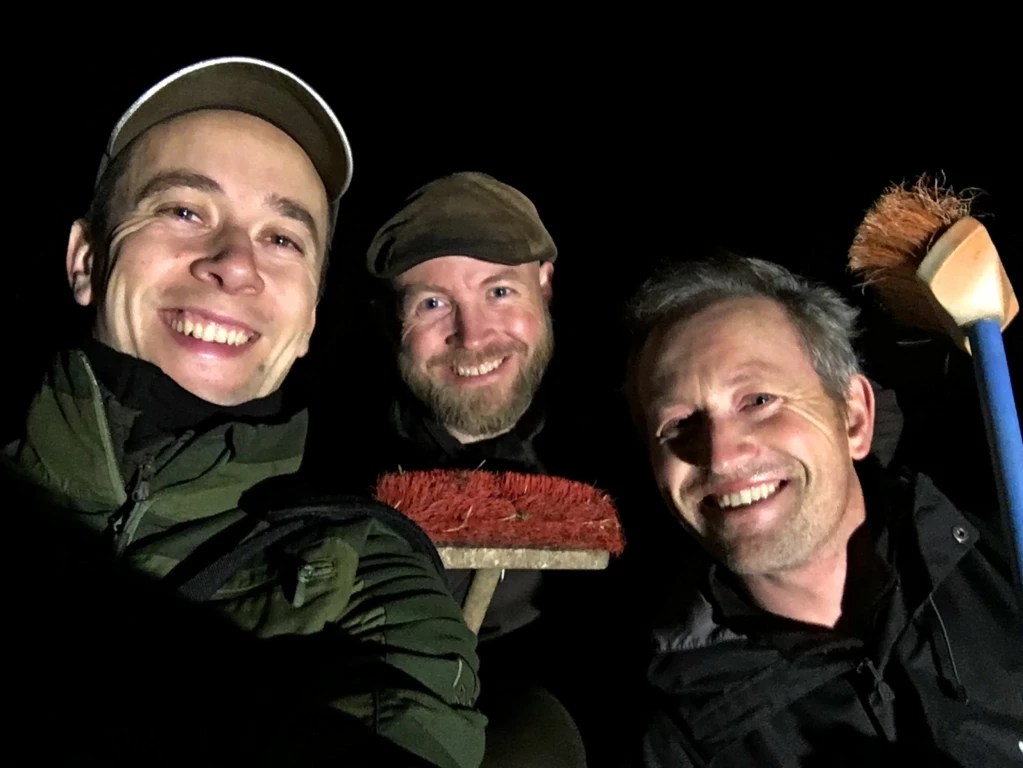
Photo: Science Norway. According to Science Norway, all it took was a smart hypothesis and a few brooms. Together, the three friends have discovered hundreds of previously unknown rock carving sites in the Østfold landscape in the last 3-4 years.
Some good buddies hang out in a bar together. Some go bowling together or maybe running. The buddies in today’s story hunt Bronze Age petroglyphs. At night.
Lisa Abend writes at the New York Times, “It was December and the first snow of the season was falling when the three friends set out on their weekly hunt through the fields of Ostfold, in southeastern Norway. … Tromping across the blanketed farmland, the men came to a low outcrop of rock, a few feet wide. With a child-size plastic broom, they brushed away the newly fallen snow from the stone to reveal the outline of a ship, its curved keel carved into the granite roughly 3,000 years ago.
“It was just one of more than 600 Bronze Age rock carvings, known as petroglyphs, that Magnus Tangen, Lars Ole Klavestad and Tormod Fjeld have discovered. Since making petroglyph hunting their collective hobby in 2016, the three enthusiasts have transformed knowledge about prehistoric art in Norway, more than doubling the number of carvings known in their home region. And although they are motivated, in part, by the pleasures of friendship and the outdoors, their findings have also lent serious weight to theories about the mysterious petroglyphs’ meaning.
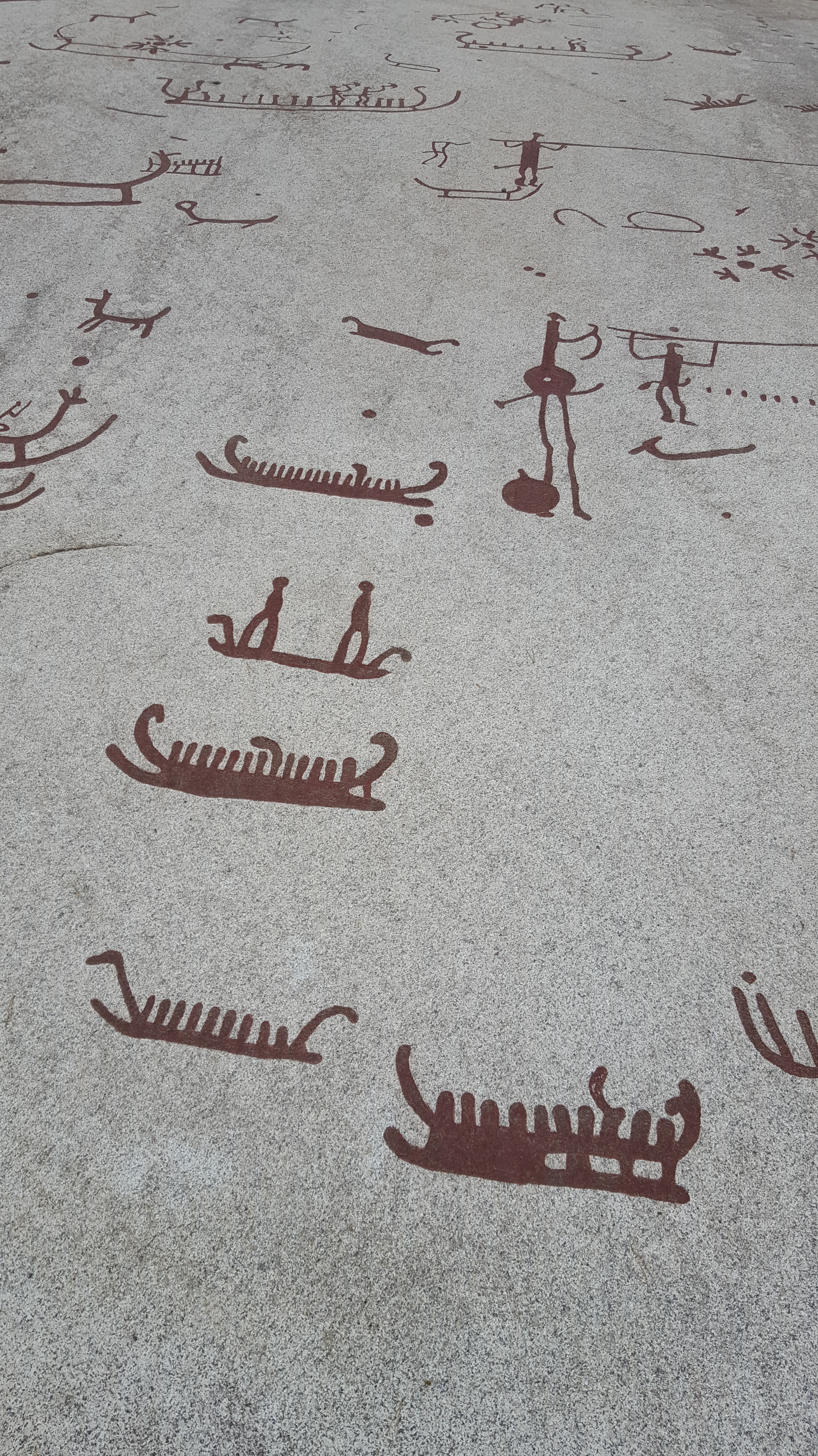
“Rock carvings from the Bronze Age (which in Scandinavia began around 2,000 B.C.) are common in parts of Sweden and Norway. Regions in both countries have been declared UNESCO heritage sites because of the density and the diversity of the images, which include human figures, animals, geometric shapes and, frequently, ships. Yet because they are commonly cut into granite that is low to the ground and easily obscured by leaves or snow, they often go unnoticed.
“Petroglyphs are also easier to see when the sun is not overhead — a realization that has been one of the keys to the three friends’ success. Because the hunt for them is a hobby rather than a career — Tangen is an archaeologist working in a different field, Fjeld a graphic designer, and Klavestad a landscape architect and artist — they make time for it at night. …
“The thrill of the hunt has naturally led them to speculate on the carvings’ meaning. Because the petroglyphs tend to be more visible in the slanted rays of dusk, or with angled artificial lights, Tangen said he believed that their creators had made deliberate use of shadow and light in their work. Thanks to the sun’s changing angle, petroglyphs can look different depending on the hour of the day, or season, he explained. ‘I think the images have to do with the awakening of people’s minds to time,’ he said.
“That is in keeping with findings from professional archaeologists about rock art and stone monuments, in places like British Columbia and Scotland, whose features are visible only at certain times of year. There is also evidence for another one of Tangen’s theories: that some of the images were meant to be seen in flickering light, so that they appeared almost animated.
“Kristin Armstrong-Oma, a professor of archaeology at the University of Stavanger, said that ‘in excavations around some carvings, archaeologists have found signs of burning or charcoal.’ That suggested fire was being used, almost like a movie camera. ‘The living flames give the carvings a feeling of movement,’ she said.
“The petroglyph-hunting trio got their start in 2016, when Fjeld, the graphic designer, was walking his dog in the countryside and found a strange mark in a rock. He wondered if it was made by humans, or nature. Trying to identify it online, he came across a website with photos of petroglyphs, and contacted its owner, Tangen, who suggested Fjeld’s find could be a Bronze Age cup mark — a simple, round carving that is a common motif in prehistoric art.
“His interest piqued, Fjeld started paying better attention on his walks, and soon found a carving that was unmistakably made by human hands: an image of a ship. ‘That was very, very fun,’ Fjeld said. ‘So I started going on a regular basis.’
“Tangen, who had made similar discoveries while walking his own dog, joined him, and before long suggested that they invite Klavestad, a local enthusiast who had found his first carving when he was 10.
“ ‘We didn’t know each other, but I hadn’t met anyone else with so much passion for it,’ said Klavestad. ‘We are, all three, very dedicated.’ “
Petroglyphs I saw in 2017 at a UNESCO-protected World Heritage Site in Sweden.Some have been painted red to make them more visible for tourists, a practice which has drawn criticism.
Back in the 1990s, I had a stint as the editor of a publication called Minnesota Physician, where I interviewed a local physician who referred to himself as “the laugh doctor.” He convinced me that even forcing yourself to laugh can create endorphins in your body that are good for your health.
More recently, I saw research about this at the Washington Post. Daryl Austin has the story.
“My three young daughters like to watch pets doing silly things. Almost daily, they ask to see animal video clips on my phone and are quickly entertained. But once my 7-year-old lets out a belly laugh, the laughter floodgates are opened and her two sisters double over as well.
“This is just what science would predict.
“ ‘Laughter is a social phenomenon,’ says Sophie Scott, a neuroscientist at University College London who has studied laughter and other human reactions for more than two decades. Scott co-wrote a study showing how the brain responds to the sound of laughter by preparing one’s facial muscles to join in, laying the foundation for laughs to spread from person to person.
‘Contagious laughter demonstrates affection and affiliation,’ Scott says. ‘Even being in the presence of people you expect to be funny will prime laughter within you.’
“Laughing has also been shown to lower stress levels. ‘Cortisol is a stress hormone that laughter lowers,’ says Scott, adding that anticipation of laughter also ‘drops your adrenaline’ and the body’s heightened fight-or-flight response. ‘All of these things contribute to you feeling better when you’ve been laughing,’ she says.
“Because humans are wired to mirror one another, laughs spread around a room just like yawns, says Lauri Nummenmaa, a brain researcher and professor at Aalto University School of Science in Finland whose work appears in a recent special issue on laughter in the journal Royal Society.
“ ‘We simply copy the behavior and laughter of others,’ Nummenmaa says. ‘Someone else’s act of laughing is first perceived when seen or heard, and this sensory information is then converted into the same area of the observers’ brain.’
“Studies also indicate that laughter can strengthen relationship connections. This happens, in part, because people naturally want to be around those who make them feel good the way laughing does. ‘We crave the company of the individuals who can give us such feelings,’ Nummenmaa says. …
“Contagious laughter isn’t necessarily a phenomenon unique to humans. Great apes, for instance, have been documented behaving similarly.
“ ‘Laughter is a play signal in humans and many other animals,’ says Disa Sauter, a social behavior professor at the University of Amsterdam. ‘It is used in rough-and-tumble play across species.’ …
“ ‘Vocal play signals frequently accompany other nonvocal behaviors, such as the play face in primates … or the play bow in dogs,’ according to a 2021 study in the journal Bioacoustics. The cues help differentiate threatening actions from play fighting and wrestling. …
“You can, of course, laugh alone, but the contagious nature of laughter means we’re more likely to laugh harder and longer in groups, as at a comedy club or in a movie theater.
“Psychologist Robert Provine showed that ‘you’re 30 times more likely to laugh with other people than you are on your own,’ Scott says. In his seminal book, Laughter: A Scientific Investigation, Provine wrote that the ‘contagious laugh response is immediate and involuntary, involving the most direct communication possible between people: brain to brain.’ …
“ ‘Laughter has many subtle rules that make adults highly attuned to when it’s socially appropriate,’ says Harry Witchel, a physiologist and neuroscientist at Brighton and Sussex Medical School in Brighton, England.
“There are circumstances, he notes, when people laugh at something that is not humorous: ‘Laughter is regularly linked to joy, relief, tickling, sudden incongruity, social discomfort, dominance, humiliating another and many other causes.’ …
“In Laughter, Provine described ‘laugh epidemics’ [like] the plague of laughter’ that befell numerous Central African schools starting in 1962: Contagious ‘laugh attacks’ among several groups of students lasted several hours to many days and continued until two schools had to close for extended periods of time. …
“Although scientists have uncovered much about laughter’s health benefits and its contagious element, there remain many unknowns, including how contagious laughter is learned in the first place.” More at the Post, here.
I wonder how blogger Laurie Graves — whose fictional characters can communicate through thoughts — reacts to the idea that “contagious laugh response [is] the most direct communication possible between people: brain to brain.” Might be something to use.
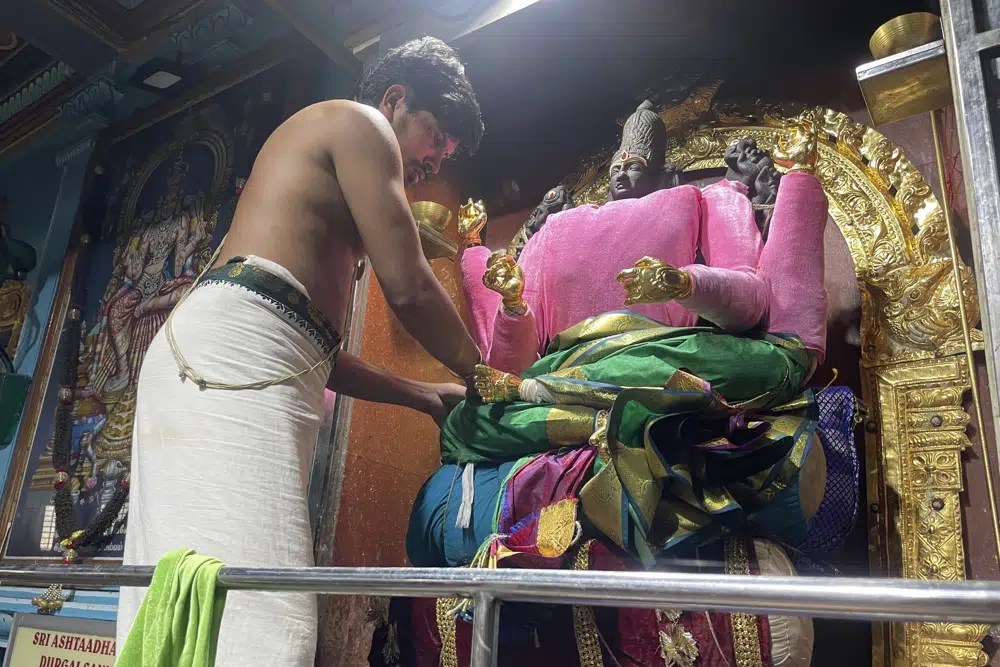
Photo: Deepa Bharath/AP. Deity decorator S. Goutham is seen at the altar of the goddess Durga at the Anantha Padmanabha Swamy Temple in Chennai, India, on Nov. 29, 2022. Goutham is a fifth-generation practitioner of this millennia-old spiritual art of decorating temple deities.
Isn’t it amazing how many kinds of jobs there are in the world? Today’s story from the Associated Press (AP) is about a young man whose family has had the job of decorating statues of local deities for five generations!
Deepa Bharath reports, “On a recent afternoon, 33-year-old S. Goutham was perched on a ladder at the altar of the goddess Durga at the Anantha Padmanabha Swamy Temple in Chennai, India. Goutham — his hand moving steadily — was pleating a green silk sari to adorn the deity. …
“A computer science graduate, Goutham quit his job nearly a decade ago to pursue his calling. He has since followed in the footsteps of his ancestors as a fifth-generation decorator of temple deities.
“In Hindu temples, idols are mostly made of materials such as black granite, white marble or five-metal alloys that have sacred significance. These deities are worshipped as physical, tangible representations of god (Brahman) who is believed to be infinite, omnipresent and beyond comprehension. Worship in a Hindu temple includes bathing these deities in milk, decorating them with colorful clothes, flowers, perfumes such as sandalwood, jewelry, and even weapons such as swords, clubs and tridents. Oil lamps are lit at the altar, and sacred chants and foods are offered to the gods.
Decorating the deities is a millennia-old practice that is described in the Hindu epic Ramayana, and Goutham has been learning the art since he was a toddler. He crafted his first formal decoration when he was 13. …
“Goutham said he became interested in decorating deities as a child because of his father.
“ ‘When you are little, your father is your hero,’ he said. ‘I wanted to be just like him.’ The first lesson Goutham got from his dad was about the weapons each god would hold. He heard stories about the power of each weapon and how gods would wield them.
“ ‘The personality of the deity and the story of the god or goddess could change depending on their weapons, the clothes they wear, the expression on their face or the position in which they are sitting or standing,’ he said. …
“There are rules about the types of materials that can be used on deities.
“ ‘The human body is made up of earth, water, fire, air and space, and everything you see naturally occurring on Earth is made of these elements,’ Goutham said. ‘To show this, we decorate deities using things that occur in nature and are a representation of these elements, like copper, cloth, coconut fibers and so on.’
“He says decorating a deity combines elements from art, dance and yoga, in terms of the hand gestures and postures the deities assume. Man-made materials such as plastic are prohibited. Goutham says he uses little pins to hold fabric together, but makes sure the pins don’t directly touch the idol. …
“[He] dreams of establishing an institution to train artists who can maintain the sacred tradition. While most deity decorators are men, he sees no reason why women cannot learn and practice it. ‘Everyone is equal under god,’ he said.
“Storytelling is an important part of what he does. One of his favorite installations depicts the friendship between Lord Krishna, an incarnation of Vishnu, and Kuchela.
“ ‘It shows Krishna washing the feet of Kuchela, a poor man, conveying the message that humility is a virtue — whether you are a human being or god,’ Goutham said.
“The term ‘idol worship’ may have negative connotations in some faiths. But for Hindus, deities — which are kept in temples, homes, shops and offices — serve as focal points ‘for to us channel our devotions, our actions and serve as a reminder of all the positive values that are associated with those deities,’ said Suhag Shukla, executive director of the Hindu American Foundation.
“Shukla says this form of worship is a way for her to connect with her ancestors. ‘As a second-generation Hindu American, I didn’t grow up with all these things around me where I could absorb through osmosis,’ she said. ‘But just knowing that I’m part of a tradition that has been passed down from generation to generation is personally powerful for me.’
“In U.S. Hindu temples, community members come together to help create the costumes for the deities, and it is an act of devotion, Shukla said.
“ ‘No one has to sit there and embroider a skirt or sari for a goddess, but they do it as a display of love,’ she said. ‘It’s humbling and empowering.’ ”
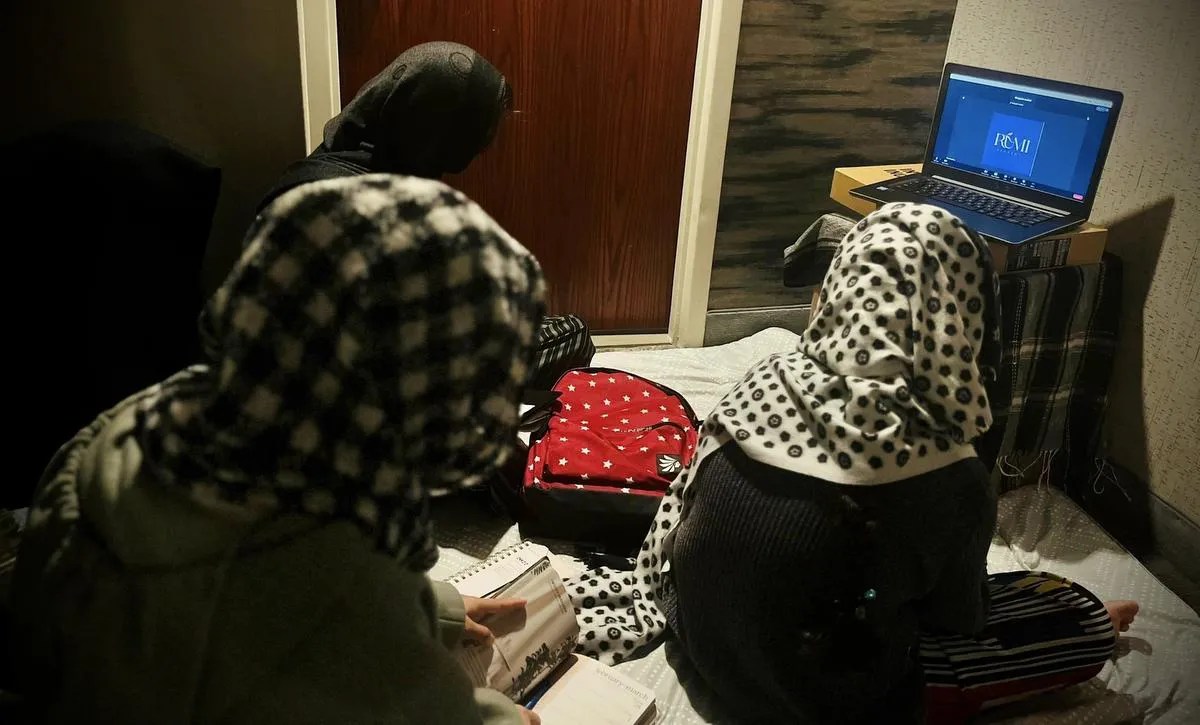
Photo: Toronto Star. Banned from schools and sports, Afghan girls are turning to online education. Nonprofits around the world are acting on their belief that impoverished girls should have a better future than being forced into marriage for the “bride price.”
Readers will remember my young friend Shagufa, who escaped Afghanistan some years ago thanks to sports and education. Today, about to graduate from a master’s program at Brandeis University, she is moving on from the bleak life mapped out for her as the youngest of 11 in a crushingly poor family. Not so, the girls left behind.
Marjan Sadat writes at the Toronto Star, “Muzhdah Rahmani was a soccer-playing teenager with dreams of studying law before the Taliban took power.
“ ‘The first thing that the Taliban did was ban girls from school and women from sports,’ recalled the 18-year-old. ‘One of my sisters studied at university. Now she can’t. My other sister, who was in the 11th grade, is now not allowed to study. My older sister, she was a journalist, is banned from work — my dad is unwell, so she was the breadwinner.
“ ‘What kind of law and Sharia is this?’ Muzhdah said via WhatsApp, speaking in Persian from Kabul.
“Added her older sister, Morwarid: ‘The days are so hard for me and my sisters that I can’t count the minutes or I would lose my mind.’
“But the sisters have found something to help them through this moment.
“Rumi Academy offers girls and women online classes. Through it, Morwarid and Muzhdah have been studying English. …
“Anita is the founder and director of Rumi Academy. She asked that her last name and her location not be made public due to concerns for her safety. She said the academy started offering classes in 2020, due to COVID-19. It started in Afghanistan, and is now based in Turkey. …
“They are teaching international languages, in particular English ‘as lingua franca,’ as well as management, journalism, literary composition and psychology.
“There were 40 Afghan female students before the Taliban’s takeover back in mid-August 2021. Now there are 382 girls at Rumi Academy amid increasing Taliban restrictions on girls and women. They range in age from 13 to 25.
” ‘When I decided to participate in these classes, I didn’t even have the money to connect the internet,’ Morwarid said. ‘A woman from Canada sponsored me to take this course and I managed to start my studies online. In these dark days, these classes are a source of light for us.’
“Preeti Verpal, a registered nurse who lives in Kitchener [Canada], is one of the people who has financially supported education for Afghan girls, and one of two sponsors from Canada. She sponsored Morwarid.
“ ‘I cried when I read the news that Afghan girls won’t be allowed to continue studying,’ Verpal said via WhatsApp.
“For six months, the cost per student is $300 (U.S.), which goes to teachers, the academy says.
‘I have no connection to Afghanistan but as a woman and a mother, I cannot sit here comfortably in Canada and watch the entire Afghan female population suffer,’ Verpal said. ‘And the only thing they did wrong was what? Be born a female.’
“ ‘I want to sponsor because I believe every girl should have the same opportunities available to them as boys. When girls are educated they can change the world, they can become financially independent to support not only themselves but their families.’
“Shafiqa Khpalwak, a poet and humans rights defender, said the country is ‘an open prison for women and every other ordinary Afghan.’
“ ‘My sister is 15 years old and in Kabul and not allowed to go to school,’ she said via WhatsApp from Afghanistan. ‘My cousin, 16 years old, wanted to be a doctor and is now at home. Every day they ask me when their school will be reopened. … The world must take serious action to put pressure on the Taliban. Condemnation will not bring any tangible results. They are responsible for this mess; now, they can’t look away.’ ”
A word on Shagufa now. She has a good job lined up to start saving money toward her goals. She also assists the founder of Educate Girls Now, another nonprofit that, despite all the upheaval in Afghanistan, continues to educate girls there, help them get to college in Bangladesh, and keep them from being sold into early marriage.
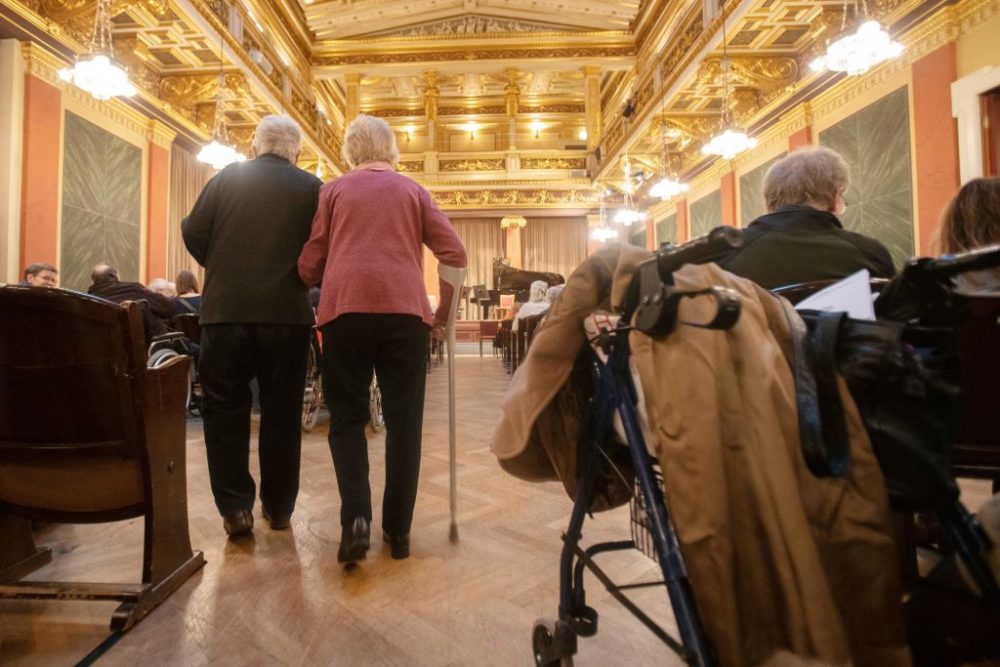
Photo: Alex Halada/AFP via Getty Images. Elderly spectators arrive to attend a concert specifically tailored to people living with dementia at the Wiener Musikverein in Vienna on December 5, 2022.
Meghna Chakrabarti of WBUR’s On Point had a great show recently about enlightened dementia communities in the Netherlands and other parts of Europe.
I came away feeling that the reason we have little like this in the US is because of insurance. We are such a crazily litigious society, we can’t afford to take the slightest risk, even if it means an older person will have a happier aging experience.
Producer Paige Sutherland and host Meghna Chakrabarti shared highlights from the show at the WBUR website.
“Is there a better way to care for dementia patients? And what might that look like?
” ‘I think it really focuses on what’s the day-to-day life and looking at this balance between safety and freedom,’ Dr. Tia Powell [professor of psychiatry and bioethics at Albert Einstein College of Medicine] says.
“And that’s exactly what the Netherlands did when they opened up the first-ever ‘dementia village,’ where residents can live freely despite their memory loss.
” ‘Officially, it’s a nursing home, so we offer highly complex care, skilled nursing. But it does not look anything like a nursing home,’ [advisor at Be Advice] Iris Van Slooten says. …
“On the idea behind a ‘dementia village’
“Iris Van Slooten: It should be about the individual; it should be about the person living in that place and need to deal with dementia. And you want to continue your life even though you are dealing with dementia. And so you want to continue life like you did before and not be hospitalized. I always ask our visitors and the people we work with, would you want to live in a hospital for the rest of your life? And then always the answer, of course, is no.
“So then why did we do that to the people that were living with us? … You can continue with your life, you can stay a human being. And what makes you a human being, for instance, is that you can make your own choices every day. Like … what do I have on my sandwich? Or in what place do I want to be right now? Very, very simple choices we make every day but are taken away from people that live in a nursing home.
“On what the village looks like
“Iris Van Slooten: You will enter through a door and then you will enter the hallway. And that is a safe neighborhood where the outside of the homes are the barrier to the … broader surroundings. And we had a door because there were laws in place back when we designed … we had to keep people inside. But you will find 27 homes in a normal looking community. In a normal neighborhood. The homes look like normal Dutch homes with a normal living room, a kitchen, private bedrooms.
“And when residents also step out of the front door, … they are really outside. And there are many streets and many gardens they can explore. We have a restaurant, a pub, a theater, many club rooms, a supermarket. So, everything you will find in any neighborhood, in any community. So yeah, very normal, and especially on a sunny day and in spring and summer, of course, then you see a lot of people walking around, having conversations, meeting each other, grabbing a chair, enjoying a drink in a restaurant. It’s just life. …
“Every resident that lives there has severe dementia. So, you need to have an indication from the Dutch government saying you have severe dementia. … We have teams in the houses that support the household and really run the household. But we also have a quite extensive medical support team, including a specialist, elderly care, doctor, but also a psychiatrist, an official therapist, a social coach. …
“Say someone left their home, and they wanted to go to the village supermarket, but got lost or forgot the way. How do you help that person get to where they wanted to go?
“Iris Van Slooten: One thing we highly value in the Hogeweyk is having freedom and giving the freedom to these people and not restraining them. … They are free to walk around on their own. A lot of people can find their way because also people with severe dementia, they still have learning abilities, and the place is designed [so that it is] recognizable for them. …
“So also the staff in the restaurant, also the reception, also the technicians, also me when I’m there. … When I look out my office and I see somebody in the rain without a coat on, it might slip to the attention of a staff member in house. But then it’s also my job to go over there and find a jacket for that person. …
“On helping people maintain their independence and humanity in the ‘dementia village’
“Dr. Tia Powell: [As] a bioethicist, really all of our challenges can be summed up by the tension between maintaining freedom, which is part of what all human beings strive for, and safety. And this argument’s been going on forever for hundreds of years.
So I do think that many of the ways in which we provide care today in the U.S. for people with dementia do not focus on care, but they focus on other issues. You know, maintaining regulations, all kinds of other things.
“And we have forgotten about freedom and joy.”
A bit from the transcript on the sad US situation.
“Meghna Chakrabarti: Beth Ounsworth … was living a very rich life full of friends and music. As a member of her choir, she was independent in her own apartment in Philadelphia. And that started changing when Beth was about 69 years old. She began forgetting simple things like what day and time she had scheduled meetings, directions to common places. …
“And so her children finally took her to see a neurologist. And Beth was diagnosed with Alzheimer’s disease. Now, we spoke with her daughter, Meg Ounsworth Steere. Because Meg wanted to care for her mother, but with two young children at home, it just wasn’t possible. So they looked at assisted living centers near where Meg lived in Boston.
“Meg Ounsworth Steere: So she did go and visit a few assisted living centers with me. … We went to lunch, and she just looked around and she was like, Not me, not now. And I was like, okay, you know? And that’s when we had this conversation about she was like, I don’t want to be in a place where I’m just surrounded by old people. I want to be in a place where there are, you know, babies, too, and young families, and I can feel a part of a community. …
“Chakrabarti: So Beth stayed in Philadelphia, but it wasn’t easy. Daughter Meg had to find full time aides to take Beth to all of her appointments and to help with all of her daily activities. Meanwhile, the disease progressed.
“Ounsworth Steere: It got to a point when I took her to the neurologist. He would give her a mini mental state exam and 30 is normal. My mom was testing at a four at that point. Partially because she has aphasia and so she doesn’t really understand words. And so he was like, you know, she’s not going to answer the questions that were like, do you know who the president is? …
“Chakrabarti: So the family decided it would be better for Beth to live in a memory care facility. And they found a good one near Boston. Beth moved in in 2018, and ever since then, Meg and the family have been paying about $100,000 out of pocket for the facility every year.
“Ounsworth Steere: What worries me is that I know I’m on the luckier side and it’s still not perfect. So I can’t quite fathom what it’s like when you have to go to a facility that can’t possibly retain the aides that they want. … Or where aides are just less engaged and involved, they’re just kind of physically there. Kind of like the first aides that I had, but not really assisting, you know, and engaging with and kind of trying to love the resident and then the people who can’t afford care at all. I just, I don’t know how that’s possible.
“Chakrabarti: Meg visits her mother often. Beth is nonverbal now, However, Meg gets to communicate with her in a different way: by singing.”
If you click on the arrow at WBUR, here, you can listen to the whole show. PS. I blogged about the Dutch dementia village in 2016, here!
Photo: Dea Andreea/Unsplash. When a child is in a play, she can see what it’s like to be someone else for a while.
You don’t really need a reason to justify doing theater with children. It is just so much fun. But if you need a reason, think about what theater-engendered empathy and active listening can do for kids throughout their lives.
Alexandra Moe writes at the Washington Post, “It’s after school, and the tweens are rowdy with angst. Then two of them, Charlotte Williams, 13, and Tally Vogel, 11, face each other. Williams raises an arm, and Vogel raises her arm to follow. They’re practicing ‘the mirror,’ an improv exercise in a theater classroom, and the room suddenly hushes. It’s indistinguishable which girl is leading, and which is following. When the exercise stops, and the teacher asks how they were able to sync up so completely without speaking, Vogel says, ‘I used my eyes.’
“In other words, she used ‘active listening,’ a type of verbal and nonverbal communication skill that promotes mutual understanding.
“Several studies show communication skills are the most essential skills for navigating American adult life. … These skills are often taught through Social Emotional Learning programs, offered in K-12 schools in 27 states. But they are also a by-product of theater class, according to a recent study from George Mason University and the Commonwealth Theatre Center. The study follows children aged 5 to 18 over six years — the longest look at theater’s impact in kids to date — and finds increases in communication skills across age, gender and race.
“ ‘The longer the kids spent in the theater classes, the more they gained in 21st century skills, like communication, creativity, imagination, problem solving, and collaboration,’ says Thalia Goldstein, the study’s co-author and an associate professor of applied developmental psychology at George Mason University. …
“Parents of young children are familiar with pretend play — the couch is suddenly a frog castle, the floor a lake, and unbeknown to you, sharks are circling your ankles. It may seem like pure fantasy, but in fact, pretend play is the foundation for developing empathy, Goldstein says. It helps young children build emotional understanding, regulation and executive function, the foundational skills that later predict empathy levels. Parents can help foster empathy in children by introducing fiction books throughout childhood, with varied characters, settings and authors, which correlates directly to empathy scores in adulthood. They can let them be the drivers of pretend play, authors of their own stories.
“And theater class is yet another way. It’s the social dynamic of theater, the give and take, the volley of listening and responding, that expands kids’ capacity to read cues, think quickly and creatively, work as an ensemble and see things from another perspective. Theater provides an awareness of space, pausing, waiting for somebody else to talk.
“For children with autism, improv techniques increase eye attention and reciprocity of conversation, says Lisa Sherman, co-founder of Act As If, a communications program that specializes in working with autistic youths. And this is where the arts level the playing field for children of different abilities; they can participate in meaningful ways where language is not a requisite skill.
“A study among K-2 children in San Diego showed that participating in activities in drama and creative movement significantly improved English-speaking skills among children from primarily Spanish-speaking homes. Children with the most limited English benefited the most, says the study’s co-author, Christa Greenfader, an assistant professor of child and adolescent studies at California State University at Fullerton. …
“Connecting is ultimately the goal of communication, and it is the reason the actor Alan Alda began using improv exercises with scientists. Scientists are trained to speak methodically, defend their arguments and use niche jargon, a communication style that doesn’t always land with a general audience, says Laura Lindenfeld, executive director of the Alda Center for Communicating Science. Through improv, they are taught to make mistakes and laugh about it, to ‘give ourselves permission to fail and move on.’
“ ‘When scientists come into a room, they’re like, “Oh man, you’re going to put me through improv?” ‘ she says. But after exercises like ‘the mirror,’ looking intently into other people’s eyes, they realize they can’t succeed unless they’re in touch with the other person. Speaking becomes about making a human connection rather than pushing information — and that’s the point. You may have the most wonderful scientific finding, but if no one understands it, what’s the use?
“Sara Williams, mother to Charlotte, cites theater as the foundation for her daughter’s self-awareness. Charlotte began drama classes at age 5. At 13, she is not afraid to speak publicly or join the student council; she listens and has confidence. ‘They go to these classes and come home feeling energized, like they accomplished something,’ Williams says. And not just the outgoing kids — for the shy, theater opens them up. For children with anxiety, like so many children coming out of the pandemic, ‘the least judgmental place you can be is in a theater class.’ You can keep your personality, and unlike in sports, you’re not competing with anyone.
“In the end, theater is about telling stories. It is one of the best ways to help young people get to know themselves, Dawson says. Stories help us make sense of the world and understand another’s experience.”
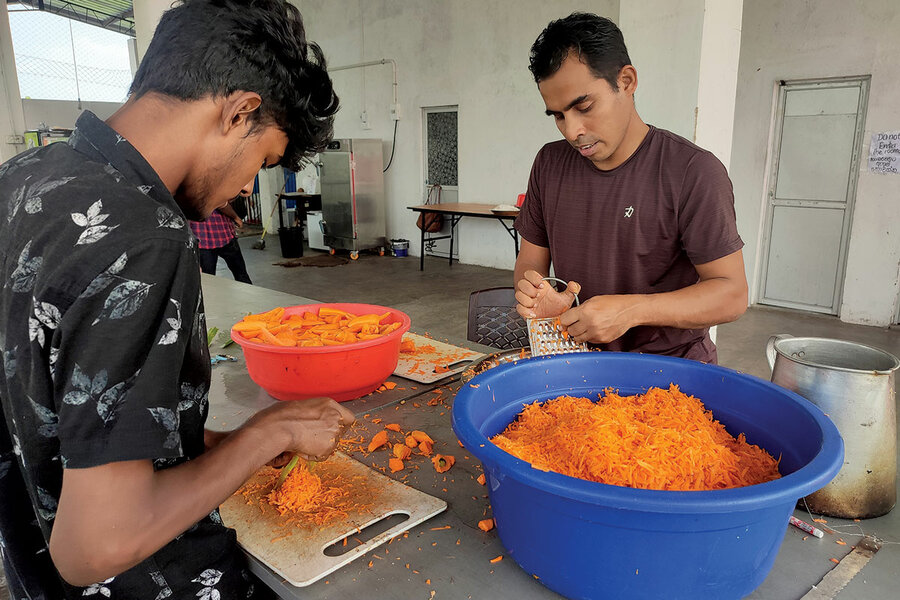
Photo: Munza Mushtaq. Pastor Moses Akash de Silva (right) helps prepare carrot sambol at Voice for the Voiceless Foundation’s flagship community kitchen in Sri Lanka.
Here’s a story from across the world about one way that food brings people together.
Munza Mushtaq reports at the Christian Science Monitor, “It’s just past noon, and on the sweltering rooftop of the Bethany Church in Rajagiriya, Sri Lanka, Pastor Moses Akash de Silva and a team of volunteers are grating piles of carrots while K.D. Iranie hovers over a large pan, stirring a spicy fish curry atop a makeshift firewood cooker.
“Ms. Iranie, who’s in her 60s, has served as the main cook for the church’s community kitchen since Pastor Moses started the project in June. ‘I come all five days a week,’ she says. ‘Seeing the people getting a delicious meal makes me so happy.’ …
“At 12:30 p.m. sharp, after trays of fresh food are carried down four flights of steps, Pastor Moses signals a volunteer to open the church’s grilled gates. At least a hundred men, women, and children eagerly file in, following the aromas of turmeric-infused fluffy yellow rice, fish and pumpkin curries, carrot sambol, and papadums. More will arrive with time. For many, this is their first proper meal in days.
“Sri Lanka’s worst-ever economic crisis has left nearly 30% of its 22 million people food insecure, according to the World Food Program, with food inflation soaring to 73% in November. The Voice Community Kitchen helps out by providing some 6,000 free lunches every week across roughly two dozen locations throughout Sri Lanka, while also bringing together different ethnoreligious communities that have historically struggled to find common ground. Pastor Moses says the initiative was born of pragmatism, compassion toward all Sri Lankans, and a desire to model the same generosity he experienced as a young person.
“ ‘I have gone for days without food, so I understand how these people feel,’ he says. ‘It does not matter to us what religion they are from, or if they have family, or what they do. If they are hungry, they are welcome to eat at our community kitchen.’
“Raised in an orphanage in the hill capital of Kandy, Pastor Moses moved to Colombo at age 17 seeking better opportunities. He lived at a bus stop for three days before finding work as a cleaner at a polyethylene factory. It’s there he met the senior pastor of Bethany Church, Dishan de Silva, who took him in.
“Pastor Moses explains with a bright smile how he lived with the senior pastor for seven years, eventually adopting his mentor’s surname. … The community kitchen idea came to [Senior Pastor de Silva] earlier this year when Voice Foundation volunteers were distributing dry rations to families on the outskirts of Colombo.
“ ‘In one house we met a mother with a 2-year-old child who had been surviving on ripened breadfruit and water spinach for three days due to the shortage of cooking gas in the market,’ he says. ‘That was when we thought, there was no point giving dry rations if people were unable to cook.’
“So they started cooking up meals themselves. Many of the current community kitchens are based in schools, while others, such as the flagship Bethany Church program in a Colombo suburb, serve lunch every day to a mix of children and adults. At least 60% of the people who come to the kitchen do not eat breakfast or dinner due to financial hardship, according to the Voice Foundation.
“There is only one rule at the Voice Foundation’s community kitchens: Guests can eat as much as they want, but they can’t take food outside the premises.
“At the Bethany Church, there is not a single garbage bin. According to Pastor Moses, there’s no need – there are never leftovers.
“ ‘The community kitchen attracts different people from different walks of life, including beggars, street cleaners, security guards, and anyone else who needs a meal,’ Pastor Moses says.
“N.K. Karunawathie works at a bank nearby. Even as the cost of living skyrockets, her salary has remained stagnant, meaning her family can ‘no longer afford three meals a day,’ she says. To help make ends meet, she and her husband, both Buddhists, have been visiting the Voice Community Kitchen since it started this summer. …
“For a small country, Sri Lanka frequently faces religious-based conflict. Apart from a quarter-century-long war with the Liberation Tigers of Tamil Eelam, which strained the relationship between the majority Buddhists and minority Hindus, the country has also seen a rise in attacks against Muslims since 2013. The Easter Sunday bombings in 2019 further exacerbated tensions.
“Mehdi Ghouse started volunteering at the kitchen months ago after learning about the project on social media.
‘It doesn’t matter that I am Muslim, or this project is run by the church. What matters is the satisfaction we all get when we see people eating and leaving happy,’ he says.
“Not only are all religions welcome at the Voice Community Kitchen, but experts also say such initiatives could be key to improving ethnoreligious engagement and lead to better conflict mediation in the future. …
“For Pastor Moses, the community kitchen’s mission is simple: Feed the hungry. But he does hope the work will have a ripple effect by inspiring generosity among all who engage with the project.
“ ‘I am who I am because of the upbringing I had in the orphanage and the help I got throughout the years since I came to Colombo,’ he says. ‘I hope others who volunteer here and those who I have taken under my wings will follow my footsteps by serving the people.’ “
Photo: Amanda Barrows via Instagram | ccsf_p4pvia Upworthy. Amanda Barrows has placed a “poetry nightstand” in parks around San Francisco, including Alamo Square, left, and Golden Gate Park.
Here’s a good one for all my poet friends — actually, not just for poets, for everyone. Read about a park ranger in California who is getting all kinds of people involved in the art of poetry.
Sydney Page reports at the Washington Post, “In the middle of Golden Gate Park in San Francisco, a park ranger carefully placed a wooden nightstand on the ground. She attached a sign she made:
“ ‘Take a poem, leave a poem.’
“Since the nightstand’s debut there last month, amateur poets have filled it with more than 100 handwritten poems.
“ ‘The wind graces this park / Like a breezy whisper / as sounds of longing / echo from the nearby piano,’ one parkgoer scribbled on a piece of lined paper that they then left in the nightstand.
“Amanda Barrows, who came up with the idea, was surprised that it worked and people followed her instructions. …
“During the pandemic, Barrows — who said she has always considered herself a writer — decided to try her hand at poetry and signed up for a workshop.
“ ‘I had a really beautiful time,’ said Barrows, who then enrolled in another poetry class at City College of San Francisco ‘to keep the inspiration flowing, and keep myself writing.’
“The culminating assignment for the class — which is called Poetry for the People and has been taught at the school since 1975 — is a field project. Students are asked to find a way to ‘bring poetry into the community.’ …
“It dawned on her that she could perhaps fuse together her two worlds — parks and poetry. A colleague offered up a weathered nightstand, which Barrows thought would be the perfect vessel for her project, as she could fill the drawer at the top with fresh paper and pens and add a box at the bottom for poems. To get the ball rolling, she asked her close friends to help her stock the drawer with their favorite poems for people to take. …
“Since she only had a single nightstand to work with, Barrows decided she would leave it in one park for four days before moving it to a new location. …
“ ‘I’m in the parks all the time, and I see the many different ways people utilize them,’ she said, explaining that she wanted her project to reach as many people as possible.
“ ‘I love to see different people’s handwriting, and for them to be sharing their personal words,’ she said. “ ‘Every day that I check it and I have had submissions, it feels like Christmas.’ …
“The instructors of the Poetry for the People class — which is free for San Francisco residents — said Barrows’s nightstand has fulfilled the primary purpose of the project, which is to bring poetry to the community in a creative way.
“The success of Barrows’s project reinforces that ‘people need poetry now,’ said Lauren Muller, who started teaching the class at CCSF in 2000. ‘It fills me with optimism.’
“Other students have come up with various creative concepts, such as writing chalk poetry on neighborhood sidewalks and distributing poems disguised as parking tickets.
“ ‘It’s thrilling to see the work that students are doing,’ said Muller, adding that she hopes others will be inspired to establish similar initiatives in their own communities. ‘My hope is that this will happen across city parks, in D.C. and elsewhere.’
“Tanea Lunsford Lynx, a guest instructor for the class, agreed. ‘It’s really special to see that Poetry for the People is the catalyst but that it has a much, much bigger life; it’s one of the best things we could hope for,’ she said, adding that she believes San Franciscans are gravitating toward Barrows’s project in particular, as it has an old-fashioned feel ‘in the context of hyper-tech central.’ …
“ ‘It really is a community project,’ Barrows said. ‘It belongs to all of us.’ ”
Does humanity sometimes do the right thing? Yes indeed. Hard to imagine but true: every country in the world signed on to combatting the danger of depleted ozone.
Scott Dance reports at the Washington Post that “a new assessment of Earth’s depleted ozone layer released [in January] shows that efforts to repair the vital atmospheric shield are working, according to a panel of U.N.-backed scientists, as global emissions of ozone-harming chemicals continue to decline.
“At this rate, the ozone layer could recover to 1980s levels across most of the globe by the 2040s, and by 2066 in Antarctica, the report concludes. Ozone loss is most dramatic above the South Pole, with an ozone ‘hole’ appearing there every spring.
“Those improvements will not be steady, scientists stressed, given natural fluctuations in ozone levels and the ozone-inhibiting influence of volcanic eruptions like the massive one from underwater Pacific Ocean volcano Hunga Tonga a year ago.
“But scientists said the latest ozone data and projections are nonetheless further proof of the success of the Montreal Protocol, the global 1987 agreement to phase out production and use of ozone-depleting substances. …
“A recent decline in observed levels of the chemical known as CFC-11, in particular — which as recently as 2018 had been observed at higher-than-expected levels and traced to China — is proof that societies can collaborate to address a confounding environmental problem, said Martyn Chipperfield, a professor at the University of Leeds who serves on the scientific panel. …
“Ozone is a molecule made of three oxygen atoms, and it proliferates in a layer of the stratosphere about 9 to 18 miles above the ground. It can exist at ground level, too, where it is a product of air pollution on hot summer days and considered a health hazard. But in the atmosphere, it serves as an essential shield protecting Earth’s life from harmful ultraviolet radiation.
“In the same way that UV lights eradicate pathogens like the virus responsible for covid-19, the sun’s radiation would make it impossible for life to thrive on Earth if not for the ozone layer’s protection.
UV-B, a high-energy form of solar radiation, damages DNA in plants and animals, disrupting a variety of biological processes and reducing the efficiency of photosynthesis.
“The Montreal Protocol, which has been approved by every country in the world, protects the ozone by outlawing the manufacturing and use of substances that destroy it when they come in contact with it in the atmosphere. That largely includes a class known as chlorofluorocarbons, or CFCs, which contain ozone-depleting chlorine and were used in refrigerators, air conditioners and aerosol cans.
“The treaty was expanded in 2016 through the Kigali Amendment to include hydrofluorocarbons or HFCs, a replacement for CFCs that do not harm the ozone but are a type of greenhouse gas that warms the planet more potently than carbon dioxide. The U.S. Senate ratified the amendment in September. …
“ ‘We can already see HFCs are not increasing as fast as we thought they would because countries are starting to implement their own controls,’ said Paul Newman, one of four co-chairs of the Scientific Assessment Panel of the Montreal Protocol.
“Still, it is possible forthcoming data on ozone levels will prompt some concerns that the ozone layer is not recovering as quickly as the report concludes, he said. Newman said he expects that will be because the Hunga Tonga eruption blasted so much material into the atmosphere. Volcanic eruptions are known to accelerate ozone depletion.
“Progress would likely also be slowed if humans pursue geoengineering to reverse global warming by injecting sunlight-reflecting particles into the upper atmosphere, Newman said. The panel, which considered the potential impact of that practice for the first time … found that, depending on the timing, frequency and amount of such injections, the particles could alter aspects of atmospheric chemistry that are important in ozone development.”
Photo: Evan Qu/Unsplash. Self-healing concrete at the Pantheon in Rome.
I grew up in a family that placed high value on the humanities — the arts, literature — and the people who practiced them. With the exception of our beloved Uncle Jim, who was a chemist, and Margaret Lawrence, who was a physician, we didn’t know how to admire people who didn’t fit our limited definition of “creative.”
But today, I’m bowled over by the imaginative pragmatism of people who invent solutions to real-world problems like those who reengineer gasoline engines to use electricity, for example, or who invent building materials that reduce the dangerous carbon dioxide we pump into the atmosphere.
I think even my parents would have loved that today’s scientists are finding inspiration in the ancients. After all, it was fine to admire archaeologists.
Adele Peters reports at Fast Company on research that suggests new possibilities for ancient wisdom.
“A road or bridge made from modern concrete might only last 50 years. But the massive Pantheon building in Rome, made from unreinforced concrete, has been standing for nearly two millennia. And nearby, some ancient concrete aqueducts still deliver water to the city. What made ancient Roman concrete so much more durable?
“A new study from researchers at MIT and Harvard University, along with labs in Italy and Switzerland, suggests that an ancient manufacturing technique can create self-healing concrete that naturally fills in cracks. Using a similar process now could help shrink concrete’s massive carbon footprint. ‘We’re looking to the ancient world as a source of inspiration,’ says chemist Admir Masic, an engineering professor at MIT who focuses on sustainable construction materials.
“Cement, the glue that binds concrete together, is responsible for up to 8% of global emissions when it’s made, both because of the energy it uses and the process of heating up limestone, a key ingredient in the material, which releases CO2 directly. Multiple startups are now working on alternatives: including companies that replace limestone with different rocks or add captured CO2 to the final product.
“The Roman-inspired approach is different. By making concrete last much longer, far less of it would need to be made in the first place. … The older production method also happens at a lower temperature, so it uses less energy.
“The researchers studied samples from a 2,000-year-old city wall in an Italian city. They focused on tiny white fragments of lime that aren’t found in modern concrete, but are ubiquitous in old ruins throughout the former Roman Empire. …
“In the past, some researchers thought that the fragments, called lime clasts, were the result of sloppy mixing. But it’s more likely that they were formed deliberately, and the study suggests that they are the reason the concrete lasts so long.
When tiny cracks form in the concrete, water travels to the lime clasts, which dissolve and then fill the cracks with calcium carbonate.
“The researchers attempted to duplicate the manufacturing process that created the lime clasts, and then tested the material against samples made with modern techniques. After cracking the samples and adding rainwater, they watched what happened: The old-school concrete healed itself within two weeks, while in the modern version, the cracks remained.
“Other approaches to ‘self-healing’ concrete also exist now. For example, it’s possible to embed bacteria in concrete that can fill cracks; but it’s costly to make. ‘Current self-healing concretes are very expensive because they are based on very complex chemistry, while our material is super cheap,’ Masic says. … The ancient process involves adding quicklime, a calcium oxide-based material (also known as lime), directly to other ingredients before adding water.
“A new startup is now spinning out from the research to bring the concrete to market. It may later add other features that the lab is studying, including making concrete that can absorb CO2 as it sits outside.” That would be amazing!
Speaking of “creative,” check out the varied interests of that MIT chemistry professor: “Professor Masic’s research focuses on the science-enabled engineering of sustainable construction materials for large-scale infrastructure innovation. A chemist by training, with expertise in biomineralization, he specializes in the development of multifunctional cement-based materials, ranging from self-healing concrete materials to carbon absorbing concretes and electron conducting cement-based materials.
“He is a principal investigator in the Concrete Sustainability Hub at MIT, a faculty fellow in Archaeological Materials at MIT’s Center for Materials Research in Archaeology and Ethnology (CMRAE), and the faculty director of the Refugee ACTion Hub (ReACT) at MIT. MIT ReACT aims at providing new professional content development for displaced learners around the world.”











 Suzanne's Mom's Blog