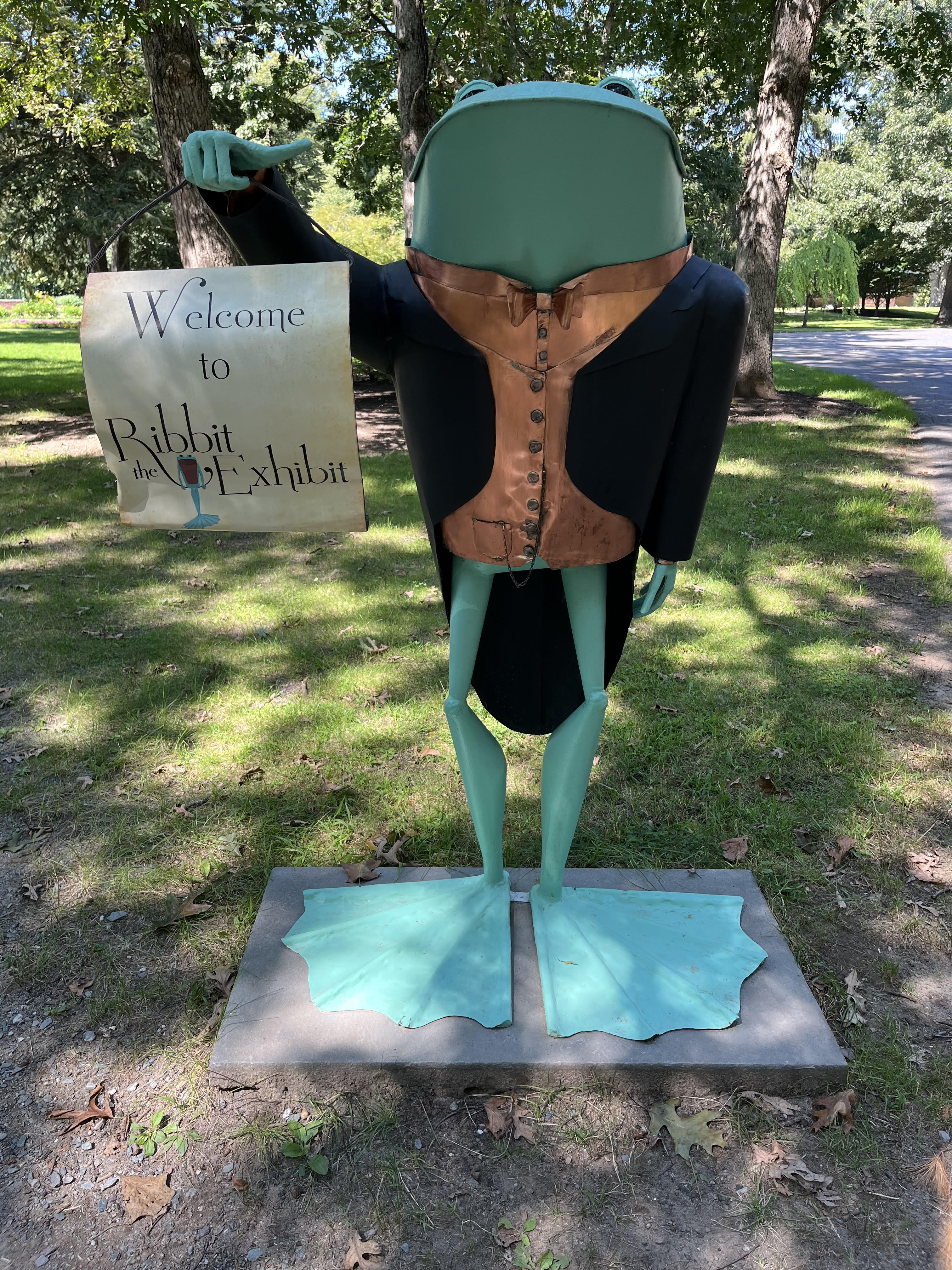
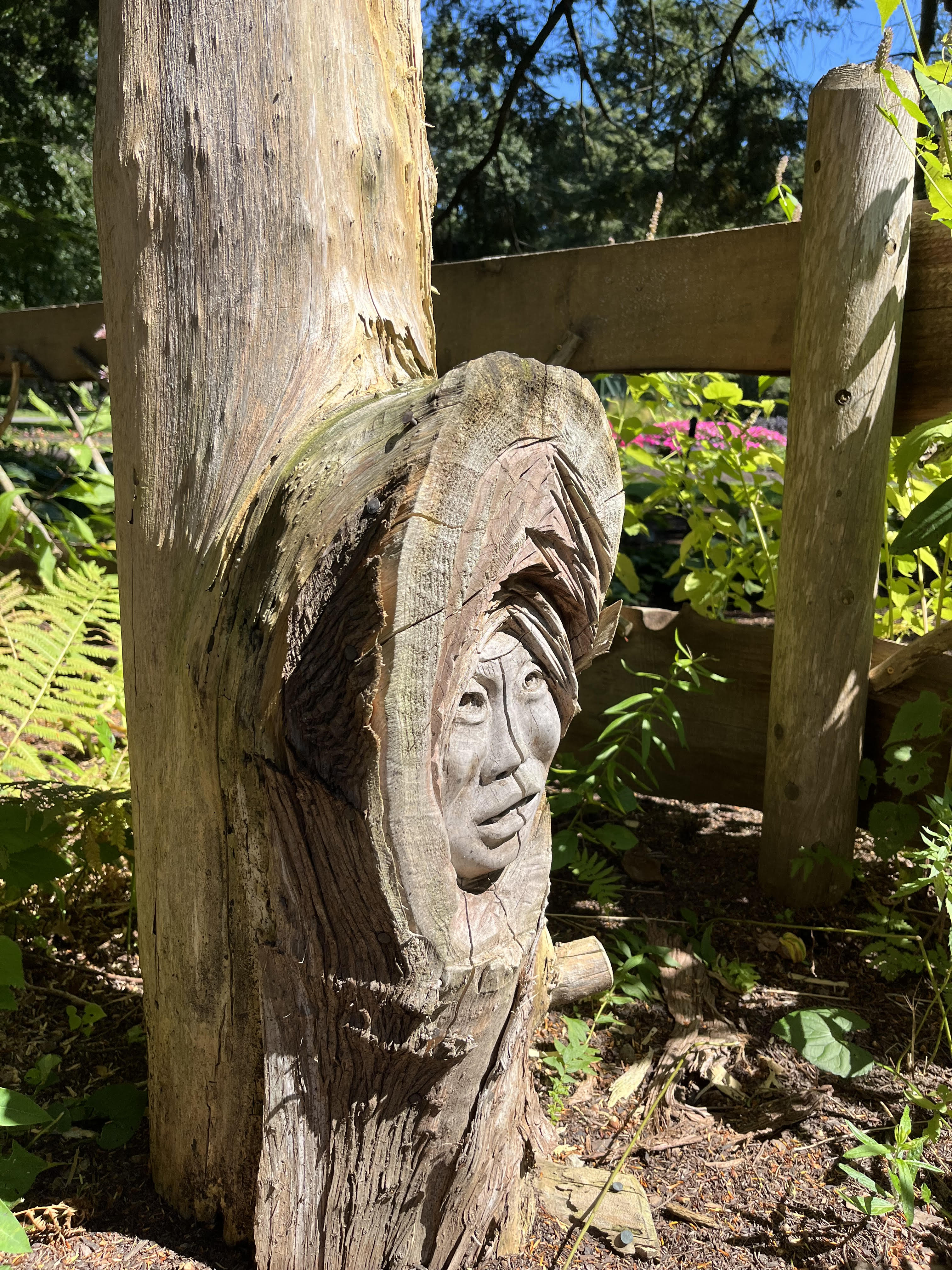
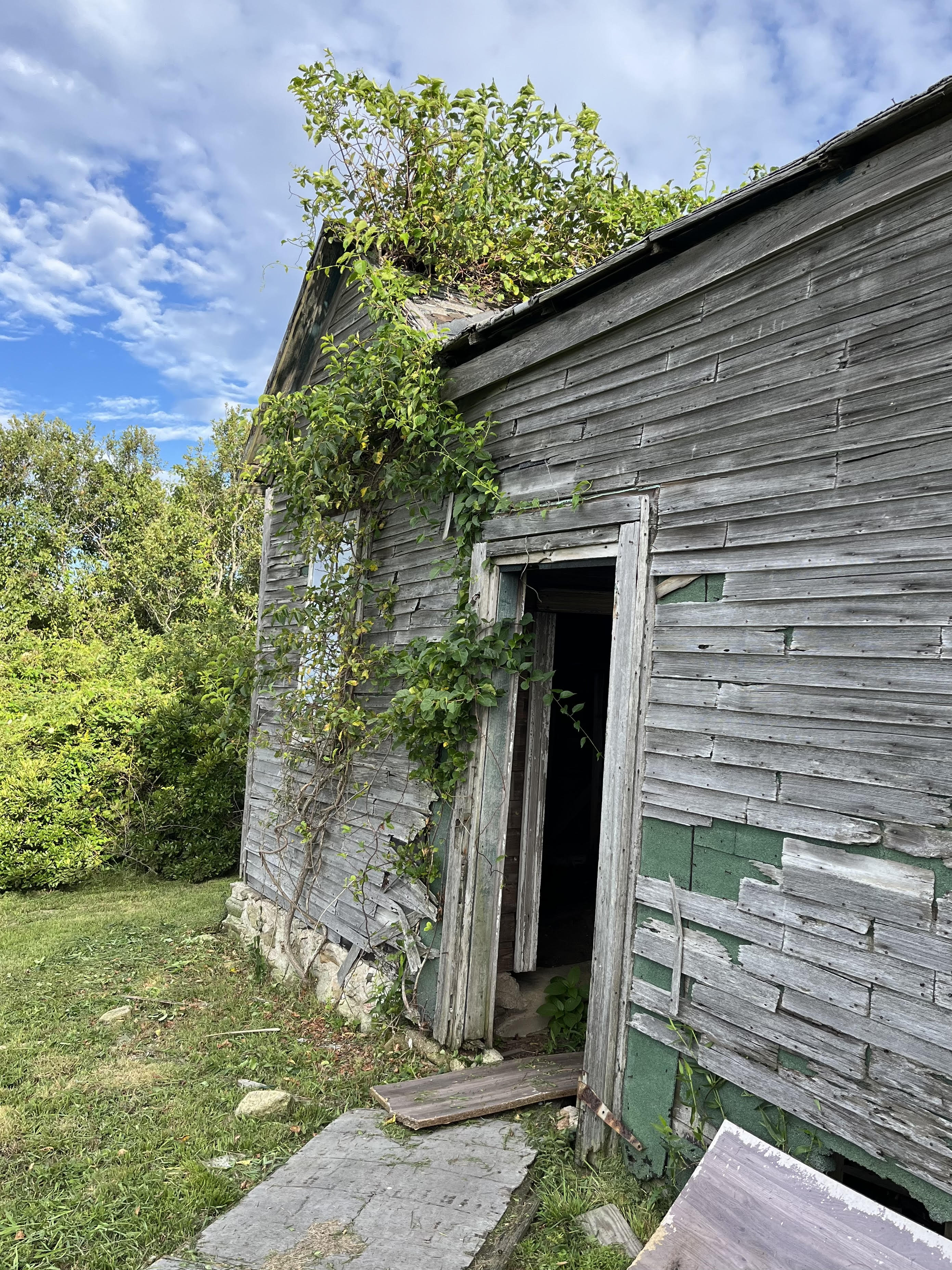
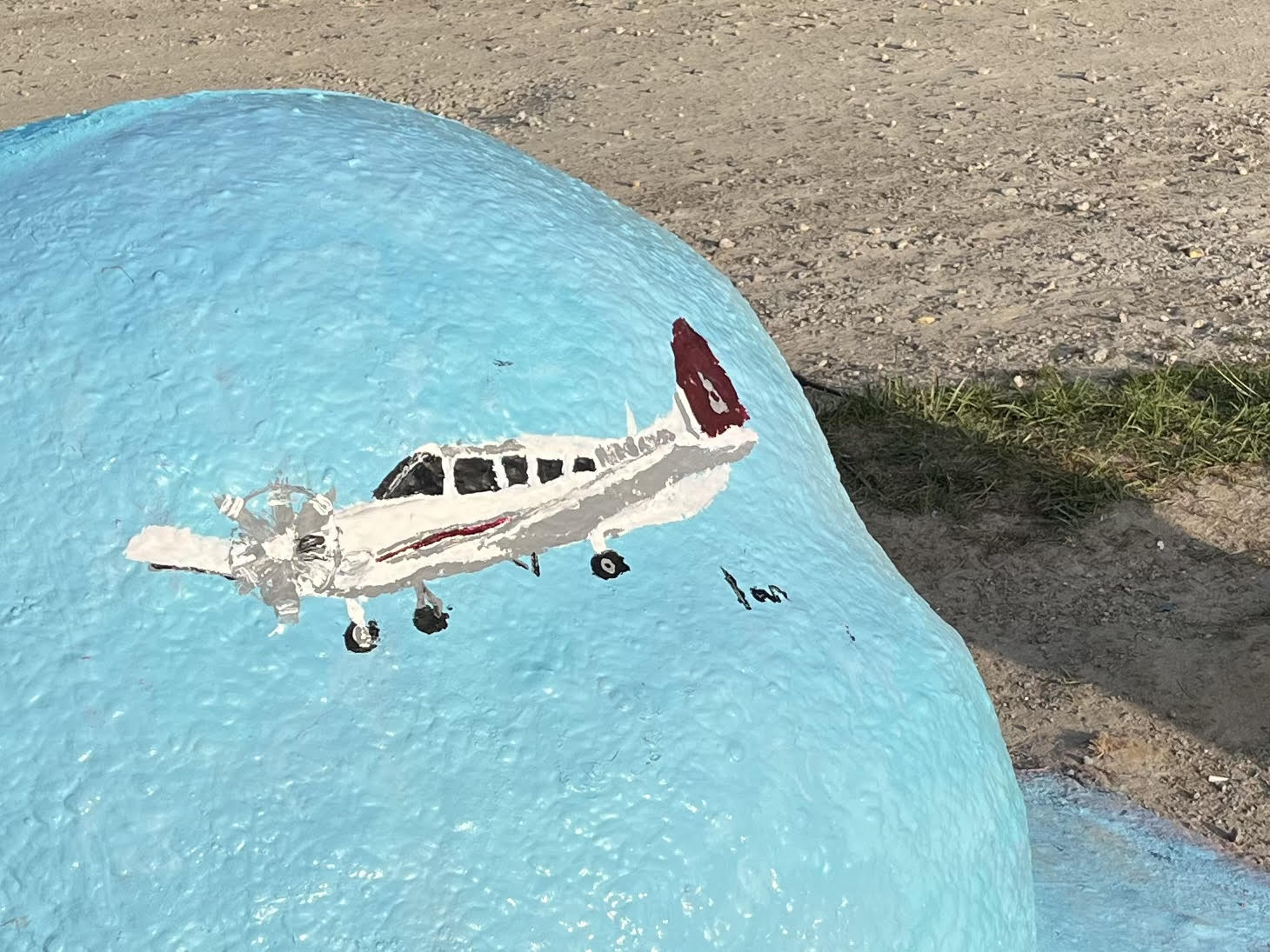
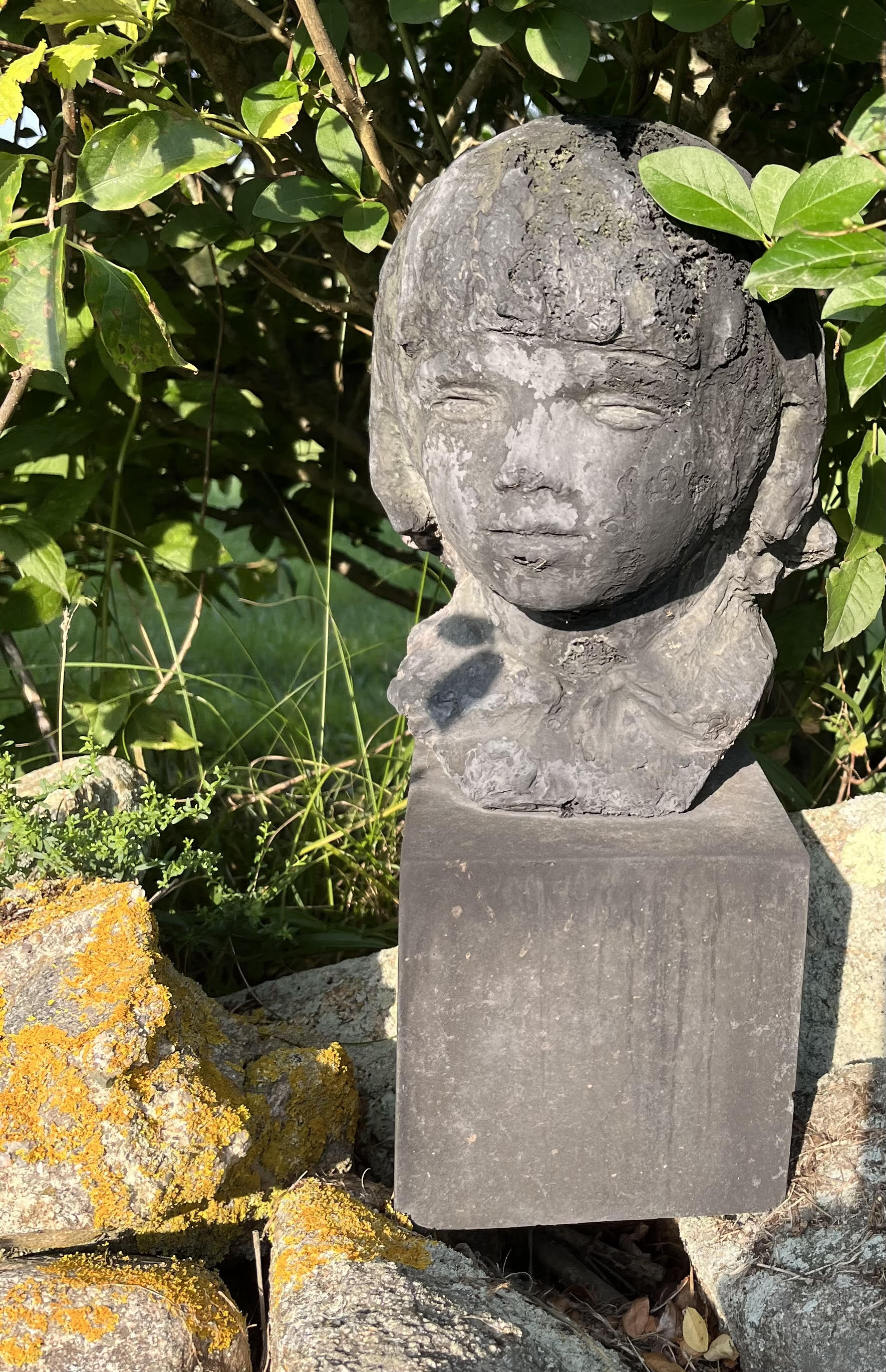
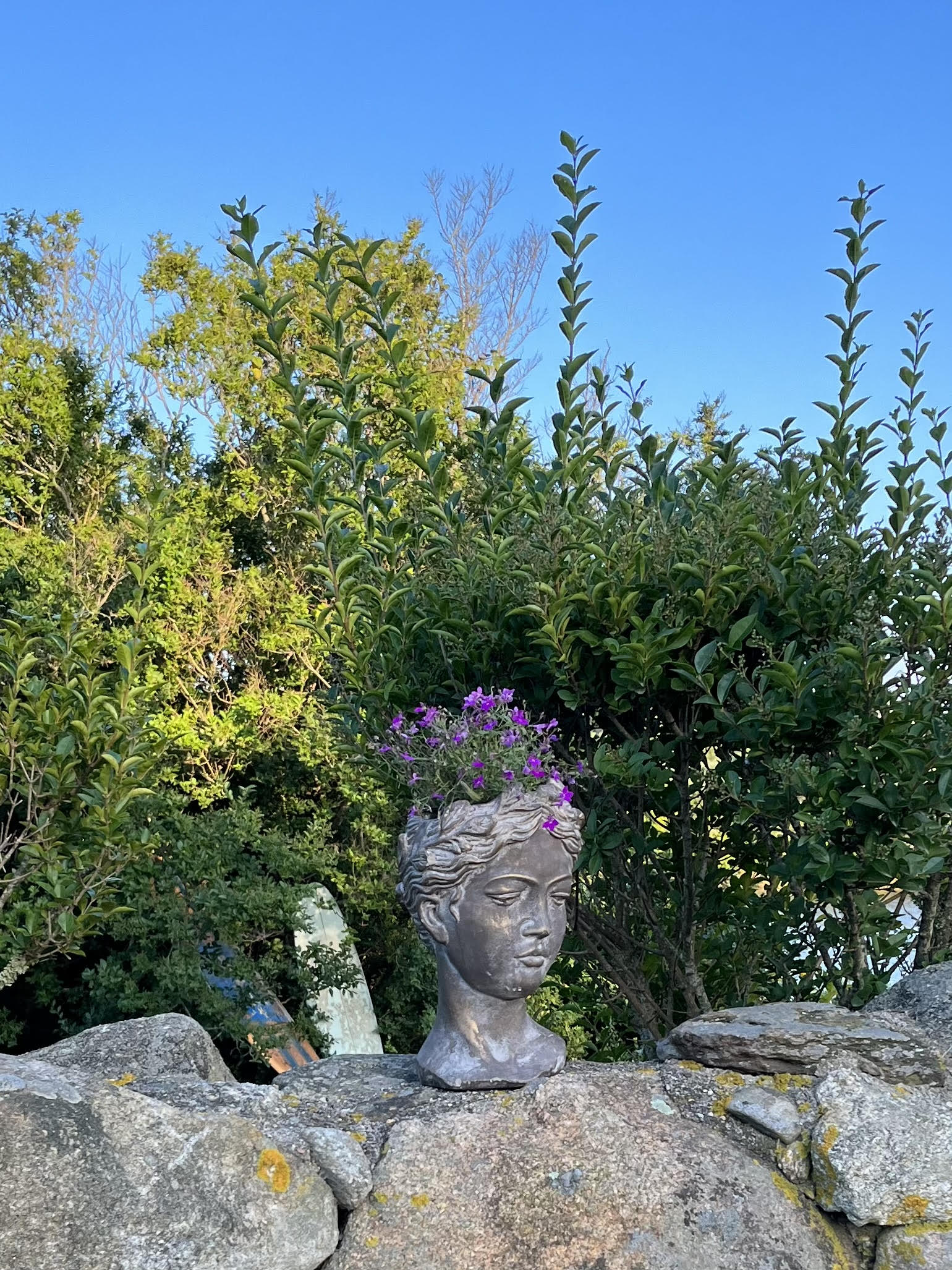
Photos: John and Suzanne’s Mom. Above, the fishing flee in Galilee, Rhode Island. And some rather decent clouds.
Summer always seems to be the best time for photos. In winter I have to look harder. Here are a few recent shots from New England: specifically, from Massachusetts and Rhode Island.
A luau at our new Place had an unusual approach: Hawaiian food, Caribbean music. Well, OK, I thought, I do like the sound of a steel drum.
A very decent artist brought Gerald and Piggy to the front walk of the Fowler Library.
Frog characters welcomed both children and adults to Mass Horticultural Society’s Elm Bank gardens. Nancy and I liked the pollinator garden with its tinkling waterfalls and shady benches a lot more than the formal gardens. I also admired an interesting totem-like carving there.
My other photos are just odds and ends that caught my eye. Let me know if you would like more explanation of any.
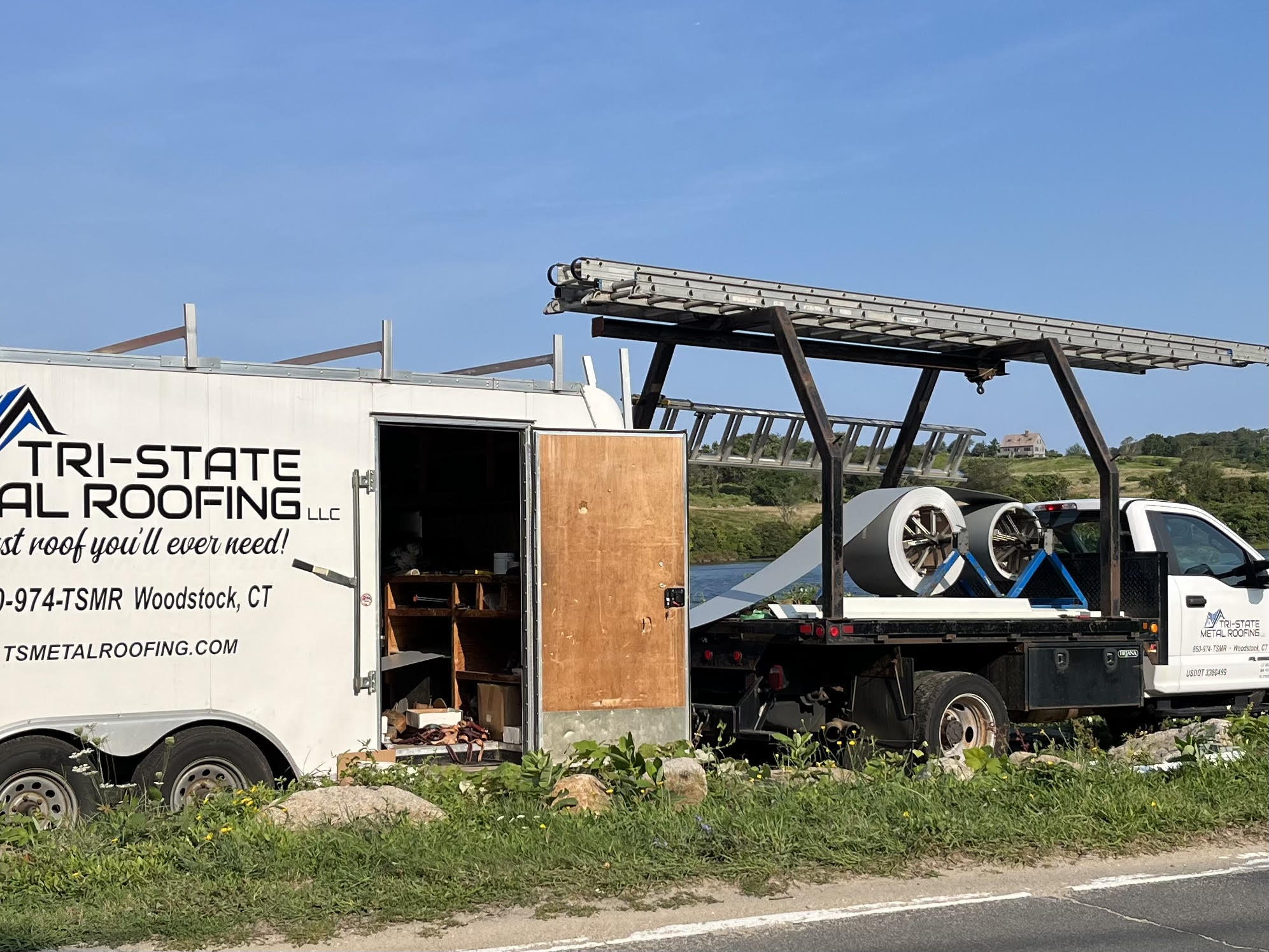
I do need to explain that the person floating along the bluffs was likely in a motorized parachute. Frightening! And the truck is included because I was fascinated that metal roofing comes off a giant roll that looks to me like nothing so much as chewing gum.
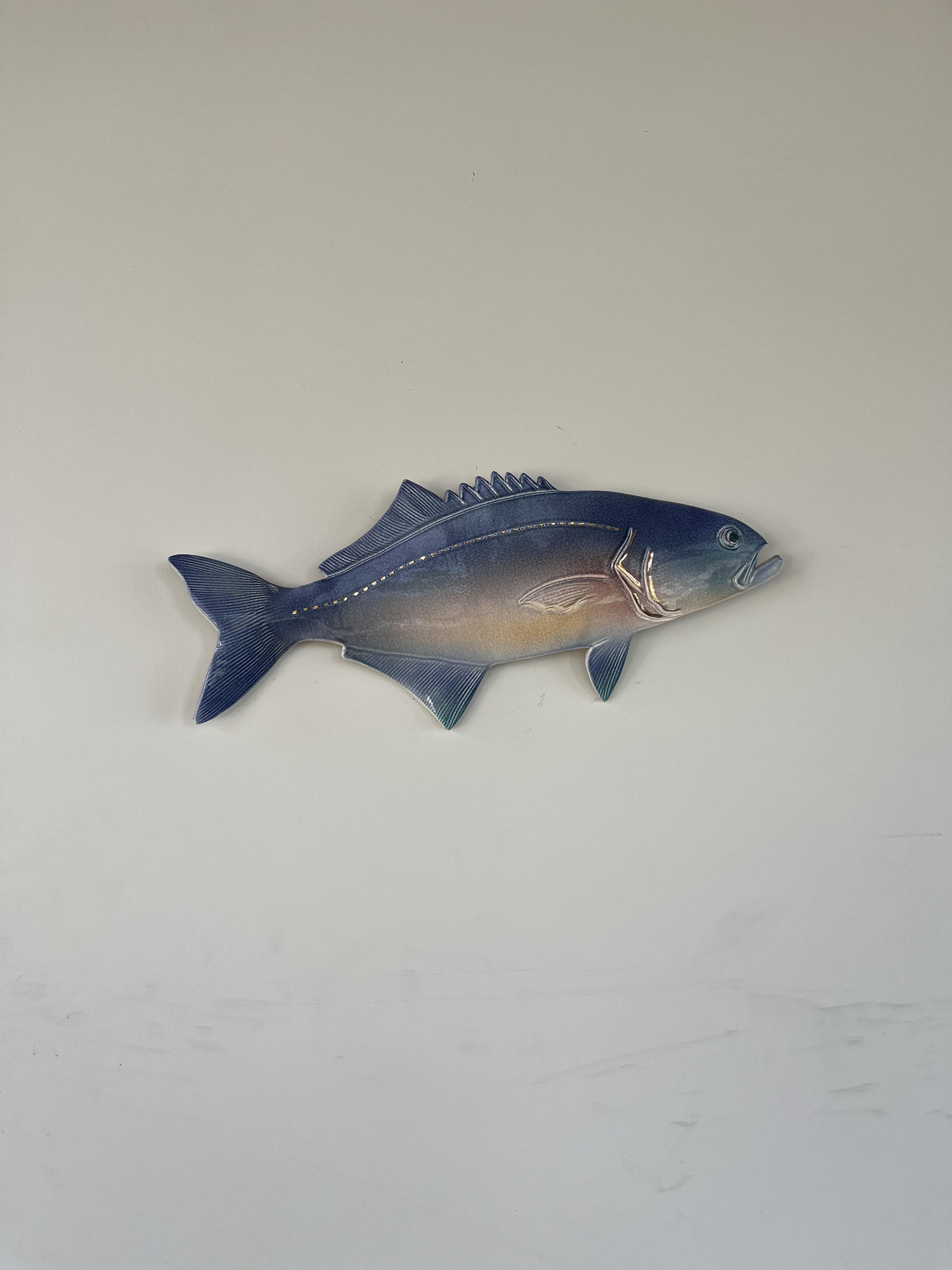
I’ll wrap up with a word on Joan Mallick’s popular “blue pottery. ” As Joan is unwell and no longer able to work, I think her distinctive mugs, plates, planters, and Christmas ornaments are likely to become collectors’ items.
The last shot shows my husband’s clematis trying to get into the house.
Photo: John Tlumacki/Globe Staff. The Boston Globe reported recently on service workers marching “down Tremont Street to Boston Common, where they held a labor rally for new contracts and freedom to unionize.”
As a member of the general public, I don’t like being inconvenienced by a labor strike any more than the next person. But I know my history. I know what life was like when workers couldn’t strike and how some gave their lives to change the status quo. So I think of that on Labor Day.
At the Boston Globe, John Hilliard wrote recently about service workers, who are among the last to band together for better working conditions. We need to stay as grateful to them as we were during the pandemic.
“Hundreds of essential workers — including janitors, airport staff, and ride-hailing drivers — marched through Boston’s streets Saturday demanding better post-pandemic workplace conditions after laboring to keep the economy afloat during the health crisis.
“The Labor Day weekend demonstration, organized by Local 32BJ of the Service Employees International Union, drew together service workers from across Greater Boston who are members, as well as some who are organizing to join the union, according to Roxana Rivera, a labor organizer and assistant to 32BJ president Manny Pastreich.
“ ‘This is a moment for workers, because they put so much of themselves out there during the pandemic. They didn’t have a choice to work remotely. Service workers risked their own personal health, and those of their families,’ Rivera said. ‘The fact that they still struggle to make ends meet is unacceptable.’ …
“Luis Medina, of Malden, who works full time as a janitor, said he joined the demonstration because he is fighting to secure full-time hours for colleagues struggling to make ends meet with part-time employment. …
“Saturday’s demonstration came amid a dramatic resurgence in labor organizing and activity across the country — from Starbucks workers seeking to unionize to Hollywood writers and actors now on strike — demanding better pay, benefits, and working conditions from employers.
“Among the successes are Teamsters and UPS workers who have secured new contracts through union efforts.
Support for labor unions in the US has soared, with roughly two-thirds of Americans now saying they approve of them, according to a Gallup poll released Wednesday.
“And demonstrators in Boston Saturday, like Marty, a 43-year-old from Plymouth who works as an Uber driver and gave only his first name, drew a direct line between union successes nationwide and efforts to support workers locally.
“ ‘We are really important, because we are the people who move the economy,’ said Marty, who wore a Screen Actors Guild shirt to support striking actors. ‘If no one is making any money, no one’s spending anything, [and] that’s when the economy starts to suffer.’
“Rivera said that even though many people now can work from home, commercial buildings must still be cleaned and maintained, while airport employees and ride-hailing drivers remain vital to keeping the economy going. ‘We need to make sure that we are not leaving these workers behind,’ Rivera said. …
“Waitstaff and food service workers at restaurants along the route gathered at doors to watch the protesters. One worker left her restaurant, asked a union representative for a flyer being handed out and took it back inside.
“The city was packed with people enjoying a beautiful end-of-summer Saturday, and throngs watched from sidewalks, many taking photos with their phones. Several raised their arms in support, and one man on a scooter beeped his horn as he rode along Tremont Street.
“Elizabeth Hill-Karbowski, who was visiting Boston with family from Wisconsin, watched as demonstrators marched along Tremont Street and read from a flyer.
“ ‘It’s a timely type of demonstration for the Labor Day weekend, very peaceful, well organized and [it is] people just wanting to have their voices heard,’ Hill-Karbowski said. …
“State Senator Lydia Edwards, whose district includes East Boston, Revere, and Winthrop, spoke to workers in Spanish then English. …
“ ‘We celebrate all the victories that we have had, but also we need to remember the lives that we’ve lost in the fight for justice, and the lives that you have saved as workers’ during the pandemic, Edwards said.
“Ed Flynn, Boston City Council president, told the crowd: ‘When workers aren’t receiving a decent wage here in the most liberal, progressive city in the country, there’s something wrong with that.’ ”
Photo: HarGoldMusic.com. “Harriet Goldberg writes songs evoking old standards,” says her website. In addition, she has an incognito presence you have probably encountered.
Here is a woman who probably would have preferred to get the attention of the New York Times for other reasons than this. Her new claim to fame is not noted on her website. The thing is, she wrote a song that became ubiquitous background music for telephoners put “on hold.”
Sal Cataldi writes, “Harriet Goldberg is the composer of what may be one of the most heard songs in the world today. This 74-year-old New Jersey native is, in her own words, a ‘late blooming, part-time musician.’ …
“Since 2017, Goldberg’s jazzy instrumental, ‘My Time to Fly,‘ has been served up to countless callers who are put on hold by the customer service lines of businesses large and small. …
“Goldberg’s journey from a career in social work to the queen of hold music is an unlikely one. It’s the product of a passion that wasn’t acted on until she was in her late 40s.
” ‘When I was a kid, my family got a free piano,’ Goldberg said in a phone interview from her home in Boston. ‘My dad wrote songs and played jazz as a hobby. I studied a little classical but mainly played folk, rock and the Beatles. …
” ‘In my late 40s, my interest in jazz deepened, mainly standards and cabaret music,’ she said. ‘I started composing songs based on the songs I loved. I knew my limitations and wanted to find someone who could help me with my writing.’
“Looking for a mentor, Goldberg turned to an old friend, the saxophonist Billy Novick, a onetime Berklee College of Music student who has appeared on more than 250 recordings, film and television scores. …
“ ‘Harriet and I knew each other for years and our collaboration started very organically,’ Novick said in a phone interview from his home in Lexington, Mass. ‘She would show me her compositions and I would make suggestions to modify chord structure, melody and the like.’
“After a few years, Goldberg had enough songs to record an album. The result was ‘Bring Back the Moonlight,’ from 2002, a 14-track collection of vocal tunes modeled on the lush classics she loved. Novick created arrangements, booked the studio and engineer, and found the musicians who played and sang on this and four more albums Goldberg self-released through 2021.
“Aware there were better opportunities for Goldberg’s compositions to be licensed as incidental music in film and television if they were instrumentals, Novick suggested she record wordless versions of her songs, most crucially, the title track to her 2011 album, ‘My Time to Fly.’
“But before this tune took off on phones, Goldberg gained a foothold by entering a song from her debut disc, ‘Suddenly You Walked By,’ into a songwriting contest sponsored by Billboard magazine. Though she didn’t win the top prize, she earned a membership with Taxi, a firm that helps composers place music in film and television. By 2008, Goldberg was working with another catalog service, Crucial Music. …
“ ‘We were working … a service that manages the call centers for tens of thousands of businesses worldwide, handling 10 million calls in a day,’ Tanvi Patel, the chief executive of Crucial Music, said in an interview. …
“[Goldberg] didn’t know anything about her place atop the on-hold hit parade until 2019, when she heard from her collaborator.
‘I was on hold with Capital One Bank and heard something familiar,’ Novick said. ‘My first impression was I liked the sax player, but I honestly couldn’t pin it down. I listened again, opened my Shazam app and found out it was one of the songs I recorded with Harriet.’
“While Goldberg’s tune may be spinning more than any other at the moment, it isn’t earning her untold riches. The licensing agreement with Amazon was a buyout, earning Harriet a ‘four-figure flat fee’ for its use in perpetuity.
“But the song has earned this late bloomer unexpected fandom — and some money. Through its release on her own label, Goldberg is making a modest income from streams, downloads and occasional CD sales. She is also garnering positive messages from fans via email and her SoundCloud page. The song’s popularity in Japan was even subject of a skit on Tamori Club, a sort of Japanese Saturday Night Live. …
“ ‘It’s especially funny,’ Goldberg added, ‘when I call my bank and get put on hold and it’s my own music that I have to listen to.’
“Dane Vannatter, the cabaret singer featured on the vocal version of ‘My Time to Fly,’ sometimes performs it at club gigs.
“ ‘Before he sings it, he holds up his phone and plays the instrumental version,’ Goldberg said. ‘Then, he asks how many people have heard the tune. It’s usually most of the audience though they never can quite place exactly where they heard it.’ “
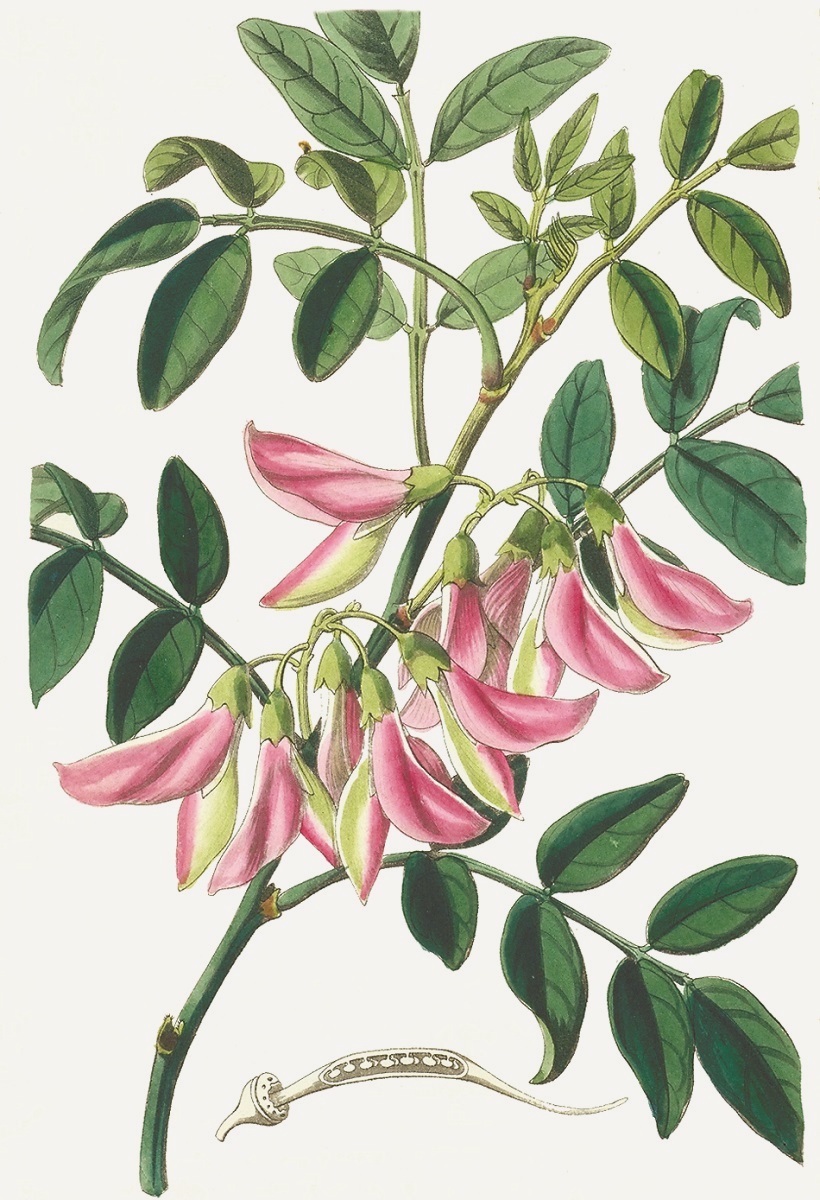
Photo: Edwards’s Botanical Register. The Phillip Island glory pea, which once grew in Australia, is a leading candidate for de-extinction, according to e360.
Do you get visions of Frankenstein’s monster when you hear about reversing extinction? Maybe we start with plants, but then what? Dinosaurs?
Well, it’s hard for me to be against anything that extends knowledge, so I’m keeping an open mind about the Yale Environment 360 report on the de-extinction of plants.
Janet Marinelli writes, “In January 1769, botanists Joseph Banks and Daniel Solander found a daisy in Tierra del Fuego, at the southern tip of South America. Later named Chiliotrichum amelloides, it is one of a thousand plant species unknown to European scientists that the two men collected during Captain Cook’s first voyage on the HMS Endeavor. … The plant was dried and pressed for future study. Today, the 254-year-old specimen is among the almost 8 million preserved plants in New York Botanical Garden’s William & Lynda Steere Herbarium.
“ ‘When a plant goes extinct,’ says Giulia Albani Rocchetti, a postdoctoral researcher at Roma Tre University and the lead author of the paper, ‘we don’t just lose a species, we lose a member of a habitat community with a specific role and relations with other species; … we lose genes which could have provided insight into the species and its community and yielded new pharmacological compounds and other products.’ …
“For nearly five centuries, herbaria have helped botanists identify, name, and classify the world’s floral diversity. Now these vast botanical libraries are being tapped to try to create a new chapter in the 500-million-year history of Earth’s terrestrial plant life. In Nature Plants in December, an international group of biologists published the first-ever list of globally extinct plants they believe can be returned from the dead, using seeds available in herbarium specimens. …
“In recent decades, the seeds of rare and imperiled species have been preserved in seed banks at low humidity and temperatures that ease the embryos inside into a kind of state of suspended animation to maximize their longevity. However, species already lost remain only as specimens in the collections of dried and pressed plants known as herbaria, and only in some (lucky) cases. … Only a few of these plants happened to be in fruit and in seed when they were collected. And even when herbarium seeds are discovered, there is no easy way to tell if the embryos inside are dead or lying dormant, waiting to sprout when conditions are right. …
“Abby Meyer, executive director of Botanic Gardens Conservation International in the United States, points to the rise in recent decades of the field of bioinformatics, which has transformed the trove of biodiversity information once locked up in natural history collections — such as herbarium specimens of extinct plants that contain seeds — into browsable digital databases. New York Botanical Garden (NYBG), for example, began digitizing its herbarium specimens in the mid-1990s, and today some 4 million, or about half of its preserved plants, have been scanned and can now be called up on a computer screen by anyone around the globe.
“Data aggregators such as the Global Biodiversity Information Facility provide researchers looking for seeds with instant access to millions of scanned specimens, along with associated ‘metadata’ such as the GPS coordinates where the plants were collected. At the same time, scientists have been refining in vitro embryo rescue techniques, increasing the odds that old or weak seed embryos can grow into viable plants. …
“While attempts to de-extinct the dodo, the woolly mammoth, and other charismatic megafauna continue to grab headlines, they would result at best in a hybrid, genetically engineered animal — a proxy of an extinct species. By contrast, recovering plants by germinating or tissue-culturing any surviving seeds or spores preserved in herbaria would result in the resurrection of the actual species. …
“One of the biggest hurdles is figuring out how to germinate the precious few seeds of often genetically unique plants found only on dried specimens. There is little margin for error, and before attempting to germinate the extinct species itself, scientists must perfect methods for germinating seeds of any closely related species that survive. …
“In December 2019, Giulia Albani Rocchetti sat in Florence’s Central Herbarium, marveling over the remains of Ranunculus mutinensis, an endemic buttercup that once grew in moist floodplain forests of the Po River, as it threads through northeastern Italy. … It was a thrill for her to find not just one but two Ranunculus specimens with numerous mature fruits called achenes. She then spent months at her desk in Rome, blowing up digitized images of extinct plants from herbaria across the globe on her computer screen in the improbable search for seeds.
“She was also spurred on by the knowledge that some seeds have the astonishing ability to survive adverse conditions and sprout after decades, even centuries — such as the Judean date palm, which a team of scientists successfully germinated in 2005 from a 2,000-year-old seed. …
“Albani Rocchetti and colleagues … identified 556 specimens that contained seeds, representing 161 of the extinct plant species [and] proceeded to devise a pioneering roadmap for prioritizing species for de-extinction. Assuming that species whose close kin produce long-lived seeds and newer specimens are the most likely to contain seeds that survive, they combined data on the seed behavior and longevity of closely related plants, as well as the age of each specimen, to create a DEXSCO, or best de-extinction candidate score for each species. …
“Streblorrhiza speciosa, a spectacular member of the pea family, was [so] unique that it is considered the only member of its genus, or closely related group of plants. The species’ striking cascades of pink blossoms clambered exuberantly over trees on Phillip Island in the Pacific Ocean east of Brisbane, Australia. Collected in 1804 by Austrian botanist Ferdinand Bauer, the Phillip Island glory pea was an instant hit in Europe, coveted by every wealthy family with a conservatory. Meanwhile, however, Phillip Island was being overrun by pigs, goats, and rabbits introduced by British officers overseeing a nearby penal settlement, leaving barely a scrap of the remote island’s unique vegetation, and the glory pea was never seen in the wild again. …
“The glory pea is now presumed extinct, but at number three is near the top of the list of recommended de-extinction candidates. …
“Another challenge of plant de-extinction is the lack of financial support for pursuing it. But on the bright side, plant de-extinction has not kicked up the controversy surrounding attempts to resurrect, say, the wooly mammoth or passenger pigeon. ‘For whatever reason, the human brain doesn’t seem to be as concerned about plants as about animals,’ Knapp says. ‘But in this case, we’re literally just germinating seed. We’re not reconstructing a genome. And that’s way less intimidating. Everyone can understand that.’ “
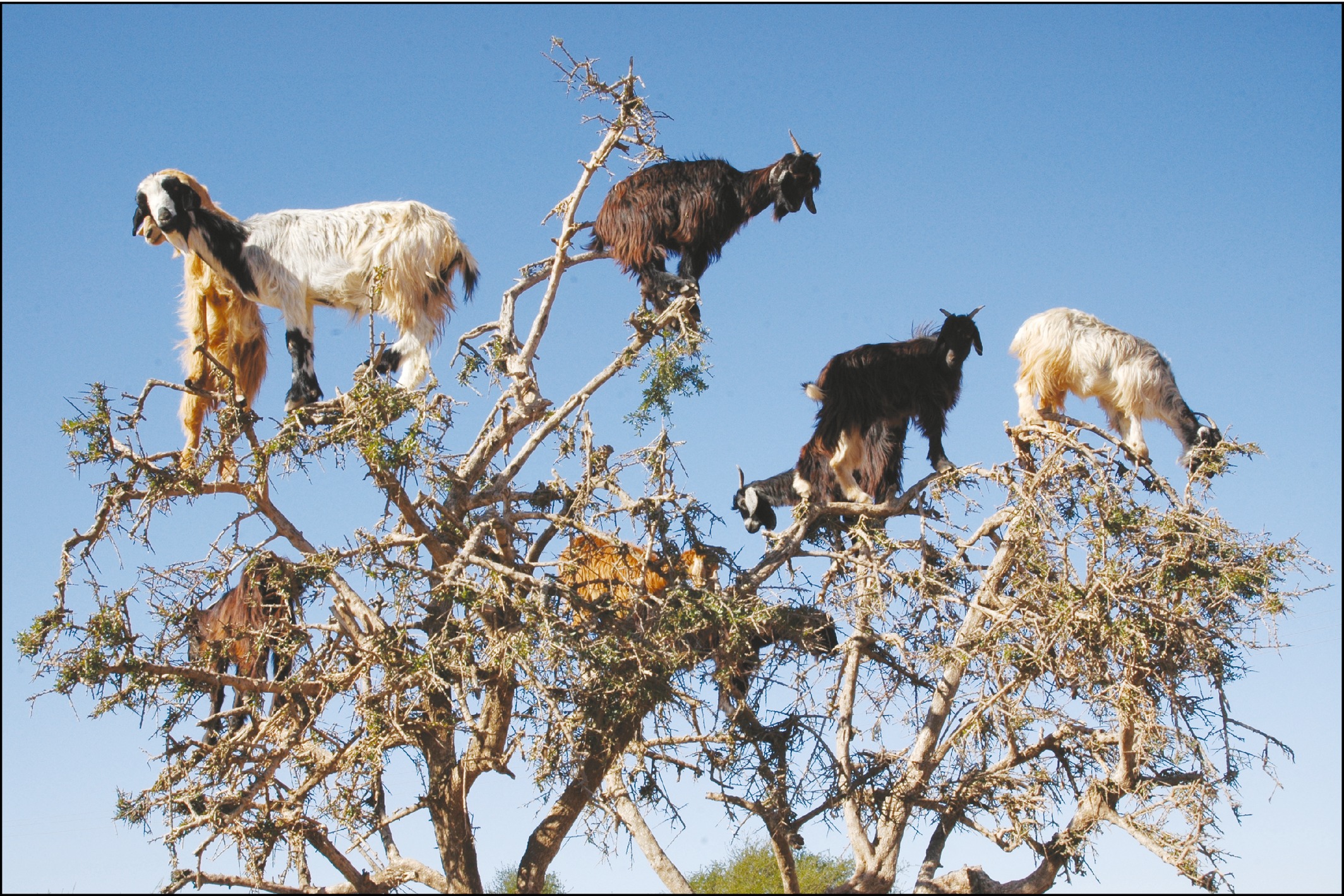
Photo: H Garrido/EBD-CSIC. Goats grazing on an argan tree in southwestern Morocco. They disperse seeds during rumination, which is one of the ways the trees extend their presence.
When I first saw the picture above, I knew I needed it for the blog. An internet search revealed plenty of touring companies that offer customers photo ops with climbing goats.
“Most people are familiar with domestic goats (Capra hircus) climbing on rocks,” the authors write, “but few know they are talented tree climbers too. In temperate countries where green pastures abound, goats do not need to climb trees to forage, but in arid regions the only available forage is sometimes found on the tops of evergreen shrubs and trees. Furthermore, goats often like seasonal fruits and collect them directly from fruiting trees when fallen fruits have been depleted.
“In southwestern Morocco, where the average annual rainfall is only 300 mm (~12 inches), goats climb the endemic argan tree (Argania spinosa).
Herders assist kid goats in learning to climb and even occasionally prune the trees to facilitate climbing.
“During the autumn, when herbaceous vegetation is lacking, goats devote 74% of their foraging time to ‘treetop grazing.’ …
“We previously observed Spanish and Mexican goats grazing on short trees or shrubs, but in Morocco we were astonished to see between 10 and 20 goats regularly climbing thorny 8–10-m-tall argan trees, mostly defoliated after intensive grazing. The purpose of our research was to verify that goats regurgitated the nuts of argan fruits while ruminating. …
“Argan forests are ecologically and economically important in southern Morocco, which is a developing country. The forests serve as an effective barrier for the Saharan Desert and provide local people with wood, fodder for livestock, cooking oil, medicine, and cosmetic materials. …
“To extract the oily kernels, the fleshy pulp of the tree fruits must first be removed and the hard nuts broken manually. Most popular accounts [say] that to remove the pulp, traditional Berbers feed the fruit to goats so the nuts pass through the digestive system and the seeds can be collected from the manure. However, goats do not usually defecate large seeds, so we were skeptical. …
“We wondered whether goats, which are ruminants, might spit out the nuts while chewing their cud, as we had seen goats do when fed with olive (Olea europaea) and dwarf palm (Chamaerops humilis) fruits in Spain (unpublished data). Moroccan goat herders confirmed that goats regurgitated most argan nuts while ruminating, although regurgitations and excrement found on the ground are usually mixed, resulting in misunderstandings about the way the nuts were expelled.
“Why is it important that goats regurgitate and spit out seeds from the cud? For plants there are well-known reproductive benefits associated with dispersing their seeds far from the maternal parent, including a greater probability of seed and seedling survival. To successfully disperse, many plant species produce edible fruits that attract frugivorous vertebrates, which ingest the fruits and transport the seeds inside their body until they are released elsewhere by regurgitation or defecation. …
“The possibility of ruminant ungulates spitting out some viable seeds from the cud is not even mentioned in [many] comprehensive reviews. … To illustrate the potential of domestic ruminants to spit viable seeds from their cud, we supplied Spanish domestic goats with fruits differing in size and structure, corresponding to five species (six varieties) of plants, including five drupes or pomes (fleshy fruits) and one legume (pods). …
“For all the plant species, we recovered appreciable numbers of seeds that the goats had regurgitated, despite not being able to find all of the seeds, since the goats were not subject to controlled conditions. As might be expected, larger seeds were more frequently spat out during rumination. …
“Our observations suggest that almost any seed could be ejected during mastication, spat from the cud, digested, or defecated. We tested the viability of regurgitated seeds by incubating them in a solution containing tetrazolium chloride; the embryo and endosperm of most seeds (71.5%) were stained red, indicating they were viable after processing by goats. …
“In conclusion, many previous studies that investigated the role of ruminants as seed dispersers were based exclusively on dung analyses and may have underestimated an important fraction of the total number of dispersed seeds. Moreover, this fraction of seeds should correspond to plant species with particular fruit and seed traits (eg large linear dimensions) differing from those of plant species dispersed exclusively or mostly through defecation. Importantly, the seeds of some species are unlikely to survive passage through the ruminant lower digestive tract so that spitting from the cud may represent their only, or at least their main, dispersal mechanism. It is therefore essential to investigate the effectiveness of this overlooked mechanism of seed dispersal in various habitats and systems.”
Don’t you love the language they use? “Processing by goats”! More at Ecological Society of America, here. No firewall. I have removed citations, so check out the original if you want to know who discovered what.
Art: Beatrix Potter via the Marginalian. The mighty mushroom.
As the blogger at Spores, Moulds, and Fungi in New Zealand could tell you, mushrooms are important to the efficient functioning of the planet.
Today’s article explains how, if encouraged to do their own thing, fungi can prevent the worst climate-change wildfires. Here are excerpts from Stephen Robert Miller’s report at the Washington Post.
“If you’ve gone walking in the woods out West lately, you might have encountered a pile of sticks. Or perhaps hundreds of them, heaped as high as your head and strewn about the forest like Viking funeral pyres awaiting a flame.
“These slash piles are an increasingly common sight in the American West, as land managers work to thin out unnaturally dense sections of forests. …
“The federal government has committed nearly $5 billion in the Inflation Reduction Act and Bipartisan Infrastructure Law to thinning forests on about 50 million Western acres over the next 10 years. Although this can be accomplished with prescribed burns, the risk of controlled fires getting out of hand has foresters embracing another solution: selectively sawing trees, then stripping the limbs from their trunks and collecting the debris.
“The challenge now is what to do with all those piles of sticks, which create fire hazards of their own. Some environmental scientists believe they have an answer: mushrooms. Fungus has an uncommon knack for transformation. Give it garbage, plastic, even corpses, and it will convert them all into something else — for instance, nutrient-rich soil.
“Down where the Rocky Mountains meet the plains, in pockets of forest west of Denver, mycologists like Zach Hedstrom are harnessing this unique trait to transform fire fuel into a valuable asset for local agriculture.
“For Hedstrom, the idea sprung from an experiment on a local organic vegetable farm. He and the farm owner had introduced a native oyster mushroom to wood chips from a tree that fell in a windstorm.
“ ‘That experiment showed us that the native fungi were helping to accelerate the decomposition really substantially,’ he said. Working with local governments, environmental coalitions and farmers, he is now honing the method. …
“When slash piles are set alight, they burn longer and hotter than most wildfires over a concentrated area. This leaves behind blistered soil where native vegetation struggles for decades to take root. As an alternative, foresters have tried chipping trees on-site and broadcasting the mulch across the forest floor, where it degrades at a snail’s pace in the arid climate. Boulder County also carts some of its slash to biomass heating systems at two public buildings.
“ ‘We’re removing a ton of wood out of forests for fire mitigation,’ Hedstrom said. ‘This is not a super sustainable way of managing it.’ He hopes to show that fungi can do it better.
“Jeffrey Ravage is a forester with the Coalition for the Upper South Platte, which manages protection and restoration of a more-than-million-acre watershed in the mountains southwest of Denver. He describes the action of saprophytes, a type of fungi that feeds off dead organic matter, as ‘cold fire.’ Like a flame, saprophytic fungi break organic material into carbon compounds.
Mycelium, the often unseen, root-like structure of the fungi, secretes digestive enzymes that release nutrients from the substrate it consumes.
“Whereas a flame destroys nearly all organic nitrogen, mycelium can fortify nitrogen where it’s needed in the forest floor. … Standard thinning costs somewhere around $3,000 per acre, about a third of which is spent hauling out or burning the slash. Using mycelium could drastically reduce that cost. With the right kind of fungi, he said, ‘we can do in five years what nature could take 50 years to a century to do: create organic soil.’
“Though the method is new, it’s not untried. At the Balcones Canyonlands Preserve, north of Austin, biologist Lisa O’Donnell deploys mycelium to combat invasive glossy privet [successfully]. … For mycelium to be a truly viable solution to wildfires, however, it would have to work at the scale of the Western landscape. Hedstrom is experimenting with brewing mycelium into a liquid that can be sprayed across hundreds of acres. …
“Ravage doubts it could be so easy. ‘Half the battle is how you target the slash,’ he said. Success stories like Balcones are rare. Ravage has spent a decade cultivating wild saprophytes and perfecting methods of applying them in Colorado’s forests.
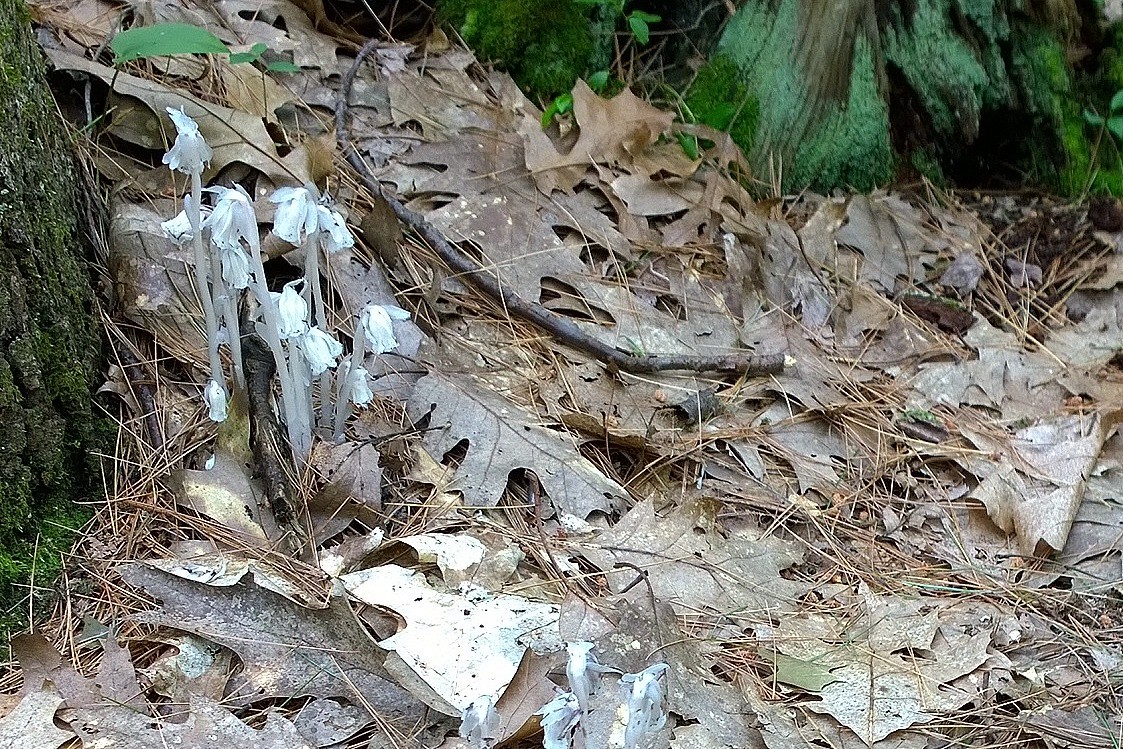
Photo: Suzanne and John’s Mom Indian Pipe is a kind of saprophyte.
“He begins by mulching slash to give his fungi a head start. Then he seeds the mulch with spawn, or spores that have already begun growing on blocks of the same material, and wets them down. Fungi require damp conditions and will survive in the mulch if it is piled deeply enough. Given the changing character of Western forests, however, aridity poses a serious hurdle.
“At his lab in the Rockies, Ravage grows about a ton of spawn annually. To meet the demands of forest-fire mitigation, he wants to produce 12 tons every week. This presents an opportunity for intrepid mushroom farmers, should the government choose to fund them.”
Photo: Arnold Gold/Hearst Connecticut Mediavia Middletown Press. Turtles stand on a tire in Pameacha Pond in Middletown on June 30, 2023.
How do people end up protecting wildlife? They are not necessarily longtime nature lovers. Maybe they just work at a dry cleaner.
Cathy Free reports at the Washington Post, “Every summer at Best Cleaners in Middletown, Conn., employees throw open the front and back doors and the slow parade begins. Very slow.
“During nesting season from May through September, turtles ramble into the store, ease their way past the front counter and racks of freshly cleaned jackets and skirts, and crawl for the opposite door.
“They’re among dozens of female Eastern painted turtles on their annual summer migration from Middletown’s Pameacha Pond to lay their eggs at a grassy marsh behind the dry-cleaning store. In late summer and early fall, the trek changes direction, with tiny hatchlings making their way back to the pond.
“To head either direction, the turtles need to cross South Main Street, a busy two-lane road that is part of Route 17.
“Some of the turtles are smashed by cars during their precarious annual journey, so current employees at Best Cleaners decided about five years ago to start saving as many turtles as they could, including the ones they saw wandering around the store and in the parking lot.
“ ‘I believe that people who were at the shop in the years before us also helped out,’ said Matt Dionne, regional manager for Best Cleaners, adding that the Middletown South Main Street location has always opened the doors and windows every summer to help cool things off. …
“Looking down and finding turtles in the shop is pretty common [in July], often several times a week. That’s when the employees know it’s time to help them safely cross the street. …
“The store’s eight employees routinely monitor the parking lot for stray turtles every summer, he said, noting that they’ll gently scoop them up and carry them to where they’re going — either to the marsh or the 19-acre pond.
“ ‘The babies can be as small as a quarter,’ Dionne, 36, said. ‘There’s a good chance they won’t make it across the road by themselves.’
“Assistant manager Jennifer Malon is among those who regularly makes a trip across the road with a turtle or two in hand. She also gives a lift to the occasional snapping turtle, but she makes sure to carry those in a dustpan. …
“ ‘Every summer, we’re always looking at our feet because we don’t want to step on them,’ said Malon, 37. ‘They’re important to the environment.’
“Although painted turtles are the most common turtles in North America and aren’t endangered in Connecticut like bog turtles and spotted turtles, they’re important indicators of healthy ecosystems, said Brian Hess, a wildlife biologist with Connecticut’s Department of Energy and Environmental Protection.
“They’re also vulnerable to land development that imperils habitat and migration paths, he said.
“ ‘An adult turtle might survive a raccoon trying to eat it, but it can’t survive an encounter with a car,’ Hess said. …
“Dionne hopes that rescuing the turtles will give them a better chance to make it to breeding age — usually about age 10 or so.
“ ‘Humans are the ones who built infrastructure around their habit, so we owe it to the turtles to do anything we can to give back,’ Dionne said.
“He and Malon were among those in Middletown who rallied last year to save Pameacha Pond from being turned into a city park. Students from Wesleyan University made an eight-minute documentary about the community’s efforts to keep the centuries-old haven for a variety of turtles, birds and frogs.
“ ‘They were going to drain the water from the pond, then because of the turtles, they decided not to,’ Malon said. ‘A lot of people love the turtles.’ …
“Mac Falco, manager of the Best Cleaners shop in Middletown, said many of his customers can’t imagine a summer without seeing a few slow-moving turtles in the shop when they pick up their dry cleaning.
“ ‘It’s part of the summer experience — everyone thinks it’s wonderful that we’re helping them across,’ Falco said. …
“He and other employees carefully place rescued baby turtles at the top of the pond bank across the street, then enjoy watching them climb down to the water.
“Painted turtles — named for their colorful markings — are often spotted basking in the sun on rocks and logs by kayakers on the pond, Dionne said.
“ ‘They’re fascinating, instinctual little creatures with built-in GPS systems that know where the water is,’ he said. ‘But if for some reason they end up lost in our shop, we’re happy to stop what we’re doing and pick them up.’ ”
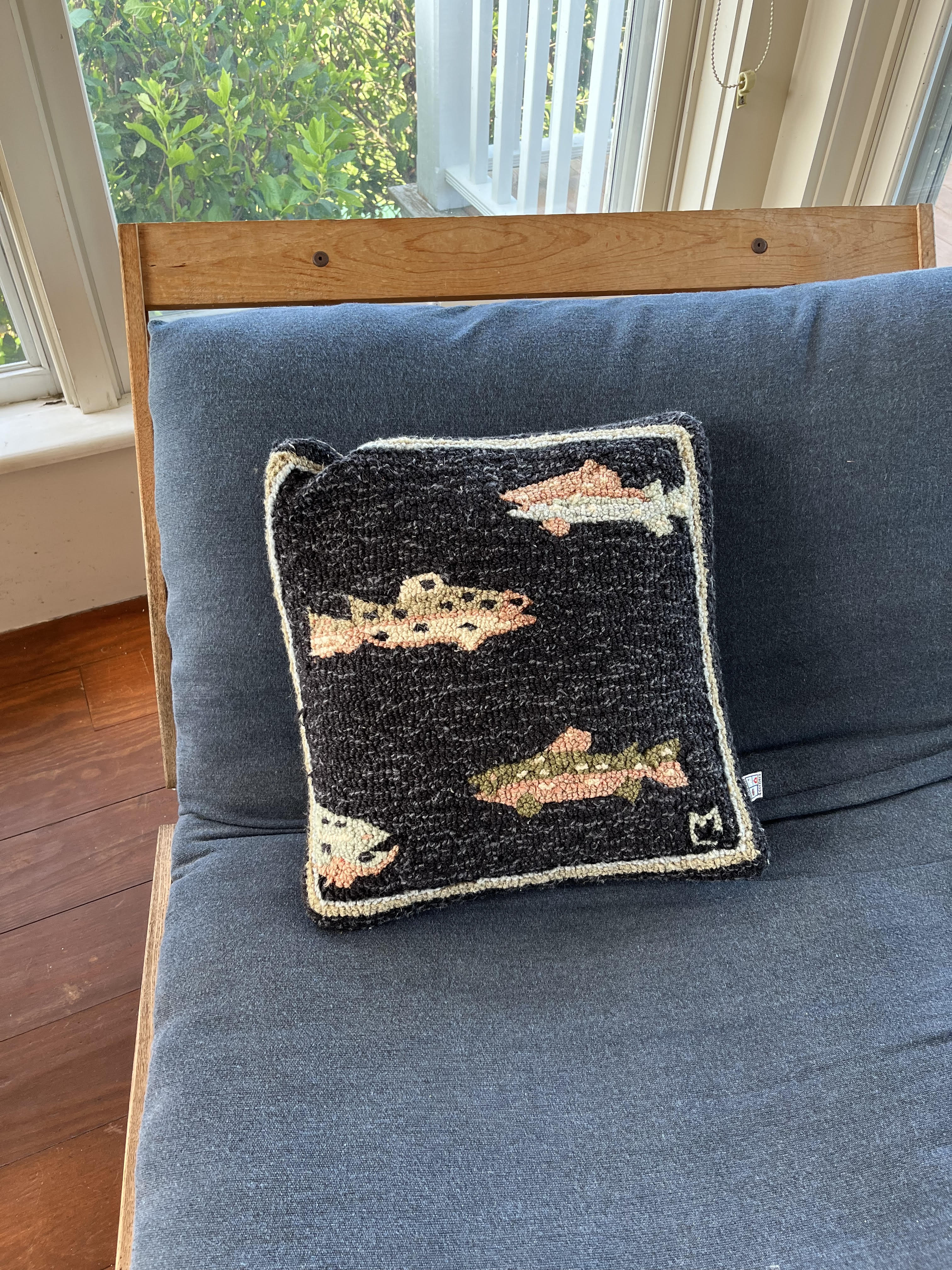
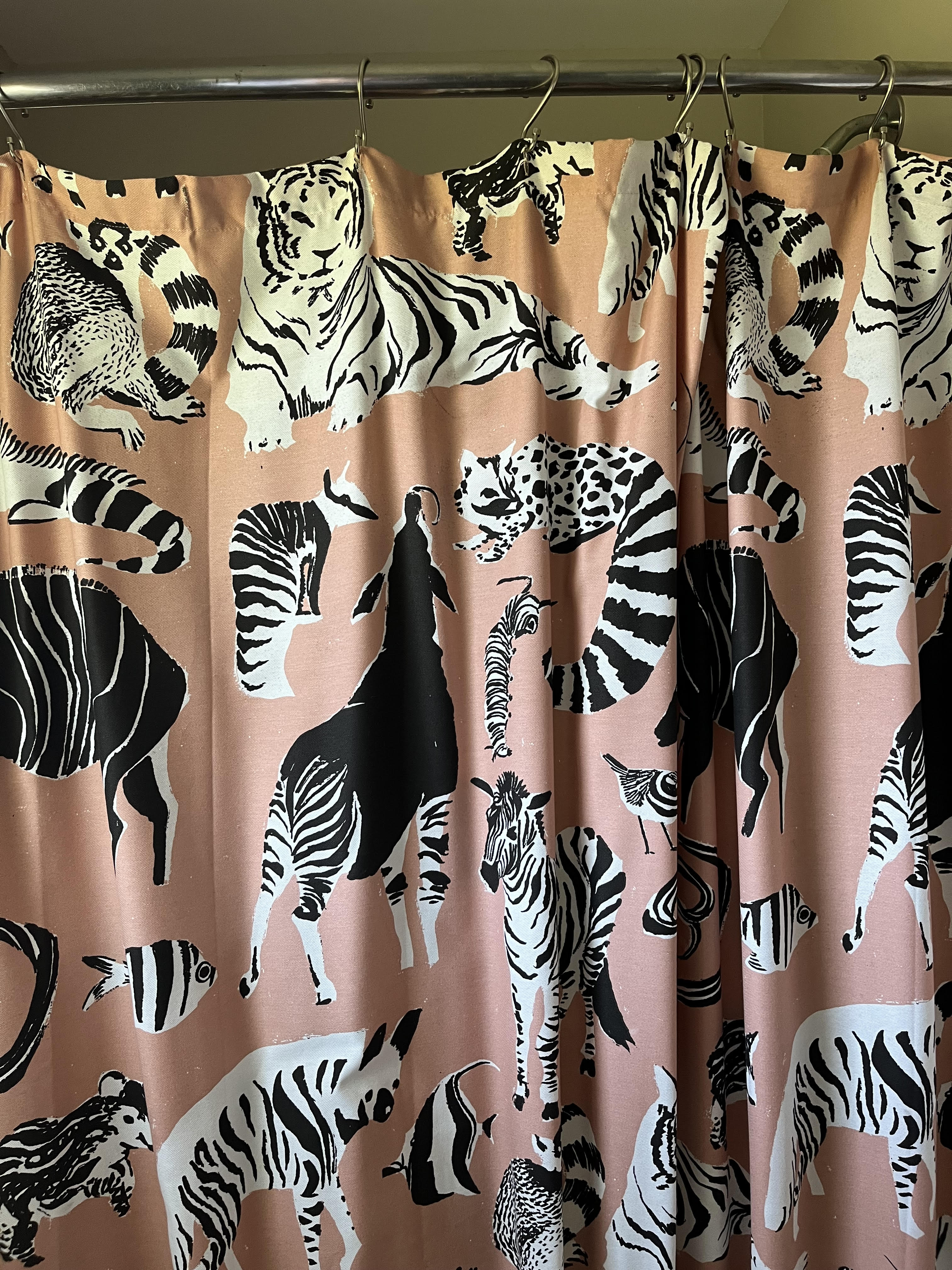
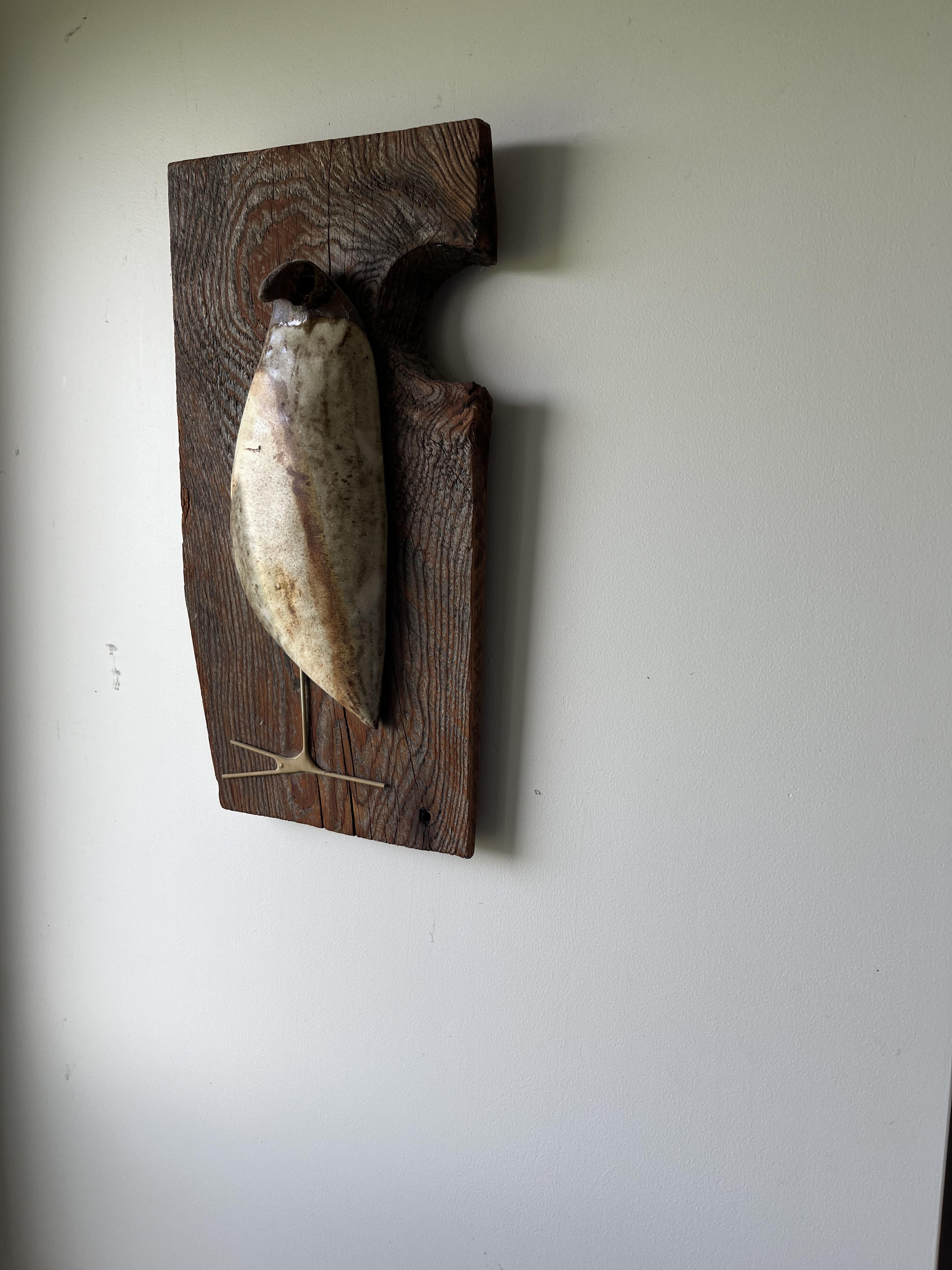
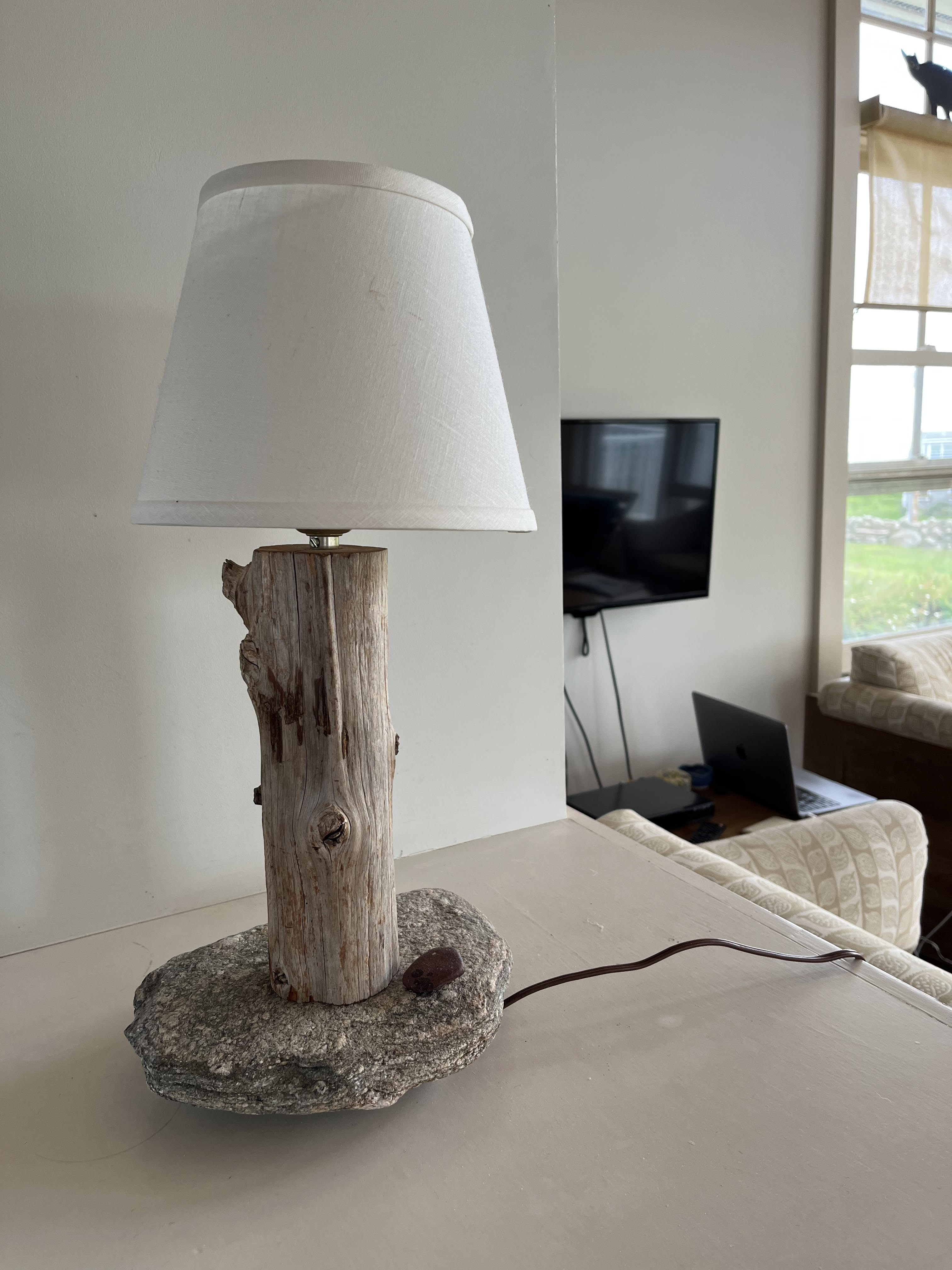
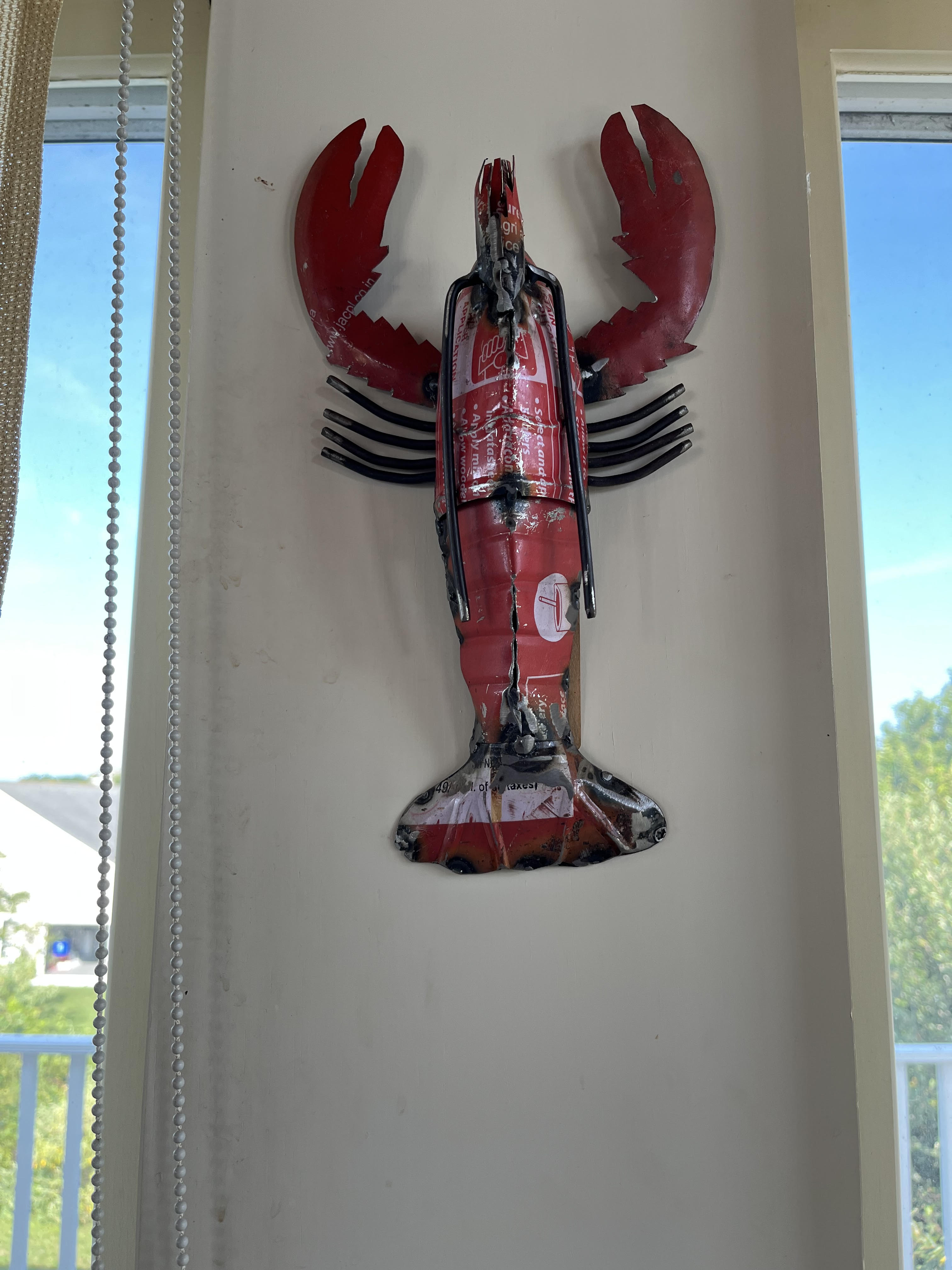
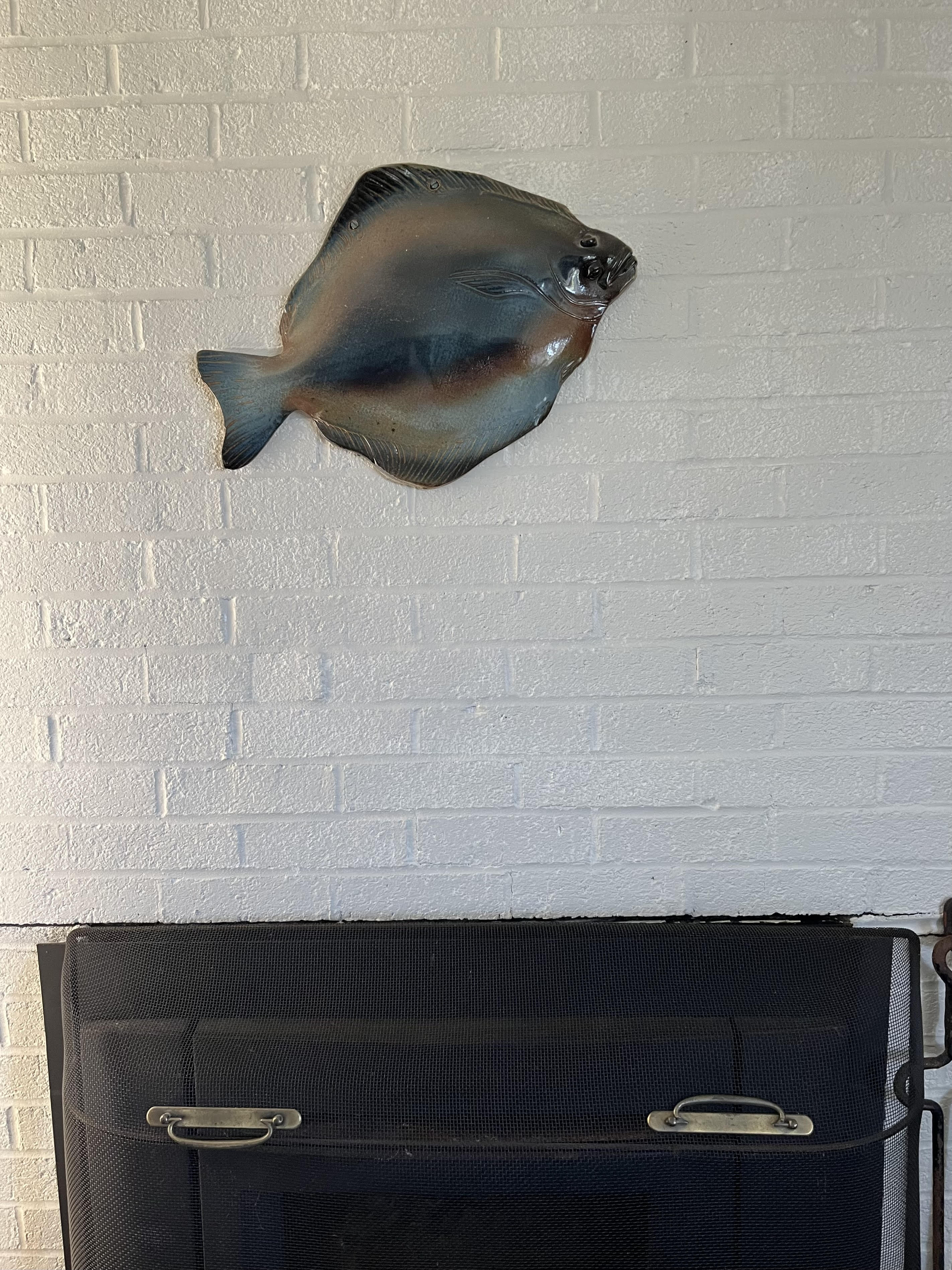
Photos: Suzanne and John’s Mom. Beach cottage artifacts.
I like to see how other people decorate beach cottages. I’ve noticed a lot of ocean paintings and photos of sea-going ships. A lot of shells, seaglass, and driftwood.
Here are photos of artifacts we have in our place — some beach-y, others just lighthearted.
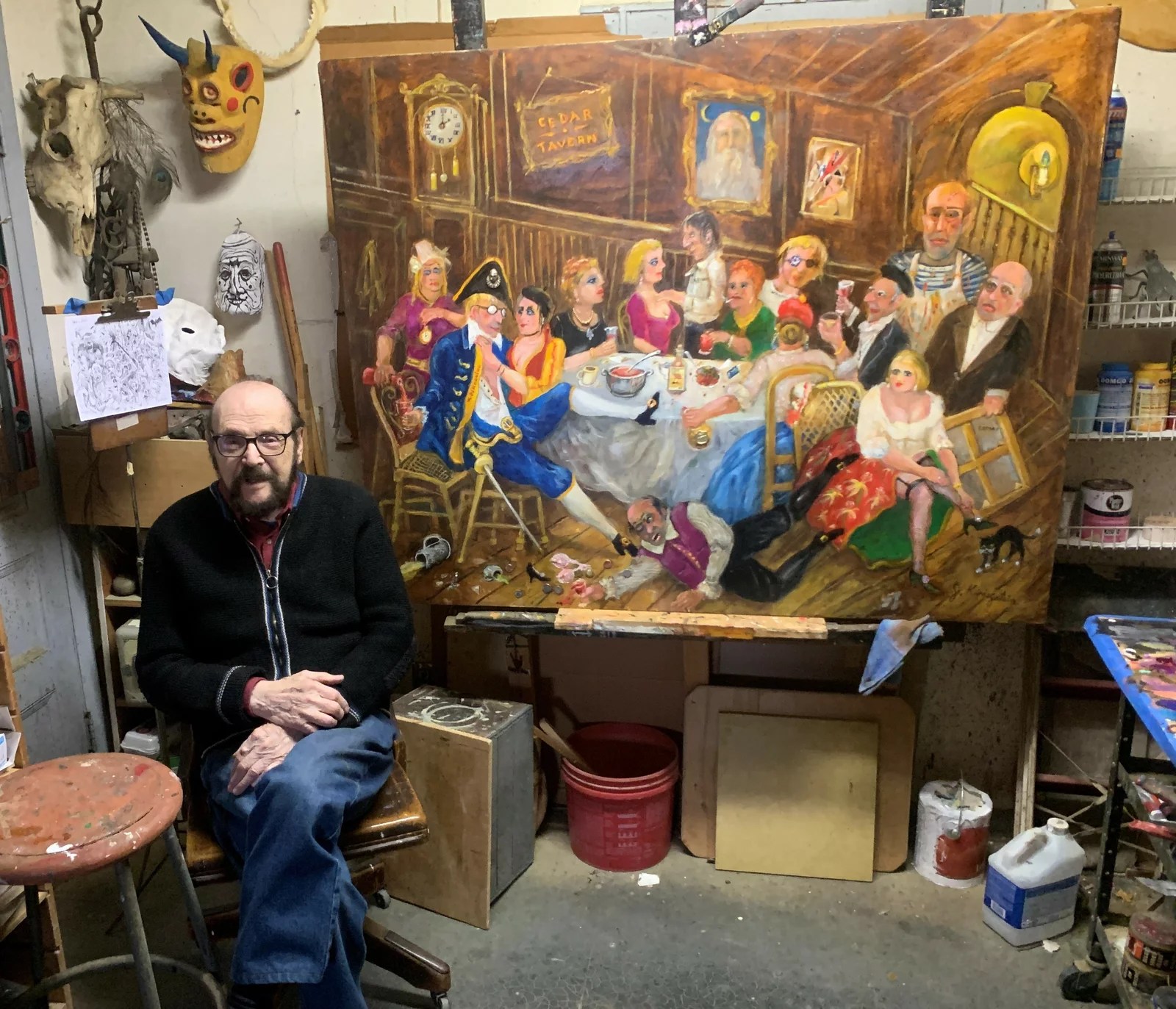
Photo: Matthew Schuerman/NPR. “Jonah Kinigstein, 99, has been making art since he was a teenager,” says NPR. “Some of his work satirizes modern artists such as Andy Warhol and Jackson Pollock, visible in the painting behind him.”
Although I am personally a big fan of abstract art, I find it interesting to consider that that former rebellion against convention spurred its own rebellion. When abstract art was the accepted best, what happened to artists whose inspiration lay elsewhere?
Matthew Schuerman reported at National Public Radio (NPR) about one artist working in the heyday of abstract expressionism who swam against the tide.
“In the 1950s, Jonah Kinigstein was on the verge of making it big in New York’s art world. He won a Fulbright to Rome. His paintings got into the Whitney Museum’s annual show of contemporary art (the precursor to the Whitney Biennial). And he was taken in by one of the biggest gallerists in the city, Edith Halpert. …
“Once, when Life magazine ran a profile of Halpert and nine of the artists she was promoting titled, ‘New Crop of Painting Protégés,‘ Kinigstein was among them. In fact, in the main photo, he stood directly behind Halpert. But then, as a result of changing tastes in the art world, he fell into obscurity and could not convince anyone to give him a gallery show.
“He nonetheless kept painting … and painting … and painting some more. Even today, at age 99, he said he spends two to three hours a day. …
“His painting style has gone through a lot of changes throughout his life, but he calls himself a ‘figurative expressionist.’ That is, he paints people, but they are often distorted and grotesque, set against backgrounds that are surreal and fantastical. His subjects are saints, rabbis, impresarios and showgirls — people who [seem] to be suffering or seem to be enjoying other people’s suffering. …
” ‘I was born in Coney Island, and I remember certain things,’ he said. ‘These large figures and people waiting in line.’ …
“Born in 1923 in Brooklyn, Kinigstein was raised in the Bronx by Jewish-Russian-Polish immigrants. As a teenager, he learned he had a knack for art by drawing with chalk on the sidewalk. His father, a house painter, used to brag about him to his co-workers.
” ‘I used to go with him to help paint the apartments. And he would say, as he introduced me, “Hey, I’m painting with a real artist,” ‘ Kinigstein said with a laugh.
“After high school, Kinigstein attended The Cooper Union. … But before he could finish, he was drafted into the Army for World War II, where he worked in a photo topography unit. …
“To Kinigstein, though, the twilight of figurative art meant it was less and less likely that he would ever make a living as a painter. The rejection stung.
” ‘I made painting after painting. And I always felt, you know, I was doing my best,’ he said.
“Kinigstein married and had two children while continuing a career in commercial art. He designed store windows and also Bloomingdale’s first-ever collectible shopping bag. (He was later inducted into the National Academy of Design.) And he kept painting.
“He also began to draw cartoons: satirical and biting, like something out of a 19th century political magazine, except his lampooned the art establishment that promoted abstract painting.
“One of them is based on a famous Rembrandt painting, The Anatomy Lesson of Dr Nicolaes Tulp. Except the cadaver on the bed is labeled ‘figurative painting’ and the men around him, cutting him up, are members of the art establishment that promoted abstraction in the 1950s.
“A few times, Kinigstein took these cartoons to New York’s gallery district, SoHo, and pasted them onto building walls and lamp posts. Some passersby would get into arguments with him, while others would take them down and ask him to sign them. …
“To Kinigstein, abstract painting took no talent, no skill, no ability to observe the world. There was also a moral component — he refused to change the way he painted simply because it wasn’t popular.
” ‘I saw a guy right in my front of my eyes going from real, real painting to, you know, he laid the painting down on the floor and he started to splash around,’ he said. ‘I couldn’t talk to that guy. I really couldn’t talk to him.’
“Recently, though, Kinigstein is finally getting some recognition. In 2014, Fantagraphics, arguably the foremost art comics publisher in the U.S., came out with a collection of his cartoons, The Emperor’s New Clothes: The Tower of Babel in the ‘Art’ World. Editor Gary Groth knew he wanted to publish them the day he opened Kinigstein’s submission.
” ‘They were clearly not drawn by a young person because they displayed a level of craft,’ Groth said. ‘They were all so extraordinarily well-drawn. And then I looked at the content, and every single one of them was a ferocious attack on abstract expressionism.’
“Groth visited Kinigstein in Brooklyn and took a tour of his studio, which is packed with hundreds of paintings standing on their ends, like playing cards. That’s when he decided to do a second book, this one focused on Kinigstein’s paintings.
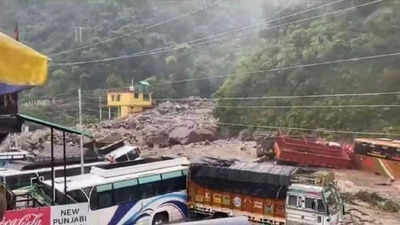
Photo: Times of India. Himachal rains: Chandigarh-Manali highway blocked at multiple places.
Blogger Friends,
Has anything like this happened to you? My June post about earthquake resistant construction in India elicited a cry for help today from a flooded part of the same country.
Here it is.
“saurabh joshi “Aryavrat or Bharat or India “I am from Himachal. Currently buildings have collapsed in Shimla, Manali and Mandi due to Heavy rains. I need to learn about old Earthquake Resistant Structures. Kindly help.”
I did a Google search and found out about the flooding August 14. But I am not someone who can advise about such things. All I do is share stories. I suggested trying to contact the expert in the article at his university.
I wish I could do more. All of a sudden, after posting an article that interested me, I am connected to a person in India who urgently wants my advice on earthquake resistant structures! It’s both wonderful and scary. What would you do? Have you encountered anything similar?
Photo: Whpqat Wikimedia Commons. Crawford Lake in Ontario, Canada, is giving up its secrets to geologists.
There is always something new to learn from the ancient record if we know how to read it. Case in point: the unusual characteristics of a deep lake in Canada are helping geologists understand a bit more about today’s rapid changes to the planet.
Sarah Kaplan, Simon Ducroquet, Bonnie Jo Mount, Frank Hulley-Jones, and Emily Wright each contributed to the story at the Washington Post.
“This summer, researchers will determine whether Crawford Lake should be named the official starting point for [the current] geologic chapter, with pollution-laden sediments from the 1950s marking the transition from the dependable environment of the past to the uncertain new reality humans have created.
“In just seven decades, the scientists say, humans have brought about greater changes than they did in more than seven millennia. Never in Earth’s history has the world changed this much, this fast. Never has a single species had the capacity to wreak so much damage — or the chance to prevent so much harm.
“ ‘It’s a line in the sand,’”’ said Francine McCarthy, a professor of Earth sciences at Brock University in Ontario, who has led research on Crawford Lake. …
“Every new phase of Earth’s history begins with a ‘golden spike‘ — a spot in the geologic record where proof of a global transformation is perfectly preserved.
“An exposed Tunisian cliff face bearing traces of an ancient asteroid impact marks the transition from the age of the dinosaurs to the Cenozoic era. Hydrogen molecules uncovered in Greenland’s ice denote the start of the Holocene — the 11,700-year stretch of stable temperatures that encompasses all of human civilization, up to and including the present day.
“These spikes are like exclamation points in the story of the planet, punctuating a tale of shifting continents, evolving species and temperatures that rose and fell as carbon levels fluctuated in the atmosphere. They mark the starts of epochs — small segments of geologic time. And they have helped scientists interpret the forces that shaped Earth’s past climates, which in turn allows them to forecast the effects of modern warming.
“In 2009, the International Commission on Stratigraphy — an obscure scientific body responsible for defining the phases of Earth’s past — created a new working group to investigate the evidence for the Anthropocene. The group’s mission: to identify a potential ‘golden spike’ site that might convince fellow scientists of the new epoch’s validity.
“Their search spanned from mountain summits to the depths of the ocean, from the Antarctic ice sheet to tropical coral reefs. And, in 2018, it led them to McCarthy’s office door.
“Before that moment, few beyond her field knew of McCarthy’s research studying lake sediments for signs of past climate change. Her outreach work was meaningful, but largely local: advocating for conservation of the Great Lakes, teaching geology to students at her midsize public university.
“Crawford Lake was similarly modest. … Yet McCarthy’s colleague Martin Head, a geologist at Brock who had been involved with the Anthropocene Working Group, was intrigued by the rare chemistry uncovered at Crawford.
“Crawford Lake developed thousands of years ago, as water filled a sinkhole in the limestone cliffs of Southern Ontario. Though tiny, the lake is exceptionally deep — so deep its waters are separated into two distinct layers.
“The upper waters are warmed by the sun and mixed by the wind. The layer below is cold and dark, with barely any life to disturb the sediments that accumulate at the bottom. All year long, a constant stream of dead microbes, animal droppings and other organic debris drifts through the Crawford’s waters to settle on the lake bed.
“But during summer, when the the temperature and acidity levels are just right, the water also produces minerals of a white color called calcite that falls to the lake bed forming a thin white cap. Each annual pair of dark and light sediments is also laced with material from outside the lake — pollen grains, pollution particles — that can serve as indicators of the changing environment.
“No other water body is known to possess this particular combination of attributes, making Crawford Lake a unique bellwether of global change. …
“As she considered her colleague’s proposal, McCarthy thought about the decades she’d spent studying prior planetary upheavals. Her work on lake sediments from the past several million years had shown her how dramatic swings in temperature destabilized ecosystems and drove species to extinction.
“Without drastic action to stave off modern climate change, she said, that history could repeat. …
“First, researchers had to tether a wooden raft in the deepest part of the lake, right over the spot they wanted to sample. To extract the lake’s layered sediments, the team used a tool called a ‘freeze corer.’ … The long aluminum wedge was filled with a mixture of alcohol and dry ice, making it much colder than the surrounding water, soil and air.
“They suspended the freeze corer from a tripod and lowered it through a hole in the raft. Down, down it went, through 75 feet of water, until finally it sank into the squishy mud on the lake bottom. Then they waited. It would take about 40 minutes for the lake sediments to freeze onto the corer’s chilly surface.
“Finally, it was time to pull the corer back up. Clinging to its face was a five-foot slice of mud, cut from the lake bottom like a piece from the center of a cake.
“Back on shore, McCarthy traced a gloved finger over the core’s delicate brown and white stripes — sharper than any other sample she’d seen. … Each sample, she knew, would give her a glimpse into a thousand years of the lake’s history, revealing its deepest responses to the changing world above. Each was like a new page from the diary of the Earth. …
“The archive inside Crawford Lake’s cores shows how human pressures on the lake built up over the centuries like steam inside a kettle, until finally the kettle boiled over.
“But humanity’s influence hasn’t always been so destructive.The first people to make their mark on the lake were Native villagers who built longhouses near the lakeshore. Researchers have counted more than two centuries’ worth of sediments from the lake’s ‘Indigenous period’ containing crop pollen and other evidence of human habitation alongside ancient goose droppings and traces of trees.
“Around the start of the 16th century, all signs of the settlement vanished for reasons still unknown. … Sediments from subsequent eras showed Europeans’ growing influence on the landscape. White pine pollen counts dwindled as people cut down trees. Traces of ragweed marked how different species flourished in the cleared land.
“The impacts piled up throughout the 19th and 20th centuries. Tiny black bits of fly ash — a byproduct of burning coal and oil — drifted into the lake from rapidly industrializing cities. Heavy metals like copper and lead increased in the mud.
“And then, around 1950, the world reached a tipping point.
“ ‘This is when humans essentially overwhelmed the Earth as a functioning system,’ said Head, McCarthy’s collaborator. Crawford Lake — and the rest of the planet — were fundamentally, irrevocably transformed.
“The sharpest sign of change was a surge in radioactive plutonium that started in Crawford Lake’s mud around 1950. … A lighter form of nitrogen — a molecular signature of burning fossil fuels — proliferated. The amount of fly ash increased eightfold in less than five years.”
More at the Post, here. If you have a subscription, you can see very cool graphics showing odds and ends floating downward through water.
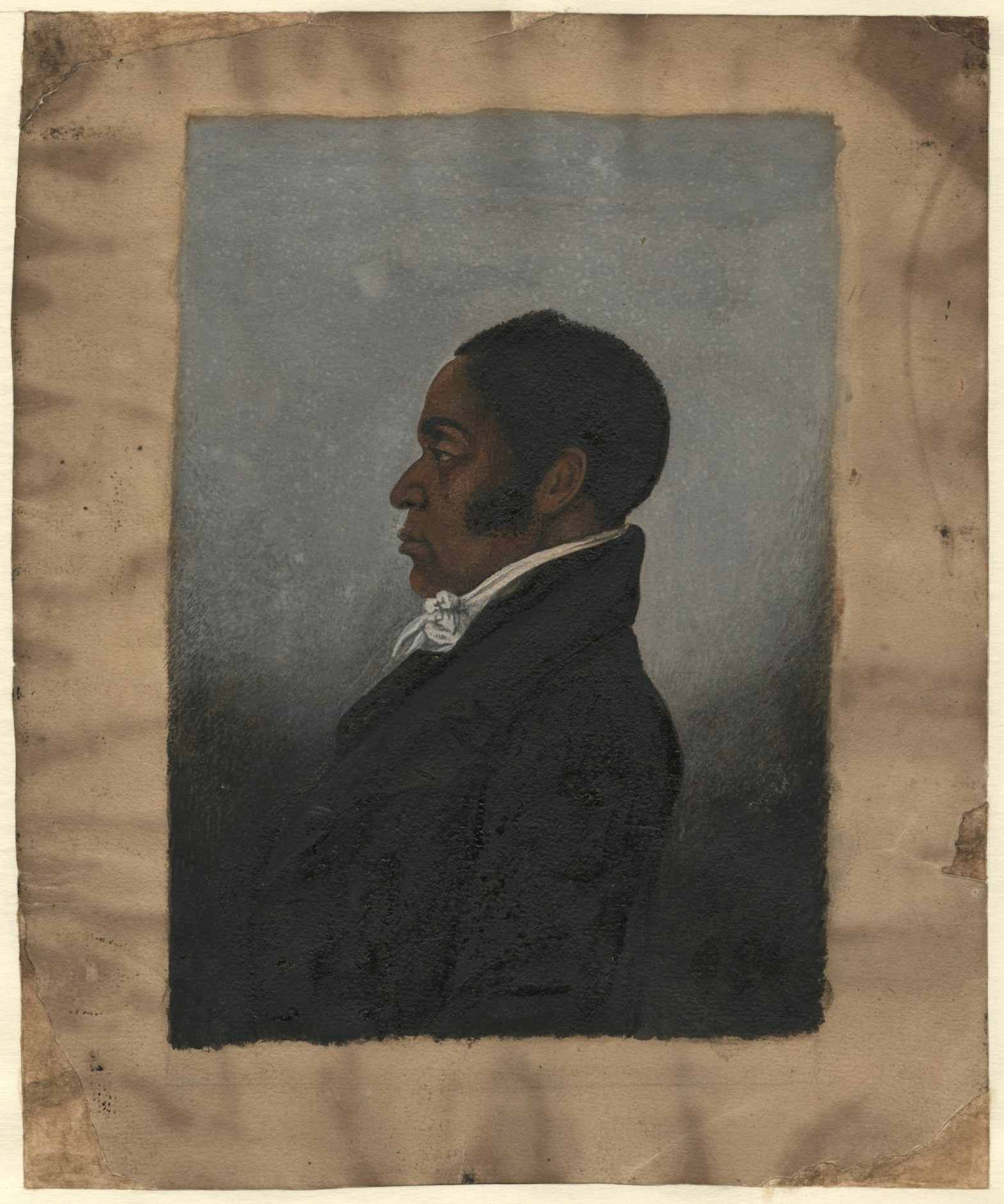
Photo: Artist unknown/Historical Society of Pennsylvania. Portrait of James Forten (c. 1834), oil on paper, from the Leon Gardiner collection of American Negro Historical Society records.
The US likes to designate a month for neglected groups to be honored, which is OK, I guess, but accomplished women are interesting even when it isn’t Women’s History Month, as are people who identify as Latino/a when it isn’t National Hispanic Heritage Month or African Americans when it isn’t Black History Month in February. I like to post the stories year round. So it’s August, and here’s a bit of Black history.
At Hyperallergic, Xenobia Bailey offers research on 19th century fiber craftsman James Forten.
Bailey begins, “That I, a quiet, radical, African-American fiber artist, raised in a nautical lakeshore Black community in the Pacific Northwest, would find the book A Gentleman of Color: The Life of James Fortenby Julie Winch, about a free-born, quiet, radical, elite African-American fiber craftsman, living in North America from 1766 to 1842 — the most prosperous and philanthropic sailmaker, born in Philadelphia during the turbulent period of the Revolutionary War — was truly a cosmic alignment. … I saw this book steps from the Schomburg Center for Research in Black Culture in Harlem, on the table of a street vendor and book dealer, Brother Mustafa. …
“James Forten’s miraculous life, and its role in shaping a prominent African-American history, is one of my greatest inspirations. Unknown to me, I opened my fiber arts studio in Philadelphia blocks away from where Forten’s sailmaking loft was located at Penn’s Landing on the Delaware River. It was my research into Forten’s life that bridged my wild, aquatic childhood, along Seattle’s Lake Washington, with my present fiber arts practice, which focuses on the evolution of African-American domestic textiles before and after emancipation.
“Looking back, it was fulfilling growing up in a lakeside ‘redlined’ Black community in Seattle’s Central District, with a pack of rambunctious children from the neighborhood. We played in the ponds and wooded area around our homes, venturing through Washington Park’s Arboretum to a now gentrified and forgotten area of natural bodies of shifting sand and clay mounds. They would emerge and disappear with the tides that created patches of land we claimed and named as our islands.
“We’d play pirate captains, patterning ourselves on the rowdy Seafair Pirates who opened the citywide Seafair summer festival of parades, hydroplane boat races, and carnivals every year. We built three-walled log cabins with open roofs and gathered floating logs for rafts from the fallen trunks, broken roots, branches, mud, and stones, and as our furniture we used the beautiful, organically sculpted driftwood that was scattered along the edge of the lake.
“Like James Forten’s community, ours was an unfamiliar story of the African-American experience. Our playground was the shoreline, with a backdrop of flying sea hawks, seagulls, rowboats, motorboats, and houseboats. And, like Forten, we were mesmerized by the majestic sails on the sailboats. …
“As with young James Forten in the mid-1700s, we too had the inquisitiveness and freedom of imagination of childhood — characteristics that continue to serve us as adults. We were aware of the community activism, cultural revolutions, and Black Power Movement happenings of the 1960s. In our imaginations, this was our private utopia. We’d make believe whatever we wanted. …
“James Forten and my siblings and I also share the experience of having a father who was an intuitive and knowledgeable maker. The senior Forten was a master sailmaker who repaired worn sails and prepared raw materials for sewing the strong textiles into tents for surveyors and sails for large-sail ships. …
“My father was a self-taught manipulator of electrical wiring. He purchased an abandoned van for about $100 and a broken floor buffer for $25 from a local junkyard and rewired them, which allowed him to start our family’s janitorial business. This upcycling practice was common in our underserved yet sustainable community in an otherwise booming industrial Seattle.
“Mrs. Forten, a ‘fierce’ homemaking mother, refused to give birth to children until she was able to buy her freedom at age 42; this was followed by her birthing two free, healthy children whom she groomed into outstanding adults. One of my fierce homemaking mother’s many gifts was enriching our home with vintage crocheted Afghans and quilts that she would purchase from the Goodwill Store and then elegantly drape and tuck the handmade textiles over our secondhand furniture.
“Forten was an abolitionist. His benevolent service to both free and enslaved Black people during the unsettling times of the Fugitive Slave Acts (passed by the US Congress in 1793 and 1850), the American Revolution, and the state of affairs before Emancipation is deeply admirable.
“Forten learned his discipline starting at the age of seven, from going to work with his father when an apprentice was absent, at the sailmaking loft near their home. This is the same loft young Forten would buy for his future successful sailmaking business, from Robert Bridges, the man who employed his father.
“At his prestigious sailmaking loft, Forten employed Black, White, and Indigenous men who were supported by his engineering a unique suite of sails and a device I am currently researching allowed his commissioned ships to outpace British war ships during battles and sea pirate ships searching for booty.”
Read about Forten’s connection to Paul Cuffe and the Back to Africa movement at Hyperallergic, here. No firewall.
Photo: BBC. A group of women from the Western Isles of Scotland perform a Waulking Song while softening wool so it can be woven and made into clothes and blankets.
Have you ever heard of “wool waulking”? It was new to me — a step after shearing the sheep and before turning wool into something usable. It shows up in various parts of the British Isles, and in addition to the delightful idea of working together to prep wool, it involves a special kind of song.
As in the old photo above, the wool “is banged off of a table, or ‘waulked,’ in time to songs that take the form of question and answer type songs. One woman would sing the question and the rest of the group would sing the response.”
A blogger at the website Shepherd’s Dream opines, “One of the most powerful aspects of working with wool is how deeply connected the tradition is with our Ancestors. Learning the traditional ways that our Ancestors worked with wool is a powerful way to connect with the fabric in our lives. Reading about the history of waulking songs is one of those opportunities. …
“Waulking is another word for fulling, a step in woolen clothmaking that refers to the practice of cleansing the cloth to eliminate oils, dirt, and other impurities. Fulling involves two processes, scouring and thickening, and is one of the steps in creating melton cloth.
“Originally, fulling was carried out by pounding the woolen cloth with the fuller’s feet, or hands, or a club. In the Scottish Gaelic tradition this process was accompanied by Waulking Songs, Scottish folk songs which were sung to set the pace.
“One person led the group by singing well-known verses or making up new lines. The rest would then come in on the chorus while the leader took a breath. A fulling session usually began with slow-paced songs. The tempo only increased as the cloth softened. As the fullers sang, they gradually shifted the cloth to the left so as to work it thoroughly.
“In this tradition moving the cloth counterclockwise is unlucky. It is also bad luck to repeat a song during a fulling session, which explains the large number of songs and verses.
“Our washable mattress protectors are made out of our pure melton wool textile and our mattresses are encased in this historical material as well,” the blogger adds.
Wikipedia also talks about “fulling” and adds some surprising details.
“Fulling, also known as tucking or walking (Scots: waukin, hence often spelled waulking in Scottish English), is a step in woollenclothmaking which involves the cleansing of woven cloth (particularly wool) to eliminate (lanoline) oils, dirt, and other impurities, and to make it shrink by friction and pressure.
“The work delivers a smooth, tightly finished fabric that is isolating and water repellent. Well known examples are duffel cloth, first produced in Flanders in the 14th century, and loden, produced in Austria from the 16th century on.
“Waulking could be done with the hands and feet. In Medieval Europe, it was done in water-powered fulling mills. After the industrial revolution, coal and electric power were used.
“Felting refers more generally to the interlocking of loose wool fibers; they need not be spun and woven first.
“Fulling involves two processes: scouring (cleaning) and milling (thickening). Removing the oils encourages felting, and the cloth is pounded to clean it and to encourage the fibers to felt, so in practice the processes overlap.
“Urine was so important to the fulling business that it was taxed in Ancient Rome. Stale urine, known as wash or lant, was a source of ammonium salts and assisted in cleansing and whitening the cloth and having its fibers intertwined.
“By the medieval period, fuller’s earth had been introduced for use in the process. This is a soft clay-like material occurring naturally as an impure hydrousaluminium silicate. Worked through the cloth, it absorbs oils and dirt. …
“The second function of fulling was to thicken cloth by matting the fibres together to give it strength and increase waterproofing (felting). … After this stage, water was used to rinse out the foul-smelling liquor used during cleansing. Felting of wool occurs upon hammering or other mechanical agitation because the microscopic scales on the surface of wool fibres hook together, somewhat like hook and loop fixings. …
“Scotland, then a rather remote and un-industrialized region, retained manual methods into the 1700s. In Scottish Gaelic tradition, this process was accompanied by waulking songs, which women sang to set the pace.”
More here, at Shepherd’s Dream, and here, at waulk.org. No firewalls.
Photo: Miami Herald/Getty. The English language in Miami is changing.
Here’s something for readers interested in the evolution of languages. Miami has such a vibrant Spanish-speaking community that it’s developing its own version of English.
Phillip M Carter of Florida International University describes the new dialect at the Conversation, ” ‘We got down from the car and went inside.’
“ ‘I made the line to pay for groceries.’
“ ‘He made a party to celebrate his son’s birthday.’
“These phrases might sound off to the ears of most English-speaking Americans. In Miami, however, they’ve become part of the local parlance.
“According to my recently published research, these expressions – along with a host of others – form part of a new dialect taking shape in South Florida. This language variety came about through sustained contact between Spanish and English speakers, particularly when speakers translated directly from Spanish.
“Whether you’re an English speaker living in Miami or elsewhere, chances are you don’t know where the words you know and use come from…. Borrowed words are far more pervasive than you might think.
“They’re all over English vocabulary: ‘pajamas‘ from Hindi; ‘gazelle‘ from Arabic, via French; and ‘tsunami‘ from Japanese.
“Borrowed words usually come from the minds and mouths of bilingual speakers who end up moving between different cultures and places. …
“One bilingual confluence famously changed the trajectory of the English language. In 1066, the Norman French, led by William the Conqueror, invaded England in an event now known as ‘the Norman Conquest.’
‘Soon thereafter, a French-speaking ruling class replaced the English-speaking aristocracy, and for roughly 200 years, the elites of England – including the kings – did their business in French.
“English never really caught on with the aristocracy, but since servants and the middle classes needed to communicate with aristocrats – and with people of different classes intermarrying – French words trickled down the class hierarchy and into the language.
“During this period, more than 10,000 loanwords from French entered the English language, mostly in domains where the aristocracy held sway: the arts, military, medicine, law and religion. Words that today seem basic, even fundamental, to English vocabulary were, just 800 years ago, borrowed from French: prince, government, administer, liberty, court, prayer, judge, justice, literature, music, poetry, to name just a few.
“Fast forward to today, where a similar form of language contact involving Spanish and English has been going on in Miami since the end of the Cuban Revolution in 1959.
“In the years following the revolution, hundreds of thousands of Cubans left the island nation for South Florida, setting the stage for what would become one of the most important linguistic convergences in all of the Americas.
“Today, the vast majority of the population is bilingual. In 2010, more than 65% of the population of Miami-Dade County identified as Hispanic or Latina/o, and in the large municipalities of Doral and Hialeah, the figure is 80% and 95%, respectively.
“Of course, identifying as Latina/o is not synonymous with speaking Spanish, and language loss has occurred among second- and third-generation Cuban Americans. But the point is that there is a lot of Spanish – and a lot of English – being spoken in Miami.
“Among this mix are bilinguals. Some are more proficient in Spanish, and others are more skilled English speakers. Together, they navigate the sociolinguistic landscape of South Florida in complex ways, knowing when and with whom to use which language – and when it’s OK to mix them.
“When the first large group of Cubans came to Miami in the wake of the revolution, they did precisely this, in two ways.
“First, people alternated between Spanish and English, sometimes within the same sentence or clause. This set the stage for the enduring presence of Spanish vocabulary in South Florida, as well as the emergence of what some people refer to as ‘Spanglish.’
‘Second, as people learned English, they tended to translate directly from Spanish. These translations are a type of borrowing that linguists call ‘calques.’ Calques are all over the English language.
“Take ‘dandelion.’ This flower grows in central Europe, and when the Germans realized they didn’t have a word for it, they looked to botany books written in Latin, where it was called dens lionis, or ‘lion’s tooth.’ The Germans borrowed that concept and named the flower ‘Löwenzahn‘ – a literal translation of ‘lion’s tooth.’ The French didn’t have a word for the flower, so they too borrowed the concept of ‘lion’s tooth,’ calquing it as ‘dent de lion.’ The English [brought] ‘dent de lion’ into English, calling it ‘dandelion.’
“This is exactly the sort of thing that’s been happening in Miami.”
Since people whose first language is Spanish live all over the US, I think any of us could come up with similar blends if we thought about it. Maybe there are some specific to English as spoken in England.
At the Conversation, here, you can read about the three kinds of calques the researchers identified in Miami. No firewall.
Photo: Getty Images via New York Post. Helping recent migrants put a strain on overworked cops in Chicago.
There are no easy stories about migration. Although most people would rather make a good life at home if they could, many launch themselves into the unknown with a vague idea that someplace else will be safer. As a popular destination, however, the US has not been on top of things for a very long time.
In one example, described by Eric Cox and Ted Hesson at Reuters in May, our confused system left “Chicago’s new mayor [grappling] with how to house hundreds of migrants arriving on buses from the U.S.-Mexico border, with some sleeping in police stations and shelters strained after border crossings. …
“Officials in the third-largest U.S. city have said they cannot afford to rent hotel rooms for all arriving migrants and have pressed for more federal funding. Some migrants seeking a safe place to sleep have turned to police stations.
” ‘We’re waiting to see where they’re going to place us,’ said Tomas Orozco, a 55-year-old migrant who arrived at a Chicago shelter on Wednesday with his family after an arduous seven-week journey from his home country, Venezuela.
“The trip took them through the Darien Gap, an inhospitable jungle separating Colombia and Panama, and his family members were still sick from drinking contaminated water, Orozco said. …
“Earlier this month, Texas Governor Greg Abbott [resumed] a campaign of busing migrants to Democratic strongholds further north, including Chicago and New York City. The busing aims to alleviate pressure on border cities and call attention to what Abbott says were overly lenient policies by Biden’s [administration].
“On Thursday, Texas began busing migrants to Denver, where [Mayor] Michael Hancock is already struggling to house new arrivals.
“New York City Mayor Eric Adams … has called on the Biden administration to provide more funding to cities. Adams suspended some of New York’s right-to-shelter rules last week, citing the strain of housing asylum seekers, and is considering using school gyms as shelters.
“Chicago Mayor Brandon Johnson … reaffirmed the city’s commitment to welcoming asylum seekers in his inauguration speech, saying ‘there’s enough room for everyone.’ …
“Dean Wynne, who owns a Chicago building serving as a temporary shelter for nearly 200 migrants, said families were ‘subdued and quiet’ on the first day they arrived.
” ‘By the second day, I could see little kids were playing around, playing catch, kicking the ball and stuff,’ Wynne said. ‘They were just happy.’
A more recent article, from July, may be read at the Chicago Sun-Times, here. Said one migrant through a translator, “You can rest, but this isn’t life. … I’m happy to work because that’s my goal. Because I want to fight and learn each day a little more than what I knew.”
The immigrants I’ve worked with as a volunteer in ESL classes are often suspicious of police in their home countries. I imagine the Chicago experience is unsettling, but then, maybe not as unsettling as that dangerous trip.