Feeds:
Posts
Comments

Posts Tagged ‘africa’

An African writer’s gratitude to a generous book lover in his childhood city has inspired an online bookstore geared toward African authors.

Daniel A. Gross writes at the New Yorker, “Magunga Williams grew up in Kisumu, a Kenyan city that’s home to more than three hundred thousand people but to only two major bookstores. There, Williams told me recently, ‘people depend on books that they find in supermarkets.’ Most of these books come from the United States and Europe. ‘These supermarkets do not have a rich African collection,’ Williams said.

“But there was one place where he could always find a wider range of books. It was the personal collection of a local man, whose house became a neighborhood meeting place and an unofficial sort of public library. …

“Williams moved to Nairobi and began an undergraduate program in law, but he never forgot the way that a house full of books, in a city with too few, became an escape. …

“So Williams, while he was in school, started a literary blog, Magunga.com, and … he made it his mission to create a space like that library—not in a house but on the Internet. The result is a fledgling online pan-African bookshop: the Magunga Bookstore.

“In becoming a bookseller, Williams was, in part, following in the footsteps of his girlfriend, Abigail Arunga. A few years ago, Arunga, a Nairobi-based freelance writer in her late twenties, stopped by a few local bookstores and asked if they would stock ‘Akello,’ her self-published collection of poems.

“At one shop, she was told that Kenyans don’t read poetry. At another, an employee claimed that her ninety-three-page book was too short. ‘They told me that my book had to be at least a hundred pages,’ she said. So she decided to sell the book herself — at poetry readings, literary festivals, even family gatherings. …

“An epiphany came last winter, when Williams was reading an article in the Guardian and noticed that the newspaper operates its own online bookstore. He told Arunga that they were going to open a bookstore, too. …

“Williams earns his living by writing sponsored posts on his blog, which attracts around five thousand readers each day. He asked his Webmaster, David Mabiria, to add a new tab to the Web site, which would offer books for sale. … He and Arunga requested book donations from writer friends, who provided copies of their own work. They launched the feature with ten titles in stock, under a simple slogan: ‘Spreading the Word.’

“Word spread slowly. The Magunga Bookstore made its first sale in December, 2015, when Williams was out of town — he had to ask a friend to deliver the book. ‘He was telling me he was in traffic,’ Williams recalled. ‘And I was, like, “I don’t care. Just go get a boda-boda ride.“ ‘ (Boda-boda is East African slang for a motorcycle taxi.) He remembers telling the friend, “I’ll pay you even if it costs me double the price. Just to make sure the client is happy.” ‘ ”

More at the New Yorker. And while you’re clicking, take a look at the Magunga Bookstore site, here.

Photo: Facebook/Babishai Niwe Poetry
Abigail Arunga and Magunga Williams at the 2016 Babishai Poetry Festival, in Ntinda, Uganda.

Read Full Post »


Photo: ABC News: Kristine Taylor
The arrival of six primary school-aged children allowed Mingoola’s (New South Wales, Australia) school to reopen.

Cousin Claire put another good link on Facebook–this one about the small Australian community of Mingoola, which was losing population and decided to welcome refugees just as its only primary school was about to close.

Greg Hassall writes at ABC Australia, “In the tiny township of Mingoola, on the border of New South Wales and Queensland, local woman Julia Harpham was grappling with a common problem in rural communities.

“The population was in decline, enrolments at the local primary school were down and farmers could not find labourers to help with manual work. Her town was dying before her eyes.

” ‘Many of us have children who work in the city and aren’t going to come back to the farm because things have been so tough on the land,’ Ms Harpham said.

” ‘You don’t like to see a community die. And there’s not much joy in a place with no children.’

“Three years ago the local progress association decided to take a leaf from the region’s migrant past and looked for refugees willing to move to the area.

“But when they began contacting refugee agencies they were told there would not be adequate support for refugees in the bush. …

“Meanwhile in Sydney, refugee advocate Emmanuel Musoni was grappling with problems in his community from central Africa. They had been displaced from Rwanda and neighbouring countries during years of bitter civil war.

“The majority had rural backgrounds before having to flee their homes for refugee camps. …

“They were resettled in cities where employment prospects were few, the environment was intimidating and many became depressed and isolated. …

“Mr Musoni led a small delegation from his community to Mingoola early this year to meet locals and see whether resettlement was viable.

“On his return he put out a call for families willing to make the move; within a week he had a waiting list of 50.

“He chose two families [with] 16 children between them. Six of the children were of primary school age, which would allow Mingoola Primary School to remain open.

“Meanwhile, the community began renovating several abandoned houses in the area to accommodate the families, who moved to Mingoola in April. …

“For those involved in this social experiment, the hope is that its success can be replicated elsewhere to help other struggling rural communities.

“Mr Musoni now has 205 families on his database wanting to move out of the cities and politicians have been watching the Mingoola project with interest.”

Read more here. And for a past post on African refugees in rural Maine, click here.

Read Full Post »

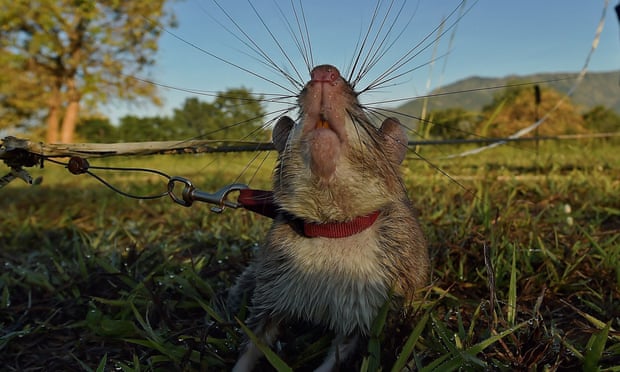
Here’s a new one. Certain rats, with their renowned sense of smell, are being used in the fight against traffickers of endangered species.

The unusual rats had previously been tapped for tasks such as identifying who has tuberculosis and needs treatment. And as I noted a year ago, they have also been successful at sniffing out land mines.

Now, according to Oliver Milman the Guardian, “An elite group of African giant pouched rats will be used at ports, initially in Tanzania, to detect illegal shipments of pangolins – the world’s most trafficked animal, which has been pushed towards extinction due to the trade in its scales and skins …

“The US Fish & Wildlife Service is spending $100,000 on a pilot project that will train rats to detect the illegal items and learn to communicate this to their human handlers. The rats, which can grow up to 3ft long, have poor eyesight but an excellent sense of smell. …

“The Fish & Wildlife Service said it hoped that the foray into the investigation of wildlife smuggling would be the first stage of a ‘much larger project to mainstream rats as an innovative tool in combating illegal wildlife trade.’ …

“The money for rat training is part of a larger $1.2m package that will provide funding for law enforcement in Cambodia, forest patrols to reduce tiger poaching in Indonesia and sniffer dogs to unearth illegal shipments of saiga antelope horn.”

More here.

Photo: Carl de Souza/AFP/Getty Images
African giant pouched rats like the one seen here are being trained to investigate illegal wildlife trafficking.

Read Full Post »

In Tanzania, women farmers appearing on a TV show called in English “Female Food Heroes” are bringing attention to the importance of their work and the barriers to expansion.

Oxfam America reporter Coco McCabe writes about contestant Edna Kiogwe, “She grew up in a farming family and knows well the hurdles they face, especially women farmers who, in her country, own only a small fraction of the land. …

“It’s that inequality — and the lost opportunities buried beneath it — to which Kiogwe and 14 other women farmers helped to bring attention this year as contestants in the fifth season of a highly popular reality TV show shot in Tanzania and aired across East Africa. Called Mama ‘Shujaa wa Chakula ,’ or ‘Female Food Heroes,’ the Oxfam-sponsored show celebrates the vital contributions women farmers make in feeding the planet, and highlights the challenges many encounter on a daily basis, including limited access to land, credit, and training opportunities. …

“In the village of Kisanga, where ‘Mama Shujaa wa Chakula’ was filmed [in 2015], the 15 contestants learned a great deal about the struggles local farmers face in feeding their families. Each of the women stayed with a village family for the duration of the three-week shoot, and daily contests included designing tools that could be useful to Kisanga farmers, interviewing them about their agricultural challenges, and putting together skits to help bring attention to those hurdles. …

“Kiogwe [now] spends most of her time in Dar es Salaam, a coastal city about a two-and-a-half hour drive away, where she lives and works as a civil servant. But her city life belies her village roots — and her keen interest in farming. Unlike most women in Tanzania, Kiogwe owns her own land, given to her by her forward-thinking father on her wedding day. She harvests corn, cassava, rice, and sugar cane, carefully aligning her 28 days of annual leave from her city job with peak work times on her small farm in the Morogoro region. …

“ ‘I want to make agriculture like a business,’ says Kiogwe. … With a little effort, greater value can be added to the fruits farmers grow, for instance.

“ ‘Change it from fruit to juice, we can sell it … We can add value to maize — maize flour for porridge — and you can have a good label and good packaging and compete with international businesses. That is my dream.’ ” More here.

According to OXFAMCloseup, the nonprofit’s quarterly magazine, the episodes shot in Kisanga, Tanzania, aired in five countries and had 14 million people tune in. The magazine adds, “Versions of the program are now being produced in Ethiopia and Nigeria, and some finalists have become involved in local, national, and even global farmer advocacy.”

Photo: Coco McCabe / Oxfam America
Edna Kiogwe helps her host family with the morning chores in Kisanga, where the TV show “Female Food Heroes” was filmed in 2015.

Read Full Post »

Photo: The Economist

Reversing desertification in Africa has to be one of the biggest challenges ever attempted. But if we believe that the longest journey starts with a single step, then the continent’s long journey is off to a good start.

According to the Economist, “Building a wall of trees across the width of Africa is a tall order. Solving the twin problems of land degradation and desertification poses a greater challenge still. But more than 60 years after it was first proposed, just such a project is underway at the edge of the Sahara. …

“In 1952 Richard St Barbe Baker, a British environmental scientist, proposed planting a swathe of trees across the southern reaches of the Sahara. The trees would block the wind and sand that move southward from the desert and improve the quality of the soil by binding sediment together and adding nutrients to the mix.

“Although Mr Baker was unable to convince others of his plan during his lifetime, the idea has since taken root. In 2005, Olusegun Obasanjo, then president of Nigeria, revisited Mr Baker’s proposition, seeing in it an answer to some of the social, economic and environmental problems afflicting the Sahel-Sahara region.

“An estimated 83% of rural sub-Saharan Africans are dependent on the region’s land for their livelihoods, but 40% of it is degraded—worn away by soil erosion, human activity and scorching temperatures—leaving much of it unfit for use.

“In 2007, Mr Obasanjo gained the support of the African Union. The Great Green Wall Initiative was launched the same year. Today some 21 African countries are involved in the project, which has grown in scope. Trees have been planted, but building a wall of them is no longer the priority.

“Instead, the wall of trees has become a vehicle for a wider goal: countries in the region working together to tackle climate change, food security and economic growth. Recent projects include abating soil erosion and improving water management in Nigeria, agri-business development in Senegal and forestry management in Mali.”

More at the Economist.

Read Full Post »

Photo: BBC
BBC
Africa’s Sophie Ikenye visits a fish farm in Kenya.

The BBC recently called my attention to a surprising new trend in Africa: Young people, who used to flock to urban office jobs and spurn farming, are beginning to see the attractive side of a return to the land.

Sophie Ikenye writes, “Six years ago Emmanuel Koranteng, 33, gave up his job as an accountant in the US and bought a one-way ticket to Ghana. He now has a successful business growing pineapples in a village one-and-a-half hours away from the capital, Accra. He says that even when he was far away from the farm, it was always in his thoughts.

“Across the continent, Dimakatso Nono, 34, also left her job in finance … and moved from Johannesburg to manage her father’s 2,000 acre farm three hours away in Free State Province. She says she wanted to make an impact. …

” ‘At the beginning, we were not sure about what the animals were doing and where they were in the fields, so for me it was important to ensure that every single day, every activity that we do is recorded.’

“Life on the farm has not been easy. … Both young farmers have found it difficult to get funding for equipment. For this reason, Mr Koranteng has decided to stay small.

” ‘If you are small and you don’t have funding, don’t try to do anything big. It’s all about being able to manage and produce quality because if you produce quality, it sells itself,’ he says.

“But there is to be made money in farming. A World Bank report from 2013 estimates that Africa’s farmers and agribusinesses could create a trillion-dollar food market by 2030 if they were able to access to more capital, electricity and better technology.

” ‘Agriculture has a bright future in Africa,’ says Harvard University technology expert Calestous Juma. And it also means making the finished product, rather than just growing crops and selling them. ‘The focus should be … from farm to fork, not just production,’ he says.”

Check out one farming entrepreneur’s approach here.

Read Full Post »

Dorcas International of Rhode Island is a refugee-resettlement and immigrant-support organization that also offers education programs and services to native-born residents.

On the nonprofit’s website, you can find uplifting stories of DIIRI beneficiaries. Here is one.

Sidy Maiga, a master percussionist from Mali, wanted to take his skills to the next level. The first step was to get over his insecurity about education.

“His mastery of the djembe, a drum of West African origin that is rope-tuned [and] shaped like a large goblet, has taken him on tours all over the world and as a teacher in schools all over the East Coast … But without a high school diploma, he felt like he had hit a wall. …

“Sidy heard from friends about things you could do at Dorcas International Institute of Rhode Island. …

“He admits he was hesitant about going to school again. … He enrolled in an ESL [English as a Second language] class to get up to speed” before taking the high school equivalency test known as the GED “and felt himself getting discouraged — so he stopped going to class.

“However, after getting encouraging calls from DIIRI staff, Sidy decided he would give it another shot. … ‘I think they saved my life, and I’m glad I came back.’ …

“With the help and encouragement of DIIRI staaff, Sidy decided the next step would be college.”

Sidy starts at Berklee College of Music this year and says, “Once I learn the academic way of music, then I can teach African music to the world.”

More here.

Photo: Dorcas International Institute
Malian djembe drummer Sidy Maiga says Dorcas staff “saved my life.”

Read Full Post »


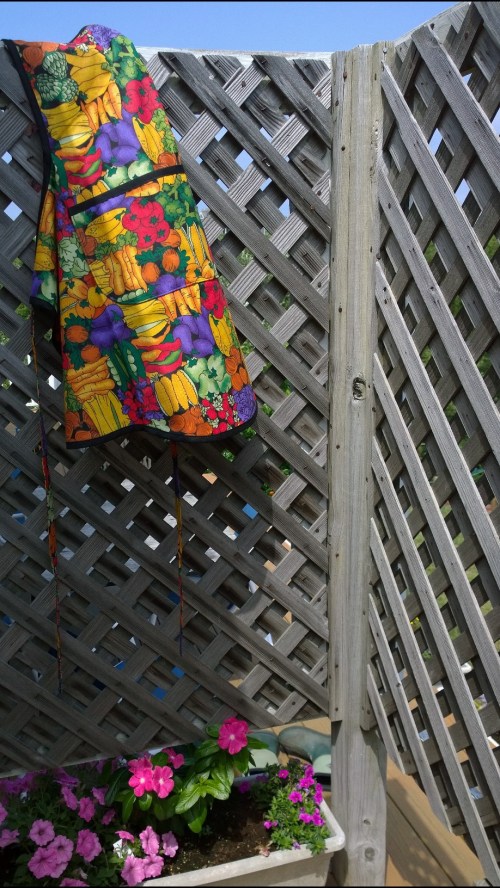
080616-vision-of-hope-zambia-apron

The first booth I encountered at the Art and Artisan fair Saturday was promoting a charity called Vision of Hope Zambia.

Co-founder Meg O’Brien had been a student at Berklee College of Music when a missionary friend in Zambia asked her to lend her musical talent to uplifting girls who lived on the streets.

When she visited Africa, Meg must have been shocked by what she saw: young girls, often orphaned, often HIV positive, who had no place to get a meal or even take a shower. She flew into action, co-founding Vision of Hope Zambia with Chitalu Chishimba.

Meg’s mother and aunt also flew into action, creating a craft initiative that donates 100 percent of proceeds to the cause.

The two artisans not only sew with skill — baby bibs, changing blankets, aprons and the like — they also are good at selling, promoting Meg’s charity while highlighting various features of their products.

Meg’s aunt saw me talking to my grandchildren and immediately pointed out the colorful array of child-size aprons. In the end, though, I bought an adult-sized apron for myself.

From humble beginnings in 2009 (“weekly meetings in the backyard of the Girl Scouts building underneath a tree”), the organization is now able to provide housing and education for many girls as it continues to grow.

Photo: Vision of Hope Zambia
Girls at Vision of Hope proudly show off their hard work in rug making.


Read Full Post »

Sweet potato evangelism has won the World Food Prize. I learned about this at National Public Radio, which has a regular feature on eating and health called the Salt.

Dan Charles reports, “One summer day in 2012, on a long drive through northern Mozambique, I saw groups of men standing beside the road selling buckets filled with sweet potatoes. My translator and I pulled over to take a closer look. Many of the sweet potatoes, as I’d hoped, were orange inside. In fact, the men had cut off the tips of each root to show off that orange color. It was a selling point. …

“In Africa, that’s unusual and new. Traditionally, sweet potatoes grown in Africa have had white flesh. …

“Those orange-fleshed sweet potatoes along the road that day represented the triumph of a public health campaign to promote these varieties — which, unlike their white-fleshed counterparts, are rich in Vitamin A. [In June], that campaign got some high-level recognition at a ceremony at the U.S. State Department. Four of the main people behind it will receive the 2016 World Food Prize. This prize is billed as the foremost international recognition of efforts to promote a sustainable and nutritious food supply.

“This year’s laureates are Maria Andrade, Robert Mwanga, Jan Low and Howarth (Howdy) Bouis. Three of them — Andrade, Mwanga and Low — worked at the International Potato Center, which is based in Peru, but has satellite operations in Africa. Bouis worked at the International Food Policy Research Institute in Washington, D.C. …

“In recent years, researchers have documented health improvements among villagers in Mozambique and Uganda, simply because they chose to eat sweet potatoes with orange flesh.” More at NPR.

Don’t you love the orange truck? I call that multichannel messaging.

Photo: Dan Charles/NPR
Maria Isabel Andrade is one of four researchers honored with the World Food Prize for promoting sweet potatoes that are orange inside to combat malnutrition.

Read Full Post »

Following up on my 2012 post about fairy circles.

Rachel Nuwer writes at the NY Times, “When Stephan Getzin, an ecologist at the Helmholtz Center for Environmental Research in Leipzig, Germany, opened the email, his heart began to flutter. Attached was an aerial image of fairy circles, just as he had seen in countless photos before. But those images were always taken along long strips of arid grassland stretching from southern Angola to northern South Africa. These fairy circles — which looked nearly identical — came from Australia, not Africa. …

“The emailed photo came from Bronwyn Bell, who does environmental restoration work in Perth. She had read about Dr. Getzin’s research in Namibia and made a connection to the odd formations in her home state, Western Australia. …

“Scientists have been interested in fairy circles since the 1970s, but have not been able to agree on what causes the patterns to form. Researchers generally fall into two groups — team termite and team water competition — but there are other hypotheses as well, including one involving noxious gases.

“Dr. Getzin, like others on team water competition, explains the circles through pattern-formation theory, a model for understanding the way nature organizes itself. The theory was first developed not by biologists, but by the mathematician Alan Turing. In the 1990s, ecologists and physicists realized it could be tweaked to explain some vegetation patterns as well. In harsh habitats where plants compete for nutrients and water, the new theory predicts that, as weaker plants die and stronger ones grow larger, vegetation will self-organize into patterns …

“In the case of African fairy circles, the bare patches act as troughs, storing moisture from rare rainfalls for several months, lasting into the dry season. Tall grasses on the edge of the circles tap into the water with their roots and also suck it up with the help of water diffusion through the sandy soil.

“Although similar in appearance, Australian fairy circles turn out to behave differently, Dr. Getzin and his colleagues have found. … Aussie circles feature a very hard surface of dry, nearly impenetrable clay, which can reach up to a scalding 167 degrees during the day. Despite the differences, though, they believe the fairy circles’ function remains the same. When the researchers poured water into the circles in a simple irrigation experiment, it flowed to the edges, reaching the bushy grass …

“The new research ‘moves us closer toward a unifying theory of fairy circle formation,’ said Nichole Barger, an ecosystem ecologist at the University of Colorado, Boulder.

“It could be that more fairy circles are yet to be discovered in arid environments around the world, she said.

“According to Walter Tschinkel, an entomologist at Florida State University, the findings strengthen the claim that the circles are a result of self-organization by plants. He cautioned, though, that to be more certain, scientists would need to control environmental factors — water and termites, for example — to see which produce the predicted outcome.”

More here.

Photo: Norbert Jürgens
Tracks of Oryx antelopes crossing fairy circles in Namibia.

Read Full Post »

I think it’s safe to say that most adults would rather take care of themselves than rely on charity, but sometimes it’s hard for people living in extreme poverty to figure out how to cut the cord. Beth Alaimo at the Christian Science Monitor‘s People Making a Difference has a story about some Ugandans who are finding a way.

“Iganga, a town conveniently located along the central highway from Kampala to Nairobi, is much more than a popular truck stop. It’s where Musana, a community organization breaking Uganda’s reliance on foreign aid, has made its home. …

“With 67 percent of the population living in poverty, Uganda is no stranger to dependency. Despite being a popular region for development ventures, organizations often lack an approach that prioritizes what locals want and need while leaving the savior mentality behind.

“Originally a children’s home for 80 orphans, Musana Community Development Organization decided to change its model from a system that perpetuated child-rearing dependency to one that encouraged parents to provide what they could. Today, says co-founder Leah Pauline, ‘we are more than a charity. We’re a sustainable solution for the community.’ …

“Its first and largest project, the nursery and primary boarding school, is the closest to being self-sustainable. Roughly 600 students are attending this upcoming semester, an estimated 500 of whom are paying fees, with the rest receiving scholarships.

“Businesses created and run by locals are also moving the Musana community closer to achieving sustainability. A trendy restaurant (the ‘only place in Iganga you can find a burger’ says Pauline), a dairy farm, and handmade women’s crafts are all businesses funding community outreach.

“A bakery is the newest sustainability project at Musana and has quickly become profitable. Proposed and started by the head of child care, the kids often come in and help bake.” More here.

A famed Wharton School professor from South Africa, Ian C. MacMillan, has been known to complain about the dependency cycle he sees in Africa, and has taken steps on his own to boost independent small businesses there. An article here is partly about that work.

Photo: Musana Community Development Organization
The Musana Community Development Organization runs several enterprises, including a nursery and primary boarding school. A bakery, proposed and started by the head of child care, is the newest project and has quickly become profitable. The children often come in and help bake.

Read Full Post »

Time for another animal story. Edie Freedman has a surprising one about elephants, African farmers, and bees at a new-to-me website called O’Reilly.

“Although elephant populations have increased since the 1970s, the human population has grown even more quickly,” she writes “cutting the elephants’ habitat up into farms and roads. The elephants’ key migratory routes have been cut off in many places. As result, they regularly break through fences, where they eat and destroy crops. When the farmers confront elephants on their property, things don’t generally end well for either party.

“Lucy King, a researcher working with Save the Elephants, has spent many years investigating the problems involved in crop protection. Her goal is to find long-term solutions that reduce the frequency of human-elephant conflicts—and that can be financed and managed by local farmers.

“As Ms. King looked into the elephants’ habits for any clues to keeping them out of fields planted with crops, she noticed that they tended to avoid acacia trees with active nests of African bees. Elephants, it so happens, are afraid of the bees, and will move away from an area and warn other elephants if they hear bees buzzing nearby.

“And so the beehive fence was invented. The fences are simple, inexpensive, and easy for the farmers to build and maintain. … The hives are hung at chest height, which makes it easy for the farmer to harvest the honey, while also making them highly visible to the elephants.

“The hives, connected by wires,  are hung every 10 meters around the perimeter of a field. The farmers leave wide pathways between their crops so elephants can move past the fences along their migratory routes. If an elephant makes contact with one of the hives or the connecting wires, the beehives all along the fence will swing and release the bees.”

More here.

What a terrific solution! Where there’s a will, there’s a way.

Photo: oreilly.com

Read Full Post »

The uncle of my co-worker from Ghana is a very fine photographer who chronicled much of the last days of colonialism and the beginning of independence in his native land.

Another colleague was reading an article about the uncle’s new book in the Washington Post and thought, “Could they be related?” They are.

Nicole Crowder wrote at the Post, “In 1957, after over a century of colonization, Ghana gained independence from Britain. Just 30 years prior, in 1929, photographer James Barnor was born in the country’s capital Accra — then the Gold Coast colony — and over the course of a career that spanned more than six decades would become one of Ghana’s leading and most well-known photographers.

“Throughout the 1950s and 1960s, Barnor created a definitive portfolio of street and studio portraiture depicting societies in transition: images of a burgeoning sub-Saharan African nation moving toward independence, and a European capital city becoming a multicultural metropolis.

“Ghana in the 1950s was experiencing a radiance of post-colonization as well as its ‘heyday of Highlife,’ a fusion of traditional African rhythms, Latin calypso and jazz influences that would soon spread across Ghana’s borders to West Africa and beyond. … Barnor captured all of this energy, playing at once artist, director, photographer and technician, by offering a well-rounded portrait of Ghanian life from many walks of life.

“On Oct. 8, Autograph ABP and the gallery Clementine de la Feronniere [released] the book ‘Ever Young‘ showcasing Barnor’s extensive archive, followed by a corresponding photo exhibition in Paris through Nov. 21.”

More at the Washington Post.

Photo: James Barnor/Autograph, ABP
Nigerian Superman, Old Polo Ground, Accra, 1957–58.

Read Full Post »

The Christian Science Monitor series People Making a Difference (“ordinary people taking action for extraordinary change”) has so many great leads, I have to restrain myself from using one every day. The Monitor staff don’t write all the stories but, like me, harvest from hither and yon.

This story, about “sack farming,” is from the Thomson Reuters Foundation, which I wouldn’t have known about either but for the Monitor.

Caroline Wambui writes, “Central Kenya’s Nturukuma region is not kind to farmers – its erratic rainfall, desert vegetation, and drying riverbeds push most people into making a living through trade rather than agriculture.

“Jane Kairuthi Kathurima toiled for years as an animal herder in the semi-arid conditions of Laikipia County, but struggled to feed her family – until she discovered sack farming, which has transformed her life and those of her children.

“ ‘Being in an environment where food was scarce and lacking in nutrition, I had to find an alternative way to survive,’ said Kathurima. …

“Sack farming involves filling a series of bags with soil, manure, and pebbles for drainage, and growing plants on the top and in holes in the sides. The sacks allow people to grow food in places with limited access to arable land and water.

“Two years after setting up her sack farm, Kathurima now grows enough vegetables – including spinach, lettuce, beets, and arugula – to feed her family and sell the surplus to the community. … Now she is supporting other food-insecure farmers by encouraging them to think differently.

“The group behind sack farming in Kenya is GROOTS (Grassroots Organizations Operating Together in Sisterhood), a global network of women-led groups which help women solve problems in their communities by changing the way they do things.

“Rahab Ngima Githaiga, vice chairman of one of the GROOTS member organizations, says sack farming has empowered women and changed lives by improving family nutrition and enabling children to go to school.”

More here.

Photo: Thomson Reuters Foundation/Caroline Wambui
Jane Kairuthi Kathurima cuts kale at her sack farm in central Kenya. She grows enough vegetables to feed her family, selling the surplus to the community. 

Read Full Post »

I think this children’s book, reviewed at Brain Pickings, is one I need to buy.

Maria Popova writes, “This Moose Belongs to Me (public library) — a disarming story about a boy who believes he owns his pet moose Marcel, only to discover that so do other people, who call him by different names, while the moose himself doesn’t quite get the concept of being owned and is thus oblivious to the boy’s list of rules for being a good pet. …

“For the backgrounds of his illustrated vignettes, Jeffers reapporpriates classical landscape paintings by a mid-century Slovakian painter named Alexander Dzigurski, rendering the project a sort of posthumous collaboration and a creative mashup.”

Read the intriguingly philosophical Brain Pickings review here.

And here is a children’s book reviewed by Asakiyume that embraces insights about both the environment and other cultures.

She writes, “Discarded plastic bags are more than just an ugly nuisance in the West African nation of the Gambia. There, plastic shopping bags kill livestock that eat them and provide a breeding ground for malaria-carrying mosquitoes.

“A woman named Isatou Ceesay found an ingenious solution. She learned how to make plarn [yarn made from plastic bags], and, with her friends, started crocheting small change purses from the discarded plastic bags, which she and her friends sold. The trash problem — and attendant health risks — disappeared, and Isatou and her friends had a new source of income. The project was so successful that Isatou started teaching women in other villages, and in 2012 she won the International Alliance for Women’s World of Difference award.

“Miranda Paul, a writer who has lived and taught in the Gambia, wrote about Isatou in One Plastic Bag: Isatou Ceesay and the Recycling Women of the Gambia (illustrated by the fabulous Elizabeth Zunon).” Lots of reasons for buying that book here, at Asakiyume’s blog.

Art: Oliver Jeffers

Read Full Post »

« Newer Posts - Older Posts »