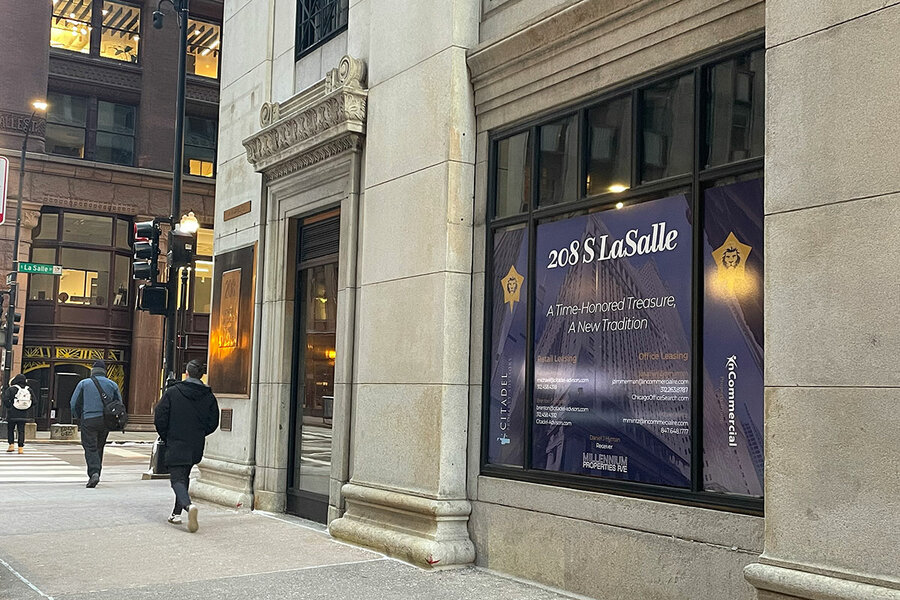
Photo: Story Hinckley/The Christian Science Monitor.
Chicago’s Classical Revival office building at 208 S. LaSalle St. is being converted to residences with 280 planned apartments in the heart of the city’s financial district.
The other day, I was listening to Boston’s Mayor Michelle Wu on Boston Public Radio talking about our region’s severe housing crisis and how she’s working to convert empty office buildings to housing. She aims to make the change incrementally — even a few apartments in each building would make a huge difference.
Boston is not the only city considering this approach.
Laurent Belsie and Story Hinkley report at the Christian Science Monitor, “At the corner of LaSalle and Adams streets in downtown Chicago, the City National Bank and Trust Co. building rises like an elegant monument to the past. Its Doric columns, carved rosettes, and lion’s heads evoke the Classical Revival style popular a century ago. But it’s a deceptive facade.
“The bank, whose name still adorns the front, disappeared in a merger 60 years ago. The building now houses two hotels, offices for professionals and a host of nonprofits, and a British men’s clothing store. And after a city competition to reimagine its financial district, the building will soon change again. The offices will give way to 280 residences: studios, one- and two-bedroom apartments, and amenities like a fitness center and even a private dog run. …
“With fewer workers going to the office, office vacancy rates stand at a 30-year high. Lease revenue is falling, especially in older buildings, and owners are seeing the value of their properties plunge. …
“Developers could upgrade their buildings or convert them to other uses, but in many cases the costs are prohibitive. And a slowing economy, rising interest rates, and tighter lending standards make those conversions even harder. Hanging over them is a cloud of uncertainty: Is the work-from-home movement a permanent change, or just a temporary post-pandemic phenomenon?
“Despite this murky outlook, some cities are charging forward with conversion plans and subsidies. With fewer workers to keep their central business districts vibrant, these cities are hoping to replace them with apartment-dwellers and kick-start a transformation of their downtowns.
“By helping developers convert offices to living units, the mayor of Washington, D.C., hopes to add 15,000 people to the 25,000 or so residents already living downtown. Pittsburgh has cobbled together some $6 million in state and federal funds for its downtown conversion program. Seattle last month put out a ‘call for ideas,’ inviting building owners and architects to come up with new solutions for struggling office buildings.
“Chicago is one of the leaders of the adaptive reuse movement. In March, the city selected the City National Bank building and two other nearby buildings for its LaSalle Street Reimagined project, which aims to revitalize the financial district. Last week, the city chose two more buildings for conversions, which will receive city help and subsidies. In all, the projects will mean more than 1,600 new downtown living apartments in what the city calls one of the largest office-to-residential conversions in the nation.
“ ‘It’s important for the resiliency of downtown,’ says Cindy Chan Roubik, deputy commissioner of the city’s planning and development department. ‘It’s important to have people at different hours of the day and with different uses. You’ll have more people here on the weekends, after work hours, and that provides a vitality.’
“The logic for such conversions makes sense – to a point. … Since the end of 2019, apartment rents have soared around the country while office leasing revenue has slumped by nearly a fifth after adjusting for inflation, according to researchers at New York and Columbia universities.
“Also, these averages mask considerable variation. Top-rated office space is holding its own, perhaps because companies want the best amenities to lure their workers back to the office. Less desirable and older office space is seeing much higher vacancy rates.
“And it is precisely these older, smaller office towers that make the best candidates for conversion to apartments. They’re typically easier to reconfigure to meet city codes, such as rules requiring every apartment to have windows. Then there’s the history and architecture, a big draw for some city-dwellers.
“The problems are scale and cost. Even with their recent uptick, the rate of conversions is far too low to solve cities’ office vacancy problem, CBRE says. And the economics are problematic. In a report last month, Moody’s Analytics found that only 35 of the nearly 1,100 office buildings it tracks in the New York City metro area were suitable for conversion. The rest of the buildings are too expensive to make conversions viable, which means either government subsidies or a big drop in office values and rents would be needed.
“Such a drop is precisely what has happened, according to the New York and Columbia researchers. In their analysis of the New York office market, they calculated that the actual value of the city’s office buildings had already fallen by 46% since the pandemic and would edge down to more than 50% by 2029 if the work-from-home trend persists. Those averages include top-rated office space; without that space in the calculation, the declines would be even worse. …
” ‘The unit costs are so high [if you do a conversion, however],’ says Dennis McClendon, a Chicago historian and geographer. For ‘half the cost, you could adapt and build the unit in a walk-up building in an outlying neighborhood.’
“On the brighter side of the ledger, America’s cities have shown remarkable resilience and creativity in keeping up with the times.”
More at the Monitor, here. No firewall.


 Suzanne's Mom's Blog