Feeds:
Posts
Comments

Posts Tagged ‘art’

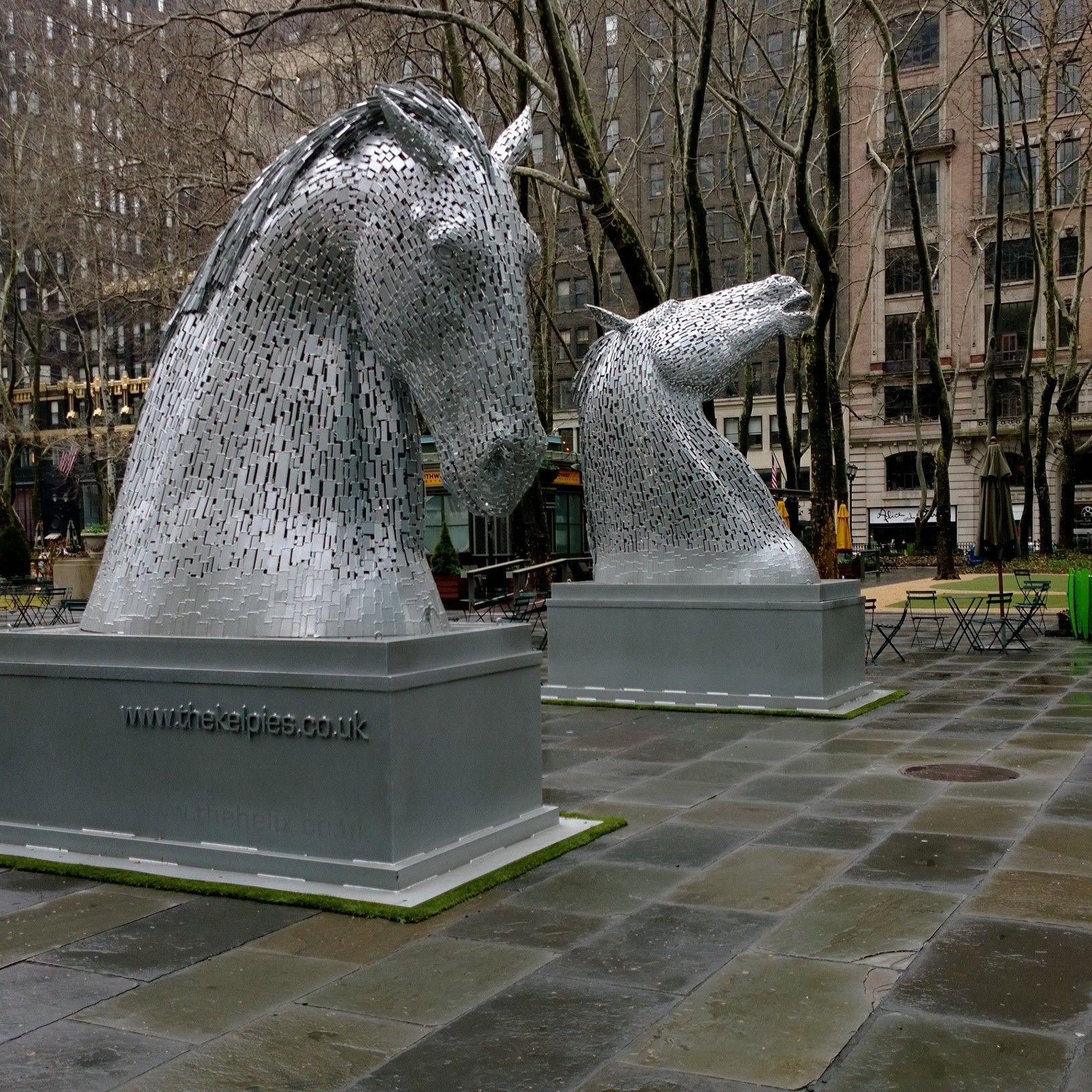
The last tidbit from my recent New York City trip is about the Kelpies on loan in Bryant Park, near the New York Public Library.

Kelpies are water spirits of Scottish folklore, typically taking the form of a horse. Artist Andy Scott was inspired by the legends to create giant ones for Helix Park in Falkirk, Scotland.

The ones in New York are smaller maquettes but still pretty huge.

The artist writes that he came up with an idea eight years ago about “mystical water-borne equine creatures. …

“Since then it has evolved dramatically and in the process the ethos and function has shifted from the original concept. Falkirk was my father’s home town and that inherited link to the town has been one of my driving inspirations. A sense of deep personal legacy has informed my thinking from the outset …

“The mythological associations behind the original brief have been absorbed by other sources of inspiration in the creative processes, and the ancient ethereal water spirits have been forged into engineered monuments. The Kelpies are modeled on heavy horses (two Clydesdales of Glasgow City Council actually served as models in the process), and it is this theme of working horses which captured my imagination and drove the project.”

The website adds that the Kelpies in New York City “were installed by Andy and his colleague Simon Chambers, with the assistance of the American Scottish Foundation, the Bryant Park Corporation, Mariano Brothers freight & cranes, Synlawn matting and the New York City Department of Parks & Recreation. Thanks to Creative Scotland for their funding assistance towards the costs of the transport and install.”

You really have to check out Scott’s website. The full-size sculptures are unbelievable. Click here.

Kelpies-Bryant-Park

Read Full Post »

Something fun from Studio 360: the mystery of the Toynbee tiles.

“For more than two decades, an unknown artist has been leaving a message in the streets of Philadelphia. The message is has been cut by hand into a linoleum tile, and pressed into the asphalt by the weight of passing cars. There are dozens of these around the city; old ones wear away, and new ones appear. The message is the same:

TOYNBEE IDEA
IN Kubrick’s 2001
RESURRECT DEAD
ON PLANET JUPITER

“The Toynbee tiles, as they’re called, have become a thing in Philly — you can even buy a t-shirt (the tiler isn’t getting royalties). For artists, the cryptic message inspires far-out forms of creativity, but perhaps nothing as ambitious as the ten-minute work by the rapper and ‘bedroom composer’ Raj Haldar, who performs as Lushlife.

“The work is in four parts, one for each line of the tiles’ message. By the end, the ‘Toynbee Suite’ has left behind anything resembling hip-hop, going out on a two-minute clarinet solo.

“But what exactly is the Toynbee message? Alfred Toynbee was a historian and philosopher of the 20th century, known for the 12-volume A Study of History. …

“A documentary film speculated that the tiler remained unseen by dropping the tiles from a car with cut-out floorboards.”

More on the mystery here, where you also can listen to the rapper’s tile-inspired music and check out a map showing where Toynbee tiles are located around Philadelphia.

Photo: Kimberly Blessing/flickr
A Toynbee Tile at 9th and Market Streets in Philadelphia, Pa.

Read Full Post »

An early stage in the creation of a Hari & Deepti light box

Do you ever click on the links to the right, in my blog roll? My Dad’s Records, for example, has old blues recordings you’d be hard-pressed to find anywhere else.

And This Is Colossal is a constant wonder. Today the art and visual-culture site posted illuminated paper light boxes that have to be seen to be believed.

Says Colossal: “Deepti Nair and Harikrishnan Panicker (known collectively as Hari & Deepti) are an artist couple [originally from India] who create paper cut light boxes. Each diorama is made from layers of cut watercolor paper placed inside a shadow box and is lit from behind with flexible LED light strips. The small visual narratives depicted in each work often play off aspects of light including stars, flames, fireflies, and planets. The couple shares about their work …

‘What amazes us about the paper cut light boxes is the dichotomy of the piece in its lit and unlit state, the contrast is so stark that it has this mystical effect on the viewers.’ ”

More.

Read Full Post »

One thinks of Iran as repressive, and having watched the doomed 2009 revolution unfold on twitter, I believe it is. But Iranian theater people seem to be managing to squeeze in some fun.

I blogged before about the Tehran production in a taxi, here. Now Studio 360 has a story on what might be called extreme improvisation. I take that back. There’s a script. But the actor doesn’t get to see it in advance.

“Actors face stage fright all the time,” says Studio 360, a radio show. “But consider this scenario: you show up to perform a one-person show, and you’ve never seen the script. You don’t know what it’s about because you promised not to do any research. It’s your first performance, and the only one you’ll ever have. The theater’s artistic director hands you a fat manila envelope with a script. And go.

“Also, the audience will decide whether you drink a glass of water that appears to have been poisoned.

“This is the premise of White Rabbit, Red Rabbit, by Iranian playwright Nassim Soleimanpour. ‘I did not know what was in front of me inside that envelope,’ says actor Gwydion Suilebhan. ‘What if this script is going to require that I disrobe? Or insult my mother? Or be rude or self-debasing?’ …

“Soleimanpour pulls his strings from afar, because — although the play has been performed in Toronto, Berlin, San Francisco, Brisbane, Edinburgh, London, and now Washington, DC — he really is in a cage. He doesn’t have a passport and can’t leave Iran, so he has never seen his play performed. ‘Nassim has given up the kind of control that is customary for playwrights,’ says Suilebhan, of working with actors and directors to realize the play. ‘At the same time, because he has put all of these restrictions on how it is to be performed, he has seized certain kinds of control that playwrights normally do not have. So he is literally embodying the ideas of control and submission and manipulation that he’s baked into his script.’ ” More.

Photo of Iranian playwright Nassim Soleimanpour found at the HuffingtonPost

Read Full Post »

Amtrak-trains-Boston

I love Amtrak, and I love writing, but I don’t think I am ever going to do an Amtrak Artist Residency, so I am passing along the info so you can apply. It sounds like fun. Just glimpsing the exposed backs of houses along the tracks with their hints of the private lives lived in them is inspiration for a ream of stories.

William Grimes writes for the NY Times blog ArtBeat, “The wheels have begun moving on Amtrak’s plan to offer writers a rolling residency aboard their trains. … Up to 24 writers, chosen from a pool of applicants, will be given a round-trip ticket on a long-distance train, including a private sleeper-car room with a bed, a desk, and electrical outlets. …

“The idea was born in December when the novelist Alexander Chee, in an interview with the magazine PEN America, casually mentioned his love for writing on trains, and added, jokingly, ‘I wish Amtrak had residencies for writers.’

“When Jessica Gross, a writer in New York, echoed the sentiment on Twitter, Amtrak arranged for her to do a trial residency on the Lake Shore Limited from New York to Chicago. She agreed.

“Her account of the trip, ‘Writing the Lake Shore Limited,’ published by The Paris Review in February, grabbed the attention of The Wire, The New Yorker and The Huffington Post. Soon after, Amtrak decided to turn the trial run into a full-fledged program.” More on when and how to apply.

Even before that series of events, there was the Whistlestop Arts Train, you know. I blogged about the rolling public art project by Doug Aitken last July, here.

Trains for dreaming. Holiday model train layout at Amtrak’s South Station, Boston.

model-trains-Amtrak-S-Station

Read Full Post »

On Sunday, the Concord Bookshop had a guest speaker, bird maven David Allen Sibley.

There was a great turnout to hear him and to have him sign the new edition of his guide.

He talked about his painting process and his interest in perception as it applies to people who are convinced they see a bird they are looking for. From what he has read, he says, it’s very much like the phenomenon of witness identification of suspects — many factors may distort what witnesses think they see. (Consider the old guy in the play Twelve Angry Men, for example, who didn’t have his glasses on.)

When asked how 12 people who identified the probably extinct ivory-billed woodpecker in Louisiana in recent years could all be wrong, he tries to explain why it’s likely: They get only a glimpse, they are desperate to see it, they are being paid to find it, etc.

I want to believe they saw it, of course, but I thought his points were interesting.

Also interesting was the way he paints. He has a very good sense of the profile of the bird, having drawn birds since he was seven. So in the wild he looks for identifying markers, sketches in the profile, and adds the marks. Then he paints the bird in the studio. He does a lot of research, but once he has done all he can, he takes only about an hour to do each painting.

Read more at Sibley’s website, here, and at his Facebook page, here.

Below is a bird that a woman in the audience Sunday asked about, the Snowy Owl. The questioner wanted know whether the many Snowy Owls that were sighted around New England this winter would stay. He said that, no, they were already heading back to the Arctic and only came because there were a lot of babies hatched up north this year and not enough food to go around.

Art: David Allen Sibley
Snowy owl

Read Full Post »

Another good one from This Is Colossal: Janet Echelman’s suspended net creations.

According to This Is Colossal, “In the late 1990s artist Janet Echelman traveled to India as a Fulbright Scholar with the intention of giving painting exhibitions around the country.

“She shipped her painting supplies ahead of time and landed in the fishing village of Mahabalipuram to begin her exhibitions with one major hitch: the painting supplies never arrived.

“While walking through the village Echelman was struck by the quality and variety of nets used by the local fisherman and questioned what it might look like if such nets were hung and illuminated in the air. Could it be a new approach to sculpture? …

“Echelman is currently embarking on her largest piece ever, a 700-foot-long sculpture that will be suspended over Vancouver … In collaboration with the Burrard Arts Foundation, she’s seeking funding via Kickstarter to make it happen. There’s all kinds of great prints, postcards, and shirts available so check it out.”

More here, at This Is Colossal, where you can see lots more nets. They will make you feel happy.

Art installation by Janet Echelman

Read Full Post »

Whatever works.

Curator Scott Stulen pays attention to what attracts people. At the avant garde Walker Museum in Minneapolis, he actually tapped the popularity of cat videos — and created a mini sensation.

Now at the Indianapolis Museum of Art, Stulen is curator of the visitor experience.

Writes David Lindquist at the Indy Star, “Newly hired as the first-ever curator of audience experiences and performance at the Indianapolis Museum of Art, Stulen’s assignment is to attract people to the museum’s galleries as well as 100 Acres art and nature park, Tobias Theater, outdoor amphitheater and Lilly House and gardens.

“He comes from the Walker Art Center in Minneapolis, where his track record includes the surprise success of the Internet Cat Video Festival, which brought 10,000 people together in a field in 2012 and then 11,000 paying customers at the 2013 Minnesota State Fair. …

“The cat video festival debuted at Open Field, a space adjacent to the Walker where Stulen co-developed projects with the museum, independent artists and the public.

“ ‘We had the ability to do more experimental programs that didn’t make as much sense inside the museum, and had a lot more creative freedom,’ he said.” More here.

2013 Internet Cat Video Festival at the Minnesota State Fair.

Read Full Post »

Maser-Flanagan-quilt-Concord-Library

This was a weekend for looking at art. The quilts on the left are by Valerie Maser-Flanagan and are on display at the Concord Library. My favorite was the one with the vertical stripes.

My husband and I also visited Brandeis University’s Rose Art Museum, back in action after being threatened with extinction by a president who lost his job over the ensuing uproar. I must say, the Rose presents some pretty inaccessible stuff, but the weird films by Mika Rottenberg were the highlight of the visit for me today. Mesmerizing.

The films carried me back to Kenneth Anger’s and Andy Warhol’s experimental movies in the ’60s. I didn’t understand those films either, but I was fascinated. Rottenberg’s kooky stories also was reminded me (my husband, too) of an offbeat video Asakiyume lent us recently called Cold Fever, which we loved. (Saying it was about a young Japanese businessman getting lost in Iceland in winter — on a quest to honor his dead parents with ceremonies he doesn’t believe in — hardly does it justice.)

Sebastian Smee at the Boston Sunday Globe has more on Rottenberg’s videos, and he covers the other exhibits, too.

Also this weekend, I stopped in at a gallery I like in Lincoln. They were featuring several interesting artists, including the photographer Leonard Freed, below. And they have other great work coming up March 4 — take a taste here.

Photo: Leonard Freed
From “Black and White in America” exhibit at the Clark Gallery in Lincoln. See review by Mark Feeney in the Boston Globe, here.

Read Full Post »

Kai the World Traveler and Titan of Industry knows the kind of story that catches my eye. He sent me this one from the New York Times about a street artist who spoofs Banksy, Tom Hanks, and a lot else.

John Leland writes, “This is a story about art in the age of social media

“In April 2011, a law school dropout in Bushwick, Brooklyn, newly arrived from the Midwest, had an idea that he thought might make a splash. He admired the street artist Banksy; he grew up on the movies of Tom Hanks. Why not mash up the two?

“Using simple computer software, he downloaded a Banksy painting of a rat holding a paint roller, then added an image of Mr. Hanks’s face. The whole thing took 10 or 15 minutes to create. He printed a cutout and pasted it on a wall at Mulberry and Kenmare Streets in Little Italy, signing it Hanksy.

“He photographed the wall for his Instagram and Twitter accounts, and emailed it to the Wooster Collective, a popular street art website. Then he went to sleep.

“ ‘And then it just went viral,’ Hanksy said the other day

“RJ Rushmore, who runs the street art blog Vandalog, said he was among many who initially dismissed Hanksy as an opportunist. ‘I thought it was not art, not brilliant, just taking the stupidest ideas and presenting them in ways that were very friendly for Tumblr and Instagram,’ Mr. Rushmore said. ‘It’s not art in the sense of a graffiti writer who spent 15 years developing his style.’

“Mr. Rushmore has since warmed to Hanksy, for comic relief in a scene that sometimes gets too serious. ‘He makes the best cat videos,’ he said. ‘That’s still something to be applauded.’

“Ellen Lupton, senior curator of contemporary design at the Smithsonian’s Cooper-Hewitt, National Design Museum, said more was at stake in Hanksy’s visual gags.

“ ‘It’s more than a pun,’ she said. ‘Banksy’s work is hypermasculine and serious about its underground, tough, outlaw image. And Tom Hanks is just not that guy. So the humor is putting that identity on this hyper-butch material. It’s the revenge of the nerd.’ ” More.

Photo: Nicole Bengiveno/The New York Times
Street artist Hanksy merged Banksy’s famous rat with Tom Hanks.

Read Full Post »

2014-DeCordova-in-winter

On Sunday, my husband and I decided to see what’s new at the DeCordova Museum in Lincoln.

A favorite in the biennial show of New England artists was Laura Braciale of Manchester, NH. It took me a minute, but when I realized she had displayed everyday objects along with what they looked like once she had turned them into art, I thought, Yes, art really is in everything if you look.

The blurb about her says, “close observation reveals subtle differences between the three-dimensional structures and their two-dimensional renderings. …  Her works engage a question concerning representation—which image is more ‘real’? As both her items and her illustrations occupy the same physical reality, however, Braciale’s work suggests that neither is more real than the other.” (Sigh. I’m not really fond of the way museums write.)

In a different DeCordova exhibit we saw three tintype photo portraits by the late David Prifti, Suzanne’s high school photography teacher. (A solo show in Winchester, Mass., goes through March 2, here.)

The biggest surprise was a documentary about Laos, a country we are interested in largely because of the the mystery books of Colin Cotterill. (Read one of my posts about him, here.)

The film, Route 3, shows a small mountain town that, having been leased to China for 75 years, was utterly destroyed to make way for casinos, hotels, entertainments, and jobs for Chinese people alone. Hard to imagine selling a part of your country like that, but Laos is desperately poor.

The documentary was by Patty Chang and David Kelley, who live and work in Boston and Brooklyn.

The DeCordova says on its website, “Blending the genres of documentary and road trip films with surrealist cinematic passages, Patty Chang and David Kelley present a compelling trip through the physical and psychological landscape of a community in transition. … Enlisting the help of tour guides and local entrepreneurs in this tightly controlled area, the artists immersed themselves in this community to create a unique portrait of a changing society.” More information on the artists here and here.

Read Full Post »

Artist Susan Jaworski-Stranc is having a show she’s calling Water Blues at Centro Restaurant and Bar in Lowell. The exhibit, which includes oil paintings and linoleum prints, runs to March 17 at 24 Market St.

If you can get to Lowell on Sunday, Feb 23, there’s a reception where you can meet the artist, 1 pm to 3 pm.

My husband and I have been to a number of art shows in Lowell, which is quite a creative community. Our favorite Lowell artist is a former boss of mine, Meredith Fyfe Day, who held down a newspaper job while she was artist in residence at the Whistler House. I worked for her at the Harte-Hanks community newspaper chain in the early 1990s.

Here’s the intriguing artist statement from Jaworski-Stranc: “I am a printmaker, specializing in the creation of linoleum block prints. After each successive printing of a color, the surface of the block is reduced while at the same time the printing surface is built up with multi-layered colors. Born from one block of linoleum, my relief prints have the nuance and rich textural surfaces of an oil painting.

“Although Picasso coined this method of working, a ‘suicide print,’ I rather think of this printmaking process as emulating the journey of life. While creating my prints, I am never able to re-visit past stages. I can only proceed forward with the acceptance of all good and not so good choices which were mediated and acted upon with the hope and joy of completion.”

When Asakiyume and I met in December at the Worcester Art Museum, there was an exhibit on printmaking that showed what prints looked like at each of the layering stages. Challenging work. I love that Jaworski-Stranc sees the printmaker’s role as accepting each previous stage and working with it. As she says, “The journey of life.” Another good topic for a poem.

Find out more about Susan Jaworski-Stranc here. And thank you, Vyü magazine, for the lead.

Read Full Post »

congress st nook

The City of Boston has a nice opportunity for folks with ideas about making cities more livable.

The City says, “In Boston, a third of the land is open to the public. We invite you to reimagine that space. How can our streets, plazas, sidewalks, street furniture, and public buildings better serve people?

“The Mayor’s Office of New Urban Mechanics Streetscape Lab is sourcing ideas from designers, makers, artists, and engineers to improve Boston. We are asking members of our vibrant creative community to submit project ideas to make our public spaces simple, intuitive, and literally awesome. Project ideas can be entirely new creations or a new way of using an existing product. The City will review the submissions and may select up to six ideas total to implement in the following categories:

“The Streetscape: sidewalks, streets, medians, plazas, and our other civic front porches. What improvements would you make to space? What is the next iteration of our classic street furniture? Look at the sample locations to get you thinking.

“Boston City Hall: rethinking the indoor and outdoor space, signage, improving service delivery and the user experience. These designs may help inform future improvements to the building.

“Random Awesome Designs: great ideas that defy classification or location.” Guidelines here.

I see no reason you have to be an artist or an engineer. What’s to stop you from sending in a good idea? Go for it.

Dewey-Sq-_farmers_market

providence author lovecraft

Read Full Post »

Mary Ann put this trompe l’oeil art on Pinterest, bless her heart. She’s an endless source of cool stuff.

The online magazine Feel Desain has the story.

“In Potsdam, Germany, street artists Daniel Siering and Mario Shu have recently created a clever piece of illusion that depicts a surreal hovering tree. After wrapping a part of the tree truck with plastic sheeting, they made an amazingly detailed and realistic spray-painting of the surrounding landscape on it.

“The result is a brilliant illusion that the tree has been sawed through and is floating in mid-air over its stump.”

Watch the video showing how it’s done,  here.

Read Full Post »


Lately, I have been following a very artistic art consultant on twitter called Liz Devlin.

Here is what her website says about her: “Since launching FLUX. in 2008, I have provided an online resource for local artists and Arts enthusiasts in the Boston area, and beyond. Through weekly event coverage, artist interviews, Open Studios recaps, and educational posts, the site enables readers to feel informed, engaged in, and connected to the pulse of Boston Arts.”

Here’s the part that floors me: “My 9-5 is in the corporate world as a Financial Analyst.” Gosh, how can she possibly have time for it all?

She continues, “My downtime, in-between times and restless nights are spent actively pursuing and supporting creative endeavors.”

A reason to follow her on twitter is that she keeps up on everything in the Boston arts scene for you. You can also check out weekly lists of events — with commentary — at her website. For example, here.

I especially like the nostalgic, off-kilter look of this piece in the current  Montserrat exhibit.

Art: Andrew Houle’s “Leaving East Gloucester.”
Montserrat College of Art Galleries, 23 Essex St., Beverly, Mass., through February 14

Read Full Post »

« Newer Posts - Older Posts »