Feeds:
Posts
Comments

Posts Tagged ‘ballet’

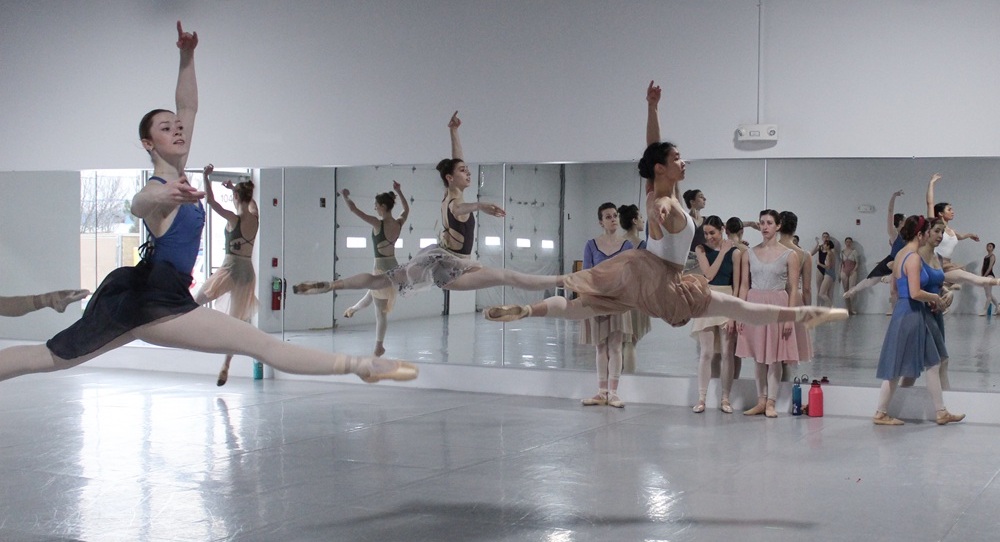
Photo: Julianna Slager/Ballet 5:8.

An ancient Greek philosopher once noted that you can’t step into the same river twice. What he meant, of course, was that the river is constantly changing. The drops of water that touch your foot when you step in are not the same drops you felt a few moments ago when you tested the temperature.

Here’s a story about the changing ballet world and how one company is adapting to the river.

Melody McTier Thomason at Dance Informa writes, “Since our last conversation with Julianna Slager, Artistic Director of Ballet 5:8, the company has experienced tremendous growth with an expanded repertoire, increased guest choreographers, and last year Slager was named a fellow at the School of American Ballet (SAB). Most notably, Ballet 5:8 recently announced a groundbreaking milestone for the 14-year-old company: full-time contracts for its dancers. …

“A dreamer at heart, Slager always had hopes of achieving full-time contracts, but it was in 2019 when vision casting began. ‘We moved into our new building in 2018. 2019 was the first time I was brave enough to share what was in my mind, and the board really took to that. Then COVID arrived. That threw me for a loop a little bit. It was a big test of faith to hang on to unseen things and allow myself to hope.’

“As Slager began to dig further into making her dream a reality, she uncovered a unique model to bring Ballet 5:8 to its next chapter. After reviewing the company’s finances, Slager realized the organization could shift resources from paying part-time contract employees who were doing administrative tasks, to paying dancers to do those same jobs. This shift would allow them to offer the dancers full-time contracts with benefits.

” ‘When we made the discovery that a big structural shift could be the answer to getting us where we wanted to go, we took pen to paper and looked at all the people we have in the organization,’ Slager explains. ‘If dancers are in rehearsal 25 hours a week, and additionally have 10 hours of either teaching or helping with administrative duties, social media, whatever, that still gives them five flexible hours for meetings or time they can spend to cross-train. We sat down and daydreamed a little bit about what it could look like, and then we slowly started talking to the dancers about it. …

” ‘We had a cohort of dancers along with a cohort of board members who created a caucus and talked through how this would work practically,’ Slager says. ‘Then, we rolled it out to the dancers and walked everybody through the process. Now, we are able to do a guaranteed salary increase every year, with a three-year contract which is super exciting so they have better job security. Because we have this stability, the board now can budget further out.’ …

“Combining artistic development alongside administrative tasks, extends beyond full-time company dancers to Ballet 5:8’s Trainee and Second Company dancers. ‘Because we want to make sure our Trainee and Second Company dancers are able to advance into the company and have a skill set, the Trainee directors have done a really good job of giving them a chance to job shadow in areas they’re interested in,’ explains Slager. …

“ ‘I really love working with everybody inside and outside the studio. I think it strengthens our bond as a team because we’re very focused on the goals and the mission. It also helps the dancers. They can see behind the scenes and better understand why organizational decisions are made. On the dancer side, we’re able to have more rehearsal time because everybody is full-time, so the roles they do outside of dance are a little smaller. … The “many hands make the load lighter” frame of mind is how it feels.’ “

More at Dance Informa, here.

Read Full Post »

Photo: Neil Reid at the New Zealand Herald.
Former All Blacks coach Mike Cron integrated techniques from ballet and sumo wrestling into the team’s workouts.

Today, I share an article from New Zealand about using creative techniques in rugby training. Since I personally don’t know the first thing about rugby, please correct me if I use the terminology incorrectly.

Neil Reid has the story at the New Zeland Herald.

“Mike Cron has looked far and wide to make his [rugby] forward packs better – including adopting techniques from slender, tights-wearing ballet dancers and borderline-obese sumo wrestlers. Regarded by many as the rugby world’s leading scrum and forwards coach, the former police detective has never been afraid to look in less traditional places to get the best out of his players – and himself.

“In his upcoming autobiography – Coach – Lessons from an All Blacks Legend – the 70-year-old opens up on his 210-test tenure with the All Blacks, including Rugby World Cup triumphs in 2011 and 2015 – and his current role with the Wallabies.

“He writes about the All Blacks pack benefiting from techniques he observed in dancers at the Royal New Zealand Ballet and at a sumo wrestling gym in Japan.

“Cron spent time with both during a period when a variety of All Blacks – most notably front rowers – were battling a condition dubbed ‘turf toe’ involving pain at the base of the big toe when bent. Jumping, landing or pushing off when running could all exacerbate the sometimes career-ending ligament injury.

“In an interview with the Herald … Cron said his first travels in search of ways to prevent turf toe saw him visit NFL franchise the New York Giants. NFL athletes are susceptible to the condition from hard artificial turf surfaces.

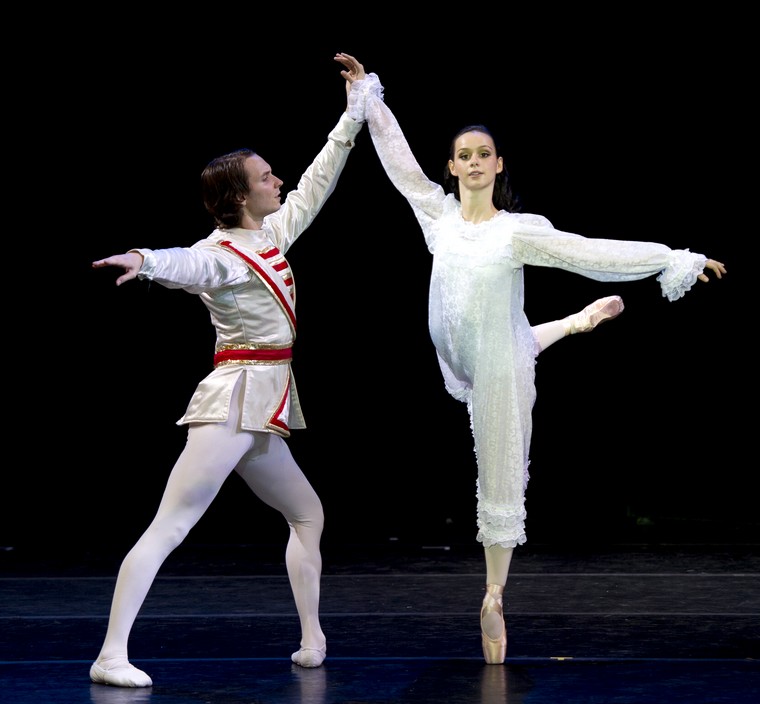
“He was then allowed access to the Royal New Zealand Ballet as it prepared for a performance of The Mikado; including a meeting with the group’s Italian artistic director and talking to the dancers.

“ ‘At the end of training, we were invited up on stage,’ Cron told the Herald. ‘And I had two questions, one was about turf toe.’

“Cron was told ballet dancers were able to limit the risk of turf toe because of their landings. They had ways of landing that put less impact on the big toe. It was something Cron passed on to the All Blacks medical team and their lineout jumpers.

“Cron’s other question was to the Kiwi male lead of The Mikado production after he had watched him … lifting above the head’ of his dance partner.

Cron likened it to the process of forwards lifting a teammate in the air to snare an opposition kickoff. …

“ ‘He tells me about how you lock out and how you breathe, how you fill your belly up with the air and push your guts out and down, and I go … “same as powerlifters.” ‘ …

“Another nugget of knowledge was learned from spending time observing a sumo wrestling school in Japan. Cron spent several days there before returning to his base in Canterbury still contemplating what he’d seen, and wondering whether any of the lessons could be applied to rugby.

“Three months later, he reviewed video footage, and it clicked. ‘The last thing they do before they explode, these big guys, is with their toes . . . they hold the ground to get power and then release the power through into [their] opponent,’ Cron said.

‘I came back and started teaching that. With the sprigs in our boots, we push into the ground and hold the ground like a parrot in a bird cage.

“ ‘You get far more grip, far more purchase because power comes from the ground through your feet and through your body,’ …

“Cron said while top rugby players, ballet dancers and sumo wrestlers excel in very different arenas, they’re all still athletes who had insights others could learn from.

“ ‘If you go and see Cirque Soleil train, you will pick something up.’ ”

More at the New Zealand Herald, here.

Read Full Post »

Photo: Dina Litovsky.
Román Baca leads rehearsal on the deck of the Intrepid, the aircraft carrier turned museum on the Hudson River.

The wars that have been fought in my lifetime sometimes seem to have been necessary and inevitable. Most often, not. As the young people head off, I always think about how their lives will have been warped if they get back. It seems so wrong. And right now the services we’ve promised them are being slashed.

Fortunately, there are efforts at healing that forge ahead. One such program involves ballet.

Brian Seibert writes at the New York Times, “When Román Baca was serving as a Marine in Iraq in 2005, he didn’t tell many people what kind of work he had done before the war. He had tried that in boot camp, and it hadn’t gone well. So when his best friend in the platoon asked him why he seemed so interested in local dance practices, he hesitated before admitting the truth: He was a ballet dancer.

“Baca’s friend wasn’t bothered by the revelation. So Baca told him his crazy idea: to translate their wartime experiences into dance.

“Eventually, that crazy idea became Baca’s life. With his wife, Lisa Fitzgerald, he founded Exit12 Dance Company, which makes and performs works about military experience. What started as a way for Baca to deal with his trauma has expanded into a mission to help other veterans deal with theirs — through dance.

“In recent weeks, a group of veterans and family members of veterans, ranging in age and physical ability, has been gathering in the belly of the U.S.S. Intrepid, an aircraft carrier turned museum on the Hudson River. Using various improvisational exercises, they have been creating a dance work [to] perform on May 30 on the ship (on the flight deck, weather permitting). More important than that performance, though, is the process.

“Baca sees the workshops as a corrective for military training. ‘To make a person respond immediately to orders and commit acts of violence, military training changes your identity,’ he said. ‘It removes everything that defines a person’ — your clothing, your haircut — ‘and then it changes you through physical exercises, repetitive motion and powerful brain-body connections.’

“Baca, who has been leading these workshops since 2011, recalled a moment from one: Everett Cox, a Vietnam War veteran who had kept away from everything military for decades, responded to a prompt of action verbs by expertly stabbing and slashing with an invisible bayonet. His long-unused training was intact in muscle memory.

“Another time, Baca was choreographing a military exercise sequence and directed his dancers to yell ‘kill’ with every motion. When Fitzgerald questioned if that creative decision might have been a bit much, Baca explained that he was only being accurate: Coupling all actions with the word ‘kill’ was part of boot camp.

” ‘That’s absolutely needed when you are in uniform,’ he said. ‘But what do you do with that after you get home?’

“The workshops use physical exercises to help restore what Baca, borrowing a term from the philosopher Paul Ricoeur, called narrative identity. ‘You start to tell people who you are and parts of your story and then you listen to others do the same,’ he said.

“ ‘A lot of trauma survivors will say that you never fully heal,’ he added. But as evidence of how the process can work, he pointed to the experience of Cox, who returned from service in Vietnam feeling so guilty and ashamed that he did not consider himself a veteran. ‘I lost my mind in Vietnam’ is how Cox put it to me.

“For nearly 40 years, Cox, who took drugs and attempted suicide, tried to lock away what had happened. He was diagnosed as paranoid schizophrenic; one psychiatrist told him he was incurably insane. Then, in 2010, he attended a retreat for veterans at the Omega Institute, a holistic wellness center in the Hudson Valley. ‘It changed my life,’ he said. For the first time, he began to talk about his wartime experiences, and to write about them, and to cry. …

“ ‘If you’re holding a war in, it takes a lot of energy,’ he said. ‘And if you want to loosen that up, it also takes a lot of energy.’ ”

I so admire Baca, who against what seems to me like very long odds, keeps working hard to bring these damaged veterans back to life.

More at the Times, here.

Read Full Post »

Photo: Safeed Rahbaran/New York Times via the Las Vegas Sun.
“George Lee at the Four Queens Hotel and Casino in Las Vegas, on Jan. 16, 2024. Lee was the original Tea in ‘George Balanchine’s The Nutcracker,’ ” says the New York Times. “A documentary filmmaker found him and a lost part of ballet history in Las Vegas.”

Several of my good friends from college are Chinese. I don’t know if I am stereotyping my friends, but having come from a throughly impractical family, I was impressed at once with what seemed to me a startling level of practicality. Practicality about what kinds of courses to take for what kind of well-paying jobs; even practicality about potential marriage partners.

So one of the things that struck me about the mother in today’s lovely story was the way she helped her son earn rice during the Japanese occupation of China and her advice to him when they headed to America.

Siobhan Burke reports at the New York Times, “Among the blaring lights and all-hours amusements of downtown Las Vegas, in a sea of slot machines at the Four Queens Hotel and Casino, George Lee sits quietly at a blackjack table, dealing cards eight hours a day, five days a week, a job he’s been doing for more than 40 years.

“Lee, 88, was likely in his usual spot when the filmmaker Jennifer Lin was sifting through old photos at the New York Public Library for the Performing Arts in 2022, wondering what had become of a dancer with a notable place in ballet history. Pictured in a publicity shot for the original production of ‘George Balanchine’s The Nutcracker,’ in the role known as Tea, was a young Asian dancer identified as George Li.

“For Lin, a veteran newspaper reporter turned documentarian, the picture raised intriguing questions. In 1954, when the photo was taken, it was rare to see dancers of color on the stage of New York City Ballet, the company Balanchine co-founded. Who was this young man, this breaker of racial barriers, this pioneer? Was he still alive? And if so, what was he up to?

“ ‘I became absolutely obsessed with trying to find out what happened to George Li,’ Lin said in a video interview.

“In just over a year, that obsession has blossomed into a short film, Ten Times Better, that chronicles the unexpected story of Lee’s life: from his childhood in 1940s Shanghai, where his performing career began; to a refugee camp in the Philippines, where he fled with his mother, a Polish ballet dancer, in 1949; to New York City and the School of American Ballet, where Balanchine cast him in ‘The Nutcracker’; to Flower Drum Song on Broadway, his first of many musical theater gigs; and ultimately, to Las Vegas, where he left dance for blackjack dealing in 1980. (He changed the spelling of his last name in 1959, when he became a United States citizen.) …

“ ‘So many years I haven’t done ballet,’ Lee said over coffee at the Four Queens on a recent Sunday, after his shift. ‘And then suddenly Jennifer comes and tries to bring everything up.’ …

“Lin was not the only one who had been searching for Lee. In 2017, while organizing an exhibition on ‘The Nutcracker,’ Arlene Yu, who worked for the New York Public Library at the time and is now Lincoln Center’s head archivist, was puzzled by the relatively few traces of him in the library’s vast dance collection. ‘Whereas if you look at some of his peers in ‘The Nutcracker’ in 1954, they went on to careers where there was a lot more documentation.’ …

“Lee, in his heyday, was a dancer to know. At just 12, he was already winning public praise. In a preview of a recital of the King-Yanover School in Shanghai, the North China Daily News called him an ‘extremely promising young Chinese boy, whose technique is of a very high standard.’ A reviewer wrote that he ‘already may be said to be the best Chinese interpreter of Western ballet.’ (Lee saved these newspaper clippings and shared them with Lin.) …

“Lee’s mother, Stanislawa Lee, who had danced with the Warsaw Opera, was his first ballet teacher; as a child, he would follow along with her daily barre exercises. Shanghai had a significant Russian population, and with that a robust ballet scene. To earn money, Stanislawa arranged for her son to perform in nightclubs — ‘like a polka dance, or Russian dance, or sailor dance,’ Lee said. The clubs would pay them in rice. …

“In 1951, an American friend of Lee’s father sponsored them to come to New York, where he introduced Lee to the School of American Ballet, City Ballet’s affiliated school. As Lee narrates these twists and turns in the film, one memory anchors his recollections. Before they immigrated, his mother issued a warning. ‘You are going to America, it’s all white people, and you better be 10 times better,’ he recalls her saying. ‘Remember that: 10 times better!’

“The footage of Lee in his 20s suggests he took that advice to heart. In television appearances — with the company of the ballet star André Eglevsky, and in a number from Flower Drum Song on the Ed Sullivan Show — his power and precision dazzle.

“ ‘He was good; he was really good,’ [Phil Chan, cofounder of Final Bow for Yellowface, an initiative focused on ending offensive depictions of Asians in ballet] said. ‘Clean fifth, high jump, polished turns, stick the landing — the training is all there. He’s already 10 times better than everybody else.’ …

“In a 1979 interview heard in the film, the former City Ballet soloist Richard Thomas, who took over the role of Tea, raves about Lee’s peerless acrobatic jumps: ‘He was wonderful! Balanchine choreographed a variation for him that none of us have ever been able to equal.’

“As Lee remembers it … the City Ballet makeup artist put him in full yellowface, and Balanchine insisted he take off the makeup. ‘He is Asian enough! Why do you make him more?’ he remembers Balanchine saying. Lee was costumed in the Fu Manchu mustache, queue ponytail and rice paddy hat often associated with the role, now widely critiqued as racist caricatures. But he said he didn’t take offense. ‘Dancing is dancing,’ he said. …

“He pieced together jobs for more than 20 years, often unsure of what would come next. He was dancing in a Vegas revue, ‘Alcazar de Paris,’ now in his 40s, when a blackjack dealer friend suggested he go to dealer school. ‘I can’t dance all my life,’ he remembers thinking.” More at the Times, here.

Read Full Post »

Photo: BBC News.
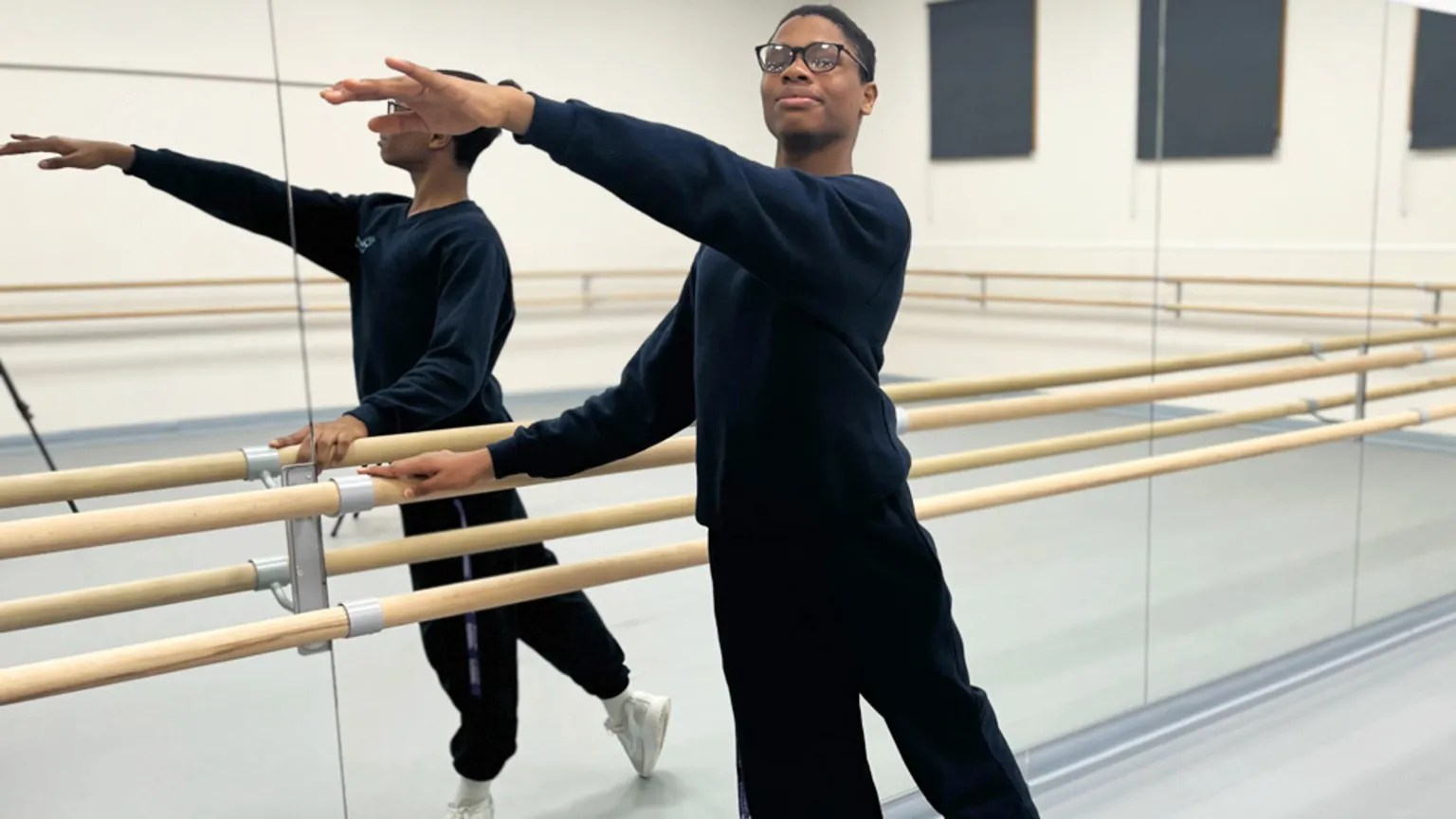
Said Anthony’s mother, “People were telling me that this type of dance is not for boys. But it’s what he loves doing, so I let him go for it.”

The other day, my husband and I were talking about the discovery of the very young Judy Garland (scroll down here) and how the pressures of being a child star really messed her up. Fortunately, many parents of child stars since then have learned to keep a steady hand on the tiller.

Consider the story of the young Nigerian dancer that Jenna Abaakouk writes about at BBC News.

“Dubbed Nigeria’s viral ballet dancer, 13-year-old Anthony Madu’s life has changed beyond recognition over the last three years after his dance moves and internet fame catapulted him from his modest home in Lagos to one of the UK’s most prestigious ballet schools.

“It was his dance teacher who filmed the young boy in June 2020 as he practiced pirouettes barefoot in the rain.

“Afterwards, he uploaded the video to social media where it caught the eye of Hollywood actress Viola Davis who shared it to her huge following on Twitter. … It led to Anthony being offered a scholarship at the Jacqueline Kennedy Onassis School at the American Ballet Theatre. However, Covid-19 restrictions at the time meant the training had to take place online.

“It was then that Anthony was given a chance to study at Elmhurst Ballet School in Birmingham — which had seemed to him an unattainable dream. …

“Sitting in one of the school’s practice studios, he shyly admits it has not been an easy transition. ‘For the first year, it felt really, really hard trying to adjust to like the weather compared to Nigeria and also missing home as well,’ he says.

“However he has how settled down and enjoys the strictures of his new dance regime. ‘I video call my mum every day and hang out with my friends. Here, we do more classical ballet. It has to be precise, like having the arms right.’ …

Without the chance for formal training, he taught himself through watching videos and copying moves that fascinated him.

“It was a hobby that surprised his family. ‘When he was five years, I saw him dancing. I thought: “What is wrong with you?” ‘ Ifeoma Madu, Anthony’s mother, who still lives in Lagos, tells the BBC. ‘People were telling me that this type of dance is not for boys. But it’s what he loves doing, so I let him go for it,’ she says.

“As Anthony’s interest developed, his family moved to a different neighborhood of the city so he could attend the Lagos Leap of Dance Academy. …

“Mike Wamaya, a ballet teacher in Kibera — Africa’s largest informal urban settlement — in Kenya’s capital, Nairobi, is impressed by Anthony’s story.

” ‘It is very rare to see young boys getting scholarships from Africa to go outside to dance,’ the 48-year-old, who has more than 250 children taking his classes, tells the BBC. … Mr Wamaya admits too that many young boys on the continent do not pursue ballet because of the social stigma associated with it. ‘People are very homophobic and as a male dancer you are called gay. … This built a lot of resilience in us. We got teased a lot but I’m very happy that my students used the teasing to prove those people wrong.’ …

“Anthony has already inspired other young people in Nigeria and the rest of Africa to pursue their dancing ambitions. His journey is also to be shown to a much wider audience as Disney is making a documentary about it. Called Madu, it is currently in post-production. …

“Life in Birmingham is also broadening Anthony’s horizons, as there is more on offer academically at Elmhurst. ‘When I was in Nigeria, I didn’t do things like art. But now I love drawing. And learning other dances too. Aside from ballet, contemporary is my favorite,’ he says. …

” ‘There might be struggles along the way but remember it’s just temporary and it will be worth it in the end.’ “

More at the BBC, here. No paywall.

Read Full Post »

Photo: The Nation.
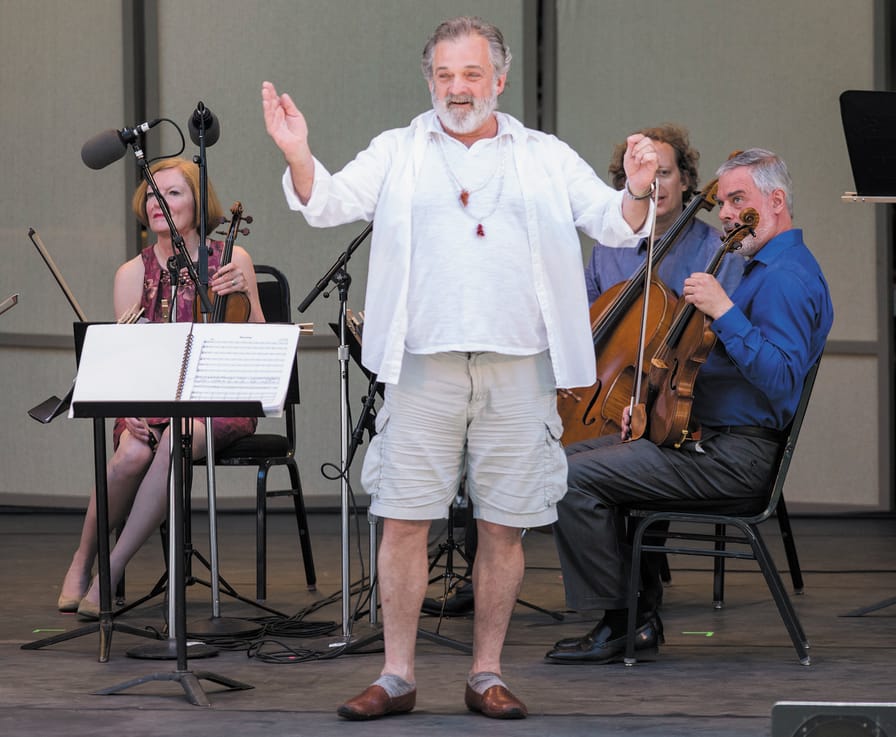
Choreographer Mark Morris at the Ojai Music Festival.

Many people know Mark Morris as a great choreographer, but much of his success has depended on his devotion to teaching his dancers.

Alastair Macaulay wrote recently about this side of Morris at the New York Times. “New York City has often been called the world’s dance capital. One good reason is that a number of the world’s foremost choreographers not only lived and worked in New York, but also taught class here. Martha Graham, George Balanchine, Merce Cunningham and many others helped to lure dancers to the city.

“Fewer and fewer of today’s top dance-makers carry on that tradition. The foremost exception is Mark Morris. … While there have been seasons when his choreographic inspiration has dipped, his performers have almost invariably looked wonderful. This is a tribute to how he and his teaching colleagues prepare them each day.

“The dancers don’t present themselves as virtuosos. And they’re all such distinct individuals — each exuding what seems natural — that it’s easy to make the mistake of thinking they don’t share training. But it’s precisely their schooling with Morris, whose company, the Mark Morris Dance Group, was established in 1980, that makes them look so natural.

“ ‘I first taught when I was 13 — Spanish sevillanas — and first taught ballet in my later teens,’ Morris, 66, said in an interview at the Union Square Cafe. ‘As an adult, I used to teach modern or jazz or ballet. I would take class all over the city, which is how I met so many fabulous people: We were all dancing together. And when I gave workshops, I’d ask the most talented people to come back and be in my next piece.’ …

“ ‘It’s just the last year or two I’ve cut back,’ he said. He now shares teaching assignments with company alumni. Surprisingly, for a modern-dance master, he teaches a ballet class, with a live pianist. The dancers start by standing at the barre, bringing more and more parts of the body into play with each exercise. Then, after about 40 minutes, they work without support in the center of the room. Finally they move expansively across the room, in phrases involving turns and jumps.

“It’s ballet — though with a difference or two. Like other modern-dance choreographers (he particularly credits Hannah Kahn), Morris will sometimes ask his dancers to articulate and bend the spine in ways largely foreign to ballet — they alternate convex and concave shapes of the spine at the barre — and to phrase in irregular counts. And there’s no work on pointe: the dancers are barefoot or in socks or soft shoes. …

“The Morris class is ‘a very pure form of ballet that strives to be stripped of its affectations,’ Billy Smith, a dancer who joined the company in 2010, wrote in an email. ‘We do use our torsos in a more “modern” way than maybe a ballet company would in class. But at the core our classes are very much oriented toward the purity of ballet technique.’ …

“Morris, an invariably entertaining talker, speaks exuberantly to his dancers, between exercises — about what’s on television, about an unmissable Broadway show (and about the long lines for the ladies room in Broadway theaters), about New York traffic gridlock, about Olive Oyl. But this spiel isn’t just a one-way Morris event: He wants his dancers to be people with lives and interests, not just dance executants, and he enjoys their repartee. …

“Sam Black, who became a full-time Morris dancer in 2005 and is now the company director sharing the teaching assignments, will give his stage farewell during the Joyce season. In an interview at the Mark Morris Dance Center in Brooklyn in July, he recalled how he used to stretch his arms too straight upward in certain positions. Morris would say, ‘You only have three joints in your arm. You have to make a curve with only three joints. That takes imagination.’

“Many dancers have remained with the company more than 10 years, their longevity in part attributable to Morris’s growing concern with anatomical efficiency. …

“It was not until 1988, when the Morris dancers moved for three years to Brussels to become the resident company at the Théâtre Royale de la Monnaie, that he began to teach them a daily ballet class. That was when Megan Williams, now a ballet teacher, joined. She remembers that, in class, he enjoyed giving them one exercise for footwork and one for the upper body.

“ ‘He would show us the feet pattern, and then the port de bras pattern — separately!’ she said. ‘We had to put them together like a puzzle. It was almost impossible, like that exercise of rubbing your stomach and patting your head at the same time.’ “

More at the Times, here.

Read Full Post »

Photo: Ivan Petrov.
Kyiv-born and -trained ballet star Ivan Petrov is working with ballerina Alina Cojocaru to help dancers whose lives are in upheaval since Russia invaded Ukraine.

It’s been interesting to see how many different kinds of groups are pulling together to help Ukraine since Russia invaded. College alumni groups, small towns, chefs, former military, athletes … the list goes on.

When I was reading today’s article on the dance world’s efforts, I was surprised by an observation about how ballet-world organizing after the death of George Floyd affected the speed with which dance folk are taking action today.

Sarah L. Kaufman reports at the Washington Post, “Amid the constant air raid sirens and shelling near her home in Kyiv, 17-year-old Polina Chepyk tried to fill her days with dancing.

“Her ballet school had shut down, so she stretched and spun in the apartment she shared with her parents and 8-year-old sister, Anfisa. Chepyk used the back of the sofa as her ballet barre.

“But lying in bed in the dark, she could not tune out the war. ‘At night you can’t control your feelings,’ Chepyk said in a recent phone interview. …

“Since early childhood, she had devoted herself to perfecting her pirouettes and learning excerpts of the great ballet roles. When war came, she feared that the world of music and grace she longed to inhabit was gone. …

“Yet the international ballet community has swung into action, led by the New York-based organization Youth America Grand Prix. Russian dancers Larissa and Gennadi Saveliev, who began their careers at Moscow’s Bolshoi Ballet before emigrating to the United States, founded YAGP in 1999 to help students gain access to the world’s most selective ballet schools, through scholarship auditions. But since the war in Ukraine began, YAGP has been tapping its network of dancers and educators to help nearly 100 Ukrainian dance students (and often their entire families) flee danger and continue their art, by placing them in training academies throughout Europe. …

“Suddenly, Chepyk found herself packing a suitcase with leotards, tights, bottles of her mother’s perfume and ‘every gift my parents ever gave me, for remembering them.’ …

“After a five-day journey, she arrived March 21 into the embrace of a Dutch family with two girls. Chepyk said she has become ‘their third daughter.’

“And she has resumed her beloved dance training at the Dutch National Ballet Academy, where she is in the highest level. …

“The war in Ukraine has hit the tight-knit ballet world hard, and dancers have responded with an unprecedented storm of activism. Ukrainian ballet students and professional dancers are being taken in by far-flung academies and companies, swelling their rosters. Dancers are converging across borders for star-studded fundraisers. …

“Ballet is a profoundly international art, as well as a communal one. It depends on continuous, daily interaction with fellow performers, who are typically drawn from all over and who work together on a uniquely intimate physical and emotional level. …

“The ballet world’s rapid mobilization in support of Ukraine was prompted by something much more recent, according to Lynn Garafola, a dance historian and author of La Nijinska: Choreographer of the Modern. She points to the Black Lives Matter movement as helping set the ground for solidarity.

“ ‘Black Lives Matter primed the ballet community for self-interrogation,’ she said. ‘It responded in a very strong way with a lot of thinking and discussion, across the board, trying to establish new norms for diversity and inclusivity and equity. So people were already thinking in ways that were more ethical. And that’s what has come to the fore here.’

“Echoes of BLM lie in the questions that dance artists have been asking themselves since the Russian invasion of Ukraine, Garafola said, such as: ‘What can I do about it?’ …

“Romanian-born ballerina Alina Cojocaru, formerly of the Royal Ballet, and Ivan Putrov, a Royal Ballet principal from Kyiv, trained together in the Ukrainian capital as children. Before joining the Royal Ballet, Cojocaru danced professionally in Kyiv for a year, where one of her first partners was Artyom Datsishin, ‘a tall, very quiet person and very talented dancer,’ she said in a recent video call with Putrov from London. Datsishin later became an internationally known star of the National Opera of Ukraine. Two days after the Russian invasion began, he was hit by shelling, and he died three weeks later of his injuries.

“Datsishin’s death, which made headlines around the world as an especially poignant symbol of the war’s brutality, helped spur Cojocaru and Putrov to organize the Dance for Ukraine charity gala. … The gala came together in two weeks, and was an easy sell to their colleagues. ‘We already knew so many people from all over the world. We are just one phone call away from someone in Cuba, France, Germany and America,’ Putrov said.”

Read more at the Post, here.

Read Full Post »

Art: Renoir.

When I was a child, I went through a period of wanting to be a ballet dancer. It was a thrill to have a small role in the Elysian Fields of Gluck’s Orpheus alongside grown-up ballerinas and opera singers. But as ballet lessons waned, other interests took their place.

Later, as a worrywort adult, when a dancer I knew kept getting injuries, I began to think of ballet as a dangerous sport. Today’s post celebrates a revolution in addressing ballet injuries.

From Nick Miller at the Age: “Is injury common among ballet dancers? Yes. But perhaps not for the reasons you might think. A study in Britain in 2014 found that professional dancers were far more likely to suffer injuries than rugby players: 80 per cent of dancers incur at least one injury a year that affects their ability to perform, compared to 20 per cent for rugby or football players.

“Muscles and joints were the most common sites for injury, according to the British Fit to Dance 2014 survey. Other studies found that over-use was the most common cause of injuries for female dancers while men were more susceptible to sudden, traumatic injuries. And they found that younger dancers were more likely to be injured than older ones. …

“[Matthew Wyon, professor of dance science at the University of Wolverhampton and one of dance science’s leading experts] believes it’s because of the way dancers train.

“ ‘None of their training causes them to get either stronger or fitter until right up close to a performance. Ballet dancers are technically unbelievable. They’ve got an economy of movement we never see in sport. But it means the dance no longer puts a stress on the body. They don’t have that physical adaptation. So, in fact, the better your dancer is, the less fit they are. Because dance doesn’t stress them any more.’

“On the face of it, the lifts and jumps that dancers perform seem to require extraordinary strength. But, behind the scenes, a lot is accomplished by perfect balance; by aligning bones and locking joints so that, rather than relying on muscles to hold your partner aloft, the weight transfers through your frame to the floor. …

“Evidence of their reliance on technique can also be found in dancers’ almost freakish ability to ignore fatigue when it matters.

“In one experiment, Wyon’s team made a dancer exercise until they were ‘absolutely dead on their feet’ and then perform a double pirouette on to arabesque (which is where they stand en pointe with one leg in the air behind). ‘And they could pull it off, even when they were having trouble doing the fatiguing dance in between. As soon as they were being watched, or having the data collected, they could pull it out. This is just a phenomenon and we’re trying to explain it – and it could be how they’re trained.’

“Technique, it seems, honed over hours of practice each day and since an early age, hides a multitude of flaws. Wyon has seen a male dancer ‘built like a stick insect’ who could lift any of the women in the company – purely through ability. ‘His technique was so good for doing it, beautifully. Once. But if you asked him to do it three times, he couldn’t. … They’re always training and dancing at close to their maximum.’ …

“The Australian Ballet is one of a group of pioneering dance companies around the world that have beefed up their in-house medical expertise and are leading the way in the search for better treatment, rehabilitation and – most importantly – injury prevention.

“Dr Sue Mayes is the director of artistic health at the ballet, where she’s worked since 1997 – at first in the littlest room in the building as the company’s first full-time touring physio, now leading a high-tech medical and physiotherapy operation. …

“ ‘We’re [always] going to see if we can do it non-surgically,’ says Mayes, ‘because a dancer loves that swan neck, that hyper-extended shape. If you lose even five degrees of that, it’s going to be obvious to the eye and harder to function with. So, we avoid surgery at any cost – we’ve done very few operations in the last 10 years.’

“For a year, [Benedicte Bemme, an injured dancer] had to run through a simple, repetitive exercise routine involving the movement method Pilates, little jumps, or jogging up and down a stairwell, designed to restore strength and function to her foot.

“It may sound simple, but in ballet it is a revolution. Rather than rushing dancers to hospital, they are experimenting with techniques to painstakingly rebuild the dancer from the inside out. Research published by Mayes and her team looks at each joint and each injury, and assesses what particular types, frequency and power of exercise are best to get a dancer back to the stage.”

Read more at the Age, here.

Read Full Post »

Urban Nutcracker

Photo: Suzanne Kreiter/Globe Staff.
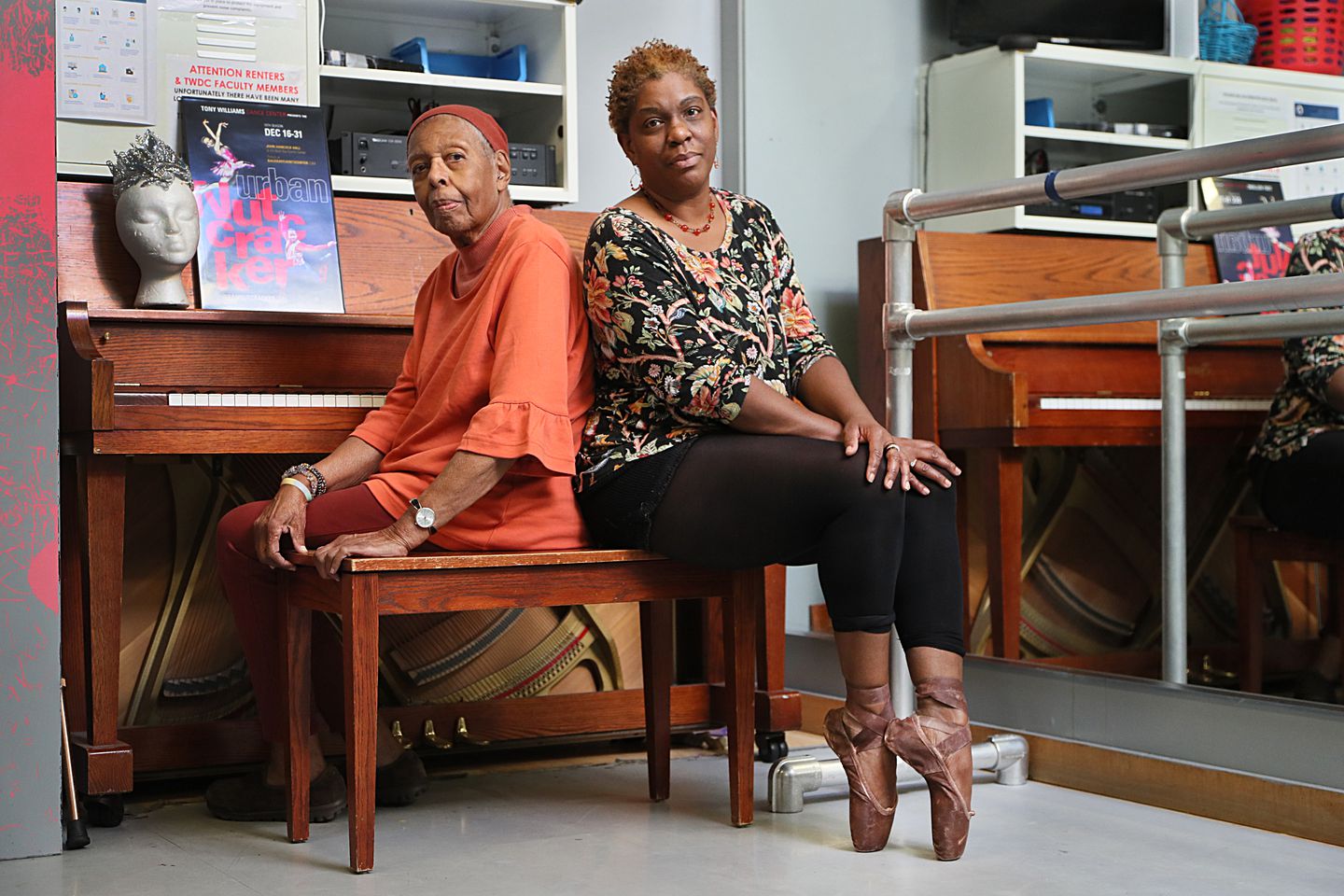
Mother and daughter Afrika Lambe (a pianist), and Erika Lambe (a dancer) talk about their deep roots in Boston arts and their love for the “Urban Nutcracker.

Boston has an unusual dance event at the holidays. It’s called the “Urban Nutcracker.” Some years ago, Kristina and I went to see to a production and really enjoyed it. My understanding is that it’s a little different every year, so I know I need to get back there. Today’s story highlights a mother and daughter who have had a role in preparing young dancers of color to take part both here and in the wider arts world.

The daughter danced with the acclaimed Boston Ballet for 11 years, but says that despite some principal solos there, she finds her current work with young dancers more meaningful.

Karen Campbell reports at the Boston Globe, “Twenty years ago, dancer Erika Lambe became Boston Ballet’s first Black Sugar Plum Fairy in ‘The Nutcracker.’ During much of her time with the company, she was the only Black ballerina.

“Now Lambe is involved with a version of the classic ballet dedicated to putting artists of color front and center. This season, City Ballet of Boston’s production of ‘Anthony Williams’ Urban Nutcracker’ also celebrates a landmark 20th anniversary. Williams’s multicultural twist on the ballet classic, set in present-day downtown Boston, blends the traditional Tchaikovsky score with Duke Ellington’s jazzy version and features dance styles ranging from ballet and flamenco to hip-hop.

“ ‘There’s no other “Nutcracker” like this,’ Lambe says. ‘Its whole intent is to speak to a more diverse audience, unlike the more traditional productions. … Twenty years ago, people in this community wouldn’t even consider going to a ballet, but this has brought them into the theaters and gives kids exposure to dance, ballet in particular. It’s such a holiday tradition.’

“This year, Lambe reprises her role as the Mother in ‘Urban Nutcracker,’ and a role behind the scenes, too, as ballet mistress, running the children’s rehearsals, working with some of the adults in the production, teaching upper-level classes in City Ballet of Boston’s school, and running its introductory Relevé program. She’s also helping in the wardrobe department, refurbishing costumes and making new tiaras.

“Now in her 50s, Lambe, who grew up in Brookline, has been enmeshed in the dance world since she began classes at the age of 4. She says she was never one of those kids who dreamed of being a ballerina, but after seeing a Boston Ballet ‘Nutcracker’ production when she was 6, she was hooked, beginning training with the company as one of only a handful of students of color. ‘I hated ballet, but I wanted to be in “The Nutcracker.” ‘ …

“When she was 10, she says, the ballet master pushed for her to be given the role of Clara. Boston Ballet founder E. Virginia Williams demurred, saying the ballet was a period piece, but she cast Lambe in other challenging roles to showcase her talent.

“At the age of 16, Lambe began her professional career at Dance Theater of Harlem under the legendary Arthur Mitchell, which led to three years of ‘great opportunities.’ Then Edward Villella invited her into the fledgling Miami City Ballet. In 1993, she joined Boston Ballet, dancing with the company until 2004. ‘I did a lot. Jumping was my forte, and I was a quick study. I remember I got thrown into a solo [last minute] in “Raymonda” — and I got a good review!’ she recalls with a delighted laugh.

“Lambe comes by her drive and enthusiasm honestly. Her mother is Afrika Hayes Lambe, a beloved Boston area dance accompanist with an impressive background as a vocal soloist as well. At the age of 88, Afrika is still accompanying ballet classes, known for her expansive memory in repertoire ranging from ballet classics to Broadway tunes.

Erika’s grandfather was the internationally acclaimed tenor Roland Hayes, whose father had been enslaved and was later emancipated. Roland went on to fill concert halls and shatter racial barriers around the world.

” ‘A lot of my grandfather’s history informs me,’ Lambe says, citing Hayes’s tireless fight against racism and inequity to blaze a trail for generations of Black vocalists and become one of the highest-paid recitalists in the world by the 1920s. …

” ‘I had hoped to follow in my grandfather’s footsteps,’ says Erika Lambe. ‘I wanted to be a principal or soloist at Boston Ballet, but it just didn’t happen. I got some principal roles so I did get the opportunities, just not the title. I had a great career dancing … but I feel like maybe what I’m doing now is more meaningful.’

“Williams, a progressive dance educator and former principal dancer with Boston Ballet … says at his own school, Lambe has become an inspiring role model. ‘Students and parents can identify with her,’ Williams says. ‘She really cares about them, and she’s passionate, reliable, professional, and very proactive about getting things done.’

“Lambe who has taught widely in Greater Boston, also currently teaches at Reading’s Northeast School of Ballet and created a program to bring students from the school’s youth company into the upcoming ‘Urban Nutcracker’ production. ‘It’s a great exchange,’ says Williams, ‘a nice bridge between the white suburbs and inner-city kids. … People that come to the show are struck by the diversity onstage. … Our first show happened right after 9/11, now this one’s right after COVID. I hope it offers the community a kind of a salve to help us heal wounds.’ “

More at the Globe, here.

Read Full Post »

Photo: Library of Congress.
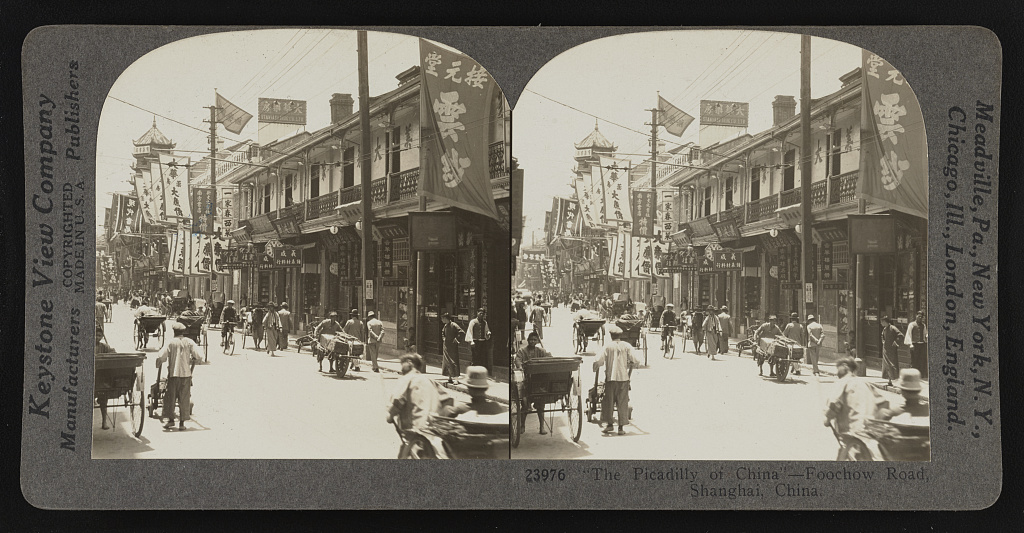
Shanghai in the 1930s.

Something worth remembering as the need for asylum in our world grows every year, is that Shanghai accepted many Jewish refugees in the 1930s, where they joined an already thriving community of Jewish immigrants from Baghdad.

And as most immigrants do, these transplants made valuable contributions to their new country. Today’s story is about one such contribution in Shanghai: an unusual ballet.

Susan Blumberg-Kason writes at the Los Angeles Review of Books, “Jews in Shanghai have been the subject of many memoirs and novels. … Kirsty Manning’s The Song of Jade Lily (2018) and Rachel DeWoskin’s Someday We Will Fly (2019) are two recent novels that tell stories of Jewish refugees who fled to the Chinese city, one of the only places in the world that didn’t require papers back then.

“Other books have told of a Jewish community in Shanghai before the refugees arrived. Taras Grescoe’s Shanghai Grand (2016) and Jonathan Kaufman’s The Last Kings of Shanghai (2020) center around Baghdadi Jewish families like the Sassoons and Kadoories, families that arrived in Shanghai a century before the onset of World War II. …

“Judaism is not a monolithic culture, as the different communities in Shanghai before and during the war show. Besides the refugees and the Baghdadi businesspeople, Shanghai was also home to Jews in the performing arts. Very little has been written about their contributions to Shanghai before the Japanese took over most of the city in 1937.

“These contributions centered around two people: Russian Jewish composer Aaron Avshalomov and American Jewish theater producer Bernardine Szold Fritz. …

“Avshalomov left Russia to study medicine in Zürich before the Bolshevik Revolution. … But by the end of the 1910s, he had decided to leave medicine and the US, and pursue a career in music. He moved to Shanghai.

“At the time, customs in this port city were not administered by Chinese officials, nor was it managed by French, British, or American authorities, all of which held local concessions. Because of these loose arrangements, Shanghai became a refuge for anyone seeking a new home. It attracted Russians fleeing the Bolshevik Revolution and Jews escaping pogroms. In Shanghai, Avshalomov worked with other Jewish musicians.

“Bernardine Szold Fritz was a Jewish actress-turned-journalist who fled three husbands before the age of 30, arriving in Shanghai in 1929 to marry her fourth husband, an American silver broker. Born in Peoria, Illinois, she had acted at Chicago’s Little Theatre before moving to New York and then Paris. …

“In Shanghai, Bernardine started a salon, bringing together Chinese and foreign writers, artists, musicians, and actors. In early 1933, she invited Avshalomov and learned that he had written a ballet, The Soul of the Ch’in, while living in Peking in 1925–’26. The ballet had been performed in Portland, Oregon, in the late ’20s, but had yet to be produced in China.

“Suddenly Bernardine envisioned a new project that inspired her to think beyond her living room. She convinced Avshalomov that the two of them together could produce his ballet right there in Shanghai. Not unfamiliar with the dance world, she was friendly with Ruth Page, the American ballerina, and her partner, Harald Kreutzberg, a German pioneer in modern dance.

“Avshalomov’s experience in China — he had already lived there for almost 15 years — and Bernardine’s theatrical background allowed the duo to bring a ballet to Shanghai that would appeal to all arts enthusiasts, both Chinese and expat. Bernardine also tapped into her connections in Shanghai’s financial, political, and artistic communities. She and Avshalomov knew members of the influential Soong family, including Madame Chiang Kai-shek (or Soong Mei-ling) and Madame Sun Yat-sen (or Soong Ching-ling), both avid patrons of the arts. The performance ran on May 21, 1933, at 9:15 p.m. at the new Grand Theatre. …

The Soul of the Ch’in was possibly the first Chinese ballet performed on a grand scale in China. … The event was even more remarkable because the cast of dancers was all Chinese, as were the set designers, dramaturge, and stage manager. In fact, the only foreigners on the crew were the costume designer and the person managing the lights.”

More at the Los Angeles Review of Books, here. There’s a full description of the ballet’s rather wild plot.

Read Full Post »

Photo: Attributed to Eugène Atget.
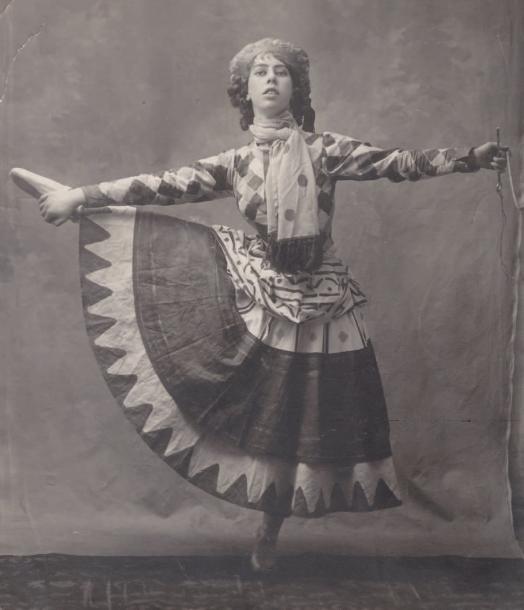
The great ballerina and choreographer Bronislava Nijinska performing in Stravinsky‘s Petrushka.

A sweet text message and a post on Facebook from my mentee reminded me early this morning that it’s International Women’s Day. With her example of accomplishment — and Suzanne’s and my daughter-in-law’s — an old-fashioned grandma like me is starting to pay attention to the issues behind the need for an International Women’s Day.

It isn’t news to me, of course, that women have long taken a back seat, but I have “leaned in” to the idea that one can make a virtue of invisibility. I’d make a good spy.

Even so, I feel a bit outraged that I’d never heard of the subject of today’s post, only her famous brother. Nadia Beard at the Calvert Journal enlightened me.

“Dancer and choreographer Bronislava Nijinska, a Minsk-born Pole, was an instrumental force in redirecting the choreographic cannon towards a vision of process and motion. Despite her pioneering choreography, Nijinska’s legacy is often overshadowed by that of her brother, ballet dancer and choreographer Vaslav Nijinsky. …

“The Nijinsky name, however, does not belong to him alone. In an era where static positions were the marrow of classical dance, Nijinska envisioned a modernist ballet, one which saw focus shift towards the movement which connected these positions.

Ultimately, she believed it was not the final posture that encapsulated the beauty of ballet, but the spaces in between.

“The daughter of two Polish dancers, Bronislava Nijinska was born in Minsk on 8 January 1891, and accompanied her parents to shows across provincial Russia even as a baby. It was through their parents that both Nijinska and her brother, Vaslav, first absorbed dance, learning movements outside of ballet’s traditional canon — Polish folk steps danced by her parents and acrobatics from the circus performers they met on their travels — which would influence the subversive, minimal choreography of their later years.

“Later in life, Nijinska’s contributions to performance and choreography would be dominated by her brother’s, but at the turn of the century, the pair both joined the Imperial Ballet School in St Petersburg, briefly graduating from the Imperial Ballet (now known as the Mariinsky) in 1908 before leaving together for Paris to join the Ballet Russe.

“The radical, itinerant ballet corp, founded by Russia-born arts impresario Serge Diaghlev, became legendary, a crucible for the radical performance that encapsulated the strange daring seen across the artistic spectrum of the time.

“Nijinska helped her brother choreograph some of the Ballets Russes’ earliest controversial works: L’Après-midi d’un Faune, premiered in Paris in 1912, and 1913 ballet Le Sacre du Printemps. Marriage and pregnancy precluded Nijinska from starring in some of Diaghlev’s ballets, much to the dismay of her brother, but where her brother’s creative life was cut short by deteriorating mental and physical health, Nijinska’s endured alongside family life, until she had made her mark on both sides of the Atlantic. …

“Her 1920s treatise on ballet, The School of Movement (Theory of Choreography), now lost to posterity, foregrounded the idea that movement is the essence of dance. Today this seems an obvious point, but it is so only because of the legacy of fringe luminaries like Nijinska; in early 20th century Europe, movement in dance was largely auxiliary, used in service to the final aim of achieving a complete position which could be held and admired. For Nijinska, motion became more important.”

More at the Calvert Journal, here, where you can watch a video of Nijinska’s dark choreography for Stravinsky’s Les Noces. Talk about women’s issues!

Read Full Post »

In one of the Rhode Island English classes where I volunteer, there’s a former soccer pro. I do not know if he’s following this blog, but I would love to hear from any soccer player about the topic for today: ballet for sports agility and strength.

From an article by Toby Bryant in the Irish Times: “It’s November 29th, 2020, and Manchester United are 2-0 down at Southampton. Bruno Fernandes skews a shot goalward, it’s off target. Defeat seems inevitable.

“Out of nowhere, gliding across the box unnoticed with long black locks flowing, Edinson Cavani springs into the air and nods the misfired shot into the back of the net. With movement so stealthy and so swift, you’d easily mistake Cavani for a ballet dancer.

“As it happens, two months earlier the striker had swapped the football boots for the pointe shoes of ballet to train in his homeland of Uruguay at the Ballet Nacional de Sodre (BNS). … The images shared by the ballet company had soccer fans’ heads turning when they emerged. Such a sports star dabbling in ballet may have seemed unheard of, but it wasn’t a new trend.

“In 2017, over in the United States, St Paul Ballet and Element Gym’s boxers formed a partnership. The premise was simple: the ballet dancers box and the boxers dance ballet. Not simply as a social experiment but, for the boxers, to enhance footwork and balance. …

“American Footballer Eddie George spent hours forcing his 245lb body into demi-pliés and spins so it would become second nature on the field. England women’s rugby star Zoe Aldcroft spent her formative years balancing rugby with ballet and is now the Rugby Players’ Association England player of the year. … Former England rugby league international Darrell Goulding now coaches Wigan Warriors’ under-19 squad, another group who have dipped into ballet in the past.

“ ‘The season before we started we had quite a lot of ankle injuries and stability issues, so it was something we were keen to look at.’

Goulding tells the Irish Times, ‘Obviously our lads are not built for some of the ballet work, so a lot of the delicate stuff we didn’t progress to, but we used a lot of the simple drills to focus on that ankle area.’ …

” ‘Pound for pound, ballet dancers are the strongest athletes you will find,’ remarks ballet physiotherapist Luke Abnett, who believes the cross-sport benefits that ballet can offer are evident. ‘In ballet, there’s a need to not only have strength of movement but precision of movement. It’s a combination of the strong movement muscles with the fine-tuning stability muscles. …

“ ‘When you get to more advanced levels of ballet skills, you’re working on jumping, turning, pirouettes, control and rotation,’ Abnett says. ‘Landing in interesting positions and transferring your weight as you move into the next step – all of that would apply to situations like that.’

“Injury prevention is another benefit. While ballet can’t help stop the collisions that come with sports such as rugby and soccer, its muscle development can reduce the risk of any overuse injuries.

“One study compared basketballers, prone to ACL problems, and ballet dancers. Even though dancers would land at more difficult angles, their training meant they suffered far fewer ACL injuries. …

“ ‘Cavani’s movements have always been sharp but at his age and with the physical demands of the Premier League, it’s impressive,’ one fan tells the Irish Times. ‘Cavani’s spatial awareness and manoeuvrings are so incredible, it has me wishing he’d make ballet a thing in the United dressingroom too,’ another admits. …

“As well as the physical benefits, mainstream sports stars are entering the ballet studio to improve mentality and actively combat stereotypes.

“When speaking of his Wigan Warriors youth team, Goulding believes that ‘people only grow when they are outside of their comfort zone.

“ ‘As you can imagine, the idea of these physical rugby lads from tough working-class areas is a total contrast from ballet and how graceful it is. From the first session there was a lot of embarrassment – it wasn’t a comfortable situation for the lads. They grew a lot of respect, even from just trying the basics. They came back really sore and couldn’t believe some of the muscle they used.’ ”

More at the Irish Times, here.

Photo: ESPN.
Manchester United fans’ hopes of seeing … Edinson Cavani dancing through Premier League defenses may be helped by the striker’s passion for ballet,” says ESPN.

Read Full Post »

Photo: Le Lac St Jean.
Jean-Daniel Bouchard (left) in a 2011
Nutcracker. Bouchard now divides his time between ballet and his family’s farm.

I like reading about independently minded people who make surprising decisions that are perfect for them. In this story from Canada, a successful ballet dancer realized during the pandemic that keeping his family farm going is just as important to him as ballet.

CBC has the story. “A farmer in the Saguenay–Lac-St-Jean region of Quebec is striking a fine, if unusual, balance: running his family dairy farm by day and working as a classical ballet dancer by night.

“Jean-Daniel Bouchard started dancing before he turned four, and after high school he decided to try to make a career of it. His dancing took him to Banff, Alberta, British Columbia, Toronto and Montreal. In all, Bouchard spent almost nine years more or less constantly on tour. …

“But eventually, his rural Quebec upbringing as a sixth-generation farmer in St-Bruno started to call him home.

Map: Wikimedia Commons
St-Bruno, Quebec.

“Bouchard told Quebec AM that he was looking for more stability, to settle down, and his two older brothers were not especially interested in taking over the farm.

‘I thought it would be really sad to lose this family treasure,’ he said. ‘So I thought I could do both — I could come back here, start a company and dance, and do the farming with my dad.’

“Bouchard said although his twin passions may seem like something of a contradiction — farming can be gruelling physical labour and involves plenty of financial mathematics, versus an art form that depends on imagination and creativity — they help him find balance.

” ‘I think this is the perfect match for life,’ he said. ‘You have more stable work and then you can let go of the stress with dance.’

“Plus, there are physical benefits. Bouchard said farm work makes him stronger, which helps with his dancing, whereas the repetitive movements and stretching he uses for ballet help him prevent injury in the barn.

“With theatres closed due to the COVID-19 pandemic, Bouchard is both taking and teaching virtual dance classes. …

” ‘We can’t wait for the studios to open again so we can get back into a full dance ballet class, and to be able to move from a space in the studio to the other end,’ he said. …

“Bouchard said he sometimes misses touring and will dream he’s off dancing somewhere else, but he’s happy with the life he chose as both a farmer and a dancer. … ‘The point should be to be happy,’ he said.”

More at CBC, here. I can’t help wondering how Bouchard will manage when his father is no longer able to work. Somehow, I’m confident he’ll figure it out.

Video by Romy Boutin St-Pierre

Read Full Post »

Photo: New York City Ballet Archives.
Maria Tallchief in the title role in George Balanchine’s ballet “Firebird.”

When I was a child, I was taken a couple times to see “The Nutcracker” at the New York City Ballet. I went backstage to see the ballerinas after the show and got autographs on slips of paper that, of course, I managed to lose. I got Patricia McBride. I got Maria Tallchief. Recently, I read an obit about Tallchief that filled in some blanks in her remarkable history.

Jack Anderson reported at the New York Times, “Maria Tallchief, a daughter of an Oklahoma oil family who grew up on an Indian reservation, found her way to New York and became one of the most brilliant American ballerinas of the 20th century, died [in April 2013] in Chicago. …

“A former wife and muse of the choreographer George Balanchine, Ms. Tallchief achieved renown with Balanchine’s New York City Ballet, dazzling audiences with her speed, energy and fire. Indeed, the part that catapulted her to acclaim, in 1949, was the title role in the company’s version of Stravinsky’s ‘Firebird,’ one of many that Balanchine created for her. …

“A daughter of an Osage Indian father and a Scottish-Irish mother, Ms. Tallchief left Oklahoma at an early age, but she was long associated with the state nevertheless. She was one of five dancers of Indian heritage, all born at roughly the same time, who came to be called the Oklahoma Indian ballerinas. …

“She was born Elizabeth Marie Tall Chief on Jan. 24, 1925 in a small hospital in Fairfax, Okla. Her father, Alexander Joseph Tall Chief, was a 6-foot-2 full-blooded Osage Indian whom his daughters idolized. … Her mother, the former Ruth Porter, met Mr. Tall Chief, a widower, while visiting her sister, who was a cook and housekeeper for Mr. Tall Chief’s mother.

“ ‘When Daddy was a boy, oil was discovered on Osage land, and overnight the tribe became rich,’ Ms. Tallchief recounted in ‘Maria Tallchief: America’s Prima Ballerina,’ her 1997 autobiography written with Larry Kaplan. …

“She had her first ballet lessons in Colorado Springs, where the family had a summer home. She also studied piano and, blessed with perfect pitch, contemplated becoming a concert pianist.

“But dance occupied her attention after the family, feeling confined in Oklahoma, moved to Los Angeles when she was 8. The day they arrived, her mother took her daughters into a drugstore for a snack at the soda fountain. While waiting for their order, Mrs. Tall Chief chatted with a druggist and asked him if he knew of a good dancing teacher. He recommended Ernest Belcher.

As Ms. Tallchief recalled in her memoir, ‘An anonymous man in an unfamiliar town decided our fate with those few words.’

“Mr. Belcher, the father of the television and film star Marge Champion, was an excellent teacher, and Ms. Tallchief soon realized that her training in Oklahoma had been potentially ruinous to her limbs. At 12 she started studies with Bronislava Nijinska, a former choreographer for Diaghilev’s Ballets Russes, who had opened a studio in Los Angeles. …

“Tatiana Riabouchinska became her chaperon on a trip to New York City, which, since the outbreak of World War II, had become the base of the Ballet Russe de Monte Carlo, a leading touring company. She joined the troupe in 1942.

“Nijinska, one of its choreographers, cast her in some of her ballets. But Ms. Tallchief also danced in Agnes de Mille’s ‘Rodeo,’ a pioneering example of balletic Americana. It was de Mille who suggested that Elizabeth Marie make Maria Tallchief her professional name. Her sister, who survives her, went on to achieve fame mostly in Europe.

“In the summer of 1944, the entire Ballet Russe de Monte Carlo served as the dance ensemble for ‘Song of Norway,’ a Broadway musical based on the life and music of Grieg, with choreography by Balanchine. And Balanchine remained as a resident choreographer for the company. …

“Balanchine paid increasing attention to Ms. Tallchief, and she became increasingly fond of him, admiring him as a choreographic genius and liking him as a courtly, sophisticated friend. Yet it came as an utter surprise when he asked her to marry him. After careful thought, she agreed, and they were married on Aug. 16, 1946. …

“Balanchine wanted a company of his own. In 1946, he and the arts patron Lincoln Kirstein established Ballet Society, which presented a series of subscription performances; it was a direct forerunner of today’s City Ballet. … Ms. Tallchief was soon acclaimed as one of its stars. …

“Ms. Tallchief remained closely identified with her Osage lineage long after she found fame and glamour in Paris and New York, and she bridled at the enduring stereotypes and misconceptions many held about American Indians. Recalling her youth in her memoir, she wrote of a dance routine that she and her sister were asked to perform at Oklahoma country fairs. …

” ‘It wasn’t remotely authentic,’ she wrote. … The performance ended with Marjorie performing ‘no-handed back-flip somersaults. In the end, [we] stopped doing the routine because we outgrew the costumes. I was relieved when we put those bells away for good.’ ”

More at the New York Times, here, and at the Library of Congress, here.

Read Full Post »

Holidays go on, one way or another. On Friday, our church had an online carol sing (secret of success: only one person unmuted at a time), and I was able to see my grandchildren in two different states mouthing the words and dancing. Someone else I know watched her friend’s son perform (virtually) as the Prince in a local Nutcracker. In Miami, another Nutcracker is taking place outdoors.

Gia Kourlas reports at the New York Times, “Lourdes Lopez, the artistic director of Miami City Ballet, is facing a new unknown. It’s a fear she’s never had. And it stresses her out.

“ ‘I just hope that at the last minute that they don’t close us down,’ she said. …

“Against the odds during a pandemic, the company will present its reimagined production of ‘George Balanchine’s The Nutcracker’ this month. Normally, Ms. Lopez said, her worries would fall more along the lines of, are the costumes going to be ready? …

“Now she is thinking about the backstage choreography of the crew and the dancers, since masks will not be worn during performances. ‘We have to make sure that when you’re exiting, no one is in that wing,’ she said. …

“ ‘The Nutcracker’ ” is more than a beloved holiday staple. For ballet companies across the country it’s a financial lifeline that supports the repertory for the rest of the year. This year, most productions have been relegated to virtual offerings, but Miami has something that some other cities, like New York, don’t: warm weather at holiday time.

“The company’s production of Balanchine’s 1954 classic already pops with an abundance of color and heat. In 2017, it was given a vibrant Miami makeover, with designs and costumes by Isabel and Ruben Toledo and projections by Wendall K. Harrington. …

“Miami City Ballet’s production is, Ms. Lopez noted, a true community effort. ‘Think of a hospital, a government agency, a real estate investment firm and a ballet company somehow coming to the table,’ she said. ‘Never in my wildest dreams would I ever, ever have thought of that.’

“She hadn’t planned for this to happen.

‘This is not because I’m a visionary,’ Ms. Lopez said. ‘It was just opportunities that arose and it came, honestly, from a “What can we do?” ‘ …

“It was Ms. Harrington who, over the summer, suggested to Ms. Lopez that the company should present a ‘Nutcracker.’ … ‘I’m not like the hugest fan of “The Nutcracker” in all the world, but I do know of its healing effects,’ she said. ‘And right now we need a little Christmas, as the song goes.’ …

“The company has teamed up with a health care partner, Baptist Health South Florida, and abides by a stringent testing and safety protocol. Masked audience members will be seated in socially distanced pods that accommodate up to four people each. The intermission has been cut to five minutes — more of a pause — and the idea is to get people in and out efficiently.

“Ms. Lopez credited early actions that the Miami City Ballet organization took when the coronavirus forced a shutdown in March. It quickly formed a Covid task force, which led to engaging an industrial hygienist who examined the studios for safety. …

“Ms. Lopez was able to hold the school’s summer course — an indoor, in-person program for 100 students — for five weeks in July. ‘We were biting our nails because Florida in July was a red-hot state,’ she said. ‘And we didn’t have one single case in those five weeks. We sent the staff home. You couldn’t come into the building if you weren’t part of the school or faculty.

“ ‘And so there was a real sense that we could do this, that we knew how to do it safely in the building. That’s really how it started.”

“When Downtown Doral Park became available, Ms. Harrington refocused her thinking. … ‘I had to look through the ballet and figure out how the storytelling can continue without the numbers of people that you would want in the party scene and the battle scene. … One big change is an Act 2 overture in place of the young children who usually play Angels. For it, she created a journey from the snow scene that ends Act 1 to the beach, ‘because it’s Miami,’ Ms. Harrington said. …

[Ms. Harrington] was always baffled by the abrupt change in setting, from the Act 1 snow scene to Act 2’s tropical Land of the Sweets. ‘It was snowy and now there’s a pineapple onstage,’ she said. … ‘It was within my grasp to fill in the gaps. …

“ ‘I felt like this could be a thrill. I hope I’m right. I believe in theater and art. … I just needed it to happen.”

More here.

Read Full Post »

Older Posts »