Feeds:
Posts
Comments

Posts Tagged ‘book’

Photo: John.

People absorb information differently, so to each his own. I hope today’s attempt to explain scientific differences between reading a book and listening to one doesn’t make you think reading is necessarily better than listening. We all know the vital importance of being read to as a child.

Let’s see what Stephanie N. Del Tufo, assistant professor of education & human development at the University of Delaware, has to say at Science Alert, via the Conversation.

“As a language scientist, I study how biological factors and social experiences shape language. My work explores how the brain processes spoken and written language, using tools like MRI and EEG.

“Whether reading a book or listening to a recording, the goal is the same: understanding. But these activities aren’t exactly alike. Each supports comprehension in different ways. Listening doesn’t provide all the benefits of reading, and reading doesn’t offer everything listening does. Both are important, but they are not interchangeable.

“Your brain uses some of the same language and cognitive systems for both reading and listening, but it also performs different functions depending on how you’re taking in the information.

“When you read, your brain is working hard behind the scenes. It recognizes the shapes of letters, matches them to speech sounds, connects those sounds to meaning, then links those meanings across words, sentences and even whole books. The text uses visual structure such as punctuation marks, paragraph breaks or bolded words to guide understanding. You can go at your own speed.

“Listening, on the other hand, requires your brain to work at the pace of the speaker. Because spoken language is fleeting, listeners must rely on cognitive processes, including memory to hold onto what they just heard.

“Speech is also a continuous stream, not neatly separated words. When someone speaks, the sounds blend together in a process called coarticulation. This requires the listener’s brain to quickly identify word boundaries and connect sounds to meanings.

“Beyond identifying the words themselves, the listener’s brain must also pay attention to tone, speaker identity and context to understand the speaker’s meaning.

“Many people assume that listening is easier than reading, but this is not usually the case. Research shows that listening can be harder than reading, especially when the material is complex or unfamiliar.

“Listening and reading comprehension are more similar for simple narratives, like fictional stories, than for nonfiction books or essays that explain facts, ideas or how things work. My research shows that genre affects how you read. In fact, different kinds of texts rely on specialized brain networks.

“Fictional stories engage regions of the brain involved in social understanding and storytelling. Nonfiction texts, on the other hand, rely on a brain network that helps with strategic thinking and goal-directed attention.

“Reading difficult material tends to be easier than listening from a practical standpoint, as well. Reading lets you move around within the text easily, rereading particular sections if you’re struggling to understand, or underlining important points to revisit later.

“A listener who is having trouble following a particular point must pause and rewind, which is less precise than scanning a page and can interrupt the flow of listening, impeding understanding.

“Even so, for some people, like those with developmental dyslexia, listening may be easier. Individuals with developmental dyslexia often struggle to apply their knowledge of written language to correctly pronounce written words, a process known as decoding. Listening allows the brain to extract meaning without the difficult process of decoding.

“One last thing to consider is engagement. In this context, engagement refers to being mentally present, actively focusing, processing information and connecting ideas to what you already know.

“People often listen while doing other things, like exercising, cooking or browsing the internet – activities that would be hard to do while reading. When researchers asked college students to either read or listen to a podcast on their own time, students who read the material performed significantly better on a quiz than those who listened.

“Many of the students who listened reported multitasking, such as clicking around on their computers while the podcast played. This is particularly important, as paying attention appears to be more important for listening comprehension than reading comprehension. …

“Each activity offers something different, and they are not interchangeable. The best way to learn is not by treating books and audio recordings as the same, but by knowing how each works and using both to better understand the world.”

More at the Conversation, here.

Read Full Post »

Photo: Maxine Wallace/The Washington Post.
Books with decorated page edges (spredge) are becoming increasingly popular.

Although I always liked the designs on the edge of pages in fancy, old-time books, I never thought about all the ways you can use so-called “spredges” to convey the appeal of your book in the bookshop.

Sophia Nguyen writes at the Washington Post that the phenomenon has recently gained adherents.

“Sumptuous fore-edges — sprayed a bright color, stenciled with city skylines, made to look like pointy teeth — used to be relatively rare. But in recent years, publishers have brought decorated edges to the masses. Edge-painted books are now so widespread that you can find them at Walmart. The feature has spread from romance and fantasy to horror, thrillers and even literary fiction; it’s spread from works by famous authors with ravenous followings to those by debut novelists hoping to make a splash. It even has a (horrifying) portmanteau: spredges. On social media, readers show off floor-to-ceiling shelves crammed full of these books — spines facing inward, of course.

“Jim Sorensen, president of Lakeside Book Company, the largest book manufacturer in North America, recalled the time a decade ago, when a colleague brought back edge-printing samples from a work trip to Europe. ‘Honestly, there wasn’t a whole lot of interest’ from clients, Sorensen said. Times have changed. …

“The surge was driven by a few corners of the publishing world. Subscription companies, such as LitJoy Crate and Illumicrate, seeded interest (and a sense of exclusivity) among readers as they printed relatively small runs that quickly sold out. Self-published authors, selling special editions of their books on their personal websites or at conventions, also helped to popularize the look. This prompted publishers to invest in the trend. When, in 2023, Bloom Books sprayed the pages of Elle Kennedy’s Off-Campus novels in powder blue, the set hit the bestseller lists — an unusual success for a collector’s bundle. …

“Barnes & Noble, after seeing the trend take off with the exclusive editions sold by its sister chain Waterstones, now devotes an entire section of its website to decorated, stenciled and sprayed edges. Decorated edges have ‘developed into an extension of the book experience itself,’ said Shannon DeVito, director of books at Barnes & Noble.

“The printed-edge craze has also opened up a new business niche. Inspired by DIY videos, Stephanie Moreno launched an edge-painting service this year, including live painting at author events. What, after all, could be more limited than an edition only offered at a single local signing? …

“For designers, the edge gives a whole new surface to play with and another opportunity to make a book recognizable. ‘From a creative standpoint, it’s thrilling,’ said Molly Waxman, executive director of marketing for adult fiction and nonfiction at Sourcebooks. Logistically, there were some kinks to work out, she added — such as building in time for ink to dry, so pages don’t curl unattractively.

“As printed edges have flooded into stores, ramping up the competition for eyeballs, ‘the bigger race is being able to manage all of these specs and still hold a price point that’s not going to be so difficult for a consumer,’ [Bloom editorial director Christa] Désir said. …

“When, in the 1500s, people in the English-speaking world started storing their books upright and on shelves — moving them from chests and lecterns — they stored them just as many TikTokers do: with pages facing out. Title information was printed there in ink, said Mark Purcell, director for research and collections at Cambridge University’s libraries and archives.

“Then, starting around the early 1600s in England, modish bookbinders started gilding titles on the spines of books, and so collectors started to reverse their displays. The practice spread gradually and unevenly over a century-and-a-half in what’s called ‘the Great Turnaround.’ 

“ ‘It depends where you are, how up-to-date you are, how fashionable you are, how wealthy you are, what your library is like, all sorts of things,’ Purcell said. …

“He did note one possible practical consideration favoring the old way: Some libraries threaded chains through their collections for security reasons, and the system only worked with the pages facing out.”

More at the Post, here.

Read Full Post »

Photo: Meriem Belhiba.
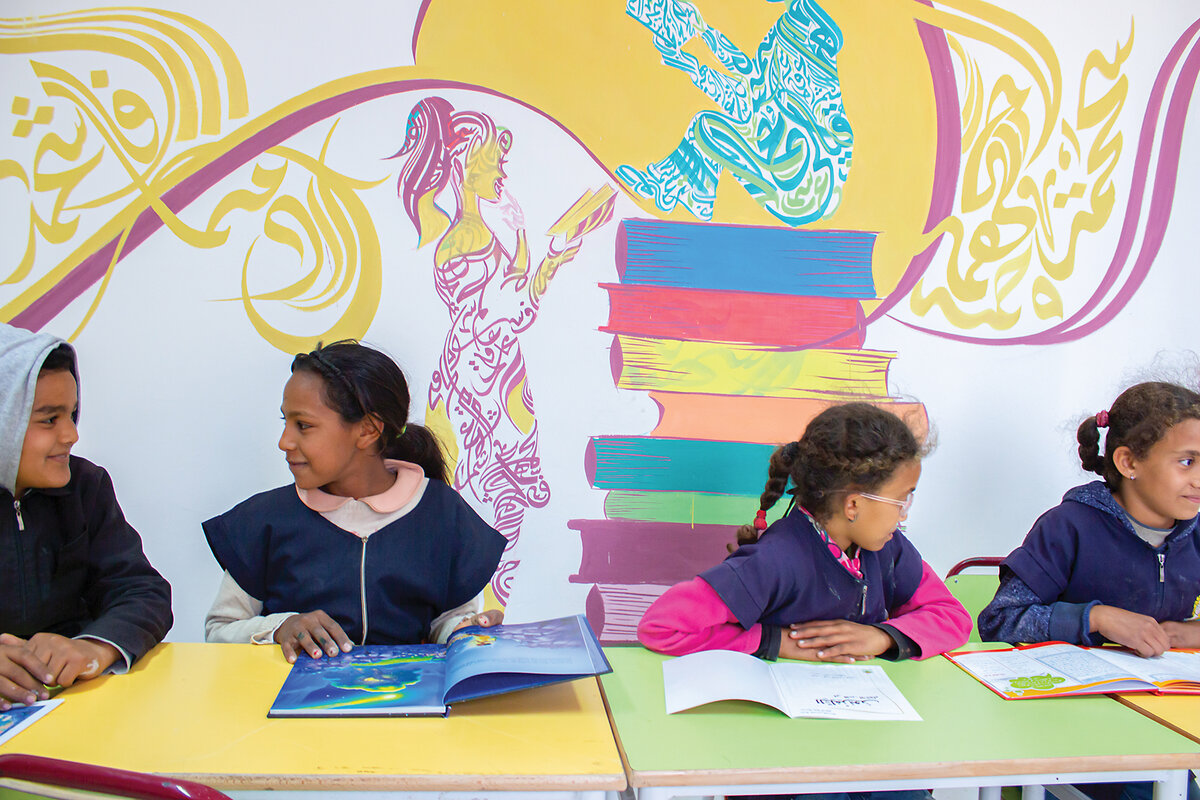
Girls explore colorful storybooks in the newly inaugurated library at Bir El Euch Primary School in Tunisia.

Meriem Belhiba wrote this story for the Christian Science Monitor.

“To children in this hilltop village, their school library is a portal to another world.

“Israa Al Trabelsi and five other 9-year-olds barely stifle their giggles as they weave – wide-eyed with curiosity – through the colorful room. They can plop down into cushioned chairs, look at bright wall art, and, of course, browse shelves bursting with books. The transformative space was built for children to dream in.

“ ‘I’ve learned so much,’ Israa says after taking a seat with a book about faraway lands in her hands. ‘It is also helping me improve my vocabulary and my writing,’ she notes, quickly adding, ‘I want to be a judge.’

“That might seem an unusual ambition for a child in Bir El Euch, a rural community of 1,600 people southwest of Tunisia’s capital, Tunis. But it makes sense when one learns that the man behind the library, Omar Weslati, is himself a judge who knows how precious books can be to children. ‘This project began as a way to reconcile with the child I once was, who had nothing,’ he says.

“Economic inequality has long been a challenge in Tunisia, a country of 12 million people. Widespread poverty in rural areas, high unemployment, and poor infrastructure were key triggers behind the 2011 mass protests that toppled a 23-year dictatorship and touched off the Arab Spring uprisings. …

” ‘I grew up in a rural school without a library, without light, without transportation, and without heating,’ Judge Weslati recalls. ‘As a bookworm, I needed to walk long distances to reach the nearest public library.’

“Launched in 2016, the initiative is led by white-collar professionals, most of whom hail from rural communities. These journalists, writers, judges, and teachers have chipped in funding to create a new library every year. Each one serves hundreds of students and takes thousands of dollars to complete.

“The project’s launch could not have been timed better. The first ‘imagination libraries,’ as they were initially called, were built in the aftermath of the violent extremism that accompanied the Arab Spring. Amid the waves of unrest that ensued across the region, Tunisia has been the biggest contributor of foreign fighters in the world – with Tunisians joining extremist groups in Syria, Libya, Iraq, and elsewhere.

“This was a factor behind the library initiative. ‘Where the book doesn’t reach, the extremist arrives first,’ Judge Weslati says. …

“Besides offering books as a source of inspiration, Judge Weslati’s team began visiting remote schools and sharing members’ personal stories. ‘We wanted to show kids that people from their own soil once dreamed, created, and contributed,’ he says.

‘We never saw this as charity; it’s about cultivation,’ he adds. ‘Planting stories where they hadn’t taken root before.’

“Beyond reading, the initiative led to something more: a writing club for rural youths. Teenagers craft short stories together and publish their work. One of the teens, Molka Hammami, credits her former teacher Jamila Sherif for lighting a spark in her.

“ ‘Reading changed my life,’ Molka says. ‘It pushed me to do more. I was published in the [club’s] collective storybook last year.’ Now she helps run a radio show for the club.

“Ms. Sherif, who has since become a school inspector, emphasizes the stakes. ‘Many kids drop out after primary school,’ she says. … ‘We’re trying to change that – one library, one book at a time.’”’

“Reports have shown that, despite declining school dropout rates across Tunisia, the problem is most acute in rural areas. Donia Smaali Bouhlila, an expert on educational inequality at the University of Tunis El Manar, says inadequate schools and infrastructure in rural areas are among the biggest reasons that students drop out.

“ ‘When learning spaces lack comfort, resources, or consistency, they stop being places of growth and become sources of alienation,’ she says. ‘Every small success – helping a child learn to read, keeping a teenager engaged – represents a meaningful step forward.’

“Safahat, a cultural organization whose name translates to ‘pages’ in Arabic, aimed to serve schools when it was founded in 2020 [but] faced logistical and financial hurdles because of the region’s remoteness. This prompted its team to pivot to a more mobile model: public bookcases. …

“Through its Maktabtena (‘our library’) initiative, the group placed red-and-white boxes of books in hospitals, youth centers, and schools, and on street corners. … Readers are invited to take a book, read freely, and donate their own books if they can. ‘We want to make reading a habit, not a luxury,’ [Khawla Mondhri, a university professor and volunteer leading the initiative] says. ‘If someone takes a book and doesn’t return it, that just means it’s being read somewhere else. ‘And that’s enough for us.” …

“So far, the team has installed 35 bookcases in accessible, safe, and visible spots. To ensure a bookcase is never empty, the team has formed partnerships with municipalities, associations, and individuals.

“ ‘We send books as often as needed. We plant small oaks,’ Ms. Mondhri says. ‘But we dream of forests.’ ”

More at the Monitor, here.

Read Full Post »

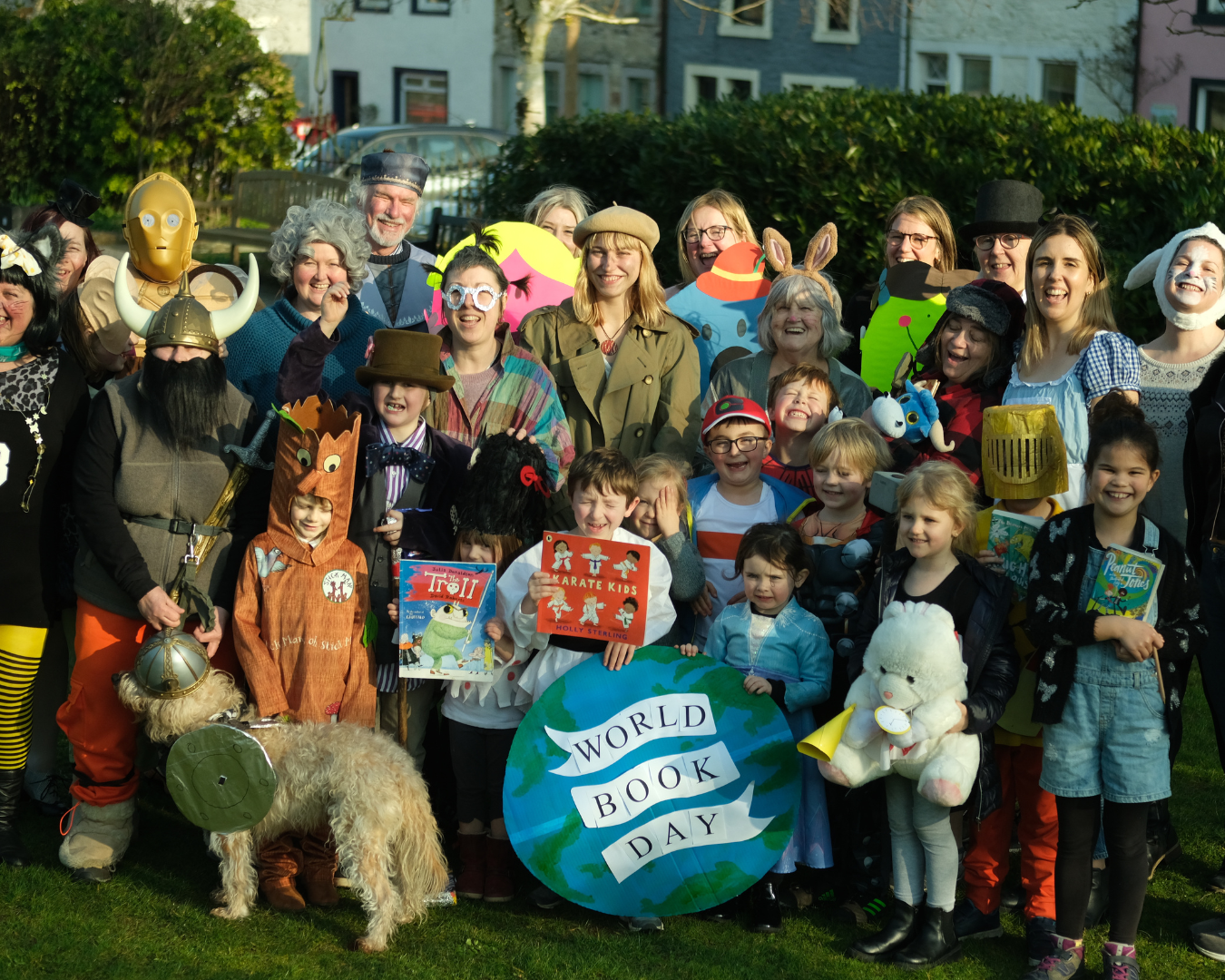
Photo: Wigtown, Scotland, Book Festival.

Book lovers who are traveling this year may want to think about visiting one of the “book towns” profiled recently in National Geographic. Ashley Packard collected seven that sound charming.

“1. In the Welsh village of Hay-on-Wye, where sheep outnumber people and books spill onto the streets, a quiet revolution began. Antiquarian and academic Richard Booth inadvertently launched a global movement when he began filling the empty buildings of Hay-on-Wye with secondhand books.

“What started as a single decision in 1961 to fill his sleepy hometown with secondhand books to sell in numerous empty buildings, turned into the birthplace of a global literary mecca uniting villages, bibliophiles, and dreamers alike. …

“Hay-on-Wye became the first ever ‘book town,’ supporting patrons who flocked to the shops. Booth, who crowned himself ‘King of Hay,’ inspired others to turn literature into lifelines for their little towns and villages. As word of his success spread, more towns around the world embraced the concept for their communities. Before long, the International Organization of Book Towns was formed in April 2001, though it had existed without the official designation for decades prior.

“The organization aims to raise public awareness of book towns through online information and a biennial International Book Town Festival. It supports rural economies by facilitating knowledge exchange among booksellers and businesses, encouraging the use of technology, and helping to preserve and promote regional and national cultural heritage on a global scale.

“By definition, a book town is ‘a small, preferably rural, town or village in which secondhand and antiquarian bookshops are concentrated.’ … Today, there are dozens of towns with the designation, from Pazin, Croatia, to Featherson, New Zealand. These selected and approved locations take pride in their history, scenic beauty, and contributions to the literary world. …

“2. In a small village tucked away in the hilly countryside of Belgium, Redu is now celebrating its 41st anniversary since becoming the second book town in 1984. This idyllic village is described as, ‘fragrant with the scent of old paper.’ … It, along with its hamlets Lesse and Séchery, were recently added to the ‘Most Beautiful Villages in Wallonia‘ list in July 2024.

“3. [In Scotland] nestled on a hill overlooking the sea along a rugged coastline, woodlands, and forests, lies Wigtown, celebrating 20 years as ‘Scotland’s Book Town.’ … It has 16 different types of book shops, many secondhand, that participate in an annual Spring Weekend in early May, a community festival in July, a market every Saturday from April through late September, and the annual Wigtown Book Festival in late September through early October. The 10-day literary celebration was founded in 1999 and now features more than 200 events, including music, theater, food, and visual arts. 

“4. Turup [in Denmark] is situated 37 miles north of the Danish capital of Copenhagen, between the sea and a fjord, and has a population of 374 people. Here, locals put out the best and most high-quality secondhand books from donations out for sale along the rural roads of the 10 different shops (if you can call them that) for purchase. These ‘bookshops’ include a garage, a workman’s hut, a disused stable, a bookshelf on a farm entrance, and even a newly restored railway station. Some of these stalls process transactions on a self-help and honesty basis where customers leave their change in a jar in exchange for their purchases. The Torup Book Town Association hosts an annual Nordic Book Festival with book readings from authors, contemporary short films, cultural events, and more. 

“5. Surrounded by stunning landscapes, rolling hills, and vineyards is the quaint town of Featherston [New Zealand] … became officially recognized as a book town in 2018. It is famously known for the annual book festival held in May. They have initiatives dedicated to fostering community growth, inspire reading, writing, and idea-sharing across Wairarapa and Aotearoa, New Zealand.

“6. Offering year-round bookstalls and literary festivals, the village of St-Pierre-de-Clages is home to Switzerland’s only book village. ‘Le Village Suisse du Livre,’ translated to ‘The Swiss Book Village,’ is home to a large secondhand market, along with authors, thematic exhibitions, activities for children, and a renowned Book Festival that has been hosted every last weekend of August since 1993. … This festival takes place over three days and attracts visitors from all over French-speaking Switzerland and neighbors. It offers insight into book professions such as calligraphy and old printing techniques, a welcoming space for writers and publishing houses to meet, and various artists to display their work.

“7. The former garrison town of Wünsdorf [in Germany] is known as ‘book and bunker city’ due to the historical sites, buildings, book shops, cafes and tea rooms, and lively cultural life. Nestled about 12 miles south of Berlin, the town offers year-round events, readings, exhibitions, military vehicle meetings, and currently five different bunker and guided tours. Wünsdorf was established as an official member of the International Organization of Book Towns in 1998 thanks to its three large antiquarian shops that boast of a wide array of literary treasures on topics such as poetry, philosophy, classical literature, and many more.”

More at National Geographic, here. Great photos, as you would expect from National Geographic.

Read Full Post »

Photo: Jaida Grey Eagle/Sahan Journal.
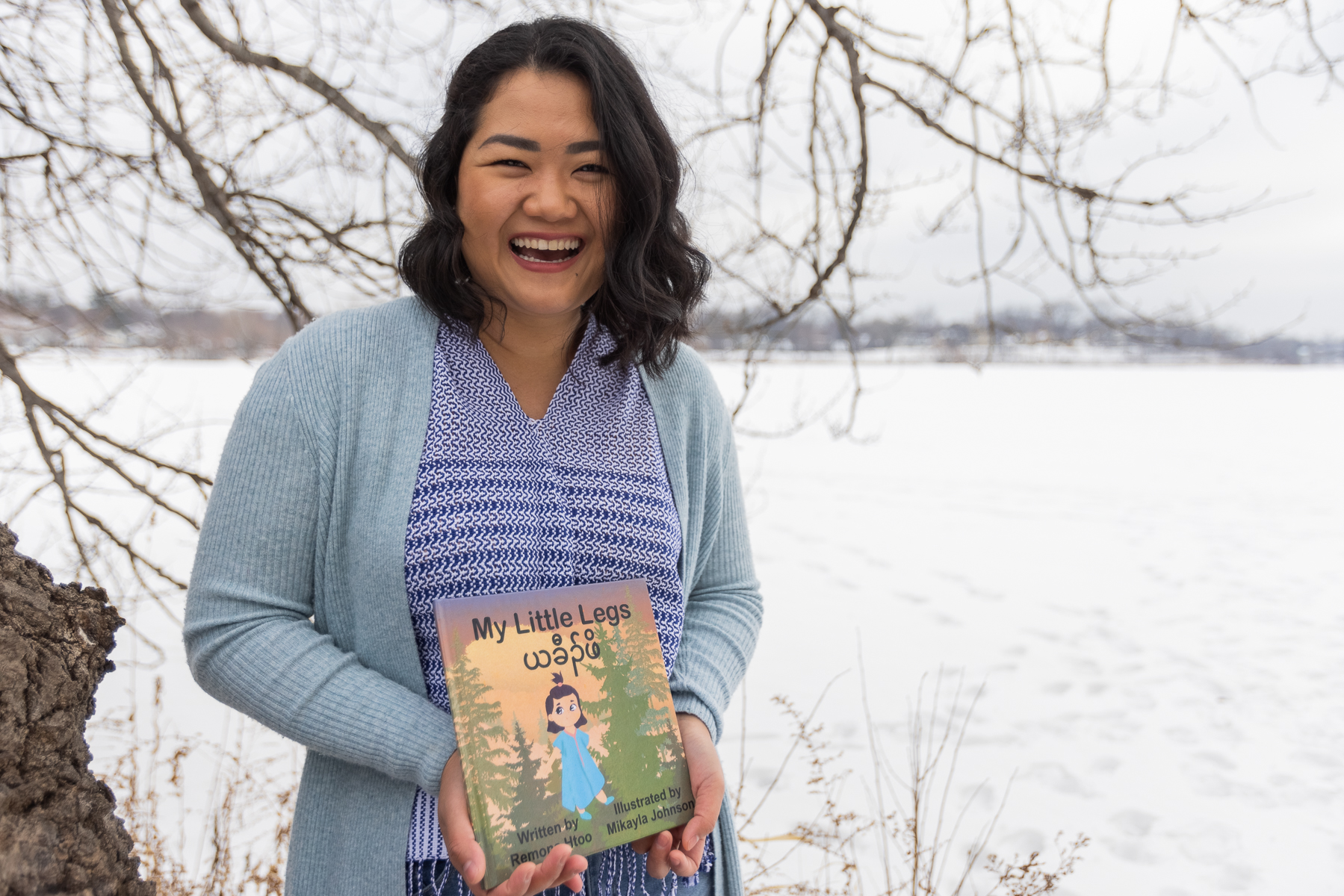
Remona Htoo, an immigrant from Mynamar (Burma), with her book My Little Legs at Como Lake in St. Paul, MN on January 13th, 2021. (Minnesota in January? She must be freezing!)

Since 2016, I’ve had the privilege of meeting people from vastly different cultures as I volunteer to help teachers in English as a Second Language classes, currently online.

Right now, I’m thinking of one woman who was originally from Myanmar (Burma) and who spent many years in a refugee camp in Thailand. She eventually landed in Rhode Island with her husband and children. It was there that I met her.

Myanmar is unfortunately known mostly for brutal military rule and suppression of rights activists and minorities. Among those minorities are the Karen people. I knew a little about them, but had not met any until the ESL class. There is good reason to believe that their language and culture are in danger of being lost, particularly as English becomes the primary language for their children.

Andrew Hazzard has a story on a Karen woman who decided to do something about that. The article was published at Sahan Journal, “the only independent, 501(c)(3) nonprofit digital newsroom fully dedicated to providing authentic news reporting for and with immigrants and communities of color in Minnesota.”

Hazzard writes, “Remona Htoo didn’t have any children’s books growing up. Now, she’s publishing one of her own. 

“Htoo was born into a Karen family fleeing the civil war in Myanmar. She spent 10 years in a refugee camp in Thailand before her family resettled in Idaho, in 2007. At the time, the 12-year-old spoke no English. 

“Refugees don’t choose where in the U.S where they end up. A significant population of Karen people came to Minnesota, but only 20-odd families landed in Idaho, Htoo said. …

“While attending college at a small Christian university, she began taking trips to the Sawtooth Mountains, where she fell in love with the landscapes of mountains, pine trees, and clear lakes. 

“ ‘It was me trying to cope with stress, trying to cope with the trauma I had. It was a healing mechanism for me,’ Htoo said. 

“Ten years ago, she met a young Karen man online who lived in St. Paul: More than 17,000 Karen people live in the city and neighboring Maplewood. The two shared early childhood experiences in the refugee camps and struck up a relationship. Now, the two are married, with a 22-month-old daughter, Emma, and live in St. Paul’s east side. 

“Htoo, 27, began taking her daughter on outdoor adventures: backpacking and camping in the summer; and sledding in the winter. The family goes near and far to experience nature. … In the summer, the family hits the road to visit national parks like Glacier, in Montana. Emma has already seen 10 national parks — more than many adults. …

“ ‘After I became a mom, I realized there are no children’s books in Karen,’ she said. ‘I wanted to read a book in Karen for my daughter.’ 

“So, Htoo took action. She wrote and self-published My Little Legs, a book she said is about ‘being outdoors and what your little legs can do.’  Emma, her daughter, served as inspiration for the main character. She wears a traditional Karen shirt in the illustrations, created by local artist Mikayla Johnson. The book is bilingual, with English and Karen script. 

“There are very few children’s books, or books in general, published in Karen in the United States, and much of what exists originated in St. Paul. … St. Paul Public Library recognized the need for more Karen language literature. The library system has published three children’s books in Karen since 2015, according to spokesperson Stacy Optiz. The most recent is Children’s Stories, a collection of five traditional Karen folk stories, released in 2021.

My Little Legs targets families with children ages 1–3. In compiling the tale, Htoo looked back at Emma’s own development milestones, like learning to crawl and walk. She also wanted to create an outdoor adventure story that featured southeast Asian characters, and to inspire a curiosity about the Karen people for other American readers. 

“ ‘I don’t think people think we are the outdoor type,’ Htoo said. 

“People of color make up about 20 percent of Minnesota’s population, but only 5 percent of state park users, according to Minnesota Department of Natural Resources data. Many Minnesotans of color feel isolated in outdoor spaces. In response, groups like BIPOC Outdoors Twin Cities emerged, where people can find diverse friends to hit the trails or go fishing.” 

Readers can order Htoo’s book by emailing NawHaChu@gmail.com. More at Sahan Journal, here.

Read Full Post »

image

Photos: Lebrecht Music & Arts / Alamy Stock; Getty/whitemay
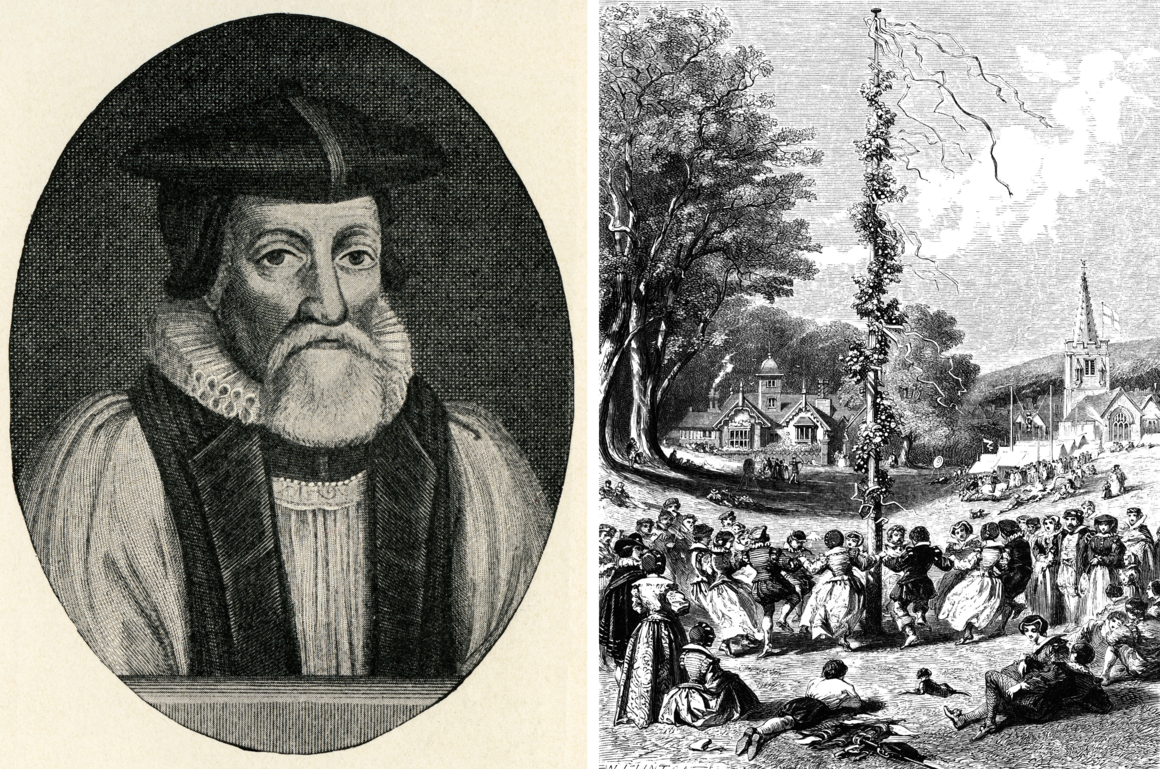
Unlike the Puritans he lived among, Thomas Morton loved nature, local tribes, and pagan traditions like dancing around the maypole. The Puritans banned a book book he wrote — the first banned book in America. 

Today we joke about Boston and its “Banned in Boston” moniker. We criticize other communities that ban books they believe threaten local morals. People have always tried to address threats they believe are posed by certain ideas. Even now we argue about the best way to keep fake news off social media. But who is to decide? I hope we don’t think government officials — whether they’re currently the ones we voted for or not —  are capable of deciding.

Let’s take a look at an old controversy over America’s first banned book.

Matthew Taub writes at Atlas Obscura, “Apparently, Thomas Morton didn’t get the memo. The English businessman arrived in Massachusetts in 1624 with the Puritans, but he wasn’t exactly on board with the strict, insular, and pious society they had hoped to build for themselves.

“ ‘He was very much a dandy and a playboy,’ says William Heath, a retired professor from Mount Saint Mary’s University who has published extensively on the Puritans. …

“Within just a few short years, Morton established his own unrecognized offshoot of the Plymouth Colony, in what is now the town of Quincy, Massachusetts (the birthplace of presidents John Adams and John Quincy Adams). He revived forbidden old-world customs, faced off with a Puritan militia determined to quash his pagan festivals, and wound up in exile.

“He eventually sued and, like any savvy rabble-rouser should, got a book deal out of the whole affair. Published in 1637, his New English Canaan mounted a harsh and heretical critique of Puritan customs and power structures that went far beyond what most New English settlers could accept. So they banned it — making it likely the first book explicitly banned in what is now the United States. …

“The Puritans’ move across the ‘pond’ was motivated by both religion and commerce, but Morton was there only for the latter reason, as one of the owners of the Wollaston Company. He loved what he saw of his new surroundings, later writing that Massachusetts was the ‘masterpiece of nature.’ His business partner — slave-owning Richard Wollaston — moved south to Virginia to expand the company’s business, but Morton was already deeply attached to the land. …

‘He was extremely responsive to the natural world and had very friendly relations with the Indians,’ says Heath, while ‘the Puritans took the opposite stance: that the natural world was a howling wilderness, and the Indians were wild men that needed to be suppressed.’

“After Wollaston left, Morton enlisted the help of some brave recruits — both English and Native — to establish the breakoff settlement of Ma-Re Mount, also known as Merrymount. …

“The Puritan authorities didn’t see Merrymount as a free-wheeling annoyance; they saw an existential threat. The problem wasn’t only that Morton was taking goods and commerce away from Plymouth, but that he was giving that business to the Native Americans, including trading guns to the Algonquins.

“With Plymouth’s monopoly dissolved and its perceived enemies armed, Morton had perhaps done more than anyone else to undermine the Puritan project in Massachusetts. Worse yet, in the words of Plymouth’s governor William Bradford, Morton condoned ‘dancing and frisking together’ with the Native Americans . … Governor Bradford nicknamed Morton the ‘Lord of Misrule.’

“There could be no greater symbol of such misrule than Morton’s maypole. … Throughout medieval Europe, maypoles had been a popular installation for May Day (or Pentecost or midsummer, in some regions) — encouraging human fertility as the land itself sprung up from winter. Now that was a tradition that Morton could get behind, and he gladly called upon the residents of Merrymount to drink, dance, and frolic around the pole. The establishment of Merrymount had been a provocation, but Morton’s May Day celebrations meant war.”

What happened next? Find out at Atlas Obscura, here.

Read Full Post »

Photo: Nederlandse Spoorwegen
A special book given out as gift to readers during National Book Week is accepted instead of a ticket on the train.

The Dutch seem to be ahead of the curve on many things. I’ve posted about their friendly communities for people with dementia, about their environmental innovation, about their biking culture. This story is on their support for reading books.

Jon Stone writes at the Independent, “Dutch book lovers got free rail travel across their country’s entire network [in March] as part of the Netherlands’ annual book week celebrations.

“Every year since 1932 the Netherlands has encouraged reading with Boekenweek – a celebration of literature marked with literary festivals and book signings across the country.

“Traditionally, a well-known Dutch author writes a special novel – the ‘book week gift’ or Boekenweekgeschenk – which is given out for free to people who buy books during the festivities or sign up to a library.

“But the special book – this year the novel Jas Van Belofte by celebrated author Jan Siebelink, can also be presented instead of a rail ticket on every train in the country on the Sunday of book week.

“Nederlandse Spoorwegen (NS), the Dutch state railway company, has long been a sponsor of the annual festivities – and even organises book readings signings by top authors on its trains.

” ‘It is good to see all those happily surprised faces of travellers,’ author Jan Siebelink said after boarding a train for the city of Utrecht to meet passengers and read his book. …

“This year the book week gift was given out by bookshops to anyone who spent €12.50 on Dutch-language books.” More here.

And check out this cool article by Feargus O’Sullivan at CityLab, in which he describes a wide array of unusual ways to pay fares — ideas from all around the world.

Because of a problem with rail passes, he writes, England’s Virgin Trains let people pay with an avocado for a while. And “Indonesia’s second city, Surabaya, came up with a novel way of clearing its streets of plastic waste last autumn: It has been encouraging passengers to trade in trash for bus tickets.”

Among other creative approaches, Russia promoted the Winter Olympics by offering passes for doing a certain number of squats, Berlin partnered with Adidas to offer sneakers with a pass in the tongue, and Japan started experimenting with cryptocurrency.

Can you think of other ideas cities should try? Maybe on Giving Tuesday, transit systems could allow free travel for proof you gave to a charity.

Read Full Post »

Oh, I do love kindhearted stealth projects. This worldwide campaign promotes reading. Chayanit Itthipongmaetee filed a report about it at KhaosodEnglish in Thailand.

“ ‘A Little Prince’ was hiding at BTS Siam [Bangkok Transportation System, or Skytrain]. A ‘Cat in the Rain’ was discovered at BTS Sala Daeng. …

“Fairies hid copies of these books and more in public places [in early August] as a local launch of The Book Fairies project, an international initiative in which people leave texts for others to discover in cities around the world. After readers finish a book, they are supposed to pass it on to others.

“One of the Bangkok book fairies said she learned about the book-drop project a few days before attending Saturday’s TedxBangkok. At the event held inside the KBank Siam Pic-Ganesha Theatre, she sneakily dropped five copies of best-selling memoir ‘Tuesdays with Morrie.’

“ ‘I was really excited for my first book drop, hiding one book at a time, mostly on breaks throughout the event,’ said the woman. …

“She was delighted to hear from one of her book beneficiaries a day later.

“ ‘Dear #bookfairies, I found this at #TEDxBangkok and took it home with me. I don’t know who you are but thank you for passing it on,’ wrote Facebook user Awm Has Standards. …

“Asked what kind of books she wants Thais to read more, the Bangkok book fairy said it would be literary publications for youths.

“ ‘This might sound strange, but I would love to recommend everyone to read English children’s books. … They are doors to creativity, language learning and life lessons. With or without pictures, the exciting stories for children always allow you to be free with your imagination and color them wild. They are also a good start for those who want to practice English.’

“The Book Fairies campaign was originally launched March 8 on International Women’s Day. The campaign became world-famous when British activist and actress Emma Watson, best known as Hermione Granger in the ‘Harry Potter’ film franchise, left copies of books with feminist themes around cities such as London, Paris and New York.”

More here.

Photo: The Book Fairies Thailand / Facebook

littleprince-420x420

Read Full Post »

Image: NPR Multimedia/AP Photo
Purple, Prose: The new book Nabokov’s Favorite Word is Mauve subjects thousands of books to statistical analysis.

Nabokov’s favorite word is mauve. That is actually the name of a book by statistician Ben Blatt.

Glen Weldon reviewed it at National Public Radio’s Morning Edition. Blatt, he reports, “loaded thousands of books — classics and contemporary best-sellers — into various databases and let his hard drive churn through them, seeking to determine, for example, if our favorite authors follow conventional writing advice about using cliches, adverbs and exclamation points (they mostly do); if men and women write differently (yep); if an algorithm can identify a writer from his or her prose style (it can); and which authors use the shortest first sentences (Toni Morrison, Margaret Atwood, Mark Twain) versus those who use the longest (Salman Rushdie, Michael Chabon, Edith Wharton). …

“Blatt’s book isn’t terribly interested in the art of writing. What it’s fascinated by — and is fascinating about — is the craft of writing.

“Technique. Word choice. Sentence structure. Reading level. There’s something cheeky in the way Blatt throws genre best-sellers into his statistical blender alongside literary lions and hits puree, looking for patterns of style shared by, say, James Joyce and James Patterson. …

“Blatt looked for the specific words that authors use much more frequently than the rate at which those words generally occur in the rest of written English (i.e., compared to a huge sample of literary works — some 385 million words in total — written in English between 1810 and 2009, assembled by linguists at Brigham Young University). …

“Here’s some that jumped out at me. Jane Austen: civility, fancying, imprudence … Dan Brown: grail, masonic, pyramid. … Truman Capote: clutter, zoo, geranium. John Cheever: infirmary, venereal, erotic … Agatha Christie: inquest, alibi, frightful. F. Scott Fitzgerald: facetious, muddled, sanitarium. Ian Fleming: lavatory, trouser, spangled … Ernest Hemingway: concierge, astern, cognac … Toni Morrison: messed, navel, slop.”

For many people, doing this to literature would be off-putting, but to me it is interesting. And fun. One of the reasons a favorite mystery writer, Eliot Pattison, stopped being my favorite was that I got bored with everyone who got hurt “moaning.”

Check out Weldon’s favorite findings from the book at NPR, here.

Read Full Post »

We had just enough snow yesterday to top off the cross-country trail my husband likes, but he’s pretty sure today was his last day skiing this season.

Before winter is entirely gone, check out a charming children’s book called Once Upon a Northern Night.

In the words of Maria Popova at BrainPickings.org, “Writer Jean E. Pendziwol and illustrator Isabelle Arsenault weave a beautiful lullaby in Once Upon a Northern Night (public library | IndieBound) — a loving homage to winter’s soft-coated whimsy, composed with touches of Thoreau’s deep reverence for nature and Whitman’s gift for exalting ‘the nature around and within us.’ …

” ‘Once upon a northern night
a great gray owl gazed down
with his great yellow eyes
on the milky-white bowl of your yard.
Without a sound
not even the quietest whisper,
his great silent wings lifted and
down,
down,
down,
he drifted,
leaving a feathery sketch
of his passing
in the snow.’ “

More about the book here.

Popova recommends that you complement Once Upon a Northern Night with Tove Jansson’s Finnish “classic Moominland Midwinter, then revisit the best children’s books of the year.”

My local indie bookstore is getting a lot of extra business because of Popova’s reviews of children’s books. In fact, I told the shop manager yesterday he should follow Brain Pickings, but there was a long line at the register, and I don’t think he wrote it down.

Art: Isabelle Arsenault/Groundwood Books
Once Upon a Northern Night


Read Full Post »

Adele Peters writes at FastCoExist that some schools, “like Ward Elementary in Winston-Salem, North Carolina, are starting to fill classrooms with exercise bikes, so students can work out while they learn.

“The Read and Ride program at Ward began five years ago. One classroom is equipped with enough exercise bikes for a full class of students, and teachers bring students throughout the day to use them. As they ride, they read. The combination burns calories, but it turns out that it also helps students learn better. As the elementary school analyzed testing data at the end of school year, they found that students who had spent the most time in the program achieved an 83% proficiency in reading, while those who spent the least time in the program had failing scores–only 41% proficiency.” More here.

The concept, which I learned about at Andrew Sullivan’s blog, is interesting. I hope most such efforts are in addition to recess, not instead of, but I know from experience that physical motion can helping with learning. And if the kids like it, so much the better.

Photo: Read and Ride

Read Full Post »

Art: Vita Wells
‘Flights of mind,’ 2007. Book, hair, lights, fan, key, screws, hinges, glue.

Maria Popova’s website, Brain Pickings, is a never-ending source of inspiration, and my only regret is that when her e-newsletter arrives each week, there never is enough time to savor it.

In a recent one, she was a reviewed Art Made from Books: Altered, Sculpted, Carved, Transformed, which she got at the library. The pictures are terrific and remind me of other items we’ve featured. (Remember the lead from Asakiyume about the stealth artist in Scotland who made sculptures from books and left them in libraries? I wrote about that here.)

“As a fervent lover of papercraft, book sculpture, and creative repurposing of physical books,” writes Popova at Brain Pickings, “I was instantly taken with Art Made from Books: Altered, Sculpted, Carved, Transformed (public library) — a compendium of extraordinary artworks from the around the world, using the physical book as raw material for creative contemplation and cultural commentary.

“Sensual, rugged, breathtakingly intricate, ranging from ‘literary jewelry’ to paperback chess sets to giant area rugs woven of discarded book spines, these cut and carved tomes remind us that art is not a thing but a way — a way of being in the world that transmutes its dead cells into living materials, its cultural legacy into ever-evolving art forms and creative sensibilities.”

Read more here, and be amazed by the other pictures of book art.

Art: Jennifer Khoshbin
“Prove It,” 2009, cut book.

Read Full Post »

Photo: 1Funny

Funny thing about memory. I went on Google to find a children’s book my mother liked to read to the children. I thought it was called Gabriel Churchmouse, but in fact it was Peter Churchmouse. It was the churchkitten who was called Gabriel.

Other people on the Internet  had similarly fuzzy memories. One person thought the phrase “I could listen and listen and listen” referred to words that one character heard another say, but I am reasonably sure the phrase was what Gabriel said to Peter when the churchmouse played the organ (or maybe when Peter sang; a picture comes back to me of Peter raising his eyebrows when he sang).

Amazon describes the book thus: “Cute story about Peter, a churchmouse who was so hungry he ate the hymn books. A cat was brought to get rid of him as he was thought to be a rat. When Peter found out the cat was a kitten and the kitten found out the rat was a mouse they grew into a close friendship!”

Peter was eating hymnals to alert the parson to the existence of a hungry churchmouse. He knew that every parson loves a churchmouse. But Parson Pease-Porridge, who was given to exclaiming, “I’ll be twitched!” and was in  need of decent glasses, thought the large bites must belong to a rat.

Here’s a description from an Amazon customer: “Beautifully illustrated, tenderly told stories about a soft-hearted, near sighted, sleepwalking parson, a Churchmouse (not rat!), church kitten and (puppy) dog all learning to live with, and despite, each other. The stories will teach tolerance to young children, and are amusing and witty, too, for older readers, including adults. I read these stories to my daughter 30 years after my mother read them to me and I suspect my daughter will be reading them to her children as well.”

Well, that would be if she can find a copy. The series, by Margot Austin,  is out of print. Read about Austin (1907-1990) on Wikipedia, here.

An animated 1944 short film about another book in the series, Gabriel Churchkitten, lacks Austin’s adorable illustrations, but has the benefit of reminding me that Gabriel had a thinking cap and that there was a churchpuppy called Trumpet.

Read Full Post »

The other day John brought up the topic of Andrew Carnegie. Whatever else might be said about this 19th Century steel baron, you have to give him credit for putting so much of his fortune into philanthropy, especially libraries.

Today John Wood is carrying on that work in impoverished countries around the world. As Nicholas Kristof writes in the NY Times, “Wood’s charity, Room to Read, has opened 12,000 … libraries around the world, along with 1,500 schools. …

“He has opened nearly five times as many libraries as Carnegie, even if his are mostly single-room affairs that look nothing like the grand Carnegie libraries. Room to Read is one of America’s fastest-growing charities and is now opening new libraries at an astonishing clip of six a day. …

“He also runs Room to Read with an aggressive businesslike efficiency that he learned at Microsoft, attacking illiteracy as if it were Netscape. He tells supporters that they aren’t donating to charity but making an investment: Where can you get more bang for the buck than starting a library for $5,000? …

“ ‘In 20 years,’ Wood told me, ‘I’d like to have 100,000 libraries, reaching 50 million kids. Our 50-year goal is to reverse the notion that any child can be told “you were born in the wrong place at the wrong time and so you will not get educated.” ‘ ” Read more.

Photograph of John Wood: Room to Read

Read Full Post »