Feeds:
Posts
Comments

Posts Tagged ‘brown university’

Interested in doing well by doing good? Consider attending the April 29-April 30 Providence event hosted by the Social Enterprise Greenhouse and the Social Innovation Initiative at Brown University.

According to the nonprofit’s website, the 2016 SEEED (Social Enterprise Ecosystem for Economic Development) Summit “provides a comprehensive support system to inspire, start, grow, and sustain successful social enterprises. …

“This year’s conference theme is Growing Businesses with Impact. We will explore the unique challenges facing a social enterprise at three stages of growth, with half day modules devoted to launching, growing and transforming. 

“Whether you’re a social entrepreneur, student, academic, impact investor, policymaker, or plain ol’ fan of ‘do well, do good’ business, we hope you will join us. This year’s conference will include free coaching, a ‘Buy With Heart’ market, lunchtime roundtable discussions, and a pitch competition. …

“The conference is hosted jointly by Social Enterprise Greenhouse and The Social Innovation Initiative at Brown University, in collaboration with sponsors The City of Providence, The Rhode Island Commerce Corporation and Worldways Social Marketing, as well as knowledge partners Bridgespan and Neighborhood Economics/SOCAP.

“SEEED is the first impact conference in the US to adopt a ‘pay what you can’ ticket model so that the event is accessible to everyone. However, it costs us $200 per participant. Therefore, we ask all attendees to pay what they can to support our mission (the minimum payment to register is $1.00). … For any questions contact info@segreenhouse.org.” Register here.

The keynote speaker is Willy Foote of Root Capital. According to Sacha Pfeiffer in the Boston Globe, “This year, the Cambridge nonprofit Root Capital expects to have surpassed $1 billion in loans made to small businesses in the developing world, a sector neglected by large commercial banks. …

“Because many farmers in sub-Saharan Africa and Latin America don’t have the traditional collateral needed to borrow money, such as property deeds, Root Capital relies on less conventional ways to judge creditworthiness. For example, it accepts future production of harvests — including cocoa, coffee, cotton, fruit, and nuts — as collateral for financing. That approach has been a success; Foote says Root Capital’s repayment rate is about 97 percent. …

“Root Capital doesn’t just loan money; it also offers financial training to rural entrepreneurs, helping them improve their business skills and strengthen their market connections.”

Read more about Foote and Root Capital in the Boston Globe article.

Photo: Heidi Gumula
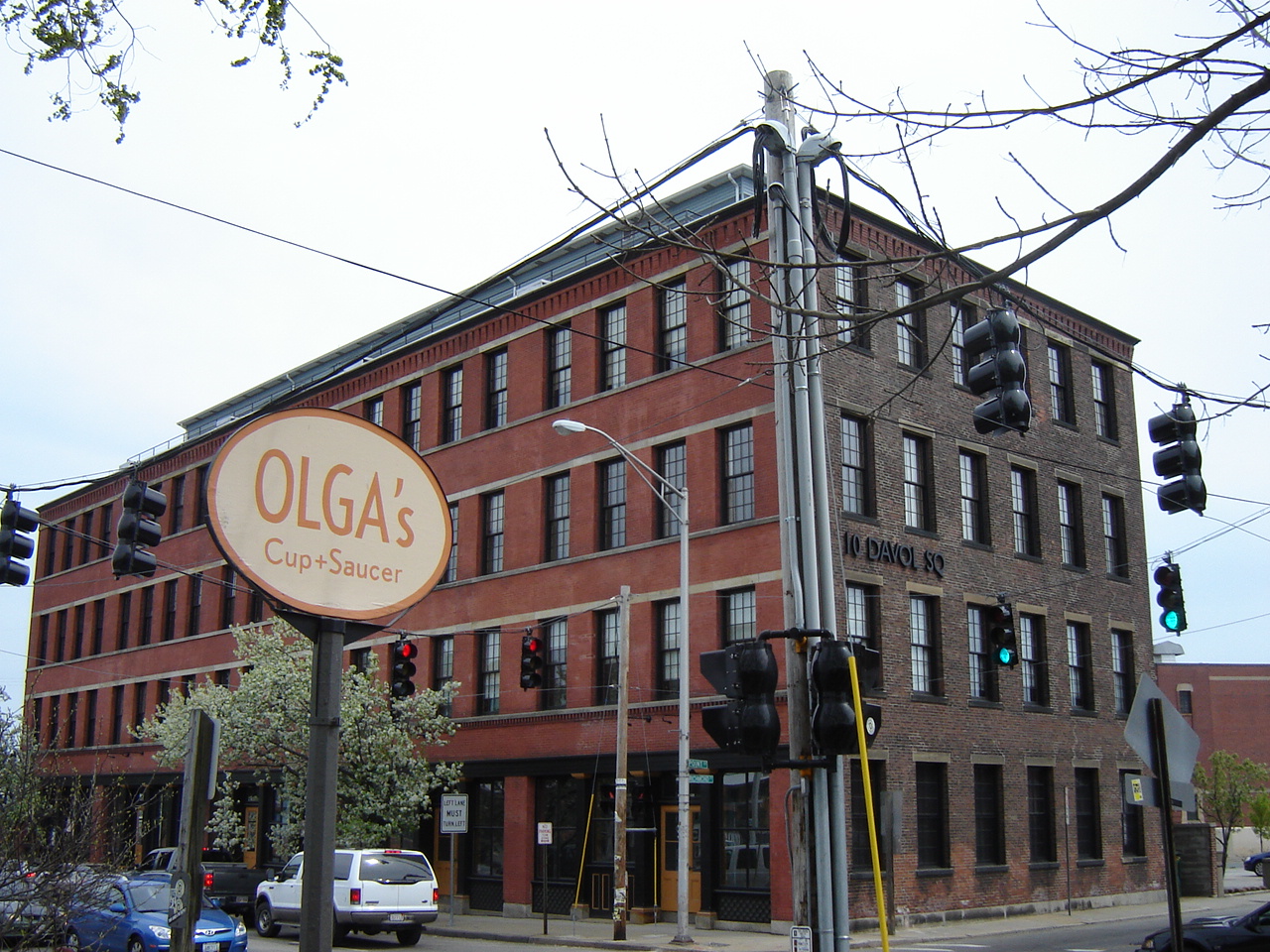
The Social Enterprise Greenhouse has its headquarters at 10 Davol Square, Providence. 

Read Full Post »

If you walk frequently in the same area, you notice more things.

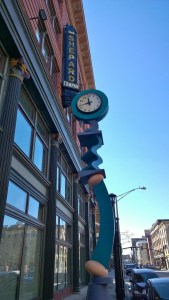
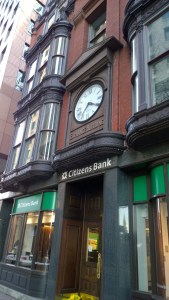
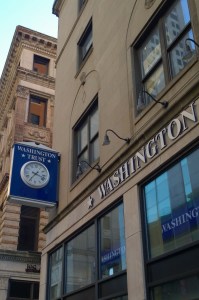
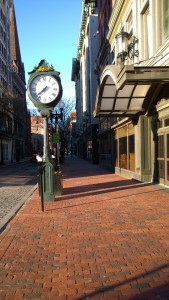
The other day it occurred to me that Providence has an unusual number of public clocks — and they all have the right time.

The clocks below are in a block or two of one another.

I wondered about the green freestanding clock with curlicue writing spelling out “Shepard.” An Internet search brought up the Providence Architecture website at Brown University.

“A historic, notable element of the Shepard Building is the late 19th century cast-iron clock, which still stands in front of the building on Westminster Street.”

And the Shepard Building? Turns out it’s a former department store that once covered a whole block and now houses the downcity campus of the University of Rhode Island.

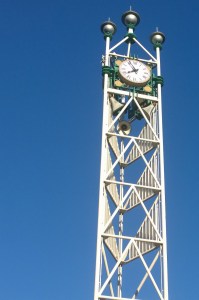
The very tall clock is at Johnson & Wales University. My favorite clock is the one that looks like something from Alice in Wonderland. It suggests to me that although “the time is out of joint,” it will all be OK in the end.

021716-time-is-out-of-joint

021816-clock-Citizens-Bank


021816-clock-Wash-Trust

021816-Westminster-St-clock


021916-JWU-clock


Read Full Post »

I have to say, I found this new research fascinating as I had been experiencing something similar to the contrast sensitivity described. And I was delighted to see you could train your eyes to counteract the perceptions that can cause a stumble.

Jan Hoffman writes at the NY Times, “As adults age, vision deteriorates. One common type of decline is in contrast sensitivity, the ability to distinguish gradations of light to dark, making it possible to discern where one object ends and another begins.

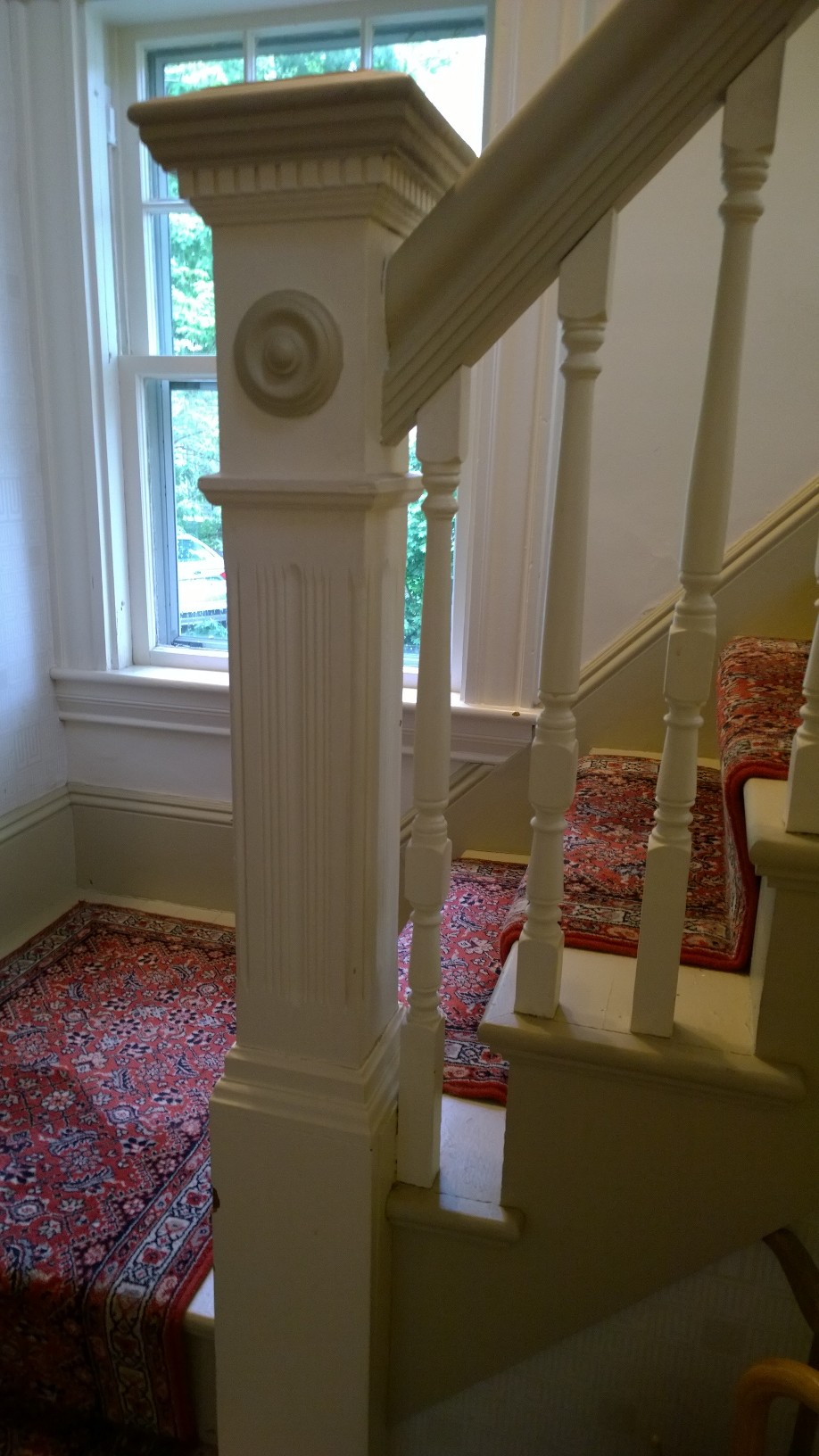
“When an older adult descends a flight of stairs, for example, she may not tell the edge of one step from the next, so she stumbles. At night, an older driver may squint to see the edge of white road stripes on blacktop. Caught in the glare of headlights, he swerves.

“But new research suggests that contrast sensitivity can be improved with brain-training exercises. In a study published [in March] in Psychological Science, researchers at the University of California, Riverside, and Brown University showed that after just five sessions of behavioral exercises, the vision of 16 people in their 60s and 70s significantly improved.”

Read more at the NY Times, here, or go straight to “Improving Vision Among Older Adults: Behavioral Training to Improve Sight,” here. Authors Denton J. DeLoss and George J. Andersen are from the University of California, and Takeo Watanabe is at Brown.

stairs

Read Full Post »

Here is an artist who addresses the sense of smell — and not only with lily-of-the-valley fragrance or the sea or brewing coffee.

Douglas Quenqua writes in the Science section of the NY Times that Belgian artist Peter De Cupere uses pretty much everything that has an odor.

“Peter De Cupere’s ‘Tree Virus’ sculpture wasn’t much to look at: a dead, black tree rooted in a craggy white ball suspended over a dirt pit, all of it covered by a plastic igloo. Built on a college campus in the Netherlands in 2008, the whole thing might have been leftover scenery from a Tim Burton film if it weren’t for the outrageous smell.

‘Inside the igloo, a heady mix of peppermint and black pepper saturated the air. It flooded the nose and stung the eyes. Most visitors cried; many ran away. Others seemed to enjoy it, laughing through the tears. Such is the strange power of olfactory art.

“ ‘When you walk into an installation with scent, you cannot hide. Your body starts to react,’ said Mr. De Cupere. … He is just one of several contemporary artists using odor to create art that delivers an intensely personal, emotional and sometimes physical experience. …

“Smell has an unfair advantage over the other senses when it comes to eliciting a response, researchers say. ‘There is a unique and directly intimate connection between where smell is processed in the brain and where memory is stored,” said Rachel Herz, a psychologist at Brown University and the author of The Scent of Desire: Discovering Our Enigmatic Sense of Smell. …

“Just as Proust’s madeleines opened a floodgate to childhood memories, scents can recall different feelings depending on how a person first encountered them.”

More here.

Photo: Peter De Cupere
Peter De Cupere’s “Tree Virus” sculpture, which causes many visitors to cry.

Read Full Post »

Teny Gross tweeted this nice story from the Brown University alumni magazine.

Courtney Coelho wrote, “On a snowy December evening, lights were visible through the second-floor windows of List Art Center as the visual arts department’s Critique Intensive held its last session. Mixed with the students in the large studio space were four working artists—Elise Ansel ’84, Chitra Ganesh ’96, Keith Mayerson ’88, and Rob Reynolds ’90—who’d spent sixteen weeks with the class, teaching, critiquing, and discussing art.

“The class was the brainchild of Chair of Visual Art Wendy Edwards, who hopes it will serve as a model for future classes. ‘Alumni bring a generosity to their approach to the Brown students,’ Edwards said. ‘They love coming back here, they love giving, and they’re very professional and committed to helping our students.’ ” More here.

Speaking of art education in Providence, RISD just got a new president, an artisan herself. Meredith Goldstein at the Boston Globe writes, “The Rhode Island School of Design has chosen its 17th president. Rosanne Somerson takes the title effective immediately, the Board of Trustees announced [in February]. Somerson, a RISD grad and furniture designer, has been serving as the school’s interim president since January 2014. The board says it chose to keep Somerson in the job after a nine-month international search.”

The Globe article is here. Disegno magazine has an interview with Somerson, here.

Photo: Mike Cohea
Rose Congdon ’15, left, and her classmates critique work created for the visual art department’s Critique Intensive, a class taught by four alumni artists last semester. 

Read Full Post »

No matter how bad things get in the great world, there will always be someone who starts a quirky, individualistic project just for the love of it, reassuring us all.

In Providence recently, a few folks got together to resurrect an abandoned natural history museum partly to see what an early museum looked like, partly because it was a shame to throw it all out.

In the NY Times, Henry Founatain wrote,  “If museums are meant to preserve objects forever, then forever ended here in 1945.

“That year, Brown University’s natural history museum, which included multitudes of animal skeletons and specimens among its 50,000 items, as well as anthropological curiosities like rope made from human hair, was thrown away.

“It was a sad end to what had been a labor of love for John Whipple Potter Jenks, a Brown alumnus, taxidermist and naturalist who founded the teaching museum in 1871.

“But Jenks had died in 1894 — on the steps of the museum, no less — and what by then was known as the Jenks Museum fell into disarray. It was shuttered in 1915, and the objects were scattered or stored until most of them were hauled, in 92 truckloads, to a nearby dump in 1945.

“But now the Jenks Museum lives again, at least temporarily, in an exhibition that is as much about art as it is about science.

“A group of Brown graduate students, with help from a faculty adviser and a New York artist, has rounded up a few surviving odds and ends, commissioned artists to recreate some of the vanished objects, and installed it all in Rhode Island Hall, the home of the original museum. The exhibition, which also includes a recreation of Jenks’s office as it might have looked in the year of his death, will be on display until spring.” Read more here.

The Lost Museum will be on display in Rhode Island Hall on the Brown University campus, 60 George Street, the Jenks Museum’s original home, through May 2015.

Photo: Mike Cohea/Brown University
The office of John Whipple Potter Jenks, who founded the natural history museum at Brown University, was recreated for an exhibition called Lost Museum.

Read Full Post »

Some posts at Andrew Sullivan I only need to glance at briefly and bells go off: for example, this entry about an artist who works with coral.

Andrew quotes Amelia Urry writing about Courtney Mattison, who became enamored of coral while studying conservation biology at Brown University and moonlighting at the Rhode Island School of Design.

“Mattison’s newest piece, Our Changing Seas III,” says Urry at Grist, “depicts a hurricane-spiral of bleached corals coalescing to a bright center. You can read it as a message of hope or one of impending doom, depending on your disposition …

At the heart of Mattison’s artwork is her desire to inspire real-life changes in how people view and treat the world’s oceans and environments. Similar to the Our Changing Seas series, Courtney Mattison’s Hope Spots collection comprises 18 vignettes, each of which represents a vital marine ecosystem in its ideal form (that is, protected from various threats such as global warming or pollution).” Read more at Grist, here.

Art: Courtney Mattison
“Our Changing Seas III,” a ceramic coral reef

Read Full Post »

The Puritan thinker Roger Williams got fed up with the rigid Puritans in the Massachusetts Bay Colony and went off to found the state of Rhode Island and advocate for freedom of religion.

Recently Lucas Mason-Brown, a Brown University math major, worked with a small group of undergraduates to crack the shorthand code Williams used while making notes.

According to Martine Powers in today’s Boston Globe, here, translation of the notes was an achievement that had resisted scholars for centuries. No major insights about Roger Williams were revealed, but some were confirmed.

For example, the notes show that Williams was against baptizing Indian children — a new example of how adamantly he opposed pressure to convince anyone of any religious belief.

In an earlier AP article in the Herald Online, Erika Niedowski writes, “College history professor emeritus J. Stanley Lemons and others at Brown started trying to unravel the so-called ‘Mystery Book’ a few years ago. But the most intense work began this year after the university opened up the challenge to undergraduates, several of whom launched an independent project.

” ‘No one had ever looked at it systematically like this in generations,’ Widmer said. ‘I think people probably looked at it and shrugged.’

“Senior math major Lucas Mason-Brown, who has done the majority of the decoding, said his first instinct was to develop a statistical tool. The 21-year-old from Belmont, Mass., used frequency analysis, which looks at the frequency of letters or groups of letters in a text, but initially didn’t get far.

“He picked up critical clues after learning Williams had been trained in shorthand as a court stenographer in London, and built his own proprietary shorthand off an existing system. Mason-Brown refined his analysis and came up with a rough key.” Read more.

AP Photograph
The preface page of the Mystery Book from Brown University’s John Carter Brown Library. Lucas Mason-Brown, a senior mathematics major, helped crack a mysterious shorthand code developed and used by religious dissident Roger Williams in the 17th century. The handwritten code surrounds the printed text on the preface page.

Read Full Post »

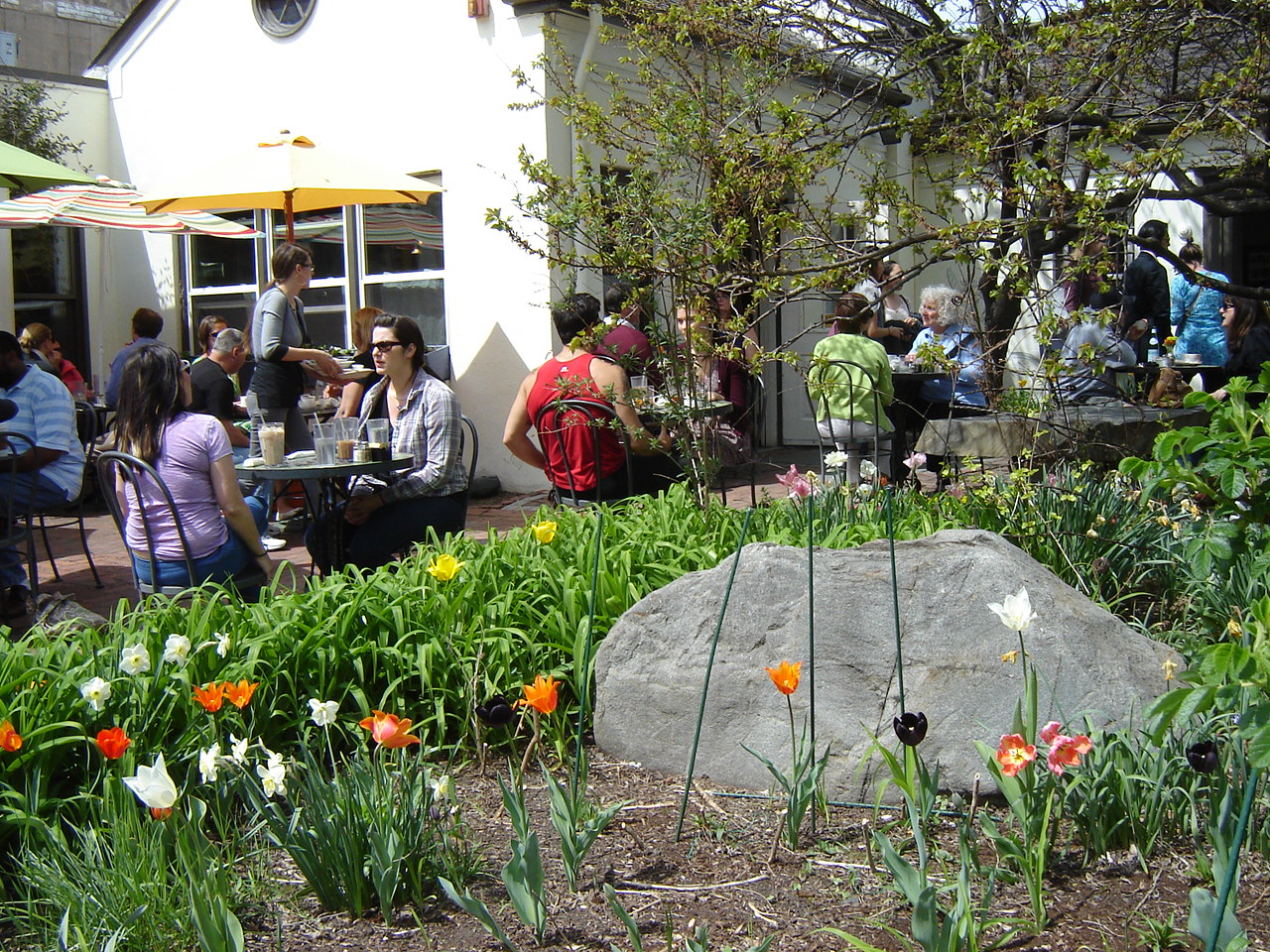
Brunch in Providence’s former jewelry district (now called the Knowledge District) can feature some intriguing overheard conversations among Brown University students. Wish I had caught the rest of this one: “Well, but if there were an alien invasion …”

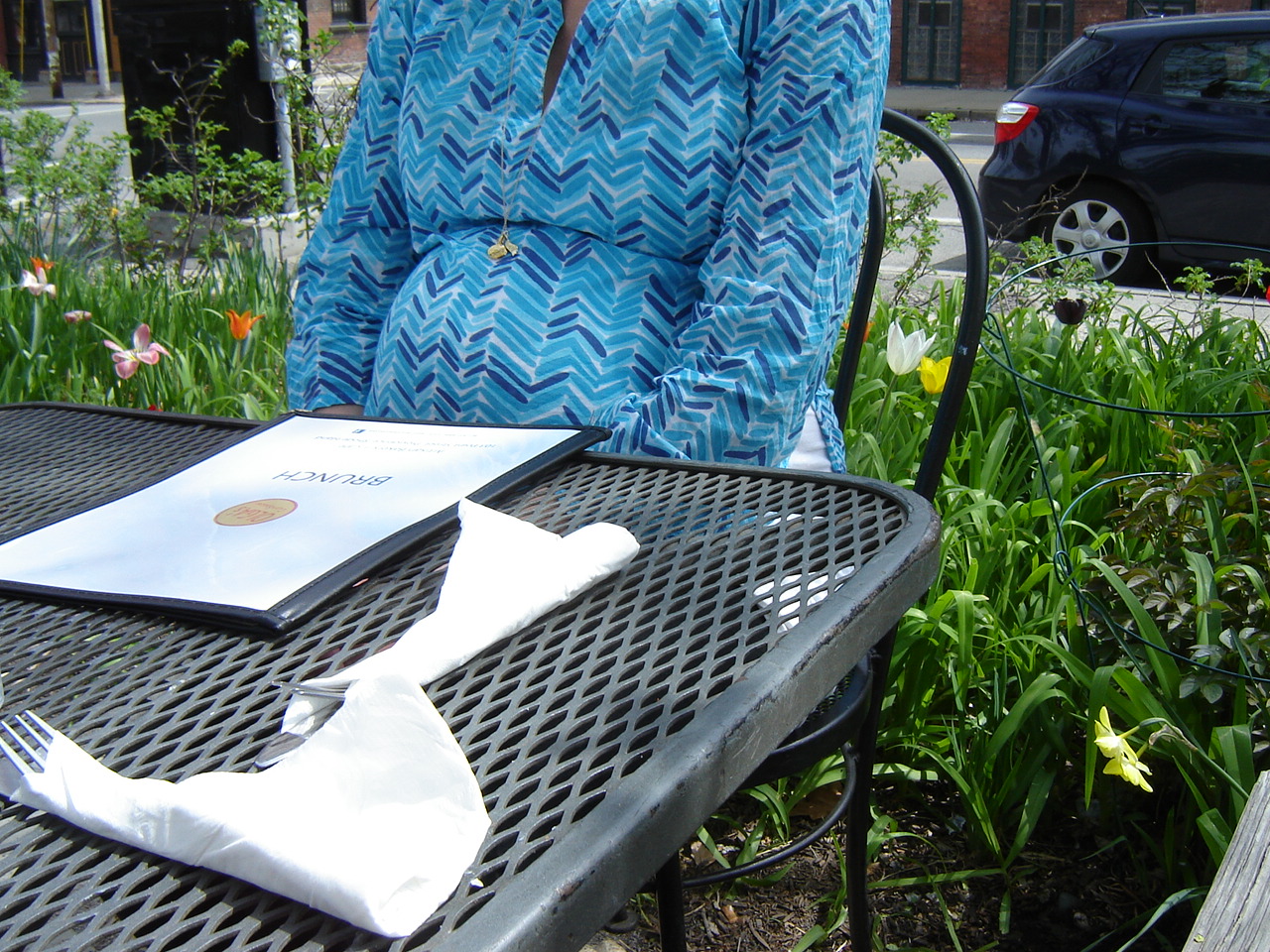
Today was lovely for sitting outside with two of our favorite Rhode Islanders. Do note the chain-and-charms motherhood present (I don’t call it a “push” present) modeled by the mother-to-be. Sorry I didn’t get a close-up. Better pictures at Luna & Stella.

Read Full Post »