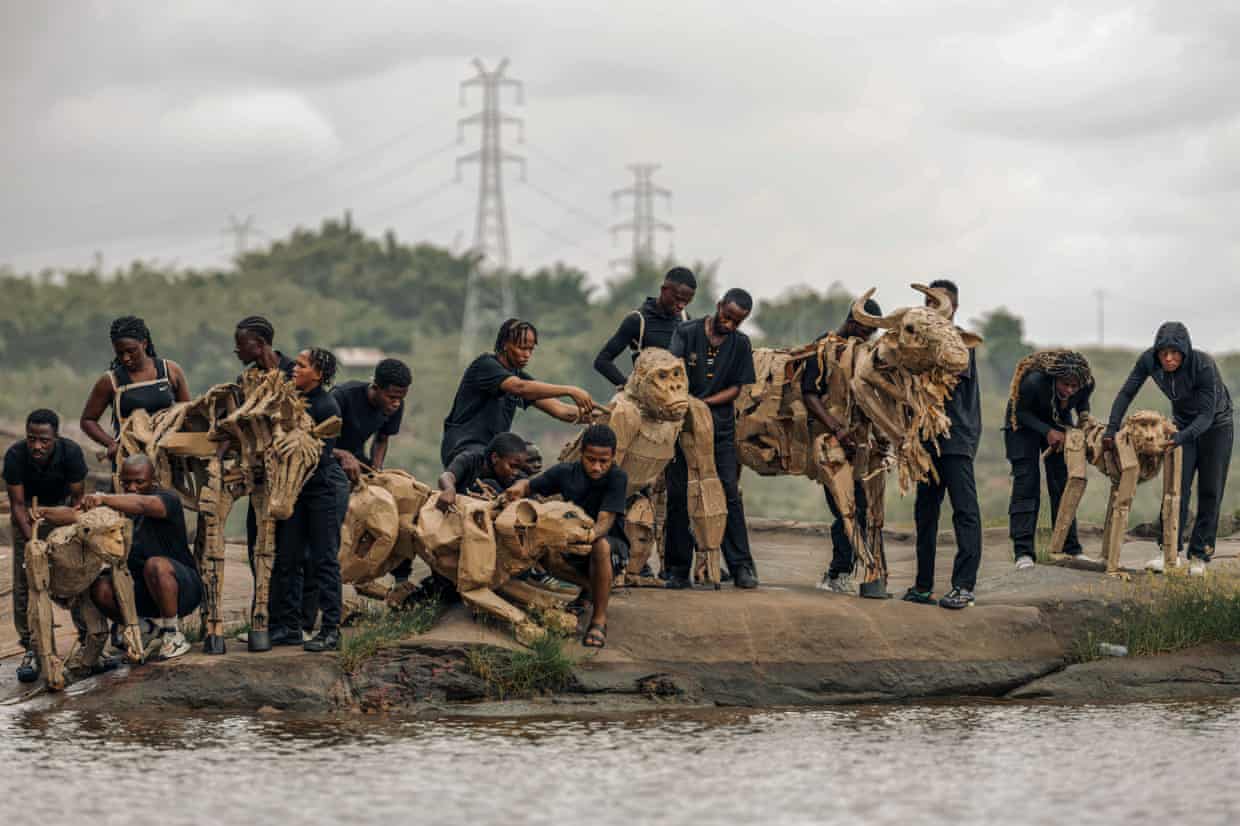
Photo: Berclaire/walk productions. Above, a puppet herd beginning its 20,000km [~2,400 mile] journey in Kinshasa, the Democratic Republic of the Congo. The caravan of zebras, wildebeest, monkeys, giraffes and baboons “will make its way from Dakar to Morocco, then into Europe, including London and Paris, arriving in the Arctic Circle in early August,” the Guardian reports.
Do you remember Little Amal, the world-traveling puppet designed to spread empathy for asylum seekers, especially children? Well, now the creators of Little Amal have launched a slew of puppet animals to bring attention to another cause — the effects of global warming on all living things.
In April, Isabel Choat wrote at the Guardian about the project. “Hundreds of life-size animal puppets have begun a 20,000km (12,400 mile) journey from central Africa to the Arctic Circle as part of an ambitious project created by the team behind Little Amal, the giant puppet of a Syrian girl that travelled across the world.
“The public art initiative called The Herds, which has already visited Kinshasa and Lagos, will travel to 20 cities over four months to raise awareness of the climate crisis.
“It is the second major project from The Walk Productions, which introduced Little Amal, a 12-foot puppet, to the world in Gaziantep, near the Turkey-Syria border, in 2021. The award-winning project, co-founded by the Palestinian playwright and director Amir Nizar Zuabi, reached 2 million people in 17 countries as she travelled from Turkey to the UK.
In Dakar more than 300 artists applied for 80 roles as artists and puppet guides.
“The Herds’ journey began in Kinshasa’s Botanical Gardens on 10 April, kicking off four days of events. It moved on to Lagos, Nigeria, the following week, where up to 5,000 people attended events performed by more than 60 puppeteers.
“On Friday the streets of Dakar in Senegal will be filled with more than 40 puppet zebras, wildebeest, monkeys, giraffes and baboons as they run through Médina, one of the busiest neighborhoods, where they will encounter a creation by Fabrice Monteiro, a Belgium-born artist who lives in Senegal, and is known for his large-scale sculptures. …
“The first set of animal puppets was created by Ukwanda Puppetry and Designs Art Collective in Cape Town using recycled materials, but in each location local volunteers are taught how to make their own animals using prototypes provided by Ukwanda. The project has already attracted huge interest from people keen to get involved. In Dakar more than 300 artists applied for 80 roles as artists and puppet guides. About 2,000 people will be trained to make the puppets over the duration of the project. …
“Zuabi has spoken of The Herds as a continuation of Little Amal’s journey, which was inspired by refugees, who often cite climate disaster as a trigger for forced migration. The Herds will put the environmental emergency center stage, and will encourage communities to launch their own events to discuss the significance of the project and get involved in climate activism. …
“The Herds’ Senegal producer, Sarah Desbois [expects] thousands of people to view the four events being staged over the weekend. ‘We don’t have a tradition of puppetry in Senegal. As soon as the project started, when people were shown pictures of the puppets, they were going crazy.’ “
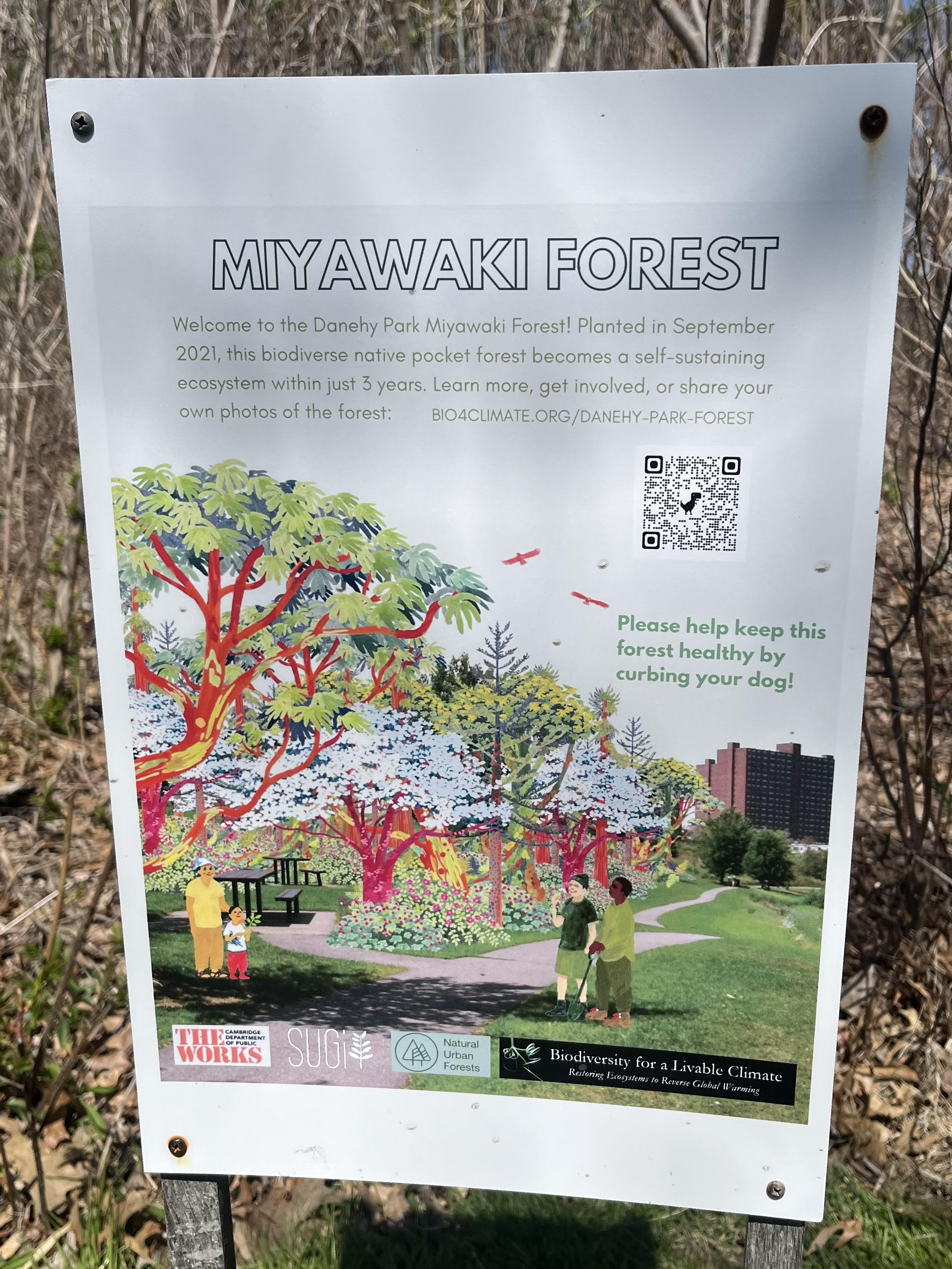
Photo: Biodiversity for a Livable Climate. A Miyawaki forest at Danehy Park in North Cambridge, Massachusetts, planted on September 25, 2021 — with the help of enthusiastic volunteers. Other Miyawaki forests don’t look like much in April. But just watch!
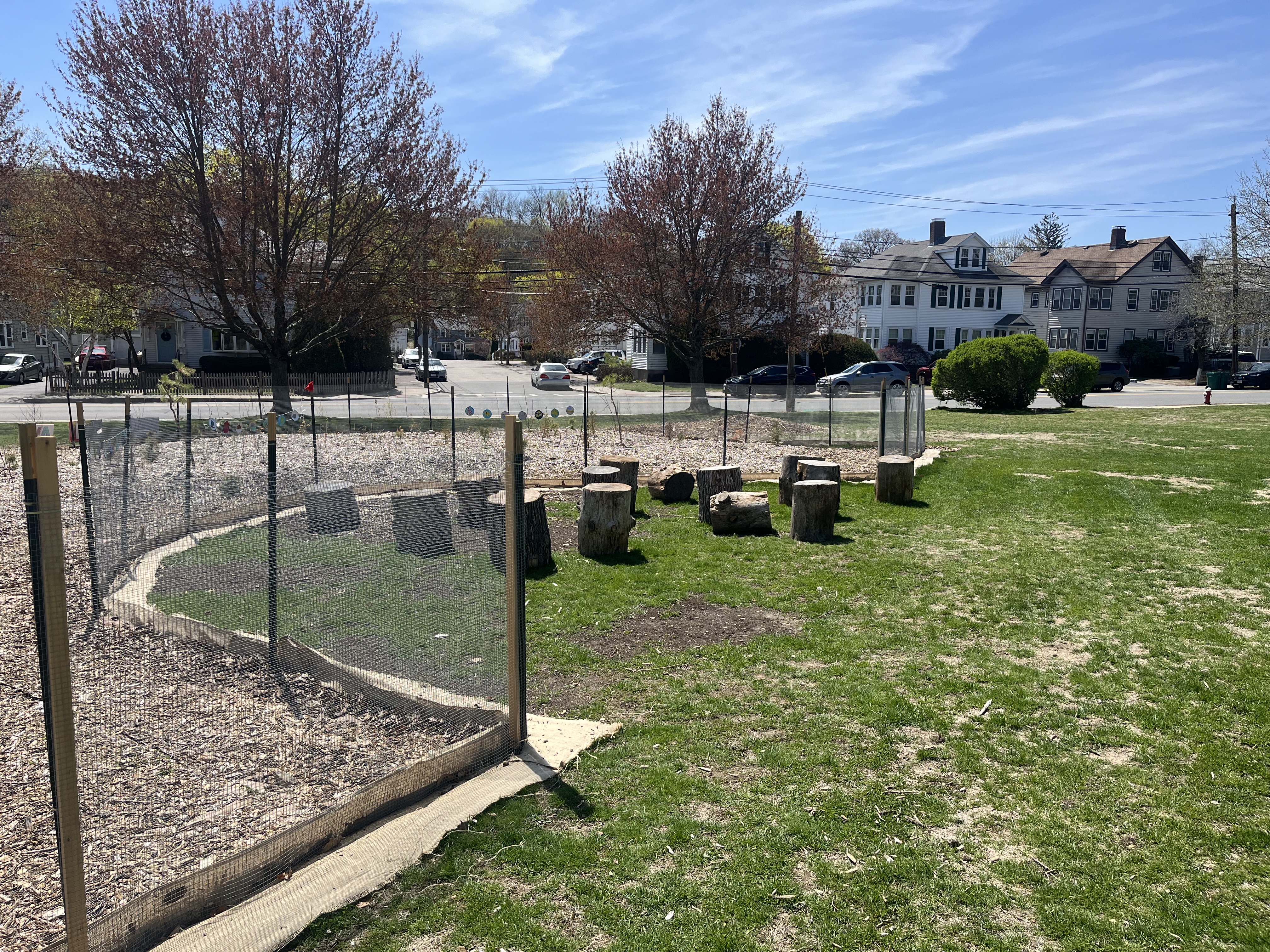
Although I blogged about Miyawaki mini urban forests in 2023, here, and again after a tip from Hannah in Philadelphia, here, I had never seen one in person and didn’t really understand the concept. These are not forests you take a walk in. They are deliberately planted too densely for entering, which is why one elementary school asked for a crescent shape to let kids see the native plants that their teachers were talking about.
On a special day in April, my friend Jean Devine of Biodiversity Builders took two of us on a tour of three Miyawaki Forests and the site for one that she and students at her local high school are building.
Now I think I get it. In order to have a healthy climate, we need a healthy, biodiverse planet. And the effects of even very small sites can spread. Birds, small animals, pollinators, and other critters flourish in these biodiverse pockets.
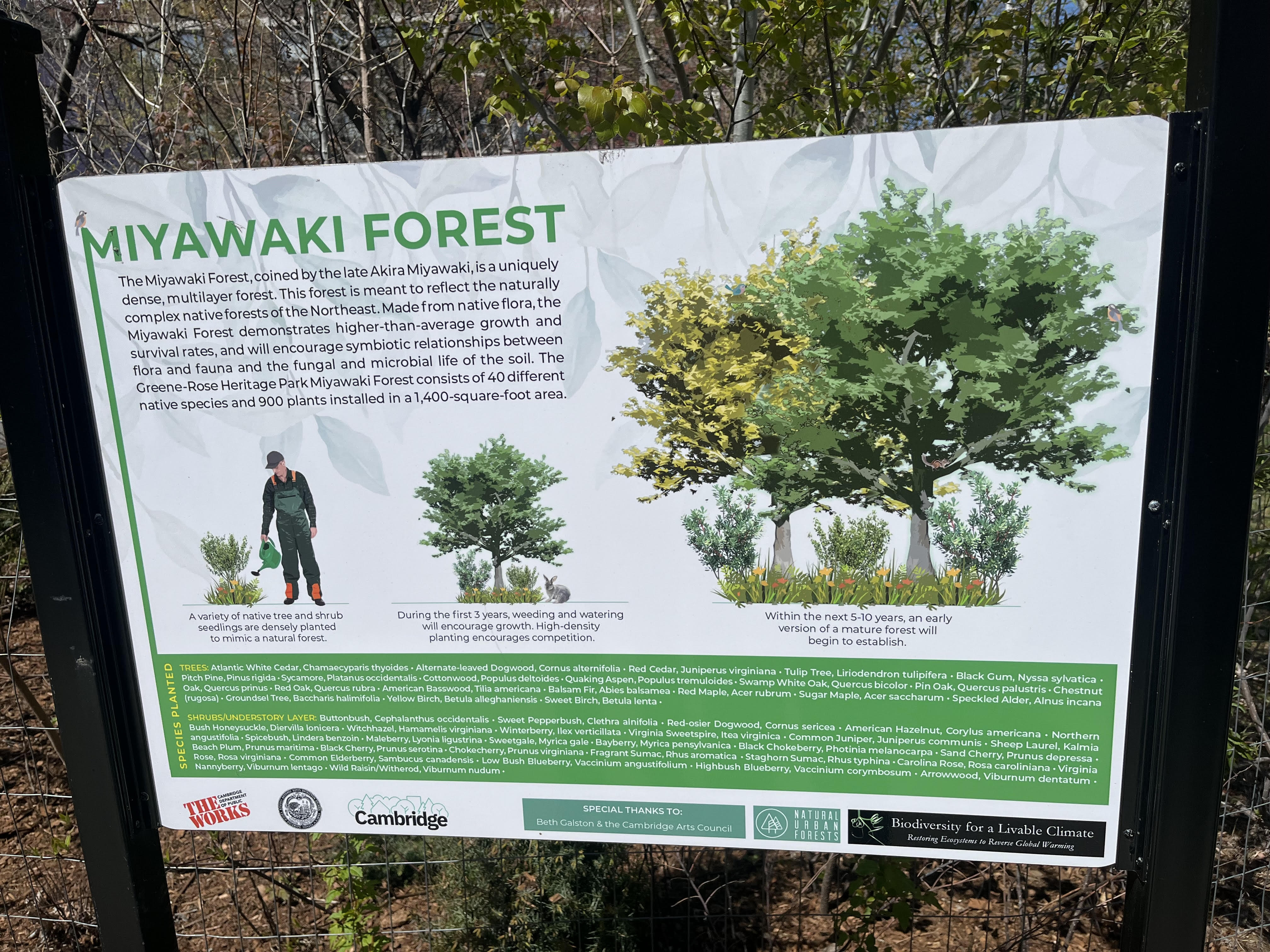
Biodiversity for a Livable Climate: Restoring Ecosystems to Reverse Global Warming says, “The Miyawaki Forest is an ultra dense, biodiverse pocket forest that recreates the complexity of natural forests and the relationships and processes that help them grow strong and resilient. By giving home to a vast array of native species, they boost the biodiversity of the area and nurture pollinators, supporting and restoring ecosystems. They sequester carbon in the soil, reduce air pollution and soil contamination, improve water absorption to buffer against flooding and erosion, and cool the surrounding area to mitigate the urban heat island effect. They also create a living classroom for people and communities to learn about native ecology, engage in stewardship, and experience the interconnectedness of the natural world.”
GBH tv provides a forum on the concept, asking, “What can hold more than 500 species, sequester more than 500 lbs. CO2/year, be 10F cooler than its surroundings, soak up lots of rainwater, and be made by and for children in a space no bigger than a tennis court? A ‘mini-forest’ planted using the Miyawaki Method, of course!
“Biodiversity for a Livable Climate hosts Miyawaki-Method advocates Hannah Lewis (Bio4Climate Compendium editor) and Daan Bleichrodt (The Netherlands’ Tiny Forest initiative leader), as they talk about mini-/tiny-forests and their role in climate resilience, urban beautification, and connecting all of us to nature.” More here.
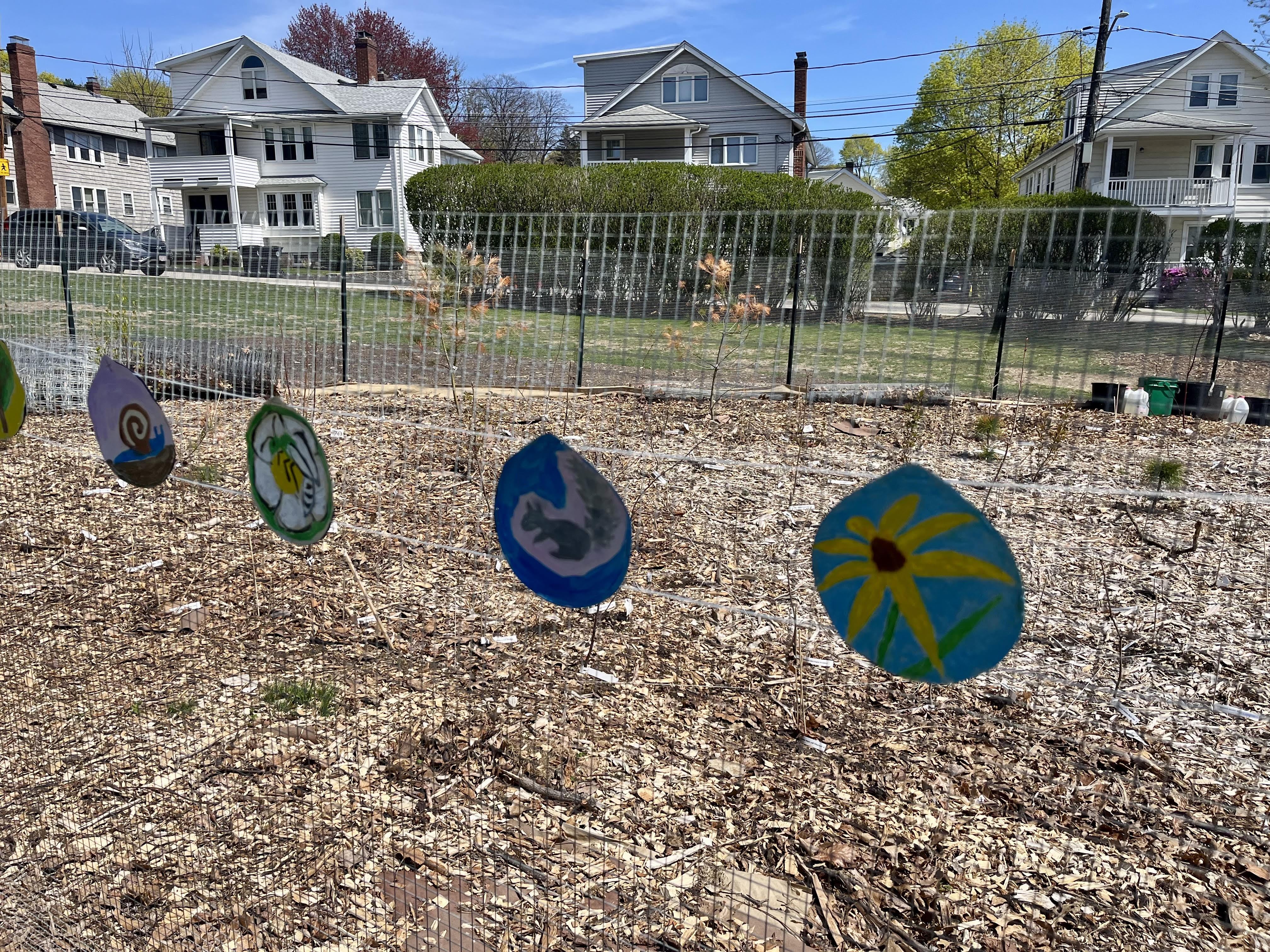
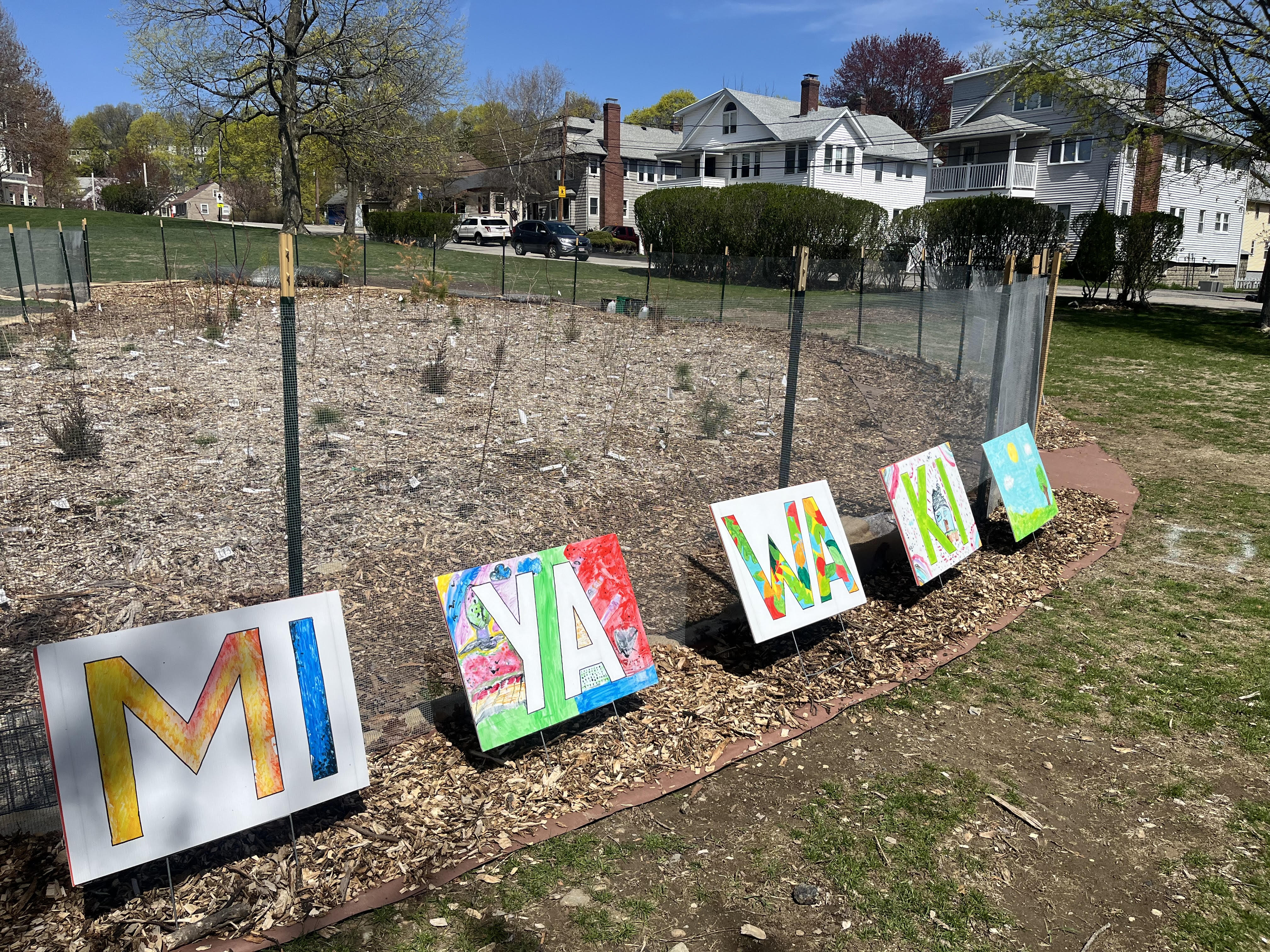
My photos are from mini forests Massachusetts, one in a large park in Cambridge, one in a Cambridge neighborhood’s pocket park, and one at an elementary school in Watertown. At the latter, the children sit on tree stumps for classes. Note the art they created for their forest, too. The forest doesn’t look like much in April, but just wait!
More at Biodiversity for a Livable Climate, here, and here.
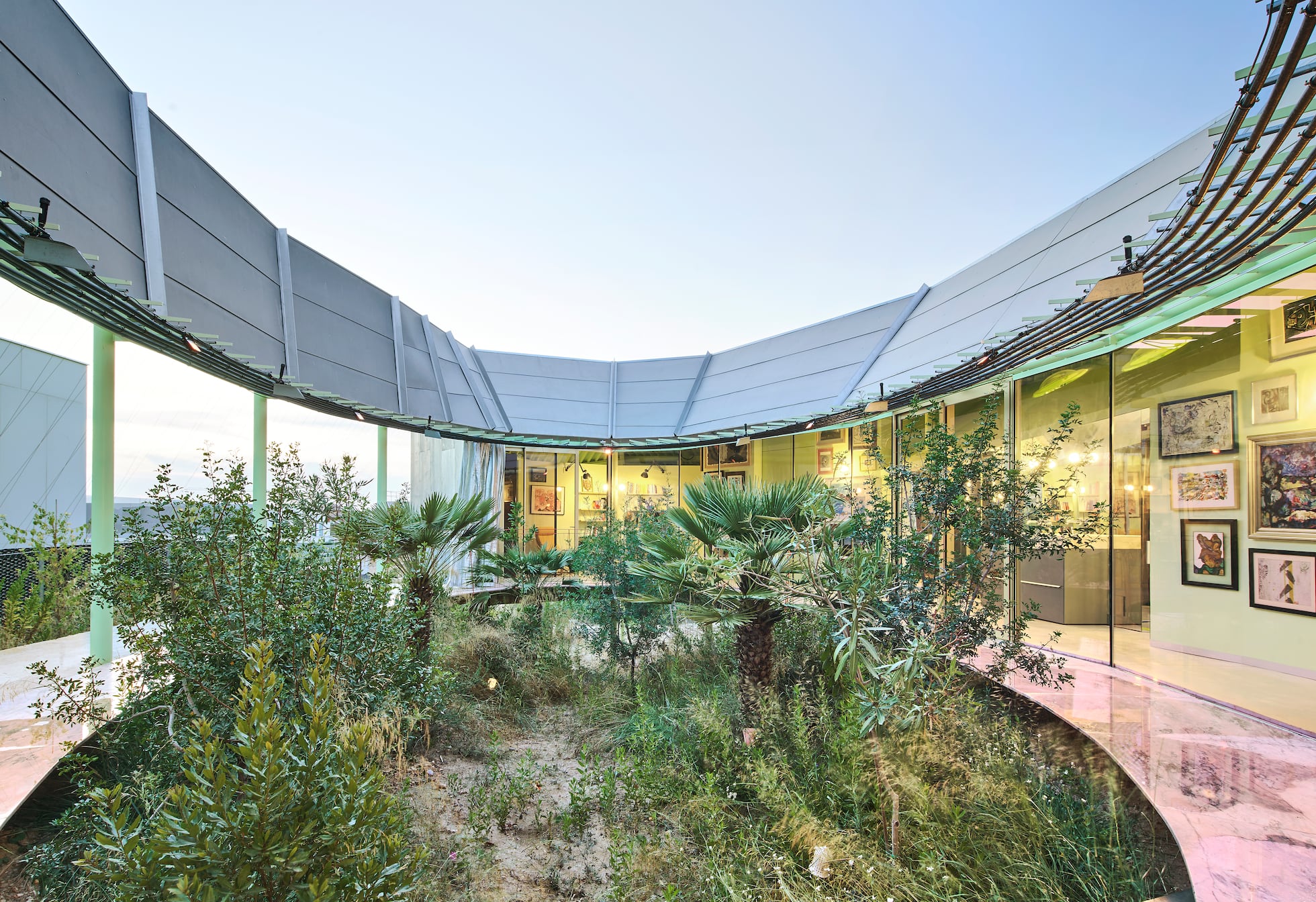
Photo: José Hevia. Rambla Climate-House by architect Andrés Jaque in Molina de Segura, Spain.
Today’s article addresses how architecture can and should repair our ecological system. How in cities, for example, a comprehensive vision would extend beyond beautifying downtown to embracing the understanding that we are not the only species on the planet.
At El País, Miguel Ángel Medina interviews architect Andrés Jaque about buildings that can be good for the environment.
“For three years,” he says, “Andrés Jaque, 53, has been dean of the Graduate School of Architecture at Columbia University, one of the most cutting-edge centers in architectural innovation. The Madrid-born architect is spending his time at the university rethinking how buildings and cities should face climate change. He believes that we must commit to an ‘interspecies alliance’ and that buildings, beyond just being sustainable, should also contribute to repairing our ecology.
“Jaque has proposed several projects with this concept in mind, such as the Reggio School in Madrid — designed to create life within its walls and attract insects and animals. …
Andrés Jaque “Architecture is the discipline that has most clearly assumed the responsibility of responding to the climate crisis. In the last 15 years, there’s been a radical transformation [in the field]: materials have gone from being sustainable to [repairing the ecology]. And [the architectural field] has revised its own mission, which is no longer to just build new buildings, but to manage the built environment. Additionally, it has brought about an intersectional vision: understanding that the material, the social, the ecological and the political are inseparable and that climate action has to coordinate these fronts of transformation. This has placed architecture at the center of environmental action.
Miguel Ángel Medina “Do architects share this interpretation?
Jaque There’s a part [of the field] that’s anchored in a heroic vision of modernity and another that’s commercial… but there’s another that has a political commitment to the planet. And [those who adhere to this] understand that architecture must respond not only to the most immediate circumstances of a commission, but also to action for the planet. …
“There are two systems: a material world of extractivism — which is a mix of carbonization, colonialism, anthropocentrism, heteropatriarchy and racialization — that’s currently collapsing. And, in the cracks of this system, another kind of architecture is emerging, which seeks alliances between species based on symmetry, which pursues a global regime of solidarity and which advances along a line of decarbonization that marks the esthetics, the materialities [and] the types of relationships that constitute contemporary culture. This is gaining undeniable strength. In the future, we’ll see a change that’s as important as the one that modernity once represented. …
Medina “What do we do with urban planning, given so many extreme phenomena?
Jaque “We’ve been pioneers in proposing a change of focus, from an emphasis on the city as a kind of stain on the territory, to a trans-scalar approach. This is a way of understanding [the physical structure that is] an urban block of apartments, the microbial relationships that occur in the bodies of those who live on that block, as well as the large networks of resource extraction that make life on that block possible.
“The city has lost the capacity to contain all realities, [which is necessary] in order to think in a climatic and ecosystemic way. And we need a new model that allows us to understand that what happens on a molecular scale has implications on the scale of bodies, buildings, streets, neighborhoods, the planet and the climate. Designing [cities] in a trans-scalar way requires changes in the methodologies of architecture, which we’re exploring. …
“Cities are going through a period of great transformation. A transformation in which the city has to be understood as something physically porous, which allows for the circularity of water, which contributes to multiplying life… a transformation of materiality that promotes a flow of materials that also contributes to the health of bodies. [We require] a very different way of urbanizing the air – in such a way that it’s understood that there’s a direct relationship between our lungs and the climate – and a commitment to the generation of diverse and empowered living environments. The main difficulty is how to do this quickly, so as to mitigate the impact of the climate and environmental crises.
Medina “What’s this new ‘interspecies diplomacy’ that you advocate in favor of?
Jaque “Humans are just one of many forms of life. And the idea that humans can decide to sacrifice the rest of the species to serve their own interests has been shown to be harmful. Understanding that we’re dependent on many other species — and that we’re actually inseparable from them — is more realistic. We depend on the quality of the soil, on the ecosystems. An interspecies alliance based on protecting the living conditions of diverse species is beneficial for all life on the planet.”
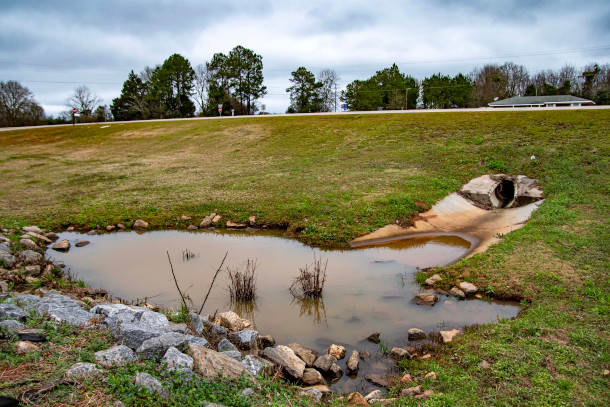
Photo: Lee Hedgepeth, Inside Climate News via Living on Earth. These highway drainage pipes send water directly toward homes in Shiloh, Alabama — homes that Black landowners have maintained since the Reconstruction era.Other neighborhoods benefit from drainage that runs parallel to roadways.
“Climate injustice” is not a term favored by the billionaire class, but removing out-of-favor words doesn’t make the realities they represent go away. Whether injustices occur on purpose or by accident, they happen. But around the world, ordinary people do what they can to fight back.
Paloma Beltran, associate producer of environmental radio show Living on Earth, has written that recent government decisions “will have a ripple effect across communities that have been pushing back against the impacts of industrial pollution for years. On this week’s show, we spoke with Patrice Simms, the Vice President of Litigation for Healthy Communities at Earthjustice, about the federal government’s role in protecting people from environmental discrimination. … Here’s some of what he said:
“ ‘Really significantly for me, what continues to motivate me is my tremendous respect and appreciation for the people on the front lines of pollution and exposures. I work really closely with communities across the country who are in very real ways, fighting for their lives, fighting for their families, fighting for their well-being, and fighting for their communities. And these aren’t people who are getting paid to do this. These are people who are doing this because they have to. They’re doing this because they’re watching their children get sick. They’re doing this because they’re watching their communities die. And there’s nothing more motivating than understanding and knowing the members of these communities. … It’s an honor and a privilege to get to work with them and beside them and for them, and that keeps me going every day.’
“So it feels like an opportune time to highlight a few environmental justice leaders who have shared their stories with us:
“Sharon Lavigne is a former school teacher who has become a fierce environmental defender out of love for her community. She’s from Cancer Alley, an eighty-five-mile stretch of the Mississippi River, from Baton Rouge to New Orleans. Slave plantations once lined this part of the river, and many descendants of former slaves still reside in that area. In the 1960s, petrochemical plants began flooding the area, in part due to the river allowing trade, transportation and the disposal of waste in an unseen and cheap way. Most of these plants are in close proximity to predominantly Black communities, exposing them to toxic emissions. According to a 2023 study published in Environmental Challenges, toxic emissions in Louisiana are 7 to 21 times higher in communities of color compared to white communities, and chemical manufacturing is the largest contributor to this disparity. Sharon Lavigne … co-founded Rise St. James, a faith-based grassroots organization fighting against the proliferation of chemical industries in St. James Parish, Louisiana. In 2021, Sharon won the prestigious Goldman Environmental Prize for her activism. For more, take a listen to our conversation. ….
“Nalleli Cobo grew up within 30 feet of an oil well — one of more than 5,000 oil and gas wells across Los Angeles, California, 700 of which are currently active. Like much of her community, Nalleli suffered from chronic headaches, nosebleeds, stomach pain, and asthma, and at the age of 19, she was diagnosed with cancer. Following treatment, Nalleli is now cancer free, but unable to have children. In March 2020, she joined a coalition of environmental justice organizations and successfully sued the city of Los Angeles for environmental racism and violation of CEQA, which is the California Environmental Quality Act. AllenCo Energy was forced to close down its well located near Nalleli’s home. … Tune into my interview with her here.
“Andrea Viduarre is another environmental justice advocate who organized her community and convinced the California Air Resources Board to adopt transportation regulations that limit trucking and rail emissions. (However, the state withdrew these rules [after the 2024 presidential election.] Southern California’s Inland Empire serves as a the hub for logistical infrastructure and is home to a predominantly Latino population. A staggering 40% of all US goods move through the area, a lot of which is transported through diesel trucks which emit toxic pollutants linked to cancer, asthma and premature death. Andrea Viduarre’s work has made huge strides in getting pollution out of her community. … You can learn more about in our discussion here.
“Robert Bullard is known to many as the father of environmental justice. He ran the first study on eco racism in 1979, and found that toxic facilities in Texas were disproportionately located in Black communities. His research was used in the Bean v. Southwestern Waste Management Corporation lawsuit, the first case to use civil rights law to challenge environmental racism. He’s the founding director of the Bullard Center for Environmental and Climate Justice, as well as Distinguished Professor of Urban Planning and Environmental Policy at Texas Southern University. He’s been advocating on behalf of the predominantly Black community of Shiloh, Alabama, whose homes have been repeatedly flooded since a nearby highway was widened in 2018. Dr. Bullard joined us back in 2024 to talk about this case.”
It has always lifted my spirits to see everyday people doing what they can where they are. Public radio’s environmental show Living on Earth will lift your spirits.
As everyone knows, it’s hard to avoid plastic. The other day I found on the floor tiny pieces of one of those mesh bags that oranges often come in. I may be overthinking everything, but I was stumped about how to dispose of it. If I flush it, it goes into our water system. If I put it out for the landfill, the result is ultimately the same. And now we’re hearing that plastic particles are even getting into the clouds.
Nicola Jones writes at YaleEnvironment360, “Plastic has become an obvious pollutant over recent decades, choking turtles and seabirds, clogging up our landfills and waterways. But in just the past few years, a less-obvious problem has emerged. Researchers are starting to get concerned about how tiny bits of plastic in the air, lofted into the skies from seafoam bubbles or spinning tires on the highway, might potentially change our future climate.
“ ‘Here’s something that people just didn’t think about — another aspect of plastic pollution,’ says environmental analytical chemist Denise Mitrano of ETH Zürich University, in Switzerland, who co-wrote an article last November highlighting what researchers know — and don’t yet know — about how plastics can change clouds, potentially altering temperature and rainfall patterns.
“Clouds form when water or ice condenses on ‘seeds’ in the air: usually tiny particles of dust, salt, sand, soot, or other material thrown up by burning fossil fuels, forest fires, cooking, or volcanoes. There are plenty of these fine particles, or aerosols, in the skies. …
“Until recently, when chemists thought of the gunk in our air, plastics did not leap to mind. Concentrations were low, they thought, and plastic is often designed to be water repellent for applications like bags or clothing, which presumably made them unlikely to seed cloud droplets. But in recent years, studies have confirmed not only that microscopic pieces of plastic can seed clouds — sometimes powerfully — but they also travel thousands of miles from their source. And there are a lot more particles in the air than scientists originally thought. …
“ ‘The people who invented plastics all those decades ago, who were very proud of inventions that transformed society in many ways — I doubt they envisaged that plastics were going to end up floating around in the atmosphere and potentially influencing the global climate system,’ says Laura Revell, an atmospheric scientist at the University of Canterbury in New Zealand. …
“Global annual production of plastics has skyrocketed from 2 million tons in 1950 to more than 450 million tons today. And despite growing concerns about this waste accumulating in the environment, production is ramping up rather than slowing down — some oil companies are building up their plastic production capacity as the demand for fossil fuel declines. To date, more than 9 billion tons of plastic has been produced, and about half of it has gone to landfills or been otherwise discarded. Some project that by 2025, 11 billion tons of plastic will have accumulated in the environment. …
“In recent years, several studies have suggested that microplastics (pieces less than 5 millimeters in length) and nanoplastics (smaller than approximately 1,000 nanometers) were being transported long distances through the air. In 2019, for example, researchers found microplastics in the Pyrenees that had arrived via rain or snowfall. In 2020, Janice Brahney of Utah State University and four coauthors published a high-profile Sciencepaper revealing high amounts of plastic in federally protected areas of the United States. …
“Brahney’s extensive U.S. dataset also opened the door for modelers to figure out where, exactly, all this plastic was coming from. ‘It’s a really beautiful data set,’ says Cornell University’s Natalie Mahowald, who did the modeling work.
“Mahowald took the plastic concentrations Brahney had cataloged and mapped them against atmospheric patterns and known sources of plastics, including roads, agricultural dust, and oceans. On roadways, tires and brakes hurl microplastics into the air. Plastic winds up in agricultural dust, notes Mahowald, in part from plastics used on farm fields and in part because people toss fleece clothing into washing machines: the wastewater flows to treatment plants that separate solids from liquids, and about half the resulting biosolids get sent to farms for use as fertilizer. As for the ocean, Mahowald says, big globs of plastic in places like the Pacific Gyre degrade into microscopic pieces, which then float to the surface and are whipped up into the air by chopping waters and bursting air bubbles. …
“Exactly how aerosols affect climate has been a critical sticking point in climate models, and many of the details are still unknown. Different aerosols can change the climate by either reflecting or absorbing sunlight, which can depend, in part, on their color. Black soot, for example, tends to have a warming effect, while salt reflects and cools. Aerosols can land on the ground and change the albedo, or reflectivity, of ice and snow.
“Aerosols also affect cloud formation: different bits and pieces can seed more and smaller droplets of water or ice, making for different types of clouds at different elevations that last for different amounts of time. High-altitude, thin, icy clouds tend to warm the Earth’s surface like a blanket, while low-altitude, bright and fluffy clouds tend to reflect sunlight and cool the Earth.”
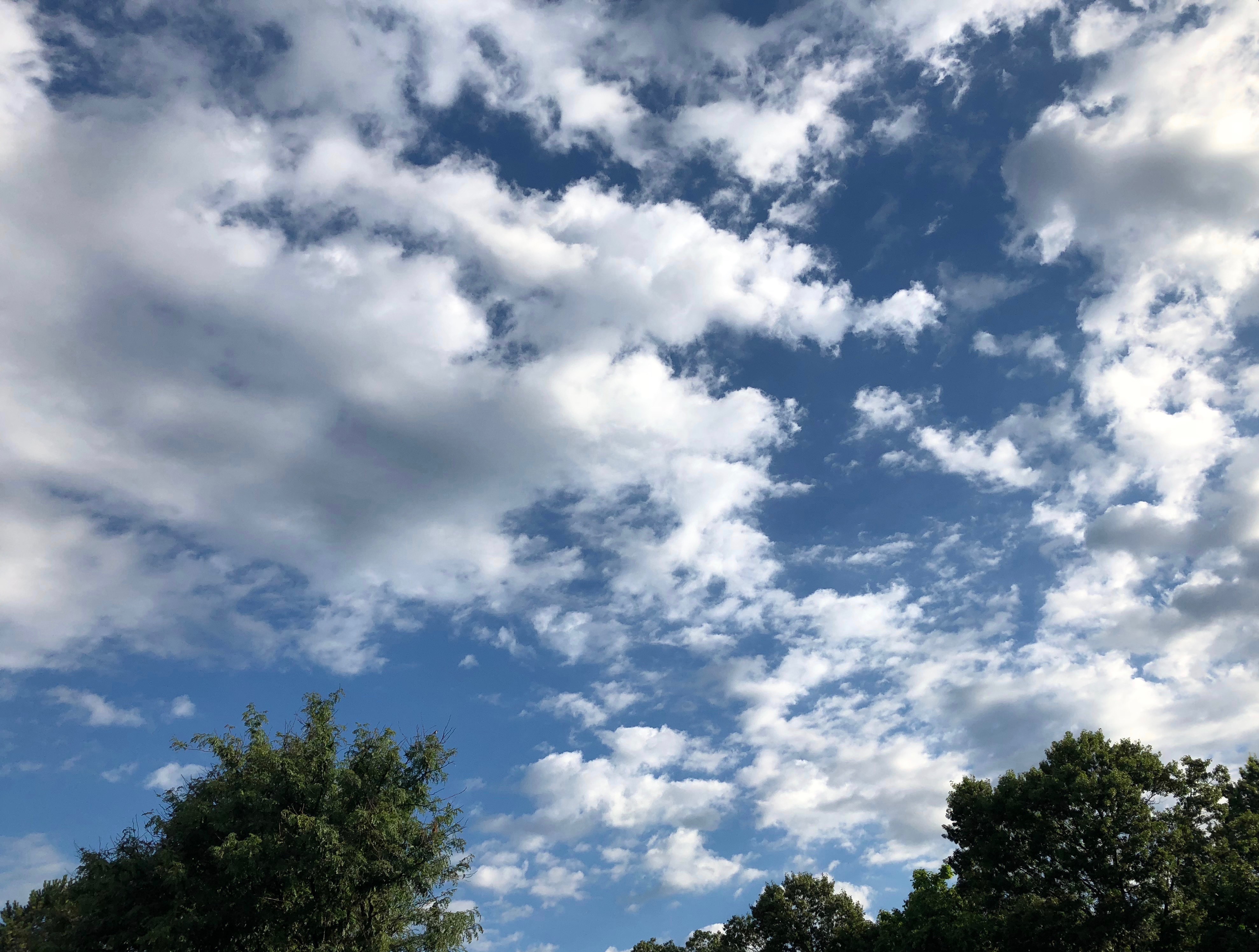
More at YaleEnvironment360, here. Rebecca of Fake Flamenco was speculating not long ago about clouds and whether they have started looking different. Do 20th century cloud photos from your region look different from those taken recently?
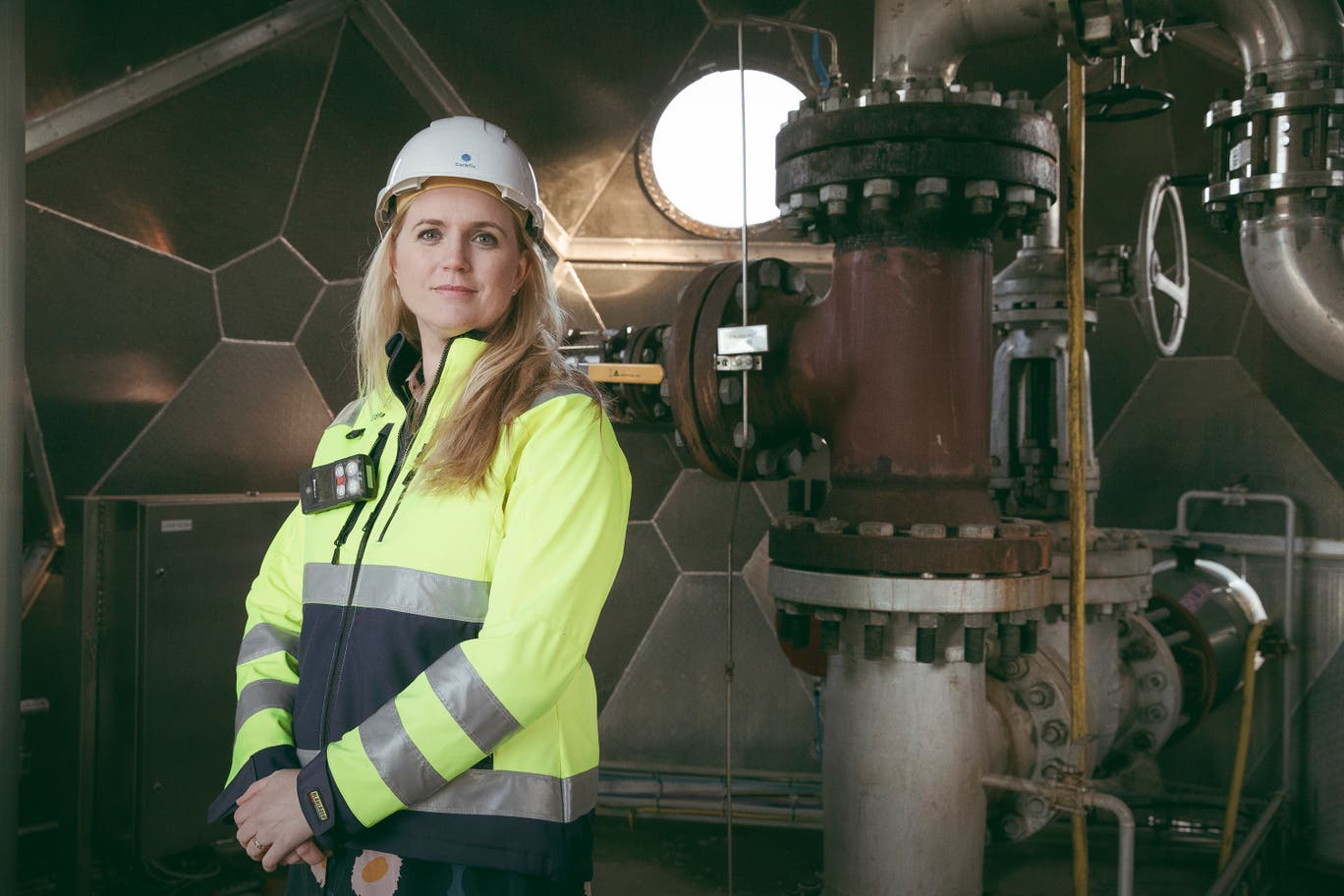
Photo: Heida Helgadottir for the Washington Post via the Independent. Edda Aradottir is the chief executive of Carbfix, a company that captures CO2 byproduct from the largest geothermal plant in Iceland. Many Icelandic start-ups are tackling climate change.
File this one under Hope. And maybe book a trip to the innovation hub called Iceland.
Hannah Hall has a report at the Washington Post on Icelandic companies that are taking on global environmental challenges.
“The electric red and green glow of the production facility resembles the Icelandic aurora borealis. Algae in their growth stage flow through hundreds of glass tubes that travel from floor to ceiling, all part of a multistep process yielding nutrients for health supplements. Soon, all parts of each alga will be used.
“The facility, operated by Icelandic manufacturer Algalif, is a space of inspiration for Julie Encausse, a 34-year-old bioplastic entrepreneur. During a July summer storm, Svavar Halldorsson, an Algalif executive, was guiding her through a tour of the company’s newest facility on the Reykjanes Peninsula.
“By the end of 2023, this new facility aims to triple its production. After Algalif dries the microalgae and extracts oleoresin, a third of this output then goes toward health supplements. Algalif has traditionally used the rest as a fertilizer. Now Encausse, founder and chief executive of the bioplastic start-up Marea, hopes to use that leftover biomass to create a microalgae spray that can reduce the world’s reliance on plastic packaging.
“Her newest partnership with Algalif is part of a start-up network in Iceland that focuses on inventive and creative technologies to address the climate and sustainability crisis. The Sjavarklasinn (‘Iceland Ocean Cluster’) network includes environmental entrepreneurs working across several industries.
“Thor Sigfusson founded the network in 2012 after conducting research on how partnerships between companies in Iceland’s technology sector helped expand that industry. At the time, he found that the fishing industry was not experiencing the same collaboration or growth.
“ ‘Even though companies were in the same building together, fishing from the same quotas and facing similar challenges, they were closed off,’ said Alexandra Leeper, the Iceland Ocean Cluster’s head of research and innovation.
“Three cod hanging on the wall of the second-floor entryway are the first thing to greet any visitor to the Iceland Ocean Cluster. Lightbulbs shine from their centers, and the dried scales filter the light to fill the space with an amber glow. The precise design is one that underlines the group’s belief that using 100 percent of a fish or natural resource can give rise to innovative technologies. …
“Encausse and Marea co-founder Edda Bjork Bolladottir have partnered with the cluster for 2½ years. Encausse says that involvement was core to their company’s inception.
“ ‘There is a collaborative mind-set when being on an island,’ she said. ‘We need to work together to survive, and this was passed from generation to generation.’
“In a country about the size of Kentucky, the people of Iceland have had to learn how to guard their resources. Encausse has discovered that often means using 100 percent of any material — a lesson she’s now implementing in her work with Algalif. She created a food coating from Algalif’s leftover biomass, a product she’s named Iceborea — in a nod to theaurora borealis.
“ ‘We are repurposing it and making something with value that gives it another life to avoid using more plastic,’ Encausse said. Once Algalif’s factory expands over the next year, it will have 66 tons of microalgae leftovers that Encausse’s company can tap each year.
“When sprayed onto fresh produce, Iceborea becomes a natural thin film and a semipermeable barrier that can protect against microorganisms. Iceborea can either be eaten with produce or washed off, reducing the need for plastic packaging.
“[Edda Aradottir] is the chief executive of Carbfix, a company capturing CO2 byproduct from the largest geothermal plant in Iceland, Hellisheidi, and injecting it into stone to be buried underground.
“Carbfix’s successful trials have marked a global milestone for carbon sequestration. It also has received international recognition — and Aradottir’s leadership has already served as a model for growing start-ups and other founders in the cluster trying to tackle extensive environmental concerns. …
“Another Icelandic company, GeoSilica, harvests silica buildup from the Hellisheidi waste stream to make health supplements.GeoSilica reaches the Icelandic and European markets, and its chief executive, Fida Abu Libdeh, is also working with the Philippines to pilot her silica-removal technology to create similar sustainable factory processes.
“A Palestinian from Jerusalem, Abu Libdeh moved to Iceland in 1995 at age 16, a transition she described as difficult because of the language barrier and the country’s small immigrant population. In 2012, she graduated from the University of Iceland after studying sustainable energy engineering and researching the health benefits of silica. That same year, she and Burkni Palsson co-founded GeoSilica.
“Ever since moving to Iceland, she was impressed with how the country produced electricity through geothermal sources. …
“GeoSilica is not formally part of the Iceland Ocean Cluster, but the network it has fostered reflects the same collaborative approach. Abu Libdeh has worked with cluster companies and held investor meetings at its headquarters. It’s a place that founders want to be, she said, where they want to learn from each other even if they are competitors in their fields.
“While there has been progress over the years, Abu Libdeh said, it’s still a challenge for women to enter this entrepreneurial space. In 2020, less than 1 percent of investment went to women-founded start-ups, according to a recent European Women in Venture Capital report. …
“What began as a dozen start-ups in 2012 has now grown to more than 70 members and associated firms connected to the Iceland Ocean Cluster. … There are now four sister clusters in the United States, as well as one in Denmark and one in the Faroe Islands.
“The Alaska Ocean Cluster, which was the first to follow the Icelandic model, has already accelerated policy change in the United States. Sen. Lisa Murkowski (R-Alaska) proposed legislation last year to create ‘Ocean Innovation Clusters in major U.S. port cities, which would provide grants along the U.S. coastline and the Great Lakes.
“ ‘I’ve learned a great deal from our friends in Iceland who created a roadmap of innovation and public/private partnership when they established the first Oceans Cluster in Reykjavik,’ Murkowski said in an email.”
Art: Cara Despain via the gallery Current Work. Increasing numbers of artists are addressing climate disasters, as in “test still no. 1 (Upshot-Knothole — Simon)” (2022), graphite on paper, above.
I always feel grateful to artists for the way they make the invisible visible to those of us who lack a second sight.
Hyperallergic recently posted an article about artists using ash and residue from natural disasters to convey their messages about the environmental calamity they perceive.
Reporter Scotti Hill gets a bit sidetracked by other environmental disasters in the Hyperallergic article, but I thought her words on the art itself were worth sharing.
“Many of us recall the haunting early pandemic-era imagery of individuals wandering amid orange, smoke-filled backdrops that synthesized the reoccurring horror of wildfires on the West Coast and beyond. Such images accompanied headlines of widespread home evacuations, wildlife loss, and blankets of smoke covering entire states.
“Now artists on a local and international scale are using their craft to bring attention to this issue, using a novel formal process — cultivating ash and residue from natural disasters, namely fires, as an actual medium of expression.
“Cara Despain’s work, which ranges from public installation to video and painting, confronts complex issues of wildfires, nuclear testing, and land use in her native Utah and beyond. Her latest exhibition, Ashes of Her Enemy, [has been] on view at new Salt Lake City gallery Current Work. …
“Upon encountering Despain’s photographs of beautiful landscapes, chosen by the artist for their similarity to famously iconic Western views like Monument Valley, one detects a scarring on the face of each image. Here, Despain devised a frame with a fuse inside that, when lit on one side, ripples across the image, burning the pristine image in its wake. She ignited each of the images at the exhibition opening for an active audience. To Despain, this process is a metaphor for the West’s changing landscape and the fallacy of pristine nature untouched by human intervention. …
“Despain’s wildfire paintings … are made from the soot of the wildfires that share their name. She crafted the works’ scale and composition to work in dialogue with large-scale Thomas Moran-style landscape paintings. …
“Despain is not the first artist to incorporate ash into her creative process. Artist Zhang Huan crafts large-scale paintings made from the ash residue of burned incense used in Buddhist temple ceremonies. By foraging ash from various temples around Shanghai, Huan sees the ash as symbolic of ‘the fulfillment of millions of hopes, dreams, and blessings,’ according to his website.
“In the months preceding the pandemic, Filipino artist Janina Sanico used ash from the active Taal Volcano in her watercolors, while German artist Heide Hatry incorporated cremated remains into darkly meditative portraits. …
“This fall, the Palo Alto Art Center debuted Fire Transforms, an exhibition featuring several Bay Area artists whose work considers the impact of fire in the area of the country most fraught by wildfire devastation. …
“Artist Andrea Dale forages the burnt remnants of plants and human-made structures left in the aftermath of California wildfires. Her application of ash draws inspiration from East Asian ink wash painting with an application that is at once loose and also sequestered to the bottom quarter of pristine resin-covered panels. New Mexico-based Nina Elder crafts intricately detailed drawings of decimated forests from the incinerated debris of pulp mills to ‘focus the viewer on the textures and scale of deforestation,’ according to her site.
” ‘We often look at big catastrophes, but it’s the small stuff that’s going to get us,’ [Despain] explained in an interview at Current Work of the particulate matter left behind after fires, often invisible yet enormously destructive. Despain emphasizes that fire is a natural part of environmental ecology, yet the increased prevalence and scale of wildfires is unprecedented and follows a decades-long history of nuclear testing. …
“For Despain, the story of the West’s atomic testing is personal — her mother grew up in Southern Utah’s Cedar City. Due to atomic testing, half of her high school class died early of various radiation-related ailments. … After the war, expansive areas of government-owned land north of Las Vegas were designated as optimal sites for domestic nuclear testing. [Residents] of Southern Utah’s Iron County received assurances that atomic testing was being carried out with utmost safety. Yet, in the years to come, those same residents would suffer startlingly high rates of cancer, birth defects, and adverse health issues. …
“Such histories often recede into the realm of whispers, relegated to the annals of history and individual familial tragedy. Yet, they are part of the indelible fabric of the West both past and present that are connected to the environmental calamity unfolding before us. Formally, artistic processes which imbue ash and residue visualize the otherwise infinitesimal markers of this legacy.”
More at Hyperallergic, here. No firewall. Contributions welcome.
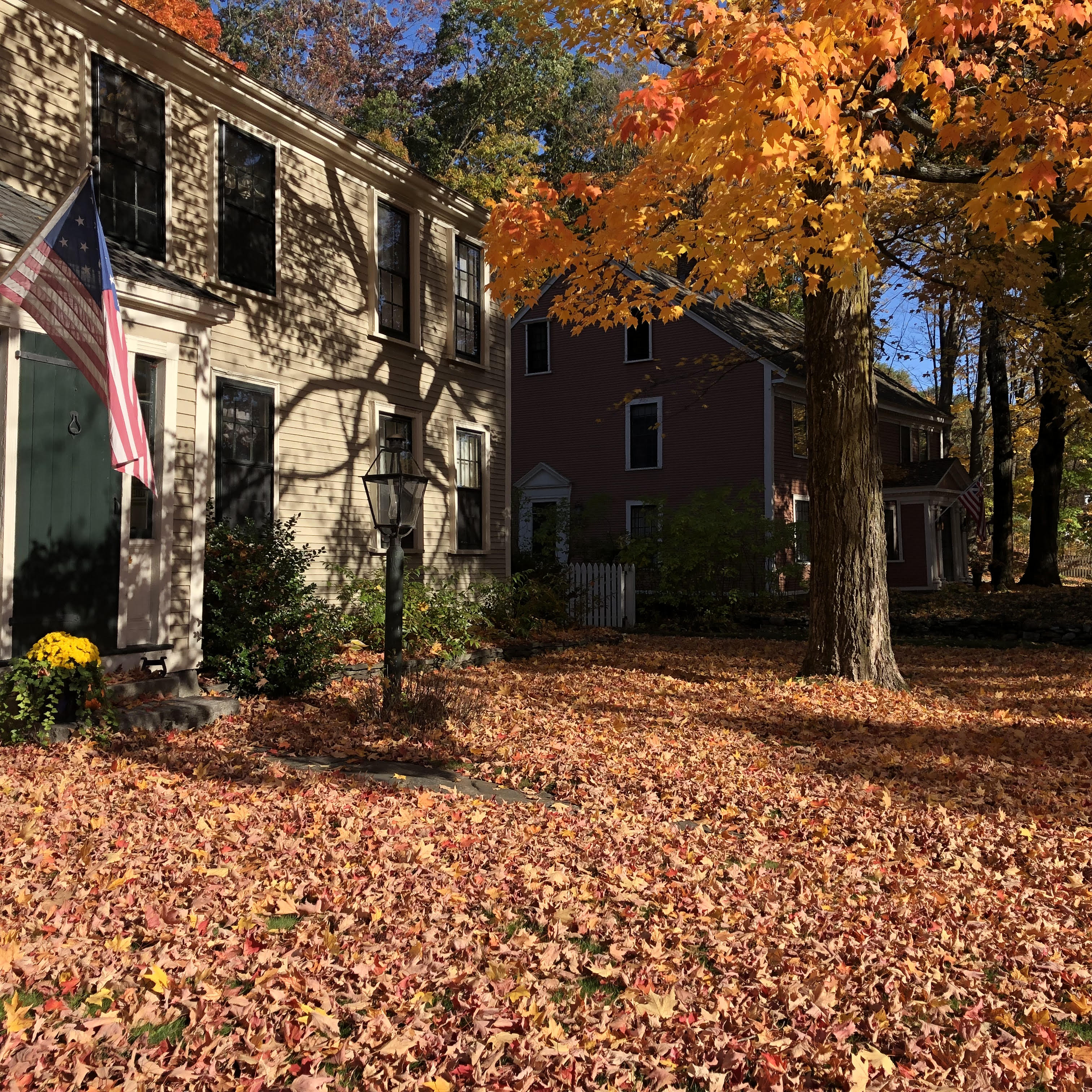
Photos: Suzanne and John’s Mom. The movement to promote native species as protectors of the environment is gaining steam. Native species love your discarded leaves.
I haven’t had any luck yet persuading my own family and friends about the advantages of unraked yards, but after all, it took a few years for my friend Jean, the native-plant evangelist, to get through to me.
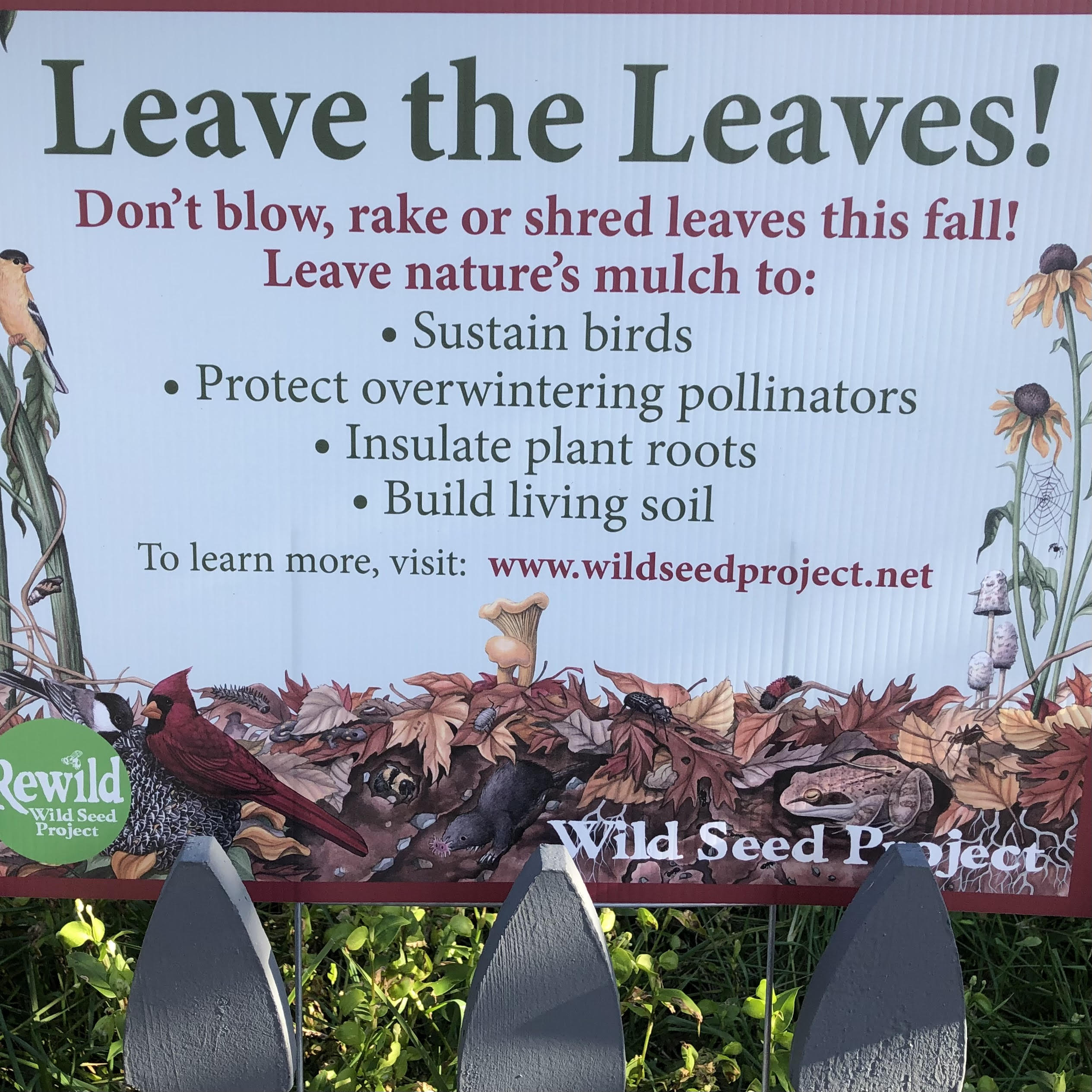
In recent years, a range of stories on the topic have appeared as the national media has caught on. I will list a few articles at the end. But perhaps the best explanation of the thinking behind unraked yards — and the best how-to — can be found at the Wild Seed Project.
Anna Fialkoff talks about rethinking garden clean-up. “While planting native plants is an essential step toward creating habitat, how we manage our plantings will determine whether we can sustain and support the life-cycles and successful reproduction of many other organisms including birds, butterflies, moths, bees, salamanders, and frogs.
“Autumn is when many of us think to put our gardens to bed by removing leaves and cutting back perennials. Yet to truly support living creatures year round, it’s much better to leave fallen leaves, branches, stems, and seed heads where they are rather than raking, blowing, shredding, or cutting them away. Leaves and other organic matter insulate plant roots through the cold winter months and then decompose to build up living soil critical to healthy vegetation.
This organic matter also stores large amounts of carbon, which is crucial to supporting a climate-resilient planet. …
“Many species of butterflies and moths, including our beloved luna moth, pupate and overwinter in leaves before emerging as stunning winged adults the following spring. Raking away the leaves is very disruptive to that life in the leaf litter. Leaf blowers are even more damaging, and also create noise pollution and use large amounts of fossil fuels – please discontinue this practice.
“Undisturbed leaf litter is also essential to the Baltimore checkerspot butterfly, which requires two seasons to complete its life cycle. After a first season of foraging on its host plant (white turtlehead) the caterpillars crawl down and overwinter in the leaf litter. This once common butterfly is in decline due to loss of habitat and poor gardening practices. [See pictures here.]
“Other small creatures like the eastern newt, as well as many species of salamanders and frogs, spend the frigid winter months hibernating under the protection of leaves, rocks, and logs.
“For many, leaf management can feel like a never-ending burden in the fall. Even if we want to leave the leaves, we can’t let them accumulate everywhere or they will smother the grass, clog sewer heads, and leave a slippery layer to get mushed into the ground by cars, snowblowers and pedestrians.
The problem is not that deciduous trees shed ‘too many’ leaves, but that we have developed our landscapes and removed natural areas. Too much space is now taken up by driveways, streets, sidewalks, and lawn.
“Leaves are an exceptionally valuable resource! They contain nutrients and organic matter that we should keep on site, instead of raking or blowing them from off our lawns and driveways and into the woods, or stuffing them into leaf collection bags to be taken off site. We can find more places for the leaves to go by shrinking our lawns, creating more planting space, and consolidating the excess leaves that fall outside our planting beds.
“Using leaves as mulch for a planting bed is a free alternative to buying bark mulch or other expensive and harmful inputs such as fertilizers and dyed mulches. The space under a tree is an especially critical place to keep leaves since many butterfly and moth caterpillars drop down from trees into the leaf litter to pupate and overwinter. …
“Still too many leaves? Rake the leaves that fall outside the planting beds into a pile. Yes, in this case raking is okay (and leaf piles are necessary for jumping in!). Our goal is to not remove them from within our planting beds, which benefit from the organic matter and insulation for the cold winter months, limiting disturbance to the leaf litter and any overwintering creatures.
“Move your leaf pile somewhere it can compost in place over the next growing season. You will be surprised by how quickly it shrinks down. Or, make a leaf fence! Coil up chicken wire into columns and arrange them side by side. Fill them with leaves. You’ll find that you can’t use the leaves up fast enough since they break down so quickly. Before you know it you’ll be stealing the curbside leaf collection bags from your neighbors to keep your leaf fence full. Suddenly one person’s yard waste is another’s treasure. …
“Inevitably, leaves will blow around and pile up in various corners of the yard. Rather than repeatedly removing leaves from the same spots, pause and pay attention to where they tend to accumulate or blow away, and plant accordingly.
“Plant strong stemmed plants like ferns, baneberries and bugbanes, coneflowers, or milkweeds in the areas where leaves accumulate. Leaves often form a deeper layer in low, concave spaces of the landscape, like at the bottom of a slope or a valley.
“There are a few ground covers like sedges, creeping and rock phlox, pussytoes, bearberry, and groundsels, that can get smothered by leaves. Plant them in spots where the wind strips leaves away. Leaves don’t tend to stay put on elevated, convex landforms, so don’t fight it and work with what you have.
“Wait until spring, just as you begin to notice sprouting and emergence, to remove leaves that get stuck in the crevices between rocks, against fences, and within shrubs.
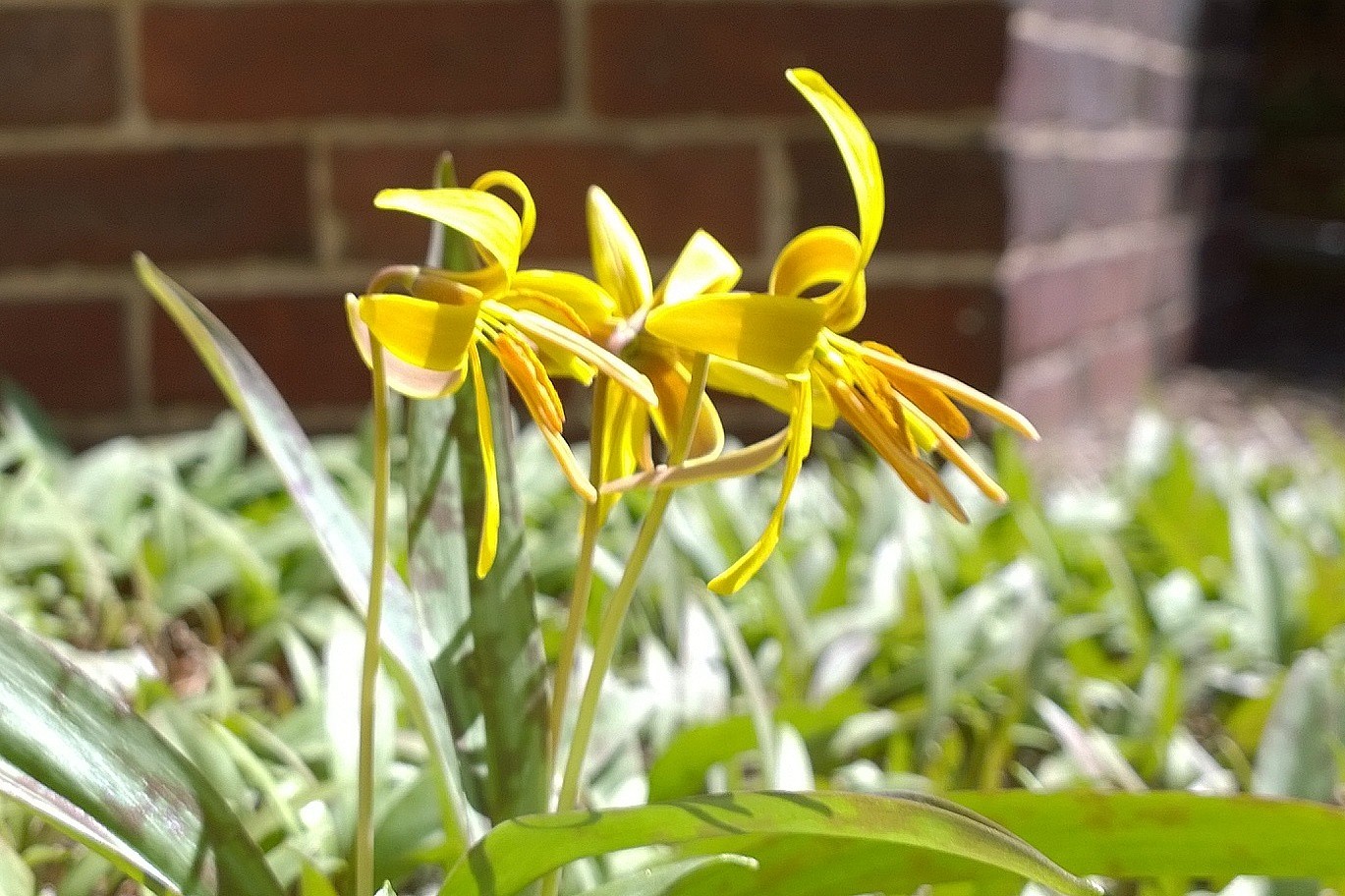
The native trout lily has no problem pushing through 2″ to 6″ of leaf litter.
“A common worry of gardeners is that plants cannot push through whole leaves or thick layers of leaves. Many woodland natives, even ephemerals like trout lily and squirrel corn, that are adapted to soils rich in organic matter created by decomposing leaves, have no trouble emerging through a good 2-6” of leaves.”
Fialkoff even gets into leaving the sticks and making outdoor art if you are so inclined, but I will stop now and let you read the rest at the Wild Seed Project, here. More at the Nature Conservancy, here, Audubon, here, and USA Today, here. No firewalls.
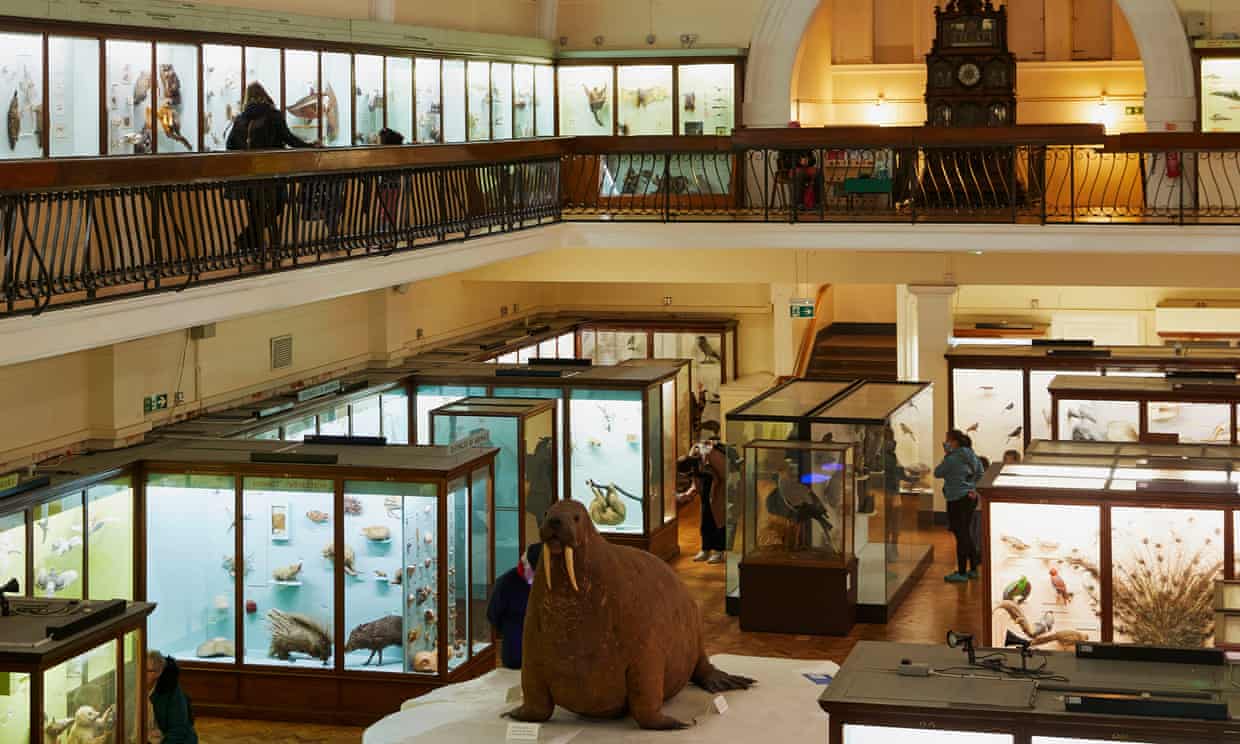
Photo: Emli Bendixen/Arts Fund/PA. The venue in London’s Forest Hill, says the Guardian,”is the capital’s only museum where environment, ecology and human cultures can be seen side by side.”
What special features are people looking for in museums these days? The traditional recorders of art and history keep changing. A look at a museum award in the UK may provide an insight into what is currently valued.
Nadia Khomamiwrites at the Guardian, “The Horniman museum in London has been crowned the Art Fund museum of the year 2022 for its work to inspire the next generation. …
“Its director, Nick Merriman, was presented with the £100,000 [about $117,000] prize – the world’s largest museum prize – by the DJ and broadcaster Huw Stephens at a ceremony at the Design Museum. … The Horniman was commended for completely reconfiguring its program in 2021 after the pandemic, Black Lives Matter and the increasing urgency of the climate crisis.
“It set up its ‘Reset Agenda,’ which focused on reorienting activity to reach diverse audiences more representative of London. This included embedding a Climate and Ecology Manifesto – from an online club of Environment Champions to the creation of a microforest to combat local air pollution.
“ ‘From a takeover of the galleries by children to its youth panel of 14-19-year-olds, work experience opportunities and Kickstart apprenticeships, the museum is inspiring the next generation,’ Art Fund, the UK’s national art charity, said.
“A further focus of the Reset Agenda was the 696 Program, an interrogation of the power and responsibility that public organizations have in supporting local music.
“The museum was said to showcase Black British creativity through a sold-out festival that reached 8,000 visitors, while nearly 20,000 experienced the related exhibition.
“Jenny Waldman, Art Fund director and chair of the judges, said: ‘The Horniman museum and gardens has now blossomed into a truly holistic museum bringing together art, nature and its myriad collections.’ …
“Dame Diane Lees, director-general of the Imperial War Museums and fellow judge, said the museum was championing the natural environment and commissioning artists and music festivals ‘to bring the eclectic collections of Frederick Horniman new relevance with diverse communities.’ …
“The 2022 edition of the annual award championed organizations whose achievements told the story of museums’ creativity and resilience, and particularly focused on those engaging the next generation of audiences in innovative ways.
“The other four shortlisted museums – the Story Museum in Oxford, the People’s History Museum in Manchester, Ty Pawb in Wrexham [Wales], and the Museum of Making in Derby – each received a £15,000 [about $18,000] prize in recognition of their achievements.”
I’m looking at an example form the Horniman website. An upcoming show, “We Breathe, Together: A Day of Community Air Action and Exploration” invites all who “dream of a clean air future – and want the tools to take action.
“From building (and racing!) your own hydrogen car, learning the skills to create a 2D stop motion clean air animation, to co-designing immersive climate adventures and ink breath painting. Meet incredible local campaigners in our Clean Air Village and listen to expert talks.
” ‘We Breathe, Together’ extends the conversation around ‘Breathe:2022‘ by artist Dryden Goodwin, the ambitious multi-site artwork exploring air pollution produced by Invisible Dust. ‘Breathe:2022’ combines over 1,000 new drawings, appearing as large-scale still and moving images on sites close to the heavily polluted South Circular Road and beyond, from May to December 2022.
“As part of the day, you can also immerse yourself in ‘Airborne,’ artist Sarah Stirk’s audio-visual installation that seeks to make the invisible threat of pollution visible.”
More at the Guardian, here. I know I have friends in the UK. If you go, will you share your reactions?
In July, Princess Mononoke, the animated film for grown-ups of all ages, turned 25. I have thought about it often since Asakiyume first pointed me toward the work of the brilliant Hayao Miyazaki. So many things in life remind me of the movie’s wisdom.
The BBC highlighted the Princess Mononoke birthday with a deep think.
Stephen Kelly reports, “In 1997, the British fantasy author Neil Gaiman received a call out of the blue from then-head of Miramax, Harvey Weinstein. ‘This animated film, Princess Mononoke,’ Gaiman recalls him saying, ‘it’s the biggest thing in Japan right now. So I thought I’ve got to get the best to do it. I called Quentin Tarantino and said, “Quentin, will you do the English language script?” And he said, “You don’t want me, you want Gaiman.” So, I’m calling you.’ Miramax, a then-subsidiary of Disney, had acquired the rights to distribute Princess Mononoke, the newest film from Japanese animation studio Studio Ghibli, in the United States, and Weinstein wanted to fly Gaiman to Los Angeles to watch a cut of the movie.
” ‘I had zero plans to do it,’ Gaiman tells BBC Culture. ‘But the moment that changed everything for me was the scene where you’re looking at this large pebble. And then a raindrop hits it. And then another raindrop hits it. And then another raindrop hits it. And now it’s raining and the surface is slippery and wet. And I’m like, “I have never seen anything like this.” ‘ …
“When Princess Mononoke was first released … it represented something of a departure for master animator and director Hayao Miyazaki. During the late 80s, Miyazaki had built his reputation (along with the success of Studio Ghibli, which he founded with fellow director Isao Takahata) on films like Kiki’s Delivery Service and My Neighbor Totoro; formally ambitious, thematically rich works, but generally affirming in tone and family-friendly in nature.
“But something changed during the 90s. Firstly, he began to bristle at the popular idea that Studio Ghibli only makes gentle movies about how great nature is. … Even more significant was his growing despair at a world which he had increasingly come to believe was cursed.
” ‘He used to be what he called leftist in sympathy, a believer in people power,’ explains Shiro Yoshioka, lecturer in Japanese Studies at Newcastle University. ‘But for obvious reasons [the collapse of the Soviet Union, and the escalation in ethnic conflicts across Europe], his political beliefs were totally shaken in the early 1990s.’
“Japan itself was also going through something of an existential crisis. The country’s bubble period, an economic boom during the late 80s, burst in 1992, stranding Japan in a seemingly endless recession. Three years later, in 1995, the country was hit by the Kobe earthquake, the worst earthquake to hit Japan since 1922. It killed 6,000 people, and destroyed the homes of tens of thousands more. Only two months after that, a terrorist cult by the name of Aum Shinrikyo launched a sarin gas attack on the Tokyo Metro, killing 13 and injuring thousands. Miyazaki, who was sickened by the materialism of the bubble period, was now living in a country traumatized and confused – both by its relationship with nature, and a creeping sense of spiritual emptiness.
” ‘He began to think,’ says Yoshioka, ‘maybe I should not make this entertaining, light-hearted stuff for children. Maybe I should make something substantial.’
“Set during the 14th Century, the Muromachi period of Japan, Princess Mononoke tells the story of Ashitaka, a young prince cursed by the hatred of a dying boar god, who has been corrupted by an iron ball lodged in his body. … To seek a cure for his curse, Ashitaka travels across the land, hoping to find the Shishigami, a deer-like forest spirit with the power to bring life and death.
“Along the way, Ashitaka discovers a world out of balance. The ironworks community of Tatara, run by the enigmatic Lady Eboshi, is ravaging the nearby forest for resources, provoking the wrath of ferocious wolf god Moro and her feral human daughter San (the titular Mononoke, which roughly translates to spectre or wraith). Caught in the middle is Ashitaka, who must figure out how to navigate this difficult world with ‘eyes unclouded.’ …
” ‘I believe that violence and aggression are essential parts of us as human beings,’ Miyazaki once told journalist Roger Ebert. ‘The issue that we confront as human beings is how to control that impulse.’ …
“Hayao Miyazaki is a self-confessed bundle of contradictions. Read his writings, listen to his interviews, watch him speak, and he paints a portrait of an artist caught between idealism and nihilism, optimism and despair. …
“This idea of a man at war with himself is obvious to see in the characters and world of Princess Mononoke: a film that, as Miyazaki told a press conference at the Berlin Film Festival in 1998, ‘was not made to judge good and evil.’ Take Lady Eboshi, whose mining colony is manufacturing an arsenal of guns to use against the forest gods. In most animated movies, she would be cast as the greedy, villainous scourge of nature. But Eboshi is also a generous leader, someone who has liberated women (implied to be former sex workers) from feudalistic oppression, who has provided a safe haven for leprosy sufferers and outcasts, and whose industrialization work is raising the standards of human life.
” ‘It would have been so easy to have a “technology is bad versus the good beasts of the forest” story,’ says Susan Napier, professor of the Japanese Program at Tufts University, Massachusetts, and author of Miyazakiworld: A Life in Art. ‘But the foundry helps these marginalized people live. It gives them jobs, a source of community, pride.’ Speaking in 1997 to Cine Furontosha magazine, Miyazaki himself once rationalized Lady Eboshi with ‘often, those who are destroying nature are in reality people of good character. People who are not evil diligently take actions thinking they are for the best, but the results can lead to terrible problems.’ “
It’s a long and thoughtful article. Read more at the BBC, here. No firewall.
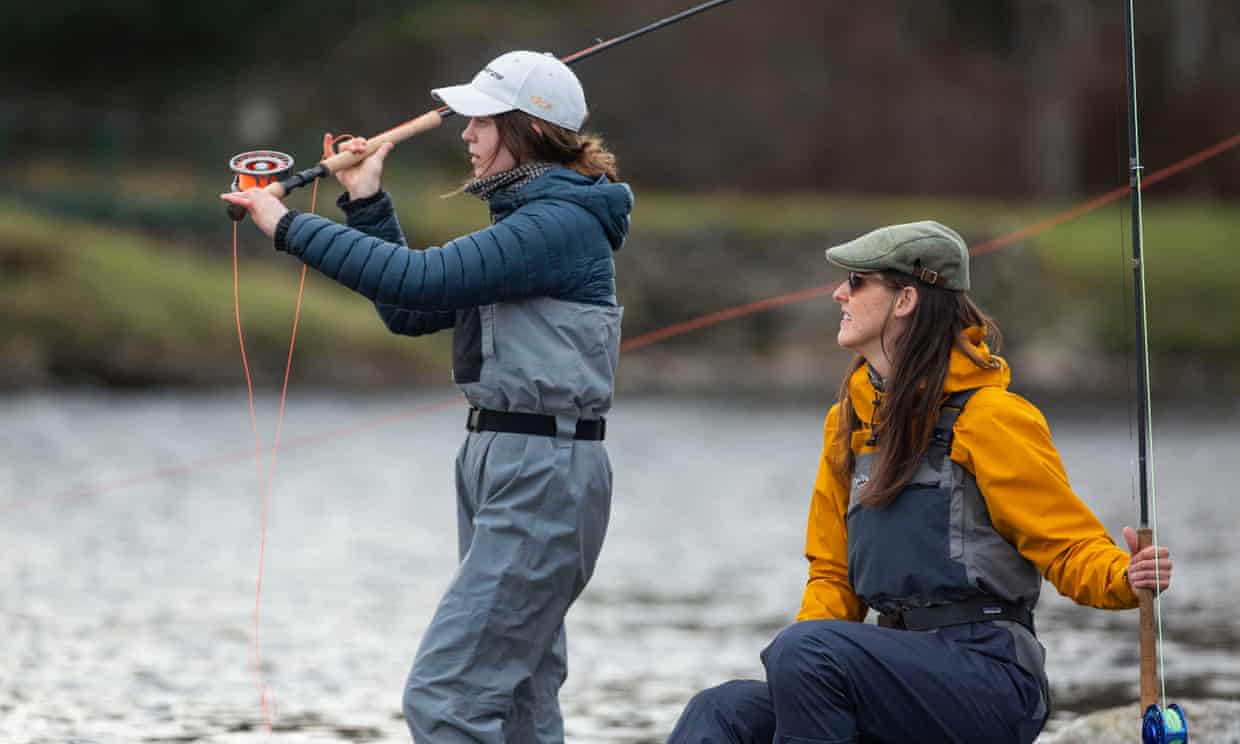
Photo: Murdo MacLeod/The Guardian. Camryn Stewart, 14, and Naomi Bell (right) open the salmon season on Scotland’s River Dee with the first casts.
So many good people trying to make the world better! Each one has their own area of action. It may be health, sports for kids, peace, housing, justice, the environment, art, teaching school. You name it. Today’s story is on people doing something about the effects of global warming where they live — along Scotland’s rivers.
Severin Carrell reports at the Guardian that “millions of trees are being planted beside Scotland’s remotest rivers and streams to protect wild salmon from the worst effects of climate heating.
“Fisheries scientists have found rivers and burns in the Highlands and uplands are already too warm in summer for wild Atlantic salmon as they head upstream to spawn, increasing the threat to the species’ survival.
“Fisheries on the River Dee in Aberdeenshire, one of the country’s most famous salmon fishing rivers, have planted 250,000 saplings along key tributaries. They plan to plant a million in the Dee’s catchment by 2035. …
“In 2018, the year Scotland recorded the lowest rod catch for salmon since records began, climatic changes meant water temperatures in 70% of salmon rivers were too warm for at least one day that summer. They exceeded 23C [73.4 Fahrenheit], a temperature that induces stress and behavioural change. …
“Marine Scotland scientists found that only 35% of Scotland’s rivers, which stretch for 64,000 miles (103,000km), have adequate tree cover.
“Lorraine Hawkins, the river director for the Dee District Salmon Fishery Board, a statutory body, said: ‘These rivers and burns are the nursery grounds for young fish and it’s the young fish which will be affected by summer temperatures – their feeding and growth rates are affected. If it gets hotter, we will see fish dying.’
“Fishery boards across Scotland have similar tree-planting programs, to provide essential shade to lower water temperatures. Many will be fenced off to prevent the saplings from being eaten by deer. Hawkins said these projects improved the overall health and biodiversity of rivers across the uplands, increasing insect life, leaf fall, managing essential nutrients and flood control.
“Alan Wells, the director of Fisheries Management Scotland, an industry body, said climate forecasts were clear that water temperatures would continue to climb, even if governments succeed in limiting climate heating. …
“He said, ‘This will get worse. We need to grow trees now to create that cooling shade.’
“The dramatic decline in wild salmon numbers is blamed on numerous factors: climate change affecting food availability; weirs and other obstructions in rivers; predation by soaring seal populations; sea lice attracted by fish farms; bycatch by trawlers at sea and poor river quality. Wells said that while Scottish ministers were proposing new conservation strategies, he remained frustrated with the slow pace of change.
“The Dee marked the start of its angling season [in February] by inviting two female anglers who won a fundraising competition last year to make the first cast, an annual ceremony at Banchory. …
“Camryn Stewart, 14, one of the first cast fishers, said she had been brought up fishing by her parents, Deirdre and Jim. The sport is targeting women and children as it strives to expand its participation and appeal. …
“ ‘I have been surrounded by people who fish, and I’ve wanted to fish all my life,’ she said. ‘We need more people fishing. … We gain so much from it. Just being outside and being in the wild. Even if you don’t catch anything, you come back from the day fulfilled.’ ”
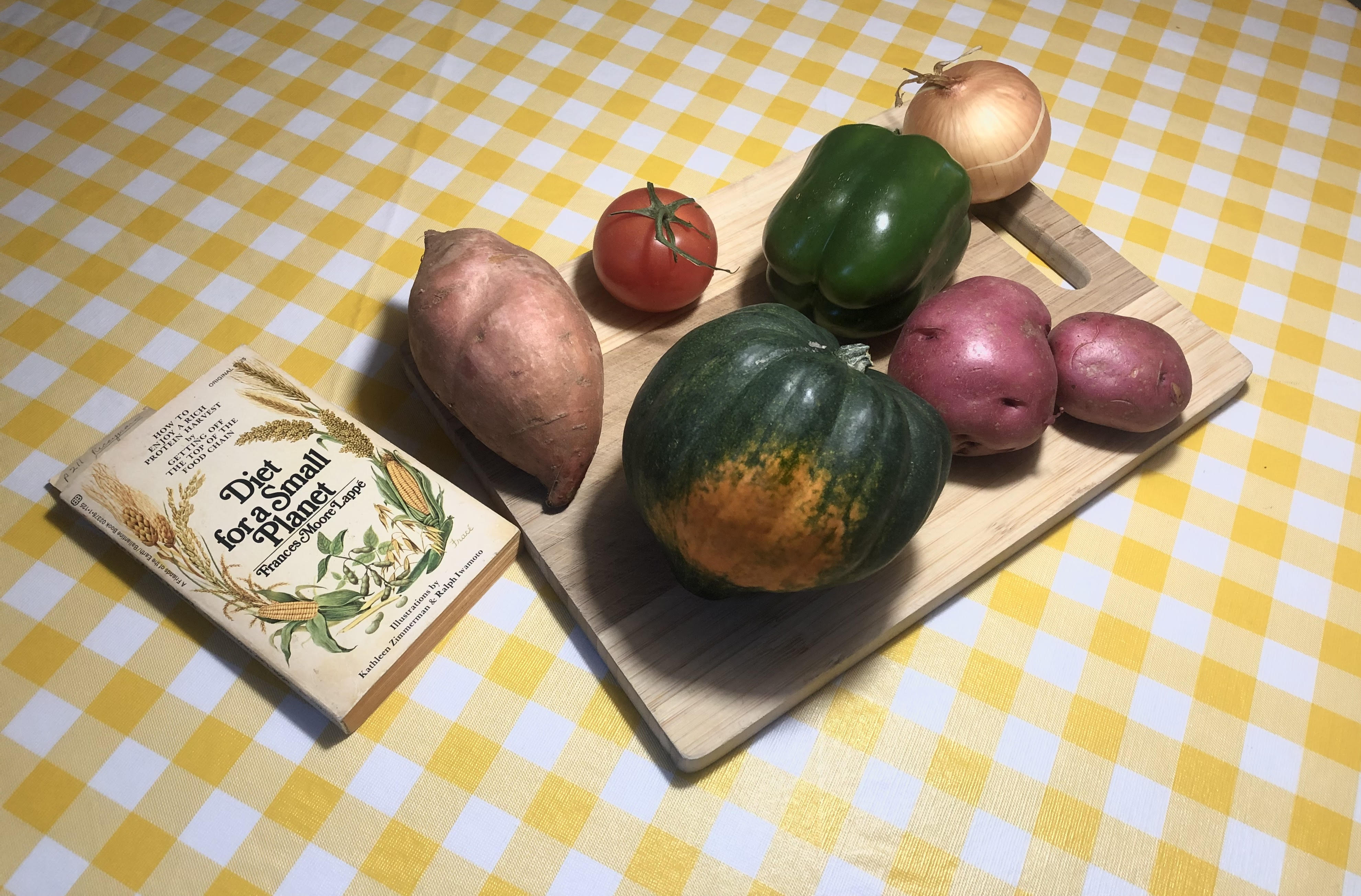
We do not have a plant-based diet in our house, although I’ve been taking baby steps in that direction as far back as the early 1970s when my little sister (now departed) gave me the Frances Moore Lappé book Diet for a Small Planet. This was when my sister was still in college and studying to be a poet. Long before she went to medical school and became a doctor.
I used to make an eggplant, mozzarella, and brown rice dish from that book. It was yummy but took too long to make. I’m a lazy cook.
Still, I keep being reminded that the effort is important — for example, when Robyn Vinter wrote for the Guardian in October about the environment summit in Glasgow, Scotland.
Vinter reported, “Plant-based dishes will dominate the menu at the Cop26 [Conference of the Parties no. 26] climate conference. … The low-carbon menu includes 95% British food, especially locally sourced Scottish produce, and each menu item has an estimate of its carbon footprint, ‘helping attendees make climate-friendly choices.’
“Delegates will be served dishes such as potato, leek and rosemary chowder, smoked salmon and ‘a spiced mushroom and onion burger served with a vegan tomato mayo, slaw and shoots.’
“Caterers are using sustainable suppliers including Edinburgh’s Mara Seaweed, which is abundant, entirely sustainable and does not require fertilizer, fresh water or soil to grow, and carrots and potatoes from Benzies, which uses wind turbines to power their cool storage, biomass to provide heating and recycles the water used. Hot drinks will be served in reusable cups that can be washed 1,000 times, which organizers say will save 250,000 single-use cups.”
How does the list at the Guardian sound to you?
” Winter squash lasagne (0.7kg CO2 equivalent emissions) – celeriac, glazed root vegetables and winter squash, with a vegan cheddar. ” Organic kale and seasonal vegetable pasta (0.3kg CO2 ee) – spelt fusilli, field mushrooms, kale and seasonal vegetables. ” Braised turkey meatballs (0.9kg CO2 ee) – with organic spelt penne pasta in a tomato ragu. ” Organic spelt wholegrain penne pasta (0.2kg CO2 ee) – with a tomato ragu, kale, pesto and oatmeal crumble.”
Mmmm. Maybe it’s worth the effort.
Meanwhile, at the Harvard Health newsletter, you can read why a plant-based diet is also better for your health. Katherine D. McManus, MS, RD, LDN, says, “Plant-forward eating patterns focus on foods primarily from plants. This includes not only fruits and vegetables, but also nuts, seeds, oils, whole grains, legumes, and beans. It doesn’t mean that you are vegetarian or vegan and never eat meat or dairy. Rather, you are proportionately choosing more of your foods from plant sources.
“What is the evidence that plant-based eating patterns are healthy? Much nutrition research has examined plant-based eating patterns such as the Mediterranean diet and a vegetarian diet. The Mediterranean diet has a foundation of plant-based foods; it also includes fish, poultry, eggs, cheese, and yogurt a few times a week, with meats and sweets less often.
“The Mediterranean diet has been shown in both large population studies and randomized clinical trials to reduce risk of heart disease, metabolic syndrome, diabetes, certain cancers (specifically colon, breast, and prostate cancer), depression, and in older adults, a decreased risk of frailty, along with better mental and physical function. Vegetarian diets have also been shown to support health, including a lower risk of developing coronary heart disease, high blood pressure, diabetes, and increased longevity. …
“Here are some tips to help you get started on a plant-based diet.
” Eat lots of vegetables. Fill half your plate with vegetables at lunch and dinner. Make sure you include plenty of colors in choosing your vegetables. Enjoy vegetables as a snack with hummus, salsa, or guacamole. ” Change the way you think about meat. Have smaller amounts. Use it as a garnish instead of a centerpiece. ” Choose good fats. Fats in olive oil, olives, nuts and nut butters, seeds, and avocados are particularly healthy choices. ” Cook a vegetarian meal at least one night a week. Build these meals around beans, whole grains, and vegetables. ” Include whole grains for breakfast. Start with oatmeal, quinoa, buckwheat, or barley. Then add some nuts or seeds along with fresh fruit. ” Go for greens. Try a variety of green leafy vegetables such as kale, collards, Swiss chard, spinach, and other greens each day. Steam, grill, braise, or stir-fry to preserve their flavor and nutrients. ” Build a meal around a salad. Fill a bowl with salad greens such as romaine, spinach, Bibb, or red leafy greens. Add an assortment of other vegetables along with fresh herbs, beans, peas, or tofu. ” Eat fruit for dessert. A ripe, juicy peach, a refreshing slice of watermelon, or a crisp apple will satisfy your craving for a sweet bite after a meal.”
To read McManus’s meal suggestions and her answers to readers with specific diet problems, click on the Harvard Health newsletter, here. More at the Guardian, here. And don’t forget to investigate Diet for a Small Planet, here.
I love stories about volcanoes that change the flow of history. The really big ones, you know, darken the skies for months — even years — and disrupt the sea like a tsunami.
As Katherine Kornei reports at the New York Times, there are other effects that researchers are just beginning to discover.
“Chaos and conflict roiled the Mediterranean in the first century B.C.,” she reports. “Against a backdrop of famine, disease and the assassinations of Julius Caesar and other political leaders, the Roman Republic collapsed, and the Roman Empire rose in its place. Tumultuous social unrest no doubt contributed to that transition — politics can unhinge a society. But so can something arguably more powerful.
Scientists [in June] announced evidence that a volcanic eruption in the remote Aleutian Islands, 6,000 miles away from the Italian peninsula, contributed to the demise of the Roman Republic.
“That eruption — and others before it and since — played a role in changing the course of history.
“In recent years, geoscientists, historians and archaeologists have joined forces to investigate the societal impacts of large volcanic eruptions. They rely on an amalgam of records — including ice cores, historical chronicles and climate modeling — to pinpoint how volcanism affected civilizations ranging from the Roman Republic to Ptolemaic Egypt to pre-Columbian Mesoamerica.
“There’s nuance to this kind of work, said Joseph Manning, a historian at Yale University who has studied the falls of Egyptian dynasties. ‘It’s not “a volcano erupts and a society goes to hell.” ‘ But the challenge is worth it, he said. ‘We hope in the end that we get better history out of it, but also a better understanding of what’s happening to the Earth right now.’ …
“Joseph McConnell, a climate scientist at the [Desert Research Institute in Reno, Nev.], and his collaborators are in the business of looking for debris [from long ago eruptions]. …
“Volcanic ash, more generally known as tephra, sometimes hides in ice. It’s a special find because it can be geochemically tied to a specific volcano. … The ice also carries a time stamp. Dr. McConnell and his colleagues look for variations in elements like sodium, which is found in sea spray that’s seasonally blown inland. By simply counting annual variations in these elements, it’s possible to trace the passage of time, Dr. McConnell said. ‘It’s like a tree-ring record.’
“Dr. McConnell and his collaborators recently analyzed six ice cores drilled in the Arctic. In layers of ice corresponding to the early months of 43 B.C., they spotted large upticks in sulfur and, crucially, bits of material that were probably tephra. The timing caught the scientists’ attention. Researchers have previously hypothesized that an environmental trigger may have helped set in motion the crop failures, famines and social unrest that plagued the Mediterranean region at that time. …
“Gill Plunkett, a paleoecologist at Queen’s University Belfast, set out sleuthing. After extracting 35 pieces of tephra from the ice, she pored over the rock chemistry of likely volcanic suspects. Nicaragua’s Apoyeque. Italy’s Mount Etna. Russia’s Shiveluch.
“But it was Okmok, a volcano in Alaska’s Aleutian Islands, that turned out to be the best match, at least on paper. Sealing the deal would require testing two tephra samples — one from the ice and one from Okmok — on the same instrument.
“Dr. Plunkett arranged for a tephra handoff at a conference in Dublin. A colleague from the Alaska Volcano Observatory, Kristi Wallace, packed four bags of Okmok tephra in her carry-on luggage. The match was spot on, Dr. Plunkett said. …
“This eruption was one of the largest of the last few millenniums, Dr. McConnell and his collaborators concluded, and the sulfate aerosols it created remained in the stratosphere for several years. These tiny particles are particularly good at reflecting sunlight, which means they can temporarily alter Earth’s climate. …
“There’s good evidence that the Northern Hemisphere was colder than normal around 43 B.C. Trees across Europe grew more slowly that year, and a pine forest in North America experienced an unusually early autumn freeze. Using climate models to simulate the impact of an Okmok eruption, Dr. McConnell and his collaborators estimated that parts of the Mediterranean, roughly 6,000 miles away, would have cooled by as much as 13.3 degrees Fahrenheit. … Rain patterns changed as well — some regions would have been drenched by 400 percent more precipitation than normal, the modeling revealed.
“That climate shock came at precisely the wrong time, Dr. [Jessica Clark, a historian of the Roman Republic at Florida State University] said. ‘This was a period of Mediterranean-wide political, social and economic upheaval.’
“These cold, wet conditions would have almost certainly decimated crops, Dr. McConnell and his colleagues said. Historical records compiled by Roman writers and philosophers note food shortages and famines. … For a society already reeling from the assassination of Julius Caesar the year before, such trying conditions might have exacerbated social unrest, the researchers concluded. They might even have kick-started transfers of political power that led to the rise of the Roman Empire.
“ ‘It’s an incredible coincidence that it happened exactly in the waning years of the Roman Republic when things were falling apart,’ said Dr. McConnell, who published the team’s results inProceedings of the National Academy of Sciences.”
This was a long, fascinating article. For additional details, including details about the effects of distant volcanic eruptions on the Nile River in Egypt, click here.
Photo: Jeremy Turley / Forum News Service Teenage indigenous rights activist Tokata Iron Eyes stands beside Swedish climate activist Greta Thunberg in the high school gym in Fort Yates, N.D., on the Standing Rock Sioux Reservation. (Fun to see Greta’s father came, too!)
The teenage Swedish climate activist Greta Thunberg is getting a lot of flack these days from vested interests terrified of her influence, but she shoulders on as new and old climate activists give her encouragement. In this story, indigenous people recognize a girl after their own hearts.
Natasha Rausch Forum News Service reports, “Nearly 500 Indigenous students stood in a circle surrounding two 16-year-old climate activists and their fathers Tuesday morning, Oct. 8, in the Standing Rock High School gym.
“A medicine man blessed the girls — Tokata Iron Eyes and Greta Thunberg — in what’s known as a smudging ceremony. Then, a circle of men played the drum as everyone in the gym slowly turned to face the four sacred directions.
“One of the drummers, Hans Young Bird Bradley, of the Standing Rock Environmental Protection Agency, said the tribe has ‘no choice but to support them, hold them up’ on their mission to spread awareness about climate change.
“ ‘We shouldn’t leave it on the back of two little girls to do this,’ he said. ‘It’s too much weight to carry for them. It should be all of us doing our part.’
“Thunberg … told the crowd of Indigenous students she was honored to be speaking at ‘this symbolic place of resistance’ where just three years earlier thousands of Indigenous and non-Indigenous people gathered to protest the Dakota Access oil pipeline. Though the line was eventually installed, the tribe has continued to fight it in court as others from the Standing Rock Sioux Nation have built on momentum from the protest to create a more sustainable future.
“Thunberg met Tokata Iron Eyes — one of the Standing Rock citizens who helped garner support for the Dakota Access oil pipeline protests in 2016 through the Rezpect Our Water campaign — at a September event at George Washington University. …
To see two teenagers take the stage in the Standing Rock High School gym, ‘it’s inspirational,’ said 13-year-old Chante Baker, who sat in the bleachers with her classmates. …
” ‘It took two youth to get us all together,’ said Cody Two Bears, the head of nonprofit Indigenized Energy which opened a solar farm last month near the site of the Dakota Access Pipeline protests. … We all need clean water and clean air and a safe place to call home. As Indigenous people, our culture and way of life is inherently tied to the environment.’
“Tyrel Iron Eyes, a 23-year-old from Standing Rock, said he’s proud of his cousin Tokata, and of Thunberg for getting people to listen to them.
” ‘They inspire,’ he said. ‘And at the end of the day that’s what we need is people to be inspired to make changes in their lives.’
“[Thunberg said,] ‘We need local solutions to this global problem, and of course global solutions as well.’ …
“In a closing ceremony, former Standing Rock Chairman Jay Taken Alive gifted Thunberg with a Lakota name: Maphiyata echiyatan hin win, meaning ‘woman who came from the heavens.’
“ ‘Only somebody like that can wake up the world,’ he said. “We stand with you. We appreciate you. We love you as a relative.’ ” More at the Billings Gazette, here.
And while we’re on the subject of sustainability influencers, you can see they’re having an effect in Europe, where this past summer increasing numbers of people decided to take the train instead of flying. Read about that at the Guardian, here.
By the way, does anyone know how Greta is getting home? She can’t very well take an wind-powered yacht across the Atlantic in winter.
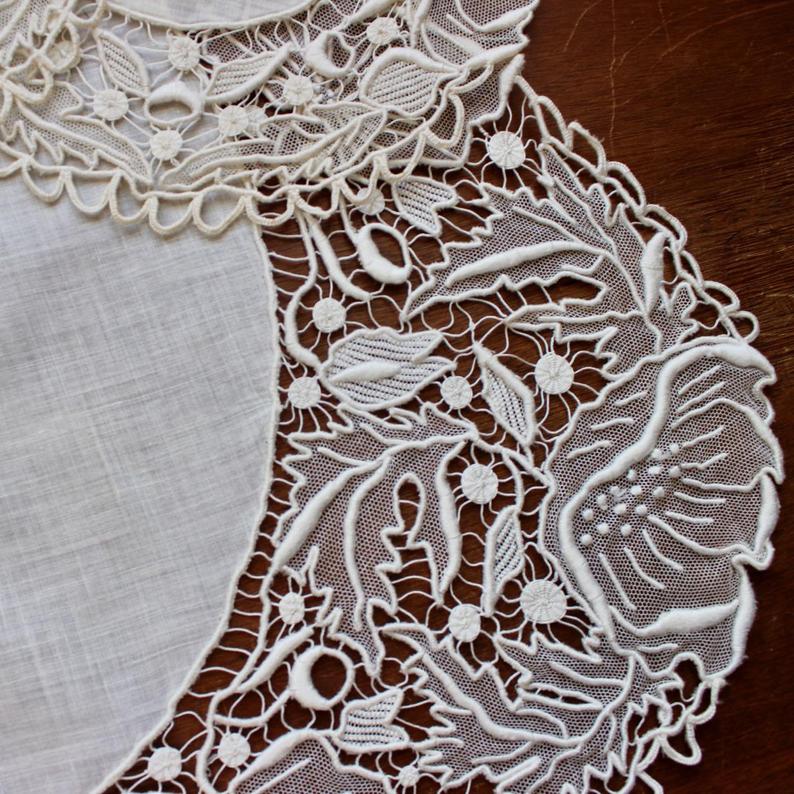
Photo: KerryCan/Etsy
Online markets like Etsy and Amazon currently rely on fossil fuels for deliveries, which is why Etsy is leading the way in addressing climate effects.
I’m happy to see that more individuals and organizations are taking action against the climate crisis. In this story it’s Etsy, the site where many people sell handcrafts. (I hope you have checked out blogger KerryCan’s gorgeous vintage linens there.)
As Emily Dreyfuss wrote in February at Wired magazine, the online market favored by “indie makers” is working toward a carbon neutral future.
“Tomorrow, all the carbon emissions spewed into the atmosphere from US ecommerce deliveries — some 55,000 metric tons of CO2, by one estimate, from trucks and planes shipping packages across the country — will be neutralized.
“It’s all thanks to Etsy, the global online market for indie makers, which is picking up the tab on high-quality carbon offsets for itself as well as its competitors on Thursday. Etsy’s largesse ends after tomorrow, but it will continue to offset its own carbon footprint going forward, becoming the first ecommerce company to completely offset all its emissions generated from shipping.
“Etsy estimates that doing so will cost less than a penny per package — less than $1 million for the year. The company made more than $200 million in just the last quarter of 2018. The price of covering the industry’s emissions for one day won’t even reach six figures.
“ ‘It’s a pretty trivial cost,’ says Etsy CEO Josh Silverman, who joined the company in 2017 and has been credited with turning around its fortunes. Before he joined, the company’s sales seemed poised to be gobbled up by Amazon. Though Amazon has only continued to dominate — accounting for almost 50 percent of total online sales last year, by one estimate — Etsy has regained its foothold on the craft market. …
“Silverman sees tackling sustainability as core to his stewardship of the brand. Ecommerce has come under scrutiny for its environmental consequences, but Silverman believes Etsy sellers and customers are eager to minimize their harm to the planet. …
“If every ecommerce company offset its emissions, it would make a difference. Transportation is the single biggest source of greenhouse gas emissions, according to the US Environmental Protection Agency — more than electricity or industry. …
“If Amazon wanted to offset its shipping emissions now, some back-of-the-envelope math using available numbers suggests how much it might cost. The company says it shipped over 5 billion items using Amazon Prime in 2017. Amazon Prime, with its free two-day delivery, has been accused of having a larger environmental impact, since the expedited time frame can make bundling items in the same package or delivery vehicle less practical. If each of those items was shipped separately, and if I borrow from Etsy’s calculation that it costs less than a penny per package to offset emissions, then it would cost Amazon less than $50 million to offset the emissions of Amazon Prime shipments in a year … less than 5 percent of Amazon’s reported $11.2 billion profit from 2018. …
“While experts agree that carbon offsets are the best option for an organization wanting to take immediate action, they caution that it’s a stopgap measure and not a solution to climate change. ‘Offsets are sort of second best because, essentially, what it does is allow you to continue emitting, and what we have to actually do is stop emitting,’ says Phil Duffy, president of the Woods Hole Research Center, the leading climate change think tank in the US. …
“Etsy knows this. According to Mozen and Silverman, the company’s goal is to eventually cut down on actual emissions. … Today it becomes the first ecommerce company to offer its customers the promise that packages delivered from Etsy are not hurting Earth. It’s a pretty good start.”
Until Amazon gets serious about its impact on the climate, maybe you’d rather find what you’re looking for at Etsy. Read more at Wired, here.





 Suzanne's Mom's Blog