Feeds:
Posts
Comments

Posts Tagged ‘conservation’

Photo: RJ Sangosti/MediaNews Group/The Denver Post via Getty Images.
Above, Las Vegas Valley Water District Water Waste Investigator Devyn Choltko puts a water waste violation into the computer system outside a home in north Las Vegas, Nevada.

When water is seen running into the gutter from a lawn in a desert city, Water Waste Investigator 9393 steps in. The good news is, water conservation efforts like those in Las Vegas are paying off.

Yvette Fernandez reports at National Public Radio by way of the Mountain West News Bureau, an NPR regional hub, in collaboration with Nevada Public Radio in Las Vegas. 

“About two dozen investigators patrol neighborhoods throughout Las Vegas every day searching for signs of wasted water. They’re known as water waste investigators who are part of the Southern Nevada Water Authority. For more than 20 years, they have been helping conserve water in the growing desert city.

“Devyn Choltko is one of the investigators with the Las Vegas Valley Water District, which is part of SNWA. … On an early July morning, she stops her patrol car in a neighborhood where water flows onto the street.

” ‘Water Waste Investigator 9393,’ Choltko reports into her cell phone to record the incident. ‘Some misaligned sprinklers as well as over-irrigation causing some run-off,’ she continues. …

“Choltko says ‘spray and flow’ violations are among the most common problems. This is when water from a sprinkler head sprays out onto the sidewalk or street, and that’s considered wasted water.

“Choltko marks a yellow flag with the date, time and alleged violation, then places the marker on the property to notify the resident. The investigators can only leave the yellow flag if they have actually witnessed the violation.

” ‘Most people don’t even know they have a problem,’ Choltko says. …

“Residents get a few notices to take corrective action. If they are ‘repeat’ violators, a fine ‘is recommended,’ says Choltko. They face a fee of $80 initially, which can continue to double if ignored.

“Choltko says some homeowners may have issues they aren’t aware of. A homeowner, for example, may have taken proactive steps to conserve water by removing their grass and switching to desert landscaping. Succulents and drought-resistant plants should be watered using drip irrigation to get water directly to the roots and reduce evaporation. But faulty or worn-out tubes can result in water spewing onto sidewalks. …

“For low-income homeowners who cannot afford repairs, the SNWA can provide financial assistance to make necessary repairs. It will also provide help in detecting leaks.

“More than twenty years ago, drought gripped the Colorado River Basin. … By 2003, the Southern Nevada Water Authority, a not-for-profit water provider with a half dozen water collaborative agencies in southern Nevada, responded with several water conservation efforts, which included starting the water patrol. …

“Says Bronson Mack, a spokesperson with the SNWA, the goal [is] to educate people about the importance of water conservation and encourage people to change their behavior. That change can be as small as people taking shorter showers or reusing water for plants or cleaning.

” ‘We collected in the neighborhood of about $1-$1.5 million over the recent years in water waste violations,’ says Mack. The Las Vegas Valley Water District uses those dollars to support conservation programs, such as incentives to remove turf and rebates to install smart irrigation systems. …

“Just east of Las Vegas, receding ‘bathtub rings’ are etched into one of the country’s largest reservoirs, Lake Mead — a reminder of how much water there once was. The reservoir provides water to Las Vegas and surrounding Clark County. Lake Mead and Lake Powell are at less than 35% normal capacity.

“The Southern Nevada Water Authority … has a significant effort to recycle water that’s already been used by treating it and putting it back into use. According to SNWA, it returned more than 245,000 acre-feet of water to Lake Mead in 2024. …

“The population of Las Vegas has grown by over 800,000 people since 2002. And, the city has seen over 40 million visitors during that time. Despite that growth, ‘we have reduced our consumption of Colorado River water by more than 30% over the past two decades,’ Mack says. …

“Low levels at Lake Mead and Lake Powell are expected to continue, according to the latest data released by the Bureau of Reclamation. The Department of the Interior’s Acting Assistant Secretary for Water and Science, Scott Cameron, said in a news release: ‘forward-thinking solutions’ that prioritize conservation will be increasingly important.”

More at NPR, here.

Read Full Post »

Art: NC Wyeth.
N.C. Wyeth’s “Apotheosis of the Family,” which hung behind the tellers in the downtown Wilmington Savings Fund Society for three quarters of a century, has been readied for public viewing at the artist’s grandson’s home in Wilmington, Delaware.

I have always loved the monumental paintings of NC Wyeth. Today we learn about his largest mural, which was created during the Depression and is getting a new lease on life.

Ralph Blumenthal writes at the New York Times, “As the Great Depression savaged America, a bank in Wilmington, Del., commissioned the protean illustrator N.C. Wyeth to soothe anxious customers with an epic tribute to the bounteous land and its laboring families.

“Known more by his initials than his given name, Newell Convers, he had long been a towering figure in American art, embellishing classics like Treasure Island. … Wyeth’s mural, in oil in five panels, came in at 60 feet long and 19 feet high — his biggest and one of the largest ever created for a public space in the United States. For three quarters of a century, it hung behind the tellers in the downtown Wilmington Savings Fund Society, inspiring visions of thrift and industry. And then it came down and disappeared.

“Now it has re-emerged in a gleaming new round barn on N.C.’s grandson Jamie Wyeth’s Point Lookout Farm outside Wilmington and near the Wyeth studios in Chadds Ford, Pa. …

“The 1932 work, ‘Apotheosis of the Family,” aims to welcome visitors by jitney from the nearby Brandywine Museum of Art [soon].

“N.C. Wyeth is enjoying a renaissance of sorts. His work will be included in the filmmaker George Lucas’s new Museum of Narrative Art, scheduled to open next year in Los Angeles. Five years ago, Wyeth had a retrospective at the Taft Museum of Art in Cincinnati, an exhibition that cited his influence on cinema. …

“In ‘Apotheosis,’ which celebrates the pinnacle of family, Wyeth … looms bare-chested dead center as a kind of superman, beside his wife, Carol, amid vignettes of harvesting, fishing, weaving and timbering as the seasons change. Pan plays the pipes, smoke boils from a campfire, and ships with billowing sails race for a distant shore. The foreground sprouts strange flowers hardly seen in nature.

“Prominent among other family models is Wyeth’s flaxen-haired son, Andrew, then 15 — destined to eclipse the rest of the famous art clan with his starkly realistic landscapes and portraits — drawing a bow and arrow and nude but for a modest blurry G-string. Next to him stands his sister Carolyn as a toddler, although she was actually eight years older. …

‘The work enshrines two of N.C.’s core beliefs — ‘love of family and the importance of land’ — at a terrible time when such values were especially precious. …

“After periodic restorations, most recently in 1998, the painting was pried off the wall and damagingly rolled up 10 years later when the bank was sold for conversion into apartments.

“The mural went to the Delaware Historical Society, which couldn’t place it. It was then bequeathed to the Wyeth Foundation for conservation, with Jamie, now 79, committing about $1 million for its reinstallation in a new round barn on his 250-acre Brandywine farm.

“Jamie is the widower of Phyllis Mills Wyeth, a philanthropist and socialite racehorse breeder. … As a tribute to his wife after her death at 78 in 2019, Jamie opened the pastures as a lifetime sanctuary for former racehorses. It also became a refuge for the nearly-century-old artwork. …

“ ‘I adore my grandfather’s work,’ he said. ‘He had more influence on me than my father.’ …

“Jamie, who was born the year after N.C. was killed in a bizarre train collision in 1945, recalled visits to his grandfather’s painting studio crammed with old muskets and cutlasses for his illustrations. …

“The story of the mural’s resurrection has many beginnings, but let’s start with the Wyeth patriarch: N.C., a descendant of early English colonists and maternal grandparents from Switzerland, who settled in Needham, Mass., where he was born in 1882. His father wanted him to go into farming but he was strongly drawn to art, winning acceptance as a star protégé of the pre-eminent illustrator Howard Pyle.”

Lots more at the Times, here. You will love how the Times animated restoration visuals by Caroline Gutman.

Read Full Post »

Photo: Lindsey McGinnis/The Christian Science Monitor.
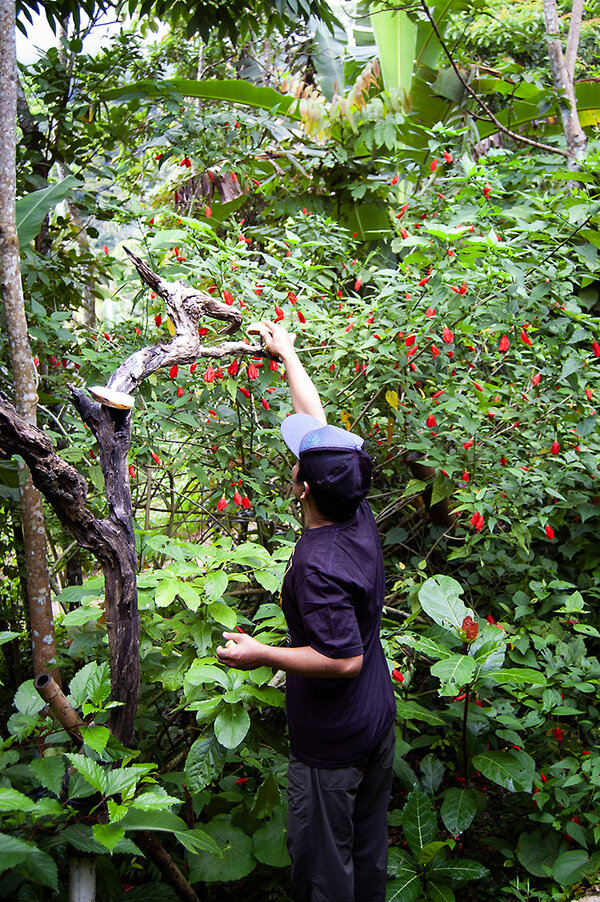
Kelik Suparno, a bird-hunter-turned-nature-guide, begins his day by loading fruit onto trees to attract birds to a viewing area near his home in Jatimulyo, Indonesia, March 1, 2025.

As I started to work on this post, I had an uneasy feeling that I’d written before about the birdsong competitions that are mentioned. Alas, yes. Click here to enjoy the charming side of today’s topic. Continue reading for the other side.

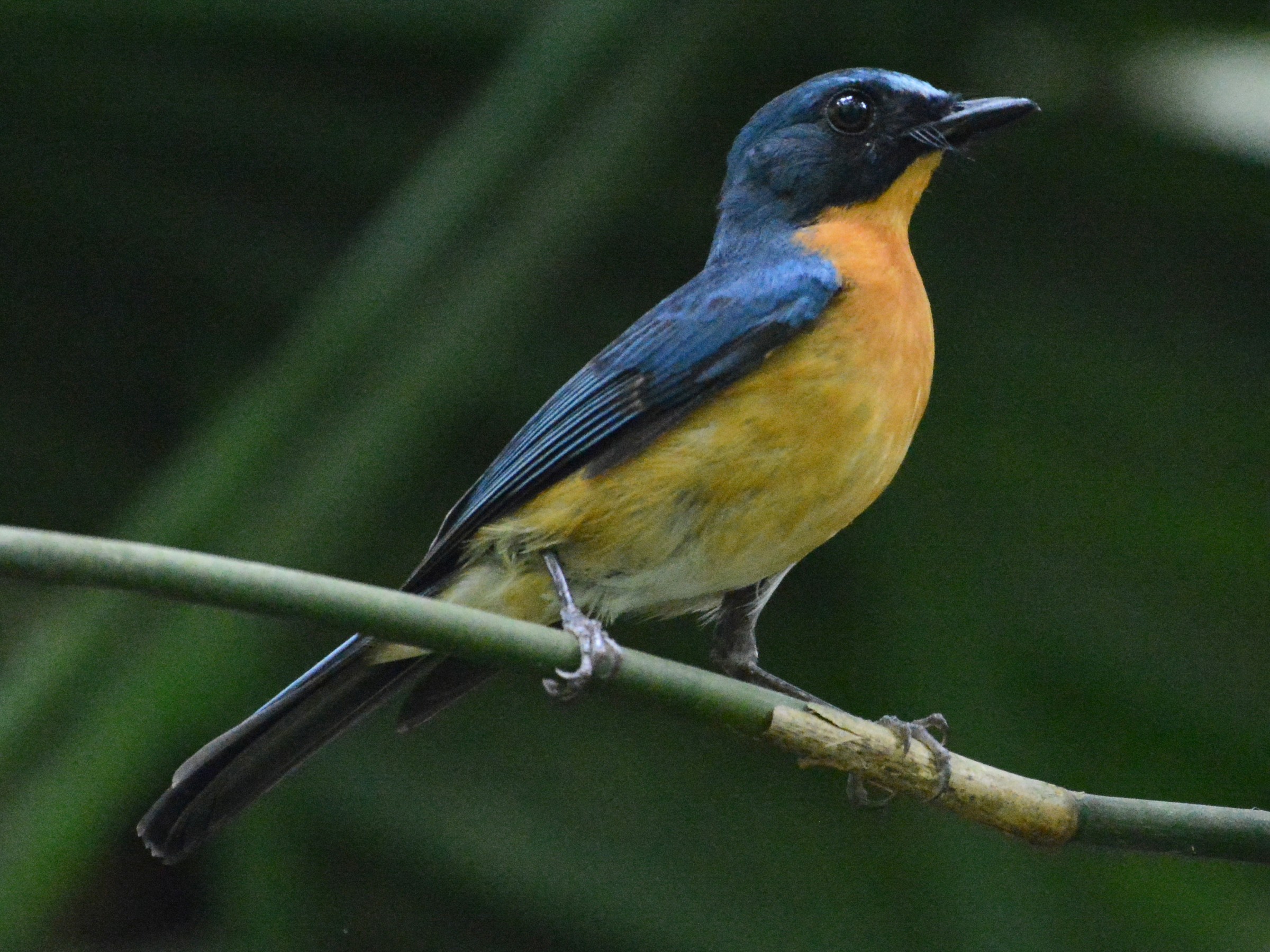
Lyndsey McGinnis writes at the Christian Science Monitor, “A decade ago, when Kelik Suparno heard the Javan blue flycatcher’s melodic whistle, he perked up at the promise of a payday. Knowing a single bird could earn him two months’ salary at one of Indonesia’s bustling bird markets, he set off to capture the critically endangered creature.

“Now, when he hears its distinct, high-pitched ‘twee-twoo sounds, he perks up for a different reason. It means he gets to introduce a group of outsiders – researchers, photographers, tourists – to his favorite species.

Photo: Ari Noviyono via eBird.

“Like many other men in the mountain village of Jatimulyo, Mr. Suparno made the switch from bird hunter to nature guide shortly after the village banned poaching. And now, as increasingly popular birdsong competitions across Asia threaten the country’s wildlife, Jatimulyo could set an example for other communities.

“Indonesia is the epicenter of what ecologists describe as the Asian songbird crisis: the rampant, illegal trade of rare and endemic birds to the devastation of their wild populations. The crisis affects at least 26 threatened species within Indonesia, where it’s fueled by the rising popularity of high-stakes birdsong competitions. Everyone wants these species to thrive. The love of native songbirds runs deep, especially here on the island of Java, and many hope to pass that love on to younger generations. But protecting both the country’s biodiversity and its songbird culture will require balance.

“ ‘In Indonesia, all kinds of birds are being hunted, everywhere,’ says Mr. Suparno. ‘The competition accelerates the rate of bird extinction.’

“The practice of keeping caged songbirds originated centuries ago in Java, and among general collectors, competitors, and breeders, up to 84 million caged birds are believed to be kept on this island today.

“Six belong to Emmannuel Tantyo, head of a neighborhood in the heart of Yogykarta – a city about 20 miles away from Jatimulyo, and often described as Java’s cultural ‘soul.’ Here, in the mazelike streets surrounding the city’s historic palace, a kind of perkutut, or zebra dove, reigns supreme.

“For Javanese men, it’s a symbol of prosperity, Mr. Tantyo explains, and a source of calm.

“ ‘When I wake up from sleep and hear the “too too too too” …’ he says, pausing to find the right word to describe the feeling. He taps his fingers to his heart. ‘Peaceful.’

“After Indonesia gained independence in 1945, the Javanese passion for bird keeping spread, spurred further by the introduction of birdsong competitions in the 1970s.

“As the popularity of competitions steadily grew, so did the industry around them – bird markets cropped up in every major city, a network of birder associations flourished, and cash prizes ballooned. Today, Indonesia holds hundreds of competitions annually, drawing thousands of competitors from all walks of life, all hoping to win money and prestige with their champion crooners.

“The competitions help uplift the entire economy, says Susri, a Yogyakarta-based perkutut breeder who, like many Indonesians, goes by one name. …

“He didn’t snag these doves from the forests of central Java. ‘Even a bird like the perkutut has its own role in the ecosystem,’ he says, and that’s where he believes wild birds should stay.

“Competition coordinators generally agree. They are trying to phase out the use of wild-caught birds by requiring competitors to prove the origins of their flock, usually through special bands that are installed by breeders like Susri onto a bird’s leg when they’re young.

“Phasing out wild songbirds would mark a seismic shift. A survey of 24 different songbird markets found that 71.5% of the birds were believed to have been taken from the wild, according to a preliminary study by Birdlife International and the international wildlife regulation group CITES. The study, presented during a 2023 workshop, found that only 2.2% of the birds were believed to be bred in captivity. Conservationists say that lax law enforcement and consumer preferences for wild-caught songbirds (which are often cheaper and, some collectors believe, sing better) help buoy the wildlife trade.

“Ultimately, says Susri, it’s up to all sectors of society to preserve Indonesia’s wildlife. ‘We are all responsible,’ he says.”

More at the Monitor, here.

Read Full Post »

Photo: Paulius Peciulis/AP.
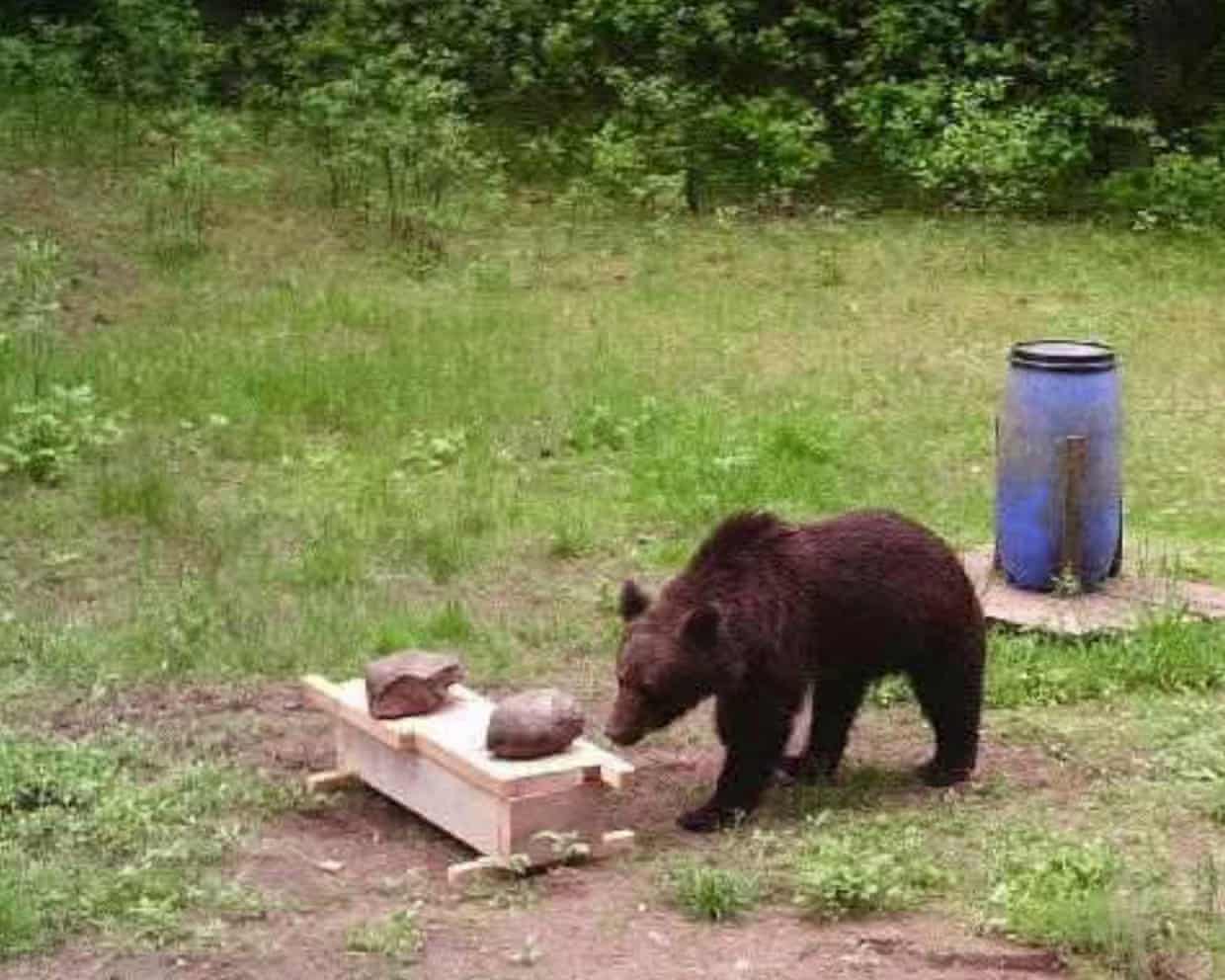
This young bear was recorded by a hunter in the forest calmly feasting on baits in Pabradė, Lithuania, in June. 

When I was young, I was surprised when my conservationist mother told me that hunting organizations like Ducks Unlimited were often sollid partners in protecting nature. But when I thought about it, I reaized that, of course, if you’re a duck hunter, you want enough ducks to hunt, and that means protecting their habitat.

Something similar may be the thinking of the Lithuanian hunters in today’s story who refused to shoot a bear.

Bears have started reappearing in small numbers, typically wandering in from neighboring countries such as Latvia and Belarus, where small bear populations still exist.

From the Associated Press in Warsaw via the Guardian: “A young female bear caused a stir after wandering out of the forest and into the leafy suburbs of the Lithuanian capital.

“For two days, the brown bear ambled through the neighborhoods of Vilnius, trotted across highways and explored backyards – all while being chased by onlookers with smartphones and, eventually, drones.

“The government then issued a permit allowing the bear to be shot and killed if it became aggressive and posed a threat to human life.

“That did not go down well with Lithuania’s hunters who, aware that there were only a tiny number of the protected species in the entire country, refused.

“The Lithuanian association of hunters and fishermen said it was shocked by the government’s approach.

“The association’s administrator, Ramutė Juknytė, said the bear was a beautiful young female who was about two years old and did not deserve to be shot. ‘She was scared but not aggressive. She just didn’t know how to escape the city, but she didn’t do anything bad,’ he said.

“The organization tracks the movements of bears. It believes there are only five to 10 bears in the Baltic country but does not have a precise number.

“The drama began [when] the bear entered the capital. It was the first time in many years that a bear had entered the city and it became a national story. The animal came within about 2-3 miles of the city center.

“Since causing a stir with their permit to kill the bear, Lithuanian authorities have been on the defensive. The deputy environment minister, Ramūnas Krugelis, said that the kill permit had been issued purely as a precaution in case the bear posed a threat, according to a report by the Lithuanian broadcaster LRT.

“The hunters proposed a more humane approach: sedation, tracking and relocation.

“As the debate over the bear’s fate unfolded, she took matters into her own paws and wandered out of the city. …

“Brown bears are native to the region and were once common. They were wiped out in Lithuania in the 19th century as a result of hunting and habitat loss.

“In recent years, they have started reappearing in small numbers, typically wandering in from neighboring countries such as Latvia and Belarus, where small bear populations still exist.

“Bears are protected under Lithuanian and EU law as they are considered a rare and vulnerable species in the region.” More at the Guardian, here.

Do you or your family members hunt? Over time, I’ve seen repeatedly that real hunters are supporters of gun-safety laws as well as conservation. They are definitely not the people who buy machine guns and shoot up schools. I hope that more and more, hunters will be the ones leading the charge for safety laws. Their viewpoint probably carries the most weight.

Read Full Post »

Photo: @risdmuseum on Instagram.
Conservator Ingrid Neuman (left) with Rhode Island School of Design undergrad student Sophie Bugat, doing repair work on a statue of Pan.

When a new artwork is acquired by a museum, it doesn’t go right on display. At least one expert must look it over and make sure it’s in good shape.

At the Rhode Island School of Design [RISD ] in Providence that expert is often Ingrid Neuman.

Kristine Yang writes at the Providence Eye, “This past November, Ingrid Neuman, senior conservator at the RISD Museum, wheeled a twelfth-century Japanese wooden Bodhisattva Avalokiteshvara into Hasbro Children’s Hospital for a CAT scan. Conservators have repaired the ancient figure, a revered Buddhist symbol, over centuries — Neuman’s examination would reveal exactly where and how they had carried out those repairs. …

“Over time, sculptures accumulate dirt and often chip, show wear, or even break. Some arrive with broken parts or past repair attempts that complicate restoration. Preparing these pieces for public exhibition falls to the museum’s conservation team.

“Through a meticulous process that integrates chemistry, art history, and craftsmanship, conservators work to stabilize and restore each object. … Neuman’s background in organic chemistry is essential to her work. Sculptures are vulnerable to a host of natural forces over time such as ultraviolet radiation, pollution, humidity, and fluctuations in temperature – all of which can degrade original materials. Pieces with organic materials like wood and ivory, along with metals such as bronze or iron, are particularly prone to these ‘agents of deterioration’ and can experience accelerated degradation if not properly maintained, says Neuman.

‘An ancient bronze beaker from China wants to corrode. It wants to go back to its original copper ore,’ says Neuman. ‘We’re trying to keep it from doing that.’

“Corrosion is a natural chemical reaction that occurs when metals like bronze are exposed to oxygen, moisture, or pollutants over time. This reaction, called oxidation, causes the metal to slowly break down. Left unchecked, this chemical process can eat away at the surface of a sculpture. …

” ‘We borrow a lot of techniques from dentists and doctors,’ says Neuman. ‘There’s a lot of overlap with the medical field.’ With limited in-house instrumentation at the RISD Museum, Neuman often relies on nearby hospitals such as Hasbro’s and research institutions for specialized evaluations.

“Understanding a sculpture’s composition and preservation history is crucial, as it directly informs the selection of repair materials. … Conservators intentionally choose repair materials that are visually similar to the original but chemically distinct, ensuring that their work can be easily differentiated from the artist’s upon chemical evaluation.

“ ‘We don’t like to use the same materials as the artist,’ Neuman says. ‘We’re not trying to be the artist, or be better than the artist, or confuse people.’ 

“The ease with which any added materials can be removed is also a crucial consideration for conservators, as they must ensure that any restoration work can be undone without damaging the original piece. …

“For this reason, conservators use inpainting – a technique used to fill in missing parts of an artwork – with materials that can be easily distinguished and removed. For example, Neuman says conservators often use acrylic paint when filling in an oil painting. Acrylic is water-based and chemically different from oil paint, allowing it to be safely removed. …

“Neuman emphasizes the importance of reversibility and the chemical properties of adhesives. ‘There’s so many glues in the world. A zillion,’ she says. ‘Everyone uses epoxy or Gorilla Glue, but we never use them because they’re too strong.’

“If conservators use a glue that is stronger than the sculpture’s original material, any physical stress on the object could result in new fractures, rather than breaking along existing lines. … She prepares her own adhesives in the lab, including wheat starch paste and Funori, a traditional Japanese adhesive made from seaweed — both of which are gentle yet effective enough for conservation work.

“While conservators intentionally make their repairs distinguishable from the original through their selection of materials, their work must remain invisible to the viewer. … This means conservators must address each deformity with painstaking precision and care. Inpainting demands an especially detailed approach. … Neuman says, ‘You have to use a very tiny brush, with only a few hairs in it, and you have to be really good at color matching.’

“One of the challenges of inpainting is a color perception phenomenon called metamerism, where colors that match under one light source may look different under another. … To navigate this, she moves the piece back and forth on wheeled carts between her sunlit lab and the gallery space to ensure the colors match under different lighting conditions.

“Once the restoration is complete, detailed documentation is essential, Neuman says. Photographs of the piece before, during, and after the process, along with written records, are uploaded to the museum’s database for future conservators’ reference. ‘It’s important to leave a record,’ Neuman says.”

More at the Providence Eye, here. This story reminds me of the work that Sotheby’s did on one of my mother’s Pousette-Dart paintings, one that had been too close to a chimney fire!

Read Full Post »

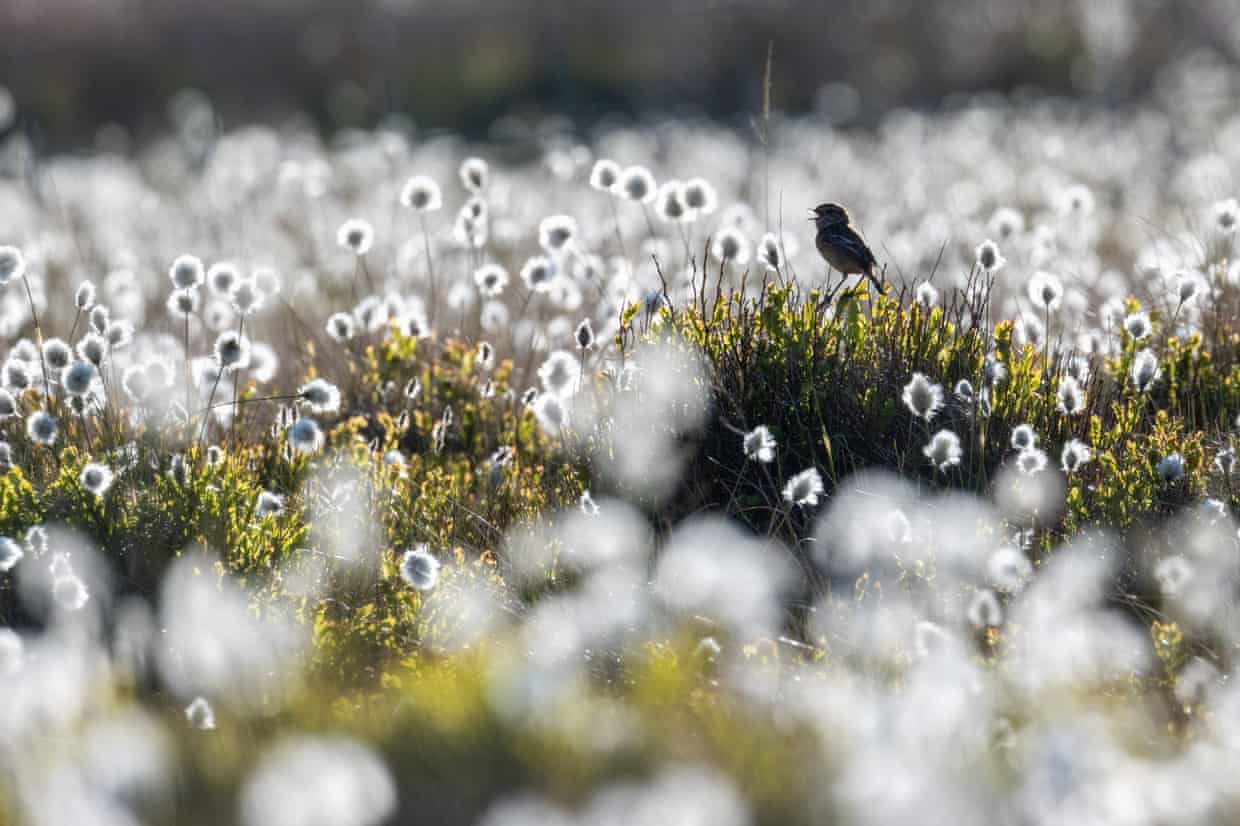
Photo: Rebecca Cole.
A female stonechat calls from a bilberry bush. Cooperation between farmers and conservationists in England is bringing back “ghost woodlands” and wildlife habitat.

When do tree-planting programs accomplish what they set out to do? That is the question as we hear more and more that some massive initiatives haven’t worked. In a story from Yorkshire we learn that cooperation among different interest groups is one route to success. Another is using native species to reawaken ancient species buried deep in the soil.

Phoebe Weston writes at the Guardian about a restoration effort by both conservationists and farmers to transform barren sheep fells.

“The Howgill Fells are a smooth, treeless cluster of hills in the Yorkshire Dales national park, so bald and lumpy that they are sometimes described as a herd of sleeping elephants. Their bare appearance – stark even by UK standards – has been shaped by centuries of sheep grazing. Yet beneath the soil lie ancient tree roots: the silent traces of long-lost ‘ghost woodlands.’ …

“Over the past 12 years, 300,000 native trees have been planted across these hills in sheep-free enclosures. The results are beginning to be seen: birds and flowers are returning. … Says ecologist Mike Douglas from South Lakes Ecology, who is monitoring birds in the enclosures, ‘We are 10 years into what was ecologically very damaged land.’ …

“Big rewilding projects often happen on private land with limited public access. These enclosures are a result of agreements reached between dozens of farmers on common land with public access. ‘Doing so much tree-planting on a common was groundbreaking,’ says Peter Leeson from the Woodland Trust. …

“Bluebells are popping up and there are patches of bracken, which suggest the soils and seed banks retain the memory of being a woodland despite hundreds of years of sheep grazing. “We call these memories ‘ghost woodlands,’ says Leeson. These ancient woodland indicators could offer a blueprint of where trees should return. …

“Last year, there were 14 breeding species here. Before the enclosure was created, he says, just four would have been found: meadow pipit, skylarks, wren and grey wagtails. Eleven new breeding bird species have been recorded since the original 2016 survey, with numbers increasing year-on-year. ‘I’m surprised by how quickly birds have colonized, and the diversity of species,’ says Douglas. …

“The enclosures were possible thanks to a 10-year government agri-environment scheme, signed by farmers with grazing rights to the fell as part of the Tebay Common Grazing Association, and the owner of the fell, Lonsdale Estates, supported and monitored by the Woodland Trust. …

“Across Europe, conflicts between farmers and conservationists are increasing due to the need for maintaining food production while creating space for nature. This conflict tends to be especially pronounced in the uplands because the land is relatively unproductive for farming. ‘Farmer and conservation collaboration is the real joy,’ Leeson says. ‘We want the same things. We want to be listened to, and heard and involved. I’d say we’re friends now.’

“John Capstick, chair of the Ravenstonedale Common Graziers Association, which hosts 187 hectares (462 acres) of fenced off land, says at first some farmers ‘were dead against it being fenced off. They were frightened it was an ulterior motive to get sheep off the fell.’ …

“In fact, the trees are not proving a threat to hill farming. The money is a lifeline for farmers, who earn as little as £7,500 a year from selling sheep and have been reliant on disappearing government subsidies. The Tebay scheme provides payments of £25,600 a year for maintaining the trees and fences and for loss of grazing rights, which are shared equally between the landowner and the farmers.

“Twenty-five years ago, there were 25 farmers on Tebay common. Now there are 10. For those who still graze on the common, the payments are ‘keeping them going,’ says Tim Winder, chair of the Tebay Common Grazing Association, whose father’s family have been farming for as long as they can remember.

“Now Winder is working with researchers on using the fells for peatland restoration and natural flood management. ‘We have to look at different ways of farming,’ he says. ‘We’ll invite anyone to work with us.’

“In the years to come, patches of mature woodland and scrubland will develop here, and common birds such as great tits, blue tits, dunnocks and blackbirds, will move in, says Douglas. It is a mystery what these hills may have looked like hundreds of years ago – no detailed historical records exist. Ghost woodlands speak of not only what has been lost, but what could one day return. ‘This was a leap in the dark for the farmers, as much as anyone else,’ says Leeson. ‘Hats off to them.’ “

More at the Guardian, here.
Read Full Post »

Photo: Nilo Merino Recalde.
A visual representation of an audio clip of five different great tit birds singing one song each.

There is so much for humans to learn about other species! The other day, a post on household pets reacting to the animated film Flow inspired Deb in Tennessee to conduct her own experiment with her dog. She learned that Buster, for one, was bored by Flow, failing to replicate the anecdotal evidence of curiosity described at the New York Times — a good example of why studies usually say, “More research is needed.”

Today we learn something new about birds, but maybe it’s only certain birds.

Victoria Craw writes at the Washington Post, “They sound beautiful, herald the start of spring, and even have the power to reduce stress and boost mental health.

“Now it turns out that some birdsongs also contain a hidden world of shared language, with varying local accents and dialects that change depending on the age of the bird and its peers — not unlike human songs.

“ ‘Just as human communities develop distinct dialects and musical traditions, some birds also have local song cultures that evolve over time,’ said Nilo Merino Recalde of the University of Oxford’s biology department, who led the new research published in the journal Current Biology. ‘Our study shows exactly how population dynamics — the comings and goings of individual birds — affect this cultural learning process.’ …

“The study is based on analysis of over 100,000 bird songs from at least 242 birds recorded in 2020, 2021 and 2022 in Wytham Woods in Britain’s Oxfordshire — a sprawling 1,000-acre wood where ecological and environmental research is carried out. For the last 77 years it has been the site of the Wytham Great Tit Study showing how two species of tit — the great tit and blue tit — have changed over time. …

“While some birds learn songs from their fathers and others learn continuously from neighbors, great tits are believed to do most of their learning in the first 10-11 months of life. …

“Merino Recalde said he was inspired by his love of birds and interest in social learning in animals, which creates an evolving shared culture reminiscent of the way humans learn languages and music. Theoretical work indicates that factors such as population turnover, immigration and age can affect the evolution of these cultural traits — so far, however, empirical evidence on the subject has been limited.

“His research team focused on the great tit, a small bird that lives just 1.9 years on average. The team recorded the ‘dawn chorus’ from March to May — coinciding with breeding season — using microphones placed near nesting boxes to gather more than 200,000 hours of the ‘simple yet highly diverse songs’ sung by males. Through a combination of physical capture, microchips and an artificial intelligence model, researchers were able to recognize the songs of individual birds and track how they changed over time, showing each bird had a repertoire ranging from one to more than 10 tunes.

“ ‘One of the main findings was that the distance that these birds travel while they are learning the songs, and also the ages of the other birds they interact with … affect how varied their songs become, collectively,’ Merino Recalde said. …

” ‘Homegrown’ songs in areas where birds stay close to their birthplace tend to stay unique, similar to the way in which isolated human communities can develop distinct local dialects over time, the team found.

“Age also had a significant impact, with birds of a similar age singing similar tunes, whereas mixed-age neighborhoods had ‘higher cultural diversity.’

This shows that the older birds can act as guardians of culture as they ‘continue to sing song types that are becoming less frequent in the population,’ researchers said.

“ ‘In this way, older birds can function as “cultural repositories” of older song types that younger birds may not know, just as grandparents might remember songs that today’s teenagers have never heard.’ …

“Merino Recalde said capturing how population changes are reflected in song could provide a future avenue for less invasive research, eliminating the need for capturing and tagging animals, for instance. …

“Professor Richard Gregory, the head of monitoring conservation science at Britain’s Royal Society for the Protection of Birds (RSPB), who was not involved with the study, praised the ‘herculean’ effort to analyze such a large data sample over a three-year period and said similar research could be used to highlight ‘critical tipping points’ for a population in future.

“While the great tit is not endangered, Gregory said the study could help inform plans to reintroduce or relocate certain animals, as such conservation efforts may be ‘doomed’ if they don’t take their cultural traits into account. ‘This study reminds us that the details of an animal’s life really matter.’

“Gregory, who is also an honorary professor of genetics, evolution and environment at University College London, said the study also showed that ‘methods of wildlife recording and song analysis are developing at break-neck speed,’ and AI is going to ‘revolutionize conservation science’ by allowing patterns in nature to be identified more readily.”

More at the Post, here. You can listen to an audio clip there.

Read Full Post »

Photo: John and Suzanne’s Mom.
Fungi and algae receive less than 0.2% of conservation funding, according to a new study. Small speices never seem as cool as rhinos and elephants.

Is it human nature to pay more attention to the large and aggressive than to the small and quiet? As a female, I think so.

At the Guardian, Mariam Amini writes about how that tendency, when applied to the study of the natural world, can be harmful to the planet.

“Most global conservation funds go to larger, charismatic animals,” she says, “leaving critically important but less fashionable species deprived, a 25-year study has revealed.

“Scientists have found that of the $1.963bn allocated to projects worldwide, 82.9% was assigned to vertebrates. Plants and invertebrates each accounted for 6.6% of the funding, while fungi and algae were barely represented at less than 0.2%.

“Disparities persisted among vertebrates, with 85% of all resources going to birds and mammals, while amphibians received less than 2.8% of funding.

“Further funding bias was found within specific groups such as large-bodied mammals towards elephants and rhinoceros. Although they represent only a third of that group, they were the focus of 84% of such conservation projects and received 86% of the funding. Meanwhile mammals such as rodents, bats, kangaroos and wallabies remained severely underfunded, despite being considered endangered.

“ ‘Nearly 94% of species identified as threatened, and thus at direct risk of extinction, received no support,’ said Benoit Guénard, the lead author of the study. ‘Protecting this neglected majority, which plays a myriad of roles in ecosystems and represents unique evolutionary strategies, is fundamental if our common goal is to preserve biodiversity.’

“Alice Hughes, a coordinating lead author of the research, said: ‘The sad reality is that our perception of “what is threatened” is often limited, and so a few large mammal species may receive more funding than the near-12,000 species of reptile combined.

“ ‘Not only does this limit our ability to implement protective measures, but it closes opportunities to researchers. I have lost count of the number of times collaborators have switched taxa [organism populations] purely because theirs was difficult to fund. This leads to a chicken and egg situation – some of the groups with the highest rates of recent extinction, like freshwater snails, have the most outdated assessments.’

“The study, led by Guénard and colleagues at the University of Hong Kong, analyzed 14,566 conservation projects spanning a 25-year period between 1992 and 2016. …

“ ‘We are in the midst of a global species extinction crisis,’ said research author Bayden Russell. … ‘We need to change how we think about conservation funding. The community needs to be educated about the value of biodiversity and protecting species that are under threat.’ …

“ ‘Governments, in particular those which represent the main pool of funding, need to follow a more rigorous and scientifically driven approach in conservation funding,’ said Guénard.”

More at the Guardian, here.

And be sure to check Anna Kuchment’s Boston Globe interview with Mandë Holford, here, about a poisonous snail with lifesaving properties. It reads in part: “Some of the most powerful drugs in our medical arsenal come from animal venom. Ozempic was derived from Gila monsters, a lizard native to the southwestern US; Prialt, used to treat chronic pain in HIV and cancer patients, comes from deadly cone snails; and captopril, the first ACE inhibitor, a class of drugs used to treat high blood pressure, came from Brazilian pit vipers.”

Read Full Post »

Photo: Gabriela Contreras González.
Saint Catherine of Alexandria, patroness of students, teachers, librarians, and lawyers.

Today’s post is about art restoration, a field that always seems brave to me. Imagine charging into some time-honored work and presuming to “fix” it! I guess a good restorer becomes the artist, too — perhaps in the way that a skilled translator of a literary work becomes a coauthor.

This month, with trepidation, my husband and I put a lovely Inuit watercolor into the hands of a conservator. Would she be able to remove all the mildew from life in a damp summer cottage? The results were nothing short of miraculous.

At Artnet, Min Chen writes about a larger work of conservation in Mexico.

“For decades, the interior of the Temple of Our Lady of the Assumption, a church in the town of Santa María Huiramangaro in Mexico, stood stark white, with blue accents. But the parish was not always so bare. A new restoration has revealed a host of resplendent 16th-century religious paintings that once spanned the ceiling of the historic church.

“The project, undertaken by participants including the Ministry of Culture of the Government of Mexico and the National Institute of Anthropology and History (INAH), dispatched a team of professionals to conserve the roof of the church. What they discovered instead were ancient images of saints and martyrs — hagiographic works rarely found in the Michoacán region — which had been painted over during the 1940s.

“The work, said Laura Elena Lelo de Larrea López, expert restorer at the INAH Michoacán Center, in a statement, ‘allowed us to recover an extraordinary work on the horizontal roof of the main altar, and to discover the rich artistic, technical and iconographic evolution that has marked this religious site.’

“The Temple of Our Lady of the Assumption was constructed in the early 16th century, when Santa María Huiramangaro was designated a district head, overseeing the communities of San Juan Tumbio, Zirahuén, and Ajuno. The building reflected the architectural styles of Mudéjar, which featured ornate motifs believed to have been originated by Muslim craftspeople in the 13th century, and Plateresque, a late-Gothic and early Renaissance aesthetic imported by the Franciscans.

“During restoration work, three pictorial layers of religious iconography were uncovered on the church’s ceiling. The oldest, from the 16th century, saw the use of tempera paint, which was applied in thin glazes to depict various characters corresponding to Saints Paul, Peter, Agatha of Cantania, and Catherine of Alexandria, as well as baby Jesus in Franciscan habit. The works were retouched with oil paints in the following century, adding volume and colors to the depicted figures’ clothing.

“When water ran dry in the region in the 17th century, the church fell largely into disrepair, as Santa María Huiramangaro lost its capital status. ‘The misfortune was a blessing in disguise, in terms of conservation,’ said Lelo de Larrea López, ‘since, not having the resources to renew its religious furnishings, the parish priests of the Temple of Santa María preserved its Plateresque ornaments. …

“Still, experts uncovered evidence of a restoration effort in the 20th century. Acrylic paints were deployed to touch up the faces of the saints. …

“During remodeling work in the 1940s, the iconography on the church’s roof was painted over in white, with blue designs. The repainting, noted Lelo de Larrea López, ’caused an alteration in the appearance of the place.’

“The latest conservation removed the repainted layer and restored missing portions of the paintings. Additionally, the ceiling was cleaned of dust and animal droppings, reinforced with joints and wood grafts, and fumigated to deter wood-eating insects. Other roof elements, such as corbels, partitions, and Franciscan cord carvings, were also given a refresh.

“The work marks the latest phase in a major restoration of the Temple of Our Lady of the Assumption, which began a decade ago with a focus on its main altarpiece. Despite a dismantling (undertaken to tackle a collapse in the church’s rear wall), conservators found the artifact in a well-preserved state. Over 2022 and 2023, they addressed damage to its cornices and carvings, and undid a repainting job to reveal its original gold leaf and polychrome.”

I admire the commitment it takes to work on projects of ten years or more like this. Have you ever had a piece of art restored?

More at Artnet, here.

Read Full Post »

Photo: Jenna Garrett/The Guardian.
Eric Haas in his backyard in Oakland, California. The California professor had a rainwater and greywater capture system installed at his highly efficient urban home to conserve water. 

I like reading about people who are handy at fixing or making things. Probably because I’m not. Other than sewing on a button or baking cookies, I don’t do much in the do-it-yourself line, but I know some of you do, and I’d love to hear about it.

Today’s article is part of a Guardian series on people who figure out ways to limit their impact on the environment. Sometimes that means working with companies specializing in sustainable building practices. Eric Haas told his story to Victoria Namkung.

“I joined the Peace Corps after college in 1985,” Haas explains, “and was a math and science teacher in Buchanan, Liberia. There, I started to realize that large parts of the world don’t live with all the energy consumption and materialism that we do in the US.

“I started seeing people’s innovative ways of keeping their houses warm or cool and how they would get their water. I had to carry my own water at times and be very conscious where it came from. These experiences started cementing this idea that life could take into account the environment you lived in.

Relatively simple ideas could make a huge difference in the comfort and quality of your house. You adapt and your lifestyle can adapt. …

“When our family settled in Oakland, California, in 2007, part of the decision in buying a house was whether it was somewhere I could finally focus on water conservation and other low-carbon-footprint projects like installing solar panels, insulation and high-efficiency appliances.

“I hired Dig Cooperative Inc, a local contractor known for pioneering water-conservation systems across the greater Bay Area, to install a rainwater and greywater collection system at our home. I have about 4,000 gallons of water I can collect, which translates to about 7inches of rain coming off the roof. Filtered rainwater is used to fill the toilets and washing machine and water most of our plants. It can also be saved on site for emergency use in case of a fire or an earthquake.

“The greywater system takes our ‘used’ shower, bathroom sink and washing machine water and diverts it to the backyard to water our vegetable gardens and six fruit trees. …

“During 2024, the typical household in our area used an average of 124 gallons of water a day. We used an average of 39 gallons of water a day, less than a third.

“It wasn’t hard and the whole project took about a week. Rain barrels needed to be purchased and set up and the ground had to be leveled. I have a relatively small and simple house and connecting the rainwater and greywater system into the existing plumbing just took a day or two.

“The whole project cost about $15,000. We still have a water bill because the shower, sink and dishwasher water use regular city water, but it’s a fraction of what it used to be. … Compared to the average water user, I save about $220 a year on my water bill. So, my rainwater and greywater systems do more for my local environment than they do for my wallet.

“Since moving to Oakland, I’ve noticed a lot of climate-related changes. Before, nobody had air-conditioning, and I never even thought about it. Now it’s almost a necessity on select days. When I first put in the system, there was enough rain periodically in California’s dry season to fill up the tanks enough that I never had to go back to city water for the first several years. Now it only lasts for about 10 months. The dry season is so dry and when we’ve got extra rain in the rainy season my tanks overflow and drain into the sewer because they’re full.

“We have to approach our water use differently in California. … Our overuse of water now impacts our quality of life. We have water-restriction days where they ask you not to use as much water, including not flushing our toilets every time, and we’re encouraged not to have a lawn. … You can still have a really nice garden. We have a hot tub, we have a regular shower, but because those things are connected into this larger system, we have a much smaller impact.

“I feel like I’m doing something real and concrete, and every time I hear the greywater pump go on or when I hear the pump from our rainwater system go on to fill up the washing machine or  toilet, that’s water that I’m not taking from the system and that matters.

“Every time it rains, I love to go out and look at the gutters and see how much it’s pouring into the system. It brings me joy to interact with the natural environment in this small way in my urban house.”

More at the Guardian, here. My DIY climate hack is a Guardian series about everyday people across the US using their own ingenuity to tackle the climate crisis in their neighborhoods, homes and backyards.

Read Full Post »

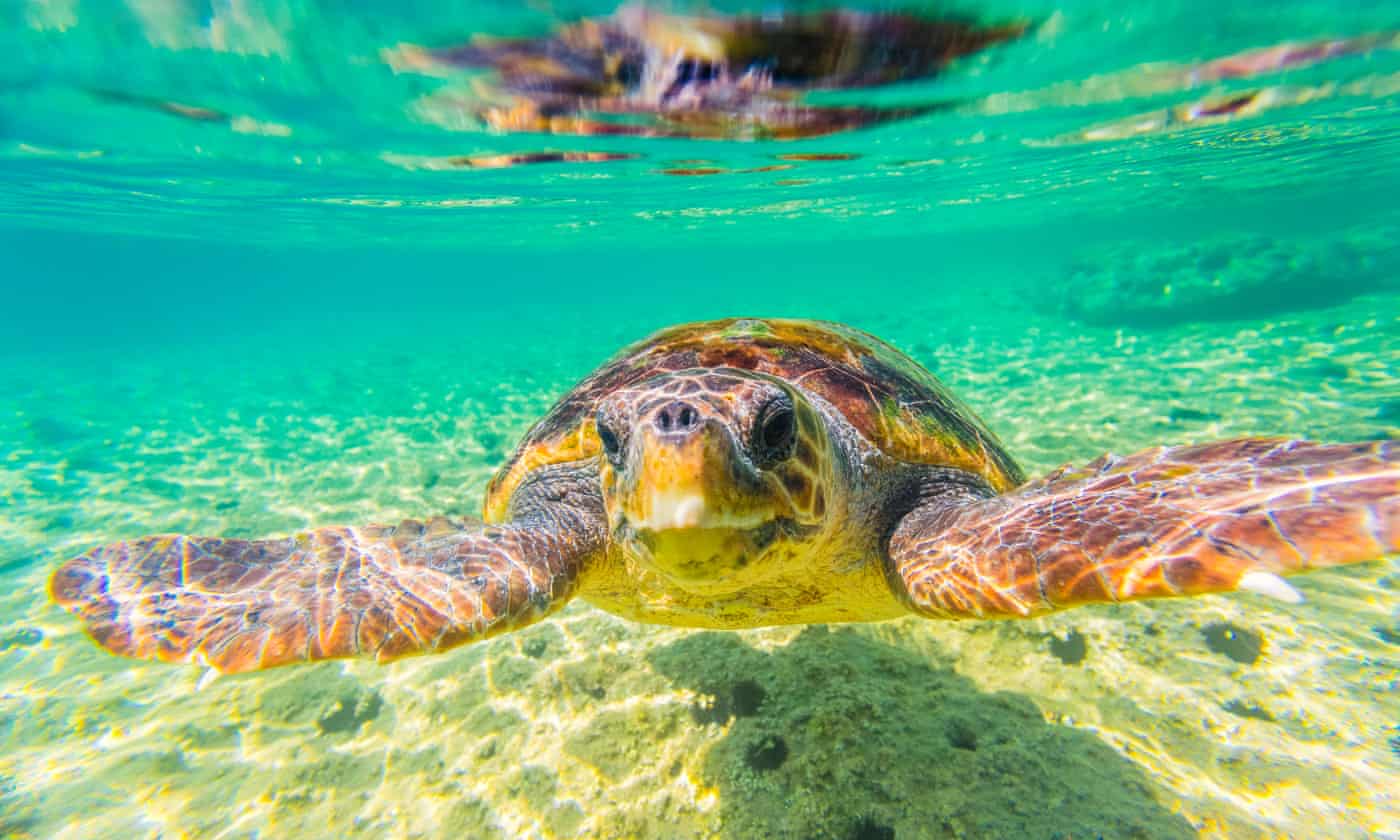
Photo: Giacomo Augugliaro/Getty Images.
A loggerhead turtle (Caretta caretta) off Elafonissos island in Greece, where the rebound in population has been called “phenomenal.”  

Today’s article is about the resurgence of turtles in Greece. But before I get into it, I need you to indulge my current train of thought about turtles.

There are the chocolate, caramel, and pecan-footed “turtles” that my sister-in-law makes every Christmas, turtles that this week have gotten certain farflung relatives wildly excited.

There are songs about turtles like one I just found out my exercise teacher made for a fundraiser years ago, here.

And there are turtle fans all over the world who are bringing real turtles back from the brink of extinction. Slowly but surely.

Helena Smith writes for the Guardian about that.

“After nearly a quarter of a century observing one of the world’s most famous sea turtle nesting grounds,” she reports, “Charikleia Minotou is convinced of one thing: nature, she says, has a way of ‘sending messages.’

“Along the sandy shores of Sekania, on the Ionian island of Zakynthos, what she has seen both this year and last, has been beyond her wildest dreams. The beach, long described as the Mediterranean’s greatest ‘maternity ward’ for the Caretta caretta loggerhead sea turtle, has become host to not only record numbers of nests, but record numbers of surviving hatchlings as the species makes an extraordinary resurgence.

“ ‘The message sea turtles are sending is very clear,’ said Minotou, who coordinates the WWF program in the protected area. ‘And that is the measures we have taken over the past 25 years to ensure conditions are right for the marine turtles to nest here are working … It’s fantastic.’

“One of the oldest living species, sea turtles are believed to have existed for more than 100m years. Although highly migratory – over a lifetime, the reptiles cross thousands of miles of seas and oceans – female turtles always return as mature adults, about 20 to 25 years later, to the habitat where they were born to lay eggs. It is a reproductive cycle that happens with perfect synchronicity. In Sekania and other nesting grounds in Zakynthos and around Greece, turtles tagged at birth by conservationists a quarter of a century ago are now reappearing to nest.

“ ‘It’s hugely moving,’ says Minotou, a sustainable development expert who highlights the importance of technological advances, including the installation of CCTV cameras, in helping to ward off seagulls, ghost crabs and other predators. ‘This year more than 1,200 nests have been recorded in Sekania, which is one every 50cm [~20 inches] of beach. An amazing number.’

“From Spain in the west to Cyprus in the east, the Mediterranean has witnessed a record rise in sea turtle nesting – testimony to the painstaking efforts of environmentalists determined to save an ancient mariner that not that long ago was on the verge of extinction. Only one in 1,000 turtle hatchlings makes it to adulthood, making the turnaround even more remarkable.

“In Greece, which hosts 60% of Caretta caretta nests, the rebound has been phenomenal: from an average of 5,000 to 7,000 nests per year, since 2023 over 10,000 nests have been recorded annually, according to Archelon, the Sea Turtle Protection Society of Greece. …

“Thirty years ago, before the creation of a state-funded marine park on Zakynthos – the country’s biggest sea turtle nesting ground after the bay of Kyparissia in the Peloponnese – Greek authorities appeared oblivious to the plight of a species whose survival is now widely recognized as vital for marine ecosystems and the region’s ecological biodiversity.

“Few have more vivid memories of the dangers the creatures once faced than Lily Venizelos, who founded the UK-based Mediterranean Association to Save the Sea Turtles (Medasset) in the 1980s.

“The doughty campaigner, now in her 90s, spent years lobbying successive Greek governments to legislate policies to protect Caretta caretta from the then nascent threat of tourism and other perils posed by speedboat propellers, beach furniture and human activity in marine turtle habitats, conservationists say. …

“ ‘It’s been the most wonderful news, at my age, to find out that the Caretta caretta are no longer so threatened, but it’s crucial protective measures continue to be enforced. One false move and everything could be lost.’ ”

Do you have any thoughts on why turtles are so beloved? I think for me it’s their patience, the way they get everything done that they need to do while moving slowly.

More at the Guardian, here. No firewall.

Read Full Post »

Photo: Top Africa News.
One of the benefits of having Kenyan farmers raise butterflies for a living is that they are protecting East Africa’s largest coastal forest.

I’m reading a strange British novel called Ash Before Oak in which the protagonist is keeping a diary about the natural world he encounters on leaving London for England’s West Country. As a kind of self-therapy for the impending breakdown he senses, he makes lists of — and tries to focus on — all the flora and fauna he sees. Starting with butterflies.

Who knew there were so many butterflies in the world? Who knew there were so many in southwest England? They do have a mesmerizing quality. Today’s article is about how unsuspecting butterflies are mesmerizing people in Africa while doing good work for the planet.

Evelyn Makena wrote at Top Africa News, “Before becoming a butterfly farmer, Dickson Mbogo made a living by selling charcoal from trees he cut in the forest.

“ ‘In my search for food and an income, I was destroying the forest,’ he said.

“Now, after getting involved in butterfly farming, Mbogo’s weekly routine involves visiting sections of Kenya’s eastern Arabuko-Sokoke Forest to capture butterflies using trapping nets.

“Home to some of the world’s endangered animals and plants, the Arabuko-Sokoke Forest Reserve is the most extensive indigenous forest on the east African coast. Once part of an extensive coastal forest that ran from southern Somalia to northern Mozambique, the forest is visible for miles along Kenya’s north coast highway.

“It is home to several threatened bird species, including Clarke’s weaver bird and the Sokoke scops owl, as well as endemic animals like the Aders’s duiker, the golden-rumped elephant shrew and the bushy-tailed mongoose. It is also home to elephants and other members of the ‘big five.’

“The forest also hosts almost 300 butterfly species. For local communities living adjacent to the forest, these butterflies are now the source of a sustainable livelihood, enhancing the conservation of a forest previously threatened by illegal logging.

“At home, Mbogo places the butterflies in a netted cage that houses different varieties of trees for the butterflies to feed on and lay eggs.

“ ‘Butterflies can lay up to 300 eggs. After a few days, eggs hatch to caterpillars and feed on specific food plants until they develop into pupae,’ explained Mbogo.

“After the pupae stage, farmers take the insects to Kipepeo Center in Gede town, a few kilometers from their homes.

“ ‘Here, the insects are sorted according to species, graded, carefully wrapped in cotton for protection and packaged in boxes. They are then exported to markets in the United Kingdom,’ said Hussein Abdulahi Aden, Project Manager of the Kipepeo Butterfly Project.

“From an initial 141 members when the project started, [in 2022, there were] 872. … Farmers are paid for every pupa delivered, depending on the species type. Pupae can attract between Ksh. 90 – 225, (US$0.75 – 1.8) with farmers making collective earnings of up to Ksh.15 – 20 million (US$124,000 – 166,000) per year.

“According to Aden, the Kipepeo project was started in 1993 by the National Museums of Kenya and other stakeholders to reduce pressure on the forest while offering an alternative source of income to locals. Initially, the project was met with resistance from the community.

“ ‘For a community used to subsistence farming of maize, cashew nuts and coconuts, the idea of butterfly farming was strange and perceived as mystical. There was also fear that this was a government project aimed at evicting them from their farms,’ Aden explained. But other community members followed suit as the pioneer farmers began reaping the project’s benefits. …

“Among the butterfly species reared are the colourful African Swallowtail, Silver Stripped Charaxes and Taita Blue-banded Swallowtail. There are also other less colorful species, like the African Migrant.

“The project buys all the pupae brought by the farmers. When supply is higher than the demand, the surplus is released to the Kipepeo Butterfly Exhibition House at Gede to educate the public on the insects. Some are released back into the forest for the continuity of species – ensuring that the forest is not only protected from the charcoal burners but is also well pollinated. …

“In many ways, Kipepeo project members have become champions of conservation within the community. Sofia Saidi, a member of the Mkongani group, said that members report any suspicious activities they may come across in the forest to the relevant authorities, including Kenya Forest Service and Kenya Wildlife Service. The project has also trained volunteer community scouts who patrol the forest and deter illegal activities.

“The Kipepeo project has also been crucial in improving food security in the community. Specific butterfly species play a vital role in pollination. According to Aden, a survey conducted within a five-kilometre radius of the forest boundary found that farms closer to the forest had better yields, indicating the impact of the butterflies on plant reproduction.”

More at Top Africa News, here. For an audio story about Kenyan butterfly growers, check out The World, here.

Read Full Post »

Photo: Wikipedia.
Rembrandt’s “The Night Watch” (1642) at the Rijksmuseum in Amsterdam.

A couple years ago I wrote (here) about how AI was being used to help in the restoration of Rembrandt’s “The Night Watch.” Now at the Rijksmuseum in Amsterdam, conservators are taking another unusual step: allowing museum goers to watch the restoration process.

Kelsey Ables writes at the Washington Post, “Visitors eager to catch a glimpse of Rembrandt’s ‘The Night Watch’ at the Rijksmuseum in Amsterdam may be surprised to find the large oil painting looking more like a work in progress than a masterpiece that was completed in 1642. On Tuesday, conservators — equipped with masks, gloves, brushes and scaffolding — began a long-anticipated restoration of the work, a process that would usually take place behind the scenes but that the Rijksmuseum is putting on full display to the public.

“Images and videos from the museum show conservators inside a glass chamber, crouching over Rembrandt’s emphatic figures and gently removing decades-old varnish with brushes and solvent, as curious visitors crowd around outside.

“Taco Dibbits, director of the Rijksmuseum, said in a statement that the beginning of the restoration, which follows years of research and a re-stretching of the canvas, ‘is filled with anticipation.’ …

“A sprawling 12½-by-15-foot canvas that depicts a group of civic guardsmen cast in a dramatic lighting style known as chiaroscuro, ‘The Night Watch’ is considered one of the crowning artistic achievements of the Dutch Golden Age. The Rijksmuseum’s undertaking marks another chapter in the long life of the famous work, which has survived two knife attacks and was hidden in a cave during World War II.

“The process will involve removing varnish that was applied during its 1975-1976 restoration and will significantly change the look of the painting, making white paint whiter and dark areas more visible. The current varnish is ‘discolored, has yellowed, and it saturates poorly,’ Ige Verslype, paintings conservator at the Rijksmuseum, said in a video. …

“To remove the old varnish, conservators are using a special technique that reduces the need for ‘mechanical action’ and involves applying a measured amount of solvent to the canvas with a tissue and brush. As they remove the varnish, the famously dark painting will become more matte and gray, the Rijksmuseum explained, until a fresh layer is applied, imbuing the figures with new life.

“Paula Dredge, a lecturer in cultural materials conservation at the University of Melbourne in Australia … said that such work, which involves peeling back previous restorations, is a ‘process of discovery,’ even for the conservator. ‘The value we give originality and artists’ intent is a modern concept. In the past, restorations were more invasive and often covered over passages of the artist’s paint,’ she wrote, adding, ‘We may find more of Rembrandt.’

“In the 18th century, the painting’s old varnish and accumulated dirt actually became a part of its identity when it was nicknamed ‘The Night Watch,’ in response to its dark colors. The painting is in fact set during the day.

“It is a type of painting unique to the northern Netherlands, where civic watchmen companies commissioned group portraits that were intended to create a sense of local pride. While such paintings were usually stiff and straightforward, Rembrandt broke with tradition in ‘The Night Watch’ by imagining a dynamic composition that shows the guardsmen poised for attack. In his scene, the guardsmen, cloaked in darkness, appear to be responding to a threat. They hold up flags, raise weapons, play the drums, as their captain, bathed in light, guides them forward.

“Rembrandt also added unique flourishes, such as a personification of the watchmen’s company in the form of a small girl with a chicken — and even his own self-portrait (peeking over a soldier’s shoulder in the top row, just left of center).

“But the drama is a fiction. By the time Rembrandt finished this, the Dutch war of independence against the Spanish was nearly over, Amsterdam was mostly safe, and these watchmen companies were largely drinking societies.”

More at the Post (via MSN), here.

Read Full Post »

Photo: Corey Favino/Elephant Family USA/Newport Restoration Foundation.
The Great Elephant Migration installation outside Rough Point mansion in Newport, Rhode Island.
The elephants are made by indigenous people from an invasive plant.

Here’s a new way to reach audiences with a message about the importance of conservation: a giant “elephant” exhibit in a beautiful seaside setting that tourists visit anyway.

At Forbes magazine, Chadd Scott begins the story by talking about India.

“India has experienced a remarkable population explosion over the past 40 years. Several actually. One is well known. India’s human population has more than doubled since 1980. … Lesser known, and even more extraordinary in light of the country’s surging human population, has been a doubling of its elephant population over that same period, from a bottom-out of around 15,000 individuals to nearly 30,000 today. Populations of Asiatic lionstigers, and the greater one-horned rhinoceros are also increasing across the country.

“India offers a remarkable example for how humans and wildlife, even the largest of wildlife, can coexist in an ever-developing world. Sharing that message with the world is the mission of the Great Elephant Migration which debuted 100 life-sized Asian elephants in Newport, RI on July 1.

“The elephants — each based on a real, wild elephant from the Nilgiri Hills known by name and personality living alongside people in their coffee and tea plantations — were made by members of the Coexistence Collective, a group of 200 Indigenous artisans from the Nilgiri Biosphere Reserve

“The herd was produced from the Lantana camara, a toxic, invasive plant overtaking the Indian forest, pushing elephants and other wildlife out and into closer proximity to humans, with greater potential for conflict. …

“ ‘It’s a conservation miracle; it’s contrary to what’s happening everywhere else in the world and it’s definitely owed to an incredibly beautiful perspective on nature and our place within nature,’ Ruth Ganesh, trustee, Elephant Family USA, co-organizer of the Newport presentation along with Art&Newport, and co-founder of the Coexistence Collective, said at The Great Elephant Migration’s opening at Rough Point. ‘That’s what we hope the herd will spread, this beautiful perspective of coexistence and seeing other species as our biological kin.’

“The elephants, and the Indians, prove conservation is as much a mindset as a management plan.

“ ‘That culture of being able to live with animals is the most important thing, more than any of the natural variables about habitat and prey, and all of that,’ Asian elephant expert and co-founder of the Real Elephant Collective in India, Tarsh Thekaekara, told Forbes.com. The Great Elephant Migration exhibition and tour is the brainchild of he and Ganesh. His research in India has focused on human-elephant coexistence. ‘Animals will survive in human dominated landscapes if people tolerate them. That is the bottom line.’ …

” ‘The people who made the elephants [practice] kind of a fusion of Hinduism and animism,’ Ganesh told Forbes.com. Animism attributes a soul and living spirit to animals, rivers, mountains, plants, and other objects often considered inanimate. ‘There’s a spiritual tapestry that underpins the answer to the question why is India succeeding in this way despite so many challenges? It’s the spirituality. It’s this perspective.’ …

“Research published this year by scientists at Colorado State University indicates that elephants have names for each other.

“Research from 2022 demonstrates the numerous ways elephants grieve their dead and participate in post-death rituals like burial, same as humans. They communicate. Feel pain. Play. Look out for each other. …

“Seeing animals as beautiful people, seeing mountains as deities and rivers as our veins, that it’s a beautiful perspective,’ Ganesh added. …

“ ‘Not just India, in lots of traditional cultures there wasn’t a decimation of wildlife. If you look at conservation in most of the First World, it happened because there was a systematic decimation of all the wildlife,’ Thekaekara explains. ‘When settlers arrived on the North American continent, they wiped out most animals. So, then you had nothing, and you had to conserve.’ …

” ‘Set aside land for nature because you assume people cannot coexist with nature — that model of conservation was inherently separationist.’ …

“Indigenous people the world over have lived more or less harmoniously with wildlife for millennia. That has not been the case with Europeans and their descendants. …

“ ‘If people stopped killing, [animals are] going to come back,’ Thekaekara said. … ‘In coffee and tea plantations, the core of the local economy isn’t upset by the elephants. They don’t eat the coffee or tea, so people’s livelihoods are not affected. It’s only a minor adjustment to your lifestyle to be able to coexist.’ ”

More at Forbes, here. No paywall for your first articles.

Read Full Post »

Photo: Lenny Rashid Ruvaga.
Senior Sgt. Purity Lakara (foreground) stands with members of Team Lioness at the Olgulului-Ololorashi Group Ranch. They make up Kenya’s first all-woman ranger force.

Maasai women are breaking out of traditional subservient roles, with some especially adventurous females deciding to serve as conservation rangers.

Lenny Rashid Ruvaga writes at the Christian Science Monitor, “The breakthrough was a bottle of water. For three days, wildlife ranger Everlyne Merishi had been embedded with a group of Maasai morans, or hunters. It was mid-2023, and they were searching for lions that had killed several of their cattle near this national park at the foot of Mount Kilimanjaro. For the Maasai, cows are sacred and considered members of their families. The men wanted vengeance. 

“Mrs. Merishi understood that feeling, because she is Maasai herself. That is also why she was convinced there could be a less destructive solution. 

“The group had already walked about 25 miles that day when members stopped, exhausted, for a break. Mrs. Merishi and her team began to pass around bottles of water. As the hunters drank, their faces softened and they mustered weak smiles. 

“Mrs. Merishi remembers walking over to a group where one of the leaders sat. ‘I told them that I understood their pain and that an injustice had occurred, but I promised that we would ensure that the authorities would relocate these two lions,’ she says. 

“Mrs. Merishi is part of an all-woman ranger unit working on Maasai lands near Amboseli National Park in southern Kenya. That’s rare: Globally, women account for only 3% to 11% of all park rangers. Team Lioness, as the Kenyan unit is known, was formed in 2019, part of a worldwide movement to increase those numbers. 

“These efforts are important, experts say, because they challenge stereotypes – but also because they help conservation efforts reach a wider audience. In the Amboseli area, for instance, the Lionesses have been particularly effective among the ranger teams at connecting with locals like the Maasai. 

“ ‘It’s astonishing to see the incredibly positive ripple effect of employing women from local communities and the benefits on their lives and their communities at large,’ says Holly Budge, the founder of World Female Ranger Week and a longtime advocate for women in wildlife protection. …

“The commander of Team Lioness, Sgt. Purity Lakara, has dreamed of this life since she was a child. 

“She grew up in a Maasai village approximately 30 miles from here. Her community placed heavy value on living in harmony with both animals and nature. And when she saw wildlife rangers patrolling the area, she was awed by the sense of authority they projected. There was one problem though: ‘They were all men,’ she says. 

“Meanwhile, girls like her were expected to get married young and settle into a domestic life. … But Mrs. Lakara’s parents were determined that she should get an education, and her timing was fortuitous. 

“In 2013, Africa’s first all-woman ranger unit, the Black Mambas, was formed in South Africa, and others soon followed in countries such as Zimbabwe and Congo. Supporters of the trend argued that women were more approachable and were able to communicate more easily with other women in the communities where they worked.  

“The idea to form an all-woman ranger team in Amboseli came up in 2019. It was the brainchild of a female Maasai elder named Kirayian Katamboi and the International Fund for Animal Welfare, a global charity. 

“At the time, Mrs. Lakara had just finished high school. When village elders called a meeting to pitch the new ranger unit, ‘my heart leapt for joy,’ she says. She became one of its founding members.

“Today, Team Lioness is made up of 17 women, each of whom has completed a three-month training in ecology, first aid, and ‘bushcraft’ – or the art of talking to people about conservation. They live for stretches of 21 days at a simple base camp with concrete floors and a sheet iron roof in the Olgulului-Ololorashi Group Ranch, as the Maasai land surrounding Amboseli National Park is known. 

“Each morning, the rangers patrol the surrounding area on foot, walking about 12 miles as they look for signs of poaching and survey the wildlife in the area.  The women are also responsible for managing occasional conflicts between locals and the animals, which usually flare up when lions or cheetahs from Amboseli cross into Maasai villages and kill cattle. 

“In the past, these situations often led to tensions between park rangers, who didn’t take kindly to attempts to kill the offending wildlife, and communities, who often felt authorities wanted to protect animals but didn’t care about the people they harmed. 

“However, the honest communication style of Team Lioness and other ranger units from Maasai communities has helped gain trust. They explain the law and people’s rights – like their right to be compensated for cattle killed by big cats from the park. …

“The rangers also give back to the community in other ways. In April 2022, they started a school outreach program where they hope to inspire students – particularly girls – to stay in school and pursue careers in conservation. 

“ ‘I beam with joy when I hear the students say, “I want to be like Ranger Lakara or Ranger Merishi,” ‘ Mrs. Lakara says. ‘It means that they see us as role models.’”

More at the Monitor, here.

Read Full Post »

Older Posts »