Feeds:
Posts
Comments

Posts Tagged ‘eco’

Photo: Rhode Island School Recycling Club via ecoRI News.
The nonprofit’s mission is to help reduce school food waste.

My Rhode Island grandson has inhaled environmental lessons at home and in school to the point that he requests only such clothes as are made of recycled material and eschews beef. He’s in charge of composting the family’s fruits and vegetables, at least when the bin isn’t frozen solid.

Today I’m sharing news on a composting story involving both public and private Rhode Island schools.

Veteran environmental reporter Frank Carini writes at ecoRI News, “Rhode Island’s 450 or so public and private schools generate a lot of food waste, nearly 28,000 pounds every school day, according to more than a dozen food-waste audits conducted by a local nonprofit.

“Among the food wasted daily is some 4,000 pounds of milk, fruit, granola bars, yogurt, baby carrots, and other sustenance that is unopened and perfectly edible.

Here are some other findings from the Rhode Island School Recycling Project’s 15 lunch audits:

  • “About 5 million pounds, some 2,500 tons, of school food scrap is sent to the Central landfill in Johnston every year. Of that, some 750,000 pounds is edible.
  • “Each high school student generates an average of 0.23 pounds of food waste daily, and 41 pounds every school year.
  • “Each middle school student generates an average of 0.39 pounds of food waste daily, and 70 pounds every school year.
  • “Each elementary school student generates an average of 0.48 pounds of food waste daily, and 86 pounds every school year.

“The Rhode Island School Recycling Project was co-founded in 2001 by James Corwin, in partnership with the Rhode Island Resource Recovery Corporation (RIRRC) and the state Department of Environmental Management, to improve school recycling.

At that time, the number of schools recycling properly was 18%, which was among the lowest in New England. Today, it is close to 70%.

“The nonprofit quickly incorporated diverting cafeteria food from the state’s waste stream into its work. That’s where much of the Project’s focus is now centered. … The nonprofit’s mission is to reduce, recover, and recycle to help protect the environment and develop the next generation of environmentalists through project-based learning, according to Corwin.

“Currently, there are 21 schools participating in the Project’s waste-reduction efforts. Since its inception, the program has diverted nearly 150 tons of food and food scrap from the Central Landfill, according to Corwin.

“The cost per school is about $5,000 annually. The Project pays for the first year, and buys participating schools a refrigerator to store recovered food. Students can take food from the refrigerator when they are hungry.

“ ‘So we’re saying to custodians, listen, when you see that that dumpster is only half full let’s talk to the facilities director about reducing the amount of pickups to, you know, instead of one a day, one every other day, so that you can offset the cost of the organics hauling,’ Corwin said. …

“The Project’s program starts with an educational presentation by RIRRC, which operates the Central Landfill, about the many problems associated with food waste. Corwin and Warren Heyman, the nonprofit’s organizing director, then visit the participating school to discuss what the students learned during the RIRRC presentation and start training them, and staff, on a new waste-sorting system.

“Participating students — in groups called Green Teams in middle school and Cafeteria Rangers in elementary school — go to lunch early so they can spend the last 8 minutes of the period managing the station and making sure everything is sorted correctly. There’s usually four to five students working a sorting station. …

“Each station features a ‘share table’ that repurposes uneaten food. On the table is a cooler where students place leftover perishable items such as milk and yogurt. There’s a basket for leftover fruit. These provisions are then moved to the refrigerator.

“A 5-gallon bucket is where students pour out leftover milk. There’s a compost bin for food scrap and a recycling bin for milk cartons and plastic bottles. A landfill bin holds the trash that can’t be eaten, composted, or recycled. The compostable material is picked up weekly by one of two local composting outfits — Black Earth Compost or Bootstrap Compost. …

“Heyman noted that after Richmond Elementary School implemented the Project’s waste-reduction system, cafeteria trashed was reduced from eight bags a day to one. He also noted that the state Department of Education has been a supportive advocate of the Project’s work.

“Nearly 1 in 3 Rhode Island households can’t afford adequate food, according to the Rhode Island Community Food Bank. … About 40% of U.S. food is wasted, either buried or incinerated. In schools, the amount of wasted food increases. A 2019 study of school cafeteria waste found that 27% to 53% of the food served was thrown away. Another study has estimated that U.S. schools waste some 530,000 tons of food annually — about 39 pounds of food and 29 cartons of milk per student per year — costing $1.7 billion nationally.”

More at ecoRI News, here.

Read Full Post »

Photo: EcoForge.
Startup EcoForge’s lead scientist, Jiale Han, working on making sustainable building products.

Sometimes the Boston Globe features interviews with founders of startup companies. This company is in Rhode Island, and it makes alternative building products for a greener future.

Alexa Gagosz has the story.

“Brown University graduates Rongyu Na and Myung Bender are the founders of EcoForge, a startup that is developing local and sustainable building materials from agricultural residues and plants.

Alexa Gagosz: How does EcoForge work?
“Rongyu Na: We start by providing our solutions, such as material binding agents and fire-resistant agents, to materials like hemp — a bio-based material that’s carbon-negative — to interested companies and manufacturers.

“Unlike traditional materials that harm both people and the planet, our materials significantly improve sustainability and ensure material health. EcoForge’s bio-based building products help construction projects secure permits, reduce carbon emissions by up to 40 percent, and save on future energy costs, estimated at more than 15 percent on heating and cooling.

“AG: How does EcoForge fit into both of your experiences?
“RN: With my extensive experience in industrial design at NASA and at Subaru, Nissan, and Amazon, I’ve worked on future clean mobility concepts and innovative products like the Kindle, and led global initiatives focused on sustainable materials. My passion for sustainability is complemented by a strong background in innovation and design excellence.

“My cofounder, Myung Bender, is a seasoned entrepreneur. Her startup was acquired by Apple, and as the former head of product at Bumble, she brings strong business acumen and operational expertise. We’ve both developed numerous products, and we are now focusing on products that significantly impact our health and the planet.

“AG: What kinds of ‘agricultural residues’ are you using? And what kinds of building materials can they be transformed into?
“RN: Our technology is highly compatible with various plants, allowing us to form building products by leveraging their natural material structures.

Agricultural residues like hemp/cannabis waste, sunflower husks, sugarcane waste, corncobs, and invasive plants like Arundo donax [giant reed] are of particular interest to us.

“We’re currently focusing on creating solutions such as zero-VOC [no volatile organic compounds], 95 percent bio-based binders, and highly compatible sustainable fire-resistant technology that work with hemp and cannabis waste. We’re looking to collaborate with interested companies and manufacturers to transform these faster-growing plants and agricultural residues into various building products.

“AG: Who are your customers?
“RN: Our primary customers are large manufacturers seeking innovation and reduced carbon footprints through selling or licensing our ecologically safe material solutions. Secondary customers include corporate owners and real estate firms who renovate frequently to meet ESG [Environmental, Social, and Governance] goals.

“AG: Who or what is your greatest competition? How do you plan on breaking into the market?
“RN: Our greatest competition comes from traditional material solution suppliers using petroleum-based materials that employ green-washing strategies and lack transparency. These companies are also energy-intensive and cause harm to both the planet and human health. They still have a strong influence in the market, with established market presence, customer bases, and industry equipment tuned for their specifications, making it challenging for new entrants.

“To break into the market, we plan to leverage our unique value propositions. … Our hemp recipes tackle cost, supply, fire safety, performance, recyclability, or degradability issues. Our adaptable products are compatible with existing manufacturing lines and can be used for various building products like ceiling tiles, drywall, insulation panels, and flooring. …

“AG: What challenges are you facing currently, and how do you plan to overcome them?
“RN: One of the biggest challenges has been overcoming the industry’s struggle with greenwashing and false claims. Many companies claim to be sustainable but fall short in practice. This makes it difficult for genuinely sustainable products to stand out and gain trust. … We’re committed to maintaining maximum transparency and conducting rigorous testing to ensure our materials are genuinely sustainable and healthy.”

Read about the cost of their products and their funding sources at the Globe, here.

Read Full Post »

Photo: PriyaShakti.com.
Indian superhero Priya Shakti was named Gender Equality Champion in 2014 by UN Women.

Superheroes are not all brawn these days, bending steel and throwing cars around. They are not all white males, and they don’t spend all their time chasing gangsters. Gangsters may be bad, but there are other problems in the world that need to be addressed just as urgently.

Chhavi Sachdev writes at the radio show the World, “India’s first female comic superhero has previously tackled issues like masking up during COVID-19, surviving assault, trafficking and acid attacks. On Earth Day, Priya [returned] — astride her faithful flying tiger — to show young children the power of collective action in tackling air pollution.

“When Ram Devineni decided to create India’s first female comic superhero, he had plenty of inspiration.

“Indian mythology is full of gods and goddesses who come to the aid of mortals in trouble. The goddess of fortune, Laxmi, shows up riding an owl. The goddess of knowledge, Saraswati, travels on a peacock.

“Devineni’s hero, Priya, travels around the world on a flying tiger named Sahas, helping people find solutions to the problems they face. In the seventh comic of the series, Priya and the Twirling Wind, she tackles climate change in northern India and the toxic haze that affects New Delhi.

“The comic book is 18 pages long, but there are also puppets and a short animated film online. And the physical comic book itself has an extra element: augmented reality. If you scan certain panels, you can see and hear the puppets on a smart device.

“The story is fairly simple. Little Somya’s asthma is so critical that she ends up in a hospital. Her cries for her mother catch Priya’s attention, who is passing by with Sahas. So, Priya takes her to a magical land where the air is clean and easy to breathe. But unfortunately, there’s trouble even there — miners are cutting down trees. 

“ ‘And then, it becomes up to Somya, Priya and the women in the village to stop deforestation of this forest that Priya and they live in,’ Devineni said. 

“Somya, Priya and the village women put their arms around the tree trunks, forming a human chain so that the miners’ henchmen cannot cut them down — a direct homage to what’s known as the chipko movement that began in 1973 in the Himalayan region of Uttarakhand, referring to how women pressed their bodies against trees to defend them. It’s been hailed as one of the earliest women-led environmental movements.  

“Devenini said that they found images from the 1970s in northern India. Village women had realized that deforestation was affecting not only their food chain and natural resources, but also causing unprecedented flooding, so they decided to take a stand.  

“In her first five comics, Priya tackled gender issues — like women who survive acid attacks and trafficking. …

“Priya survives an assault and finds herself being judged and blamed. She flees to the jungle, where she notices a tiger stalking her. Finally one day, she finds her shakti, or ‘power,’ and looks it in the eye. Since then, the tiger (whose name Sahas means courage) remains her loyal companion in the fight against injustice. …

“Devineni is a documentary filmmaker, but he chose to address these issues in graphic novel format to reach wider audiences.  

‘I felt it was important that Indian men needed to talk to teenage boys about how we treat or mistreat women,’ he said. ‘And I know teenage boys just don’t watch documentaries.’ …

“The new comic, Priya and the Twirling Wind, is for younger children. And the goal is to make the problem of air pollution feel less overwhelming. … Devineni hopes that children will channel their own superpowers to find a solution.”

More at the World, here, where you can also listen to the news report. No firewall.

Read Full Post »

Photo: Daniil Shvedov.
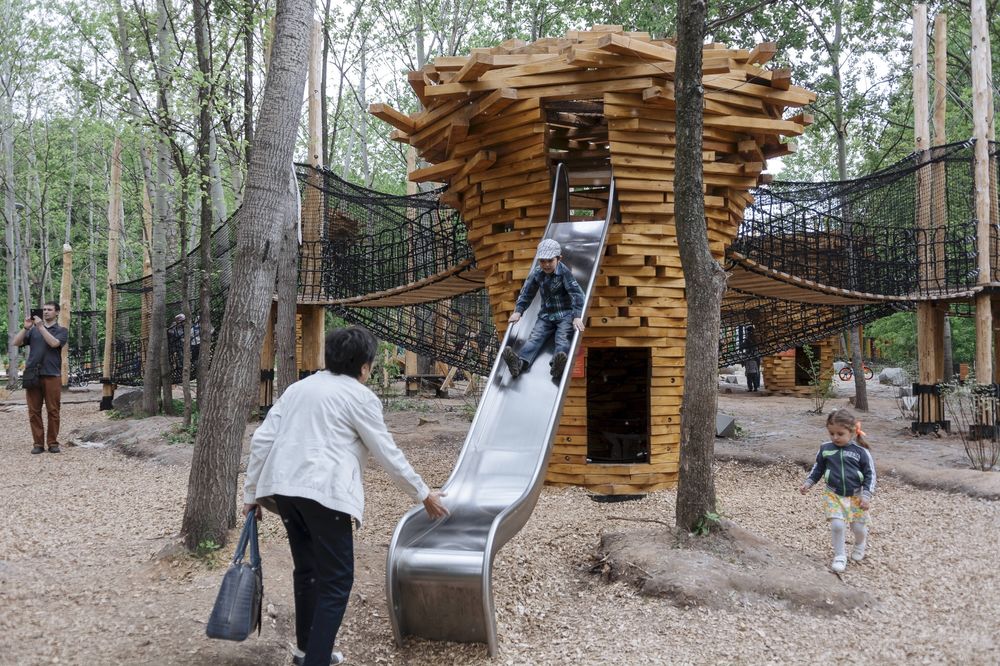
An eco-playground in the Gorkinsko-Ometyevsky Forest near Kazan.

The problem with headlines is that they tend to focus on bad stuff — a bad leader, say, planning bad moves in a country we know about only from headlines. But a leader can’t be everywhere all the time, and no country is a monolith. Especially not one as big and diverse as Russia.

Alex Ulam has a Bloomberg City Lab story about something going on way out in the semi-autonomous Russian republic of Tatarstan.

“In 2015, Natalia Fishman-Bekmambetova arrived in [Kazan] to oversee a large public works program. Then only 24 years old, she found a city with a population of 1.7 million, a renowned university, grand boulevards and major historic sites, including a Unesco-listed walled Kremlin from which Mongols once ruled.

“But Kazan also was a typical post-Soviet city — surrounded by drab concrete tower complexes and parking lots. Since the fall of the Soviet Union in 1991, little attention had been devoted to revitalizing derelict public open spaces or to building new ones.

“Six years after Fishman-Bekmambetova’s arrival, a massive initiative often referred to as a ‘green revolution‘ has dramatically reshaped this city 450 miles east of Moscow. Tatarstan’s Public Space Development Program, launched by Fishman-Bekmambetova and Tatarstan President Rustam Minnikhanov, has created or upgraded more than 420 projects throughout the republic, including parks, walkways, gardens and other kinds of landscaped areas.

“You don’t have to walk far in Kazan to see how the new public space program has changed the city. Near the center of the city is the Lake Kaban Embankments, designed by the Chinese-Russian consortium Turenscape +MAP and completed in 2017. The project transformed a formerly deserted postindustrial site around three lakes into a waterfront promenade with rows of trees, beds of wild grasses and wooden decks. At night, the area is illuminated by lights inside glowing red benches of diaphanous resin. Huge fountains rise on the lakes; restored wetlands help clean the once-heavily polluted water.

“Southeast of the city, Fishman-Bekmambetova’s team oversaw the rebirth of the 87-hectacre Gorkinsko-Ometevsky Forest, a new park that features a ski hill and an eco-playground along with preserved woodlands and performance spaces, located on a site where local activists successfully defeated the construction of medical centers and a planned road that would have bisected the park.

“The most ambitious project in the works for Fishman-Bekmambetova’s team is the Kazanska River Strategy, a plan for a 22-kilometer stretch of urban river and 68 kilometers of embankment running the entire length of Kazan; it’s one of the largest landscape projects in Russia. More at CityLab, here.

And while we’re feeling surprised about Russia, here’s a story by Fred Weir at the Christian Science Monitor about environmental action in the far north.

Arkhangelsk, a Russian region almost as big as France that borders the White Sea, is a land of permafrost and marshy tundra, with stunted Arctic forest, rolling hills, and labyrinthine lakes and rivers. It’s been inhabited by Russians for almost a thousand years; Indigenous peoples, some related to Finnish Laplanders, have been there much longer.

“People here are very conscious of history. Much of it revolves around their fragile Arctic habitat and the need to preserve it.

“About two years ago, mass popular protest forced Moscow authorities to abandon plans to build a giant waste dump near the village of Shiyes in this Arctic region that had been intended to receive 2 million tons annually of the garbage overflowing from heavy-consuming Moscow. The success of that ‘Stop Shiyes’ struggle launched a lasting ecological movement and ushered in the election of a more environment-friendly local leadership. It also planted surprisingly divergent ideas in some peoples’ minds about how to take that newfound consciousness and turn it toward a permanent transformation. ….

“For Oleg Mandrykin, a local real estate developer from the closed naval shipyard city of Severodvinsk, it served as inspiration to try and get into national politics in order to raise ecological awareness in Moscow. Anastasia Trofimova, an Arkhangelsk doctor, went a different direction, eschewing politics for [business]. And Alexandra Usacheva heads Clean North, a group that interfaces between the public and local authorities to promote ecological education.”

More at the Monitor, here.

Photo: Fred Weir.
Anastasia Trofimova, a doctor, in her shop in Arkhangelsk, Russia. She was inspired by protests against a proposed landfill to launch a business that sells around 700 products made from natural or recycled materials.

Read Full Post »

A “funky, eco-friendly” shop in Providence, Small Point Café, serves wooden cutlery that can be recycled. The only problem is that if you do takeout and want to use the recycling bin at work, wood is not accepted.

Here’s an idea that could solve the problem of takeout-cutlery waste once and for all: utensils you can eat.

Brittany Levine Beckman writes at Mashable, “Tired of seeing mountains of plastic cutlery polluting India’s landfills, Narayana Peesapaty had an idea: What if you could eat your disposable spoon rather than toss it?

“Peesapaty, a researcher and agriculture consultant from Hyderabad, India, developed an edible spoon made of millet, rice and wheat flours, in 2010. Now, after selling 1.5 million spoons for his company Bakeys, he wants to reach even more eaters. Peesapaty knows that means he has to cut the cost of his products to compete with cheaper plastic counterparts. …

“Bakeys plans to use its successful Kickstarter campaign to improve production and expand the product line. Its ‘edible lunch spoon,’ which can last 20 minutes in hot liquid, comes in a variety of flavors: sugar, ginger-cinnamon, ginger-garlic, cumin, celery, black pepper, mint-ginger and carrot-beetroot. The spoons have a shelf life of two to three years.

” ‘You can eat it up. If you don’t want to eat it, you can throw it. It decomposes within four to five days,’ Peesapaty said in a promotional video that has been shared millions of times since posting on March 16. …

” ‘Plastic is very cheap, true. But I can make it as cheap,’ Peesapaty remarks confidently. ‘I can with volumes, and once I get the volumes, I [can go to] the farmers directly and start procuring raw material directly from the farmers, in which case my spoons will be as cheap as the plastic spoons.’ ”

More. Learn how to get a supply of your own.

Photo: Mashable
Edible cutlery is already reducing plastic waste and benefiting the environment.

Read Full Post »

Back in June, Jane Devlin tweeted a link to a story on a curious “urban algae canopy” designed for EXPO 2015 in Milan.

Ross Brooks wrote at Inhabitat, “The Urban Algae Canopy by ecoLogic Studio is a piece of bio-digital architecture that combines micro-algal cultures and real time digital cultivation protocols. To be displayed at Expo Milano 2015, the structure is able to control the flow of energy, water and carbon dioxide based on weather patterns, visitors’ movements, and other environmental variables. It’s the first of its kind in the world, and … will be able to produce the oxygen equivalent of four hectares of woodland, along with nearly 330 pounds of biomass per day.” More at Inhabitat.

DOMUSweb adds that Claudia Pasquero and Marco Poletto of ecoLogicStudio “proposed a new vision of future bio-digital architecture powered by microalgae organisms as part of the Future Food District project, curated by Carlo Ratti Associati at the central crossroads of the EXPO site. …

“The flows of energy, water and CO2 are … regulated to respond and adjust  to weather patterns and visitors’ movements.  As the sun shines more intensively, algae would photosynthesise and grow, thus reducing the transparency of the canopy and increasing its shading potential.” More from DOMUS.

Photo: ecoLogicStudio
Urban Algae Canopy

Read Full Post »

Not long ago, I listened to a certain “Living on Earth” radio broadcast with amazement. A woman was explaining how she made up her mind to live without plastics. She did not make the effort sound easy, but she did make me think of ways I might cut back.

The “Living on Earth” account begins,”We live in a plastic-filled world. It’s used in almost everything, from cars to chewing gum to prescription drug bottles. Five years ago, Beth Terry decided to stop consuming plastic and she’s survived to tell the tale. Host Bruce Gellerman talks with Terry about her new book, ‘Plastic Free: How I Kicked the Plastic Habit and How You Can Too.’ ”

Terry tells the host, “Five years ago, almost to the day, I stumbled across an article about the plastic pollution problem in the ocean. And what completely blew my mind, and broke my heart, was this photo I saw of a dead albatross chick on Midway Island, thousands of miles from civilization — halfway between the United States and Japan. And it was just the carcass; it was full of plastic pieces. Like the plastic that I used on an everyday basis — things like bottle caps, things that didn’t come from the middle of the Pacific Ocean — they came from us. I just had to change. …

“I didn’t commit to stop using the plastic I already had, first of all, and I don’t recommend that anybody go through their house and purge the plastic and throw it away, because that’s just so wasteful, I think. But when my computer broke and it couldn’t be fixed — my first step is always to try and fix things and make them last as long as possible — but, when it couldn’t be fixed, I looked on Craig’s List and I found a secondhand computer.”

My own worry about plastics is how unstable the components are and how chemicals may escape into the air we breathe and the water we drink. When plastics are heated, as in a microwave, they can be dangerous. Please use ceramic containers for warming food in your — er — plastic microwave.

Read more of Terry’s alternatives to buying new plastics at “Living on Earth.”

Photograph: Beth Terry, with the plastic she collected in the first half of 2007.

Read Full Post »