Feeds:
Posts
Comments

Posts Tagged ‘education’

Photo: Alfredo Sosa/CSM.
Community MusicWorks, a program that allows students to use stringed instruments at no cost, is shown presenting its end-of-year gala in Providence, Rhode Island.

When I was visiting Nancy on Thursday, we talked about an amazing new music hall and school in our area and how it provides free noontime concerts to all comers. My husband and I had just attended one where some of the jazz teachers performed new compositions.

Looking at the huge crowd reminded me what music means to people, and how the word “free” in connection with “music” can make a real difference in people’s lives.

Troy Aidan Sambajon reports at the Christian Science Monitor about how it can make a difference for low-income children.

“The melodies drifting from Community MusicWorks’ spacious building are more than just the sounds of young musicians practicing. They are the heartbeat of the neighborhood.

“For 28 years, an after-school program run by the Providence, Rhode Island-based nonprofit has been reimagining what access to classical music education looks like. Community MusicWorks operates in areas of the state where K-12 students might not otherwise be able to afford to play stringed instruments. The program allows students to use instruments at no cost, offers mentorship, and hosts free concerts and workshops for the wider community to attend.

“Eli Arrecis, 10, is starting his fourth season in CMW this fall. On the last day of summer camp in late July, he and his fellow campers are performing original songs for their parents, using violins, violas, cellos – and shakers they crafted out of cardboard.

“Since joining the program, Eli listens to music with a newfound appreciation and even picks up sheet music at home to read for fun. His parents hope to enroll Eli’s siblings in the program. …

“In an era when many schools’ arts budgets are dwindling, CMW offers something increasingly rare: a space where young people find joy, purpose, and camaraderie through music.

“CMW’s beginnings were modest. In 1997, while he was a senior at Brown University, Sebastian Ruth launched the program with a $10,000 grant and a vision for what he termed ‘musicianship working for positive social change.’

“Mr. Ruth grew up in Ithaca, New York, and was first inspired by a high school violin teacher, who encouraged him to think about the social and spiritual impact of music on people. He and a small team rented a tiny storefront in Providence’s West End neighborhood – one of the city’s most diverse but also most economically disadvantaged areas – and began offering free violin lessons. …

“Within a few years, CMW expanded to the building next door to accommodate its growing after-school program. Hundreds of students later, CMW has cemented its place in the neighborhood with a new state-of-the-art facility, which opened in September 2024. …

“The three-story building has a performing arts center, group practice rooms, an instrument repair workshop, and plenty of space for lessons. Financing for the $15 million project came from state and local funds, as well as individual donations.

“AlexisMarie Nelson started her CMW journey in the sixth grade in 2006. It led her to study violin and viola and to eventually graduate from the Boston Conservatory at Berklee College of Music. Now a program coordinator at CMW, she says … ‘The connections that we’re making are so important.’

“Inside the building, teens such as Cesar Mendez shuffle in and out of lessons and jam sessions. They engage in soul-searching discussions about music and identity.

“ ‘This place feels like home,’ says Mr. Mendez, an 18-year-old violist who joined the program nearly a decade ago. ‘It’s just full of life.’

“But the real impact goes beyond mastering scales. ‘The arts aren’t just about skill-building or learning to play an instrument,’ Mr. Ruth says. ‘It’s a different way of being with other people. Many communities, particularly urban communities, are just doing a disservice to the children by not having adequate opportunities to learn the arts.’ …

“Notes Cecil Adderley, chair of music education at Berklee College of Music and president of the National Association for Music Education. ‘It’s a way to model how to excel at something artistic.’

“Even if students never go pro, he adds, they’re using their creativity as well as fostering collaboration and a sense of belonging. ‘You’re learning not just how to be a musician – but how to be a better neighbor.’ …

” ‘A lot of the time, we talk just so we don’t feel alone in the questions we have,’ says Mr. Mendez, who will study biomedical engineering at the University of Rhode Island this fall.”

More at the Monitor, here.

Read Full Post »

Photo: Ogar Monday.
Two students sit outside an experimental Nigerian school’s computer lab, donated by the Irish Embassy.

Today’s article is about an educational experiment in Africa that makes it possible for the “poorest of the poor” to get an education. The experiment is focused on keeping payments low and teaching kids to become “problem solvers.”

Ogar Monday writes at the Christian Science Monitor, “Groups of students, deep in discussion, are huddled under a large schoolyard canopy on a sweltering morning. Flanked by two teachers, Kingsley Bangwell strolls among the students. He stops beside one group and asks, What problem are you solving?’

“Two students rise. Faridat Bakare, a girl with paper in hand, responds. ‘Our work is on the lack of proper business strategy among female-owned small businesses in Kuje,’ she says.

“She explains that many women in that Nigerian city unintentionally limit the growth of businesses they start by overlooking the four P’s of marketing: product, price, place, and promotion. The students’ solution is to start a mentorship cycle connecting established businesswomen with local budding entrepreneurs. Mr. Bangwell nods his approval and moves on to another group.

“Mr. Bangwell is a co-founder of the Knowledge, Solutions, Skills, and Kreativity (Knosk) school in Kuje, on the outskirts of Nigeria’s capital, Abuja. For 100 naira (6 cents) a day, the school provides six years of learning for students who would otherwise be unable to afford it.

“The exercise that Mr. Bangwell is observing is part of a solutions ‘hackathon.’ Over four days, students engage with small-business owners in their communities to identify real-world challenges and develop solutions.

“ ‘The goal is to help them think critically and work collaboratively,’ Mr. Bangwell says. Winning teams receive prizes, but the biggest takeaway, he insists, is that the students realize ‘they, too, can provide answers to questions around them.’

“In 2018, while she was at a hospital in Abuja, Irene Bangwell overheard a cleaner talking about her teenage daughter, who had dropped out of school to work alongside her. The cleaner explained that she couldn’t afford the $19-per-term school fees for the girl. She believed that it was better for her daughter to work and save money than to attend an underfunded public school with little promise of quality education.

“Mrs. Bangwell, who had spent years working with young people, understood the mother’s concerns. Although public schools in Nigeria are mostly free, they are chronically underfunded, which has led to crumbling infrastructure, teacher shortages, and frequent strikes. Private schools provide better alternatives, but with nearly 39% of Nigerians living below the poverty line, many families find such schools out of their reach.

“Mrs. Bangwell shared the cleaner’s story with her husband, who has a background in youth development. They started Knosk in September 2019 after reaching out to community leaders, churches, mosques, and public primary schools, asking them to refer students who couldn’t afford secondary education. …

“Parents contribute $4 per term.

“ ‘We cater to the poorest of the poor,’ Mrs. Bangwell says. ‘If we don’t take the child in, they have no other chance at an education.’

“The school provides a curriculum that integrates computer and vocational skills, daily lunch, menstrual supplies for female students, and a boarding facility for a few students. …

“Victoria Simon, one of Knosk’s pioneer students, was 6 months old when she lost her father. By age 9, she had also lost her mother, leaving her in the care of her older sister. After Victoria completed primary school in 2018, her family had no means to send her for further education.

“ ‘We were ready to give up when my sister heard about Knosk,’ Victoria recalls.

“The school sounded too good to be true. But two weeks later, Victoria took Knosk’s entrance exam and wrote a 300-word essay about her aspirations. ‘I wrote about creating a free six-month training program for women and giving them tools to start their businesses,’ she says. …

“For some families, even the small fees that Knosk charges are a struggle. And according to Mrs. Bangwell, those fees are not enough to sustain the school. ‘Between paying teachers, uniforms, feeding the kids, and providing learning materials, we need more support,’ she says. Yet no child is ever turned away for unpaid fees.

“The school, which started with 30 students and now has 170, relies heavily on what it calls ‘education angels.’ These are individuals and organizations that sponsor students, for $156 per year.

“Knosk’s impact hasn’t gone unnoticed. ‘The quality of teaching and learning there is comparable to any private school in this area,’ says Daudu Shedrach, an education inspector with the Federal Capital Development Authority. …

“At Knosk, every student is called ‘solver,’ a title that reflects expectations. ‘A solver sees problems and takes action,’ Mrs. Bangwell explains. ‘We build their capacity to see beyond their challenges and to think like contributors to society, not victims.’

“For solvers like Mustapha Ibrahim, who joined Knosk in 2019 after losing his father two years earlier, the title has become a compass for how he approaches life. ‘There is no problem that I cannot solve,’ he says. ‘I just have to think hard about it.’

“Mustapha recalls how he once struggled with self-doubt and anger, believing that his life had ended when his father died. … Today, Mustapha dreams of becoming an aeronautical engineer. ‘I’m always fascinated by how airplanes stay in the sky despite their weight,’ he says.

“He also hopes to give back to the school that changed his life.

“ ‘I want to make it,’ he says, ‘and then come back to help other kids like me. Because I honestly don’t know who I would have become without this place.’ ”

More at the Monitor, here. No firewall. Subscriptions are reasonable.

Read Full Post »

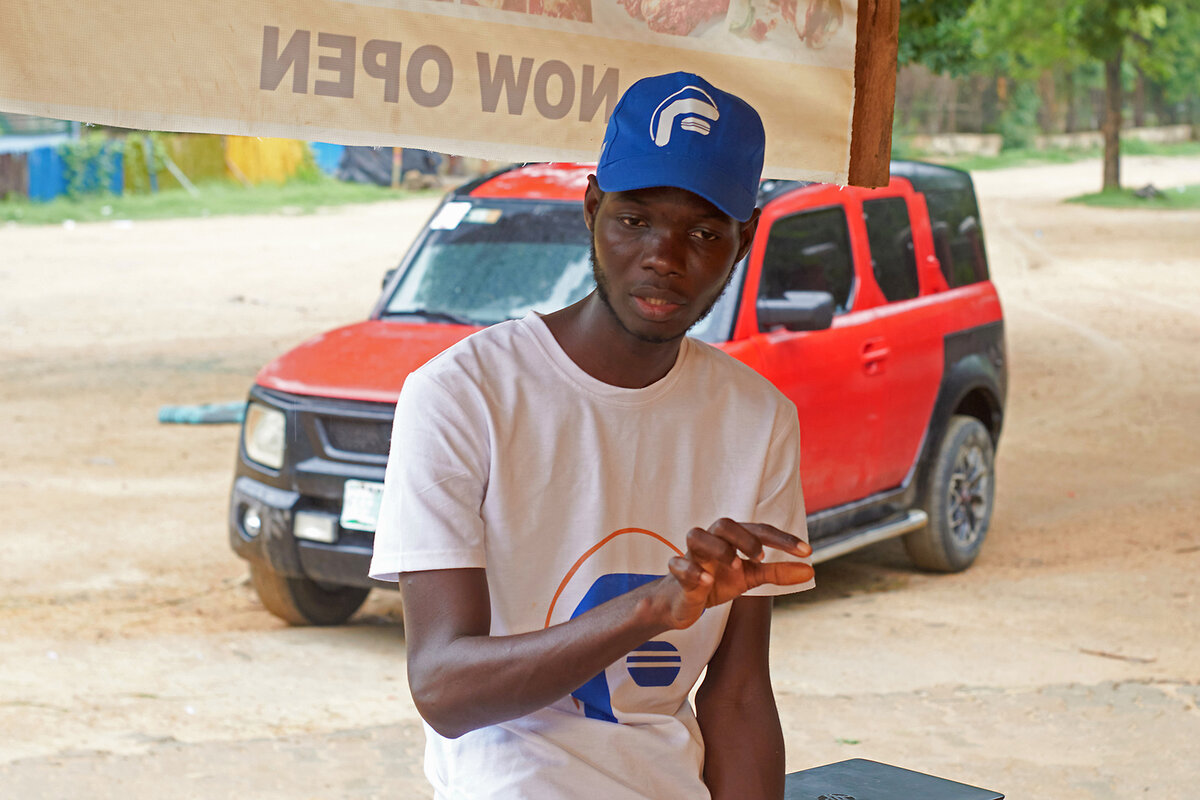
Photo: Nathaniel Bivan.
Muhammad Auwal Ahmad wears a cap and shirt with the Flowdiary logo during a meetup in KanoNigeria with some of his educational app’s tutors and students.

Whenever I used to read about Boko Haram terrorists in Nigeria, all I could think was how horrifying and hopeless the situation seemed. But it’s amazing how the human spirit can work around almost any hopeless situation.

Today’s story is about the young man who invented an app to help displaced Nigerian youth learn skills — despite terrorists and a disrupted education.

Nathaniel Bivan reports at the Christian Science Monitor, “Seventeen-year-old Ahmad Aminu finished secondary school and would like to go to college near his village in Zamfara state. But this region of northwestern Nigeria bears the brunt of attacks by bandits who kidnap students for ransom. …

“The 17-year-old Mr. Aminu [has] been able to take – for free, or at very little cost – courses in various digital skills in Hausa. He is becoming a well-known graphic designer within the community surrounding Dalba.

“ ‘The payment depends,’ says Mr. Aminu, the excitement clear in his voice. Designing an invitation card, for example, earns him about 2,000 Nigerian nairas, about $1.25; doing video editing, up to 3,000 nairas.

“ ‘In a month, I make as much as 30,000 naira,’ he says. ‘I really thank God.’ …

“Mr. Aminu is the sort of student whom Muhammad Auwal Ahmad had in mind when he created Flowdiary two years ago as a 23-year-old attending Federal University Gashua in northeastern Yobe state. He says Flowdiary now has more than 8,000 students enrolled from far-flung, impoverished areas across northern Nigeria; on average, almost one-fifth of those are active weekly users. The platform’s name refers to opportunities flowing to young people who might not normally have them.

“ ‘We have students from regions affected by terrorism and banditry … that we train and mentor,’ Mr. Ahmad says, noting that students who speak only Hausa struggle to find online courses in digital skills in their language.

“Mr. Ahmad’s dream began in Bayamari, a village in Yobe state that has only two small schools, a health center, and a police outpost. As a curious tween growing up there, Mr. Ahmad started researching digital technology when his father brought home a mobile phone and, later, a computer. Gradually, Mr. Ahmad started troubleshooting and soon had ambitious digital goals. …

“After unsuccessful attempts at building a couple of online businesses as an undergraduate computer science student, Mr. Ahmad set up Flowdiary in March 2022. It started as a team of tutors, who included some of his friends, teaching digital skills on Telegram to other young people across northern Nigeria at low cost.

“By that November, students could access the Flowdiary website. In February 2023, the app’s release became official. Paying as little as 1,200 nairas per course, students could register to learn web development, graphic design, and other digital skills. Tutors net half of the proceeds from course fees, and the rest goes toward operational costs such as maintaining the app and helping link Flowdiary students with career opportunities, Mr. Ahmad explains.

“Registered as a business, not as a nonprofit, Flowdiary has struggled to find other funding. … But Mr. Ahmad says he is set to obtain some much-needed funding after winning the 2024 Yobe State Research and Innovation Challenge, a prestigious regional competition organized by the Biomedical Science Research and Training Center of Yobe State University, in partnership with Yobe’s state government. …

“In 2011, Al’amin Dalha Suleiman and his seven family members abandoned their home in Maiduguri, the capital of northeastern Borno state, because of the Boko Haram insurgency there. They fled to Kano, more than 500 kilometers (about 310 miles) away, mourning the deaths of neighbors and friends as well as the loss of the family’s hat shop. But discrimination in Kano against outsiders forced them to return three years later to Maiduguri, where Mr. Suleiman struggled to revive the family business. …

“Through a friend on Facebook, Mr. Suleiman heard last year about Flowdiary. He enrolled in several courses, including video editing, web development, and graphic design. There was a major challenge, though – the need for wireless data and a laptop. For months, Mr. Suleiman struggled to finish the courses over his phone, but the payoff – the skills he has acquired – has been worth it. …

“Mr. Ahmad currently teaches computer science in northwestern Kebbi state as part of his National Youth Service Corps requirement. His vision after the one-year program is to expand the Flowdiary platform to reach more young people and – crucially – to help them grow their skills into careers.

“The end of online training for each student does not necessarily mean goodbye at Flowdiary. The Flowdiary team recently set up a mentoring and internship program; any student who takes a course can apply to work with companies that Flowdiary has forged a relationship with. As of late September, 20 students had secured internships – including two with Abdul Gusau, the owner of Abdoul Shoe Ventures in Zamfara.

“ ‘It is impressive to see how effective Flowdiary is through the work the interns are putting in my store,’ Mr. Gusau says. “ ‘The graphic designer has not yet entered the intermediate class, and yet his work is excellent. The same goes for the social media manager, who runs effective ads.’ “

More at the Monitor, here. No paywall. Subscriptions solicited.

Read Full Post »

Photo: Ahmad Masood/Reuters.
Working on a salt pan in the western Indian state of Gujarat. The marshes produce 30% of India’s inland salt. 

I’m always up for a little good news from distance places, as I hope you are, too. Today we learn about the benefits of solar energy for one hands-on industry in India.

Suchak Patel writes at the Guardian, “In the expansive salt marshes of the Little Rann of Kutch the bleakness of the sunburnt, treeless landscape is matched only by the drudgery of the salt farmers who toil there for eight months of the year.

“In October, as the monsoon recedes and the flooded salt pans dry out, farmers and their families hop on to trucks and tractors to migrate to the Little Rann of Kutch in Kutch district, Gujarat, where they pitch tarpaulin shelters and begin mining the underground deposits.

“An estimated 10,000 families of farmers, known as agariyas in Gujarati, migrate to the marshes from across the state. They start each season by digging wells to pump out brine using diesel pumps; the brine is then poured into shallow, squarish plots carved on the salt pans and left to evaporate under the sun to produce salt crystals. These marshes produce 30% of India’s inland salt, typically table salt.

“Life in the salt marshes is uniquely challenging. Drinking water comes not from pipes but tankers, children attend schools inside buses not buildings, and the only avenue to healthcare is weekly mobile vans from the health department. Basic amenities such as an electricity grid and toilets are nonexistent.

“ ‘My entire family, including my brother’s two daughters, lives in the desert these eight months, and my nieces attend primary school in a mobile school bus,’ says Bharatbhai Shyamjibhai Mandviya, 45.

“Contracts made with salt traders before each season, where the traders pay an advance to the farmers to buy pumps, diesel, and to meet household expenses mean most farmers start the season in debt, with the harvest income barely enough to cover their costs, let alone allow them to save.

“Diesel constitutes nearly 65% of the input costs in salt farming, and about 1,800 litres [~476 gallons] of the fuel is needed to produce [about] 750 tons of salt, according to Purshottam Sonagra, area manager of nonprofit Vikas Centre for Development that works with salt producers in the region. …

“But the introduction of solar panels to the pans has triggered a significant shift in the lives and lifestyles of the impoverished salt workers. In 2017, the Gujarat government gave solar pumps to salt farmers at nearly 80% subsidy, as part of a larger push to cut emissions and bring down the costs involved in salt production.

“ ‘Solar-powered pumps have reduced the cost of salt farming to one-third of what it was,’ says Sonagra.

“Mandviya has installed three pumps on the salt pan he works on, the savings from which have led to many firsts in his life.

“ ‘We have now built a two-bedroom house with a separate hall and a kitchen in Kharaghoda [his home village],’ says Mandviya. The new home with tiled walls and built-in cupboards which he will share with his brother and family, is a big upgrade from the kuccha [mud and straw] house they lived in before.

“The brothers also bought a motorcycle and a refrigerator from the money they managed to save.

“With more than 5,500 solar-powered pumps now dotting the region, energy costs have fallen [and] the agariyas such as Mandviya are no longer as dependent on the capital from traders, which gives them greater negotiating power over salt prices. …

“Solar pumps and the financial stability they grant have improved access to health, education and mobility, while also offering freedom to salt farmers from an endless work cycle, campaigners say.

“ ‘Steady supply from the solar panels is powering not only pumps but also televisions. Children of salt makers are switching to state-run ‘edutainment’ programs to make up for the loss of education,’ says Bhavna Harchandani, a research scholar at the Indian Institute of Technology Gandhinagar, who has tracked the agariya community as part of her studies. …

“Sonagra says it was difficult to find an office assistant with basic secondary-school education among agariyas until a few years ago.

“ ‘Today, many agariya children attend private schools, complete ITI (vocational) courses, and some manage to go to college. Solar pumps have opened up educational opportunities for the next generation of the community,’ he says.”

More at the Guardian, here.


Read Full Post »

Photo:Todd Davis.
Friends of Cleveland School District, a nonprofit composed of local parents and community members are working to save the town’s school district.

Northern states are supposedly against segregation, but as soon as Boston desegregated its public schools, it resegregated. Interestingly, a city in the deep South, is embracing diversity.

Leonardo Bevilacqua reports from Cleveland, Mississippi, for the Guardian, “Fernando Green sits on a pile of plywood in a new barn on a humid Mississippi Delta afternoon. The barn will be a center for students like his daughter to get a feel for local jobs in agriculture. There’s school swag for the incoming middle schoolers. A petting zoo with a baby alligator is off in one corner while boys throw a pigskin around in the back.

“A Mississippi Delta native … looks out with a glint in his eyes on the grounds of a middle school that used to house his revered high school: East Side. … A recent effort by a parent group looking to heal divides and counteract disinvestment has locals like Mr. Green excited. … Using donated lumber and dollars, the parents are fighting not only for their children’s future but for their town’s as well. …

“Says Todd Davis, a professor at the town’s own Delta State University in an interview with the Monitor. ‘I’m not fighting for some grand mission … I just want my kids to go to a nice school. … Every kid should have that option.’ …

“Dr. Davis joined with Kierre Rimmer, a Cleveland native and coordinator at the Family Treatment court, to fight disinvestment in Cleveland public schools. The duo, along with community partners, LaKenya Evans, Clare Adams Moore, and Rori Eddie Herbison, helped found the group, Friends of Cleveland School District (FOCSD).

“In a 2016 high-profile court-ordered integration, Cleveland School District’s two middle schools and high schools were ordered to merge. Some 63 years after Brown v. the Board of Education, Cleveland became the last district in the United States to desegregate in 2017. The historically white high school became the consolidated high school, and the historically Black high school became the site of the consolidated middle school. The district’s football team was rechristened the Wolves in purple and white. 

“The following autumn, over 100 white parents pulled their children out of public school – as locals of all races had predicted. That, locals interviewed say, is why residents both Black and white sought to block integration, to the consternation of mainstream media outlets and policy watchdogs. Many in town feared that court-ordered desegregation would inspire a massive white flight in the last town in the Delta to have a sizable white population still enrolled in the public schools.

“And, those interviewed say, the reality on the ground was different than in the headlines. By the time of consolidation in 2017, enrollment at Cleveland High and Margaret Green Junior High, the historically white schools, were roughly 50-50 when it came to race. In 2013, parents were granted the freedom to choose which high school to send their children to.

“With students arriving for their first day Aug. 5, administrators are still waiting on a final head count for the 2024-2025 academic year. Last year, 243 more students joined Cleveland public schools, the first time the district wasn’t losing students since consolidation. …

“Friends of Cleveland School District has secured $30,000 worth of paint, timber, and appliances from the likes of Fleming Lumber Company and other regional and local businesses. They’ve raised roughly $250,000 for the school from grants and fundraising efforts.

“This is a little less than the roughly $300,000 that leaves the district each year with the 300 or so students that depart for private school or other towns, after the neighborhood-zoned and magnet elementary schools cut off at sixth grade.

It helps that Cleveland has a middle class. Quality Steel, Baxter Healthcare, a luxury hotel, a local university, and a downtown with boutiques and coffee shops offer families comforts unknown in the rest of the Delta. …

“Dr. Davis is building planters for a school garden on a warm April afternoon, putting the raised funds to use. Students will get a chance to grow okra, sweet potatoes, and tomatoes – a reflection of the local agricultural economy.

“It’s still the big industry in this area,” remarks Dr. Davis. … He lends his green thumb during breaks in between teaching classes at the local university.

“Students have joined the garden club by the dozen, learning the power of civic mindedness with hands deep in world famous Delta dirt. The garden ‘allowed us to make new friends that we otherwise probably would not have made,’ says seventh grader Michael Vardaman. …

“Parent volunteer Stephen Chudy is tall and burly with a firm handshake and a warm smile beaming beneath a trucker hat. He’s here for one reason.

“ ‘I gave my daughter the choice, here or the independent school. She chose here. Fine by me. She’ll get to be around all different kinds of kids like there is out there in the world. It’s realistic,’ says Mr. Chudy, who is digging an irrigation path with ditches for the school’s many green stretches on a molasses thick morning. 

“ ‘There’s an understanding that the school is the only thing we all share as a town,’ he adds. ‘It’s a small place. We all go to the same McDonald’s and Walmart too.’ “

More at the Monitor, here. No paywall. Reasonable subscriptions. I really like the Monitor because it seeks out positive stories and international stories.

Read Full Post »

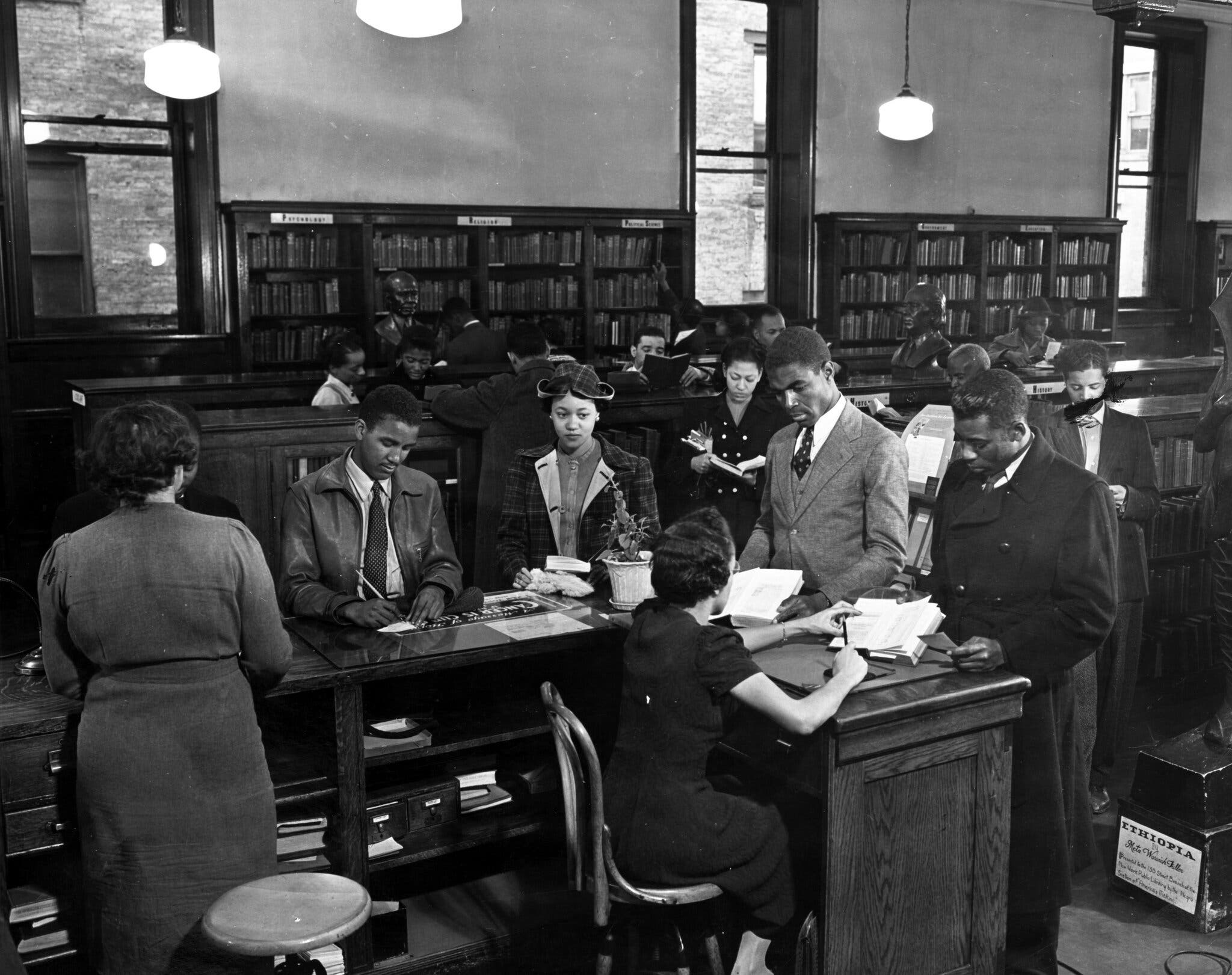
Photo: New York Public Library.
In 1925, the New York Public Library system established the first public collection dedicated to Black materials at its 135th Street branch in Harlem, now known as the Schomburg Center for Research in Black Culture.

I have read numerous accounts of what a public library has meant to poor children with insatiable curiosity. The most recent was the autobiography Up Home by future intellectual and university president Ruth J. Simmons. She grew up in a desperately poor Black sharecropper’s family in Texas. Books and encouragement from Black teachers meant everything.

Meanwhile in Harlem, Black librarians meant everything to generations of Northern children.

Jennifer Schuessler reports at the New York Times, “It was a banner day in the history of American libraries — and in Black history. On May 25, 1926, the New York Public Library announced that it had acquired the celebrated Afro-Latino bibliophile Arturo Schomburg’s collection of more than 4,000 books, manuscripts and other artifacts.

“A year earlier, the library had established the first public collection dedicated to Black materials, at its 135th Street branch in Harlem. Now, the branch would be home to a trove of rare items, from some of the earliest books by and about Black people to then-new works of the brewing Harlem Renaissance.

“Schomburg was the most famous of the Black bibliophiles who, starting in the late 19th century, had amassed impressive ‘parlor libraries’ in their homes. Such libraries became important gathering places for Black writers and thinkers at a time when newly created public libraries — which exploded in number in the decades after 1870 — were uninterested in Black materials, and often unwelcoming to Black patrons.

“Schomburg summed up his credo in a famous 1925 essay, writing, ‘The American Negro must remake his past in order to make his future.’ In a 1913 letter, he had put it less decorously: The items in his library were ‘powder with which to fight our enemies. …

“Today, figures like Schomburg and the historian and activist W.E.B. Du Bois (another collector and compiler of Black books) are hailed as the founders of the 20th-century Black intellectual tradition. But increasingly, scholars are also uncovering the important role of the women who often ran the libraries, where they built collections and — just as important — communities of readers.

“ ‘Mr. Schomburg’s collection is really the seed,’ said Joy Bivins, the current director of the Schomburg Center for Research in Black Culture, as the 135th Street library, currently home to more than 11 million items, is now known. ‘But in many ways, it is these women who were the institution builders.’

“Many were among the first Black women to attend library school, where they learned the tools and the systems of the rapidly professionalizing field.

On the job, they learned these tools weren’t always suited to Black books and ideas, so they invented their own.

“At times, they battled overt and covert censorship. … But whether they worked in world-famous research collections or modest public branch libraries, these pioneers saw their role as not just about tending old books but also about making room for new people and new ideas.

“ ‘These librarians were very tuned in and understood that a cultural movement also needs a space,’ said Laura E. Helton, a historian at the University of Delaware and author of the recent book Scattered and Fugitive Things: How Black Collectors Created Archives and Remade History. …

“In the 1920 census, only 69 of the 15,297 Americans who listed their profession as librarian were Black. Many cities in the segregated South had no library services at all for Black citizens. And even in the North, those branches that did serve them often had few books geared to their interests, and sometimes no card catalogs or reference collections at all.

“That started to change, if slowly. In 1924, in Chicago, Vivian Harsh became the first Black librarian to lead a public library branch there. [But] no place captures the transformations of the era more than Harlem, where, starting in 1920, a white librarian named Ernestine Rose hired four young Black librarians at the 135th Street library. …

“The poet Arna Bontemps (who himself later became a librarian) recalled visiting the 135th Street library after his arrival in Harlem in 1924. ‘There were a couple of very nice-looking girls sitting at the desk, colored girls,’ he said. ‘I had never seen that before.’ …

“Other ‘girls’ at the branch fostered the neighborhood’s artistic ferment in different ways. Among them was Regina Andrews, a young librarian from Chicago (where she was mentored by Harsh) who came to New York City on vacation in 1922 and decided to stay. She … soon settled into an apartment at 580 St. Nicholas Avenue with two friends who worked at Opportunity, a new magazine that aimed to capture the creative ferment bubbling up in Harlem. Nicknamed Dream Haven, the apartment quickly became a salon and crash pad for some of the most celebrated figures of the period.

“It was there that Alain Locke held some planning meetings for the special issue of the Survey Graphic magazine that later grew into his landmark 1925 anthology The New Negro. And it was there that many Black artists and writers who attended the 1924 Civic Club dinner now recognized as an opening bell of the Harlem Renaissance gathered.”

Read more at the Times, here.

Read Full Post »

Photo: Ann Scott Tyson/Christian Science Monitor.
This photo from 1992 shows Bai Guiling teaching multi-grade primary students in a cave classroom carved from a hillside in the village of Yangjiagou. It had no electricity and few books.

Today’s story is about two women who transformed education in rural China. It’s written by Ann Scott Tyson of the Christian Science Monitor, who wanted to follow up on an article she wrote 30 years ago.

“After a 12-hour train ride, I’ve reached a remote village on China’s Loess Plateau, where I’m searching for a teacher I wrote about 30 years ago. I can still picture Bai Guiling juggling lessons for four grades in a dim cave classroom carved from the yellow earth. Her dedication to the needy village children was unforgettable. Now, I want to revisit her story as a window into education in rural China today. 

“But no one in the dusty hamlet in northern Shaanxi province has heard of Teacher Bai or even remembers the school. … I flip through my notebook looking for the phone number of the only person who might be able to help – a Chinese American woman who years ago took a special interest in Teacher Bai. 

“Sitting in my taxi while the police watch from down the road, I tap her U.S. number into my phone and wait for what seems like forever.

“ ‘Hello?’ a frail but chipper voice answers. It’s Lin-yi Wu.

“A few days earlier, in mid-May, I’d tracked down Ms. Wu, a retired librarian, at a senior living home in Walnut Creek, California. The nonagenarian was recovering from a fall – taken while jazz dancing – but was in good spirits. …

“Born the daughter of a well-to-do Shanghai antiques merchant in 1933, Ms. Wu received an elite education that bore no resemblance to Teacher Bai’s bare-bones cave classes. She rode rickshaws to a stately Shanghai middle school run by American missionaries. After graduating from the top-flight Peking University, she was retained to teach French. A formative moment came when Communist Party authorities exiled her and her husband-to-be, English professor Hung-sen Wu, to labor in a hardscrabble mountain village outside Beijing in 1958, during Mao Zedong’s commune movement.

“ ‘My eyes were opened to see how the majority of Chinese lived,’ Ms. Wu told me. For that, she was grateful. But she also witnessed how Mao’s failed communes slashed farm output, leaving bok choy wilting in the fields and piglets dying in the street. A massive famine ensued, forcing villagers to eat leaves and corncobs. ‘It was horrible,’ she said. From 1959 to 1961, tens of millions of Chinese starved. 

“Once back at Peking University, Ms. Wu was shocked when authorities spread propaganda about a bumper harvest, rejoicing with music and gongs. ‘People are dying, and they celebrate the big harvest? That was the last straw,’ she said. ‘I could never live under a government that tells such a lie to the detriment of its people.’ In 1961, the couple fled via Hong Kong to the United States. …

“Forging a life in America, the Wus never lost the desire to help their destitute countrymen. Then, in April 1992, they opened the Christian Science Monitor and read my article about Teacher Bai’s struggles. At once, they each decided – without a word between them – to use their savings to build the village a proper school. … She penned a letter to me in Beijing, asking to contact Teacher Bai.

“But where is Teacher Bai now? I ask over the phone. ‘I don’t know where she lives, but I remember her village was in Ansai County,’ Ms. Wu tells me. ‘And I have her daughter’s phone number.’

“I open my road atlas and scour the map of Ansai, two counties away from where I am. Suddenly it makes sense – there are two villages with the same name, Yangjiagou, and I’m in the wrong one.   

“Her smile and warmth are infectious. After 30 years, I instantly recognize Teacher Bai when I see her waiting for me at the train station in the nearby city of Yan’an, a meeting arranged by her daughter. It feels like we never lost a beat. Driving a borrowed car, she whisks me into the rugged countryside. …

“ ‘Look at this old classroom!’ she says, peering through the worn wooden lattice of the cave’s front window at the peeling mud-and-straw walls. ‘I taught here for five years. We were so poor,’ she says. …

“Born in 1964 to a farming couple in a cave high on a barren hillside a few miles away, Ms. Bai was the eldest of five children – four girls and a boy. Food was scarce in the wake of China’s famine. They ate boiled thistles and cornhusk buns. ‘That counted as good food,’ she says. …

“ ‘I want to popularize the importance of primary education,’ she told me back in 1992. … Her dream: to rally the villagers to build a new school. …

” ‘The article you wrote changed my fate, and the fate of three generations of my family.’

“Not long after my 1992 trip, a local official came to find Teacher Bai. Breathlessly, he told her a group of overseas Chinese and Americans wanted to build a new primary school at Yangjiagou – and they named her to be in charge. …

“Back in the U.S., Ms. Wu excitedly tallied the funds. After a benefit dinner, greeting card drive, and garage sale – combined with her $4,000 in savings – she’d amassed more than $8,000 as of 1994. It was enough to build Yangjiagou a new school, the first by her new organization, Friends of Rural China Education (FORCE). …

“Through a Catholic church with contacts in Hong Kong, she found a nun who would soon travel to mainland China to teach. They arranged for the nun to hand-deliver $8,000 in cash to Teacher Bai at the train station in Guangzhou, across the border from Hong Kong. ‘I will never forget what Teacher Bai told me,’ recalls Ms. Wu. ‘She said, “I will guard this money with my life.” ‘ “

It’s actually a very long article, but how can I not love it? Read the whole beautiful thing at the Monitor, here. No firewall.

Read Full Post »

Photo: Fernando Cortes via Inside Higher Ed.

Unless people are committed to the “ain’t it awful?” worldview, they probably respond in more positive ways to pitches about hopeful progress than pitches describing how dire everything is.

In an opinion piece at Inside Higher Ed, Stephen Porder agrees, noting that climate-change education is more likely to be effective when students learn that there is hope.

Porder writes, “The first year I taught Introduction to Environmental Science was 2007, the year after the release of An Inconvenient Truth. The class was full of eager students, most of whom would have described themselves as environmentalists. … I was there to teach them the science — basically how to use hypothesis testing, data and analysis to convince them the world is going to hell. They didn’t need much convincing.

“The endless description of problems, with little emphasis on solutions, is a hallmark of almost all environmental science and studies textbooks. After 20-plus years teaching in this field, I’ve come to think that our relentless focusing on the negative is, at best, missing an opportunity. … My more recent experiences teaching about solutions, rather than problems, suggests that a healthy dose of positivity even in the face of profound environmental challenges will reach a broader audience, gain more traction and diversify the people working on the admittedly wicked environmental challenges of the 21st century.

“Back in 2007, I walked into the classroom, fresh out of my Ph.D. and postdoc, eager to share the wonders of environmental science. I marveled at the data from the group run by Charles Keeling, who measured rising carbon dioxide in the atmosphere at the observatory on Mauna Loa in Hawai‘i. … I dove into the details of carbon isotopes to demonstrate just how we knew that the rise in carbon dioxide was a result of fossil fuel combustion, as opposed to natural sources. The course was definitely a science course —but looking back I realize each bit of data and analysis was perfused with pessimism. …

“Still, my course evaluations were good. … These good evaluations came from students who were mostly self-selected environmentalists — passionate about ‘saving the planet.’ They were bright, motivated and talented. … Other equally bright, motivated and talented students didn’t take the course. I wondered why.

“Having talked to many such students since, I’ve learned many felt a bit excluded. The environment was a worry for them, as it is for most of us, but it wasn’t their primary worry. They also felt like environmental studies or sciences was not a place where they could explore solutions. They felt that there was a relentless focus on what was wrong, rather than how to put it right. Finally, they felt like the problems we were describing were going to be fixed by people beyond the environmental field.

“I’ve come to agree with them. I, at least, was not doing enough to train problem-solvers. I’d been training people to cleverly document problems. I don’t think I’m the only one in the field who’s fallen into that trap. …

“I handed off Introduction to Environmental Science to a younger professor a few years ago, and from here on out I’m focusing on solutions, not problems. Climate solutions. Agricultural solutions. Deforestation solutions. They exist. They are not perfect and involve hard trade-offs. But their existence should be front and center in our teaching.

“Just putting ‘Climate Solutions’ in a course name dramatically changed my student enrollment. Surprisingly, very few environmental studies and sciences students signed up. Instead, students majoring in economics, political science, engineering, applied math and a variety of humanities fields appeared in my classroom. … Like all my students, they were united by their climate anxiety. But they came for, and responded to, the idea of solutions.

“This eclectic group brought a wealth of different interests, skills and weaknesses to the class and was eager to learn from each other about different approaches to overcoming the 21st century’s biggest environmental (I would argue societal) challenge. They were thrilled at the opportunity to contribute to a better future, even if the environment was not their top priority (for some it became a top priority when they learned there were things they could actually do to make a difference). Many had felt unwelcome in environmental studies/sciences, which often demands a political and philosophical homogeneity of its participants.

“As an example of this, a senior applied math major told me he had been searching for a field where his math could have impact. He had never taken an environmental class before (despite plenty of environmental angst) in part because he didn’t feel welcome or like he fit in with environmentalists. He now works doing data analytics for a solar power company. …

“Solutions are picking up speed. Technological advances in transportation (electric vehicles), space heating (heat pumps) and electricity production (renewables) have made extraordinary leaps since I started teaching. Given that transportation, space heating and electricity generation make up more than 70 percent of all fossil fuel emissions, this is huge news! We should be teaching about it at every level and helping our students gain the skills to push these revolutions forward as engineers, community organizers, investors and so on.

“Already these advances have cooled our future. A decade ago, we were headed for four to five degrees Celsius warming by century’s end. Now three degrees Celsius is more likely. Anyone who studies climate knows that’s still way too much warming to be safe, but it’s also a huge step in the right direction. You may not hear that in most environmental science classes, or in the news, but you should. Even better news is that most of what precludes keeping that number to two degrees Celsius is political, not technological. That wasn’t true when I started teaching, so we need to update our curricula to reflect this remarkable progress.

“I don’t mean to be overly optimistic. The challenges to a stable climate future are enormous. … But by relentlessly beating a drum of negativity in the absence of hope, we’re driving away brilliant young minds that could help make the world a better place.”

More at Inside Higher Ed, here. No paywall.

Read Full Post »

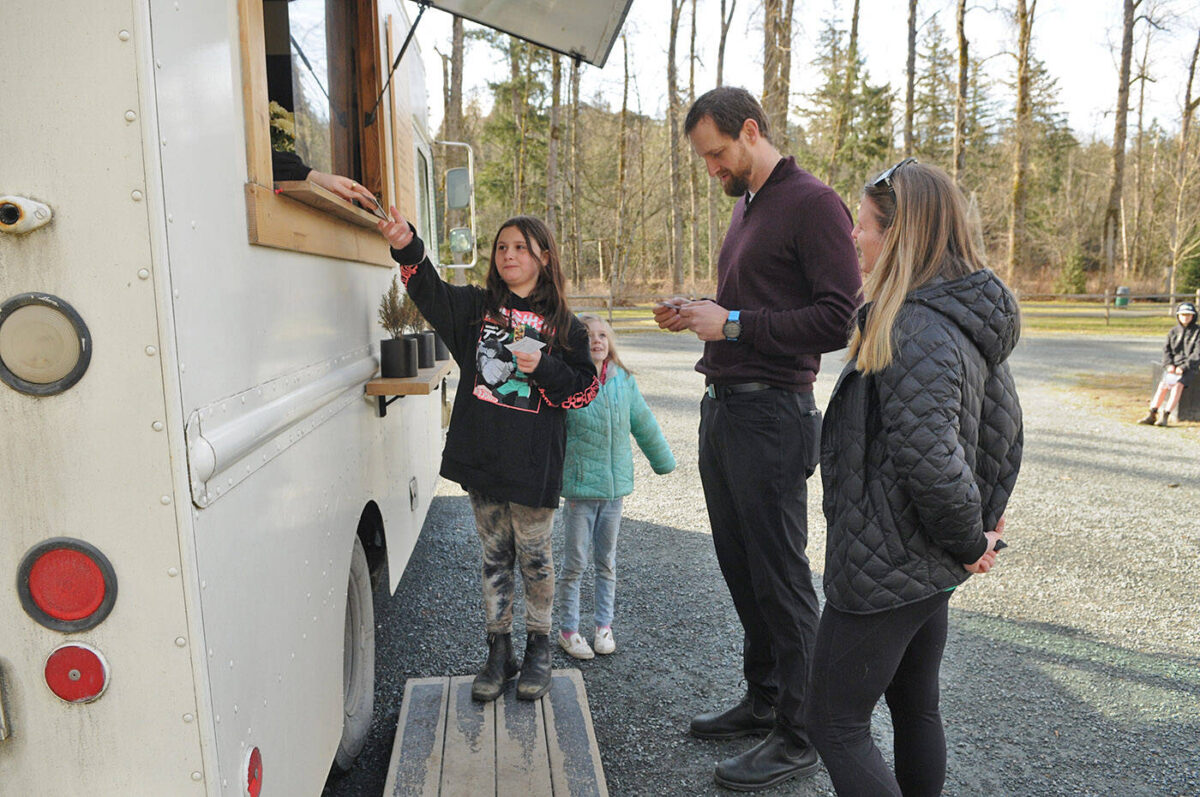
Photo: Jenna Hauck/ Chilliwack Progress.
Children in Canada buying coffee for two strangers at Vedder Park during Watson Elementary’s Kindness Project on March 15. It’s all part of the curriculum.

How do you raise children who are kind? Partly by example. And maybe partly by putting generosity in the school curriculum. It can’t hurt to set aside a time for kids to know the satisfaction of committing random acts of kindness.

Sydney Page at the Washington Post writes about an experiment in Canada.

“While writing report cards several years ago, Jennifer Thiessen was troubled by something. Her third-grade students were being evaluated on subjects such as math and science, but not on life skills — such as social responsibility and kindness.

“ ‘That’s the stuff that I feel is really important for them to learn and carry forward in their lives,’ Thiessen said. … ‘There are so many important life lessons I wanted to teach them outside of the curriculum,’ said Thiessen, a teacher at Canada’s Watson Elementary School in Chilliwack, British Columbia.

“She mentioned her concerns to Kyla Stradling, then a fellow teacher at the school, and they hatched a plan. They assigned their students a project that had nothing to do with standard school subjects. Instead, it was centered on spreading goodwill. They called it the ‘Kindness Project.’

“ ‘If we could be that spark of kindness, we could inspire others to do acts of kindness,’ Thiessen told her third-graders in 2018.

“Students from two separate third-grade classes made cupcakes at home and sold them for $1 during a series of bake sales at the school. They raised about $400 and used the proceeds to purchase small gifts — things like bouquets of flowers, dog treats, chocolate bars and coffees — and handed them out to strangers near the school.

‘The students felt joy inside of them; that they did something that day that mattered,’ Thiessen said.

“Many of the gift recipients seemed ‘caught off guard’ at first, she said, though they were all in when the students explained what the project was about. Some were moved to tears. … She decided to make it a yearly activity for third-graders at the school.

“ ‘This project isn’t about who can read the best and who is best at math,’ she said. ‘This is an everybody project. It doesn’t have any limitations when it comes to ability.’

“For the past five years, third-grade students at Watson Elementary have embraced the Kindness Project. They host several bake sales to raise money, and each class adds their own spin to the assignment. During the pandemic, for instance, students collected funds to put together care packages for front-line workers.

“ ‘Every year, we sit down with them and ask them how they want to spend the money,’ Thiessen said. …

“Occasionally, students can be ‘a little overzealous,’ she said. As she brainstormed with her class this year, one child enthusiastically said: ‘Let’s buy someone a house!’ …

“Given the success of the project, the school decided to broaden it this year to involve five classes — including three third-grade classes, and some students in second and fourth grades. They started selling cupcakes each week at the school in February, and over five weeks, they raised more than $1,000 — the highest amount yet. …

“This year, the 100 students split up into several groups to focus on different initiatives. While one group wrote cards and bought small gifts to hand out to strangers, another put together care packages with essential supplies — including toothbrushes, snacks, gloves, socks and sanitizer — for homeless children and teens. Other students made a ‘teacher appreciation bin’ filled with treats and goodies and dropped it off at a nearby school.

“On March 15, the students and chaperones divided and carried out their various kindness missions. Some stayed at coffee shops surrounding the school, offering to buy beverages for strangers, while others waited around a local park, passing out dog treats and fresh flowers. Several students did a forest cleanup. …

“Though the goal of the project is to start a chain of kindness within the community (one man offered up $20 toward next year’s fundraising effort, Thiessen said), it’s also intended to show the students what they are capable of.

“ ‘I think what I want most for them is to know that it doesn’t matter where you come from or how old you are, you can do something that is good,’ Thiessen said.”

The idea of buying someone a house is not necessarily “overzealous,” I’d say. It shows the kid is already thinking about about adult-sized needs. Isn’t that the point?

More at the Post, here. For a version with no firewall, click on the Chilliwack Progress, here.

Read Full Post »

Photo: Alfredo Sosa/CSM Staff.
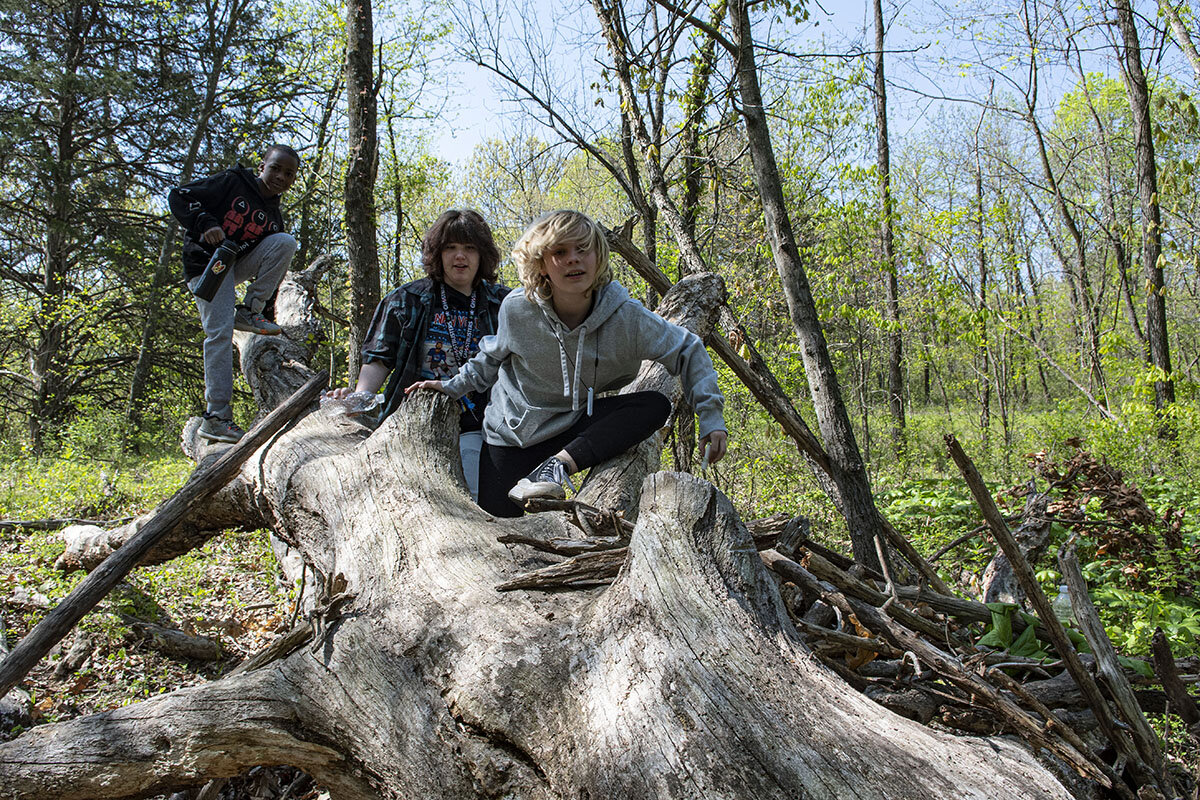
Students from Thorpe Gordon Elementary in Jefferson City, Missouri, at the Runge Conservation Nature Center in April.

It’s not a new idea, but it’s gaining traction: Getting kids outside into nature benefits their learning.

Jackie Valley writes at the Christian Science Monitor, “Down a hiking path and through the woods, giggles and chatter echo from a clearing where elementary students have just finished constructing makeshift shelters.

The challenge blended environment with engineering, hence this visit to the Runge Nature Center from third, fourth, and fifth graders. They’re part of a STEM (science, technology, engineering, and math) club at nearby Thorpe Gordon Elementary in Jefferson City, Missouri. …

“A boy announces he saw a turkey, while another student proclaims ‘teamwork’ her favorite part. The scene portrays what conservation leaders and educators in Missouri are hoping to instill in the state’s youngest residents: an appreciation for the outdoors, a new experience, and some learning along the way.

“ ‘I think it’s so important,” says Melanie Thompson, a librarian from the elementary school who’s leading the STEM group on this day. ‘Kids don’t spend enough time playing outside.’

“In Missouri, efforts to connect children with nature date back to 1939. That’s when the Nature Knights program launched, giving children recognition for conservation practices. Three years earlier, the state’s residents approved an amendment that created an apolitical conservation agency.

“Today, terms such as nature education, outdoor learning, and environmental education refer to instruction that, in many ways, takes students out of traditional classroom settings. Subtle nuances exist, though, depending on the location and programming. The Environmental Protection Agency defines environmental education as a type of learning that allows people to ‘explore environmental issues, engage in problem solving, and take action to improve the environment’ – while also not advocating a particular viewpoint.

“The Missouri Department of Conservation, meanwhile, sees nature education as a way to ‘inspire and educate individuals about nature so they appreciate and ultimately protect our resources and wild places,’ says Brian Flowers, a regional supervisor for the agency’s education branch. …

“ ‘You introduce them to it,’ says Mr. Flowers, referring to conservation, natural resources, and wildlife. ‘You show them why it’s important, and, eventually, that leads to that they care about it. They protect it.’

“A study called The Nature of Americans, conducted in 2015 and 2016, found that more than 80% of children surveyed said time in nature made them feel creative, happy, healthy, and smarter. …

“ ‘Once they’re there, there’s so much that happens – curiosity and creativity and just enjoyment of being outside,’ [Megan Willig, a program coordinator for the National Environmental Education Foundation] says. It can also introduce students to career pathways in the natural resource, conservation, and STEM fields.

“In a grassy field not far from an elderberry patch, a sustainably designed building with large windows and a gently sloping roofline is under construction. It’s the future Boone County Nature School, which occupies land in the Three Creeks Conservation Area and will welcome a rotating cast of 12,000 to 13,000 students each year, says Mr. Flowers.

“The project represents a partnership among the Missouri Department of Conservation, Columbia Public Schools, community organizations, and other school districts in Boone County.

“Columbia Public Schools has hired a teacher to lead instructional efforts at the Boone County Nature School, which fits into the district’s overall mission to pour more resources into place-based learning, says Michelle Baumstark, the chief communications officer. About half of the district’s students qualify for free or reduced-price lunch.

“ ‘These may not be experiences that they would have any other way and when you can create an access to an enriching opportunity, that can change the trajectory of a kid,’ she says.

“The land surrounding the nature school will feature a food forest, pollinator plots, a prairie restoration area, trails, a pavilion, and a council house with three tiers of stadium seating. The karst topography of the conservation area – caves, springs, and hills – is typically only found in southern Missouri near the Ozarks, making it an ideal exploration area for local children, Mr. Flowers says. …

“The Missouri Department of Conservation also operates programs that teach students archery and how to fish, among other things. And, in St. Louis, pavement will be removed and replaced with a green schoolyard at Froebel Literacy Academy. Picture a park-like setting with trees and wildflowers, where students can play and learn through STEM activities.

“The schoolyard project represents a step toward outdoor equity for children who grow up in urban areas that have more concrete and asphalt than lush, green recreation space, says Aaron Jeffries, deputy director of the Missouri Department of Conservation. …

“There’s no national standard for outdoor learning or environmental education, says Ms. Willig of NEEF, which was congressionally chartered in 1990 to complement the work of the EPA. So efforts differ by state and local jurisdiction, though she has seen more interest in making it a formal part of the curriculum.

“If barriers such as time or transportation exist, Ms. Willig recommends that school systems seek community partnerships. For instance, a local nonprofit that supports watershed health, she says, may be keen on helping with programming.

“ ‘The school doesn’t need to reinvent the wheel or start from scratch,’ she says.”

More at the Monitor, here. No firewall, nice pictures.

You can read another of my posts on kids benefiting from nature at school, here.

Read Full Post »

Photo: Melanie Stetson Freeman/CSM.
Repotting plants at Eastie Farm.
The Christian Science Monitor says, “The geothermal greenhouse is warmed in the winter and cooled in the summer by heat exchange, using pipes that circulate a fluid underground. Crops will be grown during all seasons.”

Here’s a new take on an urban community farm — keeping it going in the winter without recourse to fossil fuels.

Ariana Bennett writes at the Christian Science Monitor, “Tucked near a highway underpass, a greenhouse glows faintly in the cold night. Inside, volunteers stand in the warmth, crowded around two pizzas topped with homegrown basil. Rows of potted greens, herbs, peppers, eggplants, and even strawberries line shelves along the walls.

“The greenhouse is a new project of Eastie Farm, a nonprofit educational urban farm founded in 2016 and housed in East Boston. Focused on feasible climate action, the nonprofit – and its new greenhouse – provides the surrounding community with greater control over its food supply. The building runs on geothermal energy and is the first of its kind in New England. …

“ ‘Everything that we do, we try to make sure that it has a relevance here and now, and it serves the purpose for the people who are living here today,’ says Kannan Thiruvengadam, the director of Eastie Farm. …

“The geothermal greenhouse operates as a heat exchange. Below the frost line, Earth’s temperature stays at a steady 50 to 60 degrees Fahrenheit year round. A fluid composed of water and antifreeze is pumped up from the ground, runs through a compressor, passes over a warm coil, and finally blows into the greenhouse as warm air. The fluid then heads back underground, forming a closed loop system.

“By drawing the temperature below the frost line up and into the greenhouse, the system warms in the winter and cools in the summer. Add in some warmth from sunshine, and winter temps in the greenhouse can be as high as 70 degrees.

“Inspiration for the greenhouse sparked during one of Eastie Farm’s nature classes taught to local students: Kids wanted an opportunity to get outside and farm in the colder months. ‘They even asked, “Come on, there must be something we can grow in the wintertime, ‘ ” Mr. Thiruvengadam remembers. …

“There was no one to guide Eastie Farm through the project – because it hadn’t been done before. Greenhouses are typically powered by propane and aren’t all that green, despite their name. They leak warm air in the winter and are often abandoned or used as storage in the hot summer months. Funding entities and contractors alike were unsure how to help. …

“Greenhouse manager Will Hardesty-Dyck aims to use the 1,500-square-foot enclosure to grow year-round, for about 2,000 pounds of produce yearly.

“Inside the greenhouse, string lights crisscross the ceiling underneath an insulation layer that is pulled tight to trap the daylight’s long-gone heat inside the building. The smell of soil fills the space with the feeling of spring.

“ ‘I just really love growing plants,’ Mr. Hardesty-Dyck says. ‘That makes me tick – and then being able to do that in this sort of organization where we’re really engaging with people and addressing needs.’

“The neighborhood Eastie Farm serves is as unique as its greenhouse. East Boston is a community that suffers a disproportionate burden of climate hazards. The peninsula is home to Boston Logan International Airport, houses stores of petroleum-derived products, and is at risk of climate-related flooding. It also experiences a high level of food insecurity.

“Mr. Hardesty-Dyck is already fielding requests to house budding saplings as well as to cultivate culturally relevant foods that may not be available – at least not fresh – at supermarkets.

South and Central American community members have asked for tropical and subtropical fruits, such as mamoncillo. There have also been requests for herbs such as cilantro and mint, a common ingredient in Moroccan tea.

“ ‘The reality is that we don’t have a lot of access to fresh fruits and vegetables. So the farm really is a great way to expose yourself to a variety that you don’t easily get in the stores that we have,’ says Bessie King, a CSA subscriber and East Boston resident.

“Eastie Farm challenges the conventional definition of an urban farm.  ‘Urban farms have more to harvest from their proximity to a lot of consumers and from their connections with rural farms than just by maximizing what [they grow] in every square inch,’ Mr. Thiruvengadam says. …

“One of the pillars of the nonprofit is education. Students can learn about the greenhouse effect and its meaning for the planet while standing in a greenhouse and experiencing it hands-on. The farm also manages four school gardens, which give students ‘ownership or buy-in to the school community,’ says Sam Pichette, a fifth grade teacher at Bradley Elementary whose students have participated in nature classes here. ‘It helped to strengthen ties between the students and to the community they live in.’ “

More at the Monitor, here. No firewall. Subscriptions encouraged.

Read Full Post »

Photo: Jim Weber/Santa Fe New Mexican/AP/File.
Fire rages along a ridgeline near the Taos County line as firefighters from all over the country converge on northern New Mexico to battle a fire on May 13, 2022.

An interesting experiment is taking place in New Mexico, where leaders are merging recovery efforts for children who were affected by recent wildfires and floods with recovery efforts for the environment.

At the Christian Science Monitor, Sarah Matusek has the story.

“Sara Villa watches her second grader, Aaron, focus on the task, his jacket hood raised against the November chill. He’s one of several dozen students on a school excursion at a New Mexico ranch. The Villas evacuated their nearby Holman home in the spring due to wildfire, then again in the summer due to floods. Because of water damage, the family went into debt purchasing a new mobile home, says Ms. Villa. Other scars are harder to see.

“Aaron gets ‘scared now when it rains,’ she says. ‘I just try to explain to him that he’s OK.’

“Aaron, shy, offers a snaggletooth smile. The ball in his mud-smeared palms is stuffed with seeds of native grasses. Students can plant these ‘seed bombs’ where they please, such as at home or here at Collins Lake Ranch, where about half of its 300 acres burned last spring in the state’s largest recorded wildfire.

“The activity is part of a school district experiment linking environmental recovery to that of students, whose families lost ranchland, income, freezers full of food, and safe drinking water. This school year, the rural Mora Independent School District (MISD) has tried several ways of harnessing lessons about such disasters to ‘promote the healing,’ says Superintendent Marvin MacAuley. …

“The district hired a second social worker to deal with an upswell of behavioral issues. MISD has also doubled down on logistical preparedness, which includes ongoing food distribution to local families and the drafting of school flood-response plans. …

“Not unlike the weather radio that Mr. MacAuley keeps on his desk, antenna raised at the ready, district staffers have had to broaden their attention to student needs that include not only academics but also resilience.

“ ‘I want them to recover. I want them to succeed,’ says the superintendent. …

“Family trees in Mora County intertwine with Indigenous, Spanish, and Mexican histories; some residents trace back ties to the land through nine generations. The district of around 400 students – most are Hispanic, and nearly all qualify for free or reduced-price lunches. …

“In April, prescribed burning in Santa Fe National Forest botched by the U.S. Forest Service grew into the largest wildfire in recorded New Mexico history. The blaze of over 340,000 acres was fueled by adverse conditions that the government says it underestimated. April set a record dry average for the state in terms of precipitation: five-hundredths of an inch that month. …

“As the fire blazed, Mr. MacAuley, a former wildland firefighter for the U.S. Forest Service, made the call to send students and staff home early. Evacuations followed. After a ‘chaotic’ two weeks, he says displaced teachers resumed lessons through a semblance of virtual learning. Though the district had begun using 1-to-1 computing during the pandemic, not all children evacuated with devices, let alone landed where they had access to Wi-Fi. …

“Summer flooding from thunderstorms was made worse by the wildfire. At the start of the fall semester, flooding cued two early dismissals and the sheltering of students late at school until the roads cleared. …

“Researchers are beginning to understand the impact of climate change on young people, including through self-reporting of ‘climate anxiety.’ In April 2021, a year before the New Mexico blaze, the National Association of School Psychologists adopted a resolution recognizing the importance of mitigating climate-related harms (like air pollution, extreme heat, and wildfire) to the learning and mental health of students. 

“MISD is now equipped with cots, food, and water in case of future needs to shelter students. And the district used American Rescue Plan Act education funding to hire the second social worker based on a spike in social-emotional needs, with a third contracted on an as-needed basis. …

“Senior Casey Benjamin is among those who helped, as a junior firefighter. Sixth grader Ana Crunk, daughter of the teacher, volunteered at an evacuation center in Peñasco.

“Though it was ‘scary’ to flee home, helping out ‘helped me feel better,’ says Ana, whose own family was evacuated for two weeks. …

“Mora’s expeditionary learning, first mentioned in a report by Searchlight New Mexico, is partially meant to address social-emotional needs. Sometimes called experiential or project-based learning, the hands-on learning approach was developed by educators in the 1990s.

“Since the fall semester, several expeditionary learning days, including the seed bomb outing, have taken place at Collins Lake Ranch, a nonprofit serving people with disabilities. In other lessons there, students learned to fly drones for aerial data collection and tested post-fire water quality, in partnership with the New Mexico Forest and Watershed Restoration Institute at New Mexico Highlands University. …

“The district has [also] launched its first team to enter the New Mexico Envirothon, a problem-solving competition that tests student knowledge of natural resources.”

More at the Monitor, here.

Read Full Post »

Photo: Vesa Laitinen for the New York Times via the Jordan News.
Teacher Saara Martikka (in pink sweater) works with students to identify misinformation. Media literacy is taught in Finland starting in preschool.

I have long admired Finland for its educational system, but this beats all. The country starts teaching children how to identify misinformation at a very young age. That’s why it “ranked No. 1 of 41 European countries on resilience against misinformation for the fifth time in a row in a survey published in October by the Open Society Institute in Sofia, Bulgaria.”

Jenny Gross has the story at the New York Times.

“A typical lesson that Saara Martikka, a teacher in Hameenlinna, Finland, gives her students goes like this: She presents her eighth graders with news articles. Together, they discuss: What’s the purpose of the article? How and when was it written? What are the author’s central claims?

“ ‘Just because it’s a good thing or it’s a nice thing doesn’t mean it’s true or it’s valid,’ she said. In a class last month, she showed students three TikTok videos, and they discussed the creators’ motivations and the effect that the videos had on them.

“Her goal, like that of teachers around Finland, is to help students learn to identify false information. … Officials say Finland’s success is not just the result of its strong education system, which is one of the best in the world, but also because of a concerted effort to teach students about fake news. Media literacy is part of the national core curriculum starting in preschool.

“ ‘No matter what the teacher is teaching, whether it’s physical education or mathematics or language, you have to think, “OK, how do I include these elements in my work with children and young people?” ‘ said Leo Pekkala, the director of Finland’s National Audiovisual Institute, which oversees media education. …

“The survey results were calculated based on scores for press freedom, the level of trust in society and scores in reading, science and math. The United States was not included in the survey, but other polls show that misinformation and disinformation have become more prevalent since 2016 and that Americans’ trust in the news media is near a record low. …

“Finland has advantages in countering misinformation. Its public school system is among the best in the world. College is free. There is high trust in the government, and Finland was one of the European countries least affected by the pandemic. Teachers are highly respected.

On top of that, Finnish is spoken by about 5.4 million people. Articles containing falsehoods that are written by nonnative speakers can sometimes be easily identified because of grammatical or syntax errors. …

“While teachers in Finland are required to teach media literacy, they have significant discretion over how to carry out lessons. Mrs. Martikka, the middle school teacher, said she tasked students with editing their own videos and photos to see how easy it was to manipulate information. A teacher in Helsinki, Anna Airas, said she and her students searched words like ‘vaccination’ and discussed how search algorithms worked and why the first results might not always be the most reliable. Other teachers also said that in recent months, during the war in Ukraine, they had used Russian news sites and memes as the basis for a discussion about the effects of state-sponsored propaganda.

“Finland, which shares an 833-mile border with Russia, developed its national goals for media education in 2013 and accelerated its campaign to teach students to spot misinformation in the following years. Paivi Leppanen, a project coordinator at the Finnish National Agency for Education, a government agency, said the threat of Russian misinformation on topics such as Finland’s bid to join the North Atlantic Treaty Organization ‘hasn’t changed the basics of what we do, but it has shown us that this is the time for what we have been preparing.’

“Even though today’s teenagers have grown up with social media, that does not mean that they know how to identify and guard against manipulated videos of politicians or news articles on TikTok. In fact, a study published last year in the British Journal of Developmental Psychology found that adolescence could be a peak time for conspiracy theorizing. …

“For teachers of any age group, coming up with effective lessons can be challenging. ‘It’s so much easier to talk about literature, which we have been studying for hundreds of years,’ said Mari Uusitalo, a middle and high school teacher in Helsinki.

“She starts with the basics — by teaching students about the difference between what they see on Instagram and TikTok versus what they read in Finnish newspapers. … During Ms. Uusitalo’s 16 years as a teacher, she has noticed a clear decline in reading comprehension skills, a trend she attributes to students’ spending less time with books and more time with games and watching videos. With poorer reading skills and shorter attention spans, students are more vulnerable to believing fake news or not having enough knowledge about topics to identify misleading or wrong information, she said.

“When her students were talking this summer about leaked videos that showed Finland’s prime minister, Sanna Marin, dancing and singing at a party, Ms. Uusitalo moderated a discussion about how news stories can originate from videos circulating on social media. Some of her students had believed Ms. Marin was using drugs at the party after watching videos on TikTok and Twitter that suggested that. Ms. Marin denied having taken drugs, and a test later came back negative.

“Ms. Uusitalo said her goal was to teach students methods they could use to distinguish between truth and fiction. ‘I can’t make them think just like me,’ she said. ‘I just have to give them the tools to make up their own opinions.’ ”

More at the Times, here.

Read Full Post »

Photo: School on Wheels.
A student at School on Wheels’ Skid Row Learning Center works with staff member Emma Gersh.

All children need an education, but those experiencing homelessness get a spotty one at best. That’s a situation the nonprofit School on Wheels is aiming to rectify.

Magda Hernandez wrote about it at the Christian Science Monitor. “The little girl was 6 years old, and life hadn’t been kind to her. 

“When Catherine Meek walked into a homeless shelter for their tutoring session, she found the child hiding under a desk. 

“No questions asked, the volunteer joined her on the floor and began reading to her. For an hour a week, the session would allow the girl to be just a kid, getting the assistance she needed, and for at least a moment forgetting about the circumstances that put the girl educationally behind by about a grade. 

“The space remained their meeting spot for six sessions until, one day, Ms. Meek walked in to find the girl sitting at the desk waiting for her. 

“ ‘I had, I remember, the biggest smile on my face, and she did too,’ Ms. Meek says. ‘I think even at that young, vulnerable age she understood that something had changed, that there was a set level of trust, that she could trust me.’

“Ms. Meek lights up recalling that moment – one of her greatest success stories as a volunteer tutor for School on Wheels, a nonprofit addressing educational needs of children K-12 who are experiencing homelessness. She and the girl worked together for about two years until the child moved out of state and they lost touch. 

“Recently, Ms. Meek – now executive adviser to the organization – attended that no-longer-little-girl’s wedding after they reconnected through social media. 

“A brainchild of the late Agnes Stevens, a retired schoolteacher, School on Wheels began in 1993 when she started tutoring kids living in shelters on Skid Row, an area of Los Angeles known for its large homeless population. In the next few years, she formalized her efforts, recruited more volunteers, and grew the organization with the help of Ms. Meek, who joined in 1999. 

“ ‘She was the inspiration and teacher and had the education background, and I had the business and financial background,’ says Ms. Meek.

‘The need was there in 1993, and it’s just grown astronomically since then. One in 30 kids in California in a classroom is homeless.’

“The organization grew steadily, partnering with shelters, school districts, motels, libraries, anywhere homeless families could be – even reaching those living in cars, in foster homes, and on the streets. With year-round operations in six counties, prior to the pandemic, the organization reached more than 3,000 homeless children a year, and it recruited and trained more than 2,000 tutors annually. …

“ ‘Students experiencing homelessness move on average about three to four times a year, and with each move, it’s estimated that they fall behind four months academically,’ says Charles Evans, the organization’s executive director. …

“School on Wheels doesn’t get into the students’ backgrounds but focuses solely on assessing the kids’ educational needs – like a fourth grader who is two grades behind in reading or a 10th grader who’s struggling with pre-algebra and biology – and matching them with tutors. …

“Says Mr. Evans. ‘We don’t pry and try to figure out why a family became homeless.’

“The children are assessed every few weeks to make sure they’re improving. Ms. Meek says that in 2021, K-4 students improved their literacy skills by 21%; in the past six months, fifth through eighth grade students increased math skills by almost one grade level, and self-efficacy surveys showed a 40% increase in confidence in ninth through 12th graders. 

” ‘Before the pandemic, tutors would meet students wherever they were – motels, shelters, libraries. But tutoring sessions have been remote – via donated Chromebooks and laptops – in the past couple of years. The drastic change had benefits and drawbacks. On one hand, students could stay in touch with tutors even on the move. On the other, School on Wheels had to pivot from handing out backpacks and school supplies to figuring out how to get digital equipment into kids’ hands and making sure they had Wi-Fi access. … Now, the organization is returning to in-person sessions, particularly for younger kids. But it will keep the hybrid model. …

“Outside of tutoring, School on Wheels is out to erase the stigma of homelessness. Many of the families the organization works with found themselves homeless through no negligence of their own – victims of domestic violence or economic hardship, doing their best to get back on their feet.

“For example, one single mother in her 20s, who for security reasons asked not to be named, left an abusive relationship, and ended up in a shelter with her four young kids. When she noticed her children falling behind in school, she connected with School on Wheels.

“ ‘It’s been the best thing ever, because my kids love their tutors,’ says the young woman, who works and goes to school. She now gets reports from school that her kids are doing much better: ‘The teacher did see a lot of improvement in [my daughter’s] math and her spelling.’ That motivates her to do better herself, says the mother.”

Read at the Monitor, here, about Angela Sanchez and how she got math help from a rocket scientist. No firewall.

Read Full Post »

Photo: Bihar Museum.
Tens of thousands of schoolchildren have visited the Bihar Museum in Patna, India, thanks to a government initiative.

I like being exposed to parts of the world I know nothing about. That’s why most of the mystery books I read are set in froreign countries.

Today I’m learning about a region just south of Nepal in India’s northeast, Bihar. In the town of Patna, the government-owned Bihar Museum is working to expand the horizons of its large population of children.

Kabir Jhala writes at the Art Newspaper, “At India’s last census, Bihar was the nation’s youngest state, with 58% of its more than 104 million citizens under 25 years old. The museum hopes, through a unique scheme, [to] create a generation of future art lovers.

“Since 2019 Bihar’s Ministry of Education has pledged to provide 20,000 rupees ($260) to every primary school in the state for museum visits, with the money going towards transport, entry tickets and lunches. While the sum might not seem great, multiplied by the state’s 67,000 eligible schools, it amounts to more than $17.4 million, a considerable sum in a country where most public museums have virtually no engagement programs.

“At the museum, children can explore dedicated sections for young visitors, including works that can be touched, labels at child-friendly heights and workstations in which they can mint their own coins and simulate parts of an archaeological excavation.

“So far the scheme has only been rolled out in the nearest districts to Patna, the state’s capital, and Covid-19 has limited its reach. But from April 2019 to March 2020, the only full year in which the scheme was untouched by the pandemic, 33,000 students from 1,000 schools visited the museum. …

“ ‘I want the children to go back to their communities and rave about their time at the museum,’ says the institution’s director, Anjani Kumar Singh. ‘Through word of mouth, I think we can transform not just this generation into museum-goers, but the whole state, too.’ …

“ ‘Many of these children live in rural areas with parents who can’t read or write [Bihar’s literacy rate is one of the lowest in India] and the concept of museums and art are totally alien,’ Singh says. ‘But despite Bihar being one of the country’s poorest states, I am proud that we have pioneered a scheme that is totally unprecedented in terms of scale in India — no other museum comes close to this level of youth engagement.’ …

“Singh says his next plan is to fill a vehicle with photographs, films and replicas from the collection to create a traveling museum to tour the state.”

More at the Art Newspaper, here.

I went to Wikipedia to learn more. Of the Children’s Gallery, it says, “Its collection of artifacts and exhibit items is divided into six domains: the Orientation Room, the Wildlife Sanctuary, the history sections on Chandragupta Maurya and Sher Shah Suri, the Arts and Culture section and the Discovery Room. Among the exhibits are a simulated the Asian paradise flycatcher, the Indian giant flying squirrel, animals, birds, trees and plants native to the state of Bihar. The gallery’s focus is family learning; most exhibits are designed to be interactive, allowing children and families to actively participate.’

A history gallery boasts “artifacts from the Harappan Civilization, also known as Indus Valley Civilization, the second urbanization and Haryanka. The whole collection of this gallery represents the advanced technology and sophisticated lifestyle of the Harappan people. The gallery has objects from the fourth century BCE to the first century BCE. It has objects spanning three major dynasties of India: the Mauryas, the Nandas and the Shishunagas. The gallery also houses fragments of railings from various ancient Stupas that are carved on with episodes from Buddha‘s and Mahavira’s life.”

And I’ll just add a bit about the Diaspora Gallery, which “provides the historic context of how Biharis were relocated to countries like Mauritius, Bangladesh and beyond. Some were recruited as laborers in the early days of the East India Company, and others explored foreign lands on their own initiative. Activate an interactive map to learn about the origins of Bihari culture, trade routes and how the population has relocated in foreign lands. Aside of the past movements, also discover recent stories of the people of Bihar, their accomplishments and their involvements, to understand the influence Bihar has had around the world.”

Read Full Post »

Older Posts »