Feeds:
Posts
Comments

Posts Tagged ‘education’


Photograph: ESBC Handout
Pupils at this German school have no homework and no grades until age 15, but they are learning a lot.

My husband and I have liked seeing how Montessori teachers guide children in learning. They get them started and then turn them loose to learn at their own speed and follow their own interests. Certainly, the approach has been good for Suzanne’s eldest.

Having been an elementary school teacher for five years right after college, I continue to be intrigued by different techniques. Here is a method that is working in Germany.

Philip Oltermann writes at The Guardian, “Anton Oberländer is a persuasive speaker. Last year, when he and a group of friends were short of cash for a camping trip to Cornwall, he managed to talk Germany’s national rail operator into handing them some free tickets. So impressed was the management with his chutzpah that they invited him back to give a motivational speech to 200 of their employees. Anton, it should be pointed out, is 14 years old.

“The Berlin teenager’s self-confidence is largely the product of a unique educational institution that has turned the conventions of traditional teaching radically upside down. At Oberländer’s school, there are no grades until students turn 15, no timetables and no lecture-style instructions. The pupils decide which subjects they want to study for each lesson and when they want to take an exam. …

“Set subjects are limited to maths, German, English and social studies, supplemented by more abstract courses such as ‘responsibility’ and ‘challenge.’ For challenge, students aged 12 to 14 are given €150 [$180] and sent on an adventure that they have to plan entirely by themselves. Some go kayaking; others work on a farm. Anton went trekking along England’s south coast. …

“The school’s headteacher, Margret Rasfeld, argues [that] the most important skill a school can pass down to its students is the ability to motivate themselves. …

“The Evangelical School Berlin Centre (ESBC) is trying to do nothing less than ‘reinvent what a school is,’ she says. ‘The mission of a progressive school should be to prepare young people to cope with change, or better still, to make them look forward to change. … Nothing motivates students more than when they discover the meaning behind a subject of their own accord.’ …

“Germany’s federalised education structure, in which each of the 16 states plans its own education system, has traditionally allowed ‘free learning’ models to flourish. Yet unlike Sudbury, Montessori or Steiner schools, Rasfeld’s institution tries to embed student self-determination within a relatively strict system of rules. Students who dawdle during lessons have to come into school on Saturday morning to catch up. …

“The main reason why the ESBC is gaining a reputation as Germany’s most exciting school is that its experimental philosophy has managed to deliver impressive results. … Yet some educational experts question whether the school’s methods can easily be exported: in Berlin, they say, the school can draw the most promising applicants from well-off and progressive families.

“Rasfeld rejects such criticisms, insisting that the school aims for a heterogenous mix of students from different backgrounds. While a cross adorns the assembly hall and each school day starts with worship, only one-third of current pupils are baptised. Thirty per cent of students have a migrant background and 7% are from households where no German is spoken.”

Read more here.

Read Full Post »


Photo: Jonathan Wilson
ArtistYear Fellow Aqil Rogers explains to Harrity School students in West Philadelphia how to assemble a contact microphone from component parts.

Many people worry about the drastic cutbacks in arts programs in schools. Not that many people do something about it. Pat Zacks of Camera Werks, Providence, is one person who does, as you may recall from this post.

In Philadelphia, another great idea is moving beyond the piloting phase — a kind of AmeriCorps for arts in education.

Peter Dobrin writes at the Philadelphia Inquirer, “With major new funding from a federal agency in hand, a Philadelphia service group in the arts is going national.

“ArtistYear has been operating since 2014, placing a few recent college graduates into Philadelphia schools each year as teaching fellows. This year, the program will expand to 25 full-time fellows who will teach music, art, dance, creative writing, and media arts in low-income schools in Queens, N.Y., and Colorado’s Roaring Fork Valley, as well as Philadelphia.

“A big boost to the program comes through AmeriCorps, part of the Corporation for National and Community Service, which has awarded ArtistYear a three-year, $1.45 million grant and extended certain benefits to the teaching fellows. …

“The grant is a first for AmeriCorps. ‘This is the first time there’s been a program that allows artists to dedicate a year of service to their country,’ said AmeriCorps spokeswoman Samantha Jo Warfield, citing the innovative model as one criterion for the award.

“Service-year programs for college graduates are common — to build English-language curriculum in Tonga, or to work on food-justice issues in Milwaukee. But ArtistYear may be unique. Its leaders call it the ‘first organization dedicated to national service through the arts.’

“This school year in the Rego Park neighborhood of Queens, storyteller and improviser Jill M. Pullara will put to use skills she learned earning an MFA in writing from the Royal Central School of Speech and Drama in London. Will Brobston, a guitarist and composer armed with a master’s degree from the University of Denver, goes west to the Colorado towns of Glenwood Springs, Carbondale, and Basalt.

“In Philadelphia, Aqil Rogers, a metal sculptor and designer who grew up in Lansdowne, is teaching at Mastery Charter Harrity Upper School at 56th and Christian Streets.

“ ‘What I’ll be doing is helping them create a maker space,’ said Rogers, 22, a Drexel University graduate whose senior thesis was Empowering Underserved High-Schoolers to Engage in Design/Maker Education through Hip-Hop and DIY Electronics. ‘We’ll work our way to electronics, robotics, lots of different sewing techniques — anything that can be done with hands, I suppose, will be learned at some point. And a lot of design-thinking work, which I think is critical.’ …

“In choosing fellows, the group wants artists who see teaching not merely as a space filler, but as a calling. ‘What we’re looking for is what kind of work experience they have that makes them think they are ready for a year of service, and that they want this as a piece of their career,’ says ArtistYear chief program officer Christine Witkowski.”

Learn more about the program and how it aims to supplement (not replace) arts in schools that still have them, here.

Read Full Post »

Photo: Steve Swayne/wikimedia
The humanities are staging a comeback. May the Parthenon and the finer things it represents stand forever.

I had a liberal arts education. I studied Latin. I studied Ancient Greek. There were certainly times after college I wondered if I should have spent more time on something “practical,” if I should have gotten training that would have plunked me straight into a job.

But then again, where would I be without the richness of the humanities?

Nowadays, there is a prominent thread of educational dialogue that emphasizes the importance of training for jobs, and I get that. But as the drumbeat of practicality continues loud and clear, a new one is also making itself heard. It turns out that even tech companies are beginning to see the point of a liberal arts background.

George Anders writes at Forbes, “In less than two years Slack Technologies has become one of the most glistening of tech’s ten-digit ‘unicorn’ startups, boasting 1.1 million users and a private market valuation of $2.8 billion. If you’ve used Slack’s team-based messaging software, you know that one of its catchiest innovations is Slackbot, a helpful little avatar that pops up periodically to provide tips so jaunty that it seems human.

” ‘Such creativity can’t be programmed. Instead, much of it is minted by one of Slack’s 180 employees, Anna Pickard, the 38-year-old editorial director. She earned a theater degree from Britain’s Manchester Metropolitan University before discovering that she hated the constant snubs of auditions that didn’t work out. After winning acclaim for her blogging, videogame writing and cat impersonations, she found her way into tech, where she cooks up zany replies to users who type in ‘I love you, Slackbot.’ It’s her mission, Pickard explains, ‘to provide users with extra bits of surprise and delight.’ The pay is good; the stock options, even better.

“What kind of boss hires a thwarted actress for a business-to-business software startup? Stewart Butterfield, Slack’s 42-year-old cofounder and CEO, whose estimated double-digit stake in the company could be worth $300 million or more. He’s the proud holder of an undergraduate degree in philosophy from Canada’s University of Victoria and a master’s degree from Cambridge in philosophy and the history of science.

” ‘Studying philosophy taught me two things,’ says Butterfield, sitting in his office in San Francisco’s South of Market district, a neighborhood almost entirely dedicated to the cult of coding. ‘I learned how to write really clearly. I learned how to follow an argument all the way down, which is invaluable in running meetings. And when I studied the history of science, I learned about the ways that everyone believes something is true — like the old notion of some kind of ether in the air propagating gravitational forces — until they realized that it wasn’t true.’ …

“Considering that Butterfield spent his early 20s trying to make sense of Wittgenstein’s writings, sorting out corporate knowledge might seem simple.

“And he’s far from alone. Throughout the major U.S. tech hubs, whether Silicon Valley or Seattle, Boston or Austin, Tex., software companies are discovering that liberal arts thinking makes them stronger.  Engineers may still command the biggest salaries, but at disruptive juggernauts such as Facebook and Uber, the war for talent has moved to nontechnical jobs, particularly sales and marketing. The more that audacious coders dream of changing the world, the more they need to fill their companies with social alchemists who can connect with customers — and make progress seem pleasant.”

Lots more at Forbes showing that the humanities have practical applications (here). All good. But let’s not forget that there is more to life than the purely practical. Liberal arts can benefit people in other ways besides helping them get jobs.

Read Full Post »

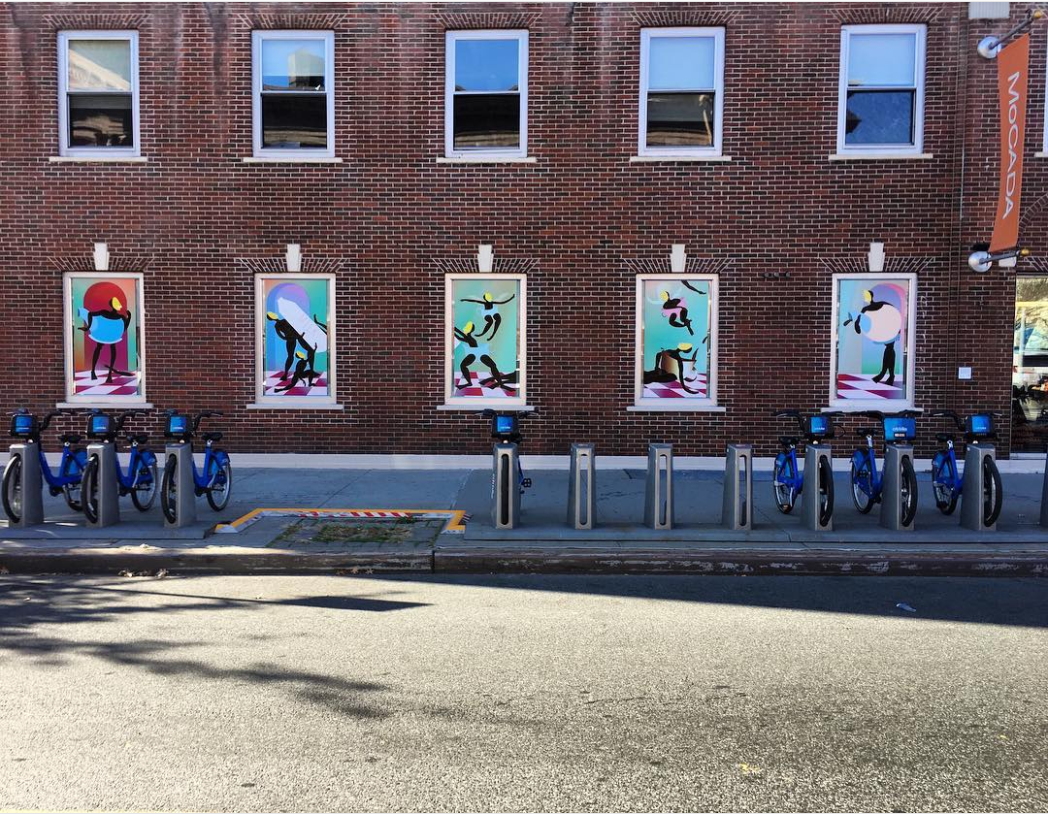
Photo: @elliott.jerome, via Instagram
Installation view of Theresa Chromati’s
Tea Time, with audio accompaniment by Pangelica, at Museum of Contemporary African Diaspora Arts in Brooklyn.

For ten years, I was the editor of a magazine focused lower-income communities, and like this blog, it reflected a lot of my interests. One of the topics I was always on the hunt for was the role of the arts in community development. This study would have fit perfectly.

Isaac Kaplan writes at Artsy, “Arts advocates have long extolled the benefits of culture to personal and neighborhood welfare. While the contention is broadly accepted within the field, the existence of the link has largely been argued without an abundance of data and taken a backseat to economic justifications for arts funding.

“But a two-year study released this month by researchers from the School of Social Policy & Practice at the University of Pennsylvania has revealed a quantitative relationship between the presence of cultural resources in a neighborhood and key aspects of social well-being, particularly in less advantaged neighborhoods. The research was part of the school’s ongoing Social Impact of the Arts Project (SIAP).

“Professor Mark J. Stern and SIAP director Susan C. Seifert found that low- and middle-income residents across New York City with more access to cultural resources experience better education, security, and health outcomes compared to residents of neighborhoods with similar economic profiles but with fewer cultural resources. …

“The relative higher presence of cultural resources in lower-income neighborhoods is linked with several health, safety, and education benefits. These include a 14% decrease in indicted investigations of child abuse and neglect, an 18% decrease in felony crime rate and also a 17–18% increase in the number of students scoring at the highest level on standardized Math and English tests. …

“While the report is careful to note that such findings do not mean the arts are causing these outcomes, the link is nonetheless significant within a broader picture. …

“To reach their conclusions, the researchers compiled a ‘cultural asset index’ — an accounting of thousands of nonprofits, for-profits, employed artists, and cultural participants across New York City, drawing on numerous sources, including tax, grant, and administrative data.

“The study complements this data with interviews and discussions with individuals engaged with cultural enterprises across the entire city. …

“The study says that economically disadvantaged areas generally have fewer cultural resources than wealthier parts of the city. But less advantaged communities also had a stronger correlation between the prevalence of cultural resources and social well-being.”

Read more at Artsy, here.

Read Full Post »

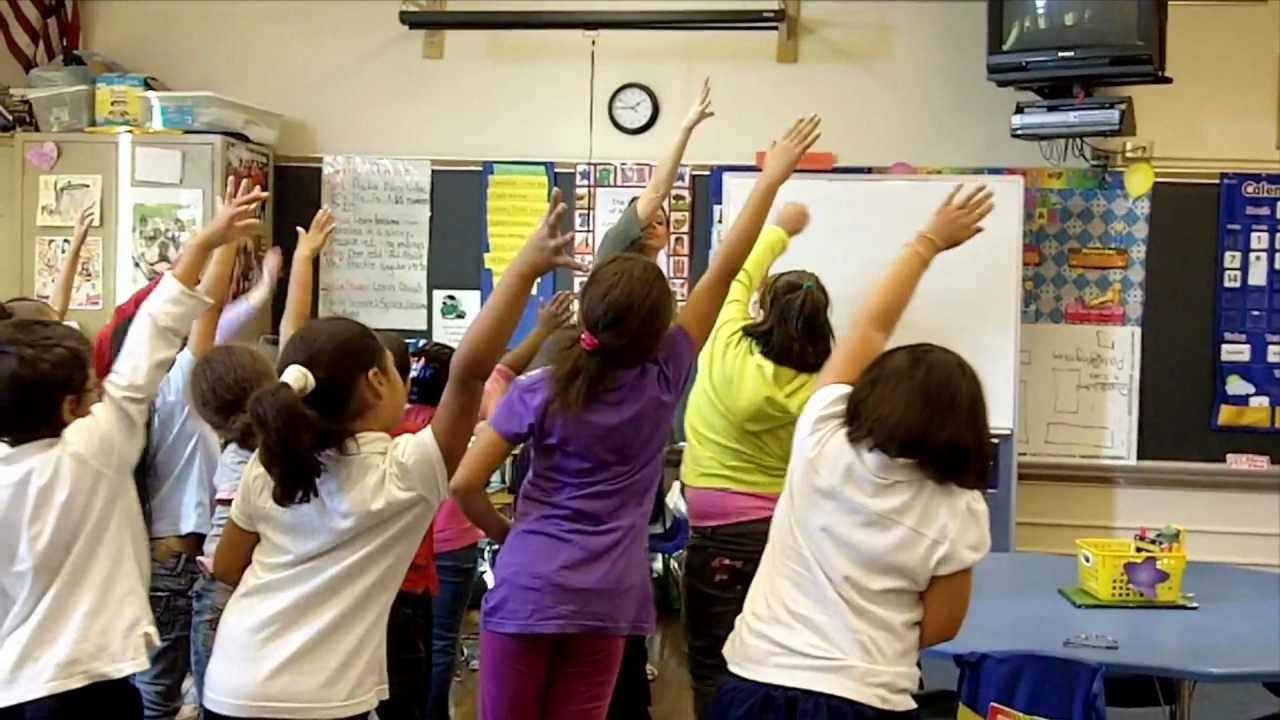
Photo: Milwaukee Public Schools
Sarah Wenzel and her class at Forest Home Elementary demonstrate a series of poses from the YogaKids cards, http://www.yogakids.com.

When I was in kindergarten, someone would come to play the piano and we children would walk in a circle pretending to be giraffes (re-e-eaching!) and elephants (swinging gently while bent over).

Just the other day, I realized that those kindergarten stretches were the same as stretches I’ve been doing for my back.

Decades ago, schools like mine were helping kids exercise for health. Now an increasing number of studies suggest that moving while in class helps children’s brains learn better, too.

Donna de la Cruz writes at the NY Times, “Sit still. It’s the mantra of every classroom. But that is changing as evidence builds that taking brief activity breaks during the day helps children learn and be more attentive in class, and a growing number of programs designed to promote movement are being adopted in schools. …

“A 2013 report from the Institute of Medicine concluded that children who are more active ‘show greater attention, have faster cognitive processing speed and perform better on standardized academic tests than children who are less active.’ And a study released in January by Lund University in Sweden shows that students, especially boys, who had daily physical education, did better in school.

“ ‘Daily physical activity is an opportunity for the average school to become a high-performing school,’ said Jesper Fritz, a doctoral student at Lund University and physician at the Skane University Hospital in Malmo, who was the study’s lead author. …

“ ‘Kids aren’t meant to sit still all day and take in information,’ said Steve Boyle, one of the co-founders of the National Association of Physical Literacy, which aims to bring movement into schools. ‘Adults aren’t wired that way either.’

“Mr. Boyle’s association has introduced a series of three- to five-minute videos called ‘BrainErgizers‘ that are being used in schools and Boys and Girls Clubs in 15 states and in Canada, Mexico, Ireland and Australia, he said. A version of the program is available to schools at no charge. …

“ ‘At the end of the week, kids have gotten an hour or more worth of movement, and it’s all done in the classroom with no special equipment,’ Mr. Boyle said. ‘We’re not looking to replace gym classes, we’re aiming to give kids more minutes of movement per week. And by introducing sports into the videos, giving kids a chance to try sports they may not have ever tried before.’ ”

To read more at the NY Times, click here.

Read Full Post »

College is expensive, and for students from low-income families, even a small emergency can throw the whole thing off course.

That is why colleges are beginning to get creative with techniques to keep students’ educational goals from derailing over relatively small but unexpected expenses.

Boston Globe columnist Adrian Walker writes about one such college.

“Francis Dillon will tell you that the huge expenses associated with college aren’t necessarily what makes it hard for students of limited means to get through school. Often, it’s relatively small stuff that can have a huge impact.

“Formally, Dillon is a vice president for advancement of Stonehill College. But for years he has been the person those on campus turn to when a student can’t afford a new laptop, or a trip home during a vacation break, or to apply to graduate school — the kinds of expenses that many of their peers take for granted. …

“Tuition, room, and board at the private 2,500-student school in Easton runs about $55,000 a year. That’s not cheap, but it is often defrayed by scholarships and other financial aid. The dealbreakers are much smaller. …

“Two years ago, a benefactor surprised Stonehill with a gift of $117,000 that came with no restrictions. Stonehill officials, including Dillon, had a novel idea for it. They decided to create a small, permanent fund to take care of the little student crises they had been quietly addressing piecemeal. …

“When he thinks about students whose college careers may have been saved by emergency infusions of cash, Dillon can rattle off examples. But one of his favorites is a current Stonehill accounting student named Juan Lopez.

“Lopez grew up in a tough area on the South Side of Chicago called Little Village. He says when he was about 13, some gang members in his math class noticed his facility with numbers and tried to recruit him as a bookkeeper. He avoided getting involved, but school became a constant source of anxiety.

“A teacher encouraged him to enroll in a parochial school across town, from which he graduated as the valedictorian. From there, he was recruited to Stonehill. …

“At one point, he faced an unexpected crisis. His father had lost his job, and with it his family’s health insurance. Stonehill requires all its students to have health insurance.

“Enter Dillon, with a check for the required coverage. Lopez freely admits that it wasn’t the only time he has needed help.

” ‘If it wasn’t for this fund, I probably would [have been] out of here by the end of my freshman year,’ Lopez told me. …

“Instead, he is a junior with a 3.6 grade-point average. He’s been hired as a summer intern at a major Chicago accounting firm.” More here.

For folks struggling to pull themselves out of poverty, any unexpected expense can raise insurmountable barriers. Congrats to Stonehill College for this smart assistance.

Read Full Post »

Photo: Boston Globe
Students at Abaarso, the secondary school that a former hedge fund manager founded in Somaliland. Over the past eight years, the school has placed more than 80 students in international boarding schools or colleges.

Some people in tech start-ups or finance make a lot of money at a young age and then decide to do something for the world. Johnathan Starr is such a person.

James Sullivan has the story at the Boston Globe.

“It was no ordinary test for Mubarik Mohamoud. As the first student from the Abaarso School of Science and Technology to be accepted into an American school, Mubarik could create untold opportunities for his schoolmates with a successful transition to Worcester Academy.

“On the other hand, if he stumbled, his peers’ hopes might be dashed.

“Jonathan Starr, a former hedge fund manager who started Abaarso eight years ago in the breakaway African republic of Somaliland, chuckles as he recalls his demanding expectations for Mubarik. When he learned that his prize student was worried ‘the entire future is on his shoulders,’ he responded, ‘Good! He’s been listening.’

“Starr … has just published a book, ‘It Takes a School: The Extraordinary Story of an American School in the World’s No. 1 Failed State,’ about his rash decision to bring a rigorous education to the former region of Somalia, and the remarkable group of teachers and students who brought that vision to reality.

“By his early 30s, Starr had amassed significant wealth and achievement as a systems savant for Fidelity Investments and later with his own hedge fund, Cambridge-based Flagg Street Capital. But he still felt a nagging desire to do something meaningful with his life. …

“A movie buff, he was drawn to inspirational classroom films like ‘Stand and Deliver,’ the 1988 story of East Los Angeles math teacher Jaime Escalante. And for some time, he writes in his book, he had harbored an idea ‘to start a school for really talented kids who have great potential that will otherwise go wasted.’ …

“When he first arrived in Somaliland, almost all of the republic’s schools had been destroyed or run into the ground by the Somali civil war. Covering grades 7-12, Abaarso, named for the town the school is in, now serves 212 students on its walled, multibuilding campus. Acceptance is competitive. …

“Mubarik graduated from Worcester Academy — Starr’s alma mater — in 2013. This spring, after majoring in electrical engineering and computer science, he’ll graduate from M.I.T. Having specialized in autonomous robotics, he’d like to help engineer driverless cars. It’s an astounding trajectory for a boy who grew up in a world so rural, he mistook the first motor vehicles he saw to be some kind of bizarre domesticated animal.

“ ‘I do not feel exceptional,’ says Mubarik, ‘but I do feel lucky.’ ”

More here.

Read Full Post »

Photo: Taught by Finland
Taught by Finland promotes a play-centered approach to early education and writes loving posts about “the joyful, illiterate kindergartners of Finland.”

On Facebook, I’ve been following Taught by Finland, which highlights the Finnish approach to education (e.g., lots of playtime for young children) and posts links to related research and stories.

In higher grades, Finns usually outrank American students by a lot on standardized tests. That may have multiple causes, but it seems reasonable to ask what Finland is doing right and what would happen if American schools were to lighten up.

A school in Burlington, Vermont, is beginning to get answers to that question.

Nicole Higgins DeSmet writes at the Burlington Free Press, “Five months after a no-homework policy went into effect, Orchard Elementary parents report that after-school reading is flourishing.

” ‘We have a first grader, and at her age it’s as much a chore for the parents as the kids,’ parent Rani Philip said about homework. ‘Instead we’ve been spending time reading. We don’t have to rush.’

“Philip said her husband was skeptical, but now he’s convinced. Other parents who were surprised by the policy said their children are reading more. …

“[Kindergartner Sean Conway] hid behind his dad’s legs but managed to share that his solo literary conquest was the book ‘Spirit Animals.’

“Teachers at Orchard voted unanimously before the start of the school year to end homework for their kindergarten through fifth-grade students. Instead students are encouraged to read, play games and be kids.

“Orchard Principal Mark Trifilio sent a homework policy survey to parents in November. Of those parents, 254 sent back answers. About 80 percent indicated they agree with the policy.

“Parents reported in the survey concern that their fifth-graders might miss skills that will help them succeed in middle school. …

“Lolly Bliss, a fifth-grade teacher with 25 years experience, said her students will be prepared to accomplish more because they are freed from busywork — which is how she defined some homework.

“She has more time to accomplish academic goals in class because she doesn’t have to spend time on kids’ and parents’ anxieties about missing or incomplete homework.

” ‘We get a lot done in a calm class,’ Bliss said.”

If you read the rest of the story, you’ll see that some parents fear children are missing needed skills. They may not take into account how difficult it is to learn if you are stressed. I hope someone will tell those parents about Finland.

Read Full Post »

Some schools are taking the current push for STEM skills (science, technology, engineering and math) a step further and putting kids on project teams with students from around the world. While you are learning science, you are getting to know what life is like somewhere else.

Dugan Arnett writes at the Boston Globe, “In just a few weeks’ time, the students in Kathy Wright’s Richard J. Murphy K-8 School STEM class have developed a keen grasp of Costa Rican culture.

“ ‘They don’t get snow there,’ said Jayd’n Washington, a 12-year-old seventh grader at the Dorchester school. Added fellow 12-year-old Fabian Riascos, ‘They have their own currency.’

“Their burgeoning interest in the Central American country stems not from a recent geography lesson plan — it’s the result, instead, of a program called Design Squad Global, which pairs American middle-school classes with students from other countries in a kind of virtual pen-pal relationship.

“Created by WGBH Boston as a spinoff of the old PBS television series ‘Design Squad,’ the program serves, at its core, as a way to introduce young students across the globe to the importance of engineering-related projects.

“But another goal — and one that organizers seem to value as much as anything — is the program’s ability to connect children from various locations, backgrounds, and cultures. …

“The DSG program connects kids ages 10-13. Currently, it operates in 25 American cities — including Boston, Chicago, and New York — and eight countries, from Brazil to Jordan to South Africa.

“At the start of the program, which can run either six or 12 weeks, two classes from different countries are paired together. In online correspondence, they tick off their names, nicknames, and interests — and as they tackle a collection of weekly projects, a virtual relationship blossoms. …

“The focus is on real-world problem-solving. Participants are charged with designing and constructing scaled-down versions of a number of projects: a structure that can withstand an earthquake, an emergency shelter, an adaptive device for someone with disabilities.

“ ‘Middle school kids can come up with some amazing solutions,’ said Mary Haggerty, who oversees educational outreach at WGBH. ‘It makes you feel very hopeful for the future.’ ”

More here.

Photo: Jonathan Wiggs/Globe staff
Jhondell Smith-Young tested his STEM project for a Dorchester class that assigns him to an international team.

Read Full Post »

My high school friend Susie posted this KQED article on Facebook. I couldn’t agree more with its focus on the value of daydreams and allowing everyone adequate  time to recharge batteries.

Referencing today’s many distractions, KQED reporter Katrina Schwartz writes, “Many people believe they are skilled multitaskers, but they’re wrong. Neuroscience has shown that multitasking — the process of doing more than one thing at the same time — doesn’t exist.

“ ‘The brain doesn’t multitask,’ said Daniel Levitin, author and professor of psychology, behavioral neuroscience and music at McGill University on KQED’s Forum program. ‘It engages in sequential tasking or unitasking, where we are shifting rapidly from one thing to another without realizing it.’ The brain is actually fracturing time into ever smaller parts and focusing on each thing individually. …

“The brain has a natural way of giving itself a break — it’s called daydreaming. ‘It allows you to refresh and release all those neural circuits that get all bound up when you’re focused,’ Levitin said. …

“[Daydreaming] is particularly important for students, who are often asked to sit through a long school day with very few breaks. Lots of research has shown the importance of recess and free play time for academic success, but schools still tend to emphasize time spent in class ‘learning’ over a more nuanced view of how and why kids learn.

“ ‘Children shouldn’t be overly scheduled,’ Levitin said. ‘They should have blocks of time to promote spontaneity and creativity.’ Without that time, kids don’t have the mental space to let new ideas and ways of doing things arise. Daydreaming and playing are crucial to develop the kind of creativity many say should be a focal point of a modern education system.” More.

Time to think, time to free associate, is not just important for kids. If the electric handwarmers I use in winter take twice as long to recharge as to expend their stored heat, then I, too, should have double time to recharge after engaging on anything. You, too.

Photo: Brynja Eldon/Flickr

Read Full Post »

I’ve read about book lovers delivering books to children and adults by camel, donkey, portable Uni bookshelf and van. Now at the BBC, Theodora Sutcliffe reports on a sailboat that can get books to watery places in Indonesia.

“The toothless steersman positioned the rudder. A second sailor, balancing barefoot on an outrigger, coaxed an elderly engine into life. A third poled the boat away from the trash-strewn beach. In West Sulawesi, Indonesia, a ground-breaking mobile library was on its way.

“The Perahu Pustaka (Book Boat) is sorely needed. In a recent study of 61 nations for which data was available, Indonesia ranked second worst for literacy – only Botswana scored lower. More than 10% of the West Sulawesi’s adult population cannot read, while in many villages, the only book available is a solitary copy of the Quran.

“So in 2015, local news journalist Muhammad Ridwan Alimuddin decided to combine his twin passions for books and boats by setting up a mobile library on a baqgo, a small traditional sailboat. His aim? To bring fun, colourful children’s books to remote fishermen’s villages and tiny islands in the region where literacy is low and reading for pleasure virtually non-existent. He preaches the joy of reading. …

“Despite never finishing university, he has written 10 books on maritime culture and helped sail a small traditional pakur craft from Sulawesi to Okinawa in Japan. His love of the sea can be seen in his maritime museum, a collection of model and antique boats, which shares space with his library. And he uses the boat journeys, which can mean up to 20 days at sea, to research and make YouTube documentaries on the fishing and seafaring life of his native Mandar people. …

“As we closed in on the oyster-farming village of Mampie on the West Sulawesi coast, a gaggle of children emerged from the palms to watch the library boat pull in. Others stopped the hard, repetitive work of shucking oysters as Alimuddin, a volunteer from his home village and his crew of three unrolled plastic mats and covered them in books.

“Excited children dived into the brightly coloured tomes; their mothers, some with babies, were more circumspect.

“ ‘We have low expectations,’ Alimuddin said. ‘We want them to use the books – that’s all.’

“With more than 17,000 islands scattered across the Indian and Pacific oceans – some virtually in the Philippines, others close to Australia or butting up against Singapore – education in Indonesia is a constant struggle. …

“ ‘When you see a child smile and open a book, all your problems disappear,’ Alimuddin said with a smile of his own.” More here.

Photo: Theodora Sutcliffe
In 2015, Alimuddin decided to combine his twin passions for books and boats by setting up a mobile library.

Read Full Post »

Dorcas International of Rhode Island is a refugee-resettlement and immigrant-support organization that also offers education programs and services to native-born residents.

On the nonprofit’s website, you can find uplifting stories of DIIRI beneficiaries. Here is one.

Sidy Maiga, a master percussionist from Mali, wanted to take his skills to the next level. The first step was to get over his insecurity about education.

“His mastery of the djembe, a drum of West African origin that is rope-tuned [and] shaped like a large goblet, has taken him on tours all over the world and as a teacher in schools all over the East Coast … But without a high school diploma, he felt like he had hit a wall. …

“Sidy heard from friends about things you could do at Dorcas International Institute of Rhode Island. …

“He admits he was hesitant about going to school again. … He enrolled in an ESL [English as a Second language] class to get up to speed” before taking the high school equivalency test known as the GED “and felt himself getting discouraged — so he stopped going to class.

“However, after getting encouraging calls from DIIRI staff, Sidy decided he would give it another shot. … ‘I think they saved my life, and I’m glad I came back.’ …

“With the help and encouragement of DIIRI staaff, Sidy decided the next step would be college.”

Sidy starts at Berklee College of Music this year and says, “Once I learn the academic way of music, then I can teach African music to the world.”

More here.

Photo: Dorcas International Institute
Malian djembe drummer Sidy Maiga says Dorcas staff “saved my life.”

Read Full Post »

I liked this local story about a new approach to helping students who have special needs master independent-living skills while still connected with high school. It’s not hard to imagine the satisfaction students will gain from this volunteer-powered opportunity.

Brittany Ballantyne writes at the Valley Breeze, “Thanks to $15,000 donated from Lowe’s Home Improvement stores and the help of volunteers, students in the transition program at North Providence High School [NPHS] will start the school year in a new state-of-the-art transitional apartment space.

“Christopher Jones, special education director, said six Lowe’s stores donated $2,500 each to help build a studio apartment in the building at 1828 Mineral Spring Ave., where students will learn how to prepare and cook food, do laundry, type up resumes, make a bed and become [nursing assistant] certified if they choose.

“By the start of the academic year, Jones said, students ages 18 to 21 in the program will be able to get to work in the space …

“Jones envisioned giving the students an experience where they moved up not just in academics, but also in the NPHS building after receiving their diplomas. What were two in-school suspension classrooms [have been] transformed into the apartment after space was reconfigured in the high school, Jones explained. …

“He said the apartment space will be used anytime students aren’t out in the community getting hands-on work experience.”

More at the Valley Breeze, here.

Photo: The Valley Breeze
Students in the transition program at North Providence High School get apartment-style space to practice how to prepare food and cook, do laundry, make beds and write resumes.

Read Full Post »

Photo: Aram Boghosian for The Boston Globe
Jean Devine (left) and Jayden Pineda, 7, make a meadow at the Waltham Y.

I’m excited that today the Boston Globe caught up with my friend Jean’s terrific biodiversity-education outreach. Readers may recall that I blogged here and here about how she and Barbara Passero got started on “meadowscaping” — hoping to ween homeowners from using pesticides and herbicides that harm the environment and contribute to global warming.

Debora Almeida reports on the educators’ latest work with kids: “Swimming, crafting, and playing games are staples of day camp, but kids at the Waltham YMCA are doing something new this summer.

“They’re learning how to plant and cultivate a meadow — and why they should.

“ ‘We just want to save the world, that’s all,’ said Barbara Passero, cofounder of Meadowscaping for Biodiversity, an outdoor environmental education program for students of all ages, which has partnered with the Y for the project.

“Over the course of the summer, Passero and program leader Jean Devine are teaching children the fundamentals of meadow upkeep and the importance of planting exclusively native plants. They are the best hosts for pollinators, such as bees, butterflies, and moths. In turn, the insects attract other wildlife such as birds and rabbits, building biodiversity.

“While some people’s first instinct would be to spray pesticides to protect their hard work from leaf-munching insects, Passero knows that birds will take care of the insects on their own. She also refuses to use any toxic substances around the children, who truly get their hands dirty digging in the meadow. Seth Lucas, program administrator at the Waltham Y, said kids love the activity. …

“The meadow started as a patch of weedy grass, but is in the process of becoming a 10-by-60-foot flourishing garden. Passero and Devine are setting the meadow up for success with native plants that come back year after year. The plants are self-sustaining and spread on their own.”

Such a happy story! Do read the whole thing here.

Read Full Post »

The Atlantic magazine says Estonia is the new Finland, meaning that it is doing a bang-up job with quality education for all. Educating the poor turns out to be a salient strength of the system.

Sarah Butrymowicz writes, “In 2012, Estonia’s 15-year-olds ranked 11th in math and reading and sixth in science out of the 65 countries that participated in an international test that compares educational systems from around the world (called the Programme for International Student Assessment, or PISA).

“In addition to beating out western nations such as France and Germany and essentially tying Finland in math and science, Estonia also had the smallest number of weak performers in all of Europe, about 10 percent in math and reading and 5 percent in science.”

In comparison, the United States hovers in the middle of the pack.

“While there is less income inequality in Estonia than in the United States—and, with 1.3 million people, the country is significantly smaller—the Baltic nation also has its share of cultural diversity.

“When it achieved independence from the Soviet Union 25 years ago, Estonian became the official language and the language of school instruction. Yet about a fifth of its students come from families that still speak Russian at home, and they have historically lagged behind their native speaking counterparts on tests such as PISA. …

“Marc Tucker, president of National Center on Education and the Economy in Washington, D.C., visited Estonia last year to find out what they’re doing right. He said that after the fall of the Iron Curtain other former Soviet satellites, such as Hungary and the Czech Republic, transitioned to a system preferentially suited to the needs of its elites. Estonia, however, kept giving equal opportunities to students of all backgrounds. …

“There are many factors that may contribute to Estonia’s success on PISA beyond their focus on equality. Education continues to be highly valued. Teacher autonomy is relatively high, which has been shown to be related to better test scores. Teachers stay with the same students in grades one to three – or sometimes even up to sixth grade – allowing deep relationships to develop.”

Maybe we could learn something from this small Baltic state. Read more here about why Estonian students are so successful on tests and whether they are happy with the system and why the country is trying to encourage more individuality and creativity without losing rigor.

Photo: Ints Kalnins / Reuters
First graders take a computer class in Tallinn, Estonia.

Read Full Post »

« Newer Posts - Older Posts »