Feeds:
Posts
Comments

Posts Tagged ‘education’

Among all the sad aspects of the refugee crisis, children in refugee camps going without any education — sometimes for years — has to be one of the saddest.

10 million under the age of 8 are displaced

Fortunately, there are occasional rays of light, such as adult refugees deciding to start their own school. And here is a story from Mashable about a partnership between the International Rescue Committee and the makers of Sesame Street.

Matt Petronzio writes, “A new partnership between Sesame Workshop, the brand’s educational nonprofit, and global humanitarian aid organization International Rescue Committee (IRC) will allow the two groups to develop, distribute, and test educational resources and programs designed with young refugees in mind. …

“The first phase is to develop educational multimedia content that can reach children living in displaced or resettled communities through mobile devices, radio, TV and printed materials in engaging, enjoyable ways.

” ‘We really set out to find a partner that complements our offerings, and I think the IRC is ideal,’ said Sherrie Westin, executive vice president of global impact and philanthropy at Sesame Workshop. …

“Sesame Workshop and the IRC will adapt existing Sesame products and content for regions where the two organizations already have a presence working with young children and their families. …

“The partnership is aimed at the children who make up half of the record 60 million people currently displaced around the world, specifically the one-third of that population under the age of eight. In addition to a lack of education, these children also often deal with toxic stress and trauma.

” ‘We’ve seen time and time again, in the context of conflict and crisis, that those very young children don’t have a safety net to support them,’ Sarah Smith, senior director for education at the IRC, told Mashable. …

“Most recently [Sesame] launched Zari, the first local Muppet in Afghanistan, a country where many young children lack access to education, especially girls.

“Zari’s gender was a deliberate choice to promote girls’ empowerment — an example of tailoring curricular goals to the needs of a particular country. (According to Westin, recent research showed that fathers in Afghanistan changed their minds about sending their daughters to school after watching Baghch-e-Simsim, the local language version of Sesame Street.)”

More at Mashable.

Image: Vicky Leta/Mashable

Read Full Post »

The article by Astrid Zweynert and Ros Russell begins, “Boys campaigning for girls’ education is not common in most parts of the world, but in India’s Rajasthan state, they are at the heart of a drive to get more girls into schools.

“Educate Girls trains young people to go into villages to find girls who are not in the classroom in a country where more than 3 million girls are out of school.

“Some 60 percent of Educate Girls’ 4,500 volunteers are boys, founder and executive director Safeena Husain told the Thomson Reuters Foundation.

” ‘Having these boys as champions for the girls is absolutely at the core of what we’re trying to achieve,’ Husain said in an interview as she was awarded the $1.25 million Skoll Award for Social Entrepreneurship, the largest prize of its kind. …

“In Rajasthan, 40 percent of girls leave school before reaching fifth grade, often because their parents do not see education as necessary for their daughter because she is going to get married or stay at home to do housework, Husain said. …

“Educate Girls’ approach to is to define hotspots where many girls are out of school, often in remote rural or tribal areas, and then deploy its volunteers to bring them back into the classroom, said Husain.”

There’s plenty of research showing that when girls are educated, the standard of living in a country goes up. Educated girls “are less likely to get married at an early age or to die in childbirth, they are likely to have healthier children and more likely to find work and earn more money.”

More at the Christian Science Monitor, here.

Read Full Post »

Are you familiar with the “Lens” blog at the NY Times? It focuses on “photography, video and visual journalism.” Here David Gonzalez writes about the photos of Putu Sayoga.

[Hat tip: Asakiyume on twitter.]

“If you live in a far-off place, a library may be something you’d only read about in books. That is, if you had books to begin with.

“That became the mission of Ridwan Sururi, an Indonesian man with a plan — and a horse. Several days a week, he loads books onto makeshift shelves he drapes over his steed, taking them to eager schoolchildren in the remote village of Serang, in central Java. ..

“Mr. Sayoga, a co-founder of the collective Arka Project, had seen something about the equine library on a friend’s Facebook page. It reminded him of his own childhood, where his school had only out-of-date books. Intrigued, he reached out to Mr. Sururi, who offered to put Mr. Sayoga up in his home while he spent time photographing Mr. Sururi on his rounds. …

“Mr. Sururi made a living caring for horses, as well as giving scenic tours on horseback. One of his clients, Nirwan Arsuka, came up with the book idea as a way of doing something to benefit the community, specifically a mobile library. He gave Mr. Sururi 138 books for starters. Most were in Indonesian, and the books included a lot with drawings.

“Children at the schools he visits can borrow the books for three days, and demand has been so great that he now has thousands of books.” More here. Check out the slide show.

Photo: Putu Sayoga

Read Full Post »

Do we praise the work of librarians enough? I started following the Ferguson Library on twitter and Facebook after reading how it was the calm eye of the storm in Ferguson, Missouri, amid the 2014 riots. As a result, I now get good leads about other libraries. Here is a report on Ohio librarians who go the distance — and beyond.

Katie Johnson at School Library Journal describes her experience with “Play, Learn and Grow, a pop-up storytime and early learning program created through a collaboration between Twinsburg (OH) Public Library and Akron Metropolitan Housing Authority (AMHA). …

“I noticed that none of the children living in the housing development were coming to storytime at our library. I reached out to AMHA representatives, hoping they would be open to the idea of the library hosting a weekly program at the development. They were, partnering me with one of their employees, Kellie Morehouse, who was already working with families within the complex.

“We set up Play, Grow, and Learn in an unused room behind the apartment leasing office. Our initial goal was to get to know children age five and younger and their families through storytime, crafts, and free play. As the weeks went on, we saw everything that these families lacked: employment, education, transportation, healthy food, proper healthcare, access to preschool, even reliable phone service.”

They got involved in all those areas — helping children get vaccinations and nutritious food, for example, and arranging for isolated young mothers to address depression.

“Early experiences with storytime revealed a desire of the young mothers to interact with one another.  This led the AMHA representative to suggest teaming storytime with one of the organization’s programs for moms.  AMHA and a local behavioral health agency had been working together to provide maternal depression support groups to low-income women in other parts of the county. …

“Twice a month, the moms in our storytime are able to meet in a group setting with a professional to discuss their frustrations and worries. Mom-ME Time has become key, as so many of our moms are dealing with heavy pressures every day, and most do not have a strong support network. Being able to vent and get helpful parenting advice can be crucial to the choices they are making for their young children.”

It is worthy of applause when a librarian sees the whole child, not just a child in storytime, and tries to tackle the barriers to a better life. More here.

Photo: Katie Johnson/School Library Journal
Moms are included in programming for children.

Read Full Post »

I’ve read before about inventive approaches to teaching math — and my daughter-in-law, who coaches teachers of math, probably knows most of them. But recently, the Washington Post examined a new method, one that uses dance.

Reporter Moriah Balingit described observing a kindergarten game that “actually was a serious math lesson about big and small and non-standard measurements. Dreamed up by [drama teacher Melissa] Richardson and kindergarten teacher Carol Hunt, it aims to get the children to think of animal steps as units of measurement, using them to mark how many it takes each animal to get from a starting line to the target.

“[Today] teachers are using dance, drama and the visual arts to teach a variety of academic subjects in a more engaging way. …

“The Wolf Trap Institute, based at the Wolf Trap Foundation for the Performing Arts, brought Richardson to Westlawn Elementary through a program that pairs art teachers with early-childhood educators to formulate math lessons. The program also provides professional development to teachers.

“And the program appears to have been effective: A study by the American Institutes for Research found that students in classes headed by Wolf Trap-trained teachers performed better on math assessments than did their peers being taught by teachers who were not in the program. …

“Researcher Mengli Song said the students in the program did not necessarily learn additional math content but they did demonstrate a better grasp of the material. And the effect was comparable to other early-childhood interventions. …

“Jennifer Cooper, director of the Wolf Trap Institute for Early Learning Through the Arts, said arts integration — particularly lessons where children get to move and play — is a good way to reach a lot of children who struggle with traditional book lessons.

“ ‘By embodying a concept . . . and putting it through your body in a multi-sensory way, you’re going to reach a lot of different kinds of learners,’ Cooper said.”

Read more at the Washington Post, here.

Photo: Bill O’Leary/The Washington Post
Teaching artist Melissa Richardson, right, from the Wolf Trap Institute, watches her kindergarten students at Westlawn Elementary School take large bear steps during a math lesson in Falls Church, Va.

Read Full Post »

Do you ever read Kevin Lewis’s Sunday Globe column, “Uncommon Knowledge”? He covers new research in the social sciences. Thanks to him, I learned about this study on helping minority boys get engaged in education.

“A disproportionate number of students struggling academically are minorities, ” he writes. “Can we do better?

“In what they claim is the first credible study of the effect of an ethnically grounded education, researchers at Stanford analyzed the effect of a ninth-grade course offered in several San Francisco public schools covering ‘themes of social justice, discrimination, stereotypes, and social movements from US history spanning the late 18th century until the 1970s’ and requiring students ‘to design and implement service-learning projects based on their study of their local community.’…

“The researchers found that taking the course ‘increased attendance by 21 percentage points, GPA by 1.4 grade points, and credits earned by 23 credits (or roughly four courses).’ They call the results ‘surprisingly large effects,’ which were concentrated among boys.”

The paper, by Thomas S. Dee, and Emily Penner, is The Causal Effects of Cultural Relevance: Evidence from an Ethnic Studies Curriculum.” It was posted at the National Bureau of Economic Research in January.

More here.

Photo: Stanford University
Teacher David Ko instructs an ethnic studies class at Washington High School in San Francisco. A Stanford study found students benefit from such courses. Here, Ko is explaining an assignment about the role of advertising in reinforcing cultural stereotypes.

Read Full Post »

In October, Tim Faulkner of ecoRI wrote that for the local celebration of National Food Day, “there was plenty to celebrate about Rhode Island’s food industry. During a downtown food festival, leaders and pioneers in the local food movement explained how they are connecting Rhode Island’s restaurants and culinary arts sector with farming, education, environmentalism, entrepreneurism and social justice.

“This effort was best demonstrated by Julius Searight, founder of a new food truck and mobile soup kitchen. Searight’s Food4Good held its grand opening during the Oct. 24 Providence Food Day Festival, selling chicken waffle sandwiches and baked potatoes. Proceeds from food sales are expected to fund about 400 meals a week for the needy.

“Searight, 26, grew up as a foster child in Providence and graduated from Johnson & Wales University in 2013. He got the idea for the hybrid food operation after volunteering at local nonprofits and wondering what it was like for his biological mother to get fed.

“ ‘I really just saw the need to give back to those in need,’ he said.

More here.

Photo: Tim Faulkner/ecoRI News
Julius Searight is the founder of Food4Good food truck and mobile soup kitchen. Every $5 dollars earned buys two meals for people who need them.

Read Full Post »

I thought today would be a good day to note that, with the right supports in place, veterans who have suffered post-traumatic stress while serving the country can move forward with their lives.

The willingness of some of these service men and women to expose their story in the media strikes me as an extra level of bravery.

Kathy McCabe writes at the Boston Globe about Army veteran Michael Saunders.

“Saunders, who served from 2002 to 2006, deployed twice to Iraq … He started therapy at the VA outpatient clinic in Lynn, where a counselor suggested he focus on a new mission: going to college.

“ ‘She said I would make more money with a college degree,’ said Saunders, who worked for a lumberyard after his discharge from the Army.

“He enrolled in VITAL — an acronym for Veterans Integration to Academic Leadership — a national program that helps veterans transition from soldier to student. VITAL brings VA services, including mental health counseling, to college campuses. …

“According to Pam Flaherty, dean of students, Middlesex Community College had nearly 600 student veterans in 2014-15. In the last year, 70 who have PTSD have taken part in VITAL and received mental health care on campus. …

“The Bedford VA also offers the VITAL program at Bunker Hill Community College in Charlestown, Mount Wachusett Community College in Gardner, Northern Essex Community College in Haverhill, North Shore Community College in Danvers and Lynn, Endicott College in Beverly, and Salem State University.

“Saunders, who graduated from Everett High School in 1999, is in his second year studying liberal arts at Middlesex Community College in Bedford. He has discovered a talent for writing, and hopes to transfer to Emerson College next year.

“ ‘It was a rough start, but I’m doing fine now,’ said Saunders, who also has a job at the college’s Veterans Resource Center. ‘Had the VA not had the service in place here, I wouldn’t have come.’ …

“ ‘I can sit in class now, for an hour and 20 minutes,’ Saunders said. ‘I couldn’t sit still for 10 minutes before.’ He has a lingering fear of crowds, so he adjusted his seat in the classroom.

“ ‘ I have to be able to see the door, and I don’t like anybody behind me,’ Saunders said. ‘If I can’t do that, I can’t focus.’

“For one class, Saunders wrote a story called ‘The Dark Is Afraid of Me,’ a fictional account of a military mission in Iraq.

“ ‘It was really easy for me to tell the story,’ Saunders said. ‘When the professor read the paper, she was like, “You need to go see a publisher, now.”

” ‘Maybe I will.’ ”

More such stories at the Globe, here.

080115-flag

Read Full Post »

At the Guardian, teacher Steve Ritz tells Matthew Jenkin about how he began growing food in a troubled South Bronx school.

“The Green Bronx Machine was an accidental success. I wound up working at a very troubled high school in New York’s South Bronx district. It had a very low graduation rate and the bulk of my kids were special educational needs, English language learners, in foster care or homeless. It was dysfunctional to say the least.

“Someone sent me a box of daffodil bulbs one day and I hid them behind a radiator – I didn’t know what they were and figured they may cause problems in class. A while later … we looked behind the radiator and there were all these flowers. The steam from the radiator forced the bulbs to grow.

“That was when I realised that collectively and collaboratively we could grow something greater. We started taking over abandoned lots and doing landscape gardening, really just to beautify our neighbourhood. … We then moved on to growing food indoors in vertical planters around the school.

“By building an ‘edible wall’ to grow fresh vegetables in our science classroom, I gave the kids a reason to come to school. …

“Remarkably the plants grew. The kids really believe that they are responsible for them and attendance has increased from 43% to 93%. Students come to school to take care of their plants – they want to see them succeed. Along the way, the kids succeed, too.” More here.

Photo: Progressive Photos  
Steve Ritz gets students involved in the natural world. Attendance has more than doubled.

Read Full Post »

Thomas Whaley, a teacher of 7-year-old English-language learners on Long Island came up with a creative way to build confidence while building writing skills. He has students make the case for why they should be president.

Jasmine Garsd reports at National Public Radio, “Whaley does not look like the kind of guy that dabbles in magic markers. Before he was a second-grade teacher, he worked at a public relations company in New York City.

“He says he started thinking about doing something else while riding to and from work on the Long Island Rail Road. ‘I would talk with people on the train at 6 a.m. and 8 p.m. on the way home,’ he recalls. ‘They were people who had a complete disconnect from the young people of the world. They were all so focused on adults and the rat race. And I realized that this was not for me.’

“That was 16 years ago. He has been teaching ever since.

“In addition, Whaley has found time to write a novel called Leaving Montana, and he’s starting to write children’s books. Last year, he won the New York state teacher-of-the-year award.

“This second-grade presidential campaign is an example of why. He tells me he got the idea when he asked the children one day to raise their hands if they thought they could never be a U.S. president.

“The answer broke his heart.

” ‘Almost every single child who is an English-language learner believed that they couldn’t be,’ Whaley recalls. They’d say things like, ‘ “I can’t run for president because my parents are from a different country.” That was a biggie. “Because I’m poor, and you need a lot of money to be the president.” “Because I don’t like to read, or I can’t read.” ‘

“Whaley says the presidential speech project is about more than just learning to read and speak in public. He wants these kids to learn to boast about themselves.

” ‘Bragging about yourself, and your best qualities,’ Whaley says, ‘is very difficult for a child who came into the classroom not feeling any confidence whatsoever to read three or four words.’

“Robert Epstein, the principal at Canaan Elementary, says this is the essence of what makes Whaley such a great teacher.

” ‘There’s a sense of community that’s really unsurpassed,’ and the students will take risks as a result, Epstein says. He adds that Whaley goes above and beyond what is expected of him as a teacher. ‘If one needs sneakers, I’ve seen him go out and buy sneakers. He’s gone to homes. He’s constantly on the phone, constantly emailing parents.’ ”

More at NPR.

Photo: Christopher Gregory for NPR
Thomas Whaley walks his students back to class from the library.

Read Full Post »

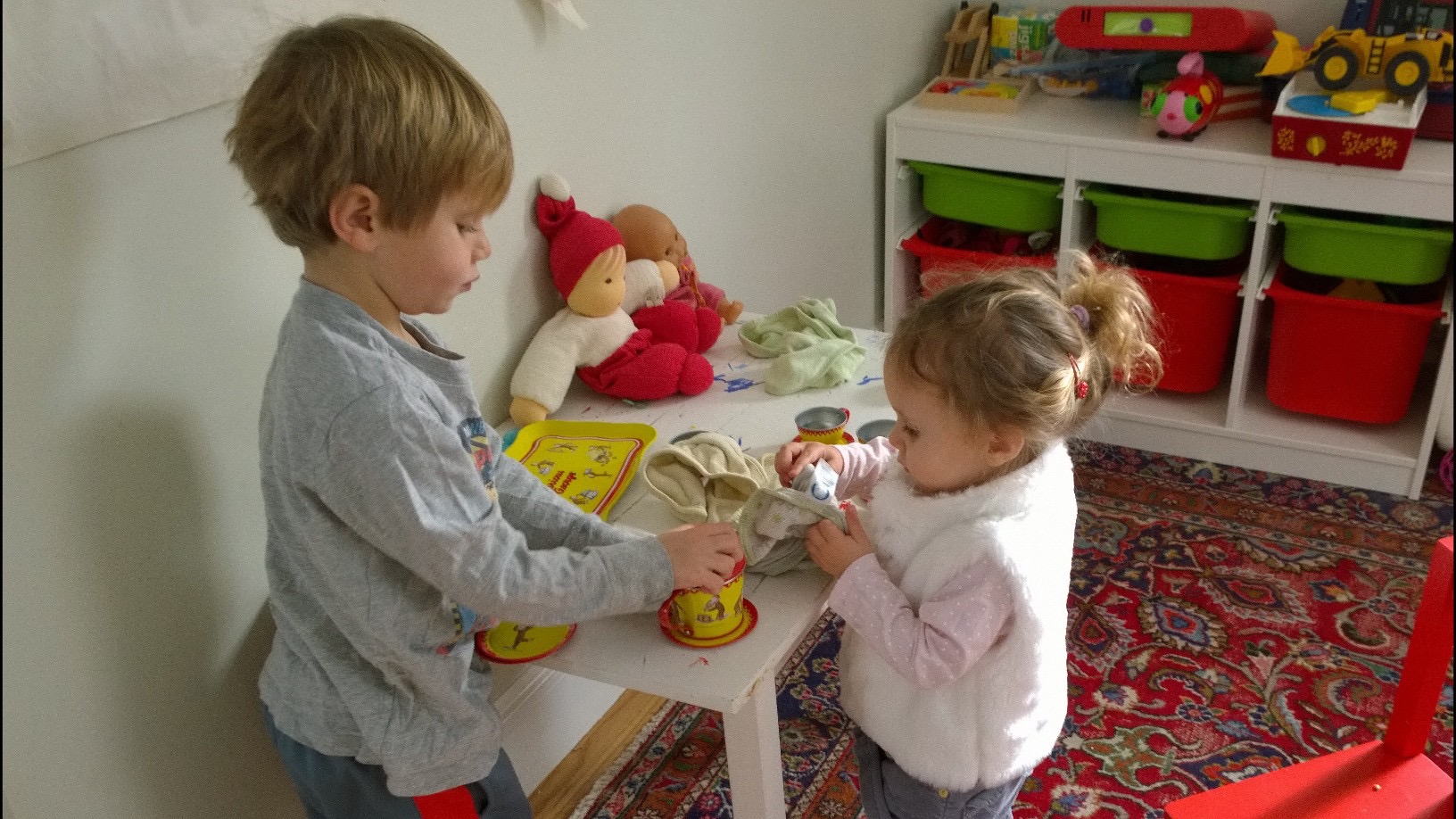
I read this NY Times article with relief. It seems that educators are returning to (or perhaps being heard about) the importance of play in learning.

Reporter Motoko Rich says, “Call it Kindergarten 2.0. Concerned that kindergarten has become overly academic in recent years, this suburban school district south of Baltimore is introducing a new curriculum in the fall for 5-year-olds. Chief among its features is a most old-fashioned concept: play.

“ ‘I feel like we have been driving the car in the wrong direction for a long time,’ said Carolyn Pillow, who has taught kindergarten for 15 years and attended a training session here on the new curriculum last month. ‘We can’t forget about the basics of what these kids need, which is movement and opportunities to play and explore.’

“As American classrooms have focused on raising test scores in math and reading … even the youngest students have been affected, with more formal lessons and less time in sandboxes. But these days, states like Vermont, Minnesota and Washington are again embracing play as a bedrock of kindergarten. …

“Still, teachers like Therese Iwancio, who works at Cecil Elementary School in Baltimore’s Greenmount neighborhood, where the vast majority of children come from low-income families, say their students benefit from explicit academic instruction. She does not have a sand table, play kitchen or easel in the room. …

“Traci Burns, who has taught kindergarten for the last five years at Annapolis Elementary School, said she was looking forward to retrieving previously banished easels.

“ ‘With the Common Core, this has been pushed and pushed and pushed that kids should be reading, sitting and listening,’ she said. ‘Five-year-olds need to play and color. They need to go out and sing songs.’

“At Hilltop Elementary, a racially and economically diverse school in Glen Burnie, Melissa Maenner said she had found that teaching kindergartners too many straightforward academic lessons tended to flop.

“ ‘They are 5,’ Ms. Maenner said. ‘Their attention span is about five minutes.’ ”

Read more here.

013115-spilt-tea (1)


Read Full Post »

After work yesterday, I went with a colleague to observe a parent-engagement program organized by Lawrence Community Works (LCW) at the Oliver Partnership School, in Lawrence, Mass. I had long been interested in LCW’s use of circles to build a sense of community among strangers of very different backgrounds.

Lawrence is what is sometimes called a Gateway City, meaning it’s always been a gateway to the U.S. culture and experience for new waves of immigrants. It currently has a large Spanish-speaking Dominican population and foreign-born and native-born residents from all over.

The parent night was the third in a series. In the first two, facilitators had helped the participants to come up with agreed-upon ground rules (come on time, no cellphones, respectful attention to one another) and to choose an “obstacle” that they would like to address related to their children’s life at the school. They had selected recess, which is only 10 minutes. (Lunch is 15 minutes.)

Everything was conducted in both Spanish and English.

As the evening was getting going, Tony told me his children love school. He believes a good education is vital. He wishes he had more. He did learn Spanish and English in addition to his native Portuguese. The languages help him in his job working with troubled youth, a job he loves to go to every day.

In a warm-up exercise, we stood in a circle and stated our name, followed by our favorite fruit and the name and favorite fruit of everyone who spoke previously. It was fun and a great equalizing experience as anyone can be good at that and anyone can struggle with it. The people who went last had about 20 names and fruits to report and did really well despite language differences.

To discuss the recess issue, we separated into two groups — those who felt comfortable speaking English (which included the two teachers in attendance) and those who felt comfortable speaking Spanish. At the end we came together with the results of our investigation of three questions: why having a longer recess is important, why it might have been set up that way, and what parents themselves could do about it. (Asking the administration’s help was to wait for a joint meeting in June.)

I won’t make this post much longer, but I do want to say that I thought the way this was handled was very good. Parents appeared to feel that their opinions were welcome and that they could accomplish something. Continued engagement with them will be important as the work is a piece of a much bigger project by LCW that aims to help parents get skills for jobs. Unemployment is a serious issue in a city where many of the people are poor, have not had good educational opportunities, and are still learning English.

Photo: Family literacy night at the Oliver Partnership School in Lawrence, Mass.

Read Full Post »

Sometimes it just takes one person to be a catalyst. Internationally known jazz musician Danilo Pérez is a catalyst for a growing jazz scene in his native Panama. He has a special focus on getting young people excited about jazz and giving them a chance to become musicians.

At the NY Times, Melena Ryzik writes, “Even in jazz, which has a long tradition of mentorship, Mr. Pérez, 49, has emerged as a singular figure. Nearly 30 years after he left his native Panama to study jazz composition at Berklee [College of Music in Boston], he has made promoting musicianship in Panama — using music as a springboard, cultural unifier and teaching tool — his life’s work.

“In 2005, a year after he started [a] jazz festival with his family, he created the Danilo Pérez Foundation, a nonprofit center for music education and outreach; the festival, which draws as many as 30,000 people over its six-day run each January, provides money for the foundation. The club, which opened last February at the new American Trade Hotel, a luxe outpost of the Ace Hotel chain, is, in his view, the last piece of the puzzle.”

Read more.

Photo: Jennifer Shanley
Danilo Pérez (right) directs the Berklee Global Jazz Institute inaugural class.

Read Full Post »

Everything old is new again. Here’s a story about a type of teaching that is coming back in vogue.

Peter Balonon-Rosen writes for WBUR radio, “Closing the gap between the achievements of low-income students and their peers is such a formidable challenge that some experts say it cannot be done without eliminating poverty itself. By the time children enter kindergarten, there is already a significant skills gap across socioeconomic lines that manifests in an income achievement gap that has widened dramatically over the past 25 years.

“In Revere [MA], a high-poverty school district, school officials have turned internally to raise outcomes for kids in poverty. Their notion is that school success can begin with a successful teaching model.

“ ‘What is this?’ kindergartner Thea Scata asks. She taps the picture of a rabbit with a wooden pointer and looks to the three other girls seated at her table.

“The group of four kindergartners at Revere’s A.C. Whelan Elementary School is learning about the letter ‘R’ — writing its shape and reviewing words that begin with the letter.

“ ‘Bunny!’ replies Bryanna Mccarthy.

“ ‘No, what’s the first sound? “R”— rabbit,’ Scata says to the group. …

“Whelan is one of 43 public elementary schools in the state that Bay State Reading Institute (BSRI), a Holliston-based education nonprofit organization, partners with to implement this teaching model into Massachusetts schools.”

Said “Kimberlee Clark, a first grade teacher at Whelan, ‘I’m really able to target those that need to be challenged and go above and beyond and I’m able to work with those students that need the extra support to get onto grade level.’ …

“Core to BSRI’s approach is independent student learning. As teachers work closely with small groups of students, the other students are expected to work by themselves on separate tasks.

“ ‘Students then own a piece of the learning,’ said Ed Moscovitch, chairman and co-founder of BSRI. ‘They learn how to learn from an independent perspective.’

“ ‘When they’re working together it’s not so much that students are teaching students, but they’re discovering and coming to the knowledge together,’ said Lenore Diliegro, a fifth grade teacher at Whelan.” More here.

Photo: Peter Balonon-Rosen/WBUR
Thea Scata, left, leads a group of kindergarten peers at A.C. Whelan Elementary School in Revere.

Read Full Post »

Speaking of libraries, if any of you decide to publish a collection of stories on the value of libraries, be sure to include this one about a family in India.

The nonprofit Read Global provided opportunity to them. “Om Prakash and his wife Sheela Devi raised three daughters and a son in the rural community of Geejgarh, in Rajasthan India. There were no educational resources nearby except for underfunded public schools, where books and computers were rare. …

“When we opened a READ Center in their village, the whole family was excited to join.

“ ‘It is a safe place for my daughters and wife to visit because it is close by, and it’s community owned and operated,’ Om Prakash says, ‘The staff are like family members. Anyone can visit and see what’s going on.’

“Their daughter Anuradha was the first to join the local READ Center. She took trainings in English, computer skills, and radio, where she created programs on health and women’s rights to help spread awareness in her community.  …

“Their daughter Archana started an online college program, and uses the books and computers at the Center for school. After graduating, she wants to become a teacher …

“Their son Pankaj is applying for government jobs. He took computer training from the Center and uses the library daily to prepare for the government’s required entrance exam.

“Mahima is the youngest. She participated in beautician training at the Center, and now she plans to become a makeup artist and open a beauty parlor of her own. …

“Anuradha says there has been a change in social norms in her community because of the Center: ‘Earlier, villagers were totally against letting their wives and daughters work, but now many of them have changed. They see women with respect, and they value their opinions.’ ”

More at Read Global.

Photo: ReadGlobal.org 

Read Full Post »

« Newer Posts - Older Posts »