Feeds:
Posts
Comments

Posts Tagged ‘education’

I like to listen to a jazz radio station out of Worcester, WICN.

The other day the announcer mentioned an effort funded by TD Bank’s charitable foundation to collect old school instruments and refurbish them for a new generation.

If you live near Worcester and have been wondering what to do with those drums and violins, consider dropping them off at 50 Portland St. If you don’t live near Worcester, you might consider looking for a similar program in your town — or even starting one. Other TD Banks might help out. Banks in general can be good sources of such community support.

Here’s what the website says: “WICN 90.5, the NPR jazz station in Worcester, and Worcester Public Schools continue their collaboration called Instrumental Partners. The program collects used musical instruments from Central New England residents for the benefit of public school students. ‘We’re approaching 100 instruments donated so far!’ said WICN General Manager Gerry Weston. Instrumental Partners began in 2012.

“All instruments are accepted: brass, wind, string, percussion, acoustic, electric, etc. Worcester Public Schools Performing Arts Liaison Lisa Leach said, ‘We are very excited about this collaboration and putting instruments in the hands of young people who are unable to purchase or rent them, but still have the desire and work ethic to make music an integral part of their developing lives.’ ” More.

If you want to call first, the number is 508 752 0700.

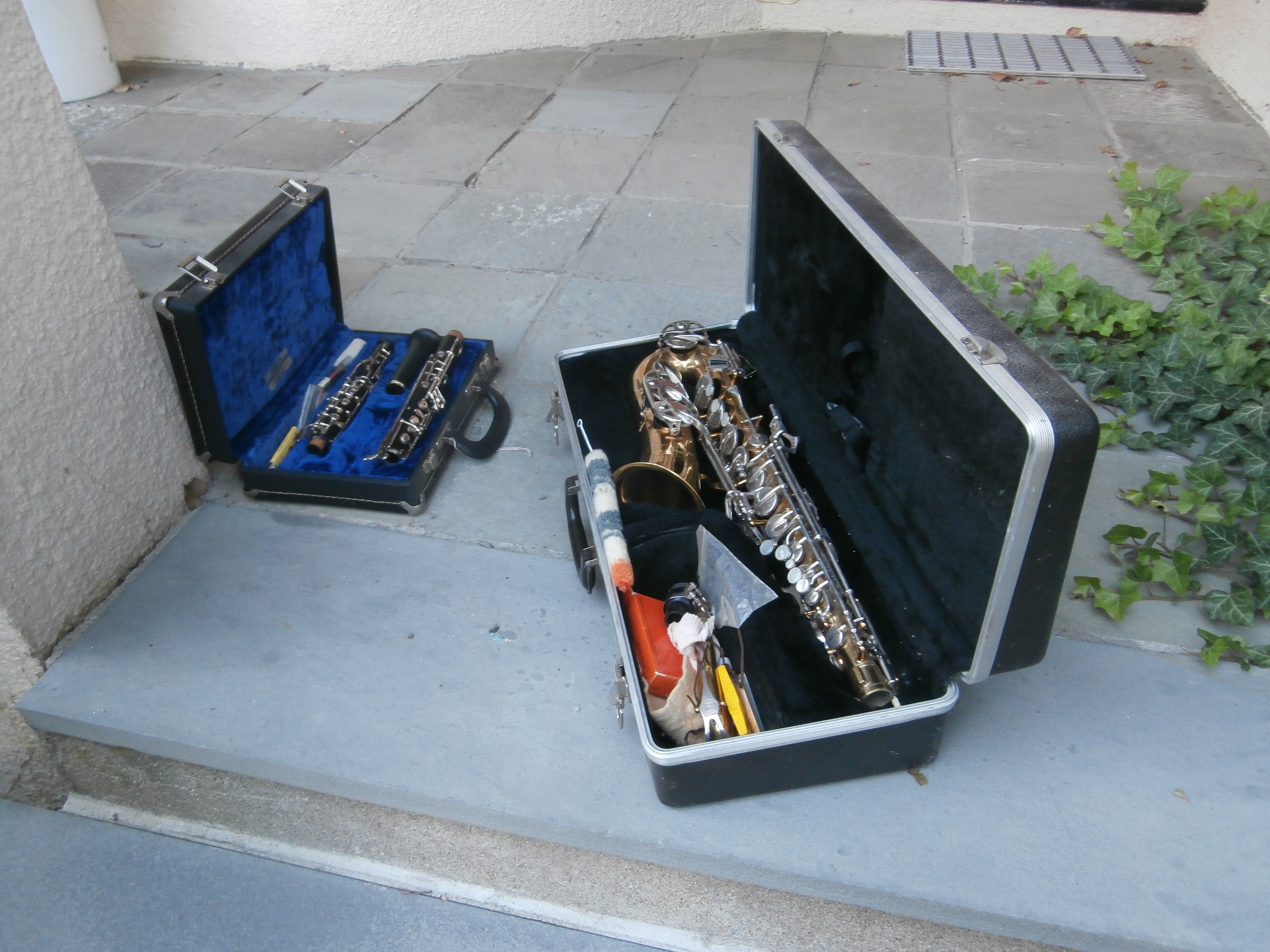
12/27/13 Update. Today I took the oboe and the alto sax below to WICN for the Worcester Public Schools music program. Now a new generation of children will play them.

school-instruments-sax=oboe

Read Full Post »

On the radio show “Living on Earth,” Bruce Gllerman interviewed Antioch education professor David Sobel recently about helping kids grow up to care about nature.

“Research shows that adults who are strong environmental stewards were allowed to explore nature unfettered as kids. …  Sobel says educators are too focused on rules and making sure that students learn correct scientific terms instead letting kids be kids. …

“SOBEL: Kids should have alone time in the woods. If it gets crazy, then there should be some adult intervention. … There needs to be a large quotient of being outdoors, in the meadows and in the woods, as well as the more didactic, pictorial experience of IMAX and National Geographic.

“GELLERMAN: So basically, take the kid kayaking.

“SOBEL: Take the kid kayaking. Take the kid berry-picking.

“GELLERMAN: Well, [with] a lot of parents — you say ‘berry-picking’ and they’ll say, ‘Oh my gosh, they’ll pick something poisonous!’ I know I take my kid mushrooming, and I tell other parents, and they look at me like ‘Oh my God, should we call the police on this guy?’

“SOBEL: Exactly. It’s fascinating how shocked and disapproving other parents are about [that] kind of behavior. … One of the things in childhood that seems to shape environmental behaviors in adulthood is parents taking their kids mushroom picking and berry picking: selecting a natural resource for consumption …

“GELLERMAN: You know, Professor, if I were asked, I could trace my environmentalism to when I was just maybe four years old. And my mother gave me a spoon, put me in the garden, and I started digging to China. Do you have a memory like that?

“SOBEL: The analogous memory that I recount is a snow day when I was about eight years old. And my friends and I decided we would play this game where they were gonna go off and I was gonna to follow them fifteen minutes later. And in the midst of tromping through waist-deep snow all by myself, my glasses were fogging up, I had one of those little epiphany moments: that I was out here, all by myself, in the snowy wilderness, and wasn’t this great! It’s a recurrent phenomenon that kids have these great moments, somewhere in early to middle childhood, that often connect them to the natural world.”

More at the website, where you also can listen to the recording of the interview.

Photo: Flickr CC/your neighborhood librarian
Walking in the woods. 

Read Full Post »

Photo: nfait.wordpress.com

New research featured at WBUR radio’s “Only a Game” suggests that frequent physical activity in school boosts learning.

“Mid-morning on Tuesday at the South Lawrence 5th Grade Academy in Lawrence, Mass., a row of students prepares to learn science more efficiently…by stepping.

“At this kind of school within a school, the daily schedule for these fifth graders includes not one physical education class, but three. The students break during the day for physical activity, which, according to Kevin Qazilbash, the school’s principal, is not to say academics are being de-emphasized.” More.

“The curriculum at the South Lawrence 5th Grade Academy is based in part on the notion that exercise improves brain function and stimulates learning. According to Dr. Majid Fotuhi, the Chairman of the Neurology Institute for Brain Health and Fitness in Baltimore, studies support the idea that exercise can improve learning efficiency for children. …

“ ‘It’s so exciting,’ Fotuhi told Bill on … Only A Game. ‘There are actual new cells that are born in the memory parts of your brain. Literally, new cells are born, this has been shown in animal studies. So exercise is the best thing for [the] brain, especially for the memory part of the brain.’ …

“Though no study prescribes a perfect amount of exercise, Fotuhi offers guidelines to parents and educators.

“ ‘My recommendation would be at least one hour a day for children who are 6-12 and for high school kids, two hours a day,’ Fotuhi said. ” More.

I myself find that walking around helps me think, and I remember my father doing that, too. He was a writer. There is something about moving around while puzzling out how to express a complicated thought that is more productive than sitting in front of a computer (or in his case, a typewriter).

Photo of Dr. Fotuhi, Johns Hopkins

Read Full Post »

She’s a mild-mannered school teacher in Pakistan — unless education for girls is threatened, and then, watch out! She’s the Burka Avenger!

Salman Masood and Declan Walsh have the story at the NY Times: “Cartoon fans in Pakistan have been excited by the arrival of the country’s first caped crusader, in the form of a female superhero who flies through the air, battling villains using pens and books.

“The heroine, Burka Avenger, is certainly an unusual role model for female empowerment in Pakistan: a woman who uses martial arts to battle colorful villains …

“But the cartoon, in which a demure schoolteacher, Jiya, transforms into the action heroine by donning a burqa, or traditional cloak, has also triggered an awkward debate about her costume.

“ ‘Is it right to take the burqa and make it look “cool” for children, to brainwash girls into thinking that a burqa gives you power instead of taking it away from you?” asked the novelist and commentator Bina Shah in a blog post.

“The criticism has not overshadowed the broader welcome that Burka Avenger, which aired [in Islamabad] for the first time on Sunday evening, has received. With slick computer animation, fast-paced action and flashes of humor that even adults can appreciate, the character could offer Pakistanis a new cultural icon akin to Wonder Woman in the United States.”

And she is generating some thoughtful discussions about the role of girls and women and the importance of education for girls.  The show’s maker, pop star Aaron Haroon Rashid, points out that the burka is merely the heroine’s disguise.

(An excellent disguise indeed, used effectively by the playwright Tony Kushner in Homebody/Kabul, about a Western woman who leaves home and disappears in Afghanistan.)

Read more about the cartoon show here.

Read Full Post »

Solving a problem by definition means making something better. But for many years, disciplinary action in schools made things worse. Now more communities are testing the potential of “restorative justice,” an approach focused on helping a perpetrator change for the better.

It was at a neighborhood picnic that I first heard from a couple neighbors that they were restorative-justice volunteers.

They told me that if a student spray paints someone’s garage, let’s say, the police get called in, and the kid may end up with a record.

Under restorative justice, however, police, perpetrator, victim, school personnel, and community volunteers hear the case and agree on suitable compensation — in this case, it might be repainting the garage. The youth sees face to face how the victim feels. Change is possible with the community involved.

Patricia Leigh Brown writes at the NY Times about a restorative justice program in Oakland, California, where a high school’s “zero tolerance” policies had ridden roughshod over underlying causes, leading to escalation of problems.

She writes about youth adviser Eric Butler, whose “mission is to help defuse grenades of conflict at Ralph J. Bunche High School, the end of the line for students with a history of getting into trouble. He is the school’s coordinator for restorative justice, a program increasingly offered in schools seeking an alternative to ‘zero tolerance’ policies like suspension and expulsion.

“The approach … encourages young people to come up with meaningful reparations for their wrongdoing while challenging them to develop empathy for one another through ‘talking circles’ led by facilitators like Mr. Butler.” More.

In one talking circle, participants discovered that a girl in trouble for uncontrolled aggression had just lost a brother to gun violence. She had not told anyone or sought support. She began to learn other ways to deal with her anger.

Photo: Jim Wilson/The New York Times
Mr. Butler with a student at Ralph J. Bunche High School in Oakland.

Read Full Post »

As a scientist with young children, Gregg often tweets ideas for engaging kids in science. Recently @gfavalora tweeted about a website with instructive and fun videos. It’s called The Kid Should See This.

The site describes the video below thus:

“To celebrate World Ocean Day 2013, director and animator Akiko McQuerrey created a Papa Cloudy stop-motion music video: Overfishing Song from Papa Cloudy’s Restaurant.

Overfishing—catching fish faster than they can reproduce—is an urgent and devastating issue, and may be the single biggest threat to ocean ecosystems… The global fishing fleet is operating at 2.5 times the sustainable level—there are simply too many boats chasing a dwindling number of fish.

“What can we do to help? With more sustainable practices, our oceans can be healthy and plentiful for everyone. Recommendations from the Monterey Bay Aquarium suggest that we select sustainable fish from restaurants and stores, and diversify the kinds of fish we eat beyond just the popular choices.

“To help make these choices easier, they created a Monterey Bay Aquarium Seafood Watch pocket guide and mobile app. They even have recipes and more information about how to solve our ocean challenges.”

More videos here.

Read Full Post »

We blogged a while back about tutoring students via distance learning. Kyle Spencer at the NY Times wrote about it here:

“Newly designed software for the tutoring of beginning readers has bridged the gap, allowing volunteers to meet students online from a distance. P.S. 55 is testing the program with students in its four first-grade classes.”

Now it turns out that remote tutoring is not the only kind of remote volunteering possible. In this article by Casey Armstrong at Shareable, we learn more about why “volunteers don’t have to be in the room anymore to physically volunteer.”

“As far as fun volunteering opportunities go, playing with kittens at an animal shelter is probably unequaled. It’s no wonder that the option to do this over the internet is a popular one. The Oregon Humane Society gives volunteers the chance to control robotic arms wielding toys for bored cats waiting to be adopted. This opportunity is not only good for the cats and volunteers, but it’s a great way to encourage donations and adoptions.

“And, if you look beyond the surface, this is more than just a stunt. It proves a concept: Volunteering can be done from anywhere by anyone if you accommodate it with the right technology. … Check out Reach-In.com if you’re interested in setting up your own robot volunteer opportunity.”

Photograph: Librado Romero/The New York Times
Edward Muñoz, a first grader at P.S. 55 in the Bronx, works out tricky words with Jenny Chan, his tutor in Midtown Manhattan.

Read Full Post »

This weekend, having spent special time with both grandsons and a brand-new granddaughter, I have been pretty aware of how much promise children hold.

Not just my grandchildren. All children.

But sometimes children who live in poverty need a boost from the rest of us. Kind of like at christenings when everyone in the congregation says they will help the baby learn and grow even though they don’t know the baby’s family and may not see them again. It’s a symbol that people take all children seriously.

At the Chronicle of Philanthropy, Suzanne Perry writes about the Washington, DC, version of the federal Promise Neighborhoods initiative that takes the nation’s responsibility toward children very seriously.

“The D.C. Promise Neighborhood Initiative, one of the country’s premier efforts to lift children out of poverty by offering a comprehensive array of educational and social services, has won a five-year, $25-million federal grant to step up its work.

“The grant, one of just seven of its kind that the Education Department awarded last month, was an especially sweet victory for the Washington project, which is working to turn around the city’s Parkside-Kenilworth neighborhood. Last year, it failed to win a similar award because it missed the application deadline due to technical problems it faced when e-mailing its proposal.

“This time, the group’s leaders left no stone unturned to ensure the application met all of the federal agency’s specifications, says Ayris Scales, the executive director—who now calls the project ‘the comeback kid’ and says she feels like ‘Cinderella at the ball.’

“The Washington effort is among dozens across the country that are following an approach pioneered by Geoffrey Canada, founder of Harlem Children’s Zone, which involves marshaling schools, nonprofits, and other community organizations to help children in troubled neighborhoods from ‘cradle to college.’ ” More.

By the way, I blogged about Geoffrey Canada and the movie on Harlem Children’s Zone, Waiting for Superman, a couple years ago, here.

Photograph: Cliff Owen/AP/File
A three-year-old pre-kindergarten student practices drawing spirals during a class at Powell Elementary School in Washington, DC. The DC Promise Neighborhood Initiative offers ‘cradle to college’ help to children in the nation’s capital.

Read Full Post »

Photograph: Melanie Stetson Freeman/Christian Science Monitor
Eric Schwarz, chief executive of Citizen Schools, advocates ideas such as an extended day, hands-on learning, and adult mentors in classrooms.

At work, we have a relationship with an after-school enrichment organization called Citizen Schools. One day a teacher brought in a Citizen Schools group for a special event that my friend Lillian and I attended.

At the end of the program I said to Lillian, “Do you see that girl second from left? Don’t we know her?” And then we both realized the sixth grader had the previous year been in a reading-enrichment program where we volunteer.

It makes you think. There are young people in urban public schools who understand the importance of education and will grab every opportunity they can get.

But about Citizen Schools: “Eric Schwarz is remaking public education in the United States using a simple formula: Extend the school day, give kids adult mentors, and let them get their hands dirty,” writes Gregory Lamb at the Christian Science Monitor.

“The program, called Citizen Schools, has succeeded so well that Mr. Schwarz has been invited to the White House to explain how it works ..

“Now at work in 14 US inner-city school districts and on one Indian reservation, Citizen Schools is seen as a model for making dramatic improvements at low-performing schools. To do that it partners not only with AmeriCorps, the quasi-governmental service organization, but with some of the biggest names in US business …

“The idea is to level the playing field for students who grow up in low-income households.

” ‘In this country we have a growing achievement gap based on family income. It’s actually a bigger gap than it was 50 years ago,’ Schwarz says in an interview at the Citizen Schools headquarters in a renovated brick building on Boston’s waterfront, just one pier away from the replica of the historical Boston Tea Party ship. ‘The reason, I think, is not that poor kids are learning less, but that rich kids are learning more because their families are giving them all these opportunities to get violin lessons, go to robotics camp, get extra coaching and tutoring, and have lots of chances to be [around] successful adults.

” ‘Those opportunities are incredibly unequally provided in our society, and Citizen Schools changes that.’ ”

More.

Read Full Post »

Erik’s mother saw yesterday’s post on poetry slams and sent this.

“I do not know if you are aware of a competition held in England in April for young people 14-18 years old who recite poems by heart. You can read about it on www.poetrybyheart.org.uk. I found out about it when I read a Swedish newspaper where they suggested it would be good if they had this type of competition in Swedish schools too.”

When I was in school, we were obliged to memorize both poetry and Bible verses. I still remember poems and verses going back decades, even some lines in French. The trend away from any sort of “rote learning” has an unfortunate side.

Having beautiful words and cadences in your head can help you so much with your writing. (It also helps when you are standing in a long line with nothing interesting to think about.) Educators threw out the baby with the bathwater when they decided kids should understand, not just memorize, historical facts, science, and math. Understanding is good, and sometimes it comes from memorization.

I’m going to reuse a funny little poetry recitation that I posted once before. Jim Clark, Poetry Reincarnations, copyrighted the animation and explains it on YouTube.

Read Full Post »

I’m not sure where I first read about Studio H, but I think you will be interested in this high school that engages students in hands-on construction from design to delivery.

The website explains: “Studio H is a public high school design/build curriculum that sparks community development through real-world, built projects. Originally launched in rural Bertie County, North Carolina, Studio H is now based at REALM Charter School in Berkeley, CA.

“By learning through a design sensibility, applied core subjects, and industry-relevant construction skills, students develop the creative capital, critical thinking, and citizenship necessary for their own success and for the future of their communities.

“Over the course of one semester, students earn high school credit and have the opportunity to design, prototype, and build a full-scale community project. Our students have designed and built some crazy chicken coops for families in need, and a 2,000-square-foot farmers market pavilion.”

More here.

Photographs: http://www.studio-h.org

Read Full Post »

Catch this story on National Public Radio today?

Jake Scott, a math teacher and wrestling coach in Silver Spring, Maryland, draws students in with clever ways to memorize formulas.

“Keeping control of the class is one thing, but holding their attention through complicated calculations and theorems is another challenge altogether. So Scott gets a little extra help from his alter ego, 2 Pi.

“About three years ago, Scott started infusing rap into his lessons.”

He describes to NPR’s David Greene his early lack of success in school, his time on the streets, the help he received from taking up wrestling, and the reasons he eventually got into math.

” ‘You know, when my dad lost his sight, I started doing accounting for him, and math was the one area that I was able to succeed in,’ Scott says. ‘Because of my time in the streets, my vocabulary wasn’t very extensive, and so I shied away from English. I was bored to death by history. Math, on the other hand — I didn’t need to know how to speak well in order to do well in math, so that was very helpful, when I look back. It helped me to grow in my appreciation for numbers.’

“Scott says that one of his most important goals as a teacher is to make meaningful connections with his students. This drive to connect with the kids in his classroom influenced him to begin rapping as 2 Pi.

” ‘I mean, I think that we can preach to kids until they turn blue and we turn blue, but if there’s no connection, then there’s no response,’ Scott says. ‘I mean, I constantly search for ways to connect with students — with the language, with conversations, music.” Read more here.


Read Full Post »

My husband and I like Colin Cotterill’s quirky mystery books about Dr. Siri Palboun of Laos. The series starts with The Coroner’s Lunch, in case you are interested.

Cotterill has been involved in several worthy causes in Laos, including one addressing the abysmal lack of children’s books in the country. You can read how he got started on his quest for children’s books, here. That work is now handled by Sasha Alyson at Big Brother Mouse, who writes:

“Do you remember the excitement of rushing home to read a book that you hoped would never end? Many Lao children have no such memories, because they’ve never seen a book that was fun or exciting to read. Some have shared textbooks; others have never seen a book at all. We sometimes have to explain how books work: ‘Look, if you turn the page, there’s more!’ ”

Big Brother Mouse is a “Lao-based, Lao-owned project.” More.

Cotterill also works with http://www.copelaos.org to help victims of land mines left over from the CIA’s “secret war.”

And, pointing out that more than 75 percent of children in the far north of Laos have no schools, Cotterill funds efforts to get hill tribe students into teachers colleges. More.

Art: Colin Cotterill at http://www.colincotterill.com

Read Full Post »

Here’s another nice story about using the arts to inspire kids who are turned off by school in troubled districts.

Writes Patricia Cohen at the NY Times, “Stationed in front of one of his large self-portraits, the artist Chuck Close raised his customized wheelchair to balance on two wheels, seeming to defy the laws of gravity.  The chair’s unlikely gymnastics underlined the points that Mr. Close was making to his audience, 40 seventh and eighth graders from Bridgeport, Conn.: Break the rules and use limitations to your advantage.

“The message had particular resonance for these students, and a few educators and parents, who had come by bus on Monday from Roosevelt School to the Pace Gallery in Chelsea for a private tour of Mr. Close’s show. Roosevelt, located in a community with high unemployment and crushing poverty, recently had one of the worst records of any school in the state, with 80 percent of its seventh graders testing below grade level in reading and math.

“Saved from closure by a committed band of parents, the school was one of eight around the country chosen last year to participate in Turnaround Arts, a new federally sponsored public-and-private experiment that puts the arts at the center of the curriculum.”

Read about the reactions of the students — and more at the NY Times.

Photograph: Kirsten Luce for the NY Times
The artist Chuck Close giving a private tour of his show to students from Bridgeport, Conn.

Read Full Post »

John knows a good blog topic when he sees it. This tip he gave me is about minimally invasive education, which brings learning to the poorest of the poor.

According to wikipedia, “Dr. Sugata Mitra, Chief Scientist at NIIT, is credited with the discovery of Hole-in-the-Wall [HiWEL]. As early as 1982, he had been toying with the idea of unsupervised learning and computers.

“Finally, in 1999, he decided to test his ideas in the field. On 26th January, Dr. Mitra’s team carved a ‘hole in the wall’ that separated the NIIT premises from the adjoining slum in Kalkaji, New Delhi. Through this hole, a freely accessible computer was put up for use.

“This computer proved to be an instant hit among the slum dwellers, especially the children. With no prior experience, the children learned to use the computer on their own. This prompted Dr. Mitra to propose the following hypothesis: ‘The acquisition of basic computing skills by any set of children can be achieved through incidental learning provided the learners are given access to a suitable computing facility, with entertaining and motivating content and some minimal (human) guidance.’ ”

More at Hole-in-the-Wall.com. Also at the Christian Science Monitor.

And of course, I have to say a word about the program’s appearance in Bhutan, since Suzanne loves Bhutan.

“One of the major projects that HiWEL is in the process of executing is for the Royal Government of Bhutan. The project is part of a large Indo-Bhutan project formally known as the Chiphen Rigpel (broadly meaning ‘Enabling a society, Empowering a nation’). Chiphen Rigpel is an ambitious project designed to empower Bhutan to become a Knowledge-based society.” Read more.

Photograph: HiWEL
Playground Learning Stations in Dewathang Gewog of Samdrup Jongkhar District in Eastern Bhutan.

Read Full Post »

« Newer Posts - Older Posts »