Feeds:
Posts
Comments

Posts Tagged ‘education’

Shawn and Laura Sears were touched by inner-city kids with too many strikes against them and invited a few for an outdoor camping experience. The outing was so satisfying all around that they just kept doing it.

Marilyn Jones has the story at the Christian Science Monitor.

“Leaving college with liberal arts degrees – his in psychology, hers in geology – Shawn and Laura applied to Teach for America and were eventually placed to teach in one of the poorest regions in the country.

“Today, celebrating 14 years together (getting married along the way in 2004), they’ve seen the seeds sown during their experiences in Mississippi grow to fruition in the founding of Vida Verde Nature Education, a nonprofit outdoor education camp they’ve now run for 11 years.

“Located on northern California’s spectacular coast between San Francisco and Santa Cruz, this free camp for children from low-income families has served more than 7,000 kids from the inner cities of Oakland, East Palo Alto, San Francisco, and San Jose.

” ‘We help them let go of much of the negativity they often carry,’ Shawn says. ‘It’s nonstop fun, and they get to just be kids for a few days. Three days later, they’re transformed.’ ”

Read more.

Tony Avelar/Special to the Christian Science Monitor
Laura and Shawn Sears founded Vida Verde to give groups of students three days of exposure to and hands-on experience in the outdoors.

Read Full Post »

Paul Tough has written a book arguing that developing character is more critical to a child’s future success than IQ.

National Public Radio has the story: “Tough explores this idea in his new book, How Children Succeed: Grit, Curiosity and the Hidden Power of Character.

” ‘For some people, [the] path to college is so easy that they can get out into life and they’ve never really been challenged,’ he tells NPR’s David Greene. ‘I think they get into their 20s and 30s and they really feel lost — they feel like they never had those character-building experiences as adolescents, as kids, that really make a difference when they get to adulthood.’

“That wasn’t true for the teenagers Tough met during the time he spent in some of Chicago’s roughest neighborhoods. There, he worked with teenagers overcoming unimaginable challenges. One young woman …  was getting into fights in school and was on the verge of dropping out. But then she entered an intensive mentoring program that changed her life.

” ‘She made it through high school, overcame a lot of obstacles and now is getting a cosmetology degree,’ Tough says. ‘For some people, that wouldn’t be a huge success. But for her, she overcame obstacles that won’t only set her on a path for material success, but also psychological success.’

“The difference-maker really depends on the person, Tough says. Mentoring programs that focus on goal-setting can be helpful, and he also says parents should try to help their kids manage stress from a very early age.”

Do you agree with this? Overcoming obstacles is important, but the obstacles that some of the students Tough met were so severe, I can’t help wondering if the consequences have yet to play out. I’m for kids overcoming normal, age-appropriate obstacles that are part of any life — as they say in Italy, “the things that happen to the living.”

More at NPR, here.

Read Full Post »

Ashoka, which defines itself as “a global organization that identifies and invests in leading social entrepreneurs,” has a blog called Changemakers that might interest readers. The March 26 post is on teaching and empathy.

Nora Cobo at the Center for Inspired Teaching writes, “While test-based assessments are essential, they reflect only one type of data and one kind of skill that students need. Schools must also focus on students’ social-emotional growth in order to create sound learning environments. Such settings help students develop interpersonal competence and improve short- and long-term academic and personal outcomes.

“Center for Inspired Teaching partners with teachers to change the school experience for students to include these critical skills. … Instead of looking at students’ behavior as something to be corrected, we train teachers to look at students’ behavior in terms of unmet needs. In particular, we ask teachers to consider students’ needs for Autonomy, Belonging, Competence, Developmental appropriateness, and Engagement — the ABCDE of learners’ needs.

“For example, a teacher may encounter a student who repeatedly gets frustrated and leaves his seat to chat with classmates when he encounters a complicated geometry problem. Rather than assuming the student has a bad attitude, the teacher strives to figure out which of the student’s needs is not being met. The teacher may discover that the student learns best when physically engaged – and offer him the option to tackle the equation by measuring distances by walking.

“Similarly, a teacher may find a student who refuses to work in a group setting, saying she just prefers to work alone. In examining the student’s unmet needs, that teacher may discover that the student longs for more autonomy with her work – and empower that student to create on her own.

“The teacher may discover, upon further engaging her skills of empathy, that other members of the group aren’t treating the student kindly, and therefore the student’s need for belonging is not being met when classroom groups are self-selected. …

“Placing empathy at the core of teachers’ practice ensures that students learn how to think, not just what to think – and go beyond covering the curriculum to learn the skills they need in order to thrive.”

More here.

Photograph: Kate Samp, Strategies for Children

Read Full Post »

When I worked with Denise at a certain hyped management magazine, I always knew she had better things in her than the tasks she was given there.

Moreover, she was the most sensible 25-year-old I had ever met. After moving on to better jobs, including writing for teens at Scholastic, she turned to the hardest and most important work in the world. And on the whole, it seems to suit her.

But nothing can stop the itch to write. Here she shares the joy and frustration of reading repetitive stories to book-hungry kids:

“Nothing brings me more joy than knowing how much my 5-year-old son, Isaiah, looks forward to sitting in our rocking chair while I read him books at bedtime. And my heart swells with love whenever my 2-year-old twins, Joel and Nina, bring me books and say, ‘Read book, please.’

“But, holy moly, I’ve run into a very serious problem. While Isaiah can enjoy a variety of different stories, the twins are all about sameness. Even though I rotate their books constantly so we’re not reading the same ones every week, the repetitiveness of reading these books is driving me crazy.

“I’m sure many parents are familiar with the rhythm and rhyme scheme of many children’s board books, ‘Bend and reach, touch your toes. Now stand up straight and touch your nose!’ Lately, I’ve been adding a few colorful rhymes in my head as I read these books to the twins. ‘Clap your hands, then point to your shoes, reading this book is driving me to booze!’ ” Read more.

(I admit I felt the same way about Richard Scarry. The pictures were darling, but the words, not so, even if I did let “five-seater pencil car” become part of my vocabulary.)

For a mom with twins, it is must be twice as much “bend, reach, touch your toes,” but for sure these kids will grow up to be readers.

This is Denise with one of her three book mavens.

Read Full Post »

Did you catch the story today about the young boy whose composition was performed by the New York Philharmonic?

At the National Public Radio site, Jeff Lunden writes: “What would it be like if you were 10 years old and composed a piece of music that was played by the New York Philharmonic? For a few New York City school kids, including one fifth-grader, it’s a dream come true, thanks to the orchestra’s Very Young Composers program.

“Composer Jon Deak, who played bass with the New York Philharmonic for more than 40 years, says the idea for Very Young Composers came when he and conductor Marin Alsop visited an elementary school in Brooklyn several years ago.”

Now every year, “72 lucky kids in six New York area schools participate in this free after-school program. …

” ‘The kids are not chosen for being musical geniuses,’ [the Philharmonic’s director of education, Theodore] Wiprud says. ‘The guidelines we give the schools, in trying to identify some fourth- and fifth-graders for the program, is that they be kids for whom this could make a difference. Whether or not they study an instrument is not necessarily a good predictor of whether they’re going to do something creative in music.’ …

” ‘Some of these kids have trouble locating middle C on a piano,’ Deak says. ‘Does that mean they can’t compose music of depth? No. What do they have to do? They have to hum it for us, sing, whistle, tap the rhythms — even if they can’t notate them — and we get their piece.’

“As [teaching artist and composer Daniel] Felsenfeld puts it, ‘The most important thing about this class is that you never, ever, ever write their music for them — not even a little.’ ”

I’m hearing a refrain from yesterday’s post: all children have music in them and you should just let it flower.

Read more and listen to the performance of young Milo Poniewozik’s composition at NPR.

Photograph of student Milo Poniewozik and the New York Philharmonic: Michael DiVito

Read Full Post »

I’ve been meaning to blog about the wildly successful music-education program out of Venezuela, El Sistema.

Here music critic Mark Swed follows the L.A. Philharmonic to Caracas and writes about El Sistema for the Los Angeles Times.

“Musically, Venezuela is like no other place on Earth. Along with baseball and beauty pageants, classical music is one of the country’s greatest passions.

“In the capital, Caracas, superstar Venezuelan conductor Gustavo Dudamel is mobbed wherever he goes. Classical music teeny-boppers run up to him for autographs when he walks off the podium at concerts. The state-run music education program, which is known as El Sistema and from which Dudamel emerged, is the most extensive, admired and increasingly imitated in the world. One of its nearly 300 music schools for children, or núcleos, is deep in the Venezuelan Amazon, reachable only by boat. …

“The basic tenet of José Antonio Abreu, the revered founder of El Sistema, is the universal aspect of music. He likes to say that music is a human right. That’s an effective, politically expedient slogan. But what he has demonstrated on a greater scale than ever before is that music is not so much a right as a given. El Sistema is not about talent, ingeniously effective system though it may be for discovering and fostering musical talent. The truly revolutionary aspect of El Sistema is its proof that everyone has a capacity for music.”

Read about how El Sistema has spread worldwide in the Los Angeles Times.

Children at La Rinconada in Caracas, Venezuela, Feb. 14, 2012. Gustavo Dudamel, right, among students at a showcase of El Sistema in Caracas, Venezuela, Feb. 15. Photograph: Mark Swed / Los Angeles Times

Read Full Post »

I’m fascinated by the many ways the Internet has enabled broader support for worthy causes. I’ve blogged about Kickstarter, for example, “a funding platform for creative projects.” Through Kickstarter, friends and other well-wishers can help fund a documentary, an art installation, or a book publication within a designated time frame. Magic can happen, often with only small donations that add up.

Today OFH_John tweeted about something similar for schools, Donors Choose. Donors Choose calls itself “an online charity connecting you to classrooms in need.” You can search for projects in your local area, projects that have special meaning to you, and projects that might let your company offer special expertise.

John’s company has optical expertise and jumped on a need at a District of Columbia school, where an applied science project on light called for optical gear. Read about that here.

If you are seeking to help impoverished schools in particular, you may look for the “high poverty” rating at Donors Choose. School needs of all sorts are listed here.

Photograph: DonorsChoose.org

Read Full Post »

Amusing validation for folks who think standardized testing has gone too far.

“A reading passage included [last] week in one of New York’s standardized English tests,” writes Anemona Hartocollis in the NY Times, “has become the talk of the eighth grade, with students walking around saying, ‘Pineapples don’t have sleeves,’ as if it were the code for admission to a secret society.

“The passage is a parody of the tortoise and the hare story, the Aesop’s fable that almost every child learns in elementary school. Only instead of a tortoise, the hare races a talking pineapple.”

Apparently, the test questions were so nonsensical, the kids are still scratching their heads. “And by Friday afternoon, the state education commissioner had decided that the questions would not count in students’ official scores.”

Have a chuckle here.

[We interrupt this broadcast for the baby to chew on my knuckle while his mother tries to get some stuff done,]


Read Full Post »

I was interested in an article in today’s NY Times about a school that gives chronically failing students another chance. It succeeds against all odds, but success is a slow process. New York’s mayor is not a fan, because many kids take six years to graduate.

Aniah McAllister, once a lost and wandering soul, has one of the happier stories. Reporter Michael Powell writes that she seems amazed to have earned 46 credits and to be headed to college.

“ ‘This school made realize,’ she says, ‘that I am much better than I thought I was.’

“That’s a pretty fair bottom line for any school,” writes Powell, “although in the up-is-down world of public education in New York, it might just be an epitaph for this small marvel of a high school. Known as a transfer high school, Bushwick Community admits only those teenagers who have failed elsewhere. Most students enter at age 17 or 18, and most have fewer than 10 credits.

“You can muck around quite a bit trying to find someone who has walked the school’s corridors, talked to its students and faculty, and come away unmoved. Most sound like Kathleen M. Cashin, a member of the State Board of Regents and a former superintendent. ‘They care for the neediest with love and rigor,’ she said. ‘They are a tribute to public education.’ ”

Read the article. I’m hoping it will have an influence on the policymakers and let an initiative that sounds so positive keep going.

Aniah McAllister, left, Justin Soto and Kassandra Barrientos attend Bushwick Community High School. Photograph: Kirsten Luce, NY Times

Read Full Post »

Don’t you love “secret benefactor” stories? You remember, of course, that in Great Expectations Pip was convinced Miss Havisham was his secret benefactor. (Spoiler alert! she wasn’t.)

A similar theme is found in Frances Hodgson Burnett‘s A Little Princess, about a much-abused but uncomplaining orphan who one day trudges the weary steps to her bare-bones garret and discovers a magical world of comfort has been created for her.

In 1912, the American writer Jean Webster wrote an epistolary novel in the same vein, Daddy LongLegs. It’s about a poor girl in an orphanage whose little essays capture the attention of a man on the orphanage board. He doesn’t like girls and wants nothing to do with her other than to send her to college anonymously and see if she can be a success. He keeps tabs by reading letters he has required her to write every month.

Well, you can imagine …

The book was hugely popular in its day and has been made into all manner of anime and films, including one with Shirley Temple and one with Fred Astaire ( both of which have snippets on YouTube and seem to be in pure gag-me-with-a-spoon territory).

Last night we saw a musical version of Daddy LongLegs at the Merrimack Rep and liked it very much. Some might find it too epistolary for the stage or too sweet for 2012, but it wasn’t Shirley Temple and the audience was crazy for it.

John Caird, famous in part for the Royal Shakespeare Theater’s Nicholas Nickleby, wrote the book and directed. Paul Gordon wrote the music and lyrics. Megan McGinnis was the orphan, and Rob Hancock was the benefactor she assumed to be 83 and bald. (Spoiler alert! he isn’t.)

What was surprising was the strong feminist and socialist vibe, which the program notes explain were characteristic of the author. “Webster was actively involved in remedying the plight of the impoverished, not only from a financial standpoint, but from a cultural standpoint as well.” She believed that no matter what the poor had missed out on in their early years (we discussed that here), many could succeed if just given a chance.

Read Full Post »

A while back I watched the movie The Little Red Truck, a documentary by producer Pam Voth and director Rob Whitehair highlighting the work of the Missoula Children’s Theatre. It was a moving experience.

The Missoula (Montana) Children’s Theatre travels by truck from city to city all over America to put on productions with children in low-income urban and rural areas. The transformation of some of these children in the week it takes to produce a full-scale, one-hour musical is something to see, with many insecure children discovering talents that no one, including the children themselves, knew they had.

For kids who have never seen a play and have no place to rehearse — nor any props or costumes or sets other than what the theater company can pack into the truck —  putting on a production seems unimaginable.

As the movie unfolds, you see how doing the unimaginable builds self-confidence, and generates both laughter and ideas about possible futures. It’s not about growing up to be actors. It’s about seeing that there are options, and starting to think differently.

And in case anyone is more interested in the academic skills boosted through theater, this Education Week article makes that case. Not a bad case to be made, but it’s the magic of Queen Mab that speaks to me.

Read Full Post »

A reason that poor children are sometimes unprepared for school is that the words they are starting to read in books may not convey meaning to them. What does it mean to park a car if you have never ridden in a car?

The NY Times has a lovely article about one NYC school’s unusual field trips, designed to fill some gaps in knowledge that textbook writers take for granted.

Michael Winerip writes, “Experiences that are routine in middle-class homes are not for P.S. 142 children. When Dao Krings, a second-grade teacher, asked her students recently how many had never been inside a car, several, including Tyler Rodriguez, raised their hands. ‘I’ve been inside a bus,’ Tyler said. ‘Does that count?’

“When a new shipment of books arrives, Rhonda Levy, the principal, frets. Reading with comprehension assumes a shared prior knowledge, and cars are not the only gap at P.S. 142. Many of the children have never been to a zoo or to New Jersey. Some think the emergency room of New York Downtown Hospital is the doctor’s office. …

“Working with Renée Dinnerstein, an early childhood specialist, [Ms. Levy] has made real life experiences the center of academic lessons, in hopes of improving reading and math skills by broadening children’s frames of reference.

“The goal is to make learning more fun for younger children. … While many schools have removed stations for play from kindergarten, Ms. Levy has added them in first and second grades. [And] several times a month they take what are known as field trips to the sidewalk. In early February the second graders went around the block to study Muni-Meters and parking signs. They learned new vocabulary words, like ‘parking,’ ‘violations’ and ‘bureau.’ JenLee Zhong calculated that if Ms. Krings put 50 cents in the Muni-Meter and could park for 10 minutes, for 40 minutes she would have to put in $2. They discovered that a sign that says ‘No Standing Any Time’ is not intended for kids like them on the sidewalk.” Read more.

One thinks of all the small daily interactions one has with one’s own children and the learning occurring without forethought. There are interactions and learning in poor families, too, but if the words and concepts are not what they kids will encounter in school, I think these excursions can be very helpful.

Photograph: Librado Romero, NY Times

Read Full Post »

Central Falls, Rhode Island, may be best known today for going bankrupt and forcing its police and fire unions to accept cuts to pension benefits, but it has more going for it than angst.

It has people who care, like Mike Ritz and chocolatier Andrew Shotts, who are selling Chocolateville chocolate bars to help children at risk.

It also has a charter school that has quietly improved children’s reading skills, spreading its success to public schools in the city.

Joe Nocera writes in the NY Times that before starting The Learning Community in Central Falls, Meg O’Leary and Sarah Friedman “spent three years working with the Providence school system on a pilot program designed to come up with ways to ‘transform teaching practices and improve outcomes.’ ”

In 2007, when Frances Gallo became the Central Falls Schools superintendent, she began to investigate why families were so excited about getting into The Learning Community.

“The school drew from the same population as the public schools. It had the same relatively large class sizes. It did not screen out students with learning disabilities. Yet the percentage of students who read at or above their grade level was significantly higher than the public school students. When Gallo asked O’Leary and Friedman if they would apply their methods to the public schools, they jumped at it.

“ ‘At first it was, “Oh, here comes another initiative,” ‘ recalls Friedman. There were plenty of venting sessions at the beginning, along with both resentment and resistance. But The Learning Community invited the teachers to visit its classrooms, where the public school teachers saw the same thing Gallo had seen. And very quickly they also began to see results.”

Read about how they do it here.

Read Full Post »

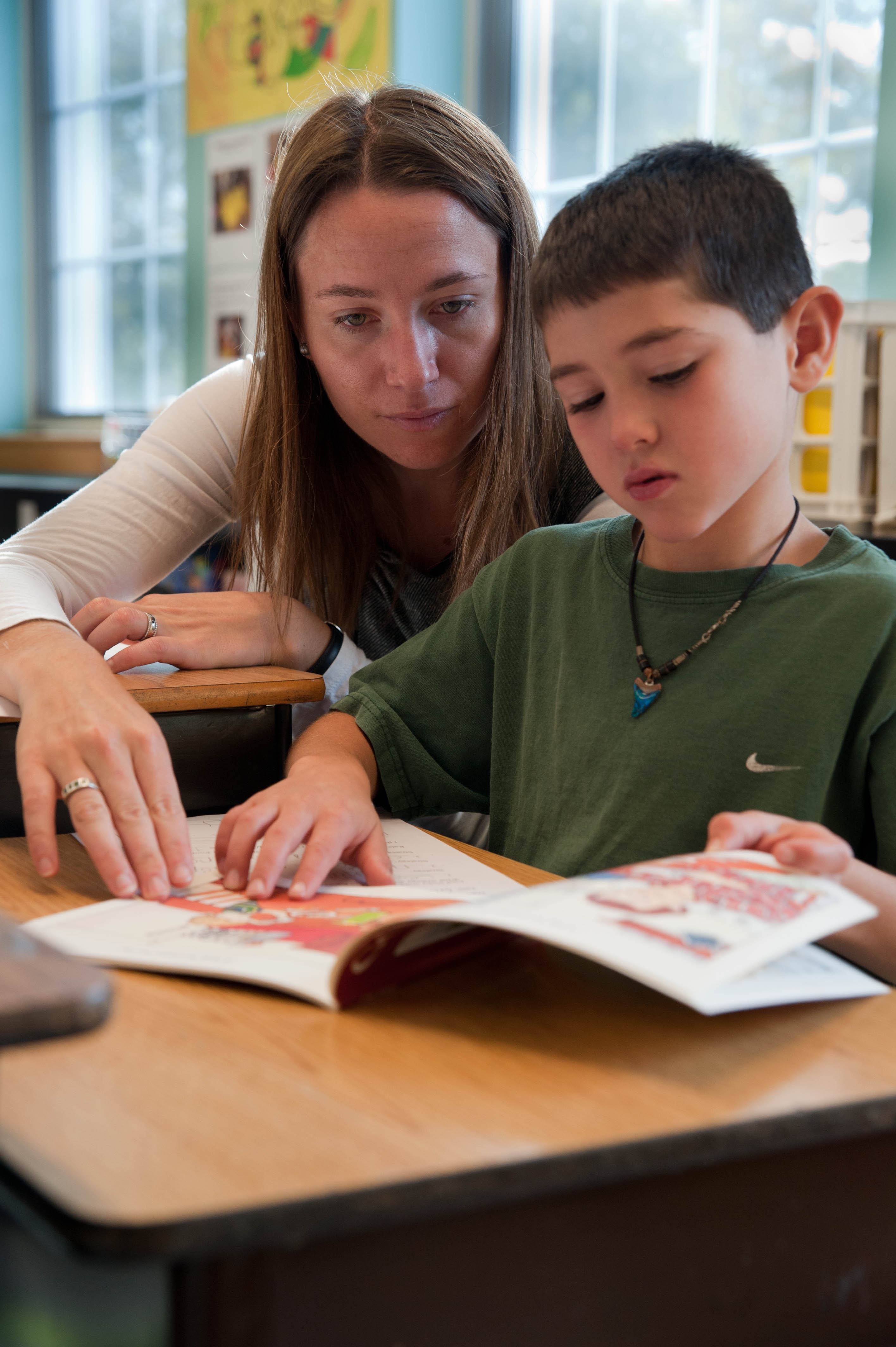
People where I work have been volunteering in an inner-city school for years. It started with reading picture books to first graders and expanded to second grade reading, fourth grade math, and fifth grade “Book Club,” the one I do. I once taught fifth grade, and I would still read the books written for that age even if I weren’t volunteering in the school.

This past week, the NY Times had an interesting article on using technology to enable tutors to work with elementary school kids remotely.

“Edward’s tutor was not in the classroom. His school, a 20-minute walk from the nearest subway stop in a crime-plagued neighborhood, has long had trouble finding tutors willing to visit. ‘It is hard to get anyone to volunteer,’ said the school’s principal, Luis Torres, who sometimes cancels fire drills because of the gunfire he hears outside.

“Now, newly designed software for the tutoring of beginning readers has bridged the gap, allowing volunteers to meet students online from a distance. P.S. 55 is testing the program with students in its four first-grade classes.

“Edward’s tutor, Jenny Chan, was an hour away in Midtown, on a bustling trading floor at JPMorgan Chase, where she provides technology support. She was talking to Edward by phone and seeing the story he was reading with screen-sharing software on her desktop computer.

“JPMorgan Chase is sponsoring the remote tutoring program and encouraging its employees to get involved from their desks during the school day.” Read more.

There’s nothing like face-to-face contact, but if people can’t take work time for the commute, perhaps more people will tutor.

Photo: Librado Romero, NY Times

Read Full Post »

We found a letter with a return envelope in a recent issue of our newspaper. The envelope wasn’t for a tip.

The newspaper delivery man was telling us, and his 629 other customers, a bit about himself and his work situation and asking how early we needed our papers.  He said that the delivery service for seven national and local papers was changing. Some some clients had always wanted their paper delivered before 5:30, but he was hoping people would let him know who could wait until 6:15. He told us he makes 7-1/2 cents per household. (I think there’s a song about 7-1/2 cents from the musical Pajama Game.) He referenced the cost of gasoline and car maintenance.

And then he told a story that is very common for generations of immigrants and Puerto Ricans (who are, of course, citizens but come to the mainland to provide a better life for their children).

“I am father to four children who are 11. 10, 6, and 4 … My wife and I decided to move to the Untied States 4 years ago finding a better quality of life for our family. I obtained my degree as a Licensed Electirician in Puerto Rico and my wife was a Nail Technician. When we arrived in the United States, we were faced with the hard reality that neither of our licenses were valid in the US. My wife and I decided to start our studies here, so that we can obtain once again our licenses and pursue a career in our field of study. Currently, in addition to my job as a Newspaper Delivery, I go to school every night — Monday through Thursday — and I have a second job, right after I finish newspaper delivery, as an electrician assistant, while my wife is both taking care of the children, and working as a Housekeeper at St Patrick Parish.

“Together, with hard work and dedication, we are able to cover all the expenses that come our way. We want to ensure that our children will learn by example to work hard to become self-sufficient and independent … . We hope God will provide us with good health and strength to be able to work each day so that our dreams can became a reality.”

Needless to say, I wrote him and said no hurry on the paper. My husband thought the letter really embodied what the season was about.

(I am always grateful for our comments. and if you tweet, consider following us @LunaStellaBlog1 on twitter.)

Read Full Post »

« Newer Posts - Older Posts »