Feeds:
Posts
Comments

Posts Tagged ‘environment’

Photo: Linda Barrett.
The Chicago River, once badly polluted, has been cleaned up. Above, 265 swimmers participated in a public swim this year.

When humans make up their minds to do something, miracles can happen. Remember the river that caught fire and led to the Clean Water Act? Today’s article points to a more recent river success.

The environmental radio show Living on Earth reports that “on September 21st, hundreds of people leapt into the Chicago River for the first public swimming event since 1927.” Here’s an interview between Friends of the Chicago River Executive Director Margaret Frisbie and Aynsley O’Neill of Living on Earth. (I edited out the verbal pauses.)

Aynsley O’Neill
“This public swimming event was a fundraiser, but its impact actually goes even further than that. What does it mean to you to have public swimming in the Chicago River for the first time in nearly 100 years?

Margaret Frisbie
” ‘I was a magical day that’s hard to describe, seeing hundreds of people in the water swimming so joyfully, really represented all the work that Friends of the Chicago River and so many organizations and agencies have done to improve the health of the river, not only for people, but for wildlife too. The morning of the swim, people just were beyond thrilled. People were watching from the bridges. They were watching from the Riverwalk. … For people who’ve lived here a long time, I think it’s a game-changer. Seeing people in the water makes you believe that it’s possible. …

“We had Olympic athletes. We had … Becca Mann, who’s an Olympic athlete who swims 10Ks in open water, which is really impressive and amazing. She got out and she was just beside herself, and she said, I cannot wait to come back to Chicago and do this again. …

O’Neill
“Give us a sense of the difference between maybe now and maybe 50 years ago in terms of sewage spills into the river.

Frisbie
“When friends of the Chicago River was founded in 1979, on average, there was sewage in the river every three days. Fast Forward 46 years, and basically there’s never sewage in the river ever. …

“The one thing that’s always fun for us to talk about at Friends of the Chicago River is how alive the river is and how different it is. .. We’re seeing our aquatic animal life going up, and that’s because of the work of Friends of the Chicago River, the Metropolitan Water Reclamation District, the forest preserves at Cook County and so many partners. In the 1970s, when friends was founded, there were less than 10 species of fish in the river system. Now there’s nearly 80, and we have beavers and muskrats and turtles, and we’re seeing the return of river otters, who are really an excellent sign of river health, because they depend on clean water to keep their coats clean and their bodies healthy, and then they’re also dependent upon mussels and fish and other aquatic and macro invertebrates to eat. …

O’Neill
“For those who are unfamiliar, how did we get here? …

Frisbie
“Over the last 50 years, Friends of the Chicago River has been chipping away at both the actual water quality through advocating for cleaning up the river system, but also by using the Clean Water Act and building support for a river that was swimmable. And so the water quality has changed since 1979 when we were founded, bit by bit, you know, using the rules of the Clean Water Act and partnering with government agencies like the Metropolitan Water Reclamation District that dug a huge tunnel and reservoir system that’s virtually eliminated sewage from the river system, and then also disinfecting sewage affluent that goes to the river, and just also creating public access so people can get down to and in the water.

O’Neill
“How much of this was from a government level versus a volunteer level? How did that work?

Frisbie
“[It] really it takes both. The Tunnel and Reservoir Plan is 110 miles of tunnel, three enormous reservoirs that can store 17 billion gallons of sewage and storm water and industrial waste. However, it’s not just about building it; it’s having support for that system and also making sure that the government agencies who are working on it are on task, and making sure that they’re getting the work done. … Advocates encouraged and pushed a long way. So while we partner with this agency, the Metropolitan Water Reclamation District, on many, many programs, we also were engaged with forcing a permit that included an enforceable deadline of 2029 so they have to be done and wrap up the project and not say, hey, we ran out of money, we just can’t finish it yet. …

O’Neill
“What would you consider the biggest challenge during this process of cleaning up the Chicago River?

Frisbie
“People got used to the river systems being a place where sewage and waste could go, as opposed to we’re on the shores of Lake Michigan, which everyone fights for. …

“The river comes to us. It flows through communities. It’s a community connector, and it provides access to nature for people who live in an urban area. We also know that with the impact of the climate crisis, heat is the number one killer, and it is incumbent upon all of us to take seriously the fact that people need public open space where they can go and they can get away from the heat. … We know that nature actually improves public health, and, you know, mental wellness. So it plays so many, many, many roles. And then also we have major biodiversity loss, and cities can play a role in protecting biodiversity. … We are getting massive amounts of migratory animals, birds, bats, insects, and they depend on natural areas, and so it’s really important for that too. …

O’Neill
“For many of us, we might hear about the Chicago River once a year, St. Patrick’s Day, when it gets dyed green. What do you think about this tradition? …

Frisbie
“At Friends of the Chicago River, we think that we have outgrown that tradition. It’s really a fun morning. It builds community. … But we think a river that’s alive with wildlife really needs to be treated like a natural resource.”

More at Living on Earth, here.

Read Full Post »

Photo: Suzanne Kreiter/Globe Staff.
Lacey Kohler, Urban Greening Projects co-ordinator and Cristiane Caro, cofounder of Pearl Street Garden Collective, worked in the new microforest in Providence, Rhode Island.

I have posted a lot about Miyawaki urban forests in Massachusetts, thanks to my friend Jean (Biodiversity Builders), who showed me several she’s helped to create. I didn’t know that similar work was afoot in nearby Rhode Island.

These efforts are all about what a dense little forest can give to a city neighborhood where there’s very little nature left. It can remove dangerous carbon from the atmosphere while spreading biodiversity all around, making the city a healthier place for both humans and critters.

Ed Fitzpatrick reports on the Rhode Island venture at the Boston Globe, “The asphalt grid of South Providence is lined with multifamily homes and concrete sidewalks. But along Pearl Street, one lot stands out.

“It’s lush and green, with nearly 270 trees packed into a 1,000-square-foot lot. Officially called the Pearl Street Garden, it contains a tiny forest in the middle of the urban jungle.

“ ‘Microforests’ like this one are cropping up in places ranging from Elizabeth, N.J., to Cambridge, Mass., to Pakistan. South Providence has two, both along Pearl Street, created by Groundwork Rhode Island and the Pearl Street Garden Collective. …

“ ‘This isn’t habitat restoration on the scale that is needed in terms of the world,’ said Jacq Hall, director of special projects at Groundwork Rhode Island … but it is a really great way, especially in a city, for people to become very in close touch with biodiversity and why it’s important and why it’s also beautiful.’

“In May, more than 100 people came out to plant the microforest. …

“The pocket forests adhere to the ‘Miyawaki method’ devised in the 1970s by Japanese botanist Akira Miyawaki, which calls for planting a wide variety of local trees in large numbers and in very tight quarters. …

“Massachusetts now has at least 20 microforests, according to Alexandra Ionescu, a Providence resident who is associate director of regenerative projects at Biodiversity for a Livable Climate, a Cambridge-based nonprofit that promotes ecosystem restoration to address climate change. …

“Rhode Island is the smallest and second most densely populated state in the nation, and a 2022 study found it contains 139 square miles of asphalt, concrete, and other hard surfaces, amounting to 13 percent of its land area. Hall said the benefits of forests and tree-lined streets are not distributed evenly in Rhode Island. …

“[Hall said], ‘We’re trying really hard to go back into those places that have been aggressively paved over and try to work in little bits of nature to bring those benefits to more people.’ …

“Hall said microforests help combat climate change because they grow so quickly. With plants packed close together, they both collaborate and compete for resources, racing to reach the sun first. She said research shows forests grown using the Miyawaki method grow 10 times faster than a traditional landscape planting. …

“Hall said projects such as this received a big boost in funding from the federal Inflation Reduction Act of 2022. ‘It was a historic moment,’ she said. …

“Groundwork Rhode Island and the Pearl Street Garden Collective are now looking for other funding sources” because of federal curbacks.

More at the Globe, here. And if you want to know more, search this site for “Miyawaki.” Or just click here.

Read Full Post »

Photo: Rory Murphy.
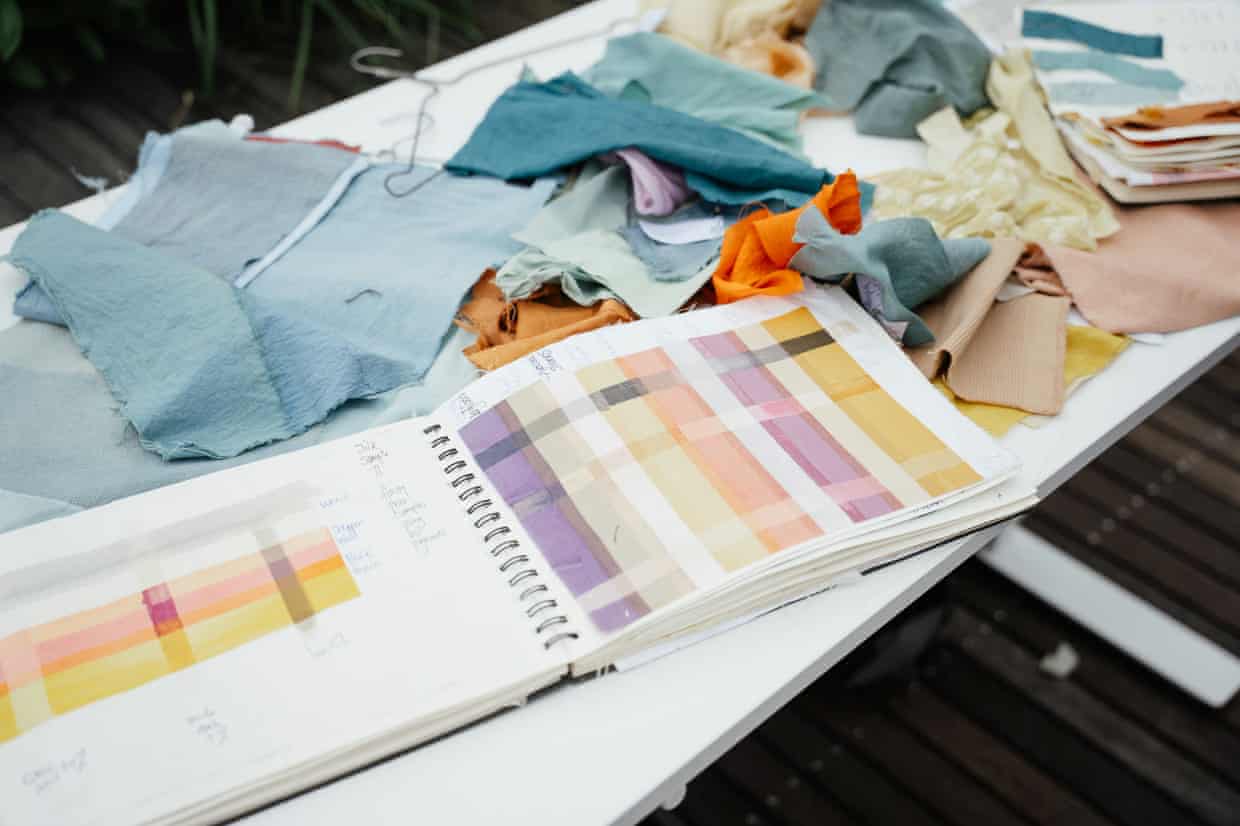
Chemical dyes are often toxic for the environment and bad for human health, and that is why the National Theatre in London is planning to use natural dyes from a rooftop garden in its costumes.

My friend Ann is deep into using natural dyes for her textile art, and she even grows the plants that are used for those dyes. It is not just that she is concerned about all the synthetics in our environment, she loves the colors that nature produces.

In London, the National Theatre is on the same track.

Helena Horton  writes at the Guardian, “Squint at the roof of the grey, brutalist National Theatre on London’s South Bank and you might be able to spy a riot of color spilling from the concrete. This is the theater’s new natural dye garden, from which flowers are being picked to create the colors for the costumes worn in the theater’s plays.

“Chemical dyes are often toxic for the environment and bad for human health, so the costume designers at the theater are experimenting with using flowers including indigo, dahlias, hollyhocks, camomile and wild fennel to create the vivid colors used in their productions.

“The textile artist, Liz Honeybone, is buzzing with excitement about the opportunities the new garden is bringing. … She has been very concerned about the health impacts of using harsh, synthetic chemical dyes, which require users to be swaddled in protective clothing. …

“ ‘There used to be a thing called dyer’s nose, which is basically when the aniline dyes came in,’ Honeybone said, ‘They used to destroy your nasal membrane.’ …

“The theater is planning to use natural dyes from the garden in every production at the South Bank going forward, starting with Playboy of the Western World, which is on this autumn and winter.

“Claire Wardroper, costume production supervisor at the theater, said it was ‘a beautiful early 19th century piece, with lots of nice woolly jumpers, because it’s set in rural Ireland, and we can certainly get some nice colors into them.’ …

“They are trying to bring a gentler, more environmentally friendly way of dyeing into the mainstream. ‘We are saying that if you want to use this horrible synthetic dye, you can do that, but you can achieve this beautiful look by using a natural dye, and we can do it a little bit slower and a bit more sort of organically,’ said Honeybone.

“Wardroper added: ‘It’s unfortunate to say, but the theatre and film and anything creative in one-shot opportunity entertainment has a history of being incredibly wasteful.’ …

“Honeybone said: ‘It’s been such a good harvest. My indigo is more than I can cope with. I’ve got three shows going on at the moment, so I’ve had to recruit people to help me.’

“People may imagine the colors extracted from flowers will be muted compared with synthetic dyes, but Honeybone said this could not be further from the truth and she has been able to create neon greens and yellows. ‘Our forefathers were drowning in color. They loved it, it wasn’t hard to get and all the tapestries that were up on the wall were a riot of color. What we’re seeing now is the sad, faded leftovers,’ she said.

“Honeybone says she has become ‘obsessed’ with natural dyeing. ‘My daughter gave me a bunch of flowers on Mother’s Day, and I noticed there was some golden rod in it, so whisked that out and dyed with it just to see what it yielded. And it was the most glorious, strong yellow.’

“The garden is not only used for dyes but also as a refuge from the hustle and bustle of the theatre. The pair said actors were frequently seen pacing among the flowers, or sitting down on benches to learn their lines.

“The space is also a haven for wildlife. The grey concrete of the South Bank does not have a huge amount to offer pollinators, and they have been swarming to the garden to sample the nectar from the varied dye plants.

“Wardroper said: ‘We’re seeing so much more wildlife, like hummingbird moths, and we’ve got bees on the National Theatre roof which produce honey for the National Theatre. And they’re loving the variety of plants that we’ve planted as well. These are a new stock of plants that they just haven’t had access to. So the bee person that comes in and caters to the bees is very happy.’

“The pair hope that most if not all of the costumes at the theatre can eventually be produced using natural methods. But for now, Honeybone is enjoying the opportunity to start using these dyes.

“She said: ‘This is such an all round sensory experience, totally engulfed in the smells and the feeling. … It is just wonderful.’ ”

More at the Guardian, here. (Gotta love that someone in this earthy-crunchy field has a name like Honeybone and that Wardroper oversees the wardrobe!)

Read Full Post »

Photo: Farmingdale Observer.
Merino sheep are said to show improved wool quality under solar arrays.

Here’s a win-win-win for the environment, sheep grazing, and agrivoltaic farming practices in general. One caveat: you need to place solar arrays on already open land. Cutting down trees to put in solar is actually a loss for the environment as trees are so good at carbon capture.

Bob Rubila writes at the Farmingdale Observer, “In a groundbreaking study that combines renewable energy with traditional farming practices, researchers have observed remarkable changes in 1,700 sheep grazing amidst solar panels. This innovative approach, known as agrivoltaics, is revolutionizing how we think about land use while yielding unexpected benefits for the animals involved.

“A comprehensive three-year study conducted at Wellington Solar Farm in New South Wales, Australia, has revealed fascinating results about sheep and solar panel coexistence. The research team from Lightsourcebp, in partnership with EMM Consulting and Elders Rural Services, monitored 1,700 Merino sheep divided into two groups: one grazing in traditional pastures and another among solar panels.

“The findings challenge conventional assumptions about livestock welfare in modified environments. Sheep grazing between solar arrays showed no negative health impacts. Instead, researchers documented enhanced wool quality with increased fiber strength and growth rates. The solar infrastructure created microhabitats that benefited both the animals and the underlying vegetation.

“ ‘The promising results indicate we’re on the right track,’ explained Brendan Clarke, acting environmental planning manager at Lightsourcebp for Australia and New Zealand. …

“The solar arrays provide critical shelter during extreme weather events, protecting sheep from both intense heat and adverse weather conditions. This protection creates a more stable environment for the animals throughout seasonal variations. The panels’ shade effect helps retain soil moisture, which promotes healthier grass growth and more nutritious forage for the grazing animals.

Interestingly, researchers noted reduced parasite presence in the solar grazing areas, contributing to improved overall animal health.

“This unexpected benefit appears to stem from altered ground conditions beneath the panels, creating an environment less hospitable to [common] parasites. …

“The relationship between energy infrastructure and animal welfare continues evolving as more long-term studies emerge. While some regions face environmental challenges like the dormant volcano showing signs of awakening after 250,000 years, these sheep-solar partnerships represent positive ecological developments.

“The Australian findings align with similar research conducted in France, where INRAE (National Research Institute for Agriculture, Food and Environment) collaborated with renewable energy producers Statkraft and CVE. Their two-year study involving 24 ewes confirmed beneficial effects on flock welfare, improved thermal comfort, and enhanced forage quality.

“ ‘The thermal comfort of the animals improves significantly, and the availability of quality fodder increases, among other benefits,’ noted Véronique Deiss, INRAE researcher. These correlated results across continents suggest universally applicable principles for successful agrivoltaic implementation.

“Beyond animal welfare, agrivoltaics offers economic advantages for both energy and agricultural sectors. Solar farms benefit from reduced vegetation management costs as sheep naturally control grass growth, eliminating the need for mechanical mowing or chemical treatments. For farmers, access to otherwise unused land provides additional grazing opportunities without purchasing or leasing additional property. …

“With these 1,700 sheep demonstrating improved wool quality while maintaining solar farms, agrivoltaics exemplifies how innovation can simultaneously address energy production, land management challenges, and animal welfare – creating sustainable solutions that benefit multiple stakeholders across agricultural and energy sectors.”

More at Farmingdale Observer, here.

Read Full Post »

Photo: Durrie Bouscaren/The World.
Inspired by Istanbul’s “deadstock” shops, OhSevenDays uses small batches of fabric to create womenswear. Designer Megan Mummery is pictured above inside OhSevenDays in Turkey.

According to public radio show The World, the textile industry generates an estimated 92 million tons of waste every year — equivalent to a garbage truck full of clothing every second. But today’s article suggests a way to give textiles a second life. 

The whole time I read this, I was picturing Cinderella’s little friends among the birds and mice turning the ugly sisters’ cast-off fabrics and ribbons into a gown for the ball. You remember the Disney Cinderella? I’m talking about the pretty gown the sisters destroyed, causing the Fairy Godmother to step in.

Durrie Bouscaren reports at The World, “In the backstreets of Istanbul’s garment districts, there are stores selling bolts and bolts of leftover fabric. …

“These 100-meter rolls of fabric, known as ‘deadstock,’ are the discards of Turkey’s largest clothing manufacturers. And to a growing cohort of designers, they hold the key to reducing waste in the fashion industry.  

“ ‘There are big manufacturers in Turkey that do production runs of 30,000 to 50,000 unit pieces. So, the precision in that production is something else,’ said Australian Canadian designer Megan Mummery.

“At that scale, fabric rolls with small tears, stains or other imperfections are immediately removed from the machines. And if a brand miscalculates and orders too many rolls of a specific fabric, it will end up with a surplus.

“In most cases, deadstock fabric rolls are incinerated or dropped off at a landfill. …

“ ‘It’s minuscule for them — one roll is 100 meters,’ Mummery told The World. ‘But for us, it’s gold.’

“Inspired by Istanbul’s deadstock shops, which she explored after moving to the city with her husband in 2015, Mummery began using smaller batches of fabric to create womenswear designs. She named her brand OhSevenDays — a reference to her earliest collections of only seven pieces at a time, and a play on the Turkish word ‘seven,’ for ‘one who loves.’  

“ ‘It was really slow at the beginning,’ Mummery said. … ‘And I remember, an influencer once wore a top and posted it, and we got like 20 orders in a day, and it was the most exciting thing ever!’ 

“Today, Mummery’s designs are a tasteful blend of classic neutrals and airy patterns. Signature bralette tops are paired with matching high-waisted skirts and summery cotton shorts, perfectly at home in the historic Istanbul apartments and garden balconies often featured in her photo shoots. A line of maternity clothes offers options for both the office and casual wear. 

“As with many small-scale sustainable brands, OhSevenDays’ price point is higher than that of major retailers. A popular blue patchwork Darcy dress is priced at $240, and a dark denim jumpsuit sells for $150. A breathable, white cotton maternity blouse is $124. …

“Turkey is among the world’s largest exporters of clothing, and a significant amount of deadstock fabric is available in the country, according to [Sibel Ege, an Istanbul-based fashion industry expert who runs a textile consultancy called REN Sourcing]. But few brands are incorporating it into their practices, and even fewer customers are aware of what it is. 

“ ‘After COVID, the customers became more aware of the importance of (sustainability), and started to pressure the brands,’ Ege said. ‘But if the customer doesn’t know what it means, it doesn’t make a value at the sales.’ 

“Mummery and her team work together out of a shared studio that is no larger than 700 square feet. A line of dresses hangs above the machines, while tailors measure, steam and cut fabric — making the pieces from start to finish.  That makes the work harder, but more interesting, said tailor Türker Pehlivan. 

” ‘It’s challenging,’ Pehlivan said. ‘But in the end, something beautiful comes out — and we’re happy because we made something beautiful.’

“[Mummery] has found ways to use the small size of OhSevenDays to her advantage.  Custom sizing can be done according to a shopper’s measurements at no extra charge, if fabric is available — the website notes. …

“Deadstock-sourced pieces are also popular among clothing subscription services, where subscribers receive a selection of clothes every month that can be kept or returned. This reduces the risk of disappointing customers if a popular item runs out quickly. …

“ ‘We say, you know, there might be a little color discrepancy between the products — and most of the boutiques love that actually,’ Mummery said. ‘Because when there’s a dress on the railing and two slightly different colors, they have a story to tell, even in the store.’ “

More at The World, here.

Read Full Post »

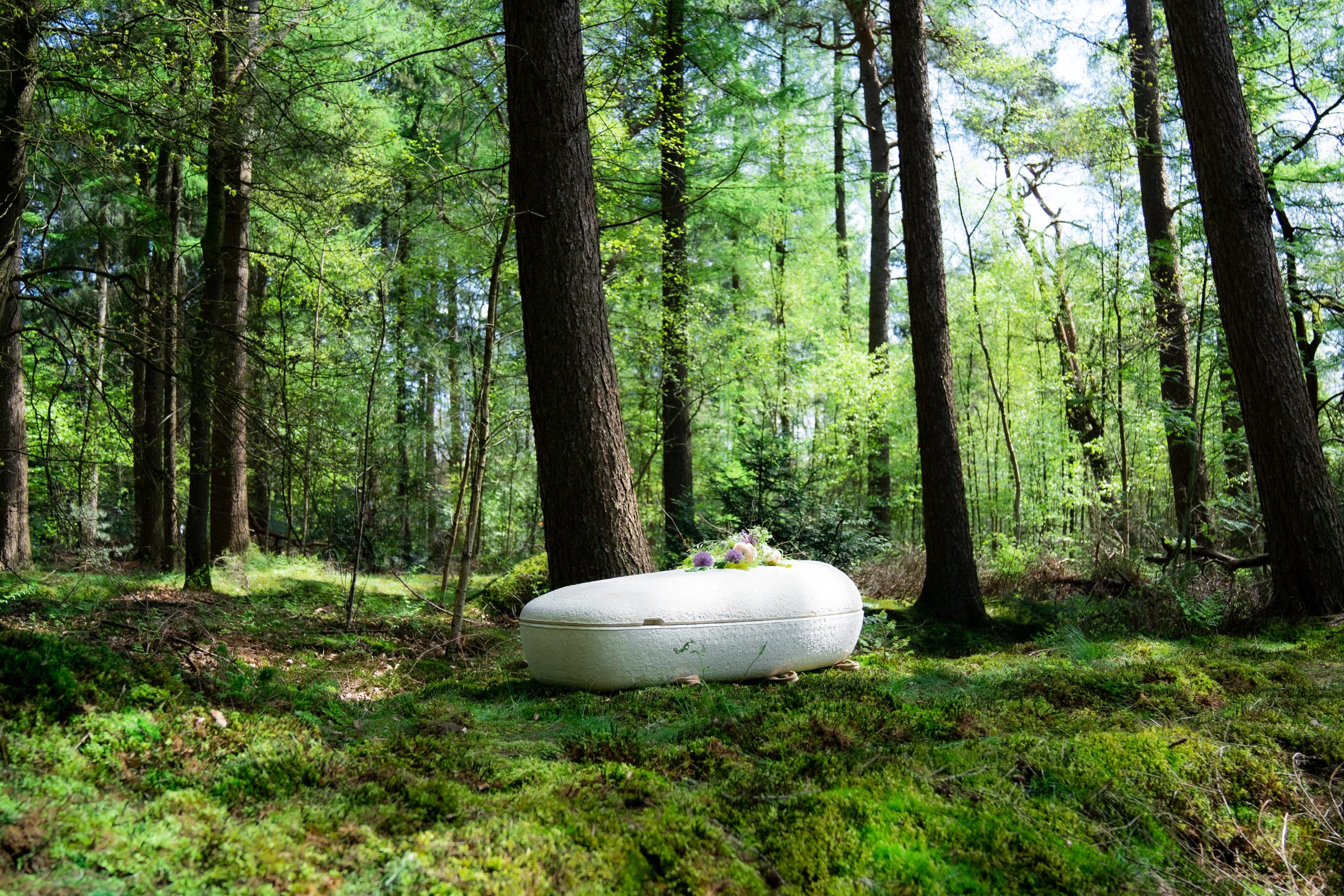
Photo: The Optimist Daily.
Website the Optimist Daily says, “Mushroom caskets offer an earth-friendly goodbye in North America’s first burial of its kind.”

Blogger Will McMillan at A Musical Life on Planet Earth gave me the lead for today’s story. And because my husband and I just recently entertained two mushroom enthusiasts from a recent conference, I decided today was a good day to tell you how some folks take their love of mushrooms to the end — and beyond.

“Traditional burials,” writes the Optimist Daily, “though deeply meaningful, often come at a steep environmental cost. The chemicals, hardwood, and land use involved can have long-term ecological impacts. But a quiet revolution in burial traditions is beginning to bloom and its roots are made of mushrooms.

“In a first for North America, a burial using a fully biodegradable mushroom casket took place on a serene hillside in rural Maine. The Loop Living Cocoon, developed by Dutch company Loop Biotech, is made entirely from mycelium, the intricate root system of fungi. The casket is grown in just one week, naturally breaks down within 45 days, and enriches the soil it returns to.

“ ‘My father always told me that he wanted to be buried in the woods on the property that he loved so much,’ said Marsya Ancker, whose father Mark C. Ancker was laid to rest in the pioneering casket. ‘He wanted his final resting place to nourish the land and plants he cherished.’ …

“Though this was a first for North America, Loop Biotech has already facilitated more than 2,500 burials across Europe using mushroom caskets. Green burials are an alternative that avoids embalming fluids, hardwood caskets, and steel-reinforced concrete vaults, and they’ve been steadily growing in popularity since the 1990s.

“ ‘Since 2005, the Green Burial Council has certified over 250 providers and recorded 400+ green cemeteries across the U.S. and Canada: a clear sign of growing demand for environmentally conscious end-of-life choices,’ said Sam Perry, president of the Green Burial Council.

“The statistics are striking. According to the Council, conventional U.S. burials consume roughly 20 million board feet of wood, 4.3 million gallons of embalming fluid, and 1.6 million tons of concrete each year.

“Bob Hendrikx, founder of Loop Biotech, believes funerals can be more than a final goodbye. ‘We created the Loop Living Cocoon to offer a way for humans to enrich nature after death. It’s about leaving the world better than we found it.’

The Global Green Burial Alliance, founded in 2022, is helping reshape global perspectives on death. Entirely volunteer-run, the organization connects families with green providers and empowers people to reclaim their voice in end-of-life decisions. …

“Ed Bixby, founder of the Global Green Burial Alliance, believes these choices create a legacy of compassion. … ‘To embrace the living with our death becomes the final act of kindness we can bestow upon our planet.’

“With innovations like the mushroom casket and a groundswell of interest in sustainable options, a cultural shift appears to be underway. It asks that we reimagine death not as an ending, but as a way to nourish new life.”

So there’s that.

Sometime I’ll tell you about our mycologist visitors. Theirs is a whole different world. And when you live in a retirement community and are in danger of too much sameness, “different” is especially welcome.

Consider for example, how we learned from these guys that truffles are actually all over the world but buried very deep. And how they might even have been the “manna” in the desert described in the Bible. They do grow in desert places like Saudi Arabia.

So says the CEO of MycoSymbiotics, William Padilla-Brown, who, we learned, was a speaker at the conference. His bio describes him as a “Multidisciplinary Citizen Scientist practicing social science, mycology, phycology, molecular biology, and additive manufacturing. William founded MycoSymbiotics in 2015, and has since developed it into the innovative practical applied biological science business it is today. William holds permaculture design certificates acquired through Susquehanna Permaculture and NGOZI, and a certificate from the Bigelow Laboratory for Ocean Sciences in algal culturing techniques. He has published the first English-language books on cultivating the cordyceps mushroom and regularly leads courses on their cultivation. William’s research has been sponsored by several organizations and his work has been featured in multiple publications, including Fantastic Fungi and VICE. He also founded and manages MycoFest, an annual mushroom and arts festival, now on its eleventh year.”

So many unusual pursuits in this world! I am not knowledgeable enough to recommend the ideas of any mycologists or herbalists, nor am I planning a mushroom burial, but I sure am a sucker for anything interesting.

Doesn’t curiosity keep us all going?

More at the Optimist, here.

Read Full Post »

Photo: Edward Burtynsky.
“Manufacturing #17, Deda Chicken Processing Plant, Dehui City, Jilin Province” (2005) is one of Burtynsky‘s best-known large-scale photos of China’s industrialization of just about everything.

The International Center of Photography in New York City recently hung an exhibit of Edward Burtynsky, a photographer I’ve admired since I first encountered his massive works in the early 2000s.

Louis Bury at Hyperallergic calls the show “A God’s-Eye-View of Earth’s Destruction.,” which doesn’t sound like fun but is sure to be interesting.

Edward Burtynsky: The Great Acceleration,” writes Bury, “at the International Center of Photography contains the artist’s largest ever print, which is saying something. Across a celebrated 40-plus-year career, Burtynsky has been renowned for his work’s ambition and scalar play. His fantastic images, often taken from aerial vantages, depict landscapes modified by human industry, from a stepped mine resembling an amphitheater … to a salt pan whose multicolored pond rows evoke a painter’s palette. …

“The large formats and supra-human perspectives render the Earth alien, potentially confronting the viewer not only with our species’ collateral ecological harms but also our estrangement from them. 

“Even by that standard, the exhibition’s 28-by-28-foot mural Pivot Irrigation #8, High Plains, Texas Panhandle, USA (2012) stands out. The distant overhead view and subdued color palette transform farmland into an almost abstract composition, in which the pictorial space is divided into textured, geometric browns on one side and alternating vertical stripes of washed out blues and grays on the other. A teensy farmstead occupies the bottom left corner and the roads running parallel to the edges of the picture plane serve as a clever framing device.

“But the two-story-tall print’s physical size produces its most dramatic effects. It dominates the central gallery, dwarfing visitors in a manner akin to the quarry cliffs that sometimes loom over the ant-like human figures in Burtynsky’s other landscapes, such as the miners digging for cobalt, for a couple dollars a day, in ‘Dry Tailings #1, Kolwezi, Democratic Republic of Congo’ (2024).

“Curator David Campany’s approach encapsulates the ‘bigger is better’ ethos. … The scope of the artist’s environmentalist muckraking matches the scope of the iniquities it portrays; for decades, Burtynsky has pursued research leads around the globe to capture yet more examples of civilization’s terraforming. Early in his career, before the term ‘Anthropocene’ became common in academic and artistic circles, such images offered a prescient vision of large-scale anthropogenic changes that were typically out of sight and out of mind.

“But as others have caught up to and even surpassed that vision … its style has remained mostly the same, god’s-eye-view consciousness raising feels more and more like a pretext for aesthetic dazzle.

“Burtynsky’s dazzle serves a psychological rather than a moral function. It can provoke in viewers the uncomfortable recognition that harmful ecological realities nonetheless appear beguiling. But it can also occlude the human-scaled implications of those realities. On the central gallery’s terrace level, Campany has helpfully included examples of Burtynsky’s lesser known work: early 1980s portraits of food plant laborers; studies of marshlands taken during the COVID-19 lockdown. While these series lack the wow factor of the artist’s panoramic work, they evidence his eye for formal patterns and keen details. …

“[The show] continues at the International Center of Photography (84 Ludlow Street, Lower East Side, Manhattan) through September 28.”

Fantastic photos at Hyperallergic, here. No firewall. See also Photographic Journal, here, and the artist’s site, here.

Read Full Post »

Photo: Devine Native Plantings.
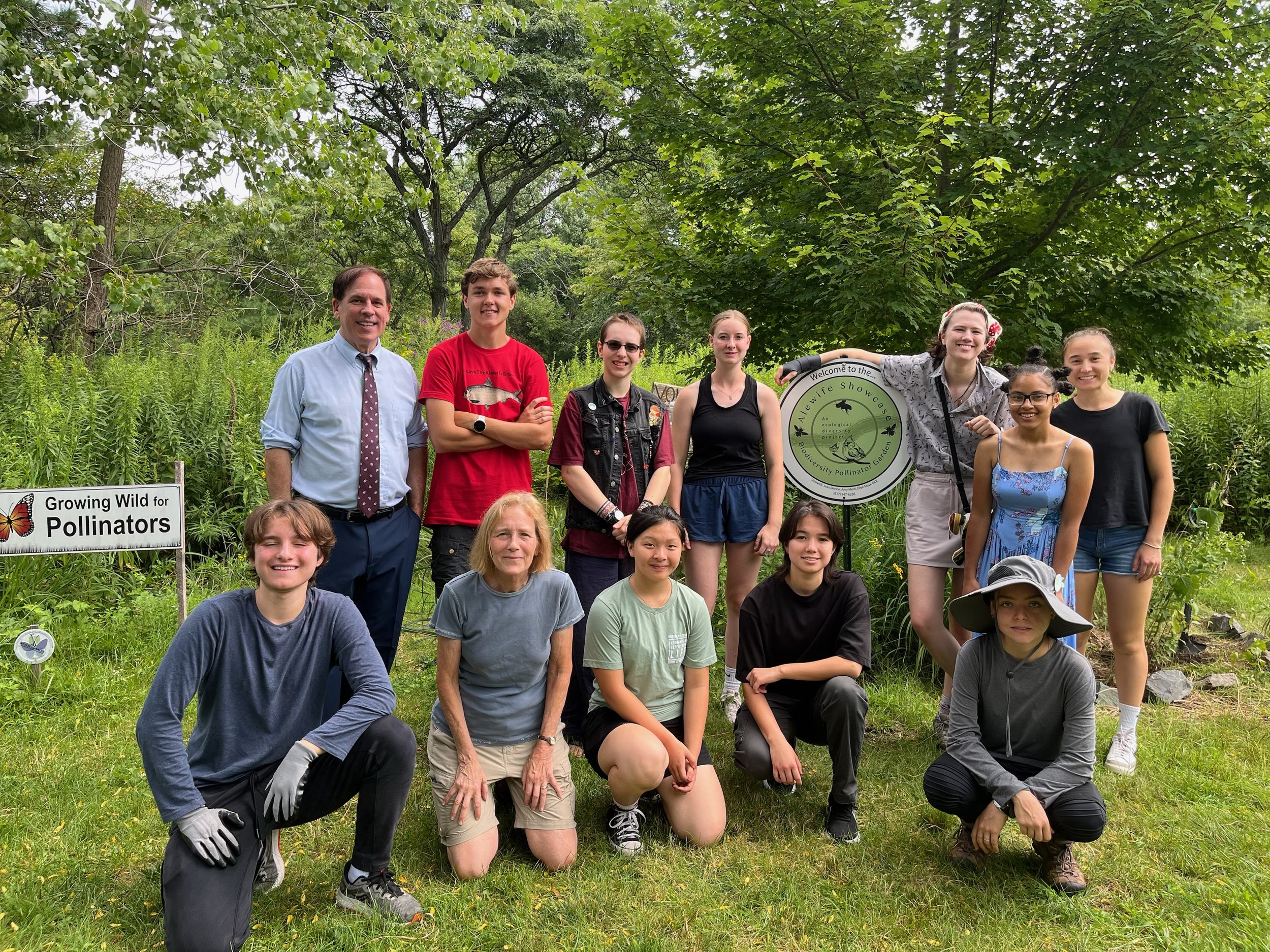
Jean Devine, founder of Biodiversity Builders, is in the front row, second from left. She engages young people in the important work of improving the environment.

Recently, I blogged about my friend Jean Devine, founder of Biodiversity Builders, and described how she took me on a tour of local urban forests. (Click here.)

Now I find that Edible Boston has caught up with her and is highlighting the amazing environmental work Jean’s been doing with young people.

Nicole Estvanik Taylor writes, “Ask the average Gen Z-er to name their favorite native plant and you might expect a blank stare. But for alumni of the Biodiversity Builders program, the hard part is narrowing it down.

“Strawberries come to mind for Jasmine Rancourt, International School of Boston graduating senior — ‘or maybe butterfly weed, because it’s really pretty and vibrant … and it attracts butterflies, obviously.’

“Belmont High School’s Sophia Shaginian chose to plant bleeding heart in front of her house because it’s ‘absolutely gorgeous’ and ‘blooms all summer long.’

“Leia Ahmad-LeBlanc of Arlington Catholic High School gravitates to the striking red pods of wild sumac. ‘You can actually make lemonade out of it, and it’s a good source of food for animals.’

“And UMass Amherst student Kira O’Neill is partial to black birch trees: ‘They have such beautiful yellow leaves in the fall. And if you scratch a twig, it smells like root beer.’ 

“The students got to know these and many other plant species native to Massachusetts through a six-week paid summer internship created and run by Jean Devine, a Belmont-based environmental educator, native plant coach and specialty landscaper.

“Entering its fourth year, Biodiversity Builders has provided 55 high school students from Arlington, Belmont and Cambridge with hands-on experience designing and installing native plant gardens and removing invasive flora. The curriculum also covers entrepreneurial concepts like mission and marketing and culminates in a native plant sale run entirely by the students. …

“It’s only been a decade or so that Devine herself could tell you much about birch trees or bleeding hearts. …

“ ‘I was looking for opportunities to mentor youth and get them outdoors as an antidote to “nature-deficit disorder,” ‘ she says, referencing a term coined by journalist Richard Louv in his book Last Child in the Woods.

“A walk with a scientist opened Devine’s eyes to the ecological value of native plants, including as a source of food and shelter for pollinators and other wildlife, and the threat invasives pose to biodiversity. Teaching kids how to restore this balance struck her as ‘an ideal project with a purpose that helped the world and the youth at the same time.’ …

“After several years running nature programs for school kids in Cambridge and Brookline, she launched her own business, Devine Native Plantings, in 2021. Biodiversity Builders followed a year later, operating as a nonprofit under the fiscal sponsorship of the Vermont-based Tiny Seed Project. It partners with the Cambridge Mayor’s Summer Youth Employment Program to support the participation of students from that city and covers the rest of its budget through grants and crowdfunding. This July, it will recommence with a fresh batch of 14 high school students and a pair of college mentors, plus four young professionals interested in the Biodiversity Builders approach.

“ ‘Jean is so high energy and enthusiastic about the curriculum,’ says O’Neill, who did the program in 2022 and returned last summer as a mentor. ‘She very easily connects with the students … and she knows so many of the people in the area doing similar kinds of work.’

“Among her many affiliations, Devine is a co-founder of the Mystic Charles Pollinator Pathways Group, which maps local gardens that support declining populations of native bees, butterflies and birds. She guided Belmont High School’s Climate Action Club in creating a pollinator garden and is part of an intergenerational committee of Belmont residents organizing to plant a Miyawaki miniforest. As a member of the Native Plant Community Gardeners group in Cambridge, she’ll help install Danehy Park’s first pollinator garden this summer — with upkeep to come from the 2025 Biodiversity Builders crew. …

“For 2024 Biodiversity Builders participant Rancourt, who has artistic leanings, planning gardens that are aesthetically pleasing and ecologically useful was a highlight of the program.

“ ‘It turns out you have many colorful native plants that can be used,’ Rancourt reasons, ‘instead of those other plants that are colorful but look like plastic for pollinators.’ …

“Ahmad-LeBlanc, part of last summer’s cohort, says she applied to Biodiversity Builders after watching her sister go through the experience two years prior.

“ ‘She would always come home covered in dirt, she would have to wear super high socks because there were a lot of ticks, but she had a great time,’ she says. When it was her turn to get dirty, she understood why. ‘I think it was easier for us to process the information because it was all really hands-on … It’s a way that we’re not usually able to learn in school.’

“The Alewife reservation is Biodiversity Builders’ home base, but the students tend plots in other community spaces. … Last summer they removed invasives at Mass Audubon’s Habitat Education Center and Wildlife Sanctuary with the aid of its resident goats; toured Mount Auburn Cemetery with a herpetologist, a horticulturalist and an artist; and took the T to East Boston for birdwatching in Belle Isle Marsh. They also donned gloves and climbed into canoes with the Mystic River Watershed Association to remove thick, spiny mats of invasive water chestnuts from the Arlington Reservoir—filling 270 laundry baskets by day’s end.

“ ‘It was just amazing how we were all collaborating and working all together,’ says Shaginian, who shared a canoe with Devine. ‘I remember how big that pile was. It was huge.’

“Shaginian says pulls like that one, or the sweaty hours spent uprooting black swallow-wort along the edge of the Minuteman Bike Path, impressed upon her both the enormity of the problem and the importance of doing her part. …

“ ‘For me, the idea of getting paid to do gardening, which I did at my house for fun, was novel and exciting,’ says O’Neill, ‘and definitely cemented the idea that I wanted to study something related to working outside when I got to college.’ “

More at Edible Boston, here, and at this blog, here.

Read Full Post »

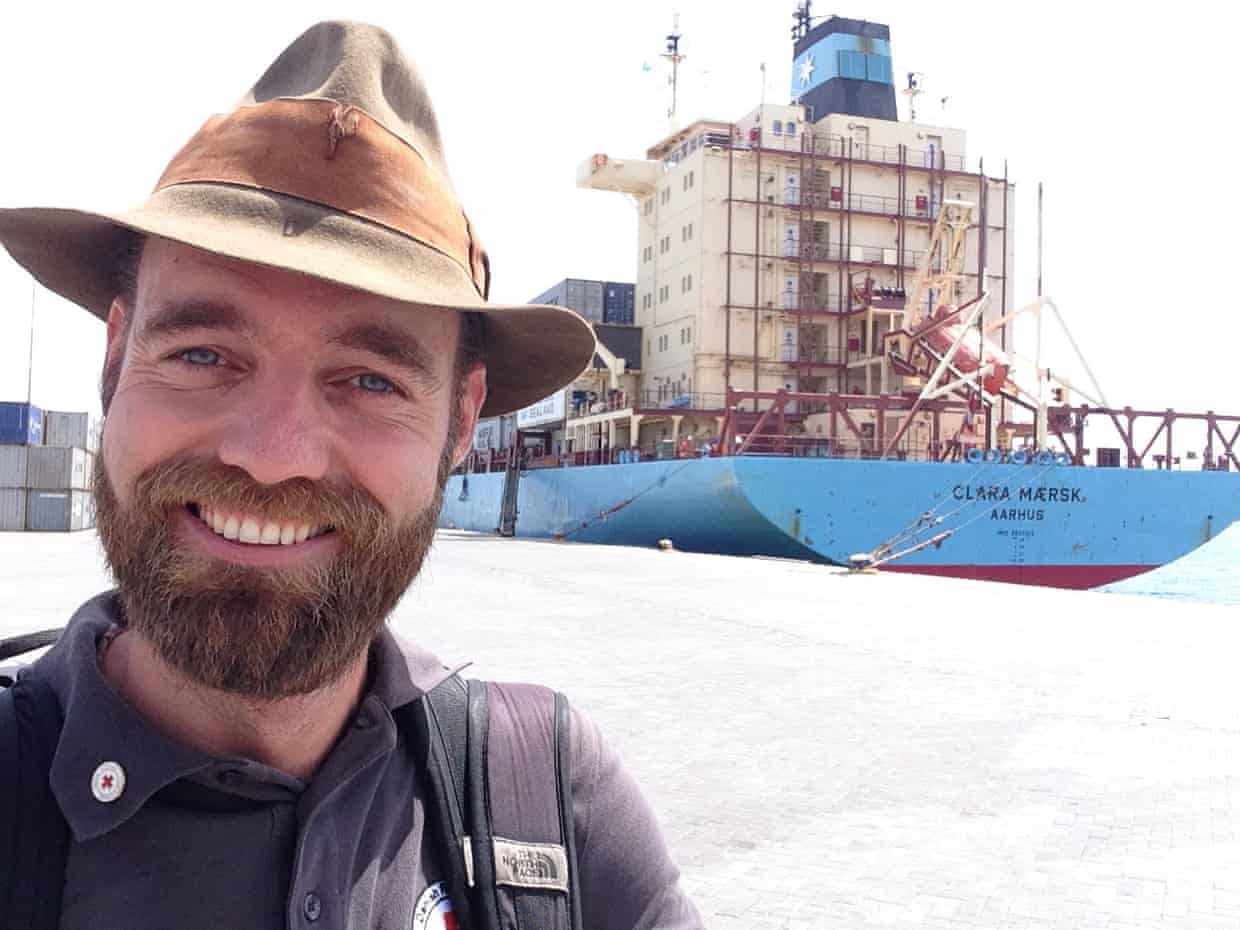
Photo: Thor Pedersen.
Thor Pedersen took a container ship from Praia, Cape Verde, to Guinea Bissau — one step in his quest to travel the world without flying. 

I recently met a couple who are unusually thoughtful about their footprint on Planet Earth, to the point of investigating how they could get to Europe without flying. There are ways to travel without flying, as we learn from today’s story in the Guardian, but they all have a cost in carbon emissions — ocean-going vessels especially. Unless you’re talking sailboats, which are not practical for most people.

Nevertheless, experiments in avoiding airplanes are consciousness raising — and often fun. Thor Pedersen reported on his own effort to travel everywhere without flying. It took him 10 years!

He writes, “Growing up, it seemed as if all the great adventures had happened before I was born. But in 2013 I discovered that – although it had been attempted – no one had made an unbroken journey through every country without flying. I had a shot at becoming the first to do it. …

“At 34, I set off – and didn’t return home until almost a decade later. These are the lessons I learned along the way.

“1. Human generosity can be astounding. It was a cold, dark night in December. A train had brought me to Suwałki, which people say is the coldest city in Poland. It was quiet. Snow was falling, but otherwise everything was still. I was carrying a piece of paper with a name, a phone number and an address for where I was supposed to be staying. But I had no sim card, so I began walking, looking for someone who could help me.

“Just as I was beginning to wonder if I would ever meet anyone, a woman opened her front door. I dashed over. Luckily, she spoke English and invited me in. She was happy to host me and convinced me there was no point in heading back out into the cold.

“I was quickly given a full plate of food and a spare bed. All this from a stranger. The next day, I was served breakfast and taken to the bus that would carry me to Lithuania.

“2. There are still some hidden and spectacular natural wonders. Lesotho was country No 106 on my very long journey. Its natural beauty was immediately apparent. … The mountains of Lesotho are horse country. Every now and again, riders draped in thick blankets would pass. Then I reached Maletsunyane Falls. The nearly 200-metre waterfall was glistening in the sun at the end of a canyon. And I had it all to myself.

“3. People’s resilience is powerful. In 2015, I travelled through western Africa. At the time, Guinea, Sierra Leone and Liberia were dealing with the world’s largest Ebola outbreak. A taxi driver in Guinea said to me: ‘Here we have everything, but we have nothing.’ These countries are rich in many ways – from natural resources to beautiful landscapes – yet most of the people are not.

“But after only an hour in Sierra Leone, I had been invited to a wedding: loads of music, lots of people in fancy clothes, an abundance of food and drink, small talk and dancing.  …

“4. Isolating yourself is a mistake. When you take public transport in Denmark, where I’m from, you always pick the seat farthest from everyone else. We value our privacy and respect the privacy of others. But in much of the world, the best seats are the ones next to other passengers. Where else will you find conversation?

“In west and central Africa, I found that everyone in a bus or a bush taxi would immediately form a unit, sharing food and stories and holding babies for one another. …

“5. What you want and what you need are not the same thing. … I hit a wall after about two years, but had to push through it to reach my goal. I learned the difference between what I want and what I need. I learned to live on a rock and how to engage in conversation with absolutely anyone. Once I returned home, I realized the only things that had kept their value were the relationships and conversations I had had. Everything else seemed perishable.

“6. You can form connections without sharing a language. I once had a 12-hour train journey from Belarus to Moscow during which no one else spoke anything but Russian. It didn’t seem to bother them that I didn’t know the language beyond nyet or da; they sat and spoke to me in Russian for several hours, while we shared food and vodka.”

To see more of Pedersen’s photos and his life lessons from this kind of travel, click at the Guardian, here. No paywall.

Read Full Post »

Photo: Joanna Detz/ecoRI News.
Tess Feigenbaum and Brendan Baba in the hot-composting room at their Providence facility.

At my retirement community, there’s a handful of people who are serious about composting both garden waste and food waste. We have Black Earth bins available for anyone hardy enough to trek to the garden area.

Massachusetts, meanwhile, passed a law that the kitchens of institutions our size must also compost food waste. But no one seems to be enforcing it. Here, the powers that be say it’s too complicated and expensive to reconfigure kitchen processes. Maybe they’d have to knock down a wall to build out the space.

Still, the idea of composting is catching on slowly in New England generally, and more restaurants and institutions are finding it can save a lot in trash-pickup fees.

In a story supported by 11th Hour Racing (get it — we are at the 11th hour with climate), Frank Carini of ecoRI News writes about a particularly dedicated composting couple in Rhode Island.

“Their journey, so far, has been epic, from Pawtucket to Los Angeles and back to Rhode Island. They left for the City of Angels with an idea borrowed from ecoRI News and returned with a business model to help the Ocean State get out from under all its food waste.

“Tess Feigenbaum and Brendan Baba co-founded Epic Renewal soon after landing in Los Angeles in late August 2016. They left three years later, but not before keeping some 23,000 pounds (11.5 tons) of L.A. food scrap from being landfilled or incinerated.

“Their for-profit operation, now run out of a 3,000-square-foot space on Acorn Street [Providence], provides low-cost composting services for events, businesses, and homes. Epic Renewal also offers zero-waste consulting services, products such as vermicompost and red wiggler worms, and software that helps other composting businesses track the amount of organic matter they are keeping out of the waste stream.

“ ‘Our big focus area is zero-waste events,’ Feigenbaum said. ‘We do a little bit of commercial and residential, but we very intentionally lean out of residential because of the density there … we’re not interested in competing with all of our friends. The events are really our fun place. They also let us reach a ton of people who otherwise might not really care about it.’

“Feigenbaum and Baba are part of an unofficial composting collaborative that Michael Merner, founder of Earth Care Farm in Charlestown and godfather of Rhode Island composting, unknowingly started in the mid-1980s. For years, Earth Care Farm went at it alone.

“Now, four decades later, about a dozen composting operations, including Epic Renewal, are helping Earth Care Farm take a bite out of the amount of food scrap being unnecessarily wasted.

“ ‘We had three generations of Merners at the last compost fund bill hearing,’ Feigenbaum said. ‘It was awesome.’

“The bill (H5195) would create a compost fund that would award composting and waste-diversion grants to help reduce the amount of material being sent to the getting-crowded Central Landfill in Johnston. …

“Baba said, ‘We need every single solution at the table, but what we really firmly believe in is hyper local, many sites that are smaller, especially knowing we have the most expensive farmland in the country, and we want those to be farms. It’s pretty critical when we’re thinking about urban spaces and creating a resilient network that we create more sites, not just one or two big ones.’ …

“In November 2024, they experienced a life- and career-changing event: they moved their composting operation from a Central Falls basement — Feigenbaum called the space ‘depressing’ — to a roomy, industrial space in Providence’s Valley neighborhood. Epic Renewal was born in an extra bedroom in the couple’s Los Angeles apartment.

“Their newish Acorn Street workspace includes room to store the operation’s 300 or so containers of various sizes, hot-composting boxes made of wood, and parking for their biodiesel-powered truck, a van, and two trailers. …

“Baba, with help from LA Compost founder Michael Martinez, replicated something similar to ecoRI Earth. By the time the duo left Los Angeles, Epic Renewal had 200 residential and 16 commercial customers. …

“When the couple isn’t collecting food scrap and other organic material and making compost with it, Feigenbaum works part-time at the Social Enterprise Greenhouse in Davol Square and Baba works full-time as a financial technology consultant. He wrote the material-tracking software Epic Renewal is sharing with other composting business for free while he works on putting the final touches on the tech. …

“Epic Renewal diverts about three-quarters of a ton of organic matter monthly from the waste stream. Since 2022, the operation has diverted 35.6 tons. Feigenbaum and Baba work with offices, food service and retail businesses, gyms, cosmetic producers, weddings, marathons, and festivals to reduce their waste.

“All of Epic Renewal’s magic is done indoors, thanks to bokashi composting. This anaerobic process, using a culture of bacteria that thrive in an oxygen-free environment, doesn’t produce off-gassing and is ‘ideal for indoor composting.’

“Feigenbaum noted this method requires less space, offers more input options, and is better suited for an urban environment or anywhere with limited green space. There is no runoff. The little liquid that is produced is recycled back into the process, which avoids the need to add tap water. …

“ ‘The biggest thing is demystifying it for people,’ Feigenbaum said of getting folks to compost. ‘We just need to get people exposed to it.’ ”

This story is part of a series “Black Gold Rush: The Race to Reduce Food Waste and Save Soil.”

More at ecoRI News, here.

Read Full Post »

Photo: José Hevia.
Rambla Climate-House by architect Andrés Jaque in Molina de Segura, Spain.

Today’s article addresses how architecture can and should repair our ecological system. How in cities, for example, a comprehensive vision would extend beyond beautifying downtown to embracing the understanding that we are not the only species on the planet.

At El País, Miguel Ángel Medina interviews architect Andrés Jaque about buildings that can be good for the environment.

“For three years,” he says, “Andrés Jaque, 53, has been dean of the Graduate School of Architecture at Columbia University, one of the most cutting-edge centers in architectural innovation. The Madrid-born architect is spending his time at the university rethinking how buildings and cities should face climate change. He believes that we must commit to an ‘interspecies alliance’ and that buildings, beyond just being sustainable, should also contribute to repairing our ecology.

“Jaque has proposed several projects with this concept in mind, such as the Reggio School in Madrid — designed to create life within its walls and attract insects and animals. …

Andrés Jaque
“Architecture is the discipline that has most clearly assumed the responsibility of responding to the climate crisis. In the last 15 years, there’s been a radical transformation [in the field]: materials have gone from being sustainable to [repairing the ecology]. And [the architectural field] has revised its own mission, which is no longer to just build new buildings, but to manage the built environment. Additionally, it has brought about an intersectional vision: understanding that the material, the social, the ecological and the political are inseparable and that climate action has to coordinate these fronts of transformation. This has placed architecture at the center of environmental action.

Miguel Ángel Medina
“Do architects share this interpretation?

Jaque
There’s a part [of the field] that’s anchored in a heroic vision of modernity and another that’s commercial… but there’s another that has a political commitment to the planet. And [those who adhere to this] understand that architecture must respond not only to the most immediate circumstances of a commission, but also to action for the planet. …

“There are two systems: a material world of extractivism — which is a mix of carbonization, colonialism, anthropocentrism, heteropatriarchy and racialization — that’s currently collapsing. And, in the cracks of this system, another kind of architecture is emerging, which seeks alliances between species based on symmetry, which pursues a global regime of solidarity and which advances along a line of decarbonization that marks the esthetics, the materialities [and] the types of relationships that constitute contemporary culture. This is gaining undeniable strength. In the future, we’ll see a change that’s as important as the one that modernity once represented.

Medina
“What do we do with urban planning, given so many extreme phenomena?

Jaque
“We’ve been pioneers in proposing a change of focus, from an emphasis on the city as a kind of stain on the territory, to a trans-scalar approach. This is a way of understanding [the physical structure that is] an urban block of apartments, the microbial relationships that occur in the bodies of those who live on that block, as well as the large networks of resource extraction that make life on that block possible.

“The city has lost the capacity to contain all realities, [which is necessary] in order to think in a climatic and ecosystemic way. And we need a new model that allows us to understand that what happens on a molecular scale has implications on the scale of bodies, buildings, streets, neighborhoods, the planet and the climate. Designing [cities] in a trans-scalar way requires changes in the methodologies of architecture, which we’re exploring. …

“Cities are going through a period of great transformation. A transformation in which the city has to be understood as something physically porous, which allows for the circularity of water, which contributes to multiplying life… a transformation of materiality that promotes a flow of materials that also contributes to the health of bodies. [We require] a very different way of urbanizing the air – in such a way that it’s understood that there’s a direct relationship between our lungs and the climate – and a commitment to the generation of diverse and empowered living environments. The main difficulty is how to do this quickly, so as to mitigate the impact of the climate and environmental crises.

Medina
“What’s this new ‘interspecies diplomacy’ that you advocate in favor of?

Jaque
“Humans are just one of many forms of life. And the idea that humans can decide to sacrifice the rest of the species to serve their own interests has been shown to be harmful. Understanding that we’re dependent on many other species — and that we’re actually inseparable from them — is more realistic. We depend on the quality of the soil, on the ecosystems. An interspecies alliance based on protecting the living conditions of diverse species is beneficial for all life on the planet.”

More at El País, here.

Read Full Post »

Photo: John and Suzanne’s Mom.
Fungi and algae receive less than 0.2% of conservation funding, according to a new study. Small speices never seem as cool as rhinos and elephants.

Is it human nature to pay more attention to the large and aggressive than to the small and quiet? As a female, I think so.

At the Guardian, Mariam Amini writes about how that tendency, when applied to the study of the natural world, can be harmful to the planet.

“Most global conservation funds go to larger, charismatic animals,” she says, “leaving critically important but less fashionable species deprived, a 25-year study has revealed.

“Scientists have found that of the $1.963bn allocated to projects worldwide, 82.9% was assigned to vertebrates. Plants and invertebrates each accounted for 6.6% of the funding, while fungi and algae were barely represented at less than 0.2%.

“Disparities persisted among vertebrates, with 85% of all resources going to birds and mammals, while amphibians received less than 2.8% of funding.

“Further funding bias was found within specific groups such as large-bodied mammals towards elephants and rhinoceros. Although they represent only a third of that group, they were the focus of 84% of such conservation projects and received 86% of the funding. Meanwhile mammals such as rodents, bats, kangaroos and wallabies remained severely underfunded, despite being considered endangered.

“ ‘Nearly 94% of species identified as threatened, and thus at direct risk of extinction, received no support,’ said Benoit Guénard, the lead author of the study. ‘Protecting this neglected majority, which plays a myriad of roles in ecosystems and represents unique evolutionary strategies, is fundamental if our common goal is to preserve biodiversity.’

“Alice Hughes, a coordinating lead author of the research, said: ‘The sad reality is that our perception of “what is threatened” is often limited, and so a few large mammal species may receive more funding than the near-12,000 species of reptile combined.

“ ‘Not only does this limit our ability to implement protective measures, but it closes opportunities to researchers. I have lost count of the number of times collaborators have switched taxa [organism populations] purely because theirs was difficult to fund. This leads to a chicken and egg situation – some of the groups with the highest rates of recent extinction, like freshwater snails, have the most outdated assessments.’

“The study, led by Guénard and colleagues at the University of Hong Kong, analyzed 14,566 conservation projects spanning a 25-year period between 1992 and 2016. …

“ ‘We are in the midst of a global species extinction crisis,’ said research author Bayden Russell. … ‘We need to change how we think about conservation funding. The community needs to be educated about the value of biodiversity and protecting species that are under threat.’ …

“ ‘Governments, in particular those which represent the main pool of funding, need to follow a more rigorous and scientifically driven approach in conservation funding,’ said Guénard.”

More at the Guardian, here.

And be sure to check Anna Kuchment’s Boston Globe interview with Mandë Holford, here, about a poisonous snail with lifesaving properties. It reads in part: “Some of the most powerful drugs in our medical arsenal come from animal venom. Ozempic was derived from Gila monsters, a lizard native to the southwestern US; Prialt, used to treat chronic pain in HIV and cancer patients, comes from deadly cone snails; and captopril, the first ACE inhibitor, a class of drugs used to treat high blood pressure, came from Brazilian pit vipers.”

Read Full Post »

Photo via the Guardian.
Imperial College researchers Franklin Keck, left, and Ion Ioannou are seeking a biological approach to mining copper with less danger to the environment. 

Can mining be made greener? I know it sounds implausible, but you have to love people who will tackle questions like that. Especially as the modern world is demanding more and more metals.

Robin McKie writes at the Guardian that copper “faces an uncertain future as manufacturers prepare to expand its use to make the electric cars, renewable power plants and other devices that will help the planet move towards net zero. Unrestricted extraction could cause widespread ecological devastation, scientists have warned.

“The issue is to be the prime focus for the new Rio Tinto Centre for Future Materials, based at Imperial College London in partnership with several international university groups. …

“ ‘The world needs to electrify its energy systems, and success will absolutely depend on copper,’ materials scientist and Imperial vice-provost Prof Mary Ryan, one of the centre’s founders, told the Observer last week. ‘The metal is going to be the biggest bottleneck in this process. So, in setting up the centre, we decided copper would be the first challenge that we dealt with.’ …

“Copper has become essential for powering devices ranging from smartphones to electric vehicles because it transmits electricity with minimal loss of power and is resistant to corrosion. Around 22m tons of copper were mined in 2023, a 30% increase from 2010, and annual demand will reach around 50m tons by 2050, say analysts.

“Such an output will have enormous environmental consequences because copper mining uses acids that poison rivers, contaminate soil and pollute the air. Producers such as Peru, Chile and the Democratic Republic of the Congo have seen natural habitats destroyed, wildlife populations wiped out and human health damaged near mines. Deep-sea mining has been proposed, but the idea horrifies marine biologists, who say such enterprises would devastate sea life.

“The aim of the new centre is to find ways round these problems and help provide the materials the world will need to reach net zero. It is funded by the mining group Rio Tinto and hosted by Imperial College London in partnership with the University of British Columbia in Vancouver, the University of California, Berkeley, the Australian National University and the University of the Witwatersrand, Johannesburg.

“One key project is seeking new ways to mine copper. ‘We typically extract it from minerals that have crystallized out of very saline, copper-rich brines,’ said Professor Matthew Jackson, chair in geological fluid dynamics at Imperial College. ‘However, this process requires huge amounts of energy to break open the rocks and bring them to the surface and also generates a lot of waste as we extract copper from its source ores.’

“To get round this issue, Jackson, working with international partners, has been searching for underground sites where copper-rich brines are still in liquid form. These brines are created by volcanic systems which can, crucially, provide geothermal energy for extraction.

“ ‘That means we can extract the copper by pumping the brines to the surface via boreholes – which is relatively easy – and also use local energy to power the mine itself and possibly provide excess energy for nearby communities,’ Jackson said. ‘Essentially, we are seeking to build self-powered mines and have already pinpointed promising sites in New Zealand, and there is potential to explore conventionally barren areas such as Japan.’

“A different approach is being followed by another Imperial project where a company, RemePhy, has been started by Imperial PhD students Franklin Keck and Ion Ioannou.

“They have used GM technology to develop plant-bacterial systems that have an enhanced ability to extract metal from the soil. ‘Essentially, you will be able to grow these crops on land contaminated by waste left over from the mining of metals such as copper, and they will extract that metal,’ said Keck.

“The importance of these techniques was stressed by Ryan. ‘The world will need more copper in the next 10 years than has been mined in the whole of the last century. [We] need to both reduce our demand for copper and work out how to extract it in the most sustainable way possible.’ “

More at the Guardian, here. No firewall. Donations support reliable journalism.

Read Full Post »

Photo: Katie Orlinsky.
“On Long Island [in New York state] a group of Shinnecock women are nursing a bay back to health and, in the process, reclaiming traditions,” writes the magazine Nature.

A couple nonprofits and a few indigenous women are putting into practice one of my favorite principles: “Two and two and 50 make a million.” They are saving their small piece of the ocean from pollution and helping to bring back a better world.

Claudia Geib writes at Nature, “Danielle Hopson Begun stands waist-deep in the waveless expanse of Long Island’s Shinnecock Bay. She reaches into the water and lifts out a heavy rope, which drips with the amber and butterscotch-colored fronds of a marine plant called sugar kelp. It’s early June, and over the past eight months this kelp, anchored here, has grown from millimeter-long seedlings into foot-long golden ribbons, absorbing nitrogen and carbon from the water in the process.

“Tended by Hopson Begun and four other women from the Shinnecock Indian Nation, these lines are part of the first Indigenous-owned kelp farm on the U.S. East Coast. The kelp is harvested each year and sold locally as a natural fertilizer. But for these women, who have formed a nonprofit organization called Shinnecock Kelp Farmers, it has become something more than a crop: It is one piece of a multifront effort to reassert ancestral ties to the lands and waters their community has stewarded for thousands of years.

“Today, though, Shinnecock Bay is drastically different from the waters their ancestors once harvested wild kelp from. It’s more polluted, and the waters have grown warmer and more acidic. And almost every year since starting the farm in 2020, Hopson Begun and her partners have found their lines coated in an alga that suffocates and kills baby kelp. It significantly reduced part of their harvests — until now.

“To combat the algae, the kelp farmers have turned to cutting-edge science and technological solutions — supported by a grant from The Nature Conservancy and industry expertise from aquaculture nonprofit GreenWave — to supplement their long connection to the bay.

“ ‘There is this traditional knowledge that we have — of how the seaweed grows in the bay, and how to nurture it and prepare it for the work that it has to do,’ says Tela Troge, one of the group’s founders. If the Shinnecock Kelp Farmers can successfully grow kelp in the bay — weaving this ancestral understanding with modern science — the plant stands to help restore an ancient link to a cultural practice, while perhaps helping stem the rising tide of pollution that has invaded these waters since the arrival of colonialism.

“Among the challenges of farming kelp is simply finding the time. The kelp farmers and their friends and families — mothers, lawyers, counselors, activists — live and work in the communities of the greater Long Island and New York City area. Today about half of the nearly 1,600 enrolled members of the Shinnecock Indian Nation live on a 900-acre property on the eastern edge of Shinnecock Bay — a property surrounded by wealthy Hamptons enclaves and just a barrier island away from the Atlantic Ocean.

“Life here has always been intertwined with water. For at least 10,000 years, the ‘People of the Stony Shore’ gathered fish, mussels, scallops and clams, and cultivated oyster gardens along a vast stretch of land and waters on and around what is now called Long Island. Skilled seafarers, they relied on the Shinnecock and Peconic Bays — both local inlets — as well as the open sea. They hunted whales and exchanged white and purple wampumpeag beads they carved from the shells of hard clams, or quahog. These beads, known as wampum, remain an important touchstone for the Shinnecock, who continue to carve them as jewelry and cultural symbols.

“When Europeans arrived in the Northeast in the 1600s, they brought diseases that decimated the Shinnecock and their neighbors, razed forests to sow farms and claimed burial grounds to build towns. Over time the Shinnecock Indian Nation lost access to most of their historic hunting and fishing grounds, retaining a territory of about 1,000 acres, including the 900-acre reservation. With the spread of new people, the waters the Shinnecock relied on changed, too.

“Shinnecock Bay, in particular, suffered. The bay spans 9,000 acres, separated from the Atlantic Ocean to the south by a narrow barrier island. Warm and shallow, with an average depth of only about 6 feet, the bay’s connection to the sea has shifted over the centuries as storms alternately carved and filled in cuts through the island. A powerful 1938 hurricane created Shinnecock Inlet, a permanent opening to the Atlantic. Yet, still largely landlocked, the bay’s waters concentrated high levels of nitrogen, which seeped through the ground from cesspools and septic systems as homes and towns sprung up along its shores.

“By the 1980s, annual nitrogen-fed algal blooms turned the water ‘brown like a cup of coffee,’ says Stony Brook University researcher Ellen Pikitch, one of the co-founders of the university’s Shinnecock Bay Restoration Program. These ‘brown tides’ clouded the water, blocking sunlight from reaching eelgrass, killing fish and destroying shellfish habitat. …

“By the mid-2000s the marine life that the Shinnecock people had once relied on was nearly gone. Oyster reefs vanished. Between the 1970s and 2011, the commercial fishery for quahogs, the clams used for Shinnecock wampum and food, collapsed by more than 99%.

“At the same time, members of the Shinnecock Indian Nation had been fighting to assert their ancestral land and water claims. In 2019, an ocean-farming nonprofit called GreenWave reached out to members of the Nation. Inspired by a PBS documentary about the Shinnecock people’s long battle against Southampton’s development, one of the group’s staffers wanted to know if members of the Nation would consider working with GreenWave on a kelp farm.

“The proposal captured the interest of the future Shinnecock Kelp Farmers for multiple reasons. They knew that, historically, the Shinnecock harvested seaweed for home insulation, food and medicine, and that kelp could absorb nitrogen and carbon into its tissues. When harvested and dried for garden fertilizer and used in place of traditional fertilizers, kelp offered a way to pull excess nutrients from the bay. …

“The Sisters of St. Joseph, a Catholic religious order, joined the collaboration by providing water access from their community center along Shinnecock Bay. In 2020, five Shinnecock women — Danielle Hopson Begun, Donna Collins-Smith, Rebecca Genia, Tela Troge and her mother, Darlene Troge — took up waders and began the work of nursing kelp to life.”

There’s a lot more at Nature, here. No paywall. Great photos.

Read Full Post »

Photo: Agustín Marcarian/Reuters.
Capybaras eat the grass in the gated community of the Nordelta, north of Buenos Aires.

Can there be such a thing as too many capybaras? Five-year-old Suzanne visiting Disney World back in the day would have said no. Now she’s grown up with children of her own, but she was still pretty excited to see capybaras wandering around Columbia last week. (Columbia seems to be a new destination for school vacations. John’s family went last year and Suzanne’s this year.)

Meanwhile in Argentina, capybaras are considered too much of a good thing, especially in wealthy neighborhoods.

Harriet Barber reports for the Guardian, “A contraception debate is gripping one of Argentina’s most notable luxury neighborhoods – not for its wealthy residents, but for its original occupants, the capybaras.

“In recent years, the lovable rodents have been accused of overrunning the Nordelta, a meticulously landscaped and manicured suburb north of Buenos Aires.

“Now, in a bid to quell reproduction – some accounts suggest the number of capybaras has tripled to more than 1,000 in the past three years – the Buenos Aires government has approved wildlife population control plans, involving selective sterilization and contraceptives.

“Marcelo Cantón, a resident and spokesperson for the Nordelta Neighborhood Association, says that while capybaras themselves are not a problem, the ‘excessive growth’ of their populations is, adding that it is causing the creatures to ‘fight among themselves, fight with dogs in private gardens,’ leading to traffic accidents. …

According to El País, the new plans would see two doses of contraceptives injected into 250 of the rodents … which authorities hope will stem reproduction for up to a year.

“But not all neighbors are in agreement. The Nordelta sits within the Paraná Delta, an environmentally important wetland home to dense flora, an abundance of birds and dozens of species of mammals.

“Silvia Soto and a group of neighbors known as ‘Nordelta Capybaras – We Are Your Voice’ say the plans should be halted, dispute that there is an overpopulation problem and criticize property developers for ignoring proposals to create biological corridors and protected areas.

“ ‘For years, we have been asking for different, linked green areas that function as natural reserves connected by biological corridors, to protect the capybaras and preserve their survival and coexistence in their own natural space,’ Soto said. … Environmentalists are also now weighing in and calling on the government to protect the capybaras, which are the world’s largest rodent.”

More at the Guardian, here.

I don’t know what’s best for Buenos Aires, but I’ve often wondered if there weren’t some way to use contraception for the deer populations that have burgeoned in urban and suburban America, spreading tick diseases. What do you think?

Read Full Post »

Older Posts »