Feeds:
Posts
Comments

Posts Tagged ‘environment’

An organization that I follow on twitter called SmallerCitiesUnite! (@smallercitiesu) tweeted today about a design for an educational marine center in Malmö, Sweden. It caught my eye because I like marine centers and because two novels I read recently took place in Malmö: Murder at the Savoy, by Maj Sjöwall and Per Wahlööand Karl Ove Knausgaard’s Book 2, based on his life. (And of course, we have a Swedish connection in the family.)

Dezeen magazine reports, “Danish studio NORD Architects has released designs for a new Marine Educational Centre in Malmö, Sweden, comprising a 700-square-metre visitor centre with a large overhanging roof structure that covers an external aquatic learning environment. …

“The education centre will be set in 3,000 square metres of landscaping, including small ponds and planting that are intended to mimic an assortment of marine ecologies and create ‘an engaging learning landscape’ that allows visitors to have a hands-on experience of nature.

” ‘In the learning landscape, users will find floating laboratories on small removable pontoons, teaching signs on the seabed and underwater sea binoculars to name a few,’ said the studio.” More at Dezeen magazine, here.

Photo: NORD Architects

Read Full Post »

And speaking of schools that develop a love of the natural world, check out this story from the radio show Living on Earth.

“On the other side of the world, in the tourist paradise of Bali, there’s a school that the U.S. Green Building Council named the greenest school on Earth for 2012. It’s called the Green School, and it educates some 300 students from 25 different countries. Living on Earth’s Bobby Bascomb went to check out what’s so green about the school.”

Among the people he spoke with was Charis Ford, director of communications for the Green School.

“BOBBY BASCOMB: It rains a lot in Bali. Humidity and bugs typically destroy a bamboo structure in about 4 years, but the Green School buildings should survive 20 years or more.

“CHARIS FORD: We use treated bamboo, but it’s been treated with salt essentially. We heat water and we submerge the bamboo poles into the saltwater and it makes the bamboo unpalatable to termites and mold and funguses and other things that would biodegrade the bamboo. …

“FORD: All the building companies that he spoke with were like well, ‘You have to have walls. All schools have to have walls,’ and John [Hardy, a Canadian jewelry designer who moved to Bali in the 1970s and founded the school] said, ‘Why do they have to have walls?”’ They rubbed their chins and scratched their heads and said, “’Well, where are the kids going to hang the art?’ As it turns out, you don’t have to have walls. And we don’t have walls and we’re quite happy about it.

“BASCOMB: Just outside the classroom, a chicken wanders through a patch of green beans. Gardens are everywhere, integrated throughout the campus. They mimic a natural forest ecosystem using edible plants, a design called permaculture.

“FORD: When you wander around Green School’s campus, you might think it looks kind of like it’s wild, but then as you tune in and look at the plants that you’re around, you’ll see that that’s a bean trellis, and that’s a guava tree, and that’s ginger. Even though it looks like a jungle setting, you get a little closer and you see that’s chocolate — cacao pods — hanging from a tree next to you.” Lots more here. You also can listen to the recording of the radio interview.

Photo: Mark Fabian
On extremely hot days a canvas envelope can be pulled around a wall-less Green School classroom so cool air can be piped in to keep kids comfortable. 

Read Full Post »

John sent a link to a story at Business Insider about a science fair project that could have a real impact on the environment.

Jessica Orwig writes, “This 13-year-old is trying to save the world one ecosystem at a time. Chythanya Murali, an eighth grader from Arkansas, has created a safe, effective, non-conventional method to clean oil spills, by harnessing the cleaning properties of bacteria — specifically the enzymes they use to break down oil particles. These enzymes disassemble oil molecules, making way for the bacteria to convert it into harmless compounds. …

“In 2012, a study found a chilling discovery about the oil-cleaning agents dispersed in the Gulf of Mexico after the Deepwater Horizon oil spill of 2010. When combined with the oil itself, the resulting mixture was 52 times more toxic to small animals like plankton than oil alone. …

” ‘My inspiration for this project began [from] the immense damage caused by the BP oil spill in early 2010.’

“To improve oil-cleaning methods, Murali designed a science fair project that explored the different mixtures of oil-eating enzymes and oil-breaking-down bacterias, to see how they effect the marine environment.

” ‘The combination of bio-additive enzymes and oil-degrading bacteria as a novel combination for short and long-term cleaning, and its effect on ecosystems, was not explored before,’ Murali told Business Insider.

“So it only seemed natural to Murali to combine the two and see what happened. She discovered that in a small-scale aquarium, the combination of her chosen oil-cleaning agents could help remove oil while preserving the health of the overall ecosystem, something that some of the oil-cleaning agents we use today cannot achieve.” Read more here.

Kids are going to save the world, I think.

Photo: Chythanya Murali
Chythanya Murali with her science fair poster.

Read Full Post »

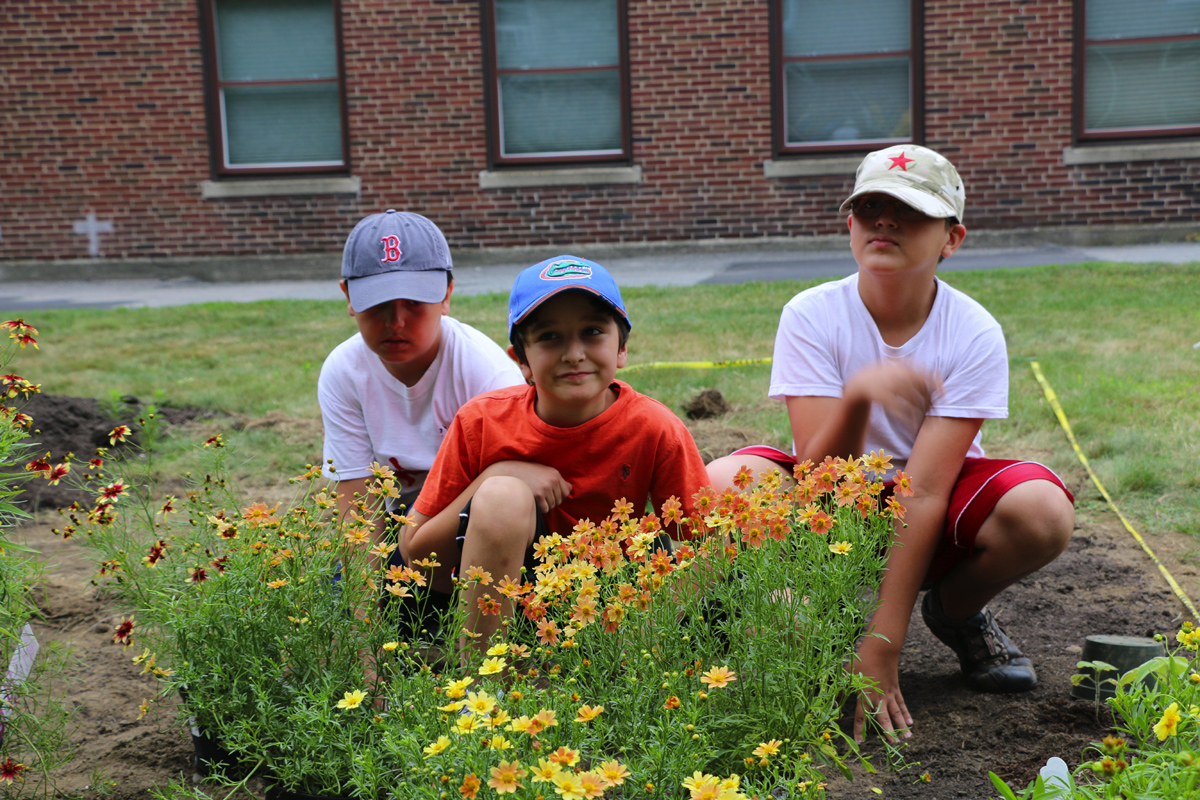
In June I wrote (here) about my friend Jean Devine’s latest venture, “Meadowscaping for Biodiversity.” Jean hoped to get middle-grade kids involved in creating a meadow where once there was lawn juiced with chemicals — and learning how meadows provide habitat for many small creatures. She conducted a pilot program over the summer with her collaborator Barbara Passero and an 8th grade science teacher, Steve Gordon.

Jean e-mails her friends and fans, “We’re delighted to announce that our 8-week summer pilot of “Meadowscaping for Biodiversity” in Waltham, MA, was a great success! The three of us, along with a strong soil turner and a landscape designer, worked with a few boy scouts (and their mothers) to repurpose a 400 square foot plot on the east lawn of Christ Church Episcopal (750 Main St. across from the Waltham Public Library) into a meadow filled with native plants.

“Why did we do this? To engage youth in fun, project-based, outdoor education, while providing native plants as habitat — especially food source — for bees, caterpillars, butterflies, birds, etc.

“The end result? An aesthetically pleasing product and proof that Meadowscaping for Biodiversity, a generative/environmental education program, pays a solution forward to the next generation by inspiring, engaging, and empowering students to be problem solvers and stewards of the Earth. All involved, including the vendors who supplied plants and garden materials, were able to see that this program helps heal the Earth and improve outdoor educational opportunities for youth ‘one meadow at a time.’ Now all we have to do is convince funders, teachers, city planners etc. of the benefits of this program!”

If you fit any of those categories or just want to learn more, contact information is here.

biodiversity-kids

Read Full Post »

The radio show Living on Earth is a font of useful and interesting environmental knowledge.

In a recent show, host Steve Curwood spoke with “agronomist Frank Forcella about how he modified the common sand blaster to simultaneously fertilize and weed food crops.”

Curwood introduces the topic thus, “If you’ve ever weeded a garden, you know it’s a backbreaking job, and if you have row upon row of crops, it’s, well, it’s easier to use herbicides. But then the crop is not organic. Enter a team of soil scientists for the U.S. Department of Agriculture who harnessed a common tool of the building trades to blast away those unwanted weeds without chemicals. Joining me to explain this breakthrough is Frank Forcella. He’s an agronomist with the USDA’s North Central Soil Conservation Research Laboratory.”

Forcella then tells Curwood how he got the idea. “One of my hobbies here in Minnesota is growing apricots, and 2007 happened to be a wonderful year for apricot production in Minnesota.

“We ended up with about a five gallon bucket worth of apricot pits, and I was wondering what can we do with apricot pits. One of the things you can do with them is to grind them up and use then as a grit in sandblasters, and I was talking about that with one of the fellows who works with me, Dean Peterson, on our way out to our field plots. Both of us work on weeds, and we had more or less simultaneously had the idea, ‘I wonder if you could use sandblasters to kill weeds.’ Initially we thought that had to be the dumbest idea in the world, but it was one of those ideas we just couldn’t get out of our heads.”

Read how a dumb idea led to a great invention here.

Photo: Frank Forcella
The four-row grit applicator in action, driven by Charles Hennen.

Read Full Post »

Fireflies are not as ubiquitous as they used to be, and that’s a concern. They are like the canary in the mine. If fireflies go, other species go.

What has caused the decline? Lawn chemicals? Rapid urbanization? Scientists want to know.

NY Times reporter Alan Bllinder writes from Greenville, South Carolina, about a crowdsourced research project to help figure out what’s going on.

“As dusk faded over the home of Jeremy Lyons and his sons on a recent evening here, one ritual of the Southern summer — the soft hiss of a can of mosquito repellent — signaled that the start of another was near.

“And although Raine Lyons, 6, grimaced, coughed and flinched during his dousing with bug spray, he soon stood near a chain-link fence in his backyard and shouted, in speedy succession: ‘Found one! Found one! Found one!’ Mr. Lyons, perched on his knee next to Raine, was almost completely silent as he tapped the screen of his cellphone again and again and again.

“There, on a weeknight in a South Carolina backyard, a father and his son, in their different ways, were counting fireflies. But an evening among fireflies was not merely a modest round of summertime nostalgia; instead, it was part of a multiyear quest by Clemson University researchers to measure the firefly population and investigate whether urbanization, especially here in the fast-growing South, threatens the insects.” Read how they are going about it here.

I hope we can reverse the decline of fireflies. I have so many happy memories of them from my childhood and my children’s childhood.

Photo: Jacob Biba for The New York Times
Raine Lyons counting fireflies alongside his father, Jeremy, in Greenville, S.C., as volunteers in the Vanishing Firefly Project of Clemson University.

Read Full Post »

Ron Finley is a man of humble ambitions. He aims to save the planet, beginning with urban gardeners. I heard an interview with him on America’s Test Kitchen as I was driving home today.

From his website: “Let’s grow this seed of urban guerrilla gardening into a school of nourishment and change. Help spread his dream of edible gardens, one city at a time. …

“In part of this effort, Ron is planning to build an urban garden in South Central LA that will serve as an example of a well-balanced, fruit-and-veggie oasis – called ‘HQ.’ Inspired by the idea of turning unused space such as parkways and vacant lots into fruitful endeavors, this garden and gathering place will be a community hub, where people learn about nutrition and join together to plant, work and unwind. HQ will create a myriad of jobs for local residents, and this plot of land will be a self-sufficient ecosystem.”

It all started, according to Ron, when he “wanted a carrot without toxic ingredients I didn’t know how to spell.” He began to plant food near his house, on a strip by a road.

“The City of Los Angeles owns the ‘parkways,’ the neglected dirt areas next to roads where Ron was planting. He was cited for gardening without a permit.”

After Ron “started a petition with fellow green activists, demanding the right to garden and grow food in his neighborhood … the city backed off.” More here.

When asked on America’s Test Kitchen if his gardens were not just about obesity and healthful eating but also about making neighborhoods more livable, Ron said he wanted to do that for the whole planet.

Read Full Post »

Discouraging as it is to read that many children won’t eat the healthful food schools are now providing, I take heart that at least they are learning to compost.

Al Baker writes at the NY Times, “The sad voyage of fruits and vegetables from lunch lady to landfill has frustrated parents, nutritionists and environmentalists for decades. Children are still as picky and wasteful as ever, but at least there is now a happier ending — that banana-filled bin is a composting container, part of a growing effort to shrink the mountains of perfectly good food being hauled away to trash heaps every year.

“New York City’s school composting program, kicked off just two years ago by parents on the Upper West Side, is now in 230 school buildings in Manhattan, Brooklyn and Staten Island, and is expected to more than double in size and reach all five boroughs in the fall, with an ultimate goal of encompassing all 1,300-plus school buildings. …

“The hope is that by building up composting in school, the city will help the environment, instill a sense of conservation in schoolchildren and, critically, save some money. The city paid $93 per ton in 2013 to dump in landfills, up from $68 in 2004. Composting saves the city $10 to $50 per ton, because the cost is offset by the sale of the end product, according to the Sanitation Department.” More here.

I tend to think kids will eventually eat something nourishing if that’s what’s available and they’re hungry. All I know is my kids eat everything now that they are grown-ups. (Still laughing that John came home from college and said, “How come you never told me I like mushrooms?”)

Photo: Hiroko Masuike/The New York Times

Read Full Post »

An Associated Press blurb in the Globe caught my eye today.

Here it is in its entirety: “Unity Plantation, Maine. A two-year quest by Unity College students to fit a black bear with a video collar has succeeded. The Morning Sentinel said Professor George Matula and about a dozen students trekked deep into a 4,000-acre patch of woods off Route 139 Thursday to fit the collar on a trapped bear. While one student kept the angry bear’s attention, another sneaked in from behind to deliver a shot to knock it out.”

I had to find out more. The website of Unity College, “America’s Environmental College” located north of Augusta in Waldo County, explains it wasn’t a professor-assisted prank.

“With permission from the Maine Department of Inland Fisheries and Wildlife, the Unity College Bear Study team does hands-on research to provide information on a bear population in Central Maine. Students work with faculty mentor George Matula and alumna mentor Lisa Bates ’08 to tag, tattoo and radio collar bears to collect data and monitor activity.” More at Unity College, here.

But about actually collaring the bear. …

Matt Hongoltz-Hetling  writes at the Kennebec Journal/Morning Sentinel, “Once Matula gave the all-clear, the students descended on the bear, intent and serious as each performed a well-defined role. They still spoke in whispers as they took blood samples, checked its vital signs and prepared to affix the all-important video collar to its neck. …

“One student, Leon Burman, cradled the bear’s head in his lap while he pulled back its lips, using a tattoo gun to leave an identification mark on the gums.

“[Student Jonah] Gula lifted the bear’s front right paw, inspecting a raw and red line defining the previous capture’s cable. Gula speculated later that it meant the bear was pulling at its snare more aggressively than most. The team treated it with a first-aid kit.” More here.

Photo: Mark Bennett

Read Full Post »

My friend Jean Devine is always up to something interesting. A Brown U grad, with an MBA from Simmons, she used to work in investor relations but in recent years has been testing the waters of social entrepreneurship.

Her latest initiative, with Barbara Passero of Sandpiper Creative, is called meadowscaping and is intriguing on many levels.

With access to a Waltham church lawn for a summer youth program, Jean and Barbara will work with kids to convert the yard into a meadow that uses native species from Garden in the Woods and provides a habitat to the bugs and other small creatures that make a healthy environment.

From the Meadowscaping for Biodiversity website: Meadowscaping “is an outdoor, project-based, environmental education program that provides middle school youth with real-world experiences in STEAM learning (Science, Technology, Engineering, Arts and Math), while inspiring and empowering them to address challenges to the environment and our society.

“Today, few children spend time experiencing Nature and the benefits of outdoor recreation, education, and contemplation. Founder and former Director of the Children and Nature Network (C& NN) Richard Louv coined the phrase nature-deficit disorder to describe the negative effects of reduced outdoor time on children’s development. …

“Children who spend little time outdoors may value nature less than children who spend time outdoors in free play. Similarly, children who feel part of something bigger than themselves may … understand their dependence on a clean environment and know that they are responsible for caring for the Earth as their home.” More here.

The idea behind the meadowscaping summer program is that children, both at a young age and as they become adults, can actually do something about the environment.

Remember our post “The Doctor Is In” about the woman who sets up in a Providence park to listen to your worries about global warming (here)? Stop worrying and do something, say the meadowscape entrepreneurs. Give up lawn chemicals, plant a meadow, provide a home for tiny necessary critters, and work to make change.

white-iris-in-morning

Read Full Post »

At the radio show Living on Earth, Steve Curwood recently interviewed Gary Cook of Greenpeace about an effort to get tech companies to be greener.

CURWOOD: “Back in 2012, you criticized Apple for using carbon-intensive energy from coal plants to power its servers. …

COOK: “Just after we spoke, they made a commitment to be 100 percent renewably powered, and as the end of last year, they even made that goal. So, it’s been quite a big shift.

CURWOOD: “100 percent renewable energy. How’s that possible?

COOK: “It requires some effort. Apple has done a lot in North Carolina where they have their largest data center in terms of deploying two different solar farms and an onsite fuel cell that’s powered with biogas energy, so it’s all renewable. They have several other data centers. … In Oregon they’re using wind; in Nevada they’re using solar.

“So they’ve actually shown a commitment from the top, been very aggressive, probably the most aggressive of any of the brands to make sure as they grow, they’re using clean energy.

CURWOOD: “Biogas. Where are they getting that from?’

COOK:” Currently, they’re getting that from landfill and some other renewable sources. The landfill is methane capture in the southeast, and they’re having that piped to where their data center is in North Carolina.”

The radio interview covers several other efforts tech companies are making. It’s a good thing, too, when you consider, as Living on Earth points out, “If the Internet were a country, it would be the sixth largest consumer of electricity in the world.” More here.

Photo: George Nikitin, Greenpeace
The Greenpeace Airship A.E. Bates flies over Facebook headquarters with a banners reading “Building a Greener Internet” and “Who’s The Next To Go Green?” Apple, Facebook and Google have committed to powering their data centers with renewable energy.

Read Full Post »

Some posts at Andrew Sullivan I only need to glance at briefly and bells go off: for example, this entry about an artist who works with coral.

Andrew quotes Amelia Urry writing about Courtney Mattison, who became enamored of coral while studying conservation biology at Brown University and moonlighting at the Rhode Island School of Design.

“Mattison’s newest piece, Our Changing Seas III,” says Urry at Grist, “depicts a hurricane-spiral of bleached corals coalescing to a bright center. You can read it as a message of hope or one of impending doom, depending on your disposition …

At the heart of Mattison’s artwork is her desire to inspire real-life changes in how people view and treat the world’s oceans and environments. Similar to the Our Changing Seas series, Courtney Mattison’s Hope Spots collection comprises 18 vignettes, each of which represents a vital marine ecosystem in its ideal form (that is, protected from various threats such as global warming or pollution).” Read more at Grist, here.

Art: Courtney Mattison
“Our Changing Seas III,” a ceramic coral reef

Read Full Post »

Photo: Masaki Miya et al. Wikimedia Creative Commons
Anglerfish use bioluminescence to attract their prey in the darkest depths of the ocean.

When John was little, he liked a book called Fish Do the Strangest Things. Strangeness is a great focus for a nature book, because everyone likes offbeat critters.

Steve Curwood, founder of the radio show Living on Earth, recently interviewed the author of a book that focuses on the strangeness of ocean life.

CURWOOD: “In an engaging new book called The Extreme Life of the Sea, biologist Steve Palumbi and his novelist son Tony deepen our understanding of how strange sea life has managed to survive against all odds. … Why did you write this book. Why now?

PALUMBI: “Well, the real reason is that we’re trying an experiment: can you take the narrative style and approach that a novelist would use and combine it with what a scientist would do? … You don’t really care about the plot until you care about the characters, and so we wanted to write a book that made you care about the characters.

CURWOOD: “Now, you write about the extreme life of the sea, the oldest, the hottest, the shallowest, to name a few. Why did you choose this approach?

PALUMBI: “Because it was a way of getting people’s attention to the really sort of amazing things that these critters do. Organisms in the sea live in some of the hottest places, they live in some of the coldest places, and how they do that is something marine scientists have paid a lot of attention to. So it was really a way to make it more engaging, more fun, and to let us move credibly between different kinds of organisms all in the same chapter. …

CURWOOD: “You had one extreme that you called immortal.

PALUMBI: “That’s an amazing jellyfish called turritopsis, and it has the remarkable ability to age in reverse. So when the environment is bad, this animal can essentially go from its adult body form back, back, back to its larval form, and then start all over again. … It’s called transdifferentiation. It’s the only critter known to be able to do that.”

More here, where you can read the rest of the transcript and listen to the recording. It’s all pretty amazing.

Photo: Eddie Welker, Flickr Creative Commons 2.0)
Clownfish

Read Full Post »

I used to love finding little red salamanders when I was a child.

I didn’t know they played an important role in the ecosystem, even balancing out processes that contribute to climate change. Of course, when I was a child, nobody talked about ecosystems or climate change. But I’m glad to learn salamanders are important. Small things often are.

Writes Richard Conniff in the NY Times, “According to a new study in the journal Ecosphere, salamanders play a significant role in the global carbon cycle. …

“The study — by Hartwell H. Welsh Jr., a herpetologist at the United States Forest Service’s research station in Arcata, Calif., and Michael L. Best, now at the College of the Redwoods in Eureka, Calif. — notes that salamanders’ prey consists almost entirely of ‘shredding invertebrates,’ bugs that spend their lives ripping leaves to little bits and eating them.

“Leaf litter from deciduous trees is on average 47.5 percent carbon, which tends to be released into the atmosphere, along with methane, when the shredding invertebrates shred and eat them.

“If there aren’t as many shredders at work and the leaves remain in place, uneaten, they are covered by other leaves. … The anaerobic environment under those layers preserves the carbon until it can be captured by the soil, a process called humification.

“At least in theory, having more salamanders in a forest should mean fewer shredding invertebrates and more carbon safely locked underground.”

Read how they tested their theory, here.

 Photo: Todd W. Pierson/University of Georgia

Read Full Post »

No matter how much you like your routine or how pleasant your surroundings, sometimes you just have to get up and go out. Today I needed a change of scene so, in spite of the freezing temperatures and high wind, I went to look at some art.

The Design Museum is not far from my office, and the folks there come up with lots of good projects. I blogged here about their Street Seats, an array of public benches designed by creative people from around the world.

This being Design Week in Boston, I decided to check out the exhibit space they are using in a new apartment building called 315 on A, a lovely renovation of an 18th century warehouse for coffee.

The new exhibit is called Green Patriot Posters and features handsome posters from professionals as well as the pretty impressive results of a school poster contest on the conservation theme.

Many of the posters explicitly reference WW II posters. You know: “Loose lips sink ships” and all that. Here, the posters urge viewers to pursue a more sustainable way of life and fight global warming. More.

Be sure to check the poster over the left shoulder of the woman speaker in this video. That was my favorite in the show because it made me laugh out loud. I think you can see a Paul Bunyan figure with an ax. He is looking at the tree he was going to cut with an uncertain expression as the tree is growing out of his foot.


Read Full Post »

« Newer Posts - Older Posts »