Feeds:
Posts
Comments

Posts Tagged ‘environment’

In case anyone thought that this blog wasn’t eclectic enough, I’m linking today to a story about garbage collection in Taiwan.

“For several years, Taiwan’s garbage trucks have played classical music as they travel through crowded residential areas, drawing forth residents with their garbage. Conceived by Taiwan’s Environmental Protection Administration as a way to decrease pests and odors in outdoor public trash disposal areas, the trucks musically notify residents that they are to bring their garbage directly to the trucks, ensuring that the garbage never sits on the curb attracting vermin and releasing odors.”

I wonder how two-career families who aren’t home to respond to the music deal with this. Read more on Taiwan’s approach at New York’s classical music station, WQXR.

Meanwhile, at Los Alamos, Americans show they can innovate in garbage collection, too. I think my grandson will like this truck.


Read Full Post »

Living on Earth, a radio show based in Somerville, Massachusetts, and distributed by Public Radio International, recently did a story on East Africa and the worst drought in 60 years. Bobby Bascomb interviewed musicians who decided to do something about it, letting their voices be heard in the way they know best.

They call themselves the Caravan of Hope, says Bascomb. “More than 25 bands from 11 different African nations are traveling across the continent to raise awareness about climate change … as international climate talks begin in Durban, South Africa.”

Singer Angella Katatumba of Uganda explains, “We use our voices to get people fired up and educate people about climate change in Africa. Uganda usually has an amazing climate. It’s usually warm and just perfect. These days, when it’s hot it’s way too hot. When it’s cold it’s way too cold. When it’s wet, it’s storming. We’re seeing things like landslides, which we’ve never had before.” So she’s taking her concern on the road. Read more here.

Read Full Post »

From the Boston Globe comes a curious bit of research suggesting that videogames may allow people to “burn off the desire or the time to commit a crime.” Across U.S. counties from 1994 to 2004, a greater number of videogame stores is associated with less arson, car theft, robbery, and mortality.

Don’t you love counterintuitive findings like that? Does it mean that fantasy (or “Queen Mab” as Charles Dickens contended in Hard Times) continues to play a valuable role in our lives?  Read about the research here.

And while we are on the subject, the Innovators Insights listserv linked to an article on how playing a videogame has assisted city planners in their work.

“IBM has partnered with the Environmental Protection Agency to develop CityOne, a game simulation that provides city planners with an interactive tool to help them investigate complex energy and water interactions, learning how best to achieve certain performance goals under budget. Outside of the U.S., the tool has been used by governments in China, France, and South America.” Read more here.

These are just a couple examples. As Jane McGonigal, the author of Reality is Broken has written, today videogames are being used to “change the world.”

Read Full Post »

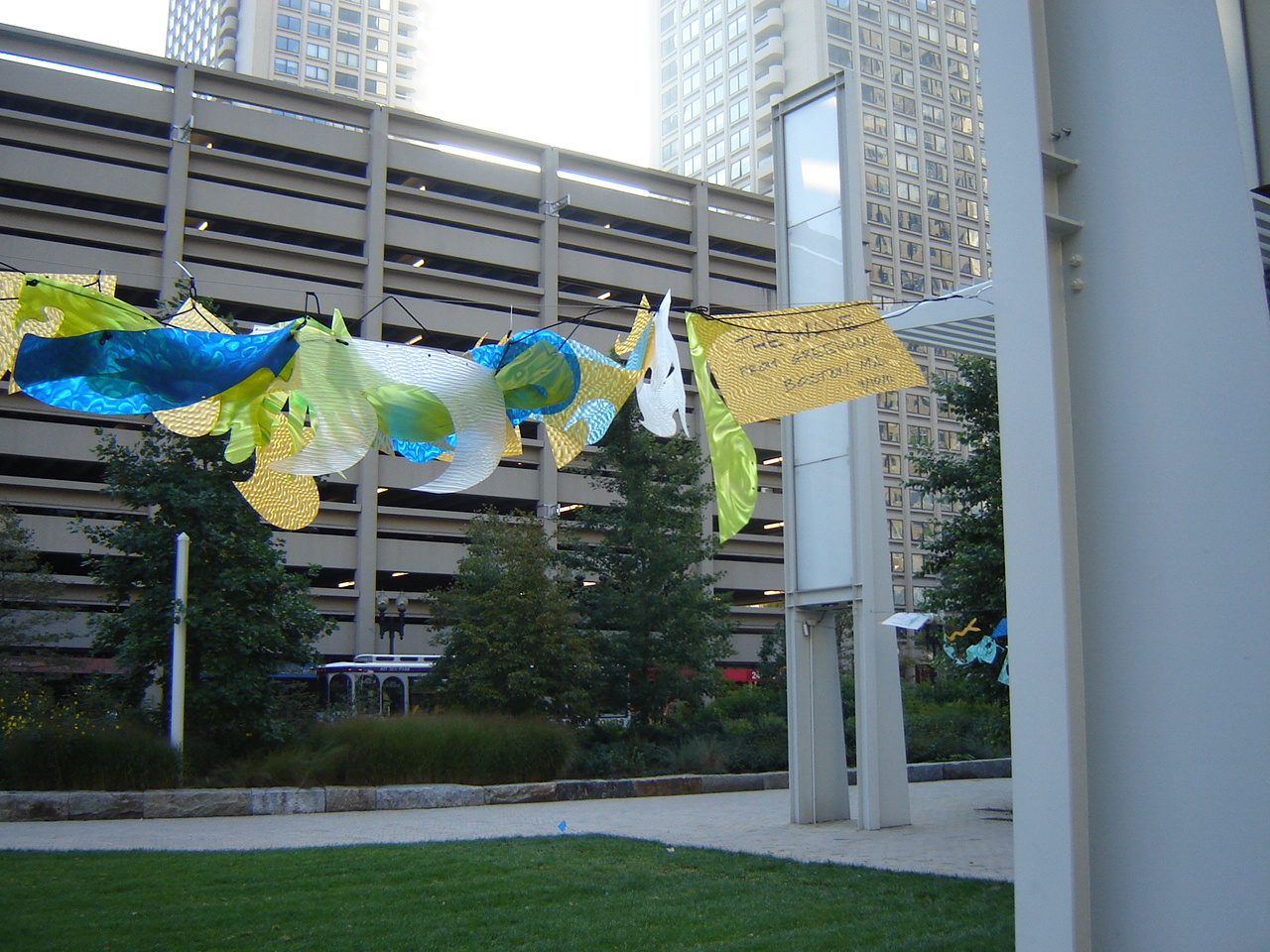
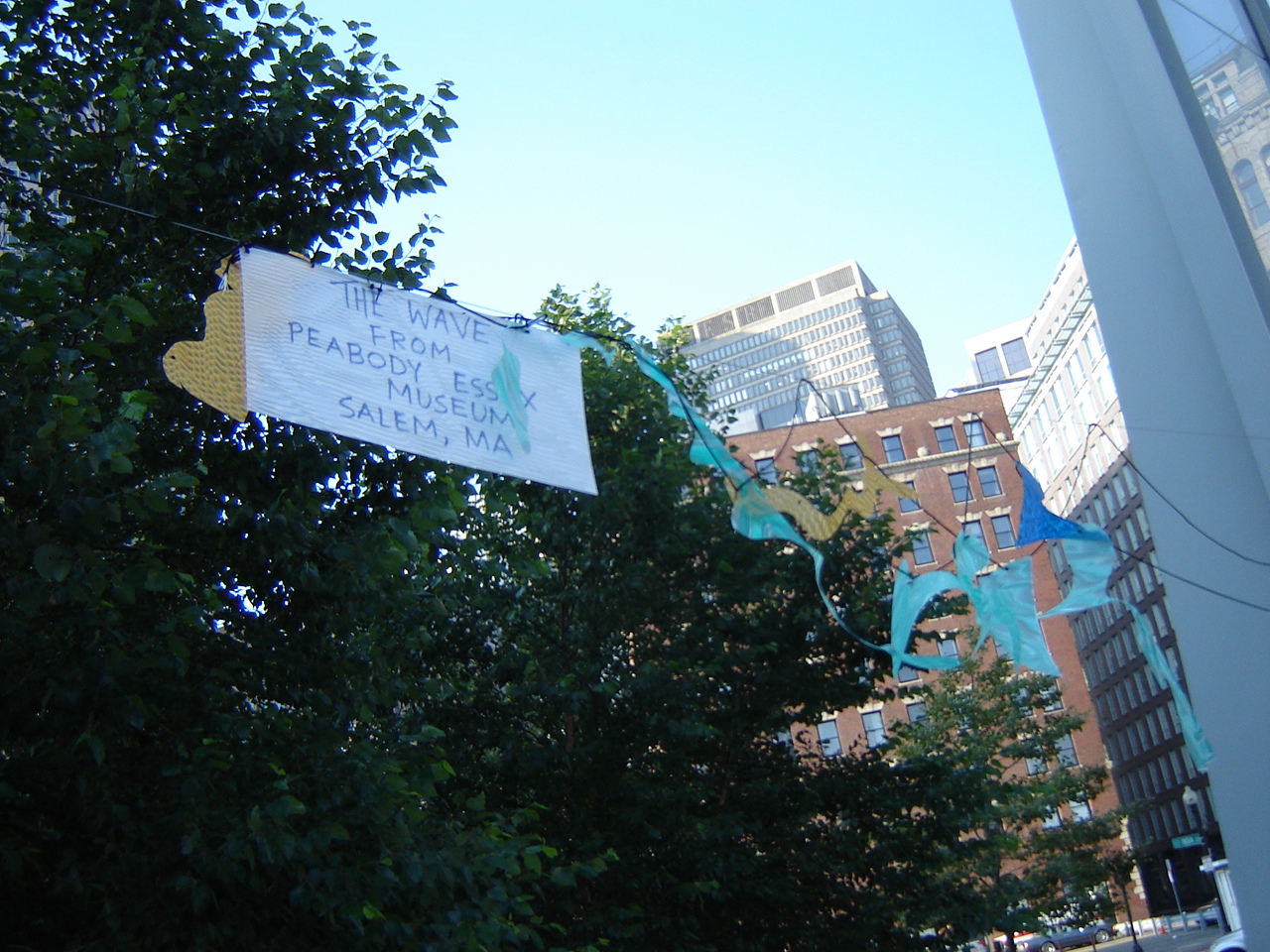
More curiosities seen on the Rose Kennedy Greenway in Boston: Waves. The first wave pictured below has a sign saying, “From the Greenway.” The second says, “From the Peabody Essex Museum, Salem, MA.”

This website helps to explain that an urban collaboration led by artists Susan Hoffman Fishman and Elena Kalman is behind this project, “The Wave: An Interactive Public Art Installation Fostering Global H20 Awareness.” I love it, but it didn’t raise my water awareness immediately because I had trouble figuring out what it was. Thank goodness for Google.

A couple weeks ago, I wrote to the Greenway people (and to the city of Boston) about bikers who were using the Greenway paths despite signs saying not to use “bicycles, skateboards, personal transportation, i.e. Segway.” I like that people bike instead of use cars, but not on footpaths. The signs cause walkers to lower their guard. I’ve seen near misses.

The city wrote me: “Thank you so much for your email. It is illegal to ride on the Greenway. We at the City of Boston are aware of this issue. We will be installing a bike lane on the road for the cyclists this season. Research shows that that bike lanes dramatically reduce sidewalk riding.”

The Greenway people wrote: ” For the safety and enjoyment of all Greenway visitors, biking is not permitted anywhere in the parks. When our horticultural and maintenance staffs witness a cyclist, they will ask them to dismount; City of Boston Police Department handles enforcement.  … The City of Boston installed five new Hubway stations along the Greenway.  This fall, the City will be installing painted bike lanes onto the street which will help alleviate the problem in the parks.”

(At the moment the Boston police are more preoccupied with Occupy Boston. They arrested 141 Occupiers early Tuesday because they had spread into the Greenway from Dewey Square. Funny how a few days can change one’s perspective. Today the concerns of the Occupiers and the concerns of the police both seem more serious than bikes on footpaths.)


Read Full Post »

The other day on an American Public Media radio broadcast, I heard a story about Better Block Houston and its approach to urban revitalization. “The Better Block is a national movement which originated in the Oak Cliff neighborhood of Dallas. Better Block projects have improved neighborhoods in Chicago, Dallas, Fort Worth, Portland, and Memphis.”

Concerned residents focus on a vision for one block and throw a daylong event showing the potential.  The idea is that visitors might come to see the event and its special one-day amenities and would then notice cool things about the area and decide to return. New businesses might decide to move in. Sounds like wishful thinking, but the Better Block folks claim the approach is attracting more foot traffic and business.

“The ‘Better Block’ project provides a one-day living workshop of how a ‘Complete Street’ works, by actively engaging the community, helping them to visualize better outcomes for the future, and empowering them to provide feedback in real time. Better Block is a fun and interactive demonstration of a ‘Complete Street’ — and what it can do for a neighborhood. Complete Streets …  are designed and operated to enable safe access for all users. Pedestrians, bicyclists, motorists and transit riders of all ages and abilities must be able to safely move along and across a complete street. Complete Streets make it easy to cross the street, walk to shops, and bicycle to work. They allow buses to run on time and make it safe for people to walk to and from train stations.”

In Boston, a young couple I know, Sam and Leslie Davol, had an idea to set up a temporary library in Chinatown, which had not had a branch library in decades. Their project made use of a storefront that had been vacant during the economic downturn.

Leslie just sent out an e-mail about what they’re working on next: The Uni Project.

“Many of you know the Storefront Library, which Sam and I undertook in a vacant storefront in Boston’s Chinatown last year. That project had a big impact on us, just as it did on the Chinatown community. Since then, we’ve helped several local groups take over the books and Chinatown’s library advocacy, and we’ve spent time exploring a broader need for places like libraries in urban neighborhoods and cities generally. …

“The Uni is a portable infrastructure that will allow us to quickly deploy and create staffed, open-air reading rooms in almost any available urban space. The Uni is based on a system of cubes, and the books inside those cubes are just the start. Like libraries, we plan to use the Uni to provide a compelling venue for readings, talks, workshops, and screenings, through partnerships with local organizations and institutions. And the best part, once we fabricate this lightweight infrastructure, we can keep it running, serve multiple locations, and even replicate it.” Read about The Uni Project here.

8/11/12 update on Uni Project here. Now it’s even in Kazakhstan.

Read Full Post »

I was reading about the latest enthusiastic group of LEAF interns in the Block Island Times tonight and decided to look up more information on the program.

The Leaders in Environmental Action for the Future (LEAF) program is an initiative started by the Nature Conservancy (TNC) 17 years ago. According to the TNC website, it “provides paid summer internships for high school students and helps educators from environmental high schools share best practices and scientific resources. The long-term goal of LEAF is to support more than 30 environmental high schools across the country, ultimately serving over 20,000 students.”

The Block Island Times notes that this is the third year of the island’s participation. The three girls who are currently interning have come with their mentor come from Atlanta. Intern Niniola Mark tells the newspaper, “This is my first time in New England, and I also saw the ocean for the very first time.” The article doesn’t say what high school the girls attend, but the only one in Georgia that I see on the TNC site is the Arabia Mountain High School.

What fun to go to an environmental high school!

Read Full Post »

Heard this interview today on the great environmental radio show Living on Earth. Tom Montgomery Fate talks about  trying to “live deliberately” like H.D.  Thoreau and connecting to nature and memories of his father in the woodland cabin he often escapes to. His book is  Cabin Fever: A Suburban Father’s Search for the Wild.

In the elementary school Suzanne attended, all second-graders learn about Thoreau, and as a parent volounteer, I went with her class to the cabin site at Walden Pond. The children had a quiz sheet with questions like, “What sounds would Thoreau have heard in his cabin?” The teacher asks,  “An airplane?” (All the kids say, “No-o-o!”) When the Living on Earth interviewer asked the author about his own retreat being near a noisy highway and a short walk to a pub, I was surprised that he didn’t point out that a Boston-Fitchburg train ran right along the edge of Walden Pond in Thoreau’s day, and that the famous naturalist had an easy walk back home to Concord for a Sunday dinner with his mother. Fate did explain that the Walden mystique was all about a mindset and keeping a balance between what’s important and the often numbing dailiness of modern life.

Asakiyume comments: Living deliberately. Something that’s very important to me about that concept is the notion that you can do it anywhere, in any circumstances. I’ll grant that some circumstances make it really hard: if you’re in a job you hate, or a relationship you hate–basically, if there’s some part of your life that’s putting a huge negative drain on you–I think it’s very hard. But I do think that living deliberately can be done in a suburb, in the country, in a city… not just in the wilderness. I think Thoreau wanted to mark, in actual space, his separation from mundane daily life, and I understand that. But I think it’s the mindset, not the location, that’s important.  

Read Full Post »

« Newer Posts