Feeds:
Posts
Comments

Posts Tagged ‘environment’

How many times lately have I read “in these uncertain times” and “now more than ever”? Crises bring these phrases out.

So how do we inject the words with extra special urgency? I find myself thinking like Charlie Brown (or was it Lucy?) trying to fill up a book report: Now more than ever ever ever really and truly and I’m not kidding, programs about the environment such as Living on Earth are important.

Some of the Living on Earth shows — about melting ice and rising seas, for example — are crucial to our understanding of what we face. Others, like the one about a certain pig in Haiti, underline the interconnectedness of the environment and local economies. You can’t wipe out an animal people rely on and expect everything to be fine.

From Living on Earth: “In Haiti, the creole pig was a staple of the peasant economy, bringing families economic stability, devouring food waste and occasionally becoming an religious sacrifice. But as Allison Griner reports, disease killed many creole pigs and American efforts to control the swine flu took the rest. Efforts to replace the pig failed, but now peasant farmers are slowly rebuilding the creole pig herd.

“GRINER: To reverse the trend, [2015 presidential candidate Jean-Baptiste] Chavannes and his colleagues in the peasant movement decided to reintroduce the creole pig — or at least a hybrid that could fill its place.

“CHAVANNES: We want the return of the creole pig. So we led a fight, and over the years, the minister of agriculture finally started a program for the repopulation of the pigs. …

“GRINER: But just as the new pig herd was starting to grow, once again disease intervened. This time, the culprit was teschen, a virus that can kill a pig within days. Six years ago, it started to spread. And decades of work were lost. …

“Still, the fight is not yet over for the creole pig. Vaccines for teschen are already being tested in Haiti, and Chavannes hopes partnerships with international NGOs will help fight this latest disease. Part of Chavannes’ mission is to rebuild the peasant economy. But to reach that goal, bringing back the creole pig is a necessity, he says.

“CHAVANNES: We must. [Laughs] We must, and like I said, pig farming is indispensable for reestablishing the peasant economy. …

“GRINER: Already, the race to save Haiti’s pigs is well underway. This past spring, an official from the ministry of agriculture announced that the 500,000 doses of the teschen vaccine had been produced. The official says they are currently available for farmers to use.”

At Living on Earth, you can read what the pigs meant to the farmers, why they got killed off, why American pigs were a terrible replacement, and what kind of livestock peasants decided to raise while they are waiting for the creole pigs to come back.

Photo: Allison Griner
Pig in Delmas, Port au Prince, Haiti

Read Full Post »

Recently, Kara Baskin wrote for the Boston Globe about a couple of young environmental philanthropists.

Arlington (Mass.) siblings Will Gladstone (age 12) and Matthew (age 9) “run the Blue Feet Foundation, which manufactures bright blue socks with bird logos to support the endangered blue-footed booby, a threatened species found in the Galapagos Islands.

“Proceeds benefit the Galapagos Conservancy, and the brothers have raised $18,000 since launching a few months ago.

“The idea began in science class at the Fessenden School in West Newton last year. …

“The brothers started a logo contest among pals. Dad Peter Gladstone helped the pair create a final design on logo site 99designs.com and located a manufacturer to to produce the cotton footwear. …

” ‘We put a thank you card in each package, write out the label, and talk about what this will go to. We ask for photos of them wearing the socks,’ Will says. …

“Will also plans to expand his business a bit, perhaps shifting to red socks for Valentine’s Day. (Yes, there is also a red-footed booby.) …

” ‘My brother says, “If we go out of business, I hope it’s because we save the birds.” ‘ ”

Read more at the Blue Feet Foundation, here. There’s a cute photo of three generations of one family wearing the blue socks in memory of their trip to the Galapagos Islands.

6/21/17. I have to add this this heavenly surreal animation I just saw, Mr Blue-Footed Booby: https://slipperyedge.com/2017/06/08/mr-blue-footed-booby/.

Photo: chutupandtakemykarma
The Galapagos bird the blue-footed booby is endangered

Read Full Post »

What is it about Nordic countries that they seem to find more solutions to global challenges than the rest of us? Do they have fewer challenges to worry them, better education, more ability to focus?

Here are some of their successful and replicable tactics for combating global warming.

Christian Bjørnæs writes at Cicero, “By scaling up just 15 proven Nordic solutions, countries all over the world can save 4 [gigatons] of emissions every year by 2030, which is as much as the EU produces today. The costs for this scale-up equal the amount spent in just 9 days on fossil fuel subsidies.

“These results come from the Nordic Green to Scale study which was launched during the UN Climate Conference in Marrakech. …

“ ‘The main concern decision makers have is that it’s either too difficult or too expensive to rapidly reduce emissions,’ says Senior Advisor Oras Tynkkynen, who led the Nordic Green to Scale analysis on behalf of [the Finnish Innovation Fund Sitra].

“ ‘Our objective with this study is to highlight what different countries have already achieved on climate action and what other countries can learn from their successes.’ …

“Urban Danes cycle on an average almost 3 km every day. If other countries followed the example of Denmark and promoted cycling in cities, it would reduce emissions by almost as much as Slovakia produces in a year.

“In Finland, most of industrial and district heating is provided with energy efficient combined heat and power production (CHP). If other countries used CHP like this, it would reduce emissions by almost as much as Japan produces in a year.

“Iceland produces almost 30% of its electricity and most of its heat with geothermal energy. If countries with significant geothermal potential started using it like Iceland does, it would reduce emissions by more than Denmark produces in a year.

“Last year, almost every fourth new car sold in Norway was an electric or plug-in hybrid vehicle. If other wealthy countries used as many electric vehicles as Norway does, it would reduce emissions by almost as much as Denmark produces in a year.

“Sweden has the world’s highest number of heat pumps per population. Scaling up the solution to selected European countries would cut emissions by as much as Cuba produces every year.

“In addition to direct emission reductions, the 15 solutions also create considerable co-benefits. These include improved air and water quality, higher energy security, more local jobs, lower fuel bills, less traffic jams, and sustained biodiversity.”

More here.

Photo: Cicero
Biking can help reduce global warming.

Read Full Post »

In Denmark, a beekeeping program is not only beneficial to the environment but a good way for refugee workers to settle in to a new culture.

Jennifer Hattam writes at Take Part about bees atop Copenhagen’s convention center that pollinate crops, produce honey, provide employment, and help flavor a local beer.

“The honey and the beer are the fruits of the innovative project Bybi, named after the Danish word for ‘city bee.’ Its mission: to use urban beekeeping to create a greener Copenhagen, connect residents with the city around them, and bring together and employ people from diverse backgrounds, including refugees and the formerly homeless.

“Syrian beekeeper Aref Haboo is among Bybi’s small staff. He kept dozens of hives back in his home village while also working as a civil servant and agricultural consultant. Like millions of refugees fleeing Syria’s civil war, Haboo made the treacherous journey to Europe, part of it smuggled in the cargo hold of a truck, leaving behind his wife and three children to find a safer place for them all to live. A year ago, he was able to reunite his family in Denmark. …

“Haboo recently helped teach a season-long apiculture course to a mixed group of around 20 Syrians, Africans, and Europeans, who produced 450 kilograms of honey from hives in a Copenhagen park. Graduates who want to continue working with bees will receive support from Bybi, and proceeds from the sale of the first course’s honey will help fund training sessions.

“ ‘A lot of our residents have difficulties getting into the Danish labor market, whether because of language issues, skills gaps, or health problems. Working with Bybi is good for them in terms of getting out to meet people and doing something constructive, something they can be proud of,’ says Simon Christopher Hansen, cultural coordinator for the Copenhagen public housing association 3B. …

“With relatively high rates of winter mortality among honeybees in Denmark, Bybi’s urban hives also help ensure that bee populations stay healthy — along with the green environment they nurture and depend on.

“In a way, [social entrepreneur Oliver Maxwell, who founded Bybi in 2010] sees the hive as a model for Bybi and for humanity. ‘We’re looking at ways we can work together that protect our communities and enrich our environment,’ he says. ‘That’s what bees do: They create bigger apples, richer strawberries; they help everything thrive.’ ”

More here.

Photo: Bybi
Beekeeping in Copenhagen helps refugees and the environment.

Read Full Post »

I know I’m a broken record talking about what one determined person can accomplish, but I want share another example.

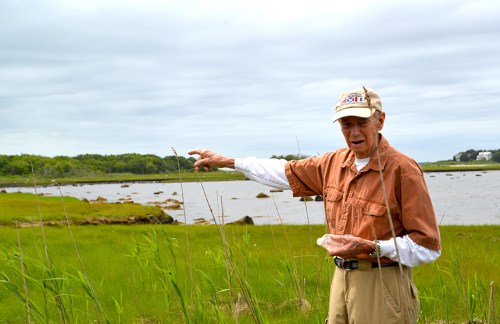
At ecoRI News, Sonya Gurwitt writes about a retired Massachusetts harbormaster who made up his mind to put an end to what was polluting a cove near his home.

Horace Field, says Gurwitt, “has lived only meters from Brandt Island Cove for nearly two decades. The water’s edge is connected to Field’s backyard by a short, grassy path. …

“Field wanders through the grasses along the shoreline, untangling the occasional piece of plastic or bit of Styrofoam from vegetation. … Field pinches a a small piece of dirty Styrofoam between his fingers, examining it. This, he said, is a small reminder of the pollution that used to cover the salt marsh — Styrofoam everywhere. …

“It was during his tenure as harbormaster that he noticed more and more pieces of Styrofoam cropping up on his property and along the rest of the Mattapoisett shoreline, from small beads to large chunks.

“The source of the pollution was no mystery — Field knew that the Leisure Shores Marina used uncovered Styrofoam blocks to keep its docks afloat. These were beginning to break down, allowing pieces of foam to float away. …

“In 2005, Field wrote a letter to the Board of Selectmen. He didn’t receive a response or even an acknowledgement of its receipt. Undeterred, Field kept at it — attending town meetings and talking to various committees and boards. …

“It wasn’t until early 2013, after Field retired from the position of harbormaster, that he began to make progress. Fed up with the lack of response from the town and other government agencies, Field contacted the Buzzards Bay Coalition (BBC), a nonprofit ‘dedicated to the restoration, protection, and sustainable use and enjoyment’ of Buzzards Bay and its watershed.

“Field said the BBC took action immediately, sending a team to examine the problem. …

“With the help of the Harvard Law School’s Emmett Environmental Law and Policy Clinic, [Korrin Petersen, senior attorney for the coalition] began to research which laws the pollution might violate. Petersen said they discovered that the saltwater marsh is a protected resource under the Massachusetts Wetlands Protection Act. This meant that the Styrofoam debris altering the salt marsh was a violation of that law. …

“Field said the process taught him some important lessons.

Be persistent, and be honest. Have a cause that is bulletproof, and don’t let up on it until you get satisfactory results.

More here.

Photo: Joanna Detz/ecoRI News photos
Horace Field took it upon himself to get Brandt Island Cove in Mattapoisett, Massachusetts, cleaned up.

Read Full Post »

Small tree farms are now eligible to sell carbon credits, which can supplement or even replace logging income. But to many owners, getting into the market looks pretty daunting. In a recent article in the New York Times, Erica Goode explains how the obstacles can be overcome.

“Lately, [Eve] Lonnquist, 59 and recently retired, has been thinking about the future of her family’s land. Like many small-forest owners, they draw some income from logging and would like to keep doing so. But they would also like to see the forest, with its stands of Douglas fir, alder and cherry, protected from clear-cutting or being sold off to developers.

“ ‘For us, the property is our family’s history,’ she said.

“More than half of the 751 million acres of forestland in the United States are privately owned, most by people like Ms. Lonnquist, with holdings of 1,000 acres or less. These family forests, environmental groups argue, represent a large, untapped resource for combating the effects of climate change.

“Conserving the trees and profiting from them might seem incompatible. But Ms. Lonnquist is hoping to do both by capitalizing on the forest’s ability to clean the air, turning the carbon stored in the forest into credits that can then be sold to polluters who want or need to offset their carbon footprints.

“ ‘Trees are the No. 1 way in which carbon can be removed from the atmosphere and stored in vegetation over the long term,’ said Brian Kittler, the western regional office director for the Pinchot Institute for Conservation, which has a program in Oregon to help the owners of family forests develop potentially profitable carbon projects. …

“The carbon credits from Ms. Lonnquist’s forest could bring an estimated $235,000 over the first six years, and about $6,000 a year after that, said Kyle Holland, the managing director of Ecological Carbon Offset Partners, a California firm that helps small-forest owners enter the carbon markets. …

“Recent developments in forestry may help make the prospect more appealing by lowering the initial costs to landholders. Mr. Holland’s company, for example, has developed a digital tool — a smartphone equipped with a laser to measure distance and an inclinometer to measure height — that he believes will greatly reduce the expense of conducting a forest inventory, which typically costs $40,000 to $100,000 or more, depending about the amount of land.

“With the specialized smartphone, landholders can take an inventory themselves, photographing and measuring the diameters and heights of their trees. The photos and data are sent to the company’s office in California, where an expert forester goes through the images, identifying the species and checking for damage to the branches or crowns, among other things. Probability models are used to calculate the amount of carbon stored in the forest.”

Hmmm. I wonder if this smartphone app could also be used by towns like Arlington, where John and other volunteers are conducting a tree inventory, not for selling carbon credits but for beautification plans.

More at the New York Timeshere.

Photo: American Forest Foundation

Read Full Post »

Large quantities of clothes that are damaged in textile manufacturing end up in landfills. To organizations like Renewal Workshop, that seems like a waste. So they are stepping up to the plate, with real benefits to the planet.

“As discarded clothing piles up in landfills around the country,” writes the Huffington Post, “a handful of companies are trying to save some of those garments and give them new life.

“The Renewal Workshop is one of these. It takes shirts, jackets and other items damaged during manufacturing, then repairs and resells them for 30 to 50 percent off the original price, co-founder Nicole Bassett told The Huffington Post. Its goal is to prevent imperfect items, which traditional retailers can’t sell in stores, from being tossed in the trash. …

“Companies fighting clothing waste have their work cut out for them. The average American throws out 70 pounds of clothing or household textiles a year. Only 15 percent of that is recycled, according to a report by the Environmental Protection Agency. The other 85 percent ― around 13 million tons of textiles in 2013 ― ends up in landfills, where it decomposes alongside other solid wastes, releases greenhouse gasses and contributes to global warming.

“The Renewal Workshop is attempting to combat waste in the textile industry by ‘closing the loop,’ or trying to ensure new clothes are made from recycled or used garments. … It creates every single one of its products out of existing garments.

“The company partners with apparel companies like prAna, Ibex and Toad & Co, which are all outdoor clothing brands selected specifically for their commitment to sustainability, Bassett told HuffPost.

“The Renewal Workshop takes those brands’ damaged or returned clothes ― items with broken zippers, seam tears or missing buttons ― and then repairs, cleans and resells them at a discount.

“Apparel partners provide damaged items at no cost to The Renewal Workshop, and pay a partnership fee. When a customer buys a repaired garment, the partner business that provided it gets a portion of the sales, and the customer receives an item with the original company’s brand label and a Renewal Workshop label on it.” Read more here.

And ordinary folks can always help by giving old clothes to organizations that distribute nice ones to new users.

Photo: GaijinPot

Read Full Post »

EcoRI News is a local environmental site where I often find good stories. I especially like this one. It’s not only an upbeat environmental story, but it features middle-school and high-school enrichment in a district that has not often been able to afford enrichment.

Frank Carini writes from Central Falls, “Crammed into 1.3 square miles is a diverse community of 19,300 residents, lots of traffic and plenty of pavement. The most densely populated city in the smallest state also lacks green.

“Central Falls has the lowest percentage of tree cover in Rhode Island. … Today, only 3 percent of Central Falls is green space, a problem Mayor James Diossa soon began addressing when he took office three years ago.

“ ‘Past administrations had never given priority or importance to the role of trees,’ he told ecoRI News earlier this year during a tour of revitalized Jenks Park and a nearby community garden. ‘Trees are instrumental for a community.’

“When Diossa took office in January 2013, it had been nearly three years since the city filed for receivership and nearly two years since it had filed for bankruptcy. Those challenges, however, didn’t prevent Diossa and his administration from implementing ‘Operation Tree Hugger.’

“In December 2014, students from Calcutt Middle School and Scituate High School partnered with the city to develop a proposal for the America the Beautiful-Tree Rhode Island 2015-2016 grant program. The students’ proposal was funded. Four months later, on April 10, 2015, the students planted 14 trees around Calcutt Middle School and established the Central Falls Arboretum.

“Since then, tree plantings haven’t stopped. Last year a group of local middle-school students planted 15 trees along Hunt Street. On National Arbor Day in April, six trees were planted in front of City Hall. A line item has been added to the budget to fund the planting and maintenance of the city’s slowly growing green space. …

“The city and its many partners, however, aren’t limiting new green to the tall variety. They are bringing back all kinds of vegetation. The 26th-most densely populated city in the country wants an urban jungle that features more than concrete, asphalt, steel and brick.

“The community seems to have embraced its greening. The mayor noted that neighborhood volunteers water new plantings, weed, and keep a watchful eye on new green space.”

More at EcoRI, here.

Photo: Joanna Detz/ecoRI News
Middle-school students have planted 15 trees along Hunt Street. Six trees were planted in front of City Hall in April. Central Falls High School students have planted eggplants, peppers and tomatoes in what used to be a vacant lot.

Read Full Post »

Is it possible for a group of people to collaborate effectively enough to make their quaint English village carbon neutral?

Tatiana Schlossberg has an answer at the New York Times: “Ashton Hayes is different in an important way when it comes to one of the world’s most pressing issues: climate change. Hundreds of residents have banded together to cut greenhouse emissions — they use clotheslines instead of dryers, take fewer flights, install solar panels and glaze windows to better insulate their homes.

“The effort, reaching its 10th anniversary this year, has led to a 24 percent cut in emissions, according to surveys by a professor of environmental sustainability who lives here.

“But what makes Ashton Hayes unusual is its approach — the residents have done it themselves, without prodding from government. About 200 towns, cities and counties around the world — including Notteroy, Norway; Upper Saddle River, N.J.; and Changhua County, Taiwan — have reached out to learn how the villagers here did it.

“As climate science has become more accepted, and the effects of a warming planet are becoming increasingly clear, Ashton Hayes is a case study for the next phase of battling climate change: getting people to change their habits.

‘We just think everyone should try to clean up their patch,’ ” said Rosemary Dossett, a resident of the village. ‘And rather than going out and shouting about it, we just do it.’

Oh, ye-es! One and one and 50 make a million.

More here.

Read Full Post »

A “funky, eco-friendly” shop in Providence, Small Point Café, serves wooden cutlery that can be recycled. The only problem is that if you do takeout and want to use the recycling bin at work, wood is not accepted.

Here’s an idea that could solve the problem of takeout-cutlery waste once and for all: utensils you can eat.

Brittany Levine Beckman writes at Mashable, “Tired of seeing mountains of plastic cutlery polluting India’s landfills, Narayana Peesapaty had an idea: What if you could eat your disposable spoon rather than toss it?

“Peesapaty, a researcher and agriculture consultant from Hyderabad, India, developed an edible spoon made of millet, rice and wheat flours, in 2010. Now, after selling 1.5 million spoons for his company Bakeys, he wants to reach even more eaters. Peesapaty knows that means he has to cut the cost of his products to compete with cheaper plastic counterparts. …

“Bakeys plans to use its successful Kickstarter campaign to improve production and expand the product line. Its ‘edible lunch spoon,’ which can last 20 minutes in hot liquid, comes in a variety of flavors: sugar, ginger-cinnamon, ginger-garlic, cumin, celery, black pepper, mint-ginger and carrot-beetroot. The spoons have a shelf life of two to three years.

” ‘You can eat it up. If you don’t want to eat it, you can throw it. It decomposes within four to five days,’ Peesapaty said in a promotional video that has been shared millions of times since posting on March 16. …

” ‘Plastic is very cheap, true. But I can make it as cheap,’ Peesapaty remarks confidently. ‘I can with volumes, and once I get the volumes, I [can go to] the farmers directly and start procuring raw material directly from the farmers, in which case my spoons will be as cheap as the plastic spoons.’ ”

More. Learn how to get a supply of your own.

Photo: Mashable
Edible cutlery is already reducing plastic waste and benefiting the environment.

Read Full Post »

For the longest time, it looked like nothing at all, this art installation of 10,000 sunflowers where route 195 once polluted the soil.

Adam E. Anderson, the brains behind the community-building project, writes on his website, “Ten Thousand Suns is a summer-long botanical performance in which over 10,000 sunflower seeds have been planted and being nurtured over the course of the summer months, on land that until recently sat under a highway, with high compaction, low-organic material, and embedded with toxicity.  …

“Rather than using high maintenance and energy intensive large swaths of turf grass, the installation uses the bio-accumulating (removes toxins) and habitat creating properties of Helioanthus (aka, Sunflower) planted in rows in a series of large circles, leaving paths in-between for intimate exploration.

“The project will create a spontaneous and unique cultural identity for the citizens of Providence and its visitors during the summer months.”

With little rain all summer, the project looked like a hopeless cause for many weeks. Until it didn’t.

In celebration of the cheery results, I want to share a few lines of a poem about a goldfinch loving a sunflower. Because who wouldn’t love a sunflower?

From poet Ross Gay‘s “Wedding Poem”

Friends I am here modestly to report
seeing in an orchard
in my town
a goldfinch kissing
a sunflower
again and again
dangling upside down
by its tiny claws
steadying itself by snapping open
like an old-timey fan
its wings
again and again
until swooning, it tumbled off
and swooped back to the very same perch …

Read more about the project at Adam Anderson’s site, here, and on Facebook, here. Click on my photos to check the dates.

060816-plant-sunflowers-superman-bldg

060816-help-us-plant-sunflowers


071216-sunflower-seedlings

081616-sunflower4


082916-finally-sunflowers

090716-sunflowers-growing


091316-sunflowers-providnece

Read Full Post »

Video: PBS NewsHour

Not long ago, Julia Griffin of PBS NewsHour interviewed an artist who has turned plastic trash into sculptures with a message.

“JULIA GRIFFIN: Octavia the octopus, Priscilla the parrot fish, and Flash the marlin, all sculptures now on display at Smithsonian’s National Zoo in Washington, D.C., and all made of trash pulled from the Pacific Ocean. …

“Angela Haseltine Pozzi is the lead artist and executive director of Washed Ashore, a nonprofit seeking to educate the public on the plastics polluting the word’s oceans.

“ANGELA HASELTINE POZZI: We create sculptures that can teach people about the problem. And, as an artist, it is a real challenge to use everything that comes up off the beach.

“JULIA GRIFFIN: In six years, Haseltine Pozzi and her team of volunteers have created 66 sculptures from more than 38,000 pounds of debris collected from a stretch of Oregon’s coastline.

“The countless bottle caps, flip-flops and beach toys are just a fraction of the more than 315 billion pounds of plastic estimated to be in the world’s oceans.

“Such plastics not only pose entanglement threats to Marine animals, but are often mistaken for food. …

“JULIA GRIFFIN: As scientists debate how to clean the water, Haseltine Pozzi hopes her sculptures will inspire visitors to curb pollution in the first place.”

The exhibit can be seen at the zoo until September 16, 2016. More at PBS here. Check out the Smithsonian’s site, too.

Photo: Smithsonian

Read Full Post »

Photo: Aram Boghosian for The Boston Globe
Jean Devine (left) and Jayden Pineda, 7, make a meadow at the Waltham Y.

I’m excited that today the Boston Globe caught up with my friend Jean’s terrific biodiversity-education outreach. Readers may recall that I blogged here and here about how she and Barbara Passero got started on “meadowscaping” — hoping to ween homeowners from using pesticides and herbicides that harm the environment and contribute to global warming.

Debora Almeida reports on the educators’ latest work with kids: “Swimming, crafting, and playing games are staples of day camp, but kids at the Waltham YMCA are doing something new this summer.

“They’re learning how to plant and cultivate a meadow — and why they should.

“ ‘We just want to save the world, that’s all,’ said Barbara Passero, cofounder of Meadowscaping for Biodiversity, an outdoor environmental education program for students of all ages, which has partnered with the Y for the project.

“Over the course of the summer, Passero and program leader Jean Devine are teaching children the fundamentals of meadow upkeep and the importance of planting exclusively native plants. They are the best hosts for pollinators, such as bees, butterflies, and moths. In turn, the insects attract other wildlife such as birds and rabbits, building biodiversity.

“While some people’s first instinct would be to spray pesticides to protect their hard work from leaf-munching insects, Passero knows that birds will take care of the insects on their own. She also refuses to use any toxic substances around the children, who truly get their hands dirty digging in the meadow. Seth Lucas, program administrator at the Waltham Y, said kids love the activity. …

“The meadow started as a patch of weedy grass, but is in the process of becoming a 10-by-60-foot flourishing garden. Passero and Devine are setting the meadow up for success with native plants that come back year after year. The plants are self-sustaining and spread on their own.”

Such a happy story! Do read the whole thing here.

Read Full Post »

Sometimes I get blog ideas from Facebook, which is one reason I can’t see myself pulling out despite all the irrelevant, unwanted clutter there.

Former colleague Scott G. recently posted a curious item on Facebook about turning pineapple waste into leather — real leather, not “fruit leather.” It’s much better for the environment than animal-based leathers and more appealing to sustainability-conscious consumers than petroleum-based ones.

Adele Peters at FastCoexist says that Carmen Hijosa got the idea for a new, sustainable industry on a visit to the Philippines years ago. But first she needed a PhD.

“When leather expert Carmen Hijosa visited the Philippines to consult with the leather industry there, she discovered two big problems: The leather was poor quality, and producing it was bad both for the local environment and the people involved.

“But as she traveled around the country, she had an epiphany. The Philippines grows a lot of pineapples — and ends up with a lot of wasted pineapple leaves. The leaves, she realized, had certain features that might make it possible to turn them into a plant-based leather alternative. …

“She also looked at other local plants, such as banana fibers and sisal. But only pineapple fibers were strong and flexible enough to handle the manufacturing process she had in mind.

“Hijosa left her work in the traditional leather industry and spent the next seven years at the Royal College of Art in London, developing the material into a patented product while she earned a PhD. Now running a startup — at age 63 — she’s ramping up manufacturing of her pineapple-based leather, called Piñatex. …

“Her startup, Ananas Anam, has built its production from 500 meters to 2,000 meters, and [by August], she expects the next batch to be around 8,000 meters. But as the company’s capacity grows, demand is already outpacing supply. Companies like Puma and Camper have made prototypes with the material, and others are already using it.”

What an impressive woman! More here.

Photo: FastCoexist
Because pineapple leaves would normally be wasted, turning them into leather, is an extra source of income for farmers.

Read Full Post »

Shows how far we have come from ancestors who let nothing go to waste that making clothes out of leftover fabric is a novelty. But it’s a good idea nevertheless.

Katherine Martinko at TreeHugger writes that Beru Kids is a children’s clothing company in downtown Los Angeles that makes use of textiles that would otherwise be landfilled.

“The garment workers are mostly female,” she says, “and are paid higher than minimum wage (not per-garment, as is usual in the fashion industry).

“What’s really interesting about Beru is that it repurposes deadstock fabrics to make its clothes. ‘Deadstock’ refers to surplus fabric that has not been used by other factories. In LA, it is sent to a warehouse, where Beru’s founder Sofia Melograno goes on a regular basis to purchase whatever textiles catch her eye. Beru has also begun recently incorporating organic, traceable cotton into its garments.”

Traceability means the cotton can be traced back to its original source so it’s possible to assess whether all steps in the supply chain are environmentally and ethically sound.

Martinko adds that because the fashion industry is a huge polluter, finding a use for fabric that would otherwise get thrown away is good for the planet.

More here.

Photo: Beru Kids (via Facebook)
Beru-Kids-Molly-Bee-dress

Read Full Post »

« Newer Posts - Older Posts »